
Genesis 4:25

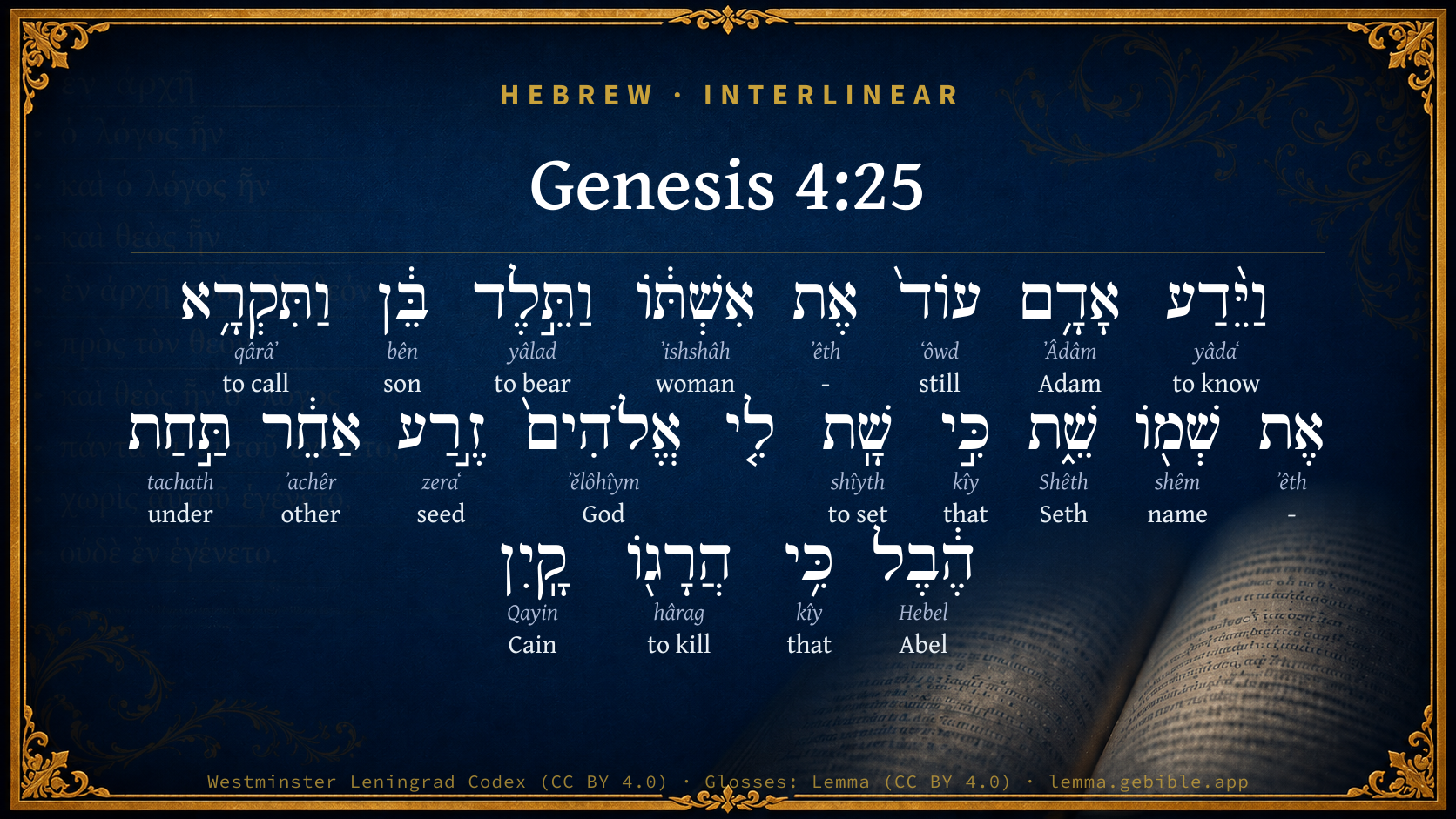
Hebrew (Westminster Leningrad Codex) Genesis 4:25 appears in the Hebrew Old Testament. The text above is from the Westminster Leningrad Codex. Each word links to its Strong’s number, a concise gloss, and parsing drawn from the Open Scriptures Hebrew Bible morphology. Click any word for its full Brown-Driver-Briggs (BDB) entry.
Download image
Cite this verse

Genesis 4:25 (World English Bible). Public Domain. Lemma interlinear Bible study tool, https://lemma.gebible.app/v/genesis/4/25.

Show BibTeX & RIS
BibTeX
RIS
English Translation
Adam knew his wife again. She gave birth to a son, and named him Seth. For, she said, "God has appointed me another child instead of Abel, for Cain killed him."
World English Bible · Public Domain
Highlights
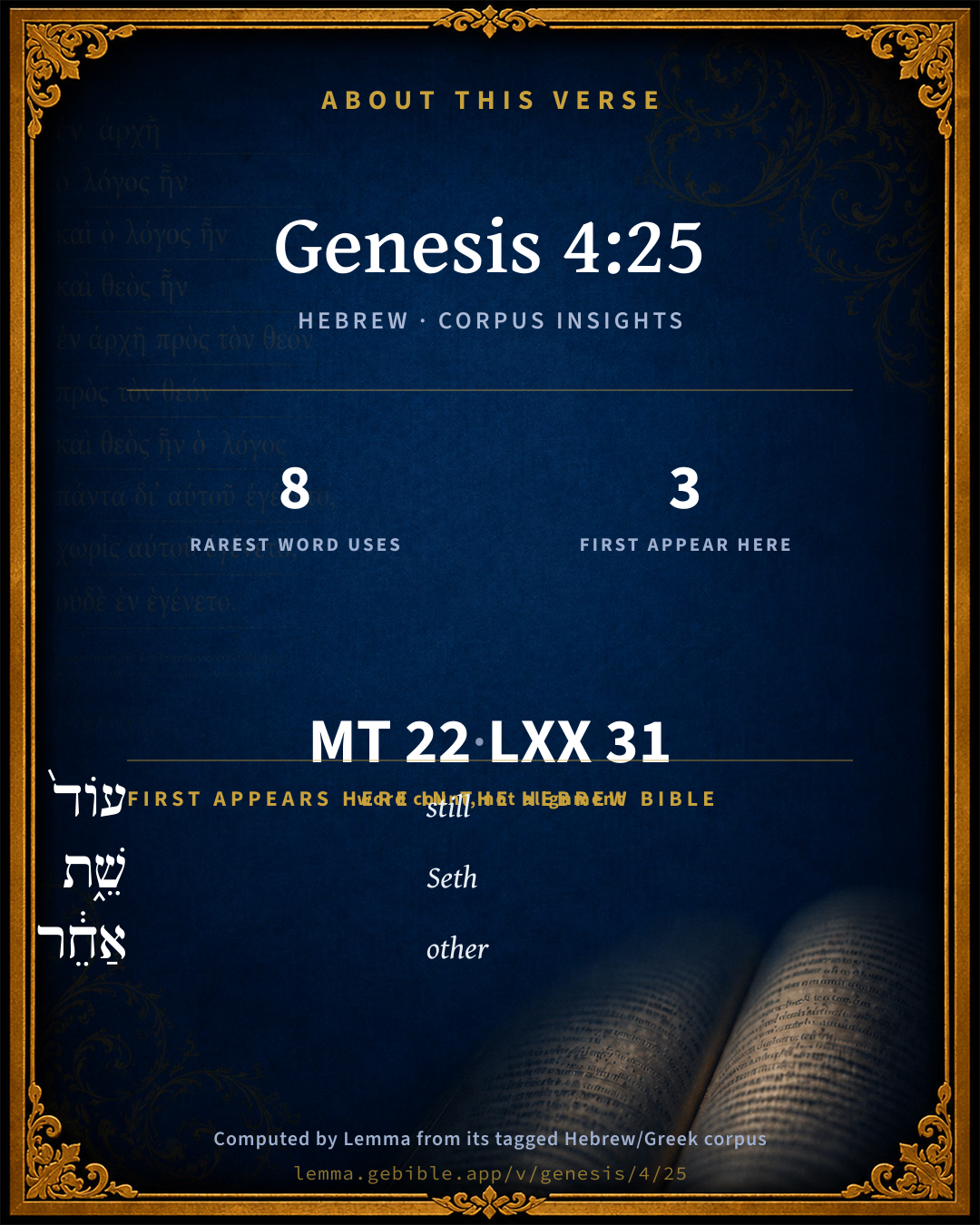
  • 3 first appearances in the Hebrew Bible
Full analysis ↓
Download a study sheet

One document with this verse’s original text, its word-by-word gloss line, the meaning frame, cross-references with their text, attributed commentary, and full source and license credits — printable, and it pastes into notes with its structure intact.

This verse Autodidact and up

Study sheet (.html) Plain text (.txt)

A passage Seminary Student

Up to 50 verses in one chapter. A passage sheet keeps up to 6 commentary sources and 12 cross-references per verse, in the order this page ranks them, and says so on the sheet whenever that leaves anything out. Ask for a single verse and you get the Autodidact verse sheet above.

Everything on this page stays free to read, with no account — the sheet is a download of what is already on screen, not access to it.

Want to remove ads? Support Godless Engineer
Compare translations 3

The same verse in 3 English versions, stacked beneath the original-language interlinear above. Click any original word for its lexicon entry.

Each is an independent rendering of the whole verse — the interlinear is not word-aligned to these translations.

Highlighted words mark where these versions differ — a whole-verse word diff, not a word-by-word alignment.

  • World English Bible Public Domain
    Adam knew his wife again. She gave birth to a son, and named him Seth. For, she said, "God has appointed me another child instead of Abel, for Cain killed him."
  • King James Version Public Domain
    And Adam knew his wife again; and she bare a son, and called his name Seth: For God, said she, hath appointed me another seed instead of Abel, whom Cain slew.
  • unfoldingWord Literal Text CC BY-SA 4.0
    Then Adam knew his wife again, and she bore a son, and she called his name Seth, because, “God has appointed for me another offspring in place of Abel, since Cain killed him.”

unfoldingWord Literal Text — © unfoldingWord, licensed CC BY-SA 4.0. Word-aligned USFM3 via Door43 (git.door43.org/unfoldingWord/en_ult).

Versions to compare (up to 4)

3 of 4 selected

Show all 18 translations

Every available English version of this verse, each an independent rendering of the whole verse.

  • World English Bible Public Domain
    Adam knew his wife again. She gave birth to a son, and named him Seth. For, she said, "God has appointed me another child instead of Abel, for Cain killed him."
  • Berean Standard Bible Public Domain
    And Adam again had relations with his wife, and she gave birth to a son and named him Seth, saying, “God has granted me another seed in place of Abel, since Cain killed him.”
  • Majority Standard Bible Public Domain
    And Adam again had relations with his wife, and she gave birth to a son and named him Seth, saying, “God has granted me another seed in place of Abel, since Cain killed him.”
  • King James Version Public Domain
    And Adam knew his wife again; and she bare a son, and called his name Seth: For God, said she, hath appointed me another seed instead of Abel, whom Cain slew.
  • American Standard Version (1901) Public Domain
    And Adam knew his wife again; and she bare a son, and called his name Seth. For, `said she', God hath appointed me another seed instead of Abel; for Cain slew him.
  • Revised Version (1885) Public Domain
    And Adam knew his wife again; and she bare a son, and called his name Seth: For, said she, God hath appointed me another seed instead of Abel; for Cain slew him.
  • Geneva Bible (1599) Public Domain
    And Adam knewe his wife againe, and she bare a sonne, and she called his name Sheth: for God, saide she, hath appointed me another seede for Habel, because Kain slewe him.
  • Douay-Rheims (1899) Public Domain
    Adam also knew his wife again: and she brought forth a son, and called his name Seth, saying: God hath given me another seed, for Abel whom Cain slew.
  • Young's Literal Translation Public Domain
    And Adam again knoweth his wife, and she beareth a son, and calleth his name Seth, `for God hath appointed for me another seed instead of Abel:' for Cain had slain him.
  • Literal Standard Version CC BY-SA 4.0
    And Adam again knows his wife, and she bears a son, and calls his name Seth, “for God has appointed for me another seed instead of Abel”: for Cain had slain him.
  • Unlocked Literal Bible CC BY-SA 4.0
    Adam slept with his wife again, and she bore another son. She called his name Seth and said, “God has given me another son in the place of Abel, for Cain killed him.”
  • unfoldingWord Literal Text CC BY-SA 4.0
    Then Adam knew his wife again, and she bore a son, and she called his name Seth, because, “God has appointed for me another offspring in place of Abel, since Cain killed him.”
  • Darby Bible Public Domain
    And Adam knew his wife again, and she bore a son, and called his name Seth:... For God has appointed me another seed instead of Abel, because Cain has slain him.
  • World Messianic Bible Public Domain
    Adam knew his wife again. She gave birth to a son, and named him Seth, saying, “for God has given me another child instead of Abel, for Cain killed him.”
  • Webster's Bible Public Domain
    And Adam knew his wife again, and she bore a son, and called his name Seth: For God, said she, hath appointed me another seed instead of Abel, whom Cain slew.
  • Free Bible Version CC BY-SA 4.0
    Adam slept with his wife again, and she had a son and named him Seth, explaining that, “God has given me another child to replace Abel, the one Cain killed.”
  • Bible in Basic English Public Domain
    And Adam had connection with his wife again, and she gave birth to a son to whom she gave the name of Seth: for she said, God has given me another seed in place of Abel, whom Cain put to death.
  • JPS Tanakh (1917) Public Domain
    And Adam knew his wife again; and she bore a son, and called his name Seth: 'for God hath appointed me another seed instead of Abel; for Cain slew him.'

Literal Standard Version (2020), Covenant Press — licensed CC BY-SA 4.0. Text via the HelloAO Bible API (eBible.org). Unlocked Literal Bible (unfoldingWord) — licensed CC BY-SA 4.0. Text via the HelloAO Bible API (eBible.org). unfoldingWord Literal Text — © unfoldingWord, licensed CC BY-SA 4.0. Word-aligned USFM3 via Door43 (git.door43.org/unfoldingWord/en_ult). Free Bible Version, Dr. Jonathan Gallagher — licensed CC BY-SA 4.0. Text via the HelloAO Bible API (eBible.org).

Word by word

More ways to search: Search by grammar → Find every occurrence → Compare this word →

Practice this passage: Drill this verse → Learn its vocabulary →

שֵׁ֑ת
Shêth
H8352
“Seth”
Noun, Proper
Part of Speech
Noun
Type
Proper
Full BDB Definition

Origin: from H7896

TWOT: None

Seth = "compensation" - the 3rd son of Adam by Eve - also 'Sheth'
  1. וַיֵּ֨דַע yâdaʻ H3045 “and · to know” Conjunction + Verb, Qal, Sequential Imperfect, 3rd Person, Masculine, Singular
  2. אָדָ֥ם ʼÂdâm H121 “Adam” Noun, Proper
  3. עוֹד֙ ʻôwd H5750 “still” Adverb
  4. אֶת ʼêth H853 “-” Particle, Direct Object
  5. אִשְׁתּ֔וֹ ʼishshâh H802 “woman · his” Noun, Common, Feminine, Singular, Construct + Suffix, Personal, 3rd Person, Masculine, Singular
  6. וַתֵּ֣לֶד yâlad H3205 “and · to bear” Conjunction + Verb, Qal, Sequential Imperfect, 3rd Person, Feminine, Singular
  7. בֵּ֔ן bên H1121 “son” Noun, Common, Masculine, Singular, Absolute
  8. וַתִּקְרָ֥א qârâʼ H7121 “and · to call” Conjunction + Verb, Qal, Sequential Imperfect, 3rd Person, Feminine, Singular
  9. אֶת ʼêth H853 “-” Particle, Direct Object
  10. שְׁמ֖וֹ shêm H8034 “name · his” Noun, Common, Masculine, Singular, Construct + Suffix, Personal, 3rd Person, Masculine, Singular
  11. כִּ֣י kîy H3588 “that” Conjunction
  12. שָֽׁת shîyth H7896 “to set” Verb, Qal, Perfect, 3rd Person, Masculine, Singular
  13. אֱלֹהִים֙ ʼĕlôhîym H430 “God(s)” Noun, Common, Masculine, Plural, Absolute
  14. זֶ֣רַע zeraʻ H2233 “seed” Noun, Common, Masculine, Singular, Absolute
  15. אַחֵ֔ר ʼachêr H312 “other” Adjective, Adjective, Masculine, Singular, Absolute
  16. תַּ֣חַת tachath H8478 “under” Preposition
  17. הֶ֔בֶל Hebel H1893 “Abel” Noun, Proper
  18. כִּ֥י kîy H3588 “that” Conjunction
  19. הֲרָג֖וֹ hârag H2026 “to kill · him” Verb, Qal, Perfect, 3rd Person, Masculine, Singular + Suffix, Personal, 3rd Person, Masculine, Singular
  20. קָֽיִן Qayin H7014 “Cain” Noun, Proper

About this verse

These counts appear in no published source. They are computed here, from the morphology-tagged text and Lemma’s own curated glosses. What Lemma adds →

22
words
19
distinct lemmas
Pentateuch
section

Notable vocabulary

The rarest word here is שֵׁ֑ת Seth H8352 — appearing just 8 times in the whole Hebrew Bible.

First appearance in Scripture

These words make their first canonical appearance in the Hebrew Bible here:

Shared distinctive vocabulary

שֵׁ֑ת Seth H8352 occurs in 8 verses of the Hebrew Bible. Also found in:

Grammatical profile

  • 5 verbs
  • 9 nouns
  • 1 adjective
  • 2 prepositions
  • 2 conjunctions
  • 1 adverb
  • 2 particles

Verb forms

  • וַיֵּ֨דַע Qal · Sequential Imperfect
  • וַתֵּ֣לֶד Qal · Sequential Imperfect
  • וַתִּקְרָ֥א Qal · Sequential Imperfect
  • שָֽׁת Qal · Perfect
  • הֲרָג֖וֹ Qal · Perfect

Repetition

A word recurs within this verse — often emphatic in Hebrew:

  • כִּ֣י that H3588 ×2

Hebrew & Septuagint length

In English translation the verse runs 31 words from the Hebrew and 34 from the Septuagint (LXX English) — closely comparable.

A rough comparison of the two English renderings, which tokenize alike — not a word-level alignment.

Word counts can differ between the Hebrew and the Greek without any difference in meaning — e.g. the Hebrew direct-object marker אֵת has no separate Greek word, and Greek often adds the article ὁ.

In the original languages it is 22 Hebrew tokens and 31 Greek tokens — but the two are counted differently (Hebrew bundles its prefixes and suffixes into one token; the Greek is in lemma form), so that isn’t a like-for-like length.

Cross-references

6

Topical passages linked to Genesis 4:25 in the Treasury of Scripture Knowledge — connected by theme and wording, ordered by reader-vote popularity; previews shown in the World English Bible.

  • Genesis 4:8 Cain said to Abel, his brother, "Let's go into the field." It happened, when they were in the field, that Cain rose up against Abel, his brother, and killed him.
  • Luke 3:38 the son of Enos, the son of Seth, the son of Adam, the son of God.
  • Genesis 4:1–3 The man knew Eve his wife. She conceived, and gave birth to Cain, and said, "I have gotten a man with Yahweh's help."
  • Genesis 4:10–11 Yahweh said, "What have you done? The voice of your brother's blood cries to me from the ground.
  • Genesis 5:3–4 Adam lived one hundred thirty years, and became the father of a son in his own likeness, after his image, and named him Seth.
  • 1 Chronicles 1:1 Adam, Seth, Enosh,

Cross-references courtesy of OpenBible.info (CC BY 4.0).

Hebrew and Greek witnesses Masoretic Hebrew ↔ Greek Septuagint

The same verse in the two great witnesses to the Old Testament, shown verse-for-verse.

These are two independent witnesses, not word-aligned to each other, and the Septuagint is shown in lemma (dictionary) form.

Hebrew Genesis 4:25 Masoretic · Westminster Leningrad Codex

וַיֵּ֨דַע אָדָ֥ם עוֹד֙ אֶת אִשְׁתּ֔וֹ וַתֵּ֣לֶד בֵּ֔ן וַתִּקְרָ֥א אֶת שְׁמ֖וֹ שֵׁ֑ת כִּ֣י שָֽׁת לִ֤י אֱלֹהִים֙ זֶ֣רַע אַחֵ֔ר תַּ֣חַת הֶ֔בֶל כִּ֥י הֲרָג֖וֹ קָֽיִן

Adam knew his wife again. She gave birth to a son, and named him Seth. For, she said, "God has appointed me another child instead of Abel, for Cain killed him."

World English Bible · Public Domain

Greek LXX Genesis 4:25 Septuagint · lemma form

γιγνώσκω δέ αδαμ ευα ὁ γυνή αὐτός καί συνλαμβάνω τίκτω υἱός καί ἐπιὀνομάζω ὁ ὄνομα αὐτός σηθ λέγω ἐκ ἀναἵστημι γάρ ἐγώ ὁ θεός σπέρμα ἕτερος ἀντί αβελ ὅς ἀποκτείνω καιν

And Adam knew Eve his wife, and she conceived and bore a son, and called his name Seth, saying, For God has raised up to me another seed instead of Abel, whom Cain killed.

LXX2012 (modern English Septuagint) · Public Domain

On this verse, The Pulpit Commentary discusses the Septuagint’s reading. Read the note in Commentary ↓

Hebrew: Westminster Leningrad Codex (CC BY 4.0). Greek: Septuagint (public domain); English from LXX2012 (modern English Septuagint) (Public Domain). How the Septuagint differs from the Hebrew →

Targum (Aramaic paraphrase)

2

The Targum is the ancient Jewish Aramaic paraphrase of the Hebrew Scriptures — an interpretive translation, not the Hebrew text itself. Onkelos (literal) and Pseudo-Jonathan (expansive) render the Torah, and Jonathan the Prophets. Coverage is partial: where no permissively-licensed English translation exists for a verse, only the Aramaic is shown. This is verse-level text, not a word-by-word alignment to the Hebrew.

  1. Targum Onkelos Torah (Genesis–Deuteronomy)
    וִידַע אָדָם עוֹד יָת אִתְּתֵהּ וִילֵידַת בַּר וּקְרַת יָת שְׁמֵהּ שֵׁת אֲרֵי אַמָרַת יְהַב לִי יְיָ בַּר אוֹחֲרָן חֲלַף הֶבֶל דִּקַטְלֵהּ קָיִן

    (no public-domain English translation for this verse)

    Targum Onkelos — Aramaic: “Onkelos Genesis” (public domain); “Onkelos Exodus” (public domain); “Onkelos Leviticus” (public domain); “Onkelos Numbers” (public domain); “Onkelos Deuteronomy” (public domain). English: “Sefaria Community Translation” (CC0 1.0 (public-domain dedication)); “J.W. Etheridge. The Targums of Onkelos and Jonathan Ben Uzziel on the Pentateuch. London: Longmans, Green, 1862” (public domain). Text via Sefaria.

  2. Targum Pseudo-Jonathan Torah (Genesis–Deuteronomy)
    וִידַע אָדָם תּוּב יַת אִנְתְּתֵיהּ לְסוֹף מְאָה וּתְלָתִין שְׁנִין דְאִתְקְטֵיל הֶבֶל וִילֵידַת בַּר וּקְרַת יַת שְׁמֵיהּ שֵׁת אֲרוּם אֲמַרַת יְהַב לִי יְיָ בַּר אוֹחֲרָן חֲלַף הֶבֶל דְקַטְלֵיהּ קַיִן

    And Adam knew his wife again, at the end of a hundred and thirty years after Habel had been slain; and she bare a son, and called his name Sheth; for she said, The Lord hath given me another son instead of Habel whom Kain slew.

    Targum Pseudo-Jonathan — Aramaic: “Targum Jonathan on Genesis” (public domain); “Targum Jonathan on Exodus” (public domain); “Targum Jonathan on Leviticus” (public domain); “Targum Jonathan on Numbers” (public domain); “Targum Jonathan on Deuteronomy” (public domain). English: “The Targum of Jonathan ben Uzziel, trans. J. W. Etheridge, London, 1862” (public domain). Text via Sefaria.

Commentary

Notes on Genesis 4:25 from classic Christian and Jewish commentators (each source and its license shown beneath its notes). The classic Christian expositions comment on the surrounding passage and are grouped to its opening verse, so a note may address several verses; the Jewish commentaries on the Tanakh (Rashi and others) are per-verse, so they appear only where the commentator wrote on this verse.

Lemma curates 59 commentaries, every one of them public domain or Creative Commons licensed, each selected and text-cleaned for this edition rather than reprinted as found. About our sources →

Matthew Henry's Commentary

This is the first mention of Adam in the story of this chapter. No question, the murder of Abel, and the impenitence and apostasy of Cain, were a very great grief to him and Eve, and the more because their own wickedness did now correct them and their backslidings did reprove them. Their folly had given sin and death entrance into the world; and now they smarted by it, being, by means thereof, deprived of both their sons in one day, Gen 27:45. When parents are grieved by their children's wickedness they should take occasion thence to lament that corruption of nature which was derived from them, and which is the root of bitterness. But here we have that which was a relief to our first parents in their affliction.

I. God gave them to see the re-building of their family, which was sorely shaken and weakened by that sad event. For, 1. They saw their seed, another seed instead of Abel, Gen 4:25. Observe God's kindness and tenderness towards his people, in his providential dealings with them; when he takes away one comfort from them, he gives them another instead of it, which may prove a greater blessing to them than that was in which they thought their lives were bound up. This other seed was he in whom the church was to be built up and perpetuated, and he comes instead of Abel, for the succession of confessors is the revival of the martyrs and as it were the resurrection of God's slain witnesses. Thus we are baptized for the dead (Co1 15:29), that is, we are, by baptism, admitted into the church, for or instead of those who by death, especially by martyrdom, are removed out of it; and we fill up their room. Those who slay God's servants hope by this means to wear out the saints of the Most High; but they will be deceived. Christ shall still see his seed; God can out of stones raise up children for him, and make the blood of the martyrs the seed of the church, whose lands, we are sure, shall never be lost for want of heirs. This son, by a prophetic spirit, they called Seth (that is, set, settled, or placed), because, in his seed, mankind should continue to the end of time, and from him the Messiah should descend. While Cain, the head of the apostasy, is made a wanderer, Seth, from whom the true church was to come, is one fixed. In Christ and his church is the only true settlement. 2. They saw their seed's seed, Gen 4:26. To Seth was born a son called Enos, that general name for all men, which bespeaks the weakness, frailty, and misery, of man's state. The best men are most sensible of these, both in themselves and their children. We are never so settled but we must remind ourselves that we are frail.

II. God gave them to see the reviving of religion in their family: Then began men to call upon the name of the Lord, Gen 4:26. It is small comfort to a good man to see his children's children, if he do not, withal, see peace upon Israel, and those that come of him walking in the truth. Doubtless God's name was called upon before, but now, 1. The worshippers of God began to stir up themselves to do more in religion than they had done; perhaps not more than had been done at first, but more than had been done of late, since the defection of Cain. Now men began to worship God, not only in their closets and families, but in public and solemn assemblies. Or now there was so great a reformation in religion that it was, as it were, a new beginning of it. Then may refer, not to the birth of Enos, but to the whole foregoing story: then, when men saw in Cain and Lamech the sad effects of sin by the workings of natural conscience, - when they saw God's judgments upon sin and sinners, - then they were so much the more lively and resolute in religion. The worse others are the better we should be, and the more zealous. 2. The worshippers of God began to distinguish themselves. The margin reads it, Then began men to be called by the name of the Lord, or to call themselves by it. Now that Cain and those that had deserted religion had built a city, and begun to declare for impiety and irreligion, and called themselves the sons of men, those that adhered to God began to declare for him and his worship, and called themselves the sons of God. Now began the distinction between professors and profane, which has been kept up ever since, and will be while the world stands.

Matthew Henry's Commentary on the Whole Bible (1708–1710) — public domain (CC PDM 1.0). Text via the HelloAO Bible API.

Trapp's Complete Commentary

John Trapp

Gen 4:25 And Adam knew his wife again; and she bare a son, and called his name Seth: For God, [said she], hath appointed me another seed instead of Abel, whom Cain slew.

Ver. 25. She bare a son, and called, &c.] Sic uno avulso, non deficit alter Aureus .{ a} Dead bones may revive, and out of the ashes of a phoenix another phoenix spring. Iana iacet phoenix nato phoenice ,& c. The two witnesses that were killed, received the Spirit of life from God again. {Rev 11:11} John Baptist reviveth in our Saviour ( qui huic succenturiatus est), and Stephen in Paul; John Huss in Luther (the goose in the swan); and the suppressed Waldenses in the Protestants. The Papists gave out that when Luther died, all his sect would die with him: and when Queen Elizabeth’s head was laid, we should have strange work in England. A false Jesuit in a scandalous libel published it, {b} that she wished that she might, after her death, hang a while in the air, to see what striving would be for her kingdom. But she both lived and died with glory; her rightful successor came in peaceably, not a dog moving his tongue at him; the true reformed religion was established, and is hitherto maintained among us, evil the malice of Rome and hell. It was the legacy left us by our ancestors: the blood of those blessed martyrs was the seed of our Church, of which I may say, as he of his city,

“ Victa tamen vinces, eversaque Troia resurges:

Obruit hostiles illa ruina domos. ”

When the devil and his imps had got Abel into his grave, and saw Adam without another in his place for a hundred and thirty years’ space, or near upon, what a deal of joy was there, think we, among them, and sending of gifts! But God in due time sets up a Seth, instead of Abel, and so cuts the devil’s comb, confutes his confidence. He will have a Church, when all’s done. The Pope {c} could tell the Turk so much in a message,

“ Niteris incassum Christi submergere navem:

Fluctuat, at nunquam mergitur illa ratis. ”

{a} Virgil. The Duke of Florence gave for his ensign a great tree with many spreading boughs, one of them being cut off, with this posie, Uno avulso ,& c.

{b} Camdon’s Elis.

{c} Plus II. ad Imperat. Turc.

John Trapp, A Commentary or Exposition upon All the Books of the Old and New Testament (1647–1656) — public domain. Text from a community e-Sword module.

Albert Barnes' Notes on the Bible

- XX. Sheth

25. שׁת shēt, Sheth, “placed, put.”

26. אנישׁ 'enôsh, Enosh, “man, sickly.” בשׁם קרא qero' beshēm means, first, to call an object by its name Isa 40:26; Isa 43:1; Isa 45:3-4; second, to call an object by the name of another, who is the parent, leader, husband, owner Num 32:42; Jdg 18:29; Psa 49:12; Isa 43:7; Isa 44:5; Isa 48:1; Isa 65:1; third, to proclaim the name of Exo 33:19; Exo 35:5-6; fourth, to call upon the name of God, to address him by his proper name with an audible voice in the form of prayer. This is the most common meaning of the phrase. In this sense it is followed by Yahweh as the proper name of the true God among the Hebrews. It is not to be forgotten that names were still significant, at this early period.

This passage completes the account of Adam’s family. Henceforth, we generally meet with two parallel lines of narrative, as the human family is divided into two great branches, with opposing interests and tendencies. The main line refers to the remnant of the race that are on terms of open reconciliation with God; while a collateral line notes as far as necessary the state of those who have departed from the knowledge and love of the true God.

Gen 4:25

The narrative here reverts to a point subsequent to the death of Habel, when another son is born to Adam, whom his mother Eve regards as a substitute for Habel, and names Sheth in allusion to that circumstance. She is in a sadder, humbler frame than when she named her first-born, and therefore does not employ the personal name of the Lord. Yet her heart is not so much downcast as when she called her second son a breath. Her faith in God is sedate and pensive, and hence she uses the more distant and general term אלהים 'ĕlohı̂ym, God.

Yet there is a special significance in the form of expression she employs. “For God” hath given me another seed instead of Habel. He is to be instead of Habel, and God-fearing like Habel. Far above this consideration, God hath given him. This son is from God. She regards him as God’s son. She receives this gift from God, and in faith expects him to be the seed of God, the parent of a godly race. Her faith was not disappointed. His descendants earn the name of the sons of God. As the ungodly are called the seed of the serpent, because they are of his spirit, so the godly are designated the seed of God, because they are of God’s Spirit. The Spirit of God strives and rules in them, and so they are, in the graphic language of Scripture, the sons of God Gen 6:1.

Gen 4:26

A son is born to Sheth also, whom he calls Enosh. In this name there is probably an allusion to the meaning of sickliness and dependence which belongs to the root. These qualities were now found to be characteristic of man in his present state.

The closing sentence signalizes a remarkable event, which took place at the birth of Enosh, about two hundred and forty years after the creation of Adam. “Then was it begun to call upon the name of the Lord.” The solemn invocation of God by his proper name in audible and social prayer and praise is the most usual meaning of the phrase now before us, and is to be adopted unless there be something in the context or the circumstances demanding another meaning. This involves also the first of the meanings given above, as we call God by his name in oral worship. It includes the third in one of its forms, as in praise we proclaim the name of our God. And it leads to the second, as those who call on the name of the Lord are themselves called the children of God.

Some change is here intimated in the mode of approaching God in worship. The gist of the sentence, however, does not lie in the name “Yahweh”. For this term was not then new in itself, as it was used by Eve at the birth of Cain; nor was it new in this connection, as the phrase now appears for the first time, and Yahweh is the ordinary term employed in it ever afterward to denote the true God. As a proper name, Yahweh is the fit and customary word to enter into a solemn invocation. It is, as we have seen, highly significant. It speaks of the Self-existent One, the Author of all existing things, and in particular of man; the Self-manifest, who has shown himself merciful and gracious to the returning penitent, and with him keeps promise and covenant. Hence, it is the custom itself of calling on the name of Yahweh, of addressing God by his proper name, which is here said to have been commenced.

At first sight, with our habits and associations, it seems a very strange thing that calling upon the name of the Lord should only begin two hundred and forty years after the creation of man. But let us endeavor to divest ourselves of these limitations, and rise to the primeval simplicity of man’s thoughts in regard to God. We read of God speaking to man in paradise, but not of man speaking to God. In the examination that preceded the sentence passed upon the transgressors, we hear Adam and Eve replying to the questions of God, but not venturing to open a conversation with the Most High. If the feeling of reverence and solemn awe did not permit such a liberty before the fall, much more would the super-added sense of guilt after that event restrain man from making any advances toward the infinitely holy Being whom he had so wantonly offended. The rebuking examination, the judicial sentence, and the necessary execution of this sentence in its preliminary form, were so prominent and impressive as to throw into the background any intimations of the divine mercy with which they were accompanied. The latter, however, were not unnoticed, or without a salutary effect on the primeval pair. Adam believed the indications of mercy, whether in word or deed, which God gave him. Faith was prompt and natural in that early stage of comparative nearness to God, to his manifest presence and his conspicuous wonders of creative power. It was also a native tendency of the human breast, and would be so still, had we not become so sophisticated by education that doubt has come to be the prominent attitude of our minds. This faith of the first pair led to confession; not directly, however, to God, but indirectly in the names Adam gave his wife, and Eve her first-born son. Here humble, distant, self-condemning faith solilloquizes, or, at most, the penitent pair converse in humble hope about the mercy of the Most High.

The bringing of an offering to God was a step in advance of this penitent, humble, submissive, self-accusing faith. It was the exact counterpart and representation by a well-devised symbol of the nature of the offerer’s faith. It was therefore a confession of faith and certain accompanying feelings toward God by a symbolic act. It was quite natural that this mute sign should precede the actual address. The consequences, however, of the approach of Cain and Habel were calculated to deepen again the feeling of dread, and to strike the onlooker mute in the presence of the High and Holy One. Still would this be so in that infantile state of man when one thought would take full possession of the soul, until another was plainly and directly brought before the attention. In this simple, unsophisticated state of the penitent, we can conceive him to resign himself passively to the merciful will of that Maker whom he has grievously offended, without venturing to breathe a wish or even to lift up a note of thanksgiving. Such mute acquiescence in the divine will for two hundred and forty years was well-befitting the humble penitents of that infantile age, standing in solemn awe under a sense of their own demerit and of the infinite holiness of the Majesty on high. There were even an eloquent pathos and power in that tacit reverence suited to move the heart of the All-searching Spirit more than ten thousand voices less deeply penetrated with a sense of the guilt of sin and the beauty of holiness.

At length, however, Sheth was given to Eve, and accepted by her as a substitute for Habel. Enosh, the child of sorrow, was born to him. Collateral with this line of descent, and all the anxieties and desires which it involved, was the growth of a class of men who were of the spirit of Cain, and receded further and further from God. In these circumstances of growing iniquity on the one hand, and growing faith on the other, believing reason comes to conceive the full import of the mercy of God, freely and fully accepts of pardon, and realizes the peace and privilege which it bestows. Growing man now comprehends all that is implied in the proper name of God, יהוה yehovâh, “Jehovah,” the Author of being, of promise, and of performance. He finds a tongue, and ventures to express the desires and feelings that have been long pent up in his breast, and are now bursting for utterance. These petitions and confessions are now made in an audible voice, and with a holy urgency and courage rising above the depressing sense of self-abasement to the confidence of peace and gratitude. These adorations are also presented in a social capacity, and thereby acquire a public notoriety. The father, the older of the house, is the master of words, and he becomes the spokesman of the brotherhood in this new relationship into which they have spontaneously entered with their Father in heaven. The spirit of adoption has prompted the confiding and endearing terms, “Abba, Father,” and now the winged words ascend to heaven, conveying the adorations and aspirations of the assembled saints. The new form of worship attracts the attention of the early world, and the record is made, “Then began they to call upon the name of the Lord,” that keepeth covenant and mercy.

Here we perceive that the holy race has passed beyond its infancy. It has learned to speak with God in the language of faith, of conscious acceptance, of freedom, of hope, of love. This is a far nobler attainment than the invention of all the arts of life. It is the return from that revulsive dread with which the conscious sinner shrank back from the felt holiness of God. It is the drawing of the divine mercy and love let into the penitent soul, by which it has come to itself, and taken courage to return to the merciful Yahweh, and speak to him the language of penitence, of confession, of gratitude. These believing penitents, chiefly it is to be supposed in the line of Sheth, of which this paragraph speaks, began to be distinguished as the followers of the Lord; whereas others at the same time had forgotten the Lord, and renounced even the form of reverence for him. The seed of the woman was now distinguished from the seed of the serpent. The latter are in a spiritual sense called “the seed of the serpent,” because they cling to the principles of the tempter; and the former may in the same sense be designated “the seed or sons of God,” because they follow after him as the God of mercy and truth. Thus, the lamentable fact obtrudes itself upon our view that a portion of the human family have persisted in the primeval apostasy, and are no longer associated with their fellows in acknowledging their common Maker.

The progress of moral evil in the antediluvian world was manifested in fratricide, in going out from the presence of the Lord, in personal violence, and in polygamy. The first is the normal character of all murder; the second gave scope for the third, the daring and presumptuous violence of the strong; and the fourth ultimately led to an almost total corruption of manners. It is curious to observe that ungodliness, in the form of disobedience and departure from God and therefore of the practical breach of the first commandment, and unrighteousness in the form of murder, the crime of masterful passion and violence, which is the transgression of the first commandment concerning our neighbor, are the starting-points of sin in the world. They do not seem to have yet reached idolatry and adultery. This appears to point out that the prohibitions into which the law is developed in the Ten Commandments are arranged in the order of time as well as of nature.

The preceding chapters, if written in substance by Adam, formed the primeval Bible of mankind. But, whether written at that time or not, they contain the leading facts which occurred in the early history of man in relation to his Maker. These facts were well known to the antediluvian world, and formed the rule by which it was to be guided in approaching to God, presenting to him an acceptable offering, calling upon his name, and so walking with him in peace and love. Here we have all the needful germs of a gospel for the infantile race. If we ask why they were not effectual, the answer is at hand. They were effectual with a few, and are thereby proved sufficient to recover man from sin, and vindicate the mercy of God. But the All-wise Being, who made man a moral agent, must thoroughly guard his freedom, even in the dealings of mercy. And in the folly and madness of their self-will, some will revolt more and more. The history was written for our learning. Let its lessons be pondered. Let the accumulated experience of bygone wanderings recorded in the Book of God be our warning, to return at length with our whole heart to our merciful Father.

Albert Barnes' Notes on the Bible (1834–1885) — public domain. Text from a community e-Sword/MySword module.

The Biblical Illustrator

Joseph S. Exell

Gen_4:25

Another seed, instead of Abel

Seth

To Eve is born a third son; and he comes to them as the gift of love and the pledge of hope.

Eve names him Seth, which means set or placed or appointed, as being expressly given to her in room of Abel, whom Cain slew. In this her faith shows itself again; for in the ease of her three sons it is she herself who gives the names, and in them displays her faith. In Cain, it was simple and triumphant faith, that had not yet entered into conflict, nor known what trials and crosses are. In Abels, it was the utterance of hope deferred making the heart sick, and realizing strangership on earth and vanity in creation. And now, in Seth, it is faith reassured and comforted, brought to rest in God, as able to fulfil to the uttermost all that He had promised.

1. She recognizes God in this. It is not the mere law of nature; it is the Lord. It is in the fulfilment of His sovereign purpose that He is doing this.

2. She gives a name expressive of her faith. She calls her infant the appointed one, the substituted one. She saw God making up her lose, filling up the void, providing a seed, through which the promised Deliverer was to come.

3. She fondly calls to mind her martyred son. The way in which she does this, shows the yearning of her heart over him who was taken away, as if his place was one which needed to be supplied, as if there were a blank in her bosom which God only knew how to supply. (H. Bonar, D. D.)

The Biblical Illustrator, edited by Joseph S. Exell (c. 1880s–1900s) — public domain. Text from a community e-Sword module.

Joseph Benson's Commentary

Gen 4:25. In this verse we find the first mention of Adam in the story of this chapter. No question, the murder of Abel, and the impenitency and apostacy of Cain, were a very great grief to him and Eve and the more because their own wickedness did now correct them, and their backsliding did reprove them. Their folly had given sin and death entrance into the world; and now they smarted by it, being, by means thereof, deprived of both their sons in one day, Gen 27:45. When parents are grieved by their children’s wickedness, they should take occasion from thence to lament that corruption of nature which was derived from themselves, and which is the root of bitterness. But here we have that which was a relief to our first parents in their affliction; namely, God gave them to see the rebuilding of their family, which was sorely shaken and weakened by that sad event. For they saw their seed, another instead of Abel. And Adam called his name Seth — That is, set, settled, or placed, because in his seed mankind should continue to the end of time.

Joseph Benson's Commentary on the Old and New Testaments (1811–1818) — public domain. Text from a community e-Sword module.

Tyndale Open Study Notes

Tyndale Open Resources

4:25–5:32 The story returns to Adam and follows the line of Seth, whose lineage led to Abraham and the Israelite nation.

4:25 another son in place of Abel: Cain (4:8-16) and Lamech (4:19-24) illustrate sin’s consequences; the birth of Seth brought renewed hope. See also study note on 5:1-2.

Tyndale Open Study Notes — © Tyndale Open Resources, licensed CC BY-SA 4.0. Text via the HelloAO Bible API.

Adam Clarke's Commentary

Verse 25. God-hath appointed me another seed instead of Abel] Eve must have received on this occasion some Divine communication, else how could she have known that this son was appointed in the place of Abel, to continue that holy line by which the Messiah was to come? From this we see that the line of the Messiah was determined from the beginning, and that it was not first fixed in the days of Abraham; for the promise was then only renewed, and that branch of his family designated by which the sacred line was to be continued. And it is worthy of remark, that Seth's posterity alone continued after the flood, when all the other families of the earth were destroyed, Noah being the tenth descendant from Adam through Seth.

Though all these persons are mentioned in the following chapter, I shall produce them here in the order of their succession:

1. Adam;

2. Seth;

3. Enos;

4. Cainan;

5. Mahalaleel;

6. Jared;

7. Enoch;

8. Methuselah;

9. Lamech, (the second;)

10. Noah.

In order to keep this line distinct, we find particular care was taken that, where there were two or more sons in a family, the one through whom God particularly designed to bring his Son into the world was, by some especial providence, pointed out. Thus in the family of Adam, Seth was chosen; in the family of Noah, Shem; in the family of Abraham, Isaac; and in that of David, Solomon and Nathan. All these things God watched over by an especial providence from the beginning, that when Jesus Christ should come it might be clearly seen that he came by the promise, through grace, and not by nature.

Adam Clarke's Commentary on the Bible (1810–1826) — public domain. Text from a community e-Sword/MySword module.

John Calvin's Commentaries

25. Adam knew his wife again. Some hence infer that our first parents were entirely deprived of their offspring when one of their sons had been slain, and the other was cast far away into banishment. But it is utterly incredible that, when the benediction of God in the propagation of mankind was in its greatest force, Adam and Eve should have been through so many years unfruitful. But rather before Abel was slain, the continual succession of progeny had already rendered the house of Adam populous; for in him and his wife especially the effect of that declaration ought to be conspicuous, “Increase and multiply, and replenish the earth.” What, therefore, does Moses mean? Truly, that our first parents, horror-struck at the impious slaughter, abstained for a while from the conjugal bed. Nor could it certainly be otherwise, than that they, in reaping this exceedingly sad and bitter fruit of their apostasy from God, should sink down almost lifeless. The reason why he now passes by others is that he designed to trace the generation of pious descendants through the line of Seth. In the following chapter, however, where he will say, that “Adam begat sons and daughters,” he undoubtedly includes a great number who had been born before Seth; to whom, however, but little regard is paid since they were separated from that family which worshipped God in purity, and which might truly be deemed the Church of God.

God, saith she , has appointed me another seed instead of Abel. Eve means some peculiar seed; for we have said that others had been born who had also grown up before the death of Abel; but, since the human race is prone to evil, nearly her whole family had, in various ways, corrupted itself; therefore, she entertained slight hope of the remaining multitude, until God should raise up to her a new seed, of which she might expect better things. Wherefore, she regarded herself as bereaved not of one son only, but of her whole offspring, in the person of Abel.

John Calvin's Commentaries (1540-1563) — public domain. Text from the Calvin Translation Society English edition (1840s-50s) via the Christian Classics Ethereal Library (ccel.org). Calvin's coverage is partial (roughly two-thirds of the Bible); uncommented books and verses are honest gaps, never fabricated. The 19th-century editor's footnotes and remarks are omitted so the notes are faithfully Calvin's own voice.

Ellicott's Commentary for English Readers

SUBSTITUTION OF SETH FOR ABEL.

(25) Another seed instead of Abel, whom Cain slew.—Cain, the firstborn, and Abel, who had outstripped him in prosperity, were both lost to Adam. But instead of the third son succeeding to the place of the firstborn, it is given to one specially marked out, probably by prophecy, just as Solomon took the rights of primogeniture over the head of Adonijah.

Seth.—Heb., Sheth, that is, appointed, substituted: he was thus specially designated as the son who was to be the chief over Àdam’s family.

A Bible Commentary for English Readers, edited by Charles John Ellicott (1878–1897) — public domain. Text from a community e-Sword module.

The Cambridge Bible for Schools and Colleges

gen. ed. J. J. S. Perowne

25. called his name] Here, as in Gen_4:1 (see note), the mother gives the name.

God] Elohim (not Jehovah, as in Gen_4:1), probably because of Gen_4:26.

hath appointed] Heb. shath. As was pointed out in the note on Gen_4:1, the resemblance to a Hebrew word in the sound of a proper name does not supply its strict etymology. The name “Seth” (shêth) = “setting” or “slip,” resembles in sound the Hebrew verb for “appointed” or “set” (shâth), and it is to this assonance that Eve’s words refer.

It is an instance of a play on a word, viz. paronomasia, of which there are many cases in the O.T. But assonance is a delusive element in etymology.

another seed] We are not to infer that no other children were born to Eve, but that Seth was “appointed” to take the place of Abel, and his seed to form a righteous counterpart to the unholy seed of Cain. In Sir_49:16 Seth is united with Shem as “glorified among men.”

25, 26. The Line of Seth

These two verses begin the line of Seth which is parallel to that of Cain. The more complete genealogy, found in ch. 5, comes from a different source (P). But it is not unlikely that they are derived from the same materials as the previous section.

The Cambridge Bible for Schools and Colleges (gen. ed. J. J. S. Perowne; Cambridge University Press, 1878–1918) — public domain. Text from a community e-Sword module.

Matthew Poole's English Annotations

She gave the name, but not without Adam's consent, Gen 5:3. She spoke by Divine inspiration.

Note that the word

seed is used of one single person here, and Gen 21:13; 38:8; which confirms the apostle's argument, Gal 3:16.

Instead of Abel; to succeed his father Adam, as Abel should have done in the priesthood, and administration and care of holy things in the church of God.

Matthew Poole's English Annotations on the Holy Bible (1683–1685) — public domain. Text from a community e-Sword/MySword module.

Whedon's Commentary on the Bible

Daniel D. Whedon

SETH AND ENOS, 25, 26.

Having traced the development of the race of Cain, the sacred writer now turns to record the origin of that godly line whose genealogy appears at greater extent in the following chapter.

25. Seth — The name means placed, or appointed, as Eve explains in the words: For God… hath appointed me another seed, etc. The mother of this divinely chosen seed speaks by a divine inspiration.

26. Enos — Or Enosh. This name, according to most critics, means weakness, frailty, and according to Keil, “designates man from his frail and mortal condition. Psa_8:4; Psa_90:3. In this name, therefore, the feeling and knowledge of human weakness and frailty were expressed — the opposite of the pride and arrogance displayed by the Cainite family.”

Then began men to call — Literally, Then it was begun to call in the name of Jehovah. That is, with the line of Seth began a more open and established mode of worship by calling directly upon God in prayer, and using the hallowed name Jehovah. Thus the Sethites came in time to be known as “the sons of God.” Gen_6:2. These devout worshippers had probably now come to believe that the promised Deliverer, whom Eve had hoped to see in her firstborn, was to be God himself, and to him they now transfer the name Jehovah. “With a new divine race, and a new believing generation, there ever presents itself the name Jehovah, and even with a higher glory. Now it is for the first time after Eve’s first theocratic jubilee-cry of hope.” — Lange.

Daniel D. Whedon (gen. ed.), Commentary on the Old and New Testaments (1874–1909) — public domain. Text from a community e-Sword module.

The Pulpit Commentary

Vers. 25, 26. The narrative now reverts to the fortunes of the doubly saddened pair. And Adam knew his wife again. Having mournfully abstained for a season a thro conjugali (Calvin); not necessarily implying that Adam and Eve had not other children who had grown to man"s estate prior to the death of Abel (cf. Gen_5:4) And she bare a son, and called his name Seth. Sheth, from shith, to put or place; hence appointed, put, compensation. For God, said she, hath appointed me another seed semen singulars (Calvin); filium, Eve having borne daughters previously (Onkelos, Jonathon, Dathe, Rosenm instead of Abel. Her other children probably had gone in the way of Cain, leaving none to carry on the holy line, till this son was born, whom in faith she expects to be another Abel in respect of piety, but, unlike him, the head of a godly family (Calvin). Whom Cain slew. Literally, for Cain killed him (Kalisch). The A. V follows the LXX, oJn ajpekteine kain, and has the. Support of Gesenius, who renders yKirva. (see "Lax. sub nom."); of Rosenm who says, Conjunctio enim causalis yKi saepius pro relative pronomine usurpatur," quoting, though without much aptness,; Psa_71:15 (com. in loco) and of Sal. Glass, who supplies several so-called examples of the relative force of yKi, every one of which is perfectly intelligible by translating the particle as quia ("Sac. Php_3:2, 15.); and of Stanley Leathes. ("Hebrews Gram.," Gen_12:16) There seems, however, no sufficient reason for departing from the ordinary casual signification of the particle. Furst does not recognize the meaning which Gesenius attaches to yKi (cf. Ewald"s "Hebrews Syntax," And to Seth, to him also there was born a son. Thus the expectations of Eve concerning her God-given son were not disappointed, but realized in the commencement and continuance of a godly line. The pious father of this succeeding child, however, had either begun to realize the feebleness and weakness of human life, or perhaps to be conscious of the sickly and infirm state in which religion then was. And he called his (son"s) name Enos. Enosh, "man" (Gesenius); "mortal, decaying man" (Furst); "man, sickly" (Murphy). Then began men. Literally, it was begun. Huchal third preterite hophal of chalal (Greek, calaw luw), to open a way. Hence "the literal sense of the word is, a way was now opened up, and an access afforded, to the worship of God, in the particular manner here described" (Wordsworth). To call upon the name of the The Lord.

Either

1. to invoke by prayer the name of Jehovah, i.e. Jehovah himself as he had been pleased to discover his attributes and character to men, referring to the formal institution of public worship. "The expression is elsewhere used to denote all the appropriate acts and exercises of the stated worship of Gen_12:8 Gen_13:4 Gen_21:33; 1Ch_16:8; Psa_105:1 (Bush). Or

2. to call themselves by the name of Jehovah cf. (Num_32:42; Jud_1:18:29; Psa_49:12; Isa_44:5 margin) Otherrenderings need only be mentioned to be set aside.

3. Then began men profanely to call upon the name of God (Onkelos, Jonathan, Josephus), referring to the institution of idolatry.

4. Then men became so profane as to cease to call (Chaldee Targum).

(c) Then he hoped to call upon the name of the Lord; ou+tov hlpisen ejpikaleisqai toon tou qeou (LXX).

(d) Then the name Jehovah was for the first time invoked (Cajetan), which is disproved by Gen_4:3.

Ver. 25, 26.

Revelation in history.

The reappearance of the redeeming purpose. The consecrated family of Adam. The Divinely blessed line of descent preserved leading onward to the fulfillment of the first promise. Then begat, men to call upon the name of Jehovah .

I THE COMMENCEMENT OF REGULAR WORSHIP, possibly of distinct Church life.

1. The name of the Lord is the true center of fellowship including revelation, redemption, promise.

2. The pressure of outward calamity and danger, the multiplication of the unbelievers, the necessary separation from an evil world, motives to call upon God.

II RENOVATION AND RE-ESTABLISHMENT OF RELIGIOUS LIFE WORKS OUT GOD"S BLESSING ON THE RACE. The separated seed bears the promise of the future. See the repetition of the message of grace in the names of the descendants of Seth, "the appointed.

II The worship which was maintained by men was ENCOURAGED AND DEVELOPED BY REVELATIONS and special communications from Jehovah. Probably there were prophets sent. Methuselah, taking up the ministry of Enoch, and himself delivering the message to Noah, the preacher of righteousness. It is the method of God throughout all the dispensations to meet men"s call upon his name with gracious manifestations to them.

IV THE PERIOD OF AWAKENED RELIGIOUS LIFE and of special messengers, culminating in the long testimony and warning of Noah preceded the period of outpoured judgment. So it is universally. There is no manifestation of wrath which does not vindicate righteousness. He is long-suffering, and waits. He sends the spirit of life first. Then the angel of death. R.

The Pulpit Commentary (1880–1919), ed. H.D.M. Spence-Jones & Joseph S. Exell — public domain. Text from a community e-Sword module.

John Wesley's Explanatory Notes

This is the first mention of Adam in the story of this chapter. No question the murder of Abel, and the impenitency and apostacy of Cain, were a very great grief to him and Eve, and the more because their own wickedness did now correct them, and their backsliding did reprove them. Their folly had given sin and death entrance into the world, and now they smarted by it, being by means thereof deprived of both their sons in one day, chap. xxvii, 45. When parents are grieved by their children's wickedness, they should take occasion from thence to lament that corruption of nature which was derived from them, and which is the root of bitterness. But here we have that which was a relief to our first parents in their affliction, namely, God gave them to see the rebuilding of their family which was sorely shaken and weakened by that sad event. For, they saw their seed, another instead of Abel. And Adam called his name Seth - That is, Set, settled or placed, because in his seed mankind should continue to the end of time.

John Wesley, Explanatory Notes Upon the Whole Bible (1754–1765) — public domain. Text via the GEBible commentary corpus.

Keil & Delitzsch

C. F. Keil & F. Delitzsch

The character of the ungodly family of Cainites was now fully developed in Lamech and his children. The history, therefore, turns from them, to indicate briefly the origin of the godly race. After Abel's death a third son was born to Adam, to whom his mother gave the name of Seth (שׁת, from שׁית, a present participle, the appointed one, the compensation); "for," she said, "God hath appointed me another seed (descendant) for Abel, because Cain slew him." The words "because Cain slew him" are not to be regarded as an explanatory supplement, but as the words of Eve; and כּי by virtue of the previous תּחת is to be understood in the sense of כּי תּחת. What Cain (human wickedness) took from her, that has Elohim (divine omnipotence) restored. Because of this antithesis she calls the giver Elohim instead of Jehovah, and not because her hopes had been sadly depressed by her painful experience in connection with the first-born.

Gen 4:26

"To Seth, to him also (הוּא גּם, intensive, vid., Ges. 121, 3) there was born a son, and he called his name Enosh." אנושׁ, from אנשׁ to be weak, faint, frail, designates man from his frail and mortal condition (Psa 8:4; Psa 90:3; Psa 103:15, etc.). In this name, therefore, the feeling and knowledge of human weakness and frailty were expressed (the opposite of the pride and arrogance displayed by the Canaanitish family); and this feeling led to God, to that invocation of the name of Jehovah which commenced under Enos. יהוה בּשׁם קרא, literally to call in (or by) the name of Jehovah, is used for a solemn calling of the name of God. When applied to men, it denotes invocation (here and Gen 12:8; Gen 13:4, etc.); to God, calling out or proclaiming His name (Exo 33:19; Exo 34:5). The name of God signifies in general "the whole nature of God, by which He attests His personal presence in the relation into which He has entered with man, the divine self-manifestation, or the whole of that revealed side of the divine nature, which is turned towards man" (Oehler). We have here an account of the commencement of that worship of God which consists in prayer, praise, and thanksgiving, or in the acknowledgment and celebration of the mercy and help of Jehovah. While the family of Cainites, by the erection of a city, and the invention and development of worldly arts and business, were laying the foundation for the kingdom of this world; the family of the Sethites began, by united invocation of the name of God of grace, to found and to erect the kingdom of God.

Keil & Delitzsch — Biblical Commentary on the Old Testament (1861–1891) — public domain (CC PDM 1.0). Text via the HelloAO Bible API. (Old Testament only.)

Scofield Reference Notes

C. I. Scofield

Seth

i.e. Sheth = appointed.

The Scofield Reference Bible (1917 edition), notes by C. I. Scofield — public domain. Text from a community e-Sword module.

Kretzmann's Popular Commentary

Paul E. Kretzmann

Seth and Enos

v. 25. And Adam knew his wife again; and she bare a son, and called his name Seth; for God, said she, hath appointed me another seed instead of Abel, whom Cain slew. The names of other children of Adam and Eve are not mentioned, only that of Seth, who took the place of the first-born, and whose name Eve herself explained: "For the Lord has set to me another descendant in the place of Abel, because Cain slew him. " What human wickedness had taken from her in the deed of Cain the divine goodness replaced in the person of Seth.

v. 26. And to Seth, to him also there was born a son; and he called his name Enos. Then began men to call upon the name of the Lord. The family of Seth was the family of believers, and it was during the lifetime of his son Enos that men began formally to proclaim the name of Jehovah, to institute public services for the purpose of worshiping Him in prayer, praise, and the giving of thanks. So the name of the Man, Jehovah, in whom Eve had trusted, was now preached openly; the coming of the Messiah was openly declared. Thus today, in the midst of a world steeped in sin, the glorious Gospel of the Savior is proclaimed, and we have comfort in the assurance of our salvation through His power.

Paul E. Kretzmann, Popular Commentary of the Bible (1921–1924) — public domain. Text from a community e-Sword module.

unfoldingWord translationNotes

Door43 World Missions Community

slept with

Your language may have a way of saying this politely. Some older versions say "knew." See how you translated this in Genesis 4:1. (See: Euphemism)

said, "God has given me another son

This is the reason that she named him Seth. This can be made explicit. AT: "explained, 'God has given me another child" (See: Assumed Knowledge and Implicit Information)

Seth

Translators may add a footnote that says "This name sounds like the Hebrew word that means 'has given.'" (See: How to Translate Names)

A son was born to Seth

This can be made explicit. AT: "Seth's wife bore him a son" (See: Assumed Knowledge and Implicit Information)

to call on the name of Yahweh

This is the first time people called God by the name Yahweh. This can be made explicit. AT: "to worship God by using the name Yahweh" (See: Assumed Knowledge and Implicit Information)

translationWords

Adam

Abel

Cain

call

name

Yahweh

unfoldingWord translationNotes — © Distant Shores Media and the Door43 World Missions Community, licensed CC BY-SA 4.0. Source: git.door43.org/Door43/en_tn.

Rashi

Rabbi Shlomo Yitzchaki (Rashi)

וידע אדם AND ADAM KNEW — Lamech came to Adam Harishon, complaining about his wives. He (Adam) said to them: “Is it for you to be overparticular regarding God’s decrees? You do your duty, and He will do His!” They replied to him: “First correct yourself: have you not lived apart from your wife these 130 years, ever since, through you, death was decreed as a punishment?” At once ‘וידע אדם עוד וגו “Adam knew his wife עוד ” — What signifies the word עוד? It is used here to teach that his love for her was now greater than before (Genesis Rabbah 23:4-5).

Rashi on the Tanakh — English translations: “The Judaica Press complete Tanach with Rashi, translated by A. J. Rosenberg” (CC BY 4.0); “Pentateuch with Rashi's commentary by M. Rosenbaum and A.M. Silbermann, 1929-1934” (public domain); “The Metsudah Tanach series, Lakewood, N.J” (CC BY 4.0); and “The Book of Joshua, Metsudah Publications, 1997” (CC BY 4.0). Text via Sefaria.

Radak

Rabbi David Kimhi (Radak)

וידע אדם עוד את אשתו, this occurred 130 years later than the last time, as is evident from 5,3. During the intervening years Adam had not sired any children because Chavah had been the cause of his being punished. He had kept his distance from her during all these years.

כי שת לי אלוקים זרע אחר, seeing that this time she had given the credit to G’d, saying שת לי אלקים, “G’d gave me,” she named the son שת.

כי הרגו קין, seeing that Kayin had killed Hevel she had not had any other seed from him. She perceived the birth of Sheth as G’d’s gift to her, compensating her for the loss of Hevel, who had not even left behind any offspring. This is why the Torah immediately continues telling us that Sheth, as opposed to Hevel, had offspring born to him whom he called Enosh. The meaning of the word גם, “also,” here is that “just as Chavah bore a son, so her son also sired a son, not only that but such offspring endured.” The Torah, significantly, does not tell us about Kayin’s offspring other than what we know about Lemech. The reason is that all of Kayin’s offspring was wiped out during the deluge. Noach was descended through Sheth.

Radak on the Tanakh — English translations: “Sefaria Community Translation” (CC0 1.0 (public-domain dedication)); “Eliyahu Munk, HaChut Hameshulash” (CC BY 4.0); “Rabbi Mike Feuer, Jerusalem Anthology” (CC BY 4.0); and “R. David Kimhi on the first book of Psalms, Translated by R.G. Finch, London, 1919” (public domain). Text via Sefaria.

Lesson kit

Teaching starters — assembled from the data on this page, not authored interpretation. Every prompt links to the verse data it draws on. Edit before teaching.

Genesis, in the Pentateuch, opens this verse with 22 words (19 distinct Hebrew lemmas). Its most distinctive word is Shêth (“Seth”). A historical commentator’s framing appears above. Read the whole chapter for the surrounding context.

Discussion questions

  1. How does “Seth” (Shêth) shape what this verse is saying?
  2. 3 words make their first appearance in Scripture here. What does this debut establish?
  3. How does Genesis 4:26, which shares the word «Seth», read alongside this verse?
  4. What does the repetition of “that” (2× in this one verse) do in this verse?
  5. These translations render this verse differently; the difference is in the English rendering, not the original. What questions does that raise?
  6. «וַיֵּ֨דַע» is a Qal Sequential Imperfect verb. How does that grammatical form shape the action described?
  7. Compare how Matthew Henry's Commentary and Trapp's Complete Commentary read this verse. Where do they agree or differ?

Things to notice

Reading settings

Reading text

Shown beneath each verse's original-language words.

Old Testament
Old Testament edition

Read the OT as the Masoretic Hebrew (MT) or the Greek Septuagint (LXX).

English shown for the Greek Septuagint (in the Hebrew ↔ Greek comparison).

Comparing translations? Open the Compare panel on any verse page to stack up to four side by side.