Numbers 36:11

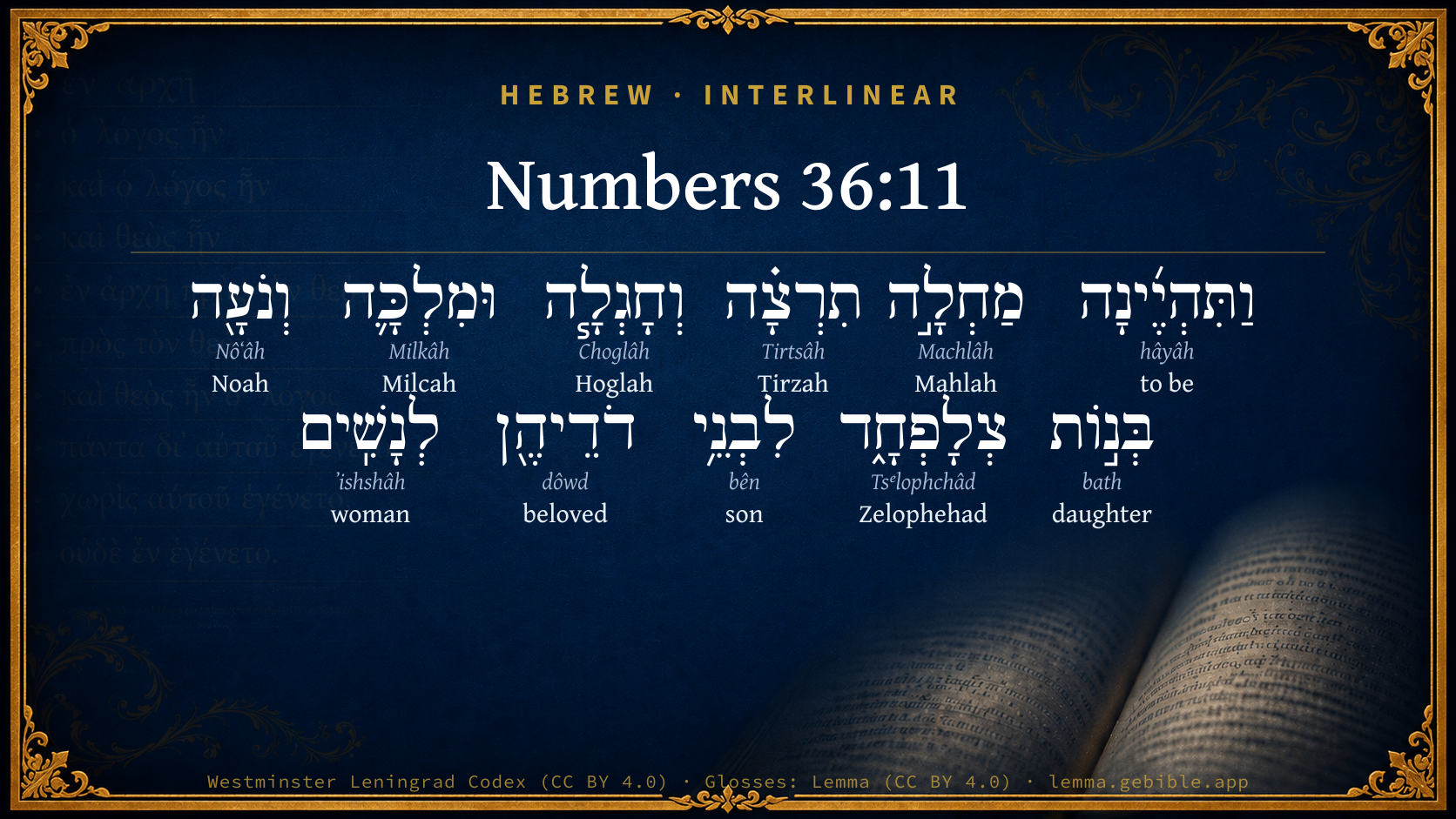
Hebrew (Westminster Leningrad Codex) Numbers 36:11 appears in the Hebrew Old Testament. The text above is from the Westminster Leningrad Codex. Each word links to its Strong’s number, a concise gloss, and parsing drawn from the Open Scriptures Hebrew Bible morphology. Click any word for its full Brown-Driver-Briggs (BDB) entry.
Download image
Cite this verse

Numbers 36:11 (World English Bible). Public Domain. Lemma interlinear Bible study tool, https://lemma.gebible.app/v/numbers/36/11.

Show BibTeX & RIS
BibTeX
RIS
English Translation
for Mahlah, Tirzah, and Hoglah, and Milcah, and Noah, the daughters of Zelophehad, were married to their father's brothers' sons.
World English Bible · Public Domain
Download a study sheet

One document with this verse’s original text, its word-by-word gloss line, the meaning frame, cross-references with their text, attributed commentary, and full source and license credits — printable, and it pastes into notes with its structure intact.

This verse Autodidact and up

Study sheet (.html) Plain text (.txt)

A passage Seminary Student

Up to 50 verses in one chapter. A passage sheet keeps up to 6 commentary sources and 12 cross-references per verse, in the order this page ranks them, and says so on the sheet whenever that leaves anything out. Ask for a single verse and you get the Autodidact verse sheet above.

Everything on this page stays free to read, with no account — the sheet is a download of what is already on screen, not access to it.

Want to remove ads? Support Godless Engineer
Compare translations 3

The same verse in 3 English versions, stacked beneath the original-language interlinear above. Click any original word for its lexicon entry.

Each is an independent rendering of the whole verse — the interlinear is not word-aligned to these translations.

Highlighted words mark where these versions differ — a whole-verse word diff, not a word-by-word alignment.

  • World English Bible Public Domain
    for Mahlah, Tirzah, and Hoglah, and Milcah, and Noah, the daughters of Zelophehad, were married to their father's brothers' sons.
  • King James Version Public Domain
    For Mahlah, Tirzah, and Hoglah, and Milcah, and Noah, the daughters of Zelophehad, were married unto their father's brothers' sons:
  • unfoldingWord Literal Text CC BY-SA 4.0
    And Mahlah, Tirzah and Hoglah and Milkah and Noah, the daughters of Zelophehad, became wives for the sons of their uncles.

unfoldingWord Literal Text — © unfoldingWord, licensed CC BY-SA 4.0. Word-aligned USFM3 via Door43 (git.door43.org/unfoldingWord/en_ult).

Versions to compare (up to 4)

3 of 4 selected

Show all 18 translations

Every available English version of this verse, each an independent rendering of the whole verse.

  • World English Bible Public Domain
    for Mahlah, Tirzah, and Hoglah, and Milcah, and Noah, the daughters of Zelophehad, were married to their father's brothers' sons.
  • Berean Standard Bible Public Domain
    Mahlah, Tirzah, Hoglah, Milcah, and Noah, the daughters of Zelophehad, were married to cousins on their father’s side.
  • Majority Standard Bible Public Domain
    Mahlah, Tirzah, Hoglah, Milcah, and Noah, the daughters of Zelophehad, were married to cousins on their father’s side.
  • King James Version Public Domain
    For Mahlah, Tirzah, and Hoglah, and Milcah, and Noah, the daughters of Zelophehad, were married unto their father's brothers' sons:
  • American Standard Version (1901) Public Domain
    for Mahlah, Tirzah, and Hoglah, and Milcah, and Noah, the daughters of Zelophehad, were married unto their father's brothers' sons.
  • Revised Version (1885) Public Domain
    for Mahlah, Tirzah, and Hoglah, and Milcah, and Noah, the daughters of Zelophehad, were married unto their father’s brothers’ sons.
  • Geneva Bible (1599) Public Domain
    For Mahlah, Tirzah, and Hoglah, and Milcah, and Noah the daughters of Zelophehad were married vnto their fathers brothers sonnes,
  • Douay-Rheims (1899) Public Domain
    And Maala, and Thersa, and Hegla, and Melcha, and Noa were married to the sons of their uncle by their father
  • Young's Literal Translation Public Domain
    and Mahlah, Tirzah, and Hoglah, and Milcah, and Noah, daughters of Zelophehad, are to the sons of their fathers' brethren for wives;
  • Literal Standard Version CC BY-SA 4.0
    and Mahlah, Tirzah, and Hoglah, and Milcah, and Noah, daughters of Zelophehad, are for wives to the sons of their fathers’ brothers;
  • Unlocked Literal Bible CC BY-SA 4.0
    Mahlah, Tirzah, Hoglah, Milkah, and Noah, the daughters of Zelophehad, married descendants of Manasseh.
  • unfoldingWord Literal Text CC BY-SA 4.0
    And Mahlah, Tirzah and Hoglah and Milkah and Noah, the daughters of Zelophehad, became wives for the sons of their uncles.
  • Darby Bible Public Domain
    and Mahlah, Tirzah, and Hoglah, and Milcah, and Noah, the daughters of Zelophehad, were married unto their uncles' sons.
  • World Messianic Bible Public Domain
    for Mahlah, Tirzah, Hoglah, Milcah, and Noah, the daughters of Zelophehad, were married to their father’s brothers’ sons.
  • Webster's Bible Public Domain
    For Mahlah, Tirzah, and Hoglah, and Milcah, and Noah, the daughters of Zelophehad, were married to their father's brothers' sons:
  • Free Bible Version CC BY-SA 4.0
    Mahlah, Tirzah, Hoglah, Milcah, and Noah, Zelophehad's daughters, married cousins on their father's side.
  • Bible in Basic English Public Domain
    For Mahlah, Tirzah, and Hoglah, and Milcah, and Noah, the daughters of Zelophehad, took as their husbands the sons of their father's brothers:
  • JPS Tanakh (1917) Public Domain
    For Mahlah, Tirzah, and Hoglah, and Milcah, and Noah, the daughters of Zelophehad, were married unto their father's brothers' sons.

Literal Standard Version (2020), Covenant Press — licensed CC BY-SA 4.0. Text via the HelloAO Bible API (eBible.org). Unlocked Literal Bible (unfoldingWord) — licensed CC BY-SA 4.0. Text via the HelloAO Bible API (eBible.org). unfoldingWord Literal Text — © unfoldingWord, licensed CC BY-SA 4.0. Word-aligned USFM3 via Door43 (git.door43.org/unfoldingWord/en_ult). Free Bible Version, Dr. Jonathan Gallagher — licensed CC BY-SA 4.0. Text via the HelloAO Bible API (eBible.org).

Word by word

More ways to search: Search by grammar → Find every occurrence → Compare this word →

Practice this passage: Drill this verse → Learn its vocabulary →

וְחָגְלָ֧ה
Choglâh
H2295
“and · Hoglah”
Conjunction + Noun, Proper
Part of Speech
Conjunction + Noun
Type
Proper
Full BDB Definition

Origin: of uncertain derivation

TWOT: None

Hoglah = "partridge" - 3rd of 5 daughters of Zelophehad, a descendant of Manasseh
  1. וַתִּהְיֶ֜ינָה hâyâh H1961 “and · to be” Conjunction + Verb, Qal, Sequential Imperfect, 3rd Person, Feminine, Plural
  2. מַחְלָ֣ה Machlâh H4244 “Mahlah” Noun, Proper
  3. תִרְצָ֗ה Tirtsâh H8656 “Tirzah” Noun, Proper
  4. וּמִלְכָּ֛ה Milkâh H4435 “and · Milcah” Conjunction + Noun, Proper
  5. וְנֹעָ֖ה Nôʻâh H5270 “and · Noah” Conjunction + Noun, Proper
  6. בְּנ֣וֹת bath H1323 “daughters of” Noun, Common, Feminine, Plural, Construct
  7. צְלָפְחָ֑ד Tsᵉlophchâd H6765 “Zelophehad” Noun, Proper
  8. לִבְנֵ֥י bên H1121 “to/for · sons of” Preposition + Noun, Common, Masculine, Plural, Construct
  9. דֹדֵיהֶ֖ן dôwd H1730 “love · their” Noun, Common, Masculine, Plural, Construct + Suffix, Personal, 3rd Person, Feminine, Plural
  10. לְנָשִֽׁים ʼishshâh H802 “to/for · women” Preposition + Noun, Common, Feminine, Plural, Absolute

About this verse

These counts appear in no published source. They are computed here, from the morphology-tagged text and Lemma’s own curated glosses. What Lemma adds →

11
words
11
distinct lemmas
Pentateuch
section

Notable vocabulary

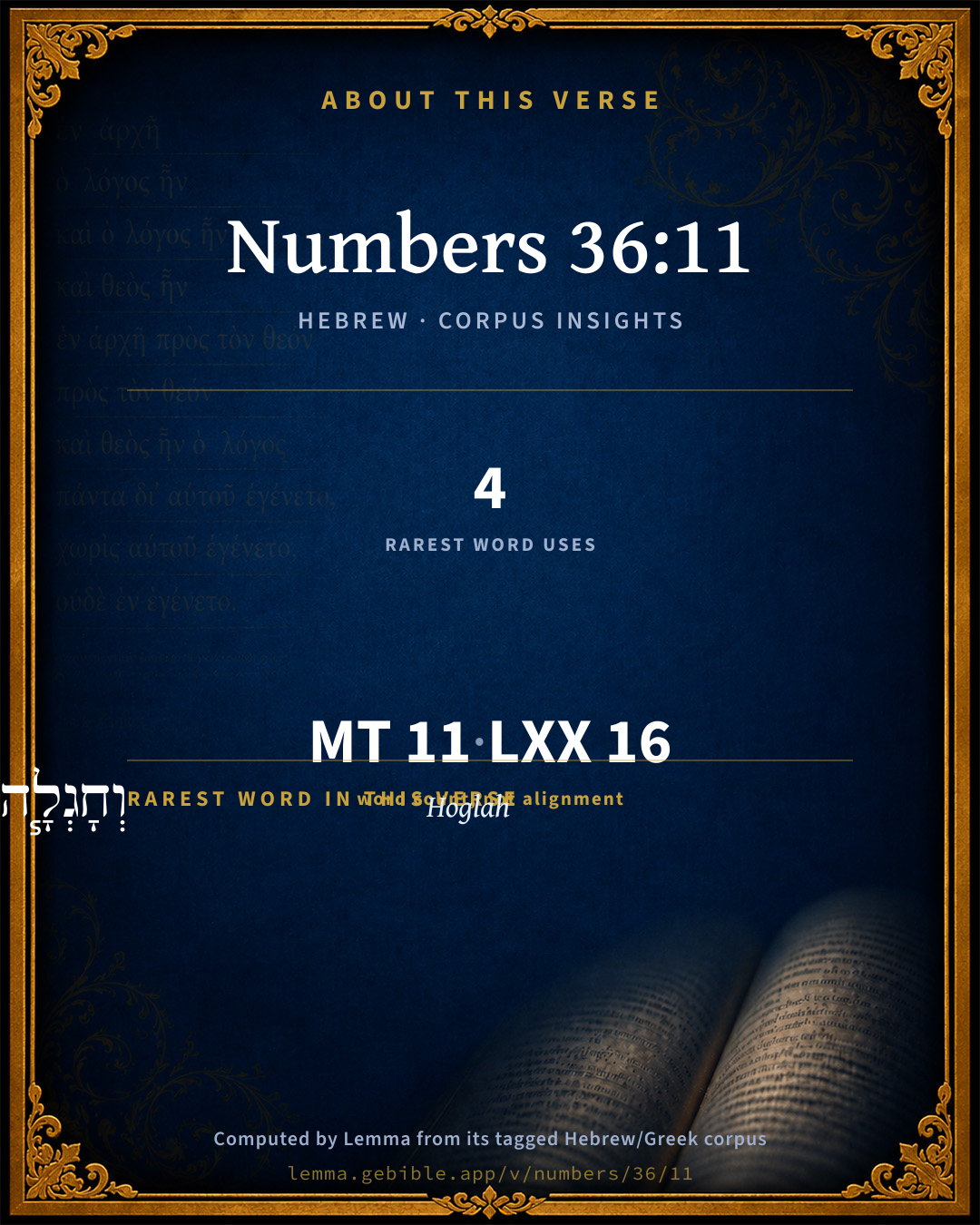
The rarest word here is וְחָגְלָ֧ה Hoglah H2295 — appearing just 4 times in the whole Hebrew Bible.

Shared distinctive vocabulary

וְחָגְלָ֧ה Hoglah H2295 occurs in 4 verses of the Hebrew Bible. Also found in:

Grammatical profile

  • 1 verb
  • 10 nouns

Verb forms

  • וַתִּהְיֶ֜ינָה Qal · Sequential Imperfect

Hebrew & Septuagint length

In English translation the verse runs 20 words from the Hebrew and 17 from the Septuagint (LXX English) — closely comparable.

A rough comparison of the two English renderings, which tokenize alike — not a word-level alignment.

Word counts can differ between the Hebrew and the Greek without any difference in meaning — e.g. the Hebrew direct-object marker אֵת has no separate Greek word, and Greek often adds the article ὁ.

In the original languages it is 11 Hebrew tokens and 16 Greek tokens — but the two are counted differently (Hebrew bundles its prefixes and suffixes into one token; the Greek is in lemma form), so that isn’t a like-for-like length.

Cross-references

2

Topical passages linked to Numbers 36:11 in the Treasury of Scripture Knowledge — connected by theme and wording, ordered by reader-vote popularity; previews shown in the World English Bible.

  • Numbers 27:1 Then drew near the daughters of Zelophehad, the son of Hepher, the son of Gilead, the son of Machir, the son of Manasseh, of the families of Manasseh the son of Joseph; and these are the names of his daughters: Mahlah, Noah, and Hoglah, and Milcah, and Tirzah.
  • Numbers 26:33 Zelophehad the son of Hepher had no sons, but daughters: and the names of the daughters of Zelophehad were Mahlah, and Noah, Hoglah, Milcah, and Tirzah.

Cross-references courtesy of OpenBible.info (CC BY 4.0).

Hebrew and Greek witnesses Masoretic Hebrew ↔ Greek Septuagint

The same verse in the two great witnesses to the Old Testament, shown verse-for-verse.

These are two independent witnesses, not word-aligned to each other, and the Septuagint is shown in lemma (dictionary) form.

Hebrew Numbers 36:11 Masoretic · Westminster Leningrad Codex

וַתִּהְיֶ֜ינָה מַחְלָ֣ה תִרְצָ֗ה וְחָגְלָ֧ה וּמִלְכָּ֛ה וְנֹעָ֖ה בְּנ֣וֹת צְלָפְחָ֑ד לִבְנֵ֥י דֹדֵיהֶ֖ן לְנָשִֽׁים

for Mahlah, Tirzah, and Hoglah, and Milcah, and Noah, the daughters of Zelophehad, were married to their father's brothers' sons.

World English Bible · Public Domain

Greek LXX Numbers 36:11 Septuagint · lemma form

καί γίγνομαι θερσα καί εγλα καί μελχα καί νουα καί μααλα θυγάτηρ σαλπααδ ὁ ἀνεψιός αὐτός

So Thersa, and Egla, and Melcha, and Nua, and Malaa, the daughters of Salpaad, married their cousins;

LXX2012 (modern English Septuagint) · Public Domain

Hebrew: Westminster Leningrad Codex (CC BY 4.0). Greek: Septuagint (public domain); English from LXX2012 (modern English Septuagint) (Public Domain). How the Septuagint differs from the Hebrew →

Targum (Aramaic paraphrase)

2

The Targum is the ancient Jewish Aramaic paraphrase of the Hebrew Scriptures — an interpretive translation, not the Hebrew text itself. Onkelos (literal) and Pseudo-Jonathan (expansive) render the Torah, and Jonathan the Prophets. Coverage is partial: where no permissively-licensed English translation exists for a verse, only the Aramaic is shown. This is verse-level text, not a word-by-word alignment to the Hebrew.

  1. Targum Onkelos Torah (Genesis–Deuteronomy)
    וַהֲוָאָה מַחְלָה תִרְצָה וְחָגְלָה וּמִלְכָּה וְנֹעָה בְּנַת צְלָפְחָד לִבְנֵי אֲחֵי אֲבוּהֶן לִנְשִׁין

    (no public-domain English translation for this verse)

    Targum Onkelos — Aramaic: “Onkelos Genesis” (public domain); “Onkelos Exodus” (public domain); “Onkelos Leviticus” (public domain); “Onkelos Numbers” (public domain); “Onkelos Deuteronomy” (public domain). English: “Sefaria Community Translation” (CC0 1.0 (public-domain dedication)); “J.W. Etheridge. The Targums of Onkelos and Jonathan Ben Uzziel on the Pentateuch. London: Longmans, Green, 1862” (public domain). Text via Sefaria.

  2. Targum Pseudo-Jonathan Torah (Genesis–Deuteronomy)
    וַהֲוָאָה מַחֲלָה תִרְצָה וְחָגְלָה וּמִלְכָּה וְנוֹעָה בְּנַת צְלָפְחָד לִבְנֵי חֲבִיבֵיהוֹן לִנְשִׁין

    and Mahalah, Thirzah, Hogelab, Milchah and Nohah, the daughters of Zelophehad, became wives of sons of their kindred;

    Targum Pseudo-Jonathan — Aramaic: “Targum Jonathan on Genesis” (public domain); “Targum Jonathan on Exodus” (public domain); “Targum Jonathan on Leviticus” (public domain); “Targum Jonathan on Numbers” (public domain); “Targum Jonathan on Deuteronomy” (public domain). English: “The Targum of Jonathan ben Uzziel, trans. J. W. Etheridge, London, 1862” (public domain). Text via Sefaria.

Commentary

Notes on Numbers 36:11 from classic Christian and Jewish commentators (each source and its license shown beneath its notes). The classic Christian expositions comment on the surrounding passage and are grouped to its opening verse, so a note may address several verses; the Jewish commentaries on the Tanakh (Rashi and others) are per-verse, so they appear only where the commentator wrote on this verse.

Lemma curates 59 commentaries, every one of them public domain or Creative Commons licensed, each selected and text-cleaned for this edition rather than reprinted as found. About our sources →

Trapp's Complete Commentary

John Trapp

Num 36:11 For Mahlah, Tirzah, and Hoglah, and Milcah, and Noah, the daughters of Zelophehad, were married unto their father’s brothers’ sons:

Ver. 11. For Mahlah, Tirzah, and Hoglah, &c.] The name of these virgins, as one interpreter {a} elsewhere observeth, seem to be not without mystery. For Zelophehad, by interpretation, signifieth the shadow of fear or of dread: his first daughter, Mahlah, infirmity; the second, Noah, wandering; the third, Hoglah, turning about for joy, or dancing; the fourth, Milcah, a queen; the fifth, Tirzah, well-pleasing, or acceptable. By these names we may observe the degrees of our reviving by grace in Christ; for we all are born, as of the shadow of fear, being brought forth in sin, and "for fear of death were all our lifetime subject to bondage." {Heb 2:15} This begetteth infirmity, or sickness, grief of heart for our estate. After which, wandering abroad for help and comfort, we find it in Christ, by whom our "sorrow is turned into joy." He communicates to us of his royalty, making us "kings and priests unto God his Father"; and we shall be presented unto him glorious, "and without blemish." {Eph 5:27} So the Church is beautiful as Tirzah. {Son 6:4}

{a} Mr Ainsworth.

John Trapp, A Commentary or Exposition upon All the Books of the Old and New Testament (1647–1656) — public domain. Text from a community e-Sword module.

Adam Clarke's Commentary

Verse 11. Mahlah, Tirza, &c.] For a curious account of these names, See Clarke on Nu 27:7.

Adam Clarke's Commentary on the Bible (1810–1826) — public domain. Text from a community e-Sword/MySword module.

Ellicott's Commentary for English Readers

(11) Were married unto their father’s brothers’ sons.—Better, unto the sons of their near kinsmen. The word dod generally denotes an uncle on the father’s side, and probably does so in the present case; but in Jer_32:12 it seems to denote a cousin.

A Bible Commentary for English Readers, edited by Charles John Ellicott (1878–1897) — public domain. Text from a community e-Sword module.

The Cambridge Bible for Schools and Colleges

gen. ed. J. J. S. Perowne

11. In accordance with the law, the five women were married to the sons of their paternal uncles.

The Cambridge Bible for Schools and Colleges (gen. ed. J. J. S. Perowne; Cambridge University Press, 1878–1918) — public domain. Text from a community e-Sword module.

John Gill's Exposition

And they were married into the families of the sons of Manasseh, the son of Joseph,.... The family of the Hepherites, of which they were. Aben Ezra observes, that their being married into families, and not a family, is a sign that their uncles' sons were not all of them brethren, or the sons of one man, but of more, though all sons of one or other of their father's, brethren:

and their inheritance remained in the tribe of the family of their father; by means of these marriages, even both in their father's tribe and family.

John Gill's Exposition of the Whole Bible (1746–1763) — public domain (CC PDM 1.0). Text via the HelloAO Bible API.

Haydock's Catholic Bible Commentary

Father. They married their cousin-germans. The original is rather undecisive, as Dod may signify, "an uncle, great uncle, or cousin;" and a son, in Scripture, is often put for any descendant. The marriages of cousins were not expressly forbidden by the law, and if they had, they might have been dispensed with on this occasion, as well as when a brother died without issue. (Calmet) --- Claudius was the first of the Romans who obtained leave of the senate to marry his brother’s daughter. (Suetonius) (Du Hamel)

George Leo Haydock (1774–1849), Haydock's Catholic Family Bible and Commentary, 1859 edition — public domain. Excludes Psalms (Douay-Rheims chapter numbering differs from Protestant) and Deuterocanonical books (Catholic canon only).

Matthew Poole's English Annotations

It is certain whether brothers or sons be taken strictly and properly, or more large, as those words are oft used in Scripture.

Matthew Poole's English Annotations on the Holy Bible (1683–1685) — public domain. Text from a community e-Sword/MySword module.

The Pulpit Commentary

Mahlah, &c. It is a curious instance of the inartificial character of the sacred records that these five names, which have not the least interest in themselves, are repeated thrice in this Book, and once in Joshua. ; (Jos_17:3) It is evident that the case made a deep impression upon the mind of the nation at the time. Their father"s brothers" sons. The Hebrew word dwOD is always translated "father"s brother," or "uncle;" and that seems to be its ordinary meaning, although in Jer_32:12 it stands for uncle"s son. There is no reason to depart from the customary reading here. No doubt the daughters of Zelophehad acted according to the spirit as well as the letter of the law, and married the nearest male relatives who were open to their choice.

The Pulpit Commentary (1880–1919), ed. H.D.M. Spence-Jones & Joseph S. Exell — public domain. Text from a community e-Sword module.

Rashi

Rabbi Shlomo Yitzchaki (Rashi)

מחלה תרצה וגו׳ MAHLA, TIRZA etc., — Here it enumerates them according to their superiority over one another in years for they were married in the order in which they were born. But everywhere else in the Bible it enumerates them according to their intelligence: This tells us that they were all equal (cf. Bava Batra 120a; Rashi on Numbers 27:1).

Rashi on the Tanakh — English translations: “The Judaica Press complete Tanach with Rashi, translated by A. J. Rosenberg” (CC BY 4.0); “Pentateuch with Rashi's commentary by M. Rosenbaum and A.M. Silbermann, 1929-1934” (public domain); “The Metsudah Tanach series, Lakewood, N.J” (CC BY 4.0); and “The Book of Joshua, Metsudah Publications, 1997” (CC BY 4.0). Text via Sefaria.

Ibn Ezra

Rabbi Abraham ibn Ezra

Machlah, Sirtzah. Scripture mentioned them first in the order in which they were born, and now mentions them in the order that they were married.

Ibn Ezra on the Tanakh — English translations: “Sefaria Community Translation” (CC0 1.0 (public-domain dedication)); “Yalkut, Sifsei Chachomim Chumash, Metsudah Publications, 2009” (CC BY 4.0); and “Commentary of Ibn Ezra on Isaiah - trans. by M. Friedlander, 1873” (public domain). Text via Sefaria.

Lesson kit

Teaching starters — assembled from the data on this page, not authored interpretation. Every prompt links to the verse data it draws on. Edit before teaching.

Numbers, in the Pentateuch, opens this verse with 11 words (11 distinct Hebrew lemmas). Its most distinctive word is Choglâh (“Hoglah”). A historical commentator’s framing appears above. Read the whole chapter for the surrounding context.

Discussion questions

  1. How does “Hoglah” (Choglâh) shape what this verse is saying?
  2. How does Numbers 26:33, which shares the word «Hoglah», read alongside this verse?
  3. These translations render this verse differently. What is at stake in choosing one wording over another?
  4. «וַתִּהְיֶ֜ינָה» is a Qal Sequential Imperfect verb. How does that grammatical form shape the action described?
  5. Compare how Trapp's Complete Commentary and Adam Clarke's Commentary read this verse. Where do they agree or differ?

Things to notice

Reading settings

Reading text

Shown beneath each verse's original-language words.

Old Testament
Old Testament edition

Read the OT as the Masoretic Hebrew (MT) or the Greek Septuagint (LXX).

English shown for the Greek Septuagint (in the Hebrew ↔ Greek comparison).

Comparing translations? Open the Compare panel on any verse page to stack up to four side by side.