Deuteronomy 23:17

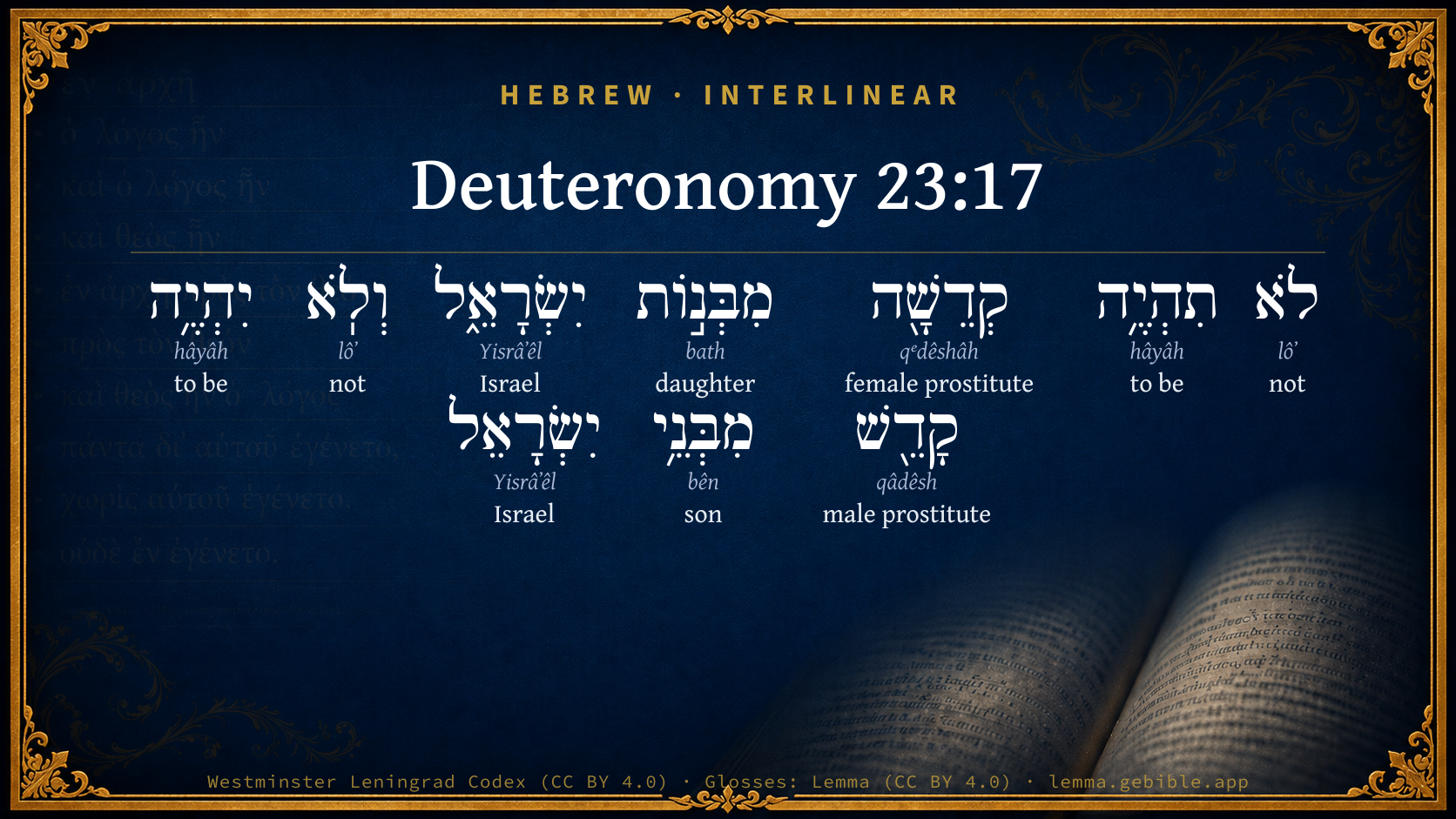
Hebrew (Westminster Leningrad Codex) Deuteronomy 23:17 appears in the Hebrew Old Testament. The text above is from the Westminster Leningrad Codex. Each word links to its Strong’s number, a concise gloss, and parsing drawn from the Open Scriptures Hebrew Bible morphology. Click any word for its full Brown-Driver-Briggs (BDB) entry.
Download image
Cite this verse

Deuteronomy 23:17 (World English Bible). Public Domain. Lemma interlinear Bible study tool, https://lemma.gebible.app/v/deuteronomy/23/17.

Show BibTeX & RIS
BibTeX
RIS
English Translation
There shall be no prostitute of the daughters of Israel, neither shall there be a sodomite of the sons of Israel.
World English Bible · Public Domain
Highlights Full analysis ↓
Download a study sheet

One document with this verse’s original text, its word-by-word gloss line, the meaning frame, cross-references with their text, attributed commentary, and full source and license credits — printable, and it pastes into notes with its structure intact.

This verse Autodidact and up

Study sheet (.html) Plain text (.txt)

A passage Seminary Student

Up to 50 verses in one chapter. A passage sheet keeps up to 6 commentary sources and 12 cross-references per verse, in the order this page ranks them, and says so on the sheet whenever that leaves anything out. Ask for a single verse and you get the Autodidact verse sheet above.

Everything on this page stays free to read, with no account — the sheet is a download of what is already on screen, not access to it.

Want to remove ads? Support Godless Engineer
Compare translations 3

The same verse in 3 English versions, stacked beneath the original-language interlinear above. Click any original word for its lexicon entry.

Each is an independent rendering of the whole verse — the interlinear is not word-aligned to these translations.

Highlighted words mark where these versions differ — a whole-verse word diff, not a word-by-word alignment.

  • World English Bible Public Domain
    There shall be no prostitute of the daughters of Israel, neither shall there be a sodomite of the sons of Israel.
  • King James Version Public Domain
    There shall be no whore of the daughters of Israel, nor a sodomite of the sons of Israel.
  • unfoldingWord Literal Text CC BY-SA 4.0
    No female cultic prostitute shall be from the daughters of Israel, and no male cultic prostitute shall be from the sons of Israel.

unfoldingWord Literal Text — © unfoldingWord, licensed CC BY-SA 4.0. Word-aligned USFM3 via Door43 (git.door43.org/unfoldingWord/en_ult).

Versions to compare (up to 4)

3 of 4 selected

Show all 18 translations

Every available English version of this verse, each an independent rendering of the whole verse.

  • World English Bible Public Domain
    There shall be no prostitute of the daughters of Israel, neither shall there be a sodomite of the sons of Israel.
  • Berean Standard Bible Public Domain
    No daughter or son of Israel is to be a shrine prostitute.
  • Majority Standard Bible Public Domain
    No daughter or son of Israel is to be a shrine prostitute.
  • King James Version Public Domain
    There shall be no whore of the daughters of Israel, nor a sodomite of the sons of Israel.
  • American Standard Version (1901) Public Domain
    There shall be no prostitute of the daughters of Israel, neither shall there be a sodomite of the sons of Israel.
  • Revised Version (1885) Public Domain
    There shall be no harlot of the daughters of Israel, neither shall there be a sodomite of the sons of Israel.
  • Geneva Bible (1599) Public Domain
    There shalbe no whore of the daughters of Israel, neither shall there be a whore keeper of the sonnes of Israel.
  • Douay-Rheims (1899) Public Domain
    There shall be no whore among the daughters of Israel, nor whoremonger among the sons of Israel.
  • Young's Literal Translation Public Domain
    `There is not a whore among the daughters of Israel, nor is there a whoremonger among the sons of Israel;
  • Literal Standard Version CC BY-SA 4.0
    There is not a whore among the daughters of Israel, nor is there a whoremonger among the sons of Israel;
  • Unlocked Literal Bible CC BY-SA 4.0
    There must be no cultic prostitute among any of the daughters of Israel, neither must there be a cultic prostitute among the sons of Israel.
  • unfoldingWord Literal Text CC BY-SA 4.0
    No female cultic prostitute shall be from the daughters of Israel, and no male cultic prostitute shall be from the sons of Israel.
  • Darby Bible Public Domain
    There shall be no prostitute amongst the daughters of Israel, nor any Sodomite amongst the sons of Israel.
  • World Messianic Bible Public Domain
    There shall be no prostitute of the daughters of Israel, neither shall there be a sodomite of the sons of Israel.
  • Webster's Bible Public Domain
    There shall be no harlot of the daughters of Israel, nor a sodomite of the sons of Israel.
  • Free Bible Version CC BY-SA 4.0
    No Israelite women or men are to be cult prostitutes.
  • Bible in Basic English Public Domain
    No daughter of Israel is to let herself be used as a loose woman for a strange god, and no son of Israel is to give himself to a man.
  • JPS Tanakh (1917) Public Domain
    (23-18) There shall be no harlot of the daughters of Israel, neither shall there be a sodomite of the sons of Israel.

Literal Standard Version (2020), Covenant Press — licensed CC BY-SA 4.0. Text via the HelloAO Bible API (eBible.org). Unlocked Literal Bible (unfoldingWord) — licensed CC BY-SA 4.0. Text via the HelloAO Bible API (eBible.org). unfoldingWord Literal Text — © unfoldingWord, licensed CC BY-SA 4.0. Word-aligned USFM3 via Door43 (git.door43.org/unfoldingWord/en_ult). Free Bible Version, Dr. Jonathan Gallagher — licensed CC BY-SA 4.0. Text via the HelloAO Bible API (eBible.org).

Word by word

More ways to search: Search by grammar → Find every occurrence → Compare this word →

Practice this passage: Drill this verse → Learn its vocabulary →

About this verse

These counts appear in no published source. They are computed here, from the morphology-tagged text and Lemma’s own curated glosses. What Lemma adds →

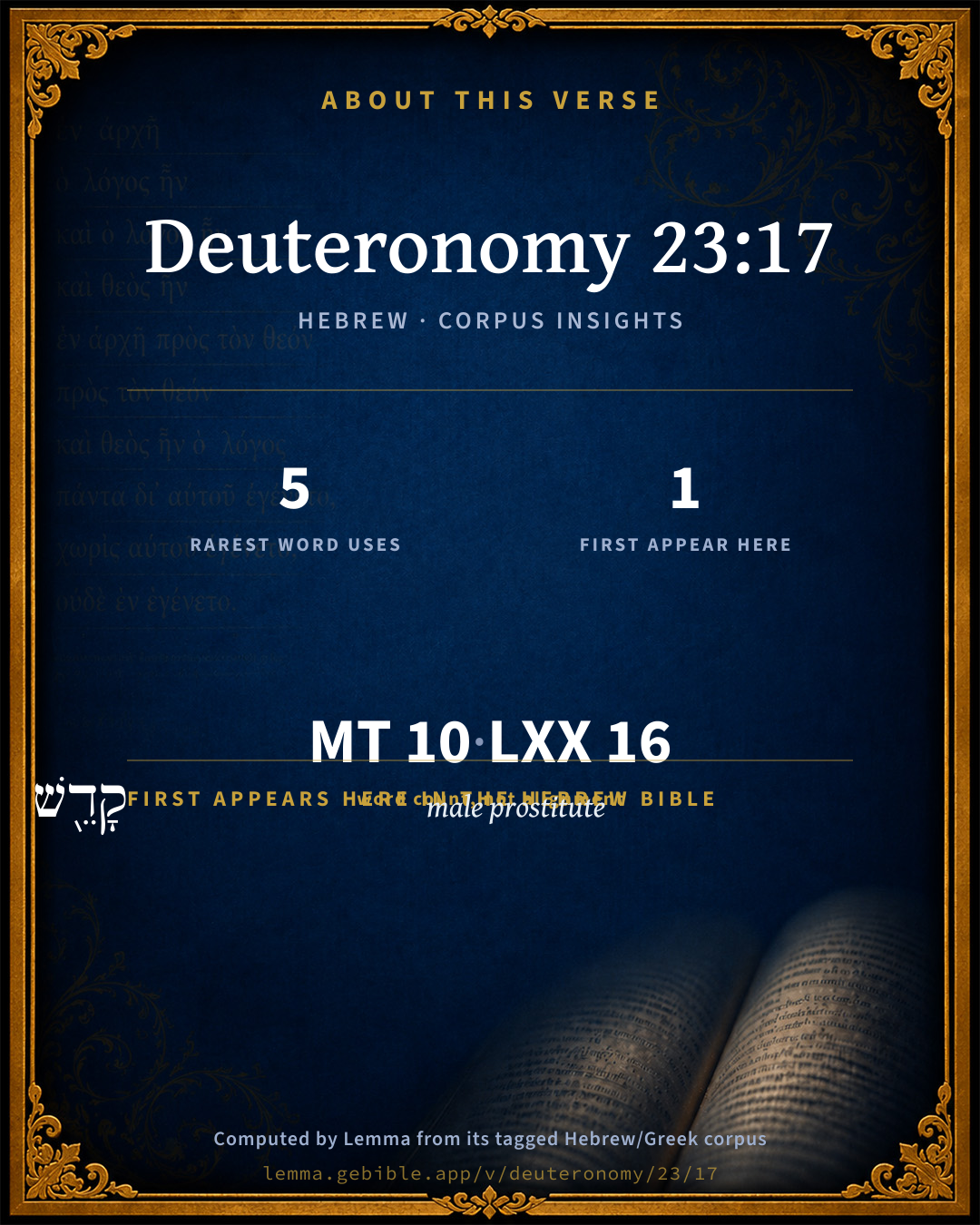
10
words
7
distinct lemmas
Pentateuch
section

Notable vocabulary

The rarest word here is קְדֵשָׁ֖ה female prostitute H6948 — appearing just 5 times in the whole Hebrew Bible.

First appearance in Scripture

This word makes its first canonical appearance in the Hebrew Bible here:

  • קָדֵ֖שׁ male prostitute H6945

Shared distinctive vocabulary

קְדֵשָׁ֖ה female prostitute H6948 occurs in 4 verses of the Hebrew Bible. Also found in:

Grammatical profile

  • 2 verbs
  • 4 nouns
  • 2 adjectives
  • 2 particles

Verb forms

  • תִהְיֶ֥ה Qal · Imperfect
  • יִהְיֶ֥ה Qal · Imperfect

Repetition

Words recur within this verse — often emphatic in Hebrew:

  • תִהְיֶ֥ה to be H1961 ×2
  • יִשְׂרָאֵ֑ל Israel H3478 ×2
  • לֹא not H3808 ×2

Hebrew & Septuagint length

In English translation the verse runs 21 words from the Hebrew and 47 from the Septuagint (LXX English) — the Septuagint runs noticeably longer here. See the side-by-side →

A rough comparison of the two English renderings, which tokenize alike — not a word-level alignment.

Word counts can differ between the Hebrew and the Greek without any difference in meaning — e.g. the Hebrew direct-object marker אֵת has no separate Greek word, and Greek often adds the article ὁ.

In the original languages it is 10 Hebrew tokens and 16 Greek tokens — but the two are counted differently (Hebrew bundles its prefixes and suffixes into one token; the Greek is in lemma form), so that isn’t a like-for-like length.

Cross-references

13

Topical passages linked to Deuteronomy 23:17 in the Treasury of Scripture Knowledge — connected by theme and wording, ordered by reader-vote popularity; previews shown in the World English Bible.

  • 2 Kings 23:7 He broke down the houses of the sodomites, that were in the house of Yahweh, where the women wove hangings for the Asherah.
  • Leviticus 19:29 Don't profane your daughter, to make her a prostitute; lest the land fall to prostitution, and the land become full of wickedness.
  • 1 Kings 14:24 and there were also sodomites in the land: they did according to all the abominations of the nations which Yahweh drove out before the children of Israel.
  • Deuteronomy 22:21 then they shall bring out the young lady to the door of her father's house, and the men of her city shall stone her to death with stones, because she has done folly in Israel, to play the prostitute in her father's house: so shall you put away the evil from the midst of you.
  • 1 Kings 15:12 He put away the sodomites out of the land, and removed all the idols that his fathers had made.
  • 1 Kings 22:46 The remnant of the sodomites, that remained in the days of his father Asa, he put away out of the land.
  • 1 Timothy 1:10 for the sexually immoral, for homosexuals, for slave-traders, for liars, for perjurers, and for any other thing contrary to the sound doctrine;
  • Romans 1:26–28 For this reason, God gave them up to vile passions. For their women changed the natural function into that which is against nature.
  • 1 Corinthians 6:9 Or don't you know that the unrighteous will not inherit the Kingdom of God? Don't be deceived. Neither the sexually immoral, nor idolaters, nor adulterers, nor male prostitutes, nor homosexuals,
  • Genesis 19:4–5 But before they lay down, the men of the city, the men of Sodom, surrounded the house, both young and old, all the people from every quarter.
  • Judges 19:22 As they were making their hearts merry, behold, the men of the city, certain base fellows, beset the house round about, beating at the door; and they spoke to the master of the house, the old man, saying, Bring forth the man who came into your house, that we may know him.
  • Proverbs 2:16 To deliver you from the strange woman, Even from the foreigner who flatters with her words;
  • Deuteronomy 22:29 then the man who lay with her shall give to the lady's father fifty [shekels] of silver, and she shall be his wife, because he has humbled her; he may not put her away all his days.

Cross-references courtesy of OpenBible.info (CC BY 4.0).

Hebrew and Greek witnesses Masoretic Hebrew ↔ Greek Septuagint

The same verse in the two great witnesses to the Old Testament, shown verse-for-verse.

Here the Septuagint runs noticeably longer than the Hebrew — LXX2012 (modern English Septuagint) 47 words vs World English Bible 21. A rough length comparison of the two English translations, not a word-level alignment — read both below.

These are two independent witnesses, not word-aligned to each other, and the Septuagint is shown in lemma (dictionary) form.

Hebrew Deuteronomy 23:17 Masoretic · Westminster Leningrad Codex

לֹא תִהְיֶ֥ה קְדֵשָׁ֖ה מִבְּנ֣וֹת יִשְׂרָאֵ֑ל וְלֹֽא יִהְיֶ֥ה קָדֵ֖שׁ מִבְּנֵ֥י יִשְׂרָאֵל

There shall be no prostitute of the daughters of Israel, neither shall there be a sodomite of the sons of Israel.

World English Bible · Public Domain

Greek LXX Deuteronomy 23:17 Septuagint · lemma form

μετά σύ καταοικέω ἐν σύ καταοικέω ἐν πᾶς τόπος οὗ ἐάν ἀρέσκω αὐτός οὐ θλίβω αὐτός

There shall not be a harlot of the daughters of Israel, and there shall not be a fornicator of the sons of Israel; there shall not be an idolatress of the daughters of Israel, and there shall not be an initiated person of the sons of Israel.

LXX2012 (modern English Septuagint) · Public Domain

On this verse, John Gill's Exposition discusses the Septuagint’s reading. Read the note in Commentary ↓

Hebrew: Westminster Leningrad Codex (CC BY 4.0). Greek: Septuagint (public domain); English from LXX2012 (modern English Septuagint) (Public Domain). How the Septuagint differs from the Hebrew →

Targum (Aramaic paraphrase)

2

The Targum is the ancient Jewish Aramaic paraphrase of the Hebrew Scriptures — an interpretive translation, not the Hebrew text itself. Onkelos (literal) and Pseudo-Jonathan (expansive) render the Torah, and Jonathan the Prophets. Coverage is partial: where no permissively-licensed English translation exists for a verse, only the Aramaic is shown. This is verse-level text, not a word-by-word alignment to the Hebrew.

  1. Targum Onkelos Torah (Genesis–Deuteronomy)
    עִמָךְ יִתֵּב בֵּינָךְ בְּאַתְרָא דִי יִתִּרְעֵי בַּחֲדָא מִן קִרְוָיךְ בִּדְיֵיטַּב לֵהּ לָא תוֹנִנֵהּ

    (no public-domain English translation for this verse)

    Targum Onkelos — Aramaic: “Onkelos Genesis” (public domain); “Onkelos Exodus” (public domain); “Onkelos Leviticus” (public domain); “Onkelos Numbers” (public domain); “Onkelos Deuteronomy” (public domain). English: “Sefaria Community Translation” (CC0 1.0 (public-domain dedication)); “J.W. Etheridge. The Targums of Onkelos and Jonathan Ben Uzziel on the Pentateuch. London: Longmans, Green, 1862” (public domain). Text via Sefaria.

  2. Targum Pseudo-Jonathan Torah (Genesis–Deuteronomy)
    עִמְכוֹן יָתֵיב וְיִנְטוֹר מִצְוָתָא בֵּינֵיכוֹן אַלִּיפוּ יָתֵיהּ אוֹרַיְיתָא קָבְעוּ לֵיהּ מֶדְרָשָׁא בְּאַתְרָא דְצָבֵי בַּחֲדָא מִן קִרְיֵיכוֹן אִתְעַסְקוּ עִמֵּיהּ בִּדְיוֹטִיב לֵיהּ לָא תוֹנִינֵיהּ בְּמִלִּין

    Let him dwell with you, and observe the commandments among you; teach him the law, and put him in a school in the place that he chooseth in one of your cities: employ (or, have business with) him, that he may do well, and trouble him not by words.

    Targum Pseudo-Jonathan — Aramaic: “Targum Jonathan on Genesis” (public domain); “Targum Jonathan on Exodus” (public domain); “Targum Jonathan on Leviticus” (public domain); “Targum Jonathan on Numbers” (public domain); “Targum Jonathan on Deuteronomy” (public domain). English: “The Targum of Jonathan ben Uzziel, trans. J. W. Etheridge, London, 1862” (public domain). Text via Sefaria.

Commentary

Notes on Deuteronomy 23:17 from classic Christian and Jewish commentators (each source and its license shown beneath its notes). The classic Christian expositions comment on the surrounding passage and are grouped to its opening verse, so a note may address several verses; the Jewish commentaries on the Tanakh (Rashi and others) are per-verse, so they appear only where the commentator wrote on this verse.

Lemma curates 59 commentaries, every one of them public domain or Creative Commons licensed, each selected and text-cleaned for this edition rather than reprinted as found. About our sources →

Trapp's Complete Commentary

John Trapp

Deu 23:17 There shall be no whore of the daughters of Israel, nor a sodomite of the sons of Israel.

Ver. 17. There shall be no whore.] And what a stinking shame is that, that stews and brothel houses are licensed by the Pope, who reaps no small profit by them? The Papists themselves write with detestation, that at Rome a Jewish maid might not be admitted into the stews of whoredom, unless she would be first baptized; Ut Iudae filiae scortari non liceat, Dei filiae liceat: Imo Israelis filia meretricari non aliter arte possit quam facta per baptismum sanctum Christi sorer et filia. {a}

Nor a Sodomite of the sons of Israel.] {See Trapp on "Gen 19:5"} Pythagoras’s precept, πων κυαμων απεχεσθαι, was intended against this kind of horrid and unnatural uncleanness, κυαμοι, signifying somewhat else besides beans. But what a beast was Pope Sixtus Quintus, qui lupanar utriusque Veneris Romoe condidit, as Agrippa reporteth?

{a} Espincaeus, De Contin., lib. iii. cap. 4.

John Trapp, A Commentary or Exposition upon All the Books of the Old and New Testament (1647–1656) — public domain. Text from a community e-Sword module.

Joseph Benson's Commentary

Deu 23:17. There shall be no whore of the daughters of Israel — No common prostitute, such as were tolerated and encouraged by the Gentiles, and used even in their religious worship. Not that such practices were allowed to the strangers among them, as is evident from many passages of Scripture and reason; but that it was in a peculiar manner, and upon special reasons, forbidden to them, as being much more odious in them than in strangers. It is remarkable that the original words, which we render whore and sodomite, import a man or woman consecrated to some deity, who served their gods by prostitution.

Joseph Benson's Commentary on the Old and New Testaments (1811–1818) — public domain. Text from a community e-Sword module.

Tyndale Open Study Notes

Tyndale Open Resources

23:17 A temple prostitute was commonly a part of Canaanite religious rituals, but they were forbidden in Israel.

Tyndale Open Study Notes — © Tyndale Open Resources, licensed CC BY-SA 4.0. Text via the HelloAO Bible API.

Adam Clarke's Commentary

Verse 17. There shall be no whore] See on Ge 38:15-21.

Adam Clarke's Commentary on the Bible (1810–1826) — public domain. Text from a community e-Sword/MySword module.

Ellicott's Commentary for English Readers

(17) Whore and sodomite seem both intended to be taken in the sense in which they belonged to the temples of Baal and Ashtaroth, of persons dedicated to impurity.

A Bible Commentary for English Readers, edited by Charles John Ellicott (1878–1897) — public domain. Text from a community e-Sword module.

John Gill's Exposition

There shall be no whore of the daughters of Israel,.... The word for "whore" is "kedeshah", which properly signifies an "holy" one; and here, by an antiphrasis, an unholy, an impure person, one that is defiled by man; See Gill on Gen 38:18. Jarchi interprets the word, one that makes herself common, that is sanctified, or set apart; that is, one that separates herself for such service, and prostitutes herself to everyone that passes by: but some understand this not of common harlots in the streets, but of sacred whores, or such as were consecrated to Heathen deities, as such there were to Venus. Strabo (x) tells us that the temple of Venus at Corinth was so rich, that more than a thousand of those sacred harlots were kept, whom men and women had devoted to that goddess; and so a multitude of the same sort were at Comana, which he calls little Corinth (y); now these of all harlots being the most abominable are forbidden to be among the daughters of Israel:

nor a sodomite of the sons of Israel: by the same rule that "kedeshah" is rendered "a whore" in the preceding clause, "kadesh" should be rendered "an whoremonger" here, as in the Septuagint and Vulgate Latin versions; though Aben Ezra interprets it passively, one that is lain with, and Jarchi one that is prepared to lie with a male, that prostitutes his body in this unnatural way; and it looks as if there were such sort of persons sacred to idols, since we read of the houses of the sodomites, which were by, or rather in the house of the Lord, Kg2 23:7.

(x) Geograph. l. 8. p. 261. (y) lb. l. 12. p. 385.

John Gill's Exposition of the Whole Bible (1746–1763) — public domain (CC PDM 1.0). Text via the HelloAO Bible API.

Albert Barnes' Notes on the Bible

Compare the marginal reference. Prostitution was a common part of religious observances among idolatrous nations, especially in the worship of Ashtoreth or Astarte. Compare Mic 1:7; Baruch 6:43.

Albert Barnes' Notes on the Bible (1834–1885) — public domain. Text from a community e-Sword/MySword module.

Haydock's Catholic Bible Commentary

Israel. Some hence very erroneously infer, that before this prohibition the thing was not criminal. (Selden, Jur. v. 4.) Notwithstanding the law, such lewd practices continued to be very common. The original expresses that both the women and men were consecrated, "kadash," in all probability to some idol, whom they intended to honour by abominable prostitutions, a thing very common in all the East, as we learn both from profane and sacred authors. (Aten. xiii. 5.) (4 Kings xxiii. 7.) The men were called the effeminate, 3 Kings xiv. 24. (Calmet) --- Some copies of the Septuagint have a double translation of this verse, and add, "None of the daughters of Israel shall bear the mysteries, nor shall any of the sons of Israel be initiated (in these mysteries of idols) to make every vow." Telesphoros denotes a strumpet for hire, ver. 18; or, according to Vossius, one who is initiated or performs the pagan mysteries, as fornication and idolatry, commonly go together in the sacred writers. Hesychius seems to understand, that it refers to "the house where a person has been delivered of a child." But Tertullian (pudic. ix.) explains it thus, "No one....shall pay tribute;" as telos means tribute, (Haydock) and the Jews are supposed to have refused to pay any to the Romans on the authority of this verse. See Casaub. in Baruch ii. 19. (Grotius) (Calmet) --- But it seems far more probable, that it is a farther elucidation of the text, and prohibits that scandalous impiety by which may were not ashamed publicly, like dogs, to commit the most obscene actions, and to present the hire of their bodies to the idols, Micheas i. 7. (Clement of Alexandria, Exhort.; Villalpand in Ezechiel xliii.) We could hardly give credit to those who have attested such things, did not God here find it necessary to caution his people not to fall into such blindness and delusion. That the poor ignorant idolater should think by these means to appease those gods who, while here on earth, had been infamous for the like excesses, needs not so much to excite our surprise. But that the Gnostics, Manichees, and other heretics, almost of all ages since the light of the gospel shone forth, should have thought that they could honour the true God by abusing the flesh, is truly astonishing. Yet they gave into this delusion, by first persuading themselves that the flesh was the creature of an evil principle, fighting against the author of the spirit and of all good, with whom they intended to take part. The way of a fool is right in his own eyes. Yea, there is a way that seemeth to a man right, and the ends thereof lead to death, Proverbs xii. 15., and xvi. 25. These wretches grounded their opinion on the authority of their gods, or of the Scripture. Will this excuse be admitted by the Sovereign Judge? But these delusions are perhaps now at an end. --- A principle, however, is still maintained of a far more pernicious tendency, inasmuch as it strikes at the root of every law, divine and human. This horrible doctrine was inculcated by J. Wesley for above thirty years, as we have already observed, chap. xvi. 22. "O natural man," says he, (Serm. on Orig. Sin,) "thou canst do [no] good. Thy natural actions are sin; thy civil actions are sin; thy religious actions are sin. As many thoughts, words, and actions, so many sins; for nothing but sin comes from thee. Thy duties are sins. Can an evil tree bring forth good fruit?" Thus Scripture teaches him that to work for one’s family, to pay taxes, to pray, read the Scriptures, or even to believe, will be a sin! "Knowest thou not that thou canst do nothing but sin, till thou art reconciled to God." (Sermon on the Righteousness of Faith.) Hence arose the Still-Methodists, Jour. iv. p. 92.. Even after this celebrated reformer had begun, when almost 70 years of age, to discover "the subtle poison which," he says, (Jour. viii. p. 90,) "has infected, more or less, almost all, from the highest to the lowest among us," it is astonishing that he still acknowledges those who were infected with it, as "the real children of God by faith." Many of these, he says, (serm. on the law) lay it down as an unquestionable truth, that when we are come to Christ, we have done with the law; and that in this sense, Christ is the end of the law to every one that believeth. We need, therefore, no longer wonder that the pagans should think they honoured their idols by prostitution, (which on other occasions they condemned as "a great disgrace," oneidos mega, as Musonias calls it,) since in this enlightened age, a man of no mean abilities, and far advanced in years, a man who requires that all the preachers in his connexion shall conform to his Sermons and Notes on the New Testament, or be superceded, (Jour. xx. p. 34,) could decide that those who maintain this principle, and make it a branch of their religion to bread the law of God on purpose, are the "real children of God by faith;" people, "whom God has taken out of the world." As well might he say that a man may live on subtle poison, and please God, by following a doctrine than which "nothing can be more false," as he styles this very principle of Antinomianism, to which he and his preachers had "leaned" for such a length of time. "If, says a great admirer of his, Mr. Fletcher, (1 Check, 4th letter,) the three first propositions of the minutes are scriptural, Mr. Wesley may well begin the remaining part, by desiring the preachers in his connexion to emerge along with him from under the noisy billows of prejudice, and to struggle quite out of the muddy streams of Antinomian delusions which have so long gone over our heads, and carried so many souls down the channels of vice into the lake that burneth with fire and brimstone." This is then to be the abode of those whom "God has taken out of the world, and who are real children of God by faith!" This is the heaven, of which they may boast in dying that they are infallibly sure of! At least, the man whom they have so eagerly followed as their judge, has passed this woeful sentence upon them, as if he had a mind to laugh at their credulity. If he join us also in the same condemnation, and say, "I have the same assurance that Jesus is the Christ, and that no Romanist can expect to be saved, according to the terms of his covenant;" (Jour. iii. p. 94) we are not solicitous about his good opinion; we have not chosen him for our judge, nor have his writings given us reason to think that he knew the nature of our covenant. If he did, so much the more dreadful must have been his reckoning with that unerring Judge, before whom he has appeared 20 years ago. It is the glory and happiness of the Catholic Church, that no one attempts to assail her, but he presently betrays the spirit by which he is inspired, the spirit of calumny, and of the perverse application of Scripture. It was thus that our divine head was treated by the father of lies, who alleged Scripture to encourage suicide, or presumption, Matthew iv. 6. So in the various points of faith which Mr. Wesley attacks, he shamefully misrepresents our doctrine, that he may have something to oppose. We have seen how unjustly he accuses us of idolatry, chap. xvi. 22. But in order, perhaps, to comfort us with the reflection, that we have many partners in guilt, he represents the Protestants as equally criminal. "They set up their idols in their churches; you set up yours in your heart....Oh how little is the difference before God! How small pre-eminence has the money worshipper at London over the image worshipper at Rome; or the idolizer of a living sinner over him that prays to a dead saint." (Word to a Protestant.) How much soever the Protestants may be entangled in this species of idolatry, they do not at least pretend to authorize it by the principles of religion, as some of the Methodists have done. Witness the man with whom J. Wesley conversed at Birmingham. "Do you believe that you have nothing to do with the law of God? He answered, I have not, I am not under the law....Have you also a right to all the women in the world? Yes, if they consent. And is this not a sin? Yes, to him who thinks it is a sin; but not to those whose hearts are free. The same thing that wretch, Roger Ball, affirmed in Dublin. Surely these are the first-born children of Satan." (Journal vi. p. 133.) Witness Mr. Fletcher, a celebrated clergyman in the Methodist connexion, who has informed us that Antinomian principles and practices had spread like wild fire among the Methodists. "Nor need I go far, says he, for a proof of this sad assertion. In one of his (Wesley’s) societies, not many miles from my parish, a married man, who professed being in a state of justification and sanctification, growing wise above what is written, despised his brethren as legalists, and his preachers as persons not clear in the gospel. He instilled his principles into a serious young woman; and what was the consequence? Why they talked about finished salvation in Christ, and the absurdity of perfection in the flesh, till a perfect child was conceived and born; and, to save appearances, the mother swore it to be a travelling man that cannot be heard of. Thus, to avoid legality, they plunged into hypocrisy, fornication, adultery, perjury, and the depth of ranterism, &c." (Check i. Let. 2.) But enough of such absurdity. We may now easily believe to what lengths the dissolute examples and maxims of the heathenish mythology would lead their unhappy votaries, when we behold the purest lessons of the gospel so strangely perverted. (Haydock) --- Whoremonger. It is very probable that the Scripture here means such as were guilty of unnatural impurities, "consecrated," as it were, to some idol of lust, as these crimes were common under several faithless kings of Israel and of Juda, 3 Kings xv. 12., and xxii. 47. Simple prostitutes are styled zona. (Calmet) --- God will not allow these to be publicly tolerated, though they contrived but too often in private to ensnare the hearts of God’s people, 3 Kings iii. 16. (Tirinus) --- Onkelos translates, "No Israelite shall give his daughter in marriage to a slave, nor take one for his son’s wife," as the contract would be null, according to the Rabbins, for want of liberty. (Calmet) --- He may, perhaps, have given this singular turn to this verse, because the preceding one speaks of fugitive slaves.

George Leo Haydock (1774–1849), Haydock's Catholic Family Bible and Commentary, 1859 edition — public domain. Excludes Psalms (Douay-Rheims chapter numbering differs from Protestant) and Deuterocanonical books (Catholic canon only).

Matthew Poole's English Annotations

No common prostitute, such, as were tolerated and encouraged by the Gentiles, and used even in their religious worship.

Of the daughters of Israel; not that such practices were allowed to the strangers among them, as is evident from many scriptures and reasons, but that it was in a peculiar manner, and upon special reasons, forbidden to them, as being much more odious in them than in strangers; though the words may be rendered among the daughters, and so in the following clause, among the sons, for the Hebrew mem is sometimes used in that sense, as Num 22:22; Psa 31:12, and so it notes that none of that sort should be permitted among them, whether Jews or strangers.

A sodomite; who defileth or suffereth himself to be defiled with mankind. See Gen 19:5; Lev 18:12; 1Ki 14:24; 22:46; Rom 1:27.

Matthew Poole's English Annotations on the Holy Bible (1683–1685) — public domain. Text from a community e-Sword/MySword module.

Whedon's Commentary on the Bible

Daniel D. Whedon

17. Whore… sodomite — The prostitution of woman was a part of the religious services of the heathen, as in the worship of Astarte. Among them men also frequently gave themselves up to unnatural lust.

Daniel D. Whedon (gen. ed.), Commentary on the Old and New Testaments (1874–1909) — public domain. Text from a community e-Sword module.

The Pulpit Commentary

Vers. 17, 18. Amongst idolatrous nations prostitution was in certain cases regarded as an act of religious service (cf. Herod, 1:199), and both mules and females prostituted themselves especially in the worship of Astarte. All such abominations were to be unknown in Israel (cf. Mic_1:7) Whore; kedeshah (hvdeq), a female who prostituted herself in the worship of an idol. The price of a dog; not money obtained from the sale of a dog, but the gains of the kadesh, or male prostitute, here called a dog, as the type of all uncleanness (cf. Rev_22:15)

Vers. 17, 18. Unholy wealth may not be put to Divine uses.

See Homilies on (Deu_15:1-6 Deu_14:22-29) The same law which regulates the appropriation of wealth rightfully gained forbids me dedication to any holy use of wealth sinfully gained.

Vers. 17-25. Money-making must be above suspicion.

We have in these verses an excellent lesson upon mercantile morality. There are too many people in this world who are not at all particular how money is made, if only it be made. "The wages of iniquity" are as welcome to them as to Balaam. But it is plain from these verses that the Lord does regard the way money is won, and will not handle what has come licentiously himself, nor give any countenance to his people in doing so.

I MONEY MADE BY WICKEDNESS IS ABHORRED OF GOD. The wretched woman who lives by her own dishonor, the wretched man who lends himself to licentiousness, are both intolerable to the Divine King. The idols of the heathen may receive the wages of licentiousness, and be served by lewd women, as the history of heathenism shows, but God will have no such dedications polluting his house. As the Holy One, he will not be served by the deliberately unholy and profane.

II MONEY MADE OUT OF THE NEEDS OF THE POOR SAINTS IS ALSO AS ABOMINATION TO GOD. It was a noble law that Jew was not to play the money-lender to few. To extort from a brother what his needs can ill afford to pay, is forbidden. The Jews were to be brothers indeed, in readiness to lend without hope of recompense. And although this arrangement may not be literally binding under this dispensation, there is a general idea abroad of the undesirableness of making money out of God"s poor people. There is to be special consideration shown surely to those who are of the household of faith. (Gal_6:10) We should suspect a man of worldliness who extorted big interest from a struggling Church, when well able to advance the desperately needed loan.

III A SPHERE FOR USURY IS RECOGNIZED BY THE LORD. The stranger may borrow under an engagement to pay interest. This is only right. If usury were universally forbidden, the world of commerce would come to a standstill. Capital would not accumulate if it had no reward awaiting it. The stranger, consequently, comes and asks the favor of a loan. He has no claim on you for it, but he is willing to pay a fair price for the obligation. The whole edifice of commerce rests upon the legality of such a transaction, it is a mutual benefit.

At the same time, there may be extortion and speculation in usury, just as in other lines of business; and God shows that "extortioners" (1Co_6:10) have no part in his kingdom. It is selfishness pure and simple, and in its most tyrannical and despicable form.

IV ALL VOWS REGISTERED IN CONNECTION WITH OUR MONEY-MAKING MUST BE FAITHFULLY PERFORMED. It is almost a natural instinct that vows should be made unto the Lord in connection with our prosperity. Often a person struggling to realize an "honest profit," while the transaction is only in progress, and the issue is still uncertain, dedicates a proportion, if the Lord send him success; or a proportion of a new crop, if it be a good one. Such vows must never be recalled, but always honor-ably met. "Better is it that thou shouldest not vow, than that thou shouldest vow and not pay". (Ecc_5:5)

V THE RIGHTS OF THE HUNGRY SHOULD ALSO BE RESPECTED IF A LAND IS TO ENJOY SUCCESS. The vines are so productive in Palestine, when properly cultivated, and the vineyards so unprotected, that a hungry passenger may fill himself and no one be a bit the poorer. Or he may enter the field of standing corn and make what use he can of his hands. In other words, the hungry was regarded as having a right to satisfy the cravings of nature and to pass on.

And when it was placed on the statute-book as a right, it saved the poor man"s self-respect and never interfered with his personal freedom. This "poor-law" gives man his need without asking him to surrender his liberty. This is its beauty, it meets the pressing necessity without destroying the person"s legitimate self-respect. Liberty is more precious to any upright soul than bread; and it is a wholesome instinct which, as far as possible, should be respected in any beneficent national arrangement. R.M.E.

The Pulpit Commentary (1880–1919), ed. H.D.M. Spence-Jones & Joseph S. Exell — public domain. Text from a community e-Sword module.

John Wesley's Explanatory Notes

No whore - No common prostitute, such as were tolerated and encouraged by the Gentiles, and used even in their religious worship. Not that such practices were allowed to the strangers among them, as is evident from many scriptures and reasons, but that it was in a peculiar manner, and upon special reasons, forbidden to them, as being much more odious in them than in strangers.

John Wesley, Explanatory Notes Upon the Whole Bible (1754–1765) — public domain. Text via the GEBible commentary corpus.

Keil & Delitzsch

C. F. Keil & F. Delitzsch

On the other hand, male and female prostitutes of Israelitish descent were not to be tolerated; i.e., it was not to be allowed, that either a male or female among the Israelites should give himself up to prostitution as an act of religious worship. The exclusion of foreign prostitutes was involved in the command to root out the Canaanites. קדּשׁ and קדשׁה were persons who prostituted themselves in the worship of the Canaanitish Astarte (see at Gen 38:21). - "The wages of a prostitute and the money of dogs shall not come into the house of the Lord on account of (ל, for the more remote cause, Ewald, 217) any vow; for even both these (viz., even the prostitute and dog, not merely their dishonourable gains) are abomination unto the Lord thy God." "The hire of a whore" is what the kedeshah was paid for giving herself up. "The price of a dog" is not the price paid for the sale of a dog (Bochart, Spencer, Iken, Baumgarten, etc.), but is a figurative expression used to denote the gains of the kadesh, who was called κίναιδος by the Greeks, and received his name from the dog-like manner in which the male kadesh debased himself (see Rev 22:15, where the unclean are distinctly called "dogs").

Keil & Delitzsch — Biblical Commentary on the Old Testament (1861–1891) — public domain (CC PDM 1.0). Text via the HelloAO Bible API. (Old Testament only.)

unfoldingWord translationNotes

Door43 World Missions Community

General Information:

Moses speaks to the Israelites as if they were one man, so the words "you" and "your" here are singular. (See: Forms of You)

cultic prostitute ... cultic prostitute ... prostitute ... dog

Yahweh gives a complete list of both forms of prostitution by both men and women to forbid prostitution by anyone for any reason. (See: Merism)

cultic prostitute ... among any of the daughters ... among the sons

Possible meanings are that Moses 1) openly forbids women and men to perform sexual acts as part of temple service or 2) uses a euphemism to forbid women and men to perform sexual acts to receive money. (See: Euphemism)

You must not bring the wages of a prostitute ... into the house

"A woman who earns money as a prostitute must not bring that money ... into the house"

a dog

a man who allows men to have sex with him for money

into the house of Yahweh your God

"into the temple"

for any vow

"to fulfill a vow"

both these

the wages of a female prostitute and of a male prostitute.

translationWords

prostitute

Israel

house of God

vow

God

unfoldingWord translationNotes — © Distant Shores Media and the Door43 World Missions Community, licensed CC BY-SA 4.0. Source: git.door43.org/Door43/en_tn.

Lesson kit

Teaching starters — assembled from the data on this page, not authored interpretation. Every prompt links to the verse data it draws on. Edit before teaching.

Deuteronomy, in the Pentateuch, opens this verse with 10 words (7 distinct Hebrew lemmas). Its most distinctive word is qᵉdêshâh (“female prostitute”). The Greek Septuagint runs longer here. A historical commentator’s framing appears above. Read the whole chapter for the surrounding context.

Discussion questions

  1. The word qᵉdêshâh carries the sense “female prostitute.” How does it shape the verse?
  2. The word “male prostitute” first appears here in Scripture. What is being introduced at this debut?
  3. Genesis 38:21 shares the word «female prostitute» with this verse. How do the two illuminate each other?
  4. “to be” occurs 2× in this one verse. What is the effect of the repetition?
  5. Compared with the Hebrew, the Septuagint runs longer here. What questions does that raise?
  6. These translations render this verse differently; the difference is in the English rendering, not the original. What questions does that raise?
  7. The verb «תִהְיֶ֥ה» is Qal Imperfect. How does its form color the action?
  8. Reading how Trapp's Complete Commentary and Joseph Benson's Commentary read this verse, where do the two commentators agree and where do they part?

Things to notice

Reading settings

Reading text

Shown beneath each verse's original-language words.

Old Testament
Old Testament edition

Read the OT as the Masoretic Hebrew (MT) or the Greek Septuagint (LXX).

English shown for the Greek Septuagint (in the Hebrew ↔ Greek comparison).

Comparing translations? Open the Compare panel on any verse page to stack up to four side by side.