
2 Kings 13:5

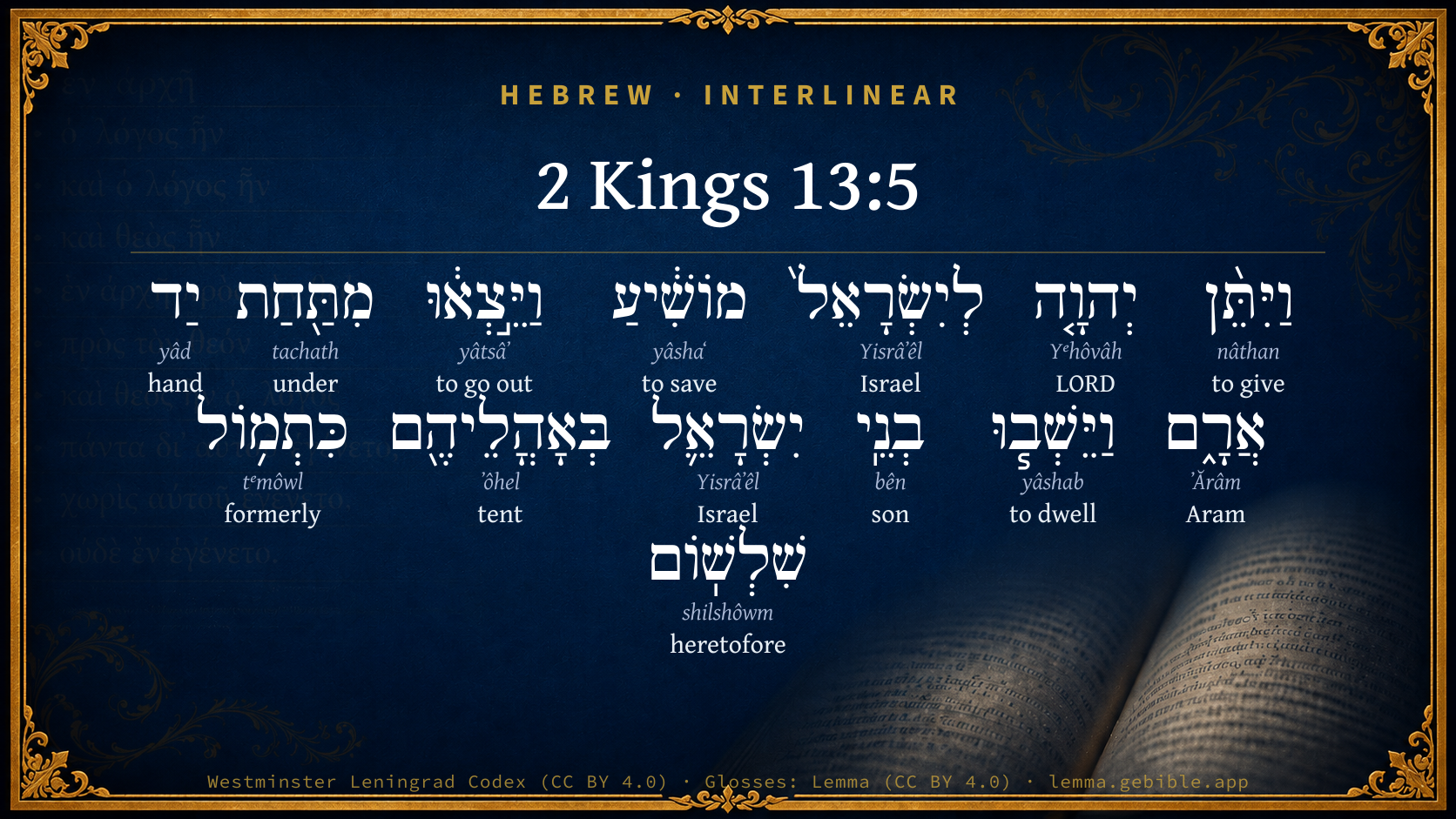
Hebrew (Westminster Leningrad Codex) 2 Kings 13:5 appears in the Hebrew Old Testament. The text above is from the Westminster Leningrad Codex. Each word links to its Strong’s number, a concise gloss, and parsing drawn from the Open Scriptures Hebrew Bible morphology. Click any word for its full Brown-Driver-Briggs (BDB) entry.
Download image
Cite this verse

2 Kings 13:5 (World English Bible). Public Domain. Lemma interlinear Bible study tool, https://lemma.gebible.app/v/2-kings/13/5.

Show BibTeX & RIS
BibTeX
RIS
English Translation
(Yahweh gave Israel a savior, so that they went out from under the hand of the Syrians; and the children of Israel lived in their tents as before.
World English Bible · Public Domain
Download a study sheet

One document with this verse’s original text, its word-by-word gloss line, the meaning frame, cross-references with their text, attributed commentary, and full source and license credits — printable, and it pastes into notes with its structure intact.

This verse Autodidact and up

Study sheet (.html) Plain text (.txt)

A passage Seminary Student

Up to 50 verses in one chapter. A passage sheet keeps up to 6 commentary sources and 12 cross-references per verse, in the order this page ranks them, and says so on the sheet whenever that leaves anything out. Ask for a single verse and you get the Autodidact verse sheet above.

Everything on this page stays free to read, with no account — the sheet is a download of what is already on screen, not access to it.

Want to remove ads? Support Godless Engineer
Compare translations 3

The same verse in 3 English versions, stacked beneath the original-language interlinear above. Click any original word for its lexicon entry.

Each is an independent rendering of the whole verse — the interlinear is not word-aligned to these translations.

Highlighted words mark where these versions differ — a whole-verse word diff, not a word-by-word alignment.

  • World English Bible Public Domain
    (Yahweh gave Israel a savior, so that they went out from under the hand of the Syrians; and the children of Israel lived in their tents as before.
  • King James Version Public Domain
    (And the LORD gave Israel a saviour, so that they went out from under the hand of the Syrians: and the children of Israel dwelt in their tents, as beforetime.
  • unfoldingWord Literal Text CC BY-SA 4.0
    And Yahweh gave to Israel a savior, and they came out from under the hand of Aram. And the sons of Israel dwelled in their tents as yesterday, the third day.

unfoldingWord Literal Text — © unfoldingWord, licensed CC BY-SA 4.0. Word-aligned USFM3 via Door43 (git.door43.org/unfoldingWord/en_ult).

Versions to compare (up to 4)

3 of 4 selected

Show all 18 translations

Every available English version of this verse, each an independent rendering of the whole verse.

  • World English Bible Public Domain
    (Yahweh gave Israel a savior, so that they went out from under the hand of the Syrians; and the children of Israel lived in their tents as before.
  • Berean Standard Bible Public Domain
    So the LORD gave Israel a deliverer, and they escaped the power of the Arameans. Then the people of Israel lived in their own homes as they had before.
  • Majority Standard Bible Public Domain
    So the LORD gave Israel a deliverer, and they escaped the power of the Arameans. Then the people of Israel lived in their own homes as they had before.
  • King James Version Public Domain
    (And the LORD gave Israel a saviour, so that they went out from under the hand of the Syrians: and the children of Israel dwelt in their tents, as beforetime.
  • American Standard Version (1901) Public Domain
    (And Jehovah gave Israel a saviour, so that they went out from under the hand of the Syrians; and the children of Israel dwelt in their tents as beforetime.
  • Revised Version (1885) Public Domain
    (And the LORD gave Israel a saviour, so that they went out from under the hand of the Syrians: and the children of Israel dwelt in their tents, as beforetime.
  • Geneva Bible (1599) Public Domain
    (And the Lord gaue Israel a deliuerer, so that they came out from vnder the subiection of the Aramites. And the children of Israel dwelt in their tents as before time.
  • Douay-Rheims (1899) Public Domain
    And the Lord gave Israel a saviour, and they were delivered out of the hand of the king of Syria: and the children of Israel dwelt in their pavilions as yesterday and the day before.
  • Young's Literal Translation Public Domain
    and Jehovah giveth to Israel a saviour, and they go out from under the hand of Aram, and the sons of Israel dwell in their tents as heretofore;
  • Literal Standard Version CC BY-SA 4.0
    and YHWH gives a savior to Israel, and they go out from under the hand of Aram, and the sons of Israel dwell in their tents as before;
  • Unlocked Literal Bible CC BY-SA 4.0
    So Yahweh gave Israel a rescuer, and they escaped from the hand of the Arameans, and the people of Israel began to live in their homes as they had before.
  • unfoldingWord Literal Text CC BY-SA 4.0
    And Yahweh gave to Israel a savior, and they came out from under the hand of Aram. And the sons of Israel dwelled in their tents as yesterday, the third day.
  • Darby Bible Public Domain
    And Jehovah gave Israel a saviour, so that they went out from under the hand of the Syrians; and the children of Israel dwelt in their tents as before.
  • World Messianic Bible Public Domain
    (The LORD gave Israel a savior, so that they went out from under the hand of the Syrians; and the children of Israel lived in their tents as before.
  • Webster's Bible Public Domain
    (And the LORD gave Israel a savior, so that they went out from under the hand of the Syrians: and the children of Israel dwelt in their tents, as formerly.
  • Free Bible Version CC BY-SA 4.0
    The Lord gave Israel someone who would save them so they no longer were under Aramean rule. Then the Israelites were able to go back to living in safety as before.
  • Bible in Basic English Public Domain
    (And the Lord gave Israel a saviour, so that they became free from the hands of the Aramaeans; and the children of Israel were living in their tents as in the past.
  • JPS Tanakh (1917) Public Domain
    And the LORD gave Israel a deliverer, so that they went out from under the hand of the Arameans; and the children of Israel dwelt in their tents, as beforetime.

Literal Standard Version (2020), Covenant Press — licensed CC BY-SA 4.0. Text via the HelloAO Bible API (eBible.org). Unlocked Literal Bible (unfoldingWord) — licensed CC BY-SA 4.0. Text via the HelloAO Bible API (eBible.org). unfoldingWord Literal Text — © unfoldingWord, licensed CC BY-SA 4.0. Word-aligned USFM3 via Door43 (git.door43.org/unfoldingWord/en_ult). Free Bible Version, Dr. Jonathan Gallagher — licensed CC BY-SA 4.0. Text via the HelloAO Bible API (eBible.org).

Word by word

More ways to search: Search by grammar → Find every occurrence → Compare this word →

Practice this passage: Drill this verse → Learn its vocabulary →

כִּתְמ֥וֹל
tᵉmôwl
H8543
“like/as · formerly”
Preposition + Adverb
Part of Speech
Preposition + Adverb
Full BDB Definition

Origin: probably for H865

TWOT: 2521

before, before that time, beforetime, heretofore, of late, of old, these days, time(s) past, yesterday, day before yesterday, recently, formerly - yesterday - recently, formerly (usual usage) (figuratively) - as formerly, so more recently - from yesterday, already
  1. וַיִּתֵּ֨ן nâthan H5414 “and · to give” Conjunction + Verb, Qal, Sequential Imperfect, 3rd Person, Masculine, Singular
  2. יְהוָ֤ה Yᵉhôvâh H3068 “LORD” Noun, Proper
  3. לְיִשְׂרָאֵל֙ Yisrâʼêl H3478 “to/for · Israel” Preposition + Noun, Proper
  4. מוֹשִׁ֔יעַ yâshaʻ H3467 “saving” Verb, Hiphil, Participle Active, Masculine, Singular, Absolute
  5. וַיֵּ֣צְא֔וּ yâtsâʼ H3318 “and · to go out” Conjunction + Verb, Qal, Sequential Imperfect, 3rd Person, Masculine, Plural
  6. מִתַּ֖חַת tachath H8478 “from · under” Preposition + Preposition
  7. יַד yâd H3027 “hand of” Noun, Common, Both, Singular, Construct
  8. אֲרָ֑ם ʼĂrâm H758 “Aram” Noun, Proper
  9. וַיֵּשְׁב֧וּ yâshab H3427 “and · to dwell” Conjunction + Verb, Qal, Sequential Imperfect, 3rd Person, Masculine, Plural
  10. בְנֵֽי bên H1121 “sons of” Noun, Common, Masculine, Plural, Construct
  11. יִשְׂרָאֵ֛ל Yisrâʼêl H3478 “Israel” Noun, Proper
  12. בְּאָהֳלֵיהֶ֖ם ʼôhel H168 “in/at · tents · their” Preposition + Noun, Common, Masculine, Plural, Construct + Suffix, Personal, 3rd Person, Masculine, Plural
  13. שִׁלְשֽׁוֹם shilshôwm H8032 “heretofore” Noun, Common, Masculine, Singular, Absolute

About this verse

These counts appear in no published source. They are computed here, from the morphology-tagged text and Lemma’s own curated glosses. What Lemma adds →

14
words
13
distinct lemmas
Historical
section

Notable vocabulary

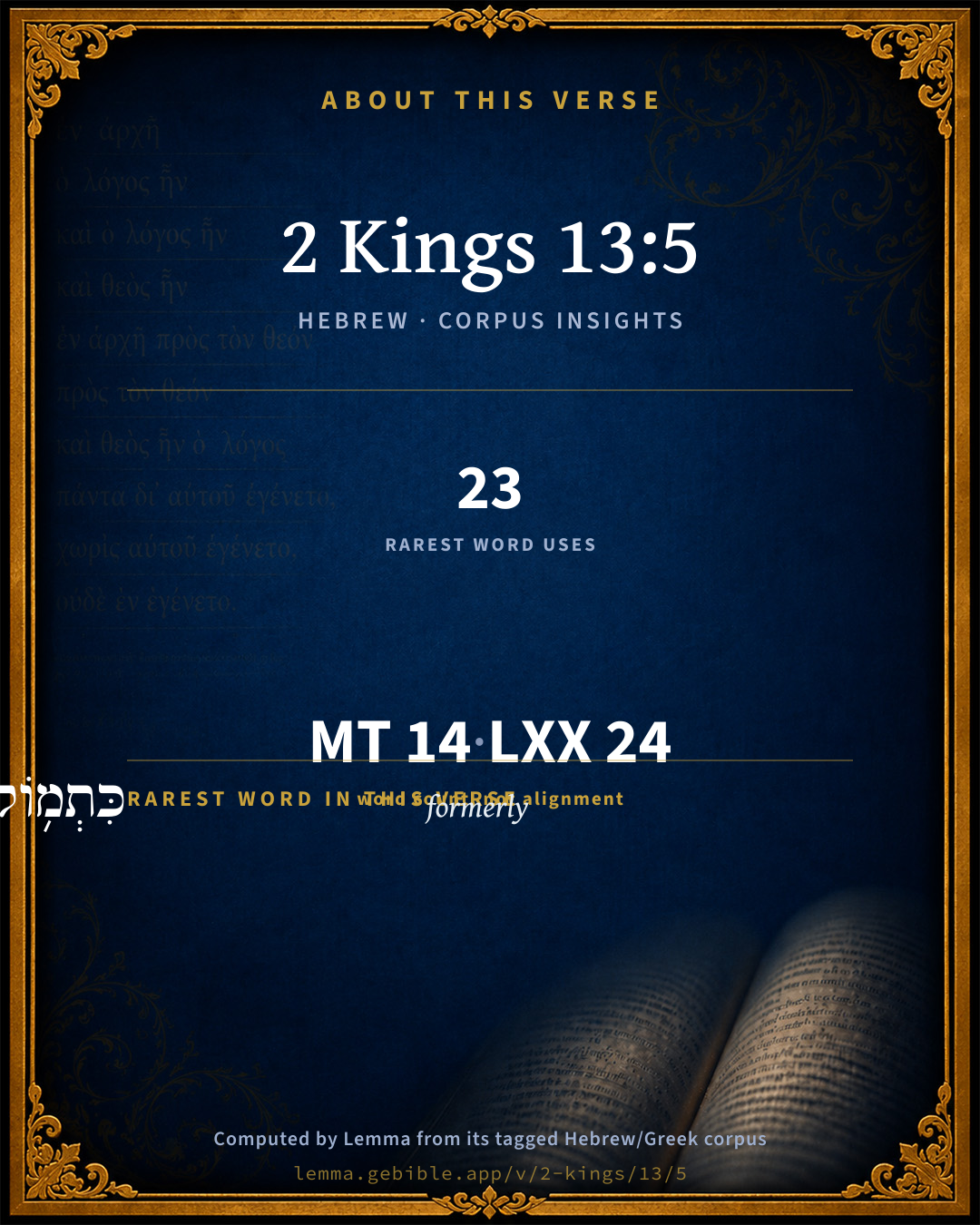
The rarest word here is כִּתְמ֥וֹל formerly H8543 — appearing just 23 times in the whole Hebrew Bible.

Shared distinctive vocabulary

כִּתְמ֥וֹל formerly H8543 occurs in 22 verses of the Hebrew Bible. Also found in:

Grammatical profile

  • 4 verbs
  • 8 nouns
  • 1 preposition
  • 1 adverb

Verb forms

  • וַיִּתֵּ֨ן Qal · Sequential Imperfect
  • מוֹשִׁ֔יעַ Hiphil · Participle Active
  • וַיֵּ֣צְא֔וּ Qal · Sequential Imperfect
  • וַיֵּשְׁב֧וּ Qal · Sequential Imperfect

Repetition

A word recurs within this verse — often emphatic in Hebrew:

  • לְיִשְׂרָאֵל֙ Israel H3478 ×2

Hebrew & Septuagint length

In English translation the verse runs 28 words from the Hebrew and 27 from the Septuagint (LXX English) — closely comparable.

A rough comparison of the two English renderings, which tokenize alike — not a word-level alignment.

Word counts can differ between the Hebrew and the Greek without any difference in meaning — e.g. the Hebrew direct-object marker אֵת has no separate Greek word, and Greek often adds the article ὁ.

In the original languages it is 14 Hebrew tokens and 24 Greek tokens — but the two are counted differently (Hebrew bundles its prefixes and suffixes into one token; the Greek is in lemma form), so that isn’t a like-for-like length.

Cross-references

11

Topical passages linked to 2 Kings 13:5 in the Treasury of Scripture Knowledge — connected by theme and wording, ordered by reader-vote popularity; previews shown in the World English Bible.

  • 2 Kings 13:25 Jehoash the son of Jehoahaz took again out of the hand of Benhadad the son of Hazael the cities which he had taken out of the hand of Jehoahaz his father by war. Three times did Joash strike him, and recovered the cities of Israel.
  • 2 Kings 14:25 He restored the border of Israel from the entrance of Hamath to the sea of the Arabah, according to the word of Yahweh, the God of Israel, which he spoke by his servant Jonah the son of Amittai, the prophet, who was of Gath Hepher.
  • 2 Kings 14:27 Yahweh didn't say that he would blot out the name of Israel from under the sky; but he saved them by the hand of Jeroboam the son of Joash.
  • Nehemiah 9:27 Therefore you delivered them into the hand of their adversaries, who distressed them: and in the time of their trouble, when they cried to you, you heard from heaven; and according to your manifold mercies you gave them saviors who saved them out of the hand of their adversaries.
  • Exodus 4:10 Moses said to Yahweh, "Oh, Lord, I am not eloquent, neither before now, nor since you have spoken to your servant; for I am slow of speech, and of a slow tongue."
  • Deuteronomy 19:4 This is the case of the manslayer, that shall flee there and live: whoever kills his neighbor unawares, and didn't hate him in time past;
  • 1 Samuel 19:7 Jonathan called David, and Jonathan showed him all those things. Jonathan brought David to Saul, and he was in his presence, as before.
  • 1 Chronicles 11:2 In times past, even when Saul was king, it was you who led out and brought in Israel: and Yahweh your God said to you, You shall be shepherd of my people Israel, and you shall be prince over my people Israel.
  • Isaiah 19:20 It shall be for a sign and for a witness to Yahweh of Hosts in the land of Egypt; for they shall cry to Yahweh because of oppressors, and he will send them a savior, and a defender, and he will deliver them.
  • Obadiah 1:21 Saviors will go up on Mount Zion to judge the mountains of Esau, and the kingdom will be Yahweh's.
  • Luke 2:11 For there is born to you, this day, in the city of David, a Savior, who is Christ the Lord.

Cross-references courtesy of OpenBible.info (CC BY 4.0).

Hebrew and Greek witnesses Masoretic Hebrew ↔ Greek Septuagint

The same verse in the two great witnesses to the Old Testament, shown verse-for-verse.

These are two independent witnesses, not word-aligned to each other, and the Septuagint is shown in lemma (dictionary) form.

Hebrew 2 Kings 13:5 Masoretic · Westminster Leningrad Codex

וַיִּתֵּ֨ן יְהוָ֤ה לְיִשְׂרָאֵל֙ מוֹשִׁ֔יעַ וַיֵּ֣צְא֔וּ מִתַּ֖חַת יַד אֲרָ֑ם וַיֵּשְׁב֧וּ בְנֵֽי יִשְׂרָאֵ֛ל בְּאָהֳלֵיהֶ֖ם כִּתְמ֥וֹל שִׁלְשֽׁוֹם

(Yahweh gave Israel a savior, so that they went out from under the hand of the Syrians; and the children of Israel lived in their tents as before.

World English Bible · Public Domain

Greek LXX 2 Kings 13:5 Septuagint · lemma form

καί δίδωμι κύριος σωτηρία ὁ ἰσραήλ καί ἐκἔρχομαι ὑποκάτωθεν χείρ συρία καί καταἵζω ὁ υἱός ἰσραήλ ἐν ὁ σκήνωμα αὐτός καθώς ἐχθές καί τρίτος

And the Lord gave deliverance to Israel, and they escaped from under the hand of Syria: and the children of Israel lived in their tents as heretofore.

LXX2012 (modern English Septuagint) · Public Domain

On this verse, The Cambridge Bible for Schools and Colleges discusses the Septuagint’s reading. Read the note in Commentary ↓

Hebrew: Westminster Leningrad Codex (CC BY 4.0). Greek: Septuagint (public domain); English from LXX2012 (modern English Septuagint) (Public Domain). How the Septuagint differs from the Hebrew →

Targum (Aramaic paraphrase)

1

The Targum is the ancient Jewish Aramaic paraphrase of the Hebrew Scriptures — an interpretive translation, not the Hebrew text itself. Onkelos (literal) and Pseudo-Jonathan (expansive) render the Torah, and Jonathan the Prophets. Coverage is partial: where no permissively-licensed English translation exists for a verse, only the Aramaic is shown. This is verse-level text, not a word-by-word alignment to the Hebrew.

  1. Targum Jonathan Prophets (Joshua–Malachi)
    וִיהַב יְיָ לְיִשְׂרָאֵל פָּרִיק וּנְפָקוּ מִתְּחוֹת יַת אֱנַשׁ אֲרָם וִיתִיבוּ בְנֵי יִשְׂרָאֵל בְּקִרְוֵיהוֹן כְּמַאִתְמָלֵי וּמִדְקָדָמוֹהִי:

    (no public-domain English translation for this verse)

    Targum Jonathan — Aramaic: “Mikraot Gedolot” (public domain). English: “Sefaria Community Translation” (CC0 1.0 (public-domain dedication)); “London "Chaldee Paraphrase," 1871” (public domain). Text via Sefaria.

Commentary

Notes on 2 Kings 13:5 from classic Christian and Jewish commentators (each source and its license shown beneath its notes). The classic Christian expositions comment on the surrounding passage and are grouped to its opening verse, so a note may address several verses; the Jewish commentaries on the Tanakh (Rashi and others) are per-verse, so they appear only where the commentator wrote on this verse.

Lemma curates 59 commentaries, every one of them public domain or Creative Commons licensed, each selected and text-cleaned for this edition rather than reprinted as found. About our sources →

Trapp's Complete Commentary

John Trapp

2Ki 13:5 (And the LORD gave Israel a saviour, so that they went out from under the hand of the Syrians: and the children of Israel dwelt in their tents, as beforetime.

Ver. 5. And the Lord gave Israel a saviour.] An angel, say some; the prophet Elisha, say others; or rather king Jehoash, {2Ki 13:25} encouraged by Elisha, with promise of a threefold victory over the Syrians.

John Trapp, A Commentary or Exposition upon All the Books of the Old and New Testament (1647–1656) — public domain. Text from a community e-Sword module.

Joseph Benson's Commentary

2Ki 13:5. The Lord gave Israel a saviour — Either Elisha, below, (2Ki 13:14,) or rather, Jehoash the son of this Jehoahaz, (2Ki 13:25,) and Jeroboam his son, 2Ki 14:25. Both of these were instrumental in working out great deliverances for Israel, although they were wicked men, who still kept up the idolatry of the calves. Israel dwelt in their tents as before time — In peace and security: not only in their strong cities, but even in their tents in the fields.

Joseph Benson's Commentary on the Old and New Testaments (1811–1818) — public domain. Text from a community e-Sword module.

Geneva Bible (1599)

Geneva Bible translators

Safely and without danger.

To wit, Joash the son of Jehoahaz.

Hebrew, as yesterday and before yesterday.

Geneva Bible (1599) marginal notes — public domain. Text via Bolls.life.

Jamieson, Fausset & Brown

Robert Jamieson, A. R. Fausset & David Brown

a saviour--This refers neither to some patriotic defender nor some signal victory, but to the deliverance obtained for Israel by the two successors of Jehoahaz, namely, Joash, who regained all the cities which the Syrians had taken from his father (Kg2 13:25); and Jeroboam, who restored the former boundaries of Israel (Kg2 14:25).

Jamieson, Fausset & Brown — Commentary Critical and Explanatory on the Whole Bible (1871) — public domain (CC PDM 1.0). Text via the HelloAO Bible API.

Adam Clarke's Commentary

Verse 5. And the Lord gave Israel a saviour] This was undoubtedly Joash, whose successful wars against the Syrians are mentioned at the conclusion of the chapter. Houbigant recommends to read the seventh verse after the fourth, then the fifth and sixth, and next the eighth, &c.

Adam Clarke's Commentary on the Bible (1810–1826) — public domain. Text from a community e-Sword/MySword module.

Ellicott's Commentary for English Readers

(5) A saviour.—Jeroboam II., the grandson of Jehoahaz, a vigorous and successful sovereign, of whom it is said that Jehovah “saved” Israel by his hand (2Ki_14:27).

They went out from under the hand.—Referring to the oppressive supremacy of Syria. From these words, and from those of 2Ki_13:22, it would appear that Israel was tributary to Syria during some part of this period.

Dwelt in their tents—i.e., in the open country. In time of war they were obliged to take refuge in strongholds and fortified cities.

As before time.—See Note on 1Ch_11:2; Gen_31:2.

A Bible Commentary for English Readers, edited by Charles John Ellicott (1878–1897) — public domain. Text from a community e-Sword module.

The Cambridge Bible for Schools and Colleges

gen. ed. J. J. S. Perowne

5. And the Lord gave Israel a saviour] The LXX, has σωτηρίαν ‘salvation’, ‘deliverance’. The two verses 5 and 6 are a parenthesis, and interrupt the connexion. The ‘saviour’ alludes to what is said of Jeroboam 2. (2Ki_14:27). ‘The Lord saved Israel by the hand of Jeroboam the son of Joash’. This was the time when the prayer of Jehoahaz was truly answered, in the reign of his grandson. That passage is connected with this also by the language of the preceding verse (26) ‘The Lord saw the affliction of Israel, that it was bitter’.

so that they went out from under the hand of the Syrians] Language like this must refer to some very great change in the relative positions of Syria and Israel. We have some indication of it in the statement (2Ki_14:28) that Jeroboam recovered Damascus for Israel. By such a reverse the power of Syria must have been severely broken. We learn from the cuneiform inscriptions (1 Rawl. 35) that Damascus was about this time made subject to Assyria (Schrader p. 110; Eng. Trans. vol. 1. 203). It may be therefore that by the help of Assyria (which we have seen that Israel sometimes gained at the expense of liberty) the kings of Israel were able to shake off the thraldom of their nearer, and therefore more galling, oppressor, at first partially, then completely, so as to come from under his hand.

the children of Israel dwelt in their tents] The expression may refer to the peaceful state when the dwellers in the country could live safely out amid their flocks and crops, and not be constrained by the pressure of war to seek refuge in the towns. But it has been noted (see on 1Ki_8:66) that ‘tents’ is used for ‘homes’. Hence the words of this verse may mean only that the people lived quietly at home, and were not constantly called forth to resist the inroads of the Syrians.

The Cambridge Bible for Schools and Colleges (gen. ed. J. J. S. Perowne; Cambridge University Press, 1878–1918) — public domain. Text from a community e-Sword module.

John Gill's Exposition

And the Lord gave Israel a saviour,.... Not an angel sent by him, nor a captain raised up among them, nor the prophet Elisha, who predicted their deliverance, nor Jehoahaz himself, but his son Joash, Kg2 13:25.

so that they went out from under the hand of the Syrians; were not in subjection to them, nor harassed by them, nor in fear of them:

and the children of Israel dwelt in their tents, as before time; in peace and safety.

John Gill's Exposition of the Whole Bible (1746–1763) — public domain (CC PDM 1.0). Text via the HelloAO Bible API.

Albert Barnes' Notes on the Bible

The Lord gave Israel a saviour - Not immediately on the repentance of Jehoahaz but after his death (see 2Ki 13:25).

They went out from under the hand of the Syrians - i. e. they ceased to be oppressed by the Syrians; they shook off their yoke, and became once more perfectly independent.

Tents - See 1Ki 8:66 note.

Albert Barnes' Notes on the Bible (1834–1885) — public domain. Text from a community e-Sword/MySword module.

Haydock's Catholic Bible Commentary

Saviour, in the person of Joas, (ver. 23.; Tostat) after the death of Joachaz, whose repentance preserved him, at least, in this world. (Haydock)

George Leo Haydock (1774–1849), Haydock's Catholic Family Bible and Commentary, 1859 edition — public domain. Excludes Psalms (Douay-Rheims chapter numbering differs from Protestant) and Deuterocanonical books (Catholic canon only).

Matthew Poole's English Annotations

A saviour; either Elisha, below, 2Ki 13:14; or rather, Jehoash, the son of this Jehoahaz, below, 2Ki 13:25, and Jeroboam his son, 2Ki 14:25.

In their tents, as beforetime; in peace and security, not only in their strong cities, but even in their tents in the fields.

Matthew Poole's English Annotations on the Holy Bible (1683–1685) — public domain. Text from a community e-Sword/MySword module.

Whedon's Commentary on the Bible

Daniel D. Whedon

5. A saviour — According to 2Ki_13:22, this saviour could not have saved Israel in the days of Jehoahaz; so it is hardly satisfactory to refer it to some unknown temporary deliverer during the reign of this king. This saviour came not in Jehoahaz’s days, but, after his death in the person of his son Jehoash, who, according to 2Ki_13:25, recovered from the then Syrian king the cities which his father had lost by war. The deliverance was still further secured under Jeroboam, the son of Joash. Compare 2Ki_14:27. Others have supposed, but with little reason, that this saviour was an angel, or perhaps Elisha.

Dwelt in their tents — That is, at peace in their homes, not disturbed by constant rumours of war, and invasion by foreign armies.

Daniel D. Whedon (gen. ed.), Commentary on the Old and New Testaments (1874–1909) — public domain. Text from a community e-Sword module.

The Pulpit Commentary

And the Lord gave Israel a savior, so that they went out from under the hand of the Syrians. A "savior means a deliverer from the hand of the Syrians. (comp. Jud_1:3:9, 15 Neh_9:27, where in the Hebrew the word used is the same) The special "deliverer" was probably in the mind of the writer, Jeroboam II, by whom he says, in 2Ki_14:27, that God "saved" Israel; but Joash, who began the deliverance (ver. 25), may also be glanced at, And the children of Israel dwelt in their tents. Here, as so often elsewhere (1Ki_8:66 1Ki_12:16; Zec_12:7) the word "tents" is a mere archaism for "abodes, houses." Israel had dwelt in tents until the going down into Egypt, and again from the time of quitting Egypt to the entrance into Canaan; and thus the word ohel had ac quired a secondary meaning of "abode," "dwelling-place." In the time which followed on the deliverance from the Syrian yoke, the Israelites of the ten tribes were no longer engaged in marches and countermarches, in battles, skirmishes, or sieges, but quietly abode in their several houses. As beforetime; i.e. as in the peaceful time before the attacks of Hazael began.

The Pulpit Commentary (1880–1919), ed. H.D.M. Spence-Jones & Joseph S. Exell — public domain. Text from a community e-Sword module.

Rashi

Rabbi Shlomo Yitzchaki (Rashi)

And Adonoy provided Yisroel with a savior. Yoash son of Yehoachaz, concerning whom it is stated, “You will strike [and defeat] Arom [only] three times.”

Rashi on the Tanakh — English translations: “The Judaica Press complete Tanach with Rashi, translated by A. J. Rosenberg” (CC BY 4.0); “Pentateuch with Rashi's commentary by M. Rosenbaum and A.M. Silbermann, 1929-1934” (public domain); “The Metsudah Tanach series, Lakewood, N.J” (CC BY 4.0); and “The Book of Joshua, Metsudah Publications, 1997” (CC BY 4.0). Text via Sefaria.

Lesson kit

Teaching starters — assembled from the data on this page, not authored interpretation. Every prompt links to the verse data it draws on. Edit before teaching.

2 Kings, in the Historical, opens this verse with 14 words (13 distinct Hebrew lemmas). Its most distinctive word is tᵉmôwl (“formerly”). A historical commentator’s framing appears above. Read the whole chapter for the surrounding context.

Discussion questions

  1. How does “formerly” (tᵉmôwl) shape what this verse is saying?
  2. How does Genesis 31:2, which shares the word «formerly», read alongside this verse?
  3. What does the repetition of “Israel” (2× in this one verse) do in this verse?
  4. The translations on this page render this verse differently — a whole-verse word diff, not a word-by-word alignment. What might account for the different wordings?
  5. «וַיִּתֵּ֨ן» is a Qal Sequential Imperfect verb. How does that grammatical form shape the action described?
  6. Compare how Trapp's Complete Commentary and Joseph Benson's Commentary read this verse. Where do they agree or differ?

Things to notice

Reading settings

Reading text

Shown beneath each verse's original-language words.

Old Testament
Old Testament edition

Read the OT as the Masoretic Hebrew (MT) or the Greek Septuagint (LXX).

English shown for the Greek Septuagint (in the Hebrew ↔ Greek comparison).

Comparing translations? Open the Compare panel on any verse page to stack up to four side by side.