
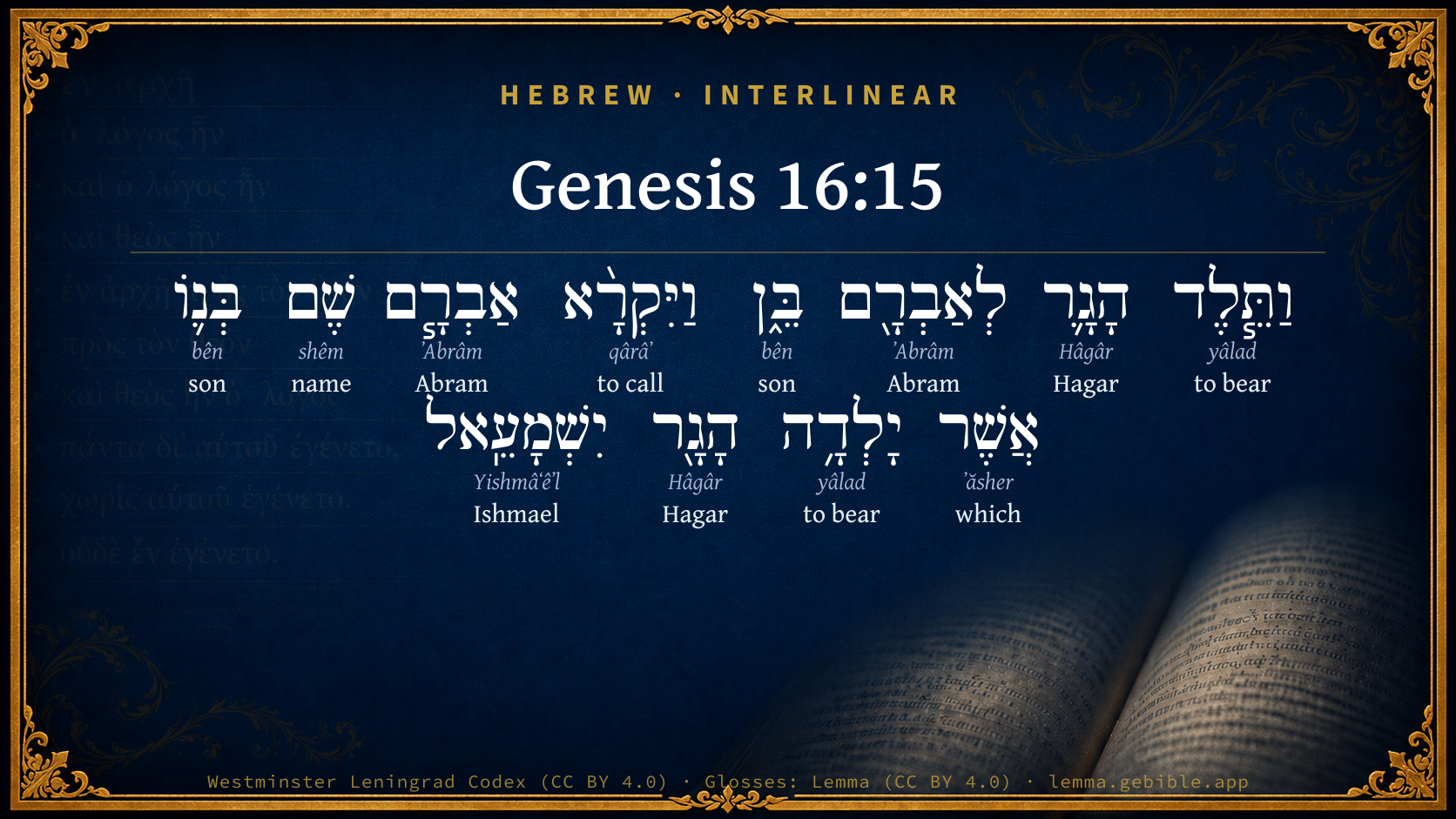
Genesis 16:15

Hebrew (Westminster Leningrad Codex) Genesis 16:15 appears in the Hebrew Old Testament. The text above is from the Westminster Leningrad Codex. Each word links to its Strong’s number, a concise gloss, and parsing drawn from the Open Scriptures Hebrew Bible morphology. Click any word for its full Brown-Driver-Briggs (BDB) entry.
Download image
Cite this verse

Genesis 16:15 (World English Bible). Public Domain. Lemma interlinear Bible study tool, https://lemma.gebible.app/v/genesis/16/15.

Show BibTeX & RIS
BibTeX
RIS
English Translation
Hagar bore a son for Abram. Abram called the name of his son, whom Hagar bore, Ishmael.
World English Bible · Public Domain
Download a study sheet

One document with this verse’s original text, its word-by-word gloss line, the meaning frame, cross-references with their text, attributed commentary, and full source and license credits — printable, and it pastes into notes with its structure intact.

This verse Autodidact and up

Study sheet (.html) Plain text (.txt)

A passage Seminary Student

Up to 50 verses in one chapter. A passage sheet keeps up to 6 commentary sources and 12 cross-references per verse, in the order this page ranks them, and says so on the sheet whenever that leaves anything out. Ask for a single verse and you get the Autodidact verse sheet above.

Everything on this page stays free to read, with no account — the sheet is a download of what is already on screen, not access to it.

Want to remove ads? Support Godless Engineer
Compare translations 3

The same verse in 3 English versions, stacked beneath the original-language interlinear above. Click any original word for its lexicon entry.

Each is an independent rendering of the whole verse — the interlinear is not word-aligned to these translations.

Highlighted words mark where these versions differ — a whole-verse word diff, not a word-by-word alignment.

  • World English Bible Public Domain
    Hagar bore a son for Abram. Abram called the name of his son, whom Hagar bore, Ishmael.
  • King James Version Public Domain
    And Hagar bare Abram a son: and Abram called his son's name, which Hagar bare, Ishmael.
  • unfoldingWord Literal Text CC BY-SA 4.0
    Then Hagar bore a son for Abram, and Abram called the name of his son, whom Hagar bore, Ishmael.

unfoldingWord Literal Text — © unfoldingWord, licensed CC BY-SA 4.0. Word-aligned USFM3 via Door43 (git.door43.org/unfoldingWord/en_ult).

Versions to compare (up to 4)

3 of 4 selected

Show all 18 translations

Every available English version of this verse, each an independent rendering of the whole verse.

  • World English Bible Public Domain
    Hagar bore a son for Abram. Abram called the name of his son, whom Hagar bore, Ishmael.
  • Berean Standard Bible Public Domain
    And Hagar bore Abram a son, and Abram gave the name Ishmael to the son she had borne.
  • Majority Standard Bible Public Domain
    And Hagar bore Abram a son, and Abram gave the name Ishmael to the son she had borne.
  • King James Version Public Domain
    And Hagar bare Abram a son: and Abram called his son's name, which Hagar bare, Ishmael.
  • American Standard Version (1901) Public Domain
    And Hagar bare Abram a son: and Abram called the name of his son, whom Hagar bare, Ishmael.
  • Revised Version (1885) Public Domain
    And Hagar bare Abram a son: and Abram called the name of his son, which Hagar bare, Ishmael.
  • Geneva Bible (1599) Public Domain
    And Hagar bare Abram a sonne, and Abram called his sonnes name, which Hagar bare, Ishmael.
  • Douay-Rheims (1899) Public Domain
    And Agar brought forth a son to Abram: who called his name Ismael.
  • Young's Literal Translation Public Domain
    And Hagar beareth to Abram a son; and Abram calleth the name of his son, whom Hagar hath borne, Ishmael;
  • Literal Standard Version CC BY-SA 4.0
    And Hagar bears a son to Abram; and Abram calls the name of his son, whom Hagar has borne, Ishmael;
  • Unlocked Literal Bible CC BY-SA 4.0
    Hagar gave birth to Abram's son, and Abram named his son, whom Hagar bore, Ishmael.
  • unfoldingWord Literal Text CC BY-SA 4.0
    Then Hagar bore a son for Abram, and Abram called the name of his son, whom Hagar bore, Ishmael.
  • Darby Bible Public Domain
    And Hagar bore Abram a son; and Abram called the name of his son whom Hagar bore, Ishmael.
  • World Messianic Bible Public Domain
    Hagar bore a son for Abram. Abram called the name of his son, whom Hagar bore, Ishmael.
  • Webster's Bible Public Domain
    And Hagar bore Abram a son: and Abram called his son's name, which Hagar bore, Ishmael.
  • Free Bible Version CC BY-SA 4.0
    Hagar gave birth to a son for Abram. Abram named his son Ishmael.
  • Bible in Basic English Public Domain
    And Hagar gave birth to a child, the son of Abram, to whom Abram gave the name of Ishmael.
  • JPS Tanakh (1917) Public Domain
    And Hagar bore Abram a son; and Abram called the name of his son, whom Hagar bore, Ishmael.

Literal Standard Version (2020), Covenant Press — licensed CC BY-SA 4.0. Text via the HelloAO Bible API (eBible.org). Unlocked Literal Bible (unfoldingWord) — licensed CC BY-SA 4.0. Text via the HelloAO Bible API (eBible.org). unfoldingWord Literal Text — © unfoldingWord, licensed CC BY-SA 4.0. Word-aligned USFM3 via Door43 (git.door43.org/unfoldingWord/en_ult). Free Bible Version, Dr. Jonathan Gallagher — licensed CC BY-SA 4.0. Text via the HelloAO Bible API (eBible.org).

Word by word

More ways to search: Search by grammar → Find every occurrence → Compare this word →

Practice this passage: Drill this verse → Learn its vocabulary →

About this verse

These counts appear in no published source. They are computed here, from the morphology-tagged text and Lemma’s own curated glosses. What Lemma adds →

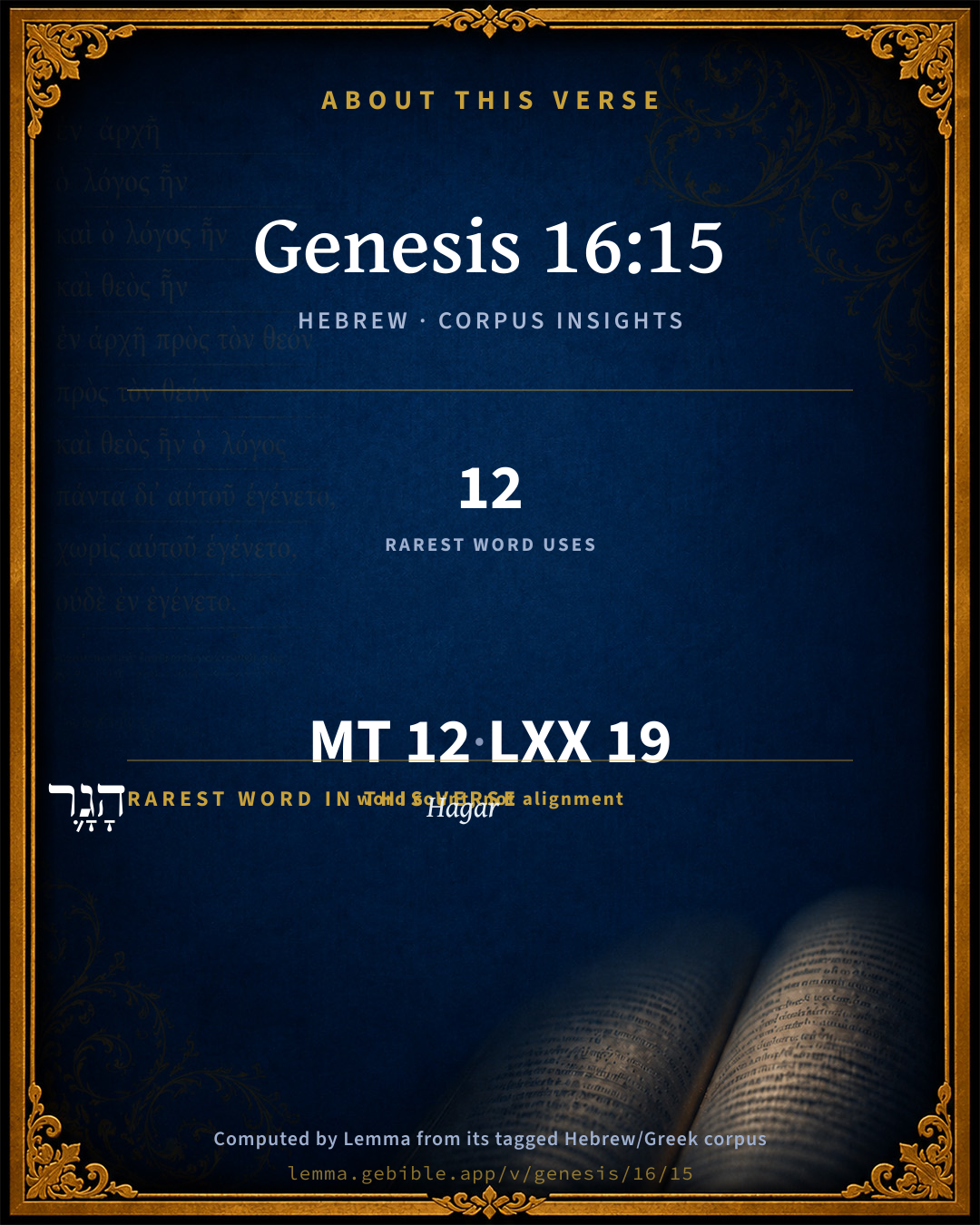
12
words
8
distinct lemmas
Pentateuch
section

Notable vocabulary

The rarest word here is הָגָ֛ר Hagar H1904 — appearing just 12 times in the whole Hebrew Bible.

Shared distinctive vocabulary

הָגָ֛ר Hagar H1904 occurs in 10 verses of the Hebrew Bible. Also found in:

Grammatical profile

  • 3 verbs
  • 8 nouns
  • 1 particle

Verb forms

  • וַתֵּ֧לֶד Qal · Sequential Imperfect
  • וַיִּקְרָ֨א Qal · Sequential Imperfect
  • יָלְדָ֥ה Qal · Perfect

Repetition

Words recur within this verse — often emphatic in Hebrew:

  • וַתֵּ֧לֶד to bear H3205 ×2
  • הָגָ֛ר Hagar H1904 ×2
  • לְאַבְרָ֖ם Abram H87 ×2
  • בֵּ֑ן son H1121 ×2

Hebrew & Septuagint length

In English translation the verse runs 17 words from the Hebrew and 21 from the Septuagint (LXX English) — closely comparable.

A rough comparison of the two English renderings, which tokenize alike — not a word-level alignment.

Word counts can differ between the Hebrew and the Greek without any difference in meaning — e.g. the Hebrew direct-object marker אֵת has no separate Greek word, and Greek often adds the article ὁ.

In the original languages it is 12 Hebrew tokens and 19 Greek tokens — but the two are counted differently (Hebrew bundles its prefixes and suffixes into one token; the Greek is in lemma form), so that isn’t a like-for-like length.

Cross-references

11

Topical passages linked to Genesis 16:15 in the Treasury of Scripture Knowledge — connected by theme and wording, ordered by reader-vote popularity; previews shown in the World English Bible.

  • Genesis 25:12 Now this is the history of the generations of Ishmael, Abraham's son, whom Hagar the Egyptian, Sarah's handmaid, bore to Abraham.
  • Genesis 16:11 The angel of Yahweh said to her, "Behold, you are with child, and will bear a son. You shall call his name Ishmael, because Yahweh has heard your affliction.
  • Genesis 17:18 Abraham said to God, "Oh that Ishmael might live before you!"
  • Genesis 17:20 As for Ishmael, I have heard you. Behold, I have blessed him, and will make him fruitful, and will multiply him exceedingly. He will become the father of twelve princes, and I will make him a great nation.
  • Genesis 17:25–26 Ishmael, his son, was thirteen years old when he was circumcised in the flesh of his foreskin.
  • Genesis 21:9–21 Sarah saw the son of Hagar the Egyptian, whom she had borne to Abraham, mocking.
  • Genesis 25:9 Isaac and Ishmael, his sons, buried him in the cave of Machpelah, in the field of Ephron, the son of Zohar the Hittite, which is before Mamre,
  • Genesis 28:9 Esau went to Ishmael, and took, besides the wives that he had, Mahalath the daughter of Ishmael, Abraham's son, the sister of Nebaioth, to be his wife.
  • Genesis 37:27 Come, and let's sell him to the Ishmaelites, and not let our hand be on him; for he is our brother, our flesh." His brothers listened to him.
  • 1 Chronicles 1:28 The sons of Abraham: Isaac, and Ishmael.
  • Galatians 4:22–23 For it is written that Abraham had two sons, one by the handmaid, and one by the free woman.

Cross-references courtesy of OpenBible.info (CC BY 4.0).

Hebrew and Greek witnesses Masoretic Hebrew ↔ Greek Septuagint

The same verse in the two great witnesses to the Old Testament, shown verse-for-verse.

These are two independent witnesses, not word-aligned to each other, and the Septuagint is shown in lemma (dictionary) form.

Hebrew Genesis 16:15 Masoretic · Westminster Leningrad Codex

וַתֵּ֧לֶד הָגָ֛ר לְאַבְרָ֖ם בֵּ֑ן וַיִּקְרָ֨א אַבְרָ֧ם שֶׁם בְּנ֛וֹ אֲשֶׁר יָלְדָ֥ה הָגָ֖ר יִשְׁמָעֵֽאל

Hagar bore a son for Abram. Abram called the name of his son, whom Hagar bore, Ishmael.

World English Bible · Public Domain

Greek LXX Genesis 16:15 Septuagint · lemma form

καί τίκτω αγαρ ὁ αβραμ υἱός καί καλέω αβραμ ὁ ὄνομα ὁ υἱός αὐτός ὅς τίκτω αὐτός αγαρ ισμαηλ

And Agar bore a son to Abram; and Abram called the name of his son which Agar bore to him, Ismael.

LXX2012 (modern English Septuagint) · Public Domain

Hebrew: Westminster Leningrad Codex (CC BY 4.0). Greek: Septuagint (public domain); English from LXX2012 (modern English Septuagint) (Public Domain). How the Septuagint differs from the Hebrew →

Targum (Aramaic paraphrase)

2

The Targum is the ancient Jewish Aramaic paraphrase of the Hebrew Scriptures — an interpretive translation, not the Hebrew text itself. Onkelos (literal) and Pseudo-Jonathan (expansive) render the Torah, and Jonathan the Prophets. Coverage is partial: where no permissively-licensed English translation exists for a verse, only the Aramaic is shown. This is verse-level text, not a word-by-word alignment to the Hebrew.

  1. Targum Onkelos Torah (Genesis–Deuteronomy)
    וִילִידַת הָגָר לְאַבְרָם בָּר וקְרָא אַבְרָם שׁוּם בְּרֵיהּ דִילִידַת הָגָר יִשְׁמָעֵאל

    (no public-domain English translation for this verse)

    Targum Onkelos — Aramaic: “Onkelos Genesis” (public domain); “Onkelos Exodus” (public domain); “Onkelos Leviticus” (public domain); “Onkelos Numbers” (public domain); “Onkelos Deuteronomy” (public domain). English: “Sefaria Community Translation” (CC0 1.0 (public-domain dedication)); “J.W. Etheridge. The Targums of Onkelos and Jonathan Ben Uzziel on the Pentateuch. London: Longmans, Green, 1862” (public domain). Text via Sefaria.

  2. Targum Pseudo-Jonathan Torah (Genesis–Deuteronomy)
    וִילֵידַת הָגָר לְאַבְרָם בַּר וּקְרָא אַבְרָם שׁוּם בְּרֵיהּ דִלֵידַת הָגָר יִשְׁמָעֵאל

    And Hagar bare Abram a son, and Abram called the name of his son whom Hagar bare, Ishmael.

    Targum Pseudo-Jonathan — Aramaic: “Targum Jonathan on Genesis” (public domain); “Targum Jonathan on Exodus” (public domain); “Targum Jonathan on Leviticus” (public domain); “Targum Jonathan on Numbers” (public domain); “Targum Jonathan on Deuteronomy” (public domain). English: “The Targum of Jonathan ben Uzziel, trans. J. W. Etheridge, London, 1862” (public domain). Text via Sefaria.

Commentary

Notes on Genesis 16:15 from classic Christian and Jewish commentators (each source and its license shown beneath its notes). The classic Christian expositions comment on the surrounding passage and are grouped to its opening verse, so a note may address several verses; the Jewish commentaries on the Tanakh (Rashi and others) are per-verse, so they appear only where the commentator wrote on this verse.

Lemma curates 59 commentaries, every one of them public domain or Creative Commons licensed, each selected and text-cleaned for this edition rather than reprinted as found. About our sources →

Trapp's Complete Commentary

John Trapp

Gen 16:15 And Hagar bare Abram a son: and Abram called his son’s name, which Hagar bare, Ishmael.

Ver. 15. Ishmael.] A good name, had he made good use of it, and a great name still among the Persians.

John Trapp, A Commentary or Exposition upon All the Books of the Old and New Testament (1647–1656) — public domain. Text from a community e-Sword module.

The Preacher's Complete Homiletical Commentary

Joseph S. Exell (gen. ed.)

MAIN HOMILETICS OF THE PARAGRAPH.—Gen_16:15-16

THE CONVICTION OF A SPECIAL PROVIDENCE: PRACTICAL EFFECTS

I. That we enter again the paths of duty. The impression of this special visitation of God was not lost upon Hagar. She translated it into duty, and at the Divine command returned to the home which she had deserted. There, in the ways of humble duty, she was to serve God, and work out the designs of His Providence. The soul’s true life is found not in prolonged rapture and amazement, but in simple faith, love, and obedience.

II. That we are found in the way of religious privilege. When Hagar wandered in the wilderness she put herself out of the way of the religious privileges which were found in Abram’s family. She now returns to that home where God was feared with a holy dread, and confided in with a trusting love. If we have wandered from the place of religious privilege, and God has met us so that we can distinctly trace His dealings, it is our duty to return. The Church of God is our true home, where alone our graces can revive and grow.

SUGGESTIVE COMMENTS ON THE VERSES

Gen_16:15-16. It is here implied that Hagar told Abram of the vision, and of the name which God had appointed for her son. God’s children take their part in carrying out His designs concerning others. Abram gives that name which had been revealed to another.

The trials of waiting for promised blessings.

1. The time is often long. Abram was now eighty-six years old, and up to this point of time was childless. He had to wait through many long and weary years till the sight of this child gladdened his eyes. God sometimes delays the fulfilment of His promises so long that the patience of His people is sorely tried.

2. We may be deceived by what is only intended to be a provisional fulfilment. Abram thought that the son of Hagar was the promised and long-desired son by whom he was to be a blessing to all generations. But he had to wait fourteen years for the true son of promise. He rejoiced too soon. God often gives us some fulfilment of His word, which stays for a time the desires of our soul. Thus we are led on till we find, at last, that real and solid good which is laid up for us.

During thirteen years of the time of Abram’s waiting, it would seem that all those delightful personal manifestations of the Almighty which he had hitherto enjoyed were suspended; but whether this was designed, as some have suggested, as a token of the Divine displeasure, or whether it is to be referred to the sovereign good pleasure of Him who giveth not account of any of His matters, it is not for us to say. It is certain, however, as a general fact, that similar conduct is productive of similar results, and that if we find that it is not with us as in times past—that communion with God is more than usually difficult—that our intercourse with heaven is sadly impeded, our prayers hindered, and our praises deadened—the cause is to be sought in ourselves. It is not a mere sovereign withdrawal of the light of God’s countenance, but a merited rebuke of some secret offence, some unrestrained temper, some unholy compliance, some unchecked and unchastened desire, which is suffered to remain undetected in the heart, and to rob us of the promised blessing.—(Bush.)

The posterity of Ishmael were earliest in the field of history. In the ordinary view they seemed the greater and the more important; yet these were not to be the channels of God’s highest blessings to mankind. Thus it is that “the first shall be last.”

The Preacher's Complete Homiletical Commentary (gen. ed. Joseph S. Exell; Funk & Wagnalls, c. 1892) — public domain (pre-1929). A full-Bible homiletical/sermon-outline anthology covering 65 of 66 books (2 John is absent from the source module). Text from a community e-Sword module.

Matthew Henry's Commentary

It is here taken for granted, though not expressly recorded, that Hagar did as the angel commanded her, returning to here mistress and submitting herself; and then, in the fulness of time, she brought forth her son. Note, Those who obey divine precepts shall have the comfort of divine promises. This was the son of the bond-woman that was born after the flesh (Gal 4:23), representing the unbelieving Jews, v. 25. Note, 1. Many who can call Abraham father are yet born after the flesh, Mat 3:9. 2. The carnal seed in the church are sooner brought forth than the spiritual. It is an easier thing to persuade men to assume the form of godliness than to submit to the power of godliness.

Matthew Henry's Commentary on the Whole Bible (1708–1710) — public domain (CC PDM 1.0). Text via the HelloAO Bible API.

Adam Clarke's Commentary

Verse 15. And Hagar bare Abram a son, c.] It appears, therefore, that Hagar returned at the command of the angel, believing the promise that God had made to her.

Called his son's name - Ishmael.] Finding by the account of Hagar, that God had designed that he should be so called. "Ishmael," says Ainsworth, "is the first man in the world whose name was given him of God before he was born."

IN the preceding chapter we have a very detailed account of the covenant which God made with Abram, which stated that his seed would possess Canaan and this promise, on the Divine authority, he steadfastly believed, and in simplicity of heart waited for its accomplishment. Sarai was not like minded. As she had no child herself, and was now getting old, she thought it necessary to secure the inheritance by such means as were in her power; she therefore, as we have seen, gave her slave to Abram, that she might have children by her. We do not find Abram remonstrating on the subject; and why is he blamed? God had not as yet told him how he was to have an heir; the promise simply stated, He that shall come forth out of thine own bowels shall be thine heir, Ge 15:4. Concubinage, under that dispensation, was perfectly lawful; therefore he could, with equal justice and innocence, when it was lawful in itself, and now urged by the express desire of Sarai, take Hagar to wife. And it is very likely that he might think that his posterity, whether by wife or concubine, as both were lawful, might be that intended by the promise.

It is very difficult to believe that a promise which refers to some natural event can possibly be fulfilled but through some natural means. And yet, what is nature but an instrument in God's hands? What we call natural effects are all performed by supernatural agency; for nature, that is, the whole system of inanimate things, is as inert as any of the particles of matter of the aggregate of which it is composed, and can be a cause to no effect but as it is excited by a sovereign power. This is a doctrine of sound philosophy, and should be carefully considered by all, that men may see that without an overruling and universally energetic providence, no effect whatever can be brought about. But besides these general influences of God in nature, which are all exhibited by what men call general laws, he chooses often to act supernaturally, i.e., independently of or against these general laws, that we may see that there is a God who does not confine himself to one way of working, but with means, without means, and even against natural means, accomplishes the gracious purposes of his mercy in the behalf of man. Where God has promised let him be implicitly credited, because he cannot lie; and let not hasty nature intermeddle with his work.

The omniscience of God is a subject on which we should often reflect, and we can never do it unfruitfully while we connect it, as we ever should, with infinite goodness and mercy. Every thing, person, and circumstance, is under its notice; and doth not the eye of God affect his heart? The poor slave, the stranger, the Egyptian, suffering under the severity of her hasty, unbelieving mistress, is seen by the all-wise and merciful God. He permits her to go to the desert, provides the spring to quench her thirst, and sends the Angel of the covenant to instruct and comfort her. How gracious is God! He permits us to get into distressing circumstances that he may give us effectual relief; and in such a way, too, that the excellence of the power may appear to be of him, and that we may learn to trust in him in all our distresses. God delights to do his creatures good.

In all transactions between God and man, mentioned in the sacred writings, we see one uniform agency; the great Mediator in all, and through all; God ever coming to man by him, and man having access to God through him. This was, is, and ever will be the economy of grace. "The Father hath sent me:-and no man cometh unto the Father but by me." God forbid that he should have cause to complain of us, "YE will not come unto me, that ye might have life."

Adam Clarke's Commentary on the Bible (1810–1826) — public domain. Text from a community e-Sword/MySword module.

John Calvin's Commentaries

15. And Abram called Hagar had been commanded to give that name to her son; but Moses follows the order of nature; because fathers, by the imposition of the name, declare the power which they have over their sons. We may easily gather, that Hagar, when she returned home, related the events which had occurred. Therefore, Abram shows himself to be obedient and grateful to God: because he both names his son according to the command of the angel, and celebrates the goodness of God in having hearkened to the miseries of Hagar.

John Calvin's Commentaries (1540-1563) — public domain. Text from the Calvin Translation Society English edition (1840s-50s) via the Christian Classics Ethereal Library (ccel.org). Calvin's coverage is partial (roughly two-thirds of the Bible); uncommented books and verses are honest gaps, never fabricated. The 19th-century editor's footnotes and remarks are omitted so the notes are faithfully Calvin's own voice.

The Cambridge Bible for Schools and Colleges

gen. ed. J. J. S. Perowne

15. Abram called … Ishmael] See note on Gen_16:11. The father here gives the name as usually in P: see notes on Gen_4:1; Gen_4:17; Gen_4:25, Gen_5:3.

15, 16. The Birth of Ishmael. (P.)

These verses are from P, and are inserted in place of J’s account of the birth of Ishmael.

The Cambridge Bible for Schools and Colleges (gen. ed. J. J. S. Perowne; Cambridge University Press, 1878–1918) — public domain. Text from a community e-Sword module.

John Gill's Exposition

And Hagar bare Abram a son,.... Being returned to his house, and received by him, and reconciled to Sarai, she brought forth a son to Abram, according to the prediction of the angel:

and Abram called his son's name, which Hagar bare, Ishmael; and this name Jarchi suggests he gave by the inspiration of the Holy Spirit that dwelt in him: but it is highly reasonable to suppose, that Hagar upon her return reported to Abram the whole of the conversation she had with the angel; wherefore Abram believing what she said, in obedience to the order and command of the angel, gave him this name.

John Gill's Exposition of the Whole Bible (1746–1763) — public domain (CC PDM 1.0). Text via the HelloAO Bible API.

Haydock's Catholic Bible Commentary

Agar being returned home, and having obtained pardon. --- Ismael, as the angel had foretold; an honour shewn to very few; such as Isaac, Solomon, Jesus, &c. (Haydock)

George Leo Haydock (1774–1849), Haydock's Catholic Family Bible and Commentary, 1859 edition — public domain. Excludes Psalms (Douay-Rheims chapter numbering differs from Protestant) and Deuterocanonical books (Catholic canon only).

Matthew Poole's English Annotations

Hagar bare Abram a son, to wit, after her return and submission to her mistress, which is evident from the following history.

Matthew Poole's English Annotations on the Holy Bible (1683–1685) — public domain. Text from a community e-Sword/MySword module.

The Pulpit Commentary

And Hagar bare Abram a son: and Abram called his son"s name a peculiarity of the Elohist to assign the naming of a child to the father (Knobel); but the present chapter is usually ascribed to the Jehovist, while the instances in which the name is given by the mother do not always occur in Jehovistic sections (cf. Gen_30:6, which Tuch imputes to the Elohist) which Hagar bare, Ishmael thus acknowledging the truth of Hagar"s vision.

The Pulpit Commentary (1880–1919), ed. H.D.M. Spence-Jones & Joseph S. Exell — public domain. Text from a community e-Sword module.

Keil & Delitzsch

C. F. Keil & F. Delitzsch

Having returned to Abram's house, Hagar bare him a son in his 86th year. He gave it the name Ishmael, and regarded it probably as the promised seed, until, thirteen years afterwards, the counsel of God was more clearly unfolded to him.

Keil & Delitzsch — Biblical Commentary on the Old Testament (1861–1891) — public domain (CC PDM 1.0). Text via the HelloAO Bible API. (Old Testament only.)

unfoldingWord translationNotes

Door43 World Missions Community

Hagar gave birth

Hagar's return to Sarai and Abram is implict. You can make this more explicit. AT: "So Hagar went back and gave birth" (See: Assumed Knowledge and Implicit Information)

named his son, whom Hagar bore

"named his son by Hagar" or "named his and Hagar's son"

Abram was

This introduces background information about Abram's age when these things happened. Your language may have a special way to mark background information. (See: Background Information)

bore Ishmael to Abram

This means "gave birth to Abram's son, Ishmael." The focus is on Abram having a son.

translationWords

Hagar

Abraham

Ishmael

unfoldingWord translationNotes — © Distant Shores Media and the Door43 World Missions Community, licensed CC BY-SA 4.0. Source: git.door43.org/Door43/en_tn.

Rashi

Rabbi Shlomo Yitzchaki (Rashi)

'ויקרא אברם שם וגו AND ABRAM CALLED THE NAME [OF HIS SON] etc. — Although Abram had not heard the words of the angel when he said to Hagar “and thou shalt call his name Ishmael”, yet the Holy Spirit rested upon him and he called him Ishmael.

Rashi on the Tanakh — English translations: “The Judaica Press complete Tanach with Rashi, translated by A. J. Rosenberg” (CC BY 4.0); “Pentateuch with Rashi's commentary by M. Rosenbaum and A.M. Silbermann, 1929-1934” (public domain); “The Metsudah Tanach series, Lakewood, N.J” (CC BY 4.0); and “The Book of Joshua, Metsudah Publications, 1997” (CC BY 4.0). Text via Sefaria.

Radak

Rabbi David Kimhi (Radak)

ויקרא אברם, even though the angel had instructed Hagar what name to give to the son she would bear, she conveyed this message to Avram, so that both she and Avram called her son Ishmael, in accordance with the angel's instructions. We find a similar situation in Genesis 4,25 and (Genesis 5,3) when Adam's third son was born, where the Torah tells us that both Chavah and Adam called him Sheth. On other occasions we find that father and mother named the same child differently, such as Rachel calling her youngest son בן אוני, whereas Yaakov call him.בנימין (Genesis 35,18)

Radak on the Tanakh — English translations: “Sefaria Community Translation” (CC0 1.0 (public-domain dedication)); “Eliyahu Munk, HaChut Hameshulash” (CC BY 4.0); “Rabbi Mike Feuer, Jerusalem Anthology” (CC BY 4.0); and “R. David Kimhi on the first book of Psalms, Translated by R.G. Finch, London, 1919” (public domain). Text via Sefaria.

Lesson kit

Teaching starters — assembled from the data on this page, not authored interpretation. Every prompt links to the verse data it draws on. Edit before teaching.

Genesis, in the Pentateuch, opens this verse with 12 words (8 distinct Hebrew lemmas). Its most distinctive word is Hâgâr (“Hagar”). A historical commentator’s framing appears above. Read the whole chapter for the surrounding context.

Discussion questions

  1. What does “Hagar” (Hâgâr) contribute to the verse as a whole?
  2. How does Genesis 16:1, which shares the word «Hagar», read alongside this verse?
  3. What does the repetition of “to bear” (2× in this one verse) do in this verse?
  4. These translations render this verse differently. What is at stake in choosing one wording over another?
  5. «וַתֵּ֧לֶד» is a Qal Sequential Imperfect verb. How does that grammatical form shape the action described?
  6. Compare how Trapp's Complete Commentary and The Preacher's Complete Homiletical Commentary read this verse. Where do they agree or differ?

Things to notice

Reading settings

Reading text

Shown beneath each verse's original-language words.

Old Testament
Old Testament edition

Read the OT as the Masoretic Hebrew (MT) or the Greek Septuagint (LXX).

English shown for the Greek Septuagint (in the Hebrew ↔ Greek comparison).

Comparing translations? Open the Compare panel on any verse page to stack up to four side by side.