2 Kings 16:20

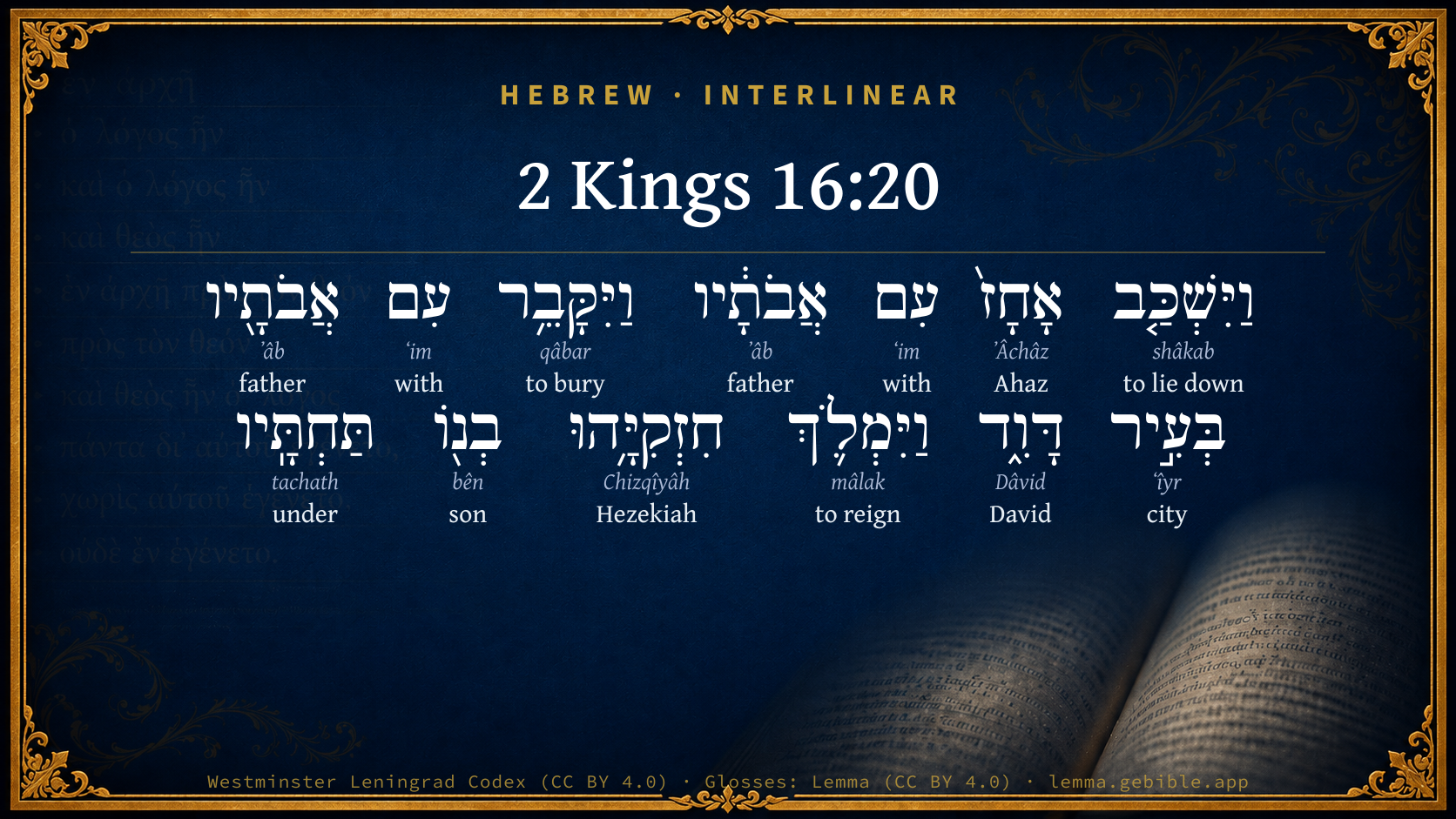
Hebrew (Westminster Leningrad Codex) 2 Kings 16:20 appears in the Hebrew Old Testament. The text above is from the Westminster Leningrad Codex. Each word links to its Strong’s number, a concise gloss, and parsing drawn from the Open Scriptures Hebrew Bible morphology. Click any word for its full Brown-Driver-Briggs (BDB) entry.
Download image
Cite this verse

2 Kings 16:20 (World English Bible). Public Domain. Lemma interlinear Bible study tool, https://lemma.gebible.app/v/2-kings/16/20.

Show BibTeX & RIS
BibTeX
RIS
English Translation
Ahaz slept with his fathers, and was buried with his fathers in the city of David: and Hezekiah his son reigned in his place.
World English Bible · Public Domain
Highlights
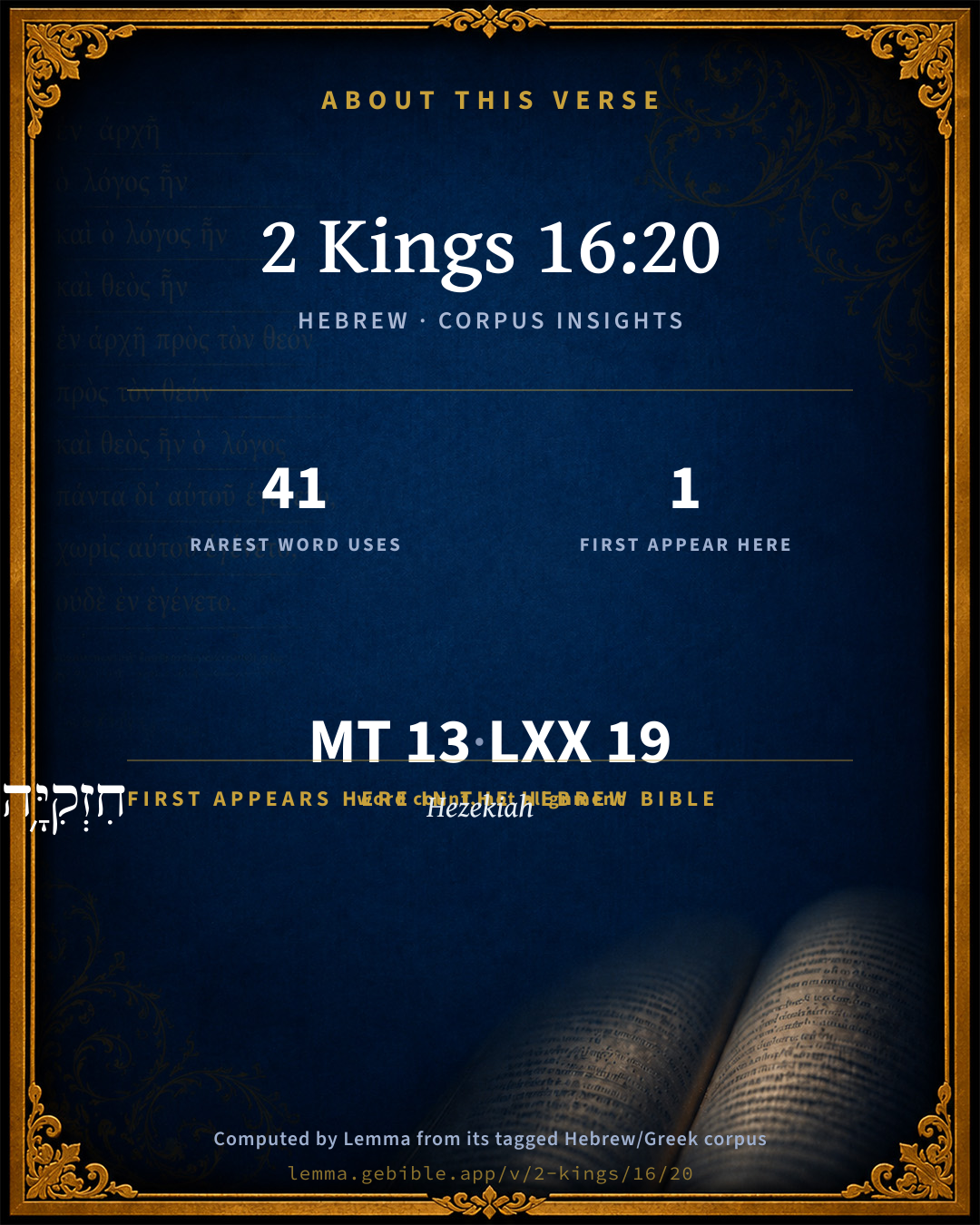
  • 1 first appearance in the Hebrew Bible
Full analysis ↓
Download a study sheet

One document with this verse’s original text, its word-by-word gloss line, the meaning frame, cross-references with their text, attributed commentary, and full source and license credits — printable, and it pastes into notes with its structure intact.

This verse Autodidact and up

Study sheet (.html) Plain text (.txt)

A passage Seminary Student

Up to 50 verses in one chapter. A passage sheet keeps up to 6 commentary sources and 12 cross-references per verse, in the order this page ranks them, and says so on the sheet whenever that leaves anything out. Ask for a single verse and you get the Autodidact verse sheet above.

Everything on this page stays free to read, with no account — the sheet is a download of what is already on screen, not access to it.

Want to remove ads? Support Godless Engineer
Compare translations 3

The same verse in 3 English versions, stacked beneath the original-language interlinear above. Click any original word for its lexicon entry.

Each is an independent rendering of the whole verse — the interlinear is not word-aligned to these translations.

Highlighted words mark where these versions differ — a whole-verse word diff, not a word-by-word alignment.

  • World English Bible Public Domain
    Ahaz slept with his fathers, and was buried with his fathers in the city of David: and Hezekiah his son reigned in his place.
  • King James Version Public Domain
    And Ahaz slept with his fathers, and was buried with his fathers in the city of David: and Hezekiah his son reigned in his stead.
  • unfoldingWord Literal Text CC BY-SA 4.0
    And Ahaz lay down with his fathers, and he was buried with his fathers in the City of David. And Hezekiah his son reigned in his place.

unfoldingWord Literal Text — © unfoldingWord, licensed CC BY-SA 4.0. Word-aligned USFM3 via Door43 (git.door43.org/unfoldingWord/en_ult).

Versions to compare (up to 4)

3 of 4 selected

Show all 18 translations

Every available English version of this verse, each an independent rendering of the whole verse.

  • World English Bible Public Domain
    Ahaz slept with his fathers, and was buried with his fathers in the city of David: and Hezekiah his son reigned in his place.
  • Berean Standard Bible Public Domain
    And Ahaz rested with his fathers and was buried with them in the City of David, and his son Hezekiah reigned in his place.
  • Majority Standard Bible Public Domain
    And Ahaz rested with his fathers and was buried with them in the City of David, and his son Hezekiah reigned in his place.
  • King James Version Public Domain
    And Ahaz slept with his fathers, and was buried with his fathers in the city of David: and Hezekiah his son reigned in his stead.
  • American Standard Version (1901) Public Domain
    And Ahaz slept with his fathers, and was buried with his fathers in the city of David: and Hezekiah his son reigned in his stead.
  • Revised Version (1885) Public Domain
    And Ahaz slept with his fathers, and was buried with his fathers in the city of David: and Hezekiah his son reigned in his stead.
  • Geneva Bible (1599) Public Domain
    And Ahaz slept with his fathers, and was buryed with his fathers in the citie of Dauid, and Hezekiah his sonne reigned in his steade.
  • Douay-Rheims (1899) Public Domain
    And Achaz slept with his fathers, and was buried with them in the city of David, and Ezechias his son reigned in his stead.
  • Young's Literal Translation Public Domain
    And Ahaz lieth with his fathers, and is buried with his fathers, in the city of David, and reign doth Hezekiah his son in his stead.
  • Literal Standard Version CC BY-SA 4.0
    And Ahaz lies with his fathers, and is buried with his fathers in the City of David, and his son Hezekiah reigns in his stead.
  • Unlocked Literal Bible CC BY-SA 4.0
    Ahaz slept with his ancestors and was buried with his ancestors in the city of David. Hezekiah his son became king in his place.
  • unfoldingWord Literal Text CC BY-SA 4.0
    And Ahaz lay down with his fathers, and he was buried with his fathers in the City of David. And Hezekiah his son reigned in his place.
  • Darby Bible Public Domain
    And Ahaz slept with his fathers, and was buried with his fathers in the city of David; and Hezekiah his son reigned in his stead.
  • World Messianic Bible Public Domain
    Ahaz slept with his fathers, and was buried with his fathers in David’s city; and Hezekiah his son reigned in his place.
  • Webster's Bible Public Domain
    And Ahaz slept with his fathers, and was buried with his fathers in the city of David: and Hezekiah his son reigned in his stead.
  • Free Bible Version CC BY-SA 4.0
    Ahaz died and was buried with his forefathers in the City of David. His son Hezekiah succeeded him as king.
  • Bible in Basic English Public Domain
    And Ahaz went to rest with his fathers, and was put into the earth with his fathers in the town of David; and Hezekiah his son became king in his place.
  • JPS Tanakh (1917) Public Domain
    And Ahaz slept with his fathers, and was buried with his fathers in the city of David; and Hezekiah his son reigned in his stead.

Literal Standard Version (2020), Covenant Press — licensed CC BY-SA 4.0. Text via the HelloAO Bible API (eBible.org). Unlocked Literal Bible (unfoldingWord) — licensed CC BY-SA 4.0. Text via the HelloAO Bible API (eBible.org). unfoldingWord Literal Text — © unfoldingWord, licensed CC BY-SA 4.0. Word-aligned USFM3 via Door43 (git.door43.org/unfoldingWord/en_ult). Free Bible Version, Dr. Jonathan Gallagher — licensed CC BY-SA 4.0. Text via the HelloAO Bible API (eBible.org).

Word by word

More ways to search: Search by grammar → Find every occurrence → Compare this word →

Practice this passage: Drill this verse → Learn its vocabulary →

אָחָז֙
ʼÂchâz
H271
“Ahaz”
Noun, Proper
Part of Speech
Noun
Type
Proper
Full BDB Definition

Origin: from H270

TWOT: None

Ahaz = "he has grasped" - king of Judah, son Jotham, father of Hezekiah - a Benjamite, son of Micah, and great grandson of Jonathan
  1. וַיִּשְׁכַּ֤ב shâkab H7901 “and · to lie down” Conjunction + Verb, Qal, Sequential Imperfect, 3rd Person, Masculine, Singular
  2. עִם ʻim H5973 “with” Preposition
  3. אֲבֹתָ֔יו ʼâb H1 “fathers · his” Noun, Common, Masculine, Plural, Construct + Suffix, Personal, 3rd Person, Masculine, Singular
  4. וַיִּקָּבֵ֥ר qâbar H6912 “and · to bury” Conjunction + Verb, Niphal, Sequential Imperfect, 3rd Person, Masculine, Singular
  5. עִם ʻim H5973 “with” Preposition
  6. אֲבֹתָ֖יו ʼâb H1 “fathers · his” Noun, Common, Masculine, Plural, Construct + Suffix, Personal, 3rd Person, Masculine, Singular
  7. בְּעִ֣יר ʻîyr H5892 “in/at · city of” Preposition + Noun, Common, Feminine, Singular, Construct
  8. דָּוִ֑ד Dâvid H1732 “David” Noun, Proper
  9. וַיִּמְלֹ֛ךְ mâlak H4427 “and · to reign” Conjunction + Verb, Qal, Sequential Imperfect, 3rd Person, Masculine, Singular
  10. חִזְקִיָּ֥הוּ Chizqîyâh H2396 “Hezekiah” Noun, Proper
  11. בְנ֖וֹ bên H1121 “son · his” Noun, Common, Masculine, Singular, Construct + Suffix, Personal, 3rd Person, Masculine, Singular
  12. תַּחְתָּֽיו tachath H8478 “under · him” Preposition + Suffix, Personal, 3rd Person, Masculine, Singular

About this verse

These counts appear in no published source. They are computed here, from the morphology-tagged text and Lemma’s own curated glosses. What Lemma adds →

13
words
11
distinct lemmas
Historical
section

First appearance in Scripture

This word makes its first canonical appearance in the Hebrew Bible here:

  • חִזְקִיָּ֥הוּ Hezekiah H2396

Shared distinctive vocabulary

אָחָז֙ Ahaz H271 occurs in 39 verses of the Hebrew Bible. Also found in:

Grammatical profile

  • 3 verbs
  • 7 nouns
  • 3 prepositions

Verb forms

  • וַיִּשְׁכַּ֤ב Qal · Sequential Imperfect
  • וַיִּקָּבֵ֥ר Niphal · Sequential Imperfect
  • וַיִּמְלֹ֛ךְ Qal · Sequential Imperfect

Repetition

Words recur within this verse — often emphatic in Hebrew:

  • אֲבֹתָ֔יו father H1 ×2
  • עִם with H5973 ×2

Hebrew & Septuagint length

In English translation the verse runs 24 words from the Hebrew and 22 from the Septuagint (LXX English) — closely comparable.

A rough comparison of the two English renderings, which tokenize alike — not a word-level alignment.

Word counts can differ between the Hebrew and the Greek without any difference in meaning — e.g. the Hebrew direct-object marker אֵת has no separate Greek word, and Greek often adds the article ὁ.

In the original languages it is 13 Hebrew tokens and 19 Greek tokens — but the two are counted differently (Hebrew bundles its prefixes and suffixes into one token; the Greek is in lemma form), so that isn’t a like-for-like length.

Cross-references

9

Topical passages linked to 2 Kings 16:20 in the Treasury of Scripture Knowledge — connected by theme and wording, ordered by reader-vote popularity; previews shown in the World English Bible.

  • Isaiah 1:1 The vision of Isaiah the son of Amoz, which he saw concerning Judah and Jerusalem, in the days of Uzziah, Jotham, Ahaz, and Hezekiah, kings of Judah.
  • Matthew 1:9 Uzziah became the father of Jotham. Jotham became the father of Ahaz. Ahaz became the father of Hezekiah.
  • 2 Kings 18:1 Now it happened in the third year of Hoshea son of Elah king of Israel, that Hezekiah the son of Ahaz king of Judah began to reign.
  • 2 Kings 21:18 Manasseh slept with his fathers, and was buried in the garden of his own house, in the garden of Uzza: and Amon his son reigned in his place.
  • 1 Chronicles 3:13 Ahaz his son, Hezekiah his son, Manasseh his son,
  • 2 Chronicles 28:27–29:1 Ahaz slept with his fathers, and they buried him in the city, even in Jerusalem; for they didn't bring him into the tombs of the kings of Israel: and Hezekiah his son reigned in his place.
  • Hosea 1:1 The word of Yahweh that came to Hosea the son of Beeri, in the days of Uzziah, Jotham, Ahaz, and Hezekiah, kings of Judah, and in the days of Jeroboam the son of Joash, king of Israel.
  • Micah 1:1 The word of Yahweh that came to Micah the Morashtite in the days of Jotham, Ahaz, and Hezekiah, kings of Judah, which he saw concerning Samaria and Jerusalem.
  • 2 Kings 21:26 He was buried in his tomb in the garden of Uzza: and Josiah his son reigned in his place.

Cross-references courtesy of OpenBible.info (CC BY 4.0).

Hebrew and Greek witnesses Masoretic Hebrew ↔ Greek Septuagint

The same verse in the two great witnesses to the Old Testament, shown verse-for-verse.

These are two independent witnesses, not word-aligned to each other, and the Septuagint is shown in lemma (dictionary) form.

Hebrew 2 Kings 16:20 Masoretic · Westminster Leningrad Codex

וַיִּשְׁכַּ֤ב אָחָז֙ עִם אֲבֹתָ֔יו וַיִּקָּבֵ֥ר עִם אֲבֹתָ֖יו בְּעִ֣יר דָּוִ֑ד וַיִּמְלֹ֛ךְ חִזְקִיָּ֥הוּ בְנ֖וֹ תַּחְתָּֽיו

Ahaz slept with his fathers, and was buried with his fathers in the city of David: and Hezekiah his son reigned in his place.

World English Bible · Public Domain

Greek LXX 2 Kings 16:20 Septuagint · lemma form

καί κοιμάω αχαζ μετά ὁ πατήρ αὐτός καί θάπτω ἐν πόλις δαυίδ καί βασιλεύω εζεκιας υἱός αὐτός ἀντί αὐτός

And Achaz slept with his fathers, and was buried in the city of David: and Ezekias his son reigned in his stead.

LXX2012 (modern English Septuagint) · Public Domain

On this verse, The Cambridge Bible for Schools and Colleges discusses the Septuagint’s reading. Read the note in Commentary ↓

Hebrew: Westminster Leningrad Codex (CC BY 4.0). Greek: Septuagint (public domain); English from LXX2012 (modern English Septuagint) (Public Domain). How the Septuagint differs from the Hebrew →

Targum (Aramaic paraphrase)

1

The Targum is the ancient Jewish Aramaic paraphrase of the Hebrew Scriptures — an interpretive translation, not the Hebrew text itself. Onkelos (literal) and Pseudo-Jonathan (expansive) render the Torah, and Jonathan the Prophets. Coverage is partial: where no permissively-licensed English translation exists for a verse, only the Aramaic is shown. This is verse-level text, not a word-by-word alignment to the Hebrew.

  1. Targum Jonathan Prophets (Joshua–Malachi)
    וּשְׁכִיב אָחָז עִם אֲבָהָתוֹהִי וְאִתְקְבַר עִם אֲבָהָתוֹהִי בְּקַרְתָּא דְדָוִד וּמְלַךְ חִזְקִיָהוּ בְרֵיהּ תְּחוֹתוֹהִי:

    (no public-domain English translation for this verse)

    Targum Jonathan — Aramaic: “Mikraot Gedolot” (public domain). English: “Sefaria Community Translation” (CC0 1.0 (public-domain dedication)); “London "Chaldee Paraphrase," 1871” (public domain). Text via Sefaria.

Commentary

Notes on 2 Kings 16:20 from classic Christian and Jewish commentators (each source and its license shown beneath its notes). The classic Christian expositions comment on the surrounding passage and are grouped to its opening verse, so a note may address several verses; the Jewish commentaries on the Tanakh (Rashi and others) are per-verse, so they appear only where the commentator wrote on this verse.

Lemma curates 59 commentaries, every one of them public domain or Creative Commons licensed, each selected and text-cleaned for this edition rather than reprinted as found. About our sources →

Trapp's Complete Commentary

John Trapp

2Ki 16:20 And Ahaz slept with his fathers, and was buried with his fathers in the city of David: and Hezekiah his son reigned in his stead.

Ver. 20. And Hezekiah his son.] A most pious prince, who standeth between his father Ahaz and his son Manasseh, as a rose betwixt two thistles, &c.

John Trapp, A Commentary or Exposition upon All the Books of the Old and New Testament (1647–1656) — public domain. Text from a community e-Sword module.

Joseph Benson's Commentary

2Ki 16:20. And Ahaz slept with his fathers — Resigning his life in the midst of his days, at thirty-six years of age, and leaving his kingdom to a better man, Hezekiah his son, who proved as much a friend to the temple as Ahaz had been an enemy to it.

Joseph Benson's Commentary on the Old and New Testaments (1811–1818) — public domain. Text from a community e-Sword module.

Adam Clarke's Commentary

Verse 20. Was buried with his fathers in the city of David] But it is expressly declared, 2Ch 28:27, that he was not buried in the sepulchres of the kings of Israel; and this was undoubtedly intended as a mark of degradation.

His reign was disastrous and impious; and it was disastrous because it was impious. He had been a scourge, not a blessing, to his people. He had not only made illegal alterations in the temple, and in the mode of worship prescribed by the true God, but he had polluted all the cities of Judah with idolatry, and brought ruin upon the nation. On the whole, a worse king than himself had not as yet sat on the Jewish throne; and yet he had many advantages: he had for counsellor one of the greatest men ever produced in the Jewish nation, ISAIAH the prophet; and God condescended to interpose especially for him when grievously straitened by the kings of Israel and Syria, both of whom were cut off according to the prediction of this prophet. But he would not lay it to heart, and therefore the wrath of God fell heavily upon him, and upon the stiff-necked and rebellious people whom he governed. He had sufficient warning and was without excuse. He would sin, and therefore he must suffer.

Adam Clarke's Commentary on the Bible (1810–1826) — public domain. Text from a community e-Sword/MySword module.

The Cambridge Bible for Schools and Colleges

gen. ed. J. J. S. Perowne

20. was buried with his fathers] The last three words are not represented in the LXX., and the Chronicler says ‘they buried him in the city, even in Jerusalem, but they brought him not into the sepulchres of the kings of Israel.’ For bodily leprosy Uzziah had been treated in the same way after death and the moral and spiritual leprosy of the idol-loving Ahaz was worthy of a like deprivation. ‘Of all the kings of Judah hitherto, there is no one so dreadful an example, either of sin or judgment, as this son of good Jotham. I abhor to think that such a monster should descend from the loins of David. Where should be the period of this wickedness? He began with the high places … from thence he falls to a Syrian altar, to the Syrian god: then from a partnership, he falls to an utter exclusion of the true God, and blocking up of His temple, and then to the sacrifice of his own son; and at last as if hell were broken loose upon God’s inheritance, every several city, every high place of Judah hath a new god. No marvel if he be branded (2Ch_28:22) by the spirit of God with “This is that king Ahaz” ’ (Bp. Hall).

The Cambridge Bible for Schools and Colleges (gen. ed. J. J. S. Perowne; Cambridge University Press, 1878–1918) — public domain. Text from a community e-Sword module.

Haydock's Catholic Bible Commentary

With them; but not in the same sepulchre, on account of his impiety, 2 Paralipomenon xxviii. 27. (Calmet) --- In the 5th year of his reign, the Idumeans harassed the country, and in the 6th, the Philistines took several towns; (Salien) so that he fell a prey to enemies on all sides, and was memorable for nothing but impiety and disasters. (Haydock) --- Rome was built, and Numa born, on the 21st of April, in the 9th year of Achaz, and the first of the 7th Olympiad. (Salien, the year before Christ 751.)

George Leo Haydock (1774–1849), Haydock's Catholic Family Bible and Commentary, 1859 edition — public domain. Excludes Psalms (Douay-Rheims chapter numbering differs from Protestant) and Deuterocanonical books (Catholic canon only).

The Pulpit Commentary

And Ahaz slept with his fathers, and was buried with his fathers in the city of David. This must be taken in the same sense, and with the same limitations, as the same phrase in 2Ki_12:21. The writer of Chronicles (2Ch_28:27) says, "And Ahaz slept with his fathers, and they buried him in the city, even in Jerusalem: but they brought him not into the sepulcher s of the kings." Like Uzziah, he was not thought worthy of sepulture in the royal catacomb. (see the comment on 2Ki_12:21)

The Pulpit Commentary (1880–1919), ed. H.D.M. Spence-Jones & Joseph S. Exell — public domain. Text from a community e-Sword module.

Lesson kit

Teaching starters — assembled from the data on this page, not authored interpretation. Every prompt links to the verse data it draws on. Edit before teaching.

2 Kings, in the Historical, opens this verse with 13 words (11 distinct Hebrew lemmas). Its most distinctive word is ʼÂchâz (“Ahaz”). A historical commentator’s framing appears above. Read the whole chapter for the surrounding context.

Discussion questions

  1. The word ʼÂchâz carries the sense “Ahaz.” How does it shape the verse?
  2. This is the first place “Hezekiah” appears in Scripture (first appears here). What does its debut here establish?
  3. How does 2 Kings 15:38, which shares the word «Ahaz», read alongside this verse?
  4. What does the repetition of “father” (2× in this one verse) do in this verse?
  5. These translations render this verse differently. What is at stake in choosing one wording over another?
  6. «וַיִּשְׁכַּ֤ב» is a Qal Sequential Imperfect verb. How does that grammatical form shape the action described?
  7. Compare how Trapp's Complete Commentary and Joseph Benson's Commentary read this verse. Where do they agree or differ?

Things to notice

Reading settings

Reading text

Shown beneath each verse's original-language words.

Old Testament
Old Testament edition

Read the OT as the Masoretic Hebrew (MT) or the Greek Septuagint (LXX).

English shown for the Greek Septuagint (in the Hebrew ↔ Greek comparison).

Comparing translations? Open the Compare panel on any verse page to stack up to four side by side.