
Deuteronomy 28:55

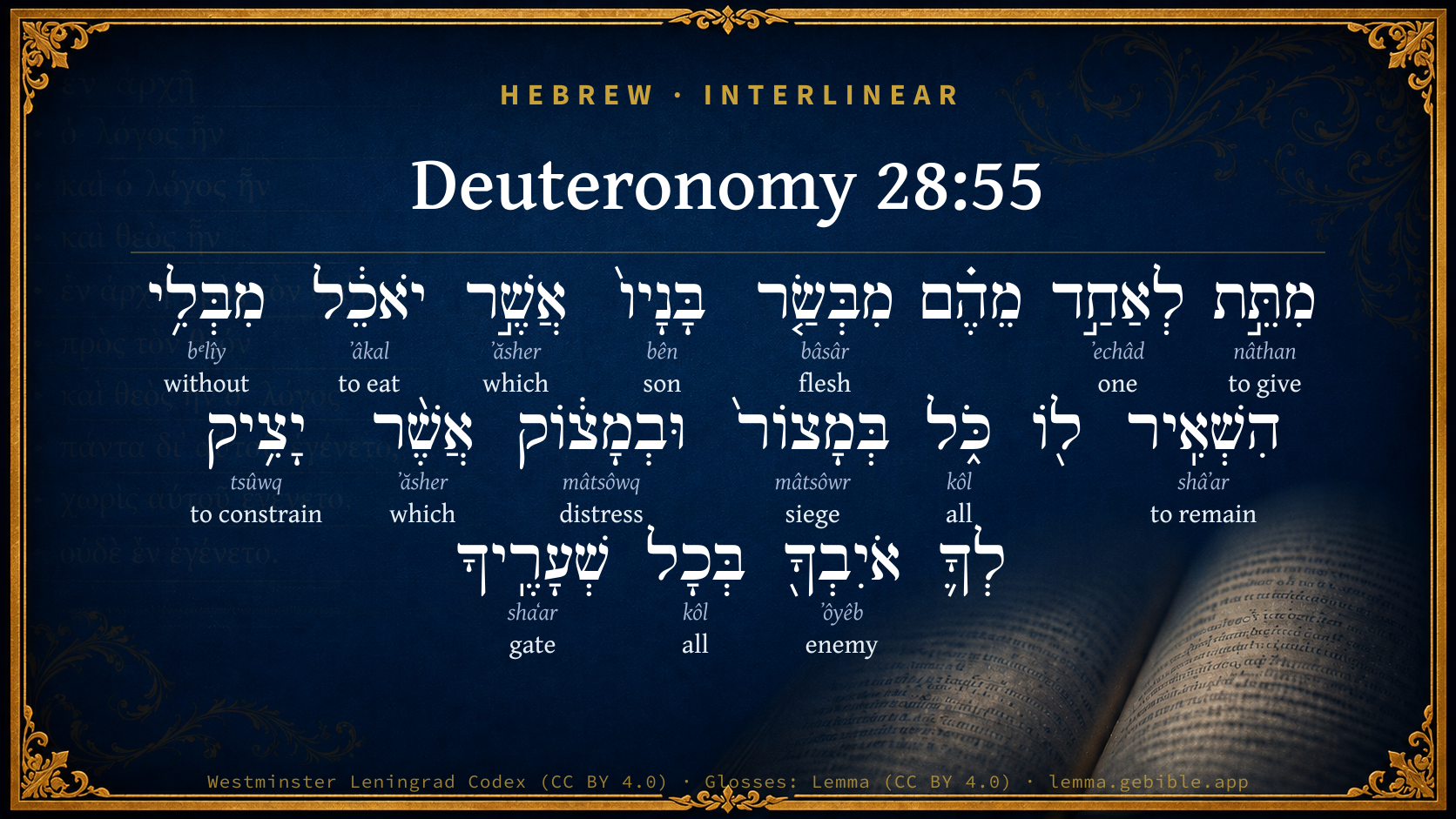
Hebrew (Westminster Leningrad Codex) Deuteronomy 28:55 appears in the Hebrew Old Testament. The text above is from the Westminster Leningrad Codex. Each word links to its Strong’s number, a concise gloss, and parsing drawn from the Open Scriptures Hebrew Bible morphology. Click any word for its full Brown-Driver-Briggs (BDB) entry.
Download image
Cite this verse

Deuteronomy 28:55 (World English Bible). Public Domain. Lemma interlinear Bible study tool, https://lemma.gebible.app/v/deuteronomy/28/55.

Show BibTeX & RIS
BibTeX
RIS
English Translation
so that he will not give to any of them of the flesh of his children whom he shall eat, because he has nothing left him, in the siege and in the distress with which your enemy shall distress you in all your gates.
World English Bible · Public Domain
Download a study sheet

One document with this verse’s original text, its word-by-word gloss line, the meaning frame, cross-references with their text, attributed commentary, and full source and license credits — printable, and it pastes into notes with its structure intact.

This verse Autodidact and up

Study sheet (.html) Plain text (.txt)

A passage Seminary Student

Up to 50 verses in one chapter. A passage sheet keeps up to 6 commentary sources and 12 cross-references per verse, in the order this page ranks them, and says so on the sheet whenever that leaves anything out. Ask for a single verse and you get the Autodidact verse sheet above.

Everything on this page stays free to read, with no account — the sheet is a download of what is already on screen, not access to it.

Want to remove ads? Support Godless Engineer
Compare translations 3

The same verse in 3 English versions, stacked beneath the original-language interlinear above. Click any original word for its lexicon entry.

Each is an independent rendering of the whole verse — the interlinear is not word-aligned to these translations.

Highlighted words mark where these versions differ — a whole-verse word diff, not a word-by-word alignment.

  • World English Bible Public Domain
    so that he will not give to any of them of the flesh of his children whom he shall eat, because he has nothing left him, in the siege and in the distress with which your enemy shall distress you in all your gates.
  • King James Version Public Domain
    So that he will not give to any of them of the flesh of his children whom he shall eat: because he hath nothing left him in the siege, and in the straitness, wherewith thine enemies shall distress thee in all thy gates.
  • unfoldingWord Literal Text CC BY-SA 4.0
    without giving to any of them from the flesh of his children that he will eat, since nothing remains for himself all in the siege and in the distress with which your enemy will oppress you within all your gates.

unfoldingWord Literal Text — © unfoldingWord, licensed CC BY-SA 4.0. Word-aligned USFM3 via Door43 (git.door43.org/unfoldingWord/en_ult).

Versions to compare (up to 4)

3 of 4 selected

Show all 18 translations

Every available English version of this verse, each an independent rendering of the whole verse.

  • World English Bible Public Domain
    so that he will not give to any of them of the flesh of his children whom he shall eat, because he has nothing left him, in the siege and in the distress with which your enemy shall distress you in all your gates.
  • Berean Standard Bible Public Domain
    refusing to share with any of them the flesh of his children he will eat because he has nothing left in the siege and distress that your enemy will inflict on you within all your gates.
  • Majority Standard Bible Public Domain
    refusing to share with any of them the flesh of his children he will eat because he has nothing left in the siege and distress that your enemy will inflict on you within all your gates.
  • King James Version Public Domain
    So that he will not give to any of them of the flesh of his children whom he shall eat: because he hath nothing left him in the siege, and in the straitness, wherewith thine enemies shall distress thee in all thy gates.
  • American Standard Version (1901) Public Domain
    so that he will not give to any of them of the flesh of his children whom he shall eat, because he hath nothing left him, in the siege and in the distress wherewith thine enemy shall distress thee in all thy gates.
  • Revised Version (1885) Public Domain
    so that he will not give to any of them of the flesh of his children whom he shall eat, because he hath nothing left him; in the siege and in the straitness, wherewith thine enemy shall straiten thee in all thy gates.
  • Geneva Bible (1599) Public Domain
    For feare of giuing vnto any of them of the flesh of his children, whom he shall eate, because he hath nothing left him in that siege, and straitnesse, wherewith thine enemie shall besiege thee in all thy cities.
  • Douay-Rheims (1899) Public Domain
    So that he will not give them of the flesh of his children, which he shall eat: because he hath nothing else in the siege and the want, wherewith thy enemies shall distress thee within all thy gates.
  • Young's Literal Translation Public Domain
    against giving to one of them of the flesh of his sons whom he eateth, because he hath nothing left to him, in the siege, and in the straitness with which thine enemy doth straiten thee in all thy gates.
  • Literal Standard Version CC BY-SA 4.0
    against giving to one of them of the flesh of his sons whom he eats, because he has nothing left for himself in the siege and in the constriction with which your enemy constricts you in all your gates.
  • Unlocked Literal Bible CC BY-SA 4.0
    So he will not give to any of them the flesh of his own children that he is going to eat, because he will have nothing left for himself in the siege and in the distress which your enemy will put upon you within all your city gates.
  • unfoldingWord Literal Text CC BY-SA 4.0
    without giving to any of them from the flesh of his children that he will eat, since nothing remains for himself all in the siege and in the distress with which your enemy will oppress you within all your gates.
  • Darby Bible Public Domain
    so that he will not give to any of them of the flesh of his children that he eateth, because he hath nothing left him in the siege and in the straitness wherewith thine enemies shall distress thee in all thy gates.
  • World Messianic Bible Public Domain
    so that he will not give to any of them of the flesh of his children whom he will eat, because he has nothing left to him, in the siege and in the distress with which your enemy will distress you in all your gates.
  • Webster's Bible Public Domain
    So that he will not give to any of them of the flesh of his children whom he shall eat: because he hath nothing left him in the siege and in the straitness with which thy enemies shall distress thee in all thy gates.
  • Free Bible Version CC BY-SA 4.0
    He will refuse to share with any of them the flesh of his children that he's forced to eat because he doesn't have anything else because of the siege and suffering your enemy has caused you in all your towns.
  • Bible in Basic English Public Domain
    And will not give to any of them the flesh of his children which will be his food because he has no other; in the cruel grip of your haters on all your towns.
  • JPS Tanakh (1917) Public Domain
    so that he will not give to any of them of the flesh of his children whom he shall eat, because he hath nothing left him; in the siege and in the straitness, wherewith thine enemy shall straiten thee in all thy gates.

Literal Standard Version (2020), Covenant Press — licensed CC BY-SA 4.0. Text via the HelloAO Bible API (eBible.org). Unlocked Literal Bible (unfoldingWord) — licensed CC BY-SA 4.0. Text via the HelloAO Bible API (eBible.org). unfoldingWord Literal Text — © unfoldingWord, licensed CC BY-SA 4.0. Word-aligned USFM3 via Door43 (git.door43.org/unfoldingWord/en_ult). Free Bible Version, Dr. Jonathan Gallagher — licensed CC BY-SA 4.0. Text via the HelloAO Bible API (eBible.org).

Word by word

More ways to search: Search by grammar → Find every occurrence → Compare this word →

Practice this passage: Drill this verse → Learn its vocabulary →

וּבְמָצ֔וֹק
mâtsôwq
H4689
“and · in/at · distress”
Conjunction + Preposition + Noun, Common, Masculine, Singular, Absolute
Part of Speech
Conjunction + Preposition + Noun
Type
Common
Gender
Masculine
Number
Singular
State
Absolute
Full BDB Definition

Origin: from H6693

TWOT: 1895d

straitness, straits, distress, stress, anguish
  1. מִתֵּ֣ת nâthan H5414 “from · to give” Preposition + Verb, Qal, Infinitive Construct
  2. לְאַחַ֣ד ʼechâd H259 “to/for · one” Preposition + Adjective, Cardinal number, Masculine, Singular, Absolute
  3. מִבְּשַׂ֤ר bâsâr H1320 “from · flesh of” Preposition + Noun, Common, Masculine, Singular, Construct
  4. בָּנָיו֙ bên H1121 “sons · his” Noun, Common, Masculine, Plural, Construct + Suffix, Personal, 3rd Person, Masculine, Singular
  5. אֲשֶׁ֣ר ʼăsher H834 “which” Particle, Relative
  6. יֹאכֵ֔ל ʼâkal H398 “to eat” Verb, Qal, Imperfect, 3rd Person, Masculine, Singular
  7. מִבְּלִ֥י bᵉlîy H1097 “from · without of” Preposition + Noun, Common, Masculine, Singular, Construct
  8. הִשְׁאִֽיר shâʼar H7604 “to remain” Verb, Hiphil, Perfect, 3rd Person, Masculine, Singular
  9. כֹּ֑ל kôl H3605 “all” Noun, Common, Masculine, Singular, Absolute
  10. בְּמָצוֹר֙ mâtsôwr H4692 “in/at · siege” Preposition + Noun, Common, Masculine, Singular, Absolute
  11. אֲשֶׁ֨ר ʼăsher H834 “which” Particle, Relative
  12. יָצִ֥יק tsûwq H6693 “to constrain” Verb, Hiphil, Imperfect, 3rd Person, Masculine, Singular
  13. אֹיִבְךָ֖ ʼôyêb H341 “enemy · you” Verb, Qal, Participle Active, Masculine, Singular, Construct + Suffix, Personal, 2nd Person, Masculine, Singular
  14. בְּכָל kôl H3605 “in/at · all of” Preposition + Noun, Common, Masculine, Singular, Construct
  15. שְׁעָרֶֽיךָ shaʻar H8179 “gates · your” Noun, Common, Masculine, Plural, Construct + Suffix, Personal, 2nd Person, Masculine, Singular

About this verse

These counts appear in no published source. They are computed here, from the morphology-tagged text and Lemma’s own curated glosses. What Lemma adds →

19
words
14
distinct lemmas
Pentateuch
section

Notable vocabulary

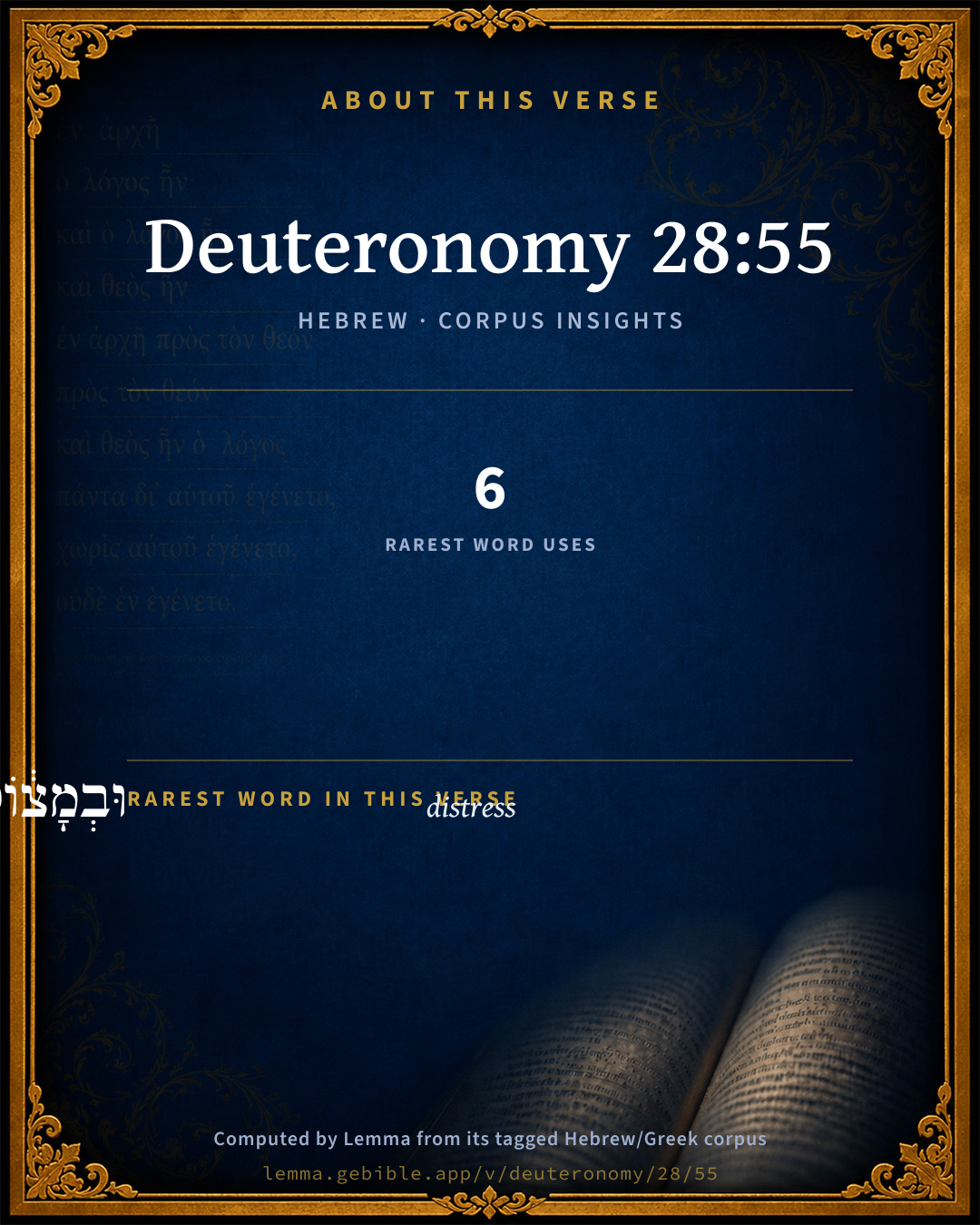
The rarest word here is וּבְמָצ֔וֹק distress H4689 — appearing just 6 times in the whole Hebrew Bible.

Shared distinctive vocabulary

וּבְמָצ֔וֹק distress H4689 occurs in 6 verses of the Hebrew Bible. Also found in:

Grammatical profile

  • 5 verbs
  • 8 nouns
  • 1 adjective
  • 3 prepositions
  • 2 particles

Verb forms

  • מִתֵּ֣ת Qal · Infinitive Construct
  • יֹאכֵ֔ל Qal · Imperfect
  • הִשְׁאִֽיר Hiphil · Perfect
  • יָצִ֥יק Hiphil · Imperfect
  • אֹיִבְךָ֖ Qal · Participle Active

Repetition

Words recur within this verse — often emphatic in Hebrew:

  • כֹּ֑ל all H3605 ×2
  • אֲשֶׁ֣ר which H834 ×2

Hebrew & Septuagint length

In English translation the verse runs 44 words from the Hebrew and 44 from the Septuagint (LXX English) — the same length.

A rough comparison of the two English renderings, which tokenize alike — not a word-level alignment.

Word counts can differ between the Hebrew and the Greek without any difference in meaning — e.g. the Hebrew direct-object marker אֵת has no separate Greek word, and Greek often adds the article ὁ.

Cross-references

3

Topical passages linked to Deuteronomy 28:55 in the Treasury of Scripture Knowledge — connected by theme and wording, ordered by reader-vote popularity; previews shown in the World English Bible.

  • Jeremiah 5:10 Go up on her walls, and destroy; but don't make a full end: take away her branches; for they are not Yahweh's.
  • Jeremiah 34:2 Thus says Yahweh, the God of Israel, Go, and speak to Zedekiah king of Judah, and tell him, Thus says Yahweh, Behold, I will give this city into the hand of the king of Babylon, and he shall burn it with fire:
  • Jeremiah 52:6 In the fourth month, in the ninth day of the month, the famine was sore in the city, so that there was no bread for the people of the land.

Cross-references courtesy of OpenBible.info (CC BY 4.0).

Hebrew and Greek witnesses Masoretic Hebrew ↔ Greek Septuagint

The same verse in the two great witnesses to the Old Testament, shown verse-for-verse.

These are two independent witnesses, not word-aligned to each other, and the Septuagint is shown in lemma (dictionary) form.

Hebrew Deuteronomy 28:55 Masoretic · Westminster Leningrad Codex

מִתֵּ֣ת לְאַחַ֣ד מֵהֶ֗ם מִבְּשַׂ֤ר בָּנָיו֙ אֲשֶׁ֣ר יֹאכֵ֔ל מִבְּלִ֥י הִשְׁאִֽיר ל֖וֹ כֹּ֑ל בְּמָצוֹר֙ וּבְמָצ֔וֹק אֲשֶׁ֨ר יָצִ֥יק לְךָ֛ אֹיִבְךָ֖ בְּכָל שְׁעָרֶֽיךָ

so that he will not give to any of them of the flesh of his children whom he shall eat, because he has nothing left him, in the siege and in the distress with which your enemy shall distress you in all your gates.

World English Bible · Public Domain

Greek LXX Deuteronomy 28:55 Septuagint · lemma form

ὥστε δίδωμι εἷς αὐτός ἀπό ὁ σάρξ ὁ τέκνον αὐτός ὅς ἄν καταἐσθίω διά ὁ μή καταλείπω αὐτός μηδείς ἐν ὁ στενοχωρία σύ καί ἐν ὁ θλῖψις σύ ὅς ἄν θλίβω σύ ὁ ἐχθρός σύ ἐν πᾶς ὁ πόλις σύ

so as not to give to one of them of the flesh of his children, whom he shall eat, because of his having nothing left him in your straitness, and in your affliction, with which your enemies shall afflict you in all your cities.

LXX2012 (modern English Septuagint) · Public Domain

Hebrew: Westminster Leningrad Codex (CC BY 4.0). Greek: Septuagint (public domain); English from LXX2012 (modern English Septuagint) (Public Domain). How the Septuagint differs from the Hebrew →

Targum (Aramaic paraphrase)

2

The Targum is the ancient Jewish Aramaic paraphrase of the Hebrew Scriptures — an interpretive translation, not the Hebrew text itself. Onkelos (literal) and Pseudo-Jonathan (expansive) render the Torah, and Jonathan the Prophets. Coverage is partial: where no permissively-licensed English translation exists for a verse, only the Aramaic is shown. This is verse-level text, not a word-by-word alignment to the Hebrew.

  1. Targum Onkelos Torah (Genesis–Deuteronomy)
    מִלְמִתַּן לְחַד מִנְהוֹן מִבְּשַׂר בְּנוֹהִי דִי יֵיכוּל מִדְלָא אִשְׁתָּאַר לֵהּ כֹּלָא בִּצְיָרָא וּבְעַקְתָא דִי יָעֵק לָךְ סָנְאָךְ בְכָל קִרְוָיךְ

    (no public-domain English translation for this verse)

    Targum Onkelos — Aramaic: “Onkelos Genesis” (public domain); “Onkelos Exodus” (public domain); “Onkelos Leviticus” (public domain); “Onkelos Numbers” (public domain); “Onkelos Deuteronomy” (public domain). English: “Sefaria Community Translation” (CC0 1.0 (public-domain dedication)); “J.W. Etheridge. The Targums of Onkelos and Jonathan Ben Uzziel on the Pentateuch. London: Longmans, Green, 1862” (public domain). Text via Sefaria.

  2. Targum Pseudo-Jonathan Torah (Genesis–Deuteronomy)
    מִן לָא לְמִתַּן לְחַד מִנְהוֹן מִבְּשַר בְּנוֹי דִי יֵיכוּל מִן דְלָא אִשְׁתְּיַיר לֵיהּ מִדַעַם בְּצַעֲרוֹי וּבְעָקָא דִי יְעָקוּן לְכוֹן סַנְאֵיכוֹן בְּכָל קִירְוֵיכוֹן

    He will not give to one of them of the flesh of his children which he eateth, because nothing remaineth to him in the anguish and straitness with which I will straiten you in all your cities.

    Targum Pseudo-Jonathan — Aramaic: “Targum Jonathan on Genesis” (public domain); “Targum Jonathan on Exodus” (public domain); “Targum Jonathan on Leviticus” (public domain); “Targum Jonathan on Numbers” (public domain); “Targum Jonathan on Deuteronomy” (public domain). English: “The Targum of Jonathan ben Uzziel, trans. J. W. Etheridge, London, 1862” (public domain). Text via Sefaria.

Commentary

Notes on Deuteronomy 28:55 from classic Christian and Jewish commentators (each source and its license shown beneath its notes). The classic Christian expositions comment on the surrounding passage and are grouped to its opening verse, so a note may address several verses; the Jewish commentaries on the Tanakh (Rashi and others) are per-verse, so they appear only where the commentator wrote on this verse.

Lemma curates 59 commentaries, every one of them public domain or Creative Commons licensed, each selected and text-cleaned for this edition rather than reprinted as found. About our sources →

Ellicott's Commentary for English Readers

(55) So that he will not give to any of them.-A complication of horrors is here described. They shall eat some of their children and refuse to share even this food with those that are left.

A Bible Commentary for English Readers, edited by Charles John Ellicott (1878–1897) — public domain. Text from a community e-Sword module.

John Gill's Exposition

Then the Lord will make thy plagues wonderful,.... Visible, remarkable, distinguishable, and astonishing to all that see them:

and the plagues of thy seed; for they were to continue, as they have done, With their posterity, age after age:

even great plagues, and of long continuance; great as to quality and quantity, and firm, sure, lasting, and durable; the word used is rendered "sure" in Isa 55:3; sure by prophecy and in the event; and which when inflicted remained, as they have 1700 years; all which might be believed as certain, or what would certainly come to pass, and be depended on:

and sore sicknesses, and of long continuance; besides those diseases mentioned Deu 28:27; or however others including them.

John Gill's Exposition of the Whole Bible (1746–1763) — public domain (CC PDM 1.0). Text via the HelloAO Bible API.

Lesson kit

Teaching starters — assembled from the data on this page, not authored interpretation. Every prompt links to the verse data it draws on. Edit before teaching.

Deuteronomy, in the Pentateuch, opens this verse with 19 words (14 distinct Hebrew lemmas). Its most distinctive word is mâtsôwq (“distress”). A historical commentator’s framing appears above. Read the whole chapter for the surrounding context.

Discussion questions

  1. What does “distress” (mâtsôwq) contribute to the verse as a whole?
  2. How does Deuteronomy 28:53, which shares the word «distress», read alongside this verse?
  3. What does the repetition of “all” (2× in this one verse) do in this verse?
  4. These translations render this verse differently. What is at stake in choosing one wording over another?
  5. «מִתֵּ֣ת» is a Qal Infinitive Construct verb. How does that grammatical form shape the action described?
  6. Compare how Ellicott's Commentary for English Readers and John Gill's Exposition read this verse. Where do they agree or differ?

Things to notice

Reading settings

Reading text

Shown beneath each verse's original-language words.

Old Testament
Old Testament edition

Read the OT as the Masoretic Hebrew (MT) or the Greek Septuagint (LXX).

English shown for the Greek Septuagint (in the Hebrew ↔ Greek comparison).

Comparing translations? Open the Compare panel on any verse page to stack up to four side by side.