1 Chronicles 2:34

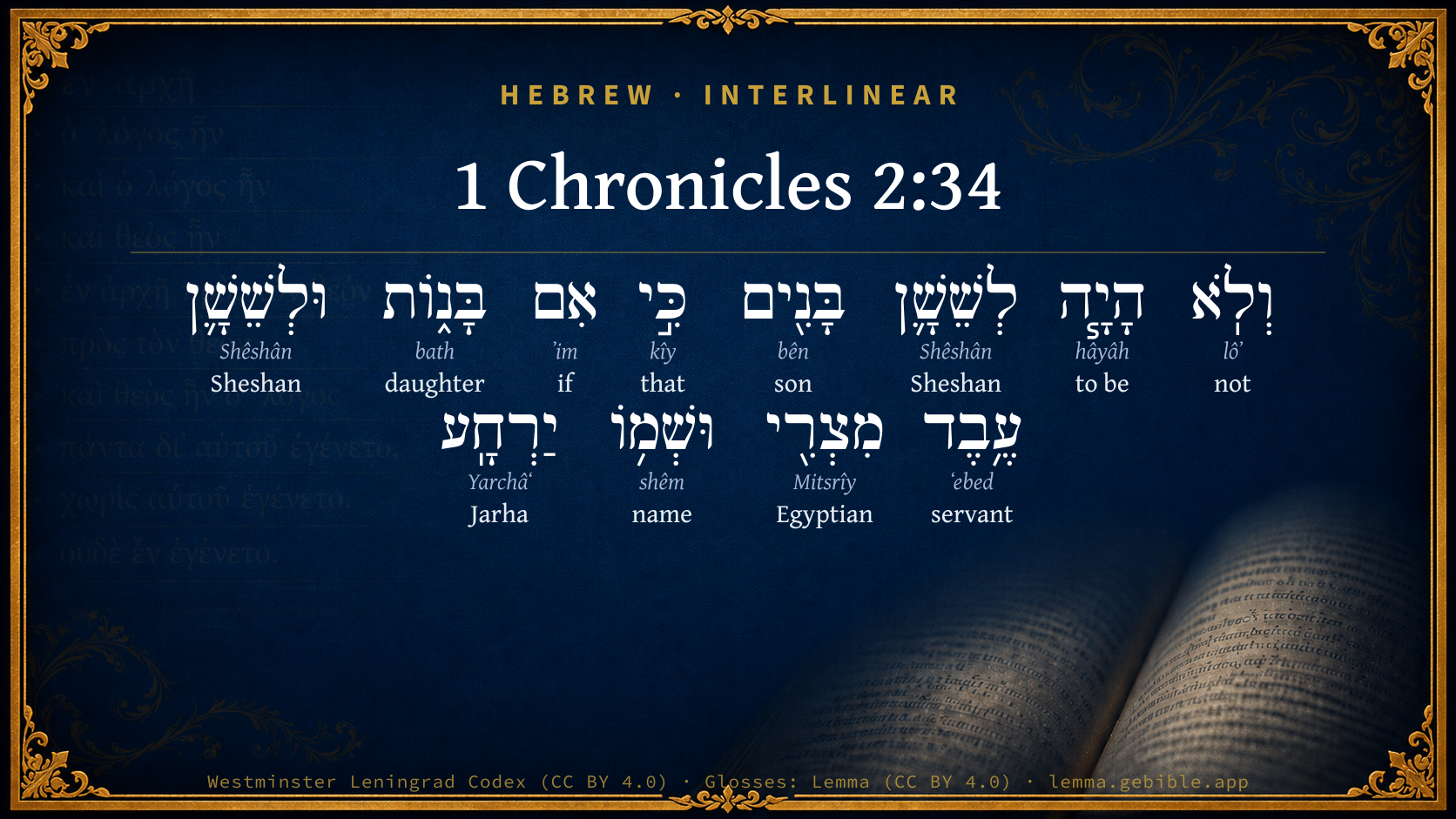
Hebrew (Westminster Leningrad Codex) 1 Chronicles 2:34 appears in the Hebrew Old Testament. The text above is from the Westminster Leningrad Codex. Each word links to its Strong’s number, a concise gloss, and parsing drawn from the Open Scriptures Hebrew Bible morphology. Click any word for its full Brown-Driver-Briggs (BDB) entry.
Download image
Cite this verse

1 Chronicles 2:34 (World English Bible). Public Domain. Lemma interlinear Bible study tool, https://lemma.gebible.app/v/1-chronicles/2/34.

Show BibTeX & RIS
BibTeX
RIS
English Translation
Now Sheshan had no sons, but daughters. Sheshan had a servant, an Egyptian, whose name was Jarha.
World English Bible · Public Domain
Highlights
  • 1 first appearance in the Hebrew Bible
Full analysis ↓
Download a study sheet

One document with this verse’s original text, its word-by-word gloss line, the meaning frame, cross-references with their text, attributed commentary, and full source and license credits — printable, and it pastes into notes with its structure intact.

This verse Autodidact and up

Study sheet (.html) Plain text (.txt)

A passage Seminary Student

Up to 50 verses in one chapter. A passage sheet keeps up to 6 commentary sources and 12 cross-references per verse, in the order this page ranks them, and says so on the sheet whenever that leaves anything out. Ask for a single verse and you get the Autodidact verse sheet above.

Everything on this page stays free to read, with no account — the sheet is a download of what is already on screen, not access to it.

Want to remove ads? Support Godless Engineer
Compare translations 3

The same verse in 3 English versions, stacked beneath the original-language interlinear above. Click any original word for its lexicon entry.

Each is an independent rendering of the whole verse — the interlinear is not word-aligned to these translations.

Highlighted words mark where these versions differ — a whole-verse word diff, not a word-by-word alignment.

  • World English Bible Public Domain
    Now Sheshan had no sons, but daughters. Sheshan had a servant, an Egyptian, whose name was Jarha.
  • King James Version Public Domain
    Now Sheshan had no sons, but daughters. And Sheshan had a servant, an Egyptian, whose name was Jarha.
  • unfoldingWord Literal Text CC BY-SA 4.0
    And sons not to Sheshan, but only daughters. And a servant to Sheshan, an Egyptian, and his name Jarha.

unfoldingWord Literal Text — © unfoldingWord, licensed CC BY-SA 4.0. Word-aligned USFM3 via Door43 (git.door43.org/unfoldingWord/en_ult).

Versions to compare (up to 4)

3 of 4 selected

Show all 18 translations

Every available English version of this verse, each an independent rendering of the whole verse.

  • World English Bible Public Domain
    Now Sheshan had no sons, but daughters. Sheshan had a servant, an Egyptian, whose name was Jarha.
  • Berean Standard Bible Public Domain
    Sheshan had no sons, but only daughters; but he did have an Egyptian servant named Jarha.
  • Majority Standard Bible Public Domain
    Sheshan had no sons, but only daughters. He also had an Egyptian servant named Jarha.
  • King James Version Public Domain
    Now Sheshan had no sons, but daughters. And Sheshan had a servant, an Egyptian, whose name was Jarha.
  • American Standard Version (1901) Public Domain
    Now Sheshan had no sons, but daughters. And Sheshan had a servant, an Egyptian, whose name was Jarha.
  • Revised Version (1885) Public Domain
    Now Sheshan had no sons, but daughters. And Sheshan had a servant, an Egyptian, whose name was Jarha.
  • Geneva Bible (1599) Public Domain
    And Sheshan had no sonnes, but daughters. And Sheshan had a seruant that was an Egyptian named Iarha.
  • Douay-Rheims (1899) Public Domain
    And Sesan had no sons, but daughters and a servant an Egyptian, named Jeraa.
  • Young's Literal Translation Public Domain
    And Sheshan had no sons, but daughters, and Sheshan hath a servant, an Egyptian, and his name `is' Jarha,
  • Literal Standard Version CC BY-SA 4.0
    And Sheshan had no sons, but daughters, and Sheshan has a servant, an Egyptian, and his name [is] Jarha,
  • Unlocked Literal Bible CC BY-SA 4.0
    Now Sheshan had no sons, only daughters. Sheshan had a servant, an Egyptian, whose name was Jarha.
  • unfoldingWord Literal Text CC BY-SA 4.0
    And sons not to Sheshan, but only daughters. And a servant to Sheshan, an Egyptian, and his name Jarha.
  • Darby Bible Public Domain
    And Sheshan had no sons, but daughters; and Sheshan had an Egyptian servant, whose name was Jarha;
  • World Messianic Bible Public Domain
    Now Sheshan had no sons, but only daughters. Sheshan had a servant, an Egyptian, whose name was Jarha.
  • Webster's Bible Public Domain
    Now Sheshan had no sons, but daughters. And Sheshan had a servant, an Egyptian, whose name was Jarha.
  • Free Bible Version CC BY-SA 4.0
    Sheshan had no sons, he only had daughters, but he did have an Egyptian servant named Jarha.
  • Bible in Basic English Public Domain
    Now Sheshan had no sons, but only daughters. And Sheshan had an Egyptian servant, whose name was Jarha.
  • JPS Tanakh (1917) Public Domain
    Now Sheshan had no sons, but daughters. And Sheshan had a servant, an Egyptian, whose name was Jarha.

Literal Standard Version (2020), Covenant Press — licensed CC BY-SA 4.0. Text via the HelloAO Bible API (eBible.org). Unlocked Literal Bible (unfoldingWord) — licensed CC BY-SA 4.0. Text via the HelloAO Bible API (eBible.org). unfoldingWord Literal Text — © unfoldingWord, licensed CC BY-SA 4.0. Word-aligned USFM3 via Door43 (git.door43.org/unfoldingWord/en_ult). Free Bible Version, Dr. Jonathan Gallagher — licensed CC BY-SA 4.0. Text via the HelloAO Bible API (eBible.org).

Word by word

More ways to search: Search by grammar → Find every occurrence → Compare this word →

Practice this passage: Drill this verse → Learn its vocabulary →

יַרְחָֽע
Yarchâʻ
H3398
“Jarha”
Noun, Proper
Part of Speech
Noun
Type
Proper
Full BDB Definition

Origin: probably of Egyptian origin

TWOT: None

Jarha = "the month of sweeping away" - the Egyptian slave of Sheshan, about the time of Eli, to whom his master gave his daughter or heir as wife
  1. וְלֹֽא lôʼ H3808 “and · not” Conjunction + Particle, Negative
  2. הָיָ֧ה hâyâh H1961 “to be” Verb, Qal, Perfect, 3rd Person, Masculine, Singular
  3. לְשֵׁשָׁ֛ן Shêshân H8348 “to/for · Sheshan” Preposition + Noun, Proper
  4. בָּנִ֖ים bên H1121 “sons” Noun, Common, Masculine, Plural, Absolute
  5. כִּ֣י kîy H3588 “that” Conjunction
  6. אִם ʼim H518 “if” Conjunction
  7. בָּנ֑וֹת bath H1323 “daughters” Noun, Common, Feminine, Plural, Absolute
  8. וּלְשֵׁשָׁ֛ן Shêshân H8348 “and · to/for · Sheshan” Conjunction + Preposition + Noun, Proper
  9. עֶ֥בֶד ʻebed H5650 “servant” Noun, Common, Masculine, Singular, Absolute
  10. מִצְרִ֖י Mitsrîy H4713 “Egyptian” Noun, Gentilic, Masculine, Singular, Absolute
  11. וּשְׁמ֥וֹ shêm H8034 “and · name · his” Conjunction + Noun, Common, Masculine, Singular, Construct + Suffix, Personal, 3rd Person, Masculine, Singular

About this verse

These counts appear in no published source. They are computed here, from the morphology-tagged text and Lemma’s own curated glosses. What Lemma adds →

12
words
11
distinct lemmas
Historical
section

Notable vocabulary

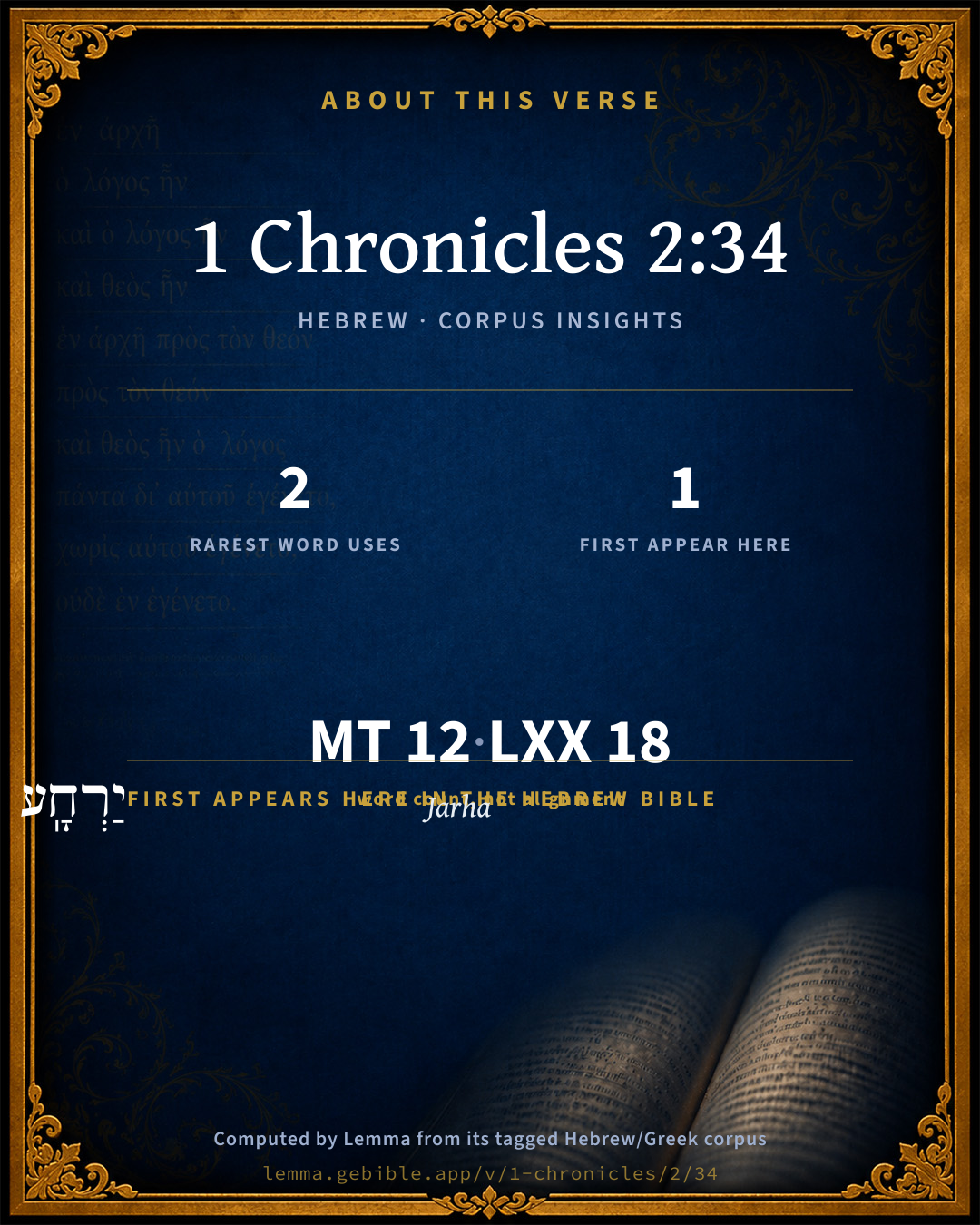
The rarest word here is יַרְחָֽע Jarha H3398 — appearing just 2 times in the whole Hebrew Bible.

First appearance in Scripture

This word makes its first canonical appearance in the Hebrew Bible here:

  • יַרְחָֽע Jarha H3398

Shared distinctive vocabulary

יַרְחָֽע Jarha H3398 occurs in 2 verses of the Hebrew Bible. Also found in:

Grammatical profile

  • 1 verb
  • 8 nouns
  • 2 conjunctions
  • 1 particle

Verb forms

  • הָיָ֧ה Qal · Perfect

Repetition

A word recurs within this verse — often emphatic in Hebrew:

  • לְשֵׁשָׁ֛ן Sheshan H8348 ×2

Hebrew & Septuagint length

In English translation the verse runs 17 words from the Hebrew and 18 from the Septuagint (LXX English) — closely comparable.

A rough comparison of the two English renderings, which tokenize alike — not a word-level alignment.

Word counts can differ between the Hebrew and the Greek without any difference in meaning — e.g. the Hebrew direct-object marker אֵת has no separate Greek word, and Greek often adds the article ὁ.

In the original languages it is 12 Hebrew tokens and 18 Greek tokens — but the two are counted differently (Hebrew bundles its prefixes and suffixes into one token; the Greek is in lemma form), so that isn’t a like-for-like length.

Hebrew and Greek witnesses Masoretic Hebrew ↔ Greek Septuagint

The same verse in the two great witnesses to the Old Testament, shown verse-for-verse.

These are two independent witnesses, not word-aligned to each other, and the Septuagint is shown in lemma (dictionary) form.

Hebrew 1 Chronicles 2:34 Masoretic · Westminster Leningrad Codex

וְלֹֽא הָיָ֧ה לְשֵׁשָׁ֛ן בָּנִ֖ים כִּ֣י אִם בָּנ֑וֹת וּלְשֵׁשָׁ֛ן עֶ֥בֶד מִצְרִ֖י וּשְׁמ֥וֹ יַרְחָֽע

Now Sheshan had no sons, but daughters. Sheshan had a servant, an Egyptian, whose name was Jarha.

World English Bible · Public Domain

Greek LXX 1 Chronicles 2:34 Septuagint · lemma form

καί οὐ εἰμί ὁ σωσαν υἱός ἀλλά ἤ θυγάτηρ καί ὁ σωσαν παῖς αἰγύπτιος καί ὄνομα αὐτός ιωχηλ

And Sosan had no sons, but daughters. And Sosan had an Egyptian servant, and his name was Jochel.

LXX2012 (modern English Septuagint) · Public Domain

Hebrew: Westminster Leningrad Codex (CC BY 4.0). Greek: Septuagint (public domain); English from LXX2012 (modern English Septuagint) (Public Domain). How the Septuagint differs from the Hebrew →

Commentary

Notes on 1 Chronicles 2:34 from classic Christian and Jewish commentators (each source and its license shown beneath its notes). The classic Christian expositions comment on the surrounding passage and are grouped to its opening verse, so a note may address several verses; the Jewish commentaries on the Tanakh (Rashi and others) are per-verse, so they appear only where the commentator wrote on this verse.

Lemma curates 59 commentaries, every one of them public domain or Creative Commons licensed, each selected and text-cleaned for this edition rather than reprinted as found. About our sources →

The Biblical Illustrator

Joseph S. Exell

1Ch_2:34

Now Sheshan had no sons, but daughters.

Compensations

Men should always put down after a statement of their deficiencies a statement of their possessions; thus: had no money, but heal mental power; had no external fame, but had great home repute; had no genius, but had great common sense; had no high connections of a social kind, but enjoyed easy access to heaven in prayer; had no earthly property, but was rich in ideas and impulses; was not at the head of a great circle of admirers, but was truly respected and trusted wherever known; had no health, but had great cheerfulness. Thus we must keep the two sides, so to say, parallel; if we have not one thing we have another. (J. Parker, D. D.)

The compensations of life

The disproportion in mans inheritances is far less than we are prone to think. If one hand of the Universal Giver be closed, the other is expanded; no one is left without his need of compensation; only in our weakness and unthankfulness we look more at the darker side of our lot, and at what appears to us the brighter side of our neighbours. Epictetus explains the mystery in part: It is not fortune that is blind, but ourselves. Whatever be our lot, if man will but just concede that that must be best for him which the Best of Beings has ordained, life thenceforward has a solace which no fortune can wrest away. (Leo H. Grindon.)

The Biblical Illustrator, edited by Joseph S. Exell (c. 1880s–1900s) — public domain. Text from a community e-Sword module.

Joseph Benson's Commentary

1Ch 2:34. But daughters — We read of no more than one daughter that he had: but the writer speaks in the plural number, as before, 1Ch 2:31. An Egyptian, whose name was Jarha — To whom, as being a proselyte to the Jewish religion, and a faithful servant, his master Sheshan first gave his freedom, and then his daughter in marriage.

Joseph Benson's Commentary on the Old and New Testaments (1811–1818) — public domain. Text from a community e-Sword module.

Jamieson, Fausset & Brown

Robert Jamieson, A. R. Fausset & David Brown

Sheshan had no sons, but daughters--either he had no sons alive at his death, or his family consisted wholly of daughters, of whom Ahlai (Ch1 2:31) was one, she being specially mentioned on account of the domestic relations about to be noted.

Jamieson, Fausset & Brown — Commentary Critical and Explanatory on the Whole Bible (1871) — public domain (CC PDM 1.0). Text via the HelloAO Bible API.

Adam Clarke's Commentary

Verse 34. Whose name was Jarha.] "And he gave him his liberty, and gave him Sheshan his daughter to wife." - T.

Adam Clarke's Commentary on the Bible (1810–1826) — public domain. Text from a community e-Sword/MySword module.

Ellicott's Commentary for English Readers

(34) Now Sheshan had no sons, but daughters.—Comp. 1Ch_2:31 above, “And the children of Sheshan; Ahlai.” Those who insist upon a literal understanding of these lists reconcile the two statements by making Ahlai a daughter; others suppose that the chronicler has preserved for us in the present section fragments of at least two independent accounts.

A Bible Commentary for English Readers, edited by Charles John Ellicott (1878–1897) — public domain. Text from a community e-Sword module.

John Gill's Exposition

And the sons of Jahdai,.... Who is not mentioned by this name before; perhaps the same with Moza, who might have two names, though, according to Hillerus (t), he was the son of Moza; some take it to be the name of another of Caleb's concubines, by whom he had the six following sons:

Regem, and Jotham, and Geshan, and Pelet, and Ephah, and Shaaph; one of these, Pelet perhaps, gave name to Bethpalet in the tribe of Judah, Jos 15:27.

(t) Onomast. Sacr. p. 841.

John Gill's Exposition of the Whole Bible (1746–1763) — public domain (CC PDM 1.0). Text via the HelloAO Bible API.

Matthew Poole's English Annotations

Sheshan had no sons, to wit, living when he died, his son Ahlai, 1Ch 2:31, dying before him; unless Ahlai was the name of a daughter.

Matthew Poole's English Annotations on the Holy Bible (1683–1685) — public domain. Text from a community e-Sword/MySword module.

Keil & Delitzsch

C. F. Keil & F. Delitzsch

And the sons of Jahdai,.... Who is not mentioned by this name before; perhaps the same with Moza, who might have two names, though, according to Hillerus (t), he was the son of Moza; some take it to be the name of another of Caleb's concubines, by whom he had the six following sons:

Regem, and Jotham, and Geshan, and Pelet, and Ephah, and Shaaph; one of these, Pelet perhaps, gave name to Bethpalet in the tribe of Judah, Jos 15:27.

(t) Onomast. Sacr. p. 841.

Keil & Delitzsch — Biblical Commentary on the Old Testament (1861–1891) — public domain (CC PDM 1.0). Text via the HelloAO Bible API. (Old Testament only.)

unfoldingWord translationNotes

Door43 World Missions Community

General Information:

All of the names here are the names of men. (See: How to Translate Names)

bore him

"gave birth to his son"

translationWords

servant

Egypt

unfoldingWord translationNotes — © Distant Shores Media and the Door43 World Missions Community, licensed CC BY-SA 4.0. Source: git.door43.org/Door43/en_tn.

Rashi

Rabbi Shlomo Yitzchaki (Rashi)

And Sheshan had no sons but daughters And that which he says above (verse 31): “... and the sons of Sheshan were Ahlai,” means that he [Ahlai] was ill and humble and died without children.

Rashi on the Tanakh — English translations: “The Judaica Press complete Tanach with Rashi, translated by A. J. Rosenberg” (CC BY 4.0); “Pentateuch with Rashi's commentary by M. Rosenbaum and A.M. Silbermann, 1929-1934” (public domain); “The Metsudah Tanach series, Lakewood, N.J” (CC BY 4.0); and “The Book of Joshua, Metsudah Publications, 1997” (CC BY 4.0). Text via Sefaria.

Lesson kit

Teaching starters — assembled from the data on this page, not authored interpretation. Every prompt links to the verse data it draws on. Edit before teaching.

1 Chronicles, in the Historical, opens this verse with 12 words (11 distinct Hebrew lemmas). Its most distinctive word is Yarchâʻ (“Jarha”). A historical commentator’s framing appears above. Read the whole chapter for the surrounding context.

Discussion questions

  1. What does “Jarha” (Yarchâʻ) contribute to the verse as a whole?
  2. The word “Jarha” first appears here in Scripture. What is being introduced at this debut?
  3. 1 Chronicles 2:35 shares the word «Jarha» with this verse. How do the two illuminate each other?
  4. “Sheshan” occurs 2× in this one verse. What is the effect of the repetition?
  5. These translations render this verse differently; the difference is in the English rendering, not the original. What questions does that raise?
  6. The verb «הָיָ֧ה» is Qal Perfect. How does its form color the action?
  7. Reading how The Biblical Illustrator and Joseph Benson's Commentary read this verse, where do the two commentators agree and where do they part?

Things to notice

Reading settings

Reading text

Shown beneath each verse's original-language words.

Old Testament
Old Testament edition

Read the OT as the Masoretic Hebrew (MT) or the Greek Septuagint (LXX).

English shown for the Greek Septuagint (in the Hebrew ↔ Greek comparison).

Comparing translations? Open the Compare panel on any verse page to stack up to four side by side.