Ezekiel 21:10

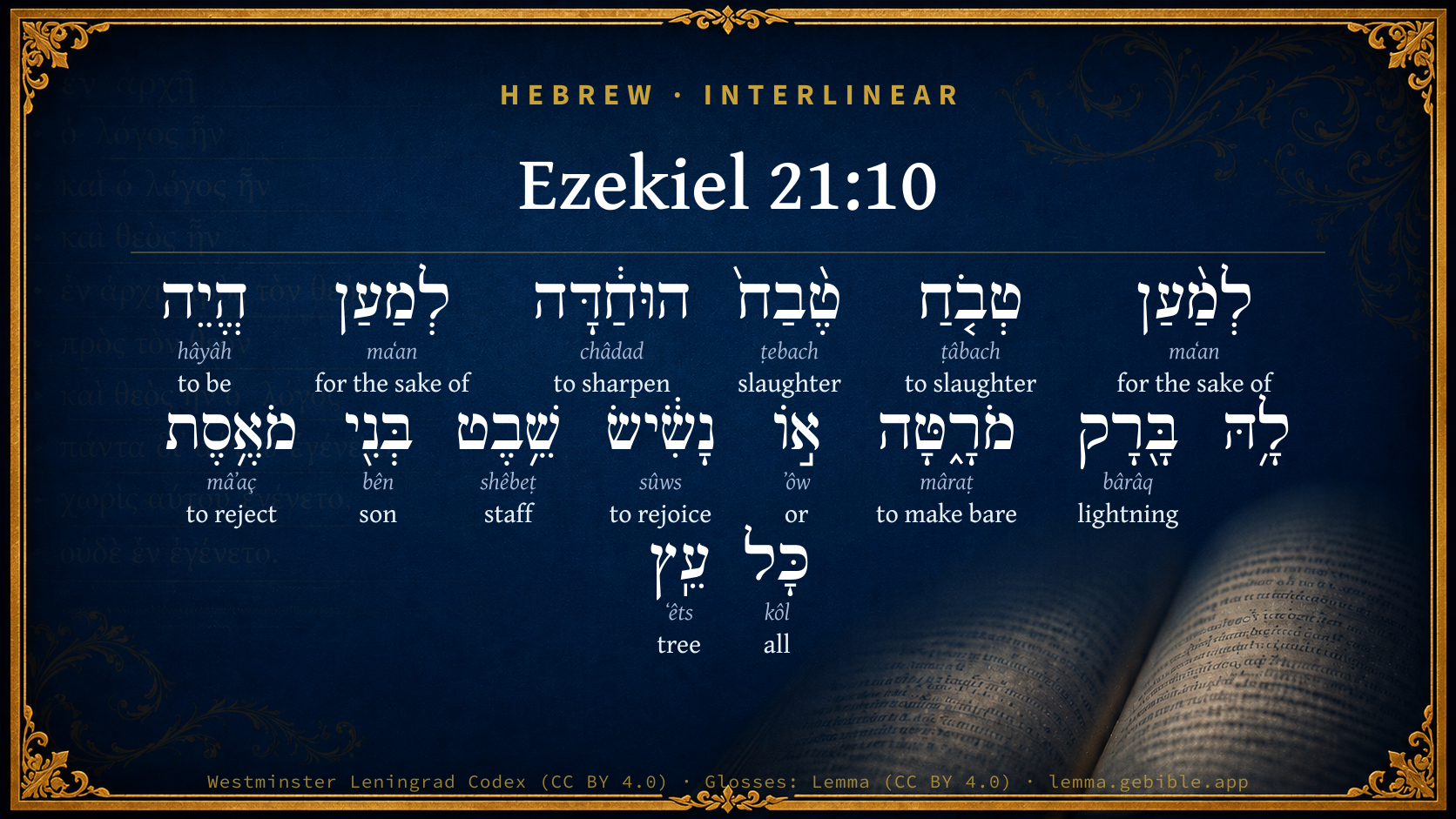
Hebrew (Westminster Leningrad Codex) Ezekiel 21:10 appears in the Hebrew Old Testament. The text above is from the Westminster Leningrad Codex. Each word links to its Strong’s number, a concise gloss, and parsing drawn from the Open Scriptures Hebrew Bible morphology. Click any word for its full Brown-Driver-Briggs (BDB) entry.
Download image
Cite this verse

Ezekiel 21:10 (World English Bible). Public Domain. Lemma interlinear Bible study tool, https://lemma.gebible.app/v/ezekiel/21/10.

Show BibTeX & RIS
BibTeX
RIS
English Translation
it is sharpened that it may make a slaughter; it is furbished that it may be as lightning: shall we then make mirth? the rod of my son, it condemns every tree.
World English Bible · Public Domain
Download a study sheet

One document with this verse’s original text, its word-by-word gloss line, the meaning frame, cross-references with their text, attributed commentary, and full source and license credits — printable, and it pastes into notes with its structure intact.

This verse Autodidact and up

Study sheet (.html) Plain text (.txt)

A passage Seminary Student

Up to 50 verses in one chapter. A passage sheet keeps up to 6 commentary sources and 12 cross-references per verse, in the order this page ranks them, and says so on the sheet whenever that leaves anything out. Ask for a single verse and you get the Autodidact verse sheet above.

Everything on this page stays free to read, with no account — the sheet is a download of what is already on screen, not access to it.

Want to remove ads? Support Godless Engineer
Compare translations 3

The same verse in 3 English versions, stacked beneath the original-language interlinear above. Click any original word for its lexicon entry.

Each is an independent rendering of the whole verse — the interlinear is not word-aligned to these translations.

Highlighted words mark where these versions differ — a whole-verse word diff, not a word-by-word alignment.

  • World English Bible Public Domain
    it is sharpened that it may make a slaughter; it is furbished that it may be as lightning: shall we then make mirth? the rod of my son, it condemns every tree.
  • King James Version Public Domain
    It is sharpened to make a sore slaughter; it is furbished that it may glitter: should we then make mirth? it contemneth the rod of my son, as every tree.
  • unfoldingWord Literal Text CC BY-SA 4.0
    It will be sharpened in order to engage in great slaughter! It will be polished in order to be like lightning! Should we rejoice in my son’s scepter? The coming sword hates every such rod!

unfoldingWord Literal Text — © unfoldingWord, licensed CC BY-SA 4.0. Word-aligned USFM3 via Door43 (git.door43.org/unfoldingWord/en_ult).

Versions to compare (up to 4)

3 of 4 selected

Show all 18 translations

Every available English version of this verse, each an independent rendering of the whole verse.

  • World English Bible Public Domain
    it is sharpened that it may make a slaughter; it is furbished that it may be as lightning: shall we then make mirth? the rod of my son, it condemns every tree.
  • Berean Standard Bible Public Domain
    it is sharpened for the slaughter, polished to flash like lightning! Should we rejoice in the scepter of My son? The sword despises every such stick.
  • Majority Standard Bible Public Domain
    it is sharpened for the slaughter, polished to flash like lightning! Should we rejoice in the scepter of My son? The sword despises every such stick.
  • King James Version Public Domain
    It is sharpened to make a sore slaughter; it is furbished that it may glitter: should we then make mirth? it contemneth the rod of my son, as every tree.
  • American Standard Version (1901) Public Domain
    it is sharpened that it may make a slaughter; it is furbished that it may be as lightning: shall we then make mirth? the rod of my son, it contemneth every tree.
  • Revised Version (1885) Public Domain
    it is sharpened that it may make a slaughter; it is furbished that it may be as lightning: shall we then make mirth? the rod of my son, it contemneth every tree.
  • Geneva Bible (1599) Public Domain
    It is sharpened to make a sore slaughter, and it is fourbished that it may glitter: how shall we reioyce? for it contemneth the rod of my sonne, as all other trees.
  • Douay-Rheims (1899) Public Domain
    It is sharpened to kill victims: it is furbished that it may glitter: thou removest the sceptre of my son, thou hast cut down every tree.
  • Young's Literal Translation Public Domain
    So as to slaughter a slaughter it is sharpened. So as to have brightness it is polished, Desire hath rejoiced the sceptre of my son, It is despising every tree.
  • Literal Standard Version CC BY-SA 4.0
    It is sharpened so as to slaughter a slaughter. It is polished so as to have brightness, || Or do we rejoice? It is despising the scepter of My son [as] every tree.
  • Unlocked Literal Bible CC BY-SA 4.0
    It will be sharpened in order to engage in great slaughter! It will be polished in order to be like lightning! Should we rejoice in my son's scepter? The coming sword hates every such rod!
  • unfoldingWord Literal Text CC BY-SA 4.0
    It will be sharpened in order to engage in great slaughter! It will be polished in order to be like lightning! Should we rejoice in my son’s scepter? The coming sword hates every such rod!
  • Darby Bible Public Domain
    It is sharpened for sore slaughter, it is furbished that it may glitter. Shall we then make mirth, [saying,] The sceptre of my son contemneth all wood?
  • World Messianic Bible Public Domain
    It is sharpened that it may make a slaughter. It is polished that it may be as lightning. Should we then make mirth? The rod of my son condemns every tree.
  • Webster's Bible Public Domain
    It is sharpened to make a grievous slaughter; it is furbished that it may glitter: should we then make mirth? it contemneth the rod of my son, as every tree.
  • Free Bible Version CC BY-SA 4.0
    It's sharpened for killing and polished so it will flash like lightning! (Are we to be happy, saying, ‘The scepter of my son despises every other stick’?)
  • Bible in Basic English Public Domain
    It has been made sharp to give death; it is polished so that it may be like a thunder-flame:...
  • JPS Tanakh (1917) Public Domain
    (21-15) It is sharpened that it may make a sore slaughter, it is furbished that it may glitter — or shall we make mirth? — against the rod of My son, contemning every tree.

Literal Standard Version (2020), Covenant Press — licensed CC BY-SA 4.0. Text via the HelloAO Bible API (eBible.org). Unlocked Literal Bible (unfoldingWord) — licensed CC BY-SA 4.0. Text via the HelloAO Bible API (eBible.org). unfoldingWord Literal Text — © unfoldingWord, licensed CC BY-SA 4.0. Word-aligned USFM3 via Door43 (git.door43.org/unfoldingWord/en_ult). Free Bible Version, Dr. Jonathan Gallagher — licensed CC BY-SA 4.0. Text via the HelloAO Bible API (eBible.org).

Word by word

More ways to search: Search by grammar → Find every occurrence → Compare this word →

Practice this passage: Drill this verse → Learn its vocabulary →

הוּחַ֔דָּה
châdad
H2300
“to sharpen”
Verb, Hophal, Perfect, 3rd Person, Feminine, Singular
Part of Speech
Verb
Stem
Hophal
Form
Perfect
Person
3rd Person
Gender
Feminine
Number
Singular
Full BDB Definition

Origin: a primitive root

TWOT: 605

to be sharp, be alert, be keen - (Qal) to be sharp, be keen - (Hiphil) to sharpen - (Hophal) to be sharpened
  1. לְמַ֨עַן maʻan H4616 “for the sake of” Preposition
  2. טְבֹ֤חַ ṭâbach H2873 “to slaughter” Verb, Qal, Infinitive Construct
  3. טֶ֨בַח֙ ṭebach H2874 “slaughter” Noun, Common, Masculine, Singular, Absolute
  4. לְמַעַן maʻan H4616 “for the sake of” Preposition
  5. הֱיֵה hâyâh H1961 “be” Verb, Qal, Imperative, 2nd Person, Masculine, Singular
  6. בָּ֖רָק bârâq H1300 “lightning” Noun, Common, Masculine, Singular, Absolute
  7. מֹרָ֑טָּה mâraṭ H4803 “to make bare” Verb, Pual, Perfect, 3rd Person, Feminine, Singular
  8. א֣וֹ ʼôw H176 “or” Conjunction
  9. נָשִׂ֔ישׂ sûws H7797 “to rejoice” Verb, Qal, Imperfect, 1st Person, Common, Plural
  10. שֵׁ֥בֶט shêbeṭ H7626 “staff of” Noun, Common, Masculine, Singular, Construct
  11. בְּנִ֖י bên H1121 “son · my” Noun, Common, Masculine, Singular, Construct + Suffix, Personal, 1st Person, Common, Singular
  12. מֹאֶ֥סֶת mâʼaç H3988 “rejecting” Verb, Qal, Participle Active, Feminine, Singular, Construct
  13. כָּל kôl H3605 “all of” Noun, Common, Masculine, Singular, Construct
  14. עֵֽץ ʻêts H6086 “tree” Noun, Common, Masculine, Singular, Absolute

About this verse

These counts appear in no published source. They are computed here, from the morphology-tagged text and Lemma’s own curated glosses. What Lemma adds →

16
words
14
distinct lemmas
Prophets
section

Notable vocabulary

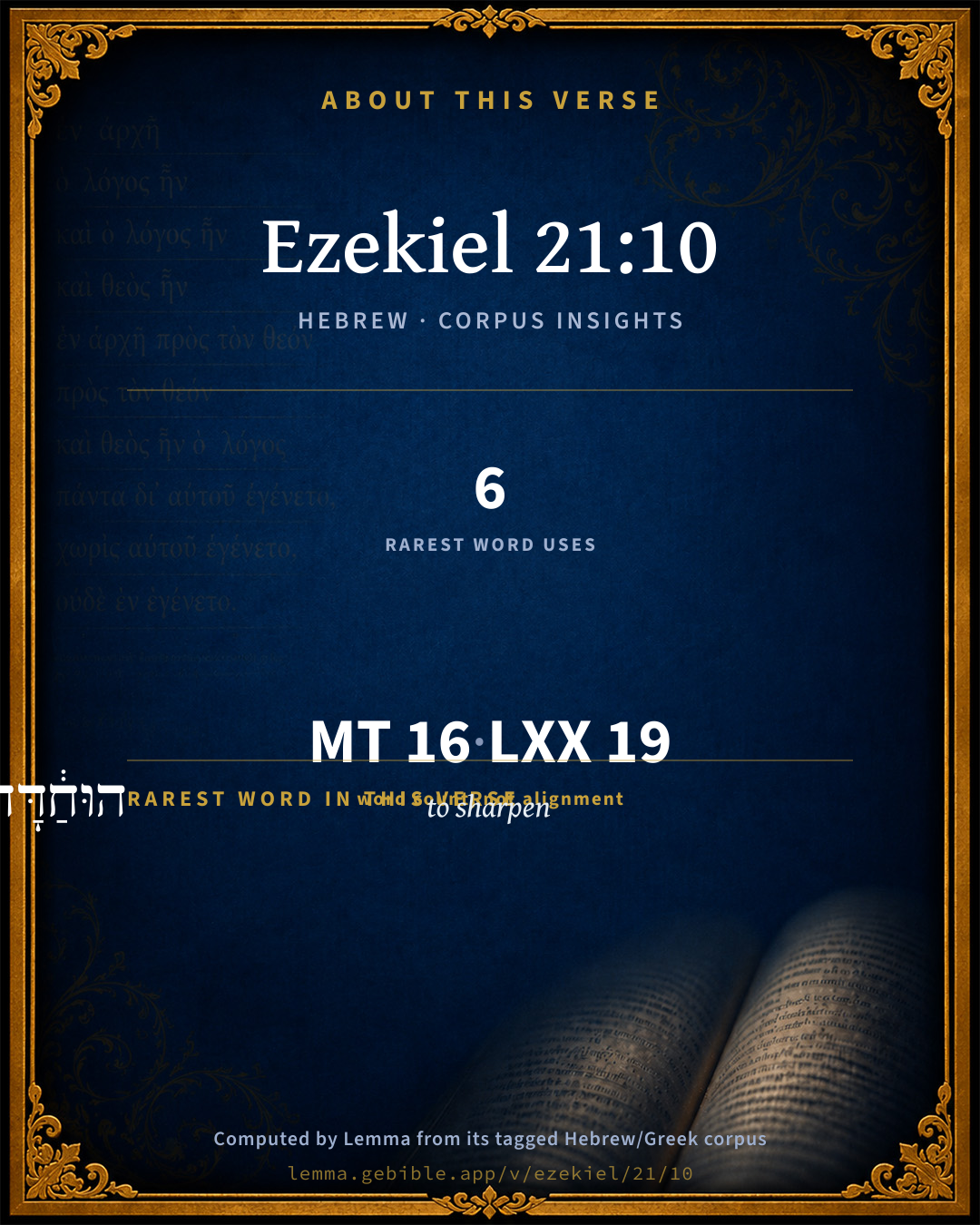
The rarest word here is הוּחַ֔דָּה to sharpen H2300 — appearing just 6 times in the whole Hebrew Bible.

Shared distinctive vocabulary

הוּחַ֔דָּה to sharpen H2300 occurs in 5 verses of the Hebrew Bible. Also found in:

Grammatical profile

  • 6 verbs
  • 6 nouns
  • 3 prepositions
  • 1 conjunction

Verb forms

  • טְבֹ֤חַ Qal · Infinitive Construct
  • הוּחַ֔דָּה Hophal · Perfect
  • הֱיֵה Qal · Imperative
  • מֹרָ֑טָּה Pual · Perfect
  • נָשִׂ֔ישׂ Qal · Imperfect
  • מֹאֶ֥סֶת Qal · Participle Active

Repetition

A word recurs within this verse — often emphatic in Hebrew:

  • לְמַ֨עַן for the sake of H4616 ×2

Hebrew & Septuagint length

In English translation the verse runs 32 words from the Hebrew and 22 from the Septuagint (LXX English) — the Septuagint runs noticeably shorter here. See the side-by-side →

A rough comparison of the two English renderings, which tokenize alike — not a word-level alignment.

Word counts can differ between the Hebrew and the Greek without any difference in meaning — e.g. the Hebrew direct-object marker אֵת has no separate Greek word, and Greek often adds the article ὁ.

In the original languages it is 16 Hebrew tokens and 19 Greek tokens — but the two are counted differently (Hebrew bundles its prefixes and suffixes into one token; the Greek is in lemma form), so that isn’t a like-for-like length.

Cross-references

20

Topical passages linked to Ezekiel 21:10 in the Treasury of Scripture Knowledge — connected by theme and wording, ordered by reader-vote popularity; previews shown in the World English Bible.

  • Psalms 110:5–6 The Lord is at your right hand. He will crush kings in the day of his wrath.
  • Ezekiel 20:47 and tell the forest of the South, Hear the word of Yahweh: Thus says the Lord Yahweh, Behold, I will kindle a fire in you, and it shall devour every green tree in you, and every dry tree: the flaming flame shall not be quenched, and all faces from the south to the north shall be burnt thereby.
  • 2 Samuel 7:14 I will be his father, and he shall be my son: if he commit iniquity, I will chasten him with the rod of men, and with the stripes of the children of men;
  • Esther 3:15 The posts went forth in haste by the king's commandment, and the decree was given out in Shushan the palace. The king and Haman sat down to drink; but the city of Shushan was perplexed.
  • Psalms 2:7–9 I will tell of the decree. Yahweh said to me, "You are my son. Today I have become your father.
  • Psalms 89:26–32 He will call to me, 'You are my Father, My God, and the rock of my salvation!'
  • Psalms 89:38–45 But you have rejected and spurned. You have been angry with your anointed.
  • Ecclesiastes 3:4 A time to weep, And a time to laugh; A time to mourn, And a time to dance;
  • Isaiah 5:12–14 The harp, lyre, tambourine, and flute, with wine, are at their feasts; But they don't regard the work of Yahweh, Neither have they considered the operation of his hands.
  • Isaiah 22:12–14 In that day did the Lord, Yahweh of Hosts, call to weeping, and to mourning, and to baldness, and to girding with sackcloth:
  • Isaiah 34:5–6 For my sword has drunk its fill in the sky: behold, it shall come down on Edom, and on the people of my curse, to judgment.
  • Jeremiah 46:4 Harness the horses, and get up, you horsemen, and stand forth with your helmets; furbish the spears, put on the coats of mail.
  • Ezekiel 19:11–14 It had strong rods for the scepters of those who bore rule, and their stature was exalted among the thick boughs, and they were seen in their height with the multitude of their branches.
  • Ezekiel 21:25–27 You, deadly wounded wicked one, the prince of Israel, whose day is come, in the time of the iniquity of the end,
  • Amos 6:3–7 Those who put far away the evil day, And cause the seat of violence to come near;
  • Nahum 1:10 For entangled like thorns, and drunken as with their drink, they are consumed utterly like dry stubble.
  • Nahum 3:3 the horseman mounting, and the flashing sword, the glittering spear, and a multitude of slain, and a great heap of corpses, and there is no end of the bodies. They stumble on their bodies,
  • Habakkuk 3:11 The sun and moon stood still in the sky, At the light of your arrows as they went, At the shining of your glittering spear.
  • Luke 21:34–35 "So be careful, or your hearts will be loaded down with carousing, drunkenness, and cares of this life, and that day will come on you suddenly.
  • Revelation 2:27 He will rule them with a rod of iron, shattering them like clay pots; as I also have received of my Father:

Cross-references courtesy of OpenBible.info (CC BY 4.0).

Hebrew and Greek witnesses Masoretic Hebrew ↔ Greek Septuagint

The same verse in the two great witnesses to the Old Testament, shown verse-for-verse.

Here the Septuagint runs noticeably shorter than the Hebrew — LXX2012 (modern English Septuagint) 22 words vs World English Bible 32. A rough length comparison of the two English translations, not a word-level alignment — read both below.

These are two independent witnesses, not word-aligned to each other, and the Septuagint is shown in lemma (dictionary) form.

Hebrew Ezekiel 21:10 Masoretic · Westminster Leningrad Codex

לְמַ֨עַן טְבֹ֤חַ טֶ֨בַח֙ הוּחַ֔דָּה לְמַעַן הֱיֵה לָ֥הּ בָּ֖רָק מֹרָ֑טָּה א֣וֹ נָשִׂ֔ישׂ שֵׁ֥בֶט בְּנִ֖י מֹאֶ֥סֶת כָּל עֵֽץ

it is sharpened that it may make a slaughter; it is furbished that it may be as lightning: shall we then make mirth? the rod of my son, it condemns every tree.

World English Bible · Public Domain

Greek LXX Ezekiel 21:10 Septuagint · lemma form

καί ἐπιγιγνώσκω πᾶς σάρξ διότι ἐγώ κύριος ἐκσπάω ὁ ἐγχειρίδιον ἐγώ ἐκ ὁ κολεός αὐτός καί οὐ ἀποστρέφω οὐκέτι

that you may kill victims; be sharpened that you may be bright, ready for slaughter, kill, set at nothing, despise every tree.

LXX2012 (modern English Septuagint) · Public Domain

On this verse, The Cambridge Bible for Schools and Colleges discusses the Septuagint’s reading. Read the note in Commentary ↓

Hebrew: Westminster Leningrad Codex (CC BY 4.0). Greek: Septuagint (public domain); English from LXX2012 (modern English Septuagint) (Public Domain). How the Septuagint differs from the Hebrew →

Targum (Aramaic paraphrase)

1

The Targum is the ancient Jewish Aramaic paraphrase of the Hebrew Scriptures — an interpretive translation, not the Hebrew text itself. Onkelos (literal) and Pseudo-Jonathan (expansive) render the Torah, and Jonathan the Prophets. Coverage is partial: where no permissively-licensed English translation exists for a verse, only the Aramaic is shown. This is verse-level text, not a word-by-word alignment to the Hebrew.

  1. Targum Jonathan Prophets (Joshua–Malachi)
    וְיֵדְעוּן כָּל בְּנֵי בִּסְרָא אֲרֵי אֲנָא יְיָ אַפְקֵית חַרְבִּי מִלִדְנָהּ לָא תְתוֹב עוֹד:

    (no public-domain English translation for this verse)

    Targum Jonathan — Aramaic: “Mikraot Gedolot” (public domain). English: “Sefaria Community Translation” (CC0 1.0 (public-domain dedication)); “London "Chaldee Paraphrase," 1871” (public domain). Text via Sefaria.

Commentary

Notes on Ezekiel 21:10 from classic Christian and Jewish commentators (each source and its license shown beneath its notes). The classic Christian expositions comment on the surrounding passage and are grouped to its opening verse, so a note may address several verses; the Jewish commentaries on the Tanakh (Rashi and others) are per-verse, so they appear only where the commentator wrote on this verse.

Lemma curates 59 commentaries, every one of them public domain or Creative Commons licensed, each selected and text-cleaned for this edition rather than reprinted as found. About our sources →

Trapp's Complete Commentary

John Trapp

Eze 21:10 It is sharpened to make a sore slaughter; it is furbished that it may glitter: should we then make mirth? it contemneth the rod of my son, [as] every tree.

Ver. 10. Should we then make mirth?] Not if we be in our right minds; for would it not be now a mad mirth, whenas we should be most serious and seek God? See Isa 22:12-14. {See Trapp on "Isa 22:12"} {See Trapp on "Isa 22:13"} {See Trapp on "Isa 22:14"}

It contemneth the rod of my son.] Other judgments forerun the sword, which, when they will not do the deed, the sword will then contemn the rod; that is, it will set at naught whatever those have done, and come furbished and sharpened for the slaughter. See Eze 21:3.

John Trapp, A Commentary or Exposition upon All the Books of the Old and New Testament (1647–1656) — public domain. Text from a community e-Sword module.

Geneva Bible (1599)

Geneva Bible translators

That is, the rest of the people.

And so cause a fear.

Meaning, the scepter: showing that it will not spare the King, who should be as the son of God, and in his place.

Geneva Bible (1599) marginal notes — public domain. Text via Bolls.life.

Jamieson, Fausset & Brown

Robert Jamieson, A. R. Fausset & David Brown

to make a sore slaughter--literally, "that killing it may kill."

glitter--literally, "glitter as the lightning flash": flashing terror into the foe.

should we . . . make mirth--It is no time for levity when such a calamity is impending (Isa 22:12-13).

it contemneth the rod of my son, &c.--The sword has no more respect to the trivial "rod" or scepter of Judah (Gen 49:10) than if it were any common "tree." "Tree" is the image retained from Eze 20:47; explained in Eze 21:2-3. God calls Judah "My son" (compare Exo 4:22; Hos 11:1). FAIRBAIRN arbitrarily translates, "Perchance the scepter of My son rejoiceth; it (the sword) despiseth every tree."

Jamieson, Fausset & Brown — Commentary Critical and Explanatory on the Whole Bible (1871) — public domain (CC PDM 1.0). Text via the HelloAO Bible API.

Adam Clarke's Commentary

Verse 10. It contemneth the rod of my son] "It," the sword of Nebuchadnezzar, "contemneth the rod," despises the power and influence of my son-Israel, the Jewish people: "Out of Egypt have I called MY SON."

As every tree.] As all the stocks, kindreds, and nations, over which I have already given him commission. Can the rod of Israel be spared, when the trees of Assyria, Egypt, &c., have been cut down?

Adam Clarke's Commentary on the Bible (1810–1826) — public domain. Text from a community e-Sword/MySword module.

Ellicott's Commentary for English Readers

(10) Make mirth.—The answer to this question has already been given in Eze_21:6, and is repeated in Eze_21:12.

Contemneth the rod of my son.—This refers to Gen_49:9-10, in which Jacob addresses Judah as “my son,” and foretells that “the sceptre shall not depart from” him until Shiloh come. There is another allusion to the same passage in Eze_21:27. Comp, also Eze_17:22-23. There is, however, serious difficulty as to the construction and meaning of the clause. The ancient versions and many commentators have more or less changed the text without improvement. The original is obscure in its extreme brevity, and allows “the rod of my son” to be either the object (as it is taken in the text) or the subject (as in the margin). The true sense is probably that which makes the clause into an objection offered by the Jew to the prophet’s denunciation: “But ‘the rod of my son’ despiseth every tree;” i.e., the Divine promise of old to Judah is sure, and his sceptre must remain whatever power arises against it. The objection was in a certain sense true, but the objectors had little idea of the means by which its truth should be established, and vainly imagined that it gave a temporal security to the kingdom of Judah, whatever might be its sins. The prophet does not notice the objection further than to go on with his prediction of the approaching desolation.

A Bible Commentary for English Readers, edited by Charles John Ellicott (1878–1897) — public domain. Text from a community e-Sword module.

The Cambridge Bible for Schools and Colleges

gen. ed. J. J. S. Perowne

10. should we then make mirth] lit., or shall we make mirth? These words with the rest to the end of the verse appear to have little meaning in the connexion. R V. renders the whole: “shall we then make mirth? the rod of my son, it contemneth every tree.” This is a literal rendering, the last words meaning probably that the rod (the sword of Babylon) with which Jehovah now chastises his son (the prince, or, people) contemneth (exceeds in severity) every tree, or, all wood, i.e. all rods of chastisement which are mere wood, for it is glittering steel. Some ingenuity is needed to extract the meaning, which, however, when extracted is difficult to harmonise with Eze_21:13. The words “shall we then make mirth?” still appear meaningless. For “or” or “then” Frd. Del. would find some cohortative particle after the Assyr.,—ha! let us make mirth! the words being those of God (cf. Eze_21:17), and the following words “contemneth every tree” meaning that in comparison with the rod he now uses all other rods of chastisement are only despicable, and useless for their purpose (Zeit. f. Keilschritftforschung, ii. 4 p. 385). The text appears to be in disorder, and though many emendations have been proposed none of them is satisfactory. Ges., … “glitter, against the prince of the tribe of my son (Judah), which despiseth all wood”—prince for “should we rejoice” (nasi’ for nasis), and the idea being expressed that as Judah has hitherto despised all ordinary chastisements with the rod of wood the sword shall now be drawn against the prince. Ew., “no weak rod of my son, the softest of all wood”—the words “rod of my son” being a phrase from the mouth of fathers and meaning a gentle rod. Apart from the unnatural constructions and the strong Aramaisms assumed, the sense is feeble and improbable. Smend, “woe O prince! thou hast despised the rod, contemned every tree (all wood)”—rod and wood being used of chastening as before. LXX. reads: “ready (= furbished) for paralysing (enfeebling); slay, despise, set at nought every tree”! The imperatives are addressed to the sword. The words “for paralysing” may be a rendering of present Heb. read with Aramean sense; but “for” is read for “or.” It is by no means certain that LXX. found imperatives, because it renders Eze_21:9 also in the imperative. Partly following Sep. Corn., “for men who slay and plunder (lit. men of slaughter and plundering) who despise every stronghold”—viz. the Chaldeans, into whose hand the sword of the Lord is to be given. (Cf. Isa_33:8; Hab_1:10.) This really gives a meaning, though it is gained at considerable cost, for some of the words assumed do not occur, the constructions are far from probable, and the changes of the text are serious. Further, in all the passage it is the sword itself that is dwelt upon and those whom it shall slay; those who are to wield it are only alluded to.

Scholars almost unanimously assume that there is ref. in the clause to former chastisement, hence “rod” and “all wood” are read in that sense. But such an idea seems little in place in the connexion; and the word rendered “rod” may mean sceptre or almost ruler (Eze_19:11; Eze_19:14), and “every tree” may be taken of other sceptres. The assumption that “contemneth every tree” (all wood) means: exceeds in severity of punishment every rod, or looks down on every other chastening rod, feeling its own superiority as an instrument of punishment, is a very far-fetched one. It is certainly possible that the word “prince” (princes) lurks in the strange “shall we then rejoice?” (Ges. Sm.). The prince and royal house are alluded to repeatedly in the chapter, e.g. Eze_21:14; Eze_21:25-27; Eze_21:29. The rendering: “against the prince (princes), the sceptre of my son (that) despiseth all wood” (i.e. other sceptres, or royal powers, Eze_19:11; Eze_19:14), is not very natural. The expression “my son,” whether applied to the king or the people, has something unexpected about it in Ezek., though “my people” is used in the passage also (Eze_21:12), and an undertone of pity, or at least a deep feeling of the terribleness of the coming calamity, runs through the passage. The words “shall we then make mirth?” can hardly stand in any case, even in this form: “or shall we make mirth (saying), The sceptre of my son contemneth all wood!” i.e. defies every other sceptre or royal power (La Bible Annotéc). Any reference in the passage to Gen_49:9 or 2Sa_7:14 is without probability.

The Cambridge Bible for Schools and Colleges (gen. ed. J. J. S. Perowne; Cambridge University Press, 1878–1918) — public domain. Text from a community e-Sword module.

John Gill's Exposition

Cry, howl, son of man,.... Not only sigh, but cry; and not cry only, but howl; signifying hereby that this would be the case of the Jews when these calamities should come upon them; and, in order to affect them with them before hand, the prophet is ordered to act such a part, as well as to express his sympathy with them:

for it shall be upon my people; that is, the sword, or the calamity signified by it; this should be not upon other nations, but upon the Lord's own people; such who professed themselves to be his people, and whom he had distinguished from all others; this is said, to affect the prophet the more, they being both the Lord's people, and his also:

and it shall be upon all the princes of Israel; who were slain in Riblah by the king of Babylon, Jer 52:10, the sword spared neither people nor princes.

Terrors, by reason of the sword, shall be upon my people; upon the rumour of the invasion, and when besieged in the city, and when attempting to make their escape by flight: or "my people are fallen by the sword" (u), as some:

smite therefore upon thy thigh; as one grieved in spirit, in great distress and anguish; see Jer 31:19.

(u) So R. Sol Urbin. Ohel Moed, fol. 59. 1.

John Gill's Exposition of the Whole Bible (1746–1763) — public domain (CC PDM 1.0). Text via the HelloAO Bible API.

Haydock's Catholic Bible Commentary

My son. He speaks, according to St. Jerome, to the sword of Nabuchodonosor; which was about to remove the sceptre of Israel, whom God here calls his son. (Challoner) --- This title belonged to all Israel, Exodus iv. 22. (Worthington) --- The Hebrew seems to be corrupt, and we may adhere to the Vulgate or to the Septuagint, (Calmet) which has, (9.) "Sword be sharp, and raging to slay victims; be sharp to shine, ready for destruction; cut, reduce to nothing, remove all wood." (Haydock) --- Syriac, "be ready to scatter the race of my son," &c. Hebrew, "Where shall we rejoice, sceptre of my son, thou sword which despisest every tree?" (Calmet) --- Protestants, "It contemneth the rod of my son as every tree?" (Haydock)

George Leo Haydock (1774–1849), Haydock's Catholic Family Bible and Commentary, 1859 edition — public domain. Excludes Psalms (Douay-Rheims chapter numbering differs from Protestant) and Deuterocanonical books (Catholic canon only).

Matthew Poole's English Annotations

To make a sore slaughter; to slay many, and with as little regard as men kill beasts, or to offer whole herds of wicked men in sacrifice to the offended justice of God; much after this style both David, Psa 44:22, and Isa 34:6.

May glitter, and strike a terror into the enemy.

Should we then make mirth? shall we allow ourselves in jollity, in feasts, or dances, or songs? This would be very uncomely.

It contemneth; this great, sharp and glittering sword, appointed to cut off, slights and despiseth all the resistance that can be made against it, and reckons all former chastisements were but as the rod wherewith a son is corrected; but now the sword of an enemy is drawn out, and will cut off all. Or, Nebuchadnezzar despiseth your king, the royal family, and nobles, which are compared to gods, Eze 19:10,11; and would use them as he would every common tree of the wood, as it appears he did, when he put out Zedekiah’s eyes, and bound him in chains as a slave.

Matthew Poole's English Annotations on the Holy Bible (1683–1685) — public domain. Text from a community e-Sword/MySword module.

Whedon's Commentary on the Bible

Daniel D. Whedon

10. Should we then make mirth? it contemneth the rod of my son, as every tree — Literally, shall we make mirth, saying, The scepter of my son contemneth all wood? Dr. Kautzsch and Professor Toy give up the text as hopelessly corrupt and without sensible meaning. The last clause may mean possibly either that the scepter of my son (Israel) defies every other scepter, or that his rod (punishment) exceeds all ordinary punishment. Smend emends the text so as to read, “Woe to the prince! thou hast despised the rod, hast contemned all wood.”

Daniel D. Whedon (gen. ed.), Commentary on the Old and New Testaments (1874–1909) — public domain. Text from a community e-Sword module.

The Pulpit Commentary

The sceptre of my son, etc. The clause is obscure, possibly corrupt, and has received many interpretations.

(1) Taking the received text, the most probable explanation is that given by Keil and Kliefoth: Shall we rejoice (saying), The sceptre of my son despiseth all woods. Here the "rod" is the "sceptre" of the tribe of Judah, (Gen_49:10) and the words are supposed to be spoken by those who hear of the destroying sword. They need not dread the sword, they say, because the sceptre of the house of David, whom Jehovah recognizes as his son, despises all wood, looks on every other rod that is the symbol of sovereignty, with scorn. It is urged, in favour of this interpretation, that ver. 27 contains an unmistakable refer, nee to the prophetic words of Gen_49:10.

(2) Ewald: It is no weak rod of my son, the softest of all wood; i.e. the sword of Jehovah is no weak weapon such as might be used for the chastisement of a child. (Pro_10:13 Pro_13:24)

(3) Hengstenberg: Shall we rejoice over the rod of my son, despising every tree? There is no cause for anything but the reverse of joy in the rod, the punishment which God appoints for Israel as his son, and which surpasses all others in its severity.

(4) The Authorized Version and Revised Version (margin) make the "sword" the nominative, and the words are those of Jehovah: It contemneth the rod (i.e. the sceptre) of my son, as it contemns every other tree (i.e. as, Eze_20:4) every other national sovereignty.

(5) The Revised. Version and Authorized Version (margin): It (the sword) is the rod of my son (appointed for his chastisement), and it despiseth every tree, in same sense as in (4).

(6) Cornill, altering the text, almost rewriting it, gets the meaning: It (the sword) is for men who murder and plunder, and regard not any strength. Neither the LXX nor the Vulgate help us, the former giving, "Slay, set at naught, reject every tree;" and the latter, "Thou who guidest the sceptre of my son, thou hast cut down." On the whole, seems to rest on better ground than the others.

The Pulpit Commentary (1880–1919), ed. H.D.M. Spence-Jones & Joseph S. Exell — public domain. Text from a community e-Sword module.

John Wesley's Explanatory Notes

Of my son - To whom God saith, Thou shalt break them with a rod of iron, Psalm ii, 9. This sword is that rod of iron, which despiseth every tree, and will bear it down.

John Wesley, Explanatory Notes Upon the Whole Bible (1754–1765) — public domain. Text via the GEBible commentary corpus.

unfoldingWord translationNotes

Door43 World Missions Community

Connecting Statement:

Yahweh continues to describe the sword of Yahweh which is a metaphor for the enemy army that Yahweh will use to attack Jerusalem. (See: Metaphor)

It will be sharpened ... It will be polished in order to

These can be stated in active form. AT: "I will sharpen it ... I will polish it so that it will" (See: Active or Passive)

in order to be like lightning

This means that the sword will be so shiny that light reflects off of it easily and brightly. AT: "so that it flashes like lightning" or "so that light reflects off of it as brightly as lightning" (See: Simile)

Should we rejoice in my son's scepter?

This rhetorical question emphasizes that the people of Israel will not celebrate their king's power, because it cannot resist the "sword." AT: "The people of Judah will not celebrate about their king's scepter." or "we should not celebrate the power of our king's scepter." (See: Rhetorical Question)

Should we

The word "we" refers to Ezekiel and the people of Israel. (See: Inclusive "We")

in my son's scepter

Here Yahweh refers to the king of Judah as his son. The king's scepter represents his rule as king. It is important to maintain the image of the king's scepter here, as the words "every such rod" refer to the scepter. AT: "in the king's scepter" or "in the power that the king's scepter represents" (See: Metonymy)

The coming sword hates every such rod

Here the "sword" is personified as coming to attack the people. This speaks of the king not being able to resist the "sword", as if the "sword" were hating the king's scepter. AT: "the sword will overpower his scepter like that of any other ruler" or "for the king will not be able to resist when the sword is brought against him" (See: Personification)

such rod

This phrase is used to mock the king's scepter by calling it a "rod." AT: "such scepter" (See: Irony)

the sword will be given to be polished

This can be stated in active form. AT: "I will polish the sword" (See: Active or Passive)

then to be grasped by the hand

This can be stated in active form. AT: "then the right person will hold it in his hand" (See: Active or Passive)

it is to be given into the hand of the one who kills

This can be stated in active form. AT: "it is ready for the killer to use" (See: Active or Passive)

translationWords

slaughter

joy

scepter

sword

rod

unfoldingWord translationNotes — © Distant Shores Media and the Door43 World Missions Community, licensed CC BY-SA 4.0. Source: git.door43.org/Door43/en_tn.

Lesson kit

Teaching starters — assembled from the data on this page, not authored interpretation. Every prompt links to the verse data it draws on. Edit before teaching.

Ezekiel, in the Prophets, opens this verse with 16 words (14 distinct Hebrew lemmas). Its most distinctive word is châdad (“to sharpen”). The Greek Septuagint runs shorter here. A historical commentator’s framing appears above. Read the whole chapter for the surrounding context.

Discussion questions

  1. What does “to sharpen” (châdad) contribute to the verse as a whole?
  2. How does Proverbs 27:17, which shares the word «to sharpen», read alongside this verse?
  3. What does the repetition of “for the sake of” (2× in this one verse) do in this verse?
  4. The Septuagint runs shorter here than the Hebrew. What might account for the difference?
  5. These translations render this verse differently; the difference is in the English rendering, not the original. What questions does that raise?
  6. «טְבֹ֤חַ» is a Qal Infinitive Construct verb. How does that grammatical form shape the action described?
  7. Compare how Trapp's Complete Commentary and Geneva Bible (1599) read this verse. Where do they agree or differ?

Things to notice

Reading settings

Reading text

Shown beneath each verse's original-language words.

Old Testament
Old Testament edition

Read the OT as the Masoretic Hebrew (MT) or the Greek Septuagint (LXX).

English shown for the Greek Septuagint (in the Hebrew ↔ Greek comparison).

Comparing translations? Open the Compare panel on any verse page to stack up to four side by side.