1 Chronicles 3:15

Hebrew (Westminster Leningrad Codex) 1 Chronicles 3:15 appears in the Hebrew Old Testament. The text above is from the Westminster Leningrad Codex. Each word links to its Strong’s number, a concise gloss, and parsing drawn from the Open Scriptures Hebrew Bible morphology. Click any word for its full Brown-Driver-Briggs (BDB) entry.
Download image
Cite this verse

1 Chronicles 3:15 (World English Bible). Public Domain. Lemma interlinear Bible study tool, https://lemma.gebible.app/v/1-chronicles/3/15.

Show BibTeX & RIS
BibTeX
RIS
English Translation
The sons of Josiah: the firstborn Johanan, the second Jehoiakim, the third Zedekiah, the fourth Shallum.
World English Bible · Public Domain
Download a study sheet

One document with this verse’s original text, its word-by-word gloss line, the meaning frame, cross-references with their text, attributed commentary, and full source and license credits — printable, and it pastes into notes with its structure intact.

This verse Autodidact and up

Study sheet (.html) Plain text (.txt)

A passage Seminary Student

Up to 50 verses in one chapter. A passage sheet keeps up to 6 commentary sources and 12 cross-references per verse, in the order this page ranks them, and says so on the sheet whenever that leaves anything out. Ask for a single verse and you get the Autodidact verse sheet above.

Everything on this page stays free to read, with no account — the sheet is a download of what is already on screen, not access to it.

Want to remove ads? Support Godless Engineer
Compare translations 3

The same verse in 3 English versions, stacked beneath the original-language interlinear above. Click any original word for its lexicon entry.

Each is an independent rendering of the whole verse — the interlinear is not word-aligned to these translations.

Highlighted words mark where these versions differ — a whole-verse word diff, not a word-by-word alignment.

  • World English Bible Public Domain
    The sons of Josiah: the firstborn Johanan, the second Jehoiakim, the third Zedekiah, the fourth Shallum.
  • King James Version Public Domain
    And the sons of Josiah were, the firstborn Johanan, the second Jehoiakim, the third Zedekiah, the fourth Shallum.
  • unfoldingWord Literal Text CC BY-SA 4.0
    And the sons of Josiah: the firstborn, Johanan; the second, Jehoiakim; the third, Zedekiah; the fourth, Shallum.

unfoldingWord Literal Text — © unfoldingWord, licensed CC BY-SA 4.0. Word-aligned USFM3 via Door43 (git.door43.org/unfoldingWord/en_ult).

Versions to compare (up to 4)

3 of 4 selected

Show all 18 translations

Every available English version of this verse, each an independent rendering of the whole verse.

  • World English Bible Public Domain
    The sons of Josiah: the firstborn Johanan, the second Jehoiakim, the third Zedekiah, the fourth Shallum.
  • Berean Standard Bible Public Domain
    The sons of Josiah: Johanan was the firstborn, Jehoiakim the second, Zedekiah the third, and Shallum the fourth.
  • Majority Standard Bible Public Domain
    The sons of Josiah: Johanan was the firstborn, Jehoiakim the second, Zedekiah the third, and Shallum the fourth.
  • King James Version Public Domain
    And the sons of Josiah were, the firstborn Johanan, the second Jehoiakim, the third Zedekiah, the fourth Shallum.
  • American Standard Version (1901) Public Domain
    And the sons of Josiah: the first-born Johanan, the second Jehoiakim, the third Zedekiah, the fourth Shallum.
  • Revised Version (1885) Public Domain
    And the sons of Josiah; the firstborn Johanan, the second Jehoiakim, the third Zedekiah, the fourth Shallum.
  • Geneva Bible (1599) Public Domain
    And of the sonnes of Iosiah, the eldest was Iohanan, the second Iehoiakim, the thirde Zedekiah, and the fourth Shallum.
  • Douay-Rheims (1899) Public Domain
    And the sons of Josias were, the firstborn Johanan, the second Joakim, the third Sedecias, the fourth Sellum.
  • Young's Literal Translation Public Domain
    And sons of Josiah: the first-born Johanan, the second Jehoiakim, the third Zedekiah, the fourth Shallum.
  • Literal Standard Version CC BY-SA 4.0
    And sons of Josiah: the firstborn Johanan, the second Jehoiakim, the third Zedekiah, the fourth Shallum.
  • Unlocked Literal Bible CC BY-SA 4.0
    Josiah's sons were his firstborn Johanan, his second son Jehoiakim, his third son Zedekiah, and his fourth son Shallum.
  • unfoldingWord Literal Text CC BY-SA 4.0
    And the sons of Josiah: the firstborn, Johanan; the second, Jehoiakim; the third, Zedekiah; the fourth, Shallum.
  • Darby Bible Public Domain
    And the sons of Josiah: the firstborn Johanan, the second Jehoiakim, the third Zedekiah, the fourth Shallum.
  • World Messianic Bible Public Domain
    The sons of Josiah: the firstborn Yochanan, the second Jehoiakim, the third Zedekiah, and the fourth Shallum.
  • Webster's Bible Public Domain
    And the sons of Josiah were, the first-born Johanan, the second Jehoiakim, the third Zedekiah, the fourth Shallum.
  • Free Bible Version CC BY-SA 4.0
    The sons of Josiah: Johanan (firstborn), Jehoiakim (second), Zedekiah (third), Shallum (fourth).
  • Bible in Basic English Public Domain
    And the sons of Josiah: the oldest Johanan, the second Jehoiakim, the third Zedekiah, the fourth Shallum.
  • JPS Tanakh (1917) Public Domain
    And the sons of Josiah: the firstborn Johanan, the second Jehoiakim, the third Zedekiah, the fourth Shallum.

Literal Standard Version (2020), Covenant Press — licensed CC BY-SA 4.0. Text via the HelloAO Bible API (eBible.org). Unlocked Literal Bible (unfoldingWord) — licensed CC BY-SA 4.0. Text via the HelloAO Bible API (eBible.org). unfoldingWord Literal Text — © unfoldingWord, licensed CC BY-SA 4.0. Word-aligned USFM3 via Door43 (git.door43.org/unfoldingWord/en_ult). Free Bible Version, Dr. Jonathan Gallagher — licensed CC BY-SA 4.0. Text via the HelloAO Bible API (eBible.org).

Word by word

More ways to search: Search by grammar → Find every occurrence → Compare this word →

Practice this passage: Drill this verse → Learn its vocabulary →

יוֹחָנָ֔ן
Yôwchânân
H3110
“Johanan”
Noun, Proper
Part of Speech
Noun
Type
Proper
Full BDB Definition

Origin: a form of H3076

TWOT: None

Johanan = "Jehovah has graced" - a priest during the high priesthood of Joiakim who returned with Zerubbabel - a Jewish captain after the fall of Jerusalem - the eldest son of king Josiah - a post-exilic prince of the line of David - father of Azariah, priest in Solomon's time - a Benjamite, one of David's mighty warriors - a Gadite, one of David's mighty warriors - a returning exile
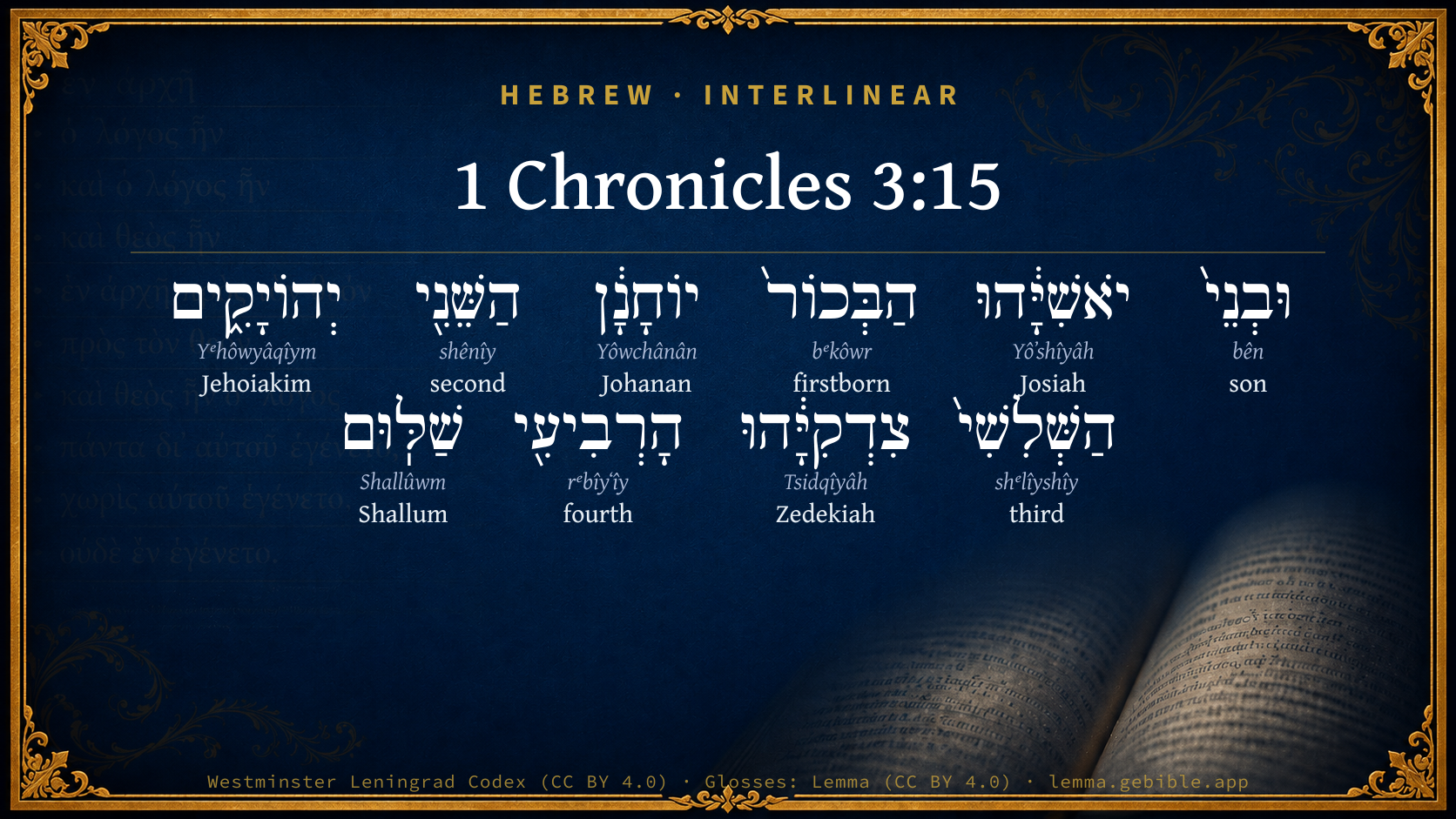
  1. וּבְנֵי֙ bên H1121 “and · sons of” Conjunction + Noun, Common, Masculine, Plural, Construct
  2. יֹאשִׁיָּ֔הוּ Yôʼshîyâh H2977 “Josiah” Noun, Proper
  3. הַבְּכוֹר֙ bᵉkôwr H1060 “the · firstborn” Particle, Definite Article + Noun, Common, Masculine, Singular, Absolute
  4. הַשֵּׁנִ֖י shênîy H8145 “the · second” Particle, Definite Article + Adjective, Ordinal number, Masculine, Singular, Absolute
  5. יְהוֹיָקִ֑ים Yᵉhôwyâqîym H3079 “Jehoiakim” Noun, Proper
  6. הַשְּׁלִשִׁי֙ shᵉlîyshîy H7992 “the · third” Particle, Definite Article + Adjective, Ordinal number, Masculine, Singular, Absolute
  7. צִדְקִיָּ֔הוּ Tsidqîyâh H6667 “Zedekiah” Noun, Proper
  8. הָרְבִיעִ֖י rᵉbîyʻîy H7243 “the · fourth” Particle, Definite Article + Adjective, Ordinal number, Masculine, Singular, Absolute
  9. שַׁלּֽוּם Shallûwm H7967 “Shallum” Noun, Proper

About this verse

These counts appear in no published source. They are computed here, from the morphology-tagged text and Lemma’s own curated glosses. What Lemma adds →

10
words
10
distinct lemmas
Historical
section

Notable vocabulary

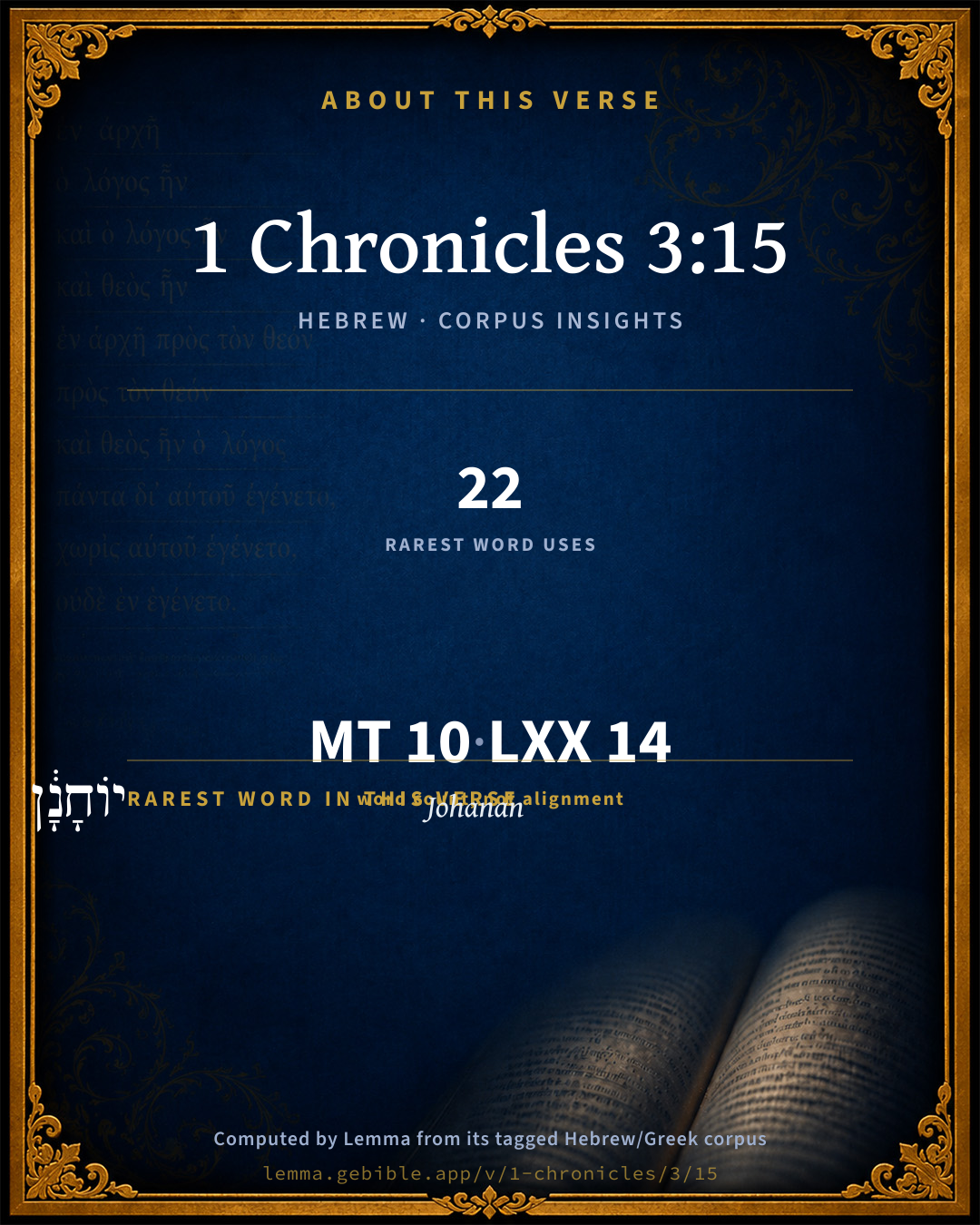
The rarest word here is יוֹחָנָ֔ן Johanan H3110 — appearing just 22 times in the whole Hebrew Bible.

Shared distinctive vocabulary

יוֹחָנָ֔ן Johanan H3110 occurs in 22 verses of the Hebrew Bible. Also found in:

Grammatical profile

  • 7 nouns
  • 3 adjectives

Hebrew & Septuagint length

In English translation the verse runs 16 words from the Hebrew and 17 from the Septuagint (LXX English) — closely comparable.

A rough comparison of the two English renderings, which tokenize alike — not a word-level alignment.

Word counts can differ between the Hebrew and the Greek without any difference in meaning — e.g. the Hebrew direct-object marker אֵת has no separate Greek word, and Greek often adds the article ὁ.

In the original languages it is 10 Hebrew tokens and 14 Greek tokens — but the two are counted differently (Hebrew bundles its prefixes and suffixes into one token; the Greek is in lemma form), so that isn’t a like-for-like length.

Cross-references

1

Topical passages linked to 1 Chronicles 3:15 in the Treasury of Scripture Knowledge — connected by theme and wording, ordered by reader-vote popularity; previews shown in the World English Bible.

  • 2 Kings 23:34 Pharaoh Necoh made Eliakim the son of Josiah king in the room of Josiah his father, and changed his name to Jehoiakim: but he took Jehoahaz away; and he came to Egypt, and died there.

Cross-references courtesy of OpenBible.info (CC BY 4.0).

Hebrew and Greek witnesses Masoretic Hebrew ↔ Greek Septuagint

The same verse in the two great witnesses to the Old Testament, shown verse-for-verse.

These are two independent witnesses, not word-aligned to each other, and the Septuagint is shown in lemma (dictionary) form.

Hebrew 1 Chronicles 3:15 Masoretic · Westminster Leningrad Codex

וּבְנֵי֙ יֹאשִׁיָּ֔הוּ הַבְּכוֹר֙ יוֹחָנָ֔ן הַשֵּׁנִ֖י יְהוֹיָקִ֑ים הַשְּׁלִשִׁי֙ צִדְקִיָּ֔הוּ הָרְבִיעִ֖י שַׁלּֽוּם

The sons of Josiah: the firstborn Johanan, the second Jehoiakim, the third Zedekiah, the fourth Shallum.

World English Bible · Public Domain

Greek LXX 1 Chronicles 3:15 Septuagint · lemma form

καί υἱός ιωσια πρωτότοκος ιωαναν ὁ δεύτερος ιωακιμ ὁ τρίτος σεδεκια ὁ τέταρτος σαλούμ

And the sons of Josia; the firstborn Joanan, the second Joakim, the third Sedekias, the fourth Salum.

LXX2012 (modern English Septuagint) · Public Domain

Hebrew: Westminster Leningrad Codex (CC BY 4.0). Greek: Septuagint (public domain); English from LXX2012 (modern English Septuagint) (Public Domain). How the Septuagint differs from the Hebrew →

Commentary

Notes on 1 Chronicles 3:15 from classic Christian and Jewish commentators (each source and its license shown beneath its notes). The classic Christian expositions comment on the surrounding passage and are grouped to its opening verse, so a note may address several verses; the Jewish commentaries on the Tanakh (Rashi and others) are per-verse, so they appear only where the commentator wrote on this verse.

Lemma curates 59 commentaries, every one of them public domain or Creative Commons licensed, each selected and text-cleaned for this edition rather than reprinted as found. About our sources →

Ellicott's Commentary for English Readers

(15) And the sons of Josiah.—The regular succession by primogeniture ceases with Josiah.

The firstborn Johanan (Iahweh bestowed) never ascended the throne of his fathers. He may have died early. He is not to be identified with Jehoahaz, who was two years younger than Jehoiakim (2Ki_23:31; 2Ki_23:36), and therefore could not have been the firstborn of Josiah.

The second Jehoiakim, the third Zedekiah, the fourth Shallum.—The order of succession to the throne after Josiah was this:—First, Shallum (= Jehoahaz, 2Ki_23:30; comp. Jer_22:11); then Jehoiakim (= Eliakim, 2Ki_23:34; Jer_22:18); then Jeconiah, son of Jehoiakini (= Jehoiachin, Jer_22:24); and, lastly, Zedekiah (= Mattaniah, 2Ki_24:17),

The third Zedekiah.—Zedekiah was much younger than Shallum. Shallum was twenty-three when he came to the throne, which he occupied eleven years. Zedekiah succeeded him at the age of twenty-one (2Ki_23:31; 2Ki_24:18). The order of 1Ch_3:15 is not wholly determined by seniority any more than by the actual succession. If age were considered, the order would be Jehoiakim, Shallum, Zedekiah; if the actual succession, it would be, Shallum, Jehoiakim, Zedekiah. The order of the text may have been influenced by the two considerations—(1) That Jehoiakim and Zedekiah each enjoyed a reign of eleven years, while Shallum reigned only three months; (2) That Shallum and Zedekiah were full brothers, both being sons of Hamutal, whereas Jehoiakim was born of another of Josiah’s wives, viz., Zebudah.

A Bible Commentary for English Readers, edited by Charles John Ellicott (1878–1897) — public domain. Text from a community e-Sword module.

Trapp's Complete Commentary

John Trapp

1Ch 3:15 And the sons of Josiah [were], the firstborn Johanan, the second Jehoiakim, the third Zedekiah, the fourth Shallum.

Ver. 15. Johanan.] Alias Jehoahaz, {2Ki 23:30} alias Shallum. {Jer 22:11} See on 2Ki 23:31. Some think that Johanan was a distinct son from Jehoahaz: and conjecture that he was slain in battle together with his father Josiah.

John Trapp, A Commentary or Exposition upon All the Books of the Old and New Testament (1647–1656) — public domain. Text from a community e-Sword module.

Joseph Benson's Commentary

1Ch 3:15. The firstborn Johanan — This Johanan is thought by many to be the same with Jehoahaz, who succeeded Josiah in the throne. But it seems more probable, as he is not mentioned in the book of Kings nor elsewhere in the Scriptures, that he died before his father. The fourth Shallum — Of whom, at least under that name, there is no mention in the history of the reign of Josiah’s sons in 2 Kings: but in Jer 22:11 there is mention of Shallum the son of Josiah, king of Judah, who reigned instead of Josiah his father; whom most conceive to be the same, who is otherwise called Jehoahaz, 2 Kings 23. And this seems most probable, 1st, From that phrase, He reigned instead of Josiah, which implies that he immediately succeeded his father, otherwise he would have been said to have reigned instead of his brother, as Zedekiah is said to have reigned instead of Jehoiachin, 2Ki 24:17. 2d, From the order of that discourse of Jeremiah, which was directed to Zedekiah, and his servants, and people, and whom he admonisheth by the examples of the kings his predecessors, and of the sentence of God concerning each of them, and that in the order in which they reigned; of Shallum, 2Ki 24:11, &c.; of Jehoiakim, 2Ki 24:18, &c.; of Jechoniah or Coniah, Jer 22:28. 3d, From the nature of that prophecy, Jer 22:11-12, delivered concerning Shallum, which perfectly agrees to Jehoahaz, who was carried captive, not so far as Babylon, but only to Egypt, a very near country; whence the people hoped that he would speedily and easily return, or be re-established in his throne by the king of Egypt, in opposition to the king of Babylon. 4th, Because Jehoahaz was one of Josiah’s younger sons, (2Ki 23:31; 2Ki 23:36,) and this Shallum is here called his fourth son.

Joseph Benson's Commentary on the Old and New Testaments (1811–1818) — public domain. Text from a community e-Sword module.

Tyndale Open Study Notes

Tyndale Open Resources

3:15 Three of the four sons of Josiah served as kings of Judah.

Tyndale Open Study Notes — © Tyndale Open Resources, licensed CC BY-SA 4.0. Text via the HelloAO Bible API.

Geneva Bible (1599)

Geneva Bible translators

Or, Jehoahaz, 2 Kings 23:30.

So called because he was preferred to the dignity royal before his brother Jehoiakim which was the elder.

Geneva Bible (1599) marginal notes — public domain. Text via Bolls.life.

Jamieson, Fausset & Brown

Robert Jamieson, A. R. Fausset & David Brown

Zedekiah--called the son of Josiah (compare Jer 1:3; Jer 37:1), but in Ch2 36:19 he is described as the brother of Jehoiachin, who was the son of Jehoiakim, and consequently the grandson of Josiah. Words expressive of affinity or relationship are used with great latitude in the Hebrew.

Shallum--No king of this name is mentioned in the history of Josiah's sons (2Ki. 14:1-29; 2Ki. 23:1-37), but there is a notice of Shallum the son of Josiah (Jer 22:11), who reigned in the stead of his father, and who is generally supposed to be Jehoahaz, a younger son, here called the fourth, of Josiah.

Jamieson, Fausset & Brown — Commentary Critical and Explanatory on the Whole Bible (1871) — public domain (CC PDM 1.0). Text via the HelloAO Bible API.

The Cambridge Bible for Schools and Colleges

gen. ed. J. J. S. Perowne

15. the firstborn Johanan] This son of Josiah never came to the throne, nor is anything known of him except from this passage. Perhaps he died before he grew up.

Zedekiah] Though reckoned third here, he was younger than Shallum (=Jehoahaz); cp. 2Ch_36:2 (= 2Ki_23:31) with 2Ch_36:11 (= 2Ki_24:18).

Shallum] To be identified with Jehoahaz; cp. 2Ch_36:1 with Jer_22:11.

The Cambridge Bible for Schools and Colleges (gen. ed. J. J. S. Perowne; Cambridge University Press, 1878–1918) — public domain. Text from a community e-Sword module.

John Gill's Exposition

And the sons of Jehoiakim; Jeconiah his son, Zedekiah his son. This is not the Zedekiah mentioned in the preceding verse; for he was not the son but the uncle of Jeconiah, unless he should be called his son because he succeeded him in the kingdom; but he seems to be another of that name, nowhere else mentioned, and not the son of Jeconiah in any sense; he is not reckoned among them in the following verses, but of Jehoiakim.

And the sons of Jehoiakim; Jeconiah his son, Zedekiah his son. This is not the Zedekiah mentioned in the preceding verse; for he was not the son but the uncle of Jeconiah, unless he should be called his son because he succeeded him in the kingdom; but he seems to be another of that name, nowhere else mentioned, and not the son of Jeconiah in any sense; he is not reckoned among them in the following verses, but of Jehoiakim.

1 Chronicles 3:17

ch1 3:17

ch1 3:17

ch1 3:17And the sons of Jeconiah,.... For though he was pronounced childless, Jer 22:30, that respects not his having no children in any sense, but none to succeed him in the kingdom:

Assir; which signifies bound, or a prisoner, because, as Kimchi thinks, he was born in a prison, his father then being a captive in Babylon; but rather it refers to Jeconiah himself, and is an appellation of him, and to be rendered:

the sons of Jeconiah the captive: which agrees best with the Hebrew accents:

Salathiel his son; the same that is called Shealtiel, Hag 1:1 who was both the proper son of Jeconiah, and who succeeded him, as some think, in the honour and dignity the king of Babylon raised him to.

John Gill's Exposition of the Whole Bible (1746–1763) — public domain (CC PDM 1.0). Text via the HelloAO Bible API.

Albert Barnes' Notes on the Bible

Of the sons of Josiah, Johanan, “the first-born,” who is mentioned in this place only, must, it would seem, have died before his father, or with him at Megiddo; and Shallum (also called Jehoahaz, marginal note and reference) was considerably older than Zedekiah, and was consequently the third, and not the fourth, son. He is perhaps assigned the fourth place here by way of intentional degradation. Compare Jer 22:10-12; Eze 19:3-4.

Albert Barnes' Notes on the Bible (1834–1885) — public domain. Text from a community e-Sword/MySword module.

Haydock's Catholic Bible Commentary

Johanan, who is not mentioned in 4 Kings xxiii., and xxiv. Some think that he died young, (Tostat) or in battle with his father, against Pharao. (Pradus.) --- Joakim, or Eliacim, possessed the throne after Joachaz, or Sellum, (Calmet) which name signifies "confusion," and was given to all the sons of Josias. (St. Jerome) --- Then came Joachin and Sedecias, whose proper name was Matthanias. (Haydock) --- Joakim is passes over by St. Matthew. (St. Jerome, ibid.)

George Leo Haydock (1774–1849), Haydock's Catholic Family Bible and Commentary, 1859 edition — public domain. Excludes Psalms (Douay-Rheims chapter numbering differs from Protestant) and Deuterocanonical books (Catholic canon only).

Matthew Poole's English Annotations

Of whom, at least under that name, there is no mention in thee history of the reign of Josiah’s sons, 2Ki 23; 2Ki 24. But in Jer 22:11, there is mention of Shallum the son of Josiah king of Judah, which reigned instead of Josiah his father; which most conceive to be the same who is otherwise called Jehoahaz, 2Ki 23. And this seems most probable,

1. From that phrase, he reigned instead of Josiah; which implies that he immediately succeeded his father; otherwise he would have been said to have reigned instead of his brother, as Zedekiah is said to reign instead of Jehoiachin, 2Ki 24:17, because he was his next successor.

2. From the order of that sermon or discourse of Jeremiah, which was directed to Zedekiah, and his servants, and people, as appears by Jer 21:1,2,11; 22:1,2, whom he admonisheth by the examples of the kings his predecessors, and of the sentence of God concerning each of them, and that in order as they reigned:

1. Of Shallum, 1Ch 3:11, &c.

2. Of Jehoiakim, 1Ch 3:18, &c.

3. Of Jeconiah, 1Ch 3:24, &c. Therefore Shallum is the same with Jehoahaz, who was the first king after Josiah, 2Ki 23:30.

4. From the nature of that prophecy, Jer 22:11,12, which best agrees to Jehoahaz, who was carried captive not so far as Babylon, but only to Egypt, a very near country whence the people hoped that he would speedily and easily return, or be re-established in his throne by the king of Egypt, in opposition to the king of Babylon.

5. Because Jehoahaz was one of Josiah’s younger sons, as appears by comparing 2Ki 23:31,36. And this Shallum is here called his fourth son.

Matthew Poole's English Annotations on the Holy Bible (1683–1685) — public domain. Text from a community e-Sword/MySword module.

The Pulpit Commentary

The first thing to be observed in this verse is that, though it lays stress on the mention of the name of Josiah"s firstborn of four sons as Johanan, this is the only mention of him. Some, however, have taken the Jehoahaz of 2Ki_23:30 for him. Next, that Jehoiakim was not the original name of the next brother, but a name slightly altered by Pharaoh-Necho from Eliakim. (2Ki_23:34) If the dates of 2Ki_23:31, 2Ki_23:34, 2Ki_23:36, be correct, there is no doubt that, though Jehoiakim, i.e. Eliakim, reigned after Jehoahaz, yet he was the elder, and is in his right place in the present passage. Next, that Shallum (Jer_20:11) is another name of the Jehoa-haz of 2Ki_23:30, 2Ki_23:31, 2Ki_23:34, and several other places. It is possible that he finds the last place amid the four brothers of this verse because of his probable usurpation of the throne, in violation of the right of his elder brother, Jehoiakim, and the early fall he met with in consequence. Lastly, that the fourth brother, Zedekiah, whose name (2Ki_24:17) was originally Mattha-niah, was put on the throne by the King of Babylon, and reigned eleven years in Jerusalem (2Ki_24:18) after that his nephew Jehoiachin (who could have no son old enough to succeed) was (2Ki_24:12, 2Ki_24:15, 2Ki_24:17) carried captive to Babylon.

The Pulpit Commentary (1880–1919), ed. H.D.M. Spence-Jones & Joseph S. Exell — public domain. Text from a community e-Sword module.

John Wesley's Explanatory Notes

Shallum - Which most conceive to be the same who is called Jehoahaz, 2 Kings xxiii, 30.

John Wesley, Explanatory Notes Upon the Whole Bible (1754–1765) — public domain. Text via the GEBible commentary corpus.

Keil & Delitzsch

C. F. Keil & F. Delitzsch

And the sons of Jehoiakim; Jeconiah his son, Zedekiah his son. This is not the Zedekiah mentioned in the preceding verse; for he was not the son but the uncle of Jeconiah, unless he should be called his son because he succeeded him in the kingdom; but he seems to be another of that name, nowhere else mentioned, and not the son of Jeconiah in any sense; he is not reckoned among them in the following verses, but of Jehoiakim.

And the sons of Jehoiakim; Jeconiah his son, Zedekiah his son. This is not the Zedekiah mentioned in the preceding verse; for he was not the son but the uncle of Jeconiah, unless he should be called his son because he succeeded him in the kingdom; but he seems to be another of that name, nowhere else mentioned, and not the son of Jeconiah in any sense; he is not reckoned among them in the following verses, but of Jehoiakim.

1 Chronicles 3:17

ch1 3:17

ch1 3:17

ch1 3:17And the sons of Jeconiah,.... For though he was pronounced childless, Jer 22:30, that respects not his having no children in any sense, but none to succeed him in the kingdom:

Assir; which signifies bound, or a prisoner, because, as Kimchi thinks, he was born in a prison, his father then being a captive in Babylon; but rather it refers to Jeconiah himself, and is an appellation of him, and to be rendered:

the sons of Jeconiah the captive: which agrees best with the Hebrew accents:

Salathiel his son; the same that is called Shealtiel, Hag 1:1 who was both the proper son of Jeconiah, and who succeeded him, as some think, in the honour and dignity the king of Babylon raised him to.

Keil & Delitzsch — Biblical Commentary on the Old Testament (1861–1891) — public domain (CC PDM 1.0). Text via the HelloAO Bible API. (Old Testament only.)

unfoldingWord translationNotes

Door43 World Missions Community

General Information:

This continues the list of David's descendants who became king. All of the names in this list are the names of men. Form these sentences as you did starting in 1 Chronicles 3:10.

translationWords

Josiah

firstborn

Jehoiakim

Zedekiah

unfoldingWord translationNotes — © Distant Shores Media and the Door43 World Missions Community, licensed CC BY-SA 4.0. Source: git.door43.org/Door43/en_tn.

Lesson kit

Teaching starters — assembled from the data on this page, not authored interpretation. Every prompt links to the verse data it draws on. Edit before teaching.

1 Chronicles, in the Historical, opens this verse with 10 words (10 distinct Hebrew lemmas). Its most distinctive word is Yôwchânân (“Johanan”). A historical commentator’s framing appears above. Read the whole chapter for the surrounding context.

Discussion questions

  1. The word Yôwchânân carries the sense “Johanan.” How does it shape the verse?
  2. 2 Kings 25:23 shares the word «Johanan» with this verse. How do the two illuminate each other?
  3. Reading how Ellicott's Commentary for English Readers and Trapp's Complete Commentary read this verse, where do the two commentators agree and where do they part?

Things to notice

Reading settings

Reading text

Shown beneath each verse's original-language words.

Old Testament
Old Testament edition

Read the OT as the Masoretic Hebrew (MT) or the Greek Septuagint (LXX).

English shown for the Greek Septuagint (in the Hebrew ↔ Greek comparison).

Comparing translations? Open the Compare panel on any verse page to stack up to four side by side.