
2 Kings 24:18

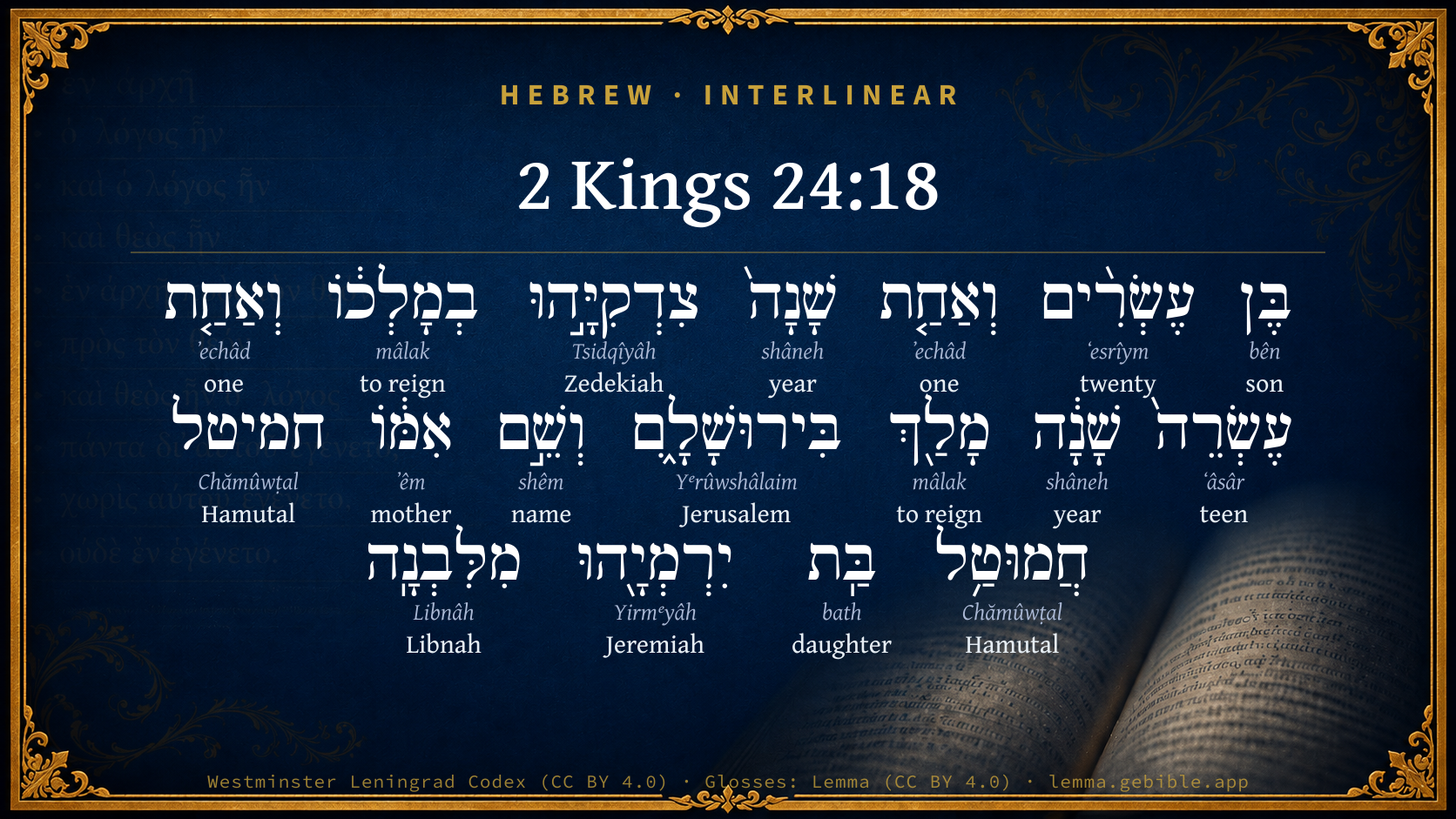
Hebrew (Westminster Leningrad Codex) 2 Kings 24:18 appears in the Hebrew Old Testament. The text above is from the Westminster Leningrad Codex. Each word links to its Strong’s number, a concise gloss, and parsing drawn from the Open Scriptures Hebrew Bible morphology. Click any word for its full Brown-Driver-Briggs (BDB) entry.
Download image
Cite this verse

2 Kings 24:18 (World English Bible). Public Domain. Lemma interlinear Bible study tool, https://lemma.gebible.app/v/2-kings/24/18.

Show BibTeX & RIS
BibTeX
RIS
English Translation
Zedekiah was twenty-one years old when he began to reign; and he reigned eleven years in Jerusalem: and his mother's name was Hamutal the daughter of Jeremiah of Libnah.
World English Bible · Public Domain
Download a study sheet

One document with this verse’s original text, its word-by-word gloss line, the meaning frame, cross-references with their text, attributed commentary, and full source and license credits — printable, and it pastes into notes with its structure intact.

This verse Autodidact and up

Study sheet (.html) Plain text (.txt)

A passage Seminary Student

Up to 50 verses in one chapter. A passage sheet keeps up to 6 commentary sources and 12 cross-references per verse, in the order this page ranks them, and says so on the sheet whenever that leaves anything out. Ask for a single verse and you get the Autodidact verse sheet above.

Everything on this page stays free to read, with no account — the sheet is a download of what is already on screen, not access to it.

Want to remove ads? Support Godless Engineer
Compare translations 3

The same verse in 3 English versions, stacked beneath the original-language interlinear above. Click any original word for its lexicon entry.

Each is an independent rendering of the whole verse — the interlinear is not word-aligned to these translations.

Highlighted words mark where these versions differ — a whole-verse word diff, not a word-by-word alignment.

  • World English Bible Public Domain
    Zedekiah was twenty-one years old when he began to reign; and he reigned eleven years in Jerusalem: and his mother's name was Hamutal the daughter of Jeremiah of Libnah.
  • King James Version Public Domain
    Zedekiah was twenty and one years old when he began to reign, and he reigned eleven years in Jerusalem. And his mother's name was Hamutal, the daughter of Jeremiah of Libnah.
  • unfoldingWord Literal Text CC BY-SA 4.0
    Zedekiah a son of 21 years when he reigned, and he reigned 11 years in Jerusalem. And the name of his mother Hamutal, the daughter of Jeremiah, from Libnah.

unfoldingWord Literal Text — © unfoldingWord, licensed CC BY-SA 4.0. Word-aligned USFM3 via Door43 (git.door43.org/unfoldingWord/en_ult).

Versions to compare (up to 4)

3 of 4 selected

Show all 18 translations

Every available English version of this verse, each an independent rendering of the whole verse.

  • World English Bible Public Domain
    Zedekiah was twenty-one years old when he began to reign; and he reigned eleven years in Jerusalem: and his mother's name was Hamutal the daughter of Jeremiah of Libnah.
  • Berean Standard Bible Public Domain
    Zedekiah was twenty-one years old when he became king, and he reigned in Jerusalem eleven years. His mother’s name was Hamutal daughter of Jeremiah; she was from Libnah.
  • Majority Standard Bible Public Domain
    Zedekiah was twenty-one years old when he became king, and he reigned in Jerusalem eleven years. His mother’s name was Hamutal daughter of Jeremiah; she was from Libnah.
  • King James Version Public Domain
    Zedekiah was twenty and one years old when he began to reign, and he reigned eleven years in Jerusalem. And his mother's name was Hamutal, the daughter of Jeremiah of Libnah.
  • American Standard Version (1901) Public Domain
    Zedekiah was twenty and one years old when he began to reign; and he reigned eleven years in Jerusalem: and his mother's name was Hamutal the daughter of Jeremiah of Libnah.
  • Revised Version (1885) Public Domain
    Zedekiah was twenty and one years old when he began to reign; and he reigned eleven years in Jerusalem: and his mother’s name was Hamutal the daughter of Jeremiah of Libnah.
  • Geneva Bible (1599) Public Domain
    Zedekiah was one and twentie yeere olde, when he began to reigne, and he reigned eleuen yeeres in Ierusalem. His mothers name also was Hamutal the daughter of Ieremiah of Libnah.
  • Douay-Rheims (1899) Public Domain
    Sedecias was one and twenty years old when he began to reign, and he reigned eleven years in Jerusalem: the name of his mother was Amital, the daughter of Jeremias of Lobna.
  • Young's Literal Translation Public Domain
    A son of twenty and one years `is' Zedekiah in his reigning, and eleven years he hath reigned in Jerusalem, and the name of his mother `is' Hamutal daughter of Jeremiah of Libnah,
  • Literal Standard Version CC BY-SA 4.0
    Zedekiah [is] a son of twenty-one years in his reigning, and he has reigned eleven years in Jerusalem, and the name of his mother [is] Hamutal daughter of Jeremiah of Libnah,
  • Unlocked Literal Bible CC BY-SA 4.0
    Zedekiah was twenty-one years old when he began to reign; he reigned eleven years in Jerusalem. His mother's name was Hamutal; she was the daughter of Jeremiah from Libnah.
  • unfoldingWord Literal Text CC BY-SA 4.0
    Zedekiah a son of 21 years when he reigned, and he reigned 11 years in Jerusalem. And the name of his mother Hamutal, the daughter of Jeremiah, from Libnah.
  • Darby Bible Public Domain
    Zedekiah was twenty-one years old when he began to reign; and he reigned eleven years in Jerusalem; and his mother's name was Hamutal, daughter of Jeremiah of Libnah.
  • World Messianic Bible Public Domain
    Zedekiah was twenty-one years old when he began to reign, and he reigned eleven years in Jerusalem. His mother’s name was Hamutal the daughter of Jeremiah of Libnah.
  • Webster's Bible Public Domain
    Zedekiah was twenty and one years old when he began to reign, and he reigned eleven years in Jerusalem. And his mother's name was Hamutal, the daughter of Jeremiah of Libnah.
  • Free Bible Version CC BY-SA 4.0
    Zedekiah was twenty-one when he became king, and he reigned in Jerusalem for eleven years. His mother's name was Hamutal, daughter of Jeremiah. She came from Libnah.
  • Bible in Basic English Public Domain
    Zedekiah was twenty-one years old when he became king, and he was king in Jerusalem for eleven years; his mother's name was Hamutal, daughter of Jeremiah of Libnah.
  • JPS Tanakh (1917) Public Domain
    Zedekiah was twenty and one years old when he began to reign; and he reigned eleven years in Jerusalem; and his mother's name was Hamutal the daughter of Jeremiah of Libnah.

Literal Standard Version (2020), Covenant Press — licensed CC BY-SA 4.0. Text via the HelloAO Bible API (eBible.org). Unlocked Literal Bible (unfoldingWord) — licensed CC BY-SA 4.0. Text via the HelloAO Bible API (eBible.org). unfoldingWord Literal Text — © unfoldingWord, licensed CC BY-SA 4.0. Word-aligned USFM3 via Door43 (git.door43.org/unfoldingWord/en_ult). Free Bible Version, Dr. Jonathan Gallagher — licensed CC BY-SA 4.0. Text via the HelloAO Bible API (eBible.org).

Word by word

More ways to search: Search by grammar → Find every occurrence → Compare this word →

Practice this passage: Drill this verse → Learn its vocabulary →

חמיטל
Chămûwṭal
H2537
“Hamutal”
Noun, Proper
Part of Speech
Noun
Type
Proper
Full BDB Definition

Origin: from H2524 and H2919

TWOT: None

Hamutal = "father-in-law is protection" - one of the wives of Josiah, daughter of Jeremiah of Libnah, mother of Jehoahaz and Zedekiah
  1. בֶּן bên H1121 “son of” Noun, Common, Masculine, Singular, Construct
  2. עֶשְׂרִ֨ים ʻesrîym H6242 “twenty” Adjective, Cardinal number, Both, Plural, Absolute
  3. וְאַחַ֤ת ʼechâd H259 “and · one” Conjunction + Adjective, Cardinal number, Feminine, Singular, Absolute
  4. שָׁנָה֙ shâneh H8141 “year” Noun, Common, Feminine, Singular, Absolute
  5. צִדְקִיָּ֣הוּ Tsidqîyâh H6667 “Zedekiah” Noun, Proper
  6. בְמָלְכ֔וֹ mâlak H4427 “in/at · to reign · him” Preposition + Verb, Qal, Infinitive Construct + Suffix, Personal, 3rd Person, Masculine, Singular
  7. וְאַחַ֤ת ʼechâd H259 “and · one” Conjunction + Adjective, Cardinal number, Feminine, Singular, Absolute
  8. עֶשְׂרֵה֙ ʻâsâr H6240 “teen” Adjective, Cardinal number, Feminine, Singular, Absolute
  9. שָׁנָ֔ה shâneh H8141 “year” Noun, Common, Feminine, Singular, Absolute
  10. מָלַ֖ךְ mâlak H4427 “to reign” Verb, Qal, Perfect, 3rd Person, Masculine, Singular
  11. בִּירוּשָׁלִָ֑ם Yᵉrûwshâlaim H3389 “in/at · Jerusalem” Preposition + Noun, Proper
  12. וְשֵׁ֣ם shêm H8034 “and · name of” Conjunction + Noun, Common, Masculine, Singular, Construct
  13. אִמּ֔וֹ ʼêm H517 “mother · his” Noun, Common, Feminine, Singular, Construct + Suffix, Personal, 3rd Person, Masculine, Singular
  14. חֲמוּטַ֥ל Chămûwṭal H2537 “Hamutal” Noun, Proper
  15. בַּֽת bath H1323 “daughter of” Noun, Common, Feminine, Singular, Construct
  16. יִרְמְיָ֖הוּ Yirmᵉyâh H3414 “Jeremiah” Noun, Proper
  17. מִלִּבְנָֽה Libnâh H3841 “from · Libnah” Preposition + Noun, Proper

About this verse

These counts appear in no published source. They are computed here, from the morphology-tagged text and Lemma’s own curated glosses. What Lemma adds →

18
words
14
distinct lemmas
Historical
section

Notable vocabulary

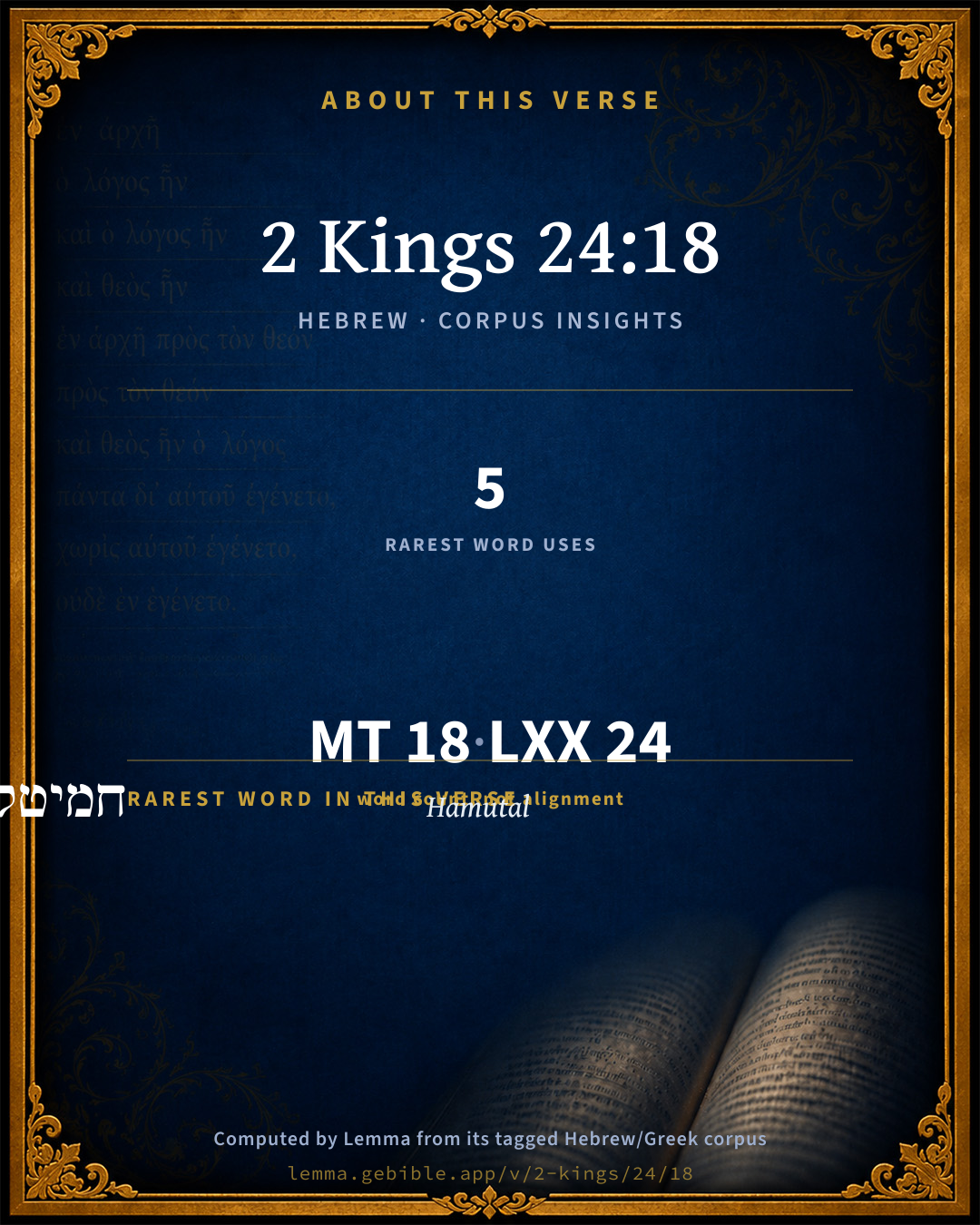
The rarest word here is חמיטל Hamutal H2537 — appearing just 5 times in the whole Hebrew Bible.

Shared distinctive vocabulary

חמיטל Hamutal H2537 occurs in 3 verses of the Hebrew Bible. Also found in:

Grammatical profile

  • 2 verbs
  • 12 nouns
  • 4 adjectives

Verb forms

  • בְמָלְכ֔וֹ Qal · Infinitive Construct
  • מָלַ֖ךְ Qal · Perfect

Repetition

Words recur within this verse — often emphatic in Hebrew:

  • וְאַחַ֤ת one H259 ×2
  • שָׁנָה֙ year H8141 ×2
  • בְמָלְכ֔וֹ to reign H4427 ×2
  • חמיטל Hamutal H2537 ×2

Hebrew & Septuagint length

In English translation the verse runs 29 words from the Hebrew and 28 from the Septuagint (LXX English) — closely comparable.

A rough comparison of the two English renderings, which tokenize alike — not a word-level alignment.

Word counts can differ between the Hebrew and the Greek without any difference in meaning — e.g. the Hebrew direct-object marker אֵת has no separate Greek word, and Greek often adds the article ὁ.

In the original languages it is 18 Hebrew tokens and 24 Greek tokens — but the two are counted differently (Hebrew bundles its prefixes and suffixes into one token; the Greek is in lemma form), so that isn’t a like-for-like length.

Cross-references

4

Topical passages linked to 2 Kings 24:18 in the Treasury of Scripture Knowledge — connected by theme and wording, ordered by reader-vote popularity; previews shown in the World English Bible.

  • 2 Kings 23:31 Jehoahaz was twenty-three years old when he began to reign; and he reigned three months in Jerusalem: and his mother's name was Hamutal the daughter of Jeremiah of Libnah.
  • Jeremiah 52:1–11 Zedekiah was twenty-one years old when he began to reign; and he reigned eleven years in Jerusalem: and his mother's name was Hamutal the daughter of Jeremiah of Libnah.
  • 2 Chronicles 36:11 Zedekiah was twenty-one years old when he began to reign; and he reigned eleven years in Jerusalem:
  • Jeremiah 37:1 Zedekiah the son of Josiah reigned as king, instead of Coniah the son of Jehoiakim, whom Nebuchadrezzar king of Babylon made king in the land of Judah.

Cross-references courtesy of OpenBible.info (CC BY 4.0).

Hebrew and Greek witnesses Masoretic Hebrew ↔ Greek Septuagint

The same verse in the two great witnesses to the Old Testament, shown verse-for-verse.

These are two independent witnesses, not word-aligned to each other, and the Septuagint is shown in lemma (dictionary) form.

Hebrew 2 Kings 24:18 Masoretic · Westminster Leningrad Codex

בֶּן עֶשְׂרִ֨ים וְאַחַ֤ת שָׁנָה֙ צִדְקִיָּ֣הוּ בְמָלְכ֔וֹ וְאַחַ֤ת עֶשְׂרֵה֙ שָׁנָ֔ה מָלַ֖ךְ בִּירוּשָׁלִָ֑ם וְשֵׁ֣ם אִמּ֔וֹ חמיטל חֲמוּטַ֥ל בַּֽת יִרְמְיָ֖הוּ מִלִּבְנָֽה

Zedekiah was twenty-one years old when he began to reign; and he reigned eleven years in Jerusalem: and his mother's name was Hamutal the daughter of Jeremiah of Libnah.

World English Bible · Public Domain

Greek LXX 2 Kings 24:18 Septuagint · lemma form

υἱός εἴκοσι καί εἷς ἐνιαυτός σεδεκιας ἐν ὁ βασιλεύω αὐτός καί ἕνδεκα ἔτος βασιλεύω ἐν ἰερουσαλήμ καί ὄνομα ὁ μήτηρ αὐτός αμιταλ θυγάτηρ ἰερεμίας

Twenty and one years old was Sedekias when he began to reign, and he reigned eleven years in Jerusalem: and his mother's name was Amital daughter of Jeremias.

LXX2012 (modern English Septuagint) · Public Domain

Hebrew: Westminster Leningrad Codex (CC BY 4.0). Greek: Septuagint (public domain); English from LXX2012 (modern English Septuagint) (Public Domain). How the Septuagint differs from the Hebrew →

Targum (Aramaic paraphrase)

1

The Targum is the ancient Jewish Aramaic paraphrase of the Hebrew Scriptures — an interpretive translation, not the Hebrew text itself. Onkelos (literal) and Pseudo-Jonathan (expansive) render the Torah, and Jonathan the Prophets. Coverage is partial: where no permissively-licensed English translation exists for a verse, only the Aramaic is shown. This is verse-level text, not a word-by-word alignment to the Hebrew.

  1. Targum Jonathan Prophets (Joshua–Malachi)
    בַּר עַסְרִין וַחֲדָא שְׁנִין צִדְקִיָה כַּד מְלַךְ וַחֲדָא עַסְרֵי שְׁנִין מְלַךְ בִּירוּשְׁלֵם וְשׁוּם אִמֵיהּ חֲמוּטַל בַּת יִרְמְיָה מִן לִבְנָה:

    (no public-domain English translation for this verse)

    Targum Jonathan — Aramaic: “Mikraot Gedolot” (public domain). English: “Sefaria Community Translation” (CC0 1.0 (public-domain dedication)); “London "Chaldee Paraphrase," 1871” (public domain). Text via Sefaria.

Commentary

Notes on 2 Kings 24:18 from classic Christian and Jewish commentators (each source and its license shown beneath its notes). The classic Christian expositions comment on the surrounding passage and are grouped to its opening verse, so a note may address several verses; the Jewish commentaries on the Tanakh (Rashi and others) are per-verse, so they appear only where the commentator wrote on this verse.

Lemma curates 59 commentaries, every one of them public domain or Creative Commons licensed, each selected and text-cleaned for this edition rather than reprinted as found. About our sources →

The Cambridge Bible for Schools and Colleges

gen. ed. J. J. S. Perowne

2Ki_24:18 to 2Ki_25:7. Zedekiah king of Judah. He rebels against Nebuchadnezzar. Jerusalem taken. Zedekiah put to death (2Ch_36:11-21; Jer_52:1-11)

18. Hamutal] See 2Ki_23:31.

The Cambridge Bible for Schools and Colleges (gen. ed. J. J. S. Perowne; Cambridge University Press, 1878–1918) — public domain. Text from a community e-Sword module.

Trapp's Complete Commentary

John Trapp

2Ki 24:18 Zedekiah [was] twenty and one years old when he began to reign, and he reigned eleven years in Jerusalem. And his mother’s name [was] Hamutal, the daughter of Jeremiah of Libnah.

Ver. 18. And he reigned eleven years.] But had small joy of his kingdom; so had King John of England.

John Trapp, A Commentary or Exposition upon All the Books of the Old and New Testament (1647–1656) — public domain. Text from a community e-Sword module.

Joseph Benson's Commentary

2Ki 24:18-19. He reigned eleven years — In the end of which he was carried captive, Jer 1:3. He did that which was evil in the sight of the Lord — Not regarding the reproofs, exhortations, or predictions of Jeremiah, but shutting him up in prison, Jer 33:1-2; 2Ch 36:12. And his servants, and the people of the land, were as wicked and incorrigible as himself, Jer 37:1-2.

Joseph Benson's Commentary on the Old and New Testaments (1811–1818) — public domain. Text from a community e-Sword module.

Keil & Delitzsch

C. F. Keil & F. Delitzsch

(Note: To this section the historical appendix to the book of Jeremiah (Jer 52) furnishes a parallel, which agrees with it for the most part word for word, omitting only the short account of the murder of Gedaliah and of the flight of the people to Egypt (Kg2 25:22-26), and adding instead a computation of the number of the people who were led away to Babel by Nebuchadnezzar (Jer 52:28-30). Apart from the less important variations, which have arisen in part simply from copyists' errors, we have in Jer 52:18, and especially in Jer 52:21 and Jer 52:22, by no means unimportant notices concerning the vessels of the temple, especially concerning the ornaments of the brazen pillars, which do not occur anywhere in our books. It is evident from this that our text was not derived from Jer (Hvernick), and that Jer was not borrowed from our books of Kings and appended to the book of Jeremiah's prophecies (Ros., Maur., Ew., Graf). On the contrary, the two accounts are simply brief extracts from one common and more elaborate history of the later times of the kingdom of Judah, possibly composed by Jeremiah or Baruch, analogous to the two extracts from the history of Hezekiah in 2 Kings 18-20 and Isa 36-39. - More minute accounts of this space of time are given in the historical portions of the prophecies of Jeremiah (Jer 39-44), which form an explanatory commentary to the section before us.)

Kg2 24:18-19

Length and spirit of Zedekiah's reign (cf. Jer 52:1-3, and Ch2 36:11-13). - Zedekiah's mother Hamital, daughter of Jeremiah of Libnah, was also the mother of Jehoahaz (Kg2 23:31); consequently he was his own brother and the half-brother of Jehoiakim, whose mother was named Zebidah (Kg2 23:36). His reign lasted eleven years, and in its attitude towards the Lord exactly resembled that of his brother Jehoiakim, except that Zedekiah does not appear to have possessed so much energy for that which was evil. According to Jer 38:5 and Jer 38:24., he was weak in character, and completely governed by the great men of his kingdom, having no power or courage whatever to offer resistance. but, like them, he did not hearken to the words of the Lord through Jeremiah (Jer 37:2), or, as it is expressed in Ch2 36:12, "he did not humble himself before Jeremiah the prophet, who spake to him out of the mouth of the Lord."

Kg2 24:20

"For because of the wrath of the Lord it happened concerning Judah and Jerusalem." The subject to היתה is to be taken from what precedes, viz., Zedekiah's doing evil, or that such a God-resisting man as Zedekiah became king. "Not that it was of God that Zedekiah was wicked, but that Zedekiah, a man (if we believe Brentius, in loc.) simple, dependent upon counsellors, yet at the same time despising the word of God and impenitent (Ch2 36:12-13), became king, so as to be the cause of Jerusalem's destruction" (Seb. Schm.). On וגו השׁליכו עד cf. Kg2 24:3, and Kg2 17:18, Kg2 17:23. "And Zedekiah rebelled against the king of Babel," who, according to Ch2 36:13, had made him swear by God, to whom he was bound by oath to render fealty. This breach of covenant and frivolous violation of his oath Ezekiel also condemns in sharp words (Eze 17:13.), as a grievous sin against the Lord. Zedekiah also appears from the very first to have had no intention of keeping the oath of fealty which he took to the king of Babel with very great uprightness. For only a short time after he was installed as king he despatched an embassy to Babel (Jer 29:3), which, judging from the contents of the letter to the exiles that Jeremiah gave to the ambassadors to take with them, can hardly have been sent with any other object that to obtain from the king of Babel the return of those who had been carried away. Then in the fourth year of his reign he himself made a journey to Babel (Jer 51:59), evidently to investigate the circumstances upon the spot, and to ensure the king of Babel of his fidelity. And in the fifth month of the same year, probably after his return from Babel, ambassadors of the Moabites, Ammonites, Tyrians, and Sidonians came to Jerusalem to make an alliance with him for throwing off the Chaldaean yoke (Jer 27:3). Zedekiah also had recourse to Egypt, where the enterprising Pharaoh Hophra (Apries) had ascended the throne; and then, in spite of the warnings of Jeremiah, trusting to the help of Egypt, revolted from the king of Babel, probably at a time when Nebuchadnezzar (according to the combinations of M. v. Nieb., which are open to question however) was engaged in a war with Media.

Keil & Delitzsch — Biblical Commentary on the Old Testament (1861–1891) — public domain (CC PDM 1.0). Text via the HelloAO Bible API. (Old Testament only.)

The Expositor's Bible

ZEDEKIAH, THE LAST KING OF JUDAH

B.C. 597-586

2Ki_24:18-20; 2Ki_25:1-7

"Quand ce grand Dieu a choisi quelquun pour etre linstrument de ses desseins rien narrete le cours, en enchaine, ou il aveugle, ou il dompte tout ce qui est capable de resistance."

- BOSSUET, "Oraison funebre de Henriette Marie."

WHEN Jehoiachin was carried captive to Babylon, never to return, his uncle Mattaniah ("Jehovahs gift"), the third son of Josiah, was put by Nebuchadrezzar in his place. In solemn ratification of the new kings authority, the Babylonian conqueror sanctioned the change of his name to Zedekiah ("Jehovahs righteousness"). He was twenty-one at his accession, and he reigned eleven years.

"Behold," writes Ezekiel, "the King of Babylon came to Jerusalem, and took the king thereof, and the princes thereof, and brought them to him to Babylon; and he took of the seed royal" (i.e., Zedekiah), "and made a covenant with him; he also brought him under an oath: and took away the mighty of the land, that the kingdom might be base, that it might not lift itself up, but that by keeping of his covenant it might stand." {Eze_17:12-14}

Perhaps by this covenant Zechariah meant to emphasize the meaning of his name, and to show that he would reign in righteousness.

The prophet at the beginning of the chapter describes Nebuchadrezzar and Jehoiachin in "a riddle."

"A great eagle," he says, "with great wings and long pinions; full of feathers, which had divers colors, came unto Lebanon, and took the top of the cedar" (Jehoiachin): "he cropped off the topmost of the young twigs thereof, and carried it into a land of traffic; he set it in a city of merchants. He took also of the seed of the land" (Zedekiah), "and planted it in a fruitful soil; he placed it beside great waters, he set it as a willow tree. And it grew, and became a spreading vine of low stature, whose branches turned towards him, and the roots thereof were under him: so it became a vine, and brought forth branches, and shot forth sprigs." {Eze_17:1-6}

The words refer to the first three years of Zedekiahs reign, and they imply, consistently with the views of the prophets, that, if the weak king had been content with the lowly eminence to which God had called him, and if he had kept his oath and covenant with Babylon, all might yet have been well with him and his land. At first it seemed likely to be so; for Zedekiah wished to be faithful to Jehovah. He made a covenant with all the people to set free their Hebrew slaves. Alas! it was very short-lived. Self-sacrifice cost something, and the princes soon took back the discarded bond-servants. {Jer_34:8-11} What made this conduct the more shocking was that their covenant to obey the law had been made in the most solemn manner by "cutting a calf in twain, and passing between the severed halves." But the weak king was perfectly powerless in the hands of his tyrannous aristocracy.

The exiles in Babylon were now the best and most important section of the nation. Jeremiah compares them to good figs; while the remnant at Jerusalem were bad and withered. He and Ezekiel raised their voices, as in strophe and antistrophe, for the teaching alike of the exiles and of the remnant left at Jerusalem, for whom the exiles were bidden to entreat God in prayer. Zedekiah himself made at least one journey northward, either voluntarily or under summons, to renew his oath and reassure Nebuchadrezzar of his fidelity. He was accompanied by Seraiah, the brother of Baruch, who was privately entrusted by Jeremiah with a prophecy of the fall of Babylon, which he was to fling into the midst of the Euphrates.

The last King of Judah seems to have been weak rather than wicked. He was a reed shaken by the wind. He yielded to the influence of the last person who argued with him; and he seems to have dreaded above all things the personal ridicule, danger, and opposition which it was his duty to have defied. Yet we cannot withhold from him our deep sympathy: for he was born in terrible times-to witness the death-throes of his countrys agony, and to share in them. It was no longer a question of independence, but only of the choice of servitudes. Judah was like a silly and trembling sheep between two huge beasts of prey.

Only thus can we account for the strange apostasies-"the abominations of the heathen"-with which he permitted the Temple to be polluted; and for the ill-treatment which he allowed to be inflicted on Jeremiah and other prophets, to whom in his heart he felt inclined to listen.

What these abominations were we read with amazement in the eighth chapter of Ezekiel. The prophet is carried in vision to Jerusalem, and there he sees the Asherah-"the image which provoketh to jealousy"-which had so often been erected and destroyed and re-erected. Then through a secret door he sees creeping things, and abominable beasts, and the idol blocks of the House of Israel portrayed upon the wall, while several elders of Israel stood before them and adored, with censers in their hands-among whom he must specially have grieved to see Jaazaneiah, the son of Shaphan, flattering himself, as did his followers, that in that dark chamber Jehovah saw them not. Next at the northern gate he sees Zions daughters weeping for Tammuz, or Adonis. Once more, in the inner court of the Temple, between the porch and the altar, he sees about twenty-five men with their backs to the altar, and their faces to the east; and they worshipped the sun towards the east; and, lo! they put the vine branch to their nose. Were not these crimes sufficient to evoke the wrath of Jehovah, and to alienate His ear from prayers offered by such polluted worshippers? Egypt, Assyria. Syria, Chaldaea, all contributed their idolatrous elements to the detestable syncretism; and the king and the priests ignored, permitted, or connived at it. {Eze_16:15-34} This must surely be answered for. How could it have been otherwise? The king and the priests were the official guardians of the Temple, and these aberrations could not have gone on without their cognizance. There was another party of sheer formalists, headed by men like the priest Pashur, who thought to make talismans of rites and shibboleths, but had no sincerity of heart-religion {Jer_7:4; Jer_8:8; Jer_31:33; Jer_7:34} To these, too, Jeremiah was utterly opposed. In his opinion Josiahs reformation had failed. Neither Ark, nor Temple, nor sacrifice were anything in the world to him in comparison with true religion. All the prophets with scarcely one exception are anti-ritualists; but none more decidedly so than the prophet-priest. His name is associated in tradition with the hiding of the Ark, and a belief in its ultimate restoration; yet to Jeremiah, apart from the moral and spiritual truths of which it was the material symbol, the Ark was no better than a wooden chest. His message from Jehovah is, "I will give you pastors according to My heart and they shall say no more, The Ark of the Covenant of the Lord: neither shall it come to mind; neither shall they remember it; neither shall they miss it; neither shall it be made any more." {Jer_3:15-16} Doom followed the guilt and folly of king, priests, and people. If political wisdom were insufficient to show Zedekiah that the necessities of the case were an indication of Gods will, he had the warnings of the prophets constantly ringing in his ears, and the assurance that he must remain faithful to Nebuchadrezzar. But he was in fear of his own princes and courtiers. A combined embassy reached him from the kings of Edom, Ammon, Moab, Tyre, and Sidon, urging him to join in a league against Babylon. {Jer_27:3} This embassy was supported by a powerful party in Jerusalem. Their solicitations were rendered more plausible by the recent accession (B.C. 590) of the young and vigorous Pharaoh Hophrah-the Apries of Herodotus- to the throne of Egypt, and by the recrudescence of that incurable disease of Hebrew politics, a confidence in the idle promises of Egypt to supply the confederacy with men and horses. In vain did Jeremiah and Ezekiel uplift their warning voices. The blind confidence of the king and of the nobles was sustained by the flattering visions and promises of false prophets, prominent among whom was a certain Hananiah, the son of Azur, of Gibeon, "the prophet." To indicate the futility of the contemplated rebellion, Jeremiah had made "thongs and poles" with yokes, and had sent them to the kings, whose embassy had reached Jerusalem, with a message of the most emphatic distinctness, that Nebuchadrezzar was Gods appointed servant, and that they must serve him till Gods own appointed time. If they obeyed this intimation, they would be left undisturbed in their own lands; if they disobeyed it, they would be scourged into absolute submission by the sword, the famine, and the pestilence. Jeremiah delivered the same oracle to his own king.

The warning was rendered unavailing by the conduct of Hananiah. He prophesied that within two full years God would break the yoke of the King of Babylon; and that the captive Jeconiah, and the nobles, and the vessels of the House of the Lord would be brought back. Jeremiah, by way of an acted parable, had worn round his neck one of his own yokes. Hananiah, in the Temple, snatched it off, broke it to pieces, and said, "So will I break the yoke of Nebuchadrezzar from the neck of all nations within the space of two full years."

We can imagine the delight, the applause, the enthusiasm with which the assembled people listened to these bold predictions. Hananiah argued with them, so to speak, in shorthand, for he appealed to their desires and to their prejudices. It is always the tendency of nations to say to their prophets, "Say not unto us hard things: speak smooth things; prophesy deceits."

Against Hananiah personally there seems to have been no charge, except that in listening to the lying spirit of his own desires he could not hear the true message of God. But he did not stand alone. Among the children of the captivity, his promises were echoed by two downright false prophets, Ahab and Zedekiah, the son of Maaseiah, who prophesied lies in Gods name. They were men of evil life, and a fearful fate overtook them. Their words against Babylon came to the ears of Nebuchadrezzar, and they were "roasted in the fire," so that the horror of their end passed into a proverb and a curse. {Jer_29:21-23} Truly God fed these false prophets with wormwood, and gave them poisonous water to drink. {Jer_23:9-32}

After the action of Hananiah, Jeremiah went home stricken and ashamed: apparently he never again uttered a public discourse in the Temple. It took him by surprise; and he was for the moment, perhaps, daunted by the plausive echo of the multitude to the lying prophet. But when he got home the answer of Jehovah came: "Go and tell Hananiah, Thou hast broken the yokes of wood; but thou hast made for them yokes of iron. I have put a yoke of iron on the necks of all these nations, that they may serve Nebuchadrezzar. Hear now, Hananiah, The Lord hath not sent thee: thou makest this people to trust in a lie. Behold, this year thou shalt die, because thou hast spoken revolt against the Lord. What hath the chaff to do with the wheat? saith the Lord." {Jer_28:13-16; Jer_23:28}

Two months after Hananiah lay dead, and mens minds were filled with fear. They saw that Gods word was indeed as a fire to burn, and as a hammer to dash in pieces. {Jer_23:29} But meanwhile Zedekiah had been over-persuaded to take the course which the true prophets had forbidden. Misled by the false prophets and mincing prophetesses whom Ezekiel denounced, {Eze_13:1-23} who daubed mens walls with whitened plaster, he had sent an embassy to Pharaoh Hophrah, asking for an army of infantry and cavalry to support his rebellion from Assyria. {Eze_17:15} In the eyes of Jeremiah and Ezekiel the crime did not only consist in defying the exhortations of those whom Zedekiah knew to be Jehovahs accredited messengers, in mitigation of this offence he might have pleaded the extreme difficulty of discriminating the truth amid the ceaseless babble of false pretenders. But, on the other hand, he had broken the solemn oath which he had taken to Nebuchadrezzar in the name of God, and the sacred covenant which he seems to have twice ratified with him. {2Ch_36:13; Jer_52:3} This it was which raised the indignation of the faithful, and led Ezekiel to prophesy:-

"Shall he prosper? Shall he escape that doeth such things? Or shall he break the covenant and be believed? As I live, saith the Lord God, surely in the place where the king dwelleth that made him king, Whose oath he despised and whose covenant he broke, Even with him in the midst of Babylon, shall he die." { Eze_17:15-16; Eze_28:19}

Sad close for a dynasty which had now lasted for nearly five centuries!

As for Pharaoh, he too was an eagle, as Nebuchadrezzar was-a great eagle with great wings and many feathers, but not so great. The trailing vine of Judah bent her roots towards him, but it should wither in the furrows when the east wind touched it. {Eze_17:7-10}

The result of Zedekiahs alliance with Egypt was the intermission of his yearly tribute to Assyria; and at last, in the ninth year of Zedekiah, Nebuchadrezzar was aroused to put down this Palestinian revolt, supported as it was by the vague magnificence of Egypt. Jeremiah had said, "Pharaoh, the King of Egypt, is but a noise [or desolation]: he hath passed the time appointed." {Jer_46:17}

This was about the year 589. In 598 Nebuchadrezzar had carried Jehoachin into captivity, and ever since then some of his forces had been engaged in the vain effort to capture Tyre, which still, after a ten years siege, drew its supplies from the sea, and remained impregnable on her island rock. He did not choose to raise this long-continued siege by diverting the troops to beleaguer so strong a fortress as Jerusalem, and therefore he came in person from Babylon.

In Eze_21:20-24 we have a singular and vivid glimpse of his march. On his way he came to a spot where two roads branched off before him. One led to Rabbath, the capital of Ammon, on the east of Jordan; the other to Jerusalem, on the west. Which road should he take? Personally, it was a matter of indifference; so he threw the burden of responsibility upon his gods by leaving the decision to the result of belomancy. Taking in his hand a sheaf of brightened arrows, he held them upright, and decided to take the route indicated by the fall of the greater number of arrows. He confirmed his uncertainty by consulting teraphim, and by hepatoscopy-i.e., by examining the liver of slain victims. Rabbath and the Ammonites were not to be spared, but it was upon the covenant-breaking king and city that the vengeance was to fall. {Eze_21:28-32} And this is what the prophet has to say to Zedekiah:-

"And thou, O deadly-wounded wicked one, the prince of Israel, whose day is come in the time of the iniquity of the end; thus saith the Lord God, Remove the miter, and take off the crown. This shall be not thus. Exalt the low, and abase that which is high. An overthrow, overthrow, overthrow, will I make it: this also shall be no more, until He come whose right it is: and I will give it Him."

So (B.C. 587) Jerusalem was delivered over to siege, even as Ezekiel had sketched upon a tile. {Eze_4:1-3} It was to be assailed in the old Assyrian manner-as we see it represented in the British Musemn bas-relief, where Sennacherib is portrayed in the act of besieging Lachish-with forts, mounds, and battering-rams; and Ezekiel had also been bidden to put up an iron plate between him and his pictured city to represent the mantelet from behind which the archers shot.

In this dread crisis Zedekiah sent Zephaniah, the son of Maaseiah, the priest, and Jehueal, to Jeremiah, entreating his prayers for the city, {Jer_37:3} for he had not yet been put in prison. Doubtless he prayed, and at first it looked as if deliverance would come. Pharaoh Hophrah put in motion the Egyptian army with its Carian mercenaries and Soudanese Negroes, and Nebuchadrezzar was sufficiently alarmed to raise the siege and go to meet the Egyptians. The hopes of the people probably rose high, though multitudes seized the opportunity to fly to the mountains. {Eze_7:16} The circumstances closely resembled those under which Sennacherib had raised the siege of Jerusalem to go to meet Tirhakah the Ethiopian; and perhaps there were some, and the king among them, who looked that such a wonder might be vouchsafed to him through the prayers of Jeremiah as had been vouchsafed to Hezekiah through the prayers of Isaiah. Not for a moment did Jeremiah encourage these vain hopes. To Zephaniah, as to an earlier deputation from the king, when he sent Pashur with him to inquire of the prophet, Jeremiah returned a remorseless answer. It is too late. Pharaoh shall be defeated; even if the Chaldaean army were smitten, "its wounded soldiers would suffice to besiege and burn Jerusalem, and take into captivity the miserable inhabitants after they had suffered the worst horrors of a besieged city."

William Robertson Nicoll, ed., The Expositor's Bible (London: Hodder & Stoughton, 1887–1910) — public domain. 65 of 66 books (1 Corinthians is not separately keyed, as that volume carries no machine-parseable verse references); section-level commentary keyed to the opening verse. Introductory and overview sections not keyed to a specific passage are excluded.

Tyndale Open Study Notes

Tyndale Open Resources

24:18-20 Zedekiah’s reign of eleven years in Jerusalem (597–586 BC) mirrored Jehoiakim’s evil reign (23:36-37). The Lord was judging Jerusalem and Judah for their sins (see 17:19; 20:16-17; 21:12-15; 22:15-20; 23:26-27). • Zedekiah rebelled: Zedekiah’s rebellion may coincide with an anti-Babylonian alliance spearheaded by Pharaoh Apries of Egypt. When Apries became king of Egypt in about 589 BC, he cherished hopes of recovering Egypt’s past glory. Zedekiah appears to have placed his confidence in him (cp. Ezek 17:15-18). Nevertheless, like earlier kings (2 Kgs 17:4; 24:1-3), Zedekiah learned that Egypt would be of little help (cp. 18:20-21; Jer 37:3-10; Ezek 29:6-7).

Tyndale Open Study Notes — © Tyndale Open Resources, licensed CC BY-SA 4.0. Text via the HelloAO Bible API.

The Pulpit Commentary

Zedekiah was twenty and one years old when he began to reign, and he reigned eleven years in Jerusalem; Probably from B.C. 597 to B.C. 586. He was thus contemporary with Nebuchadnezzar in Babylon, with Cyaxares and Astyages in Media, and with Psamatik II and Ua-ap-ra (Pharaoh-Hophra) in Egypt. And his mother"s name was Hamutal, the daughter of Jeremiah of Libnah. He was thus full brother of Jehoahaz, (2Ki_23:31) but only half-brother to Jehoiakim. (2Ki_23:36) His father-in-law, "Jeremiah of Libnah" is not the prophet, who was of Anathoth.

The Pulpit Commentary (1880–1919), ed. H.D.M. Spence-Jones & Joseph S. Exell — public domain. Text from a community e-Sword module.

unfoldingWord translationNotes

Door43 World Missions Community

twenty-one ... eleven

"21 ... 11" (See: Numbers)

Hamutal

This is a woman's name. (See: How to Translate Names)

Jeremiah

This is a man's name. (See: How to Translate Names)

Libnah

This is the name of a place. (See: How to Translate Names)

what was evil in the sight of Yahweh

The sight of Yahweh represents Yahweh's judgment or evaluation. See how you translated this in 2 Kings 3:2. AT: "what was evil in Yahweh's judgment" or "what Yahweh considers to be evil" (See: Metaphor)

translationWords

Zedekiah

reign

Jerusalem

evil

Yahweh

Jehoiakim

anger

kingdom of Judah

rebel

unfoldingWord translationNotes — © Distant Shores Media and the Door43 World Missions Community, licensed CC BY-SA 4.0. Source: git.door43.org/Door43/en_tn.

Lesson kit

Teaching starters — assembled from the data on this page, not authored interpretation. Every prompt links to the verse data it draws on. Edit before teaching.

2 Kings, in the Historical, opens this verse with 18 words (14 distinct Hebrew lemmas). Its most distinctive word is Chămûwṭal (“Hamutal”). A historical commentator’s framing appears above. Read the whole chapter for the surrounding context.

Discussion questions

  1. The word Chămûwṭal carries the sense “Hamutal.” How does it shape the verse?
  2. How does 2 Kings 23:31, which shares the word «Hamutal», read alongside this verse?
  3. What does the repetition of “one” (2× in this one verse) do in this verse?
  4. These translations render this verse differently. What is at stake in choosing one wording over another?
  5. «בְמָלְכ֔וֹ» is a Qal Infinitive Construct verb. How does that grammatical form shape the action described?
  6. Compare how The Cambridge Bible for Schools and Colleges and Trapp's Complete Commentary read this verse. Where do they agree or differ?

Things to notice

Reading settings

Reading text

Shown beneath each verse's original-language words.

Old Testament
Old Testament edition

Read the OT as the Masoretic Hebrew (MT) or the Greek Septuagint (LXX).

English shown for the Greek Septuagint (in the Hebrew ↔ Greek comparison).

Comparing translations? Open the Compare panel on any verse page to stack up to four side by side.