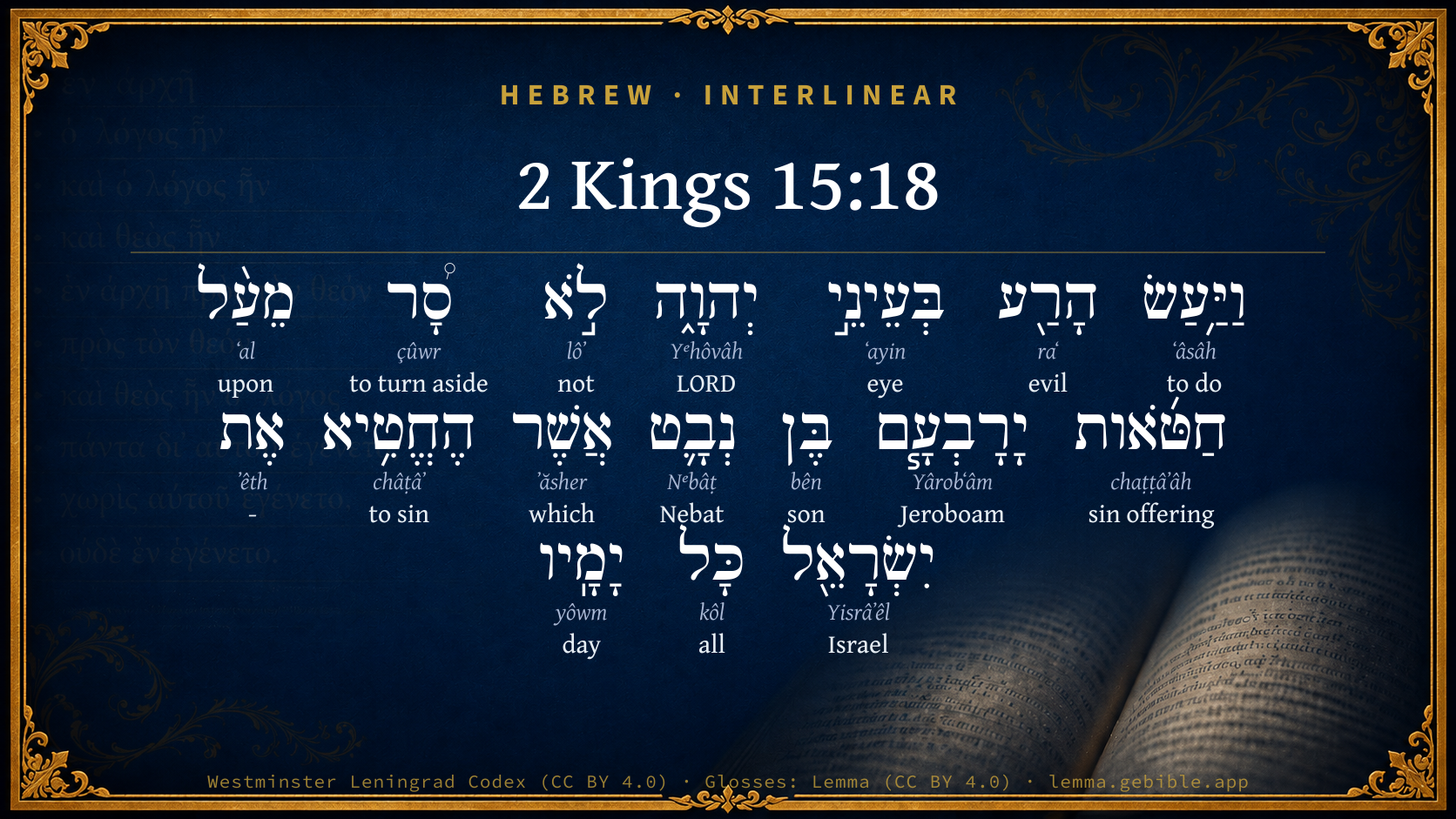
2 Kings 15:18

Hebrew (Westminster Leningrad Codex) 2 Kings 15:18 appears in the Hebrew Old Testament. The text above is from the Westminster Leningrad Codex. Each word links to its Strong’s number, a concise gloss, and parsing drawn from the Open Scriptures Hebrew Bible morphology. Click any word for its full Brown-Driver-Briggs (BDB) entry.
Download image
Cite this verse

2 Kings 15:18 (World English Bible). Public Domain. Lemma interlinear Bible study tool, https://lemma.gebible.app/v/2-kings/15/18.

Show BibTeX & RIS
BibTeX
RIS
English Translation
He did that which was evil in the sight of Yahweh: he didn't depart all his days from the sins of Jeroboam the son of Nebat, with which he made Israel to sin.
World English Bible · Public Domain
Download a study sheet

One document with this verse’s original text, its word-by-word gloss line, the meaning frame, cross-references with their text, attributed commentary, and full source and license credits — printable, and it pastes into notes with its structure intact.

This verse Autodidact and up

Study sheet (.html) Plain text (.txt)

A passage Seminary Student

Up to 50 verses in one chapter. A passage sheet keeps up to 6 commentary sources and 12 cross-references per verse, in the order this page ranks them, and says so on the sheet whenever that leaves anything out. Ask for a single verse and you get the Autodidact verse sheet above.

Everything on this page stays free to read, with no account — the sheet is a download of what is already on screen, not access to it.

Want to remove ads? Support Godless Engineer
Compare translations 3

The same verse in 3 English versions, stacked beneath the original-language interlinear above. Click any original word for its lexicon entry.

Each is an independent rendering of the whole verse — the interlinear is not word-aligned to these translations.

Highlighted words mark where these versions differ — a whole-verse word diff, not a word-by-word alignment.

  • World English Bible Public Domain
    He did that which was evil in the sight of Yahweh: he didn't depart all his days from the sins of Jeroboam the son of Nebat, with which he made Israel to sin.
  • King James Version Public Domain
    And he did that which was evil in the sight of the LORD: he departed not all his days from the sins of Jeroboam the son of Nebat, who made Israel to sin.
  • unfoldingWord Literal Text CC BY-SA 4.0
    And he did evil in the eyes of Yahweh. He did not turn away from the sins of Jeroboam, the son of Nebat, who caused Israel to sin, all of his days.

unfoldingWord Literal Text — © unfoldingWord, licensed CC BY-SA 4.0. Word-aligned USFM3 via Door43 (git.door43.org/unfoldingWord/en_ult).

Versions to compare (up to 4)

3 of 4 selected

Show all 18 translations

Every available English version of this verse, each an independent rendering of the whole verse.

  • World English Bible Public Domain
    He did that which was evil in the sight of Yahweh: he didn't depart all his days from the sins of Jeroboam the son of Nebat, with which he made Israel to sin.
  • Berean Standard Bible Public Domain
    And he did evil in the sight of the LORD, and throughout his reign he did not turn away from the sins that Jeroboam son of Nebat had caused Israel to commit.
  • Majority Standard Bible Public Domain
    And he did evil in the sight of the LORD, and throughout his reign he did not turn away from the sins that Jeroboam son of Nebat had caused Israel to commit.
  • King James Version Public Domain
    And he did that which was evil in the sight of the LORD: he departed not all his days from the sins of Jeroboam the son of Nebat, who made Israel to sin.
  • American Standard Version (1901) Public Domain
    And he did that which was evil in the sight of Jehovah: he departed not all his days from the sins of Jeroboam the son of Nebat, wherewith he made Israel to sin.
  • Revised Version (1885) Public Domain
    And he did that which was evil in the sight of the LORD: he departed not all his days from the sins of Jeroboam the son of Nebat, wherewith he made Israel to sin.
  • Geneva Bible (1599) Public Domain
    And he did euill in the sight of the Lord, and departed not all his dayes from the sinne of Ieroboam the sonne of Nebat, which made Israel to sinne.
  • Douay-Rheims (1899) Public Domain
    And he did that which was evil before the Lord: he departed not from the sins of Jeroboam the son of Nabat, who made Israel to sin all his days.
  • Young's Literal Translation Public Domain
    And he doth the evil in the eyes of Jehovah, he hath turned not aside from the sins of Jeroboam son of Nebat that he caused Israel to sin, all his days.
  • Literal Standard Version CC BY-SA 4.0
    And he does evil in the eyes of YHWH; he has not turned aside from the sins of Jeroboam son of Nebat that he caused Israel to sin, all his days.
  • Unlocked Literal Bible CC BY-SA 4.0
    He did what was evil in the sight of Yahweh. For his whole life, he did not depart from the sins of Jeroboam son of Nebat, who had caused Israel to sin.
  • unfoldingWord Literal Text CC BY-SA 4.0
    And he did evil in the eyes of Yahweh. He did not turn away from the sins of Jeroboam, the son of Nebat, who caused Israel to sin, all of his days.
  • Darby Bible Public Domain
    And he did evil in the sight of Jehovah: he departed not, all his days, from the sins of Jeroboam the son of Nebat, who made Israel to sin.
  • World Messianic Bible Public Domain
    He did that which was evil in the LORD’s sight. He didn’t depart all his days from the sins of Jeroboam the son of Nebat, with which he made Israel to sin.
  • Webster's Bible Public Domain
    And he did that which was evil in the sight of the LORD: he departed not all his days from the sins of Jeroboam the son of Nebat, who made Israel to sin.
  • Free Bible Version CC BY-SA 4.0
    Throughout his reign he did what was evil in the Lord's sight. He did not end the sins that Jeroboam, son of Nebat, had made Israel commit.
  • Bible in Basic English Public Domain
    He did evil in the eyes of the Lord; he did not keep himself from the sin which Jeroboam, the son of Nebat, did and made Israel do.
  • JPS Tanakh (1917) Public Domain
    And he did that which was evil in the sight of the LORD; he departed not all his days from the sins of Jeroboam the son of Nebat, wherewith he made Israel to sin.

Literal Standard Version (2020), Covenant Press — licensed CC BY-SA 4.0. Text via the HelloAO Bible API (eBible.org). Unlocked Literal Bible (unfoldingWord) — licensed CC BY-SA 4.0. Text via the HelloAO Bible API (eBible.org). unfoldingWord Literal Text — © unfoldingWord, licensed CC BY-SA 4.0. Word-aligned USFM3 via Door43 (git.door43.org/unfoldingWord/en_ult). Free Bible Version, Dr. Jonathan Gallagher — licensed CC BY-SA 4.0. Text via the HelloAO Bible API (eBible.org).

Word by word

More ways to search: Search by grammar → Find every occurrence → Compare this word →

Practice this passage: Drill this verse → Learn its vocabulary →

נְבָ֛ט
Nᵉbâṭ
H5028
“Nebat”
Noun, Proper
Part of Speech
Noun
Type
Proper
Full BDB Definition

Origin: from H5027

TWOT: None

Nebat = "aspect" - an Ephraimite of Zereda, father of king Jeroboam I of the northern kingdom of Israel
  1. וַיַּ֥עַשׂ ʻâsâh H6213 “and · to do” Conjunction + Verb, Qal, Sequential Imperfect, 3rd Person, Masculine, Singular
  2. הָרַ֖ע raʻ H7451 “the · evil” Particle, Definite Article + Adjective, Adjective, Masculine, Singular, Absolute
  3. בְּעֵינֵ֣י ʻayin H5869 “in/at · eyes of” Preposition + Noun, Common, Both, Dual, Construct
  4. יְהוָ֑ה Yᵉhôvâh H3068 “LORD” Noun, Proper
  5. לֹ֣א lôʼ H3808 “not” Particle, Negative
  6. סָ֠ר çûwr H5493 “to turn aside” Verb, Qal, Perfect, 3rd Person, Masculine, Singular
  7. מֵעַ֨ל ʻal H5921 “from · upon” Preposition + Preposition
  8. חַטֹּ֜אות chaṭṭâʼâh H2403 “sin offerings of” Noun, Common, Feminine, Plural, Construct
  9. יָרָבְעָ֧ם Yârobʻâm H3379 “Jeroboam” Noun, Proper
  10. בֶּן bên H1121 “son of” Noun, Common, Masculine, Singular, Construct
  11. אֲשֶׁר ʼăsher H834 “which” Particle, Relative
  12. הֶחֱטִ֥יא châṭâʼ H2398 “to sin” Verb, Hiphil, Perfect, 3rd Person, Masculine, Singular
  13. אֶת ʼêth H853 “-” Particle, Direct Object
  14. יִשְׂרָאֵ֖ל Yisrâʼêl H3478 “Israel” Noun, Proper
  15. כָּל kôl H3605 “all of” Noun, Common, Masculine, Singular, Construct
  16. יָמָֽיו yôwm H3117 “days · his” Noun, Common, Masculine, Plural, Construct + Suffix, Personal, 3rd Person, Masculine, Singular

About this verse

These counts appear in no published source. They are computed here, from the morphology-tagged text and Lemma’s own curated glosses. What Lemma adds →

17
words
17
distinct lemmas
Historical
section

Notable vocabulary

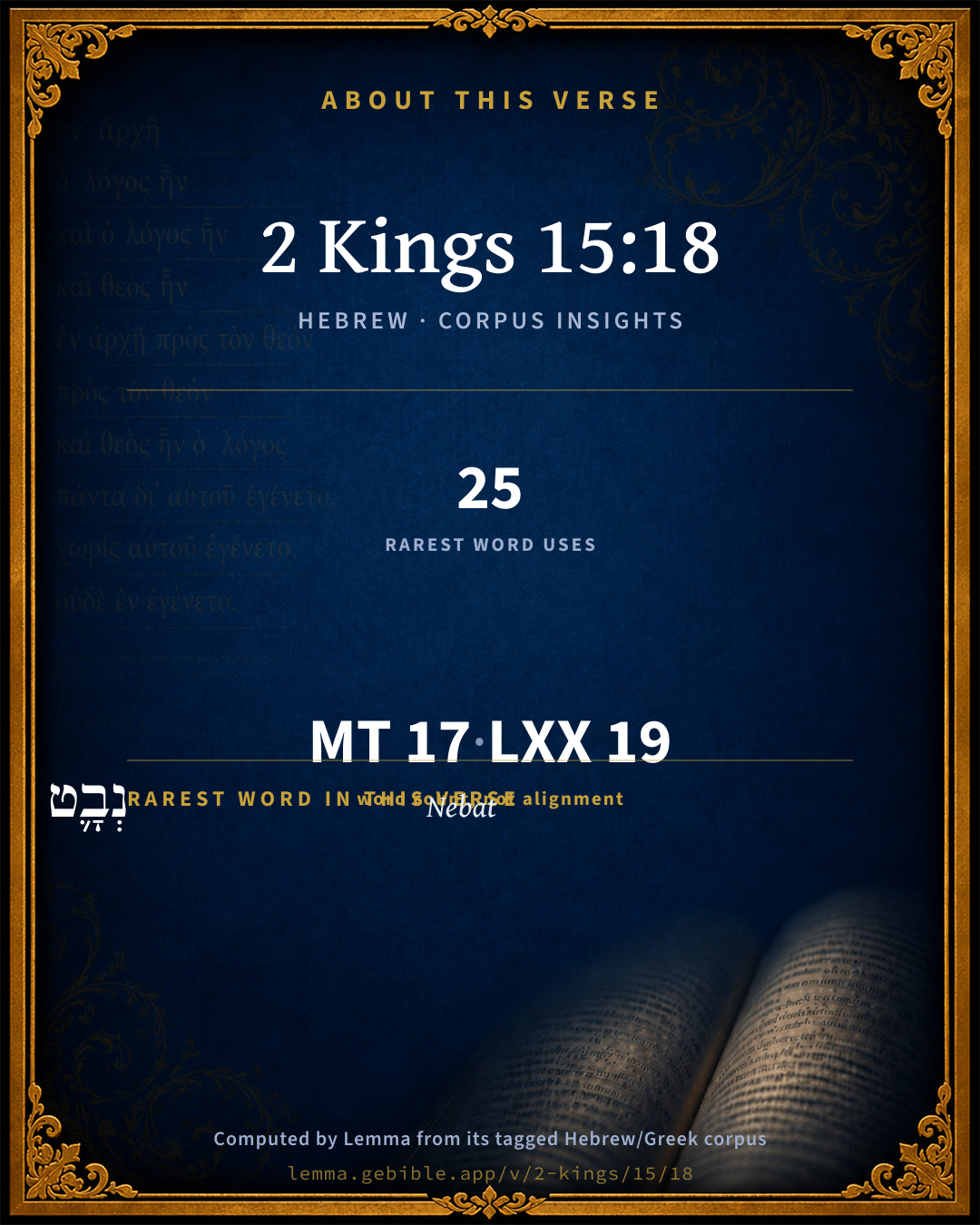
The rarest word here is נְבָ֛ט Nebat H5028 — appearing just 25 times in the whole Hebrew Bible.

Shared distinctive vocabulary

נְבָ֛ט Nebat H5028 occurs in 25 verses of the Hebrew Bible. Also found in:

Grammatical profile

  • 3 verbs
  • 9 nouns
  • 1 adjective
  • 1 preposition
  • 3 particles

Verb forms

  • וַיַּ֥עַשׂ Qal · Sequential Imperfect
  • סָ֠ר Qal · Perfect
  • הֶחֱטִ֥יא Hiphil · Perfect

Hebrew & Septuagint length

In English translation the verse runs 33 words from the Hebrew and 31 from the Septuagint (LXX English) — closely comparable.

A rough comparison of the two English renderings, which tokenize alike — not a word-level alignment.

Word counts can differ between the Hebrew and the Greek without any difference in meaning — e.g. the Hebrew direct-object marker אֵת has no separate Greek word, and Greek often adds the article ὁ.

In the original languages it is 17 Hebrew tokens and 19 Greek tokens — but the two are counted differently (Hebrew bundles its prefixes and suffixes into one token; the Greek is in lemma form), so that isn’t a like-for-like length.

Hebrew and Greek witnesses Masoretic Hebrew ↔ Greek Septuagint

The same verse in the two great witnesses to the Old Testament, shown verse-for-verse.

These are two independent witnesses, not word-aligned to each other, and the Septuagint is shown in lemma (dictionary) form.

Hebrew 2 Kings 15:18 Masoretic · Westminster Leningrad Codex

וַיַּ֥עַשׂ הָרַ֖ע בְּעֵינֵ֣י יְהוָ֑ה לֹ֣א סָ֠ר מֵעַ֨ל חַטֹּ֜אות יָרָבְעָ֧ם בֶּן נְבָ֛ט אֲשֶׁר הֶחֱטִ֥יא אֶת יִשְׂרָאֵ֖ל כָּל יָמָֽיו

He did that which was evil in the sight of Yahweh: he didn't depart all his days from the sins of Jeroboam the son of Nebat, with which he made Israel to sin.

World English Bible · Public Domain

Greek LXX 2 Kings 15:18 Septuagint · lemma form

καί ποιέω ὁ πονηρός ἐν ὀφθαλμός κύριος οὐ ἀποἵστημι ἀπό πᾶς ἁμαρτία ιεροβοαμ υἱός ναβατ ὅς ἐκἁμαρτάνω ὁ ἰσραήλ

And he did that which was evil in the sight of the Lord: he departed not from all the sins of Jeroboam the son of Nabat, who led Israel to sin.

LXX2012 (modern English Septuagint) · Public Domain

On this verse, Ellicott's Commentary for English Readers discusses the Septuagint’s reading. Read the note in Commentary ↓

Hebrew: Westminster Leningrad Codex (CC BY 4.0). Greek: Septuagint (public domain); English from LXX2012 (modern English Septuagint) (Public Domain). How the Septuagint differs from the Hebrew →

Targum (Aramaic paraphrase)

1

The Targum is the ancient Jewish Aramaic paraphrase of the Hebrew Scriptures — an interpretive translation, not the Hebrew text itself. Onkelos (literal) and Pseudo-Jonathan (expansive) render the Torah, and Jonathan the Prophets. Coverage is partial: where no permissively-licensed English translation exists for a verse, only the Aramaic is shown. This is verse-level text, not a word-by-word alignment to the Hebrew.

  1. Targum Jonathan Prophets (Joshua–Malachi)
    וַעֲבַד דְבִישׁ קֳדָם יְיָ לָא סְטָא מֵעַל חוֹבֵי יָרָבְעָם בַּר נְבָט דְחַיֵב עַל יִשְׂרָאֵל כָּל יוֹמוֹהִי:

    (no public-domain English translation for this verse)

    Targum Jonathan — Aramaic: “Mikraot Gedolot” (public domain). English: “Sefaria Community Translation” (CC0 1.0 (public-domain dedication)); “London "Chaldee Paraphrase," 1871” (public domain). Text via Sefaria.

Commentary

Notes on 2 Kings 15:18 from classic Christian and Jewish commentators (each source and its license shown beneath its notes). The classic Christian expositions comment on the surrounding passage and are grouped to its opening verse, so a note may address several verses; the Jewish commentaries on the Tanakh (Rashi and others) are per-verse, so they appear only where the commentator wrote on this verse.

Lemma curates 59 commentaries, every one of them public domain or Creative Commons licensed, each selected and text-cleaned for this edition rather than reprinted as found. About our sources →

Trapp's Complete Commentary

John Trapp

2Ki 15:18 And he did [that which was] evil in the sight of the LORD: he departed not all his days from the sins of Jeroboam the son of Nebat, who made Israel to sin.

Ver. 18. And he did that which was evil.] See 1Ki 15:26.

John Trapp, A Commentary or Exposition upon All the Books of the Old and New Testament (1647–1656) — public domain. Text from a community e-Sword module.

Ellicott's Commentary for English Readers

(18) He did that which was evil.—Ewald says that at the outset Menahem appeared to be guided by better principles, referring to Zec_11:4-8.

All his days.—In the Hebrew these words occur at the end of the verse. They are not found in any other instance of the common formula which the verse repeats (comp. 1Ki_15:26; 1Ki_15:34; 1Ki_16:26; 1Ki_22:53; 2Ki_3:1; 2Ki_10:31, &c), and almost certainly belong to the next verse.

From the sins.—Heb., from upon the sins, which is peculiar. The reading of the LXX., “from all the sins,” appears right.

A Bible Commentary for English Readers, edited by Charles John Ellicott (1878–1897) — public domain. Text from a community e-Sword module.

The Cambridge Bible for Schools and Colleges

gen. ed. J. J. S. Perowne

18. all his days] These words are unrepresented in the LXX.

The Cambridge Bible for Schools and Colleges (gen. ed. J. J. S. Perowne; Cambridge University Press, 1878–1918) — public domain. Text from a community e-Sword module.

John Gill's Exposition

And he did that which was evil,.... Besides other sins, he cleaved to that of worshipping the calves, a piece of state policy all the kings of Israel gave into.

And he did that which was evil,.... Besides other sins, he cleaved to that of worshipping the calves, a piece of state policy all the kings of Israel gave into.

2 Kings 15:25

kg2 15:25

kg2 15:25

kg2 15:25But Pekah the son of Remaliah, a captain of his,.... The word signifies a "third" man, the third to the king, as some think; Josephus (a) calls him a "chiliarch", one that had the command of a thousand men:

conspired against him, and smote him in Samaria, in the palace of the king's house; Josephus (b) says it was at a banquet:

with Argob, and Arieh; whom, according to Abarbinel, Pekah slew with the king, being mighty men, who were always about him; but they seem rather to be conspirators with Pekah, and assisting to him in smiting the king; the former of these, Ben Gersom thinks, was governor of Argob, a country on the other side Jordan, and the latter had his name from his fortitude, which signifies a lion:

and with him fifty men of the Gileadites; which may seem to strengthen the above notion concerning Argob, since the Gileadites were of the same side of Jordan, and were near Argob, see Deu 3:13.

and he killed him, and reigned in his room, as his father killed Shallum, and reigned in his stead.

(a) Ut supra. (Antiqu. l. 9. c. 11. sect. 1.) (b) Ibid.

John Gill's Exposition of the Whole Bible (1746–1763) — public domain (CC PDM 1.0). Text via the HelloAO Bible API.

Haydock's Catholic Bible Commentary

Days. During which Jeroboam or Manahem swayed the sceptre. (Calmet) --- The Septuagint refer all his days to the following verse, (Haydock) which seems to intimate that the tribute was required annually, as may be gathered from the Vulgate veniebat. (Menochius) --- But Phul probably received the talents only once, to indemnify him for his trouble. He was perhaps the father of Sardanapalus, who joined his name, Phul, to his own, Sardan; as Merodach assumed that of Baladan, Isaias xxxix. 1. Profane authors style the father of Sardanapalus,Anacindaraxes, &c. Phul was the first of the Assyrian monarchs who came into the land of Israel, where we shall find them too often in the sequel. He probably repented on the preaching of Jonas, and averted the scourge (Calmet) which fell upon the city during the reign of his son. (Haydock)

George Leo Haydock (1774–1849), Haydock's Catholic Family Bible and Commentary, 1859 edition — public domain. Excludes Psalms (Douay-Rheims chapter numbering differs from Protestant) and Deuterocanonical books (Catholic canon only).

The Pulpit Commentary

And he did that which was evil in the sight of the Lord: he departed not all his days from the sins of Jeroboam the son of Nebat, who made Israel to sin. The writer does not seem to regard Menahem as either better or worse than his predecessors. The usual formula suffices to describe the moral and religious aspect of his reign.

The Pulpit Commentary (1880–1919), ed. H.D.M. Spence-Jones & Joseph S. Exell — public domain. Text from a community e-Sword module.

Lesson kit

Teaching starters — assembled from the data on this page, not authored interpretation. Every prompt links to the verse data it draws on. Edit before teaching.

2 Kings, in the Historical, opens this verse with 17 words (17 distinct Hebrew lemmas). Its most distinctive word is Nᵉbâṭ (“Nebat”). A historical commentator’s framing appears above. Read the whole chapter for the surrounding context.

Discussion questions

  1. What does “Nebat” (Nᵉbâṭ) contribute to the verse as a whole?
  2. How does 1 Kings 11:26, which shares the word «Nebat», read alongside this verse?
  3. These translations render this verse differently; the difference is in the English rendering, not the original. What questions does that raise?
  4. «וַיַּ֥עַשׂ» is a Qal Sequential Imperfect verb. How does that grammatical form shape the action described?
  5. Compare how Trapp's Complete Commentary and Ellicott's Commentary for English Readers read this verse. Where do they agree or differ?

Things to notice

Reading settings

Reading text

Shown beneath each verse's original-language words.

Old Testament
Old Testament edition

Read the OT as the Masoretic Hebrew (MT) or the Greek Septuagint (LXX).

English shown for the Greek Septuagint (in the Hebrew ↔ Greek comparison).

Comparing translations? Open the Compare panel on any verse page to stack up to four side by side.