
2 Kings 16:2

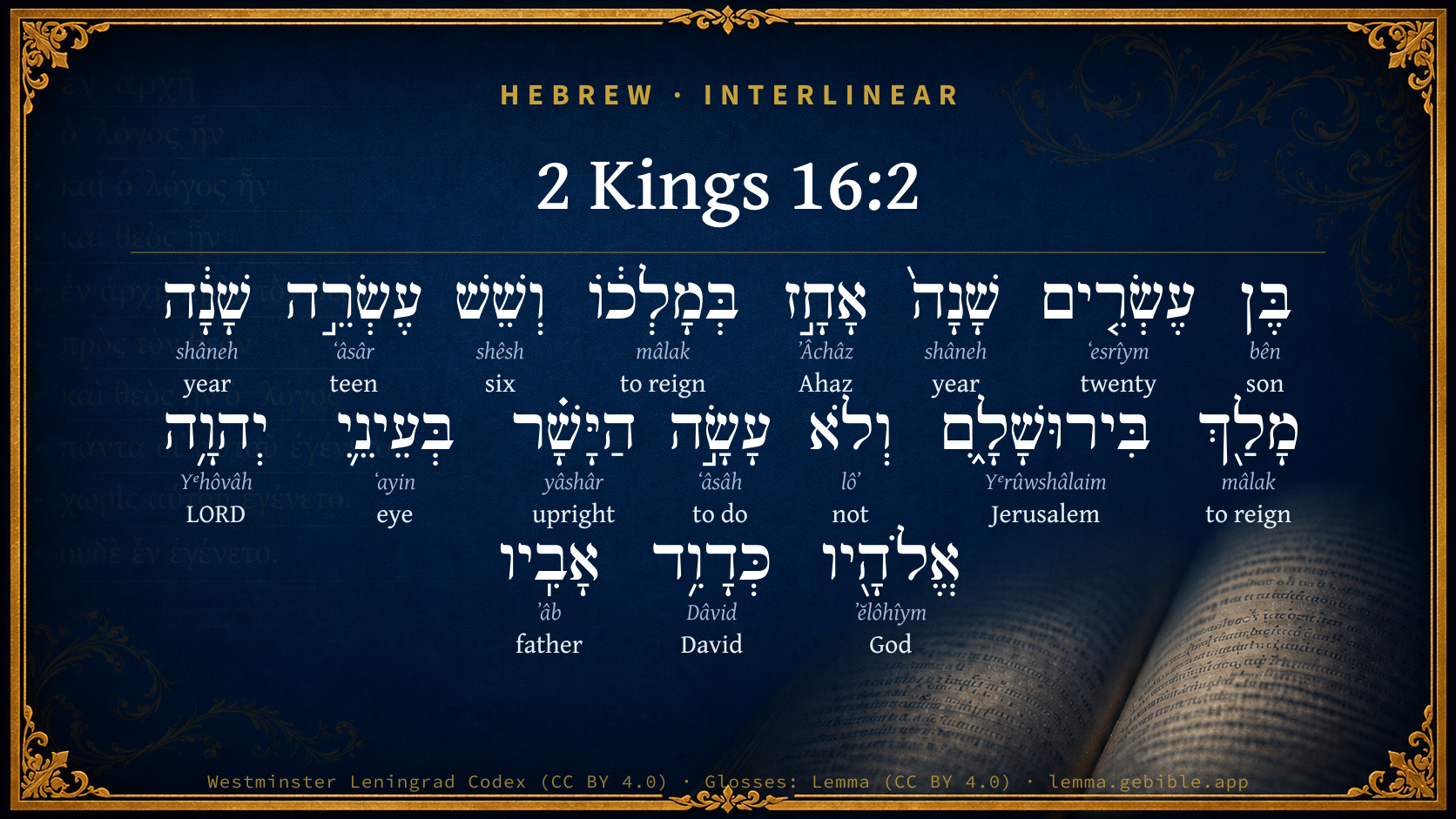
Hebrew (Westminster Leningrad Codex) 2 Kings 16:2 appears in the Hebrew Old Testament. The text above is from the Westminster Leningrad Codex. Each word links to its Strong’s number, a concise gloss, and parsing drawn from the Open Scriptures Hebrew Bible morphology. Click any word for its full Brown-Driver-Briggs (BDB) entry.
Download image
Cite this verse

2 Kings 16:2 (World English Bible). Public Domain. Lemma interlinear Bible study tool, https://lemma.gebible.app/v/2-kings/16/2.

Show BibTeX & RIS
BibTeX
RIS
English Translation
Twenty years old was Ahaz when he began to reign; and he reigned sixteen years in Jerusalem: and he didn't do that which was right in the eyes of Yahweh his God, like David his father.
World English Bible · Public Domain
Download a study sheet

One document with this verse’s original text, its word-by-word gloss line, the meaning frame, cross-references with their text, attributed commentary, and full source and license credits — printable, and it pastes into notes with its structure intact.

This verse Autodidact and up

Study sheet (.html) Plain text (.txt)

A passage Seminary Student

Up to 50 verses in one chapter. A passage sheet keeps up to 6 commentary sources and 12 cross-references per verse, in the order this page ranks them, and says so on the sheet whenever that leaves anything out. Ask for a single verse and you get the Autodidact verse sheet above.

Everything on this page stays free to read, with no account — the sheet is a download of what is already on screen, not access to it.

Want to remove ads? Support Godless Engineer
Compare translations 3

The same verse in 3 English versions, stacked beneath the original-language interlinear above. Click any original word for its lexicon entry.

Each is an independent rendering of the whole verse — the interlinear is not word-aligned to these translations.

Highlighted words mark where these versions differ — a whole-verse word diff, not a word-by-word alignment.

  • World English Bible Public Domain
    Twenty years old was Ahaz when he began to reign; and he reigned sixteen years in Jerusalem: and he didn't do that which was right in the eyes of Yahweh his God, like David his father.
  • King James Version Public Domain
    Twenty years old was Ahaz when he began to reign, and reigned sixteen years in Jerusalem, and did not that which was right in the sight of the LORD his God, like David his father.
  • unfoldingWord Literal Text CC BY-SA 4.0
    Ahaz a son of 20 years when he reigned, and he reigned 16 years in Jerusalem. But he did not do right in the eyes of Yahweh his God like David his father.

unfoldingWord Literal Text — © unfoldingWord, licensed CC BY-SA 4.0. Word-aligned USFM3 via Door43 (git.door43.org/unfoldingWord/en_ult).

Versions to compare (up to 4)

3 of 4 selected

Show all 18 translations

Every available English version of this verse, each an independent rendering of the whole verse.

  • World English Bible Public Domain
    Twenty years old was Ahaz when he began to reign; and he reigned sixteen years in Jerusalem: and he didn't do that which was right in the eyes of Yahweh his God, like David his father.
  • Berean Standard Bible Public Domain
    Ahaz was twenty years old when he became king, and he reigned in Jerusalem sixteen years. And unlike David his father, he did not do what was right in the eyes of the LORD his God.
  • Majority Standard Bible Public Domain
    Ahaz was twenty years old when he became king, and he reigned in Jerusalem sixteen years. And unlike David his father, he did not do what was right in the eyes of the LORD his God.
  • King James Version Public Domain
    Twenty years old was Ahaz when he began to reign, and reigned sixteen years in Jerusalem, and did not that which was right in the sight of the LORD his God, like David his father.
  • American Standard Version (1901) Public Domain
    Twenty years old was Ahaz when he began to reign; and he reigned sixteen years in Jerusalem: and he did not that which was right in the eyes of Jehovah his God, like David his father.
  • Revised Version (1885) Public Domain
    Twenty years old was Ahaz when he began to reign; and he reigned sixteen years in Jerusalem: and he did not that which was right in the eyes of the LORD his God, like David his father.
  • Geneva Bible (1599) Public Domain
    Twentie yeere olde was Ahaz, when hee began to reigne, and he reigned sixteene yeere in Ierusalem, and did not vprightly in the sight of the Lord his God, like Dauid his father:
  • Douay-Rheims (1899) Public Domain
    Achaz was twenty years old when he began to reign, and he reigned sixteen years in Jerusalem: he did not that which was pleasing in the sight of the Lord his Cod, as David his father.
  • Young's Literal Translation Public Domain
    A son of twenty years `is' Ahaz in his reigning, and sixteen years he hath reigned in Jerusalem, and he hath not done that which `is' right in the eyes of Jehovah his God, like David his father,
  • Literal Standard Version CC BY-SA 4.0
    Ahaz [is] a son of twenty years in his reigning, and he has reigned sixteen years in Jerusalem, and he has not done that which [is] right in the eyes of his God YHWH, like his father David,
  • Unlocked Literal Bible CC BY-SA 4.0
    Ahaz was twenty years old when he began to reign, and he reigned sixteen years in Jerusalem. He did not do what was right in the eyes of Yahweh his God, as David his ancestor had done.
  • unfoldingWord Literal Text CC BY-SA 4.0
    Ahaz a son of 20 years when he reigned, and he reigned 16 years in Jerusalem. But he did not do right in the eyes of Yahweh his God like David his father.
  • Darby Bible Public Domain
    Ahaz was twenty years old when he began to reign; and he reigned sixteen years in Jerusalem. And he did not what was right in the sight of Jehovah his God, like David his father,
  • World Messianic Bible Public Domain
    Ahaz was twenty years old when he began to reign, and he reigned sixteen years in Jerusalem. He didn’t do that which was right in the LORD his God’s eyes, like David his father.
  • Webster's Bible Public Domain
    Twenty years old was Ahaz when he began to reign, and reigned sixteen years in Jerusalem, and did not that which was right in the sight of the LORD his God, like David his father.
  • Free Bible Version CC BY-SA 4.0
    Ahaz was twenty when he became king, and he reigned in Jerusalem for sixteen years. But unlike David his forefather, he did not do what was right in the sight of the Lord his God.
  • Bible in Basic English Public Domain
    Ahaz was twenty years old when he became king; he was ruling for sixteen years in Jerusalem. He did not do what was right in the eyes of the Lord his God, as David his father did.
  • JPS Tanakh (1917) Public Domain
    Twenty years old was Ahaz when he began to reign; and he reigned sixteen years in Jerusalem; and he did not that which was right in the eyes of the LORD his God, like David his father.

Literal Standard Version (2020), Covenant Press — licensed CC BY-SA 4.0. Text via the HelloAO Bible API (eBible.org). Unlocked Literal Bible (unfoldingWord) — licensed CC BY-SA 4.0. Text via the HelloAO Bible API (eBible.org). unfoldingWord Literal Text — © unfoldingWord, licensed CC BY-SA 4.0. Word-aligned USFM3 via Door43 (git.door43.org/unfoldingWord/en_ult). Free Bible Version, Dr. Jonathan Gallagher — licensed CC BY-SA 4.0. Text via the HelloAO Bible API (eBible.org).

Word by word

More ways to search: Search by grammar → Find every occurrence → Compare this word →

Practice this passage: Drill this verse → Learn its vocabulary →

אָחָ֣ז
ʼÂchâz
H271
“Ahaz”
Noun, Proper
Part of Speech
Noun
Type
Proper
Full BDB Definition

Origin: from H270

TWOT: None

Ahaz = "he has grasped" - king of Judah, son Jotham, father of Hezekiah - a Benjamite, son of Micah, and great grandson of Jonathan
  1. בֶּן bên H1121 “son of” Noun, Common, Masculine, Singular, Construct
  2. עֶשְׂרִ֤ים ʻesrîym H6242 “twenty” Adjective, Cardinal number, Both, Plural, Absolute
  3. שָׁנָה֙ shâneh H8141 “year” Noun, Common, Feminine, Singular, Absolute
  4. בְּמָלְכ֔וֹ mâlak H4427 “in/at · to reign · him” Preposition + Verb, Qal, Infinitive Construct + Suffix, Personal, 3rd Person, Masculine, Singular
  5. וְשֵׁשׁ shêsh H8337 “and · six” Conjunction + Adjective, Cardinal number, Feminine, Singular, Absolute
  6. עֶשְׂרֵ֣ה ʻâsâr H6240 “teen” Adjective, Cardinal number, Feminine, Singular, Absolute
  7. שָׁנָ֔ה shâneh H8141 “year” Noun, Common, Feminine, Singular, Absolute
  8. מָלַ֖ךְ mâlak H4427 “to reign” Verb, Qal, Perfect, 3rd Person, Masculine, Singular
  9. בִּירוּשָׁלִָ֑ם Yᵉrûwshâlaim H3389 “in/at · Jerusalem” Preposition + Noun, Proper
  10. וְלֹא lôʼ H3808 “and · not” Conjunction + Particle, Negative
  11. עָשָׂ֣ה ʻâsâh H6213 “to do” Verb, Qal, Perfect, 3rd Person, Masculine, Singular
  12. הַיָּשָׁ֗ר yâshâr H3477 “the · upright” Particle, Definite Article + Adjective, Adjective, Masculine, Singular, Absolute
  13. בְּעֵינֵ֛י ʻayin H5869 “in/at · eyes of” Preposition + Noun, Common, Both, Dual, Construct
  14. יְהוָ֥ה Yᵉhôvâh H3068 “LORD” Noun, Proper
  15. אֱלֹהָ֖יו ʼĕlôhîym H430 “God(s) · his” Noun, Common, Masculine, Plural, Construct + Suffix, Personal, 3rd Person, Masculine, Singular
  16. כְּדָוִ֥ד Dâvid H1732 “like/as · David” Preposition + Noun, Proper
  17. אָבִֽיו ʼâb H1 “father · his” Noun, Common, Masculine, Singular, Construct + Suffix, Personal, 3rd Person, Masculine, Singular

About this verse

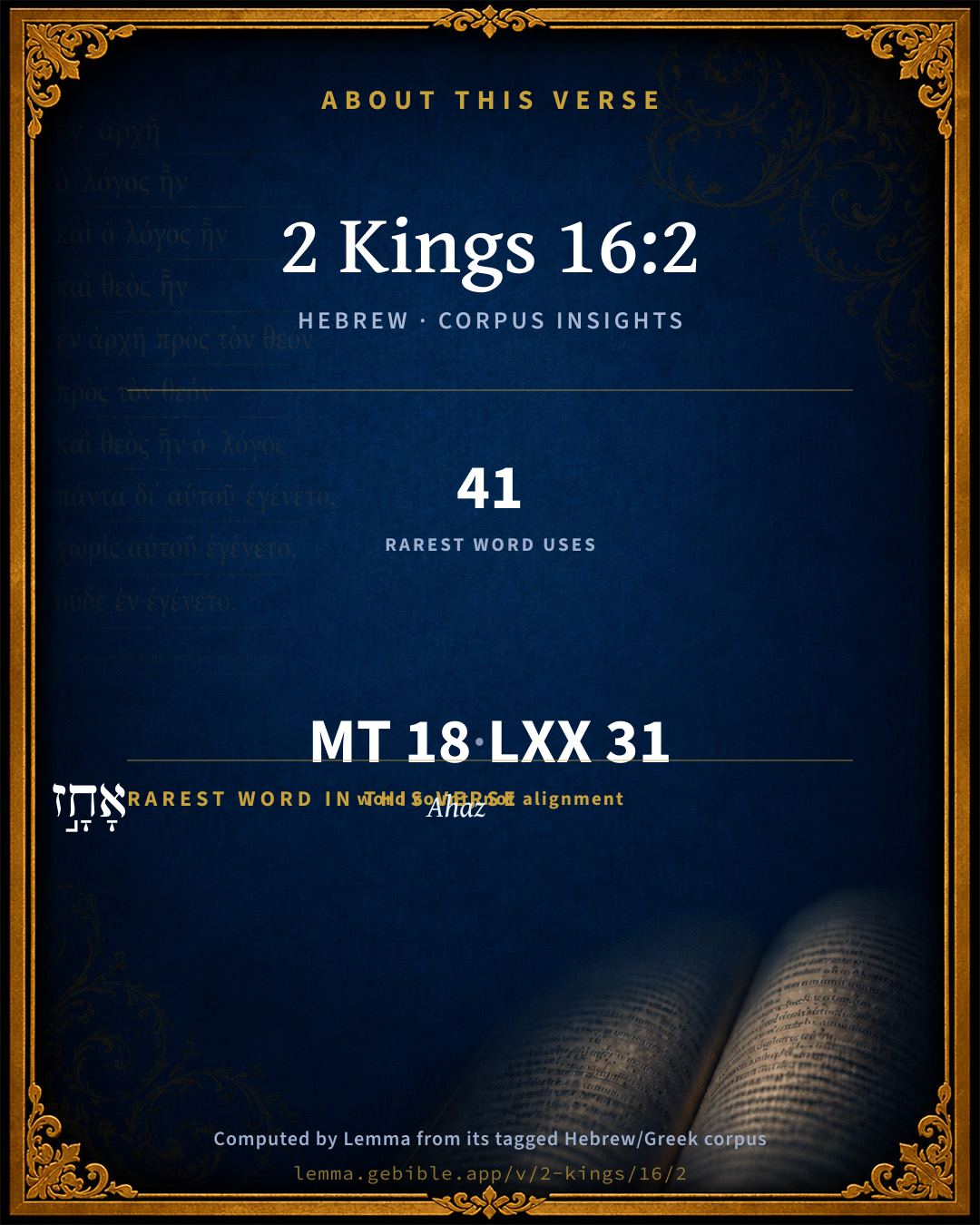
These counts appear in no published source. They are computed here, from the morphology-tagged text and Lemma’s own curated glosses. What Lemma adds →

18
words
16
distinct lemmas
Historical
section

Shared distinctive vocabulary

אָחָ֣ז Ahaz H271 occurs in 39 verses of the Hebrew Bible. Also found in:

Grammatical profile

  • 3 verbs
  • 10 nouns
  • 4 adjectives
  • 1 particle

Verb forms

  • בְּמָלְכ֔וֹ Qal · Infinitive Construct
  • מָלַ֖ךְ Qal · Perfect
  • עָשָׂ֣ה Qal · Perfect

Repetition

Words recur within this verse — often emphatic in Hebrew:

  • שָׁנָה֙ year H8141 ×2
  • בְּמָלְכ֔וֹ to reign H4427 ×2

Hebrew & Septuagint length

In English translation the verse runs 36 words from the Hebrew and 40 from the Septuagint (LXX English) — closely comparable.

A rough comparison of the two English renderings, which tokenize alike — not a word-level alignment.

Word counts can differ between the Hebrew and the Greek without any difference in meaning — e.g. the Hebrew direct-object marker אֵת has no separate Greek word, and Greek often adds the article ὁ.

In the original languages it is 18 Hebrew tokens and 31 Greek tokens — but the two are counted differently (Hebrew bundles its prefixes and suffixes into one token; the Greek is in lemma form), so that isn’t a like-for-like length.

Cross-references

13

Topical passages linked to 2 Kings 16:2 in the Treasury of Scripture Knowledge — connected by theme and wording, ordered by reader-vote popularity; previews shown in the World English Bible.

  • 2 Chronicles 28:1–4 Ahaz was twenty years old when he began to reign; and he reigned sixteen years in Jerusalem: and he didn't do that which was right in the eyes of Yahweh, like David his father;
  • 1 Kings 3:14 If you will walk in my ways, to keep my statutes and my commandments, as your father David did walk, then I will lengthen your days.
  • 1 Kings 9:4 As for you, if you will walk before me, as David your father walked, in integrity of heart, and in uprightness, to do according to all that I have commanded you, and will keep my statutes and my ordinances;
  • 1 Kings 11:4–8 For it happened, when Solomon was old, that his wives turned away his heart after other gods; and his heart was not perfect with Yahweh his God, as was the heart of David his father.
  • 1 Kings 15:3 He walked in all the sins of his father, which he had done before him; and his heart was not perfect with Yahweh his God, as the heart of David his father.
  • 2 Kings 14:3 He did that which was right in the eyes of Yahweh, yet not like David his father: he did according to all that Joash his father had done.
  • 2 Kings 15:3 He did that which was right in the eyes of Yahweh, according to all that his father Amaziah had done.
  • 2 Kings 15:34 He did that which was right in the eyes of Yahweh; he did according to all that his father Uzziah had done.
  • 2 Kings 18:3 He did that which was right in the eyes of Yahweh, according to all that David his father had done.
  • 2 Kings 22:2 He did that which was right in the eyes of Yahweh, and walked in all the way of David his father, and didn't turn aside to the right hand or to the left.
  • 2 Chronicles 17:3 Yahweh was with Jehoshaphat, because he walked in the first ways of his father David, and didn't seek the Baals,
  • 2 Chronicles 29:2 He did that which was right in the eyes of Yahweh, according to all that David his father had done.
  • 2 Chronicles 34:2–3 He did that which was right in the eyes of Yahweh, and walked in the ways of David his father, and didn't turn aside to the right hand or to the left.

Cross-references courtesy of OpenBible.info (CC BY 4.0).

Hebrew and Greek witnesses Masoretic Hebrew ↔ Greek Septuagint

The same verse in the two great witnesses to the Old Testament, shown verse-for-verse.

These are two independent witnesses, not word-aligned to each other, and the Septuagint is shown in lemma (dictionary) form.

Hebrew 2 Kings 16:2 Masoretic · Westminster Leningrad Codex

בֶּן עֶשְׂרִ֤ים שָׁנָה֙ אָחָ֣ז בְּמָלְכ֔וֹ וְשֵׁשׁ עֶשְׂרֵ֣ה שָׁנָ֔ה מָלַ֖ךְ בִּירוּשָׁלִָ֑ם וְלֹא עָשָׂ֣ה הַיָּשָׁ֗ר בְּעֵינֵ֛י יְהוָ֥ה אֱלֹהָ֖יו כְּדָוִ֥ד אָבִֽיו

Twenty years old was Ahaz when he began to reign; and he reigned sixteen years in Jerusalem: and he didn't do that which was right in the eyes of Yahweh his God, like David his father.

World English Bible · Public Domain

Greek LXX 2 Kings 16:2 Septuagint · lemma form

υἱός εἴκοσι ἔτος εἰμί αχαζ ἐν ὁ βασιλεύω αὐτός καί ἑκκαίδεκα ἔτος βασιλεύω ἐν ἰερουσαλήμ καί οὐ ποιέω ὁ εὐθής ἐν ὀφθαλμός κύριος θεός αὐτός πιστῶς ὡς δαυίδ ὁ πατήρ αὐτός

Twenty years old was Achaz when he began to reign, and he reigned sixteen years in Jerusalem; and he did not that which was right in the eyes of the Lord his God faithfully, as David his father had done.

LXX2012 (modern English Septuagint) · Public Domain

On this verse, Ellicott's Commentary for English Readers discusses the Septuagint’s reading. Read the note in Commentary ↓

Hebrew: Westminster Leningrad Codex (CC BY 4.0). Greek: Septuagint (public domain); English from LXX2012 (modern English Septuagint) (Public Domain). How the Septuagint differs from the Hebrew →

Targum (Aramaic paraphrase)

1

The Targum is the ancient Jewish Aramaic paraphrase of the Hebrew Scriptures — an interpretive translation, not the Hebrew text itself. Onkelos (literal) and Pseudo-Jonathan (expansive) render the Torah, and Jonathan the Prophets. Coverage is partial: where no permissively-licensed English translation exists for a verse, only the Aramaic is shown. This is verse-level text, not a word-by-word alignment to the Hebrew.

  1. Targum Jonathan Prophets (Joshua–Malachi)
    בַּר עַשְׂרִין שְׁנִין אָחָז כַּד מְלַךְ וְשִׁית עַסְרֵי שְׁנִין מְלַךְ בִּירוּשְׁלֵם וְלָא עֲבַד דְכָשַׁר קֳדָם יְיָ אֱלָהֵיהּ כְּדָוִד אֲבוּהִי:

    (no public-domain English translation for this verse)

    Targum Jonathan — Aramaic: “Mikraot Gedolot” (public domain). English: “Sefaria Community Translation” (CC0 1.0 (public-domain dedication)); “London "Chaldee Paraphrase," 1871” (public domain). Text via Sefaria.

Commentary

Notes on 2 Kings 16:2 from classic Christian and Jewish commentators (each source and its license shown beneath its notes). The classic Christian expositions comment on the surrounding passage and are grouped to its opening verse, so a note may address several verses; the Jewish commentaries on the Tanakh (Rashi and others) are per-verse, so they appear only where the commentator wrote on this verse.

Lemma curates 59 commentaries, every one of them public domain or Creative Commons licensed, each selected and text-cleaned for this edition rather than reprinted as found. About our sources →

Trapp's Complete Commentary

John Trapp

2Ki 16:2 Twenty years old [was] Ahaz when he began to reign, and reigned sixteen years in Jerusalem, and did not [that which was] right in the sight of the LORD his God, like David his father.

Ver. 2. When he began to reign,] i.e., Himself alone after his father’s death; in whose lifetime he had been designed to the kingdom, and then he was but twenty years old. Or, When he, that is, Jotham, began to reign. See the like, 2Ch 36:9.

And reigned sixteen years.] But had an ill life of it all the while, by reason of oppressions and miseries.

John Trapp, A Commentary or Exposition upon All the Books of the Old and New Testament (1647–1656) — public domain. Text from a community e-Sword module.

Joseph Benson's Commentary

2Ki 16:2. Ahaz did not that which was right in the sight of the Lord — Contrary to what might have been expected, considering the good education which, doubtless, Jotham, his pious father, gave him, and the excellent example he set him. Like David his father — Or progenitor. It was his honour that he was of the house and lineage of David, and it was owing to God’s ancient covenant with David, that he was now upon the throne: but he had none of that concern and affection for the instituted worship and service of God, for which David was so remarkable. He had no love for the temple, made no conscience of his duty to God, nor had any regard to his law, and therefore was a reproach to that honourable name and family, to which he was under such great obligations, and which, of consequence, was really a reproach to him, showing his wickedness in a more aggravated point of view.

Joseph Benson's Commentary on the Old and New Testaments (1811–1818) — public domain. Text from a community e-Sword module.

Tyndale Open Study Notes

Tyndale Open Resources

16:2-3 Again, his ancestor David serves as the standard for measuring the spiritual character of Judah’s kings (14:3; 1 Kgs 15:3, 11). • the example of the kings of Israel: Ahaz was one of Judah’s most wicked kings. He indulged in the apostate religion of Israel and the pagan practices of other nations to the extent of even sacrificing his own son in the fire (see Jer 19:5; 32:35). Although Levitical regulations prohibited such sacrifices as an abomination detestable to the Lord (Lev 18:10; 20:1-5), the practice was repeated among God’s people (Isa 30:33; Jer 7:31) until Josiah’s reforms (2 Kgs 23:10).

Tyndale Open Study Notes — © Tyndale Open Resources, licensed CC BY-SA 4.0. Text via the HelloAO Bible API.

Adam Clarke's Commentary

Verse 2. Twenty years old was Ahaz] Here is another considerable difficulty in the chronology. Ahaz was but twenty years old when he began to reign, and he died after he had reigned sixteen years; consequently his whole age amounted only to thirty-six years. But Hezekiah his son was twenty-five years old when he began to reign; and if this were so, then Ahaz must have been the father of Hezekiah when he was but eleven years of age! Some think that the twenty years mentioned here respect the beginning of the reign of Jotham, father of Ahaz; so that the passage should be thus translated: Ahaz was twenty years of age when his father began to reign; and consequently he was fifty-two years old when he died, seeing Jotham reigned sixteen years: and therefore Hezekiah was born when his father was twenty-seven years of age. This however is a violent solution, and worthy of little credit. It is better to return to the text as it stands, and allow that Ahaz might be only eleven or twelve years old when he had Hezekiah: this is not at all impossible; as we know that the youth of both sexes in the eastern countries are marriageable at ten or twelve years of age, and are frequently betrothed when they are but nine. I know a woman, an East Indian, who had the second of her two first children when she was only fourteen years of age, and must have had the first when between eleven and twelve. I hold it therefore quite a possible case that Ahaz might have had a son born to him when he was but eleven or twelve years old.

Adam Clarke's Commentary on the Bible (1810–1826) — public domain. Text from a community e-Sword/MySword module.

Ellicott's Commentary for English Readers

XVI.

THE REIGN OF AHAZ.

(Comp. 2 Chronicles 28)

(2) Twenty years old.—The number should probably be twenty -and- five, according to the LXX., Syriac, and Arabic of 2Ch_28:1. Otherwise, Ahaz was begotten when his father was ten (or, eleven) years old—a thing perhaps not impossible in the East, where both sexes reach maturity earlier than among Western races.

A Bible Commentary for English Readers, edited by Charles John Ellicott (1878–1897) — public domain. Text from a community e-Sword module.

The Cambridge Bible for Schools and Colleges

gen. ed. J. J. S. Perowne

2. and did [R.V. he did] not that which was right] This negative form of statement has not occurred in the account of any previous king of Judah. The offences of Ahaz were exceptional.

The Cambridge Bible for Schools and Colleges (gen. ed. J. J. S. Perowne; Cambridge University Press, 1878–1918) — public domain. Text from a community e-Sword module.

John Gill's Exposition

But he walked in the way of the kings of Israel..... Worshipping the calves as they did; which, as it was contrary to the religious sentiments in which he was educated, so against his political interest, which was the only, or at least the principal thing, which swayed with the kings of Israel to continue that idolatry:

yea, and made his son to pass through the fire; between two fires to Molech, by way of lustration; which might be true of Hezekiah his son, and others of his sons, for he had more he burnt with fire, as appears from Ch2 28:3, both ways were used in that sort of idolatry; see Gill on Lev 18:21,

according to the abominations of the heathen, whom the Lord cast out from before the children of Israel; the old Canaanites; so the Carthaginians, a colony of the Phoenicians, used in time of calamity to offer human sacrifices, and even their children, to appease their deities (l). Theodoret says, he had seen in some cities, in his time, piles kindled once a year, over which not only boys, but men, would leap, and infants were carried by their mothers through the flames; which seemed to be an expiation or purgation, and which he takes to be the same with the sin of Ahaz.

(l) Justin. e Trogo, Hist. l. 18. c. 6. Curt. Hist. l. 4. c. 3. Pescennius Festus apud Lactant. de fals. Relig. l. 1. c. 21.

John Gill's Exposition of the Whole Bible (1746–1763) — public domain (CC PDM 1.0). Text via the HelloAO Bible API.

Haydock's Catholic Bible Commentary

When he, Joatham, "had begun," cœpisset. (Haydock) --- Thus Junius evades the following difficulty. (Du Hamel) --- Sixteen, consequently he died when he was 36 years old. As Ezechias was 25 when he came to the throne, Achab must have been a father at 11 (Calmet) or 12 year of age. (Bochart, Dissert. xxiii.) --- St. Jerome asserts the same of Solomon, and observes, that "many things which seem incredible in Scripture, are nevertheless true." (ep. ad Vital.) He, with some others, has recourse to a miracle. Others suppose that Ezechias was an adopted son, or kinsman, or that the numbers are incorrect, &c. But we are assured by respectable authors, (Haydock) that people have children very soon in the hotter climates. Busbeque (Ep. 3.) says, in Colchis many are mothers at ten years of age; and to convince the incredulous, produce their infants "not much bigger than a large frog." Albert the Great says he knew one who had a child at 10, and Navarre (following Sanchez, Matthew vii. 2, 5. disp. 104.) was credibly informed that a similar fact was seen at Naples. Mandesle observes that this is common in India. He says one had lately a child at six year of age, which was there thought remarkable. St. Jerome mentions a boy who became a father at 10, and Sanchez relates that the same happened in Spain. A boy under 12 had a child by a girl of 10, in Provence. (Scaliger Elenc.) The Romans laws fix upon the age of 14 for males, and 12 for females’ lawfully marrying; (Haydock) though many examples of people having children before that age are produced by Tiraqueau, 6. conn. 36. Yet physicians require 13 in males, and 14 years complete in females before they are capable of this effect. (Genebrard) St. Augustine (City of God xv. 11., and xvi. c. ultra[last chap.] and in psalm civ.) maintains that a person of 10 years of age is unfit for generation. (Calmet) --- Malitia supplet ætatem. Achaz was a monster of wickedness. (Haydock) --- In the first year of his reign, and in the fifth Olympiad, the Ephori were appointed at Sparta under Theopompus, nephew of Lycurgus. (Salien, the year before Christ 59.)

George Leo Haydock (1774–1849), Haydock's Catholic Family Bible and Commentary, 1859 edition — public domain. Excludes Psalms (Douay-Rheims chapter numbering differs from Protestant) and Deuterocanonical books (Catholic canon only).

Matthew Poole's English Annotations

Twenty years old was Ahaz when he began to reign: of the difficulty hence arising, See Poole "2Ki 18:2", to which it more properly belongs.

Matthew Poole's English Annotations on the Holy Bible (1683–1685) — public domain. Text from a community e-Sword/MySword module.

Whedon's Commentary on the Bible

Daniel D. Whedon

2. Twenty years old… sixteen years — So his whole age was thirty-six years. But he was immediately succeeded by his son Hezekiah, who was at the time twenty-five years old. 2Ki_18:2. Accordingly Ahaz must have begotten his son Hezekiah when he was only eleven years old. To meet this difficulty some copies of the Septuagint, and the Syriac and Arabic versions at the parallel place in Chronicles (2Ch_28:1,) read twenty-five instead of twenty years. But most interpreters accept the common reading, and argue that it was nowise impossible for Ahaz to beget a son in his eleventh or twelfth year. Compare note on 2Ki_18:2.

Daniel D. Whedon (gen. ed.), Commentary on the Old and New Testaments (1874–1909) — public domain. Text from a community e-Sword module.

The Pulpit Commentary

Twenty years old was Ahaz when he began to reign. As sixteen years afterwards his son Hezekiah was twenty-five, (2Ki_18:2) it is scarcely possible that Ahaz can have been no more than twenty at his accession, since in that case he must have married at ten years of age, and have had a son at eleven! The reading of "twenty-five" instead of "twenty," found in some Hebrew codices, in the Vatican manuscript of the Septuagint, and elsewhere, is therefore to be preferred. And reigned sixteen years in Jerusalem. So the author of Chronicles (2Ch_28:1) and Josephus ("Ant. Jud:," 9:12. The reign of Ahaz probably lasted from B.C. 742 to B.C. 727. And did not that which was right in the sight of the Lord his God, like David his father. Compare what is said of Abijah, (1Ki_15:3) but the form of speech here used is stronger. Manasseh (2Ki_21:2) and Amon (2Ki_21:20-22) alone, of all the kings of Judah, receive greater condemnation.

The Pulpit Commentary (1880–1919), ed. H.D.M. Spence-Jones & Joseph S. Exell — public domain. Text from a community e-Sword module.

Lesson kit

Teaching starters — assembled from the data on this page, not authored interpretation. Every prompt links to the verse data it draws on. Edit before teaching.

2 Kings, in the Historical, opens this verse with 18 words (16 distinct Hebrew lemmas). Its most distinctive word is ʼÂchâz (“Ahaz”). A historical commentator’s framing appears above. Read the whole chapter for the surrounding context.

Discussion questions

  1. What does “Ahaz” (ʼÂchâz) contribute to the verse as a whole?
  2. How does 2 Kings 15:38, which shares the word «Ahaz», read alongside this verse?
  3. What does the repetition of “year” (2× in this one verse) do in this verse?
  4. The translations on this page render this verse differently — a whole-verse word diff, not a word-by-word alignment. What might account for the different wordings?
  5. «בְּמָלְכ֔וֹ» is a Qal Infinitive Construct verb. How does that grammatical form shape the action described?
  6. Compare how Trapp's Complete Commentary and Joseph Benson's Commentary read this verse. Where do they agree or differ?

Things to notice

Reading settings

Reading text

Shown beneath each verse's original-language words.

Old Testament
Old Testament edition

Read the OT as the Masoretic Hebrew (MT) or the Greek Septuagint (LXX).

English shown for the Greek Septuagint (in the Hebrew ↔ Greek comparison).

Comparing translations? Open the Compare panel on any verse page to stack up to four side by side.