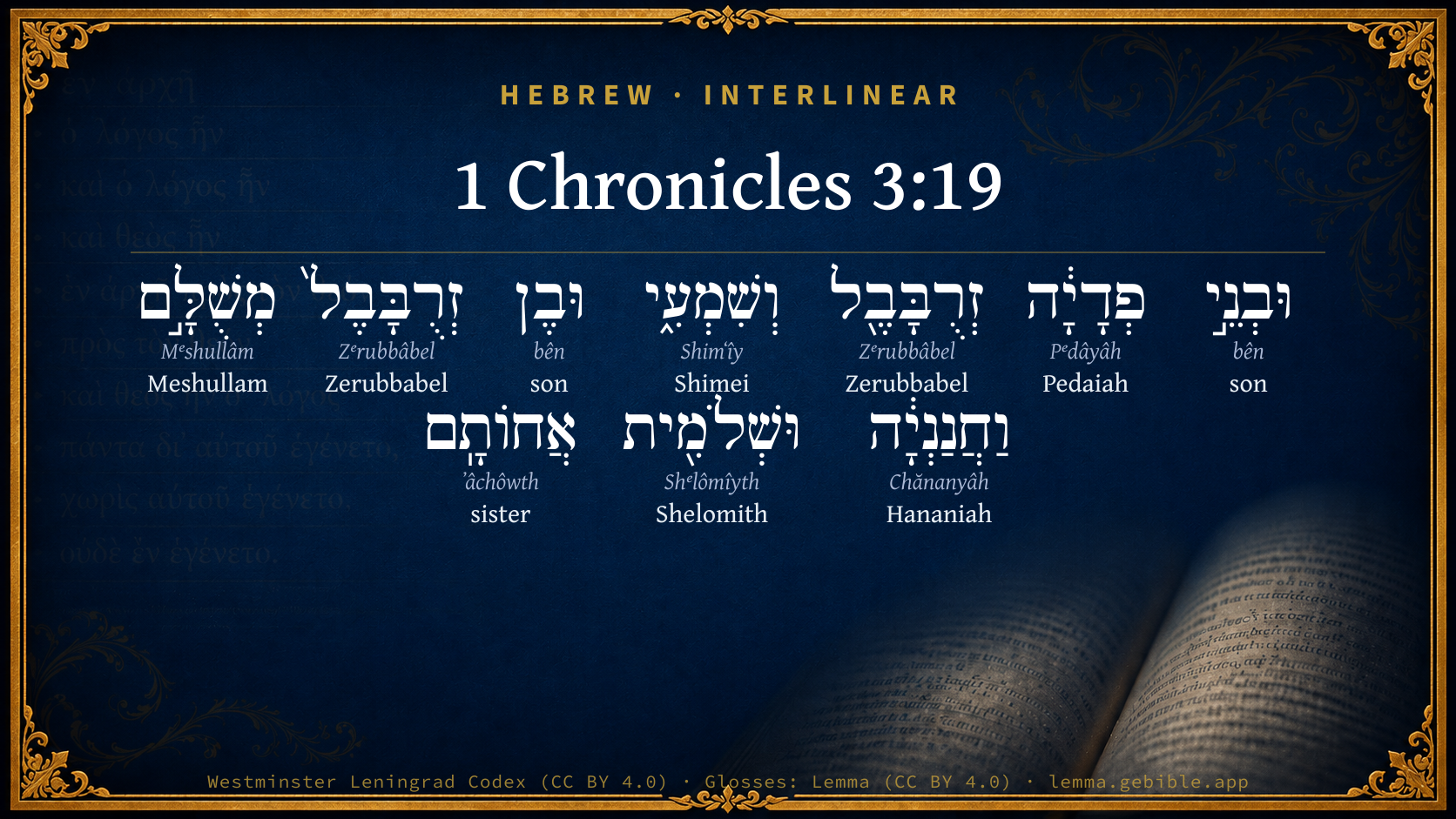
1 Chronicles 3:19

Hebrew (Westminster Leningrad Codex) 1 Chronicles 3:19 appears in the Hebrew Old Testament. The text above is from the Westminster Leningrad Codex. Each word links to its Strong’s number, a concise gloss, and parsing drawn from the Open Scriptures Hebrew Bible morphology. Click any word for its full Brown-Driver-Briggs (BDB) entry.
Download image
Cite this verse

1 Chronicles 3:19 (World English Bible). Public Domain. Lemma interlinear Bible study tool, https://lemma.gebible.app/v/1-chronicles/3/19.

Show BibTeX & RIS
BibTeX
RIS
English Translation
The sons of Pedaiah: Zerubbabel, and Shimei. The sons of Zerubbabel: Meshullam, and Hananiah; and Shelomith was their sister;
World English Bible · Public Domain
Highlights
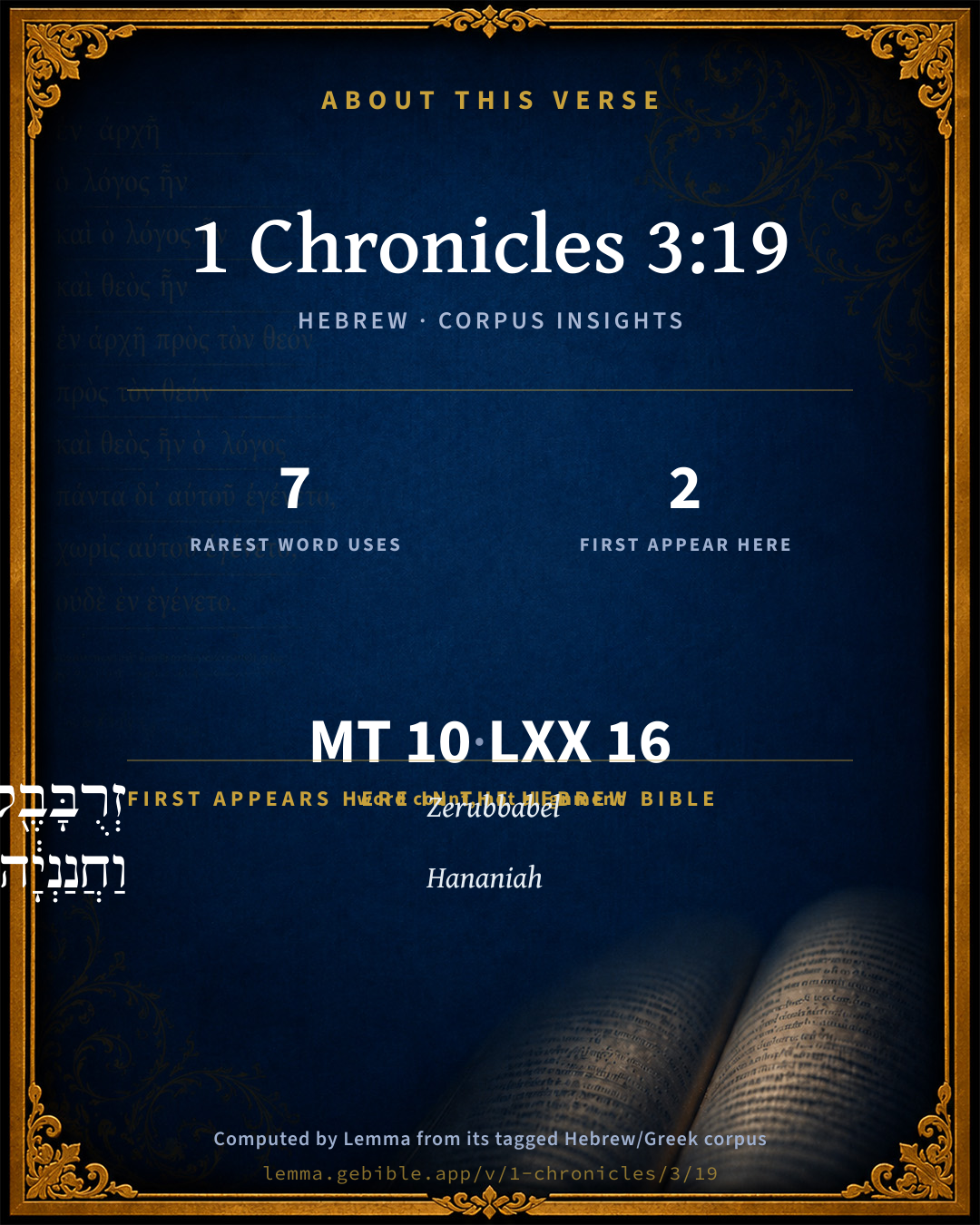
  • 2 first appearances in the Hebrew Bible
Full analysis ↓
Download a study sheet

One document with this verse’s original text, its word-by-word gloss line, the meaning frame, cross-references with their text, attributed commentary, and full source and license credits — printable, and it pastes into notes with its structure intact.

This verse Autodidact and up

Study sheet (.html) Plain text (.txt)

A passage Seminary Student

Up to 50 verses in one chapter. A passage sheet keeps up to 6 commentary sources and 12 cross-references per verse, in the order this page ranks them, and says so on the sheet whenever that leaves anything out. Ask for a single verse and you get the Autodidact verse sheet above.

Everything on this page stays free to read, with no account — the sheet is a download of what is already on screen, not access to it.

Want to remove ads? Support Godless Engineer
Compare translations 3

The same verse in 3 English versions, stacked beneath the original-language interlinear above. Click any original word for its lexicon entry.

Each is an independent rendering of the whole verse — the interlinear is not word-aligned to these translations.

Highlighted words mark where these versions differ — a whole-verse word diff, not a word-by-word alignment.

  • World English Bible Public Domain
    The sons of Pedaiah: Zerubbabel, and Shimei. The sons of Zerubbabel: Meshullam, and Hananiah; and Shelomith was their sister;
  • King James Version Public Domain
    And the sons of Pedaiah were, Zerubbabel, and Shimei: and the sons of Zerubbabel; Meshullam, and Hananiah, and Shelomith their sister:
  • unfoldingWord Literal Text CC BY-SA 4.0
    And the sons of Pedaiah: Zerubbabel and Shimei. And the son of Zerubbabel: Meshullam and Hananiah, and Shelomith their sister,

unfoldingWord Literal Text — © unfoldingWord, licensed CC BY-SA 4.0. Word-aligned USFM3 via Door43 (git.door43.org/unfoldingWord/en_ult).

Versions to compare (up to 4)

3 of 4 selected

Show all 18 translations

Every available English version of this verse, each an independent rendering of the whole verse.

  • World English Bible Public Domain
    The sons of Pedaiah: Zerubbabel, and Shimei. The sons of Zerubbabel: Meshullam, and Hananiah; and Shelomith was their sister;
  • Berean Standard Bible Public Domain
    The sons of Pedaiah: Zerubbabel and Shimei. The children of Zerubbabel: Meshullam and Hananiah, their sister Shelomith,
  • Majority Standard Bible Public Domain
    The sons of Pedaiah: Zerubbabel and Shimei. The children of Zerubbabel: Meshullam and Hananiah, their sister Shelomith,
  • King James Version Public Domain
    And the sons of Pedaiah were, Zerubbabel, and Shimei: and the sons of Zerubbabel; Meshullam, and Hananiah, and Shelomith their sister:
  • American Standard Version (1901) Public Domain
    And the sons of Pedaiah: Zerubbabel, and Shimei. And the sons of Zerubbabel: Meshullam, and Hananiah; and Shelomith was their sister;
  • Revised Version (1885) Public Domain
    And the sons of Pedaiah; Zerubbabel, and Shimei: and the sons of Zerubbabel; Meshullam, and Hananiah; and Shelomith was their sister:
  • Geneva Bible (1599) Public Domain
    And the sonnes of Pedaiah were Zerubbabel, and Shimei: and the sonnes of Zerubbabel were Meshullam, and Hananiah, and Shelomith their sister,
  • Douay-Rheims (1899) Public Domain
    Of Phadaia were born Zorobabel and Semei. Zorobabel beget Mosollam, Hananias, and Salomith their sister:
  • Young's Literal Translation Public Domain
    And sons of Pedaiah: Zerubbabel, and Shimei. And sons of Zerubbabel: Meshullam, and Hananiah, and Shelomith their sister,
  • Literal Standard Version CC BY-SA 4.0
    And sons of Pedaiah: Zerubbabel and Shimei. And sons of Zerubbabel: Meshullam, and Hananiah, and their sister Shelomith,
  • Unlocked Literal Bible CC BY-SA 4.0
    Pedaiah's sons were Zerubbabel and Shimei. Zerubbabel's sons were Meshullam and Hananiah; Shelomith was their sister.
  • unfoldingWord Literal Text CC BY-SA 4.0
    And the sons of Pedaiah: Zerubbabel and Shimei. And the son of Zerubbabel: Meshullam and Hananiah, and Shelomith their sister,
  • Darby Bible Public Domain
    And the sons of Pedaiah were Zerubbabel and Shimei. And the sons of Zerubbabel: Meshullam and Hananiah, and Shelomith their sister,
  • World Messianic Bible Public Domain
    The sons of Pedaiah: Zerubbabel and Shimei. The sons of Zerubbabel: Meshullam and Hananiah; and Shelomith was their sister;
  • Webster's Bible Public Domain
    And the sons of Pedaiah were, Zerubbabel, and Shimei: and the sons of Zerubbabel; Meshullam, and Hananiah, and Shelomith their sister:
  • Free Bible Version CC BY-SA 4.0
    The sons of Pedaiah: Zerubbabel and Shimei. The sons of Zerubbabel: Meshullam and Hananiah. Their sister was Shelomith.
  • Bible in Basic English Public Domain
    And the sons of Pedaiah: Zerubbabel and Shimei; and the sons of Zerubbabel: Meshullam and Hananiah; and Shelomith was their sister;
  • JPS Tanakh (1917) Public Domain
    And the sons of Pedaiah: Zerubbabel, and Shimei. And the sons of Zerubbabel: Meshullam, and Hananiah; and Shelomith was their sister;

Literal Standard Version (2020), Covenant Press — licensed CC BY-SA 4.0. Text via the HelloAO Bible API (eBible.org). Unlocked Literal Bible (unfoldingWord) — licensed CC BY-SA 4.0. Text via the HelloAO Bible API (eBible.org). unfoldingWord Literal Text — © unfoldingWord, licensed CC BY-SA 4.0. Word-aligned USFM3 via Door43 (git.door43.org/unfoldingWord/en_ult). Free Bible Version, Dr. Jonathan Gallagher — licensed CC BY-SA 4.0. Text via the HelloAO Bible API (eBible.org).

Word by word

More ways to search: Search by grammar → Find every occurrence → Compare this word →

Practice this passage: Drill this verse → Learn its vocabulary →

וּשְׁלֹמִ֖ית
Shᵉlômîyth
H8019
“and · Shelomith”
Conjunction + Noun, Proper
Part of Speech
Conjunction + Noun
Type
Proper
Full BDB Definition

Origin: from H7965

TWOT: None

Shelomith = "peaceful" - a Gershonite Levite, son of Zichri in the time of David (noun proper masculine) - son of king Rehoboam of Judah by Maacah the granddaughter of Absalom (noun proper masculine) - head of a family of exiles who returned with Ezra (noun proper masculine) - a woman of Dan, daughter of Dibri, and mother of a son who blasphemed God and was stoned to death in the time of Moses (noun proper feminine) - daughter of Zerubbabel (noun proper feminine)
  1. וּבְנֵ֣י bên H1121 “and · sons of” Conjunction + Noun, Common, Masculine, Plural, Construct
  2. פְדָיָ֔ה Pᵉdâyâh H6305 “Pedaiah” Noun, Proper
  3. זְרֻבָּבֶ֖ל Zᵉrubbâbel H2216 “Zerubbabel” Noun, Proper
  4. וְשִׁמְעִ֑י Shimʻîy H8096 “and · Shimei” Conjunction + Noun, Proper
  5. וּבֶן bên H1121 “and · son of” Conjunction + Noun, Common, Masculine, Singular, Construct
  6. זְרֻבָּבֶל֙ Zᵉrubbâbel H2216 “Zerubbabel” Noun, Proper
  7. מְשֻׁלָּ֣ם Mᵉshullâm H4918 “Meshullam” Noun, Proper
  8. וַחֲנַנְיָ֔ה Chănanyâh H2608 “and · Hananiah” Conjunction + Noun, Proper
  9. אֲחוֹתָֽם ʼâchôwth H269 “sister · their” Noun, Common, Feminine, Singular, Construct + Suffix, Personal, 3rd Person, Masculine, Plural

About this verse

These counts appear in no published source. They are computed here, from the morphology-tagged text and Lemma’s own curated glosses. What Lemma adds →

10
words
8
distinct lemmas
Historical
section

Notable vocabulary

The rarest word here is וּשְׁלֹמִ֖ית Shelomith H8019 — appearing just 7 times in the whole Hebrew Bible.

First appearance in Scripture

These words make their first canonical appearance in the Hebrew Bible here:

  • זְרֻבָּבֶ֖ל Zerubbabel H2216
  • וַחֲנַנְיָ֔ה Hananiah H2608

Shared distinctive vocabulary

וּשְׁלֹמִ֖ית Shelomith H8019 occurs in 7 verses of the Hebrew Bible. Also found in:

Grammatical profile

  • 10 nouns

Repetition

Words recur within this verse — often emphatic in Hebrew:

  • וּבְנֵ֣י son H1121 ×2
  • זְרֻבָּבֶ֖ל Zerubbabel H2216 ×2

Hebrew & Septuagint length

In English translation the verse runs 19 words from the Hebrew and 21 from the Septuagint (LXX English) — closely comparable.

A rough comparison of the two English renderings, which tokenize alike — not a word-level alignment.

Word counts can differ between the Hebrew and the Greek without any difference in meaning — e.g. the Hebrew direct-object marker אֵת has no separate Greek word, and Greek often adds the article ὁ.

In the original languages it is 10 Hebrew tokens and 16 Greek tokens — but the two are counted differently (Hebrew bundles its prefixes and suffixes into one token; the Greek is in lemma form), so that isn’t a like-for-like length.

Cross-references

8

Topical passages linked to 1 Chronicles 3:19 in the Treasury of Scripture Knowledge — connected by theme and wording, ordered by reader-vote popularity; previews shown in the World English Bible.

  • Ezra 2:2 who came with Zerubbabel, Jeshua, Nehemiah, Seraiah, Reelaiah, Mordecai, Bilshan, Mispar, Bigvai, Rehum, Baanah. The number of the men of the people of Israel:
  • Ezra 3:2 Then stood up Jeshua the son of Jozadak, and his brothers the priests, and Zerubbabel the son of Shealtiel, and his brothers, and built the altar of the God of Israel, to offer burnt offerings thereon, as it is written in the law of Moses the man of God.
  • Haggai 2:2 "Speak now to Zerubbabel, the son of Shealtiel, governor of Judah, and to Joshua, the son of Jehozadak, the high priest, and to the remnant of the people, saying,
  • Haggai 1:1 In the second year of Darius the king, in the sixth month, in the first day of the month, the Word of Yahweh came by Haggai, the prophet, to Zerubbabel, the son of Shealtiel, governor of Judah, and to Joshua, the son of Jehozadak, the high priest, saying,
  • Haggai 1:12–14 Then Zerubbabel, the son of Shealtiel, and Joshua, the son of Jehozadak, the high priest, with all the remnant of the people, obeyed the voice of Yahweh, their God, and the words of Haggai, the prophet, as Yahweh, their God, had sent him; and the people feared Yahweh.
  • Haggai 2:4 Yet now be strong, Zerubbabel,' says Yahweh. 'Be strong, Joshua, son of Jehozadak, the high priest. Be strong, all you people of the land,' says Yahweh, 'and work, for I am with you,' says Yahweh of Hosts.
  • Zechariah 4:6–9 Then he answered and spoke to me, saying, "This is the word of Yahweh to Zerubbabel, saying, 'Not by might, nor by power, but by my Spirit,' says Yahweh of Hosts.
  • Matthew 1:12 After the exile to Babylon, Jechoniah became the father of Shealtiel. Shealtiel became the father of Zerubbabel.

Cross-references courtesy of OpenBible.info (CC BY 4.0).

Hebrew and Greek witnesses Masoretic Hebrew ↔ Greek Septuagint

The same verse in the two great witnesses to the Old Testament, shown verse-for-verse.

These are two independent witnesses, not word-aligned to each other, and the Septuagint is shown in lemma (dictionary) form.

Hebrew 1 Chronicles 3:19 Masoretic · Westminster Leningrad Codex

וּבְנֵ֣י פְדָיָ֔ה זְרֻבָּבֶ֖ל וְשִׁמְעִ֑י וּבֶן זְרֻבָּבֶל֙ מְשֻׁלָּ֣ם וַחֲנַנְיָ֔ה וּשְׁלֹמִ֖ית אֲחוֹתָֽם

The sons of Pedaiah: Zerubbabel, and Shimei. The sons of Zerubbabel: Meshullam, and Hananiah; and Shelomith was their sister;

World English Bible · Public Domain

Greek LXX 1 Chronicles 3:19 Septuagint · lemma form

καί υἱός σαλαθιηλ ζοροβαβελ καί σεμεϊ καί υἱός ζοροβαβελ μοσολλαμος καί ανανια καί σαλωμιθ ἀδελφή αὐτός

And the sons of Phadaias; Zorobabel, and Semei: and the sons of Zorobabel; Mosollam, and Anania, and Salomethi was their sister.

LXX2012 (modern English Septuagint) · Public Domain

On this verse, Ellicott's Commentary for English Readers discusses the Septuagint’s reading. Read the note in Commentary ↓

Hebrew: Westminster Leningrad Codex (CC BY 4.0). Greek: Septuagint (public domain); English from LXX2012 (modern English Septuagint) (Public Domain). How the Septuagint differs from the Hebrew →

Commentary

Notes on 1 Chronicles 3:19 from classic Christian and Jewish commentators (each source and its license shown beneath its notes). The classic Christian expositions comment on the surrounding passage and are grouped to its opening verse, so a note may address several verses; the Jewish commentaries on the Tanakh (Rashi and others) are per-verse, so they appear only where the commentator wrote on this verse.

Lemma curates 59 commentaries, every one of them public domain or Creative Commons licensed, each selected and text-cleaned for this edition rather than reprinted as found. About our sources →

Geneva Bible (1599)

Geneva Bible translators

St. Matthew saith that Zerubbabel was son of Shealtiel, meaning, that he was his nephew according to the Hebrew speech: for he was Pedaiah’s son.

Geneva Bible (1599) marginal notes — public domain. Text via Bolls.life.

Adam Clarke's Commentary

Verse 19. The sons of Pedaiah] Houbigant thinks these words should be omitted. Pedaiah is wanting in the Arabic and Syriac. If this be omitted, Zerubbabel will appear to be the son of Salathiel, according to Mt 1:12, and not the son of Pedaiah, as here stated.

Adam Clarke's Commentary on the Bible (1810–1826) — public domain. Text from a community e-Sword/MySword module.

Ellicott's Commentary for English Readers

(19) And the sons of Pedaiah were, Zerubbabel, and Shimei.—Zerubbabel, the famous prince who, with Joshua the high priest, led the first colony of restored exiles from Babylon to Canaan, under the edict of Cyrus (B.C. cir. 536). Zerubbabel (LXX., Σοροβάβελ), means born at Babel. His father is appropriately named Pedaiah (Iah hath redeemed). Zerubbabel is called son of Shealtiel (Hag_1:1, &c.; Ezr_3:2; Ezr_5:2—part of the chronicle it should be remembered; Mat_1:12). Hence some expositors, ancient and modern, have assumed that the six persons named in 1Ch_3:18, including Pedaiah, the father of Zerubbabel, were sons, not brothers of Salathiel (Shealtiel). In this way they bring Zerubbabel into the direct line of descent from Shealtiel. But our Hebrew text, though peculiar, can hardly mean this. It makes Zerubbabel the son of Pedaiah, and nephew of Shealtiel. If Zerubbabel, for reasons unknown, became adopted son and heir of Shealtiel, his uncle, the seemingly discordant statements of the different passages before us are all reconciled; while that of our text is the more exact.

And the sons of Zerubbabel.—The Hebrew received text has “and the son.” This is not to be altered, although some MSS. have the plural. (Comp. 1Ch_3:21; 1Ch_3:23.) This use of the singular is characteristic of the present genealogical fragment (see 1Ch_3:17-18), “And the sons of Jeconiah captive—Salathiel his son, and Malchiram,” &c.

Meshullam, and Hananiah, and Shelomith their sister.—This seems to mean that the three were the offspring of one wife.

A Bible Commentary for English Readers, edited by Charles John Ellicott (1878–1897) — public domain. Text from a community e-Sword module.

The Cambridge Bible for Schools and Colleges

gen. ed. J. J. S. Perowne

19. the sons of Zerubbabel] R.V. = LXX.; A.V. = Heb.

19. their sister] R.V. was their sister.

19b–24. The Davidic Line from Zerubbabel

The text of these verses is very uncertain. In 1Ch_3:20 the names of five sons are given, but their father’s name (perhaps Meshullam) is wanting. In 1Ch_3:21-22 the LXX. differs from the Heb. in such a way as to affect the number of steps in the genealogy; the Heb. seems to reckon but one generation between Hananiah and Shemaiah, the LXX. on the contrary reckons six; the result on the whole genealogy being that the LXX. counts eleven generations after Zerubbabel as against six in the Heb. In 1Ch_3:22 again the sons of Shemaiah are reckoned to be six, but only five names are given both in Heb. and LXX.

The Cambridge Bible for Schools and Colleges (gen. ed. J. J. S. Perowne; Cambridge University Press, 1878–1918) — public domain. Text from a community e-Sword module.

Albert Barnes' Notes on the Bible

Zerubbabel, elsewhere always called “the son of Salathiel,” was only Salathiel’s heir and legal son, being naturally his nephew, the son of his brother, Pedaiah.

Albert Barnes' Notes on the Bible (1834–1885) — public domain. Text from a community e-Sword/MySword module.

Haydock's Catholic Bible Commentary

Phadaia, called also Salathiel, (Matthew i. 12.) or these two brothers had each a son named Zorobabel. The grandson of Salathiel was called Abiud, and that of Phadaia, Mosollam, (Menochius) unless these were the same person. (Sa) --- Phadaia, son of Salathiel, and father of Zorobabel, left his son to the care of his brother Salatheil, who was therefore accounted the father of Zorobabel too. (Calmet)

George Leo Haydock (1774–1849), Haydock's Catholic Family Bible and Commentary, 1859 edition — public domain. Excludes Psalms (Douay-Rheims chapter numbering differs from Protestant) and Deuterocanonical books (Catholic canon only).

Matthew Poole's English Annotations

i.e. Sister to the two last named sons of Zerubbabel, to wit, by both parents; and therefore named before the other five, 1Ch 3:20, who were her brethren by the father, but not by the mother.

Matthew Poole's English Annotations on the Holy Bible (1683–1685) — public domain. Text from a community e-Sword/MySword module.

The Pulpit Commentary

Pedaiah is now given as the father of Zeraubabel and Shimei. Of the latter of these nothing else is known, unless Lord Hervey"s theory below be correct. The former is a great name its derivation perhaps doubtful. Strictly it signifies "scattered to Babylon," but (Gesenius, "Lexicon") if the initial part of the word be strengthened into Wrz, the signification might be "born in Babylon." We have in this name another instance of the treatment just commented on with regard to the name Salathiel in Luk_3:28. Zerubbabel is elsewhere invariably described as son of Salathiel, or Shealtiel; but as the genealogy of St. Luke gives the natural descent of Salathiel as from Neri, so does our genealogy in this one place give us the natural descent of Zerubbabel as from Pedaiah, one of Salathiel"s brothers; while all other passages (e.g. Ezr_3:8; Haggai Mat_1:12; give Luk_3:27) us that for which the genealogical table is chiefly designed, viz. the matter of succession, according to which Zerubbabel would be shown as son, i.e. link of succession, following on Shealtiel.

Meshullam. Though this name recurs, and very frequently, in Chronicles, Ezra, and Nehemiah, yet the person here denoted by it son of Zerubbabel is found here only. Hananiah, 1.q. Joanna of Luk_3:27, the names being the same, but with the component parts transposed, as in instances already given above. In the Gospel, Hananiah appears as grandson of Zorobabel, Rhesa intervening. Shelomith. This person is mentioned here only. The word, though evidently a feminine form, is found for the name of a man, chief of the Izarhites, (1Ch_23:18) but very possibly by a mere clerical error, as the true form is given in the very next chapter (1Ch_24:22) for the same character, viz. twOmolv. Ver. 19.

The builder of the second temple.

Among the names recorded here, that of Zerubbabel suggests an interesting passage in the Jewish history; and he has a marked individuality, so that his work and his times may be profitably reviewed. It is noticed as a fulfilling of the Divine promise concerning the Davidic dynasty, that Zerubbabel was a prince of the house of David, and so the returned captives resumed their national life under a Davidic leader, and with a fresh and constantly effective remembrance of the Divine promise and faithfulness. From the narrative in Ezra, details of the work of Zerubbabel may be given. His mission concerned three things:

1. The leadership of the liberated captives on their return journey to Palestine. What qualities this demanded command, courage, patience, cheerfulness, etc., should be fully illustrated.

2. The erection of a new temple from the ruins of that of Solomon, and the restoration of the Mosaic ritual and worship. In this he was aided by Joshua, the high priest. Show what further qualities were demanded by this work power to inspire others, personal godliness, an enkindling enthusiasm, and, in view of the efforts of the Samaritans, firmness, unswerving loyalty to God, and a holy jealousy that permitted no compromises in religion.

3. The establishment of a national and governmental order among the people. This was the work for which he probably had hereditary genius; and his position and authority, as the Persian Sheshbazzar, enabled him effectively to carry out his schemes. In him may be illustrated the threefold truth:

(1) that circumstances call forth the best that is in men;

(2) that men may to a large extent mould their circumstances; and

(3) that God is ever ready to give his grace and strength, unto the best success, to every man who sincerely wishes to be found faithful. R.T.

The Pulpit Commentary (1880–1919), ed. H.D.M. Spence-Jones & Joseph S. Exell — public domain. Text from a community e-Sword module.

John Wesley's Explanatory Notes

Their sister - Sister to the two last named sons of Zerubbabel, namely, by both parents; and therefore named before the other five, ver.

20, who were her brethren by the father, but not by the mother.

John Wesley, Explanatory Notes Upon the Whole Bible (1754–1765) — public domain. Text via the GEBible commentary corpus.

unfoldingWord translationNotes

Door43 World Missions Community

General Information:

All of the names in this list except Shelomith are the names of men. Shelomith is a woman's name. (See: How to Translate Names)

Obadiah

This man has the same name as the prophet Obadiah but is a different person. (See: How to Translate Names)

further descendants were Arnan, Obadiah, and Shekaniah

Different versions put these people into different relationships with each other because the Hebrew is not very clear about them.

translationWords

Zerubbabel

sister

descend

Obadiah

unfoldingWord translationNotes — © Distant Shores Media and the Door43 World Missions Community, licensed CC BY-SA 4.0. Source: git.door43.org/Door43/en_tn.

Lesson kit

Teaching starters — assembled from the data on this page, not authored interpretation. Every prompt links to the verse data it draws on. Edit before teaching.

1 Chronicles, in the Historical, opens this verse with 10 words (8 distinct Hebrew lemmas). Its most distinctive word is Shᵉlômîyth (“Shelomith”). A historical commentator’s framing appears above. Read the whole chapter for the surrounding context.

Discussion questions

  1. The word Shᵉlômîyth carries the sense “Shelomith.” How does it shape the verse?
  2. 2 words here appear for the first time in Scripture. What is being introduced at this debut?
  3. Leviticus 24:11 shares the word «Shelomith» with this verse. How do the two illuminate each other?
  4. “son” occurs 2× in this one verse. What is the effect of the repetition?
  5. These translations render this verse differently. What is at stake in choosing one wording over another?
  6. Reading how Geneva Bible (1599) and Adam Clarke's Commentary read this verse, where do the two commentators agree and where do they part?

Things to notice

Reading settings

Reading text

Shown beneath each verse's original-language words.

Old Testament
Old Testament edition

Read the OT as the Masoretic Hebrew (MT) or the Greek Septuagint (LXX).

English shown for the Greek Septuagint (in the Hebrew ↔ Greek comparison).

Comparing translations? Open the Compare panel on any verse page to stack up to four side by side.