
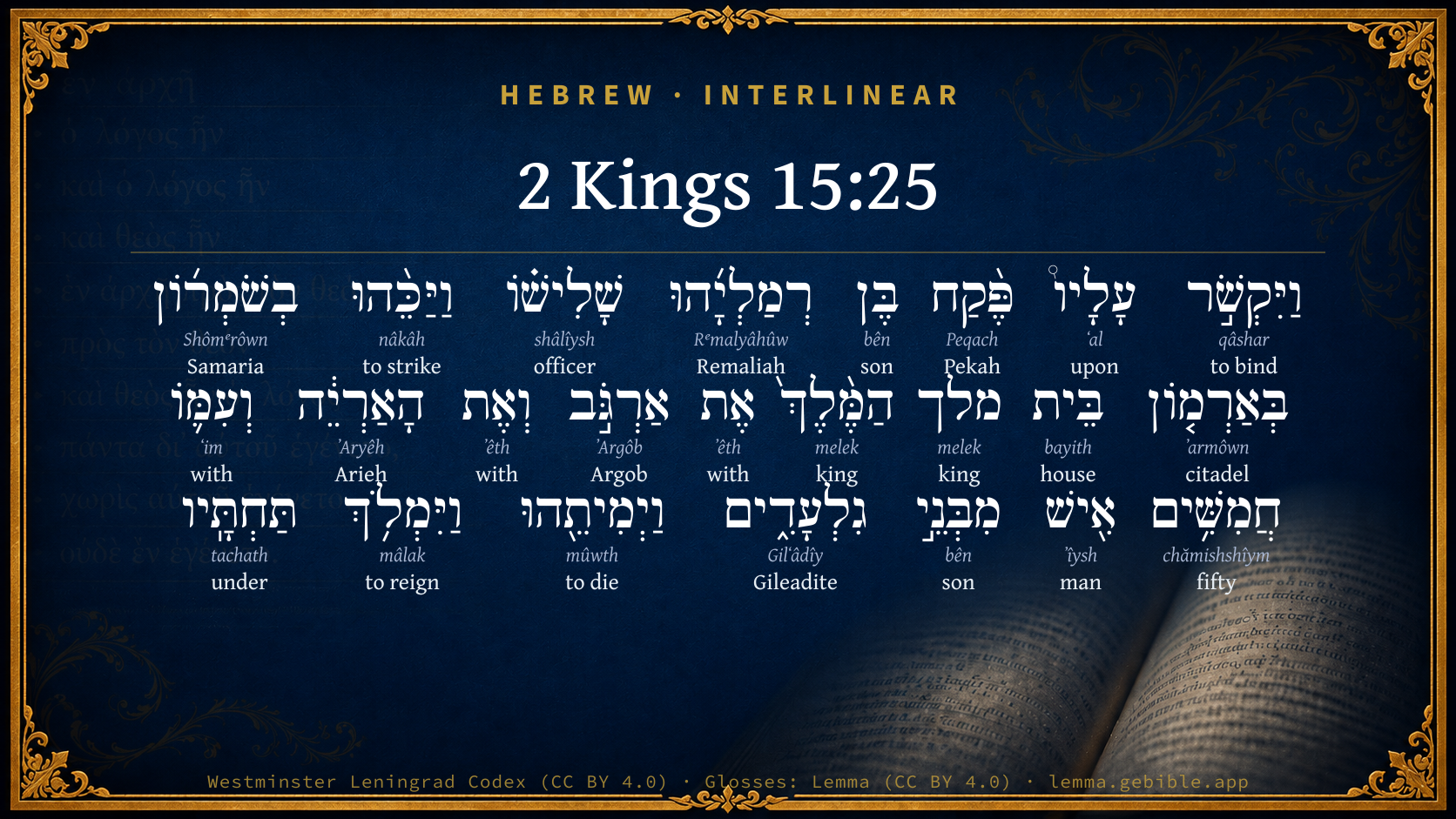
2 Kings 15:25

Hebrew (Westminster Leningrad Codex) 2 Kings 15:25 appears in the Hebrew Old Testament. The text above is from the Westminster Leningrad Codex. Each word links to its Strong’s number, a concise gloss, and parsing drawn from the Open Scriptures Hebrew Bible morphology. Click any word for its full Brown-Driver-Briggs (BDB) entry.
Download image
Cite this verse

2 Kings 15:25 (World English Bible). Public Domain. Lemma interlinear Bible study tool, https://lemma.gebible.app/v/2-kings/15/25.

Show BibTeX & RIS
BibTeX
RIS
English Translation
Pekah the son of Remaliah, his captain, conspired against him, and struck him in Samaria, in the castle of the king's house, with Argob and Arieh; and with him were fifty men of the Gileadites: and he killed him, and reigned in his place.
World English Bible · Public Domain
Highlights
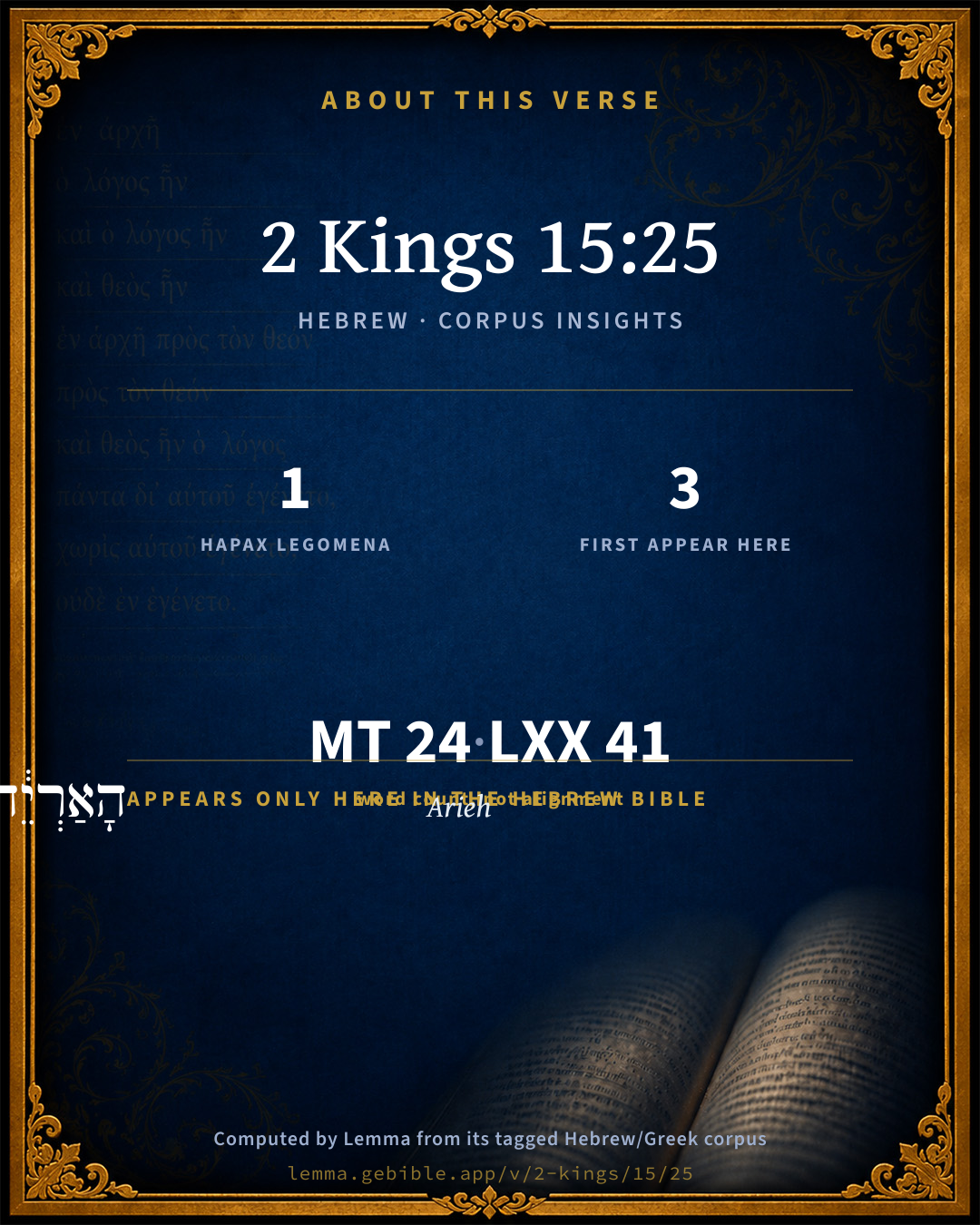
  • 1 hapax legomenon — only here in the Hebrew Bible
  • 3 first appearances in the Hebrew Bible
Full analysis ↓
Download a study sheet

One document with this verse’s original text, its word-by-word gloss line, the meaning frame, cross-references with their text, attributed commentary, and full source and license credits — printable, and it pastes into notes with its structure intact.

This verse Autodidact and up

Study sheet (.html) Plain text (.txt)

A passage Seminary Student

Up to 50 verses in one chapter. A passage sheet keeps up to 6 commentary sources and 12 cross-references per verse, in the order this page ranks them, and says so on the sheet whenever that leaves anything out. Ask for a single verse and you get the Autodidact verse sheet above.

Everything on this page stays free to read, with no account — the sheet is a download of what is already on screen, not access to it.

Want to remove ads? Support Godless Engineer
Compare translations 3

The same verse in 3 English versions, stacked beneath the original-language interlinear above. Click any original word for its lexicon entry.

Each is an independent rendering of the whole verse — the interlinear is not word-aligned to these translations.

Highlighted words mark where these versions differ — a whole-verse word diff, not a word-by-word alignment.

  • World English Bible Public Domain
    Pekah the son of Remaliah, his captain, conspired against him, and struck him in Samaria, in the castle of the king's house, with Argob and Arieh; and with him were fifty men of the Gileadites: and he killed him, and reigned in his place.
  • King James Version Public Domain
    But Pekah the son of Remaliah, a captain of his, conspired against him, and smote him in Samaria, in the palace of the king's house, with Argob and Arieh, and with him fifty men of the Gileadites: and he killed him, and reigned in his room.
  • unfoldingWord Literal Text CC BY-SA 4.0
    And Pekah, the son of Remaliah, his captain, conspired against him, and he struck him in Samaria, in the citadel of the house of the king, Argob and Arieh, and with him 50 men of the sons of the Gileadites. And he killed him, and he reigned in his place.

unfoldingWord Literal Text — © unfoldingWord, licensed CC BY-SA 4.0. Word-aligned USFM3 via Door43 (git.door43.org/unfoldingWord/en_ult).

Versions to compare (up to 4)

3 of 4 selected

Show all 18 translations

Every available English version of this verse, each an independent rendering of the whole verse.

  • World English Bible Public Domain
    Pekah the son of Remaliah, his captain, conspired against him, and struck him in Samaria, in the castle of the king's house, with Argob and Arieh; and with him were fifty men of the Gileadites: and he killed him, and reigned in his place.
  • Berean Standard Bible Public Domain
    Then his officer, Pekah son of Remaliah, conspired against him along with Argob, Arieh, and fifty men of Gilead. And at the citadel of the king’s palace in Samaria, Pekah struck down and killed Pekahiah and reigned in his place.
  • Majority Standard Bible Public Domain
    Then his officer, Pekah son of Remaliah, conspired against him along with Argob, Arieh, and fifty men of Gilead. And at the citadel of the king’s palace in Samaria, Pekah struck down and killed Pekahiah and reigned in his place.
  • King James Version Public Domain
    But Pekah the son of Remaliah, a captain of his, conspired against him, and smote him in Samaria, in the palace of the king's house, with Argob and Arieh, and with him fifty men of the Gileadites: and he killed him, and reigned in his room.
  • American Standard Version (1901) Public Domain
    And Pekah the son of Remaliah, his captain, conspired against him, and smote him in Samaria, in the castle of the king's house, with Argob and Arieh; and with him were fifty men of the Gileadites: and he slew him, and reigned in his stead.
  • Revised Version (1885) Public Domain
    And Pekah the son of Remaliah, his captain, conspired against him, and smote him in Samaria, in the castle of the king’s house, with Argob and Arieh; and with him were fifty men of the Gileadites: and he slew him, and reigned in his stead.
  • Geneva Bible (1599) Public Domain
    And Pekah the sonne of Remaliah, his captaine conspired against him, and smote him in Samaria in the place of the Kings palace with Argob and Arieh, and with him fiftie men of the Gileadites: so he killed him, and reigned in his steade.
  • Douay-Rheims (1899) Public Domain
    And Phacee the son of Romelia, his captain conspired against him, and smote him in Samaria, in the tower of the king's house, near Argob, and near Arie, and with him fifty men of the sons of the Galaadites, and he slew him and reigned in his stead.
  • Young's Literal Translation Public Domain
    And Pekah son of Remaliah, his captain, doth conspire against him, and smiteth him in Samaria, in the high place of the house of the king with Argob and Arieh, and with him fifty men of the sons of the Gileadites, and he putteth him to death, and reigneth in his stead.
  • Literal Standard Version CC BY-SA 4.0
    And Pekah son of Remaliah, his captain, conspires against him, and strikes him in Samaria, in the high place of the house of the king with Argob and Arieh; and fifty men of the sons of the Gileadites [were] with him, and he puts him to death, and reigns in his stead.
  • Unlocked Literal Bible CC BY-SA 4.0
    Pekahiah had an officer named Pekah son of Remaliah, who conspired against him. Along with fifty men of Gilead, Pekah killed Pekahiah as well as Argob and Arieh in Samaria, in the citadel of the king's palace. Pekah killed Pekahiah and became king in his place.
  • unfoldingWord Literal Text CC BY-SA 4.0
    And Pekah, the son of Remaliah, his captain, conspired against him, and he struck him in Samaria, in the citadel of the house of the king, Argob and Arieh, and with him 50 men of the sons of the Gileadites. And he killed him, and he reigned in his place.
  • Darby Bible Public Domain
    And Pekah the son of Remaliah, his captain, conspired against him, and smote him in Samaria, in the fortress of the king's house, with Argob and Arieh, and with him fifty men of the Gileadites; and he slew him, and reigned in his stead.
  • World Messianic Bible Public Domain
    Pekah the son of Remaliah, his captain, conspired against him and attacked him in Samaria, in the fortress of the king’s house, with Argob and Arieh; and with him were fifty men of the Gileadites. He killed him, and reigned in his place.
  • Webster's Bible Public Domain
    But Pekah the son of Remaliah, a captain of his, conspired against him, and smote him in Samaria, in the palace of the king's house, with Argob and Arieh, and with him fifty men of the Gileadites: and he killed him, and reigned in his room.
  • Free Bible Version CC BY-SA 4.0
    Pekah, son of Remaliah, one of his officers plotted against him together with Argob, Arieh, and fifty men from Gilead. Pekah attacked and killed Pekahiah in the fortress of the king's palace in Samaria, and took over as king.
  • Bible in Basic English Public Domain
    And Pekah, the son of Remaliah, his captain, made a secret design against him, attacking him in the king's great house in Samaria; and with him were fifty men of Gilead; and he put him to death and became king in his place.
  • JPS Tanakh (1917) Public Domain
    And Pekah the son of Remaliah, his captain, conspired against him, and smote him in Samaria, in the castle of the king's house, by Argob and by Arieh; and with him were fifty men of the Gileadites; and he slew him, and reigned in his stead.

Literal Standard Version (2020), Covenant Press — licensed CC BY-SA 4.0. Text via the HelloAO Bible API (eBible.org). Unlocked Literal Bible (unfoldingWord) — licensed CC BY-SA 4.0. Text via the HelloAO Bible API (eBible.org). unfoldingWord Literal Text — © unfoldingWord, licensed CC BY-SA 4.0. Word-aligned USFM3 via Door43 (git.door43.org/unfoldingWord/en_ult). Free Bible Version, Dr. Jonathan Gallagher — licensed CC BY-SA 4.0. Text via the HelloAO Bible API (eBible.org).

Word by word

More ways to search: Search by grammar → Find every occurrence → Compare this word →

Practice this passage: Drill this verse → Learn its vocabulary →

הָאַרְיֵ֔ה
ʼAryêh
H745
“the · Arieh”
Particle, Definite Article + Noun, Proper
Part of Speech
Particle + Noun
Type
Proper
Full BDB Definition

Origin: the same as H738

TWOT: None

Arieh = "lion" - an officer of king Pekahiah
  1. וַיִּקְשֹׁ֣ר qâshar H7194 “and · to bind” Conjunction + Verb, Qal, Sequential Imperfect, 3rd Person, Masculine, Singular
  2. עָלָיו֩ ʻal H5921 “upon · him” Preposition + Suffix, Personal, 3rd Person, Masculine, Singular
  3. פֶּ֨קַח Peqach H6492 “Pekah” Noun, Proper
  4. בֶּן bên H1121 “son of” Noun, Common, Masculine, Singular, Construct
  5. רְמַלְיָ֜הוּ Rᵉmalyâhûw H7425 “Remaliah” Noun, Proper
  6. שָׁלִישׁ֗וֹ shâlîysh H7991 “officer · his” Noun, Common, Masculine, Singular, Construct + Suffix, Personal, 3rd Person, Masculine, Singular
  7. וַיַּכֵּ֨הוּ nâkâh H5221 “and · to strike · him” Conjunction + Verb, Hiphil, Sequential Imperfect, 3rd Person, Masculine, Singular + Suffix, Personal, 3rd Person, Masculine, Singular
  8. בְשֹׁמְר֜וֹן Shômᵉrôwn H8111 “in/at · Samaria” Preposition + Noun, Proper
  9. בְּאַרְמ֤וֹן ʼarmôwn H759 “in/at · citadel of” Preposition + Noun, Common, Masculine, Singular, Construct
  10. בֵּית bayith H1004 “house of” Noun, Common, Masculine, Singular, Construct
  11. מלך melek H4428 “king” Noun, Common, Masculine, Singular, Absolute
  12. הַמֶּ֨לֶךְ֙ melek H4428 “the · king” Particle, Definite Article + Noun, Common, Masculine, Singular, Absolute
  13. אֶת ʼêth H854 “with” Preposition
  14. אַרְגֹּ֣ב ʼArgôb H709 “Argob” Noun, Proper
  15. וְאֶת ʼêth H854 “and · with” Conjunction + Preposition
  16. וְעִמּ֛וֹ ʻim H5973 “and · with · him” Conjunction + Preposition + Suffix, Personal, 3rd Person, Masculine, Singular
  17. חֲמִשִּׁ֥ים chămishshîym H2572 “fifty” Adjective, Cardinal number, Both, Plural, Absolute
  18. אִ֖ישׁ ʼîysh H376 “man” Noun, Common, Masculine, Singular, Absolute
  19. מִבְּנֵ֣י bên H1121 “from · sons of” Preposition + Noun, Common, Masculine, Plural, Construct
  20. גִלְעָדִ֑ים Gilʻâdîy H1569 “Gileadites” Noun, Gentilic, Masculine, Plural, Absolute
  21. וַיְמִיתֵ֖הוּ mûwth H4191 “and · to die · him” Conjunction + Verb, Hiphil, Sequential Imperfect, 3rd Person, Masculine, Singular + Suffix, Personal, 3rd Person, Masculine, Singular
  22. וַיִּמְלֹ֥ךְ mâlak H4427 “and · to reign” Conjunction + Verb, Qal, Sequential Imperfect, 3rd Person, Masculine, Singular
  23. תַּחְתָּֽיו tachath H8478 “under · him” Preposition + Suffix, Personal, 3rd Person, Masculine, Singular

About this verse

These counts appear in no published source. They are computed here, from the morphology-tagged text and Lemma’s own curated glosses. What Lemma adds →

24
words
21
distinct lemmas
Historical
section

Notable vocabulary

1 hapax legomenon — a word that appears only here in the entire Hebrew Bible:

  • הָאַרְיֵ֔ה Arieh H745

First appearance in Scripture

These words make their first canonical appearance in the Hebrew Bible here:

  • פֶּ֨קַח Pekah H6492
  • רְמַלְיָ֜הוּ Remaliah H7425
  • הָאַרְיֵ֔ה Arieh H745

Shared distinctive vocabulary

אַרְגֹּ֣ב Argob H709 occurs in 5 verses of the Hebrew Bible. Also found in:

Grammatical profile

  • 4 verbs
  • 14 nouns
  • 1 adjective
  • 5 prepositions

Verb forms

  • וַיִּקְשֹׁ֣ר Qal · Sequential Imperfect
  • וַיַּכֵּ֨הוּ Hiphil · Sequential Imperfect
  • וַיְמִיתֵ֖הוּ Hiphil · Sequential Imperfect
  • וַיִּמְלֹ֥ךְ Qal · Sequential Imperfect

Repetition

Words recur within this verse — often emphatic in Hebrew:

Hebrew & Septuagint length

In English translation the verse runs 44 words from the Hebrew and 47 from the Septuagint (LXX English) — closely comparable.

A rough comparison of the two English renderings, which tokenize alike — not a word-level alignment.

Word counts can differ between the Hebrew and the Greek without any difference in meaning — e.g. the Hebrew direct-object marker אֵת has no separate Greek word, and Greek often adds the article ὁ.

In the original languages it is 24 Hebrew tokens and 41 Greek tokens — but the two are counted differently (Hebrew bundles its prefixes and suffixes into one token; the Greek is in lemma form), so that isn’t a like-for-like length.

Cross-references

6

Topical passages linked to 2 Kings 15:25 in the Treasury of Scripture Knowledge — connected by theme and wording, ordered by reader-vote popularity; previews shown in the World English Bible.

  • 2 Chronicles 28:6 For Pekah the son of Remaliah killed in Judah one hundred twenty thousand in one day, all of them valiant men; because they had forsaken Yahweh, the God of their fathers.
  • 1 Kings 16:9 His servant Zimri, captain of half his chariots, conspired against him. Now he was in Tirzah, drinking himself drunk in the house of Arza, who was over the household in Tirzah:
  • 2 Kings 9:5 When he came, behold, the captains of the host were sitting; and he said, I have an errand to you, captain. Jehu said, To which of us all? He said, To you, O captain.
  • 2 Kings 9:14 So Jehu the son of Jehoshaphat the son of Nimshi conspired against Joram. (Now Joram was keeping Ramoth-gilead, he and all Israel, because of Hazael king of Syria;
  • 2 Kings 15:10 Shallum the son of Jabesh conspired against him, and struck him before the people, and killed him, and reigned in his place.
  • 2 Kings 15:27 In the two and fiftieth year of Azariah king of Judah Pekah the son of Remaliah began to reign over Israel in Samaria, [and reigned] twenty years.

Cross-references courtesy of OpenBible.info (CC BY 4.0).

Hebrew and Greek witnesses Masoretic Hebrew ↔ Greek Septuagint

The same verse in the two great witnesses to the Old Testament, shown verse-for-verse.

These are two independent witnesses, not word-aligned to each other, and the Septuagint is shown in lemma (dictionary) form.

Hebrew 2 Kings 15:25 Masoretic · Westminster Leningrad Codex

וַיִּקְשֹׁ֣ר עָלָיו֩ פֶּ֨קַח בֶּן רְמַלְיָ֜הוּ שָׁלִישׁ֗וֹ וַיַּכֵּ֨הוּ בְשֹׁמְר֜וֹן בְּאַרְמ֤וֹן בֵּית מלך הַמֶּ֨לֶךְ֙ אֶת אַרְגֹּ֣ב וְאֶת הָאַרְיֵ֔ה וְעִמּ֛וֹ חֲמִשִּׁ֥ים אִ֖ישׁ מִבְּנֵ֣י גִלְעָדִ֑ים וַיְמִיתֵ֖הוּ וַיִּמְלֹ֥ךְ תַּחְתָּֽיו

Pekah the son of Remaliah, his captain, conspired against him, and struck him in Samaria, in the castle of the king's house, with Argob and Arieh; and with him were fifty men of the Gileadites: and he killed him, and reigned in his place.

World English Bible · Public Domain

Greek LXX 2 Kings 15:25 Septuagint · lemma form

καί συνστρέφω ἐπί αὐτός φακεε υἱός ρομελιας ὁ τριστάτης αὐτός καί πατάσσω αὐτός ἐν σαμαρεία ἐναντίον οἶκος ὁ βασιλεύς μετά ὁ αργοβ καί μετά ὁ αρια καί μετά αὐτός πεντήκοντα ἀνήρ ἀπό ὁ τετρακόσιοι καί θανατόω αὐτός καί βασιλεύω ἀντί αὐτός

And Phakee the son of Romelias, his officer, conspired against him, and struck him in Samaria in the front of the king's house, with Argob and Aria, and with him there were fifty men of the four hundred: and he killed him, and reigned in his stead.

LXX2012 (modern English Septuagint) · Public Domain

On this verse, The Cambridge Bible for Schools and Colleges discusses the Septuagint’s reading. Read the note in Commentary ↓

Hebrew: Westminster Leningrad Codex (CC BY 4.0). Greek: Septuagint (public domain); English from LXX2012 (modern English Septuagint) (Public Domain). How the Septuagint differs from the Hebrew →

Targum (Aramaic paraphrase)

1

The Targum is the ancient Jewish Aramaic paraphrase of the Hebrew Scriptures — an interpretive translation, not the Hebrew text itself. Onkelos (literal) and Pseudo-Jonathan (expansive) render the Torah, and Jonathan the Prophets. Coverage is partial: where no permissively-licensed English translation exists for a verse, only the Aramaic is shown. This is verse-level text, not a word-by-word alignment to the Hebrew.

  1. Targum Jonathan Prophets (Joshua–Malachi)
    וּמְרַד עֲלוֹהִי פֶּקַח בַּר רְמַלְיָהוּ גִבָּרֵיהּ וּמְחָהִי בְשֹׁמְרוֹן בְּאִידְרוֹן בֵּית מַלְכָּא יַת אַרְגוֹב וְיַת אַרְיָא וְעִמֵיהּ חַמְשִׁין גַבְרָא מִבְּנֵי גִלְעָדָאֵי וְקַטְלֵיהּ וּמְלַךְ תְּחוֹתוֹהִי:

    (no public-domain English translation for this verse)

    Targum Jonathan — Aramaic: “Mikraot Gedolot” (public domain). English: “Sefaria Community Translation” (CC0 1.0 (public-domain dedication)); “London "Chaldee Paraphrase," 1871” (public domain). Text via Sefaria.

Commentary

Notes on 2 Kings 15:25 from classic Christian and Jewish commentators (each source and its license shown beneath its notes). The classic Christian expositions comment on the surrounding passage and are grouped to its opening verse, so a note may address several verses; the Jewish commentaries on the Tanakh (Rashi and others) are per-verse, so they appear only where the commentator wrote on this verse.

Lemma curates 59 commentaries, every one of them public domain or Creative Commons licensed, each selected and text-cleaned for this edition rather than reprinted as found. About our sources →

Trapp's Complete Commentary

John Trapp

2Ki 15:25 But Pekah the son of Remaliah, a captain of his, conspired against him, and smote him in Samaria, in the palace of the king’s house, with Argob and Arieh, and with him fifty men of the Gileadites: and he killed him, and reigned in his room.

Ver. 25. But Pekah the son, &c.] Phace, quidam eiusdem nominis, saith Sulpitius: but that is not so; Pekahiah and Pekah are names like, but not the same.

With Argob and Arieh.] These, saith Josephus, were slain, together with their king, at a feast.

John Trapp, A Commentary or Exposition upon All the Books of the Old and New Testament (1647–1656) — public domain. Text from a community e-Sword module.

Geneva Bible (1599)

Geneva Bible translators

Which were of the same conspiracy.

Geneva Bible (1599) marginal notes — public domain. Text via Bolls.life.

Jamieson, Fausset & Brown

Robert Jamieson, A. R. Fausset & David Brown

with Argob and Arieh, &c.--Many commentators view these as the captain's accomplices. But it is more probable that they were influential friends of the king, who were murdered along with him.

Jamieson, Fausset & Brown — Commentary Critical and Explanatory on the Whole Bible (1871) — public domain (CC PDM 1.0). Text via the HelloAO Bible API.

Adam Clarke's Commentary

Verse 25. Smote him in Samaria, in the palace of the king's house, with Argob and Arieh] Who Argob and Arieh were we know not; some make them men, some make them statues. Pekah had fifty Gileadites in the conspiracy with him.

Adam Clarke's Commentary on the Bible (1810–1826) — public domain. Text from a community e-Sword/MySword module.

The Cambridge Bible for Schools and Colleges

gen. ed. J. J. S. Perowne

23–26. Reign of Pekahiah king of Israel. He is slain by Pekah, the son of Remaliah, who succeeds him (Not in Chronicles)

25. Pekah … a captain of his] R.V. his captain. The word is the same which in 2Ki_7:2 is used for the captain (A.V. lord) on whose hand the king of Israel leaned. Probably Pekah occupied some such position about the king, which gave him the opportunity of attacking his master, for the murder was perpetrated ‘in the castle of the king’s house’. From the mention of the fifty men of the Gileadites who took part with him in the conspiracy, it has been conjectured that Pekah was himself a native of that wild land, the home in former days of Jephthah and of Elijah. His conduct is of the kind to be expected from one nursed in such wild localities.

in the palace [R.V. castle] of the king’s house] The word is rendered ‘palace’ everywhere in A.V. except Pro_18:19 ‘like the bars of a castle’. But here and in 1Ki_16:18 (see note there) the sense requires some word expressive of security and protection from a foe. Hence the change in R.V. We know so little of the construction of the royal houses of Israel that it is difficult to be precise about what is meant. But it seems most likely that the king when he knew that Pekah and his fifty comrades were bent on his murder would take refuge in the most fortified place he could reach.

with Argob and Arieh] Doubtless two friends who had remained with Pekahiah to the last.

of the Gileadites] The LXX. has in some MSS. the words ἀπὸ τῶν τετρακοσίων=of the four hundred. I have found no means of explaining the reading. Before ‘fifty’ in this clause R.V. inserts were.

and he killed [R.V. slew] him and reigned in his room] R.V. stead. The words are exactly the same in the original as the closing words of verse 10 above. Both should be alike in the English.

The Cambridge Bible for Schools and Colleges (gen. ed. J. J. S. Perowne; Cambridge University Press, 1878–1918) — public domain. Text from a community e-Sword module.

John Gill's Exposition

Howbeit the high places were not removed,.... As they were not by his father, and the same is observed of the best of kings before:

the people sacrificed and burnt incense still in the high places; from which they could not be brought off by prophets or kings:

he built the higher gate of the house of the Lord; which was between the temple and the king's palace, which led to it; this he repaired and beautified, or added something to it; or otherwise it was built by Solomon, and therefore called the new gate, Jer 26:10 it is the same that was afterwards called the gate of Nicanor; the east gate, as say the Jewish writers (k).

(k) T. Bab. Sotah, fol. 7. 1. Gloss. in ib. Maimon. Cele Hamikdash, c. 7. sect. 6.

John Gill's Exposition of the Whole Bible (1746–1763) — public domain (CC PDM 1.0). Text via the HelloAO Bible API.

Albert Barnes' Notes on the Bible

A captain of his - A mere “captain,” a person, therefore, of very moderate rank. The low birth of Pekah is probably glanced at in Isaiah’s favorite designation of him as “Remaliah’s son” Isa 7:4-5, Isa 7:9; Isa 8:6.

From the fact that Pekah employed Gileadites to carry out his designs, it has been conjectured that he himself belonged to the trans-Jordanic region.

In the palace of the king’s house - Rather, “In the tower of the king’s palace;” or possibly “in the harem of the king’s palace” (1Ki 16:18 note).

Albert Barnes' Notes on the Bible (1834–1885) — public domain. Text from a community e-Sword/MySword module.

Haydock's Catholic Bible Commentary

Near. Hebrew, "may be along with Argob, &c." who were in the conspiracy. (Chaldean, Septaugint, &c.) (Calmet)

George Leo Haydock (1774–1849), Haydock's Catholic Family Bible and Commentary, 1859 edition — public domain. Excludes Psalms (Douay-Rheims chapter numbering differs from Protestant) and Deuterocanonical books (Catholic canon only).

Matthew Poole's English Annotations

Argob and Arieh might be either Pekah’s partners in this treason, or the king’s courtiers or officers, who were now slain with him.

Fifty men of the Gileadites; who assisted him in the execution of his treason.

Matthew Poole's English Annotations on the Holy Bible (1683–1685) — public domain. Text from a community e-Sword/MySword module.

Whedon's Commentary on the Bible

Daniel D. Whedon

25. Smote him… in the palace of the king’s house — Rather, as Gesenius, “the fortress of the king’s house, the innermost part, as the highest and strongest, q.d., the citadel. J.D. Michaelis, and after him most modern interpreters, here translate it the woman’s apartment, the harem; but there is no trace of this in the ancient interpreters, nor is there any reason for departing from the simple explanation above given.”

With Argob and Arieh — That is, as the Hebrew particle אתhere sufficiently indicates, Argob and Arieh were slain along with the king. They were probably two important persons of Pekahiah’s court, whom Pekah thought it not safe to leave alive after their master’s assassination.

With him — With Pekah.

Fifty men of the Gileadites — These men probably belonged to the royal army, and were under the command of Captain Pekah, and joined with him in the conspiracy.

Daniel D. Whedon (gen. ed.), Commentary on the Old and New Testaments (1874–1909) — public domain. Text from a community e-Sword module.

The Pulpit Commentary

But Pekah the son of Remaliah. Remaliah was probably a man of some importance, since Pekah seems to have been almost better known by his patronymic, Ben-Remaliah, "son of Remaliah," than by his own proper name. (see Isa_7:4, Isa_7:5, 9 8:6) A captain of his of a thousand," according to Josephus (l.s.c.)conspired against him, and smote him in Samaria, in the palace of the king"s house; literally, in the tower (or keep) of the king"s house, the loftiest part (wOmra is from to be high) certainly not the harem (Ewald), if Pekahiah was feasting there with his friends (dolofonhqeiw metalwn ajpeqane), as Josephus says. With Argob and Arieh. These seem to be the "friends" of Josephus, who were with the king and shared his fate, not fellow-conspirators with Pekah. The names are uncommon ones. And with himi.e. Pekahfifty men of the Gileadites ; fifty men of "the Four Hundred," according to the LXX "The Four Hundred" were probably the royal body-guard, which at this time may have consisted of Gileadites. And he killed him, and reigned in his room. It does not appear that Pekah had any grievance. His crime seems to have been simply prompted by ambition.

The Pulpit Commentary (1880–1919), ed. H.D.M. Spence-Jones & Joseph S. Exell — public domain. Text from a community e-Sword module.

unfoldingWord translationNotes

Door43 World Missions Community

Pekah ... Remaliah

These are men's names. (See: How to Translate Names)

conspired against him

"secretly planned to kill Pekahiah"

fifty men

"50 men" (See: Numbers)

Argob ... Arieh

These are men's names. (See: How to Translate Names)

the citadel of the king's palace

"the fortified part of the king's palace" or "the safe place in the king's palace"

became king in his place

The phrase "in his place" is a metaphor meaning "instead of him." AT: "became king instead of Pekahiah" (See: Metaphor)

they are written in the book of the events of the kings of Israel

This can be stated in active form. AT: "you can read about them in the book of the events of the kings of Israel" (See: Active or Passive)

translationWords

Samaria

king

palace

Gilead

unfoldingWord translationNotes — © Distant Shores Media and the Door43 World Missions Community, licensed CC BY-SA 4.0. Source: git.door43.org/Door43/en_tn.

Rashi

Rabbi Shlomo Yitzchaki (Rashi)

His mighty warrior. His mighty warrior. [Near] the palace and [near] the lion. Every ארגוב is an expression of important palaces, and every טרכונין in Aramaic [means] important palaces of the kingdom. In the great chamber that was next to the palace.

[Near] the palace and [near] the lion. Every ארגוב is an expression of important palaces, and every טרכונין in Aramaic [means] important palaces of the kingdom. In the great chamber that was next to the palace.

And [near] the lion. It is possible to say that a golden lion was standing in that palace.

Rashi on the Tanakh — English translations: “The Judaica Press complete Tanach with Rashi, translated by A. J. Rosenberg” (CC BY 4.0); “Pentateuch with Rashi's commentary by M. Rosenbaum and A.M. Silbermann, 1929-1934” (public domain); “The Metsudah Tanach series, Lakewood, N.J” (CC BY 4.0); and “The Book of Joshua, Metsudah Publications, 1997” (CC BY 4.0). Text via Sefaria.

Lesson kit

Teaching starters — assembled from the data on this page, not authored interpretation. Every prompt links to the verse data it draws on. Edit before teaching.

2 Kings, in the Historical, opens this verse with 24 words (21 distinct Hebrew lemmas). Its most distinctive word is ʼAryêh (“Arieh”). A historical commentator’s framing appears above. Read the whole chapter for the surrounding context.

Discussion questions

  1. How does “Arieh” (ʼAryêh) shape what this verse is saying?
  2. 1 word here appears nowhere else in the Hebrew Bible. Why might the author reach for such rare wording?
  3. 3 words make their first appearance in Scripture here. What does this debut establish?
  4. How does Deuteronomy 3:4, which shares the word «Argob», read alongside this verse?
  5. What does the repetition of “son” (2× in this one verse) do in this verse?
  6. These translations render this verse differently; the difference is in the English rendering, not the original. What questions does that raise?
  7. «וַיִּקְשֹׁ֣ר» is a Qal Sequential Imperfect verb. How does that grammatical form shape the action described?
  8. Compare how Trapp's Complete Commentary and Geneva Bible (1599) read this verse. Where do they agree or differ?

Things to notice

  • 1 word in this verse appears nowhere else in the Hebrew Bible.
  • 3 words make their first canonical appearance in Scripture here.
  • This verse counts 24 Hebrew ↔ 41 Greek words.
  • These translations choose different wording for 12 words in this verse.
  • “son” occurs 2× in this single verse.

Reading settings

Reading text

Shown beneath each verse's original-language words.

Old Testament
Old Testament edition

Read the OT as the Masoretic Hebrew (MT) or the Greek Septuagint (LXX).

English shown for the Greek Septuagint (in the Hebrew ↔ Greek comparison).

Comparing translations? Open the Compare panel on any verse page to stack up to four side by side.