
2 Kings 18:9

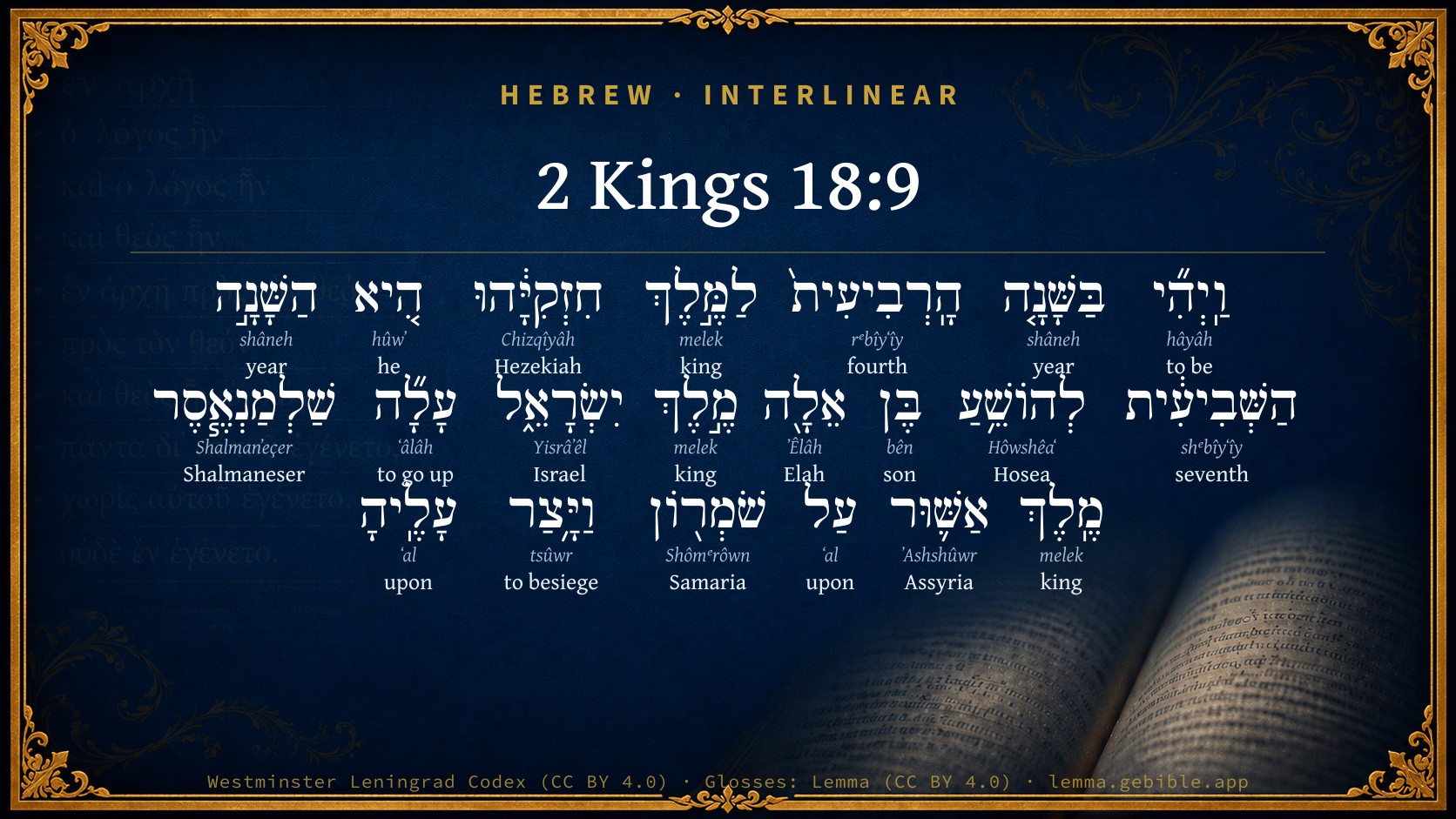
Hebrew (Westminster Leningrad Codex) 2 Kings 18:9 appears in the Hebrew Old Testament. The text above is from the Westminster Leningrad Codex. Each word links to its Strong’s number, a concise gloss, and parsing drawn from the Open Scriptures Hebrew Bible morphology. Click any word for its full Brown-Driver-Briggs (BDB) entry.
Download image
Cite this verse

2 Kings 18:9 (World English Bible). Public Domain. Lemma interlinear Bible study tool, https://lemma.gebible.app/v/2-kings/18/9.

Show BibTeX & RIS
BibTeX
RIS
English Translation
It happened in the fourth year of king Hezekiah, which was the seventh year of Hoshea son of Elah king of Israel, that Shalmaneser king of Assyria came up against Samaria, and besieged it.
World English Bible · Public Domain
Download a study sheet

One document with this verse’s original text, its word-by-word gloss line, the meaning frame, cross-references with their text, attributed commentary, and full source and license credits — printable, and it pastes into notes with its structure intact.

This verse Autodidact and up

Study sheet (.html) Plain text (.txt)

A passage Seminary Student

Up to 50 verses in one chapter. A passage sheet keeps up to 6 commentary sources and 12 cross-references per verse, in the order this page ranks them, and says so on the sheet whenever that leaves anything out. Ask for a single verse and you get the Autodidact verse sheet above.

Everything on this page stays free to read, with no account — the sheet is a download of what is already on screen, not access to it.

Want to remove ads? Support Godless Engineer
Compare translations 3

The same verse in 3 English versions, stacked beneath the original-language interlinear above. Click any original word for its lexicon entry.

Each is an independent rendering of the whole verse — the interlinear is not word-aligned to these translations.

Highlighted words mark where these versions differ — a whole-verse word diff, not a word-by-word alignment.

  • World English Bible Public Domain
    It happened in the fourth year of king Hezekiah, which was the seventh year of Hoshea son of Elah king of Israel, that Shalmaneser king of Assyria came up against Samaria, and besieged it.
  • King James Version Public Domain
    And it came to pass in the fourth year of king Hezekiah, which was the seventh year of Hoshea son of Elah king of Israel, that Shalmaneser king of Assyria came up against Samaria, and besieged it.
  • unfoldingWord Literal Text CC BY-SA 4.0
    And it happened in the fourth year of King Hezekiah (it the seventh year of Hoshea, the son of Elah, the king of Israel), Shalmaneser, the king of Assyria, came up against Samaria, and he besieged against it.

unfoldingWord Literal Text — © unfoldingWord, licensed CC BY-SA 4.0. Word-aligned USFM3 via Door43 (git.door43.org/unfoldingWord/en_ult).

Versions to compare (up to 4)

3 of 4 selected

Show all 18 translations

Every available English version of this verse, each an independent rendering of the whole verse.

  • World English Bible Public Domain
    It happened in the fourth year of king Hezekiah, which was the seventh year of Hoshea son of Elah king of Israel, that Shalmaneser king of Assyria came up against Samaria, and besieged it.
  • Berean Standard Bible Public Domain
    In the fourth year of Hezekiah’s reign, which was the seventh year of the reign of Hoshea son of Elah over Israel, Shalmaneser king of Assyria marched against Samaria and besieged it.
  • Majority Standard Bible Public Domain
    In the fourth year of Hezekiah’s reign, which was the seventh year of the reign of Hoshea son of Elah over Israel, Shalmaneser king of Assyria marched against Samaria and besieged it.
  • King James Version Public Domain
    And it came to pass in the fourth year of king Hezekiah, which was the seventh year of Hoshea son of Elah king of Israel, that Shalmaneser king of Assyria came up against Samaria, and besieged it.
  • American Standard Version (1901) Public Domain
    And it came to pass in the fourth year of king Hezekiah, which was the seventh year of Hoshea son of Elah king of Israel, that Shalmaneser king of Assyria came up against Samaria, and besieged it.
  • Revised Version (1885) Public Domain
    And it came to pass in the fourth year of king Hezekiah, which was the seventh year of Hoshea son of Elah king of Israel, that Shalmaneser king of Assyria came up against Samaria, and besieged it.
  • Geneva Bible (1599) Public Domain
    And in the fourth yere of King Hezekiah, (which was the seuenth yeere of Hoshea sonne of Elah King of Israel) Shalmaneser King of Asshur came vp against Samaria, and besieged it.
  • Douay-Rheims (1899) Public Domain
    In the fourth year of king Ezechias, which was the seventh year of Osee the son of Ela king of Israel, Salmanasar king of the Assyrians came up to Samaria, and besieged it,
  • Young's Literal Translation Public Domain
    And it cometh to pass, in the fourth year of king Hezekiah -- it `is' the seventh year of Hoshea son of Elah king of Israel -- come up hath Shalmaneser king of Asshur against Samaria, and layeth siege to it,
  • Literal Standard Version CC BY-SA 4.0
    And it comes to pass, in the fourth year of King Hezekiah—it [is] the seventh year of Hoshea son of Elah, king of Israel—Shalmaneser king of Asshur has come up against Samaria and lays siege to it,
  • Unlocked Literal Bible CC BY-SA 4.0
    In the fourth year of King Hezekiah, which was the seventh year of Hoshea son of Elah king of Israel, Shalmaneser king of Assyria came up against Samaria and besieged it.
  • unfoldingWord Literal Text CC BY-SA 4.0
    And it happened in the fourth year of King Hezekiah (it the seventh year of Hoshea, the son of Elah, the king of Israel), Shalmaneser, the king of Assyria, came up against Samaria, and he besieged against it.
  • Darby Bible Public Domain
    And it came to pass in the fourth year of king Hezekiah, which was the seventh year of Hoshea the son of Elah, king of Israel, [that] Shalmaneser king of Assyria came up against Samaria and besieged it.
  • World Messianic Bible Public Domain
    In the fourth year of King Hezekiah, which was the seventh year of Hoshea son of Elah king of Israel, Shalmaneser king of Assyria came up against Samaria and besieged it.
  • Webster's Bible Public Domain
    And it came to pass in the fourth year of king Hezekiah, which was the seventh year of Hoshea son of Elah king of Israel, that Shalmaneser king of Assyria came up against Samaria, and besieged it.
  • Free Bible Version CC BY-SA 4.0
    In the fourth year of Hezekiah's reign, equivalent to the seventh year of the reign of Hoshea, son of Elah, king of Israel, Shalmaneser, king of Assyria, attacked Samaria, besieging it.
  • Bible in Basic English Public Domain
    Now in the fourth year of King Hezekiah, which was the seventh year of Hoshea, son of Elah, king of Israel, Shalmaneser, king of Assyria, came up against Samaria, shutting it in with his armies.
  • JPS Tanakh (1917) Public Domain
    And it came to pass in the fourth year of king Hezekiah, which was the seventh year of Hoshea son of Elah king of Israel, that Shalmaneser king of Assyria came up against Samaria, and besieged it.

Literal Standard Version (2020), Covenant Press — licensed CC BY-SA 4.0. Text via the HelloAO Bible API (eBible.org). Unlocked Literal Bible (unfoldingWord) — licensed CC BY-SA 4.0. Text via the HelloAO Bible API (eBible.org). unfoldingWord Literal Text — © unfoldingWord, licensed CC BY-SA 4.0. Word-aligned USFM3 via Door43 (git.door43.org/unfoldingWord/en_ult). Free Bible Version, Dr. Jonathan Gallagher — licensed CC BY-SA 4.0. Text via the HelloAO Bible API (eBible.org).

Word by word

More ways to search: Search by grammar → Find every occurrence → Compare this word →

Practice this passage: Drill this verse → Learn its vocabulary →

שַׁלְמַנְאֶ֧סֶר
Shalmanʼeçer
H8022
“Shalmaneser”
Noun, Proper
Part of Speech
Noun
Type
Proper
Full BDB Definition

Origin: of foreign derivation

TWOT: None

Shalmaneser = "fire-worshipper" - Assyrian king who probably reigned between Tiglath-pileser and Sargon; invaded the northern kingdom of Israel when the last king Hoshea was on the throne; forced Hoshea to pay tribute but had to reinvade when Hoshea reneged; it is uncertain whether Shalmaneser or Sargon concluded the siege which finally ended the northern kingdom - maybe a common name for Assyrian kings in the 8th century BC
  1. וַֽיְהִ֞י hâyâh H1961 “and · to be” Conjunction + Verb, Qal, Sequential Imperfect, 3rd Person, Masculine, Singular
  2. בַּשָּׁנָ֤ה shâneh H8141 “in/at the · year” Preposition, Determined + Noun, Common, Feminine, Singular, Absolute
  3. הָֽרְבִיעִית֙ rᵉbîyʻîy H7243 “the · fourth” Particle, Definite Article + Adjective, Ordinal number, Feminine, Singular, Absolute
  4. לַמֶּ֣לֶךְ melek H4428 “to/for the · king” Preposition, Determined + Noun, Common, Masculine, Singular, Absolute
  5. חִזְקִיָּ֔הוּ Chizqîyâh H2396 “Hezekiah” Noun, Proper
  6. הִ֚יא hûwʼ H1931 “he” Pronoun, Personal, 3rd Person, Feminine, Singular
  7. הַשָּׁנָ֣ה shâneh H8141 “the · year” Particle, Definite Article + Noun, Common, Feminine, Singular, Absolute
  8. הַשְּׁבִיעִ֔ית shᵉbîyʻîy H7637 “the · seventh” Particle, Definite Article + Adjective, Ordinal number, Feminine, Singular, Absolute
  9. לְהוֹשֵׁ֥עַ Hôwshêaʻ H1954 “to/for · Hosea” Preposition + Noun, Proper
  10. בֶּן bên H1121 “son of” Noun, Common, Masculine, Singular, Construct
  11. אֵלָ֖ה ʼÊlâh H425 “Elah” Noun, Proper
  12. מֶ֣לֶךְ melek H4428 “king of” Noun, Common, Masculine, Singular, Construct
  13. יִשְׂרָאֵ֑ל Yisrâʼêl H3478 “Israel” Noun, Proper
  14. עָלָ֞ה ʻâlâh H5927 “to go up” Verb, Qal, Perfect, 3rd Person, Masculine, Singular
  15. מֶֽלֶךְ melek H4428 “king of” Noun, Common, Masculine, Singular, Construct
  16. אַשּׁ֛וּר ʼAshshûwr H804 “Assyria” Noun, Proper
  17. עַל ʻal H5921 “upon” Preposition
  18. שֹׁמְר֖וֹן Shômᵉrôwn H8111 “Samaria” Noun, Proper
  19. וַיָּ֥צַר tsûwr H6696 “and · to besiege” Conjunction + Verb, Qal, Sequential Imperfect, 3rd Person, Masculine, Singular
  20. עָלֶֽיהָ ʻal H5921 “upon · her” Preposition + Suffix, Personal, 3rd Person, Feminine, Singular

About this verse

These counts appear in no published source. They are computed here, from the morphology-tagged text and Lemma’s own curated glosses. What Lemma adds →

21
words
17
distinct lemmas
Historical
section

Notable vocabulary

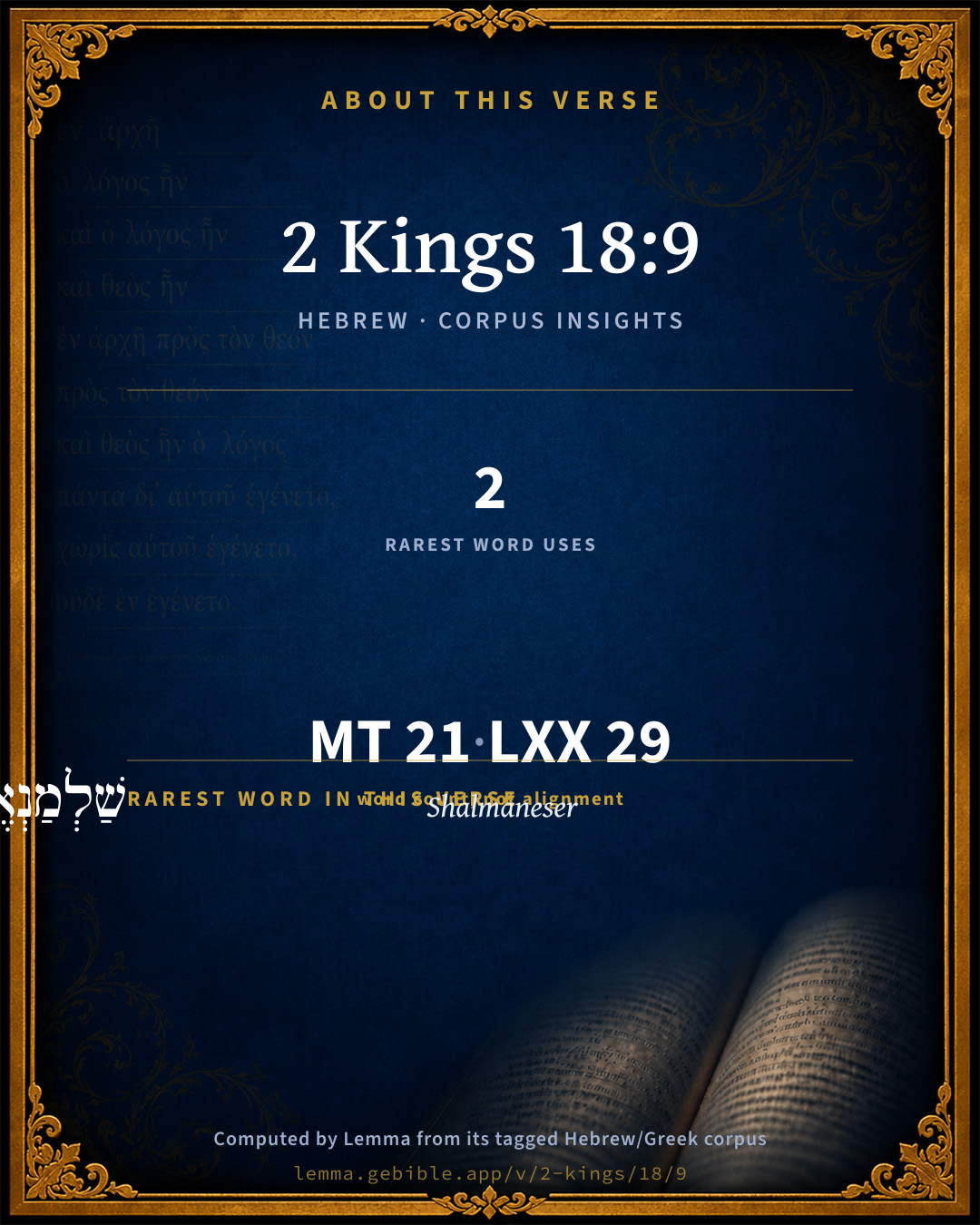
The rarest word here is שַׁלְמַנְאֶ֧סֶר Shalmaneser H8022 — appearing just 2 times in the whole Hebrew Bible.

Shared distinctive vocabulary

שַׁלְמַנְאֶ֧סֶר Shalmaneser H8022 occurs in 2 verses of the Hebrew Bible. Also found in:

Grammatical profile

  • 3 verbs
  • 13 nouns
  • 2 adjectives
  • 1 pronoun
  • 2 prepositions

Verb forms

  • וַֽיְהִ֞י Qal · Sequential Imperfect
  • עָלָ֞ה Qal · Perfect
  • וַיָּ֥צַר Qal · Sequential Imperfect

Repetition

Words recur within this verse — often emphatic in Hebrew:

  • לַמֶּ֣לֶךְ king H4428 ×3
  • בַּשָּׁנָ֤ה year H8141 ×2
  • עַל upon H5921 ×2

Hebrew & Septuagint length

In English translation the verse runs 34 words from the Hebrew and 38 from the Septuagint (LXX English) — closely comparable.

A rough comparison of the two English renderings, which tokenize alike — not a word-level alignment.

Word counts can differ between the Hebrew and the Greek without any difference in meaning — e.g. the Hebrew direct-object marker אֵת has no separate Greek word, and Greek often adds the article ὁ.

In the original languages it is 21 Hebrew tokens and 29 Greek tokens — but the two are counted differently (Hebrew bundles its prefixes and suffixes into one token; the Greek is in lemma form), so that isn’t a like-for-like length.

Cross-references

3

Topical passages linked to 2 Kings 18:9 in the Treasury of Scripture Knowledge — connected by theme and wording, ordered by reader-vote popularity; previews shown in the World English Bible.

  • Hosea 10:14 Therefore a battle roar will arise among your people, And all your fortresses will be destroyed, As Shalman destroyed Beth Arbel in the day of battle. The mother was dashed in pieces with her children.
  • 2 Kings 17:3–23 Against him came up Shalmaneser king of Assyria; and Hoshea became his servant, and brought him tribute.
  • 2 Kings 18:1 Now it happened in the third year of Hoshea son of Elah king of Israel, that Hezekiah the son of Ahaz king of Judah began to reign.

Cross-references courtesy of OpenBible.info (CC BY 4.0).

Hebrew and Greek witnesses Masoretic Hebrew ↔ Greek Septuagint

The same verse in the two great witnesses to the Old Testament, shown verse-for-verse.

These are two independent witnesses, not word-aligned to each other, and the Septuagint is shown in lemma (dictionary) form.

Hebrew 2 Kings 18:9 Masoretic · Westminster Leningrad Codex

וַֽיְהִ֞י בַּשָּׁנָ֤ה הָֽרְבִיעִית֙ לַמֶּ֣לֶךְ חִזְקִיָּ֔הוּ הִ֚יא הַשָּׁנָ֣ה הַשְּׁבִיעִ֔ית לְהוֹשֵׁ֥עַ בֶּן אֵלָ֖ה מֶ֣לֶךְ יִשְׂרָאֵ֑ל עָלָ֞ה שַׁלְמַנְאֶ֧סֶר מֶֽלֶךְ אַשּׁ֛וּר עַל שֹׁמְר֖וֹן וַיָּ֥צַר עָלֶֽיהָ

It happened in the fourth year of king Hezekiah, which was the seventh year of Hoshea son of Elah king of Israel, that Shalmaneser king of Assyria came up against Samaria, and besieged it.

World English Bible · Public Domain

Greek LXX 2 Kings 18:9 Septuagint · lemma form

καί γίγνομαι ἐν ὁ ἔτος ὁ τέταρτος βασιλεύς εζεκιας αὐτός ἐνιαυτός ὁ ἕβδομος ὁ ωσηε υἱός ηλα βασιλεύς ἰσραήλ ἀναβαίνω σαλαμανασσαρ βασιλεύς ἀσσύριος ἐπί σαμαρεία καί πολιορκέω ἐπί αὐτός

And it came to pass in the fourth year of King Ezekias (this is the seventh year of Osee son of Ela king of Israel,) that Salamanassar king of the Assyrians came up against Samaria, and besieged it.

LXX2012 (modern English Septuagint) · Public Domain

Hebrew: Westminster Leningrad Codex (CC BY 4.0). Greek: Septuagint (public domain); English from LXX2012 (modern English Septuagint) (Public Domain). How the Septuagint differs from the Hebrew →

Targum (Aramaic paraphrase)

1

The Targum is the ancient Jewish Aramaic paraphrase of the Hebrew Scriptures — an interpretive translation, not the Hebrew text itself. Onkelos (literal) and Pseudo-Jonathan (expansive) render the Torah, and Jonathan the Prophets. Coverage is partial: where no permissively-licensed English translation exists for a verse, only the Aramaic is shown. This is verse-level text, not a word-by-word alignment to the Hebrew.

  1. Targum Jonathan Prophets (Joshua–Malachi)
    וַהֲוָה בְּשַׁתָּא רְבִיעֵיתָא לְמַלְכָּא חִזְקִיָה הִיא שַׁתָּא שְׁבִיעֵיתָא לְהוֹשֵׁעַ בַּר אֵלָה מַלְכָּא דְיִשְׂרָאֵל סְלִיק שַׁלְמַנְאֶסֶר מַלְכָּא דְאַתּוּר עַל שֹׁמְרוֹן וְצָר עֲלָהּ:

    (no public-domain English translation for this verse)

    Targum Jonathan — Aramaic: “Mikraot Gedolot” (public domain). English: “Sefaria Community Translation” (CC0 1.0 (public-domain dedication)); “London "Chaldee Paraphrase," 1871” (public domain). Text via Sefaria.

Commentary

Notes on 2 Kings 18:9 from classic Christian and Jewish commentators (each source and its license shown beneath its notes). The classic Christian expositions comment on the surrounding passage and are grouped to its opening verse, so a note may address several verses; the Jewish commentaries on the Tanakh (Rashi and others) are per-verse, so they appear only where the commentator wrote on this verse.

Lemma curates 59 commentaries, every one of them public domain or Creative Commons licensed, each selected and text-cleaned for this edition rather than reprinted as found. About our sources →

Matthew Henry's Commentary

The kingdom of Assyria had now grown considerable, though we never read of it till the last reign. Such changes there are in the affairs of nations and families: those that have been despicable become formidable, and those, on the contrary, are brought low that have made a great noise and figure. We have here an account,

I. Of the success of Shalmaneser, king of Assyria, against Israel, his besieging Samaria (Kg2 18:9), taking it (Kg2 18:10), and carrying the people into captivity (Kg2 18:11), with the reason why God brought this judgment upon them (Kg2 18:12): Because they obeyed not the voice of the Lord their God. This was related more largely in the foregoing chapter, but it is here repeated, 1. As that which stirred up Hezekiah and his people to purge out idolatry with so much zeal, because they saw the ruin which it brought upon Israel. When their neighbour's house was on fire, and their own in danger, it was time to cast away the accursed thing. 2. As that which Hezekiah much lamented, but had not strength to prevent. Though the ten tribes had revolted from, and often been vexatious to, the house of David, no longer ago than in his father's reign, yet being of the seed of Israel he could not be glad at their calamities. 3. As that which laid Hezekiah and his kingdom open to the king of Assyria, and made it much more easy for him to invade the land. It is said of the ten tribes here that they would neither hear God's commandments nor do them, Kg2 18:12. Many will be content to give God the hearing that will give him no more (Eze 33:31), but these, being resolved not to do their duty, did not care to hear of it.

II. Of the attempt of Sennacherib, the succeeding king of Assyria, against Judah, in which he was encouraged by his predecessor's success against Israel, whose honours he would vie with and whose victories he would push forward. The descent he made upon Judah was a great calamity to that kingdom, by which God would try the faith of Hezekiah and chastise the people, who are called a hypocritical nation (Isa 10:6), because they did not comply with Hezekiah's reformation, nor willingly part with their idols, but kept them up in their hearts, and perhaps in their houses, though their high places were removed. Even times of reformation may prove troublesome times, made so by those that oppose it, and then the blame is laid upon the reformers. This calamity will appear great upon Hezekiah if we consider, 1. How much he lost of his country, Kg2 18:13. The king of Assyria took all or most of the fenced cities of Judah, the frontier-towns and the garrisons, and then all the rest fell into his hands of course. The confusion which the country was put into by this invasion is described by the prophet, Isa 10:28-31. 2. How dearly he paid for his peace. He saw Jerusalem itself in danger of falling into the enemies' hand, as Samaria had done, and was willing to purchase its safety at the expense, (1.) Of a mean submission: "I have offended in denying the usual tribute, and am ready to make satisfaction as shall be demanded," Kg2 18:14. Where was Hezekiah's courage? Where his confidence in God? Why did he not advise with Isaiah before he sent this crouching message? (2.) Of a vast sum of money - 300 talents of silver and thirty of gold (above 200,000l.), not to be paid annually, but as a present ransom. To raise this sum, he was forced not only to empty the public treasures (Kg2 18:15), but to take the golden plates off from the doors of the temple, and from the pillars, Kg2 18:16. Though the temple sanctified the gold which he had dedicated, yet, the necessity being urgent, he thought he might make as bold with that as his father David (whom he took for his pattern) did with the show-bread, and that it was neither impious nor imprudent to give a part for the preservation of the whole. His father Ahaz had plundered the temple in contempt of it, Ch2 28:24. He had repaid with interest what his father took; and now, with all due reverence, he only begged leave to borrow it again in an exigency and for a greater good, with a resolution to restore it in full as soon as he should be in a capacity to do so.

Matthew Henry's Commentary on the Whole Bible (1708–1710) — public domain (CC PDM 1.0). Text via the HelloAO Bible API.

Trapp's Complete Commentary

John Trapp

2Ki 18:9 And it came to pass in the fourth year of king Hezekiah, which [was] the seventh year of Hoshea son of Elah king of Israel, [that] Shalmaneser king of Assyria came up against Samaria, and besieged it.

Ver. 9. In the fourth year, &c.] See on 2Ki 18:1.

That Shalmaneser, &c.] At which time Hezekiah sat in safety, and might keep a passover for his preservation. To teach us thus much it is, saith Pellican, that Israel’s ruin is here repeated.

John Trapp, A Commentary or Exposition upon All the Books of the Old and New Testament (1647–1656) — public domain. Text from a community e-Sword module.

Whedon's Commentary on the Bible

Daniel D. Whedon

FALL OF THE KINGDOM OF ISRAEL, 2Ki_18:9-12.

The fall of the kingdom of Israel was so important and memorable a catastrophe that it was recorded in the annals of Judah as well as in those of Israel; and one object of our historian in introducing a notice of it here, seems to be to contrast it with the greater permanence of Judah under the God-fearing Hezekiah. Judah successfully rebelled against Assyria because her king trusted in Jehovah and kept his law; Israel fell because her people “obeyed not the voice of the Lord their God, but transgressed his covenant, and all that Moses the servant of the Lord commanded.” 2Ki_18:12.

9. Fourth year… seventh year — That is, the greater part of the fourth year of Hezekiah fell in the seventh year of Hoshea. See note on 2Ki_18:1.

Daniel D. Whedon (gen. ed.), Commentary on the Old and New Testaments (1874–1909) — public domain. Text from a community e-Sword module.

Keil & Delitzsch

C. F. Keil & F. Delitzsch

In Kg2 18:9-12 the destruction of the kingdom of the ten tribes by Salmanasar, which has already been related according to the annals of the kingdom of Israel in Kg2 17:3-6, is related once more according to the annals of the kingdom of Judah, in which this catastrophe is also introduced as an event that was memorable in relation to all the covenant-nation.

Keil & Delitzsch — Biblical Commentary on the Old Testament (1861–1891) — public domain (CC PDM 1.0). Text via the HelloAO Bible API. (Old Testament only.)

Tyndale Open Study Notes

Tyndale Open Resources

18:9-12 The narrator introduces the fall of Samaria as a reminder that Assyria was the prevailing power of the era and that Samaria fell because of Hoshea’s apostasy, thus setting the stage for the account of Hezekiah’s demonstration of spiritual fiber and God’s dealing with him (18:19–19:19).

Tyndale Open Study Notes — © Tyndale Open Resources, licensed CC BY-SA 4.0. Text via the HelloAO Bible API.

Adam Clarke's Commentary

Verse 9. In the fourth year] This history has been already given, 2Kg 17:3, &c.

Adam Clarke's Commentary on the Bible (1810–1826) — public domain. Text from a community e-Sword/MySword module.

Ellicott's Commentary for English Readers

(9-12) The account of the captivity of northern Israel is repeated here, because the editor faithfully reproduces what he found in the abstract of the Judœan history of the kings. (Comp. 2Ki_17:3-6, and the Notes.) We may also see a contrast between the utter overthrow of the stronger kingdom and the deliverance of its smaller and weaker neighbour, because Hezekiah trusted in Jehovah (2Ki_18:5).

A Bible Commentary for English Readers, edited by Charles John Ellicott (1878–1897) — public domain. Text from a community e-Sword module.

The Cambridge Bible for Schools and Colleges

gen. ed. J. J. S. Perowne

9–12. Israel finally carried captive by Shalmaneser (Not in Chronicles)

9. Shalmaneser … came up against Samaria and besieged it] Probably the negotiations with So king of Egypt had still gone forward (2Ki_17:4), and the tribute due from Israel to Assyria had continued to be unpaid.

and besieged it] Shalmaneser commenced the siege, but the city was not taken till the reign of his successor Sargon. (See Schrader Cuneiform Inscriptions, Engl. Trans. 1. p. 266.)

The Cambridge Bible for Schools and Colleges (gen. ed. J. J. S. Perowne; Cambridge University Press, 1878–1918) — public domain. Text from a community e-Sword module.

John Gill's Exposition

And at the end of three years they took it,.... That is, at the first end of them, at the beginning, in which sense the phrase is taken in Deu 15:1, even in the sixth year of Hezekiah, that is, the ninth year of Hoshea king of Israel, Samaria was taken: see Kg2 17:6.

.

2 Kings 18:11

kg2 18:11

kg2 18:11

kg2 18:11And the king of Assyria did carry away Israel unto Assyria,.... Of the places he disposed of them in, after mentioned; see Gill on Kg2 17:6.

John Gill's Exposition of the Whole Bible (1746–1763) — public domain (CC PDM 1.0). Text via the HelloAO Bible API.

Albert Barnes' Notes on the Bible

These verses repeat the account given in the marginal reference. The extreme importance of the event may account for the double insertion.

Albert Barnes' Notes on the Bible (1834–1885) — public domain. Text from a community e-Sword/MySword module.

Haydock's Catholic Bible Commentary

Samaria. The same history is given, chap. xvii. 3. (Calmet)

George Leo Haydock (1774–1849), Haydock's Catholic Family Bible and Commentary, 1859 edition — public domain. Excludes Psalms (Douay-Rheims chapter numbering differs from Protestant) and Deuterocanonical books (Catholic canon only).

Matthew Poole's English Annotations

The seventh year of Hoshea; the seventh of those nine years expressed 2Ki 17:1.

Matthew Poole's English Annotations on the Holy Bible (1683–1685) — public domain. Text from a community e-Sword/MySword module.

The Pulpit Commentary

Vers. 9-12. THE PUNISHMENT OF SAMARIA FOR DISOBEDIENCE. In contrast with Hezekiah"s piety and consequent prosperity, the author places the disobedience (ver. 12) and consequent extinction of the sister kingdom (vers. 9-11), which Belonged to Hezekiah"s earlier years, and was an event of the greatest importance to him, since it made his dominions conterminous with those of Assyria, and exposed his northern frontier to attack at any moment from the Assyrian forces. According to all probable human calculation, the fall of Samaria should have been followed at once by an attack on Judaea; and but for the change of dynasty, and troubles on all sides which ensued thereupon, this would naturally have taken place. As it was, Judaea was allowed a Breathing-space, during which she strengthened her power in Philistia (see the comment on the preceding verse), and otherwise prepared herself to resist attack (see 2Ch_33:3-6; Isa_22:8-11)

And it came to pass in the fourth year of King Hezekiah, which was the seventh year of Hoshea son of Elah King of Israel. Hezekiah Began to reign before Hoshea had completed his third year (ver. 1). His first year thus ran parallel with part of Hoshea"s third and part of his fourth; his fourth with part of Hoshea"s sixth and part of his seventh; his sixth with part of Hoshea"s eighth and part of his ninth. That Shalmaneser King of Assyria came up against Samaria, and besieged it. (see the comment on 2Ki_17:4, 2Ki_17:5)

Vers. 9-12. Captivity and its cause.

(See homily on preceding chapter, vers. 6-23.) C.H.I.

The Pulpit Commentary (1880–1919), ed. H.D.M. Spence-Jones & Joseph S. Exell — public domain. Text from a community e-Sword module.

Kretzmann's Popular Commentary

Paul E. Kretzmann

The Assyrian Campaign against Samaria and Jerusalem

v. 9. And it came to pass in the fourth year of King Hezekiah, which was the seventh year of Hoshea, son of Elah, king of Israel, that Shalmaneser, king of Assyria, came up against Samaria and besieged it.

v. 10. And at the end of three years they took it; even in the sixth year of Hezekiah, that is the ninth year of Hoshea, king of Israel, Samaria was taken.

v. 11. And the king of Assyria did carry away Israel unto Assyria, and put them in Halah and in Habor by the river of Gozan, and in the cities of the Medes,

v. 12. because they obeyed not the voice of the Lord, their God, but transgressed His covenant, and all that Moses, the servant of the Lord, commanded, and would not hear them nor do them. Cf 2Ki 17:5-8. The account is here repeated because the catastrophe which overtook Israel was of great importance to the entire covenant people and probably aided Hezekiah in carrying out his reforms, since the people continually had the warning example of their northern neighbors before them.

v. 13. Now, in the fourteenth year of King Hezekiah did Sennacherib, king of Assyria, come up against all the fenced cities of Judah and took them, all the fortified towns outside of Jerusalem, his purpose being to leave behind him conquered territory as he advanced against Egypt.

v. 14. And Hezekiah, King of Judah, sent to the king of Assyria to Lachish, a city some fifteen hours southwest of Jerusalem, on the way to Egypt, against which Sennacherib (or Sargon, as the inscriptions have his real name) was then encamped, saying, I have offended, he acknowledged that he had acted foolishly in not submitting to the invaders. Return from me; that which thou puttest on me, namely, in the form of ransom- or tribute-money, will I bear. And the king of Assyria appointed unto Hezekiah, king of Judah, three hundred talents of silver and thirty talents of gold, a sum which would amount to at least $2,000,000 in modern money.

v. 15. And Hezekiah gave him all the silver that was found in the house of the Lord and in the treasures of the king’s house.

v. 16. At that time did Hezekiah cut off the gold from the doors of the Temple of the Lord, which he himself had put on the door-casings, 2Ch 29:3, and from the pillars which Hezekiah, king of Judah, had overlaid, and gave it to the king of Assyria. It was a very heavy tribute and drained the resources of Hezekiah. It was a momentary weakness of Hezekiah, which caused him even to enter into negotiations with the enemy; for the Lord was well able to preserve Judah, as the subsequent events showed. The strongest test of faith in God comes on the darkest days; it is then that the heart must cling to Him to the exclusion of everything else.

Paul E. Kretzmann, Popular Commentary of the Bible (1921–1924) — public domain. Text from a community e-Sword module.

unfoldingWord translationNotes

Door43 World Missions Community

Hoshea ... Elah ... Shalmaneser

These are the names of men. (See: How to Translate Names)

translationWords

Hezekiah

Hoshea

kingdom of Israel

Samaria

siege

unfoldingWord translationNotes — © Distant Shores Media and the Door43 World Missions Community, licensed CC BY-SA 4.0. Source: git.door43.org/Door43/en_tn.

Lesson kit

Teaching starters — assembled from the data on this page, not authored interpretation. Every prompt links to the verse data it draws on. Edit before teaching.

2 Kings, in the Historical, opens this verse with 21 words (17 distinct Hebrew lemmas). Its most distinctive word is Shalmanʼeçer (“Shalmaneser”). A historical commentator’s framing appears above. Read the whole chapter for the surrounding context.

Discussion questions

  1. The word Shalmanʼeçer carries the sense “Shalmaneser.” How does it shape the verse?
  2. 2 Kings 17:3 shares the word «Shalmaneser» with this verse. How do the two illuminate each other?
  3. “king” occurs 3× in this one verse. What is the effect of the repetition?
  4. These translations render this verse differently. What is at stake in choosing one wording over another?
  5. The verb «וַֽיְהִ֞י» is Qal Sequential Imperfect. How does its form color the action?
  6. Reading how Matthew Henry's Commentary and Trapp's Complete Commentary read this verse, where do the two commentators agree and where do they part?

Things to notice

Reading settings

Reading text

Shown beneath each verse's original-language words.

Old Testament
Old Testament edition

Read the OT as the Masoretic Hebrew (MT) or the Greek Septuagint (LXX).

English shown for the Greek Septuagint (in the Hebrew ↔ Greek comparison).

Comparing translations? Open the Compare panel on any verse page to stack up to four side by side.