
2 Kings 11:12

Hebrew (Westminster Leningrad Codex) 2 Kings 11:12 appears in the Hebrew Old Testament. The text above is from the Westminster Leningrad Codex. Each word links to its Strong’s number, a concise gloss, and parsing drawn from the Open Scriptures Hebrew Bible morphology. Click any word for its full Brown-Driver-Briggs (BDB) entry.
Download image
Cite this verse

2 Kings 11:12 (World English Bible). Public Domain. Lemma interlinear Bible study tool, https://lemma.gebible.app/v/2-kings/11/12.

Show BibTeX & RIS
BibTeX
RIS
English Translation
Then he brought out the king's son, and put the crown on him, and [gave him] the testimony; and they made him king, and anointed him; and they clapped their hands, and said, [Long] live the king.
World English Bible · Public Domain
Download a study sheet

One document with this verse’s original text, its word-by-word gloss line, the meaning frame, cross-references with their text, attributed commentary, and full source and license credits — printable, and it pastes into notes with its structure intact.

This verse Autodidact and up

Study sheet (.html) Plain text (.txt)

A passage Seminary Student

Up to 50 verses in one chapter. A passage sheet keeps up to 6 commentary sources and 12 cross-references per verse, in the order this page ranks them, and says so on the sheet whenever that leaves anything out. Ask for a single verse and you get the Autodidact verse sheet above.

Everything on this page stays free to read, with no account — the sheet is a download of what is already on screen, not access to it.

Want to remove ads? Support Godless Engineer
Compare translations 3

The same verse in 3 English versions, stacked beneath the original-language interlinear above. Click any original word for its lexicon entry.

Each is an independent rendering of the whole verse — the interlinear is not word-aligned to these translations.

Highlighted words mark where these versions differ — a whole-verse word diff, not a word-by-word alignment.

  • World English Bible Public Domain
    Then he brought out the king's son, and put the crown on him, and [gave him] the testimony; and they made him king, and anointed him; and they clapped their hands, and said, [Long] live the king.
  • King James Version Public Domain
    And he brought forth the king's son, and put the crown upon him, and gave him the testimony; and they made him king, and anointed him; and they clapped their hands, and said, God save the king.
  • unfoldingWord Literal Text CC BY-SA 4.0
    And he brought out the son of the king, and he set a crown on him, and the testimony, and they made him king, and they anointed him. And they struck palm, and they said, “May the king live!”

unfoldingWord Literal Text — © unfoldingWord, licensed CC BY-SA 4.0. Word-aligned USFM3 via Door43 (git.door43.org/unfoldingWord/en_ult).

Versions to compare (up to 4)

3 of 4 selected

Show all 18 translations

Every available English version of this verse, each an independent rendering of the whole verse.

  • World English Bible Public Domain
    Then he brought out the king's son, and put the crown on him, and [gave him] the testimony; and they made him king, and anointed him; and they clapped their hands, and said, [Long] live the king.
  • Berean Standard Bible Public Domain
    Then Jehoiada brought out the king’s son, put the crown on him, presented him with the Testimony, and proclaimed him king. They anointed him, and the people clapped their hands and declared, “Long live the king!”
  • Majority Standard Bible Public Domain
    Then Jehoiada brought out the king’s son, put the crown on him, presented him with the Testimony, and proclaimed him king. They anointed him, and the people clapped their hands and declared, “Long live the king!”
  • King James Version Public Domain
    And he brought forth the king's son, and put the crown upon him, and gave him the testimony; and they made him king, and anointed him; and they clapped their hands, and said, God save the king.
  • American Standard Version (1901) Public Domain
    Then he brought out the king's son, and put the crown upon him, and `gave him' the testimony; and they made him king, and anointed him; and they clapped their hands, and said, `Long' live the king.
  • Revised Version (1885) Public Domain
    Then he brought out the king’s son, and put the crown upon him, and gave him the testimony; and they made him king, and anointed him; and they clapped their hands, and said, God save the king.
  • Geneva Bible (1599) Public Domain
    Then he brought out the Kings sonne, and put the crowne vpon him and gaue him the Testimonie, and they made him King: also they anoynted him, and clapt their handes, and sayde, God saue the King.
  • Douay-Rheims (1899) Public Domain
    And he brought forth the king's son, and put the diadem upon him, and the testimony: and they made him king, and anointed him: and clapping their hands. they said, God save the king.
  • Young's Literal Translation Public Domain
    and he bringeth out the son of the king, and putteth on him the crown, and the testimony, and they make him king, and anoint him, and smite the hand, and say, `Let the king live.'
  • Literal Standard Version CC BY-SA 4.0
    and he brings out the son of the king, and puts the crown on him, and the Testimony, and they make him king, and anoint him, and strike the hand, and say, “Let the king live.”
  • Unlocked Literal Bible CC BY-SA 4.0
    Then Jehoiada brought out the king's son Joash, put the crown on him, and gave him the covenant decrees. Then they made him king and anointed him. They clapped their hands and said, “Long live the king!”
  • unfoldingWord Literal Text CC BY-SA 4.0
    And he brought out the son of the king, and he set a crown on him, and the testimony, and they made him king, and they anointed him. And they struck palm, and they said, “May the king live!”
  • Darby Bible Public Domain
    And he brought forth the king's son, and put the crown upon him, and [gave him] the testimony; and they made him king, and anointed him; and they clapped their hands, and said, Long live the king!
  • World Messianic Bible Public Domain
    Then he brought out the king’s son, and put the crown on him, and gave him the covenant; and they made him king and anointed him; and they clapped their hands, and said, “Long live the king!”
  • Webster's Bible Public Domain
    And he brought forth the king's son, and put the crown upon him, and gave him the testimony; and they made him king, and anointed him; and they clapped their hands, and said, God save the king.
  • Free Bible Version CC BY-SA 4.0
    Then Jehoiada led out the king's son, placed the crown on him, and handed him a copy of God's Law. They proclaimed him king and anointed him. The people clapped, and shouted, “Long live the king!”
  • Bible in Basic English Public Domain
    Then he made the king's son come out, and put the crown on him and the arm-bands, and made him king, and put the holy oil on him; and they all, making sounds of joy with their hands, said, Long life to the king.
  • JPS Tanakh (1917) Public Domain
    Then he brought out the king's son, and put upon him the crown and the insignia; and they made him king, and anointed him; and they clapped their hands, and said: 'Long live the king.'

Literal Standard Version (2020), Covenant Press — licensed CC BY-SA 4.0. Text via the HelloAO Bible API (eBible.org). Unlocked Literal Bible (unfoldingWord) — licensed CC BY-SA 4.0. Text via the HelloAO Bible API (eBible.org). unfoldingWord Literal Text — © unfoldingWord, licensed CC BY-SA 4.0. Word-aligned USFM3 via Door43 (git.door43.org/unfoldingWord/en_ult). Free Bible Version, Dr. Jonathan Gallagher — licensed CC BY-SA 4.0. Text via the HelloAO Bible API (eBible.org).

Word by word

More ways to search: Search by grammar → Find every occurrence → Compare this word →

Practice this passage: Drill this verse → Learn its vocabulary →

הַנֵּ֨זֶר֙
nezer
H5145
“the · consecration”
Particle, Definite Article + Noun, Common, Masculine, Singular, Absolute
Part of Speech
Particle + Noun
Type
Common
Gender
Masculine
Number
Singular
State
Absolute
Full BDB Definition

Origin: from H5144

TWOT: 1340a

consecration, crown, separation, Nazariteship - crown (as sign of consecration), earring - stones of a crown, diadem, stones of charming - woman's hair - consecration - of high priest - of Nazarite
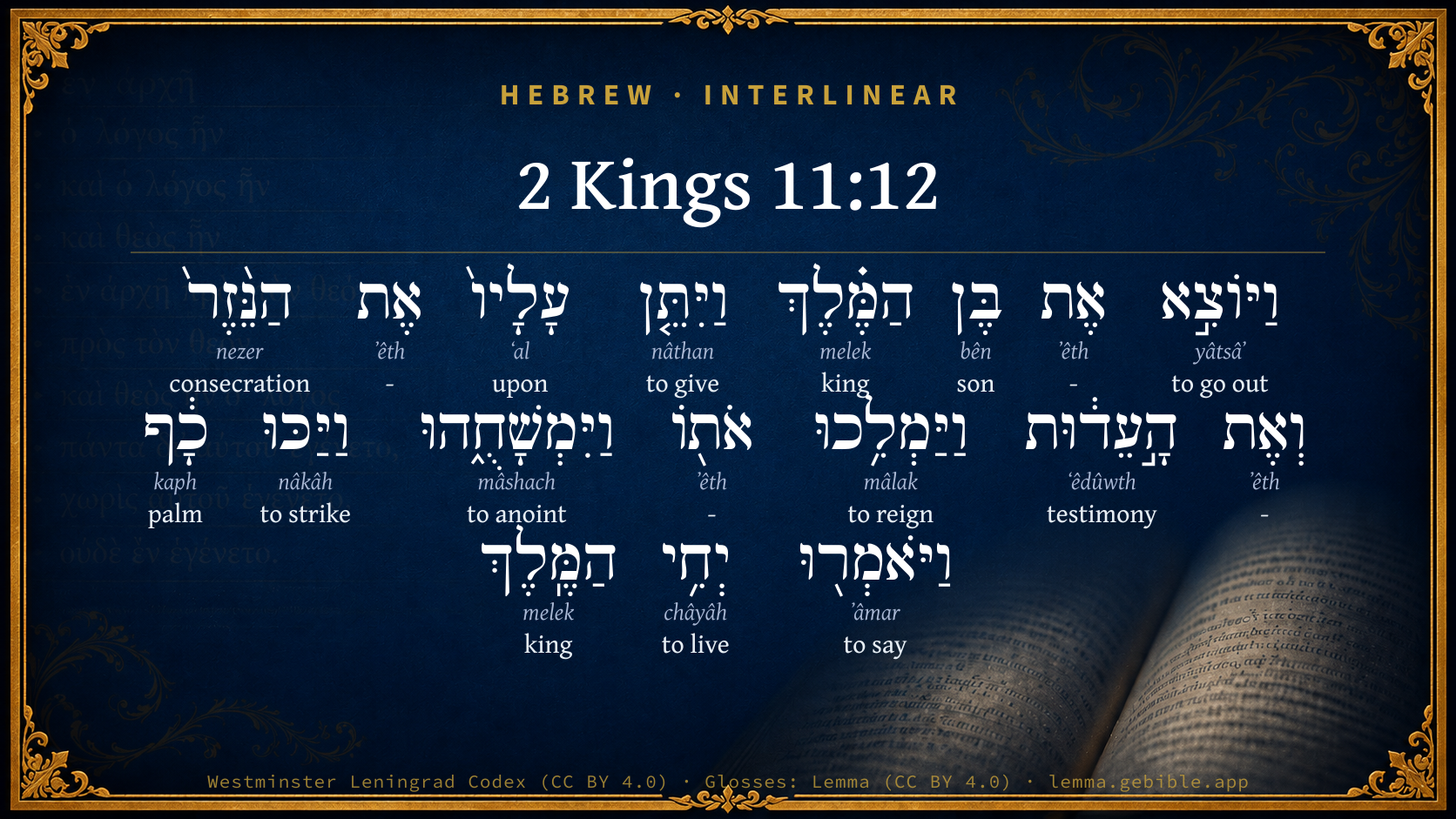
  1. וַיּוֹצִ֣א yâtsâʼ H3318 “and · to go out” Conjunction + Verb, Hiphil, Sequential Imperfect, 3rd Person, Masculine, Singular
  2. אֶת ʼêth H853 “-” Particle, Direct Object
  3. בֶּן bên H1121 “son of” Noun, Common, Masculine, Singular, Construct
  4. הַמֶּ֗לֶךְ melek H4428 “the · king” Particle, Definite Article + Noun, Common, Masculine, Singular, Absolute
  5. וַיִּתֵּ֤ן nâthan H5414 “and · to give” Conjunction + Verb, Qal, Sequential Imperfect, 3rd Person, Masculine, Singular
  6. עָלָיו֙ ʻal H5921 “upon · him” Preposition + Suffix, Personal, 3rd Person, Masculine, Singular
  7. אֶת ʼêth H853 “-” Particle, Direct Object
  8. וְאֶת ʼêth H853 “and · -” Conjunction + Particle, Direct Object
  9. הָ֣עֵד֔וּת ʻêdûwth H5715 “the · testimony” Particle, Definite Article + Noun, Common, Feminine, Singular, Absolute
  10. וַיַּמְלִ֥כוּ mâlak H4427 “and · to reign” Conjunction + Verb, Hiphil, Sequential Imperfect, 3rd Person, Masculine, Plural
  11. אֹת֖וֹ ʼêth H853 “- · him” Particle, Direct Object + Suffix, Personal, 3rd Person, Masculine, Singular
  12. וַיִּמְשָׁחֻ֑הוּ mâshach H4886 “and · to anoint · him” Conjunction + Verb, Qal, Sequential Imperfect, 3rd Person, Masculine, Plural + Suffix, Personal, 3rd Person, Masculine, Singular
  13. וַיַּכּוּ nâkâh H5221 “and · to strike” Conjunction + Verb, Hiphil, Sequential Imperfect, 3rd Person, Masculine, Plural
  14. כָ֔ף kaph H3709 “palm” Noun, Common, Feminine, Singular, Absolute
  15. וַיֹּאמְר֖וּ ʼâmar H559 “and · to say” Conjunction + Verb, Qal, Sequential Imperfect, 3rd Person, Masculine, Plural
  16. יְחִ֥י châyâh H2421 “to live” Verb, Qal, Jussive, 3rd Person, Masculine, Singular
  17. הַמֶּֽלֶךְ melek H4428 “the · king” Particle, Definite Article + Noun, Common, Masculine, Singular, Absolute

About this verse

These counts appear in no published source. They are computed here, from the morphology-tagged text and Lemma’s own curated glosses. What Lemma adds →

18
words
14
distinct lemmas
Historical
section

Notable vocabulary

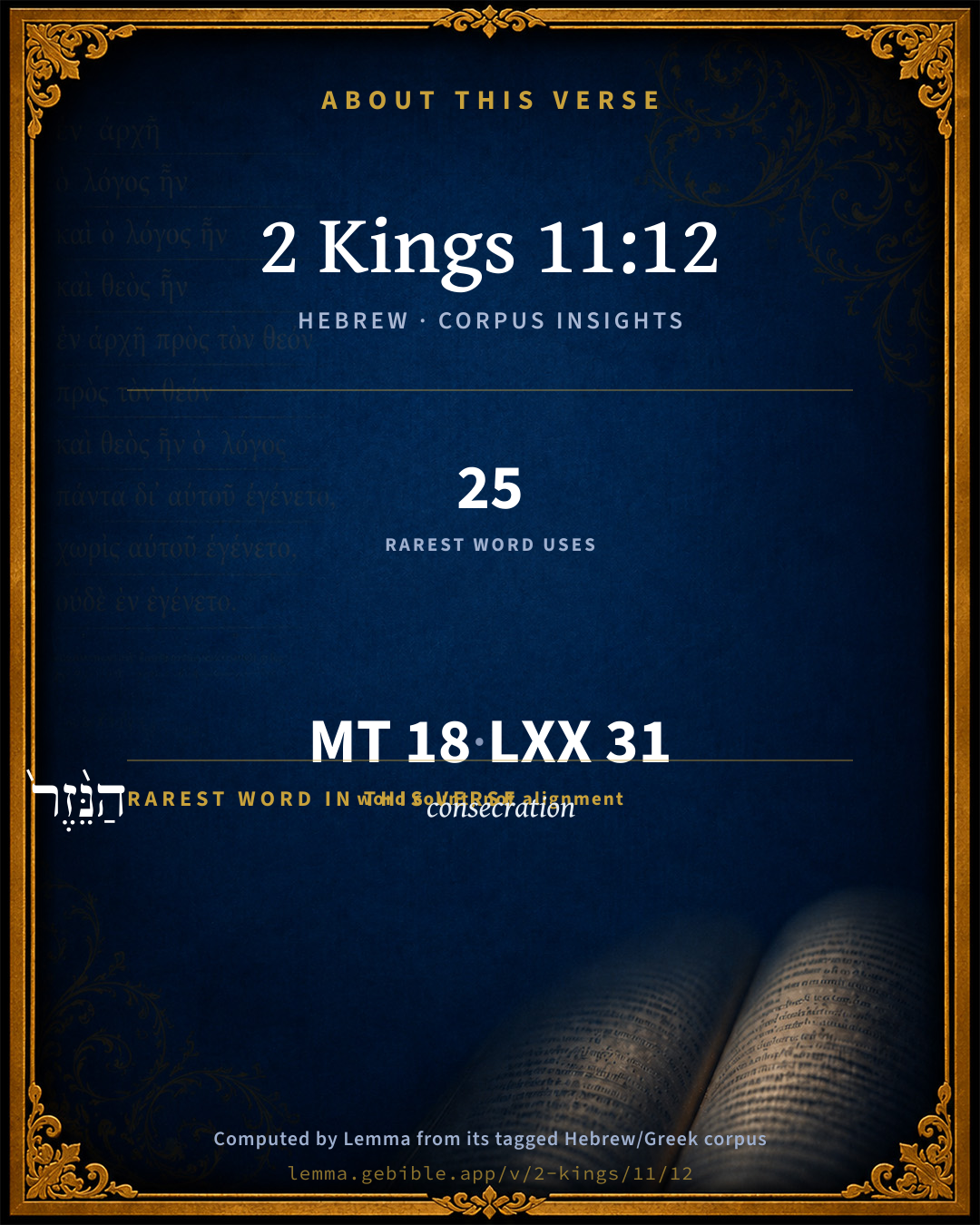
The rarest word here is הַנֵּ֨זֶר֙ consecration H5145 — appearing just 25 times in the whole Hebrew Bible.

Shared distinctive vocabulary

הַנֵּ֨זֶר֙ consecration H5145 occurs in 22 verses of the Hebrew Bible. Also found in:

Grammatical profile

  • 7 verbs
  • 6 nouns
  • 1 preposition
  • 4 particles

Verb forms

  • וַיּוֹצִ֣א Hiphil · Sequential Imperfect
  • וַיִּתֵּ֤ן Qal · Sequential Imperfect
  • וַיַּמְלִ֥כוּ Hiphil · Sequential Imperfect
  • וַיִּמְשָׁחֻ֑הוּ Qal · Sequential Imperfect
  • וַיַּכּוּ Hiphil · Sequential Imperfect
  • וַיֹּאמְר֖וּ Qal · Sequential Imperfect
  • יְחִ֥י Qal · Jussive

Repetition

A word recurs within this verse — often emphatic in Hebrew:

  • הַמֶּ֗לֶךְ king H4428 ×2

Hebrew & Septuagint length

In English translation the verse runs 37 words from the Hebrew and 37 from the Septuagint (LXX English) — the same length.

A rough comparison of the two English renderings, which tokenize alike — not a word-level alignment.

Word counts can differ between the Hebrew and the Greek without any difference in meaning — e.g. the Hebrew direct-object marker אֵת has no separate Greek word, and Greek often adds the article ὁ.

In the original languages it is 18 Hebrew tokens and 31 Greek tokens — but the two are counted differently (Hebrew bundles its prefixes and suffixes into one token; the Greek is in lemma form), so that isn’t a like-for-like length.

Cross-references

40

Topical passages linked to 2 Kings 11:12 in the Treasury of Scripture Knowledge — connected by theme and wording, ordered by reader-vote popularity; previews shown in the World English Bible.

  • 1 Samuel 10:24 Samuel said to all the people, "You see him whom Yahweh has chosen, that there is none like him among all the people?" All the people shouted, and said, [Long] live the king.
  • Exodus 25:16 You shall put the testimony which I shall give you into the ark.
  • Exodus 31:18 He gave to Moses, when he finished speaking with him on Mount Sinai, the two tablets of the testimony, stone tablets, written with God's finger.
  • 2 Samuel 1:10 So I stood beside him, and killed him, because I was sure that he could not live after that he was fallen: and I took the crown that was on his head, and the bracelet that was on his arm, and have brought them here to my lord.
  • 1 Kings 1:39 Zadok the priest took the horn of oil out of the Tent, and anointed Solomon. They blew the trumpet; and all the people said, [Long] live king Solomon.
  • Deuteronomy 17:18–20 It shall be, when he sits on the throne of his kingdom, that he shall write him a copy of this law in a book, out of [that which is] before the priests the Levites:
  • 1 Samuel 10:1 Then Samuel took the vial of oil, and poured it on his head, and kissed him, and said, Isn't it that Yahweh has anointed you to be prince over his inheritance?
  • 2 Samuel 16:16 It happened, when Hushai the Archite, David's friend, was come to Absalom, that Hushai said to Absalom, [Long] live the king, [Long] live the king.
  • 2 Kings 11:2 But Jehosheba, the daughter of king Joram, sister of Ahaziah, took Joash the son of Ahaziah, and stole him away from among the king's sons who were slain, even him and his nurse, [and put them] in the bedchamber; and they hid him from Athaliah, so that he was not slain;
  • Psalms 47:1 Oh clap your hands, all you nations. Shout to God with the voice of triumph!
  • Psalms 98:8 Let the rivers clap their hands. Let the mountains sing for joy together.
  • Isaiah 55:12 For you shall go out with joy, and be led forth with peace: the mountains and the hills shall break forth before you into singing; and all the trees of the fields shall clap their hands.
  • 1 Samuel 16:13 Then Samuel took the horn of oil, and anointed him in the midst of his brothers: and the Spirit of Yahweh came mightily on David from that day forward. So Samuel rose up, and went to Ramah.
  • 2 Samuel 2:4 The men of Judah came, and there they anointed David king over the house of Judah. They told David, saying, The men of Jabesh Gilead were those who buried Saul.
  • 2 Samuel 2:7 Now therefore let your hands be strong, and be you valiant; for Saul your lord is dead, and also the house of Judah have anointed me king over them.
  • 2 Samuel 5:3 So all the elders of Israel came to the king to Hebron; and king David made a covenant with them in Hebron before Yahweh: and they anointed David king over Israel.
  • 2 Samuel 12:30 He took the crown of their king from off his head; and the weight of it was a talent of gold, and [in it were] precious stones; and it was set on David's head. He brought forth the spoil of the city, exceeding much.
  • 1 Kings 1:34 and let Zadok the priest and Nathan the prophet anoint him there king over Israel; and blow you the trumpet, and say, [Long] live king Solomon.
  • 2 Kings 9:3 Then take the vial of oil, and pour it on his head, and say, Thus says Yahweh, I have anointed you king over Israel. Then open the door, and flee, and don't wait.
  • 2 Kings 11:4 In the seventh year Jehoiada sent and fetched the captains over hundreds of the Carites and of the guard, and brought them to him into the house of Yahweh; and he made a covenant with them, and took an oath of them in the house of Yahweh, and shown them the king's son.
  • 2 Chronicles 23:11 Then they brought out the king's son, and put the crown on him, and [gave him] the testimony, and made him king: and Jehoiada and his sons anointed him; and they said, [Long] live the king.
  • Esther 2:17 The king loved Esther above all the women, and she obtained favor and kindness in his sight more than all the virgins; so that he set the royal crown on her head, and made her queen instead of Vashti.
  • Esther 6:8 let royal clothing be brought which the king uses to wear, and the horse that the king rides on, and on the head of which a crown royal is set:
  • Psalms 21:3 For you meet him with the blessings of goodness; You set a crown of fine gold on his head.
  • Psalms 72:15–17 They shall live, and to him shall be given of the gold of Sheba. Men shall pray for him continually. They shall bless him all day long.
  • Psalms 78:5 For he established a testimony in Jacob, And appointed a law in Israel, Which he commanded our fathers, That they should make them known to their children;
  • Psalms 89:39 You have renounced the covenant of your servant. You have defiled his crown in the dust.
  • Psalms 132:18 I will clothe his enemies with shame, But on himself, his crown will be resplendant."
  • Isaiah 8:16 Bind up the testimony, seal the law among my disciples.
  • Isaiah 8:20 To the law and to the testimony! if they don't speak according to this word, surely there is no morning for them.
  • Lamentations 4:20 The breath of our nostrils, the anointed of Yahweh, was taken in their pits; Of whom we said, Under his shadow we shall live among the nations.
  • Daniel 3:9 They answered Nebuchadnezzar the king, O king, live for ever.
  • Daniel 6:21 Then said Daniel to the king, O king, live forever.
  • Matthew 21:9 The multitudes who went before him, and who followed kept shouting, "Hosanna to the son of David! Blessed is he who comes in the name of the Lord! Hosanna in the highest!"
  • Matthew 27:29 They braided a crown of thorns and put it on his head, and a reed in his right hand; and they kneeled down before him, and mocked him, saying, "Hail, King of the Jews!"
  • Acts 4:27 For truly, in this city against your holy servant, Jesus, whom you anointed, both Herod and Pontius Pilate, with the Gentiles and the people of Israel, were gathered together
  • 2 Corinthians 1:21 Now he who establishes us with you in Christ, and anointed us, is God;
  • Hebrews 1:9 You have loved righteousness, and hated iniquity; Therefore God, your God, has anointed you with the oil of gladness above your fellows."
  • Hebrews 2:9 But we see him who has been made a little lower than the angels, Jesus, because of the suffering of death crowned with glory and honor, that by the grace of God he should taste of death for everyone.
  • Revelation 19:12 His eyes are a flame of fire, and on his head are many crowns. He has names written and a name written which no one knows but he himself.

Cross-references courtesy of OpenBible.info (CC BY 4.0).

Hebrew and Greek witnesses Masoretic Hebrew ↔ Greek Septuagint

The same verse in the two great witnesses to the Old Testament, shown verse-for-verse.

These are two independent witnesses, not word-aligned to each other, and the Septuagint is shown in lemma (dictionary) form.

Hebrew 2 Kings 11:12 Masoretic · Westminster Leningrad Codex

וַיּוֹצִ֣א אֶת בֶּן הַמֶּ֗לֶךְ וַיִּתֵּ֤ן עָלָיו֙ אֶת הַנֵּ֨זֶר֙ וְאֶת הָ֣עֵד֔וּת וַיַּמְלִ֥כוּ אֹת֖וֹ וַיִּמְשָׁחֻ֑הוּ וַיַּכּוּ כָ֔ף וַיֹּאמְר֖וּ יְחִ֥י הַמֶּֽלֶךְ

Then he brought out the king's son, and put the crown on him, and [gave him] the testimony; and they made him king, and anointed him; and they clapped their hands, and said, [Long] live the king.

World English Bible · Public Domain

Greek LXX 2 Kings 11:12 Septuagint · lemma form

καί ἐκ ἀποστέλλω ὁ υἱός ὁ βασιλεύς καί δίδωμι ἐπί αὐτός ὁ νεζερ καί ὁ μαρτύριον καί βασιλεύω αὐτός καί χρίω αὐτός καί κροτέω ὁ χείρ καί εἶπον ζάω ὁ βασιλεύς

And he brought forth the king's son, and put upon him the crown and gave him the testimony; and he made him king, and anointed him: and they clapped their hands, and said, Long live the king.

LXX2012 (modern English Septuagint) · Public Domain

Hebrew: Westminster Leningrad Codex (CC BY 4.0). Greek: Septuagint (public domain); English from LXX2012 (modern English Septuagint) (Public Domain). How the Septuagint differs from the Hebrew →

Targum (Aramaic paraphrase)

1

The Targum is the ancient Jewish Aramaic paraphrase of the Hebrew Scriptures — an interpretive translation, not the Hebrew text itself. Onkelos (literal) and Pseudo-Jonathan (expansive) render the Torah, and Jonathan the Prophets. Coverage is partial: where no permissively-licensed English translation exists for a verse, only the Aramaic is shown. This is verse-level text, not a word-by-word alignment to the Hebrew.

  1. Targum Jonathan Prophets (Joshua–Malachi)
    וְאַפֵּיק יַת בַּר מַלְכָּא וִיהַב עֲלוֹהִי יַת כְּלִילָא וְיַת סַהֲדוּתָא וְאַמְלִיכוּ יָתֵיהּ וּמְשָׁחוּהִי וּטְפָחוּ יַד וַאֲמָרוּ יַצְלַח מַלְכָּא:

    (no public-domain English translation for this verse)

    Targum Jonathan — Aramaic: “Mikraot Gedolot” (public domain). English: “Sefaria Community Translation” (CC0 1.0 (public-domain dedication)); “London "Chaldee Paraphrase," 1871” (public domain). Text via Sefaria.

Commentary

Notes on 2 Kings 11:12 from classic Christian and Jewish commentators (each source and its license shown beneath its notes). The classic Christian expositions comment on the surrounding passage and are grouped to its opening verse, so a note may address several verses; the Jewish commentaries on the Tanakh (Rashi and others) are per-verse, so they appear only where the commentator wrote on this verse.

Lemma curates 59 commentaries, every one of them public domain or Creative Commons licensed, each selected and text-cleaned for this edition rather than reprinted as found. About our sources →

Trapp's Complete Commentary

John Trapp

2Ki 11:12 And he brought forth the king’s son, and put the crown upon him, and [gave him] the testimony; and they made him king, and anointed him; and they clapped their hands, and said, God save the king.

Ver. 12. And gate him the testimony.] That is, The Book of Deuteronomy, according to Deu 17:18-19, or some other book wherein the law was registered, {2Ch 23:11} called the Testimony, because it testifieth of God’s will and men’s duty, and is the best rule of ruledom; far beyond Lipsius’s "Beehive," or Machiavel’s "Spider Web." Queen Elizabeth, at her coronation, took the Bible - presented to herewith both her hands, and, kissing it, laid it to her breast, saying, that the same had ever been her chiefest delight, and should be the rule whereby she meant to frame her government. {a}

{a} Speed’s Chron.

John Trapp, A Commentary or Exposition upon All the Books of the Old and New Testament (1647–1656) — public domain. Text from a community e-Sword module.

Joseph Benson's Commentary

2Ki 11:12. And put the crown upon him — Having produced Joash, he put the crown on his head, which, it is likely, was kept in the sanctuary. And gave him the testimony — The book of the law, which he put into the king’s hand to remind him of his duty at his entrance upon his kingdom, which was to read and write out that holy book, (Deu 17:18,) and to govern himself and his kingdom by it; the law of God being frequently and most properly called a testimony, because it is a witness of God’s will, and man’s duty. They made him king, and anointed him — As was wont to be done in doubtful cases, when there was any competition or question about the crown, as now there was.

Joseph Benson's Commentary on the Old and New Testaments (1811–1818) — public domain. Text from a community e-Sword module.

Geneva Bible (1599)

Geneva Bible translators

Meaning, the Law of God, which is his chief charge, and whereby only his throne is established.

That is, Joash, which had been kept secret six years.

Geneva Bible (1599) marginal notes — public domain. Text via Bolls.life.

Adam Clarke's Commentary

Verse 12. Put the crown upon him] This was a diadem or golden band that went round the head.

And - the testimony] Probably the book of the law, written on a roll of vellum. This was his sceptre. Some think that it was placed upon his head, as well as the diadem. The diadem, the testimony, and the anointing oil, were essential to his consecration.

They clapped their hands] This I believe is the first instance on record of clapping the hands as a testimony of joy.

God save the king] יחי המלך yechi hannmelech; May the king live! So the words should be translated wherever they occur.

Adam Clarke's Commentary on the Bible (1810–1826) — public domain. Text from a community e-Sword/MySword module.

Ellicott's Commentary for English Readers

(12) And he brought forth the king’s son.—When the two lines were formed, cutting off the interior of the Temple from the court, Jehoiada led forth the young prince into the protected space between them; perhaps from a side chamber, or perhaps from the sanctuary itself.

And gave him the testimony.—The Hebrew has simply and the testimony. Kimchi explains this to mean a royal robe; other rabbis think of a phylactery on the coronet. (See Deu_6:8.) Thenius says, the Law—i.e., a book in which were written Mosaic ordinances, and which was held in a symbolic manner over the king’s head after he had been crowned. (See Note on 2Ch_23:11.)

Anointed him.—The chronicler says it was “Jehoiada and his sons” who did it. It is difficult to see what objection can fairly be taken to this explanatory addition, unless we are to suppose that, although the high priest was present, the soldiers of the guard poured the sacred oil on the king’s head. Yet Thenius adduces it as an instance of the “petty spirit of the chronist,” accusing him of inserting the words “for fear anybody should think of an anointing by unconsecrated hands.” Surely such criticism as this is itself both “petty” and “wilful.” The words probably stood in the chronicler’s principal source.

God save the king.—Literally, Vivat rex. (1Ki_1:25.)

A Bible Commentary for English Readers, edited by Charles John Ellicott (1878–1897) — public domain. Text from a community e-Sword module.

The Cambridge Bible for Schools and Colleges

gen. ed. J. J. S. Perowne

12. And he brought forth the king’s son] i.e. Jehoiada did so, who had charge of him. The name ‘king’s son’ is perhaps given to him here rather than his personal name, to mark that the struggle was for the true successor.

and gave him the Testimony] The word so rendered occurs first in Exo_16:34, where it is directed that the pot of manna is to be laid up before the Testimony. That by this is meant some portion of the Law which was given to Moses is made clear in a later passage. In Exo_25:16; Exo_25:21 it is described as ‘the Testimony which I shall give thee’. We need not suppose that in these passages the whole law of Moses is intended, but the name given to the first portion of the Law would no doubt be continued in after times for all that was considered to be the divine revelation. Hence we must here understand the Law, as the people then possessed it. Express direction is given in Deu_17:18-19, that when a king shall be chosen he shall have a copy of the Law, which he shall study ‘that he may learn to fear the Lord his God, to keep all the words of this law and these statutes to do them’. So the delivery of the Law would naturally form a most solemn portion of the coronation ceremony.

and anointed him] This was not done as far as we know with all kings, but the present was a special occasion, and no part of the ordinance would be omitted which could help to mark in a religious manner the restoration of the true scion of David’s house.

and they clapt their hands] A natural expression of approval and applause, though not frequently spoken of in the O. Test. It is found in the Psa_47:1 of exultation before God, and the figure is used Psa_98:8 ‘Let the floods clap their hands’. But it is quite as frequently used where rejoicing over a fallen enemy is the cause (cf. Job_27:23; Lam_2:15; Nah_3:19).

God save the king] Literally ‘Let the king live’. So they cried when Saul was made king, 1Sa_10:24, and at the feast of Adonijah when he sought to be king, 1Ki_1:25.

The Cambridge Bible for Schools and Colleges (gen. ed. J. J. S. Perowne; Cambridge University Press, 1878–1918) — public domain. Text from a community e-Sword module.

John Gill's Exposition

And when Athaliah heard the noise of the guard, and of the people,.... Their acclamations and shouts at the coronation of the king; for by this time the people had some knowledge of the affair, and ran, and came flocking to see the new king, and express their joy on this occasion, and whom they greatly praised, Ch2 23:12.

she came to the people into the temple of the Lord; the outward court, where the people were assembled; and she seems to come alone, unattended, in great surprise and consternation, and was admitted to pass the guards, being the queen, and alone, and perhaps by the particular order of Jehoiada, though contrary to the general orders he gave, Kg2 11:8.

John Gill's Exposition of the Whole Bible (1746–1763) — public domain (CC PDM 1.0). Text via the HelloAO Bible API.

Albert Barnes' Notes on the Bible

The testimony - i. e., “The Book of the Law” which was kept in the ark of the covenant (Dent. 31:26). This Jehoiada placed ou the king’s head at the moment of coronation, perhaps to indicate that the king was not to be above, but under, the direction of the Law of his country.

Albert Barnes' Notes on the Bible (1834–1885) — public domain. Text from a community e-Sword/MySword module.

Haydock's Catholic Bible Commentary

The testimony. The book of the law. (Challoner) --- So Job (xxxi. 35, 36.) wished to have the sentence pronounced by God as a crown upon his head. The Orientals still lift to their heads the letters which they have received from people whom they wish to honour. (Thevenot, 46.) --- Some think that the diadem was adorned with phylacteries, or scrolls, containing parts of the law, (Grotius) particularly what related to the king; (Haydock) or that Joas held in his hand a roll of vellum, containing those instructions, (Deuteronomy xvii. 18., and 2 Paralipomenon xxiii. 11.) instead of a sceptre. --- Anointed him, by the hands of Joiada; as this ceremony was requisite on account of the usurpation of Athalia. In peaceable times the unction was not given, (Calmet) according to the Jews, (Haydock) whose sentiment is elsewhere shewn to be unsatisfactory. (Calmet)

George Leo Haydock (1774–1849), Haydock's Catholic Family Bible and Commentary, 1859 edition — public domain. Excludes Psalms (Douay-Rheims chapter numbering differs from Protestant) and Deuterocanonical books (Catholic canon only).

Matthew Poole's English Annotations

The testimony, i.e. the book of the law, which he put into the king’s hand, to mind him of his duty at his entrance upon his kingdom, which was to read and write out that holy book, Deu 17:18, and to govern himself and his kingdom by it; the law of God being frequently and most properly called a testimony, as Psa 78:5; 132:12; Isa 8:16,20; see also Deu 6:17,20; 2Ki 23:3, because it is a witness of God’s will, and man’s duty.

Anointed him; as they used to do in doubtful cases, when there was any competition or question about the crown, as now there was.

Matthew Poole's English Annotations on the Holy Bible (1683–1685) — public domain. Text from a community e-Sword/MySword module.

Whedon's Commentary on the Bible

Daniel D. Whedon

12. He brought forth the king’s son — The youthful Joash, now seven years old, having been for six of these years hid in the temple. 2Ki_11:3.

And put the crown upon him — In the ceremony of crowning and anointing, Jehoiada, the high priest, officiated.

Gave him the testimony — The laws of Moses, from which he might read and learn all the days of his life. Compare Deu_17:18-19.

God save the king — Compare 1Sa_10:24. note.

Daniel D. Whedon (gen. ed.), Commentary on the Old and New Testaments (1874–1909) — public domain. Text from a community e-Sword module.

The Pulpit Commentary

And hei.e. Jehoiadabrought forth the king"s son produced him, i.e. , from the chamber or chambers where he had been concealed hitherto. (On the temple chambers, see (Neh_13:4-9) And put the crown upon him. That the Israelite kings actually wore crowns appears from 2Sa_1:10 and 1Ch_20:2. The crown was probably a band of gold, either plain or set with jewels, (Zec_9:16) fastened behind with a riband. It receives here the same name that is given to the high priest"s diadem in Exo_29:6 and Exo_39:30. And gave him the testimony. The words "gave him" are not in the original, and are superfluous. What is meant plainly is that the high priest laid on the young king"s head a copy of the Law, or of some essential portion of it, perhaps the Decalogue, which is often called "the testimony". (Exo_16:34 Exo_25:16, Exo_25:21, etc.) The object apparently was to show that the king was to rule by law, not arbitrarily that he was to be, as Dean Stanley says, "not above, but beneath, the law of his country" ("Jewish Church," vol. 2. p. 397). The ceremony seems to have been a new one, and is indicative of the gradual curtailment of the regal power under the later monarchy. And they made him king, and anointed him. A change is made from the singular to the plural, because, as we learn from 2Ch_23:11, "Jehoiada and his sons anointed him." We have had no mention of the anointing of a new monarch in Judah since the time of Solomon. (1Ki_1:39) It may, however, have been the usual practice. And theyi.e. the people all who were present clapped their hands an ordinary sign of joy (see Psa_47:1 Psa_98:8; Nah_3:19, etc.) and said, God save the king! literally, long live the king!. (comp. 1Sa_10:24; 2Sa_16:16; 1Ki_1:25, 1Ki_1:39)

The Pulpit Commentary (1880–1919), ed. H.D.M. Spence-Jones & Joseph S. Exell — public domain. Text from a community e-Sword module.

John Wesley's Explanatory Notes

Testimony - The book of the law, which he put into the king's hand, to mind him of his duty at his entrance upon his kingdom, which was to read and write out that holy book, Deut. xvii, 18, and to govern himself and his kingdom by it: the law of God being frequently and most properly called a testimony, because it is a witness of God's will, and man's duty.

John Wesley, Explanatory Notes Upon the Whole Bible (1754–1765) — public domain. Text via the GEBible commentary corpus.

Rashi

Rabbi Shlomo Yitzchaki (Rashi)

[Placed] the crown on him and [gave him] the Testimony. The Torah Scroll, as it is written, “And it shall be with him, and he shall read in it all the days of his life.” And our Rabbis stated that the crown itself was the “testimony,” for it would fit anyone who is fit for the throne, but it would not fit anyone unfit for the throne.

Rashi on the Tanakh — English translations: “The Judaica Press complete Tanach with Rashi, translated by A. J. Rosenberg” (CC BY 4.0); “Pentateuch with Rashi's commentary by M. Rosenbaum and A.M. Silbermann, 1929-1934” (public domain); “The Metsudah Tanach series, Lakewood, N.J” (CC BY 4.0); and “The Book of Joshua, Metsudah Publications, 1997” (CC BY 4.0). Text via Sefaria.

Lesson kit

Teaching starters — assembled from the data on this page, not authored interpretation. Every prompt links to the verse data it draws on. Edit before teaching.

2 Kings, in the Historical, opens this verse with 18 words (14 distinct Hebrew lemmas). Its most distinctive word is nezer (“consecration”). A historical commentator’s framing appears above. Read the whole chapter for the surrounding context.

Discussion questions

  1. The word nezer carries the sense “consecration.” How does it shape the verse?
  2. How does Exodus 29:6, which shares the word «consecration», read alongside this verse?
  3. What does the repetition of “king” (2× in this one verse) do in this verse?
  4. The translations on this page render this verse differently — a whole-verse word diff, not a word-by-word alignment. What might account for the different wordings?
  5. «וַיּוֹצִ֣א» is a Hiphil Sequential Imperfect verb. How does that grammatical form shape the action described?
  6. Compare how Trapp's Complete Commentary and Joseph Benson's Commentary read this verse. Where do they agree or differ?

Things to notice

Reading settings

Reading text

Shown beneath each verse's original-language words.

Old Testament
Old Testament edition

Read the OT as the Masoretic Hebrew (MT) or the Greek Septuagint (LXX).

English shown for the Greek Septuagint (in the Hebrew ↔ Greek comparison).

Comparing translations? Open the Compare panel on any verse page to stack up to four side by side.