
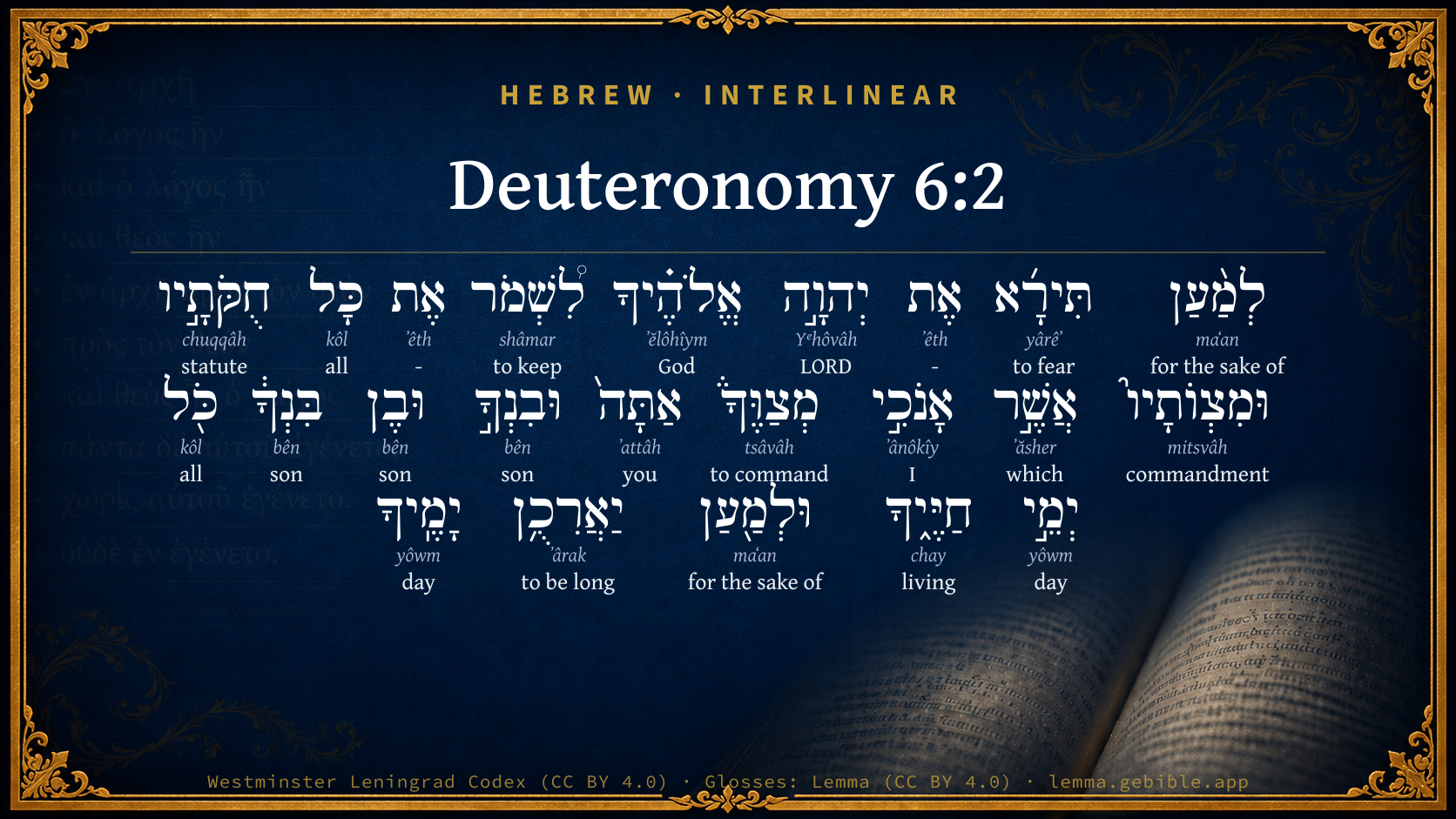
Deuteronomy 6:2

Hebrew (Westminster Leningrad Codex) Deuteronomy 6:2 appears in the Hebrew Old Testament. The text above is from the Westminster Leningrad Codex. Each word links to its Strong’s number, a concise gloss, and parsing drawn from the Open Scriptures Hebrew Bible morphology. Click any word for its full Brown-Driver-Briggs (BDB) entry.
Download image
Cite this verse

Deuteronomy 6:2 (World English Bible). Public Domain. Lemma interlinear Bible study tool, https://lemma.gebible.app/v/deuteronomy/6/2.

Show BibTeX & RIS
BibTeX
RIS
English Translation
that you might fear Yahweh your God, to keep all his statutes and his commandments, which I command you, you, and your son, and your son's son, all the days of your life; and that your days may be prolonged.
World English Bible · Public Domain
Download a study sheet

One document with this verse’s original text, its word-by-word gloss line, the meaning frame, cross-references with their text, attributed commentary, and full source and license credits — printable, and it pastes into notes with its structure intact.

This verse Autodidact and up

Study sheet (.html) Plain text (.txt)

A passage Seminary Student

Up to 50 verses in one chapter. A passage sheet keeps up to 6 commentary sources and 12 cross-references per verse, in the order this page ranks them, and says so on the sheet whenever that leaves anything out. Ask for a single verse and you get the Autodidact verse sheet above.

Everything on this page stays free to read, with no account — the sheet is a download of what is already on screen, not access to it.

Want to remove ads? Support Godless Engineer
Compare translations 3

The same verse in 3 English versions, stacked beneath the original-language interlinear above. Click any original word for its lexicon entry.

Each is an independent rendering of the whole verse — the interlinear is not word-aligned to these translations.

Highlighted words mark where these versions differ — a whole-verse word diff, not a word-by-word alignment.

  • World English Bible Public Domain
    that you might fear Yahweh your God, to keep all his statutes and his commandments, which I command you, you, and your son, and your son's son, all the days of your life; and that your days may be prolonged.
  • King James Version Public Domain
    That thou mightest fear the LORD thy God, to keep all his statutes and his commandments, which I command thee, thou, and thy son, and thy son's son, all the days of thy life; and that thy days may be prolonged.
  • unfoldingWord Literal Text CC BY-SA 4.0
    so that you will fear Yahweh your God, to keep all his statutes and his commandments that I am commanding you and your son and the son of your son, all the days of your life, and so that your days will be prolonged.

unfoldingWord Literal Text — © unfoldingWord, licensed CC BY-SA 4.0. Word-aligned USFM3 via Door43 (git.door43.org/unfoldingWord/en_ult).

Versions to compare (up to 4)

3 of 4 selected

Show all 18 translations

Every available English version of this verse, each an independent rendering of the whole verse.

  • World English Bible Public Domain
    that you might fear Yahweh your God, to keep all his statutes and his commandments, which I command you, you, and your son, and your son's son, all the days of your life; and that your days may be prolonged.
  • Berean Standard Bible Public Domain
    so that you and your children and grandchildren may fear the LORD your God all the days of your lives by keeping all His statutes and commandments that I give you, and so that your days may be prolonged.
  • Majority Standard Bible Public Domain
    so that you and your children and grandchildren may fear the LORD your God all the days of your lives by keeping all His statutes and commandments that I give you, and so that your days may be prolonged.
  • King James Version Public Domain
    That thou mightest fear the LORD thy God, to keep all his statutes and his commandments, which I command thee, thou, and thy son, and thy son's son, all the days of thy life; and that thy days may be prolonged.
  • American Standard Version (1901) Public Domain
    that thou mightest fear Jehovah thy God, to keep all his statutes and his commandments, which I command thee, thou, and thy son, and thy son's son, all the days of thy life; and that thy days may be prolonged.
  • Revised Version (1885) Public Domain
    that thou mightest fear the LORD thy God, to keep all his statutes and his commandments, which I command thee, thou, and thy son, and thy son’s son, all the days of thy life; and that thy days may be prolonged.
  • Geneva Bible (1599) Public Domain
    That thou mightest feare the Lord thy God, and keepe all his ordinances, and his commandements which I commaund thee, thou, and thy sonne, and thy sonnes sonne all the dayes of thy life, euen that thy dayes may be prolonged.
  • Douay-Rheims (1899) Public Domain
    That thou mayst fear the Lord thy God, and keep all his commandments and precepts, which I command thee, and thy sons, and thy grandsons, all the days of thy life, that thy days may be prolonged.
  • Young's Literal Translation Public Domain
    so that thou dost fear Jehovah thy God, to keep all His statutes and His commands, which I am commanding thee, thou, and thy son, and thy son's son, all days of thy life, and so that thy days are prolonged.
  • Literal Standard Version CC BY-SA 4.0
    so that you fear your God YHWH, to keep all His statutes and His commands which I am commanding you, you, and your son, and your son’s son, all [the] days of your life, and so that your days are prolonged.
  • Unlocked Literal Bible CC BY-SA 4.0
    so that you might honor Yahweh your God, so as to keep all his statutes and commandments that I am commanding you—you, your sons, and your sons' sons, all the days of your lives, so that your days may be prolonged.
  • unfoldingWord Literal Text CC BY-SA 4.0
    so that you will fear Yahweh your God, to keep all his statutes and his commandments that I am commanding you and your son and the son of your son, all the days of your life, and so that your days will be prolonged.
  • Darby Bible Public Domain
    that thou mayest fear Jehovah thy God, to keep all his statutes and his commandments which I command thee, thou, and thy son, and thy son's son, all the days of thy life; and that thy days may be prolonged.
  • World Messianic Bible Public Domain
    that you might fear the LORD your God, to keep all his statutes and his commandments, which I command you—you, your son, and your son’s son, all the days of your life; and that your days may be prolonged.
  • Webster's Bible Public Domain
    That thou mayst fear the LORD thy God, to keep all his statutes and his commandments which I command thee, thou, and thy son, and thy son's son, all the days of thy life: and that thy days may be prolonged.
  • Free Bible Version CC BY-SA 4.0
    This is so you and your children and grandchildren will show respect to the Lord your God throughout your lives by keeping all his rules and regulations that I give you, and so that you may have a long life.
  • Bible in Basic English Public Domain
    So that living in the fear of the Lord your God, you may keep all his laws and his orders, which I give you: you and your son and your son's son, all the days of your life; and so that your life may be long.
  • JPS Tanakh (1917) Public Domain
    that thou mightest fear the LORD thy God, to keep all His statutes and His commandments, which I command thee, thou, and thy son, and thy son's son, all the days of thy life; and that thy days may be prolonged.

Literal Standard Version (2020), Covenant Press — licensed CC BY-SA 4.0. Text via the HelloAO Bible API (eBible.org). Unlocked Literal Bible (unfoldingWord) — licensed CC BY-SA 4.0. Text via the HelloAO Bible API (eBible.org). unfoldingWord Literal Text — © unfoldingWord, licensed CC BY-SA 4.0. Word-aligned USFM3 via Door43 (git.door43.org/unfoldingWord/en_ult). Free Bible Version, Dr. Jonathan Gallagher — licensed CC BY-SA 4.0. Text via the HelloAO Bible API (eBible.org).

Word by word

More ways to search: Search by grammar → Find every occurrence → Compare this word →

Practice this passage: Drill this verse → Learn its vocabulary →

יַאֲרִכֻ֥ן
ʼârak
H748
“to be long”
Verb, Hiphil, Imperfect, 3rd Person, Masculine, Plural + Suffix, n
Part of Speech
Verb
Stem
Hiphil
Form
Imperfect
Person
3rd Person
Gender
Masculine
Number
Plural
Full BDB Definition

Origin: a primitive root

TWOT: 162

to be long, prolong - (Qal) to be long - (Hiphil) - to prolong (days) - to make long (tent cords) - to grow long, continue long
  1. לְמַ֨עַן maʻan H4616 “for the sake of” Preposition
  2. תִּירָ֜א yârêʼ H3372 “to fear” Verb, Qal, Imperfect, 2nd Person, Masculine, Singular
  3. אֶת ʼêth H853 “-” Particle, Direct Object
  4. יְהוָ֣ה Yᵉhôvâh H3068 “LORD” Noun, Proper
  5. אֱלֹהֶ֗יךָ ʼĕlôhîym H430 “God(s) · your” Noun, Common, Masculine, Plural, Construct + Suffix, Personal, 2nd Person, Masculine, Singular
  6. לִ֠שְׁמֹר shâmar H8104 “to keep” Preposition + Verb, Qal, Infinitive Construct
  7. אֶת ʼêth H853 “-” Particle, Direct Object
  8. כָּל kôl H3605 “all of” Noun, Common, Masculine, Singular, Construct
  9. חֻקֹּתָ֣יו chuqqâh H2708 “statutes · his” Noun, Common, Both, Plural, Construct + Suffix, Personal, 3rd Person, Masculine, Singular
  10. וּמִצְוֺתָיו֮ mitsvâh H4687 “and · commandments · his” Conjunction + Noun, Common, Feminine, Plural, Construct + Suffix, Personal, 3rd Person, Masculine, Singular
  11. אֲשֶׁ֣ר ʼăsher H834 “which” Particle, Relative
  12. אָנֹכִ֣י ʼânôkîy H595 “I” Pronoun, Personal, 1st Person, Common, Singular
  13. מְצַוֶּךָ֒ tsâvâh H6680 “commanding · you” Verb, Piel, Participle Active, Masculine, Singular, Construct + Suffix, Personal, 2nd Person, Masculine, Singular
  14. אַתָּה֙ ʼattâh H859 “you” Pronoun, Personal, 2nd Person, Masculine, Singular
  15. וּבִנְךָ֣ bên H1121 “and · son · your” Conjunction + Noun, Common, Masculine, Singular, Construct + Suffix, Personal, 2nd Person, Masculine, Singular
  16. וּבֶן bên H1121 “and · son of” Conjunction + Noun, Common, Masculine, Singular, Construct
  17. בִּנְךָ֔ bên H1121 “son · your” Noun, Common, Masculine, Singular, Construct + Suffix, Personal, 2nd Person, Masculine, Singular
  18. כֹּ֖ל kôl H3605 “all of” Noun, Common, Masculine, Singular, Construct
  19. יְמֵ֣י yôwm H3117 “days of” Noun, Common, Masculine, Plural, Construct
  20. חַיֶּ֑יךָ chay H2416 “living things · your” Noun, Common, Masculine, Plural, Construct + Suffix, Personal, 2nd Person, Masculine, Singular
  21. וּלְמַ֖עַן maʻan H4616 “and · for the sake of” Conjunction + Preposition
  22. יָמֶֽיךָ yôwm H3117 “days · your” Noun, Common, Masculine, Plural, Construct + Suffix, Personal, 2nd Person, Masculine, Singular

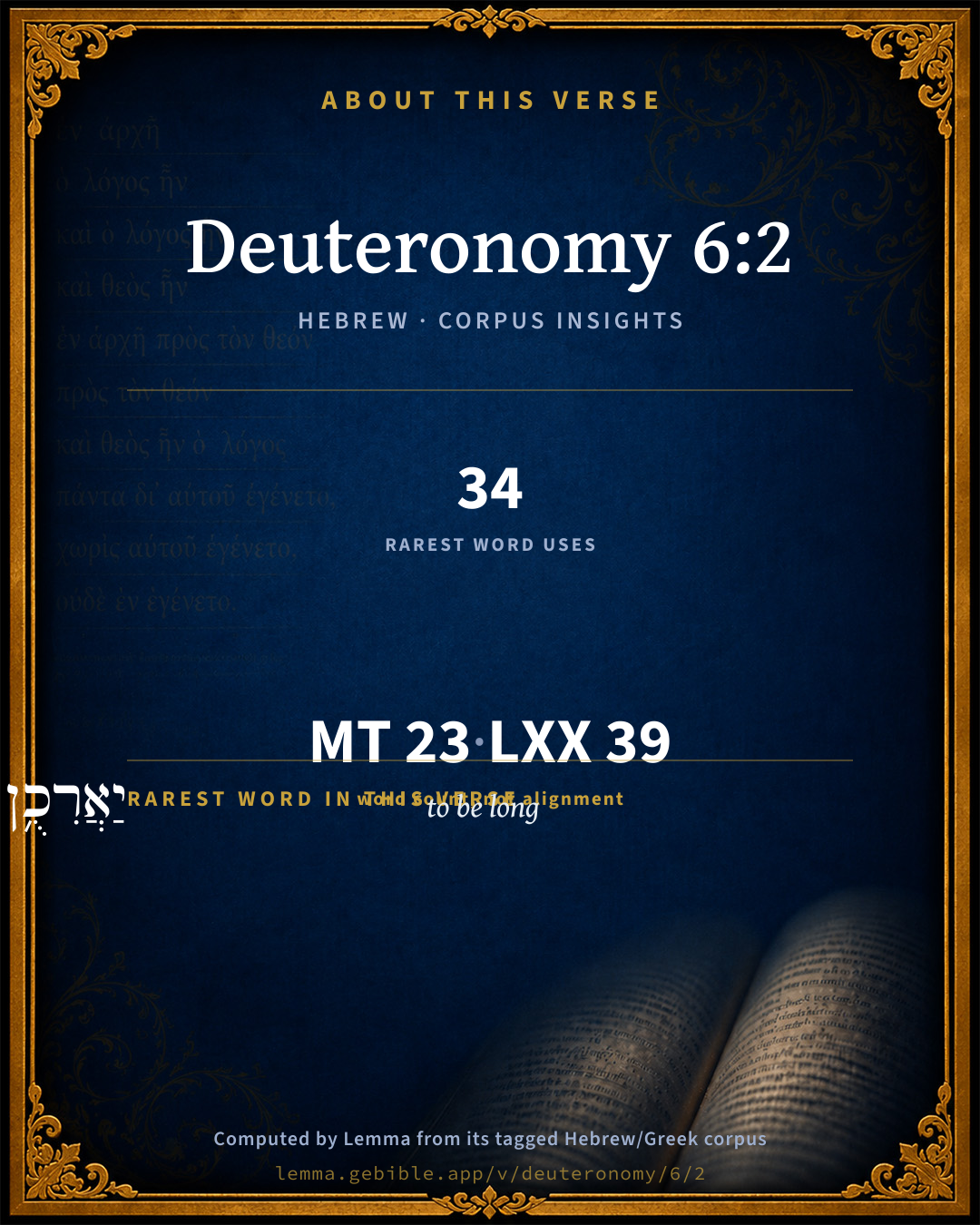
About this verse

These counts appear in no published source. They are computed here, from the morphology-tagged text and Lemma’s own curated glosses. What Lemma adds →

23
words
17
distinct lemmas
Pentateuch
section

Shared distinctive vocabulary

יַאֲרִכֻ֥ן to be long H748 occurs in 34 verses of the Hebrew Bible. Also found in:

Grammatical profile

  • 4 verbs
  • 12 nouns
  • 2 pronouns
  • 2 prepositions
  • 3 particles

Verb forms

  • תִּירָ֜א Qal · Imperfect
  • לִ֠שְׁמֹר Qal · Infinitive Construct
  • מְצַוֶּךָ֒ Piel · Participle Active
  • יַאֲרִכֻ֥ן Hiphil · Imperfect

Repetition

Words recur within this verse — often emphatic in Hebrew:

  • וּבִנְךָ֣ son H1121 ×3
  • לְמַ֨עַן for the sake of H4616 ×2
  • כָּל all H3605 ×2
  • יְמֵ֣י day H3117 ×2

Hebrew & Septuagint length

In English translation the verse runs 40 words from the Hebrew and 41 from the Septuagint (LXX English) — closely comparable.

A rough comparison of the two English renderings, which tokenize alike — not a word-level alignment.

Word counts can differ between the Hebrew and the Greek without any difference in meaning — e.g. the Hebrew direct-object marker אֵת has no separate Greek word, and Greek often adds the article ὁ.

In the original languages it is 23 Hebrew tokens and 39 Greek tokens — but the two are counted differently (Hebrew bundles its prefixes and suffixes into one token; the Greek is in lemma form), so that isn’t a like-for-like length.

Cross-references

23

Topical passages linked to Deuteronomy 6:2 in the Treasury of Scripture Knowledge — connected by theme and wording, ordered by reader-vote popularity; previews shown in the World English Bible.

  • Deuteronomy 4:40 You shall keep his statutes, and his commandments, which I command you this day, that it may go well with you, and with your children after you, and that you may prolong your days in the land, which Yahweh your God gives you, forever.
  • Exodus 20:20 Moses said to the people, "Don't be afraid, for God has come to test you, and that his fear may be before you, that you won't sin."
  • Deuteronomy 13:4 You shall walk after Yahweh your God, and fear him, and keep his commandments, and obey his voice, and you shall serve him, and cleave to him.
  • Ecclesiastes 12:13 This is the end of the matter. All has been heard. Fear God, and keep his commandments; for this is the whole duty of man.
  • Psalms 128:1 Blessed is everyone who fears Yahweh, Who walks in his ways.
  • Proverbs 3:1–2 My son, don't forget my teaching; But let your heart keep my commandments:
  • Proverbs 3:16 Length of days is in her right hand. In her left hand are riches and honor.
  • Deuteronomy 5:16 "Honor your father and your mother, as Yahweh your God commanded you; that your days may be long, and that it may go well with you, in the land which Yahweh your God gives you.
  • Job 28:28 To man he said, 'Behold, the fear of the Lord, that is wisdom. To depart from evil is understanding.'"
  • 1 Peter 3:10–11 For, "He who would love life, And see good days, Let him keep his tongue from evil, And his lips from speaking deceit.
  • Deuteronomy 10:20 You shall fear Yahweh your God; him shall you serve; and to him shall you cleave, and by his name shall you swear.
  • Psalms 78:4–8 We will not hide them from their children, Telling to the generation to come the praises of Yahweh, His strength, and his wondrous works that he has done.
  • Psalms 111:10 The fear of Yahweh is the beginning of wisdom. All those who do his work have a good understanding. His praise endures forever!
  • Luke 12:5 But I will warn you whom you should fear. Fear him, who after he has killed, has power to cast into Gehenna. Yes, I tell you, fear him.
  • 1 Peter 1:17 If you call on him as Father, who without respect of persons judges according to each man's work, pass the time of your living as strangers here in reverent fear:
  • Genesis 18:19 For I have known him, to the end that he may command his children and his household after him, that they may keep the way of Yahweh, to do righteousness and justice; to the end that Yahweh may bring on Abraham that which he has spoken of him."
  • Genesis 22:12 He said, "Don't lay your hand on the boy, neither do anything to him. For now I know that you fear God, seeing you have not withheld your son, your only son, from me."
  • Deuteronomy 4:10 the day that you stood before Yahweh your God in Horeb, when Yahweh said to me, Assemble me the people, and I will make them hear my words, that they may learn to fear me all the days that they live on the earth, and that they may teach their children.
  • Deuteronomy 5:33 You shall walk in all the way which Yahweh your God has commanded you, that you may live, and that it may be well with you, and that you may prolong your days in the land which you shall possess.
  • Deuteronomy 6:7 and you shall teach them diligently to your children, and shall talk of them when you sit in your house, and when you walk by the way, and when you lie down, and when you rise up.
  • Deuteronomy 22:7 you shall surely let the hen go, but the young you may take to yourself; that it may be well with you, and that you may prolong your days.
  • Proverbs 16:6 By mercy and truth iniquity is atoned for. By the fear of Yahweh men depart from evil.
  • Deuteronomy 10:12–13 Now, Israel, what does Yahweh your God require of you, but to fear Yahweh your God, to walk in all his ways, and to love him, and to serve Yahweh your God with all your heart and with all your soul,

Cross-references courtesy of OpenBible.info (CC BY 4.0).

Hebrew and Greek witnesses Masoretic Hebrew ↔ Greek Septuagint

The same verse in the two great witnesses to the Old Testament, shown verse-for-verse.

These are two independent witnesses, not word-aligned to each other, and the Septuagint is shown in lemma (dictionary) form.

Hebrew Deuteronomy 6:2 Masoretic · Westminster Leningrad Codex

לְמַ֨עַן תִּירָ֜א אֶת יְהוָ֣ה אֱלֹהֶ֗יךָ לִ֠שְׁמֹר אֶת כָּל חֻקֹּתָ֣יו וּמִצְוֺתָיו֮ אֲשֶׁ֣ר אָנֹכִ֣י מְצַוֶּךָ֒ אַתָּה֙ וּבִנְךָ֣ וּבֶן בִּנְךָ֔ כֹּ֖ל יְמֵ֣י חַיֶּ֑יךָ וּלְמַ֖עַן יַאֲרִכֻ֥ן יָמֶֽיךָ

that you might fear Yahweh your God, to keep all his statutes and his commandments, which I command you, you, and your son, and your son's son, all the days of your life; and that your days may be prolonged.

World English Bible · Public Domain

Greek LXX Deuteronomy 6:2 Septuagint · lemma form

ἵνα φοβέω κύριος ὁ θεός σύ φυλάσσω πᾶς ὁ δικαίωμα αὐτός καί ὁ ἐντολή αὐτός ὅσος ἐγώ ἐντέλλομαι σύ σήμερον σύ καί ὁ υἱός σύ καί ὁ υἱός ὁ υἱός σύ πᾶς ὁ ἡμέρα ὁ ζωή σύ ἵνα μακροημερεύω

That you⌃ may fear the Lord your God, keep you⌃ all his ordinances, and his commandments, which I command you today, you, and your sons, and your sons' sons, all the days of your life, that you⌃ may live many days.

LXX2012 (modern English Septuagint) · Public Domain

Hebrew: Westminster Leningrad Codex (CC BY 4.0). Greek: Septuagint (public domain); English from LXX2012 (modern English Septuagint) (Public Domain). How the Septuagint differs from the Hebrew →

Targum (Aramaic paraphrase)

2

The Targum is the ancient Jewish Aramaic paraphrase of the Hebrew Scriptures — an interpretive translation, not the Hebrew text itself. Onkelos (literal) and Pseudo-Jonathan (expansive) render the Torah, and Jonathan the Prophets. Coverage is partial: where no permissively-licensed English translation exists for a verse, only the Aramaic is shown. This is verse-level text, not a word-by-word alignment to the Hebrew.

  1. Targum Onkelos Torah (Genesis–Deuteronomy)
    בְּדִיל דְתִדְחַל קֳדָם יְיָ אֱלָהָךְ לְמִטַר יָת כָּל קְיָמוֹהִי וּפִקוּדוֹהִי דִי אֲנָא מְפַקְדָךְ אַתְּ וּבְרָךְ וּבַר בְּרָךְ כָּל יוֹמֵי חַיָיךְ וּבְדִיל דְיוֹרְכוּן יוֹמָיךְ

    (no public-domain English translation for this verse)

    Targum Onkelos — Aramaic: “Onkelos Genesis” (public domain); “Onkelos Exodus” (public domain); “Onkelos Leviticus” (public domain); “Onkelos Numbers” (public domain); “Onkelos Deuteronomy” (public domain). English: “Sefaria Community Translation” (CC0 1.0 (public-domain dedication)); “J.W. Etheridge. The Targums of Onkelos and Jonathan Ben Uzziel on the Pentateuch. London: Longmans, Green, 1862” (public domain). Text via Sefaria.

  2. Targum Pseudo-Jonathan Torah (Genesis–Deuteronomy)
    מִן בִּגְלַל דְּתִדְחַל קֳדָם יְיָ אֱלָהָךְ לְמִנְטַר כָּל קְיָימוֹהִי וּפִיקוּדוֹהִי דַאֲנָא מְפַקֵיד לָךְ אַנְתְּ וּבְרָךְ וּבַר בְּרָךְ כָּל יוֹמֵי חַיָּיךְ וּמִן בִּגְלַל דְּיוֹרְכוּן יוֹמָךְ

    that thou mayest fear the Lord thy God, and keep all His statutes and precepts which I command thee; thou, thy son, and the son of thy son, all the days of thy life; and that thou mayest prolong thy days.

    Targum Pseudo-Jonathan — Aramaic: “Targum Jonathan on Genesis” (public domain); “Targum Jonathan on Exodus” (public domain); “Targum Jonathan on Leviticus” (public domain); “Targum Jonathan on Numbers” (public domain); “Targum Jonathan on Deuteronomy” (public domain). English: “The Targum of Jonathan ben Uzziel, trans. J. W. Etheridge, London, 1862” (public domain). Text via Sefaria.

Commentary

Notes on Deuteronomy 6:2 from classic Christian and Jewish commentators (each source and its license shown beneath its notes). The classic Christian expositions comment on the surrounding passage and are grouped to its opening verse, so a note may address several verses; the Jewish commentaries on the Tanakh (Rashi and others) are per-verse, so they appear only where the commentator wrote on this verse.

Lemma curates 59 commentaries, every one of them public domain or Creative Commons licensed, each selected and text-cleaned for this edition rather than reprinted as found. About our sources →

The Cambridge Bible for Schools and Colleges

gen. ed. J. J. S. Perowne

2. fear Jehovah thy God] Deu_10:12; Deu_10:20.

all his statutes and his commandments] Note the variation from Deu_6:1.

which I command thee] am about to command thee.

that thy days may be prolonged] See on Deu_5:33.

2, 3. Transition to the Sg. with a somewhat loose accumulation of common deuteronomic formulas; on these grounds regarded by some as an editorial addition. This is not certain, but very probable. Omit Deu_6:2-3, and Deu_6:4 follows naturally on Deu_6:1 as the beginning of the Miṣwah, but couched, like the Decalogue in ch. 5, in the Sg. At the same time all of Deu_6:2-3 need not be editorial. Note that the one Pl. clause they contain is not a common formula.

The Cambridge Bible for Schools and Colleges (gen. ed. J. J. S. Perowne; Cambridge University Press, 1878–1918) — public domain. Text from a community e-Sword module.

Trapp's Complete Commentary

John Trapp

Deu 6:2 That thou mightest fear the LORD thy God, to keep all his statutes and his commandments, which I command thee, thou, and thy son, and thy son’s son, all the days of thy life; and that thy days may be prolonged.

Ver. 2. That thou mightest fear the Lord.] "Fear God and keep his commandments." {Ecc 12:13} "Fear the Lord and depart from evil," {Pro 16:6} "this is the beginning," {Pro 1:7} and "end of all" {Ecc 12:13} This is the whole of man, or as some read it, This is the whole man {a} ( ibidem). It is a problem in Aristotle, Why men are credited more than any other creatures? The answer is, Man alone reverenceth God. {b} Deum siquis parum metuit, valde contemnit: huius qui non memorat beueficentiam, auget iniuriam: Not to fear God is to slight him; as not to praise him is to wrong him, saith an ancient.

{a} Hoc est enim totus homo.

{b} οπι θεονς νομιζει μονον. - Fulgentius.

John Trapp, A Commentary or Exposition upon All the Books of the Old and New Testament (1647–1656) — public domain. Text from a community e-Sword module.

The Biblical Illustrator

Joseph S. Exell

Deu_6:2-4

Thou shalt smite them and utterly destroy them.

Wars of the Israelites

There is, perhaps, no point on which the weakness of human nature is more clearly shown than in the difficulty of treading the right path between persecution on the one hand, and indifference to evil on the other. For although we are, it may be, disposed according to our several tempers more to one of these faults than to the other, yet I fear it is true also that none of us are free from the danger of falling into them both. If we have today been too violent against the persons of evil men whom we do not like, this is no security against our being tomorrow much too forbearing towards the practices of evil men whom we do like; because we are all apt to respect persons in our judgment and in our feelings; sometimes to be too severe, and sometimes too indulgent, not according to justice, but according to our own likings and dislikings. Nor is it respect of persons only which thus leads us astray, but also our own particular sympathy with, or disgust at particular faults and characters. Even in one whom we may like, on the whole, there may be faults which we may visit too hardly, because they are exactly such as we feel no temptation to commit. And again, in one whom we dislike on the whole, there may, for the same reason, be faults which we tolerate too easily, because they are like our own. There is yet a third cause, and that a very common one, which corrupts our judgment. We may sympathise with such and such faults generally, because we are ourselves inclined to them; but if they happen to be committed against us, and we feel the bad effects of them, then we are apt to judge them in that particular case too harshly. Or again, we may rather dislike a fault in general, but when it is committed on our own side, and to advance our own interests, then in that particular case we are tempted to excuse it too readily. There are these dangers besetting us on the right hand and on the left, as to our treatment of other mens faults. And in Scripture we find very strong language against the error on either side. A great deal is said against violence, wrath, uncharitableness, harsh judgment of others, and attempting or pretending to work Gods service by our own bad passions, and a great deal is also said against tolerating sin, against defiling ourselves with evil-doers, against preferring our earthly friendships to the will and service of God. Of these latter commands the words of the text furnish us with a most remarkable instance. We see how strong and positive the language is (Deu_7:2); and the reason is given (Deu_7:4). It is better that the wicked should be destroyed a hundred times over, yea, destroyed with everlasting destruction, than that they should tempt those who are as yet innocent to join their company. And if we are inclined to think that God dealt hardly with the people of Canaan in commanding them to be so utterly destroyed, let us but think what might have been our fate, and the fate of every other nation under heaven at this hour, had the sword of the Israelites done its work more sparingly. The Israelites fought not for themselves only, but for us. Whatever were the faults of Jephthah or of Samson, never yet were any men engaged in a cause more important to the whole worlds welfare. Their constant warfare kept Israel essentially distinct from the tribes around them, their own law became the dearer to them because they found such unceasing enemies amongst those who hated it. The uncircumcised, who kept not the covenant of God, were forever ranged against those who did keep it. It might follow that the Israelites should thus be accounted the enemies of all mankind, it might be that they were tempted by their very distinctness to despise other nations; still, they did Gods work; still, they preserved unhurt the seed of eternal life, and were the ministers of blessing to all other nations, even though they themselves failed to enjoy it. But still these commands, so forcible, so fearful--to spare none--to destroy the wicked utterly--to show no mercy--are these commands addressed to us now? or what is it which the Lord bids us do? Certainly, He does not bid us shed blood, or destroy the wicked, or put on any hardness of heart which might shut out the charity of Christs perfect law. But there is a part of the text which does apply to us now in the letter, thereby teaching us how to apply the whole to ourselves in the spirit. Be ye not unequally yoked together in marriage with unbelievers. For what concord hath Christ with Belial? It is, indeed, something shocking to enter into so near and dear a connection as marriage with those who are not the servants of God. It is fearful to think of giving birth to children whose eternal life may be forfeited through the example and influence of him or of her through whom their earthly life was given. But though this be the worst and most dreadful case, still it is not the only one. St. Paul does not only speak against marriage with the unbelievers; he speaks also no less strongly against holding friendly intercourse with those who call themselves Christs, yet in their lives deny Him (1Co_5:11). We need not actually refuse to eat with those whose lives are evil; but woe to us if we do not shrink from any closer intimacy with them; if their society, when we must partake of it, be not painfully endured by us, rather than enjoyed. We may put away from among ourselves that wicked person; put him away, that is, from our confidence, put him away from our esteem; put him altogether away from our sympathy. We are on services wholly different; our masters are God and Mammon; and we cannot be united closely with those to whom our dearest hopes are their worst fears, and to whom that resurrection which, to the true servant of Christ, will be his perfect consummation of bliss, will be but the first dawning of an eternity of shame and misery. (T. Arnold, D. D.)

Destruction of the Canaanites

The extermination of the Canaanites forces itself on the attention of the most careless reader of the Old Testament. We cannot deny that there is a difficulty which needs explanation: we cannot doubt that such a judgment was meant to give to every age a solemn and needful warning.

1. In the first place, it behoves us to understand that this destruction was not a punishment for idolatry. The war of Israel in Canaan did not resemble a crusade. The Canaanites perished, not because they had bowed down to false gods, or refused to worship the true God, but because they had made themselves utterly abominable. This is clear from Lev_18:24. The Canaanites perished because the earth could no longer bear them: the safety of the whole demanded their extirpation.

2. We observe, further, that they did not perish without warning. The sites of Sodom and Gomorrah, once like the garden of Eden in loveliness, withered and burnt up by fire from heaven, and at length turned into a bituminous lake, showed the end of those sins by which the land was defiled. It was a memorial not to be forgotten. The Dead Sea was a phenomenon which forced the inquiry, Wherefore hath God done this? The forty years sojourn in the wilderness was not only fraught with blessing to Israel and instruction to the Church, but it gave to the Canaanites time to consider and repent. It produced this effect on Rahab and on the Gibeonites, who humbled themselves under the hand of God and were spared. The rest of the nations of Canaan heard and feared, but repented not. We may not, then, marvel that the cup of wrath which such habitual and audacious wickedness had filled was deep and deadly. Yet the destruction is not without its parallels. Many modern campaigns have produced a greater loss of life and far intenser misery. The sword appalls us by its fierceness; but it is more merciful than the famine and the pestilence, which in our own days have ravaged large portions of the globe. It cuts short the suspense which is more grievous than death; it inflicts no lingering pain. Besides, this was the only judgment in which idolaters would have seen the hand of the God of Israel. Had they perished in thousands by want or disease they would have attributed this to the displeasure of Moloch or Baal. But they ever regarded battle as the trial of deities. So, when the iron chariots had been broken in the valleys, and the rocky fastness and fenced city had failed to protect the Anakim, all who felt the sword of Israel and all to whom the tidings came were forced to confess that Jehovah was to be feared above all gods. Hence we may see what Israel and all other nations were to learn from these wars in Canaan.

1. They learnt, first, Gods absolute sovereignty, His right and property, in the life of man, and therefore ill everything by and for which man lives. If, then, the Canaanite had no property in his life, nor power to retain it when God demanded it, we dare not claim more than stewardship of anything that we call ours. The largest possessions, the richest intellectual gifts, are less than the life. These, then, are at the disposal of Him who is the Lord of life. If we use them as Gods servants they will secure to us everlasting possessions; but from the unfaithful steward shall be taken even that which he seemeth to have.

2. Again, God manifested that man hath something better than life. Our hearts may be harrowed or sickened at the thought that the sword of Israel struck down not only the boastful warrior, but the feeble woman and the blooming child and the infant at the breast. But the same suffering and death of the weak and the graceful and the pure is continually forcing itself on our attention in every epidemic, in public calamities, and in the more frequent casualties of private life, in Indian and Syrian massacres, and even at the birth of Christ Himself, when Rachel was weeping for her children. All this piercing and cutting down of the young and the tender and the promising would be inexplicable if we had not the revelation of a higher life, for which suffering and the contact with suffering are the preparation. (M. Biggs, M. A.)

A noble resolve

Eliza Embert, a young Parisian lady, resolutely discarded a gentleman to whom she was to have been married the next day because he ridiculed religion. Having given him a gentle reproof for some impropriety, he replied that a man of the world would not be so old-fashioned as to regard God and religion. Eliza immediately started; but soon recovering herself, said, From this moment, as I discover you do not respect religion, I cease to be yours.

The danger of a morally vitiated atmosphere

Some time ago the following strange occurrence happened at St. Cierge, a village in the Jura. The principal room of an inn there, known as the Cerf, was lighted by a hanging petroleum lamp, above which had been placed, for the protection of the ceiling, a metal plate. In course of time the woodwork above the plate became desiccated, and one evening it took fire, and when the innkeeper and his family retired to rest was all aglow--a fact, however, which they do not seem to have noticed. From the ceiling the fire was communicated to the room above, and was first discovered by a neighbour, who, early next morning, observing smoke issuing from the door, gave an alarm, when, as none of the inmates could be aroused, the door was broken open. The fire, having gone on smouldering without bursting into flame, had done little material damage, and was easily extinguished; but all the people in the house--the landlord, his wife and sister--were dead. After the manner of country people, they had firmly closed their windows before going to bed, and the smoke, having no exit, had asphyxiated every one of them. In like manner those who allow a morally vitiated atmosphere to surround them, and willingly inhale its pestiferous fumes, wither and become spiritually suffocated.

The loss of spiritual tone

Animals that live in two elements are awkward in both. Do we find it difficult, even after the most innocent and unexceptionable entertainments, to brace the soul for its devotions? Do not our pinions flap languidly as we attempt our upward flight? And is it not the case that many of the so-called amusements which men pursue are in the last degree unfavourable to those exercises, without a constant application to which the highest zones of religious experience, the snowy summits of a pure spirituality--those glistening peaks that are the first to catch the auroral glow of the rising Sun of Righteousness, and the last to lose His evening beams--cannot be reached and maintained? To spoil a harp, you need not rudely break its strings and batter its sounding-board. Remove it from one temperature to another, and the mischief is done. We cannot say that people are not hurt by these things because they are not made openly and scandalously vicious. I maintain that a man has sustained a dire and irreparable, though a subtle, and at first impalpable injury, when he has lost his spiritual tone. (J. Halsey.)

The Biblical Illustrator, edited by Joseph S. Exell (c. 1880s–1900s) — public domain. Text from a community e-Sword module.

Tyndale Open Study Notes

Tyndale Open Resources

6:2 God’s awesome power and glory (see 4:10) require that God’s people fear him, treating him with respect and reverence (see study notes on 7:21; 10:12-13).

Tyndale Open Study Notes — © Tyndale Open Resources, licensed CC BY-SA 4.0. Text via the HelloAO Bible API.

Geneva Bible (1599)

Geneva Bible translators

A reverent face and love of God is the first beginning to keep God’s commandments.

Geneva Bible (1599) marginal notes — public domain. Text via Bolls.life.

Adam Clarke's Commentary

Verse 2. That thou mightest fear the Lord] Respect his sovereign authority as a lawgiver, and ever feel thyself bound to obey him. No man can walk either conscientiously or safely who has not the fear of God continually before his eyes. When this is gone, more than a guardian angel is fled.

Thou, and thy son, and thy son's son] Through all thy successive generations. Whoever fears God will endeavour to bring up his children in the way of righteousness, that they also may fear God, and that pure and undefiled religion may be preserved in his family through all its generations, not only in word, but in practice also.

Adam Clarke's Commentary on the Bible (1810–1826) — public domain. Text from a community e-Sword/MySword module.

John Gill's Exposition

That thou mightest fear the Lord thy God,.... Being taught to know the greatness of his being, and the nature of his mind and will, and the manner of his worship; and not with a slavish fear, but with a filial one, a reverential affection for God; being instructed in their duty, as of children, to their God and Father; see Deu 5:29.

to keep all his statutes, and his commandments, which I command thee; not in his own name, but in the name, and by the authority of God, whose minister and messenger he was; and all, having the stamp of divine authority on them, were to be observed and kept, and not one to be neglected or departed from:

thou, and thy son, and thy son's son, all the days of thy life; a man and his children, and grandchildren; he was to take care that they kept all the commandments of the Lord as long as he lived, and had any concern with them:

and that thy days may be prolonged; long life being reckoned a very great outward mercy; a long enjoyment of, and continuance in the land of Canaan, is chiefly designed, which is usually expressed when this is observed; see Deu 4:26.

John Gill's Exposition of the Whole Bible (1746–1763) — public domain (CC PDM 1.0). Text via the HelloAO Bible API.

Matthew Poole's English Annotations

That thou mightest fear the Lord, which he hereby implies to be the first principle of true obedience.

Matthew Poole's English Annotations on the Holy Bible (1683–1685) — public domain. Text from a community e-Sword/MySword module.

The Pulpit Commentary

The reason for this announcement of the Law was that the people might fear the Lord, so as to keep all that he enjoined, they and their children, from generation to generation, and that they might thereby continue long in life, and in the enjoyment of the advantages accruing from the land of which they were about to take possession.

HOMILIES BY J. ORR

Descending obligations.

I CHILDREN WITH THEIR PARENTS ARE INCLUDED IN THE COVENANT. This has been a general principle in God"s dealings with his servants. We have it affirmed, both in the covenant with Abraham (Gen_17:7-15) and in the later covenant with Israel. (Deu_29:10-12) It was signified in the rite of circumcision. The Israelitish child was regarded as within the covenant, a genuine member of the theocracy, till by a personal act of apostasy if unfortunately it should be so he severed himself from its blessings. Similar language is used of the children of Christian believers. (1Co_8:1-4) Received into the Church by baptism, they are recognized with their parents as interested in the promise; they are expected, on coming to years of discretion, freely to appropriate the obligations of the Christian life; and they are, in case of refusal, justly regarded as apostates from Christ.

II THE STANDING OF CHILDREN IN THE COVENANT ENTAILS SERIOUS OBLIGATIONS ON THE PARENTS.

1. Religious instruction. (vers. 6, 7, 20; Exo_13:8, Exo_13:14, etc.) The children had not been personally at Horeb. They had not seen the mighty works of God in Egypt and the desert. It was the duty cf. parents to acquaint them with the history, and to instruct them in their duties.

2. Religious training, which is education in act, as instruction is education in word. (Gen_18:19; Deu_21:18; Pro_29:15, etc.)

3. Religious example. The parent is to be one who loves the Lord for himself (ver. 5). The Word is to be in his own heart (ver. 6). Only thus will he teach with effect. All this has its counterpart in the duties of Christian parents (Eph_4:4; 1Ti_3:4; 2Ti_3:15, etc.)

III THE STANDING OF CHILDREN IN THE COVENANT ENTAILS SERIOUS OBLIGATIONS ON THE CHILDREN. Where parental duties had been fulfilled, the Israelitish child was under the most sacred obligations to choose and adhere to the God of his fathers, and to serve him in the way prescribed. There was in this no interference with freedom, for when God proposes covenant relations to a human being, while it is his privilege, it can never be aught else than his duty to accept them. In the Christian Church, a like obligation rests on the children of believers. The baptized child is bound to serve God, and, if properly instructed, (Mat_28:19) it cannot evade the responsibilities thus laid upon it. Great is the guilt of a child brought up in a Christian home if wantonly it apostatizes. J.O.

The Pulpit Commentary (1880–1919), ed. H.D.M. Spence-Jones & Joseph S. Exell — public domain. Text from a community e-Sword module.

Ramban (Nachmanides)

Rabbi Moshe ben Nachman (Ramban / Nachmanides)

THAT THOU MIGHTEST FEAR THE ETERNAL THY G-D. He is stating that G-d commanded [me] to teach you the Torah and the commandment, the statutes and the ordinances that you might perform them in the Land, and so that you might fear the Eternal your G-d, for the main purpose of all the commandments is the fear of G-d. This is Rabbi Abraham [ibn Ezra’s] opinion. But it does not seem correct to me that [the two expressions in the verse before us:] that thou mightest fear the Eternal thy G-d, and that thy days may be prolonged [are referring to two different aspects of the commandments] one being the reason for the commandments — so that you might fear G-d; and the second stating their reward — so that your days may be prolonged! Rather, he is stating, “G-d commanded me that you should learn the commandments and perform them in order that you should merit and fear the Eternal your G-d in order to keep His commandments thou, and thy son, and thy son’s son for all the days that man shall exist upon the face of the earth, forever. For in return for the performance of the commandments you will deserve to have children who fear G-d and they will survive upon the face of the earth forever. So shall your seed and your name remain before Him all the days that thy days may be prolonged in the Land which is the inheritance of G-d. Thus all is for your good, for G-d was pleased to make you righteous and deserving [of His blessings].”

Ramban (Nachmanides) on the Tanakh — English translation: “Commentary on the Torah by Ramban (Nachmanides). Translated and annotated by Charles B. Chavel. New York, Shilo Pub. House, 1971-1976” (CC BY 4.0). Text via Sefaria.

Lesson kit

Teaching starters — assembled from the data on this page, not authored interpretation. Every prompt links to the verse data it draws on. Edit before teaching.

Deuteronomy, in the Pentateuch, opens this verse with 23 words (17 distinct Hebrew lemmas). Its most distinctive word is ʼârak (“to be long”). A historical commentator’s framing appears above. Read the whole chapter for the surrounding context.

Discussion questions

  1. The word ʼârak carries the sense “to be long.” How does it shape the verse?
  2. How does Genesis 26:8, which shares the word «to be long», read alongside this verse?
  3. What does the repetition of “son” (3× in this one verse) do in this verse?
  4. These translations render this verse differently; the difference is in the English rendering, not the original. What questions does that raise?
  5. «תִּירָ֜א» is a Qal Imperfect verb. How does that grammatical form shape the action described?
  6. Compare how The Cambridge Bible for Schools and Colleges and Trapp's Complete Commentary read this verse. Where do they agree or differ?

Things to notice

Reading settings

Reading text

Shown beneath each verse's original-language words.

Old Testament
Old Testament edition

Read the OT as the Masoretic Hebrew (MT) or the Greek Septuagint (LXX).

English shown for the Greek Septuagint (in the Hebrew ↔ Greek comparison).

Comparing translations? Open the Compare panel on any verse page to stack up to four side by side.