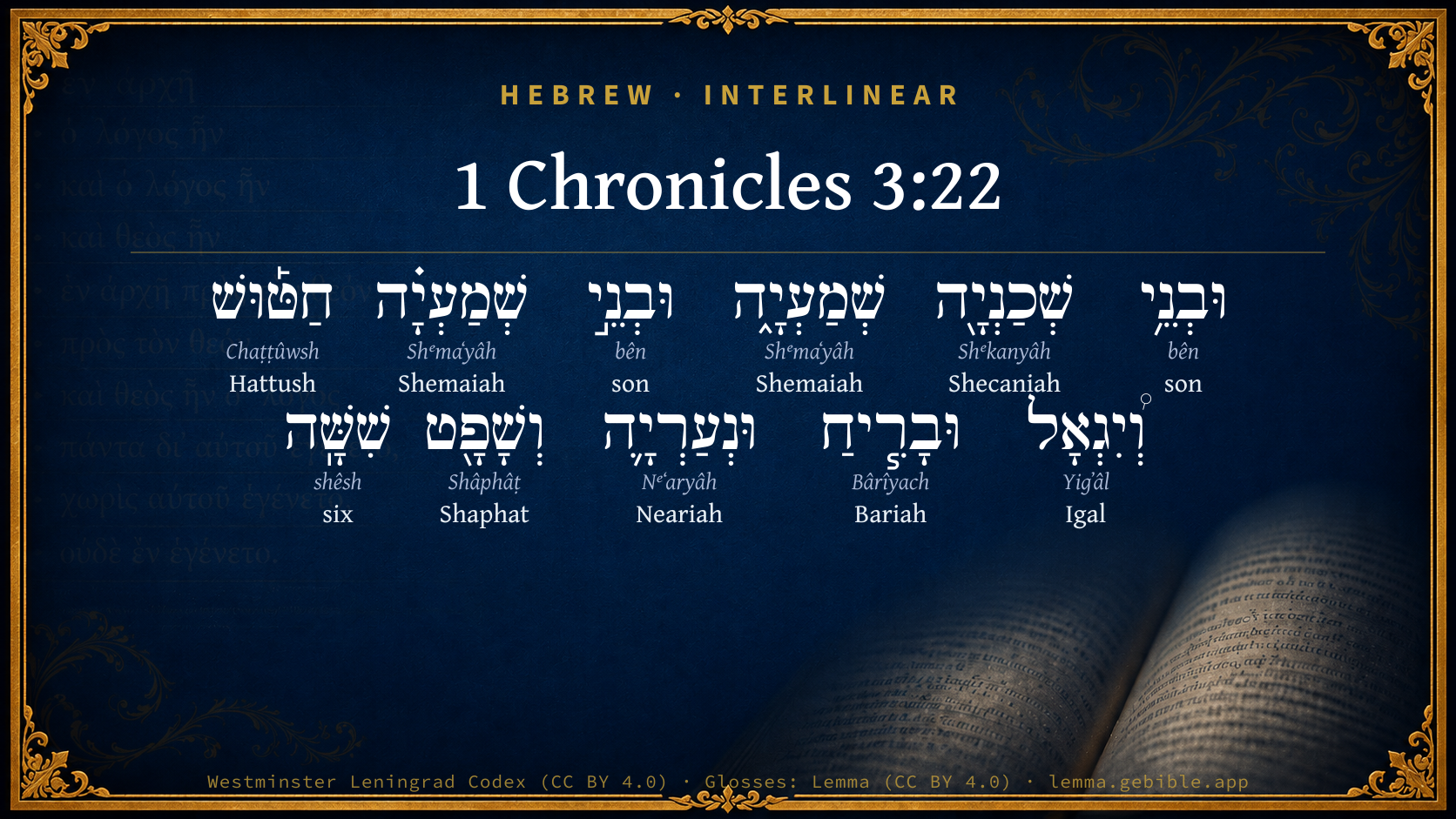
1 Chronicles 3:22

Hebrew (Westminster Leningrad Codex) 1 Chronicles 3:22 appears in the Hebrew Old Testament. The text above is from the Westminster Leningrad Codex. Each word links to its Strong’s number, a concise gloss, and parsing drawn from the Open Scriptures Hebrew Bible morphology. Click any word for its full Brown-Driver-Briggs (BDB) entry.
Download image
Cite this verse

1 Chronicles 3:22 (World English Bible). Public Domain. Lemma interlinear Bible study tool, https://lemma.gebible.app/v/1-chronicles/3/22.

Show BibTeX & RIS
BibTeX
RIS
English Translation
The sons of Shecaniah: Shemaiah. The sons of Shemaiah: Hattush, and Igal, and Bariah, and Neariah, and Shaphat, six.
World English Bible · Public Domain
Highlights
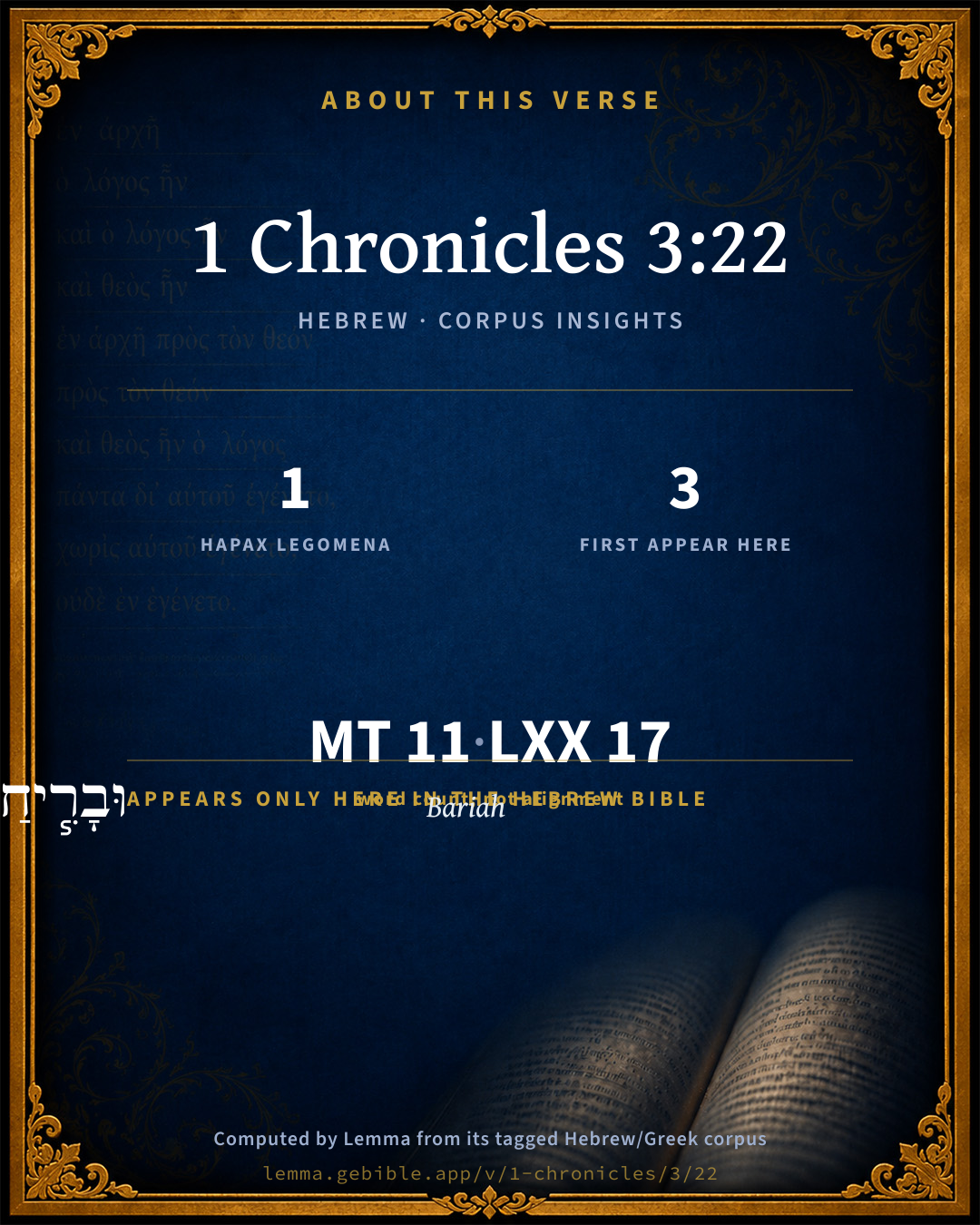
  • 1 hapax legomenon — only here in the Hebrew Bible
  • 3 first appearances in the Hebrew Bible
Full analysis ↓
Download a study sheet

One document with this verse’s original text, its word-by-word gloss line, the meaning frame, cross-references with their text, attributed commentary, and full source and license credits — printable, and it pastes into notes with its structure intact.

This verse Autodidact and up

Study sheet (.html) Plain text (.txt)

A passage Seminary Student

Up to 50 verses in one chapter. A passage sheet keeps up to 6 commentary sources and 12 cross-references per verse, in the order this page ranks them, and says so on the sheet whenever that leaves anything out. Ask for a single verse and you get the Autodidact verse sheet above.

Everything on this page stays free to read, with no account — the sheet is a download of what is already on screen, not access to it.

Want to remove ads? Support Godless Engineer
Compare translations 3

The same verse in 3 English versions, stacked beneath the original-language interlinear above. Click any original word for its lexicon entry.

Each is an independent rendering of the whole verse — the interlinear is not word-aligned to these translations.

Highlighted words mark where these versions differ — a whole-verse word diff, not a word-by-word alignment.

  • World English Bible Public Domain
    The sons of Shecaniah: Shemaiah. The sons of Shemaiah: Hattush, and Igal, and Bariah, and Neariah, and Shaphat, six.
  • King James Version Public Domain
    And the sons of Shechaniah; Shemaiah: and the sons of Shemaiah; Hattush, and Igeal, and Bariah, and Neariah, and Shaphat, six.
  • unfoldingWord Literal Text CC BY-SA 4.0
    And the sons of Shekaniah: Shemaiah; and the sons of Shemaiah: Hattush and Igal and Bariah and Neariah and Shaphat—six.

unfoldingWord Literal Text — © unfoldingWord, licensed CC BY-SA 4.0. Word-aligned USFM3 via Door43 (git.door43.org/unfoldingWord/en_ult).

Versions to compare (up to 4)

3 of 4 selected

Show all 18 translations

Every available English version of this verse, each an independent rendering of the whole verse.

  • World English Bible Public Domain
    The sons of Shecaniah: Shemaiah. The sons of Shemaiah: Hattush, and Igal, and Bariah, and Neariah, and Shaphat, six.
  • Berean Standard Bible Public Domain
    The six descendants of Shecaniah were Shemaiah and his sons: Hattush, Igal, Bariah, Neariah, and Shaphat.
  • Majority Standard Bible Public Domain
    The six descendants of Shecaniah were Shemaiah and his sons: Hattush, Igal, Bariah, Neariah, and Shaphat.
  • King James Version Public Domain
    And the sons of Shechaniah; Shemaiah: and the sons of Shemaiah; Hattush, and Igeal, and Bariah, and Neariah, and Shaphat, six.
  • American Standard Version (1901) Public Domain
    And the sons of Shecaniah: Shemaiah. And the sons of Shemaiah: Hattush, and Igal, and Bariah, and Neariah, and Shaphat, six.
  • Revised Version (1885) Public Domain
    And the sons of Shecaniah; Shemaiah: and the sons of Shemaiah; Hattush, and Igal, and Bariah, and Neariah, and Shaphat, six.
  • Geneva Bible (1599) Public Domain
    And the sonne of Shechaniah was Shemaiah: and the sonnes of Shemaiah were Hattush and Igeal, and Bariah, and Neariah, and Shaphat, sixe.
  • Douay-Rheims (1899) Public Domain
    The son of Sechenias, was Semeia, whose sons were Hattus, and Jegaal, and Baria, and Naaria, and Saphat, six in number.
  • Young's Literal Translation Public Domain
    And sons of Shechaniah: Shemaiah; and sons of Shemaiah: Hattush, and Igeal, and Bariah, and Neariah, and Shaphat, six.
  • Literal Standard Version CC BY-SA 4.0
    And sons of Shechaniah: Shemaiah; and sons of Shemaiah: Hattush, and Igeal, and Bariah, and Neariah, and Shaphat—six.
  • Unlocked Literal Bible CC BY-SA 4.0
    Shekaniah's son was Shemaiah. Shemaiah's sons were Hattush, Igal, Bariah, Neariah, and Shaphat.
  • unfoldingWord Literal Text CC BY-SA 4.0
    And the sons of Shekaniah: Shemaiah; and the sons of Shemaiah: Hattush and Igal and Bariah and Neariah and Shaphat—six.
  • Darby Bible Public Domain
    And the sons of Shechaniah: Shemaiah; and the sons of Shemaiah: Hattush, and Jigeal, and Bariah, and Neariah, and Shaphat, six.
  • World Messianic Bible Public Domain
    The son of Shecaniah: Shemaiah. The sons of Shemaiah: Hattush, Igal, Bariah, Neariah, and Shaphat, six.
  • Webster's Bible Public Domain
    And the sons of Shechaniah; Shemaiah; and the sons of Shemaiah; Hattush, and Igeal, and Bariah, and Neariah, and Shaphat, six.
  • Free Bible Version CC BY-SA 4.0
    The sons of Shecaniah: Shemaiah and his sons: Hattush, Igal, Bariah, Neariah, and Shaphat—a total of six.
  • Bible in Basic English Public Domain
    And the sons of Shecaniah: Shemaiah; and the sons of Shemaiah: Hattush and Igal and Bariah and Neariah and Shaphat, six.
  • JPS Tanakh (1917) Public Domain
    And the sons of Shecaniah: Shemaiah; and the sons of Shemaiah: Hattush, and Igal, and Bariah, and Neariah, and Shaphat, six.

Literal Standard Version (2020), Covenant Press — licensed CC BY-SA 4.0. Text via the HelloAO Bible API (eBible.org). Unlocked Literal Bible (unfoldingWord) — licensed CC BY-SA 4.0. Text via the HelloAO Bible API (eBible.org). unfoldingWord Literal Text — © unfoldingWord, licensed CC BY-SA 4.0. Word-aligned USFM3 via Door43 (git.door43.org/unfoldingWord/en_ult). Free Bible Version, Dr. Jonathan Gallagher — licensed CC BY-SA 4.0. Text via the HelloAO Bible API (eBible.org).

Word by word

More ways to search: Search by grammar → Find every occurrence → Compare this word →

Practice this passage: Drill this verse → Learn its vocabulary →

About this verse

These counts appear in no published source. They are computed here, from the morphology-tagged text and Lemma’s own curated glosses. What Lemma adds →

11
words
9
distinct lemmas
Historical
section

Notable vocabulary

1 hapax legomenon — a word that appears only here in the entire Hebrew Bible:

  • וּבָרִ֧יחַ Bariah H1282

First appearance in Scripture

These words make their first canonical appearance in the Hebrew Bible here:

  • חַטּ֡וּשׁ Hattush H2407
  • וּבָרִ֧יחַ Bariah H1282
  • וּנְעַרְיָ֛ה Neariah H5294

Shared distinctive vocabulary

וְ֠יִגְאָל Igal H3008 occurs in 3 verses of the Hebrew Bible. Also found in:

Grammatical profile

  • 10 nouns
  • 1 adjective

Repetition

Words recur within this verse — often emphatic in Hebrew:

  • וּבְנֵ֥י son H1121 ×2
  • שְׁמַעְיָ֑ה Shemaiah H8098 ×2

Hebrew & Septuagint length

In English translation the verse runs 19 words from the Hebrew and 21 from the Septuagint (LXX English) — closely comparable.

A rough comparison of the two English renderings, which tokenize alike — not a word-level alignment.

Word counts can differ between the Hebrew and the Greek without any difference in meaning — e.g. the Hebrew direct-object marker אֵת has no separate Greek word, and Greek often adds the article ὁ.

In the original languages it is 11 Hebrew tokens and 17 Greek tokens — but the two are counted differently (Hebrew bundles its prefixes and suffixes into one token; the Greek is in lemma form), so that isn’t a like-for-like length.

Cross-references

1

Topical passages linked to 1 Chronicles 3:22 in the Treasury of Scripture Knowledge — connected by theme and wording, ordered by reader-vote popularity; previews shown in the World English Bible.

  • Ezra 8:2 Of the sons of Phinehas, Gershom. Of the sons of Ithamar, Daniel. Of the sons of David, Hattush.

Cross-references courtesy of OpenBible.info (CC BY 4.0).

Hebrew and Greek witnesses Masoretic Hebrew ↔ Greek Septuagint

The same verse in the two great witnesses to the Old Testament, shown verse-for-verse.

These are two independent witnesses, not word-aligned to each other, and the Septuagint is shown in lemma (dictionary) form.

Hebrew 1 Chronicles 3:22 Masoretic · Westminster Leningrad Codex

וּבְנֵ֥י שְׁכַנְיָ֖ה שְׁמַעְיָ֑ה וּבְנֵ֣י שְׁמַעְיָ֗ה חַטּ֡וּשׁ וְ֠יִגְאָל וּבָרִ֧יחַ וּנְעַרְיָ֛ה וְשָׁפָ֖ט שִׁשָּֽׁה

The sons of Shecaniah: Shemaiah. The sons of Shemaiah: Hattush, and Igal, and Bariah, and Neariah, and Shaphat, six.

World English Bible · Public Domain

Greek LXX 1 Chronicles 3:22 Septuagint · lemma form

καί υἱός σεχενια σαμαια καί υἱός σαμαια χαττους καί ιωηλ καί μαρι καί νωαδια καί σαφαθ ἕξ

And the son of Sechenias; Samaia: and the sons of Samaia; Chattus, and Joel, and Berri and Noadia, and Saphath, six.

LXX2012 (modern English Septuagint) · Public Domain

On this verse, The Pulpit Commentary discusses the Septuagint’s reading. Read the note in Commentary ↓

Hebrew: Westminster Leningrad Codex (CC BY 4.0). Greek: Septuagint (public domain); English from LXX2012 (modern English Septuagint) (Public Domain). How the Septuagint differs from the Hebrew →

Commentary

Notes on 1 Chronicles 3:22 from classic Christian and Jewish commentators (each source and its license shown beneath its notes). The classic Christian expositions comment on the surrounding passage and are grouped to its opening verse, so a note may address several verses; the Jewish commentaries on the Tanakh (Rashi and others) are per-verse, so they appear only where the commentator wrote on this verse.

Lemma curates 59 commentaries, every one of them public domain or Creative Commons licensed, each selected and text-cleaned for this edition rather than reprinted as found. About our sources →

Trapp's Complete Commentary

John Trapp

1Ch 3:22 And the sons of Shechaniah; Shemaiah: and the sons of Shemaiah; Hattush, and Igeal, and Bariah, and Neariah, and Shaphat, six.

Ver. 22. Neariah, and Shaphat, six,] sc., Reckoned together with their father Shemalah.

John Trapp, A Commentary or Exposition upon All the Books of the Old and New Testament (1647–1656) — public domain. Text from a community e-Sword module.

Geneva Bible (1599)

Geneva Bible translators

So that Shemaiah was Shechaniah’s natural son, and the other five his nephews, and in all were six.

Geneva Bible (1599) marginal notes — public domain. Text via Bolls.life.

Adam Clarke's Commentary

Verse 22. The sons of Shemaiah - six.] FIVE only are found in the text, and the versions give us no assistance; neither do the MSS. correct the place. If the father be not here included with his sons, some name must be lost out of the text.

Adam Clarke's Commentary on the Bible (1810–1826) — public domain. Text from a community e-Sword/MySword module.

Ellicott's Commentary for English Readers

(22) The sons of Shechaniah; Shemaiah.—See Note on 1Ch_1:41.

Hattush.—Probably the Hattush “of the sons of David, of the sons of Shechaniah,” mentioned by Ezra as one of those who went up with him from Babylon in the second return, 457 B.C. (Ezr_8:2-3). If we have rightly understood 1Ch_3:21, Hattush is of the fourth generation after Zerubbabel (Hananiah, Shechaniah, Shemaiah, Hattush), and so might well have been a youthful companion of Ezra.

Six.—As the text gives only five names, one must have been omitted by an oversight.

A Bible Commentary for English Readers, edited by Charles John Ellicott (1878–1897) — public domain. Text from a community e-Sword module.

Albert Barnes' Notes on the Bible

Six - There are only five names in the Hebrew text. The Syriac anti Arabic versions supply “Azariah” between Neariah and Shaphat.

The question of the proper arrangement of the genealogy of the descendants of Zerubbabel 1Ch 3:19-24 is important in its bearing on the interesting point of the time at which the canon of the Old Testament was closed. Assuming the average of a generation to be 20 years in the East, the genealogy of the present chapter, drawn out according to the Hebrew text, does not descend below about 410 B.C., and thus falls within the probable lifetime of Nehemiah.

If, further, we regard it as most probable that Ezra died before 431 B.C., and that this passage in question was not wholly written by him, this does not disprove the theory (see the introduction to Chronicles), that Ezra was the author of Chronicles. Deuteronomy is by Moses, though the last chapter cannot be from his hand. The “dukes of Edom” might he an insertion into the text of Genesis Gen 36:40-43 without the authorship of the remainder of the work being affected by it. So here; Nehemiah, or Malachi, may have carried on the descent of the “sons of David” as far as it had reached in their time, adding to the account given by Ezra one, or at the most two verses.

Albert Barnes' Notes on the Bible (1834–1885) — public domain. Text from a community e-Sword/MySword module.

Haydock's Catholic Bible Commentary

Six. Counting the father in the number. (Challoner) --- Hebrew shisha, or "six." Sixtus V with several manuscripts, Gothic edition, &c., take it improperly for the name of a man. (Calmet) --- Semeia and his five sons are attributed to Sechenias. (Worthington) --- Others think that a name has been lost. (Castalion)

George Leo Haydock (1774–1849), Haydock's Catholic Family Bible and Commentary, 1859 edition — public domain. Excludes Psalms (Douay-Rheims chapter numbering differs from Protestant) and Deuterocanonical books (Catholic canon only).

Matthew Poole's English Annotations

To wit, including the father. But the Hebrew word shisha, which is rendered six, may be the proper name of one of the sons of Shemaiah, who may be so called, because he was the sixth son.

Matthew Poole's English Annotations on the Holy Bible (1683–1685) — public domain. Text from a community e-Sword/MySword module.

The Pulpit Commentary

In the obscurity that obtains on the subject, there is one somewhat bright star of light in a succeeding name, Hattush, to which this verse leads us. This verse purports to help on the line of genealogy by a contribution of two descents, the effective names being Shemaiah and Neariah, the line coming to its close by aid of two other effective names, Elioenai and (say) Hodaiah, contained in the last two verses of the chapter. Although one manifest error in ver. 22 (involved in the number "six" when only five sons have been read) betokens the insecurity of the text, yet the summary measures of the ingenious Lord A. C. Hervey (see his valuable work on the "Genealogies of our Lord Jesus Christ," pp. 103, 307, 322; and articles in Smith"s "Bible Dictionary," 1:666, 667) can scarcely be warranted, when he wishes first to omit altogether the words and the sons of Shecaniah; Shemaiah; and next, to regard Shemaiah as Shimei, the brother of Zerub-babel, and, as matter of course, those who followed as the descendants of this brother of Zerubbabel, instead of Zerubbabel himself. Now, a passage in the Book of Ezra helps us much here. Ezra mentions, as one of those of the "sons of David" who went up with him from.Babylon to Jerusalem, (Ezr_8:2, Ezr_8:3) Hattush, "of the sons of Shechaniah." There is not only nothing to prevent this Hattush being the same as the elder brother of Neariah, who comes fourth in succession from Zerubbabel (i.e. on the hypothesis that the six names of ver. 21 are brothers, not a line of descents), but at the above-mentioned average of twenty years the dates will admirably synchronize the last date of Zerubbabel being about B.C. 520, and that of Neariah B.C. 440; while the date of Ezra"s journey was B.C. 458 (see "Speaker"s Commentary," 3:186, 187). This coincidence of names and dates must not be regarded as con-elusive; but, pending further discovery, it strongly disfavours the idea of the names of ver. 21 constituting a succession, and it keeps well in check the rate of succeeding generations, bringing the last member of the succession to a date that may be harmonized with others which have for the most part held their ground. That in ver. 22 only five names are given for what are summed up as six," must lead to the supposition that one has dropped out; and since no known manuscript of the Hebrew text, nor the Septuagint or Vulgate versions supplies us with the missing name, the Syriac and Arabic versions, which supply the name Azariah between Neariah and Shaphat, must be viewed with some suspicion. Igeal is, in the Hebrew, a word (la"giy) identical with the Igal of Num_13:7 2Sa_23:36 Septuagint in the latter passages jIlaal or jIga but in the present place jIwhl. Of the other persons in this verse little or nothing else is known.

The Pulpit Commentary (1880–1919), ed. H.D.M. Spence-Jones & Joseph S. Exell — public domain. Text from a community e-Sword module.

John Wesley's Explanatory Notes

Six - Including the father. But the Hebrew word, Shisha, which is rendered six, may be the proper name of one of the sons of Shemaiah.

John Wesley, Explanatory Notes Upon the Whole Bible (1754–1765) — public domain. Text via the GEBible commentary corpus.

unfoldingWord translationNotes

Door43 World Missions Community

General Information:

All of the names in this list are the names of men. (See: How to Translate Names)

unfoldingWord translationNotes — © Distant Shores Media and the Door43 World Missions Community, licensed CC BY-SA 4.0. Source: git.door43.org/Door43/en_tn.

Rashi

Rabbi Shlomo Yitzchaki (Rashi)

and the sons of Shemaiah: Hattush, and Jigal, and Bariah, and Neariah, and Shaphat six They are, in reality, only five, but there is a reason, as is written below (25:3) concerning the watches of the Levites: “Of Jeduthun, the sons of Jeduthun: Gedaliah, and Zeri, and Isaiah, Hashabiah, and Mattithiah six,” but they are only five.

Rashi on the Tanakh — English translations: “The Judaica Press complete Tanach with Rashi, translated by A. J. Rosenberg” (CC BY 4.0); “Pentateuch with Rashi's commentary by M. Rosenbaum and A.M. Silbermann, 1929-1934” (public domain); “The Metsudah Tanach series, Lakewood, N.J” (CC BY 4.0); and “The Book of Joshua, Metsudah Publications, 1997” (CC BY 4.0). Text via Sefaria.

Lesson kit

Teaching starters — assembled from the data on this page, not authored interpretation. Every prompt links to the verse data it draws on. Edit before teaching.

1 Chronicles, in the Historical, opens this verse with 11 words (9 distinct Hebrew lemmas). Its most distinctive word is Bârîyach (“Bariah”). A historical commentator’s framing appears above. Read the whole chapter for the surrounding context.

Discussion questions

  1. How does “Bariah” (Bârîyach) shape what this verse is saying?
  2. This verse holds 1 word here found nowhere else in the Hebrew Bible. What might the rare word draw attention to?
  3. 3 words here appear for the first time in Scripture. What is being introduced at this debut?
  4. Numbers 13:7 shares the word «Igal» with this verse. How do the two illuminate each other?
  5. “son” occurs 2× in this one verse. What is the effect of the repetition?
  6. The translations on this page render this verse differently — a whole-verse word diff, not a word-by-word alignment. What might account for the different wordings?
  7. Reading how Trapp's Complete Commentary and Geneva Bible (1599) read this verse, where do the two commentators agree and where do they part?

Things to notice

  • 1 word in this verse appears nowhere else in the Hebrew Bible.
  • 3 words make their first canonical appearance in Scripture here.
  • This verse counts 11 Hebrew ↔ 17 Greek words.
  • These translations choose different wording for 8 words in this verse.
  • “son” occurs 2× in this single verse.

Reading settings

Reading text

Shown beneath each verse's original-language words.

Old Testament
Old Testament edition

Read the OT as the Masoretic Hebrew (MT) or the Greek Septuagint (LXX).

English shown for the Greek Septuagint (in the Hebrew ↔ Greek comparison).

Comparing translations? Open the Compare panel on any verse page to stack up to four side by side.