
Genesis 43:29

Hebrew (Westminster Leningrad Codex) Genesis 43:29 appears in the Hebrew Old Testament. The text above is from the Westminster Leningrad Codex. Each word links to its Strong’s number, a concise gloss, and parsing drawn from the Open Scriptures Hebrew Bible morphology. Click any word for its full Brown-Driver-Briggs (BDB) entry.
Download image
Cite this verse

Genesis 43:29 (World English Bible). Public Domain. Lemma interlinear Bible study tool, https://lemma.gebible.app/v/genesis/43/29.

Show BibTeX & RIS
BibTeX
RIS
English Translation
He lifted up his eyes, and saw Benjamin, his brother, his mother's son, and said, "Is this your youngest brother, of whom you spoke to me?" He said, "God be gracious to you, my son."
World English Bible · Public Domain
Download a study sheet

One document with this verse’s original text, its word-by-word gloss line, the meaning frame, cross-references with their text, attributed commentary, and full source and license credits — printable, and it pastes into notes with its structure intact.

This verse Autodidact and up

Study sheet (.html) Plain text (.txt)

A passage Seminary Student

Up to 50 verses in one chapter. A passage sheet keeps up to 6 commentary sources and 12 cross-references per verse, in the order this page ranks them, and says so on the sheet whenever that leaves anything out. Ask for a single verse and you get the Autodidact verse sheet above.

Everything on this page stays free to read, with no account — the sheet is a download of what is already on screen, not access to it.

Want to remove ads? Support Godless Engineer
Compare translations 3

The same verse in 3 English versions, stacked beneath the original-language interlinear above. Click any original word for its lexicon entry.

Each is an independent rendering of the whole verse — the interlinear is not word-aligned to these translations.

Highlighted words mark where these versions differ — a whole-verse word diff, not a word-by-word alignment.

  • World English Bible Public Domain
    He lifted up his eyes, and saw Benjamin, his brother, his mother's son, and said, "Is this your youngest brother, of whom you spoke to me?" He said, "God be gracious to you, my son."
  • King James Version Public Domain
    And he lifted up his eyes, and saw his brother Benjamin, his mother's son, and said, Is this your younger brother, of whom ye spake unto me? And he said, God be gracious unto thee, my son.
  • unfoldingWord Literal Text CC BY-SA 4.0
    Then he lifted his eyes and saw Benjamin his brother, the son of his mother, and he said, “Is this your youngest brother whom you spoke to me?” Then he said, “May God be gracious to you, my son.”

unfoldingWord Literal Text — © unfoldingWord, licensed CC BY-SA 4.0. Word-aligned USFM3 via Door43 (git.door43.org/unfoldingWord/en_ult).

Versions to compare (up to 4)

3 of 4 selected

Show all 18 translations

Every available English version of this verse, each an independent rendering of the whole verse.

  • World English Bible Public Domain
    He lifted up his eyes, and saw Benjamin, his brother, his mother's son, and said, "Is this your youngest brother, of whom you spoke to me?" He said, "God be gracious to you, my son."
  • Berean Standard Bible Public Domain
    When Joseph looked up and saw his brother Benjamin, his own mother’s son, he asked, “Is this your youngest brother, the one you told me about?” Then he declared, “May God be gracious to you, my son.”
  • Majority Standard Bible Public Domain
    When Joseph looked up and saw his brother Benjamin, his own mother’s son, he asked, “Is this your youngest brother, the one you told me about?” Then he declared, “May God be gracious to you, my son.”
  • King James Version Public Domain
    And he lifted up his eyes, and saw his brother Benjamin, his mother's son, and said, Is this your younger brother, of whom ye spake unto me? And he said, God be gracious unto thee, my son.
  • American Standard Version (1901) Public Domain
    And he lifted up his eyes, and saw Benjamin his brother, his mother's son, and said, Is this your youngest brother, of whom ye spake unto me? And he said, God be gracious unto thee, my son.
  • Revised Version (1885) Public Domain
    And he lifted up his eyes, and saw Benjamin his brother, his mother’s son, and said, Is this your youngest brother, of whom ye spake unto me? And he said, God be gracious unto thee, my son.
  • Geneva Bible (1599) Public Domain
    And he lifting vp his eyes, beheld his brother Beniamin his mothers sonne, and sayde, Is this your yonger brother, of whome ye tolde me? And he said, God be merciful vnto thee, my sone.
  • Douay-Rheims (1899) Public Domain
    And Joseph lifting up his eyes, saw Benjamin his brother, by the same mother, and said: Is this your young brother, of whom you told me? And he said: God be gracious to thee, my son.
  • Young's Literal Translation Public Domain
    And he lifteth up his eyes, and seeth Benjamin his brother, his mother's son, and saith, `Is this your young brother, of whom ye have spoken unto me?' and he saith, `God favour thee, my son.'
  • Literal Standard Version CC BY-SA 4.0
    And he lifts up his eyes and sees his brother Benjamin, his mother’s son, and says, “Is this your young brother, of whom you have spoken to me?” And he says, “God favor you, my son.”
  • Unlocked Literal Bible CC BY-SA 4.0
    When he lifted up his eyes he saw Benjamin his brother, his mother's son, and he said, “Is this your youngest brother of whom you spoke to me?” Then he said, “May God be gracious to you, my son.”
  • unfoldingWord Literal Text CC BY-SA 4.0
    Then he lifted his eyes and saw Benjamin his brother, the son of his mother, and he said, “Is this your youngest brother whom you spoke to me?” Then he said, “May God be gracious to you, my son.”
  • Darby Bible Public Domain
    And he lifted up his eyes and saw his brother Benjamin, his mother's son, and said, Is this your younger brother of whom ye spoke to me? And he said, God be gracious to thee, my son!
  • World Messianic Bible Public Domain
    He lifted up his eyes, and saw Benjamin, his brother, his mother’s son, and said, “Is this your youngest brother, of whom you spoke to me?” He said, “God be gracious to you, my son.”
  • Webster's Bible Public Domain
    \\43:30\\And Joseph made haste; for his bowels yearned towards his brother: and he sought where to weep; and he entered into his chamber, and wept there.
  • Free Bible Version CC BY-SA 4.0
    Then Joseph looked over at his brother Benjamin, the son of his own mother. “Is this your youngest brother that you told me about?” he asked. “God be gracious to you, my son,” he said.
  • Bible in Basic English Public Domain
    Then Joseph's heart went out to his brother, and he went quickly into his room, for he was overcome with weeping.
  • JPS Tanakh (1917) Public Domain
    And he lifted up his eyes, and saw Benjamin his brother, his mother's son, and said: 'Is this your youngest brother of whom ye spoke unto me?' And he said: 'God be gracious unto thee, my son.'

Literal Standard Version (2020), Covenant Press — licensed CC BY-SA 4.0. Text via the HelloAO Bible API (eBible.org). Unlocked Literal Bible (unfoldingWord) — licensed CC BY-SA 4.0. Text via the HelloAO Bible API (eBible.org). unfoldingWord Literal Text — © unfoldingWord, licensed CC BY-SA 4.0. Word-aligned USFM3 via Door43 (git.door43.org/unfoldingWord/en_ult). Free Bible Version, Dr. Jonathan Gallagher — licensed CC BY-SA 4.0. Text via the HelloAO Bible API (eBible.org).

Word by word

More ways to search: Search by grammar → Find every occurrence → Compare this word →

Practice this passage: Drill this verse → Learn its vocabulary →

יָחְנְךָ֖
chânan
H2603
“to be gracious · you”
Verb, Qal, Imperfect, 3rd Person, Masculine, Singular + Suffix, Personal, 2nd Person, Masculine, Singular
Part of Speech
Verb
Stem
Qal
Form
Imperfect
Person
3rd Person
Gender
Masculine
Number
Singular
Full BDB Definition

Origin: a primitive root [compare H2583 ]

TWOT: 694 , 695

to be gracious, show favour, pity - (Qal) to show favour, be gracious - (Niphal) to be pitied - (Piel) to make gracious, make favourable, be gracious - (Poel) to direct favour to, have mercy on - (Hophal) to be shown favour, be shown consideration - (Hithpael) to seek favour, implore favour - to be loathsome
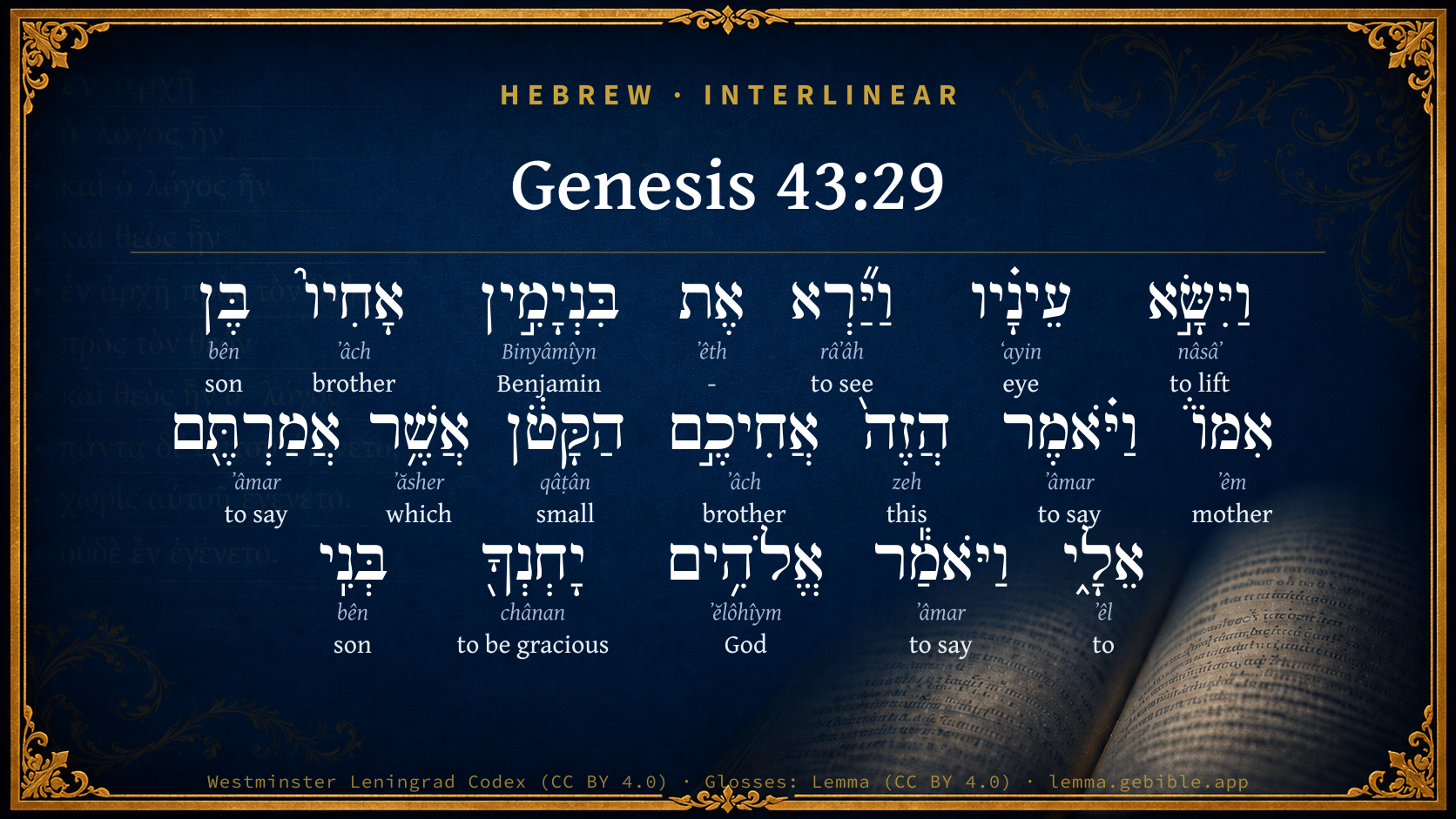
  1. וַיִּשָּׂ֣א nâsâʼ H5375 “and · to lift” Conjunction + Verb, Qal, Sequential Imperfect, 3rd Person, Masculine, Singular
  2. עֵינָ֗יו ʻayin H5869 “eyes · his” Noun, Common, Both, Dual, Construct + Suffix, Personal, 3rd Person, Masculine, Singular
  3. וַיַּ֞רְא râʼâh H7200 “and · to see” Conjunction + Verb, Qal, Sequential Imperfect, 3rd Person, Masculine, Singular
  4. אֶת ʼêth H853 “-” Particle, Direct Object
  5. בִּנְיָמִ֣ין Binyâmîyn H1144 “Benjamin” Noun, Proper
  6. אָחִיו֮ ʼâch H251 “brother · his” Noun, Common, Masculine, Singular, Construct + Suffix, Personal, 3rd Person, Masculine, Singular
  7. בֶּן bên H1121 “son of” Noun, Common, Masculine, Singular, Construct
  8. אִמּוֹ֒ ʼêm H517 “mother · his” Noun, Common, Feminine, Singular, Construct + Suffix, Personal, 3rd Person, Masculine, Singular
  9. וַיֹּ֗אמֶר ʼâmar H559 “and · to say” Conjunction + Verb, Qal, Sequential Imperfect, 3rd Person, Masculine, Singular
  10. הֲזֶה֙ zeh H2088 “this” Particle, Interrogative + Pronoun, Demonstrative, Masculine, Singular
  11. אֲחִיכֶ֣ם ʼâch H251 “brother · your” Noun, Common, Masculine, Singular, Construct + Suffix, Personal, 2nd Person, Masculine, Plural
  12. הַקָּטֹ֔ן qâṭân H6996 “the · small” Particle, Definite Article + Adjective, Adjective, Masculine, Singular, Absolute
  13. אֲשֶׁ֥ר ʼăsher H834 “which” Particle, Relative
  14. אֲמַרְתֶּ֖ם ʼâmar H559 “to say” Verb, Qal, Perfect, 2nd Person, Masculine, Plural
  15. אֵלָ֑י ʼêl H413 “to · me” Preposition + Suffix, Personal, 1st Person, Common, Singular
  16. וַיֹּאמַ֕ר ʼâmar H559 “and · to say” Conjunction + Verb, Qal, Sequential Imperfect, 3rd Person, Masculine, Singular
  17. אֱלֹהִ֥ים ʼĕlôhîym H430 “God(s)” Noun, Common, Masculine, Plural, Absolute
  18. בְּנִֽי bên H1121 “son · my” Noun, Common, Masculine, Singular, Construct + Suffix, Personal, 1st Person, Common, Singular

About this verse

These counts appear in no published source. They are computed here, from the morphology-tagged text and Lemma’s own curated glosses. What Lemma adds →

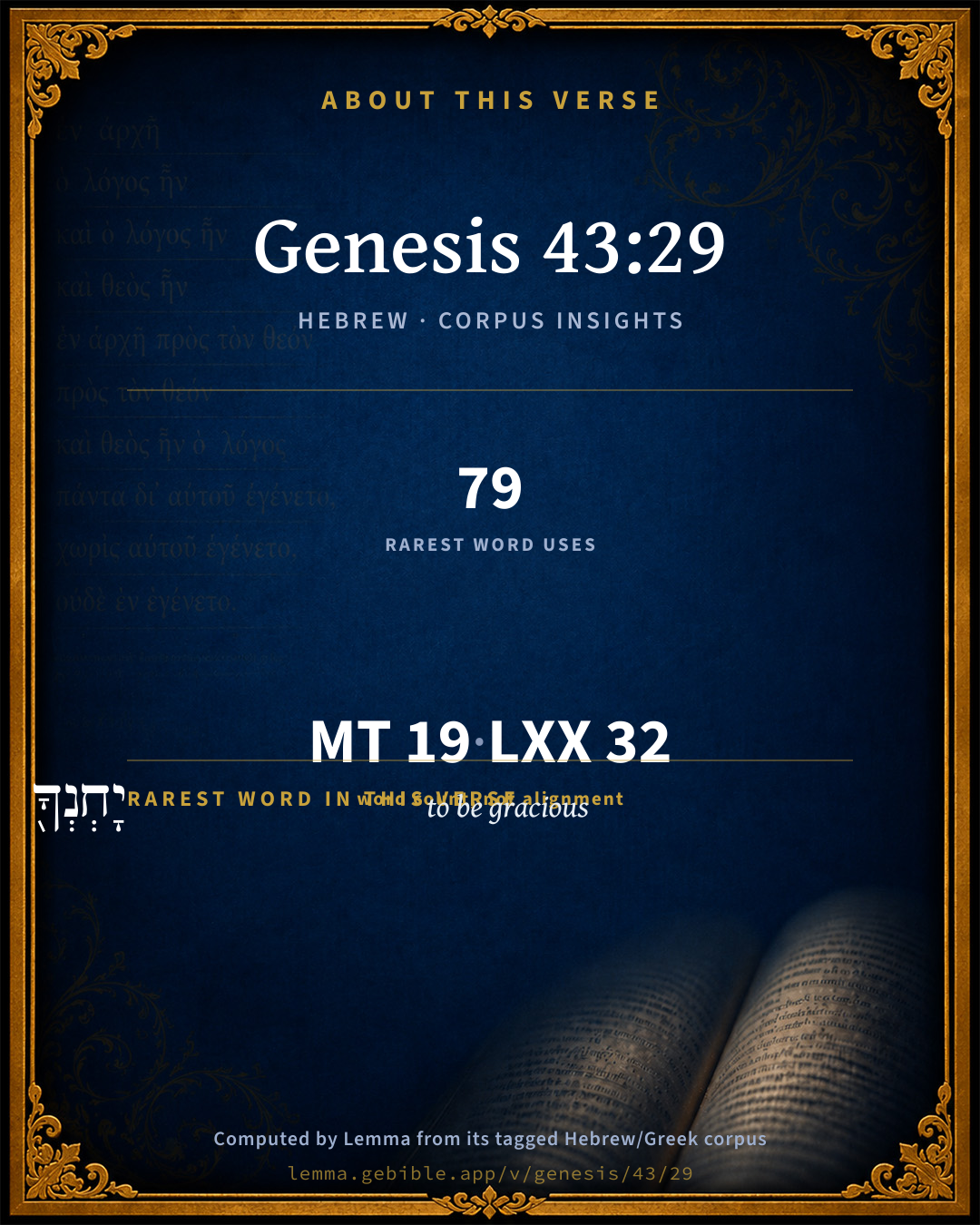
19
words
15
distinct lemmas
Pentateuch
section

Grammatical profile

  • 6 verbs
  • 8 nouns
  • 1 adjective
  • 1 pronoun
  • 1 preposition
  • 2 particles

Verb forms

  • וַיִּשָּׂ֣א Qal · Sequential Imperfect
  • וַיַּ֞רְא Qal · Sequential Imperfect
  • וַיֹּ֗אמֶר Qal · Sequential Imperfect
  • אֲמַרְתֶּ֖ם Qal · Perfect
  • וַיֹּאמַ֕ר Qal · Sequential Imperfect
  • יָחְנְךָ֖ Qal · Imperfect

Repetition

Words recur within this verse — often emphatic in Hebrew:

  • וַיֹּ֗אמֶר to say H559 ×3
  • אָחִיו֮ brother H251 ×2
  • בֶּן son H1121 ×2

Hebrew & Septuagint length

In English translation the verse runs 35 words from the Hebrew and 41 from the Septuagint (LXX English) — closely comparable.

A rough comparison of the two English renderings, which tokenize alike — not a word-level alignment.

Word counts can differ between the Hebrew and the Greek without any difference in meaning — e.g. the Hebrew direct-object marker אֵת has no separate Greek word, and Greek often adds the article ὁ.

In the original languages it is 19 Hebrew tokens and 32 Greek tokens — but the two are counted differently (Hebrew bundles its prefixes and suffixes into one token; the Greek is in lemma form), so that isn’t a like-for-like length.

Cross-references

20

Topical passages linked to Genesis 43:29 in the Treasury of Scripture Knowledge — connected by theme and wording, ordered by reader-vote popularity; previews shown in the World English Bible.

  • Genesis 42:13 They said, "We, your servants, are twelve brothers, the sons of one man in the land of Canaan; and, behold, the youngest is this day with our father, and one is no more."
  • Numbers 6:25 Yahweh make his face to shine on you, And be gracious to you.
  • Genesis 30:22–24 God remembered Rachel, and God listened to her, and opened her womb.
  • Genesis 35:17–18 It happened that, when she was in hard labor, that the midwife said to her, "Don't be afraid, for now you will have another son."
  • Genesis 42:11 We are all one man's sons; we are honest men. Your servants are not spies."
  • Genesis 45:8 So now it wasn't you who sent me here, but God, and he has made me a father to Pharaoh, lord of all his house, and ruler over all the land of Egypt.
  • Joshua 7:19 Joshua said to Achan, My son, please give glory to Yahweh, the God of Israel, and make confession to him; and tell me now what you have done; don't hide it from me.
  • 2 Chronicles 29:11 My sons, don't be negligent now; for Yahweh has chosen you to stand before him, to minister to him, and that you should be his ministers, and burn incense.
  • Psalms 67:1 May God be merciful to us, bless us, And cause his face to shine on us. Selah.
  • Psalms 111:4 He has caused his wonderful works to be remembered. Yahweh is gracious and merciful.
  • Psalms 112:4 Light dawns in the darkness for the upright, Gracious, merciful, and righteous.
  • Psalms 133:1–2 See how good and how pleasant it is For brothers to live together in unity!
  • Isaiah 30:19 For the people shall dwell in Zion at Jerusalem; you shall weep no more; he will surely be gracious to you at the voice of your cry; when he shall hear, he will answer you.
  • Isaiah 33:2 Yahweh, be gracious to us; we have waited for you: be our arm every morning, our salvation also in the time of trouble.
  • Malachi 1:9 "Now, please entreat the favor of God, that he may be gracious to us. With this, will he accept any of you?" says Yahweh of Hosts.
  • Matthew 9:2 Behold, they brought to him a man who was paralyzed, lying on a bed. Jesus, seeing their faith, said to the paralytic, "Son, cheer up! Your sins are forgiven you."
  • Matthew 9:22 But Jesus, turning around and seeing her, said, "Daughter, cheer up! Your faith has made you well." And the woman was made well from that hour.
  • Mark 10:24 The disciples were amazed at his words. But Jesus answered again, "Children, how hard is it for those who trust in riches to enter into the Kingdom of God!
  • 1 Timothy 1:2 to Timothy, my true child in faith: Grace, mercy, and peace, from God our Father and Christ Jesus our Lord.
  • Hebrews 13:1 Let brotherly love continue.

Cross-references courtesy of OpenBible.info (CC BY 4.0).

Hebrew and Greek witnesses Masoretic Hebrew ↔ Greek Septuagint

The same verse in the two great witnesses to the Old Testament, shown verse-for-verse.

These are two independent witnesses, not word-aligned to each other, and the Septuagint is shown in lemma (dictionary) form.

Hebrew Genesis 43:29 Masoretic · Westminster Leningrad Codex

וַיִּשָּׂ֣א עֵינָ֗יו וַיַּ֞רְא אֶת בִּנְיָמִ֣ין אָחִיו֮ בֶּן אִמּוֹ֒ וַיֹּ֗אמֶר הֲזֶה֙ אֲחִיכֶ֣ם הַקָּטֹ֔ן אֲשֶׁ֥ר אֲמַרְתֶּ֖ם אֵלָ֑י וַיֹּאמַ֕ר אֱלֹהִ֥ים יָחְנְךָ֖ בְּנִֽי

He lifted up his eyes, and saw Benjamin, his brother, his mother's son, and said, "Is this your youngest brother, of whom you spoke to me?" He said, "God be gracious to you, my son."

World English Bible · Public Domain

Greek LXX Genesis 43:29 Septuagint · lemma form

ἀναβλέπω δέ ὁ ὀφθαλμός ιωσηφ ὁράω βενιαμίν ὁ ἀδελφός αὐτός ὁ ὁμομήτριος καί εἶπον οὗτος ὁ ἀδελφός σύ ὁ νέος ὅς εἶπον πρός ἐγώ ἄγω καί εἶπον ὁ θεός ἐλεέω σύ τέκνον

And Joseph lifted up his eyes, and saw his brother Benjamin, born of the same mother; and he said, Is this your younger brother, whom you⌃ spoke of bringing to me? and he said, God have mercy on you, my son.

LXX2012 (modern English Septuagint) · Public Domain

Hebrew: Westminster Leningrad Codex (CC BY 4.0). Greek: Septuagint (public domain); English from LXX2012 (modern English Septuagint) (Public Domain). How the Septuagint differs from the Hebrew →

Targum (Aramaic paraphrase)

2

The Targum is the ancient Jewish Aramaic paraphrase of the Hebrew Scriptures — an interpretive translation, not the Hebrew text itself. Onkelos (literal) and Pseudo-Jonathan (expansive) render the Torah, and Jonathan the Prophets. Coverage is partial: where no permissively-licensed English translation exists for a verse, only the Aramaic is shown. This is verse-level text, not a word-by-word alignment to the Hebrew.

  1. Targum Onkelos Torah (Genesis–Deuteronomy)
    וּזְקַף עֵינוֹהִי וַחֲזָא יָת בִּנְיָמִין אֲחוּהִי בַּר אִמֵּהּ וַאֲמַר הָדֵין אֲחוּכוֹן זְעֵירָא דִּי אֲמַרְתּוּן לִי וַאֲמַר מִן קֳדָם יְיָ יִתְרַחַם עֲלָךְ בְּרִי

    (no public-domain English translation for this verse)

    Targum Onkelos — Aramaic: “Onkelos Genesis” (public domain); “Onkelos Exodus” (public domain); “Onkelos Leviticus” (public domain); “Onkelos Numbers” (public domain); “Onkelos Deuteronomy” (public domain). English: “Sefaria Community Translation” (CC0 1.0 (public-domain dedication)); “J.W. Etheridge. The Targums of Onkelos and Jonathan Ben Uzziel on the Pentateuch. London: Longmans, Green, 1862” (public domain). Text via Sefaria.

  2. Targum Pseudo-Jonathan Torah (Genesis–Deuteronomy)
    וּזְקַף יַת עֵינוֹי וַחֲמָא יַת בִּנְיָמִין אָחוֹי בַּר אִמֵיהּ וַאֲמַר הָדֵין אֲחוּכוֹן זְעֵירָא דַאֲמַרְתּוּן לִי וַאֲמַר מִן קֳדָם יְיָ יִתְרַחֵם עֲלָךְ בְּרִי

    And he lifted up his eyes and saw Benjamin his brother, the son of his mother, and said, Is this your youngest brother of whom you told me? And he said, Mercy from the Lord be upon thee, my son!

    Targum Pseudo-Jonathan — Aramaic: “Targum Jonathan on Genesis” (public domain); “Targum Jonathan on Exodus” (public domain); “Targum Jonathan on Leviticus” (public domain); “Targum Jonathan on Numbers” (public domain); “Targum Jonathan on Deuteronomy” (public domain). English: “The Targum of Jonathan ben Uzziel, trans. J. W. Etheridge, London, 1862” (public domain). Text via Sefaria.

Commentary

Notes on Genesis 43:29 from classic Christian and Jewish commentators (each source and its license shown beneath its notes). The classic Christian expositions comment on the surrounding passage and are grouped to its opening verse, so a note may address several verses; the Jewish commentaries on the Tanakh (Rashi and others) are per-verse, so they appear only where the commentator wrote on this verse.

Lemma curates 59 commentaries, every one of them public domain or Creative Commons licensed, each selected and text-cleaned for this edition rather than reprinted as found. About our sources →

Trapp's Complete Commentary

John Trapp

Gen 43:29 And he lifted up his eyes, and saw his brother Benjamin, his mother’s son, and said, [Is] this your younger brother, of whom ye spake unto me? And he said, God be gracious unto thee, my son.

Ver. 29. God be gracious unto thee, my son.] Governors should temper clemency with severity, so as to be at once loved and feared. Mercy is the brightest star in the sphere of majesty. Queen Elizabeth, next to the Bible, took special delight in Seneca’s tract, "De Clementia."

John Trapp, A Commentary or Exposition upon All the Books of the Old and New Testament (1647–1656) — public domain. Text from a community e-Sword module.

Joseph Benson's Commentary

Gen 43:29-30. God be gracious to thee, my son — So he terms him, not from special affection, which he did not yet intend to discover; but because it is a courteous appellation, whereby superiors were wont to salute those below them. Joseph’s favour, although he was the lord of the land, would do Benjamin little good, unless God were gracious to him. His bowels did yearn — His heart and inward parts were vehemently moved, as they commonly are upon occasion of any excessive passion of love, pity, grief, or joy.

Joseph Benson's Commentary on the Old and New Testaments (1811–1818) — public domain. Text from a community e-Sword module.

Tyndale Open Study Notes

Tyndale Open Resources

43:29 May God be gracious to you, my son: Joseph’s blessing to his full brother fulfilled Jacob’s prayer (43:14).

Tyndale Open Study Notes — © Tyndale Open Resources, licensed CC BY-SA 4.0. Text via the HelloAO Bible API.

Geneva Bible (1599)

Geneva Bible translators

For they two only were born of Rachel.

Geneva Bible (1599) marginal notes — public domain. Text via Bolls.life.

Adam Clarke's Commentary

Verse 29. He lifted up his eyes, and saw his brother Benjamin] They were probably introduced to him successively; and as Benjamin was the youngest, he would of course be introduced last.

God be gracious unto thee, my son!] A usual salutation in the east from the aged and superiors to the younger and inferiors, which, though very emphatic and expressive in ancient times, in the present day means no more than "I am your humble servant," or "I am exceedingly glad to see you;" words which among us mean - just nothing. Even in David's time they seem to have been, not only devoid of meaning, but to be used as a cloak for the basest and most treacherous designs: They bless with their mouths, but they curse inwardly. Hence Joab salutes Amasa, kisses him with apparent affection, and stabs him in the same moment! The case of Judas, betraying the Son of man with a kiss, will not be forgotten.

Adam Clarke's Commentary on the Bible (1810–1826) — public domain. Text from a community e-Sword/MySword module.

Ellicott's Commentary for English Readers

(29) Is this your younger brother?—Rather, your youngest brother. Joseph’s question was one of surprise. Can this young man, now nearly thirty, be the little Benjamin, who was but a child of eight or nine when last I saw him!

A Bible Commentary for English Readers, edited by Charles John Ellicott (1878–1897) — public domain. Text from a community e-Sword module.

The Cambridge Bible for Schools and Colleges

gen. ed. J. J. S. Perowne

29. his mother’s son] The words are added to augment the pathos of the situation. Joseph and Benjamin are the only two children of Rachel, the favourite wife of Jacob.

God be gracious] Joseph, in his dignified greeting of benediction, is made to use the word Elohim in its general sense of “the Divine Being,” as it would be used by an Egyptian. Cf. Gen_39:9. The Sacred Name, Jehovah, is avoided.

my son] Indicating the great disparity of age between Joseph and Benjamin. Possibly J regarded Benjamin as having been born since Joseph’s disappearance.

The Cambridge Bible for Schools and Colleges (gen. ed. J. J. S. Perowne; Cambridge University Press, 1878–1918) — public domain. Text from a community e-Sword module.

John Gill's Exposition

And Joseph made haste,.... To get out of the room where he was with his brethren as fast as he could:

for his bowels did yearn upon his brother; his passions grew strong, his affections were raised, his heart was full of tenderness, and there was such a flow of love and joy at the sight of his brother, and the little conversation he had with him, that he was ready to burst out, and must have discovered himself if he had not immediately turned and got out of the room:

and he sought where to weep; a proper place to vent his passion in tears of joy, and relieve himself

and he entered into his chamber, and wept there; where he could be the most retired, and not likely to be overheard.

John Gill's Exposition of the Whole Bible (1746–1763) — public domain (CC PDM 1.0). Text via the HelloAO Bible API.

Matthew Poole's English Annotations

Saw his brother, i.e. more narrowly observed him, having now more leisure than he seems to have had when he saw him first, Gen 43:16.

My son; so he calls him, not from special affection, which he intended not yet to discover; but because this compellation is commonly used when a man speaks to another who is his inferior in age or dignity.

Matthew Poole's English Annotations on the Holy Bible (1683–1685) — public domain. Text from a community e-Sword/MySword module.

The Pulpit Commentary

And he (i.e. Joseph) lifted up his eyes, and saw his brother Benjamin, his mother"s son, and said, is this your younger brother, of whom ye spake unto me? And he said (without waiting for an answer), God be gracious unto thee, my son. The tenderness of this language was much fitted to encourage the brethren.

The Pulpit Commentary (1880–1919), ed. H.D.M. Spence-Jones & Joseph S. Exell — public domain. Text from a community e-Sword module.

John Wesley's Explanatory Notes

God be gracious unto thee, my son - Joseph's favour, though he was the Lord of the land, would do him little good, unless God were gracious to him.

John Wesley, Explanatory Notes Upon the Whole Bible (1754–1765) — public domain. Text via the GEBible commentary corpus.

Rashi

Rabbi Shlomo Yitzchaki (Rashi)

אלהים יחנך בני GOD BE GRACIOUS UNTO THEE, MY SON — With regard of the other sons of Jacob we have heard the expression “grace” used — viz., (33:5) “[The children] whom God hath graciously given (חנן) to thy servant”. But Benjamin had not then been born and therefore was not included amongst the children of whom Jacob used this term; on this account Joseph used the term “grace” in blessing him (Genesis Rabbah 92:5).

Rashi on the Tanakh — English translations: “The Judaica Press complete Tanach with Rashi, translated by A. J. Rosenberg” (CC BY 4.0); “Pentateuch with Rashi's commentary by M. Rosenbaum and A.M. Silbermann, 1929-1934” (public domain); “The Metsudah Tanach series, Lakewood, N.J” (CC BY 4.0); and “The Book of Joshua, Metsudah Publications, 1997” (CC BY 4.0). Text via Sefaria.

Sforno

Rabbi Ovadia Sforno

Elokim be gracious. Since you are the only remaining son of your mother, as the brother’s had told him (see 44:20), may Hashem give you grace so that your brothers will feel affection towards you.

Sforno on the Tanakh — English translation: “Yalkut, Sifsei Chachomim Chumash, Metsudah Publications, 2009” (CC BY 4.0). Text via Sefaria.

Radak

Rabbi David Kimhi (Radak)

וישא עיניו, seeing that they all surrounded him without any specific order of seniority, Joseph looked up in order to recognise his brother Binyamin, [who had only been about 10 years old at the time he had last seen him. Ed.]

יחנך בני; the word יחנך has the same meaning as if the Torah had written yechancha with a dagesh in the letter נ avoiding the doubling of the letter נ. The word has been written in the conjugation kal, something that occurs quite frequently when the root contains a dual consonant, i.e. חנן. We find exactly the same construction with our root in Isaiah 30,19 חנון יחנך.

Radak on the Tanakh — English translations: “Sefaria Community Translation” (CC0 1.0 (public-domain dedication)); “Eliyahu Munk, HaChut Hameshulash” (CC BY 4.0); “Rabbi Mike Feuer, Jerusalem Anthology” (CC BY 4.0); and “R. David Kimhi on the first book of Psalms, Translated by R.G. Finch, London, 1919” (public domain). Text via Sefaria.

Lesson kit

Teaching starters — assembled from the data on this page, not authored interpretation. Every prompt links to the verse data it draws on. Edit before teaching.

Genesis, in the Pentateuch, opens this verse with 19 words (15 distinct Hebrew lemmas). Its most distinctive word is chânan (“to be gracious”). A historical commentator’s framing appears above. Read the whole chapter for the surrounding context.

Discussion questions

  1. The word chânan carries the sense “to be gracious.” How does it shape the verse?
  2. Genesis 42:13 shares this passage’s theme. How do the two illuminate each other?
  3. “to say” occurs 3× in this one verse. What is the effect of the repetition?
  4. The translations on this page render this verse differently — a whole-verse word diff, not a word-by-word alignment. What might account for the different wordings?
  5. The verb «וַיִּשָּׂ֣א» is Qal Sequential Imperfect. How does its form color the action?
  6. Reading how Trapp's Complete Commentary and Joseph Benson's Commentary read this verse, where do the two commentators agree and where do they part?

Things to notice

Reading settings

Reading text

Shown beneath each verse's original-language words.

Old Testament
Old Testament edition

Read the OT as the Masoretic Hebrew (MT) or the Greek Septuagint (LXX).

English shown for the Greek Septuagint (in the Hebrew ↔ Greek comparison).

Comparing translations? Open the Compare panel on any verse page to stack up to four side by side.