
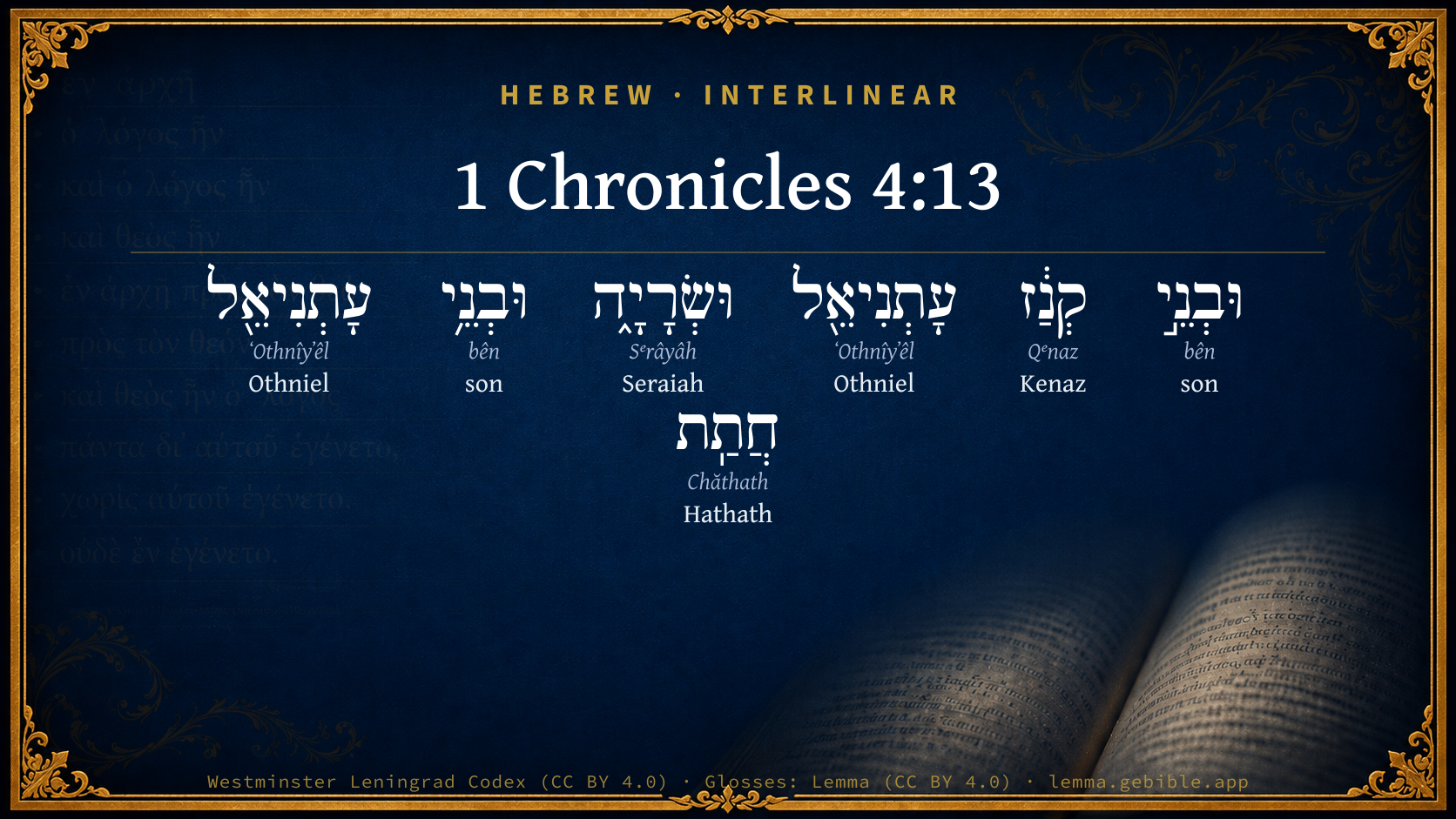
1 Chronicles 4:13

Hebrew (Westminster Leningrad Codex) 1 Chronicles 4:13 appears in the Hebrew Old Testament. The text above is from the Westminster Leningrad Codex. Each word links to its Strong’s number, a concise gloss, and parsing drawn from the Open Scriptures Hebrew Bible morphology. Click any word for its full Brown-Driver-Briggs (BDB) entry.
Download image
Cite this verse

1 Chronicles 4:13 (World English Bible). Public Domain. Lemma interlinear Bible study tool, https://lemma.gebible.app/v/1-chronicles/4/13.

Show BibTeX & RIS
BibTeX
RIS
English Translation
The sons of Kenaz: Othniel, and Seraiah. The sons of Othniel: Hathath.
World English Bible · Public Domain
Highlights
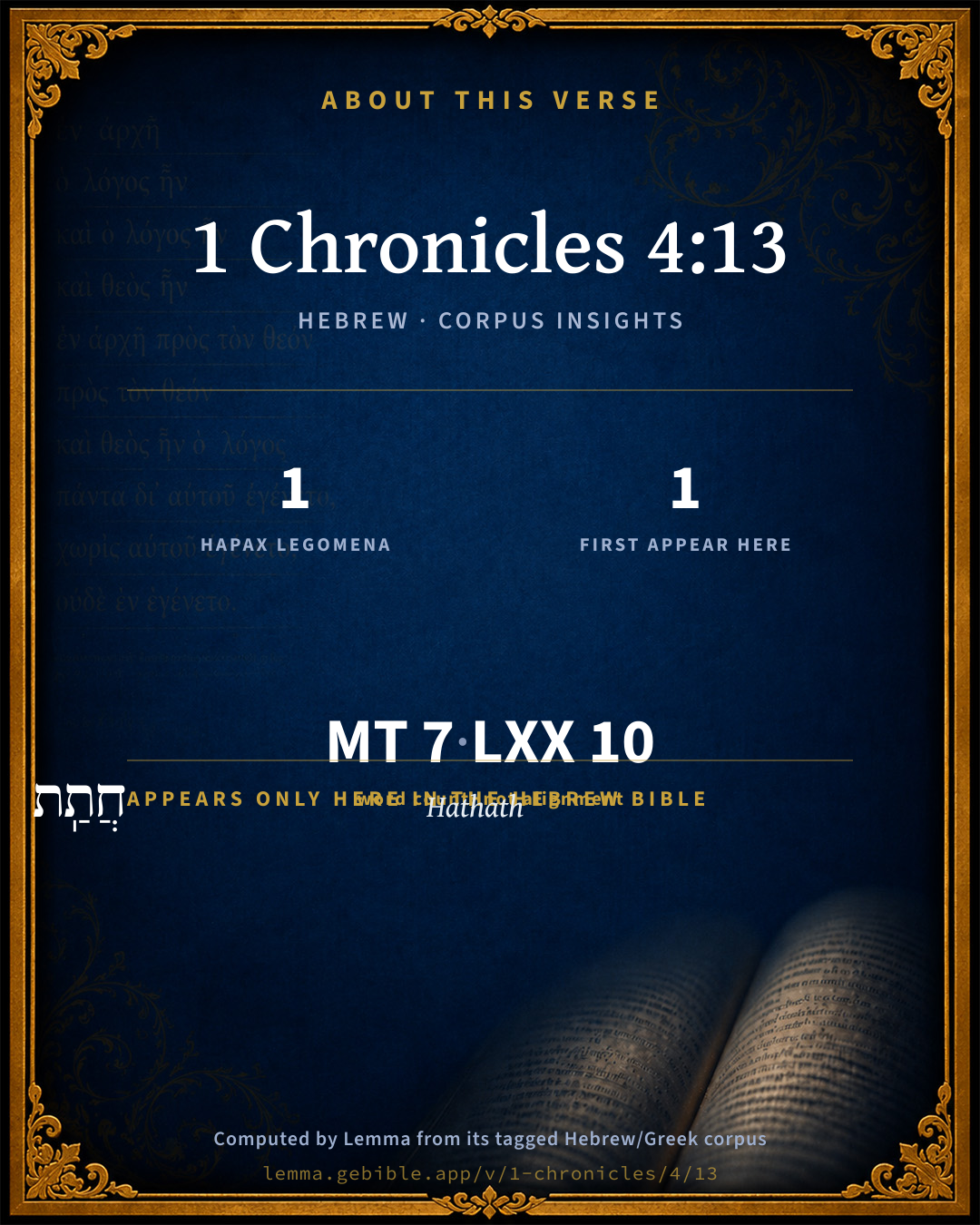
  • 1 hapax legomenon — only here in the Hebrew Bible
  • 1 first appearance in the Hebrew Bible
Full analysis ↓
Download a study sheet

One document with this verse’s original text, its word-by-word gloss line, the meaning frame, cross-references with their text, attributed commentary, and full source and license credits — printable, and it pastes into notes with its structure intact.

This verse Autodidact and up

Study sheet (.html) Plain text (.txt)

A passage Seminary Student

Up to 50 verses in one chapter. A passage sheet keeps up to 6 commentary sources and 12 cross-references per verse, in the order this page ranks them, and says so on the sheet whenever that leaves anything out. Ask for a single verse and you get the Autodidact verse sheet above.

Everything on this page stays free to read, with no account — the sheet is a download of what is already on screen, not access to it.

Want to remove ads? Support Godless Engineer
Compare translations 3

The same verse in 3 English versions, stacked beneath the original-language interlinear above. Click any original word for its lexicon entry.

Each is an independent rendering of the whole verse — the interlinear is not word-aligned to these translations.

Highlighted words mark where these versions differ — a whole-verse word diff, not a word-by-word alignment.

  • World English Bible Public Domain
    The sons of Kenaz: Othniel, and Seraiah. The sons of Othniel: Hathath.
  • King James Version Public Domain
    And the sons of Kenaz; Othniel, and Seraiah: and the sons of Othniel; Hathath.
  • unfoldingWord Literal Text CC BY-SA 4.0
    And the sons of Kenaz: Othniel and Seraiah. And the sons of Othniel: Hathath.

unfoldingWord Literal Text — © unfoldingWord, licensed CC BY-SA 4.0. Word-aligned USFM3 via Door43 (git.door43.org/unfoldingWord/en_ult).

Versions to compare (up to 4)

3 of 4 selected

Show all 18 translations

Every available English version of this verse, each an independent rendering of the whole verse.

  • World English Bible Public Domain
    The sons of Kenaz: Othniel, and Seraiah. The sons of Othniel: Hathath.
  • Berean Standard Bible Public Domain
    The sons of Kenaz: Othniel and Seraiah. The sons of Othniel: Hathath and Meonothai.
  • Majority Standard Bible Public Domain
    The sons of Kenaz: Othniel and Seraiah. The sons of Othniel: Hathath and Meonothai.
  • King James Version Public Domain
    And the sons of Kenaz; Othniel, and Seraiah: and the sons of Othniel; Hathath.
  • American Standard Version (1901) Public Domain
    And the sons of Kenaz: Othniel, and Seraiah. And the sons of Othniel: Hathath.
  • Revised Version (1885) Public Domain
    And the sons of Kenaz; Othniel, and Seraiah: and the sons of Othniel; Hathath.
  • Geneva Bible (1599) Public Domain
    And the sonnes of Kenaz were Othniel and Zeraiah, and the sonne of Othniel, Hathath.
  • Douay-Rheims (1899) Public Domain
    And the sons of Cenez were Othoniel,. and Saraia. And the sons of Othoniel, Hathath, and Maonathi.
  • Young's Literal Translation Public Domain
    And sons of Kenaz: Othniel, and Seraiah; and sons of Othniel: Hathath.
  • Literal Standard Version CC BY-SA 4.0
    And sons of Kenaz: Othniel and Seraiah; and sons of Othniel: Hathath.
  • Unlocked Literal Bible CC BY-SA 4.0
    Kenaz's sons were Othniel and Seraiah. Othniel's sons were Hathath and Meonothai.
  • unfoldingWord Literal Text CC BY-SA 4.0
    And the sons of Kenaz: Othniel and Seraiah. And the sons of Othniel: Hathath.
  • Darby Bible Public Domain
    -- And the sons of Kenaz: Othniel and Seraiah; and the sons of Othniel: Hathath.
  • World Messianic Bible Public Domain
    The sons of Kenaz: Othniel and Seraiah. The sons of Othniel: Hathath.
  • Webster's Bible Public Domain
    And the sons of Kenaz; Othniel, and Seraiah: and the sons of Othniel; Hathath.
  • Free Bible Version CC BY-SA 4.0
    The sons of Kenaz: Othniel and Seraiah. The sons of Othniel: Hathath and Meonothai.
  • Bible in Basic English Public Domain
    And the sons of Kenaz: Othniel and Seraiah; and the sons of Othniel: Hathath.
  • JPS Tanakh (1917) Public Domain
    And the sons of Kenaz: Othniel, and Seraiah; and the sons of Othniel: Hathath.

Literal Standard Version (2020), Covenant Press — licensed CC BY-SA 4.0. Text via the HelloAO Bible API (eBible.org). Unlocked Literal Bible (unfoldingWord) — licensed CC BY-SA 4.0. Text via the HelloAO Bible API (eBible.org). unfoldingWord Literal Text — © unfoldingWord, licensed CC BY-SA 4.0. Word-aligned USFM3 via Door43 (git.door43.org/unfoldingWord/en_ult). Free Bible Version, Dr. Jonathan Gallagher — licensed CC BY-SA 4.0. Text via the HelloAO Bible API (eBible.org).

Word by word

More ways to search: Search by grammar → Find every occurrence → Compare this word →

Practice this passage: Drill this verse → Learn its vocabulary →

About this verse

These counts appear in no published source. They are computed here, from the morphology-tagged text and Lemma’s own curated glosses. What Lemma adds →

7
words
5
distinct lemmas
Historical
section

Notable vocabulary

1 hapax legomenon — a word that appears only here in the entire Hebrew Bible:

  • חֲתַֽת Hathath H2867

First appearance in Scripture

This word makes its first canonical appearance in the Hebrew Bible here:

  • חֲתַֽת Hathath H2867

Shared distinctive vocabulary

עָתְנִיאֵ֖ל Othniel H6274 occurs in 6 verses of the Hebrew Bible. Also found in:

Grammatical profile

  • 7 nouns

Repetition

Words recur within this verse — often emphatic in Hebrew:

  • וּבְנֵ֣י son H1121 ×2
  • עָתְנִיאֵ֖ל Othniel H6274 ×2

Hebrew & Septuagint length

In English translation the verse runs 12 words from the Hebrew and 14 from the Septuagint (LXX English) — closely comparable.

A rough comparison of the two English renderings, which tokenize alike — not a word-level alignment.

Word counts can differ between the Hebrew and the Greek without any difference in meaning — e.g. the Hebrew direct-object marker אֵת has no separate Greek word, and Greek often adds the article ὁ.

In the original languages it is 7 Hebrew tokens and 10 Greek tokens — but the two are counted differently (Hebrew bundles its prefixes and suffixes into one token; the Greek is in lemma form), so that isn’t a like-for-like length.

Cross-references

3

Topical passages linked to 1 Chronicles 4:13 in the Treasury of Scripture Knowledge — connected by theme and wording, ordered by reader-vote popularity; previews shown in the World English Bible.

  • Joshua 15:17 Othniel the son of Kenaz, the brother of Caleb, took it: and he gave him Achsah his daughter as wife.
  • Judges 1:13 Othniel the son of Kenaz, Caleb's younger brother, took it: and he gave him Achsah his daughter as wife.
  • Judges 3:9–11 When the children of Israel cried to Yahweh, Yahweh raised up a savior to the children of Israel, who saved them, even Othniel the son of Kenaz, Caleb's younger brother.

Cross-references courtesy of OpenBible.info (CC BY 4.0).

Hebrew and Greek witnesses Masoretic Hebrew ↔ Greek Septuagint

The same verse in the two great witnesses to the Old Testament, shown verse-for-verse.

These are two independent witnesses, not word-aligned to each other, and the Septuagint is shown in lemma (dictionary) form.

Hebrew 1 Chronicles 4:13 Masoretic · Westminster Leningrad Codex

וּבְנֵ֣י קְנַ֔ז עָתְנִיאֵ֖ל וּשְׂרָיָ֑ה וּבְנֵ֥י עָתְנִיאֵ֖ל חֲתַֽת

The sons of Kenaz: Othniel, and Seraiah. The sons of Othniel: Hathath.

World English Bible · Public Domain

Greek LXX 1 Chronicles 4:13 Septuagint · lemma form

καί υἱός κενεζ γοθονιηλ καί σαραια καί υἱός γοθονιηλ αθαθ

And the sons of Kenez; Gothoniel, and Saraia: and the sons of Gothoniel; Athath.

LXX2012 (modern English Septuagint) · Public Domain

Hebrew: Westminster Leningrad Codex (CC BY 4.0). Greek: Septuagint (public domain); English from LXX2012 (modern English Septuagint) (Public Domain). How the Septuagint differs from the Hebrew →

Commentary

Notes on 1 Chronicles 4:13 from classic Christian and Jewish commentators (each source and its license shown beneath its notes). The classic Christian expositions comment on the surrounding passage and are grouped to its opening verse, so a note may address several verses; the Jewish commentaries on the Tanakh (Rashi and others) are per-verse, so they appear only where the commentator wrote on this verse.

Lemma curates 59 commentaries, every one of them public domain or Creative Commons licensed, each selected and text-cleaned for this edition rather than reprinted as found. About our sources →

Trapp's Complete Commentary

John Trapp

1Ch 4:13 And the sons of Kenaz; Othniel, and Seraiah: and the sons of Othniel; Hathath.

Ver. 13. Othniel.] See on 1Ch 4:9-10.

John Trapp, A Commentary or Exposition upon All the Books of the Old and New Testament (1647–1656) — public domain. Text from a community e-Sword module.

Tyndale Open Study Notes

Tyndale Open Resources

4:13-15 The name Kenaz also appears as a descendant of Esau by Eliphaz (Gen 36:11); his descendants are known as the Kenizzites. The Kenizzites lived in the southern part of the land and had affiliations with Judah and Edom. Caleb son of Jephunneh was a Kenizzite (Num 32:12; Josh 14:6) and had a brother named Kenaz (Josh 15:17), whose family is listed here.

Tyndale Open Study Notes — © Tyndale Open Resources, licensed CC BY-SA 4.0. Text via the HelloAO Bible API.

Jamieson, Fausset & Brown

Robert Jamieson, A. R. Fausset & David Brown

the sons of Kenaz--the grandfather of Caleb, who from that relationship is called a Kenezite (Num 32:12).

Jamieson, Fausset & Brown — Commentary Critical and Explanatory on the Whole Bible (1871) — public domain (CC PDM 1.0). Text via the HelloAO Bible API.

The Cambridge Bible for Schools and Colleges

gen. ed. J. J. S. Perowne

13. Othniel] the first of the Judges; cp. Jdg_1:13; Jdg_3:9-11.

The Cambridge Bible for Schools and Colleges (gen. ed. J. J. S. Perowne; Cambridge University Press, 1878–1918) — public domain. Text from a community e-Sword module.

John Gill's Exposition

And the sons of Kenaz,.... Who was either the son of Chelub, or of Eshton:

Othniel, and Seraiah; the first of these is he who is mentioned, Jos 15:17 and was the first judge in Israel:

and the son of Othniel, Hathath; and the next mentioned.

John Gill's Exposition of the Whole Bible (1746–1763) — public domain (CC PDM 1.0). Text via the HelloAO Bible API.

Haydock's Catholic Bible Commentary

Othoniel, first judge. (Haydock) --- He was brother, or rather cousin, of Caleb. See Josue xv. 17.

George Leo Haydock (1774–1849), Haydock's Catholic Family Bible and Commentary, 1859 edition — public domain. Excludes Psalms (Douay-Rheims chapter numbering differs from Protestant) and Deuterocanonical books (Catholic canon only).

Matthew Poole's English Annotations

Kenaz; the son either of Chelub, 1Ch 4:11, or of his son Eshton, 1Ch 4:12, and the father of Jephunneh, and consequently Caleb’s grandfather, 1Ch 4:15; whence Caleb is called a Kenezite, Num 32:12.

Hathath; understand, and Meonothai, out of 1Ch 4:14. See Poole "1Ch 4:7".

Matthew Poole's English Annotations on the Holy Bible (1683–1685) — public domain. Text from a community e-Sword/MySword module.

The Pulpit Commentary

Vers. 13-15. We return here to the neighbourhood of names not quite strange. From comparison of the many passages in Numbers, Joshua, and Judges, which contain references to Othniel and Caleb (son of Jephunneh), the stronger conclusion to which we are led is that Othniel was younger brother of Caleb (probably not by both the same parents) and Kenaz a forefather, of course not literally father. The conclusion is not arrived at without difficulty, or with any real certainty. In the present instance, e.g. , why should Othniel, if the younger brother and so expressly and repeatedly mentioned, be taken first? For the possible Kenaz of this passage, we might then refer to 1Ch_1:53; Gen_36:42. Hathath. The marginal reading, which joins Meonothai at once to Hathath, and then supplies "who" before "begat Ophrah," is decidedly to be adopted. Joab son of Seraiah is not to be assumed to be one with Joab son of Zeruiah. The valley of the Charashim (see also, Neh_11:35) i.e. smiths, or craftsmen, lay east of Jaffa, and behind the plain of Sharon; and is said by Jerome, in his "Quaestiones Hebraicae in Paral.," to have been, according to tradition, named so because the architects of the temple came thence. Iru. Perhaps the real name is It, and the final vau rather an initial for the next name. Elah. Probably another name is wanting after this, which the vau will then join to Kenaz; otherwise, as vau will not translate "even," the following name will become, as in the margin, Uknaz. The wanting name might be the Jehalaleel of the next verse. This last name is in the Hebrew identical with the Jehalelel of our Authorized Version. (2Ch_29:12)

Othniel"s adventure; or, the impulse of promised rewards.

For the story, see Jos_15:16, Jos_15:17; Jud_1:12, 13 3:9. The point of the narrative, for the sake of which it is preserved, appears to be this: Othniel acted, vigorously and successfully, under the impulse of offered reward. The daughter of one so honoured as Caleb was a prize indeed worth winning, and she was to be given to the man who, by his valour and skill, could take the city of Kirjath-sepher. Compare the offer of reward which David made on the occasion of the siege of Jerusalem. (1Ch_11:6) Some interest attaches to Kirjath-sepher as meaning the "Book-town," and suggesting the existence of a literature at that time among the Canaanites. Its earlier name (Debir, oracle) may indicate that it was a national sanctuary where the national records were preserved; and, if so, we may be sure that it was securely walled and stoutly defended. The incident may be used to introduce the consideration of the appropriateness of offering rewards, as an incentive to the doing of duty, and in the higher spheres of morals and religion, where all the quality of actions must depend on the motives for which they find expression. In relation to the education and training of the young, the subject of rewards is frequently discussed; some urging that childhood needs the help to effort and perseverance which may be found in the promise of reward; while others contend that a child is deteriorated, and led to adopt false sentiments for life, who is impelled to exertion by the hope of what is to be gained by it, and not to act or to abstain from acting because the thing required is right. It may, however, be fairly contended that, besides the proper and high motives of duty and right, we may thankfully accept the aid of auxiliary motives, and that among these may be set in a first place the promise and the hope of reward. But it would seem to settle the question, that we can show so fully how God has been pleased in lesser spheres and in greater, in temporal affairs and in spiritual, throughout all the long ages to use the impulse of rewards. This may be fully and impressively illustrated in the Bible story; and of the character of the illustrations we give a few suggestive instances.

1. In the first trial of humanity it was distinctly understood that themaintenance of all that was gathered up in Paradise was the reward of obedience.

2. To Abraham God offered himself, in his personal favour, and in hispower to guide and bless, as "his exceeding great Reward," and even Abraham"s faith and loyalty were upheld by the promise that in his "seed all nations of the earth should be blessed.

3. Israel was helped to endure the rigours of Egypt, and to make a great stand for liberty, under the assurance of a great reward, even the heritage of the land that flowed with milk and honey. And it has often been pointed out that temporal prosperity in Canaan was distinctly offered as the reward of obedience to the Law.

4. The prophets as may be most impressively seen in Isaiah heldbefore the people most glowing visions of coming days as the sure reward of a full and hearty national return to Jehovah.

5. Our Lord himself fitted the impulse of reward into his most graciousinvitation, "Come unto me and I will give you rest.

6. The apostles urge the disciples to all earnestness in the Christian life andlabour, by the assurance that we run for an "incorruptible crown," and may hope to receive a "crown of glory, that fadeth not away." Our last sight of Christ in the Word presents him as saying," Behold, I come quickly; and my reward is with me." We may, then, use the promise of rewards; they appeal to sentiments and feelings in us that are good and useful. We may magnify the grace of God in even thus helping us to win "the holy." And we may reasonably expect present, and certainly look for future, gracious rewards of obedience and faithfulness. R.T.

The Pulpit Commentary (1880–1919), ed. H.D.M. Spence-Jones & Joseph S. Exell — public domain. Text from a community e-Sword module.

Keil & Delitzsch

C. F. Keil & F. Delitzsch

And the sons of Kenaz,.... Who was either the son of Chelub, or of Eshton:

Othniel, and Seraiah; the first of these is he who is mentioned, Jos 15:17 and was the first judge in Israel:

and the son of Othniel, Hathath; and the next mentioned.

Keil & Delitzsch — Biblical Commentary on the Old Testament (1861–1891) — public domain (CC PDM 1.0). Text via the HelloAO Bible API. (Old Testament only.)

unfoldingWord translationNotes

Door43 World Missions Community

General Information:

It may be helpful to create a verse bridge and to put verse 15 together with verse 13 since Kenaz was a descendant of Jephunneh and Caleb. (See: Verse Bridges)

Kenaz ... Othniel ... Seraiah ... Hathath ... Meonothai ... Ophrah ... Joab ... Jephunneh ... Iru ... Elah ... Naam ... Jehallelel ... Ziph ... Ziphah ... Tiria ... Asarel

These are the names of men. (See: How to Translate Names)

Ge-Harashim, whose people were craftsmen

Ge-Harashim means "Valley of Craftsmen." This can be made explicit with an explanation. AT: "Ge-Harashim, which means 'Craftsmen's Valley.' It was called this because its people were craftsmen" (See: How to Translate Names and Assumed Knowledge and Implicit Information)

craftsmen

people skilled at making or building things

translationWords

people group

Caleb

unfoldingWord translationNotes — © Distant Shores Media and the Door43 World Missions Community, licensed CC BY-SA 4.0. Source: git.door43.org/Door43/en_tn.

Lesson kit

Teaching starters — assembled from the data on this page, not authored interpretation. Every prompt links to the verse data it draws on. Edit before teaching.

1 Chronicles, in the Historical, opens this verse with 7 words (5 distinct Hebrew lemmas). Its most distinctive word is Chăthath (“Hathath”). A historical commentator’s framing appears above. Read the whole chapter for the surrounding context.

Discussion questions

  1. The word Chăthath carries the sense “Hathath.” How does it shape the verse?
  2. 1 word here appears nowhere else in the Hebrew Bible. Why might the author reach for such rare wording?
  3. This is the first place “Hathath” appears in Scripture (first appears here). What does its debut here establish?
  4. How does Joshua 15:17, which shares the word «Othniel», read alongside this verse?
  5. What does the repetition of “son” (2× in this one verse) do in this verse?
  6. Compare how Trapp's Complete Commentary and Tyndale Open Study Notes read this verse. Where do they agree or differ?

Things to notice

Reading settings

Reading text

Shown beneath each verse's original-language words.

Old Testament
Old Testament edition

Read the OT as the Masoretic Hebrew (MT) or the Greek Septuagint (LXX).

English shown for the Greek Septuagint (in the Hebrew ↔ Greek comparison).

Comparing translations? Open the Compare panel on any verse page to stack up to four side by side.