
Genesis 5:32

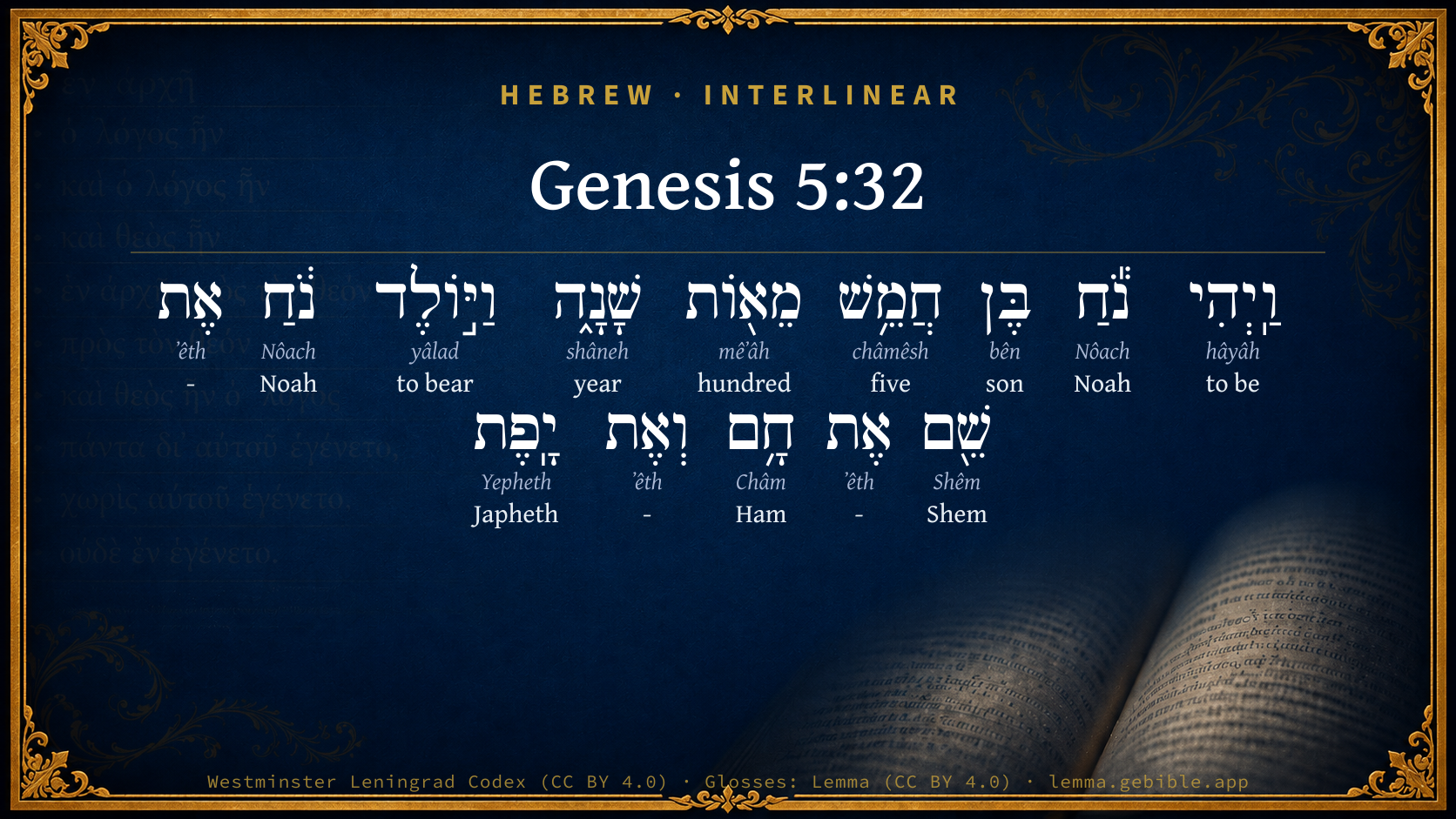
Hebrew (Westminster Leningrad Codex) Genesis 5:32 appears in the Hebrew Old Testament. The text above is from the Westminster Leningrad Codex. Each word links to its Strong’s number, a concise gloss, and parsing drawn from the Open Scriptures Hebrew Bible morphology. Click any word for its full Brown-Driver-Briggs (BDB) entry.
Download image
Cite this verse

Genesis 5:32 (World English Bible). Public Domain. Lemma interlinear Bible study tool, https://lemma.gebible.app/v/genesis/5/32.

Show BibTeX & RIS
BibTeX
RIS
English Translation
Noah was five hundred years old, and Noah became the father of Shem, Ham, and Japheth.
World English Bible · Public Domain
Highlights
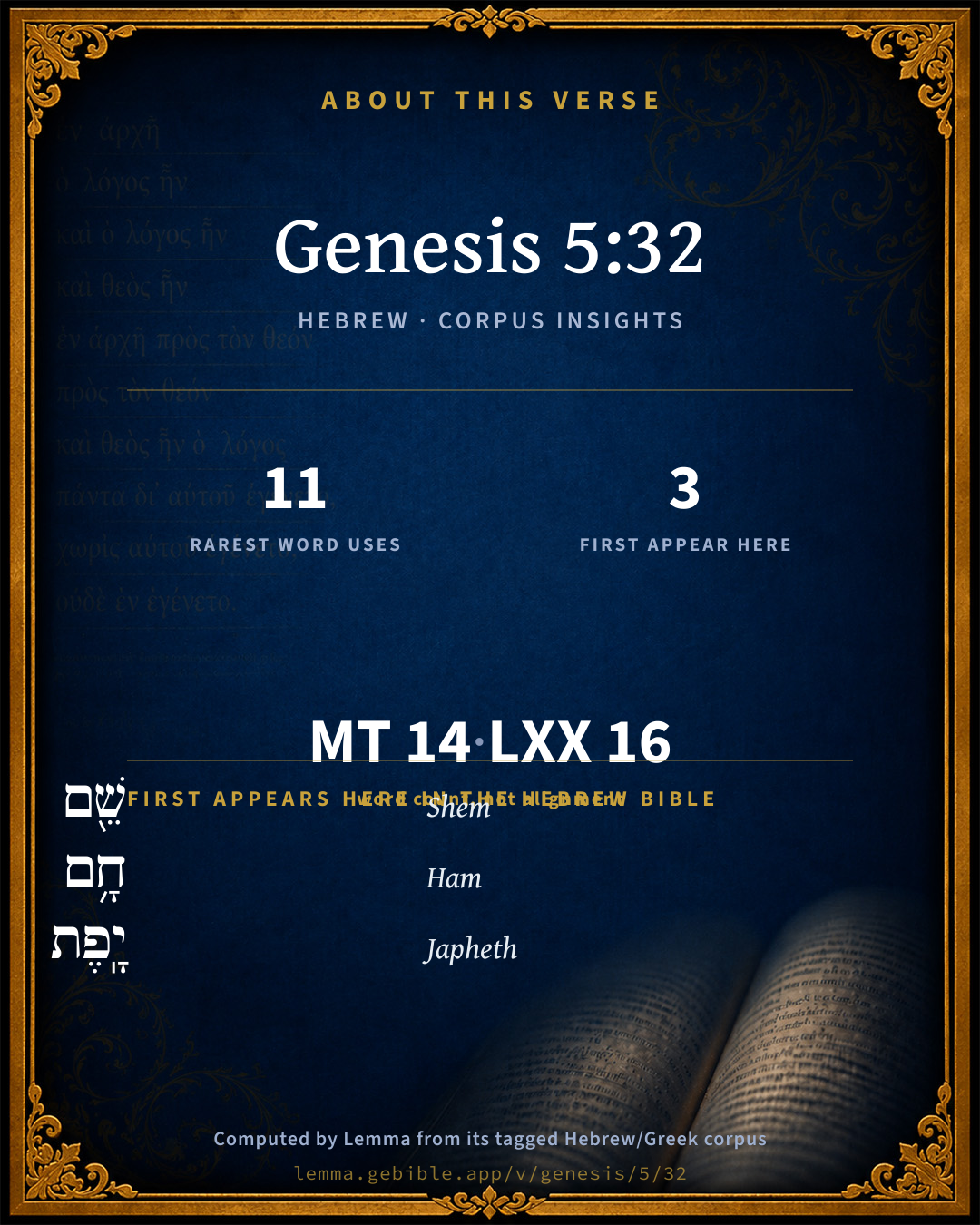
  • 3 first appearances in the Hebrew Bible
Full analysis ↓
Download a study sheet

One document with this verse’s original text, its word-by-word gloss line, the meaning frame, cross-references with their text, attributed commentary, and full source and license credits — printable, and it pastes into notes with its structure intact.

This verse Autodidact and up

Study sheet (.html) Plain text (.txt)

A passage Seminary Student

Up to 50 verses in one chapter. A passage sheet keeps up to 6 commentary sources and 12 cross-references per verse, in the order this page ranks them, and says so on the sheet whenever that leaves anything out. Ask for a single verse and you get the Autodidact verse sheet above.

Everything on this page stays free to read, with no account — the sheet is a download of what is already on screen, not access to it.

Want to remove ads? Support Godless Engineer
Compare translations 3

The same verse in 3 English versions, stacked beneath the original-language interlinear above. Click any original word for its lexicon entry.

Each is an independent rendering of the whole verse — the interlinear is not word-aligned to these translations.

Highlighted words mark where these versions differ — a whole-verse word diff, not a word-by-word alignment.

  • World English Bible Public Domain
    Noah was five hundred years old, and Noah became the father of Shem, Ham, and Japheth.
  • King James Version Public Domain
    And Noah was five hundred years old: and Noah begat Shem, Ham, and Japheth.
  • unfoldingWord Literal Text CC BY-SA 4.0
    And Noah was a son of 500 years, then Noah fathered Shem, Ham, and Japheth.

unfoldingWord Literal Text — © unfoldingWord, licensed CC BY-SA 4.0. Word-aligned USFM3 via Door43 (git.door43.org/unfoldingWord/en_ult).

Versions to compare (up to 4)

3 of 4 selected

Show all 17 translations

Every available English version of this verse, each an independent rendering of the whole verse.

  • World English Bible Public Domain
    Noah was five hundred years old, and Noah became the father of Shem, Ham, and Japheth.
  • Berean Standard Bible Public Domain
    After Noah was 500 years old, he became the father of Shem, Ham, and Japheth.
  • Majority Standard Bible Public Domain
    After Noah was 500 years old, he became the father of Shem, Ham, and Japheth.
  • King James Version Public Domain
    And Noah was five hundred years old: and Noah begat Shem, Ham, and Japheth.
  • American Standard Version (1901) Public Domain
    And Noah was five hundred years old: And Noah begat Shem, Ham, and Japheth.
  • Revised Version (1885) Public Domain
    And Noah was five hundred years old: and Noah begat Shem, Ham, and Japheth.
  • Geneva Bible (1599) Public Domain
    And Noah was fiue hundreth yeere olde. And Noah begate Shem, Ham and Iapheth.
  • Young's Literal Translation Public Domain
    And Noah is a son of five hundred years, and Noah begetteth Shem, Ham, and Japheth.
  • Literal Standard Version CC BY-SA 4.0
    And Noah is a son of five hundred years, and Noah begets Shem, Ham, and Japheth.
  • Unlocked Literal Bible CC BY-SA 4.0
    After Noah had lived five hundred years, he became the father of Shem, Ham, and Japheth.
  • unfoldingWord Literal Text CC BY-SA 4.0
    And Noah was a son of 500 years, then Noah fathered Shem, Ham, and Japheth.
  • Darby Bible Public Domain
    And Noah was five hundred years old, and Noah begot Shem, Ham, and Japheth.
  • World Messianic Bible Public Domain
    Noah was five hundred years old, then Noah became the father of Shem, Ham, and Japheth.
  • Webster's Bible Public Domain
    And Noah was five hundred years old: and Noah begat Shem, Ham, and Japheth.
  • Free Bible Version CC BY-SA 4.0
    Noah was 500 before he had Shem, Ham, and Japheth.
  • Bible in Basic English Public Domain
    And when Noah was five hundred years old, he became the father of Shem, Ham, and Japheth.
  • JPS Tanakh (1917) Public Domain
    And Noah was five hundred years old; and Noah begot Shem, Ham, and Japheth.

Literal Standard Version (2020), Covenant Press — licensed CC BY-SA 4.0. Text via the HelloAO Bible API (eBible.org). Unlocked Literal Bible (unfoldingWord) — licensed CC BY-SA 4.0. Text via the HelloAO Bible API (eBible.org). unfoldingWord Literal Text — © unfoldingWord, licensed CC BY-SA 4.0. Word-aligned USFM3 via Door43 (git.door43.org/unfoldingWord/en_ult). Free Bible Version, Dr. Jonathan Gallagher — licensed CC BY-SA 4.0. Text via the HelloAO Bible API (eBible.org).

Word by word

More ways to search: Search by grammar → Find every occurrence → Compare this word →

Practice this passage: Drill this verse → Learn its vocabulary →

יָֽפֶת
Yepheth
H3315
“Japheth”
Noun, Proper
Part of Speech
Noun
Type
Proper
Full BDB Definition

Origin: from H6601

TWOT: None

Japheth = "opened" - the 3rd son of Noah whose descendants after the flood settled on the coastal lands of the Mediterranean spreading north into Europe and parts of Asia
  1. וַֽיְהִי hâyâh H1961 “and · to be” Conjunction + Verb, Qal, Sequential Imperfect, 3rd Person, Masculine, Singular
  2. נֹ֕חַ Nôach H5146 “Noah” Noun, Proper
  3. בֶּן bên H1121 “son of” Noun, Common, Masculine, Singular, Construct
  4. חֲמֵ֥שׁ châmêsh H2568 “five” Adjective, Cardinal number, Feminine, Singular, Absolute
  5. מֵא֖וֹת mêʼâh H3967 “hundred” Adjective, Cardinal number, Both, Plural, Absolute
  6. שָׁנָ֑ה shâneh H8141 “year” Noun, Common, Feminine, Singular, Absolute
  7. וַיּ֣וֹלֶד yâlad H3205 “and · to bear” Conjunction + Verb, Hiphil, Sequential Imperfect, 3rd Person, Masculine, Singular
  8. נֹ֔חַ Nôach H5146 “Noah” Noun, Proper
  9. אֶת ʼêth H853 “-” Particle, Direct Object
  10. שֵׁ֖ם Shêm H8035 “Shem” Noun, Proper
  11. אֶת ʼêth H853 “-” Particle, Direct Object
  12. חָ֥ם Châm H2526 “Ham” Noun, Proper
  13. וְאֶת ʼêth H853 “and · -” Conjunction + Particle, Direct Object

About this verse

These counts appear in no published source. They are computed here, from the morphology-tagged text and Lemma’s own curated glosses. What Lemma adds →

14
words
11
distinct lemmas
Pentateuch
section

Notable vocabulary

The rarest word here is יָֽפֶת Japheth H3315 — appearing just 11 times in the whole Hebrew Bible.

First appearance in Scripture

These words make their first canonical appearance in the Hebrew Bible here:

Shared distinctive vocabulary

יָֽפֶת Japheth H3315 occurs in 11 verses of the Hebrew Bible. Also found in:

Grammatical profile

  • 2 verbs
  • 7 nouns
  • 2 adjectives
  • 3 particles

Verb forms

  • וַֽיְהִי Qal · Sequential Imperfect
  • וַיּ֣וֹלֶד Hiphil · Sequential Imperfect

Repetition

A word recurs within this verse — often emphatic in Hebrew:

  • נֹ֕חַ Noah H5146 ×2

Hebrew & Septuagint length

In the original languages it is 14 Hebrew tokens and 16 Greek tokens — but the two are counted differently (Hebrew bundles its prefixes and suffixes into one token; the Greek is in lemma form), so that isn’t a like-for-like length.

Cross-references

9

Topical passages linked to Genesis 5:32 in the Treasury of Scripture Knowledge — connected by theme and wording, ordered by reader-vote popularity; previews shown in the World English Bible.

  • Genesis 6:10 Noah became the father of three sons: Shem, Ham, and Japheth.
  • Genesis 10:21 To Shem, the father of all the children of Eber, the elder brother of Japheth, to him also were children born.
  • Genesis 7:13 In the same day Noah, and Shem, Ham, and Japheth, the sons of Noah, and Noah's wife, and the three wives of his sons with them, entered into the ark;
  • Genesis 9:18–19 The sons of Noah who went forth from the ark were Shem, Ham, and Japheth. Ham is the father of Canaan.
  • Genesis 9:22–27 Ham, the father of Canaan, saw the nakedness of his father, and told his two brothers outside.
  • Genesis 10:1 Now this is the history of the generations of the sons of Noah and of Shem, Ham, and Japheth. Sons were born to them after the flood.
  • Genesis 10:32 These are the families of the sons of Noah, after their generations, in their nations. Of these were the nations divided in the earth after the flood.
  • 1 Chronicles 1:4–28 Noah, Shem, Ham, and Japheth.
  • Luke 3:36 the son of Cainan, the son of Arphaxad, the son of Shem, the son of Noah, the son of Lamech,

Cross-references courtesy of OpenBible.info (CC BY 4.0).

Hebrew and Greek witnesses Masoretic Hebrew ↔ Greek Septuagint

The same verse in the two great witnesses to the Old Testament, shown verse-for-verse.

These are two independent witnesses, not word-aligned to each other, and the Septuagint is shown in lemma (dictionary) form.

Hebrew Genesis 5:32 Masoretic · Westminster Leningrad Codex

וַֽיְהִי נֹ֕חַ בֶּן חֲמֵ֥שׁ מֵא֖וֹת שָׁנָ֑ה וַיּ֣וֹלֶד נֹ֔חַ אֶת שֵׁ֖ם אֶת חָ֥ם וְאֶת יָֽפֶת

Noah was five hundred years old, and Noah became the father of Shem, Ham, and Japheth.

World English Bible · Public Domain

Greek LXX Genesis 5:32 Septuagint · lemma form

καί εἰμί νωε ἔτος πεντακόσιοι καί γεννάω νωε τρεῖς υἱός ὁ σημ ὁ χαμ ὁ ιαφεθ

No English rendering of this Greek verse — the small residue in the structurally divergent books.

On this verse, The Pulpit Commentary discusses the Septuagint’s reading. Read the note in Commentary ↓

Hebrew: Westminster Leningrad Codex (CC BY 4.0). Greek: Septuagint (public domain); English from a public-domain English Septuagint. How the Septuagint differs from the Hebrew →

Targum (Aramaic paraphrase)

2

The Targum is the ancient Jewish Aramaic paraphrase of the Hebrew Scriptures — an interpretive translation, not the Hebrew text itself. Onkelos (literal) and Pseudo-Jonathan (expansive) render the Torah, and Jonathan the Prophets. Coverage is partial: where no permissively-licensed English translation exists for a verse, only the Aramaic is shown. This is verse-level text, not a word-by-word alignment to the Hebrew.

  1. Targum Onkelos Torah (Genesis–Deuteronomy)
    וַהֲוָה נֹחַ בַּר חֲמֵשׁ מְאָה שְׁנִין וְאוֹלִיד נֹחַ יָת שֵׁם יָת חָם וְיָת יָפֶת

    (no public-domain English translation for this verse)

    Targum Onkelos — Aramaic: “Onkelos Genesis” (public domain); “Onkelos Exodus” (public domain); “Onkelos Leviticus” (public domain); “Onkelos Numbers” (public domain); “Onkelos Deuteronomy” (public domain). English: “Sefaria Community Translation” (CC0 1.0 (public-domain dedication)); “J.W. Etheridge. The Targums of Onkelos and Jonathan Ben Uzziel on the Pentateuch. London: Longmans, Green, 1862” (public domain). Text via Sefaria.

  2. Targum Pseudo-Jonathan Torah (Genesis–Deuteronomy)
    וַהֲוָה נחַ בַּר חֲמֵשׁ מְאָה שְׁנִין וְאוֹלִיד נחַ יַת שֵׁם וְיַת חָם וְיַת יָפֶת

    And Noah was the son of five hundred years, and Noah begat Shem, Cham, and Japhet.

    Targum Pseudo-Jonathan — Aramaic: “Targum Jonathan on Genesis” (public domain); “Targum Jonathan on Exodus” (public domain); “Targum Jonathan on Leviticus” (public domain); “Targum Jonathan on Numbers” (public domain); “Targum Jonathan on Deuteronomy” (public domain). English: “The Targum of Jonathan ben Uzziel, trans. J. W. Etheridge, London, 1862” (public domain). Text via Sefaria.

Commentary

Notes on Genesis 5:32 from classic Christian and Jewish commentators (each source and its license shown beneath its notes). The classic Christian expositions comment on the surrounding passage and are grouped to its opening verse, so a note may address several verses; the Jewish commentaries on the Tanakh (Rashi and others) are per-verse, so they appear only where the commentator wrote on this verse.

Lemma curates 59 commentaries, every one of them public domain or Creative Commons licensed, each selected and text-cleaned for this edition rather than reprinted as found. About our sources →

Trapp's Complete Commentary

John Trapp

Gen 5:32 And Noah was five hundred years old: and Noah begat Shem, Ham, and Japheth.

Ver. 32. And Noah begat Shem, Ham, and Japheth.] Twenty years had he heard from God, that the world should be destroyed, before he had any child. Here was “the faith and patience of this saint.” {Rev 13:10} At length he hath Japheth first; though Shem be first named, because he was in dignity preferred before his brother, to be grandfather to the Messiah. Now any relation to Christ ennobleth either place or person. If it were an honour to Mark to have been Barnabas’s sister’s son, what is it then to be related to the Son of God? Bethlehem, where he was born, though it were least, says Micah; yet it was not the least, says Matthew, among all the cities of Judah, because out of it should come Christ the Governor. {Mic 5:2 Mat 2:6}

John Trapp, A Commentary or Exposition upon All the Books of the Old and New Testament (1647–1656) — public domain. Text from a community e-Sword module.

Joseph Benson's Commentary

Gen 5:32. And Noah begat Shem, Ham, and Japheth — It should seem that Japheth was the eldest, (Gen 10:21,) but Shem is put first, because on him the covenant was entailed, as appears by Gen 9:26, where God is called the Lord God of Shem. To him, it is probable, the birthright was given, and from him it is certain both Christ the head, and the church the body, were to descend; therefore he is called Shem, which signifies a name, because in his posterity the name of God should always remain, till He should come out of his loins, whose name is above every name; so that in putting Shem first, Christ was in effect put first, who in all things must have the pre-eminence.

Joseph Benson's Commentary on the Old and New Testaments (1811–1818) — public domain. Text from a community e-Sword module.

Jamieson, Fausset & Brown

Robert Jamieson, A. R. Fausset & David Brown

Noah was five hundred years old: and . . . begat--That he and the other patriarchs were advanced in life before children were born to them is a difficulty accounted for probably from the circumstance that Moses does not here record their first-born sons, but only the succession from Adam through Seth to Abraham.

Next: Genesis Chapter 6

Jamieson, Fausset & Brown — Commentary Critical and Explanatory on the Whole Bible (1871) — public domain (CC PDM 1.0). Text via the HelloAO Bible API.

Adam Clarke's Commentary

Verse 32. Noah begat Shem, Ham, and Japheth.] From Gen 10:21; 1Ch 1:5, c., we learn that Japheth was the eldest son of Noah, but Shem is mentioned first, because it was from him, in a direct line, that the Messiah came. Ham was certainly the youngest of Noah's sons, and from what we read, Ge 9:22, the worst of them and how he comes to be mentioned out of his natural order is not easy to be accounted for. When the Scriptures design to mark precedency, though the subject be a younger son or brother, he is always mentioned first; so Jacob is named before Esau, his elder brother, and Ephraim before Manasses. See Ge 28:5; Ge 48:20.

AMONG many important things presented to our view in this chapter, several of which have been already noticed, we may observe that, of all the antediluvian patriarchs, Enoch, who was probably the best man, was the shortest time upon earth; his years were exactly as the days in a solar revolution, viz., three hundred and sixty-five; and like the sun he fulfilled a glorious course, shining more and more unto the perfect day, and was taken, when in his meridian splendour, to shine like the sun in the kingdom of his Father for ever.

From computation it appears, 1. That Adam lived to see Lamech, the ninth generation, in the fifty-sixth year of whose life he died; and as he was the first who lived, and the first that sinned, so he was the first who tasted death in a natural way. Abel's was not a natural but a violent death. 2. That Enoch was taken away next after Adam, seven patriarchs remaining witness of his translation. 3. That all the nine first patriarchs were taken away before the flood came, which happened in the six hundredth year of Noah's life. 4. That Methuselah lived till the very year in which the flood came, of which his name is supposed to have been prophetical מתו methu, "he dieth," and שלח shalach, "he sendeth out;" as if God had designed to teach men that as soon as Methuselah died the flood should be sent forth to drown an ungodly world. If this were then so understood, even the name of this patriarch contained in it a gracious warning. See the genealogical plate after "Ge 11:32".

Adam Clarke's Commentary on the Bible (1810–1826) — public domain. Text from a community e-Sword/MySword module.

John Calvin's Commentaries

32. And Noah was five hundred years old. Concerning the fathers whom Moses has hitherto enumerated, it is not easy to conjecture whether each of them was the first born of his family or not; for he only wished to follow the continued succession of the Church. But God, to prevent men from being elated by a vain confidence in the flesh, frequently chooses for himself those who are posterior in the order of nature. I am, therefore, uncertain whether Moses has recorded the catalogue of those whom God preferred to others; or of those who, by right of primogeniture, held the chief rank among their brethren; I am also uncertain how many sons each had. With respect to Noah, it plainly appears that he had no more than three sons; and this Moses purposely declares the more frequently, that we may know that the whole of his family was preserved. But they, in my opinion, err, who think that in this place the chastity of Noah is proclaimed, because he led a single life through nearly five centuries. For it is not said that he was unmarried till that time; nor even in what year of his life he had begun to be a father. But, in simply mentioning the time in which he was warned of the future deluge, Moses also adds, that at the same time, or thereabouts, he was the father of three sons; not that he already had them, but because they were born not long afterwards. That he had, indeed, survived his five hundredth year before Shem was born, will be evident from the eleventh chapter (Genesis 11:1); concerning the other two nothing is known with certainty, except that Japheth was the younger. It is wonderful that from the time when he had received the dreadful message respecting the destruction of the human race, he was not prevented, by the greatness of his grief, from intercourse with his wife; but it was necessary that some remains should survive, because this family was destined for the restoration of the second world. Although we do not read at what time his sons took wives, I yet think it was done long before the deluge; but they were unfruitful by the providence of God, who had determined to preserve only eight souls.

John Calvin's Commentaries (1540-1563) — public domain. Text from the Calvin Translation Society English edition (1840s-50s) via the Christian Classics Ethereal Library (ccel.org). Calvin's coverage is partial (roughly two-thirds of the Bible); uncommented books and verses are honest gaps, never fabricated. The 19th-century editor's footnotes and remarks are omitted so the notes are faithfully Calvin's own voice.

Ellicott's Commentary for English Readers

(32) Noah was five hundred years old.—No reason is given why Noah had no son until he had attained to so ripe an age, nor, in fact, does it follow that he might not have had other sons, though unworthy of sharing his deliverance. It is remarkable also that neither of the three sons who were with him in the ark had offspring until after the flood. (See Gen_11:19.) From them have sprung the three great lines into which the human family is divided. Shem means name: that is, fame, glory; and he, as the owner of the birthright, was the progenitor of our Lord. Ham, the dark-coloured, was the ancestor of the Egyptians, Cushites, and other black races of Arabia and Africa. Japheth, the widener, but according to others the fair, though the youngest son, was the ancestor of most of the races of Europe, as well as of some of the chief nations of Asia.

A Bible Commentary for English Readers, edited by Charles John Ellicott (1878–1897) — public domain. Text from a community e-Sword module.

The Cambridge Bible for Schools and Colleges

gen. ed. J. J. S. Perowne

32. And Noah was, &c.] Noah is thus represented as much older, when he begets his children, than were the other patriarchs, when children were born to them. A hundred years is the interval of time between the birth of Noah’s sons and the Deluge (Gen_7:6).

Compare the mention of three sons born to Lamech, the last name in the Cainite genealogy (Gen_4:20-24).

The Cambridge Bible for Schools and Colleges (gen. ed. J. J. S. Perowne; Cambridge University Press, 1878–1918) — public domain. Text from a community e-Sword module.

Matthew Poole's English Annotations

i.e. He began to beget; God in mercy denying him children till that time, that he might not beget them to the destroyer, that he might have no more than should be saved in the ark; or, having before that time begotten others who were now dead, and having the approaching flood in his view, he began again to beget a seminary for the world.

Of these three sons here following, the eldest seems to be

Japheth, Gen 10:21. The second was

Shem, as appears because he was but an hundred years old two years after the flood, Gen 11:11. The youngest

Ham, Gen 9:24. But Shem is first named in order of dignity, as being the progenitor of the church, and of Jesus Christ; and because he and his progeny is the principal subject of this whole history.

Matthew Poole's English Annotations on the Holy Bible (1683–1685) — public domain. Text from a community e-Sword/MySword module.

Whedon's Commentary on the Bible

Daniel D. Whedon

32. Noah was five hundred years old — It is not meant that Noah had no children born to him for five centuries. Only those sons are mentioned with whom the narrative is specially concerned. Each patriarch had sons and daughters whose descendants multiplied through these centuries, but their names are lost to history. The order of age in Noah’s family is a matter of discussion. Shem is mentioned first, but it may be because he was the heir in the line of promise. Japheth, in Gen_10:21, seems to be called the elder, but the meaning may be, “Shem, the elder brother of Japheth,” that is, older than Ham, though not older than Japheth. Ham is called the youngest in Gen_9:24, yet the Hebrew may also be rendered younger. See Gesen. Hebrews Gram., § 119. From Gen_11:10, it seems that Shem was a hundred years old two years after the flood, that is, in Noah’s six hundred and third year. He must, then, have been born in Noah’s five hundred and third year, and, as Ham was younger than he, it follows that Japheth only could have been born in Noah’s five hundredth year. Yet some understand that in Gen_10:21, Shem is declared to be “elder” than Japheth, but this view cannot be harmonized with Gen_11:10. Japheth is not called the eldest of the three in Gen_10:21, but is conclusively shown to be so by the above comparison of passages. The Arabic writers represent Japheth as the eldest. Shem means name, fame; Ham means burnt, and Japheth means enlargement. Shem, the heir of Messianic hopes, the man of name, is placed first because Christ and salvation are ever first in revelation.

Daniel D. Whedon (gen. ed.), Commentary on the Old and New Testaments (1874–1909) — public domain. Text from a community e-Sword module.

The Pulpit Commentary

And Noah was five hundred years old. Literally, a son of 500 years, i.e. going in his 500th year (cf. Gen_7:6 Gen_16:1) The son of a year (Exo_12:5) means "strictly within the first year of the life" (Ainsworth). And Noah begati.e. began to beget (cf. Gen_11:26) Shem, name (Gesenius), fame (Furst)Ham, chain; hot (Gesenius, Murphy), dark-colored (Furst)and Japheth spreading (Gesenius, Murphy); beautiful, denoting the white-colored race (Furst). That the sons are mentioned in the order of their ages (Knobel, Kalisch, Keil, Colenso) may seem to be deducible

(1) from the fact that they usually stand in this order (cf. Gen_6:10 Gen_7:13 Gen_9:18 Gen_10:1; 1Ch_1:4)

(2) from the circumstance that it is commonly the eldest son"s birth which is stated in the preceding list, though this is open to doubt;

(3) from Gen_10:21, which, according to Calvin, Knobel, Keil, and others, describes Shem as Japheth"s elder brother; and Gen_9:24, which, according to Keil, affirms Ham to be the younger son of Noah;

(4) from Gen_10:2-31, in which the order is reversed, but not otherwise altered. But there is reason to believe that Japheth was the eldest and Ham the youngest of the patriarch"s children (Michaelis, Clarke, Murphy, Wordsworth, Quarry) According to Gen_11:10 Shem was born 97 years before the Flood, while (Gen_6:11) Noah was 600 years old at the time of the Flood. Hence, if Noah began to beget children in his 500th year, and Shem was born in Noah"s 503rd year, the probability is that the firstborn son was Japheth. In accordance with this Gen_10:21 is understood by LXX, Vulgate, Michaelis, Lange, Quarry, and others to assert the priority in respect of age of Japheth. In the narrative ahem is placed first as being spiritually, though not physically, the firstborn. Ranke perceives in the mention of the three sons an indication that each was subsequently "to lay the foundation of a new beginning.

HEBREW SAMARITAN SEPTUAGINT JOSEPHUS Age at son"s birth Age at death Age at son"s birth Age at death Age at son"s birth Age at death Age at son"s birth Age at death ADAM 130 930 130 930 230 930 230 930 SETH 105 912 105 912 205 912 205 912 ENOS 90 905 90 905 190 905 190 905 CAINAN 70 910 70 910 170 910 170 910 MEHALALEEL 65 895 65 895 165 895 165 895 JARED 162 962 62 847 162 962 162 962 ENOCH 65 365 65 365 165 365 165 365 METHUSELAH 187 969 67 720 187 969 187 969 LAMECH 182 777 53 653 188 753 182 777 NOAH 500 950 500 950 500 950 500 950 SHEM 100 100 100 100 DELUGE 1656 1307 2262 2256 THE ANTIQUITY OF MAN. The chronology of the present chapter represents man as having been in existence at the time of the Deluge exactly 1656 years. According to the Septuagint, which Josephus follows except in one particular (the age of Lamech), and which proceeds, again with two exceptions (the age of Jared, which it leaves untouched, and that of Lamech, which it increases by six), upon the principle of adding 100 to the Hebrew numbers, the age of man at the date of that catastrophe was 2262 (vide Chronological Table). The dates of the Samaritan Pentateuch, being manifestly incorrect, need not be considered. Adding to the above dates the subsequent chronological periods from the Deluge to the call of Abram (Hebrew, 367; LXX, 1017), from the call of Abram to the exodus from Egypt (430 years according to one calculation, LXX; 730 according to another, Kalisch), from the exodus to the birth of Christ (1645, Hales; 1593, Jackson; 1491, Ussher; 1531, Petavius; 1320, Bunsen), the antiquity of man, according to the Biblical account, is not less than 5652 and not more than 7536 years. The conclusion thus reached, however, is somewhat scornfully repudiated by modem science, as affording, on either alter. native, an altogether inadequate term of existence for the human race. 1. The evidence of geology is supposed irrefragably to attest that man must have been upon the earth at least 1000 centuries, and probably ten times as long (Wallace on "Natural Selection," p. 303). The data for this deduction, as stated by Sir Charles Lyell, are chiefly the discovery, in recent and post Pliocene formations of alleged great antiquity, of fossil human remains and flint implements along with bones of the mammoth and other animals long since extinct ("Antiquity of Man," Gen_1:19.). But

(1) "So far as research has been prosecuted in the different quarters of the globe, no remains of man or of his works have been discovered till we come to the lake-silts, the peat-mosses, the river-gravels, and the cave-earths of the post-tertiary period," which seems at least an indirect confirmation of the Biblical record.

(2) "The tree canoes, stone hatchets, flint implements, and occasional fragments of the human skeleton," upon which so much is based, have been chiefly discovered within the limited area of Southern and Western Europe," while "we have scarcely any information from the corresponding deposits of other regions;" consequently, "till these other regions shall have been examined and especially Asia, where man flourished long prior to his civilization in Europe it were premature to hazard any opinion as to man"s first appearance on the globe.

(3) "It is true that the antiquity of some of the containing deposits, especially the river drifts, is open to question, and it is also quite possible that the remains of the extinct quadrupeds may in some instances have been reasserted from older accumulations.

(4) "Historically we have no means of arriving at the age of these deposits; geologically we can only approximate the time by comparison with existing operations; while palaeontologically the differences between these extinct pachyderms and those still existing are not greater than that which appears between the several living species, and would therefore indicate no great palaeontological antiquity nothing that may not have taken place within a few thousand years of the ordinarily received chronology" (Page on "The Philosophy of Geology," Genesis 12. pp. 114-117). With these undesigned replies from a late eminent authority in geological science, the Bible student will do well to pause before displacing the currently-received age of man by the fabulous duration claimed for him by the first-named writers.

The Pulpit Commentary (1880–1919), ed. H.D.M. Spence-Jones & Joseph S. Exell — public domain. Text from a community e-Sword module.

John Wesley's Explanatory Notes

And Noah begat Shem, Ham, and Japheth - These Noah begat (the eldest of these) when he was six hundred years old. It should seem that Japheth was the eldest, chap. x, 21, but Shem is put first, because on him the covenant was entailed, as appears by chap. ix, 26, where God is called the Lord God of Shem. To him 'tis probable the birthright was given, and from him 'tis certain both Christ the head, and the church the body, were to descend; therefore he is called Shem, which signifies a name, because in his posterity the name of God should always remain, 'till He should come out of his loins, whose name is above every name; so that in putting Shem first, Christ was in effect put first, who in all things must have the pre-eminence. For the glory of God's justice, and for warning to a wicked world, before the history of the ruin of the old world we have a full account of its degeneracy, its apostacy from God, and rebellion against him. The destroying of it was an act not of absolute sovereignty, but of necessary justice for the maintaining of the honour of God's government.

John Wesley, Explanatory Notes Upon the Whole Bible (1754–1765) — public domain. Text via the GEBible commentary corpus.

unfoldingWord translationNotes

Door43 World Missions Community

he became the father of

"he had his sons." This does not tell us whether the sons were born on the same day or in different years.

Shem, Ham, and Japheth

These sons may not be listed in the order of their birth. There is disagreement about which one was the oldest. Avoid translating this in a way that implies that the list is in the order of their ages.

translationWords

Noah

ancestor

Shem

Ham

Japheth

unfoldingWord translationNotes — © Distant Shores Media and the Door43 World Missions Community, licensed CC BY-SA 4.0. Source: git.door43.org/Door43/en_tn.

Rashi

Rabbi Shlomo Yitzchaki (Rashi)

בן חמש מאות שנה FIVE HUNDRED YEARS OLD — R. Judan said: “How is it that all the previous generations had children at the age of hundred years and this one (Noah) at the age of 500 years? The Holy One, blessed be He, said, “If they (Noah’s children) be wicked, they will perish by the water of the Flood and it will grieve this righteous man; if they be righteous, I shall have to trouble him to construct several arks.” He therefore restrained him from having children until he was 500 years old, in order that Japhet, the oldest of his sons (cf. Rashi on Genesis 10:21) should not reach the punishable age before the Flood. For it is written (Isaiah 65:20), “For as a lad shall one die when he is one hundred years old”, meaning, that in the future time, he will only then be of punishable age, and this was so, too, before the giving of the Torah (Genesis Rabbah 26:2).

את שם ואת חם ואת יפת SHEM, HAM AND JAPHETH — But was not Japheth the eldest? But you naturally first interest yourself in Shem who was a righteous man, who was born circumcised (a sign of righteousness) and from whom Abraham was to descend (Genesis Rabbah 26:3).

Rashi on the Tanakh — English translations: “The Judaica Press complete Tanach with Rashi, translated by A. J. Rosenberg” (CC BY 4.0); “Pentateuch with Rashi's commentary by M. Rosenbaum and A.M. Silbermann, 1929-1934” (public domain); “The Metsudah Tanach series, Lakewood, N.J” (CC BY 4.0); and “The Book of Joshua, Metsudah Publications, 1997” (CC BY 4.0). Text via Sefaria.

Radak

Rabbi David Kimhi (Radak)

ויהי נח בן חמש מאות שנה, we do not know why Noach waited for such a long time to sire children, seeing that all the generations who had preceded him generally sired children at about the age of 100. It appears that the early generations did not chase after women during their youth and did not feel the need to mate and settle down until they had become close to 100 years old. When they did marry, their main concern was to leave offspring behind them, not to indulge their libido. They were aware according to what they had observed that they had a long lifespan at their disposal. This belief was reinforced by their confidence that their lifestyle was pleasing in the eyes of G’d. Noach, who had observed the corrupt ways of his contemporaries wanted to hold off siring children, because he was afraid that any children of his might also be displeasing in the eyes of G’d. He waited until he was 500 years old when he felt the urgent need to mate with a woman. It is also possible, that he had prophetic insight, i.e. that G’d told him to get married and to sire children. These children were good, but Cham was not as good as his brothers. Noach did not produce daughters. According to Bereshit Rabbah 26,2 G’d had reasoned that in the event that Noach’s children turned out to be wicked, He did not want them to die in the deluge. In the event they should turn out to be good people, G’d’ did not want Noach to have to construct separate cabins for all of them in the ark so that they could enjoy their privacy. G’d therefore made Noach sterile until he reached the age of 500. According to the view of Rabbi Eleazar, son of Rabbi Yossi Haglili, even Yaphet, Noach’s eldest, was not quite 100 years old when the deluge began and people under 100 years of age were not considered culpable for their deeds in those times.

ויולד נח את שם, את חם, ואת יפת, in the opinion of our sages (Sanhedrin 69) Yaphet was the oldest. They derived this from Genesis 11,10 where the Torah writes ויהי שם בן מאה שנה ויולד את ארפחשד שנתים אחר המבול, “Shem was 100 tears old when he begat Arpachshad 2 years after the deluge.” If Shem had been the eldest, he would have been 100 years old already at the end of or during the deluge, not 2 years later. We think that Shem was born during Noach’s 501st year, allowing for the fact that the year was a leap year, and his wife had become pregnant when Noach married her when he was 500 years old. The deluge commenced in the 600th year of Noach’s life. As a result, Shem was 99 years old when he entered the ark at the start of the deluge. After the deluge he was only 100 years old. How could the Torah describe him as 100 years old 2 years after the deluge? We must therefore conclude that Yaphet was the eldest. This is also how we must understand Genesis 10,21 אחי יפת הגדול, “the brother of Yaphet, the senior.” Even though our sages have arrived at this conclusion, we must wonder why, every time, the three brothers are mentioned together, Shem is always mentioned as the first one. Surely, this suggests that Shem was the oldest. The words “2 years after the deluge,” may be understood as “2 years after the beginning of the deluge.” At that time Shem would have been 99 years old as we have mentioned already. When the Torah speaks of his son being born 2 years after the deluge, we must understand this as at the beginning of the second year after the deluge.

Radak on the Tanakh — English translations: “Sefaria Community Translation” (CC0 1.0 (public-domain dedication)); “Eliyahu Munk, HaChut Hameshulash” (CC BY 4.0); “Rabbi Mike Feuer, Jerusalem Anthology” (CC BY 4.0); and “R. David Kimhi on the first book of Psalms, Translated by R.G. Finch, London, 1919” (public domain). Text via Sefaria.

Lesson kit

Teaching starters — assembled from the data on this page, not authored interpretation. Every prompt links to the verse data it draws on. Edit before teaching.

Genesis, in the Pentateuch, opens this verse with 14 words (11 distinct Hebrew lemmas). Its most distinctive word is Yepheth (“Japheth”). A historical commentator’s framing appears above. Read the whole chapter for the surrounding context.

Discussion questions

  1. The word Yepheth carries the sense “Japheth.” How does it shape the verse?
  2. 3 words here appear for the first time in Scripture. What is being introduced at this debut?
  3. Genesis 6:10 shares the word «Japheth» with this verse. How do the two illuminate each other?
  4. “Noah” occurs 2× in this one verse. What is the effect of the repetition?
  5. These translations render this verse differently. What is at stake in choosing one wording over another?
  6. The verb «וַֽיְהִי» is Qal Sequential Imperfect. How does its form color the action?
  7. Reading how Trapp's Complete Commentary and Joseph Benson's Commentary read this verse, where do the two commentators agree and where do they part?

Things to notice

Reading settings

Reading text

Shown beneath each verse's original-language words.

Old Testament
Old Testament edition

Read the OT as the Masoretic Hebrew (MT) or the Greek Septuagint (LXX).

English shown for the Greek Septuagint (in the Hebrew ↔ Greek comparison).

Comparing translations? Open the Compare panel on any verse page to stack up to four side by side.