2 Kings 25:7

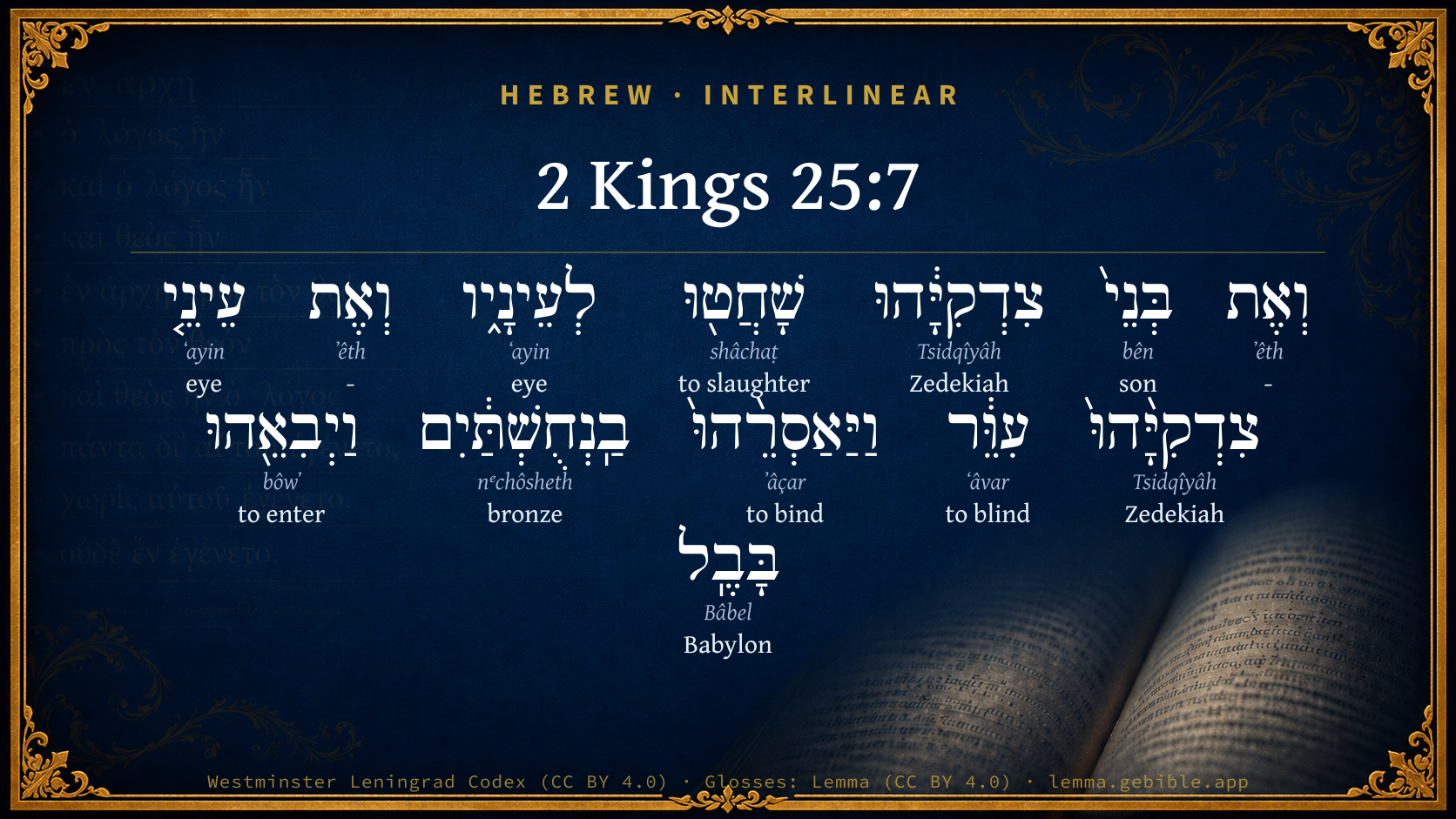
Hebrew (Westminster Leningrad Codex) 2 Kings 25:7 appears in the Hebrew Old Testament. The text above is from the Westminster Leningrad Codex. Each word links to its Strong’s number, a concise gloss, and parsing drawn from the Open Scriptures Hebrew Bible morphology. Click any word for its full Brown-Driver-Briggs (BDB) entry.
Download image
Cite this verse

2 Kings 25:7 (World English Bible). Public Domain. Lemma interlinear Bible study tool, https://lemma.gebible.app/v/2-kings/25/7.

Show BibTeX & RIS
BibTeX
RIS
English Translation
They killed the sons of Zedekiah before his eyes, and put out the eyes of Zedekiah, and bound him in fetters, and carried him to Babylon.
World English Bible · Public Domain
Download a study sheet

One document with this verse’s original text, its word-by-word gloss line, the meaning frame, cross-references with their text, attributed commentary, and full source and license credits — printable, and it pastes into notes with its structure intact.

This verse Autodidact and up

Study sheet (.html) Plain text (.txt)

A passage Seminary Student

Up to 50 verses in one chapter. A passage sheet keeps up to 6 commentary sources and 12 cross-references per verse, in the order this page ranks them, and says so on the sheet whenever that leaves anything out. Ask for a single verse and you get the Autodidact verse sheet above.

Everything on this page stays free to read, with no account — the sheet is a download of what is already on screen, not access to it.

Want to remove ads? Support Godless Engineer
Compare translations 3

The same verse in 3 English versions, stacked beneath the original-language interlinear above. Click any original word for its lexicon entry.

Each is an independent rendering of the whole verse — the interlinear is not word-aligned to these translations.

Highlighted words mark where these versions differ — a whole-verse word diff, not a word-by-word alignment.

  • World English Bible Public Domain
    They killed the sons of Zedekiah before his eyes, and put out the eyes of Zedekiah, and bound him in fetters, and carried him to Babylon.
  • King James Version Public Domain
    And they slew the sons of Zedekiah before his eyes, and put out the eyes of Zedekiah, and bound him with fetters of brass, and carried him to Babylon.
  • unfoldingWord Literal Text CC BY-SA 4.0
    And they slaughtered the sons of Zedekiah to his eyes. And he blinded the eyes of Zedikiah, and he bound him with two bronze chains, and he brought him Babylon.

unfoldingWord Literal Text — © unfoldingWord, licensed CC BY-SA 4.0. Word-aligned USFM3 via Door43 (git.door43.org/unfoldingWord/en_ult).

Versions to compare (up to 4)

3 of 4 selected

Show all 18 translations

Every available English version of this verse, each an independent rendering of the whole verse.

  • World English Bible Public Domain
    They killed the sons of Zedekiah before his eyes, and put out the eyes of Zedekiah, and bound him in fetters, and carried him to Babylon.
  • Berean Standard Bible Public Domain
    And they slaughtered the sons of Zedekiah before his eyes. Then they put out his eyes, bound him with bronze shackles, and took him to Babylon.
  • Majority Standard Bible Public Domain
    And they slaughtered the sons of Zedekiah before his eyes. Then they put out his eyes, bound him with bronze shackles, and took him to Babylon.
  • King James Version Public Domain
    And they slew the sons of Zedekiah before his eyes, and put out the eyes of Zedekiah, and bound him with fetters of brass, and carried him to Babylon.
  • American Standard Version (1901) Public Domain
    And they slew the sons of Zedekiah before his eyes, and put out the eyes of Zedekiah, and bound him in fetters, and carried him to Babylon.
  • Revised Version (1885) Public Domain
    And they slew the sons of Zedekiah before his eyes, and put out the eyes of Zedekiah, and bound him in fetters, and carried him to Babylon.
  • Geneva Bible (1599) Public Domain
    And they slew the sonnes of Zedekiah before his eyes, and put out the eyes of Zedekiah, and bounde him in chaines, and caried him to Babel.
  • Douay-Rheims (1899) Public Domain
    And he slew the sons of Sedecias before his face, and he put out his eyes, and bound him with chains, and brought him to Babylon.
  • Young's Literal Translation Public Domain
    And the sons of Zedekiah they have slaughtered before his eyes, and the eyes of Zedekiah he hath blinded, and bindeth him with brazen fetters, and they bring him to Babylon.
  • Literal Standard Version CC BY-SA 4.0
    And they have slaughtered the sons of Zedekiah before his eyes, and he has blinded the eyes of Zedekiah, and binds him with bronze chains, and they bring him to Babylon.
  • Unlocked Literal Bible CC BY-SA 4.0
    As for Zedekiah's sons, they slaughtered them before his eyes. Then he put out his eyes, bound him in bronze chains, and brought him to Babylon.
  • unfoldingWord Literal Text CC BY-SA 4.0
    And they slaughtered the sons of Zedekiah to his eyes. And he blinded the eyes of Zedikiah, and he bound him with two bronze chains, and he brought him Babylon.
  • Darby Bible Public Domain
    and slaughtered the sons of Zedekiah before his eyes, and put out the eyes of Zedekiah, and bound him with chains of brass, and carried him to Babylon.
  • World Messianic Bible Public Domain
    They killed Zedekiah’s sons before his eyes, then put out Zedekiah’s eyes, bound him in fetters, and carried him to Babylon.
  • Webster's Bible Public Domain
    And they slew the sons of Zedekiah before his eyes, and put out the eyes of Zedekiah, and bound him with fetters of brass, and carried him to Babylon.
  • Free Bible Version CC BY-SA 4.0
    They slaughtered Zedekiah's sons while he watched, and then gouged out his eyes, bound him in bronze shackles, and took him to Babylon.
  • Bible in Basic English Public Domain
    And they put the sons of Zedekiah to death before his eyes, and then they put out his eyes, and chaining him with iron bands, took him to Babylon.
  • JPS Tanakh (1917) Public Domain
    And they slew the sons of Zedekiah before his eyes, and put out the eyes of Zedekiah, and bound him in fetters, and carried him to Babylon.

Literal Standard Version (2020), Covenant Press — licensed CC BY-SA 4.0. Text via the HelloAO Bible API (eBible.org). Unlocked Literal Bible (unfoldingWord) — licensed CC BY-SA 4.0. Text via the HelloAO Bible API (eBible.org). unfoldingWord Literal Text — © unfoldingWord, licensed CC BY-SA 4.0. Word-aligned USFM3 via Door43 (git.door43.org/unfoldingWord/en_ult). Free Bible Version, Dr. Jonathan Gallagher — licensed CC BY-SA 4.0. Text via the HelloAO Bible API (eBible.org).

Word by word

More ways to search: Search by grammar → Find every occurrence → Compare this word →

Practice this passage: Drill this verse → Learn its vocabulary →

עִוֵּ֔ר
ʻâvar
H5786
“to blind”
Verb, Piel, Perfect, 3rd Person, Masculine, Singular
Part of Speech
Verb
Stem
Piel
Form
Perfect
Person
3rd Person
Gender
Masculine
Number
Singular
Full BDB Definition

Origin: a primitive root [rather denominatively from H5785 through the idea of a film over the eyes]

TWOT: 1586

(Piel) to blind, make blind, put out the eyes of
  1. וְאֶת ʼêth H853 “and · -” Conjunction + Particle, Direct Object
  2. בְּנֵי֙ bên H1121 “sons of” Noun, Common, Masculine, Plural, Construct
  3. צִדְקִיָּ֔הוּ Tsidqîyâh H6667 “Zedekiah” Noun, Proper
  4. שָׁחֲט֖וּ shâchaṭ H7819 “to slaughter” Verb, Qal, Perfect, 3rd Person, Common, Plural
  5. לְעֵינָ֑יו ʻayin H5869 “to/for · eyes · his” Preposition + Noun, Common, Both, Dual, Construct + Suffix, Personal, 3rd Person, Masculine, Singular
  6. וְאֶת ʼêth H853 “and · -” Conjunction + Particle, Direct Object
  7. עֵינֵ֤י ʻayin H5869 “eyes of” Noun, Common, Both, Dual, Construct
  8. צִדְקִיָּ֨הוּ֙ Tsidqîyâh H6667 “Zedekiah” Noun, Proper
  9. וַיַּאַסְרֵ֨הוּ֙ ʼâçar H631 “and · to bind · him” Conjunction + Verb, Qal, Sequential Imperfect, 3rd Person, Masculine, Singular + Suffix, Personal, 3rd Person, Masculine, Singular
  10. בַֽנְחֻשְׁתַּ֔יִם nᵉchôsheth H5178 “in/at the · bronze fetters” Preposition, Determined + Noun, Common, Feminine, Dual, Absolute
  11. וַיְבִאֵ֖הוּ bôwʼ H935 “and · to enter · him” Conjunction + Verb, Hiphil, Sequential Imperfect, 3rd Person, Masculine, Singular + Suffix, Personal, 3rd Person, Masculine, Singular
  12. בָּבֶֽל Bâbel H894 “Babylon” Noun, Proper

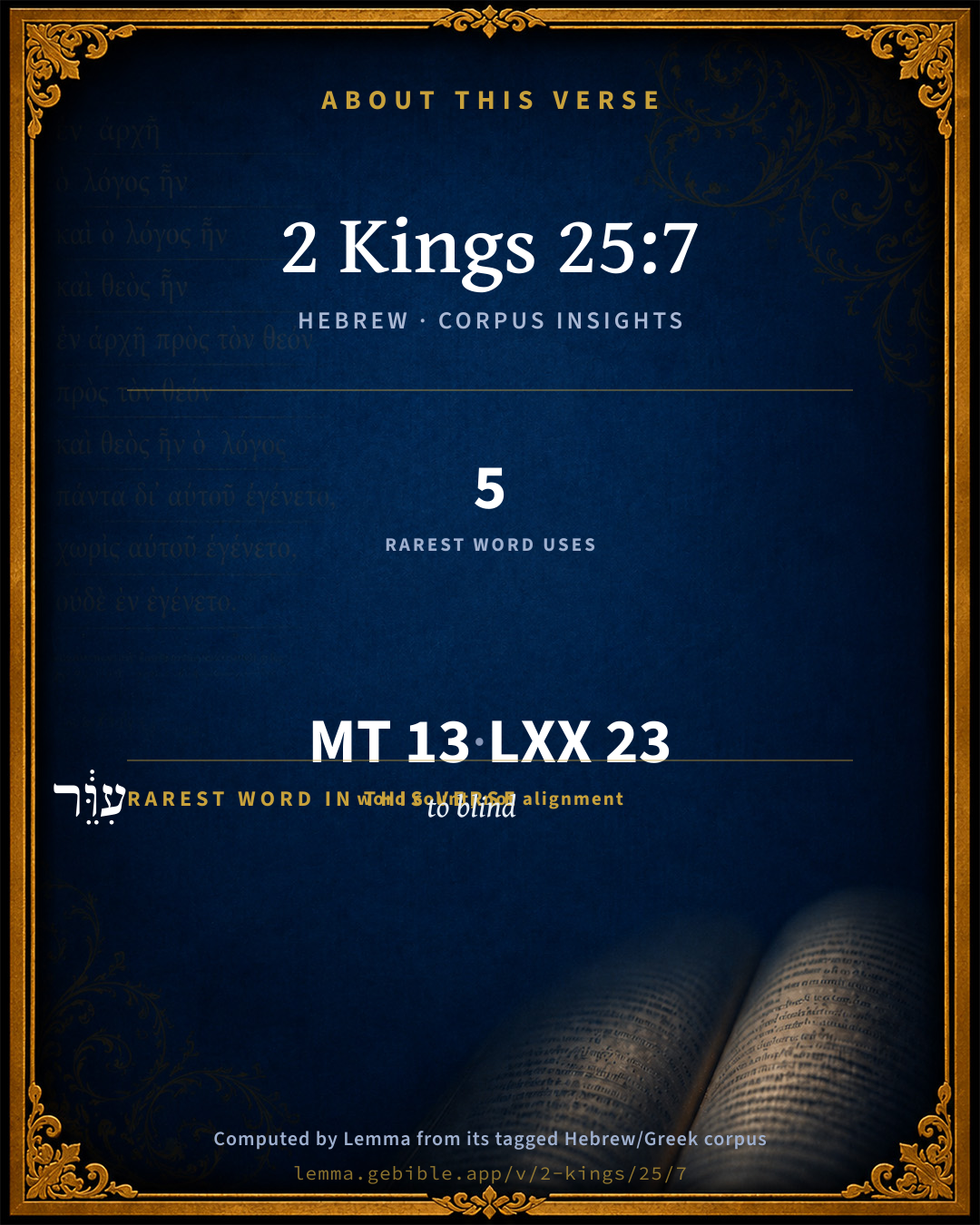
About this verse

These counts appear in no published source. They are computed here, from the morphology-tagged text and Lemma’s own curated glosses. What Lemma adds →

13
words
10
distinct lemmas
Historical
section

Notable vocabulary

The rarest word here is עִוֵּ֔ר to blind H5786 — appearing just 5 times in the whole Hebrew Bible.

Shared distinctive vocabulary

עִוֵּ֔ר to blind H5786 occurs in 5 verses of the Hebrew Bible. Also found in:

Grammatical profile

  • 4 verbs
  • 7 nouns
  • 2 particles

Verb forms

  • שָׁחֲט֖וּ Qal · Perfect
  • עִוֵּ֔ר Piel · Perfect
  • וַיַּאַסְרֵ֨הוּ֙ Qal · Sequential Imperfect
  • וַיְבִאֵ֖הוּ Hiphil · Sequential Imperfect

Repetition

Words recur within this verse — often emphatic in Hebrew:

  • צִדְקִיָּ֔הוּ Zedekiah H6667 ×2
  • לְעֵינָ֑יו eye H5869 ×2

Hebrew & Septuagint length

In English translation the verse runs 26 words from the Hebrew and 27 from the Septuagint (LXX English) — closely comparable.

A rough comparison of the two English renderings, which tokenize alike — not a word-level alignment.

Word counts can differ between the Hebrew and the Greek without any difference in meaning — e.g. the Hebrew direct-object marker אֵת has no separate Greek word, and Greek often adds the article ὁ.

In the original languages it is 13 Hebrew tokens and 23 Greek tokens — but the two are counted differently (Hebrew bundles its prefixes and suffixes into one token; the Greek is in lemma form), so that isn’t a like-for-like length.

Cross-references

16

Topical passages linked to 2 Kings 25:7 in the Treasury of Scripture Knowledge — connected by theme and wording, ordered by reader-vote popularity; previews shown in the World English Bible.

  • Jeremiah 32:4–5 and Zedekiah king of Judah shall not escape out of the hand of the Chaldeans, but shall surely be delivered into the hand of the king of Babylon, and shall speak with him mouth to mouth, and his eyes shall see his eyes;
  • Genesis 21:16 She went and sat down opposite him, a good way off, about a bow shot away. For she said, "Don't let me see the death of the child." She sat over against him, and lifted up her voice, and wept.
  • Genesis 44:34 For how will I go up to my father, if the boy isn't with me? Lest I see the evil that will come on my father."
  • Deuteronomy 28:34 so that you shall be mad for the sight of your eyes which you shall see.
  • Judges 16:21 The Philistines laid hold on him, and put out his eyes; and they brought him down to Gaza, and bound him with fetters of brass; and he did grind in the prison-house.
  • 2 Chronicles 33:11 Therefore Yahweh brought on them the captains of the host of the king of Assyria, who took Manasseh in chains, and bound him with fetters, and carried him to Babylon.
  • 2 Chronicles 36:6 Against him came up Nebuchadnezzar king of Babylon, and bound him in fetters, to carry him to Babylon.
  • Psalms 107:10–11 Some sat in darkness and in the shadow of death, Being bound in affliction and iron,
  • Psalms 149:8 To bind their kings with chains, And their nobles with fetters of iron;
  • Jeremiah 22:30 Thus says Yahweh, Write you this man childless, a man who shall not prosper in his days; for no more shall a man of his seed prosper, sitting on the throne of David, and ruling in Judah.
  • Jeremiah 34:3 and you shall not escape out of his hand, but shall surely be taken, and delivered into his hand; and your eyes shall see the eyes of the king of Babylon, and he shall speak with you mouth to mouth, and you shall go to Babylon.
  • Jeremiah 39:6–7 Then the king of Babylon killed the sons of Zedekiah in Riblah before his eyes: also the king of Babylon killed all the nobles of Judah.
  • Jeremiah 52:10–11 The king of Babylon killed the sons of Zedekiah before his eyes: he killed also all the princes of Judah in Riblah.
  • Ezekiel 7:27 The king shall mourn, and the prince shall be clothed with desolation, and the hands of the people of the land shall be troubled: I will do to them after their way, and according to their deserts will I judge them; and they shall know that I am Yahweh.
  • Ezekiel 12:13–16 My net also will I spread on him, and he shall be taken in my snare; and I will bring him to Babylon to the land of the Chaldeans; yet shall he not see it, though he shall die there.
  • Ezekiel 17:16–20 As I live, says the Lord Yahweh, surely in the place where the king dwells who made him king, whose oath he despised, and whose covenant he broke, even with him in the midst of Babylon he shall die.

Cross-references courtesy of OpenBible.info (CC BY 4.0).

Hebrew and Greek witnesses Masoretic Hebrew ↔ Greek Septuagint

The same verse in the two great witnesses to the Old Testament, shown verse-for-verse.

These are two independent witnesses, not word-aligned to each other, and the Septuagint is shown in lemma (dictionary) form.

Hebrew 2 Kings 25:7 Masoretic · Westminster Leningrad Codex

וְאֶת בְּנֵי֙ צִדְקִיָּ֔הוּ שָׁחֲט֖וּ לְעֵינָ֑יו וְאֶת עֵינֵ֤י צִדְקִיָּ֨הוּ֙ עִוֵּ֔ר וַיַּאַסְרֵ֨הוּ֙ בַֽנְחֻשְׁתַּ֔יִם וַיְבִאֵ֖הוּ בָּבֶֽל

They killed the sons of Zedekiah before his eyes, and put out the eyes of Zedekiah, and bound him in fetters, and carried him to Babylon.

World English Bible · Public Domain

Greek LXX 2 Kings 25:7 Septuagint · lemma form

καί ὁ υἱός σεδεκιας σφάζω κατά ὀφθαλμός αὐτός καί ὁ ὀφθαλμός σεδεκιας ἐκτυφλόω καί δέω αὐτός ἐν πέδη καί ἄγω αὐτός εἰς βαβυλών

And he killed the sons of Sedekias before his eyes, and put out the eyes of Sedekias, and bound him in fetters, and brought him to Babylon.

LXX2012 (modern English Septuagint) · Public Domain

On this verse, The Cambridge Bible for Schools and Colleges discusses the Septuagint’s reading. Read the note in Commentary ↓

Hebrew: Westminster Leningrad Codex (CC BY 4.0). Greek: Septuagint (public domain); English from LXX2012 (modern English Septuagint) (Public Domain). How the Septuagint differs from the Hebrew →

Targum (Aramaic paraphrase)

1

The Targum is the ancient Jewish Aramaic paraphrase of the Hebrew Scriptures — an interpretive translation, not the Hebrew text itself. Onkelos (literal) and Pseudo-Jonathan (expansive) render the Torah, and Jonathan the Prophets. Coverage is partial: where no permissively-licensed English translation exists for a verse, only the Aramaic is shown. This is verse-level text, not a word-by-word alignment to the Hebrew.

  1. Targum Jonathan Prophets (Joshua–Malachi)
    וְיַת בְּנוֹהִי דְצִדְקִיָהוּ נְכִיסוּ לְעֵינוֹהִי וְיַת עֵינֵי צִדְקִיָהוּ עַוֵר וְאַסְרֵיהּ בְשִׁלְשְׁלָן דִנְחַשׁ וְאוֹבִילֵיהּ לְבָבֶל:

    (no public-domain English translation for this verse)

    Targum Jonathan — Aramaic: “Mikraot Gedolot” (public domain). English: “Sefaria Community Translation” (CC0 1.0 (public-domain dedication)); “London "Chaldee Paraphrase," 1871” (public domain). Text via Sefaria.

Commentary

Notes on 2 Kings 25:7 from classic Christian and Jewish commentators (each source and its license shown beneath its notes). The classic Christian expositions comment on the surrounding passage and are grouped to its opening verse, so a note may address several verses; the Jewish commentaries on the Tanakh (Rashi and others) are per-verse, so they appear only where the commentator wrote on this verse.

Lemma curates 59 commentaries, every one of them public domain or Creative Commons licensed, each selected and text-cleaned for this edition rather than reprinted as found. About our sources →

Trapp's Complete Commentary

John Trapp

2Ki 25:7 And they slew the sons of Zedekiah before his eyes, and put out the eyes of Zedekiah, and bound him with fetters of brass, and carried him to Babylon.

Ver. 7. And they slew the sons of Zedekiah.] Who were, likely, taken with him, and consenting to his rebellion. {a}

Before his eyes.] To his greater grief. The like befell Mauricius, the emperor, a better man.

And put out the eyes of Zedekiah.] The eyes of whose mind had been put out long before; else he might have foreseen and prevented this evil - as prevision is the best means of prevention, - had he taken warning by what was foretold. {Jer 32:4; Jer 34:3; Eze 12:13} The Dutchmen have a proverb, When God intends to destroy a man, he first puts out his eyes. This punishment of putting out the eyes of an enemy, was practised by the Philistines upon Samson; by Irene, the empress, upon her son Constantinus Copronymus; by our Henry I upon his brother Robert, duke of Normandy; by Amidas, king of Tunis, upon his own father Muleasses; by Amurath VI, king of Turks, upon his wife’s brethren, the two young Servian princes, Gregory and Stephen, whose eyes he cruelly burnt out with a bason made red hot; {b} a common unmerciful practice among the Turks.

{a} Josephus

{b} Turk. Hist., 262.

John Trapp, A Commentary or Exposition upon All the Books of the Old and New Testament (1647–1656) — public domain. Text from a community e-Sword module.

Joseph Benson's Commentary

2Ki 25:7. They slew the sons of Zedekiah before his eyes — Though they were but children, that this spectacle, the last he was to behold, might leave a deep and durable impression of grief and horror upon his spirit. And in slaying his sons they in effect declared that the kingdom was no more, and that neither he nor any of his breed were fit to be trusted: therefore not fit to live. And put out his eyes, and carried him to Babylon — Thus two prophecies were fulfilled, which seemed contrary the one to the other. Jeremiah foretold, That he should be delivered into the hands of the king of Babylon, and should speak with him mouth to mouth, and his eyes should behold his eyes, and that he should go to Babylon, Jer 32:4; Jer 34:3; and Ezekiel prophesied, That he should never see Babylon, though he should die there, Eze 12:13. This seeming contradiction, Zedekiah the false prophet could not reconcile, and therefore concluded that both prophecies were false, and, if we may credit Josephus, Zedekiah the king stumbled at this difficulty. Both, however, were literally accomplished. The reflection which Josephus makes on this event, is worthy of the reader’s attention: “This may serve to convince even the ignorant, of the power and wisdom of God; and of the constancy of his counsels through all the various ways of his operations. It may likewise show us that God’s foreknowledge of things is certain; and his providence regular in the ordering of events; and besides, it holds forth a most exemplary instance of the danger of our giving way to the motions of sin and infidelity, which deprive us of the means of discerning God’s judgments, even though ready to fall upon us.” — Antiq., lib. 10., cap. 11.

Joseph Benson's Commentary on the Old and New Testaments (1811–1818) — public domain. Text from a community e-Sword module.

Tyndale Open Study Notes

Tyndale Open Resources

25:7 gouged out Zedekiah’s eyes: Rebellious leaders were commonly blinded in the ancient Near East. However, Zedekiah’s blinding seems especially cruel; the last image he had was of his sons being slaughtered. • True to the prophetic word, Zedekiah was taken into captivity, where he died (Jer 32:4-5; 34:3; 52:11; Ezek 12:11-14).

Tyndale Open Study Notes — © Tyndale Open Resources, licensed CC BY-SA 4.0. Text via the HelloAO Bible API.

Ellicott's Commentary for English Readers

(7) And they slew . . .—The verbs are all singular in Jer_39:6; Jer_52:10-11; so that the acts in question are attributed directly to Nebuchadnezzar, to whose orders they were due. (So the versions, except that the Targum has “they slew.”) The blinding of Zedekiah need not have been done by the conqueror himself, although in the Assyrian sculptures kings are actually represented as blinding and otherwise torturing their captives. It is no argument against the singular, “he carried him to Babylon,” to say with Thenius that Zedekiah was sent to Babylon at once, while Nebuchadnezzar remained at Riblah. “Qui facit per alium, facit per se.”

The sons.—Who fled with him (Comp. Jer_41:10). In Jeremiah it is added that all the nobles or princes. of Judah were slain also.

Put out the eyes.—A Babylonian punishment (Herod, vii. 18). This was the meaning of Ezekiel’s prediction; “I will bring him to Babylon . . . yet shall he not see it, though he shall die there” (Eze_12:13).

With fetters of brass.—Literally, with the double brass (2Ch_33:12); i.e., with manacles and fetters, as represented on the Assyrian monuments.

Carried him to Babylon.—Jer_52:11; “and put him in prison till the day of his death.” So the Arabic of Kings.

A Bible Commentary for English Readers, edited by Charles John Ellicott (1878–1897) — public domain. Text from a community e-Sword module.

The Cambridge Bible for Schools and Colleges

gen. ed. J. J. S. Perowne

7. slew the sons of Zedekiah] This was done to prevent the rise of a new revolt under a successor. To do it in the sight of the father was to break down all his hope of any rightful successor taking his throne. The narrative in Jeremiah adds that Nebuchadnezzar ‘slew all the nobles of Judah’. Not only was the royal family destroyed, but the men of power and influence were all extinguished.

put out the eyes of Zedekiah] This punishment the Philistines inflicted on Samson (Jdg_16:21) before they put him in the prison-house. The LXX. had this instance so much in mind that they say Zedekiah was put εἰς οἰκίαν μύλωνος. The deprivation of the eyes was not uncommon in the East as a punishment (cf. Herod. 2Ki_7:18).

It is very striking to put side by side the two prophecies concerning Zedekiah uttered the one by Jeremiah, the other by Ezekiel. The former said (Eze_34:3) ‘Thine eyes shall behold the eyes of the king of Babylon, and he shall speak with thee mouth to mouth, and thou shalt go to Babylon (cf. Jer_32:4); the latter (2Ki_12:13) says of this king ‘I will bring him to Babylon to the land of the Chaldæans, yet shall he not see it though he shall die there’.

and bound him with fetters of brass] R.V. in fetters. There is no need to express the metal of which the fetters were made. In English on the contrary we speak of ‘putting a man in irons’ and omit ‘fetters’. The Hebrew word is dual, and properly signifies ‘double fetters’. His legs as well as his hands were shackled.

and carried him to Babylon] The narrative in Jeremiah adds ‘and put him in prison till the day of his death’.

The Cambridge Bible for Schools and Colleges (gen. ed. J. J. S. Perowne; Cambridge University Press, 1878–1918) — public domain. Text from a community e-Sword module.

Albert Barnes' Notes on the Bible

Before his eyes - This refinement of cruelty seems to have especially shocked the Jews, whose manners were less barbarous than those of most Orientals. It is noted by Jeremiah in two places Jer 39:6; Jer 52:10.

And put out the eyes of Zedekiah - Blinding has always been among the most common of secondary punishments in the East (compare Jdg 16:2 l). The blinding of Zedekiah reconciled in a very remarkable way prophecies, apparently contradictory, which had been made concerning him. Jeremiah had prophesied distinctly that he would be carried to Babylon Jer 32:5; Jer 34:3. Ezekiel had said that he should not “see Babylon” Eze 12:13. His deprivation of sight before he was carried to the conqueror’s capital fulfilled the predictions of both prophets.

With fetters of brass - literally, (see Jer 39:7 margin), “with two chains of brass.” The Assyrians’ captives are usually represented as bound hand and foot - the two hands secured by one chain, the two feet by another. According to Jewish tradition Zedekiah was, like other slaves, forced to work in a mill at Babylon. Jeremiah tells us that he was kept in prison until he died Jer 52:11.

Albert Barnes' Notes on the Bible (1834–1885) — public domain. Text from a community e-Sword/MySword module.

Haydock's Catholic Bible Commentary

Eyes; after they had been excruciated by the sight of his slaughtered children. He thus might be convinced, that there was no reason to despise the predictions of Jeremias and of Ezechiel, (xii. 13.) as contradictory, because the latter informed him that he should not see Babylon; though the other said that he should die there. --- Babylon, where he was honourably buried, by order of Nabuchodonosor. (Josephus, [Antiquities?] x. 11.) --- Seder (Olam xxviii.) records that his attendants sung, at his funeral, "Alas! king Sedecias is dead, having drunk the dregs of all ages;" as he suffered also for the crimes of his predecessors. (Genebrard) (Tirinus) --- This is not indeed specified in Scripture: (Haydock) but it is highly probable that Nabuchodonosor would thus "revere royalty, even in its ruins," if Daniel and the other Jews in power, had not been careful to shew this mark of respect to their deceased monarch, conformably to the prediction of Jeremias; (xxxiv. 3.) who foretold that he should die, not by a violent death, the usual fate of captive kings, but in peace, or on his bed, though in a prison. (Watson, let. 6.)

George Leo Haydock (1774–1849), Haydock's Catholic Family Bible and Commentary, 1859 edition — public domain. Excludes Psalms (Douay-Rheims chapter numbering differs from Protestant) and Deuterocanonical books (Catholic canon only).

Matthew Poole's English Annotations

Thus two prophecies were fulfilled, which seemed contrary one to the other, that he should go to Babylon, Jer 32:5; 34:3, and that he should never see Babylon; which seeming contradiction, because Zedekiah the false prophet could not reconcile, he concluded both were false, and that Jeremiah was a false prophet; and it seems Zedekiah the king might stumble at this difficulty.

Matthew Poole's English Annotations on the Holy Bible (1683–1685) — public domain. Text from a community e-Sword/MySword module.

Whedon's Commentary on the Bible

Daniel D. Whedon

7. Slew the sons… before his eyes — This was not only to intensify Zedekiah’s woes by making his sons’ execution the last sight of his eyes, but also to end his dynasty.

Put out the eyes of Zedekiah — This barbarous and cruel punishment was practised by various ancient nations. Thus the Philistines punished Samson when he fell into their power, (Jdg_16:21,) and thus the Persians tortured great offenders. It was done by thrusting hot irons or a sharp lance into the eyes. On the monuments of Nineveh is the picture of a king piercing with a lance the eyes of some royal captive.

Fetters of brass — Literally, double brass. See note on Jdg_16:21.

Carried him to Babylon — But being sightless, he did not see Babylon and the land of the Chaldeans, so that Ezekiel’s prophecy concerning him came literally to pass, (Eze_12:13,) as well as that of Jeremiah, (Jer_32:4,) that he should “surely be delivered into the hand of the king of Babylon, and speak with him mouth to mouth, and his eyes should behold his eyes.” This latter was fulfilled at Riblah. He died in the land of his captivity, (Eze_12:13,) probably in prison, and not long after his capture and imprisonment. Josephus says he was honoured with a magnificent burial.

Daniel D. Whedon (gen. ed.), Commentary on the Old and New Testaments (1874–1909) — public domain. Text from a community e-Sword module.

The Pulpit Commentary

And they slew the sons of Zedekiah before his eyes (comp. Herod., 3:14, and RAPC 2Ma 7., for similar aggravations of condemned persons" sufferings). As Zedekiah was no more than thirty-two years of age, (2Ki_24:18) his sons must have been minors, who could not justly be held responsible for their father"s doings. It was usual, however, in the East, and even among the Jews, to punish children for the sins of their fathers (see Jos_7:24, Jos_7:25; 2Ki_9:26 2Ki_14:6; Dan_6:24) And put out the eyes of Zedekiah. This, too, was a common Oriental practice. The Philistines blinded Samson. (Jud_1:16:21) Sargon, in one of his sculptures, seems to be blinding a prisoner with a spear (Botta, "Monumens de Ninive," pl. 18). The ancient Persians often blinded criminals (Xen., "Anab.," 1:9. Ammian. Mare., 27:12; Procop., "De Bell. Pers.," 1:11. p. 80). In modern Persia, it was, until very lately, usual for a king, on his accession, to blind all his brothers, in order that they might be disqualified from reigning. The operation was commonly performed in Persia by means of a red-hot iron rod (see Herod., 7:18). Zedekiah"s loss of eyesight reconciled the two apparently conflicting prophecies that he would be carried captive to Babylon, (Jer_22:5, etc.) and that he would never see it (Eze_12:13) in a remarkable manner. And bound him with fetters of brass; literally, with a pair of brazen fetters. Assyrian fetters consisted of two thick rings of iron, joined together by a single long link (Botta, l.s.c. ); Babylonian were probably similar. Captives of importance are usually represented as fettered in the sculptures. And carried him to Babylon. Jeremiah adds (Jer_52:11) that Nebuchadnezzar "put him in prison till the day of his death:" and so Josephus ("Ant. Jud:," 10:8. The latter writer further tells us that, at his death, the Babylonian monarch gave him a royal funeral (comp. Jer_34:5).

The Pulpit Commentary (1880–1919), ed. H.D.M. Spence-Jones & Joseph S. Exell — public domain. Text from a community e-Sword module.

John Wesley's Explanatory Notes

Slew, &c. - Tho' they were but children, that this spectacle, the last he was to behold, might leave a remaining impression of grief and horror upon his spirit. And in slaying his sons they in effect declared, that the kingdom was no more, and that he nor any of his breed were fit to be trusted: therefore not fit to live. Babylon - Thus two prophecies were fulfilled, which seemed contrary one to the other, that he should go to Babylon, Jer. xxxii, 5, xxxiv, 3, and that he should never see Babylon: which seeming contradiction, because Zedekiah the false prophet could not reconcile, he concluded both were false, and it seems Zedekiah the king might stumble at this difficulty.

John Wesley, Explanatory Notes Upon the Whole Bible (1754–1765) — public domain. Text via the GEBible commentary corpus.

Lesson kit

Teaching starters — assembled from the data on this page, not authored interpretation. Every prompt links to the verse data it draws on. Edit before teaching.

2 Kings, in the Historical, opens this verse with 13 words (10 distinct Hebrew lemmas). Its most distinctive word is ʻâvar (“to blind”). A historical commentator’s framing appears above. Read the whole chapter for the surrounding context.

Discussion questions

  1. How does “to blind” (ʻâvar) shape what this verse is saying?
  2. Exodus 23:8 shares the word «to blind» with this verse. How do the two illuminate each other?
  3. “Zedekiah” occurs 2× in this one verse. What is the effect of the repetition?
  4. These translations render this verse differently. What is at stake in choosing one wording over another?
  5. The verb «שָׁחֲט֖וּ» is Qal Perfect. How does its form color the action?
  6. Reading how Trapp's Complete Commentary and Joseph Benson's Commentary read this verse, where do the two commentators agree and where do they part?

Things to notice

Reading settings

Reading text

Shown beneath each verse's original-language words.

Old Testament
Old Testament edition

Read the OT as the Masoretic Hebrew (MT) or the Greek Septuagint (LXX).

English shown for the Greek Septuagint (in the Hebrew ↔ Greek comparison).

Comparing translations? Open the Compare panel on any verse page to stack up to four side by side.