
2 Kings 21:6

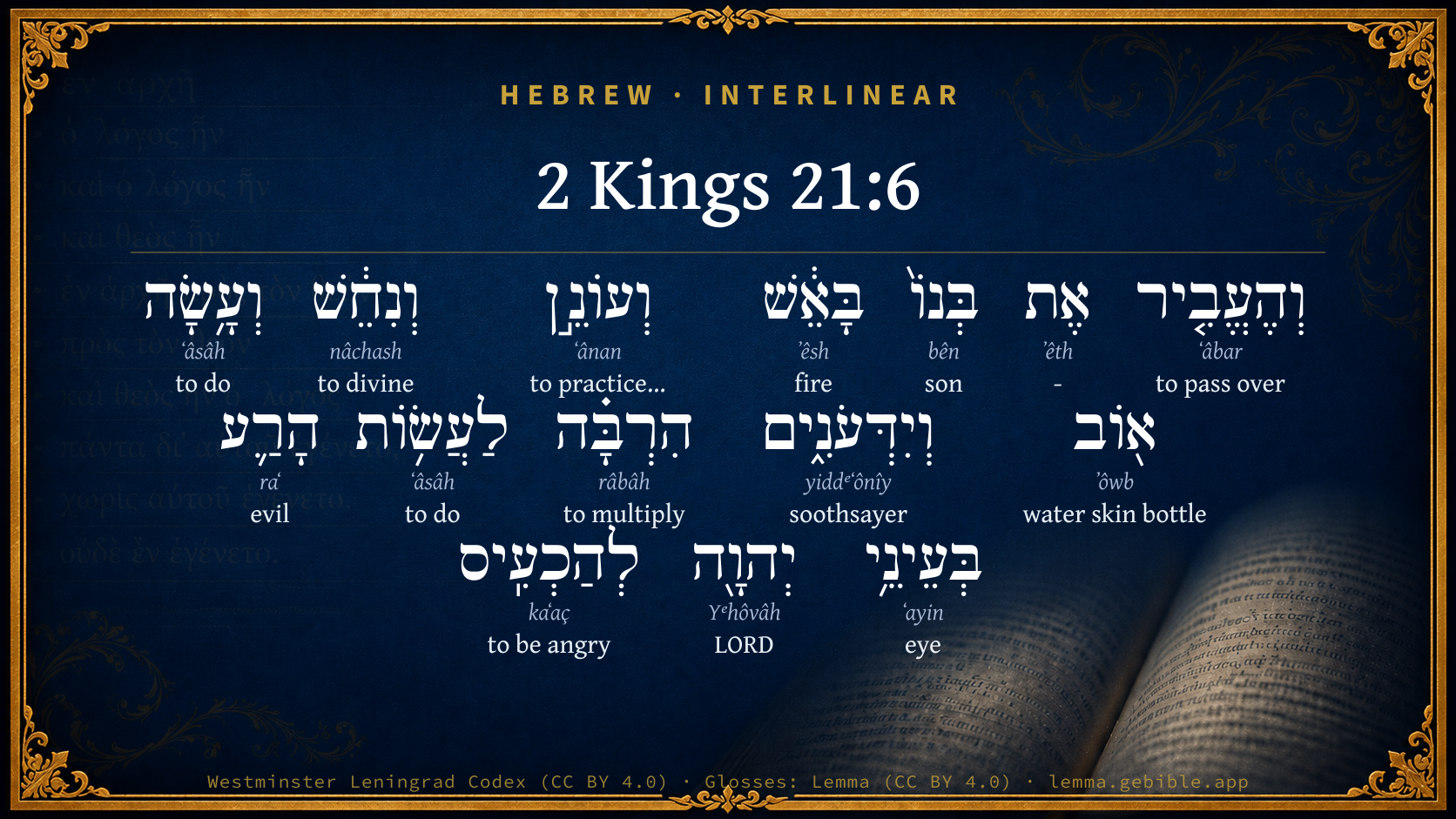
Hebrew (Westminster Leningrad Codex) 2 Kings 21:6 appears in the Hebrew Old Testament. The text above is from the Westminster Leningrad Codex. Each word links to its Strong’s number, a concise gloss, and parsing drawn from the Open Scriptures Hebrew Bible morphology. Click any word for its full Brown-Driver-Briggs (BDB) entry.
Download image
Cite this verse

2 Kings 21:6 (World English Bible). Public Domain. Lemma interlinear Bible study tool, https://lemma.gebible.app/v/2-kings/21/6.

Show BibTeX & RIS
BibTeX
RIS
English Translation
He made his son to pass through the fire, and practiced sorcery, and used enchantments, and dealt with those who had familiar spirits, and with wizards: he worked much evil in the sight of Yahweh, to provoke him to anger.
World English Bible · Public Domain
Download a study sheet

One document with this verse’s original text, its word-by-word gloss line, the meaning frame, cross-references with their text, attributed commentary, and full source and license credits — printable, and it pastes into notes with its structure intact.

This verse Autodidact and up

Study sheet (.html) Plain text (.txt)

A passage Seminary Student

Up to 50 verses in one chapter. A passage sheet keeps up to 6 commentary sources and 12 cross-references per verse, in the order this page ranks them, and says so on the sheet whenever that leaves anything out. Ask for a single verse and you get the Autodidact verse sheet above.

Everything on this page stays free to read, with no account — the sheet is a download of what is already on screen, not access to it.

Want to remove ads? Support Godless Engineer
Compare translations 3

The same verse in 3 English versions, stacked beneath the original-language interlinear above. Click any original word for its lexicon entry.

Each is an independent rendering of the whole verse — the interlinear is not word-aligned to these translations.

Highlighted words mark where these versions differ — a whole-verse word diff, not a word-by-word alignment.

  • World English Bible Public Domain
    He made his son to pass through the fire, and practiced sorcery, and used enchantments, and dealt with those who had familiar spirits, and with wizards: he worked much evil in the sight of Yahweh, to provoke him to anger.
  • King James Version Public Domain
    And he made his son pass through the fire, and observed times, and used enchantments, and dealt with familiar spirits and wizards: he wrought much wickedness in the sight of the LORD, to provoke him to anger.
  • unfoldingWord Literal Text CC BY-SA 4.0
    And he made his son pass through the fire, and he practiced divination, and he observed signs, and he made a ritual pit and familiar spirits. He multiplied doing evil in the eyes of Yahweh, making angry.

unfoldingWord Literal Text — © unfoldingWord, licensed CC BY-SA 4.0. Word-aligned USFM3 via Door43 (git.door43.org/unfoldingWord/en_ult).

Versions to compare (up to 4)

3 of 4 selected

Show all 18 translations

Every available English version of this verse, each an independent rendering of the whole verse.

  • World English Bible Public Domain
    He made his son to pass through the fire, and practiced sorcery, and used enchantments, and dealt with those who had familiar spirits, and with wizards: he worked much evil in the sight of Yahweh, to provoke him to anger.
  • Berean Standard Bible Public Domain
    He sacrificed his own son in the fire, practiced sorcery and divination, and consulted mediums and spiritists. He did great evil in the sight of the LORD, provoking Him to anger.
  • Majority Standard Bible Public Domain
    He sacrificed his own son in the fire, practiced sorcery and divination, and consulted mediums and spiritists. He did great evil in the sight of the LORD, provoking Him to anger.
  • King James Version Public Domain
    And he made his son pass through the fire, and observed times, and used enchantments, and dealt with familiar spirits and wizards: he wrought much wickedness in the sight of the LORD, to provoke him to anger.
  • American Standard Version (1901) Public Domain
    And he made his son to pass through the fire, and practised augury, and used enchantments, and dealt with them that had familiar spirits, and with wizards: he wrought much evil in the sight of Jehovah, to provoke him to anger.
  • Revised Version (1885) Public Domain
    And he made his son to pass through the fire, and practised augury, and used enchantments, and dealt with them that had familiar spirits, and with wizards: he wrought much evil in the sight of the LORD, to provoke him to anger.
  • Geneva Bible (1599) Public Domain
    And he caused his sonnes to passe through the fire, and gaue him selfe to witchcraft and sorcerie, and he vsed them that had familiar spirits and were soothsayers, and did much euill in the sight of the Lord to anger him.
  • Douay-Rheims (1899) Public Domain
    And he made his son pass through fire: and he used divination, and observed omens, and appointed pythons, and multiplied soothsayers to do evil before the Lord, and to provoke him.
  • Young's Literal Translation Public Domain
    and he hath caused his son to pass through fire, and observed clouds, and used enchantment, and dealt with a familiar spirit and wizards; he hath multiplied to do the evil thing in the eyes of Jehovah -- to provoke to anger.
  • Literal Standard Version CC BY-SA 4.0
    and he has caused his son to pass through fire, and observed clouds, and used enchantment, and dealt with a familiar spirit and wizards; he has multiplied to do evil in the eyes of YHWH—to provoke to anger.
  • Unlocked Literal Bible CC BY-SA 4.0
    He caused his son to pass through the fire, he performed sorcery and divination and consulted with those who talked with the dead and with those who talked with spirits. He did much evil in the sight of Yahweh, provoking him to anger.
  • unfoldingWord Literal Text CC BY-SA 4.0
    And he made his son pass through the fire, and he practiced divination, and he observed signs, and he made a ritual pit and familiar spirits. He multiplied doing evil in the eyes of Yahweh, making angry.
  • Darby Bible Public Domain
    And he caused his son to pass through the fire, and used magic and divination, and appointed necromancers and soothsayers: he wrought evil beyond measure in the sight of Jehovah, to provoke him to anger.
  • World Messianic Bible Public Domain
    He made his son to pass through the fire, practiced sorcery, used enchantments, and dealt with those who had familiar spirits and with wizards. He did much evil in the LORD’s sight, to provoke him to anger.
  • Webster's Bible Public Domain
    And he made his son pass through the fire, and observed times, and used enchantments, and dealt with familiar spirits and wizards: he committed much wickedness in the sight of the LORD, to provoke him to anger.
  • Free Bible Version CC BY-SA 4.0
    He even he sacrificed his own son as a burnt offering, and used fortune-telling and witchcraft, and he dealt with mediums and with spiritists. He did a great deal of evil in the Lord's sight, making the Lord angry.
  • Bible in Basic English Public Domain
    And he made his son go through the fire, and made use of secret arts and signs for reading the future; he gave positions to those who had control of spirits and to wonder-workers; he did much evil in the eyes of the Lord, moving him to wrath.
  • JPS Tanakh (1917) Public Domain
    And he made his son to pass through the fire, and practised soothsaying, and used enchantments, and appointed them that divined by a ghost or a familiar spirit: he wrought much evil in the sight of the LORD, to provoke Him.

Literal Standard Version (2020), Covenant Press — licensed CC BY-SA 4.0. Text via the HelloAO Bible API (eBible.org). Unlocked Literal Bible (unfoldingWord) — licensed CC BY-SA 4.0. Text via the HelloAO Bible API (eBible.org). unfoldingWord Literal Text — © unfoldingWord, licensed CC BY-SA 4.0. Word-aligned USFM3 via Door43 (git.door43.org/unfoldingWord/en_ult). Free Bible Version, Dr. Jonathan Gallagher — licensed CC BY-SA 4.0. Text via the HelloAO Bible API (eBible.org).

Word by word

More ways to search: Search by grammar → Find every occurrence → Compare this word →

Practice this passage: Drill this verse → Learn its vocabulary →

וְעוֹנֵ֣ן
ʻânan
H6049
“and · to practice sorcery”
Conjunction + Verb, Polel, Sequential Perfect, 3rd Person, Masculine, Singular
Part of Speech
Conjunction + Verb
Stem
Polel
Form
Sequential Perfect
Person
3rd Person
Gender
Masculine
Number
Singular
Full BDB Definition

Origin: a primitive root

TWOT: 1655 , 1656

(Piel) to make appear, produce, bring (clouds) - (Poel) to practise soothsaying, conjure - to observe times, practice soothsaying or spiritism or magic or augury or witchcraft - soothsayer, enchanter, sorceress, diviner, fortuneteller, barbarian, Meonenim (participle)
  1. וְהֶעֱבִ֤יר ʻâbar H5674 “and · to pass over” Conjunction + Verb, Hiphil, Sequential Perfect, 3rd Person, Masculine, Singular
  2. אֶת ʼêth H853 “-” Particle, Direct Object
  3. בְּנוֹ֙ bên H1121 “son · his” Noun, Common, Masculine, Singular, Construct + Suffix, Personal, 3rd Person, Masculine, Singular
  4. בָּאֵ֔שׁ ʼêsh H784 “in/at the · fire” Preposition, Determined + Noun, Common, Both, Singular, Absolute
  5. וְנִחֵ֔שׁ nâchash H5172 “and · to divine” Conjunction + Verb, Piel, Sequential Perfect, 3rd Person, Masculine, Singular
  6. וְעָ֥שָׂה ʻâsâh H6213 “and · to do” Conjunction + Verb, Qal, Sequential Perfect, 3rd Person, Masculine, Singular
  7. א֖וֹב ʼôwb H178 “water skin bottle” Noun, Common, Masculine, Singular, Absolute
  8. וְיִדְּעֹנִ֑ים yiddᵉʻônîy H3049 “and · soothsayers” Conjunction + Noun, Common, Masculine, Plural, Absolute
  9. הִרְבָּ֗ה râbâh H7235 “to multiply” Verb, Hiphil, Perfect, 3rd Person, Masculine, Singular
  10. לַעֲשׂ֥וֹת ʻâsâh H6213 “to do” Preposition + Verb, Qal, Infinitive Construct
  11. הָרַ֛ע raʻ H7451 “the · evil” Particle, Definite Article + Adjective, Adjective, Masculine, Singular, Absolute
  12. בְּעֵינֵ֥י ʻayin H5869 “in/at · eyes of” Preposition + Noun, Common, Both, Dual, Construct
  13. יְהוָ֖ה Yᵉhôvâh H3068 “LORD” Noun, Proper
  14. לְהַכְעִֽיס kaʻaç H3707 “to be angry” Preposition + Verb, Hiphil, Infinitive Construct

About this verse

These counts appear in no published source. They are computed here, from the morphology-tagged text and Lemma’s own curated glosses. What Lemma adds →

15
words
14
distinct lemmas
Historical
section

Notable vocabulary

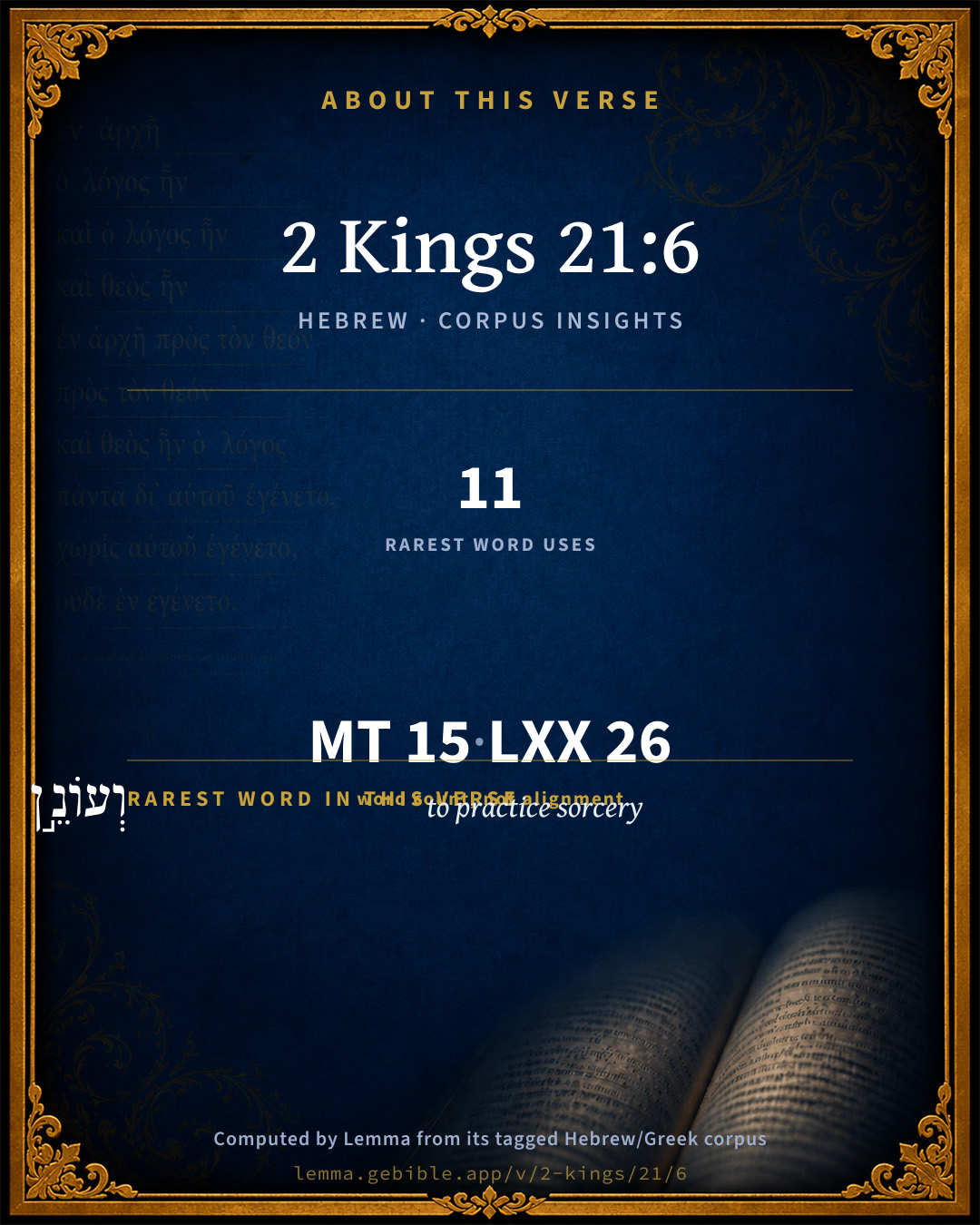
The rarest word here is וְעוֹנֵ֣ן to practice sorcery H6049 — appearing just 11 times in the whole Hebrew Bible.

Shared distinctive vocabulary

וְעוֹנֵ֣ן to practice sorcery H6049 occurs in 11 verses of the Hebrew Bible. Also found in:

Grammatical profile

  • 7 verbs
  • 6 nouns
  • 1 adjective
  • 1 particle

Verb forms

  • וְהֶעֱבִ֤יר Hiphil · Sequential Perfect
  • וְעוֹנֵ֣ן Polel · Sequential Perfect
  • וְנִחֵ֔שׁ Piel · Sequential Perfect
  • וְעָ֥שָׂה Qal · Sequential Perfect
  • הִרְבָּ֗ה Hiphil · Perfect
  • לַעֲשׂ֥וֹת Qal · Infinitive Construct
  • לְהַכְעִֽיס Hiphil · Infinitive Construct

Repetition

A word recurs within this verse — often emphatic in Hebrew:

  • וְעָ֥שָׂה to do H6213 ×2

Hebrew & Septuagint length

In English translation the verse runs 40 words from the Hebrew and 40 from the Septuagint (LXX English) — the same length.

A rough comparison of the two English renderings, which tokenize alike — not a word-level alignment.

Word counts can differ between the Hebrew and the Greek without any difference in meaning — e.g. the Hebrew direct-object marker אֵת has no separate Greek word, and Greek often adds the article ὁ.

In the original languages it is 15 Hebrew tokens and 26 Greek tokens — but the two are counted differently (Hebrew bundles its prefixes and suffixes into one token; the Greek is in lemma form), so that isn’t a like-for-like length.

Cross-references

16

Topical passages linked to 2 Kings 21:6 in the Treasury of Scripture Knowledge — connected by theme and wording, ordered by reader-vote popularity; previews shown in the World English Bible.

  • 2 Kings 17:17 They caused their sons and their daughters to pass through the fire, and used divination and enchantments, and sold themselves to do that which was evil in the sight of Yahweh, to provoke him to anger.
  • Leviticus 18:21 "'You shall not give any of your children to sacrifice to Molech; neither shall you profane the name of your God: I am Yahweh.
  • Leviticus 19:31 "'Don't turn to those who are mediums, nor to the wizards. Don't seek them out, to be defiled by them. I am Yahweh your God.
  • Leviticus 19:26 "'You shall not eat any meat with the blood still in it; neither shall you use enchantments, nor practice sorcery.
  • 2 Kings 16:3 But he walked in the way of the kings of Israel, yes, and made his son to pass through the fire, according to the abominations of the nations, whom Yahweh cast out from before the children of Israel.
  • Deuteronomy 18:10–14 There shall not be found with you anyone who makes his son or his daughter to pass through the fire, one who uses divination, one who practices sorcery, or an enchanter, or a sorcerer,
  • 2 Chronicles 33:6 He also made his children to pass through the fire in the valley of the son of Hinnom; and he practiced sorcery, and used enchantments, and practiced sorcery, and dealt with those who had familiar spirits, and with wizards: he worked much evil in the sight of Yahweh, to provoke him to anger.
  • Genesis 13:13 Now the men of Sodom were exceedingly wicked and sinners against Yahweh.
  • Leviticus 20:2–3 "Moreover, you shall tell the children of Israel, 'Anyone of the children of Israel, or of the strangers who live as foreigners in Israel, who gives any of his seed to Molech; he shall surely be put to death. The people of the land shall stone him with stones.
  • 2 Kings 24:3–4 Surely at the commandment of Yahweh came this on Judah, to remove them out of his sight, for the sins of Manasseh, according to all that he did,
  • 1 Chronicles 10:13 So Saul died for his trespass which he committed against Yahweh, because of the word of Yahweh, which he didn't keep; and also because he asked counsel of one who had a familiar spirit, to inquire [thereby],
  • 2 Chronicles 28:3 Moreover he burnt incense in the valley of the son of Hinnom, and burnt his children in the fire, according to the abominations of the nations whom Yahweh cast out before the children of Israel.
  • Isaiah 8:19 When they shall tell you, "Consult with those who have familiar spirits and with the wizards, who chirp and who mutter:" shouldn't a people consult with their God? on behalf of the living [should they consult] with the dead?
  • Isaiah 19:3 The spirit of Egypt shall fail in the midst of it; and I will destroy the counsel of it: and they shall seek to the idols, and to the charmers, and to those who have familiar spirits, and to the wizards.
  • Micah 6:7 Will Yahweh be pleased with thousands of rams? With tens of thousands of rivers of oil? Shall I give my firstborn for my disobedience? The fruit of my body for the sin of my soul?
  • Acts 16:16 It happened, as we were going to prayer, that a certain girl having a spirit of divination met us, who brought her masters much gain by fortune telling.

Cross-references courtesy of OpenBible.info (CC BY 4.0).

Hebrew and Greek witnesses Masoretic Hebrew ↔ Greek Septuagint

The same verse in the two great witnesses to the Old Testament, shown verse-for-verse.

These are two independent witnesses, not word-aligned to each other, and the Septuagint is shown in lemma (dictionary) form.

Hebrew 2 Kings 21:6 Masoretic · Westminster Leningrad Codex

וְהֶעֱבִ֤יר אֶת בְּנוֹ֙ בָּאֵ֔שׁ וְעוֹנֵ֣ן וְנִחֵ֔שׁ וְעָ֥שָׂה א֖וֹב וְיִדְּעֹנִ֑ים הִרְבָּ֗ה לַעֲשׂ֥וֹת הָרַ֛ע בְּעֵינֵ֥י יְהוָ֖ה לְהַכְעִֽיס

He made his son to pass through the fire, and practiced sorcery, and used enchantments, and dealt with those who had familiar spirits, and with wizards: he worked much evil in the sight of Yahweh, to provoke him to anger.

World English Bible · Public Domain

Greek LXX 2 Kings 21:6 Septuagint · lemma form

καί διαἄγω ὁ υἱός αὐτός ἐν πῦρ καί κληδονίζω καί οἰωνίζομαι καί ποιέω θελητής καί γνώστης πληθύνω ὁ ποιέω ὁ πονηρός ἐν ὀφθαλμός κύριος παραὀργίζω αὐτός

And he caused his sons to pass through the fire, and used divination and auspices, and made groves, and multiplied wizards, so as to do that which was evil in the sight of the Lord, to provoke him to anger.

LXX2012 (modern English Septuagint) · Public Domain

On this verse, Jamieson, Fausset & Brown discusses the Septuagint’s reading. Read the note in Commentary ↓

Hebrew: Westminster Leningrad Codex (CC BY 4.0). Greek: Septuagint (public domain); English from LXX2012 (modern English Septuagint) (Public Domain). How the Septuagint differs from the Hebrew →

Targum (Aramaic paraphrase)

1

The Targum is the ancient Jewish Aramaic paraphrase of the Hebrew Scriptures — an interpretive translation, not the Hebrew text itself. Onkelos (literal) and Pseudo-Jonathan (expansive) render the Torah, and Jonathan the Prophets. Coverage is partial: where no permissively-licensed English translation exists for a verse, only the Aramaic is shown. This is verse-level text, not a word-by-word alignment to the Hebrew.

  1. Targum Jonathan Prophets (Joshua–Malachi)
    וַעֲבַר יַת בְּרֵיהּ בְּנוֹרָא וְעַנֵין וְנַחֵישׁ וַעֲבַד בִּידִין וּזְכוּרוּ אַסְגֵי לְמֶעְבַּד דְבִישׁ קֳדָם יְיָ לְאַרְגָזָא קֳדָמוֹהִי:

    (no public-domain English translation for this verse)

    Targum Jonathan — Aramaic: “Mikraot Gedolot” (public domain). English: “Sefaria Community Translation” (CC0 1.0 (public-domain dedication)); “London "Chaldee Paraphrase," 1871” (public domain). Text via Sefaria.

Commentary

Notes on 2 Kings 21:6 from classic Christian and Jewish commentators (each source and its license shown beneath its notes). The classic Christian expositions comment on the surrounding passage and are grouped to its opening verse, so a note may address several verses; the Jewish commentaries on the Tanakh (Rashi and others) are per-verse, so they appear only where the commentator wrote on this verse.

Lemma curates 59 commentaries, every one of them public domain or Creative Commons licensed, each selected and text-cleaned for this edition rather than reprinted as found. About our sources →

Trapp's Complete Commentary

John Trapp

2Ki 21:6 And he made his son pass through the fire, and observed times, and used enchantments, and dealt with familiar spirits and wizards: he wrought much wickedness in the sight of the LORD, to provoke [him] to anger.

Ver. 6. And he made his son to pass through the fire.] Yea, more than one of his children. {2Ch 21:6} See 2Ki 16:3.

And observed times.] Vacabat arti ariolandi et auguriis, he was both a soothsayer and a sorcerer. By the position of stars and flying of birds, he took upon him to divine and to foretell future contingents. {a}

And dealt with familiar spirits.] He ordained that there should always be somebody possessed with such a kind of spirit as should give answers instead of an oracle.

To provoke him to anger.] Deliberately, as it were, and on set purpose, to vex the Lord.

{a} Diod.

John Trapp, A Commentary or Exposition upon All the Books of the Old and New Testament (1647–1656) — public domain. Text from a community e-Sword module.

Joseph Benson's Commentary

2Ki 21:6. He made his son pass through the fire — By which he dedicated him to Moloch, in contempt of the seal of circumcision by which he had been dedicated to God: see notes on Lev 18:21-22. And observed times — Lucky or unlucky days, according to the superstitious practice of the heathen.

Joseph Benson's Commentary on the Old and New Testaments (1811–1818) — public domain. Text from a community e-Sword module.

Tyndale Open Study Notes

Tyndale Open Resources

21:6 Manasseh’s wickedness included participation in the abominable Molech rites and all manner of forbidden cult and occult practices (16:3; see Lev 18:21). • the Lord’s . . . anger: God responded to Manasseh’s detestable religious practices with his righteous judgment, just as he had with the northern kingdom (2 Kgs 17:18-20).

Tyndale Open Study Notes — © Tyndale Open Resources, licensed CC BY-SA 4.0. Text via the HelloAO Bible API.

Geneva Bible (1599)

Geneva Bible translators

Read 2 Kings 16:3.

Geneva Bible (1599) marginal notes — public domain. Text via Bolls.life.

Jamieson, Fausset & Brown

Robert Jamieson, A. R. Fausset & David Brown

made his son pass through the fire--(See on Kg2 16:3).

observed times--from an observation of the clouds.

used enchantments--jugglery and spells.

dealt with familiar spirits--Septuagint, "ventriloquists," who pretended to ask counsel of a familiar spirit and gave the response received from him to others.

and wizards--wise or knowing ones, who pretended to reveal secrets, to recover things lost and hidden treasure, and to interpret dreams. A great influx of these impostors had, at various times, poured from Chaldea into the land of Israel to pursue their gainful occupations, especially during the reigns of the latter kings; and Manasseh was not only their liberal patron, but zealous to appear himself an adept in the arts. He raised them to be an influential class at his court, as they were in that of Assyria and Babylon, where nothing was done till they had ascertained the lucky hour and were promised a happy issue.

Jamieson, Fausset & Brown — Commentary Critical and Explanatory on the Whole Bible (1871) — public domain (CC PDM 1.0). Text via the HelloAO Bible API.

Adam Clarke's Commentary

Verse 6. Made his son pass through the fire] Consecrated him to Moloch.

Observed times] ועונן veonen; he practiced divination by the clouds; by observing their course at particular times, their different kinds, contrary directions, c., c.

Used enchantments] ונחש venichesh he used incantations, spells, and charms.

Dealt with familiar spirits] ועשה אוב veasah ob he was a necromancer; was a raiser of spirits, whom he endeavoured to press into his service; he had a Python.

And wizards] וידענים veyiddeonim; the knowing ones, the white witches, and such like; see on Le 19:26-31, where most of these terms are particularly explained and illustrated.

Adam Clarke's Commentary on the Bible (1810–1826) — public domain. Text from a community e-Sword/MySword module.

Ellicott's Commentary for English Readers

(6) And he made his son . . .—The LXX. has his sons; so Chronicles.

Dealt with familiar spirits . . .—made a necro-mancer—i.e., formally appointed such a person as a court official (1Ki_12:31). (See the Notes on chaps. 16:3, 17:17, and especially 2Ch_33:6.)

“In the time from Manasseh onwards, Moloch-worship and worship of the Queen of Heaven appear as prominent new features of Judah’s idolatry. It is also probable that the local high places took on their restoration a more markedly heathenish character than before” (Prof. Robertson Smith).

A Bible Commentary for English Readers, edited by Charles John Ellicott (1878–1897) — public domain. Text from a community e-Sword module.

The Cambridge Bible for Schools and Colleges

gen. ed. J. J. S. Perowne

6. And he made his son] The LXX. represents ‘sons’ here, and the Chronicler has the plural in the parallel passage, ‘He caused his children to pass through the fire in the valley of the son of Hinnom’. Probably the expression in Chronicles only means that he practised this Moloch-worship, and the plural number need not be literally pressed.

pass through the fire] See note on 2Ki_16:3. ‘The valley of the son of Hinnom’ mentioned by the Chronicler was a ravine on the south and west of Jerusalem, the south-east extremity of which had the name of Tophet. Because of the horrors which had been perpetrated there, the place was defiled, and converted into a receptacle of all that was foul and offensive, for the destruction of which constant fires were kept burning. For this reason the name Ge Hinnom, modified into Gehenna, came to be employed to designate the region of eternal torment.

and observed times] R.V. practised augury. The rendering of A.V. is from the Vulgate, but that version in other places represents the sense as being ‘to use augury’. (See Vulg. of Isa_2:6; Isa_57:3.) In the LXX. the renderings express the gathering of omens, either from sounds heard or from the flight of birds. The Jewish interpreters say it means one who decides by certain signs what days are good for trade, and which to travel on, &c. This is the idea in observing times, but the R.V. appears to embrace the whole of the senses given to the word.

used enchantments] The word is that which is used Num_24:1 of Balaam going ‘to seek for enchantments’. It refers to gathering of signs as the superstitious are wont to do, from this or that, whether they are to do or leave undone any undertaking they contemplate.

dealt with [R.V. with them that had] familiar spirits] The Hebrew word Ob, usually translated ‘one that hath a familiar spirit’, means originally ‘a bottle’. It is applied first of all to the spirit supposed to reside within the persons so possessed; then to the person himself. After that because the answers were supposed to be derived from the spirits of the dead, it was applied to one called up from the dead. So 1Sa_28:8 Saul asks at Endor ‘Divine unto me by the familiar spirit’. The second use of the word is exemplified in the verse before us, where those that deal with the spirit are called Ob, and the third sense is found in Isa_29:4 where the voice of an Ob is said to come out of the ground and to whisper out of the dust. The LXX. renders the word by ἐγγαστρίμυθος, ventriloquist, probably because the utterances of ventriloquists seem to come from within the speaker without motion of the lips.

The verb rendered ‘deal with’ is literally ‘made’. Hence it has been thought that Manasseh gave offices to such persons as are here spoken of, and appointed (see R.V. marg.) them as official diviners.

wizards] The Hebrew word is connected with the verb ‘to know’. Hence wizard, which implies one who is supposed to be preternaturally wise well represents the word.

The Cambridge Bible for Schools and Colleges (gen. ed. J. J. S. Perowne; Cambridge University Press, 1878–1918) — public domain. Text from a community e-Sword module.

John Gill's Exposition

And he made his son pass through the fire,.... To Molech, after the manner of the old Canaanites and Phoenicians; his son Amon, that succeeded him, and other children, as appears from Ch2 33:6, where mention is made of the place where it was done, the valley of the son of Hinnom:

and observed times; lucky or unlucky, which was judged of by omens, and by the position of the stars:

and used enchantments, and dealt with familiar spirits and wizards; to get knowledge of things to come; all which are forbid and condemned by the law of Moses; see Deu 18:10,

he wrought much wickedness in the sight of the Lord, to provoke him to anger; in all those evils before mentioned, which were very abominable in the sight of God.

John Gill's Exposition of the Whole Bible (1746–1763) — public domain (CC PDM 1.0). Text via the HelloAO Bible API.

Albert Barnes' Notes on the Bible

On the meaning of the phrase “passing through the fire,” see 2Ki 16:3, and Lev 20:2-5.

To “observe times” was forbidden in the Law (marginal references), and was no doubt among the modes of divination practiced by the Canaanite nations. It has been explained as,

(1) Predicting from the state of the clouds and atmosphere;

(2) Fascination with the eye;

(3) Watching and catching at chance words as ominous.

Dealt with familiar spirits - This practice was forbidden by Moses Lev 19:31 under the penalty of death Lev 20:27. Its nature is best learned from Saul’s visit to the witch of Endor (1Sa 28:7, etc.).

Wizards - “Wizards” - literally, “wise men” - are always joined with those who have familiar spirits. Probably they were a sort of necromancers.

Albert Barnes' Notes on the Bible (1834–1885) — public domain. Text from a community e-Sword/MySword module.

Haydock's Catholic Bible Commentary

Fire, for purification, or as a holocaust to Moloch. See chap. xvi. 3. --- Divination, or, "he observed times," Arabic. (Montanus) --- Omens. Protestants, "used enchantments," (Haydock) by means of brass or of serpents, &c. (Calmet) --- Septuagint agrees with the Vulgate, "he took notice of birds." (Haydock) --- Pythons. That is, diviners by spirits (Challoner) particularly by Apollo. He authorized and encouraged such ventriloquists, &c., Leviticus xix. 31. --- Soothsayers, who inspected the entrails of victims, to foretell future things. (Calmet) --- Protestants, "He dealt with familiar spirits and wizards." (Haydock)

George Leo Haydock (1774–1849), Haydock's Catholic Family Bible and Commentary, 1859 edition — public domain. Excludes Psalms (Douay-Rheims chapter numbering differs from Protestant) and Deuterocanonical books (Catholic canon only).

Matthew Poole's English Annotations

Made his son pass through the fire; of which See Poole "Lev 18:21; 2Ki 16:3".

Observed times, i.e. lucky or unlucky days or seasons for the despatch of businesses, according to the superstitious practice of the heathens. See Est 3:7; see also Lev 19:26; Deu 18:10,11.

Matthew Poole's English Annotations on the Holy Bible (1683–1685) — public domain. Text from a community e-Sword/MySword module.

Whedon's Commentary on the Bible

Daniel D. Whedon

6. Made his son pass through the fire — So he equalled the wicked Ahaz in the horrible abomination. See 2Ki_16:3, note.

Observed times — Rather, practised magic. The word עונן, thus rendered, is, according to Aben Ezra, from ענן, a cloud, and refers to the practice of divination by observing the courses of the clouds.

Enchantments… familiar spirits… wizards — Various forms of sorcery and witchcraft, all positively forbidden in the law. See on Deu_18:9-12.

Daniel D. Whedon (gen. ed.), Commentary on the Old and New Testaments (1874–1909) — public domain. Text from a community e-Sword module.

The Pulpit Commentary

And he made his son pass through the fire. The author of Chronicles says, "his sons"; (2Ch_33:6) but this is, perhaps, rhetorical. It was usually the eldest son, who, as the most precious possible offering, was sacrificed to Moloch. (see 2Ki_3:27 2Ki_16:3; and, for the true nature of the sacrifice, see the comment on this latter passage) And observed times. If this translation is right, the reference would be to a superstitious regard for lucky and unlucky days, such as we note in the accounts left of themselves by the Baby-Ionian kings, who begin their buildings "in a happy month, on an auspicious day" (see the author"s "Herodotus," vol. 2. p. 487). But probably the true meaning is, "he exercised baskania," or, "had regard to the evil eye," a common superstition in the East. And used enchantments. A use of spoils is perhaps intended, such as those by which serpents ( were charmed. (see the comment on Isa_47:9) And dealt with familiar spirits and wizards rather, he placed in office necromancers (literally, a necromancer) and wizards; i.e. he gave such persons official positions at his court, instead of putting them to death, as the Law (Lev_20:27) requiredhe wrought much wickedness in the sight of the Lord, to provoke him to anger; literally, he multiplied to work wickedness; i.e. he sought out every possible way; he not only restored all the different kinds of heathen sacrifices and idolatrous customs which had been in use under Ahaz, but carried his opposition to Jehovah a great deal further. As Ewald says ("History of Israel," vol. 4. p. 208), "He endeavored to become acquainted with all the heathen religions he could find and introduce them into Judah. For this purpose he sent into the most distant lands where there was any famous cultus, and grudged no pains for his one object."

The Pulpit Commentary (1880–1919), ed. H.D.M. Spence-Jones & Joseph S. Exell — public domain. Text from a community e-Sword module.

John Wesley's Explanatory Notes

Through the fire - Between two fires, by which he dedicated him to Molock, in contempt of the seal of circumcision by which he had been dedicated to God. Times - Lucky, or unlucky days according to the superstitious practice of the heathens.

John Wesley, Explanatory Notes Upon the Whole Bible (1754–1765) — public domain. Text via the GEBible commentary corpus.

Lesson kit

Teaching starters — assembled from the data on this page, not authored interpretation. Every prompt links to the verse data it draws on. Edit before teaching.

2 Kings, in the Historical, opens this verse with 15 words (14 distinct Hebrew lemmas). Its most distinctive word is ʻânan (“to practice sorcery”). A historical commentator’s framing appears above. Read the whole chapter for the surrounding context.

Discussion questions

  1. The word ʻânan carries the sense “to practice sorcery.” How does it shape the verse?
  2. How does Genesis 9:14, which shares the word «to practice sorcery», read alongside this verse?
  3. What does the repetition of “to do” (2× in this one verse) do in this verse?
  4. These translations render this verse differently; the difference is in the English rendering, not the original. What questions does that raise?
  5. «וְהֶעֱבִ֤יר» is a Hiphil Sequential Perfect verb. How does that grammatical form shape the action described?
  6. Compare how Trapp's Complete Commentary and Joseph Benson's Commentary read this verse. Where do they agree or differ?

Things to notice

Reading settings

Reading text

Shown beneath each verse's original-language words.

Old Testament
Old Testament edition

Read the OT as the Masoretic Hebrew (MT) or the Greek Septuagint (LXX).

English shown for the Greek Septuagint (in the Hebrew ↔ Greek comparison).

Comparing translations? Open the Compare panel on any verse page to stack up to four side by side.