
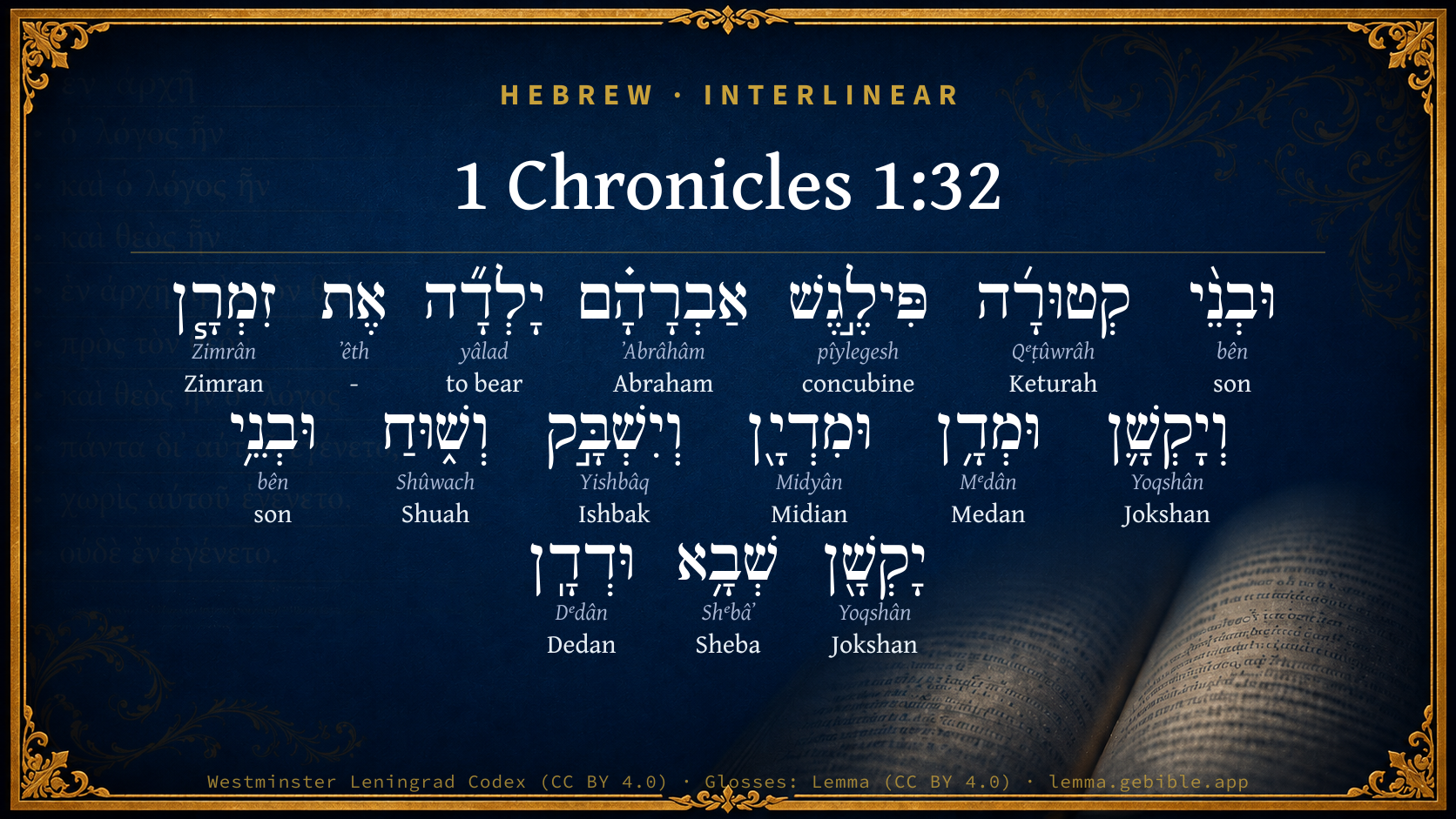
1 Chronicles 1:32

Hebrew (Westminster Leningrad Codex) 1 Chronicles 1:32 appears in the Hebrew Old Testament. The text above is from the Westminster Leningrad Codex. Each word links to its Strong’s number, a concise gloss, and parsing drawn from the Open Scriptures Hebrew Bible morphology. Click any word for its full Brown-Driver-Briggs (BDB) entry.
Download image
Cite this verse

1 Chronicles 1:32 (World English Bible). Public Domain. Lemma interlinear Bible study tool, https://lemma.gebible.app/v/1-chronicles/1/32.

Show BibTeX & RIS
BibTeX
RIS
English Translation
The sons of Keturah, Abraham's concubine: she bore Zimran, and Jokshan, and Medan, and Midian, and Ishbak, and Shuah. The sons of Jokshan: Sheba, and Dedan.
World English Bible · Public Domain
Download a study sheet

One document with this verse’s original text, its word-by-word gloss line, the meaning frame, cross-references with their text, attributed commentary, and full source and license credits — printable, and it pastes into notes with its structure intact.

This verse Autodidact and up

Study sheet (.html) Plain text (.txt)

A passage Seminary Student

Up to 50 verses in one chapter. A passage sheet keeps up to 6 commentary sources and 12 cross-references per verse, in the order this page ranks them, and says so on the sheet whenever that leaves anything out. Ask for a single verse and you get the Autodidact verse sheet above.

Everything on this page stays free to read, with no account — the sheet is a download of what is already on screen, not access to it.

Want to remove ads? Support Godless Engineer
Compare translations 3

The same verse in 3 English versions, stacked beneath the original-language interlinear above. Click any original word for its lexicon entry.

Each is an independent rendering of the whole verse — the interlinear is not word-aligned to these translations.

Highlighted words mark where these versions differ — a whole-verse word diff, not a word-by-word alignment.

  • World English Bible Public Domain
    The sons of Keturah, Abraham's concubine: she bore Zimran, and Jokshan, and Medan, and Midian, and Ishbak, and Shuah. The sons of Jokshan: Sheba, and Dedan.
  • King James Version Public Domain
    Now the sons of Keturah, Abraham's concubine: she bare Zimran, and Jokshan, and Medan, and Midian, and Ishbak, and Shuah. And the sons of Jokshan; Sheba, and Dedan.
  • unfoldingWord Literal Text CC BY-SA 4.0
    And the sons of Keturah, the concubine of Abraham: she bore Zimran and Jokshan and Medan and Midian and Ishbak and Shuah. And the sons of Jokshan: Sheba and Dedan.

unfoldingWord Literal Text — © unfoldingWord, licensed CC BY-SA 4.0. Word-aligned USFM3 via Door43 (git.door43.org/unfoldingWord/en_ult).

Versions to compare (up to 4)

3 of 4 selected

Show all 18 translations

Every available English version of this verse, each an independent rendering of the whole verse.

  • World English Bible Public Domain
    The sons of Keturah, Abraham's concubine: she bore Zimran, and Jokshan, and Medan, and Midian, and Ishbak, and Shuah. The sons of Jokshan: Sheba, and Dedan.
  • Berean Standard Bible Public Domain
    The sons born to Keturah, Abraham’s concubine: Zimran, Jokshan, Medan, Midian, Ishbak, and Shuah. The sons of Jokshan: Sheba and Dedan.
  • Majority Standard Bible Public Domain
    The sons born to Keturah, Abraham’s concubine: Zimran, Jokshan, Medan, Midian, Ishbak, and Shuah. The sons of Jokshan: Sheba and Dedan.
  • King James Version Public Domain
    Now the sons of Keturah, Abraham's concubine: she bare Zimran, and Jokshan, and Medan, and Midian, and Ishbak, and Shuah. And the sons of Jokshan; Sheba, and Dedan.
  • American Standard Version (1901) Public Domain
    And the sons of Keturah, Abraham's concubine: she bare Zimran, and Jokshan, and Medan, and Midian, and Ishbak, and Shuah. And the sons of Jokshan: Sheba, and Dedan.
  • Revised Version (1885) Public Domain
    And the sons of Keturah, Abraham’s concubine: she bare Zimran, and Jokshan, and Medan, and Midian, and Ishbak, and Shuah. And the sons of Jokshan; Sheba, and Dedan.
  • Geneva Bible (1599) Public Domain
    And Keturah Abrahams concubine bare sonnes, Zimran, and Iokshan, and Medan, and Midian, and Ishbak, and Shuah: and the sonnes of Iokshan, Sheba, and Dedan.
  • Douay-Rheims (1899) Public Domain
    And the sons of Cetura, Abraham's concubine, whom she bore: Zamran, Jecsan, Madan, Madian, Jesboc, and Sue. And the sons of Jecsan, Saba, and Dadan. And the sons of Dadan: Assurim, and Latussim, and Laomin.
  • Young's Literal Translation Public Domain
    And sons of Keturah, Abraham's concubine: she bare Zimran, and Jokshan, and Medan, and Midian, and Ishbak, and Shuah. And sons of Jokshan: Sheba and Dedan.
  • Literal Standard Version CC BY-SA 4.0
    And sons of Keturah, Abraham’s concubine: she bore Zimran, and Jokshan, and Medan, and Midian, and Ishbak, and Shuah. And sons of Jokshan: Sheba and Dedan.
  • Unlocked Literal Bible CC BY-SA 4.0
    The sons of Keturah, Abraham's concubine, were Zimran, Jokshan, Medan, Midian, Ishbak, and Shuah. The sons of Jokshan were Sheba and Dedan.
  • unfoldingWord Literal Text CC BY-SA 4.0
    And the sons of Keturah, the concubine of Abraham: she bore Zimran and Jokshan and Medan and Midian and Ishbak and Shuah. And the sons of Jokshan: Sheba and Dedan.
  • Darby Bible Public Domain
    -- And the sons of Keturah, Abraham's concubine: she bore Zimran, and Jokshan, and Medan, and Midian, and Ishbak, and Shuah. And the sons of Jokshan: Sheba and Dedan.
  • World Messianic Bible Public Domain
    The sons of Keturah, Abraham’s concubine: she bore Zimran, Jokshan, Medan, Midian, Ishbak, and Shuah. The sons of Jokshan: Sheba and Dedan.
  • Webster's Bible Public Domain
    Now the sons of Keturah, Abraham's concubine: she bore Zimran, and Jokshan, and Medan, and Midian, and Ishbak, and Shuah. And the sons of Jokshan; Sheba, and Dedan.
  • Free Bible Version CC BY-SA 4.0
    The sons born to Keturah, Abraham's concubine. She gave birth to: Zimran, Jokshan, Medan, Midian, Ishbak, and Shuah. The sons of Jokshan: Sheba and Dedan.
  • Bible in Basic English Public Domain
    And the sons of Keturah, Abraham's servant-wife: she was the mother of Zimran and Jokshan and Medan and Midian and Ishbak and Shuah. And the sons of Jokshan: Sheba and Dedan.
  • JPS Tanakh (1917) Public Domain
    And the sons of Keturah, Abraham's concubine: she bore Zimran, and Jokshan, and Medan, and Midian, and Ishbak, and Shuah. And the sons of Jokshan: Sheba, and Dedan.

Literal Standard Version (2020), Covenant Press — licensed CC BY-SA 4.0. Text via the HelloAO Bible API (eBible.org). Unlocked Literal Bible (unfoldingWord) — licensed CC BY-SA 4.0. Text via the HelloAO Bible API (eBible.org). unfoldingWord Literal Text — © unfoldingWord, licensed CC BY-SA 4.0. Word-aligned USFM3 via Door43 (git.door43.org/unfoldingWord/en_ult). Free Bible Version, Dr. Jonathan Gallagher — licensed CC BY-SA 4.0. Text via the HelloAO Bible API (eBible.org).

Word by word

More ways to search: Search by grammar → Find every occurrence → Compare this word →

Practice this passage: Drill this verse → Learn its vocabulary →

זִמְרָ֧ן
Zimrân
H2175
“Zimran”
Noun, Proper
Part of Speech
Noun
Type
Proper
Full BDB Definition

Origin: from H2167

TWOT: None

Zimran = "musician" - the eldest son of Abraham by Keturah
  1. וּבְנֵ֨י bên H1121 “and · sons of” Conjunction + Noun, Common, Masculine, Plural, Construct
  2. קְטוּרָ֜ה Qᵉṭûwrâh H6989 “Keturah” Noun, Proper
  3. פִּילֶ֣גֶשׁ pîylegesh H6370 “concubine of” Noun, Common, Feminine, Singular, Construct
  4. אַבְרָהָ֗ם ʼAbrâhâm H85 “Abraham” Noun, Proper
  5. יָלְדָ֞ה yâlad H3205 “to bear” Verb, Qal, Perfect, 3rd Person, Feminine, Singular
  6. אֶת ʼêth H853 “-” Particle, Direct Object
  7. וְיָקְשָׁ֛ן Yoqshân H3370 “and · Jokshan” Conjunction + Noun, Proper
  8. וּמְדָ֥ן Mᵉdân H4091 “and · Medan” Conjunction + Noun, Proper
  9. וּמִדְיָ֖ן Midyân H4080 “and · Midian” Conjunction + Noun, Proper
  10. וְיִשְׁבָּ֣ק Yishbâq H3435 “and · Ishbak” Conjunction + Noun, Proper
  11. וְשׁ֑וּחַ Shûwach H7744 “and · Shuah” Conjunction + Noun, Proper
  12. וּבְנֵ֥י bên H1121 “and · sons of” Conjunction + Noun, Common, Masculine, Plural, Construct
  13. יָקְשָׁ֖ן Yoqshân H3370 “Jokshan” Noun, Proper
  14. שְׁבָ֥א Shᵉbâʼ H7614 “Sheba” Noun, Proper
  15. וּדְדָֽן Dᵉdân H1719 “and · Dedan” Conjunction + Noun, Proper

About this verse

These counts appear in no published source. They are computed here, from the morphology-tagged text and Lemma’s own curated glosses. What Lemma adds →

16
words
14
distinct lemmas
Historical
section

Notable vocabulary

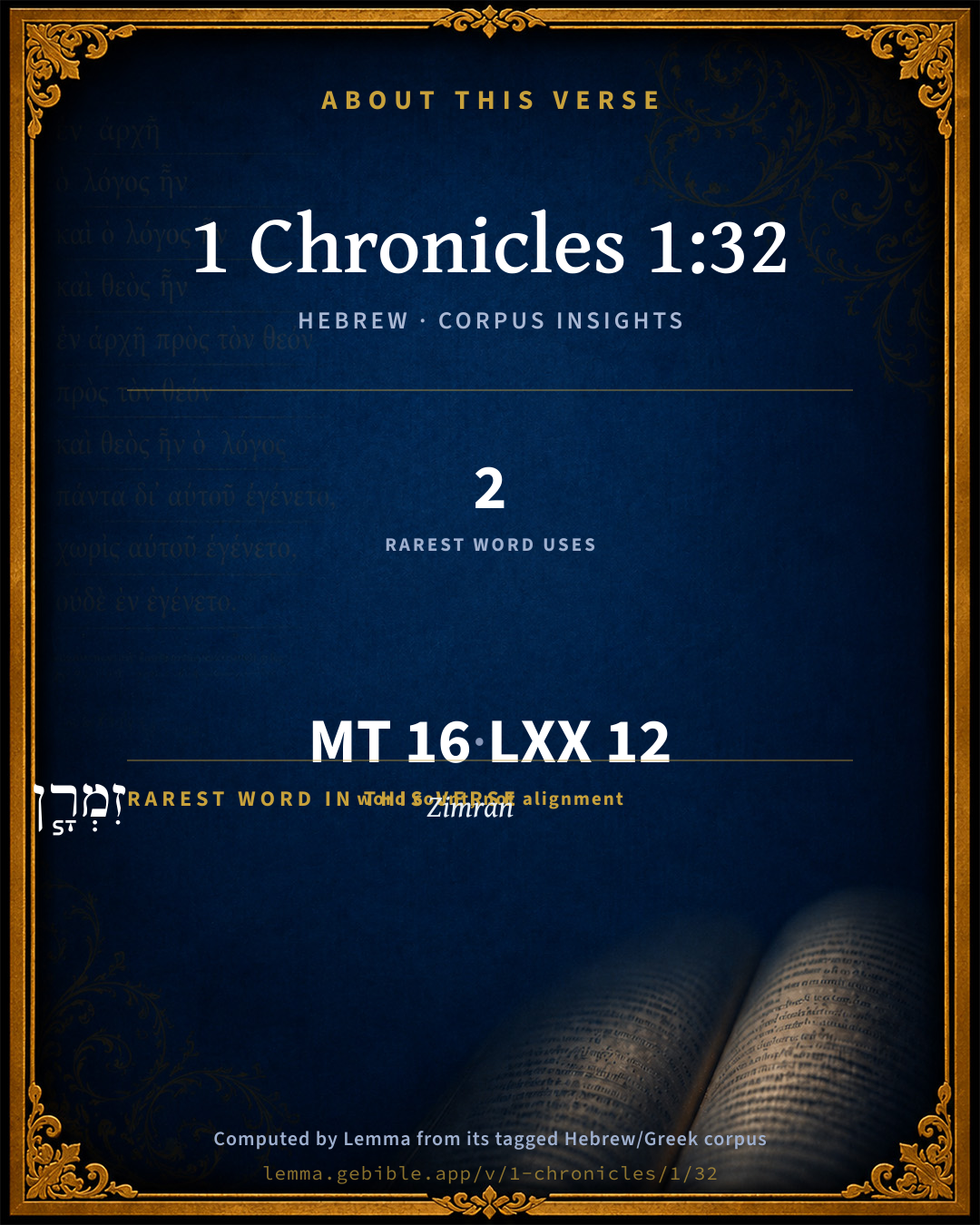
The rarest word here is זִמְרָ֧ן Zimran H2175 — appearing just 2 times in the whole Hebrew Bible.

Shared distinctive vocabulary

זִמְרָ֧ן Zimran H2175 occurs in 2 verses of the Hebrew Bible. Also found in:

Grammatical profile

  • 1 verb
  • 14 nouns
  • 1 particle

Verb forms

  • יָלְדָ֞ה Qal · Perfect

Repetition

Words recur within this verse — often emphatic in Hebrew:

  • וּבְנֵ֨י son H1121 ×2
  • וְיָקְשָׁ֛ן Jokshan H3370 ×2

Hebrew & Septuagint length

In English translation the verse runs 26 words from the Hebrew and 24 from the Septuagint (LXX English) — closely comparable.

A rough comparison of the two English renderings, which tokenize alike — not a word-level alignment.

Word counts can differ between the Hebrew and the Greek without any difference in meaning — e.g. the Hebrew direct-object marker אֵת has no separate Greek word, and Greek often adds the article ὁ.

In the original languages it is 16 Hebrew tokens and 12 Greek tokens — but the two are counted differently (Hebrew bundles its prefixes and suffixes into one token; the Greek is in lemma form), so that isn’t a like-for-like length.

Cross-references

17

Topical passages linked to 1 Chronicles 1:32 in the Treasury of Scripture Knowledge — connected by theme and wording, ordered by reader-vote popularity; previews shown in the World English Bible.

  • Genesis 25:1–4 Abraham took another wife, and her name was Keturah.
  • Genesis 37:28 Midianites who were merchants passed by, and they drew and lifted up Joseph out of the pit, and sold Joseph to the Ishmaelites for twenty pieces of silver. They brought Joseph into Egypt.
  • Exodus 2:15–16 Now when Pharaoh heard this thing, he sought to kill Moses. But Moses fled from the face of Pharaoh, and lived in the land of Midian, and he sat down by a well.
  • Numbers 22:4–7 Moab said to the elders of Midian, Now will this multitude lick up all that is round about us, as the ox licks up the grass of the field. Balak the son of Zippor was king of Moab at that time.
  • Numbers 25:6 Behold, one of the children of Israel came and brought to his brothers a Midianite woman in the sight of Moses, and in the sight of all the congregation of the children of Israel, while they were weeping at the door of the tent of meeting.
  • Numbers 31:2 Avenge the children of Israel of the Midianites: afterward you shall be gathered to your people.
  • Judges 6:1–6 The children of Israel did that which was evil in the sight of Yahweh: and Yahweh delivered them into the hand of Midian seven years.
  • 1 Kings 10:1 When the queen of Sheba heard of the fame of Solomon concerning the name of Yahweh, she came to prove him with hard questions.
  • Job 6:19 The caravans of Tema looked, The companies of Sheba waited for them.
  • Psalms 72:10 The kings of Tarshish and of the isles will bring tribute. The kings of Sheba and Seba shall offer gifts.
  • Psalms 72:15 They shall live, and to him shall be given of the gold of Sheba. Men shall pray for him continually. They shall bless him all day long.
  • Isaiah 21:13 The burden on Arabia. In the forest in Arabia shall you lodge, you caravans of Dedanites.
  • Isaiah 60:6 The multitude of camels shall cover you, the dromedaries of Midian and Ephah; all they from Sheba shall come; they shall bring gold and frankincense, and shall proclaim the praises of Yahweh.
  • Jeremiah 25:23 Dedan, and Tema, and Buz, and all who have the corners [of their hair] cut off;
  • Jeremiah 49:8 Flee you, turn back, dwell in the depths, inhabitants of Dedan; for I will bring the calamity of Esau on him, the time that I shall visit him.
  • Ezekiel 25:13 therefore thus says the Lord Yahweh, I will stretch out my hand on Edom, and will cut off man and animal from it; and I will make it desolate from Teman; even to Dedan shall they fall by the sword.
  • Ezekiel 27:20 Dedan was your trafficker in precious cloths for riding.

Cross-references courtesy of OpenBible.info (CC BY 4.0).

Hebrew and Greek witnesses Masoretic Hebrew ↔ Greek Septuagint

The same verse in the two great witnesses to the Old Testament, shown verse-for-verse.

These are two independent witnesses, not word-aligned to each other, and the Septuagint is shown in lemma (dictionary) form.

Hebrew 1 Chronicles 1:32 Masoretic · Westminster Leningrad Codex

וּבְנֵ֨י קְטוּרָ֜ה פִּילֶ֣גֶשׁ אַבְרָהָ֗ם יָלְדָ֞ה אֶת זִמְרָ֧ן וְיָקְשָׁ֛ן וּמְדָ֥ן וּמִדְיָ֖ן וְיִשְׁבָּ֣ק וְשׁ֑וּחַ וּבְנֵ֥י יָקְשָׁ֖ן שְׁבָ֥א וּדְדָֽן

The sons of Keturah, Abraham's concubine: she bore Zimran, and Jokshan, and Medan, and Midian, and Ishbak, and Shuah. The sons of Jokshan: Sheba, and Dedan.

World English Bible · Public Domain

Greek LXX 1 Chronicles 1:32 Septuagint · lemma form

καί ἀποθνήσκω βαλακ καί βασιλεύω ἀντί αὐτός ιωβαβ υἱός ζαρα ἐκ βοσορρα

And the sons of Chettura Abraam's concubine:—and she bore him Zembram, Jexan, Madiam, Madam, Sobac, Soe: and the sons of Jexan; Daedan, and Sabai;

LXX2012 (modern English Septuagint) · Public Domain

On this verse, Haydock's Catholic Bible Commentary discusses the Septuagint’s reading. Read the note in Commentary ↓

Hebrew: Westminster Leningrad Codex (CC BY 4.0). Greek: Septuagint (public domain); English from LXX2012 (modern English Septuagint) (Public Domain). How the Septuagint differs from the Hebrew →

Commentary

Notes on 1 Chronicles 1:32 from classic Christian and Jewish commentators (each source and its license shown beneath its notes). The classic Christian expositions comment on the surrounding passage and are grouped to its opening verse, so a note may address several verses; the Jewish commentaries on the Tanakh (Rashi and others) are per-verse, so they appear only where the commentator wrote on this verse.

Lemma curates 59 commentaries, every one of them public domain or Creative Commons licensed, each selected and text-cleaned for this edition rather than reprinted as found. About our sources →

Jamieson, Fausset & Brown

Robert Jamieson, A. R. Fausset & David Brown

SONS OF KETURAH. (Ch1 1:32-33)

sons of Keturah--These became founders of nomadic tribes in the north of Arabia and Syria, as Midian of the Midianites (Gen 36:35; Jdg 6:2).

and Shuah--from whom Bildad sprang (Job 2:11).

Jamieson, Fausset & Brown — Commentary Critical and Explanatory on the Whole Bible (1871) — public domain (CC PDM 1.0). Text via the HelloAO Bible API.

Geneva Bible (1599)

Geneva Bible translators

Read Gen. 25:4.

Geneva Bible (1599) marginal notes — public domain. Text via Bolls.life.

Adam Clarke's Commentary

Verse 32. Keturah, Abraham's concubine] Abraham's pilegesh, or wife of the second rank; she was neither whore, harlot, nor concubine, in our sense of these words.

Adam Clarke's Commentary on the Bible (1810–1826) — public domain. Text from a community e-Sword/MySword module.

Ellicott's Commentary for English Readers

(32) The sons of Keturah.—An extract from Gen_25:1-4.

Medan is very likely a mere repetition of Midian, due to a mistake of some ancient copyist. Gen_25:3 adds, “And the sons of Dedan were Asshuriin, and Letushim, and Leummim;” which is, perhaps, an interpolation, as the three names are of a different form from the others in the section; and the chronicler would hardly have omitted them had he found them in his text.

Midian.—The most important of these tribes. The Midianites dwelt, or rather wandered, in the peninsula of Sinai.

Sheba, and Dedan.—See 1Ch_1:9, where these names appear as sons of Cush. The names may have been common to different tribes settled in different regions. Sheba (Assyr. Saba’â’a) Massa, Tema, and Adbeel, are described by Tiglath-pileser as lying “on the border of the sunset lands”

A Bible Commentary for English Readers, edited by Charles John Ellicott (1878–1897) — public domain. Text from a community e-Sword module.

The Cambridge Bible for Schools and Colleges

gen. ed. J. J. S. Perowne

32. Medan, Midian] Kindred tribes often bore names only slightly differing in form.

Midian] In Jdg_8:24 the Midianites are reckoned as Ishmaelites.

Sheba and Dedan] The same two names occur in 1Ch_1:9 among the descendants of Ham. See note there.

32, 33. The Descent of Arabian Tribes from Abraham through Keturah (= Gen_25:1-4)

The Cambridge Bible for Schools and Colleges (gen. ed. J. J. S. Perowne; Cambridge University Press, 1878–1918) — public domain. Text from a community e-Sword module.

Albert Barnes' Notes on the Bible

Keturah, Abraham’s concubine - This passage, and Gen 25:6, sufficiently prove that the position of Keturah was not that of the full wife, but of the “secondary” or “concubine wife” Jdg 19:1 so common among Orientals.

Albert Barnes' Notes on the Bible (1834–1885) — public domain. Text from a community e-Sword/MySword module.

Haydock's Catholic Bible Commentary

Concubine. She was his lawful wife, but of an inferior degree, and such were called concubines. (Challoner) --- She has the title of wife, Genesis xxv. 1. --- And the sons of Dadan, &c., seems to be copied from Genesis, as the addition is not found in many Latin manuscripts, no more than in the Hebrew or Septuagint. (Calmet)

George Leo Haydock (1774–1849), Haydock's Catholic Family Bible and Commentary, 1859 edition — public domain. Excludes Psalms (Douay-Rheims chapter numbering differs from Protestant) and Deuterocanonical books (Catholic canon only).

The Pulpit Commentary

Vers. 32, 33, contain the list of Abraham"s sons by Keturah, here called one of his concubines; but in Genesis, "a wife," and apparently not taken by Abraham till after Sarah"s death. (Gen_25:1-4) The sons are six; the grandsons, two by the son placed second in order, and five by the son placed fourth in order; in all thirteen names. But the passage in Genesis gives also three great-grandsons, through the second grandson. All the thirteen are in the Authorized Version identical in the two places and in the Hebrew text; but in the Septuagint slight differences occur, as Zembram, Iexan, Madam, Sobak, Soe, Daidan, Sabai, Opher, Abida, and Eldada here, for Zombran, Iezan, Madal, Iesbok, Soie, Dedan, Saba, Apheir, Abeida, and Eldaga there. It is carefully stated in Gen_25:5, Gen_25:6, after the enumeration of Keturah"s children, and in spite of her having been called "wife" in the first verse, that "Abraham gave all that he had unto Isaac. But unto the sons of the concubines, which Abraham had, Abraham gave gifts, and sent them away from Isaac his sou, while he yet lived, eastward, unto the east country."

The Pulpit Commentary (1880–1919), ed. H.D.M. Spence-Jones & Joseph S. Exell — public domain. Text from a community e-Sword module.

Kretzmann's Popular Commentary

Paul E. Kretzmann

The Descendants of Esau and the Dukes of Edom

v. 32. Now, the sons of Keturah, Abraham’s concubine, the half-brothers of Ishmael; she bare Zimran, and Jokshan, and Medan, and Midian, and Ishbak, and Shuah, these being the founders of nomadic tribes in the northern part of Arabia and in Syria. Cf Gen 25:1-2; Gen 36:35; Job 2:11. And the sons of Jokshan: Sheba and Dedan.

v. 33. And the sons of Midian: Ephah, and Epher, and Renoch, and Abida, and Eldaah. All these are the sons, the descendants, of Keturah.

v. 34. And Abraham begat Isaac, this verse continuing the enumeration of 1Ch 1:28. The sons of Isaac: Esau and Israel.

v. 35. The sons of Esau, who forfeited his birthright and was not the bearer of the Messianic promise: Eliphaz, Reuel, and Jeush, and Jaalam, and Korah. Cf Gen 36:9-14.

v. 36. The sons of Eliphaz: Teman, and Omar, Zephi, and Gatam, Kenaz, and Timna, and Amalek.

v. 37. The sons of Reuel: Nahath, Zerah, Shammah, and Mizzah.

v. 38. And the sons of Seir: Lotan, and Shobal, and Zibeon, and Anah, and Dishon, and Ezar, and Dishan.

v. 39. And the sons of Lotan: Rori, and Roman (or Heman); and Timna was Lotan’s sister.

v. 40. The sons of Shobal: Alian (or Alvan), and Manahath, and Ebal, Shephi, and Onam. And the sons of Zibeon: Aiah and Anah.

v. 41. The sons of Anah: Dishon. And the sons of Dishon: Amram (or Hemdan), and Eshban, and Ithran, and Cheran.

v. 42. The sons of Ezer: Bilhan, and Zavail, and Jakan (or Akan). The sons of Dishan: Uz and Aran. Cf Gen 36:20-28. These men were founders of nomadic tribes occupying the country between the Red Sea and the Euphrates, some of the mightiest ones being found near the boundary of Chaldea.

v. 43. Now, these are the kings that reigned in the land of Edom before any king reigned over the children of Israel: Bela, the son of Beor; and the name of his city was Dinhabah. This has been identified with O’Daeb, a well known town in the center of Al Dahna, a great northern desert in the direction of Chaldea and the Euphrates.

v. 44. And when Bela was dead, Jobab, the son of Zerah, of Bozrah reigned in his stead.

v. 45. And when Jobab was dead, Husham of the land of the Temanites reigned in his stead.

v. 46. And when Husham was dead, Hadad, the son of Bedad, which smote Midian in the field of Moab, reigned in his stead; and the name of his city was Avith.

v. 47. And when Hadad was dead, Samlah of Masrekah reigned in his stead.

v. 48. And when Samlah was dead, Shaul of Rehoboth by the river reigned in his stead.

v. 49. And when Shaul was dead, Baal-hanan, the son of Acabor, reigned in his stead.

v. 50. And when Baal-hanan was dead, Hadad (or Hadar) reigned in his stead; and the name of his city was Pai; and his wife’s name was Mehetabel, the daughter of Matred, the daughter of Mezahab. It appears from this that the country had no definite capital at this time, and that the royal power was not hereditary. Probably the ruler was elected from the total number of princes or most influential sheiks.

v. 51. Hadad died also, and after his death the office of king seems to have been abolished. And the dukes of Edom were: Duke Timnah, Duke Aliah, Duke Jetheth,

v. 52. Duke Aholibamah, Duke Elah, Duke Pinon,

v. 53. Duke Kenaz, Duke Teman, Duke Mibzar,

v. 54. Duke Magdiel, Duke Iram. These are the dukes of Edom. For the entire passage compare Gen 36:31-43. This list has only geographical importance, as naming the chief Edomite principalities. It has been preserved to show how completely the Lord fulfilled His promise concerning Esau.

Paul E. Kretzmann, Popular Commentary of the Bible (1921–1924) — public domain. Text from a community e-Sword module.

unfoldingWord translationNotes

Door43 World Missions Community

General Information:

All of the names here except for Keturah are names of men. Keturah is the name of a woman. (See: How to Translate Names)

translationWords

concubine

Midian

descend

unfoldingWord translationNotes — © Distant Shores Media and the Door43 World Missions Community, licensed CC BY-SA 4.0. Source: git.door43.org/Door43/en_tn.

Rashi

Rabbi Shlomo Yitzchaki (Rashi)

And the sons of Keturah, Abraham’s concubine Anything disgraceful that he could tell about them he tells to enhance Isaac’s honor, i.e., they were all the children of a concubine, but he was the mainstay and the master of the household.

Rashi on the Tanakh — English translations: “The Judaica Press complete Tanach with Rashi, translated by A. J. Rosenberg” (CC BY 4.0); “Pentateuch with Rashi's commentary by M. Rosenbaum and A.M. Silbermann, 1929-1934” (public domain); “The Metsudah Tanach series, Lakewood, N.J” (CC BY 4.0); and “The Book of Joshua, Metsudah Publications, 1997” (CC BY 4.0). Text via Sefaria.

Lesson kit

Teaching starters — assembled from the data on this page, not authored interpretation. Every prompt links to the verse data it draws on. Edit before teaching.

1 Chronicles, in the Historical, opens this verse with 16 words (14 distinct Hebrew lemmas). Its most distinctive word is Zimrân (“Zimran”). A historical commentator’s framing appears above. Read the whole chapter for the surrounding context.

Discussion questions

  1. The word Zimrân carries the sense “Zimran.” How does it shape the verse?
  2. How does Genesis 25:2, which shares the word «Zimran», read alongside this verse?
  3. What does the repetition of “son” (2× in this one verse) do in this verse?
  4. These translations render this verse differently. What is at stake in choosing one wording over another?
  5. «יָלְדָ֞ה» is a Qal Perfect verb. How does that grammatical form shape the action described?
  6. Compare how Jamieson, Fausset & Brown and Geneva Bible (1599) read this verse. Where do they agree or differ?

Things to notice

Reading settings

Reading text

Shown beneath each verse's original-language words.

Old Testament
Old Testament edition

Read the OT as the Masoretic Hebrew (MT) or the Greek Septuagint (LXX).

English shown for the Greek Septuagint (in the Hebrew ↔ Greek comparison).

Comparing translations? Open the Compare panel on any verse page to stack up to four side by side.