
2 Kings 17:9

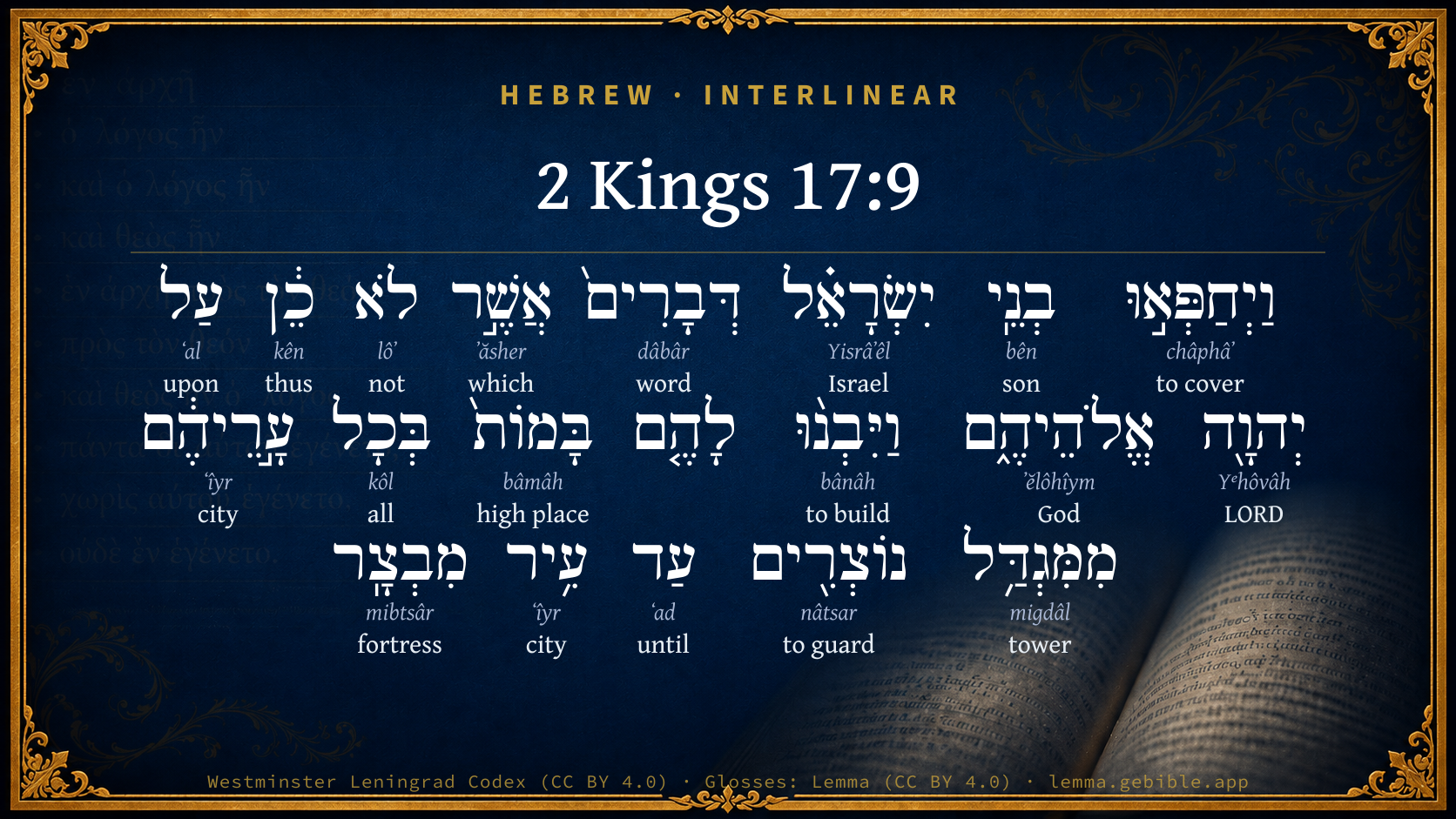
Hebrew (Westminster Leningrad Codex) 2 Kings 17:9 appears in the Hebrew Old Testament. The text above is from the Westminster Leningrad Codex. Each word links to its Strong’s number, a concise gloss, and parsing drawn from the Open Scriptures Hebrew Bible morphology. Click any word for its full Brown-Driver-Briggs (BDB) entry.
Download image
Cite this verse

2 Kings 17:9 (World English Bible). Public Domain. Lemma interlinear Bible study tool, https://lemma.gebible.app/v/2-kings/17/9.

Show BibTeX & RIS
BibTeX
RIS
English Translation
The children of Israel did secretly things that were not right against Yahweh their God: and they built them high places in all their cities, from the tower of the watchmen to the fortified city;
World English Bible · Public Domain
Highlights Full analysis ↓
Download a study sheet

One document with this verse’s original text, its word-by-word gloss line, the meaning frame, cross-references with their text, attributed commentary, and full source and license credits — printable, and it pastes into notes with its structure intact.

This verse Autodidact and up

Study sheet (.html) Plain text (.txt)

A passage Seminary Student

Up to 50 verses in one chapter. A passage sheet keeps up to 6 commentary sources and 12 cross-references per verse, in the order this page ranks them, and says so on the sheet whenever that leaves anything out. Ask for a single verse and you get the Autodidact verse sheet above.

Everything on this page stays free to read, with no account — the sheet is a download of what is already on screen, not access to it.

Want to remove ads? Support Godless Engineer
Compare translations 3

The same verse in 3 English versions, stacked beneath the original-language interlinear above. Click any original word for its lexicon entry.

Each is an independent rendering of the whole verse — the interlinear is not word-aligned to these translations.

Highlighted words mark where these versions differ — a whole-verse word diff, not a word-by-word alignment.

  • World English Bible Public Domain
    The children of Israel did secretly things that were not right against Yahweh their God: and they built them high places in all their cities, from the tower of the watchmen to the fortified city;
  • King James Version Public Domain
    And the children of Israel did secretly those things that were not right against the LORD their God, and they built them high places in all their cities, from the tower of the watchmen to the fenced city.
  • unfoldingWord Literal Text CC BY-SA 4.0
    And the sons of Israel covered things against Yahweh their God that were not thus. For they built for themselves high places in all of their cities, from a tower of watchmen to a city of fortification.

unfoldingWord Literal Text — © unfoldingWord, licensed CC BY-SA 4.0. Word-aligned USFM3 via Door43 (git.door43.org/unfoldingWord/en_ult).

Versions to compare (up to 4)

3 of 4 selected

Show all 18 translations

Every available English version of this verse, each an independent rendering of the whole verse.

  • World English Bible Public Domain
    The children of Israel did secretly things that were not right against Yahweh their God: and they built them high places in all their cities, from the tower of the watchmen to the fortified city;
  • Berean Standard Bible Public Domain
    The Israelites secretly did things against the LORD their God that were not right. From watchtower to fortified city, they built high places in all their cities.
  • Majority Standard Bible Public Domain
    The Israelites secretly did things against the LORD their God that were not right. From watchtower to fortified city, they built high places in all their cities.
  • King James Version Public Domain
    And the children of Israel did secretly those things that were not right against the LORD their God, and they built them high places in all their cities, from the tower of the watchmen to the fenced city.
  • American Standard Version (1901) Public Domain
    And the children of Israel did secretly things that were not right against Jehovah their God: and they built them high places in all their cities, from the tower of the watchmen to the fortified city;
  • Revised Version (1885) Public Domain
    And the children of Israel did secretly things that were not right against the LORD their God, and they built them high places in all their cities, from the tower of the watchmen to the fenced city.
  • Geneva Bible (1599) Public Domain
    And the children of Israel had done secretly things that were not vpright before the Lord their God, and throughout all their cities had built hie places, both from the tower of the watch, to the defensed citie,
  • Douay-Rheims (1899) Public Domain
    And the children of Israel offended the Lord their God with things that were not right: and built them high places in all their cities from the tower of the watchmen to the fenced city.
  • Young's Literal Translation Public Domain
    and the sons of Israel do covertly things that `are' not right against Jehovah their God, and build for them high places in all their cities, from a tower of the watchers unto the fenced city,
  • Literal Standard Version CC BY-SA 4.0
    and the sons of Israel covertly do things that [are] not right against their God YHWH, and build high places for themselves in all their cities, from a tower of the watchers to the fortified city,
  • Unlocked Literal Bible CC BY-SA 4.0
    The people of Israel did secretly—against Yahweh their God—things that were not right. They built for themselves high places in all their cities, from the watchtower to the fortress.
  • unfoldingWord Literal Text CC BY-SA 4.0
    And the sons of Israel covered things against Yahweh their God that were not thus. For they built for themselves high places in all of their cities, from a tower of watchmen to a city of fortification.
  • Darby Bible Public Domain
    And the children of Israel did secretly against Jehovah their God things that were not right; and they built them high places in all their cities, from the watchmen's tower to the fortified city.
  • World Messianic Bible Public Domain
    The children of Israel secretly did things that were not right against the LORD their God; and they built high places for themselves in all their cities, from the tower of the watchmen to the fortified city;
  • Webster's Bible Public Domain
    And the children of Israel did secretly things that were not right against the LORD their God, and they built for themselves high places in all their cities, from the tower of the watchmen to the fortified city.
  • Free Bible Version CC BY-SA 4.0
    Secretly the Israelites did things that were not right against the Lord their God. They built high places in all their towns, from watchtowers to fortified cities.
  • Bible in Basic English Public Domain
    And the children of Israel did secretly against the Lord their God things which were not right, building high places for themselves in all their towns, from the tower of the watchmen to the walled town.
  • JPS Tanakh (1917) Public Domain
    and the children of Israel did impute things that were not right unto the LORD their God, and they built them high places in all their cities, from the tower of the watchmen to the fortified city;

Literal Standard Version (2020), Covenant Press — licensed CC BY-SA 4.0. Text via the HelloAO Bible API (eBible.org). Unlocked Literal Bible (unfoldingWord) — licensed CC BY-SA 4.0. Text via the HelloAO Bible API (eBible.org). unfoldingWord Literal Text — © unfoldingWord, licensed CC BY-SA 4.0. Word-aligned USFM3 via Door43 (git.door43.org/unfoldingWord/en_ult). Free Bible Version, Dr. Jonathan Gallagher — licensed CC BY-SA 4.0. Text via the HelloAO Bible API (eBible.org).

Word by word

More ways to search: Search by grammar → Find every occurrence → Compare this word →

Practice this passage: Drill this verse → Learn its vocabulary →

וַיְחַפְּא֣וּ
châphâʼ
H2644
“and · to cover”
Conjunction + Verb, Piel, Sequential Imperfect, 3rd Person, Masculine, Plural
Part of Speech
Conjunction + Verb
Stem
Piel
Form
Sequential Imperfect
Person
3rd Person
Gender
Masculine
Number
Plural
Full BDB Definition

Origin: an orthographical variation of H2645

TWOT: 706

(Piel) to cover, do secretly
  1. בְנֵֽי bên H1121 “sons of” Noun, Common, Masculine, Plural, Construct
  2. יִשְׂרָאֵ֗ל Yisrâʼêl H3478 “Israel” Noun, Proper
  3. דְּבָרִים֙ dâbâr H1697 “words” Noun, Common, Masculine, Plural, Absolute
  4. אֲשֶׁ֣ר ʼăsher H834 “which” Particle, Relative
  5. לֹא lôʼ H3808 “not” Particle, Negative
  6. כֵ֔ן kên H3651 “thus” Adjective, Adjective, Masculine, Singular, Absolute
  7. עַל ʻal H5921 “upon” Preposition
  8. יְהוָ֖ה Yᵉhôvâh H3068 “LORD” Noun, Proper
  9. אֱלֹהֵיהֶ֑ם ʼĕlôhîym H430 “God(s) · their” Noun, Common, Masculine, Plural, Construct + Suffix, Personal, 3rd Person, Masculine, Plural
  10. וַיִּבְנ֨וּ bânâh H1129 “and · to build” Conjunction + Verb, Qal, Sequential Imperfect, 3rd Person, Masculine, Plural
  11. בָּמוֹת֙ bâmâh H1116 “high places” Noun, Common, Feminine, Plural, Absolute
  12. בְּכָל kôl H3605 “in/at · all of” Preposition + Noun, Common, Masculine, Singular, Construct
  13. עָ֣רֵיהֶ֔ם ʻîyr H5892 “cities · their” Noun, Common, Feminine, Plural, Construct + Suffix, Personal, 3rd Person, Masculine, Plural
  14. מִמִּגְדַּ֥ל migdâl H4026 “from · tower of” Preposition + Noun, Common, Both, Singular, Construct
  15. נוֹצְרִ֖ים nâtsar H5341 “guarding” Verb, Qal, Participle Active, Masculine, Plural, Absolute
  16. עַד ʻad H5704 “until” Preposition
  17. עִ֥יר ʻîyr H5892 “city of” Noun, Common, Feminine, Singular, Construct
  18. מִבְצָֽר mibtsâr H4013 “fortress” Noun, Common, Masculine, Singular, Absolute

About this verse

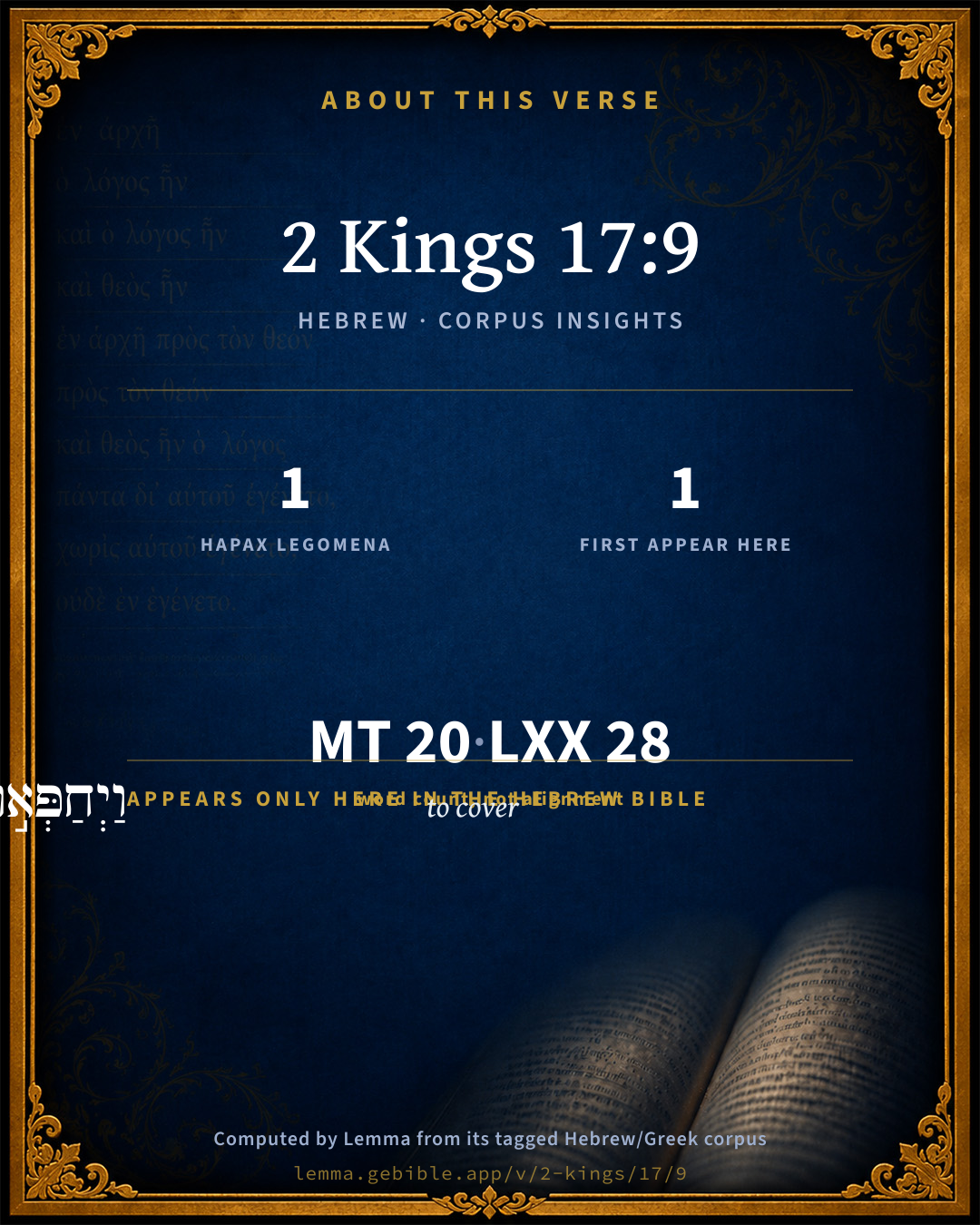
These counts appear in no published source. They are computed here, from the morphology-tagged text and Lemma’s own curated glosses. What Lemma adds →

20
words
18
distinct lemmas
Historical
section

Notable vocabulary

1 hapax legomenon — a word that appears only here in the entire Hebrew Bible:

  • וַיְחַפְּא֣וּ to cover H2644

First appearance in Scripture

This word makes its first canonical appearance in the Hebrew Bible here:

  • וַיְחַפְּא֣וּ to cover H2644

Shared distinctive vocabulary

מִבְצָֽר fortress H4013 occurs in 37 verses of the Hebrew Bible. Also found in:

Grammatical profile

  • 3 verbs
  • 11 nouns
  • 1 adjective
  • 3 prepositions
  • 2 particles

Verb forms

  • וַיְחַפְּא֣וּ Piel · Sequential Imperfect
  • וַיִּבְנ֨וּ Qal · Sequential Imperfect
  • נוֹצְרִ֖ים Qal · Participle Active

Repetition

A word recurs within this verse — often emphatic in Hebrew:

  • עָ֣רֵיהֶ֔ם city H5892 ×2

Hebrew & Septuagint length

In English translation the verse runs 35 words from the Hebrew and 25 from the Septuagint (LXX English) — the Septuagint runs noticeably shorter here. See the side-by-side →

A rough comparison of the two English renderings, which tokenize alike — not a word-level alignment.

Word counts can differ between the Hebrew and the Greek without any difference in meaning — e.g. the Hebrew direct-object marker אֵת has no separate Greek word, and Greek often adds the article ὁ.

In the original languages it is 20 Hebrew tokens and 28 Greek tokens — but the two are counted differently (Hebrew bundles its prefixes and suffixes into one token; the Greek is in lemma form), so that isn’t a like-for-like length.

Cross-references

6

Topical passages linked to 2 Kings 17:9 in the Treasury of Scripture Knowledge — connected by theme and wording, ordered by reader-vote popularity; previews shown in the World English Bible.

  • 2 Kings 18:8 He struck the Philistines to Gaza and the borders of it, from the tower of the watchmen to the fortified city.
  • Deuteronomy 13:6 If your brother, the son of your mother, or your son, or your daughter, or the wife of your bosom, or your friend, who is as your own soul, entice you secretly, saying, Let us go and serve other gods, which you have not known, you, nor your fathers;
  • Deuteronomy 27:15 Cursed be the man who makes an engraved or molten image, an abomination to Yahweh, the work of the hands of the craftsman, and sets it up in secret. All the people shall answer and say, Amen.
  • Job 31:27 And my heart has been secretly enticed, My hand threw a kiss from my mouth:
  • Ezekiel 8:12 Then said he to me, Son of man, have you seen what the elders of the house of Israel do in the dark, every man in his chambers of imagery? for they say, Yahweh doesn't see us; Yahweh has forsaken the land.
  • Hosea 12:11 If Gilead is wicked, Surely they are worthless. In Gilgal they sacrifice bulls. Indeed, their altars are like heaps in the furrows of the field.

Cross-references courtesy of OpenBible.info (CC BY 4.0).

Hebrew and Greek witnesses Masoretic Hebrew ↔ Greek Septuagint

The same verse in the two great witnesses to the Old Testament, shown verse-for-verse.

Here the Septuagint runs noticeably shorter than the Hebrew — LXX2012 (modern English Septuagint) 25 words vs World English Bible 35. A rough length comparison of the two English translations, not a word-level alignment — read both below.

These are two independent witnesses, not word-aligned to each other, and the Septuagint is shown in lemma (dictionary) form.

Hebrew 2 Kings 17:9 Masoretic · Westminster Leningrad Codex

וַיְחַפְּא֣וּ בְנֵֽי יִשְׂרָאֵ֗ל דְּבָרִים֙ אֲשֶׁ֣ר לֹא כֵ֔ן עַל יְהוָ֖ה אֱלֹהֵיהֶ֑ם וַיִּבְנ֨וּ לָהֶ֤ם בָּמוֹת֙ בְּכָל עָ֣רֵיהֶ֔ם מִמִּגְדַּ֥ל נוֹצְרִ֖ים עַד עִ֥יר מִבְצָֽר

The children of Israel did secretly things that were not right against Yahweh their God: and they built them high places in all their cities, from the tower of the watchmen to the fortified city;

World English Bible · Public Domain

Greek LXX 2 Kings 17:9 Septuagint · lemma form

καί ὅσος ἀμφιέννυμι ὁ υἱός ἰσραήλ λόγος οὐ οὕτως κατά κύριος θεός αὐτός καί οἰκοδομέω ἑαυτοῦ ὑψηλός ἐν πᾶς ὁ πόλις αὐτός ἀπό πύργος φυλάσσω ἕως πόλις ὀχυρός

and in those of the children of Israel as many as secretly practised customs, not as they should have done, against the Lord their God:

LXX2012 (modern English Septuagint) · Public Domain

On this verse, The Cambridge Bible for Schools and Colleges discusses the Septuagint’s reading. Read the note in Commentary ↓

Hebrew: Westminster Leningrad Codex (CC BY 4.0). Greek: Septuagint (public domain); English from LXX2012 (modern English Septuagint) (Public Domain). How the Septuagint differs from the Hebrew →

Targum (Aramaic paraphrase)

1

The Targum is the ancient Jewish Aramaic paraphrase of the Hebrew Scriptures — an interpretive translation, not the Hebrew text itself. Onkelos (literal) and Pseudo-Jonathan (expansive) render the Torah, and Jonathan the Prophets. Coverage is partial: where no permissively-licensed English translation exists for a verse, only the Aramaic is shown. This is verse-level text, not a word-by-word alignment to the Hebrew.

  1. Targum Jonathan Prophets (Joshua–Malachi)
    וַאֲמָרוּ בְנֵי יִשְׂרָאֵל מִלִין דְלָא כַשְׁרִין קֳדָם יְיָ אֱלָהָהוֹן וּבְנוֹ לְהוֹן בָּמָן בְכָל קִרְוֵיהוֹן מִמִגְדַל תַּקִיף עַד קִירְוִין כְּרִיכָן:

    (no public-domain English translation for this verse)

    Targum Jonathan — Aramaic: “Mikraot Gedolot” (public domain). English: “Sefaria Community Translation” (CC0 1.0 (public-domain dedication)); “London "Chaldee Paraphrase," 1871” (public domain). Text via Sefaria.

Commentary

Notes on 2 Kings 17:9 from classic Christian and Jewish commentators (each source and its license shown beneath its notes). The classic Christian expositions comment on the surrounding passage and are grouped to its opening verse, so a note may address several verses; the Jewish commentaries on the Tanakh (Rashi and others) are per-verse, so they appear only where the commentator wrote on this verse.

Lemma curates 59 commentaries, every one of them public domain or Creative Commons licensed, each selected and text-cleaned for this edition rather than reprinted as found. About our sources →

Trapp's Complete Commentary

John Trapp

2Ki 17:9 And the children of Israel did secretly [those] things that [were] not right against the LORD their God, and they built them high places in all their cities, from the tower of the watchmen to the fenced city.

Ver. 9. And the children of Israel did secretly.] Heb., They hid, or covered, or cloaked over what they did, {see Eze 8:12} but all in vain; for God is all eye, and to him dark things appear, dumb things answer, silence itself maketh confession, as an ancient speaketh.

From the tower of the watchmen to the fenced city,] i.e., From one corner of the country to another: a proverbial speech.

John Trapp, A Commentary or Exposition upon All the Books of the Old and New Testament (1647–1656) — public domain. Text from a community e-Sword module.

The Biblical Illustrator

Joseph S. Exell

2Ki_17:9

And the children of Israel did secretly those things that were not right.

Infatuation of sin

Again we come upon this report which we have had as it were a thousand times in identical terms. What is the wonderful charm of evil? Surely the philosophers have not answered that inquiry completely. There must be some peculiar inexpressible charm in evil, or men would no do it, and do it with both hands earnestly, and live in the doing of it, and reap in its execution some kind of harvest of contentment and gladness. What is this charm? Men repeat the evil even whilst denominating it iniquity and marking it as vile. In this matter we are curiously and wondrously made. We go back to the evil. The devil seems to be more attractive than God. One would have thought that one vision of truth, beauty, heavens own light, would have for ever fascinated us, and made us incapable of meanness, wrong-doing, untruthfulness, or any form or colour of iniquity. But it is not so. The devil is most charmful! We know he tells lies, but he tolls them eloquently. We are aware that he cannot keep any promise that he ever made, yet when he puts out his black hand to us we grope for it in the dark, and think the fellowship not without advantage! Who can explain this? Is the explanation in the heart? The heart is deceitful above all things, and desperately wicked, (J. Parker, D. D.)

The Biblical Illustrator, edited by Joseph S. Exell (c. 1880s–1900s) — public domain. Text from a community e-Sword module.

Geneva Bible (1599)

Geneva Bible translators

Meaning, throughout all their borders.

Geneva Bible (1599) marginal notes — public domain. Text via Bolls.life.

Adam Clarke's Commentary

Verse 9. Did secretly those things] There was much hidden iniquity and private idolatry among them, as well as public and notorious crimes.

From the tower of the watchmen to the fenced city.] That is, the idolatry was universal; every place was made a place for some idolatrous rite or act of worship; from the largest city to the smallest village, and from the public watchtower to the shepherd's cot.

Adam Clarke's Commentary on the Bible (1810–1826) — public domain. Text from a community e-Sword/MySword module.

Ellicott's Commentary for English Readers

(9) Did secretly.—The literal sense is covered. In this connection it is natural to remember that Heb. verbs of covering and hiding are often used in the sense of dealing perfidiously or deceitfully. (Comp. mâ’al, l Chron. 10:13, with me’îl, “mantle;” and bâgad, “to deal treacherously,” Hos_5:7, with bèged, “garment.”) The form in the text (the pihel of ‘hâphâ) is only found here.

They built them high places.—First, the institution of unlawful places of worship.

From the tower of the watchmen to the fenced city.—The towers are such as are mentioned in 2Ch_26:10. Here, and in 2Ki_18:8, these solitary buildings, tenanted by a few herdsmen, are contrasted with the embattled cities which protected multitudes. Wherever men were, whether in small or large numbers, these high places were established.

A Bible Commentary for English Readers, edited by Charles John Ellicott (1878–1897) — public domain. Text from a community e-Sword module.

The Cambridge Bible for Schools and Colleges

gen. ed. J. J. S. Perowne

9. And the children of Israel did secretly] The verb here used occurs nowhere else in the Bible, though one apparently cognate, and differing only by a single letter, is found several times. This latter is used of covering the head, and also of covering walls with gold to look more beautiful than the bare stone would do. From the first notion comes the sense ‘they did secretly’ which both A.V. and R.V. prefer. Others, with the LXX. (ἠμφιέσαντο), think that the meaning probably is ‘they decked out’ their worship, employed things alien to the simplicity of the Mosaic ordinances, viz. the high places, pillars and Asherim of which mention is made in the next clauses.

from the tower of the watchmen to the fenced city] This seems a sort of proverbial expression. It is found again 2Ki_18:8. The towers, in which watchmen were stationed to keep guard over the flocks and crops, were always in the most lonely and deserted spots, while fenced cities implied the presence of many inhabitants. So the sense appears to be ‘in the loneliest as well as in the most populous places’.

The Cambridge Bible for Schools and Colleges (gen. ed. J. J. S. Perowne; Cambridge University Press, 1878–1918) — public domain. Text from a community e-Sword module.

John Gill's Exposition

And the children of Israel did secretly those things that were not right against the Lord their God,.... As being partly conscious to themselves that they were not right, and ashamed to commit them openly; and partly as foolishly imagining, that, being done privately, they were not seen and observed of God, having imbibed some atheistical notions of him, that he was not omniscient, or saw not, and had forsaken the earth; or they "covered" (g) these actions of theirs under reigned and plausible pretences, that what they did they were obliged to by their kings, and with political views, and that they worshipped the true God in the calves; but these were coverings too thin not to be seen through:

and they built them high places in all their cities, from the tower of the watchmen to the fenced city; not content with those built in former times, they built new ones; and these not in their metropolis only, but in all the cities of the kingdom; and not in large cities only, but in every town and village between one fortified city and another; even wherever there was a watch tower erected, either for shepherds to watch their flocks, or for keepers of gardens, orchards, and vineyards, to watch the fruits of them, that they were not taken away.

(g) "occultaverunt", Montanus, Vatablus, Grotius; "palliaverunt", Piscator.

John Gill's Exposition of the Whole Bible (1746–1763) — public domain (CC PDM 1.0). Text via the HelloAO Bible API.

Albert Barnes' Notes on the Bible

Literally, the words run thus - “And the children of Israel concealed (or ‘dissembled’) words which were not so concerning the Lord their God;” the true meaning of which probably is, the Israelites cloaked or covered their idolatry with the pretence that it was a worship of Yahweh: they glossed it over and dissembled toward God, instead of openly acknowledging their apostasy.

From the tower of the watchmen to the fenced city - This phrase was probably a proverbial expression for universality, meaning strictly; “alike in the most populous and in the most desolate regions.” “Towers of watchmen” were built for the protection of the flocks and herds which were pastured in waste and desert places 2Ch 26:10; 2Ch 27:4.

Albert Barnes' Notes on the Bible (1834–1885) — public domain. Text from a community e-Sword/MySword module.

Haydock's Catholic Bible Commentary

Offended. Hebrew, "They concealed (or spoke secretly; Haydock) words, which were not right before the Lord:" (Calmet) being guilty of hypocrisy or of blasphemy. (Haydock) --- Watchmen: the meanest huts. (Tirinus) --- All was contaminated. (Calmet) --- Towers were erected to guard the flocks from thieves, 2 Paralipomenon xxvi. 10. (Menochius)

George Leo Haydock (1774–1849), Haydock's Catholic Family Bible and Commentary, 1859 edition — public domain. Excludes Psalms (Douay-Rheims chapter numbering differs from Protestant) and Deuterocanonical books (Catholic canon only).

Matthew Poole's English Annotations

Things that were not right against the Lord: this belongs, either,

1. To their gross idolatries, and other abominable practices, which they were ashamed to own before others: compare Eze 8:12. Or,

2. To the worship of calves; and so the words are otherwise rendered, and that agreeably to the Hebrew text, they cloaked, or disguised, or covered things that were not right against, or before, or towards the Lord, i.e. they covered their idolatrous worship of the calves with fair pretences of necessity, the two kingdoms being now divided, and at enmity; and of their honest intention of serving the true God, and retaining the substance of the Jewish religion, from which they alleged that they differed only in circumstances of worship.

From the tower of the watchmen to the fenced city; in all parts and places, both in cities and in the country; yea, in the most uninhabited and neglected parts, where few or none dwell beside the watchmen, who are left there in towers, to preserve the cattle and fruits of the earth, or to give notice of the approach of enemies.

Matthew Poole's English Annotations on the Holy Bible (1683–1685) — public domain. Text from a community e-Sword/MySword module.

Whedon's Commentary on the Bible

Daniel D. Whedon

9. Did secretly those things that were not right against the Lord — Literally, covered things (or words, דבריםwhich are not right upon Jehovah. The general idea is, that they distorted his worship, and sacrilegiously changed his ordinances. Keil translates and explains thus: “They covered words which were not right concerning Jehovah their God; that is, they sought to conceal the true nature of Jehovah by arbitrary perversions of the word of God. This covering of words over Jehovah showed itself in the fact that they built altars on high places, and by worshipping God in ways of their own invention concealed the nature of the revealed God, and made Jehovah like the idols.” Similarly Bahr: “They covered Jehovah with things which were not right; that is, they concealed him by them so that he could no longer be seen and recognised; which is as much as to say that they practically denied and ignored him.”

High places — Compare note on 1Ki_3:2.

Tower of the watchmen — A tower built in the desert or in lonely places for the convenience of shepherds and the protection of flocks. Compare 2Ch_26:10. Here and in chap. 2Ki_18:8 it is named in antithesis to the thickly populated and fortified towns.

Daniel D. Whedon (gen. ed.), Commentary on the Old and New Testaments (1874–1909) — public domain. Text from a community e-Sword module.

The Pulpit Commentary

And the children of Israel did secretly those things that were not right against the Lord their God. Most of the evil practices of the Israelites were open and flagrant, but some sought the veil of secrecy, as the use of divination and enchantments (ver. 17). It is doubtful, however, whether the Hebrew words have the signification assigned to them in the Authorized Version. They may mean no more than that the Israelites made their evil deeds a barrier between themselves and God. And they built them high places in their cities. (comp. 1Ki_14:23) "In all their cities" is probably rhetorical; but the gist of the charge is that, instead of keeping to the one temple and one altar commanded by God for the conservation of their belief in his unity, the Israelites "erected places of worship all over the country, after the fashion of the heathen" (Bahr), and so at once depraved their own faith, and ceased to be a perpetual protest to the surrounding nations. From the tower of the watchman to the fenced city; i.e. from the smallest and most solitary place of human abode to the largest and most populous. (comp. 2Ki_18:8) The expression was no doubt proverbial, and (as used here) is a strong hyperbole.

Vers. 9-23. A great privilege, wickedness, and ruin.

"For so it was," etc. We have used the first verses of this chapter, in our last sketch, to set forth the aspects of a corrupt nation. The Israelitish people appear in that fragment of their history as an unfortunate inheritor of wrong, a guilty worker of wrong, and a terrible victim of wrong. These fifteen verses now under our notice present to us three subjects of thought a great national privilege; a great national wickedness; and a greatnational ruin.

I A GREAT NATIONAL PRIVILEGE. We learn here from that the Infinite Governor of the world had given them at least three great advantage political freedom, right to the land, and the highest spiritual teaching. He had given them:

1. Political freedom. For ages they had been in political bondage, the mere slaves of despots; but here we are told that God had brought them out of the land of Egypt, from under the hand of Pharaoh King of Egypt" (ver. 7). When they crossed the Red Sea, entered the desert, and stepped into Palestine, they were civilly free; the chains that had bound them so long were then completely broken, and each had the common right of liberty. Political freedom is the inalienable right of all men, is one of the greatest blessings of a people, but one which in every age has been outraged by despots. The millions are groaning in many a land still under political disabilities.

2. A right to the land. Canaan was the common right of all; true, it was divided amongst the ten tribes, but this was not for the private interests of any, but for the good of all. What we call landlordism" scarcely existed, and perhaps it would have been as well had it never existed; it bars the common rights of mankind. When one thinks that all the land in Scotland, Ireland, Wales, and England is in the hands of eight thousand men, a number which could be crowded into Spurgeon"s tabernacle, and that thirty millions have no portion in the land, it is impossible not to feel that the condition of things is anomalous. Archdeacon Paley, no mean authority, with his characteristic clearness and common sense, has the following remarkable words. If you should see a flock of pigeons in a field of corn, and if (instead of each one picking where and what it liked, taking just as much as it wanted and no more) you should see ninety-nine of them gathering all they got in a heap, reserving nothing for themselves but the chaff and the refuse, keeping this heap for one, and that for the weakest, perhaps the worst pigeon of the flock, sitting round and looking on all the winter, whilst the one was devouring, throwing about, and wasting it; and if a pigeon more hardy or hungry than the rest touched a grain of the hoard, all the others instantly flying upon it and tearing it to pieces; if you should see this, you would see nothing more than what is every day practiced and established amongst men. Among men you see the ninety and nine toiling and scraping together a heap of superfluities for one (and this one too oftentimes the feeblest and worst of the whole set a child, a woman, a madman, or a fool), getting nothing for themselves all the while but a little of the coarsest of the provision which their own industry produces, looking quietly on while they see the fruits of all the labor spent or spoiled, and if one of the number take or touch a particle of the hoard, the others joining against him and hanging him for the theft." What boots collecting and publishing facts concerning the sufferings of people, and entitling the tract the "Bitter Cry of Outcast London," unless something is done to put a greater share of the land into the hands of the people, not by violence or spoliation, but by a calm and just legislation? Alas! even good men, through a weakness of judgment and the workings of a traditional faith, seem to dream that by multiplying churches and chapels they will hush the bitter cry." How absurd!

3. The highest spiritual teaching. "The Lord testified against Israel, and against Judah, by all the prophets, and by all the seers, saying, Turn ye from your evil ways, and keep my commandments and my statutes, according to all the Law which I commanded your fathers, and which I sent to you by my servants the prophets" (ver. 13). One of the fundamental needs of mankind is true ethical teaching; not the teaching of abstruse dogmas and vain ceremonies, but the teaching of immutable law the "statutes of God." These statutes are not only written on paper, but on every page of Nature"s magnificent volume, and on the tablets of human reason and conscience. "Do unto others as ye would have others do unto you." Genuine disciples of such teaching will evermore act rightly towards themselves, towards their fellow-men, and towards their God.

II A GREAT NATIONAL WICKEDNESS. Possessing all these privileges, how acted these people not merely the people of Israel, but the people of Judah as well? Was the sentiment of worship and justice regnant within them? Were they loyal to all that is beautiful, true, and good? Nay.

1. They rejected God. "They would not hear, but hardened their necks, like to the neck of their fathers, that did not believe in the Lord their God," etc. (vers. 14, 15). They declined the study of his statutes, and renounced his claim on their devotion.

2. They adopted idols. Mark:

(1) The earnestness of their idolatry. With what unremitting zeal they promoted the cause of idolatry! "The children of Israel did secretly those things that were not right against the Lord their God, and they built them high places in all their cities" (ver. 9). It is also stated, "They made them molten images, even two calves, and made a grove, and worshipped all the host of heaven, and served Baal" (ver. 16). Error on this earth is more active than truth, wrong is more industrious than right, the spirit of evil knows no rest, it goes to and fro on the face of the earth. Here, then, is national wickedness. Are we, as a country, less wicked than the nation of Israel? I trow not. True, we are all, for the most part, theoretical theists, but how many practical atheists? For England to a large extent ignores the Almighty. It might be said of most of us, "God is not in all our thoughts.

With lips they own him Master, in life oppose his Word; They every day deny him, and yet they call him "Lord;" No more is their religion like his in life and deed Than painted grain on canvas is like the living seed.

(2) The cruelty of their idolatry. "And they caused their sons and daughters to pass through the fire, and used divination and enchantments, and sold themselves to do evil in the sight of the Lord" (ver. 17).

III GREAT NATIONAL RUIN. "Therefore the Lord was very angry with Israel, and removed them out of his sight" (ver. 18); "The Lord rejected all the seed of Israel, and afflicted them, and delivered them into the hand of spoilers, until he had cast them out of his sight" (ver. 20).

1. Their ruin involved the entire loss of their country. "So was Israel carried away out of their own land to Assyria unto this day" (ver. 23). Expatriation is an enormous trial.

2. Their ruin involved the loss of their national existence. "The Lord removed them out of his sight" (ver. 18). The ten tribes are gone, and it may be doubted whether they were ever worth looking after, for they were a miserable type of humanity. "The kingdom of the ten tribes," says Dr. Blackie, "was never restored, nor did the dispersed of Israel ever attempt to return in a body to their land." More than two hundred years of idolatry and wickedness have been followed by more than two thousand years of dispersion and alienation. Having said in their hearts to God, "Depart from us!" God said to them, "Depart from me!" The divorce was completed, and till a reconciliation shall take place, its sad, dark fruits must remain.

3. Their ruin involved the retributive agency of Heaven. The Assyrians were only the instruments. It is God"s plan to punish the wicked by the wicked. No wonder that amid so gross a perversion of the worship of the true God, and the national propensity to do reverence to idols, the Divine patience was exhausted, and that the God whom they had forsaken by violating covenant, an adherence to which formed their title to the occupation of Canaan, permitted them to go into captivity, that they might learn the difference between his service and that of their despotic conquerors, D.T.

The Pulpit Commentary (1880–1919), ed. H.D.M. Spence-Jones & Joseph S. Exell — public domain. Text from a community e-Sword module.

John Wesley's Explanatory Notes

Did secretly - This belongs, either,

1. To their gross idolatries, and other abominable practices, which they were ashamed to own before others; or,

2. to the worship of calves: and so the words are otherwise rendered; they covered things that were not right towards the Lord: they covered their idolatrous worship of the calves, with fair pretenses of necessity, the two kingdoms being now divided, and at enmity; and of their honest intention of serving the true God, and retaining the substance of the Jewish religion. City - In all parts and places, both in cities, and in the country; yea, in the most uninhabited parts, where few or none dwell, beside the watchmen, who are left there in towers, to preserve the cattle and fruits of the earth, or to give notice of the approach of enemies.

John Wesley, Explanatory Notes Upon the Whole Bible (1754–1765) — public domain. Text via the GEBible commentary corpus.

unfoldingWord translationNotes

Door43 World Missions Community

General Information:

The narrative continues to summarize Yahweh's judgment on Israel.

on every high hill and under every green tree

These are exaggerations to show that worship of false gods was widespread. AT: "on high hills and under green trees everywhere" (See: Hyperbole and Generalization)

translationWords

high place

watchtower

column

Asherah

unfoldingWord translationNotes — © Distant Shores Media and the Door43 World Missions Community, licensed CC BY-SA 4.0. Source: git.door43.org/Door43/en_tn.

Rashi

Rabbi Shlomo Yitzchaki (Rashi)

[Bnei Yisroel] fabricated. They concealed; this interpretation is according to its context.

From watchtower. Which is made only to station a lookout to watch; they now erected idols in every high house.

To fortified city. Like “from small to big.”

Rashi on the Tanakh — English translations: “The Judaica Press complete Tanach with Rashi, translated by A. J. Rosenberg” (CC BY 4.0); “Pentateuch with Rashi's commentary by M. Rosenbaum and A.M. Silbermann, 1929-1934” (public domain); “The Metsudah Tanach series, Lakewood, N.J” (CC BY 4.0); and “The Book of Joshua, Metsudah Publications, 1997” (CC BY 4.0). Text via Sefaria.

Lesson kit

Teaching starters — assembled from the data on this page, not authored interpretation. Every prompt links to the verse data it draws on. Edit before teaching.

2 Kings, in the Historical, opens this verse with 20 words (18 distinct Hebrew lemmas). Its most distinctive word is châphâʼ (“to cover”). The Greek Septuagint runs shorter here. A historical commentator’s framing appears above. Read the whole chapter for the surrounding context.

Discussion questions

  1. How does “to cover” (châphâʼ) shape what this verse is saying?
  2. 1 word here appears nowhere else in the Hebrew Bible. Why might the author reach for such rare wording?
  3. This is the first place “to cover” appears in Scripture (first appears here). What does its debut here establish?
  4. How does Numbers 13:19, which shares the word «fortress», read alongside this verse?
  5. What does the repetition of “city” (2× in this one verse) do in this verse?
  6. The Septuagint runs shorter here than the Hebrew. What might account for the difference?
  7. These translations render this verse differently; the difference is in the English rendering, not the original. What questions does that raise?
  8. «וַיְחַפְּא֣וּ» is a Piel Sequential Imperfect verb. How does that grammatical form shape the action described?

Things to notice

  • 1 word in this verse appears nowhere else in the Hebrew Bible.
  • 1 word makes its first canonical appearance in Scripture here.
  • This verse counts 20 Hebrew ↔ 28 Greek words.
  • These translations choose different wording for 13 words in this verse.
  • “city” occurs 2× in this single verse.

Reading settings

Reading text

Shown beneath each verse's original-language words.

Old Testament
Old Testament edition

Read the OT as the Masoretic Hebrew (MT) or the Greek Septuagint (LXX).

English shown for the Greek Septuagint (in the Hebrew ↔ Greek comparison).

Comparing translations? Open the Compare panel on any verse page to stack up to four side by side.