
2 Kings 23:13

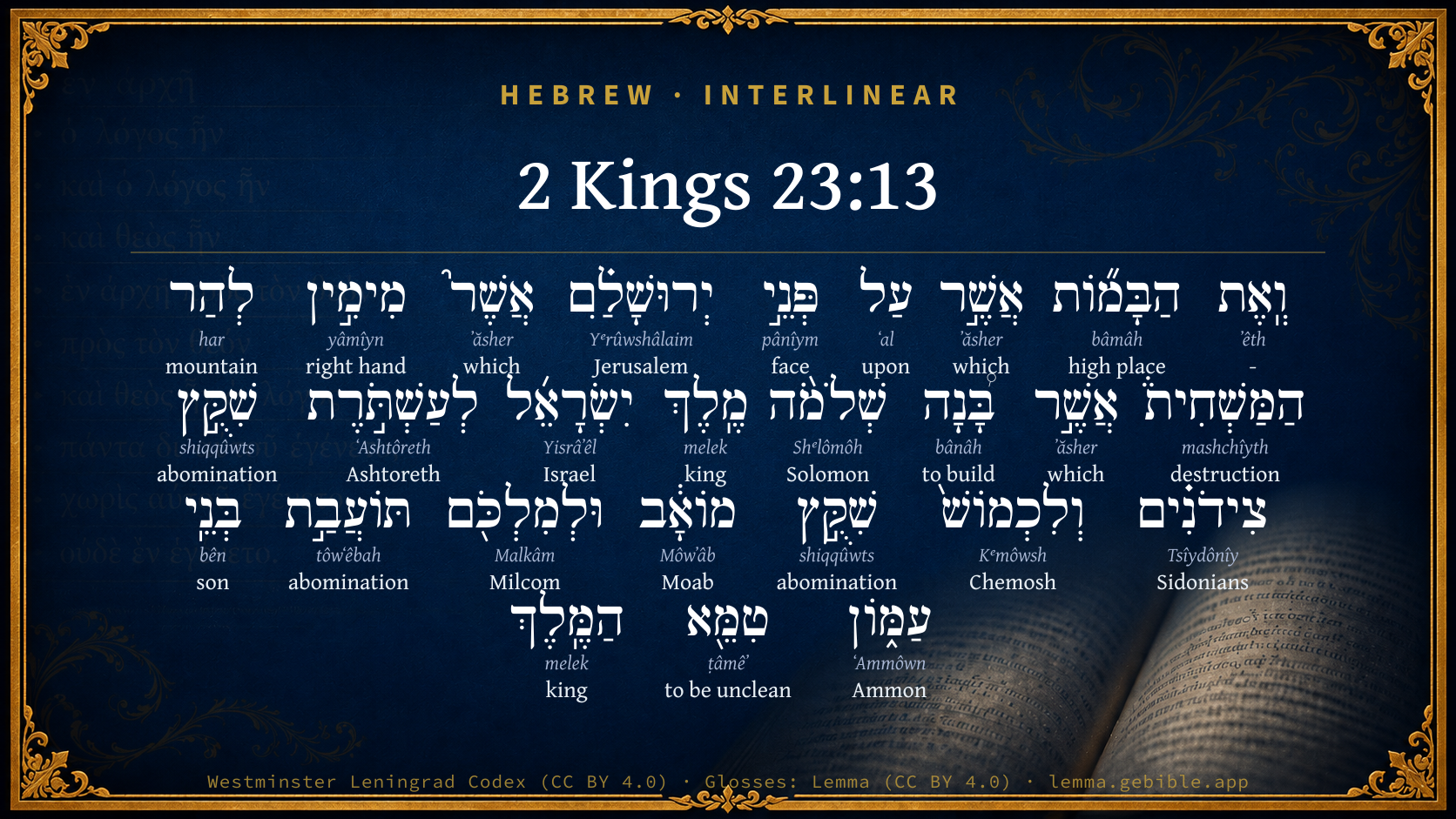
Hebrew (Westminster Leningrad Codex) 2 Kings 23:13 appears in the Hebrew Old Testament. The text above is from the Westminster Leningrad Codex. Each word links to its Strong’s number, a concise gloss, and parsing drawn from the Open Scriptures Hebrew Bible morphology. Click any word for its full Brown-Driver-Briggs (BDB) entry.
Download image
Cite this verse

2 Kings 23:13 (World English Bible). Public Domain. Lemma interlinear Bible study tool, https://lemma.gebible.app/v/2-kings/23/13.

Show BibTeX & RIS
BibTeX
RIS
English Translation
The high places that were before Jerusalem, which were on the right hand of the mountain of corruption, which Solomon the king of Israel had built for Ashtoreth the abomination of the Sidonians, and for Chemosh the abomination of Moab, and for Milcom the abomination of the children of Ammon, did the king defile.
World English Bible · Public Domain
Download a study sheet

One document with this verse’s original text, its word-by-word gloss line, the meaning frame, cross-references with their text, attributed commentary, and full source and license credits — printable, and it pastes into notes with its structure intact.

This verse Autodidact and up

Study sheet (.html) Plain text (.txt)

A passage Seminary Student

Up to 50 verses in one chapter. A passage sheet keeps up to 6 commentary sources and 12 cross-references per verse, in the order this page ranks them, and says so on the sheet whenever that leaves anything out. Ask for a single verse and you get the Autodidact verse sheet above.

Everything on this page stays free to read, with no account — the sheet is a download of what is already on screen, not access to it.

Want to remove ads? Support Godless Engineer
Compare translations 3

The same verse in 3 English versions, stacked beneath the original-language interlinear above. Click any original word for its lexicon entry.

Each is an independent rendering of the whole verse — the interlinear is not word-aligned to these translations.

Highlighted words mark where these versions differ — a whole-verse word diff, not a word-by-word alignment.

  • World English Bible Public Domain
    The high places that were before Jerusalem, which were on the right hand of the mountain of corruption, which Solomon the king of Israel had built for Ashtoreth the abomination of the Sidonians, and for Chemosh the abomination of Moab, and for Milcom the abomination of the children of Ammon, did the king defile.
  • King James Version Public Domain
    And the high places that were before Jerusalem, which were on the right hand of the mount of corruption, which Solomon the king of Israel had builded for Ashtoreth the abomination of the Zidonians, and for Chemosh the abomination of the Moabites, and for Milcom the abomination of the children of Ammon, did the king defile.
  • unfoldingWord Literal Text CC BY-SA 4.0
    And the king defiled the high places that on the face of Jerusalem, which on the right of the Mount of Destruction, which Solomon, the king of Israel, had built for Ashtoreth, the abomination of the Sidonians, and for Chemosh, the abomination of Moab, and for Milcom, the abomination of the sons of Ammon.

unfoldingWord Literal Text — © unfoldingWord, licensed CC BY-SA 4.0. Word-aligned USFM3 via Door43 (git.door43.org/unfoldingWord/en_ult).

Versions to compare (up to 4)

3 of 4 selected

Show all 18 translations

Every available English version of this verse, each an independent rendering of the whole verse.

  • World English Bible Public Domain
    The high places that were before Jerusalem, which were on the right hand of the mountain of corruption, which Solomon the king of Israel had built for Ashtoreth the abomination of the Sidonians, and for Chemosh the abomination of Moab, and for Milcom the abomination of the children of Ammon, did the king defile.
  • Berean Standard Bible Public Domain
    The king also desecrated the high places east of Jerusalem, to the south of the Mount of Corruption, which King Solomon of Israel had built for Ashtoreth the abomination of the Sidonians, for Chemosh the abomination of the Moabites, and for Milcom the abomination of the Ammonites.
  • Majority Standard Bible Public Domain
    The king also desecrated the high places east of Jerusalem, to the south of the Mount of Corruption, which King Solomon of Israel had built for Ashtoreth the abomination of the Sidonians, for Chemosh the abomination of the Moabites, and for Milcom the abomination of the Ammonites.
  • King James Version Public Domain
    And the high places that were before Jerusalem, which were on the right hand of the mount of corruption, which Solomon the king of Israel had builded for Ashtoreth the abomination of the Zidonians, and for Chemosh the abomination of the Moabites, and for Milcom the abomination of the children of Ammon, did the king defile.
  • American Standard Version (1901) Public Domain
    And the high places that were before Jerusalem, which were on the right hand of the mount of corruption, which Solomon the king of Israel had builded for Ashtoreth the abomination of the Sidonians, and for Chemosh the abomination of Moab, and for Milcom the abomination of the children of Ammon, did the king defile.
  • Revised Version (1885) Public Domain
    And the high places that were before Jerusalem, which were on the right hand of the mount of corruption, which Solomon the king of Israel had builded for Ashtoreth the abomination of the Zidonians, and for Chemosh the abomination of Moab, and for Milcom the abomination of the children of Ammon, did the king defile.
  • Geneva Bible (1599) Public Domain
    Moreouer the King defiled the hie places that were before Ierusalem and on the right hand of the mount of corruption (which Salomon the King of Israel had buylt for Ashtoreth the idole of the Zidonians, and for Chemosh the idole of the Moabites, and for Milchom the abomination of the children of Ammon)
  • Douay-Rheims (1899) Public Domain
    The high places also that were at Jerusalem on the right side of the Mount of Offence, O which Solomon king of Israel had built to Astaroth the idol of the Sidonians, and to Chamos the scandal of Moab, and to Melchom the abomination of the children of Ammon, the king defiled.
  • Young's Literal Translation Public Domain
    And the high places that `are' on the front of Jerusalem, that `are' on the right of the mount of corruption, that Solomon king of Israel had built to Ashtoreth abomination of the Zidonians, and Chemosh abomination of Moab, and to Milcom abomination of the sons of Ammon, hath the king defiled.
  • Literal Standard Version CC BY-SA 4.0
    And the high places that [are] on the front of Jerusalem, that [are] on the right of the Mount of Corruption, that Solomon king of Israel had built to Ashtoreth, abomination of the Zidonians, and Chemosh, abomination of Moab, and to Milcom, abomination of the sons of Ammon, the king has defiled.
  • Unlocked Literal Bible CC BY-SA 4.0
    The king ruined the high places east of Jerusalem, south of the mount of corruption that Solomon the king of Israel had built for Ashtoreth, the detestable idol of the Sidonians; for Chemosh, the detestable idol of Moab; and for Molech, the detestable idol of the people of Ammon.
  • unfoldingWord Literal Text CC BY-SA 4.0
    And the king defiled the high places that on the face of Jerusalem, which on the right of the Mount of Destruction, which Solomon, the king of Israel, had built for Ashtoreth, the abomination of the Sidonians, and for Chemosh, the abomination of Moab, and for Milcom, the abomination of the sons of Ammon.
  • Darby Bible Public Domain
    And the high places that were before Jerusalem, which were on the right hand of the mount of corruption, which Solomon the king of Israel had built for Ashtoreth the abomination of the Zidonians, and for Chemosh the abomination of the Moabites, and for Milcom the abomination of the children of Ammon, did the king defile.
  • World Messianic Bible Public Domain
    The king defiled the high places that were before Jerusalem, which were on the right hand of the mountain of corruption, which Solomon the king of Israel had built for Ashtoreth the abomination of the Sidonians, and for Chemosh the abomination of Moab, and for Milcom the abomination of the children of Ammon.
  • Webster's Bible Public Domain
    And the high places that were before Jerusalem, which were on the right hand of the mount of corruption, which Solomon the king of Israel had built for Ashtoreth the abomination of the Zidonians, and for Chemosh the abomination of the Moabites, and for Milcom the abomination of the children of Ammon, did the king defile.
  • Free Bible Version CC BY-SA 4.0
    The king also defiled the high places to the east of Jerusalem, to the south of the Mount of Corruption, the places which King Solomon of Israel had built for Ashtoreth, the vile goddess of the Sidonians, for Chemosh, the vile god of the Moabites, and for Molech, the vile god of the Ammonites.
  • Bible in Basic English Public Domain
    And the high places before Jerusalem, on the south side of the mountain of destruction, which Solomon, king of Israel, had made for Ashtoreth, the disgusting god of the Zidonians, and for Chemosh, the disgusting god of Moab, and for Milcom, the disgusting god of the children of Ammon, the king made unclean.
  • JPS Tanakh (1917) Public Domain
    And the high places that were before Jerusalem, which were on the right hand of the mount of corruption, which Solomon the king of Israel had builded for Ashtoreth the detestation of the Zidonians, and for Chemosh the detestation of Moab, and for Milcom the abomination of the children of Ammon, did the king defile.

Literal Standard Version (2020), Covenant Press — licensed CC BY-SA 4.0. Text via the HelloAO Bible API (eBible.org). Unlocked Literal Bible (unfoldingWord) — licensed CC BY-SA 4.0. Text via the HelloAO Bible API (eBible.org). unfoldingWord Literal Text — © unfoldingWord, licensed CC BY-SA 4.0. Word-aligned USFM3 via Door43 (git.door43.org/unfoldingWord/en_ult). Free Bible Version, Dr. Jonathan Gallagher — licensed CC BY-SA 4.0. Text via the HelloAO Bible API (eBible.org).

Word by word

More ways to search: Search by grammar → Find every occurrence → Compare this word →

Practice this passage: Drill this verse → Learn its vocabulary →

לְעַשְׁתֹּ֣רֶת
ʻAshtôreth
H6253
“to/for · Ashtoreth”
Preposition + Noun, Proper
Part of Speech
Preposition + Noun
Type
Proper
Full BDB Definition

Origin: probably for H6251

TWOT: 1718

Ashtoreth = "star" - the principal female deity of the Phoenicians worshipped in war and fertility - also 'Ishtar' of Assyria and 'Astarte' by the Greeks and Romans
  1. וְֽאֶת ʼêth H853 “and · -” Conjunction + Particle, Direct Object
  2. הַבָּמ֞וֹת bâmâh H1116 “the · high places” Particle, Definite Article + Noun, Common, Feminine, Plural, Absolute
  3. אֲשֶׁ֣ר ʼăsher H834 “which” Particle, Relative
  4. עַל ʻal H5921 “upon” Preposition
  5. פְּנֵ֣י pânîym H6440 “face(s) of” Noun, Common, Both, Plural, Construct
  6. יְרוּשָׁלִַ֗ם Yᵉrûwshâlaim H3389 “Jerusalem” Noun, Proper
  7. אֲשֶׁר֮ ʼăsher H834 “which” Particle, Relative
  8. מִימִ֣ין yâmîyn H3225 “from · right hand of” Preposition + Noun, Common, Feminine, Singular, Construct
  9. לְהַר har H2022 “to/for · mountain of” Preposition + Noun, Common, Masculine, Singular, Construct
  10. הַמַּשְׁחִית֒ mashchîyth H4889 “the · destruction” Particle, Definite Article + Noun, Common, Masculine, Singular, Absolute
  11. אֲשֶׁ֣ר ʼăsher H834 “which” Particle, Relative
  12. בָּ֠נָה bânâh H1129 “to build” Verb, Qal, Perfect, 3rd Person, Masculine, Singular
  13. שְׁלֹמֹ֨ה Shᵉlômôh H8010 “Solomon” Noun, Proper
  14. מֶֽלֶךְ melek H4428 “king of” Noun, Common, Masculine, Singular, Construct
  15. יִשְׂרָאֵ֜ל Yisrâʼêl H3478 “Israel” Noun, Proper
  16. שִׁקֻּ֣ץ shiqqûwts H8251 “abomination of” Noun, Common, Masculine, Singular, Construct
  17. צִידֹנִ֗ים Tsîydônîy H6722 “Sidonians” Noun, Gentilic, Masculine, Plural, Absolute
  18. וְלִכְמוֹשׁ֙ Kᵉmôwsh H3645 “and · to/for · Chemosh” Conjunction + Preposition + Noun, Proper
  19. שִׁקֻּ֣ץ shiqqûwts H8251 “abomination of” Noun, Common, Masculine, Singular, Construct
  20. מוֹאָ֔ב Môwʼâb H4124 “Moab” Noun, Proper
  21. וּלְמִלְכֹּ֖ם Malkâm H4445 “and · to/for · Milcom” Conjunction + Preposition + Noun, Proper
  22. תּוֹעֲבַ֣ת tôwʻêbah H8441 “abomination of” Noun, Common, Feminine, Singular, Construct
  23. בְּנֵֽי bên H1121 “sons of” Noun, Common, Masculine, Plural, Construct
  24. עַמּ֑וֹן ʻAmmôwn H5983 “Ammon” Noun, Proper
  25. טִמֵּ֖א ṭâmêʼ H2930 “to be unclean” Verb, Piel, Perfect, 3rd Person, Masculine, Singular
  26. הַמֶּֽלֶךְ melek H4428 “the · king” Particle, Definite Article + Noun, Common, Masculine, Singular, Absolute

About this verse

These counts appear in no published source. They are computed here, from the morphology-tagged text and Lemma’s own curated glosses. What Lemma adds →

27
words
23
distinct lemmas
Historical
section

Notable vocabulary

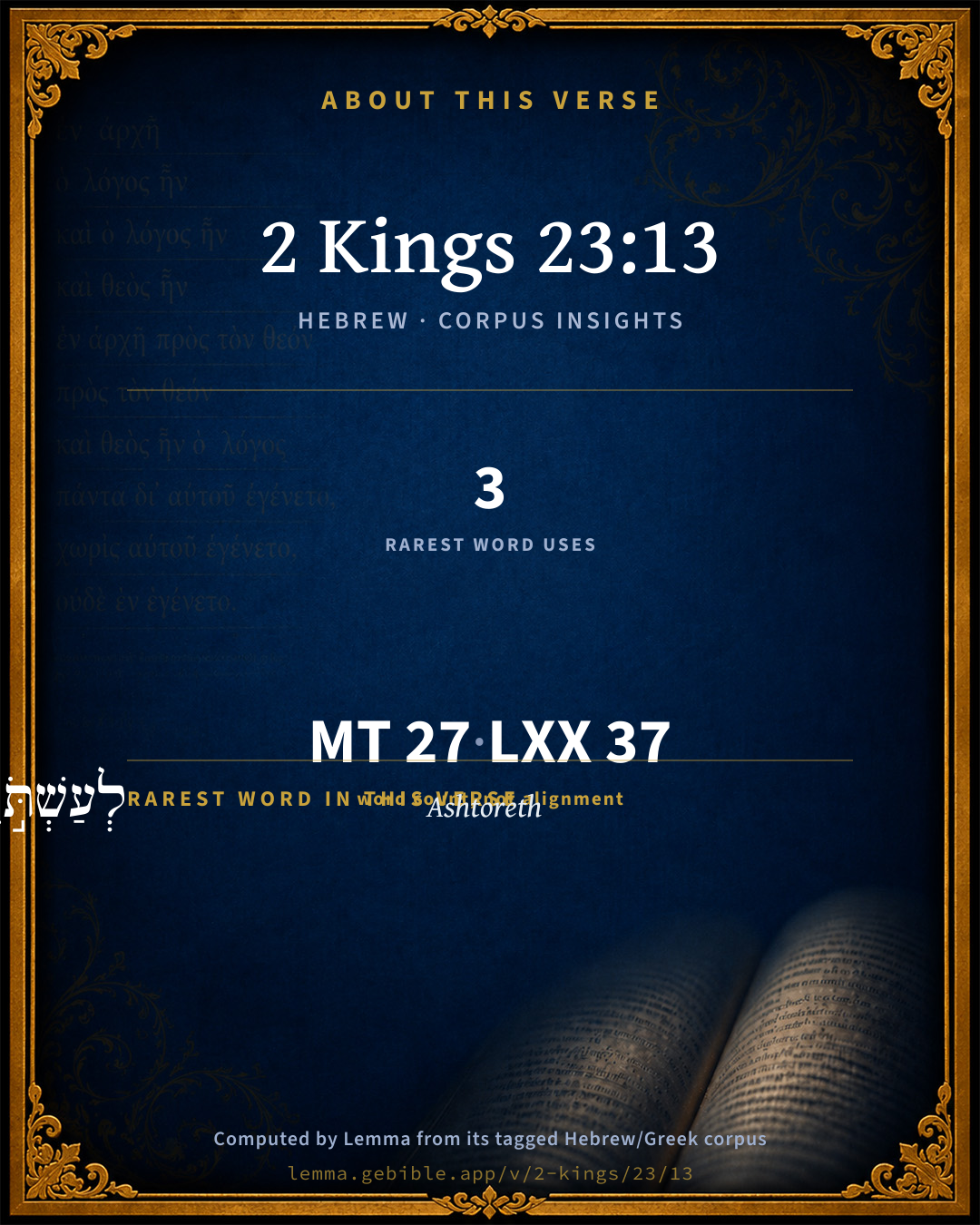
The rarest word here is לְעַשְׁתֹּ֣רֶת Ashtoreth H6253 — appearing just 3 times in the whole Hebrew Bible.

Shared distinctive vocabulary

לְעַשְׁתֹּ֣רֶת Ashtoreth H6253 occurs in 3 verses of the Hebrew Bible. Also found in:

Grammatical profile

  • 2 verbs
  • 20 nouns
  • 1 preposition
  • 4 particles

Verb forms

  • בָּ֠נָה Qal · Perfect
  • טִמֵּ֖א Piel · Perfect

Repetition

Words recur within this verse — often emphatic in Hebrew:

  • מֶֽלֶךְ king H4428 ×2
  • שִׁקֻּ֣ץ abomination H8251 ×2
  • אֲשֶׁ֣ר which H834 ×3

Hebrew & Septuagint length

In English translation the verse runs 54 words from the Hebrew and 49 from the Septuagint (LXX English) — closely comparable.

A rough comparison of the two English renderings, which tokenize alike — not a word-level alignment.

Word counts can differ between the Hebrew and the Greek without any difference in meaning — e.g. the Hebrew direct-object marker אֵת has no separate Greek word, and Greek often adds the article ὁ.

In the original languages it is 27 Hebrew tokens and 37 Greek tokens — but the two are counted differently (Hebrew bundles its prefixes and suffixes into one token; the Greek is in lemma form), so that isn’t a like-for-like length.

Cross-references

14

Topical passages linked to 2 Kings 23:13 in the Treasury of Scripture Knowledge — connected by theme and wording, ordered by reader-vote popularity; previews shown in the World English Bible.

  • 1 Kings 11:5 For Solomon went after Ashtoreth the goddess of the Sidonians, and after Milcom the abomination of the Ammonites.
  • 1 Kings 11:7 Then did Solomon build a high place for Chemosh the abomination of Moab, on the mountain that is before Jerusalem, and for Molech the abomination of the children of Ammon.
  • Numbers 21:29 Woe to you, Moab! You are undone, people of Chemosh: He has given his sons as fugitives, His daughters into captivity, To Sihon king of the Amorites.
  • Judges 2:13 They forsook Yahweh, and served Baal and the Ashtaroth.
  • Judges 10:6 The children of Israel again did that which was evil in the sight of Yahweh, and served the Baals, and the Ashtaroth, and the gods of Syria, and the gods of Sidon, and the gods of Moab, and the gods of the children of Ammon, and the gods of the Philistines; and they forsook Yahweh, and didn't serve him.
  • Judges 11:24 Won't you possess that which Chemosh your god gives you to possess? So whoever Yahweh our God has dispossessed from before us, them will we possess.
  • 1 Samuel 7:4 Then the children of Israel did put away the Baals and the Ashtaroth, and served Yahweh only.
  • 1 Samuel 12:10 They cried to Yahweh, and said, We have sinned, because we have forsaken Yahweh, and have served the Baals and the Ashtaroth: but now deliver us out of the hand of our enemies, and we will serve you.
  • 1 Kings 11:33 because that they have forsaken me, and have worshiped Ashtoreth the goddess of the Sidonians, Chemosh the god of Moab, and Milcom the god of the children of Ammon; and they have not walked in my ways, to do that which is right in my eyes, and [to keep] my statutes and my ordinances, as did David his father.
  • Nehemiah 13:26 Did not Solomon king of Israel sin by these things? yet among many nations was there no king like him, and he was beloved of his God, and God made him king over all Israel: nevertheless even him did foreign women cause to sin.
  • Jeremiah 48:7 For, because you have trusted in your works and in your treasures, you also shall be taken: and Chemosh shall go forth into captivity, his priests and his princes together.
  • Jeremiah 48:13 Moab shall be ashamed of Chemosh, as the house of Israel was ashamed of Bethel their confidence.
  • Jeremiah 48:16 The calamity of Moab is near to come, and his affliction hurries fast.
  • Zephaniah 1:5 those who worship the host of the sky on the housetops, those who worship and swear by Yahweh and also swear by Malcam,

Cross-references courtesy of OpenBible.info (CC BY 4.0).

Hebrew and Greek witnesses Masoretic Hebrew ↔ Greek Septuagint

The same verse in the two great witnesses to the Old Testament, shown verse-for-verse.

These are two independent witnesses, not word-aligned to each other, and the Septuagint is shown in lemma (dictionary) form.

Hebrew 2 Kings 23:13 Masoretic · Westminster Leningrad Codex

וְֽאֶת הַבָּמ֞וֹת אֲשֶׁ֣ר עַל פְּנֵ֣י יְרוּשָׁלִַ֗ם אֲשֶׁר֮ מִימִ֣ין לְהַר הַמַּשְׁחִית֒ אֲשֶׁ֣ר בָּ֠נָה שְׁלֹמֹ֨ה מֶֽלֶךְ יִשְׂרָאֵ֜ל לְעַשְׁתֹּ֣רֶת שִׁקֻּ֣ץ צִידֹנִ֗ים וְלִכְמוֹשׁ֙ שִׁקֻּ֣ץ מוֹאָ֔ב וּלְמִלְכֹּ֖ם תּוֹעֲבַ֣ת בְּנֵֽי עַמּ֑וֹן טִמֵּ֖א הַמֶּֽלֶךְ

The high places that were before Jerusalem, which were on the right hand of the mountain of corruption, which Solomon the king of Israel had built for Ashtoreth the abomination of the Sidonians, and for Chemosh the abomination of Moab, and for Milcom the abomination of the children of Ammon, did the king defile.

World English Bible · Public Domain

Greek LXX 2 Kings 23:13 Septuagint · lemma form

καί ὁ οἶκος ὁ ἐπί πρόσωπον ἰερουσαλήμ ὁ ἐκ δεξιός ὁ ὄρος ὁ μοσοαθ ὅς οἰκοδομέω σαλωμών βασιλεύς ἰσραήλ ὁ ἀστάρτη προσόχθισμα σιδώνιος καί ὁ χαμως προσόχθισμα μωαβ καί ὁ μολχολ βδέλυγμα υἱός αμμων μιαίνω ὁ βασιλεύς

And the king defiled the house that was before Jerusalem, on the right hand of the mount of Mosthath, which Solomon king of Israel built to Astarte the abomination of the Sidonians, and to Chamos the abomination of Moab, and to Moloch the abomination of the children of Ammon.

LXX2012 (modern English Septuagint) · Public Domain

Hebrew: Westminster Leningrad Codex (CC BY 4.0). Greek: Septuagint (public domain); English from LXX2012 (modern English Septuagint) (Public Domain). How the Septuagint differs from the Hebrew →

Targum (Aramaic paraphrase)

1

The Targum is the ancient Jewish Aramaic paraphrase of the Hebrew Scriptures — an interpretive translation, not the Hebrew text itself. Onkelos (literal) and Pseudo-Jonathan (expansive) render the Torah, and Jonathan the Prophets. Coverage is partial: where no permissively-licensed English translation exists for a verse, only the Aramaic is shown. This is verse-level text, not a word-by-word alignment to the Hebrew.

  1. Targum Jonathan Prophets (Joshua–Malachi)
    וְיַת בָּמָתָא דִי עַל אַפֵּי יְרוּשְׁלֵם דְמִדָרוֹם לְטוּר זֵיתַיָא דִי בְנָא שְׁלֹמֹה מַלְכָּא דְיִשְׂרָאֵל לְעַשְׁתּוֹרֶת שִׁקֻץ צִידוֹנָאֵי וְלִכְמוֹשׁ שִׁקֻץ מוֹאֲבָאֵי וּלְמִלְכּוֹם רִיחוּק בְּנֵי עַמוֹן סָאֵיב מַלְכָּא:

    (no public-domain English translation for this verse)

    Targum Jonathan — Aramaic: “Mikraot Gedolot” (public domain). English: “Sefaria Community Translation” (CC0 1.0 (public-domain dedication)); “London "Chaldee Paraphrase," 1871” (public domain). Text via Sefaria.

Commentary

Notes on 2 Kings 23:13 from classic Christian and Jewish commentators (each source and its license shown beneath its notes). The classic Christian expositions comment on the surrounding passage and are grouped to its opening verse, so a note may address several verses; the Jewish commentaries on the Tanakh (Rashi and others) are per-verse, so they appear only where the commentator wrote on this verse.

Lemma curates 59 commentaries, every one of them public domain or Creative Commons licensed, each selected and text-cleaned for this edition rather than reprinted as found. About our sources →

Trapp's Complete Commentary

John Trapp

2Ki 23:13 And the high places that [were] before Jerusalem, which [were] on the right hand of the mount of corruption, which Solomon the king of Israel had builded for Ashtoreth the abomination of the Zidonians, and for Chemosh the abomination of the Moabites, and for Milcom the abomination of the children of Ammon, did the king defile.

Ver. 13. And the high places that were before Jerusalem.] There they had boldly set up their abominable idols in mount Olivet, even in the sight of the Lord; so that he never looked out of the sanctuary but he saw that vile hill, which, therefore, he here calleth not Har Hammisha, {a} the mount of annointing, but Har Hammaschith, {b} the mount of corruption. Est tacita paranomasia; item allusio, item detorsio.

Of the mount of corruption.] So called, because the people had there corrupted themselves, as Deu 32:5; and yet afterwards it became our Saviour’s oratory, or usual place of prayer, This showeth, that places which have been abused to idolatry, may yet afterwards be used for God’s service. As for that which we read, Deu 12:2-3, "Ye shall utterly destroy all the places," &c., divines answer, that that was a temporary ordinance, and a part of Moses’s polity, now abrogated.

Which Solomon had builded.] But, after his repentance, had demolished, likely; though, by the idolatrous princes that came after him, they were rebuilded, and called still by his name.

{a} Of Mashach.

{b} Of Shacah.

John Trapp, A Commentary or Exposition upon All the Books of the Old and New Testament (1647–1656) — public domain. Text from a community e-Sword module.

Joseph Benson's Commentary

2Ki 23:13. The high places on the right hand of the mount of Corruption — That is, the mount of Olives, (1Ki 11:7,) called the mount of Corruption, for the gross idolatry there practised. Which Solomon had builded for Ashtoreth, &c. — Not the same individual altars; which, doubtless, either Solomon, upon his repentance, or some other of Josiah’s predecessors, had taken away, but other altars built by Manasseh or Amen, which, because erected by Solomon’s example, and for the same use, and in the same place, are called by his name: this brand is left by the Holy Ghost upon his name and memory, as a just punishment of that abominable practice, and a means to deter others from the like. The abomination of the Zidonians — The idol, so called, because it was abominable, and made them abominable to God. Did the king defile — By dead men’s bones and other unclean things.

Joseph Benson's Commentary on the Old and New Testaments (1811–1818) — public domain. Text from a community e-Sword module.

Tyndale Open Study Notes

Tyndale Open Resources

23:13 Solomon had erected the pagan shrines because of his many foreign wives (1 Kgs 11:5, 7, 33).

Tyndale Open Study Notes — © Tyndale Open Resources, licensed CC BY-SA 4.0. Text via the HelloAO Bible API.

Geneva Bible (1599)

Geneva Bible translators

That was the mount of olives, so called because it was full of idols.

Geneva Bible (1599) marginal notes — public domain. Text via Bolls.life.

Jamieson, Fausset & Brown

Robert Jamieson, A. R. Fausset & David Brown

the high places . . . which Solomon . . . had builded--(See on Kg1 11:5).

the right hand of the mount of corruption--The Mount of Olives is a hilly range on the east of Jerusalem. This range has three summits, of which the central one is the Mount of Corruption, so called from the idol temples built there, and of course the hill on the right hand denotes the southernmost peak. Josiah is said not to have destroyed, but only defiled, "the high places on the hill of corruption." It is most probable that Hezekiah had long before demolished the idolatrous temples erected there by Solomon but, as the superstitious people continued to regard the spot as consecrated ground, Josiah defiled it.

Jamieson, Fausset & Brown — Commentary Critical and Explanatory on the Whole Bible (1871) — public domain (CC PDM 1.0). Text via the HelloAO Bible API.

Adam Clarke's Commentary

Verse 13. Mount of corruption] This, says Jarchi, following the Chaldee, was the mount of Olives, for this is the mount המשחה hammishchah, of unction; but because of the idolatrous purposes for which it was used, the Scripture changed the appellation to the mount המשחית hammashchith, of corruption.

Ashtoreth the abomination, c.] See on 1Kg 11:7.

Adam Clarke's Commentary on the Bible (1810–1826) — public domain. Text from a community e-Sword/MySword module.

Ellicott's Commentary for English Readers

(13) The high places that were before the city . . .—See 1Ki_11:5-8. “Before” means “to the east of,” because, to determine the cardinal points, one faced the sunrise. The right hand was then the south, the left hand the north, and the back the west.

The mount of corruption.—The southern summit of the Mount of Olives was so-called, because of the idolatry there practised. It still bears the name of the “Hill of Offence,” derived from the Vulg. “mons offensionis.” (The word rendered “corruption,” mashhîth, may originally have meant “anointing,” from mâshah “to anoint,” and have simply referred to the olive oil there produced. The name would thus be equivalent to the German Oelberg. In later times the term was so modified as to express detestation of idol-worship.)

Did the king defile.—As it is not said that they were pulled down, these high places may have been merely sacred sites on the mountain, consisting of a levelled surface of rock, with holes scooped in them for receiving libations, &c. Such sites have been found in Palestine; and it is hardly conceivable that chapels erected by Solomon for the worship of Ashtoreth, Chemosh, and Milcom, would have been spared by such a king as Hezekiah, who even did away with the high places dedicated to Jehovah (2Ki_18:3).

A Bible Commentary for English Readers, edited by Charles John Ellicott (1878–1897) — public domain. Text from a community e-Sword module.

The Cambridge Bible for Schools and Colleges

gen. ed. J. J. S. Perowne

13. the mount of corruption] This name was given to a portion of the Mount of Olives, because of the idolatrous temples which were erected there. It is called in the Vulgate rendering of this verse ‘Mons offensionis’, and so the hill is spoken of in Christian writings as ‘the Mount of Offence’. The word rendered ‘corruption’ is also often translated ‘destruction’ (see marg.), and this name is equally applicable, from the ruinous and destructive results which developed out of this introduction of idolatry by Solomon.

Ashtoreth] On Ashtoreth, Chemosh and Milcom, and the temples which Solomon built for them under the influence of his heathen wives, see the notes on 1Ki_11:4-8.

The Cambridge Bible for Schools and Colleges (gen. ed. J. J. S. Perowne; Cambridge University Press, 1878–1918) — public domain. Text from a community e-Sword module.

John Gill's Exposition

And he brake in pieces the images,.... Of Ashtoreth, Chemosh, and Milcom, in the above high places; which as these high places had been rebuilt by Manasseh or Amon, so new images of these deities were placed there:

and cut down the groves; in which they were set:

and filled their places with the bones of men; of idolatrous priests and worshippers, buried in parts adjacent; these he dug up and scattered in the high places and groves to defile them, bones of the dead being by law unclean, Num 19:15.

John Gill's Exposition of the Whole Bible (1746–1763) — public domain (CC PDM 1.0). Text via the HelloAO Bible API.

Haydock's Catholic Bible Commentary

Offence; Olivet. (Haydock) --- In the original, the terms are very much alike; and the Jews take a pleasure in deforming names, for which they had a horror. Solomon had erected temples here to various idols, (3 Kings xi. 7.) which had probably been demolished by Ezechias, but had been rebuilt under Amon, &c., and subsisted during the minority of Josias; (Calmet) or they had been neglected by the pious kings of Juda, as no longer dangerous. But Josias, in the fervour of his zeal, thought proper to remove every thing that had been the occasion of offence: Hebrew, "of corruption." --- Idol, and scandal, and abomination, are the same in Hebrew.

George Leo Haydock (1774–1849), Haydock's Catholic Family Bible and Commentary, 1859 edition — public domain. Excludes Psalms (Douay-Rheims chapter numbering differs from Protestant) and Deuterocanonical books (Catholic canon only).

Matthew Poole's English Annotations

The mount of corruption, i.e. the Mount of Olives, 1Ki 11:7, here called the mount of corruption, for the gross idolatry there practised, which is oft expressed by the name of corruption. See Exo 32:7; Deu 32:5. In the Hebrew is an elegant allusion between miscah, anointing, and masheith, corruption, as there is between Beth-el and Beth-aven, Hos 4:15.

Which Solomon had builded; not the same individual altars; which doubtless either Solomon upon his repentance, or some other of Josiah’s godly predecessors, had taken away long before this time; but other altars built by Manasseh or Amon, which because erected by Solomon’s example, and for the same use, and in the same place, are called by his name; this brand being left by the Holy Ghost upon his name and memory, as a just punishment of that abominable practice, and a mean to deter others from the like.

For Ashtoreth; of which and the rest See Poole "1Ki 11:5"; See Poole "1Ki 11:6"; See Poole "1Ki 11:7".

The abomination, i.e. the idol, so called, because it was abominable, and made them abominable to God.

Matthew Poole's English Annotations on the Holy Bible (1683–1685) — public domain. Text from a community e-Sword/MySword module.

Whedon's Commentary on the Bible

Daniel D. Whedon

13. Mount of corruption — The southern part of the Mount of Olives, now known as the Mount of Offence. Solomon probably erected idolatrous altars on various peaks of Olivet, (see note on 1Ki_11:7,) but they seem gradually to have been removed towards the southern slopes, or right hand of the mountain, to one looking eastward from Jerusalem.

Which Solomon… builded — See on 1Ki_11:1-8. It appears, then, that at least some of the high places erected by Solomon had remained until the time of Josiah.

Daniel D. Whedon (gen. ed.), Commentary on the Old and New Testaments (1874–1909) — public domain. Text from a community e-Sword module.

The Pulpit Commentary

And the high places that were before Jerusalem. The high places which Solomon established in the neighborhood of Jerusalem for the use of his wives, and in the worship at which he became himself entangled in his old age, appear to have been situated on the ridge of the mountain which lies over against Jerusalem to the east, a part of which is Olivet. The southern summit, the traditional roans offensionis, was probably the high place of Moloch (Milcom), while the most northern summit (now called Karem-es-Seyad) has some claim to be regarded as the high place of Chemosh. (So Broeardus in A.D. 1280.) The site of the high place of Ashtoreth is doubtful. Which were on the right hand of the mount of corruption. The name "mount of corruption" seems to have been given after Solomon"s time to the entire ridge of hills which lies over against Jerusalem to the east, on account of the rites which he had allowed to be established on it. The "right hand" of the mountain would, according to Jewish notions, be the more southern part. Which Solomon the King of Israel rather, King of Israel, since there is no articlehad builded for Ashtoreth the abomination of the Zidonians. (see 1Ki_11:7) Though Ashtoreth, or Astarte, or Ishtar, or the Dea Syra, was worshipped generally throughout Phoenicia, and perhaps even more widely, yet she was in a peculiar way "the abomination of the Zidonians," being the deity to whom the city of Sidon was especially dedicated (see the inscription on the tomb of Eshmunazar, published in the "Records of the Past," vol. 9. pp. 113, 114). And for Chemosh the abomination of the Moabites. Chemosh appears as the special god of the Moabites on the famous Moabite Stone in eleven places. The stone itself was dedicated to Chemosh (line 3). The Moabites are spoken of as "the people of Chemosh" (lines 5, 6). Success in war comes from him, and defeat is the result of his anger. One of his designations is "Ashtar-Chemosh" (line 17), or "Chemosh, who is also Ashtar," Ashtar being the male principle corresponding to the female Astarte or Ashtoreth. And for Milcom. Moloch was called by the Jews "Milcom," or "Malcam king" i.e. the king of the Ammonite people, since he was the sole god whom they acknowledged (see 1Ki_11:5; Jer_49:3 compared with (Jer_48:7; Zep_1:5) The abomination of the children of Ammon. (1Ki_11:5, 1Ki_11:7; and compare the comment on 1 Kings in the "Pulpit Commentary," p. 222) Did the king defile. The manner of the defilement is stated in the next verse.

The Pulpit Commentary (1880–1919), ed. H.D.M. Spence-Jones & Joseph S. Exell — public domain. Text from a community e-Sword module.

John Wesley's Explanatory Notes

Corruption - The mount of olives, called the mount of corruption, for the gross idolatry there practiced. Which - Not the same individual altars; which doubtless either Solomon upon his repentance, or some other of Josiah's predecessors had taken away, but other altars built by Manasseh or Amon, which because erected by Solomon's example, and for the same use, and in the same place, are called by his name: this brand is left by the Holy Ghost upon his name and memory, as a just punishment of that abominable practice, and a mean to deter others from the like. Abomination - The idol, so called, because it was abominable, and made them abominable to God.

John Wesley, Explanatory Notes Upon the Whole Bible (1754–1765) — public domain. Text via the GEBible commentary corpus.

Scofield Reference Notes

C. I. Scofield

Ashtoreth

2Ki 23:6; 2Ki 23:7. (See Scofield "Jdg 2:13").

The Scofield Reference Bible (1917 edition), notes by C. I. Scofield — public domain. Text from a community e-Sword module.

Rashi

Rabbi Shlomo Yitzchaki (Rashi)

Of Har Hamashchis. [I.e.,] the Mount of Olives, which is known as the Mount of Oil. But because its name is mentioned in reference to idolatry, [Scripture] changed its name to a derogatory expression.

Rashi on the Tanakh — English translations: “The Judaica Press complete Tanach with Rashi, translated by A. J. Rosenberg” (CC BY 4.0); “Pentateuch with Rashi's commentary by M. Rosenbaum and A.M. Silbermann, 1929-1934” (public domain); “The Metsudah Tanach series, Lakewood, N.J” (CC BY 4.0); and “The Book of Joshua, Metsudah Publications, 1997” (CC BY 4.0). Text via Sefaria.

Lesson kit

Teaching starters — assembled from the data on this page, not authored interpretation. Every prompt links to the verse data it draws on. Edit before teaching.

2 Kings, in the Historical, opens this verse with 27 words (23 distinct Hebrew lemmas). Its most distinctive word is ʻAshtôreth (“Ashtoreth”). A historical commentator’s framing appears above. Read the whole chapter for the surrounding context.

Discussion questions

  1. The word ʻAshtôreth carries the sense “Ashtoreth.” How does it shape the verse?
  2. How does 1 Kings 11:5, which shares the word «Ashtoreth», read alongside this verse?
  3. What does the repetition of “king” (2× in this one verse) do in this verse?
  4. The translations on this page render this verse differently — a whole-verse word diff, not a word-by-word alignment. What might account for the different wordings?
  5. «בָּ֠נָה» is a Qal Perfect verb. How does that grammatical form shape the action described?
  6. Compare how Trapp's Complete Commentary and Joseph Benson's Commentary read this verse. Where do they agree or differ?

Things to notice

Reading settings

Reading text

Shown beneath each verse's original-language words.

Old Testament
Old Testament edition

Read the OT as the Masoretic Hebrew (MT) or the Greek Septuagint (LXX).

English shown for the Greek Septuagint (in the Hebrew ↔ Greek comparison).

Comparing translations? Open the Compare panel on any verse page to stack up to four side by side.