
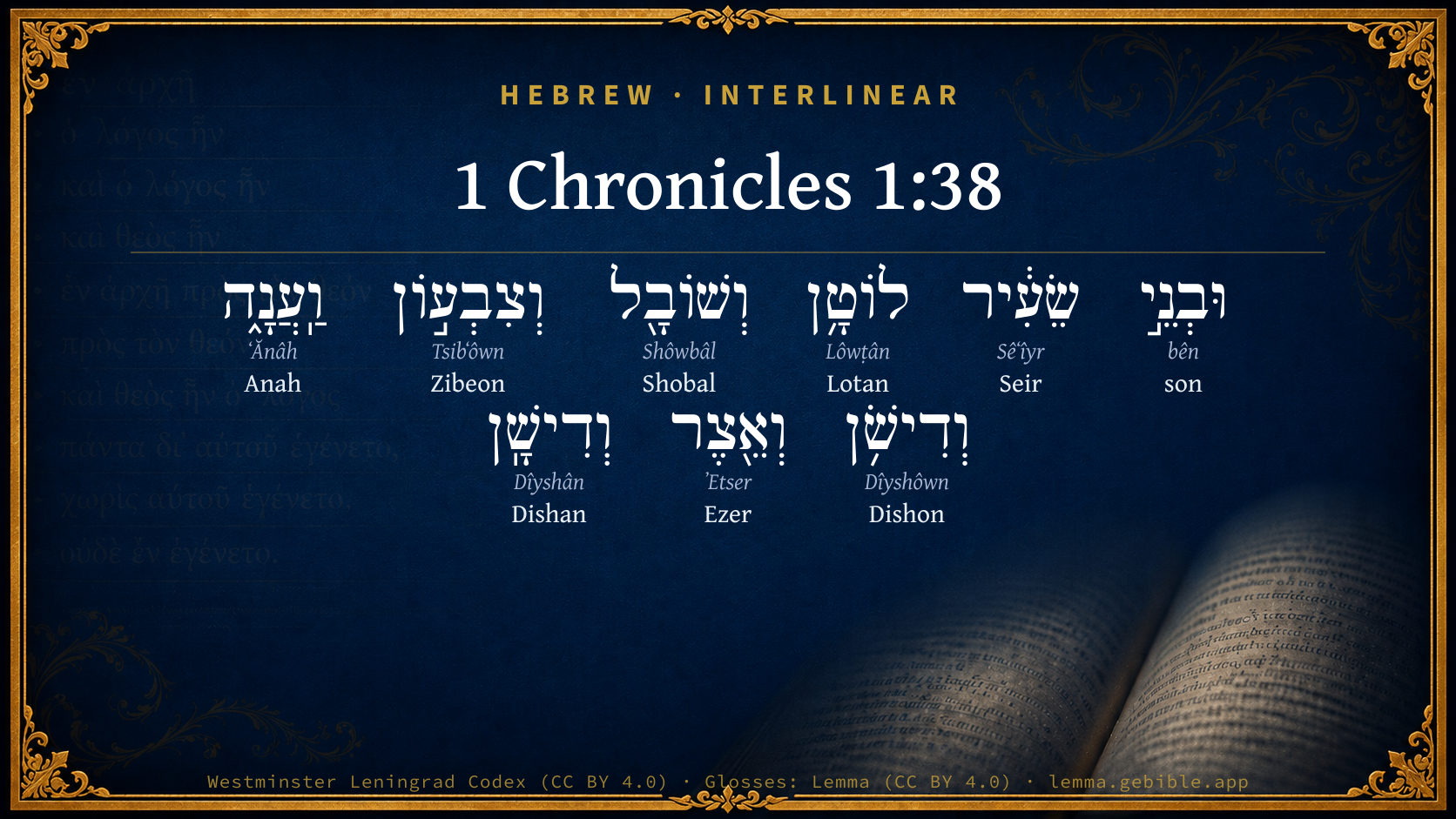
1 Chronicles 1:38

Hebrew (Westminster Leningrad Codex) 1 Chronicles 1:38 appears in the Hebrew Old Testament. The text above is from the Westminster Leningrad Codex. Each word links to its Strong’s number, a concise gloss, and parsing drawn from the Open Scriptures Hebrew Bible morphology. Click any word for its full Brown-Driver-Briggs (BDB) entry.
Download image
Cite this verse

1 Chronicles 1:38 (World English Bible). Public Domain. Lemma interlinear Bible study tool, https://lemma.gebible.app/v/1-chronicles/1/38.

Show BibTeX & RIS
BibTeX
RIS
English Translation
The sons of Seir: Lotan, and Shobal, and Zibeon, and Anah, and Dishon, and Ezer, and Dishan.
World English Bible · Public Domain
Download a study sheet

One document with this verse’s original text, its word-by-word gloss line, the meaning frame, cross-references with their text, attributed commentary, and full source and license credits — printable, and it pastes into notes with its structure intact.

This verse Autodidact and up

Study sheet (.html) Plain text (.txt)

A passage Seminary Student

Up to 50 verses in one chapter. A passage sheet keeps up to 6 commentary sources and 12 cross-references per verse, in the order this page ranks them, and says so on the sheet whenever that leaves anything out. Ask for a single verse and you get the Autodidact verse sheet above.

Everything on this page stays free to read, with no account — the sheet is a download of what is already on screen, not access to it.

Want to remove ads? Support Godless Engineer
Compare translations 3

The same verse in 3 English versions, stacked beneath the original-language interlinear above. Click any original word for its lexicon entry.

Each is an independent rendering of the whole verse — the interlinear is not word-aligned to these translations.

Highlighted words mark where these versions differ — a whole-verse word diff, not a word-by-word alignment.

  • World English Bible Public Domain
    The sons of Seir: Lotan, and Shobal, and Zibeon, and Anah, and Dishon, and Ezer, and Dishan.
  • King James Version Public Domain
    And the sons of Seir; Lotan, and Shobal, and Zibeon, and Anah, and Dishon, and Ezar, and Dishan.
  • unfoldingWord Literal Text CC BY-SA 4.0
    And the sons of Seir: Lotan and Shobal and Zibeon and Anah and Dishon and Ezer and Dishan.

unfoldingWord Literal Text — © unfoldingWord, licensed CC BY-SA 4.0. Word-aligned USFM3 via Door43 (git.door43.org/unfoldingWord/en_ult).

Versions to compare (up to 4)

3 of 4 selected

Show all 18 translations

Every available English version of this verse, each an independent rendering of the whole verse.

  • World English Bible Public Domain
    The sons of Seir: Lotan, and Shobal, and Zibeon, and Anah, and Dishon, and Ezer, and Dishan.
  • Berean Standard Bible Public Domain
    The sons of Seir: Lotan, Shobal, Zibeon, Anah, Dishon, Ezer, and Dishan.
  • Majority Standard Bible Public Domain
    The sons of Seir: Lotan, Shobal, Zibeon, Anah, Dishon, Ezer, and Dishan.
  • King James Version Public Domain
    And the sons of Seir; Lotan, and Shobal, and Zibeon, and Anah, and Dishon, and Ezar, and Dishan.
  • American Standard Version (1901) Public Domain
    And the sons of Seir: Lotan, and Shobal, and Zibeon, and Anah, and Dishon, and Ezer, and Dishan.
  • Revised Version (1885) Public Domain
    And the sons of Seir; Lotan and Shobal and Zibeon and Anah, and Dishon and Ezer and Dishan.
  • Geneva Bible (1599) Public Domain
    And the sonnes of Seir, Lotan, and Shobal, and Zibeon, and Anah, and Dishon, and Ezer, and Dishan.
  • Douay-Rheims (1899) Public Domain
    The sons of Seir: Lotan. Sobal, Sebeen, Ana, Dison, Eser, Disan.
  • Young's Literal Translation Public Domain
    And sons of Seir: Lotan, and Shobal, and Zibeon, and Anah, and Dishon, and Ezar, and Dishan.
  • Literal Standard Version CC BY-SA 4.0
    And sons of Seir: Lotan, and Shobal, and Zibeon, and Anah, and Dishon, and Ezar, and Dishan.
  • Unlocked Literal Bible CC BY-SA 4.0
    The sons of Seir were Lotan, Shobal, Zibeon, Anah, Dishon, Ezer, and Dishan.
  • unfoldingWord Literal Text CC BY-SA 4.0
    And the sons of Seir: Lotan and Shobal and Zibeon and Anah and Dishon and Ezer and Dishan.
  • Darby Bible Public Domain
    And the sons of Seir: Lotan, and Shobal, and Zibeon, and Anah, and Dishon, and Ezer, and Dishan.
  • World Messianic Bible Public Domain
    The sons of Seir: Lotan, Shobal, Zibeon, Anah, Dishon, Ezer, and Dishan.
  • Webster's Bible Public Domain
    And the sons of Seir; Lotan, and Shobal, and Zibeon, and Anah, and Dishon, and Ezar, and Dishan.
  • Free Bible Version CC BY-SA 4.0
    The sons of Seir: Lotan, Shobal, Zibeon, Anah, Dishon, Ezer and Dishan.
  • Bible in Basic English Public Domain
    And the sons of Seir: Lotan and Shobal and Zibeon and Anah and Dishon and Ezer and Dishan.
  • JPS Tanakh (1917) Public Domain
    And the sons of Seir: Lotan, and Shobal, and Zibeon, and Anah, and Dishon, and Ezer, and Dishan.

Literal Standard Version (2020), Covenant Press — licensed CC BY-SA 4.0. Text via the HelloAO Bible API (eBible.org). Unlocked Literal Bible (unfoldingWord) — licensed CC BY-SA 4.0. Text via the HelloAO Bible API (eBible.org). unfoldingWord Literal Text — © unfoldingWord, licensed CC BY-SA 4.0. Word-aligned USFM3 via Door43 (git.door43.org/unfoldingWord/en_ult). Free Bible Version, Dr. Jonathan Gallagher — licensed CC BY-SA 4.0. Text via the HelloAO Bible API (eBible.org).

Word by word

More ways to search: Search by grammar → Find every occurrence → Compare this word →

Practice this passage: Drill this verse → Learn its vocabulary →

About this verse

These counts appear in no published source. They are computed here, from the morphology-tagged text and Lemma’s own curated glosses. What Lemma adds →

9
words
9
distinct lemmas
Historical
section

Notable vocabulary

The rarest word here is וְאֵ֖צֶר Ezer H687 — appearing just 5 times in the whole Hebrew Bible.

Shared distinctive vocabulary

וְאֵ֖צֶר Ezer H687 occurs in 5 verses of the Hebrew Bible. Also found in:

Grammatical profile

  • 9 nouns

Hebrew & Septuagint length

In English translation the verse runs 17 words from the Hebrew and 12 from the Septuagint (LXX English) — the Septuagint runs noticeably shorter here. See the side-by-side →

A rough comparison of the two English renderings, which tokenize alike — not a word-level alignment.

Word counts can differ between the Hebrew and the Greek without any difference in meaning — e.g. the Hebrew direct-object marker אֵת has no separate Greek word, and Greek often adds the article ὁ.

Cross-references

1

Topical passages linked to 1 Chronicles 1:38 in the Treasury of Scripture Knowledge — connected by theme and wording, ordered by reader-vote popularity; previews shown in the World English Bible.

  • Genesis 36:20–30 These are the sons of Seir the Horite, the inhabitants of the land: Lotan, Shobal, Zibeon, Anah,

Cross-references courtesy of OpenBible.info (CC BY 4.0).

Hebrew and Greek witnesses Masoretic Hebrew ↔ Greek Septuagint

The same verse in the two great witnesses to the Old Testament, shown verse-for-verse.

Here the Septuagint runs noticeably shorter than the Hebrew — LXX2012 (modern English Septuagint) 12 words vs World English Bible 17. A rough length comparison of the two English translations, not a word-level alignment — read both below.

These are two independent witnesses, not word-aligned to each other, and the Septuagint is shown in lemma (dictionary) form.

Hebrew 1 Chronicles 1:38 Masoretic · Westminster Leningrad Codex

וּבְנֵ֣י שֵׂעִ֔יר לוֹטָ֥ן וְשׁוֹבָ֖ל וְצִבְע֣וֹן וַֽעֲנָ֑ה וְדִישֹׁ֥ן וְאֵ֖צֶר וְדִישָֽׁן

The sons of Seir: Lotan, and Shobal, and Zibeon, and Anah, and Dishon, and Ezer, and Dishan.

World English Bible · Public Domain

Greek LXX 1 Chronicles 1:38 Septuagint · lemma form

καί ἀποθνήσκω βαλαεννων υἱός αχοβωρ καί βασιλεύω ἀντί αὐτός αδαδ υἱός βαραδ καί ὄνομα ὁ πόλις αὐτός φογωρ

The sons of Seir, Lotan, Sobal, Sebegon, Ana, Deson, Osar, and Disan.

LXX2012 (modern English Septuagint) · Public Domain

On this verse, Ellicott's Commentary for English Readers discusses the Septuagint’s reading. Read the note in Commentary ↓

Hebrew: Westminster Leningrad Codex (CC BY 4.0). Greek: Septuagint (public domain); English from LXX2012 (modern English Septuagint) (Public Domain). How the Septuagint differs from the Hebrew →

Commentary

Notes on 1 Chronicles 1:38 from classic Christian and Jewish commentators (each source and its license shown beneath its notes). The classic Christian expositions comment on the surrounding passage and are grouped to its opening verse, so a note may address several verses; the Jewish commentaries on the Tanakh (Rashi and others) are per-verse, so they appear only where the commentator wrote on this verse.

Lemma curates 59 commentaries, every one of them public domain or Creative Commons licensed, each selected and text-cleaned for this edition rather than reprinted as found. About our sources →

Ellicott's Commentary for English Readers

(38-42) The sons of Seir (from Gen_36:20-30).—There is no apparent link between this series and the preceding. Comparison of Gen_36:20 shows that Seir represents the indigenous inhabitants of Edom (“the inhabitants of the land,” comp. Jos_7:9) before its conquest by the sons of Esau. In time a fusion of the two races would result, the tribes of each being governed by their own chieftains, as is indicated by Gen_36:20-21, where the seven sons of Seir (1Ch_1:38) are called “chiliarchs of the Horites, the sons of Seir in the land of Edom.” Deu_2:22 implies not the actual extermination of the Horites (Troglodytes or Cave-dwellers) by their Semitic invaders, the sons of Esau, but only their entire subjugation. The differences of spelling noticed in the margin are unimportant as regards the names Zephi (1Ch_1:36), Homam (1Ch_1:39), and Alian and Shephi (1Ch_1:40); the note on Ebal-Obal (1Ch_1:22) explains them. The written w and y in Hebrew are so similar as to be perpetually confounded with each other by careless copyists. The same fact accounts for the missing conjunction and in 1Ch_1:42, which is expressed in Hebrew by simply prefixing the letter w to a word. The w in this case having been misread, and transcribed as y, the name Jakan (Yaqan) resulted. The Aqan (not Achan) of Gen_36:2 is correct. (So some MSS., the LXX., and Arabic.) Amram, in 1Ch_1:41, is a mistake of the Authorised version. The Hebrew has Hamran, which differs only by one consonant from the Hemdan of Gen_36:26; a difference due to the common confusion of the Hebrew letters d and r, already exemplified in 1Ch_1:6-7 (Riphath—Diphath, Dodanim—Rodanim). Many MSS. and the Arabic read Hemdan here.

A Bible Commentary for English Readers, edited by Charles John Ellicott (1878–1897) — public domain. Text from a community e-Sword module.

Joseph Benson's Commentary

1Ch 1:38. The sons of Seir — This Seir was not Esau, nor of his posterity, but the ancient lord of this country, from whom it had its name, (see Gen 36:20,) whose genealogy is here set down, that it might be understood from whom Eliphaz’s concubine and the mother of Amalek sprung; and because of that affinity which was contracted between his and Esau’s posterity. Those who were not united and incorporated with them, were destroyed by them, Deu 2:12.

Joseph Benson's Commentary on the Old and New Testaments (1811–1818) — public domain. Text from a community e-Sword module.

Geneva Bible (1599)

Geneva Bible translators

He is also called Seir the Horite, which inhabited mount Seir, Gen. 36:20.

Geneva Bible (1599) marginal notes — public domain. Text via Bolls.life.

The Cambridge Bible for Schools and Colleges

gen. ed. J. J. S. Perowne

38–42. The Genealogy of the Horite Inhabitants of Seir (Cp. Gen_36:20-27)

38. The sons of Seir] Chron. omits the further description given in Gen. “the Horite, the inhabitants of the land,” words which shew clearly that these “sons of Seir” were not descendants of Esau, but aboriginal inhabitants of the land.

The Cambridge Bible for Schools and Colleges (gen. ed. J. J. S. Perowne; Cambridge University Press, 1878–1918) — public domain. Text from a community e-Sword module.

John Gill's Exposition

And the sons of Seir,.... This man and his posterity were not of the race of Esau, but are mentioned because they were a family into which Esau, and a son of his, married, and whose possessions he and his obtained. The account from hence, to the end of Ch1 1:42 is the same with Gen 36:20, with some little variation of names.

1 Chronicles 1:43

John Gill's Exposition of the Whole Bible (1746–1763) — public domain (CC PDM 1.0). Text via the HelloAO Bible API.

Haydock's Catholic Bible Commentary

Seir, not Esau, but the Horrite, (Genesis xxxvi. 20.; Menochius) which is added in order to explain the origin of Thamna. (Du Hamel)

George Leo Haydock (1774–1849), Haydock's Catholic Family Bible and Commentary, 1859 edition — public domain. Excludes Psalms (Douay-Rheims chapter numbering differs from Protestant) and Deuterocanonical books (Catholic canon only).

Matthew Poole's English Annotations

The sons of Seir; one of another nation, prince of the Horims; whose genealogy is here described, because of that affinity which was contracted between his and Esau’s posterity; and those who were not united and incorporated with them were destroyed by them. See Deu 2:12.

Matthew Poole's English Annotations on the Holy Bible (1683–1685) — public domain. Text from a community e-Sword/MySword module.

The Pulpit Commentary

Vers. 38-42. F. LIST OF DESCENDANTS OF SEIR. These verses contain the names of seven sons of Seir and one daughter, and of grandsons through every one of the seven sons, viz. two through Lotan the first, five through Shobal the second, two through Zibeon the third, one through Anah the fourth, four through Dishon the fifth, three through Ezar the sixth, and two through Dishan the seventh, twenty-six names in all, or, including the one daughter, who is introduced as Lotan"s sister, twenty-seven. The first question which arises is, who Seir was, now first mentioned here. He is called in Gen_36:20 "Seir the Horite," and the only previous mention of the name Seir in that chapter is in ver. 8, "Thus dwelt Esau in mount Seir: Esau is Edom;" while we read in Gen_14:6, "The Horites in mount Self;" in Gen_32:3, "To the land of Seir, the country of Edom." For anything we know of the person Self, then, we are confined to these two notices that in Gen_36:20, and the one in our text. The name signifies "rough;" and whether Seir. the person, took the name from Seir, the place (a mountain district, reaching from the Dead Sea to the Elanitic Gulf) or vice versa, it would seem plain that the proper name belonged to the head of the tribe, which had become located there, and was, of course, not in the line of Abraham. This tribe, called Horites Hori being the name of Seir"s eldest grandson or Troglodytes, acquired their name from hollowing out dwellings in the rocks, as at Petra. They were visited evidently by Esau: he married at least one of his wives from them; and his descendants, the Edomites, in due time dispossessed and superseded them. (Deu_2:12) No doubt some were left behind, and contentedly submitted to the Edomites and became mingled with them. These considerations put together account for the introduction here of the names of Seir and his twenty-seven descendants, while the particulars of their genealogy, so far as here given, would lie easily to hand. The sons of Seir are called in Genesis also "dukes" (ypeWLa), a word answered to by the later "sheikhs;" and they are called "dukes of the Horites," or "the dukes of Hori, among their dukes in the land of Self." The twenty-six or twenty-seven names under notice agree in the Authorized Version entirely with those in Gen_36:20-27, except that for Homam, Allan, Shephi, Amram, and Jakan here, we have Hemam, Alvan, Shepho, Hemdan, and Akau there. Also in the Hebrew the texts agree in the two places as regards these names, with the same exceptions. But in the Septuagint the names differ much more in the two places. Thus for Wsar, Disa (or Lisan, jAlwn Taibhl Swfin, Aiq Swnan Daiswn jEmerwn jAsebwn, jIeqram, and Akan here, we have jAsar, JRiswn Gwlam Gaibhl Swfar Wmae, jAna Dhswn jAmada jAsban jIqran, and JIoukam there). When the name of Anah is reached in Genesis, it is added, "This was that Anah that found the mules more probably "hot springs," as the finder of which Anah is supposed to have been called Beeri in the wilderness, as he fed the asses of Zibeon, his father." And again, when Dishon is mentioned as the son of Anah, there is added, "And Aholi-bamah the daughter of Anah." Note is made of her name, no doubt, for the same kind of reason as Timna is mentioned above. Aholibamah i.q. "Judith, the daughter of Beeri the Hittite," (Gen_26:34) enjoys notice inasmuch as she became the wife of Esau; and Timna, as she became the concubine of Esau"s son Eliphaz, and thereby the mother of Amalek.

The Pulpit Commentary (1880–1919), ed. H.D.M. Spence-Jones & Joseph S. Exell — public domain. Text from a community e-Sword module.

John Wesley's Explanatory Notes

Seir - One of another nation, prince of the Horims; whose genealogy is here described, because of that affinity which was contracted between his and Esau's posterity; and those who were not united and incorporated with them, were destroyed by them. See Deut. ii, 12.

John Wesley, Explanatory Notes Upon the Whole Bible (1754–1765) — public domain. Text via the GEBible commentary corpus.

Keil & Delitzsch

C. F. Keil & F. Delitzsch

And the sons of Seir,.... This man and his posterity were not of the race of Esau, but are mentioned because they were a family into which Esau, and a son of his, married, and whose possessions he and his obtained. The account from hence, to the end of Ch1 1:42 is the same with Gen 36:20, with some little variation of names.

1 Chronicles 1:43

Keil & Delitzsch — Biblical Commentary on the Old Testament (1861–1891) — public domain (CC PDM 1.0). Text via the HelloAO Bible API. (Old Testament only.)

unfoldingWord translationNotes

Door43 World Missions Community

General Information:

All of the names here are names of men, execpt for Timna. Timna is the name of a woman. (See: How to Translate Names)

unfoldingWord translationNotes — © Distant Shores Media and the Door43 World Missions Community, licensed CC BY-SA 4.0. Source: git.door43.org/Door43/en_tn.

Lesson kit

Teaching starters — assembled from the data on this page, not authored interpretation. Every prompt links to the verse data it draws on. Edit before teaching.

1 Chronicles, in the Historical, opens this verse with 9 words (9 distinct Hebrew lemmas). Its most distinctive word is ʼEtser (“Ezer”). The Greek Septuagint runs shorter here. A historical commentator’s framing appears above. Read the whole chapter for the surrounding context.

Discussion questions

  1. The word ʼEtser carries the sense “Ezer.” How does it shape the verse?
  2. How does Genesis 36:21, which shares the word «Ezer», read alongside this verse?
  3. The Septuagint runs shorter here than the Hebrew. What might account for the difference?
  4. The translations on this page render this verse differently — a whole-verse word diff, not a word-by-word alignment. What might account for the different wordings?
  5. Compare how Ellicott's Commentary for English Readers and Joseph Benson's Commentary read this verse. Where do they agree or differ?

Things to notice

Reading settings

Reading text

Shown beneath each verse's original-language words.

Old Testament
Old Testament edition

Read the OT as the Masoretic Hebrew (MT) or the Greek Septuagint (LXX).

English shown for the Greek Septuagint (in the Hebrew ↔ Greek comparison).

Comparing translations? Open the Compare panel on any verse page to stack up to four side by side.