2 Kings 21:24

Hebrew (Westminster Leningrad Codex) 2 Kings 21:24 appears in the Hebrew Old Testament. The text above is from the Westminster Leningrad Codex. Each word links to its Strong’s number, a concise gloss, and parsing drawn from the Open Scriptures Hebrew Bible morphology. Click any word for its full Brown-Driver-Briggs (BDB) entry.
Download image
Cite this verse

2 Kings 21:24 (World English Bible). Public Domain. Lemma interlinear Bible study tool, https://lemma.gebible.app/v/2-kings/21/24.

Show BibTeX & RIS
BibTeX
RIS
English Translation
But the people of the land killed all those who had conspired against king Amon; and the people of the land made Josiah his son king in his place.
World English Bible · Public Domain
Download a study sheet

One document with this verse’s original text, its word-by-word gloss line, the meaning frame, cross-references with their text, attributed commentary, and full source and license credits — printable, and it pastes into notes with its structure intact.

This verse Autodidact and up

Study sheet (.html) Plain text (.txt)

A passage Seminary Student

Up to 50 verses in one chapter. A passage sheet keeps up to 6 commentary sources and 12 cross-references per verse, in the order this page ranks them, and says so on the sheet whenever that leaves anything out. Ask for a single verse and you get the Autodidact verse sheet above.

Everything on this page stays free to read, with no account — the sheet is a download of what is already on screen, not access to it.

Want to remove ads? Support Godless Engineer
Compare translations 3

The same verse in 3 English versions, stacked beneath the original-language interlinear above. Click any original word for its lexicon entry.

Each is an independent rendering of the whole verse — the interlinear is not word-aligned to these translations.

Highlighted words mark where these versions differ — a whole-verse word diff, not a word-by-word alignment.

  • World English Bible Public Domain
    But the people of the land killed all those who had conspired against king Amon; and the people of the land made Josiah his son king in his place.
  • King James Version Public Domain
    And the people of the land slew all them that had conspired against king Amon; and the people of the land made Josiah his son king in his stead.
  • unfoldingWord Literal Text CC BY-SA 4.0
    But the people of the land struck all having conspired against King Amon, and the people of the land made Josiah his son reign in his place.

unfoldingWord Literal Text — © unfoldingWord, licensed CC BY-SA 4.0. Word-aligned USFM3 via Door43 (git.door43.org/unfoldingWord/en_ult).

Versions to compare (up to 4)

3 of 4 selected

Show all 18 translations

Every available English version of this verse, each an independent rendering of the whole verse.

  • World English Bible Public Domain
    But the people of the land killed all those who had conspired against king Amon; and the people of the land made Josiah his son king in his place.
  • Berean Standard Bible Public Domain
    But the people of the land killed all those who had conspired against King Amon, and they made his son Josiah king in his place.
  • Majority Standard Bible Public Domain
    But the people of the land killed all those who had conspired against King Amon, and they made his son Josiah king in his place.
  • King James Version Public Domain
    And the people of the land slew all them that had conspired against king Amon; and the people of the land made Josiah his son king in his stead.
  • American Standard Version (1901) Public Domain
    But the people of the land slew all them that had conspired against king Amon; and the people of the land made Josiah his son king in his stead.
  • Revised Version (1885) Public Domain
    But the people of the land slew all them that had conspired against king Amon; and the people of the land made Josiah his son king in his stead.
  • Geneva Bible (1599) Public Domain
    And the people of the land slewe all them that had conspired against King Amon, and the people made Iosiah his sonne King in his steade.
  • Douay-Rheims (1899) Public Domain
    But the people of the land slew all them that had conspired against king Amen: and made Josias his son their king in his stead.
  • Young's Literal Translation Public Domain
    and the people of the land smite all those conspiring against king Amon, and the people of the land cause Josiah his son to reign in his stead.
  • Literal Standard Version CC BY-SA 4.0
    and the people of the land strike all those conspiring against King Amon, and the people of the land cause his son Josiah to reign in his stead.
  • Unlocked Literal Bible CC BY-SA 4.0
    But the people of the land killed all those who had conspired against King Amon, and they made Josiah his son king in his place.
  • unfoldingWord Literal Text CC BY-SA 4.0
    But the people of the land struck all having conspired against King Amon, and the people of the land made Josiah his son reign in his place.
  • Darby Bible Public Domain
    But the people of the land smote all them that had conspired against king Amon; and the people of the land made Josiah his son king in his stead.
  • World Messianic Bible Public Domain
    But the people of the land killed all those who had conspired against King Amon; and the people of the land made Josiah his son king in his place.
  • Webster's Bible Public Domain
    And the people of the land slew all them that had conspired against king Amon; and the people of the land made Josiah his son king in his stead.
  • Free Bible Version CC BY-SA 4.0
    But then the people of the land killed everyone who had plotted against King Amon, and they chose his son Josiah king to succeed him.
  • Bible in Basic English Public Domain
    But the people of the land put to death all those who had taken part in the design against the king, and made Josiah his son king in his place.
  • JPS Tanakh (1917) Public Domain
    But the people of the land slew all them that had conspired against king Amon; and the people of the land made Josiah his son king in his stead.

Literal Standard Version (2020), Covenant Press — licensed CC BY-SA 4.0. Text via the HelloAO Bible API (eBible.org). Unlocked Literal Bible (unfoldingWord) — licensed CC BY-SA 4.0. Text via the HelloAO Bible API (eBible.org). unfoldingWord Literal Text — © unfoldingWord, licensed CC BY-SA 4.0. Word-aligned USFM3 via Door43 (git.door43.org/unfoldingWord/en_ult). Free Bible Version, Dr. Jonathan Gallagher — licensed CC BY-SA 4.0. Text via the HelloAO Bible API (eBible.org).

Word by word

More ways to search: Search by grammar → Find every occurrence → Compare this word →

Practice this passage: Drill this verse → Learn its vocabulary →

אָמ֑וֹן
ʼÂmôwn
H526
“Amon”
Noun, Proper
Part of Speech
Noun
Type
Proper
Full BDB Definition

Origin: the same as H525

TWOT: None

Amon = "skilled workman" or " master workman" - a king of Judah, son of Manasseh - a governor of Samaria - a descendant of a servant of Solomon
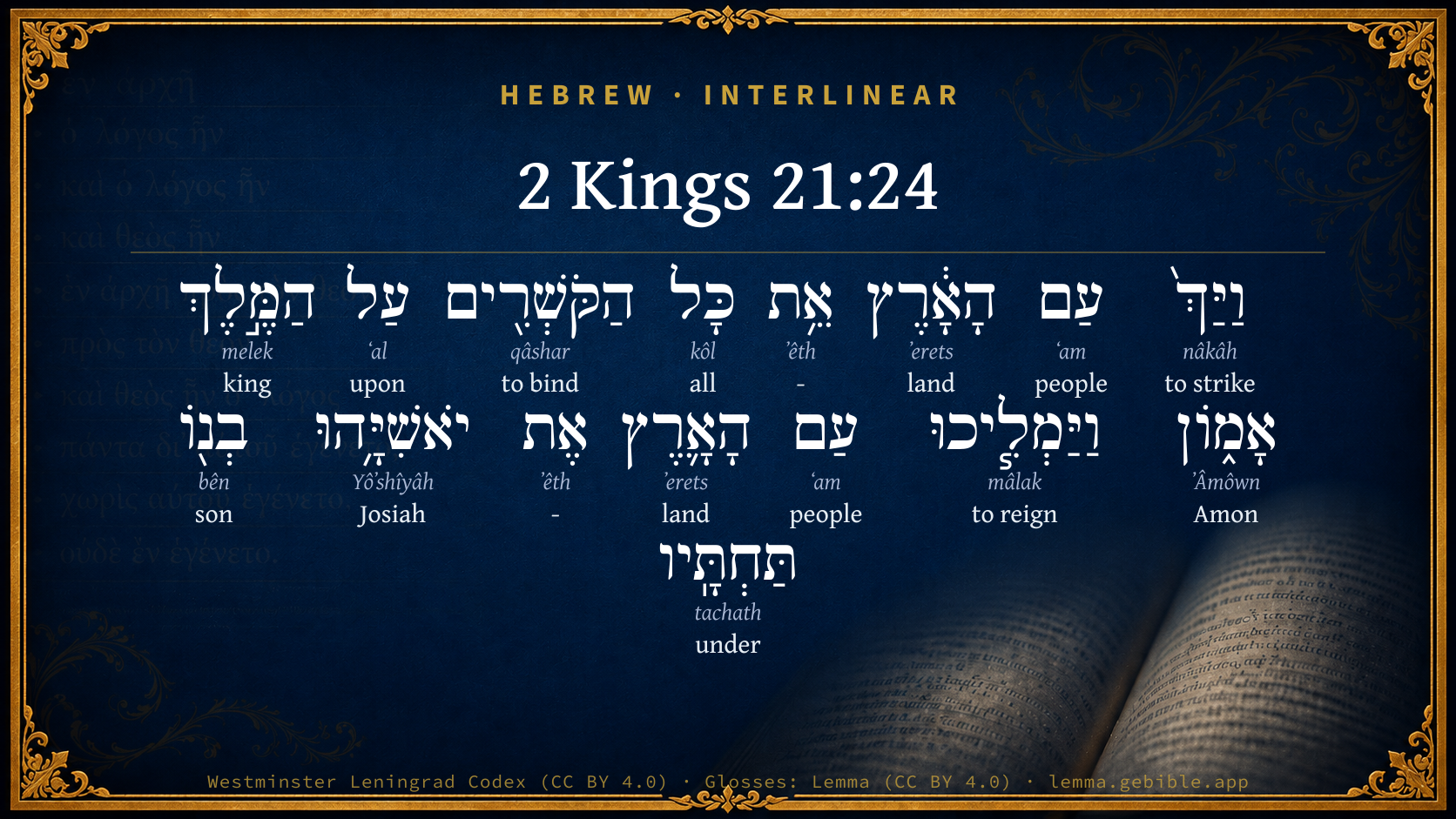
  1. וַיַּךְ֙ nâkâh H5221 “and · to strike” Conjunction + Verb, Hiphil, Sequential Imperfect, 3rd Person, Masculine, Singular
  2. עַם ʻam H5971 “people of” Noun, Common, Masculine, Singular, Construct
  3. הָאָ֔רֶץ ʼerets H776 “the · land” Particle, Definite Article + Noun, Common, Both, Singular, Absolute
  4. אֵ֥ת ʼêth H853 “-” Particle, Direct Object
  5. כָּל kôl H3605 “all of” Noun, Common, Masculine, Singular, Construct
  6. הַקֹּשְׁרִ֖ים qâshar H7194 “the · binding” Particle, Definite Article + Verb, Qal, Participle Active, Masculine, Plural, Absolute
  7. עַל ʻal H5921 “upon” Preposition
  8. הַמֶּ֣לֶךְ melek H4428 “the · king” Particle, Definite Article + Noun, Common, Masculine, Singular, Absolute
  9. וַיַּמְלִ֧יכוּ mâlak H4427 “and · to reign” Conjunction + Verb, Hiphil, Sequential Imperfect, 3rd Person, Masculine, Plural
  10. עַם ʻam H5971 “people of” Noun, Common, Masculine, Singular, Construct
  11. הָאָ֛רֶץ ʼerets H776 “the · land” Particle, Definite Article + Noun, Common, Both, Singular, Absolute
  12. אֶת ʼêth H853 “-” Particle, Direct Object
  13. יֹאשִׁיָּ֥הוּ Yôʼshîyâh H2977 “Josiah” Noun, Proper
  14. בְנ֖וֹ bên H1121 “son · his” Noun, Common, Masculine, Singular, Construct + Suffix, Personal, 3rd Person, Masculine, Singular
  15. תַּחְתָּֽיו tachath H8478 “under · him” Preposition + Suffix, Personal, 3rd Person, Masculine, Singular

About this verse

These counts appear in no published source. They are computed here, from the morphology-tagged text and Lemma’s own curated glosses. What Lemma adds →

16
words
13
distinct lemmas
Historical
section

Notable vocabulary

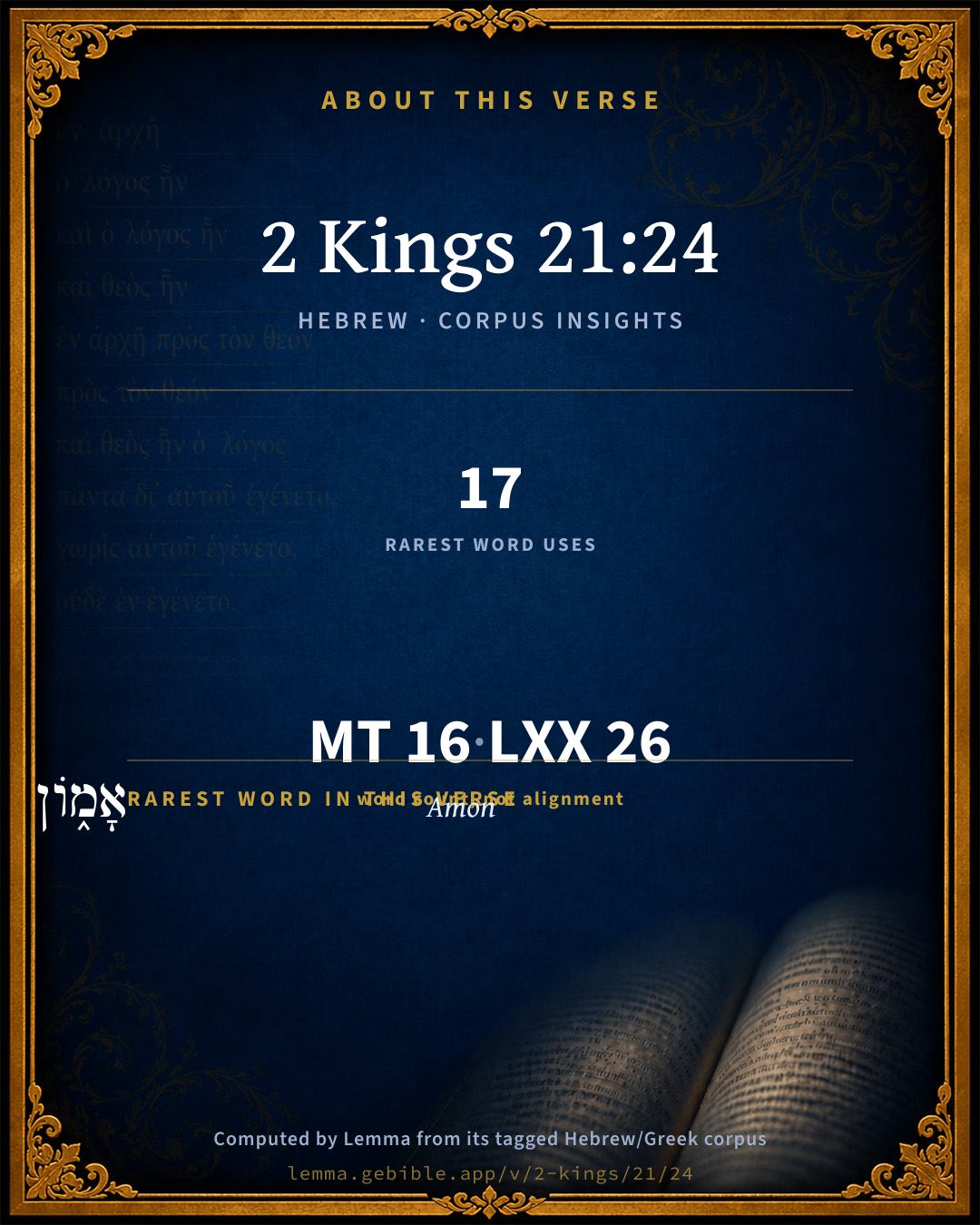
The rarest word here is אָמ֑וֹן Amon H526 — appearing just 17 times in the whole Hebrew Bible.

Shared distinctive vocabulary

אָמ֑וֹן Amon H526 occurs in 17 verses of the Hebrew Bible. Also found in:

Grammatical profile

  • 3 verbs
  • 9 nouns
  • 2 prepositions
  • 2 particles

Verb forms

  • וַיַּךְ֙ Hiphil · Sequential Imperfect
  • הַקֹּשְׁרִ֖ים Qal · Participle Active
  • וַיַּמְלִ֧יכוּ Hiphil · Sequential Imperfect

Repetition

Words recur within this verse — often emphatic in Hebrew:

  • עַם people H5971 ×2
  • הָאָ֔רֶץ land H776 ×2

Hebrew & Septuagint length

In English translation the verse runs 29 words from the Hebrew and 26 from the Septuagint (LXX English) — closely comparable.

A rough comparison of the two English renderings, which tokenize alike — not a word-level alignment.

Word counts can differ between the Hebrew and the Greek without any difference in meaning — e.g. the Hebrew direct-object marker אֵת has no separate Greek word, and Greek often adds the article ὁ.

In the original languages it is 16 Hebrew tokens and 26 Greek tokens — but the two are counted differently (Hebrew bundles its prefixes and suffixes into one token; the Greek is in lemma form), so that isn’t a like-for-like length.

Cross-references

10

Topical passages linked to 2 Kings 21:24 in the Treasury of Scripture Knowledge — connected by theme and wording, ordered by reader-vote popularity; previews shown in the World English Bible.

  • 2 Kings 14:5 It happened, as soon as the kingdom was established in his hand, that he killed his servants who had slain the king his father:
  • 1 Samuel 11:15 All the people went to Gilgal; and there they made Saul king before Yahweh in Gilgal; and there they offered sacrifices of peace-offerings before Yahweh; and there Saul and all the men of Israel rejoiced greatly.
  • 2 Samuel 5:3 So all the elders of Israel came to the king to Hebron; and king David made a covenant with them in Hebron before Yahweh: and they anointed David king over Israel.
  • 1 Kings 12:1 Rehoboam went to Shechem: for all Israel were come to Shechem to make him king.
  • 1 Kings 12:20 It happened, when all Israel heard that Jeroboam was returned, that they sent and called him to the congregation, and made him king over all Israel: there was none who followed the house of David, but the tribe of Judah only.
  • 2 Kings 11:17 Jehoiada made a covenant between Yahweh and the king and the people, that they should be Yahweh's people; between the king also and the people.
  • 2 Kings 14:21 All the people of Judah took Azariah, who was sixteen years old, and made him king in the room of his father Amaziah.
  • 2 Chronicles 22:1 The inhabitants of Jerusalem made Ahaziah his youngest son king in his place; for the band of men who came with the Arabians to the camp had slain all the eldest. So Ahaziah the son of Jehoram king of Judah reigned.
  • 2 Chronicles 26:1 All the people of Judah took Uzziah, who was sixteen years old, and made him king in the room of his father Amaziah.
  • 2 Chronicles 33:25 But the people of the land killed all those who had conspired against king Amon; and the people of the land made Josiah his son king in his place.

Cross-references courtesy of OpenBible.info (CC BY 4.0).

Hebrew and Greek witnesses Masoretic Hebrew ↔ Greek Septuagint

The same verse in the two great witnesses to the Old Testament, shown verse-for-verse.

These are two independent witnesses, not word-aligned to each other, and the Septuagint is shown in lemma (dictionary) form.

Hebrew 2 Kings 21:24 Masoretic · Westminster Leningrad Codex

וַיַּךְ֙ עַם הָאָ֔רֶץ אֵ֥ת כָּל הַקֹּשְׁרִ֖ים עַל הַמֶּ֣לֶךְ אָמ֑וֹן וַיַּמְלִ֧יכוּ עַם הָאָ֛רֶץ אֶת יֹאשִׁיָּ֥הוּ בְנ֖וֹ תַּחְתָּֽיו

But the people of the land killed all those who had conspired against king Amon; and the people of the land made Josiah his son king in his place.

World English Bible · Public Domain

Greek LXX 2 Kings 21:24 Septuagint · lemma form

καί πατάσσω πᾶς ὁ λαός ὁ γῆ πᾶς ὁ συνστρέφω ἐπί ὁ βασιλεύς αμων καί βασιλεύω ὁ λαός ὁ γῆ ὁ ιωσιας υἱός αὐτός ἀντί αὐτός

And the people of the land killed all that had conspired against king Amos; and the people of the land made Josias king in his room.

LXX2012 (modern English Septuagint) · Public Domain

Hebrew: Westminster Leningrad Codex (CC BY 4.0). Greek: Septuagint (public domain); English from LXX2012 (modern English Septuagint) (Public Domain). How the Septuagint differs from the Hebrew →

Targum (Aramaic paraphrase)

1

The Targum is the ancient Jewish Aramaic paraphrase of the Hebrew Scriptures — an interpretive translation, not the Hebrew text itself. Onkelos (literal) and Pseudo-Jonathan (expansive) render the Torah, and Jonathan the Prophets. Coverage is partial: where no permissively-licensed English translation exists for a verse, only the Aramaic is shown. This is verse-level text, not a word-by-word alignment to the Hebrew.

  1. Targum Jonathan Prophets (Joshua–Malachi)
    וּקְטַל עַמָא דְאַרְעָא יַת כָּל דִמְרָדוּ עַל מַלְכָּא אָמוֹן וְאַמְלִיכוּ עַמָא דְאַרְעָא יַת יֹאשִׁיָהוּ בְרֵיהּ תְּחוֹתוֹהִי:

    (no public-domain English translation for this verse)

    Targum Jonathan — Aramaic: “Mikraot Gedolot” (public domain). English: “Sefaria Community Translation” (CC0 1.0 (public-domain dedication)); “London "Chaldee Paraphrase," 1871” (public domain). Text via Sefaria.

Commentary

Notes on 2 Kings 21:24 from classic Christian and Jewish commentators (each source and its license shown beneath its notes). The classic Christian expositions comment on the surrounding passage and are grouped to its opening verse, so a note may address several verses; the Jewish commentaries on the Tanakh (Rashi and others) are per-verse, so they appear only where the commentator wrote on this verse.

Lemma curates 59 commentaries, every one of them public domain or Creative Commons licensed, each selected and text-cleaned for this edition rather than reprinted as found. About our sources →

Trapp's Complete Commentary

John Trapp

2Ki 21:24 And the people of the land slew all them that had conspired against king Amon; and the people of the land made Josiah his son king in his stead.

Ver. 24. Made Josiah … king.] This was a blessed change; Josiah came as a fresh spring after a sharp winter.

John Trapp, A Commentary or Exposition upon All the Books of the Old and New Testament (1647–1656) — public domain. Text from a community e-Sword module.

Joseph Benson's Commentary

2Ki 21:24. The people slew all that had conspired against King Amon — Thus they cleared themselves from having any hand in the crime, and did what was incumbent on them, to deter others from the like villanous practices. And the people made Josiah his son king — It is probable the conspirators had designed to put him by, but the people stood by him, and settled him on the throne, encouraged, it may be, by the indications he gave, even in his early days, of a good disposition. Now they made a happy change from one of the worst to one of the best of all the kings of Judah. Once more, said God, they shall be tried with a reformation: if that succeed, well; if not, then, after that I will cut them down.

Joseph Benson's Commentary on the Old and New Testaments (1811–1818) — public domain. Text from a community e-Sword module.

Ellicott's Commentary for English Readers

(24)The people of the land.—Thenius thinks these are the militia, as in 2Ki_11:14; but in neither case does his opinion appear likely.

A Bible Commentary for English Readers, edited by Charles John Ellicott (1878–1897) — public domain. Text from a community e-Sword module.

John Gill's Exposition

And the people of the land slew all them that had conspired against King Amon,.... On occasion of his death, there seems to have been an insurrection of the people in a body, to avenge the death of their king, who might be beloved on account of his idolatry, so depraved was the nation; or it may be only to avenge his death because he was their king, whose life these men ought not to have taken away: and the rather this may be thought to be the reason by what follows:

and the people of the land made Josiah his son king in his stead; who had been prophesied of by name above three hundred years before, see Kg1 13:2.

John Gill's Exposition of the Whole Bible (1746–1763) — public domain (CC PDM 1.0). Text via the HelloAO Bible API.

Albert Barnes' Notes on the Bible

The intention of the conspirators had perhaps been to declare a forfeiture of the crown by the existing line, and to place a new dynasty on the throne. This the people would not suffer. They arrested them and put them to death; and insisted on investing with the royal authority the true heir of David, the eldest son of Amon, though he was a boy only 8 years old.

Albert Barnes' Notes on the Bible (1834–1885) — public domain. Text from a community e-Sword/MySword module.

Whedon's Commentary on the Bible

Daniel D. Whedon

24. The fact stated in this verse, that the people of the land rose up against the conspirators and slew them, argues that Amon was not unpopular with the great body of the nation. Possibly the conspirators sought to establish a new dynasty in Judah, a movement not likely to meet with favour, and therefore the people hastened to place Josiah on the throne, though he was then only eight years old.

Daniel D. Whedon (gen. ed.), Commentary on the Old and New Testaments (1874–1909) — public domain. Text from a community e-Sword module.

The Pulpit Commentary

And the people of the land slew all them that had conspired against King Amon. We certainly, therefore, cannot attribute Amon"s murder to a popular reaction against his idolatries. Everything unites to prove that the foreign worships were in favor with the people at this period, and that the kings who patronized them were more generally popular than those who pursued the opposite course. And the people of the land made Josiah his son king in his stead. The prestige of the house of David was still strong. The conspirators may have intended a change of dynasty; but the mass of the people could not contemplate with equanimity the occupation of the throne by a stranger one not of David"s house. They there, in a tumultuary manner, having punished the conspirators with death, sought out the true heir, and, having found him, though he was a boy of but eight years of age, placed him upon his father"s throne. (comp. 2Ch_33:25)

The Pulpit Commentary (1880–1919), ed. H.D.M. Spence-Jones & Joseph S. Exell — public domain. Text from a community e-Sword module.

unfoldingWord translationNotes

Door43 World Missions Community

the people of the land

This is a generalization. AT: "some of the people in Judah" (See: Hyperbole and Generalization)

conspired against

"made plans and worked together to harm." See how you translated this in 2 Kings 21:23.

are they not written ... Judah?

This can be expressed in active form and assumes that the answer is positive. The question is rhetorical and is used for emphasis. See how you translated this in 2 Kings 8:23. AT: "they are written ... Judah." or "you can find them ... Judah." (See: Active or Passive and Rhetorical Question)

the garden of Uzza

Possible meanings are 1) "the garden that had once belonged to a man named Uzza" or 2) "Uzza Garden." See how you translated this in 2 Kings 21:18. (See: How to Translate Names)

translationWords

Josiah

grave

kingdom of Judah

unfoldingWord translationNotes — © Distant Shores Media and the Door43 World Missions Community, licensed CC BY-SA 4.0. Source: git.door43.org/Door43/en_tn.

Lesson kit

Teaching starters — assembled from the data on this page, not authored interpretation. Every prompt links to the verse data it draws on. Edit before teaching.

2 Kings, in the Historical, opens this verse with 16 words (13 distinct Hebrew lemmas). Its most distinctive word is ʼÂmôwn (“Amon”). A historical commentator’s framing appears above. Read the whole chapter for the surrounding context.

Discussion questions

  1. How does “Amon” (ʼÂmôwn) shape what this verse is saying?
  2. How does 1 Kings 22:26, which shares the word «Amon», read alongside this verse?
  3. What does the repetition of “people” (2× in this one verse) do in this verse?
  4. These translations render this verse differently; the difference is in the English rendering, not the original. What questions does that raise?
  5. «וַיַּךְ֙» is a Hiphil Sequential Imperfect verb. How does that grammatical form shape the action described?
  6. Compare how Trapp's Complete Commentary and Joseph Benson's Commentary read this verse. Where do they agree or differ?

Things to notice

Reading settings

Reading text

Shown beneath each verse's original-language words.

Old Testament
Old Testament edition

Read the OT as the Masoretic Hebrew (MT) or the Greek Septuagint (LXX).

English shown for the Greek Septuagint (in the Hebrew ↔ Greek comparison).

Comparing translations? Open the Compare panel on any verse page to stack up to four side by side.