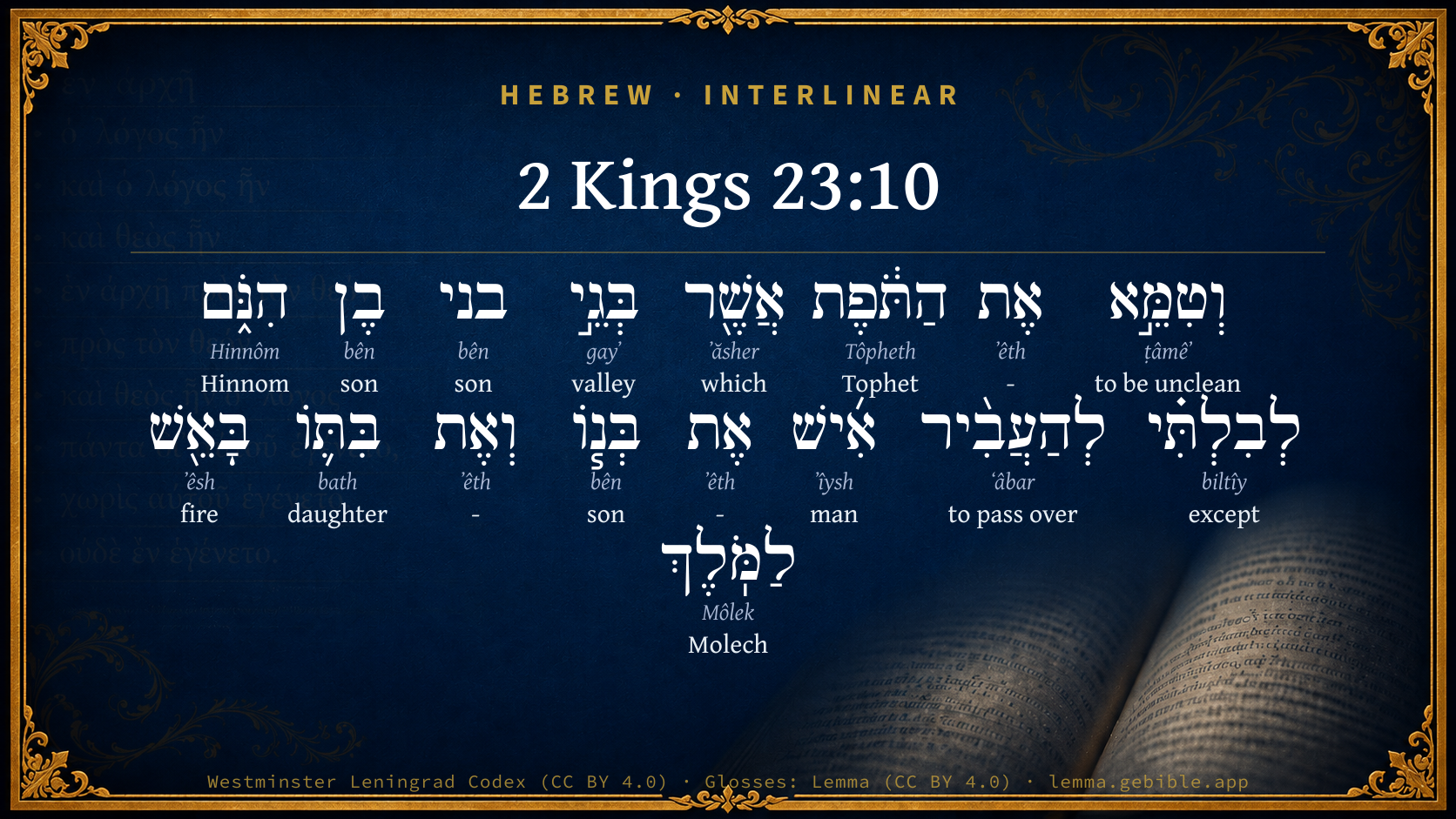
2 Kings 23:10

Hebrew (Westminster Leningrad Codex) 2 Kings 23:10 appears in the Hebrew Old Testament. The text above is from the Westminster Leningrad Codex. Each word links to its Strong’s number, a concise gloss, and parsing drawn from the Open Scriptures Hebrew Bible morphology. Click any word for its full Brown-Driver-Briggs (BDB) entry.
Download image
Cite this verse

2 Kings 23:10 (World English Bible). Public Domain. Lemma interlinear Bible study tool, https://lemma.gebible.app/v/2-kings/23/10.

Show BibTeX & RIS
BibTeX
RIS
English Translation
He defiled Topheth, which is in the valley of the children of Hinnom, that no man might make his son or his daughter to pass through the fire to Molech.
World English Bible · Public Domain
Highlights
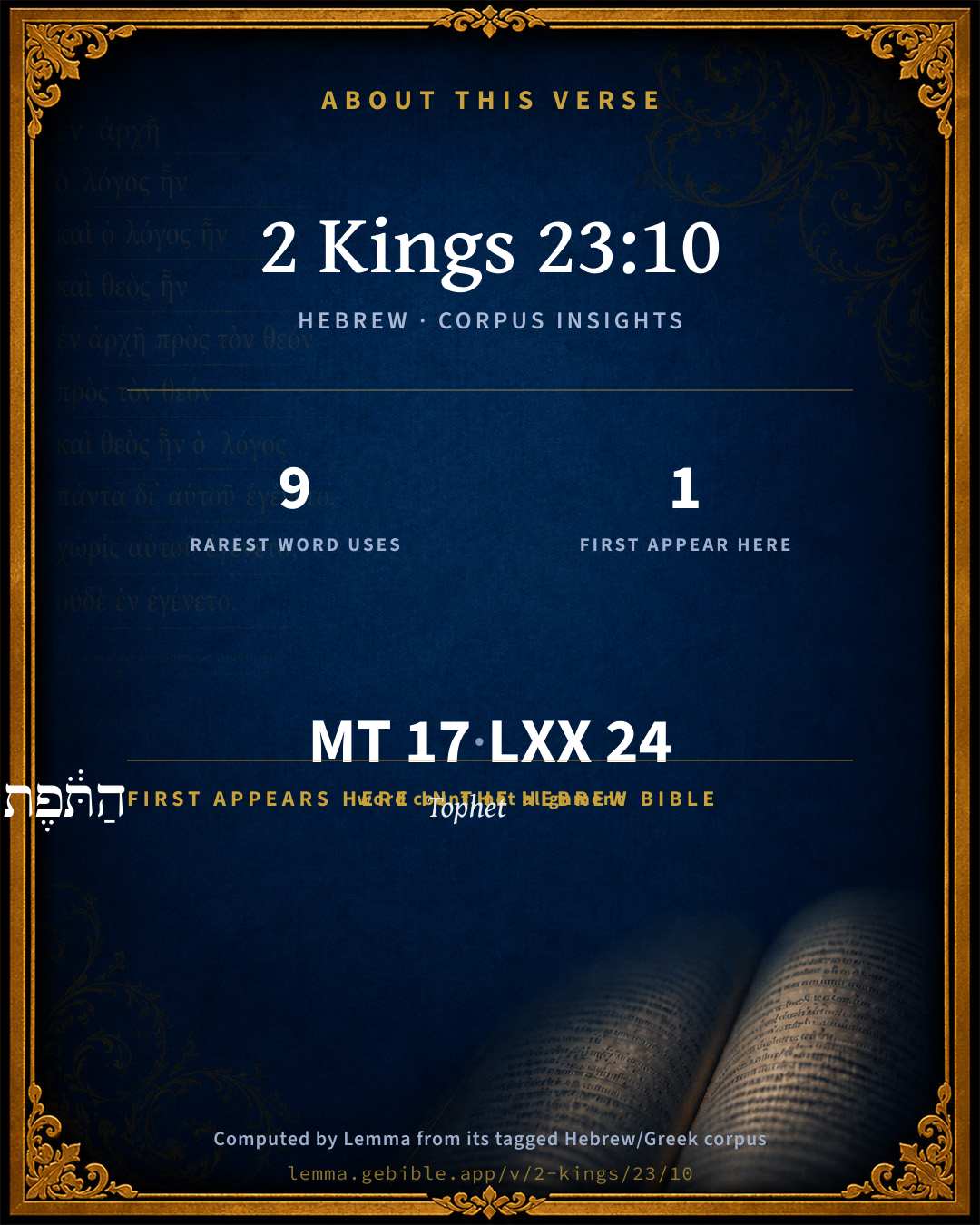
  • 1 first appearance in the Hebrew Bible
Full analysis ↓
Download a study sheet

One document with this verse’s original text, its word-by-word gloss line, the meaning frame, cross-references with their text, attributed commentary, and full source and license credits — printable, and it pastes into notes with its structure intact.

This verse Autodidact and up

Study sheet (.html) Plain text (.txt)

A passage Seminary Student

Up to 50 verses in one chapter. A passage sheet keeps up to 6 commentary sources and 12 cross-references per verse, in the order this page ranks them, and says so on the sheet whenever that leaves anything out. Ask for a single verse and you get the Autodidact verse sheet above.

Everything on this page stays free to read, with no account — the sheet is a download of what is already on screen, not access to it.

Want to remove ads? Support Godless Engineer
Compare translations 3

The same verse in 3 English versions, stacked beneath the original-language interlinear above. Click any original word for its lexicon entry.

Each is an independent rendering of the whole verse — the interlinear is not word-aligned to these translations.

Highlighted words mark where these versions differ — a whole-verse word diff, not a word-by-word alignment.

  • World English Bible Public Domain
    He defiled Topheth, which is in the valley of the children of Hinnom, that no man might make his son or his daughter to pass through the fire to Molech.
  • King James Version Public Domain
    And he defiled Topheth, which is in the valley of the children of Hinnom, that no man might make his son or his daughter to pass through the fire to Molech.
  • unfoldingWord Literal Text CC BY-SA 4.0
    And he defiled Topheth, which in the Valley of Ben Hinnom, so that a man could not make his son or his daughter pass through the fire to Molech.

unfoldingWord Literal Text — © unfoldingWord, licensed CC BY-SA 4.0. Word-aligned USFM3 via Door43 (git.door43.org/unfoldingWord/en_ult).

Versions to compare (up to 4)

3 of 4 selected

Show all 18 translations

Every available English version of this verse, each an independent rendering of the whole verse.

  • World English Bible Public Domain
    He defiled Topheth, which is in the valley of the children of Hinnom, that no man might make his son or his daughter to pass through the fire to Molech.
  • Berean Standard Bible Public Domain
    He also desecrated Topheth in the Valley of Ben-hinnom so that no one could sacrifice his son or daughter in the fire to Molech.
  • Majority Standard Bible Public Domain
    He also desecrated Topheth in the Valley of Ben-hinnom so that no one could sacrifice his son or daughter in the fire to Molech.
  • King James Version Public Domain
    And he defiled Topheth, which is in the valley of the children of Hinnom, that no man might make his son or his daughter to pass through the fire to Molech.
  • American Standard Version (1901) Public Domain
    And he defiled Topheth, which is in the valley of the children of Hinnom, that no man might make his son or his daughter to pass through the fire to Molech.
  • Revised Version (1885) Public Domain
    And he defiled Topheth, which is in the valley of the children of Hinnom, that no man might make his son or his daughter to pass through the fire to Molech.
  • Geneva Bible (1599) Public Domain
    He defiled also Topheth, which was in the valley of the children of Hinnom, that no man shoulde make his sonne or his daughter passe through the fire to Molech.
  • Douay-Rheims (1899) Public Domain
    And he defiled Topheth, which is in the valley of the son of Ennom: that no man should consecrate there his son or his daughter through fire to Moloch.
  • Young's Literal Translation Public Domain
    And he hath defiled Topheth, that `is' in the valley of the son of Hinnom, so that no man doth cause his son and his daughter to pass over through fire to Molech.
  • Literal Standard Version CC BY-SA 4.0
    And he has defiled Topheth that [is] in the Valley of the Son of Hinnom, so that no man causes his son and his daughter to pass over through fire to Molech.
  • Unlocked Literal Bible CC BY-SA 4.0
    Josiah defiled Topheth, which is in the Valley of Ben Hinnom, so that no one might cause his son or his daughter to pass through the fire as a sacrifice to Molech.
  • unfoldingWord Literal Text CC BY-SA 4.0
    And he defiled Topheth, which in the Valley of Ben Hinnom, so that a man could not make his son or his daughter pass through the fire to Molech.
  • Darby Bible Public Domain
    And he defiled Topheth, which is in the valley of the sons of Hinnom, that no man might cause his son or his daughter to pass through the fire to Molech.
  • World Messianic Bible Public Domain
    He defiled Topheth, which is in the valley of the children of Hinnom, that no man might make his son or his daughter to pass through the fire to Molech.
  • Webster's Bible Public Domain
    And he defiled Topheth, which is in the valley of the children of Hinnom, that no man might make his son or his daughter to pass through the fire to Molech.
  • Free Bible Version CC BY-SA 4.0
    He defiled the Topheth altar in the Valley of Ben-hinnom so that no one could sacrifice his son or daughter in the fire to Molech.
  • Bible in Basic English Public Domain
    And Topheth, in the valley of the sons of Hinnom, he made unclean, so that no man might make his son or his daughter go through the fire to Molech.
  • JPS Tanakh (1917) Public Domain
    And he defiled Topheth, which is in the valley of the son of Hinnom, that no man might make his son or his daughter to pass through the fire to Molech.

Literal Standard Version (2020), Covenant Press — licensed CC BY-SA 4.0. Text via the HelloAO Bible API (eBible.org). Unlocked Literal Bible (unfoldingWord) — licensed CC BY-SA 4.0. Text via the HelloAO Bible API (eBible.org). unfoldingWord Literal Text — © unfoldingWord, licensed CC BY-SA 4.0. Word-aligned USFM3 via Door43 (git.door43.org/unfoldingWord/en_ult). Free Bible Version, Dr. Jonathan Gallagher — licensed CC BY-SA 4.0. Text via the HelloAO Bible API (eBible.org).

Word by word

More ways to search: Search by grammar → Find every occurrence → Compare this word →

Practice this passage: Drill this verse → Learn its vocabulary →

הַתֹּ֔פֶת
Tôpheth
H8612
“the · Tophet”
Particle, Definite Article + Noun, Proper
Part of Speech
Particle + Noun
Type
Proper
Full BDB Definition

Origin: the same as H8611

TWOT: 2539

Tophet or Topheth = "place of fire"
  1. וְטִמֵּ֣א ṭâmêʼ H2930 “and · to be unclean” Conjunction + Verb, Piel, Perfect, 3rd Person, Masculine, Singular
  2. אֶת ʼêth H853 “-” Particle, Direct Object
  3. אֲשֶׁ֖ר ʼăsher H834 “which” Particle, Relative
  4. בְּגֵ֣י gayʼ H1516 “in/at · valley of” Preposition + Noun, Common, Both, Singular, Construct
  5. בני bên H1121 “son” Noun, Proper
  6. בֶן bên H1121 “son” Noun, Proper
  7. הִנֹּ֑ם Hinnôm H2011 “Hinnom” Noun, Proper
  8. לְבִלְתִּ֗י biltîy H1115 “to/for · except” Preposition + Conjunction
  9. לְהַעֲבִ֨יר ʻâbar H5674 “to pass over” Preposition + Verb, Hiphil, Infinitive Construct
  10. אִ֜ישׁ ʼîysh H376 “man” Noun, Common, Masculine, Singular, Absolute
  11. אֶת ʼêth H853 “-” Particle, Direct Object
  12. בְּנ֧וֹ bên H1121 “son · his” Noun, Common, Masculine, Singular, Construct + Suffix, Personal, 3rd Person, Masculine, Singular
  13. וְאֶת ʼêth H853 “and · -” Conjunction + Particle, Direct Object
  14. בִּתּ֛וֹ bath H1323 “daughter · his” Noun, Common, Feminine, Singular, Construct + Suffix, Personal, 3rd Person, Masculine, Singular
  15. בָּאֵ֖שׁ ʼêsh H784 “in/at the · fire” Preposition, Determined + Noun, Common, Both, Singular, Absolute
  16. לַמֹּֽלֶךְ Môlek H4432 “to/for the · Molech” Preposition, Determined + Noun, Proper

About this verse

These counts appear in no published source. They are computed here, from the morphology-tagged text and Lemma’s own curated glosses. What Lemma adds →

17
words
13
distinct lemmas
Historical
section

Notable vocabulary

The rarest word here is הַתֹּ֔פֶת Tophet H8612 — appearing just 9 times in the whole Hebrew Bible.

First appearance in Scripture

This word makes its first canonical appearance in the Hebrew Bible here:

  • הַתֹּ֔פֶת Tophet H8612

Shared distinctive vocabulary

הַתֹּ֔פֶת Tophet H8612 occurs in 8 verses of the Hebrew Bible. Also found in:

Grammatical profile

  • 2 verbs
  • 10 nouns
  • 1 conjunction
  • 4 particles

Verb forms

  • וְטִמֵּ֣א Piel · Perfect
  • לְהַעֲבִ֨יר Hiphil · Infinitive Construct

Repetition

A word recurs within this verse — often emphatic in Hebrew:

Hebrew & Septuagint length

In English translation the verse runs 30 words from the Hebrew and 31 from the Septuagint (LXX English) — closely comparable.

A rough comparison of the two English renderings, which tokenize alike — not a word-level alignment.

Word counts can differ between the Hebrew and the Greek without any difference in meaning — e.g. the Hebrew direct-object marker אֵת has no separate Greek word, and Greek often adds the article ὁ.

In the original languages it is 17 Hebrew tokens and 24 Greek tokens — but the two are counted differently (Hebrew bundles its prefixes and suffixes into one token; the Greek is in lemma form), so that isn’t a like-for-like length.

Cross-references

20

Topical passages linked to 2 Kings 23:10 in the Treasury of Scripture Knowledge — connected by theme and wording, ordered by reader-vote popularity; previews shown in the World English Bible.

  • Isaiah 30:33 For a Topheth is prepared of old; yes, for the king it is made ready; he has made it deep and large; the pile of it is fire and much wood; the breath of Yahweh, like a stream of sulfur, does kindle it.
  • Jeremiah 19:6 therefore, behold, the days come, says Yahweh, that this place shall no more be called Topheth, nor The valley of the son of Hinnom, but The valley of Slaughter.
  • Leviticus 18:21 "'You shall not give any of your children to sacrifice to Molech; neither shall you profane the name of your God: I am Yahweh.
  • Jeremiah 7:31–32 They have built the high places of Topheth, which is in the valley of the son of Hinnom, to burn their sons and their daughters in the fire; which I didn't command, neither came it into my mind.
  • Joshua 15:8 and the border went up by the valley of the son of Hinnom to the side of the Jebusite southward (the same is Jerusalem); and the border went up to the top of the mountain that lies before the valley of Hinnom westward, which is at the uttermost part of the valley of Rephaim northward;
  • Jeremiah 32:35 They built the high places of Baal, which are in the valley of the son of Hinnom, to cause their sons and their daughters to pass through [the fire] to Molech; which I didn't command them, neither did it come into my mind, that they should do this abomination, to cause Judah to sin.
  • Deuteronomy 18:10 There shall not be found with you anyone who makes his son or his daughter to pass through the fire, one who uses divination, one who practices sorcery, or an enchanter, or a sorcerer,
  • Jeremiah 19:11–13 and shall tell them, Thus says Yahweh of Hosts: Even so will I break this people and this city, as one breaks a potter's vessel, that can't be made whole again; and they shall bury in Topheth, until there be no place to bury.
  • 1 Kings 11:7 Then did Solomon build a high place for Chemosh the abomination of Moab, on the mountain that is before Jerusalem, and for Molech the abomination of the children of Ammon.
  • 2 Kings 16:3 But he walked in the way of the kings of Israel, yes, and made his son to pass through the fire, according to the abominations of the nations, whom Yahweh cast out from before the children of Israel.
  • 2 Kings 17:17 They caused their sons and their daughters to pass through the fire, and used divination and enchantments, and sold themselves to do that which was evil in the sight of Yahweh, to provoke him to anger.
  • 2 Kings 21:6 He made his son to pass through the fire, and practiced sorcery, and used enchantments, and dealt with those who had familiar spirits, and with wizards: he worked much evil in the sight of Yahweh, to provoke him to anger.
  • 2 Chronicles 28:3 Moreover he burnt incense in the valley of the son of Hinnom, and burnt his children in the fire, according to the abominations of the nations whom Yahweh cast out before the children of Israel.
  • 2 Chronicles 33:6 He also made his children to pass through the fire in the valley of the son of Hinnom; and he practiced sorcery, and used enchantments, and practiced sorcery, and dealt with those who had familiar spirits, and with wizards: he worked much evil in the sight of Yahweh, to provoke him to anger.
  • Jeremiah 19:2 and go forth to the valley of the son of Hinnom, which is by the entry of the gate Harsith, and proclaim there the words that I shall tell you;
  • Ezekiel 16:21 that you have slain my children, and delivered them up, in causing them to pass through [the fire] to them?
  • Ezekiel 20:26 and I polluted them in their own gifts, in that they caused to pass through [the fire] all that opens the womb, that I might make them desolate, to the end that they might know that I am Yahweh.
  • Ezekiel 20:31 and when you offer your gifts, when you make your sons to pass through the fire, do you pollute yourselves with all your idols to this day? and shall I be inquired of by you, house of Israel? As I live, says the Lord Yahweh, I will not be inquired of by you;
  • Ezekiel 23:37–39 For they have committed adultery, and blood is in their hands; and with their idols have they committed adultery; and they have also caused their sons, whom they bore to me, to pass through [the fire] to them to be devoured.
  • Matthew 5:22 But I tell you, that everyone who is angry with his brother without a cause shall be in danger of the judgment; and whoever shall say to his brother, 'Raca!' shall be in danger of the council; and whoever shall say, 'You fool!' shall be in danger of the fire of Gehenna.

Cross-references courtesy of OpenBible.info (CC BY 4.0).

Hebrew and Greek witnesses Masoretic Hebrew ↔ Greek Septuagint

The same verse in the two great witnesses to the Old Testament, shown verse-for-verse.

These are two independent witnesses, not word-aligned to each other, and the Septuagint is shown in lemma (dictionary) form.

Hebrew 2 Kings 23:10 Masoretic · Westminster Leningrad Codex

וְטִמֵּ֣א אֶת הַתֹּ֔פֶת אֲשֶׁ֖ר בְּגֵ֣י בני בֶן הִנֹּ֑ם לְבִלְתִּ֗י לְהַעֲבִ֨יר אִ֜ישׁ אֶת בְּנ֧וֹ וְאֶת בִּתּ֛וֹ בָּאֵ֖שׁ לַמֹּֽלֶךְ

He defiled Topheth, which is in the valley of the children of Hinnom, that no man might make his son or his daughter to pass through the fire to Molech.

World English Bible · Public Domain

Greek LXX 2 Kings 23:10 Septuagint · lemma form

καί μιαίνω ὁ ταφεθ ὁ ἐν φάραγξ υἱός εννομ ὁ διαἄγω ἀνήρ ὁ υἱός αὐτός καί ἀνήρ ὁ θυγάτηρ αὐτός ὁ μολοχ ἐν πῦρ

And he defiled Taphes which is in the valley of the son of Ennom, constructed for a man to cause his son or his daughter to pass through fire to Moloch.

LXX2012 (modern English Septuagint) · Public Domain

Hebrew: Westminster Leningrad Codex (CC BY 4.0). Greek: Septuagint (public domain); English from LXX2012 (modern English Septuagint) (Public Domain). How the Septuagint differs from the Hebrew →

Targum (Aramaic paraphrase)

1

The Targum is the ancient Jewish Aramaic paraphrase of the Hebrew Scriptures — an interpretive translation, not the Hebrew text itself. Onkelos (literal) and Pseudo-Jonathan (expansive) render the Torah, and Jonathan the Prophets. Coverage is partial: where no permissively-licensed English translation exists for a verse, only the Aramaic is shown. This is verse-level text, not a word-by-word alignment to the Hebrew.

  1. Targum Jonathan Prophets (Joshua–Malachi)
    וְסָאֵיב יַת תּוֹפֶת דִי בְחֵילַת בַּר הִנוֹם בְּדִיל דְלָא לְאַעֲבָרָא גְבַר יַת בְּרֵיהּ וְיַת בְּרַתֵּיהּ בְּנוּרָא לַמוֹלֶךְ:

    (no public-domain English translation for this verse)

    Targum Jonathan — Aramaic: “Mikraot Gedolot” (public domain). English: “Sefaria Community Translation” (CC0 1.0 (public-domain dedication)); “London "Chaldee Paraphrase," 1871” (public domain). Text via Sefaria.

Commentary

Notes on 2 Kings 23:10 from classic Christian and Jewish commentators (each source and its license shown beneath its notes). The classic Christian expositions comment on the surrounding passage and are grouped to its opening verse, so a note may address several verses; the Jewish commentaries on the Tanakh (Rashi and others) are per-verse, so they appear only where the commentator wrote on this verse.

Lemma curates 59 commentaries, every one of them public domain or Creative Commons licensed, each selected and text-cleaned for this edition rather than reprinted as found. About our sources →

Trapp's Complete Commentary

John Trapp

2Ki 23:10 And he defiled Topheth, which [is] in the valley of the children of Hinnom, that no man might make his son or his daughter to pass through the fire to Molech.

Ver. 10. And he defiled Tophet.] A pleasant valley near to Jerusalem, but, for the abominable abuse of it, taken afterwards for hell, {Isa 30:33 Mat 5:22} a place of torments, without end, and past imagination.

John Trapp, A Commentary or Exposition upon All the Books of the Old and New Testament (1647–1656) — public domain. Text from a community e-Sword module.

Joseph Benson's Commentary

2Ki 23:10. He defiled Topheth — By throwing different kinds of filth and dead carcasses into it, and making it the burying-place of the city. Topheth was a place very near Jerusalem, where was the image of Molech, to whom some sacrificed their children, burning them in the fire, as the reader may see in the note on Lev 18:21; and to whom others, as many able interpreters think, only dedicated them, by making them pass between two fires, or by waving them, or making them jump over a fire. It is supposed to be called Topheth, from toph, a drum; because they beat drums at the burning of their children, that their shricks might not be heard. This place, near Jerusalem, was also called the valley of the sons of Hinnom, (2Ch 28:3,) from the yelling of the sacrificed infants. Thus Milton calls Molech: —

Horrid king, besmear’d with blood

Of human sacrifice, and parents’ tears,

Though for the noise of drums, and timbrels loud,

Their children’s cries unheard, that pass’d through fire

To his grim idol. Par. Lost, book 1. 50:392.

Joseph Benson's Commentary on the Old and New Testaments (1811–1818) — public domain. Text from a community e-Sword module.

Tyndale Open Study Notes

Tyndale Open Resources

23:10 Topheth was a precinct in the valley of Ben-Hinnom, which lay southwest of the city of David and led into the Kidron Valley. The detestable rite of child sacrifice had occurred there. • Molech has been identified with a number of deities (see 1 Kgs 11:5, 7, 33) and with the name of a sacrifice offered to Baal (Jer 7:31-32; 19:5-6; 32:35).

Tyndale Open Study Notes — © Tyndale Open Resources, licensed CC BY-SA 4.0. Text via the HelloAO Bible API.

Geneva Bible (1599)

Geneva Bible translators

Which was a valley near to Jerusalem, and signifieth a taboret, because they smote on the taboret while their children were burning, that their cry should not be heard, Lev. 18:21, where after Josiah commanded carrions to be cast in contempt thereof.

Geneva Bible (1599) marginal notes — public domain. Text via Bolls.life.

Jamieson, Fausset & Brown

Robert Jamieson, A. R. Fausset & David Brown

Topheth--so called from Toph--a "drum." It is the prevailing opinion among Jewish writers that the cries of the terrified children made to pass through the fire in that place of idolatrous horror were drowned by the sound of that instrument.

Jamieson, Fausset & Brown — Commentary Critical and Explanatory on the Whole Bible (1871) — public domain (CC PDM 1.0). Text via the HelloAO Bible API.

Adam Clarke's Commentary

Verse 10. He defiled Topheth] St. Jerome says that Topheth was a fine and pleasant place, well watered with fountains, and adorned with gardens. The valley of the son of Hinnom, or Gehenna, was in one part; here it appears the sacred rites of Molech were performed, and to this all the filth of the city was carried, and perpetual fires were kept up in order to consume it. Hence it has been considered a type of hell; and in this sense it is used in the New Testament.

It is here said that Josiah defiled this place that no man might make his son or his daughter to pass through the fire. He destroyed the image of Molech, and so polluted the place where he stood, or his temple, that it was rendered in every way abominable. The rabbins say that Topheth had its name from תף toph, a drum, because instruments of this kind were used to drown the cries of the children that were put into the burning arms of Molech, to be scorched to death. This may be as true as the following definition: "Topheth, or the valley of the son of Hinnom, was a place near Jerusalem, where the filth and offal of the city were thrown, and where a constant fire was kept up to consume the wretched remains of executed criminals. It was a human shambles, a public chopping-block, where the arms and legs of men and women were quartered off by thousands." Query, On what authority do such descriptions rest?

Adam Clarke's Commentary on the Bible (1810–1826) — public domain. Text from a community e-Sword/MySword module.

Ellicott's Commentary for English Readers

(10) Topheth.—Heb. the Topheth; i.e., the burning place, or hearth, if the word be rightly derived from the Persian tôften, “to burn.” The Hebrew word, however, has been so modified as to suggest a derivation from tôph, “to spit;” so that the epithet would mean “the abomination.” (Comp. 2Ki_23:13.) (Comp. also Job_17:6; Isa_30:33; and the Coptic tâf, “spittle.”)

The valley of the children of Hinnom.—Elsewhere called “the valley of the son of Hinnom,” and “the valley of Hinnom (Jos_15:8; Jer_7:31-32). Simonis plausibly explained the word Hinnom as meaning shrieking or moaning (from the Arabic hanna, arguta voce gemuit, flevit). “The valley of the sons of shrieking” would be a good name for the accursed spot. (Thenius suggests Wimmer-Kinds-Thal.)

That no man . . .—See Note on 2Ki_16:3.

To Moloch.—Heb., to the Molech (Molech is another form of melech, “king”). In 1Ki_11:7, the god of the Ammonites is called Molech, but elsewhere, as in 2Ki_23:13, Milcom, another variation of the same word. The feminine molecheth, “queen,” occurs as a proper name in 1Ch_7:18.

A Bible Commentary for English Readers, edited by Charles John Ellicott (1878–1897) — public domain. Text from a community e-Sword module.

The Cambridge Bible for Schools and Colleges

gen. ed. J. J. S. Perowne

10. Topheth] See note on 2Ki_21:6, and on ‘passing through the fire to Molech’ see note on 2Ki_16:3.

The Cambridge Bible for Schools and Colleges (gen. ed. J. J. S. Perowne; Cambridge University Press, 1878–1918) — public domain. Text from a community e-Sword module.

John Gill's Exposition

And he took away the horses that the kings of Judah had given to the sun,.... Consecrated to it; these were not images of horses, as some have thought, but real living ones; and the kings that gave them for the service of the sun, and for sacrifice to it, very probably were Manasseh and Amon: that horses were sacred to the sun with many Heathen nations, as the Massagetae, a people in Scythia, and the Persians, and Babylonians, and Ethiopians, is affirmed by various writers (c): and from them the Jews received this notion. According to the Jewish commentators, these were horses provided for the worshippers of the sun to ride upon, and meet the sun in the morning at its rising, and pay their homage to it; but certain it is that the Heathen nations before mentioned slew the horses, and sacrificed them as burnt offerings to the sun, as is asserted by Herodotus (d), Xenophon (e), Strabo (f), Pausanias (g), Philostratus (h), and other writers (i); and so the Indians of India (k) sacrificed them to Apollo, the same with the sun; these being the swiftest of creatures, they offered them to the swiftest of their gods, as Herodotus and Heliodorus observe, in the places before referred to. The stables in which these horses were kept were

at the entering of the house of the Lord, by the chamber of Nathanmelech the chamberlain, which was in the suburbs; so that they reached from the temple to the suburbs of Jerusalem, to that part of them where this officer had a chamber, or lodgings, being in some place of power and authority there; though, according to L'Empereur (l), it is the same with Parbar, Ch1 26:18 and should not be rendered "suburbs", it being between the compass or wall of the temple, and the court:

and burnt the chariots of the sun with fire; these were either chariots, in which the king and his nobles rode, when they went to meet and worship the rising sun; or rather such as were sacred to the sun, as well as the horses, or Josiah would not have burnt them; they seem to be such in which the images of the sun were carried. Herodotus (m) makes mention as of sacred horses, so of a sacred chariot. Xenophon (n) speaks of the chariot of the sun as being of a white colour, and drawn in procession at the worship of the sun; as does also Pausanias (o) of a chariot, in which were the sun, Jupiter, and Juno, and near them other deities; which notion of sacred chariots the Heathens might take from the chariot of the cherubim Jehovah sat and rode in, Ch1 28:18.

(c) Justin e Trogo, l. 1. c. 10. Curt. Hist. l. 3. c. 3. Ovid. Fast. l. 1. Alex. ab Alex. Genial. Dier. l. 6. c. 26. Heliodor. Ethiop. l. 10. c. 6. 28. (d) Clio, sive, l. 1. c. 216. (e) Cyropaed. l. 8. c. 23, 24. (f) Geograph. l. 11. p. 353. (g) Laconica, sive, l. 3. p. 201. (h) Vit. Apollon. l. 1. c. 20. (i) Vid. Lactant. de fals. Relig. l. 1. c. 21. (k) Laon. Chalcondyl. de Rebus Turc. l. 3. p. 108. (l) Not. in Misn. Middot, c. 2. sect. 3. No. 3. So Boehart. Hierozoic. par. 1. l. 2. c. 10. col. 177. (m) Polymnia, sive, l. 7. c. 55. (n) Ut supra, (Cyropaed. l. 8.) c. 23. (o) Eliac. 1. sive, l. 5. p, 307.

John Gill's Exposition of the Whole Bible (1746–1763) — public domain (CC PDM 1.0). Text via the HelloAO Bible API.

Haydock's Catholic Bible Commentary

Defiled, or declared it unlawful. (Menochius) --- Topheth may signify "a drum;" which the Jews say the idolaters beat, to prevent their childrens’ cries from being heard, when they were burning in the arms of Moloch. St. Jerome interprets it "latitude," as the vale was very wide, and beautifully adorned with gardens and springs. It formed a part of the vale of Josaphat and of Cedron; (Calmet) or the same valley went by these different names, as well as (Haydock) by that of Geh-hinnon, "the vale of Ennom," whence Gehenna is formed, and applied to hell, Matthew v. 22., and Mark ix. 44., &c. (Calmet) --- Yet some think that the term denotes a place of torment on earth, which those deserve who say, thou fool. (Haydock)

George Leo Haydock (1774–1849), Haydock's Catholic Family Bible and Commentary, 1859 edition — public domain. Excludes Psalms (Douay-Rheims chapter numbering differs from Protestant) and Deuterocanonical books (Catholic canon only).

Matthew Poole's English Annotations

In the valley of the children of Hinnom; of which see Jos 15:8; Neh 11:30; Jer 7:31; 19:6,11.

To pass through the fire to Molech. See Poole "Lev 18:21"; See Poole "Deu 18:10".

Matthew Poole's English Annotations on the Holy Bible (1683–1685) — public domain. Text from a community e-Sword/MySword module.

Whedon's Commentary on the Bible

Daniel D. Whedon

10. Defiled Topheth — Probably by burning the bones of the priests who had offered human sacrifices there. Compare 2Ch_34:5. The word Topheth (usually with the article התפת,) occurs only in the Old Testament at the passages named in the margin, and designates the place in the valley of Hinnom, where human sacrifices were offered to Molech. Its derivation is uncertain. The rabbies say it is the same as toph, (תŠ) a drum, and is applied to the place where human sacrifices were offered, because drums were beaten there to drown the cries of the victims. Furst and others derive it from a root, תוŠ, to burn, and understand it as an altar-place for the burning of dead bodies. It is translated tabret in Job_17:7, but most interpreters agree that it there means spittle, or abhorrence, and is also, as a proper name, to be explained in a similar sense, and applied to the spot where human sacrifices were offered, because it was a place of abhorrence — a thing to be spit at.

The valley of the children of Hinnom — This has been usually identified with the valley on the west and south sides of Jerusalem; but Jeremiah says (Jer_19:2) it was “by the entry of the east gate, (Hebrews potter’s gate;) and Dr. Bonar (Smith’s Bib. Dict.) says, “Hinnom, by old writers, western and eastern, is always placed east of the city, and corresponds to what we call the mouth of the Tyropoeon, along the southern bed and banks of the Kedron, and was reckoned to be somewhere between the potter’s field and the fuller’s pool.” And Captain Wilson and M. Ganneau have concluded, from minute examinations, that the Kedron and Hinnom valleys are identical. But see note on Jos_15:8.

Daniel D. Whedon (gen. ed.), Commentary on the Old and New Testaments (1874–1909) — public domain. Text from a community e-Sword module.

The Pulpit Commentary

And he defiled Topheth. "To-pheth" or "Tophet" was the name given to the place in the valley of Hinnom where the sacrifices were offered to Moloch. The root of the word is thought by some to be taph ( "a drum," because the cries of the children burnt there were drowned by the beating of drums. Others suggest as the root, tuph ( "to spit," because the place was "spat at" by the orthodox. But Gesenius and Bottcher derive it from an Aryan root, taph, or tap, "to burn," whence Greek qaptein tefra, Latin tepidus, Mod. Persian taftan, Sanskrit tap, etc., and regard the meaning as simply "the place of burning". (see the comment on Isa_30:33) Which is in the valley of the children of Hinnom. The valley of Hinnom, or of the sons of Hinnom, is generally allowed to be that which sweeps round the more western of the two hills whereon Jerusalem was built, in a direction at first south and then east, uniting itself with the Kidron valley a little to the south of Ophel. The origin of the name is uncertain; but it is most likely that the Beni-Hinnom were a tribe of Canaanites, settled on this side of Jerusalem in the time of Joshua. (Jos_15:8) The "valley" is a ravine, deep and narrow, withsteep, rocky sides. When the Moloch-worship first began in it we cannot say; but it was probably before the time of Solomon, who built a high place for Moloch, (1Ki_11:11) on one of the heights by which the valley is enclosed. (On the horrible profanations of the Moloch-worship, see (Jer_7:31, 32 19:4-13 32:35) After the Captivity, the valley of Hinnom Ge-Hinnom was reckoned an accursed and abominable place, a sort of earthly counterpart of the place of final punishment, which. thence derived its name of "Geheuna" (Geenna); . (see Mat_5:22, Mat_5:29, etc.) That no man might make his son or his daughter to pass through the fire to Moloch. (see the comment on 2Ki_16:3)

The Pulpit Commentary (1880–1919), ed. H.D.M. Spence-Jones & Joseph S. Exell — public domain. Text from a community e-Sword module.

John Wesley's Explanatory Notes

Topheth - Very near Jerusalem, where was the image of Molech, to whom some sacrificed their children, burning them in the fire, others dedicated them, making them pass between two fires. It is supposed to be called Topheth, from toph, a drum; because they beat drums at the burning of the children, that their shrieks might not be heard.

John Wesley, Explanatory Notes Upon the Whole Bible (1754–1765) — public domain. Text via the GEBible commentary corpus.

unfoldingWord translationNotes

Door43 World Missions Community

Topheth ... Ben Hinnom

place names (See: How to Translate Names)

cause his son or his daughter to pass through the fire as a sacrifice to Molech

"put his son or his daughter in the fire and burn them as an offering to Molech"

He took away

It might be best to translate so that the reader understands that other people, perhaps Hilkiah and "the priests under him" (2 Kings 23:4), might have helped Josiah do this. (See: Assumed Knowledge and Implicit Information)

the horses

Possible meanings are 1) real horses or 2) statues of horses.

had given to the sun

Here "given" represents being dedicated for worship. AT: "had used to worship the sun" (See: Metonymy)

Nathan-Melek

a man's name (See: How to Translate Names)

translationWords

burnt offering

fire

Molech

horse

chariot

unfoldingWord translationNotes — © Distant Shores Media and the Door43 World Missions Community, licensed CC BY-SA 4.0. Source: git.door43.org/Door43/en_tn.

Rashi

Rabbi Shlomo Yitzchaki (Rashi)

The Tophes. This was the Molech, it is named [תפת] because priests would bang on drums [=תופים] so that the father should not hear the groans of the child when he was burned by the pagan image, Molech, they called it Tophes.

Rashi on the Tanakh — English translations: “The Judaica Press complete Tanach with Rashi, translated by A. J. Rosenberg” (CC BY 4.0); “Pentateuch with Rashi's commentary by M. Rosenbaum and A.M. Silbermann, 1929-1934” (public domain); “The Metsudah Tanach series, Lakewood, N.J” (CC BY 4.0); and “The Book of Joshua, Metsudah Publications, 1997” (CC BY 4.0). Text via Sefaria.

Lesson kit

Teaching starters — assembled from the data on this page, not authored interpretation. Every prompt links to the verse data it draws on. Edit before teaching.

2 Kings, in the Historical, opens this verse with 17 words (13 distinct Hebrew lemmas). Its most distinctive word is Tôpheth (“Tophet”). A historical commentator’s framing appears above. Read the whole chapter for the surrounding context.

Discussion questions

  1. How does “Tophet” (Tôpheth) shape what this verse is saying?
  2. The word “Tophet” first appears here in Scripture. What is being introduced at this debut?
  3. Jeremiah 7:31 shares the word «Tophet» with this verse. How do the two illuminate each other?
  4. “son” occurs 3× in this one verse. What is the effect of the repetition?
  5. These translations render this verse differently. What is at stake in choosing one wording over another?
  6. The verb «וְטִמֵּ֣א» is Piel Perfect. How does its form color the action?
  7. Reading how Trapp's Complete Commentary and Joseph Benson's Commentary read this verse, where do the two commentators agree and where do they part?

Things to notice

Reading settings

Reading text

Shown beneath each verse's original-language words.

Old Testament
Old Testament edition

Read the OT as the Masoretic Hebrew (MT) or the Greek Septuagint (LXX).

English shown for the Greek Septuagint (in the Hebrew ↔ Greek comparison).

Comparing translations? Open the Compare panel on any verse page to stack up to four side by side.