2 Kings 14:27

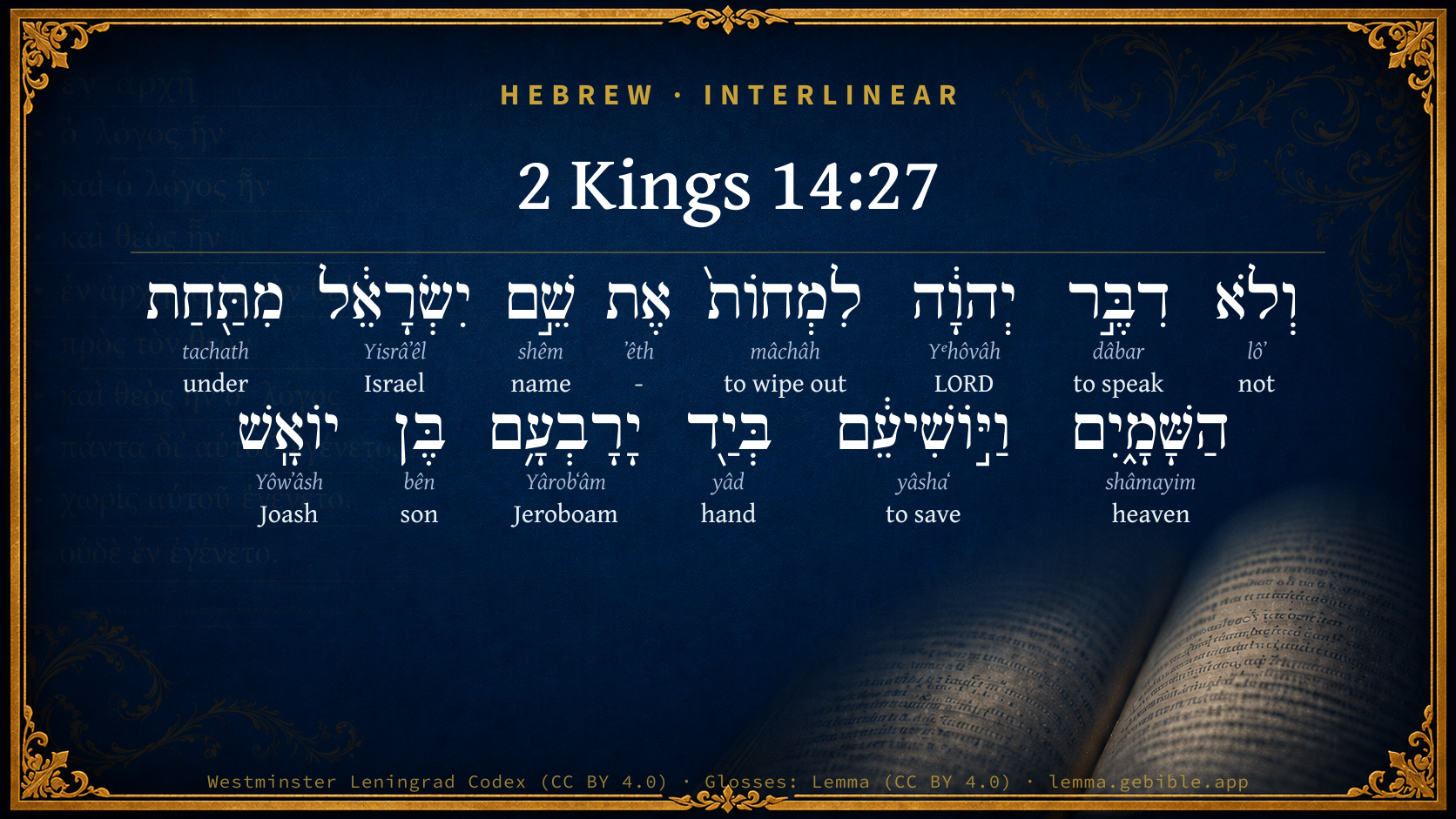
Hebrew (Westminster Leningrad Codex) 2 Kings 14:27 appears in the Hebrew Old Testament. The text above is from the Westminster Leningrad Codex. Each word links to its Strong’s number, a concise gloss, and parsing drawn from the Open Scriptures Hebrew Bible morphology. Click any word for its full Brown-Driver-Briggs (BDB) entry.
Download image
Cite this verse

2 Kings 14:27 (World English Bible). Public Domain. Lemma interlinear Bible study tool, https://lemma.gebible.app/v/2-kings/14/27.

Show BibTeX & RIS
BibTeX
RIS
English Translation
Yahweh didn't say that he would blot out the name of Israel from under the sky; but he saved them by the hand of Jeroboam the son of Joash.
World English Bible · Public Domain
Download a study sheet

One document with this verse’s original text, its word-by-word gloss line, the meaning frame, cross-references with their text, attributed commentary, and full source and license credits — printable, and it pastes into notes with its structure intact.

This verse Autodidact and up

Study sheet (.html) Plain text (.txt)

A passage Seminary Student

Up to 50 verses in one chapter. A passage sheet keeps up to 6 commentary sources and 12 cross-references per verse, in the order this page ranks them, and says so on the sheet whenever that leaves anything out. Ask for a single verse and you get the Autodidact verse sheet above.

Everything on this page stays free to read, with no account — the sheet is a download of what is already on screen, not access to it.

Want to remove ads? Support Godless Engineer
Compare translations 3

The same verse in 3 English versions, stacked beneath the original-language interlinear above. Click any original word for its lexicon entry.

Each is an independent rendering of the whole verse — the interlinear is not word-aligned to these translations.

Highlighted words mark where these versions differ — a whole-verse word diff, not a word-by-word alignment.

  • World English Bible Public Domain
    Yahweh didn't say that he would blot out the name of Israel from under the sky; but he saved them by the hand of Jeroboam the son of Joash.
  • King James Version Public Domain
    And the LORD said not that he would blot out the name of Israel from under heaven: but he saved them by the hand of Jeroboam the son of Joash.
  • unfoldingWord Literal Text CC BY-SA 4.0
    But Yahweh had not said that he would wipe out the name of Israel from under the heavens, so he saved them by the hand of Jeroboam, the son of Joash.

unfoldingWord Literal Text — © unfoldingWord, licensed CC BY-SA 4.0. Word-aligned USFM3 via Door43 (git.door43.org/unfoldingWord/en_ult).

Versions to compare (up to 4)

3 of 4 selected

Show all 18 translations

Every available English version of this verse, each an independent rendering of the whole verse.

  • World English Bible Public Domain
    Yahweh didn't say that he would blot out the name of Israel from under the sky; but he saved them by the hand of Jeroboam the son of Joash.
  • Berean Standard Bible Public Domain
    and since the LORD had said that He would not blot out the name of Israel from under heaven, He saved them by the hand of Jeroboam son of Jehoash.
  • Majority Standard Bible Public Domain
    and since the LORD had said that He would not blot out the name of Israel from under heaven, He saved them by the hand of Jeroboam son of Jehoash.
  • King James Version Public Domain
    And the LORD said not that he would blot out the name of Israel from under heaven: but he saved them by the hand of Jeroboam the son of Joash.
  • American Standard Version (1901) Public Domain
    And Jehovah said not that he would blot out the name of Israel from under heaven; but he saved them by the hand of Jeroboam the son of Joash.
  • Revised Version (1885) Public Domain
    And the LORD said not that he would blot out the name of Israel from under heaven: but he saved them by the hand of Jeroboam the son of Joash.
  • Geneva Bible (1599) Public Domain
    Yet the Lord had not decreed to put out the name of Israel from vnder the heauen: therefore he preserued them by the hand of Ieroboam the sonne of Ioash.
  • Douay-Rheims (1899) Public Domain
    And the Lord did not say that he would blot out the name of Israel from under heaven, but he saved them by the hand of Jeroboam the son of Joas.
  • Young's Literal Translation Public Domain
    and Jehovah hath not spoken to blot out the name of Israel from under the heavens, and saveth them by the hand of Jeroboam son of Joash.
  • Literal Standard Version CC BY-SA 4.0
    and YHWH has not spoken to blot out the name of Israel from under the heavens, and saves them by the hand of Jeroboam son of Joash.
  • Unlocked Literal Bible CC BY-SA 4.0
    So Yahweh said that he would not blot out the name of Israel under heaven; instead, he saved them by the hand of Jeroboam son of Jehoash.
  • unfoldingWord Literal Text CC BY-SA 4.0
    But Yahweh had not said that he would wipe out the name of Israel from under the heavens, so he saved them by the hand of Jeroboam, the son of Joash.
  • Darby Bible Public Domain
    And Jehovah had not said that he would blot out the name of Israel from under the heavens; and he saved them by the hand of Jeroboam the son of Joash.
  • World Messianic Bible Public Domain
    The LORD didn’t say that he would blot out the name of Israel from under the sky; but he saved them by the hand of Jeroboam the son of Joash.
  • Webster's Bible Public Domain
    And the LORD said not that he would blot out the name of Israel from under heaven: but he saved them by the hand of Jeroboam the son of Joash.
  • Free Bible Version CC BY-SA 4.0
    However, since the Lord had said that he would not wipe out Israel, he saved them through Jeroboam, son of Jehoash.
  • Bible in Basic English Public Domain
    And the Lord had not said that the name of Israel was to be taken away from the earth; but he gave them a saviour in Jeroboam, the son of Joash.
  • JPS Tanakh (1917) Public Domain
    And the LORD said not that He would blot out the name of Israel from under heaven; but He saved them by the hand of Jeroboam the son of Joash.

Literal Standard Version (2020), Covenant Press — licensed CC BY-SA 4.0. Text via the HelloAO Bible API (eBible.org). Unlocked Literal Bible (unfoldingWord) — licensed CC BY-SA 4.0. Text via the HelloAO Bible API (eBible.org). unfoldingWord Literal Text — © unfoldingWord, licensed CC BY-SA 4.0. Word-aligned USFM3 via Door43 (git.door43.org/unfoldingWord/en_ult). Free Bible Version, Dr. Jonathan Gallagher — licensed CC BY-SA 4.0. Text via the HelloAO Bible API (eBible.org).

Word by word

More ways to search: Search by grammar → Find every occurrence → Compare this word →

Practice this passage: Drill this verse → Learn its vocabulary →

לִמְחוֹת֙
mâchâh
H4229
“to wipe out”
Preposition + Verb, Qal, Infinitive Construct
Part of Speech
Preposition + Verb
Stem
Qal
Form
Infinitive Construct
Full BDB Definition

Origin: a primitive root

TWOT: 1178 , 1179 , 1181c

to wipe, wipe out - (Qal) - to wipe - to blot out, obliterate - to blot out, exterminate - (Niphal) - to be wiped out - to be blotted out - to be exterminated - (Hiphil) to blot out (from memory) - (Qal) to strike - (Pual) full of marrow (participle)
  1. וְלֹא lôʼ H3808 “and · not” Conjunction + Particle, Negative
  2. דִבֶּ֣ר dâbar H1696 “to speak” Verb, Piel, Perfect, 3rd Person, Masculine, Singular
  3. יְהוָ֔ה Yᵉhôvâh H3068 “LORD” Noun, Proper
  4. אֶת ʼêth H853 “-” Particle, Direct Object
  5. שֵׁ֣ם shêm H8034 “name of” Noun, Common, Masculine, Singular, Construct
  6. יִשְׂרָאֵ֔ל Yisrâʼêl H3478 “Israel” Noun, Proper
  7. מִתַּ֖חַת tachath H8478 “from · under” Preposition + Preposition
  8. הַשָּׁמָ֑יִם shâmayim H8064 “the · heaven(s)” Particle, Definite Article + Noun, Common, Masculine, Plural, Absolute
  9. וַיּ֣וֹשִׁיעֵ֔ם yâshaʻ H3467 “and · to save · them” Conjunction + Verb, Hiphil, Sequential Imperfect, 3rd Person, Masculine, Singular + Suffix, Personal, 3rd Person, Masculine, Plural
  10. בְּיַ֖ד yâd H3027 “in/at · hand of” Preposition + Noun, Common, Both, Singular, Construct
  11. יָרָבְעָ֥ם Yârobʻâm H3379 “Jeroboam” Noun, Proper
  12. בֶּן bên H1121 “son of” Noun, Common, Masculine, Singular, Construct
  13. יוֹאָֽשׁ Yôwʼâsh H3101 “Joash” Noun, Proper

About this verse

These counts appear in no published source. They are computed here, from the morphology-tagged text and Lemma’s own curated glosses. What Lemma adds →

14
words
14
distinct lemmas
Historical
section

Shared distinctive vocabulary

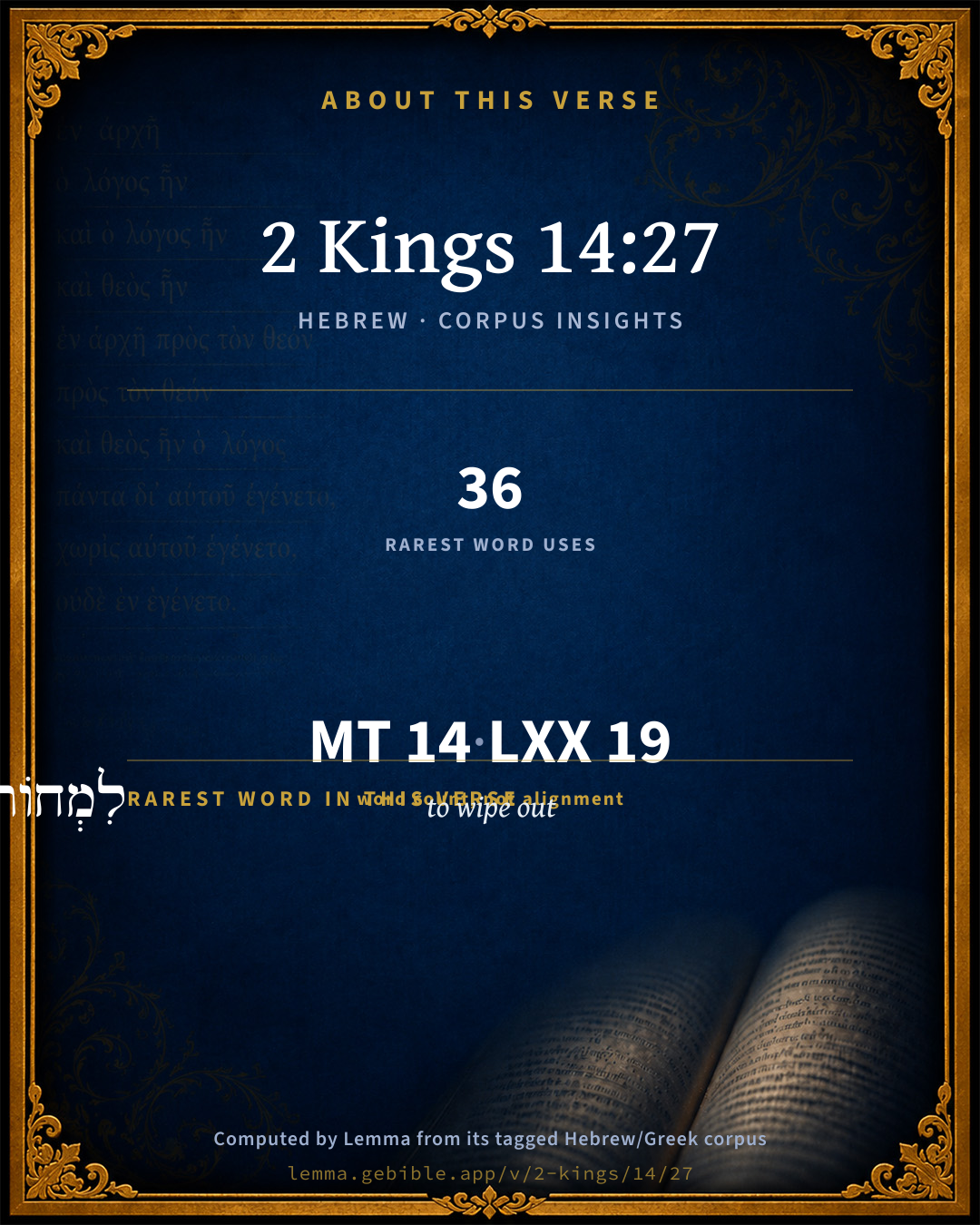
לִמְחוֹת֙ to wipe out H4229 occurs in 32 verses of the Hebrew Bible. Also found in:

Grammatical profile

  • 3 verbs
  • 8 nouns
  • 1 preposition
  • 2 particles

Verb forms

  • דִבֶּ֣ר Piel · Perfect
  • לִמְחוֹת֙ Qal · Infinitive Construct
  • וַיּ֣וֹשִׁיעֵ֔ם Hiphil · Sequential Imperfect

Hebrew & Septuagint length

In English translation the verse runs 29 words from the Hebrew and 30 from the Septuagint (LXX English) — closely comparable.

A rough comparison of the two English renderings, which tokenize alike — not a word-level alignment.

Word counts can differ between the Hebrew and the Greek without any difference in meaning — e.g. the Hebrew direct-object marker אֵת has no separate Greek word, and Greek often adds the article ὁ.

In the original languages it is 14 Hebrew tokens and 19 Greek tokens — but the two are counted differently (Hebrew bundles its prefixes and suffixes into one token; the Greek is in lemma form), so that isn’t a like-for-like length.

Cross-references

12

Topical passages linked to 2 Kings 14:27 in the Treasury of Scripture Knowledge — connected by theme and wording, ordered by reader-vote popularity; previews shown in the World English Bible.

  • 2 Kings 13:23 But Yahweh was gracious to them, and had compassion on them, and had respect to them, because of his covenant with Abraham, Isaac, and Jacob, and would not destroy them, neither cast he them from his presence as yet.
  • 2 Kings 13:5 (Yahweh gave Israel a savior, so that they went out from under the hand of the Syrians; and the children of Israel lived in their tents as before.
  • Exodus 32:32–33 Yet now, if you will, forgive their sin-- and if not, please blot me out of your book which you have written."
  • Deuteronomy 9:14 let me alone, that I may destroy them, and blot out their name from under the sky; and I will make of you a nation mightier and greater than they.
  • Deuteronomy 25:19 Therefore it shall be, when Yahweh your God has given you rest from all your enemies round about, in the land which Yahweh your God gives you for an inheritance to possess it, that you shall blot out the memory of Amalek from under the sky; you shall not forget.
  • Deuteronomy 29:20 Yahweh will not pardon him, but then the anger of Yahweh and his jealousy will smoke against that man, and all the curse that is written in this book shall lie on him, and Yahweh will blot out his name from under the sky.
  • 2 Kings 5:1 Now Naaman, captain of the host of the king of Syria, was a great man with his master, and honorable, because by him Yahweh had given victory to Syria: he was also a mighty man of valor, [but he was] a leper.
  • Psalms 69:28 Let them be blotted out of the book of life, And not be written with the righteous.
  • Hosea 1:6–7 She conceived again, and bore a daughter. Then he said to him, "Call her name Lo-Ruhamah; for I will no longer have mercy on the house of Israel, that I should in any way pardon them.
  • Romans 11:2–12 God didn't reject his people, which he foreknew. Or don't you know what the Scripture says about Elijah? How he pleads with God against Israel:
  • Titus 3:4–6 But when the kindness of God our Savior and his love toward mankind appeared,
  • Revelation 3:5 He who overcomes will be arrayed in white garments, and I will in no way blot his name out of the book of life, and I will confess his name before my Father, and before his angels.

Cross-references courtesy of OpenBible.info (CC BY 4.0).

Hebrew and Greek witnesses Masoretic Hebrew ↔ Greek Septuagint

The same verse in the two great witnesses to the Old Testament, shown verse-for-verse.

These are two independent witnesses, not word-aligned to each other, and the Septuagint is shown in lemma (dictionary) form.

Hebrew 2 Kings 14:27 Masoretic · Westminster Leningrad Codex

וְלֹא דִבֶּ֣ר יְהוָ֔ה לִמְחוֹת֙ אֶת שֵׁ֣ם יִשְׂרָאֵ֔ל מִתַּ֖חַת הַשָּׁמָ֑יִם וַיּ֣וֹשִׁיעֵ֔ם בְּיַ֖ד יָרָבְעָ֥ם בֶּן יוֹאָֽשׁ

Yahweh didn't say that he would blot out the name of Israel from under the sky; but he saved them by the hand of Jeroboam the son of Joash.

World English Bible · Public Domain

Greek LXX 2 Kings 14:27 Septuagint · lemma form

καί οὐ λαλέω κύριος ἐκἀλείφω ὁ σπέρμα ἰσραήλ ὑποκάτωθεν ὁ οὐρανός καί σώζω αὐτός διά χείρ ιεροβοαμ υἱός ιωας

And the Lord said that he would not blot out the seed of Israel from under heaven; so he delivered them by the hand of Jeroboam the son of Joas.

LXX2012 (modern English Septuagint) · Public Domain

Hebrew: Westminster Leningrad Codex (CC BY 4.0). Greek: Septuagint (public domain); English from LXX2012 (modern English Septuagint) (Public Domain). How the Septuagint differs from the Hebrew →

Targum (Aramaic paraphrase)

1

The Targum is the ancient Jewish Aramaic paraphrase of the Hebrew Scriptures — an interpretive translation, not the Hebrew text itself. Onkelos (literal) and Pseudo-Jonathan (expansive) render the Torah, and Jonathan the Prophets. Coverage is partial: where no permissively-licensed English translation exists for a verse, only the Aramaic is shown. This is verse-level text, not a word-by-word alignment to the Hebrew.

  1. Targum Jonathan Prophets (Joshua–Malachi)
    וְלָא הֲוָה רַעֲוָא קֳדָם יְיָ לְמִימְחֵי יַת שְׁמָא דְיִשְׂרָאֵל מִתְּחוֹת שְׁמַיָא וּפָרְקִינוּן עַל יְדֵי יָרָבְעָם בַּר יוֹאָשׁ:

    (no public-domain English translation for this verse)

    Targum Jonathan — Aramaic: “Mikraot Gedolot” (public domain). English: “Sefaria Community Translation” (CC0 1.0 (public-domain dedication)); “London "Chaldee Paraphrase," 1871” (public domain). Text via Sefaria.

Commentary

Notes on 2 Kings 14:27 from classic Christian and Jewish commentators (each source and its license shown beneath its notes). The classic Christian expositions comment on the surrounding passage and are grouped to its opening verse, so a note may address several verses; the Jewish commentaries on the Tanakh (Rashi and others) are per-verse, so they appear only where the commentator wrote on this verse.

Lemma curates 59 commentaries, every one of them public domain or Creative Commons licensed, each selected and text-cleaned for this edition rather than reprinted as found. About our sources →

Trapp's Complete Commentary

John Trapp

2Ki 14:27 And the LORD said not that he would blot out the name of Israel from under heaven: but he saved them by the hand of Jeroboam the son of Joash.

Ver. 27. And the Lord said not.] Yet afterwards he both said it, {Hos 1:6; Hos 1:9} and did it. {2Ki 17:18}

John Trapp, A Commentary or Exposition upon All the Books of the Old and New Testament (1647–1656) — public domain. Text from a community e-Sword module.

Geneva Bible (1599)

Geneva Bible translators

Hebrew, had not spoken.

Geneva Bible (1599) marginal notes — public domain. Text via Bolls.life.

Ellicott's Commentary for English Readers

(27) Said not.—By any prophet.

Blot out the name.—The figure is taken from blotting out writing. (Comp. Num_5:23.) The Hebrews used inks that soon faded, and could easily be wiped off the parchment (Hence the partial obliteration of words and letters which is one of the causes of textual corruption.)

A Bible Commentary for English Readers, edited by Charles John Ellicott (1878–1897) — public domain. Text from a community e-Sword module.

The Cambridge Bible for Schools and Colleges

gen. ed. J. J. S. Perowne

27. And the Lord said not] i.e. As yet the doom of Israel was not fixed. There was yet a place of repentance left.

but he saved them] Jeroboam was the saviour spoken of in 2Ki_13:5. See note there.

The Cambridge Bible for Schools and Colleges (gen. ed. J. J. S. Perowne; Cambridge University Press, 1878–1918) — public domain. Text from a community e-Sword module.

Albert Barnes' Notes on the Bible

And the Lord said not - Though the Israelites were brought thus low, yet the fiat did not as yet go forth for their destruction. God did not send a prophet to say that He would blot out the name of Israel from under heaven; but on the contrary sent two to announce that they should be delivered from their present enemies, and obtain triumphs over them (see 2Ki 14:25; 2Ki 13:17-19).

That he would blot out ... - This is a Mosaic phrase, found only here and in Deuteronomy 2Ki 9:14; 29:20.

Albert Barnes' Notes on the Bible (1834–1885) — public domain. Text from a community e-Sword/MySword module.

Haydock's Catholic Bible Commentary

Israel, like Amalec, 1 Kings xv. 3. (Menochius)

George Leo Haydock (1774–1849), Haydock's Catholic Family Bible and Commentary, 1859 edition — public domain. Excludes Psalms (Douay-Rheims chapter numbering differs from Protestant) and Deuterocanonical books (Catholic canon only).

Matthew Poole's English Annotations

The Lord said not, i.e. not yet; he had not yet declared this, as afterwards he did by the succeeding prophets, though not in those words. See Hos 1:5,6,9.

Matthew Poole's English Annotations on the Holy Bible (1683–1685) — public domain. Text from a community e-Sword/MySword module.

Whedon's Commentary on the Bible

Daniel D. Whedon

27. The Lord said not — Not yet had gone forth the oracle of judgment, for still he cared for them in mercy because of his covenant with the ancient fathers. Compare 2Ki_13:23. But there soon came a time when the Divine compassion ceased, and the prophets Hosea, Amos, Micah, and others, foretold the ruin of Israel.

Saved them by the hand of Jeroboam — Notwithstanding his wickedness and devotion to the calf-worship at Beth-el and Dan, God used him as an instrument to smite the Syrian power.

Daniel D. Whedon (gen. ed.), Commentary on the Old and New Testaments (1874–1909) — public domain. Text from a community e-Sword module.

The Pulpit Commentary

And the Lord said not that he would blot out the name of Israel from under heaven. God"s decision under the circumstances was not, as it well might have been, considering Israel"s ill desert, to blot out forthwith the very name of Israel from the earth. On the contrary, he gave the nation a breathing-space, a gleam of light, a second summer before the winter set in a further opportunity of repenting and turning to him with all their hearts if they would only have taken advantage of it, a chance of redeeming the past and reestablishing themselves in his favor. He might well have destroyed them at this time if he had looked only to considerations of justice, if in his wrath he had not thought upon mercy. But he saved them; i.e. he gave them the deliverance promised first by Elisha, (2Ki_13:17) and then by Jonah the son of Amittai (ver. 25) deliverance from Syria, recovery of their borders, and triumph overtheir enemies. He gave them all this by the hand of Jeroboam the son of Joash. Joash began the salvation, but it was reserved for Jeroboam to complete it. He was the true "savior", (2Ki_13:5) the true accomplisher of the work, for which his father only paved the way. Thus one Jeroboam founded the kingdom; another refounded it, restored its ancient glories, and gave it its old dimensions.

The Pulpit Commentary (1880–1919), ed. H.D.M. Spence-Jones & Joseph S. Exell — public domain. Text from a community e-Sword module.

John Wesley's Explanatory Notes

Said not - Not yet; he had not yet declared this, as afterwards he did by the succeeding prophets.

John Wesley, Explanatory Notes Upon the Whole Bible (1754–1765) — public domain. Text via the GEBible commentary corpus.

Lesson kit

Teaching starters — assembled from the data on this page, not authored interpretation. Every prompt links to the verse data it draws on. Edit before teaching.

2 Kings, in the Historical, opens this verse with 14 words (14 distinct Hebrew lemmas). Its most distinctive word is mâchâh (“to wipe out”). A historical commentator’s framing appears above. Read the whole chapter for the surrounding context.

Discussion questions

  1. What does “to wipe out” (mâchâh) contribute to the verse as a whole?
  2. Genesis 6:7 shares the word «to wipe out» with this verse. How do the two illuminate each other?
  3. The translations on this page render this verse differently — a whole-verse word diff, not a word-by-word alignment. What might account for the different wordings?
  4. The verb «דִבֶּ֣ר» is Piel Perfect. How does its form color the action?
  5. Reading how Trapp's Complete Commentary and Geneva Bible (1599) read this verse, where do the two commentators agree and where do they part?

Things to notice

Reading settings

Reading text

Shown beneath each verse's original-language words.

Old Testament
Old Testament edition

Read the OT as the Masoretic Hebrew (MT) or the Greek Septuagint (LXX).

English shown for the Greek Septuagint (in the Hebrew ↔ Greek comparison).

Comparing translations? Open the Compare panel on any verse page to stack up to four side by side.