2 Kings 15:23

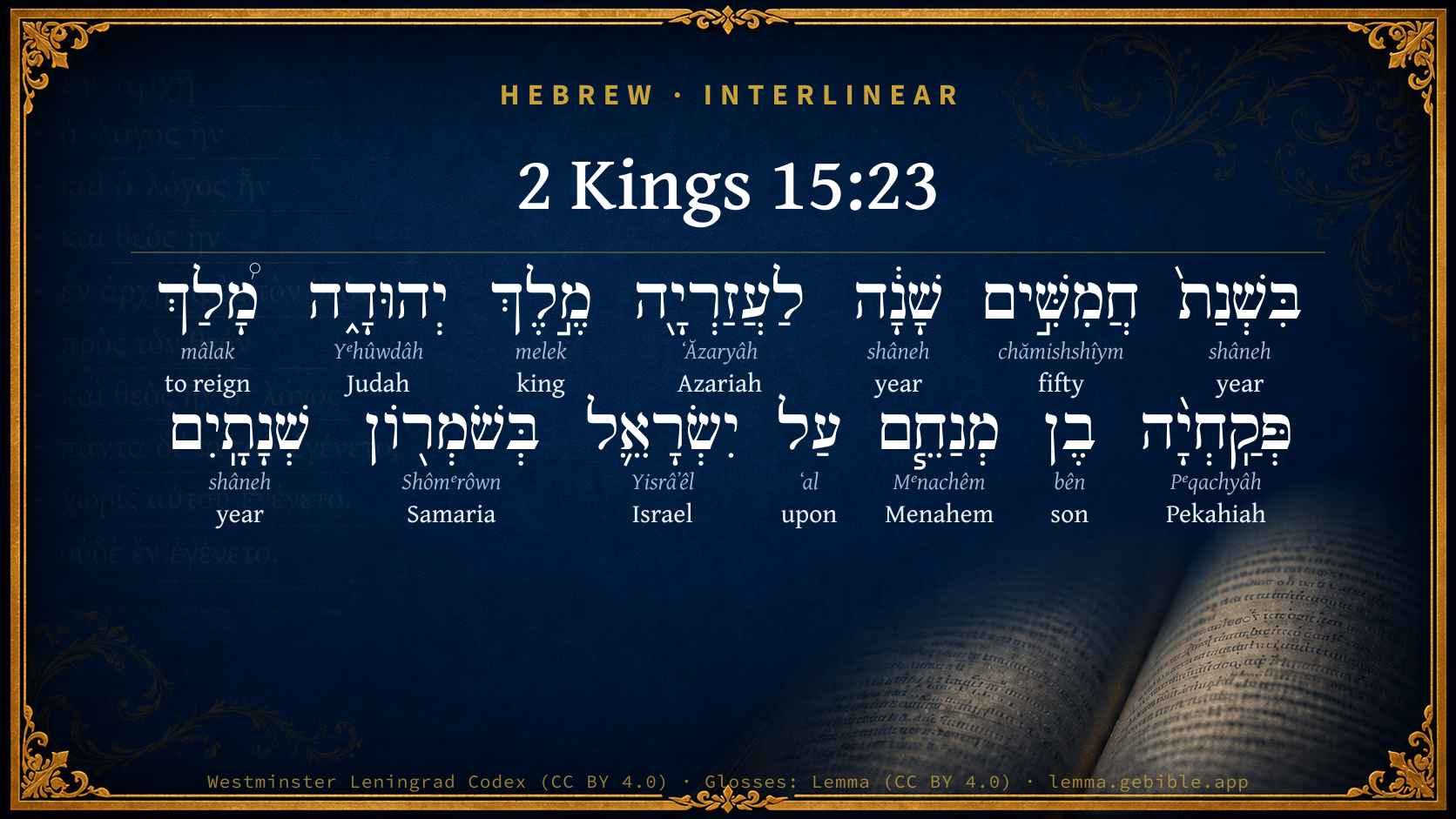
Hebrew (Westminster Leningrad Codex) 2 Kings 15:23 appears in the Hebrew Old Testament. The text above is from the Westminster Leningrad Codex. Each word links to its Strong’s number, a concise gloss, and parsing drawn from the Open Scriptures Hebrew Bible morphology. Click any word for its full Brown-Driver-Briggs (BDB) entry.
Download image
Cite this verse

2 Kings 15:23 (World English Bible). Public Domain. Lemma interlinear Bible study tool, https://lemma.gebible.app/v/2-kings/15/23.

Show BibTeX & RIS
BibTeX
RIS
English Translation
In the fiftieth year of Azariah king of Judah Pekahiah the son of Menahem began to reign over Israel in Samaria, [and reigned] two years.
World English Bible · Public Domain
Download a study sheet

One document with this verse’s original text, its word-by-word gloss line, the meaning frame, cross-references with their text, attributed commentary, and full source and license credits — printable, and it pastes into notes with its structure intact.

This verse Autodidact and up

Study sheet (.html) Plain text (.txt)

A passage Seminary Student

Up to 50 verses in one chapter. A passage sheet keeps up to 6 commentary sources and 12 cross-references per verse, in the order this page ranks them, and says so on the sheet whenever that leaves anything out. Ask for a single verse and you get the Autodidact verse sheet above.

Everything on this page stays free to read, with no account — the sheet is a download of what is already on screen, not access to it.

Want to remove ads? Support Godless Engineer
Compare translations 3

The same verse in 3 English versions, stacked beneath the original-language interlinear above. Click any original word for its lexicon entry.

Each is an independent rendering of the whole verse — the interlinear is not word-aligned to these translations.

Highlighted words mark where these versions differ — a whole-verse word diff, not a word-by-word alignment.

  • World English Bible Public Domain
    In the fiftieth year of Azariah king of Judah Pekahiah the son of Menahem began to reign over Israel in Samaria, [and reigned] two years.
  • King James Version Public Domain
    In the fiftieth year of Azariah king of Judah Pekahiah the son of Menahem began to reign over Israel in Samaria, and reigned two years.
  • unfoldingWord Literal Text CC BY-SA 4.0
    In the year of 50, the year to Azariah, the king of Judah, Pekahiah, the son of Menahem, reigned over Israel in Samaria, two years.

unfoldingWord Literal Text — © unfoldingWord, licensed CC BY-SA 4.0. Word-aligned USFM3 via Door43 (git.door43.org/unfoldingWord/en_ult).

Versions to compare (up to 4)

3 of 4 selected

Show all 18 translations

Every available English version of this verse, each an independent rendering of the whole verse.

  • World English Bible Public Domain
    In the fiftieth year of Azariah king of Judah Pekahiah the son of Menahem began to reign over Israel in Samaria, [and reigned] two years.
  • Berean Standard Bible Public Domain
    In the fiftieth year of Azariah’s reign over Judah, Pekahiah son of Menahem became king of Israel and reigned in Samaria two years.
  • Majority Standard Bible Public Domain
    In the fiftieth year of Azariah’s reign over Judah, Pekahiah son of Menahem became king of Israel and reigned in Samaria two years.
  • King James Version Public Domain
    In the fiftieth year of Azariah king of Judah Pekahiah the son of Menahem began to reign over Israel in Samaria, and reigned two years.
  • American Standard Version (1901) Public Domain
    In the fiftieth year of Azariah king of Judah Pekahiah the son of Menahem began to reign over Israel in Samaria, `and reigned' two years.
  • Revised Version (1885) Public Domain
    In the fiftieth year of Azariah king of Judah Pekahiah the son of Menahem began to reign over Israel in Samaria, and reigned two years.
  • Geneva Bible (1599) Public Domain
    In ye fiftieth yere of Azariah king of Iudah, began Pekahiah the sonne of Menahem to reigne ouer Israel in Samaria, and reigned two yere.
  • Douay-Rheims (1899) Public Domain
    In the fiftieth year of Azarias king of Juda reigned Phaceia the son of Manahem over Israel in Samaria two years.
  • Young's Literal Translation Public Domain
    In the fiftieth year of Azariah king of Judah hath Pekahiah son of Menahem reigned over Israel, in Samaria -- two years,
  • Literal Standard Version CC BY-SA 4.0
    In the fiftieth year of Azariah king of Judah, Pekahiah son of Menahem has reigned over Israel in Samaria, two years,
  • Unlocked Literal Bible CC BY-SA 4.0
    In the fiftieth year of Azariah king of Judah, Pekahiah son of Menahem began to reign over Israel in Samaria; he reigned two years.
  • unfoldingWord Literal Text CC BY-SA 4.0
    In the year of 50, the year to Azariah, the king of Judah, Pekahiah, the son of Menahem, reigned over Israel in Samaria, two years.
  • Darby Bible Public Domain
    In the fiftieth year of Azariah king of Judah, Pekahiah the son of Menahem began to reign over Israel in Samaria, for two years.
  • World Messianic Bible Public Domain
    In the fiftieth year of Azariah king of Judah, Pekahiah the son of Menahem began to reign over Israel in Samaria for two years.
  • Webster's Bible Public Domain
    In the fiftieth year of Azariah king of Judah, Pekahiah the son of Menahem began to reign over Israel in Samaria, and reigned two years.
  • Free Bible Version CC BY-SA 4.0
    Pekahiah, son of Menahem, became king of Israel in Samaria in the fiftieth year of the reign of King Azariah of Judah, and he reigned for two years.
  • Bible in Basic English Public Domain
    In the fiftieth year of Azariah king of Judah, Pekahiah, the son of Menahem, became king over Israel in Samaria, ruling for two years.
  • JPS Tanakh (1917) Public Domain
    In the fiftieth year of Azariah king of Judah Pekahiah the son of Menahem began to reign over Israel in Samaria, and reigned two years.

Literal Standard Version (2020), Covenant Press — licensed CC BY-SA 4.0. Text via the HelloAO Bible API (eBible.org). Unlocked Literal Bible (unfoldingWord) — licensed CC BY-SA 4.0. Text via the HelloAO Bible API (eBible.org). unfoldingWord Literal Text — © unfoldingWord, licensed CC BY-SA 4.0. Word-aligned USFM3 via Door43 (git.door43.org/unfoldingWord/en_ult). Free Bible Version, Dr. Jonathan Gallagher — licensed CC BY-SA 4.0. Text via the HelloAO Bible API (eBible.org).

Word by word

More ways to search: Search by grammar → Find every occurrence → Compare this word →

Practice this passage: Drill this verse → Learn its vocabulary →

פְּקַֽחְיָ֨ה
Pᵉqachyâh
H6494
“Pekahiah”
Noun, Proper
Part of Speech
Noun
Type
Proper
Full BDB Definition

Origin: from H6491 and H3050

TWOT: None

Pekahiah = "Jehovah sees" - son of king Menahem of the northern kingdom of Israel, succeeded to the throne as the 17th king and ruled for 2 years when he was murdered by one of the captains of his army, Pekah
  1. בִּשְׁנַת֙ shâneh H8141 “in/at · year of” Preposition + Noun, Common, Feminine, Singular, Construct
  2. חֲמִשִּׁ֣ים chămishshîym H2572 “fifty” Adjective, Cardinal number, Both, Plural, Absolute
  3. שָׁנָ֔ה shâneh H8141 “year” Noun, Common, Feminine, Singular, Absolute
  4. לַעֲזַרְיָ֖ה ʻĂzaryâh H5838 “to/for · Azariah” Preposition + Noun, Proper
  5. מֶ֣לֶךְ melek H4428 “king of” Noun, Common, Masculine, Singular, Construct
  6. יְהוּדָ֑ה Yᵉhûwdâh H3063 “Judah” Noun, Proper
  7. מָ֠לַךְ mâlak H4427 “to reign” Verb, Qal, Perfect, 3rd Person, Masculine, Singular
  8. בֶן bên H1121 “son of” Noun, Common, Masculine, Singular, Construct
  9. מְנַחֵ֧ם Mᵉnachêm H4505 “Menahem” Noun, Proper
  10. עַל ʻal H5921 “upon” Preposition
  11. יִשְׂרָאֵ֛ל Yisrâʼêl H3478 “Israel” Noun, Proper
  12. בְּשֹׁמְר֖וֹן Shômᵉrôwn H8111 “in/at · Samaria” Preposition + Noun, Proper
  13. שְׁנָתָֽיִם shâneh H8141 “years” Noun, Common, Feminine, Dual, Absolute

About this verse

These counts appear in no published source. They are computed here, from the morphology-tagged text and Lemma’s own curated glosses. What Lemma adds →

14
words
12
distinct lemmas
Historical
section

Notable vocabulary

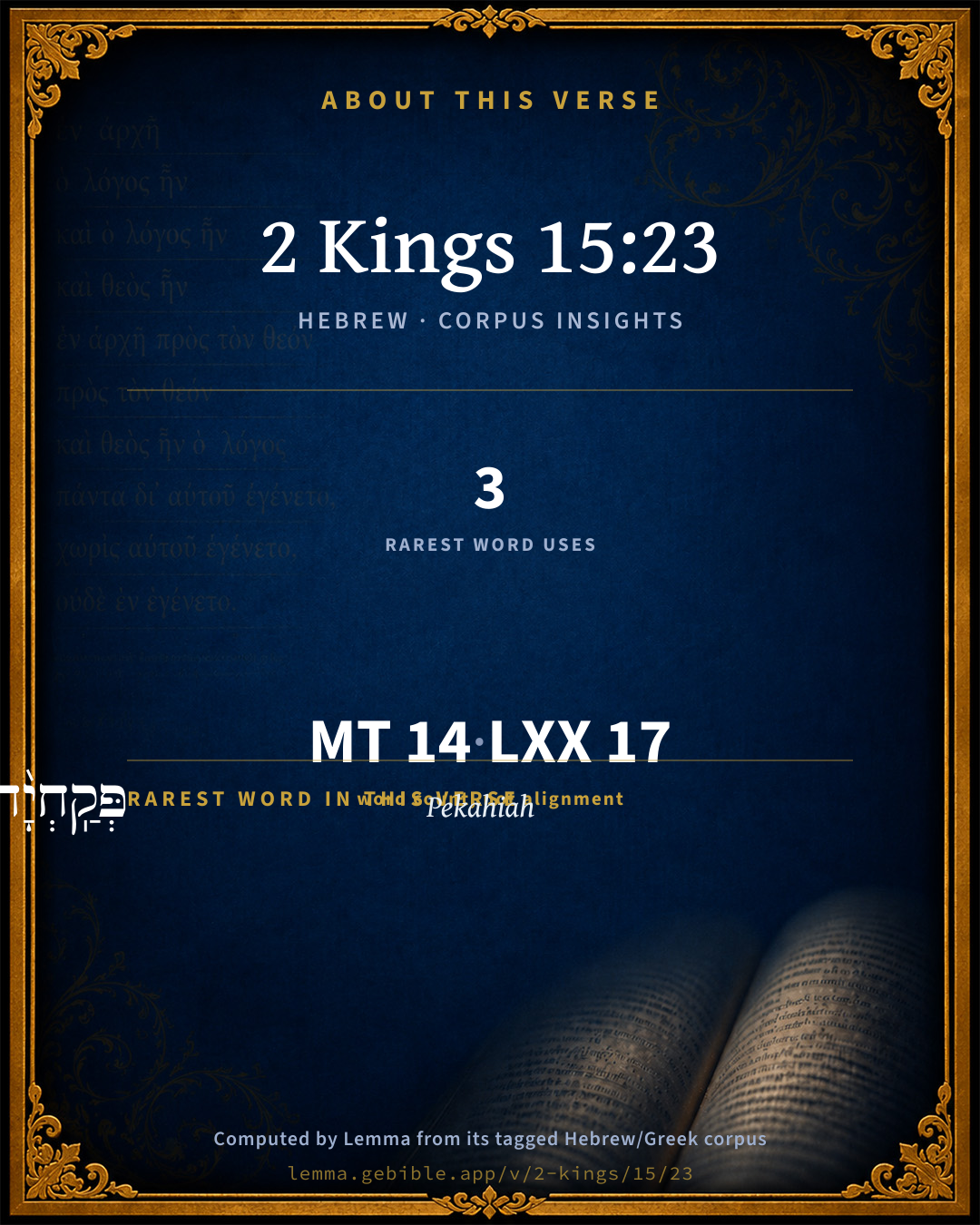
The rarest word here is פְּקַֽחְיָ֨ה Pekahiah H6494 — appearing just 3 times in the whole Hebrew Bible.

Shared distinctive vocabulary

פְּקַֽחְיָ֨ה Pekahiah H6494 occurs in 3 verses of the Hebrew Bible. Also found in:

Grammatical profile

  • 1 verb
  • 11 nouns
  • 1 adjective
  • 1 preposition

Verb forms

  • מָ֠לַךְ Qal · Perfect

Repetition

A word recurs within this verse — often emphatic in Hebrew:

  • בִּשְׁנַת֙ year H8141 ×3

Hebrew & Septuagint length

In English translation the verse runs 25 words from the Hebrew and 23 from the Septuagint (LXX English) — closely comparable.

A rough comparison of the two English renderings, which tokenize alike — not a word-level alignment.

Word counts can differ between the Hebrew and the Greek without any difference in meaning — e.g. the Hebrew direct-object marker אֵת has no separate Greek word, and Greek often adds the article ὁ.

In the original languages it is 14 Hebrew tokens and 17 Greek tokens — but the two are counted differently (Hebrew bundles its prefixes and suffixes into one token; the Greek is in lemma form), so that isn’t a like-for-like length.

Cross-references

5

Topical passages linked to 2 Kings 15:23 in the Treasury of Scripture Knowledge — connected by theme and wording, ordered by reader-vote popularity; previews shown in the World English Bible.

  • 1 Kings 15:25 Nadab the son of Jeroboam began to reign over Israel in the second year of Asa king of Judah; and he reigned over Israel two years.
  • 1 Kings 16:8 In the twenty-sixth year of Asa king of Judah began Elah the son of Baasha to reign over Israel in Tirzah, [and reigned] two years.
  • 1 Kings 22:51 Ahaziah the son of Ahab began to reign over Israel in Samaria in the seventeenth year of Jehoshaphat king of Judah, and he reigned two years over Israel.
  • 2 Kings 21:19 Amon was twenty-two years old when he began to reign; and he reigned two years in Jerusalem: and his mother's name was Meshullemeth the daughter of Haruz of Jotbah.
  • Job 20:5 That the triumphing of the wicked is short, The joy of the godless but for a moment?

Cross-references courtesy of OpenBible.info (CC BY 4.0).

Hebrew and Greek witnesses Masoretic Hebrew ↔ Greek Septuagint

The same verse in the two great witnesses to the Old Testament, shown verse-for-verse.

These are two independent witnesses, not word-aligned to each other, and the Septuagint is shown in lemma (dictionary) form.

Hebrew 2 Kings 15:23 Masoretic · Westminster Leningrad Codex

בִּשְׁנַת֙ חֲמִשִּׁ֣ים שָׁנָ֔ה לַעֲזַרְיָ֖ה מֶ֣לֶךְ יְהוּדָ֑ה מָ֠לַךְ פְּקַֽחְיָ֨ה בֶן מְנַחֵ֧ם עַל יִשְׂרָאֵ֛ל בְּשֹׁמְר֖וֹן שְׁנָתָֽיִם

In the fiftieth year of Azariah king of Judah Pekahiah the son of Menahem began to reign over Israel in Samaria, [and reigned] two years.

World English Bible · Public Domain

Greek LXX 2 Kings 15:23 Septuagint · lemma form

ἐν ἔτος πεντηκοστός ὁ αζαριας βασιλεύς ιουδα βασιλεύω φακεϊας υἱός μαναημ ἐπί ἰσραήλ ἐν σαμαρεία δύο ἔτος

In the fifties year of Azarias king of Juda, began Phakesias the son of Manaem to reign over Israel in Samaria two years.

LXX2012 (modern English Septuagint) · Public Domain

On this verse, Ellicott's Commentary for English Readers discusses the Septuagint’s reading. Read the note in Commentary ↓

Hebrew: Westminster Leningrad Codex (CC BY 4.0). Greek: Septuagint (public domain); English from LXX2012 (modern English Septuagint) (Public Domain). How the Septuagint differs from the Hebrew →

Targum (Aramaic paraphrase)

1

The Targum is the ancient Jewish Aramaic paraphrase of the Hebrew Scriptures — an interpretive translation, not the Hebrew text itself. Onkelos (literal) and Pseudo-Jonathan (expansive) render the Torah, and Jonathan the Prophets. Coverage is partial: where no permissively-licensed English translation exists for a verse, only the Aramaic is shown. This is verse-level text, not a word-by-word alignment to the Hebrew.

  1. Targum Jonathan Prophets (Joshua–Malachi)
    בִּשְׁנַת חַמְשִׁין שְׁנִין לַעֲזַרְיָה מֶלֶךְ שִׁבְטָא דְבֵית יְהוּדָה מְלַךְ פְּקַחְיָה בַּר מְנַחֵם עַל יִשְׂרָאֵל בְּשֹׁמְרוֹן תַּרְתֵּין שְׁנִין:

    (no public-domain English translation for this verse)

    Targum Jonathan — Aramaic: “Mikraot Gedolot” (public domain). English: “Sefaria Community Translation” (CC0 1.0 (public-domain dedication)); “London "Chaldee Paraphrase," 1871” (public domain). Text via Sefaria.

Commentary

Notes on 2 Kings 15:23 from classic Christian and Jewish commentators (each source and its license shown beneath its notes). The classic Christian expositions comment on the surrounding passage and are grouped to its opening verse, so a note may address several verses; the Jewish commentaries on the Tanakh (Rashi and others) are per-verse, so they appear only where the commentator wrote on this verse.

Lemma curates 59 commentaries, every one of them public domain or Creative Commons licensed, each selected and text-cleaned for this edition rather than reprinted as found. About our sources →

Trapp's Complete Commentary

John Trapp

2Ki 15:23 In the fiftieth year of Azariah king of Judah Pekahiah the son of Menahem began to reign over Israel in Samaria, [and reigned] two years.

Ver. 23. Reigned two years.] Not ten years, as Drusius affirmeth. {a}

{a} Regnavit annos decem.

John Trapp, A Commentary or Exposition upon All the Books of the Old and New Testament (1647–1656) — public domain. Text from a community e-Sword module.

Whedon's Commentary on the Bible

Daniel D. Whedon

REIGN OF PEKAHIAH, 2Ki_15:23-26.

23. The fiftieth year — According to 2Ki_15:17, Menahem must have died in the forty-ninth year of Azariah, so that perhaps several months elapsed before his son became the acknowledged king. Perhaps, as Keil suggests, his right to the throne was contested.

Daniel D. Whedon (gen. ed.), Commentary on the Old and New Testaments (1874–1909) — public domain. Text from a community e-Sword module.

Tyndale Open Study Notes

Tyndale Open Resources

15:23-25 Menahem’s son Pekahiah reigned only two years before Pekah conspired to assassinate him. Pekahiah continued the sins associated with the religious policies initiated by Jeroboam I (1 Kgs 12:26-33). Pekah, an army commander, had apparently been a rival for the throne for some time.

Tyndale Open Study Notes — © Tyndale Open Resources, licensed CC BY-SA 4.0. Text via the HelloAO Bible API.

Jamieson, Fausset & Brown

Robert Jamieson, A. R. Fausset & David Brown

PEKAHIAH'S REIGN. (Kg2 15:22-24)

Pekahiah . . . son of Menahem began to reign--On comparing the date given with Azariah's reign, it seems that several months had intervened between the death of Menahem and the accession of Pekahiah, probably owing to a contest about the throne.

Jamieson, Fausset & Brown — Commentary Critical and Explanatory on the Whole Bible (1871) — public domain (CC PDM 1.0). Text via the HelloAO Bible API.

Ellicott's Commentary for English Readers

(23-26) THE REIGN OF PEKAHIAH

(Heb., Pĕkahyâh).

(23) In the fiftieth year.—The forty-ninth, if verse seventeen were exact.

(25) But . . . a captain of his.—And . . . his adjutant (or knight, 2Ki_7:2).

The palace of the king’s house.—The same expression occurred in 1Ki_16:18. The word armôn, rendered “palace,” is usually explained as meaning citadel or keep, from a root meaning to be high. (Comp. ἡ ἄκρα in Greek.) Ewald makes it the harem, which, as the innermost and most strongly-guarded part of an Oriental palace, is probably meant here. Thither Pekahiah had fled for refuge before the conspirators.

With Argob and Arieh.—Pekah slew these two persons, probably officers of the royal guard, who stood by their master, as well as the king himself.

The peculiar names are an indication of the historical character of the account. Argob suggests that the person who bore this name was a native of the district of Bashan so designated (1Ki_4:13); Arieh (“lion”), like our own Cceur-de-Lion, betokens strength and bravery. (Comp. 1Ch_12:8, “The Gadites, whose faces were as the faces of lions.”)

And with him fifty men of the Gileadites.—Or, and with him were fifty, &c. Pekah was supported by fifty soldiers, probably of the royal guard. Menahem himself was of Gadite origin (2Ki_15:17), and so belonged to Gilead. He would therefore be likely to recruit his body-guard from among the Gileadites, who were always famous for their prowess. (Comp. Jos_17:1; Jdg_11:12; 1Ch_26:31.) The two names Argob and Arieh agree with this supposition. The LXX. reads, in place of “the Gileadites,” ἀπὸ τῶν τετρακοσίων, “of the four hundred,” which reminds us of David’s six hundred Gibbôrîm (2Sa_15:18).

Josephus accounts for the short reign of Pekahiah by the statement that he imitated the cruelty of his father.

A Bible Commentary for English Readers, edited by Charles John Ellicott (1878–1897) — public domain. Text from a community e-Sword module.

John Gill's Exposition

Five and twenty years old was he when he began to reign,.... Alone, after the death of his father:

and he reigned sixteen years in Jerusalem; and his reign, upon the whole, was a good reign:

and his mother's name was Jerusha, the daughter of Zadok; a person well known in those times; Dr. Lightfoot (h) thinks he was high priest.

(h) Works, vol. 1. p. 100.

John Gill's Exposition of the Whole Bible (1746–1763) — public domain (CC PDM 1.0). Text via the HelloAO Bible API.

The Pulpit Commentary

Vers. 23-26. SHORT REIGN OF PEKA-HIAH. The short reign of Pekahiah was wholly undistinguished. He held the throne for two years only, or perhaps for parts of two years, and performed no action that any historian has thought worthy of record. Our author has nothing to relate of him but the circumstances of his death (ver. 25), wherewith he combines the usual formulae (vers. 23, 24, 26).

The Pulpit Commentary (1880–1919), ed. H.D.M. Spence-Jones & Joseph S. Exell — public domain. Text from a community e-Sword module.

Keil & Delitzsch

C. F. Keil & F. Delitzsch

Reign of Pekahiah. - Pekahiah the son of Menahem began to reign "in the fiftieth year of Uzziah." As Menahem had begun to reign in the thirty-ninth year of Uzziah and reigned ten years, he must have died in the forty-ninth year of Uzziah; and therefore, if his son did not become king till the fiftieth year, some months must have elapsed between the death of Menahem and Pekahiah's ascent of the throne, probably cause, in the existing disorganization of the kingdom, the possession of the throne by the latter was opposed. Pekahiah reigned in the spirit of his predecessors, but only for two years, as his aide-de-camp (שׁלישׁ, see at Sa2 23:8) Pekah conspired against him and slew him in the citadel (ארמון, see at Kg1 16:8) of the king's palace, with Argob and Aryeh. Argob and Aryeh were not fellow-conspirators of Pekah, who helped to slay the king, but principes Pekachijae, as Seb. Schmidt expresses it, probably aides-de-camp of Pekahiah, who were slain by the conspirators when defending their king. We must take the words in this sense on account of what follows: וגו חמשּׁים ועמּו, "and with him (Pekah) were fifty men of the Gileadites" (i.e., they helped him). The Gileadites probably belonged to the king's body-guard, and were under the command of the aides-de-camp of Pekah.

Keil & Delitzsch — Biblical Commentary on the Old Testament (1861–1891) — public domain (CC PDM 1.0). Text via the HelloAO Bible API. (Old Testament only.)

Kretzmann's Popular Commentary

Paul E. Kretzmann

Pekahiah and Pekah in Israel

v. 23. In the fiftieth year of Azariah, king of Judah, probably after some months of anarchistic turmoil, Pekahiah, the son of Menahem, began to reign over Israel in Samaria, and reigned two years.

v. 24. And he did that which was evil in the sight of the Lord; he departed not from the sins of Jeroboam, the son of Nebat, who made Israel to sin, his idolatry with the calves having persisted through all the history of Israel.

v. 25. But Pekah, the son of Remaliah, a captain of his, the king’s adjutant, conspired against him, and smote him in Samaria, in the palace of the king’s house, the fortified part of his palace, where he had fled at the approach of the conspirators, with Argob and Arieh, who, as high officials faithful to Pekahiah, were killed with him, and with him, on the side of Pekah, fifty men of the Gileadites; and he killed him, and reigned in his room.

v. 26. And the rest of the acts of Pekahlah, and all that he did, behold, they are written in the Book of the Chronicles of the Kings of Israel.

v. 27. In the two and fiftieth year of Azariah, king of Judah, Pekah, the son of Remaliah, began to reign over Israel in Samarla, and reigned twenty years, his accession to the throne following his assassination of the king.

v. 28. And he did that which was evil in the sight of the Lord; he departed not from the sins of Jeroboam, the son of Nebat, who made Israel to sin, the constantly recurring phrase serving to draw attention to this continual defection of the ruler and the nation.

v. 29. In the days of Pekah, king of Israel, came Tiglath-pileser, king of Assyria, and took Ijon, and Abel-beth-maachah, and Janoah, and Kedesh, and Hazor, and Gilead, and Galilee, all the land of Naphtali, with some of the districts on its boundary,and carried them captive to Assyria. This was the beginning of Israel’s end.

v. 30. And Hoshea, the son of Elah, evidently as a result of this Assyrian campaign, made a conspiracy against Pekah, the son of Remaliah, and smote him, and slew him, and reigned in his stead, in the twentieth year of Jotham, the son of Uzziah, this note taking into account Jotham’s viceregency.

v. 31. And the rest of the acts of Pekah, and all that he did, behold, they are written in the Book of the Chronicles of the Kings of Israel. It is a source of great comfort that, shortly after the events here recorded, Isaiah prophesied of the light and glory of the Messiah which was to appear to the inhabitants of the devastated districts in Galilee, Isa 9:1.

Paul E. Kretzmann, Popular Commentary of the Bible (1921–1924) — public domain. Text from a community e-Sword module.

unfoldingWord translationNotes

Door43 World Missions Community

In the fiftieth year of Azariah king of Judah

It can be stated clearly that this is the fiftieth year of his reign. AT: "In year 50 of the reign of Azariah king of Judah" (See: Assumed Knowledge and Implicit Information and Numbers)

Pekahiah

This is a man's name. (See: How to Translate Names)

what was evil in the sight of Yahweh

The sight of Yahweh represents Yahweh's judgment. See how you translated this in 2 Kings 3:2. AT: "what was evil in Yahweh's judgment" or "what Yahweh considers to be evil" (See: Metaphor)

He did not leave behind the sins of Jeroboam son of Nebat

Leaving behind sins represents refusing to do those sins. AT: "Pekahiah did not refuse to commit the sins of Jeroboam son of Nebat" or "He sinned as Jeroboam son of Nebat had sinned" (See: Metaphor)

he had caused Israel to sin

Here the word "Israel" represents the people of the kingdom of Israel. (See: Metonymy)

translationWords

Uzziah

reign

Jeroboam

unfoldingWord translationNotes — © Distant Shores Media and the Door43 World Missions Community, licensed CC BY-SA 4.0. Source: git.door43.org/Door43/en_tn.

Lesson kit

Teaching starters — assembled from the data on this page, not authored interpretation. Every prompt links to the verse data it draws on. Edit before teaching.

2 Kings, in the Historical, opens this verse with 14 words (12 distinct Hebrew lemmas). Its most distinctive word is Pᵉqachyâh (“Pekahiah”). A historical commentator’s framing appears above. Read the whole chapter for the surrounding context.

Discussion questions

  1. The word Pᵉqachyâh carries the sense “Pekahiah.” How does it shape the verse?
  2. How does 2 Kings 15:22, which shares the word «Pekahiah», read alongside this verse?
  3. What does the repetition of “year” (3× in this one verse) do in this verse?
  4. The translations on this page render this verse differently — a whole-verse word diff, not a word-by-word alignment. What might account for the different wordings?
  5. «מָ֠לַךְ» is a Qal Perfect verb. How does that grammatical form shape the action described?
  6. Compare how Trapp's Complete Commentary and Whedon's Commentary on the Bible read this verse. Where do they agree or differ?

Things to notice

Reading settings

Reading text

Shown beneath each verse's original-language words.

Old Testament
Old Testament edition

Read the OT as the Masoretic Hebrew (MT) or the Greek Septuagint (LXX).

English shown for the Greek Septuagint (in the Hebrew ↔ Greek comparison).

Comparing translations? Open the Compare panel on any verse page to stack up to four side by side.