
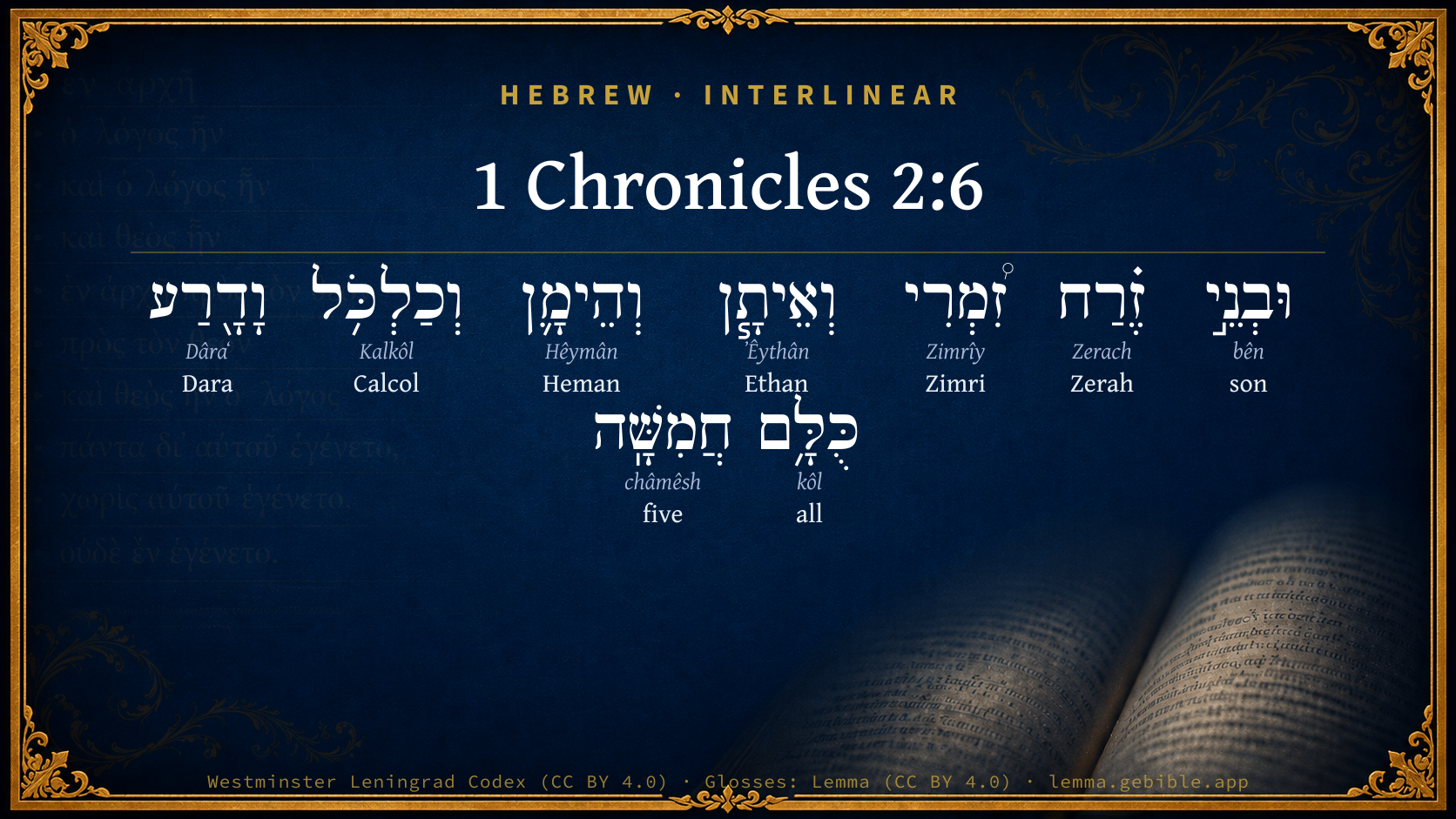
1 Chronicles 2:6

Hebrew (Westminster Leningrad Codex) 1 Chronicles 2:6 appears in the Hebrew Old Testament. The text above is from the Westminster Leningrad Codex. Each word links to its Strong’s number, a concise gloss, and parsing drawn from the Open Scriptures Hebrew Bible morphology. Click any word for its full Brown-Driver-Briggs (BDB) entry.
Download image
Cite this verse

1 Chronicles 2:6 (World English Bible). Public Domain. Lemma interlinear Bible study tool, https://lemma.gebible.app/v/1-chronicles/2/6.

Show BibTeX & RIS
BibTeX
RIS
English Translation
The sons of Zerah: Zimri, and Ethan, and Heman, and Calcol, and Dara; five of them in all.
World English Bible · Public Domain
Highlights
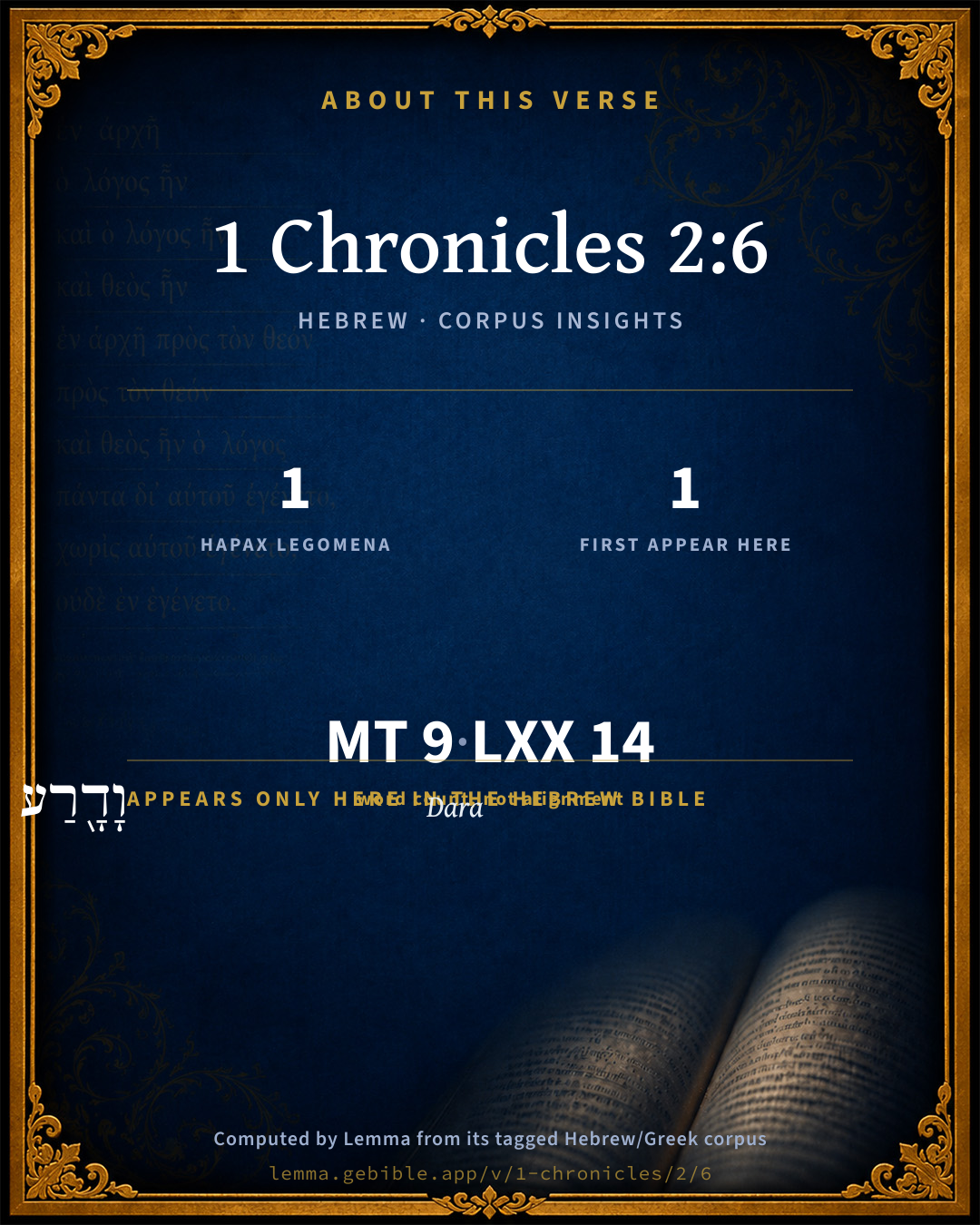
  • 1 hapax legomenon — only here in the Hebrew Bible
  • 1 first appearance in the Hebrew Bible
Full analysis ↓
Download a study sheet

One document with this verse’s original text, its word-by-word gloss line, the meaning frame, cross-references with their text, attributed commentary, and full source and license credits — printable, and it pastes into notes with its structure intact.

This verse Autodidact and up

Study sheet (.html) Plain text (.txt)

A passage Seminary Student

Up to 50 verses in one chapter. A passage sheet keeps up to 6 commentary sources and 12 cross-references per verse, in the order this page ranks them, and says so on the sheet whenever that leaves anything out. Ask for a single verse and you get the Autodidact verse sheet above.

Everything on this page stays free to read, with no account — the sheet is a download of what is already on screen, not access to it.

Want to remove ads? Support Godless Engineer
Compare translations 3

The same verse in 3 English versions, stacked beneath the original-language interlinear above. Click any original word for its lexicon entry.

Each is an independent rendering of the whole verse — the interlinear is not word-aligned to these translations.

Highlighted words mark where these versions differ — a whole-verse word diff, not a word-by-word alignment.

  • World English Bible Public Domain
    The sons of Zerah: Zimri, and Ethan, and Heman, and Calcol, and Dara; five of them in all.
  • King James Version Public Domain
    And the sons of Zerah; Zimri, and Ethan, and Heman, and Calcol, and Dara: five of them in all.
  • unfoldingWord Literal Text CC BY-SA 4.0
    And the sons of Zerah: Zimri and Ethan and Heman and Calcol and Dara. All of them five.

unfoldingWord Literal Text — © unfoldingWord, licensed CC BY-SA 4.0. Word-aligned USFM3 via Door43 (git.door43.org/unfoldingWord/en_ult).

Versions to compare (up to 4)

3 of 4 selected

Show all 18 translations

Every available English version of this verse, each an independent rendering of the whole verse.

  • World English Bible Public Domain
    The sons of Zerah: Zimri, and Ethan, and Heman, and Calcol, and Dara; five of them in all.
  • Berean Standard Bible Public Domain
    The sons of Zerah: Zimri, Ethan, Heman, Calcol, and Dara—five in all.
  • Majority Standard Bible Public Domain
    The sons of Zerah: Zimri, Ethan, Heman, Calcol, and Dara—five in all.
  • King James Version Public Domain
    And the sons of Zerah; Zimri, and Ethan, and Heman, and Calcol, and Dara: five of them in all.
  • American Standard Version (1901) Public Domain
    And the sons of Zerah: Zimri, and Ethan, and Heman, and Calcol, and Dara; five of them in all.
  • Revised Version (1885) Public Domain
    And the sons of Zerah; Zimri, and Ethan, and Heman, and Calcol, and Dara: five of them in all.
  • Geneva Bible (1599) Public Domain
    The sonnes also of Zerah were Zimri, and Ethan, and Heman, and Calcol, and Dara, which were fiue in all.
  • Douay-Rheims (1899) Public Domain
    And the sons also of Zare: Zamri, and Ethan, and Eman, and Chalchal, and Dara, five in all.
  • Young's Literal Translation Public Domain
    And sons of Zerah: Zimri, and Ethan, and Heman, and Calcol, and Dara; all of them five.
  • Literal Standard Version CC BY-SA 4.0
    And sons of Zerah: Zimri, and Ethan, and Heman, and Calcol, and Dara; all of them five.
  • Unlocked Literal Bible CC BY-SA 4.0
    Zerah's sons were Zimri, Ethan, Heman, Kalkol, and Darda, five in all.
  • unfoldingWord Literal Text CC BY-SA 4.0
    And the sons of Zerah: Zimri and Ethan and Heman and Calcol and Dara. All of them five.
  • Darby Bible Public Domain
    And the sons of Zerah: Zimri, and Ethan, and Heman, and Calcol, and Dara: five of them in all.
  • World Messianic Bible Public Domain
    The sons of Zerah: Zimri, Ethan, Heman, Calcol, and Dara—five of them in all.
  • Webster's Bible Public Domain
    And the sons of Zerah; Zimri, and Ethan, and Heman, and Calcol, and Dara: five of them in all.
  • Free Bible Version CC BY-SA 4.0
    The sons of Zerah: Zimri, Ethan, Heman, Calcol and Darda —a total of five.
  • Bible in Basic English Public Domain
    And the sons of Zerah: Zimri and Ethan and Heman and Calcol and Dara; five of them.
  • JPS Tanakh (1917) Public Domain
    And the sons of Zerah: Zimri, and Ethan, and Heman, and Calcol, and Dara: five of them in all.

Literal Standard Version (2020), Covenant Press — licensed CC BY-SA 4.0. Text via the HelloAO Bible API (eBible.org). Unlocked Literal Bible (unfoldingWord) — licensed CC BY-SA 4.0. Text via the HelloAO Bible API (eBible.org). unfoldingWord Literal Text — © unfoldingWord, licensed CC BY-SA 4.0. Word-aligned USFM3 via Door43 (git.door43.org/unfoldingWord/en_ult). Free Bible Version, Dr. Jonathan Gallagher — licensed CC BY-SA 4.0. Text via the HelloAO Bible API (eBible.org).

Word by word

More ways to search: Search by grammar → Find every occurrence → Compare this word →

Practice this passage: Drill this verse → Learn its vocabulary →

About this verse

These counts appear in no published source. They are computed here, from the morphology-tagged text and Lemma’s own curated glosses. What Lemma adds →

9
words
9
distinct lemmas
Historical
section

Notable vocabulary

1 hapax legomenon — a word that appears only here in the entire Hebrew Bible:

  • וָדָ֖רַע Dara H1873

First appearance in Scripture

This word makes its first canonical appearance in the Hebrew Bible here:

  • וָדָ֖רַע Dara H1873

Shared distinctive vocabulary

וְכַלְכֹּ֥ל Calcol H3633 occurs in 2 verses of the Hebrew Bible. Also found in:

Grammatical profile

  • 8 nouns
  • 1 adjective

Hebrew & Septuagint length

In English translation the verse runs 18 words from the Hebrew and 17 from the Septuagint (LXX English) — closely comparable.

A rough comparison of the two English renderings, which tokenize alike — not a word-level alignment.

Word counts can differ between the Hebrew and the Greek without any difference in meaning — e.g. the Hebrew direct-object marker אֵת has no separate Greek word, and Greek often adds the article ὁ.

In the original languages it is 9 Hebrew tokens and 14 Greek tokens — but the two are counted differently (Hebrew bundles its prefixes and suffixes into one token; the Greek is in lemma form), so that isn’t a like-for-like length.

Cross-references

3

Topical passages linked to 1 Chronicles 2:6 in the Treasury of Scripture Knowledge — connected by theme and wording, ordered by reader-vote popularity; previews shown in the World English Bible.

  • 1 Kings 4:31 For he was wiser than all men; than Ethan the Ezrahite, and Heman, and Calcol, and Darda, the sons of Mahol: and his fame was in all the nations round about.
  • Joshua 7:1 But the children of Israel committed a trespass in the devoted thing; for Achan, the son of Carmi, the son of Zabdi, the son of Zerah, of the tribe of Judah, took of the devoted thing: and the anger of Yahweh was kindled against the children of Israel.
  • Joshua 7:17–18 and he brought near the family of Judah; and he took the family of the Zerahites: and he brought near the family of the Zerahites man by man; and Zabdi was taken:

Cross-references courtesy of OpenBible.info (CC BY 4.0).

Hebrew and Greek witnesses Masoretic Hebrew ↔ Greek Septuagint

The same verse in the two great witnesses to the Old Testament, shown verse-for-verse.

These are two independent witnesses, not word-aligned to each other, and the Septuagint is shown in lemma (dictionary) form.

Hebrew 1 Chronicles 2:6 Masoretic · Westminster Leningrad Codex

וּבְנֵ֣י זֶ֗רַח זִ֠מְרִי וְאֵיתָ֧ן וְהֵימָ֛ן וְכַלְכֹּ֥ל וָדָ֖רַע כֻּלָּ֥ם חֲמִשָּֽׁה

The sons of Zerah: Zimri, and Ethan, and Heman, and Calcol, and Dara; five of them in all.

World English Bible · Public Domain

Greek LXX 1 Chronicles 2:6 Septuagint · lemma form

καί υἱός ζαρα ζαμβρι καί αιθαν καί αιμαν καί χαλχαλ καί δαρα πᾶς πέντε

And the sons of Zara, Zambri, and Aetham, and Aemuan, and Calchal, and Darad, in all five.

LXX2012 (modern English Septuagint) · Public Domain

On this verse, Ellicott's Commentary for English Readers discusses the Septuagint’s reading. Read the note in Commentary ↓

Hebrew: Westminster Leningrad Codex (CC BY 4.0). Greek: Septuagint (public domain); English from LXX2012 (modern English Septuagint) (Public Domain). How the Septuagint differs from the Hebrew →

Commentary

Notes on 1 Chronicles 2:6 from classic Christian and Jewish commentators (each source and its license shown beneath its notes). The classic Christian expositions comment on the surrounding passage and are grouped to its opening verse, so a note may address several verses; the Jewish commentaries on the Tanakh (Rashi and others) are per-verse, so they appear only where the commentator wrote on this verse.

Lemma curates 59 commentaries, every one of them public domain or Creative Commons licensed, each selected and text-cleaned for this edition rather than reprinted as found. About our sources →

Trapp's Complete Commentary

John Trapp

1Ch 2:6 And the sons of Zerah; Zimri, and Ethan, and Heman, and Calcol, and Dara: five of them in all.

Ver. 6. And Ethan, and Heman, &c.] Of these, see on 1Ki 4:31.

John Trapp, A Commentary or Exposition upon All the Books of the Old and New Testament (1647–1656) — public domain. Text from a community e-Sword module.

Joseph Benson's Commentary

1Ch 2:6. And Dara — If these be the same who are mentioned as the sons of Mahol, (1Ki 4:31,) either the same man had two names, Zerah and Mahol, as was usual among the Hebrews, or one of these was their immediate father, and the other their grandfather. These are named, because they were the glory of their father’s house. When the Holy Ghost would magnify the wisdom of Solomon, he saith, he was wiser than these four men. That four brothers should be so eminent, was a rare thing.

Joseph Benson's Commentary on the Old and New Testaments (1811–1818) — public domain. Text from a community e-Sword module.

Tyndale Open Study Notes

Tyndale Open Resources

2:6-8 For the genealogy of Zerah, cp. Josh 7:1, 17; 1 Kgs 4:31 (Mahol might be another name for Zerah).

Tyndale Open Study Notes — © Tyndale Open Resources, licensed CC BY-SA 4.0. Text via the HelloAO Bible API.

Geneva Bible (1599)

Geneva Bible translators

Of these read 1 Kings 4:31.

Or, Zabdi.

Geneva Bible (1599) marginal notes — public domain. Text via Bolls.life.

Jamieson, Fausset & Brown

Robert Jamieson, A. R. Fausset & David Brown

Zimri, and Ethan, and Heman, and Calcol, and Dara--These five are here stated to be the sons of Zerah, that is, of Ezra, whence they were called Ezrahites (Kg1 4:31). In that passage they are called "the sons of Mahol," which, however, is to be taken not as a proper name, but appellatively for "sons of music, dancing," &c. The traditional fame of their great sagacity and acquirements had descended to the time of Solomon and formed a standard of comparison for showing the superior wisdom of that monarch. Jewish writers say that they were looked up to as prophets by their countrymen during the abode in Egypt.

Jamieson, Fausset & Brown — Commentary Critical and Explanatory on the Whole Bible (1871) — public domain (CC PDM 1.0). Text via the HelloAO Bible API.

Adam Clarke's Commentary

Verse 6. Five of them in all.] "These were all chief men; and on them the spirit of prophecy rested." - T.

Adam Clarke's Commentary on the Bible (1810–1826) — public domain. Text from a community e-Sword/MySword module.

Ellicott's Commentary for English Readers

(6) Zimri.—This name is probably a merely accidental variant of Zabdi. Both are genuine Hebrew names occurring elsewhere. But the fact that Zimri here, and Zabdi at Jos_7:1, are both called sons of Zerah, seems to prove their identity; especially as m is often confused with b, and d with r.

Ethan, and Heman, and Calcol, and Dara.—It is stated (1Ki_4:31) that Solomon was “wiser than all men; than Ethan the Ezrahite, and Heman, and Chalcol, and Darda, the sons of Mahol.” It will be seen that the first three names coincide with those of our text, and that Dara is only one letter different from Darda. Further, many MSS. of Chronicles, as well as the Svriac and Arabic versions and the Targum, actually have Darda. The Yatic. LXX. reads Darad. There is thus a virtual repetition of these four names in the passage of Kings, and it is difficult to suppose that the persons intended are not the same there and here. Ethan is called an Ezrahite in Kings, but Ezrah and Zerah are equivalent forms in Hebrew; and the Yatic. LXX. actually calls Ethan a Zarhite—i.e., a descendant of Zerah (Num_26:13). The designation of the four as “sons of Mahol” presents no difficulty. Mahol is a usual word for the sacred dance (Psa_149:3; Psa_150:4), and the four Zarhites are thus described as “sons of dancing”—that is, sacred musicians. It is likely, therefore, that these famous minstrels of Judah were adopted into the Levitical clans in which sacred music was the hereditary profession. (See Psalms 88, 89., titles.) Whether Ethan and Heman are the persons mentioned in 1Ch_6:33; 1Ch_6:44; 1Ch_15:17; 1Ch_15:19 as the recognised heads of two of the great guilds of temple musicians is not clear. The Levitical ancestry ascribed to them in 1 Chronicles 6 would not be opposed to this assumption, as adoption would involve it.

(6-8) The sons of Zerah.—From this point our narrative ceases to depend entirely upon the data of Genesis.

A Bible Commentary for English Readers, edited by Charles John Ellicott (1878–1897) — public domain. Text from a community e-Sword module.

The Cambridge Bible for Schools and Colleges

gen. ed. J. J. S. Perowne

6. the sons of Zerah] This genealogy appears only in Chron.

Zimri] LXX (B) Ζαμβρεί (β being merely euphonic) here and also Jos_7:1 where Heb. has “Zabdi.” LXX. is probably right in identifying the two. Either form might arise from the other by easy textual corruption.

Ethan … Dara] Read, Darda with Vulg., Targ., Pesh. The same four names in the same order occur 1Ki_4:31 as the names of wise men whom Solomon surpassed in wisdom. They are there called sons of “Mahol” who may have been either a nearer or remoter ancestor than Zerah. Ethan however is there called the Ezrahite (= probably “son of Zerah”). [Psalms 88, 89 bear respectively the names “Heman the Ezrahite,” “Ethan the Ezrahite,” but these (it seems) were Levites (1Ch_15:17; 1Ch_15:19).]

The Cambridge Bible for Schools and Colleges (gen. ed. J. J. S. Perowne; Cambridge University Press, 1878–1918) — public domain. Text from a community e-Sword module.

John Gill's Exposition

And the sons of Ethan; Azariah. Including his posterity, see Gen 46:23, the posterity of the other three sons of Zerah are not mentioned, either because the writer could not find the genealogy of them, as Kimchi; or rather, as he thinks, he cuts short the genealogy of Zerah, because the kingdom did not proceed from him, and returns to the genealogy of Hezron, from whence it did, or perhaps they had no children.

, the posterity of the other three sons of Zerah are not mentioned, either because the writer could not find the genealogy of them, as Kimchi; or rather, as he thinks, he cuts short the genealogy of Zerah, because the kingdom did not proceed from him, and returns to the genealogy of Hezron, from whence it did, or perhaps they had no children.

1 Chronicles 2:9

ch1 2:9

ch1 2:9

ch1 2:9The sons also of Hezron, that were born unto him,.... The Targum adds, in Timnath; but most likely in Egypt:

Jerahmeel, and Ram, and Chelubai; afterwards called Caleb.

John Gill's Exposition of the Whole Bible (1746–1763) — public domain (CC PDM 1.0). Text via the HelloAO Bible API.

Albert Barnes' Notes on the Bible

The sons of Zerah - Here, for the first time, the writer of Chronicles draws from sources not otherwise known to us, recording facts not mentioned in the earlier Scriptures. Ethan, Heman, Calcol, and Dara, sons of Zerah, are only known to us from this passage, since there are no sufficient grounds for identifying them with the “sons of Mahol” (marginal reference).

Albert Barnes' Notes on the Bible (1834–1885) — public domain. Text from a community e-Sword/MySword module.

Haydock's Catholic Bible Commentary

Zamri, or Zabdi, Josue vii. 1. --- Etham. Similar names occur [in] 3 Kings iv. 30. But they seem to have been different persons.

George Leo Haydock (1774–1849), Haydock's Catholic Family Bible and Commentary, 1859 edition — public domain. Excludes Psalms (Douay-Rheims chapter numbering differs from Protestant) and Deuterocanonical books (Catholic canon only).

Matthew Poole's English Annotations

If these be the same who are mentioned as the sons of Mahol, 1Ki 4:31, either the same man had two names, Zerah and Mahol, as was usual among the Hebrews; or one of these was their immediate father, and the other their grandfather.

Matthew Poole's English Annotations on the Holy Bible (1683–1685) — public domain. Text from a community e-Sword/MySword module.

John Wesley's Explanatory Notes

Dara - If these be the same who are mentioned as the sons of Machol, 1 Kings iv, 31, either the same man had two names, Zerah and Machol, as was usual among the Hebrew: or, one of these was their immediate father, and the other their grand-father. These are named, because they were the glory of their father's house. When the Holy Ghost would magnify the wisdom of Solomon, he saith, he was wiser than these four men. That four brothers should be so eminent, was a rare thing.

John Wesley, Explanatory Notes Upon the Whole Bible (1754–1765) — public domain. Text via the GEBible commentary corpus.

Keil & Delitzsch

C. F. Keil & F. Delitzsch

And the sons of Ethan; Azariah. Including his posterity, see Gen 46:23, the posterity of the other three sons of Zerah are not mentioned, either because the writer could not find the genealogy of them, as Kimchi; or rather, as he thinks, he cuts short the genealogy of Zerah, because the kingdom did not proceed from him, and returns to the genealogy of Hezron, from whence it did, or perhaps they had no children.

, the posterity of the other three sons of Zerah are not mentioned, either because the writer could not find the genealogy of them, as Kimchi; or rather, as he thinks, he cuts short the genealogy of Zerah, because the kingdom did not proceed from him, and returns to the genealogy of Hezron, from whence it did, or perhaps they had no children.

1 Chronicles 2:9

ch1 2:9

ch1 2:9

ch1 2:9The sons also of Hezron, that were born unto him,.... The Targum adds, in Timnath; but most likely in Egypt:

Jerahmeel, and Ram, and Chelubai; afterwards called Caleb.

Keil & Delitzsch — Biblical Commentary on the Old Testament (1861–1891) — public domain (CC PDM 1.0). Text via the HelloAO Bible API. (Old Testament only.)

Rashi

Rabbi Shlomo Yitzchaki (Rashi)

and Ethan, and Heman, and Calcol, and Dara They all lived at the time of David and at the time of Solomon, and they were exceedingly wise. Concerning this it says (I Kings 5:11): “And he was wiser than all men, than Ethan the Ezrahite, and Heman, and Calcol, and Darda, the sons of Mahol.” Further on, regarding Solomon’s wisdom, the expression is “Darda,” for even though it was called the generation of knowledge (דֵּעָה דּוּר) because of its wisdom, Solomon was wiser than all of them. Now when Scripture says הָאֶזְרָחִי, the “aleph” is superfluous, like הַזַּרְחִי (Num. 26:20), [because] he was descended from Zerah, and in many places, the “aleph” is inserted into the word, and is not pronounced, e.g. (Job. 13:17): “and my speech (וְאַחְוָתִי)” (Isa. 19:6): “And they shall abandon (וְהֶאֶזְנִיחוּ).” And likewise, (Num. 11:4): “וְְהָאסַפְסוּף, and the rabble.” Now sometimes it is completely missing, as (II Sam. 19:14): “תֹמְרוּ, you shall say,” and likewise, (II Chron. 22:5): “... and the Arameans (הָרַמִּים) smote.” [The verse in Kings] is expounded by Pesikta (Peskikta d’Rav Kahana p. 34, Pesikta Rabbathi 14:9): “... than all men this refers to Adam. Ethan is Abraham. Heman is Moses. Calcol is Joseph. Darda is the generation of the desert. Mahol means that He forgave them for making the Calf.”

Rashi on the Tanakh — English translations: “The Judaica Press complete Tanach with Rashi, translated by A. J. Rosenberg” (CC BY 4.0); “Pentateuch with Rashi's commentary by M. Rosenbaum and A.M. Silbermann, 1929-1934” (public domain); “The Metsudah Tanach series, Lakewood, N.J” (CC BY 4.0); and “The Book of Joshua, Metsudah Publications, 1997” (CC BY 4.0). Text via Sefaria.

Lesson kit

Teaching starters — assembled from the data on this page, not authored interpretation. Every prompt links to the verse data it draws on. Edit before teaching.

1 Chronicles, in the Historical, opens this verse with 9 words (9 distinct Hebrew lemmas). Its most distinctive word is Dâraʻ (“Dara”). A historical commentator’s framing appears above. Read the whole chapter for the surrounding context.

Discussion questions

  1. The word Dâraʻ carries the sense “Dara.” How does it shape the verse?
  2. 1 word here appears nowhere else in the Hebrew Bible. Why might the author reach for such rare wording?
  3. This is the first place “Dara” appears in Scripture (first appears here). What does its debut here establish?
  4. How does 1 Kings 4:31, which shares the word «Calcol», read alongside this verse?
  5. Compare how Trapp's Complete Commentary and Joseph Benson's Commentary read this verse. Where do they agree or differ?

Things to notice

Reading settings

Reading text

Shown beneath each verse's original-language words.

Old Testament
Old Testament edition

Read the OT as the Masoretic Hebrew (MT) or the Greek Septuagint (LXX).

English shown for the Greek Septuagint (in the Hebrew ↔ Greek comparison).

Comparing translations? Open the Compare panel on any verse page to stack up to four side by side.