Genesis 37:3

Hebrew (Westminster Leningrad Codex) Genesis 37:3 appears in the Hebrew Old Testament. The text above is from the Westminster Leningrad Codex. Each word links to its Strong’s number, a concise gloss, and parsing drawn from the Open Scriptures Hebrew Bible morphology. Click any word for its full Brown-Driver-Briggs (BDB) entry.
Download image
Cite this verse

Genesis 37:3 (World English Bible). Public Domain. Lemma interlinear Bible study tool, https://lemma.gebible.app/v/genesis/37/3.

Show BibTeX & RIS
BibTeX
RIS
English Translation
Now Israel loved Joseph more than all his children, because he was the son of his old age, and he made him a coat of many colors.
World English Bible · Public Domain
Highlights
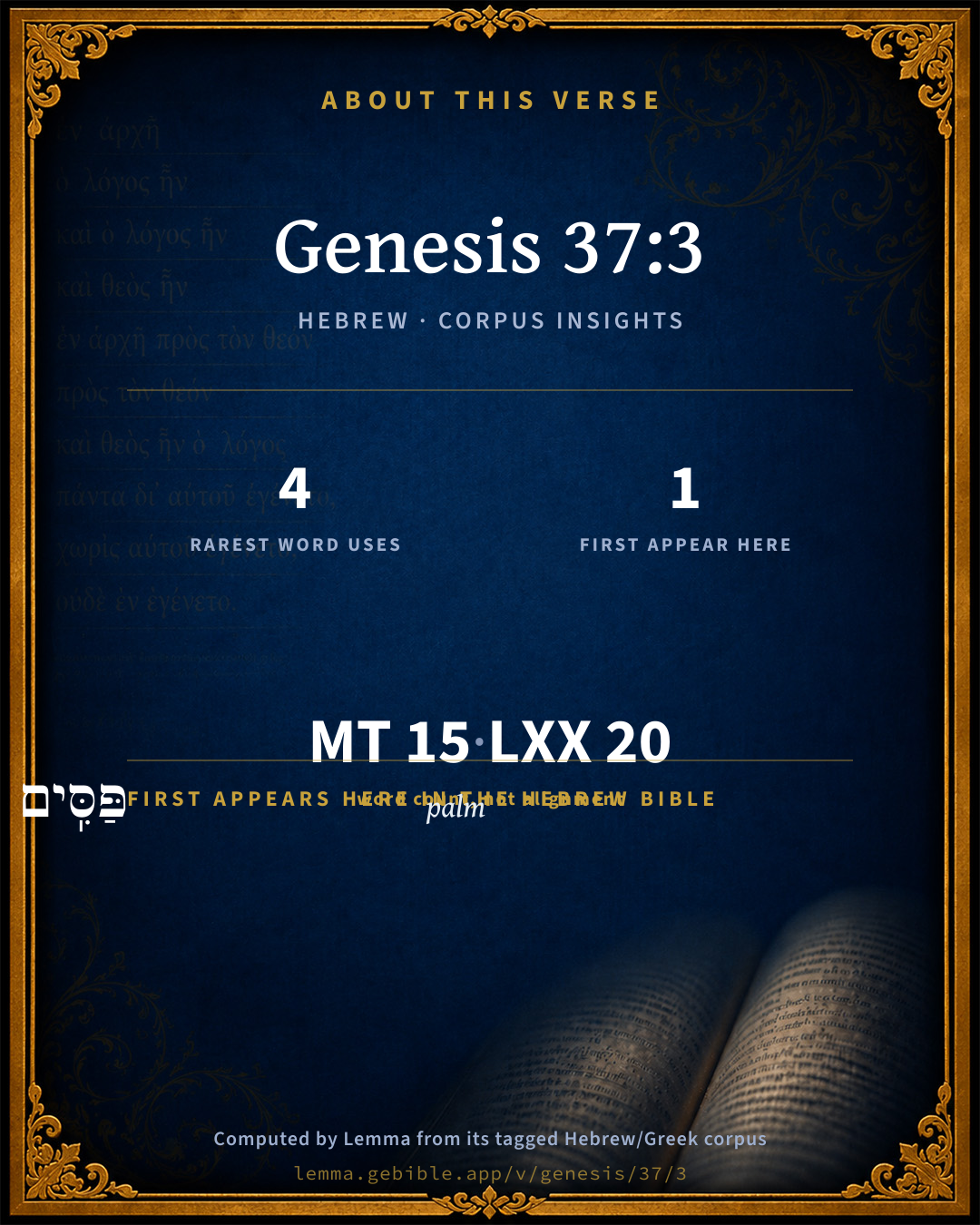
  • 1 first appearance in the Hebrew Bible
Full analysis ↓
Download a study sheet

One document with this verse’s original text, its word-by-word gloss line, the meaning frame, cross-references with their text, attributed commentary, and full source and license credits — printable, and it pastes into notes with its structure intact.

This verse Autodidact and up

Study sheet (.html) Plain text (.txt)

A passage Seminary Student

Up to 50 verses in one chapter. A passage sheet keeps up to 6 commentary sources and 12 cross-references per verse, in the order this page ranks them, and says so on the sheet whenever that leaves anything out. Ask for a single verse and you get the Autodidact verse sheet above.

Everything on this page stays free to read, with no account — the sheet is a download of what is already on screen, not access to it.

Want to remove ads? Support Godless Engineer
Compare translations 3

The same verse in 3 English versions, stacked beneath the original-language interlinear above. Click any original word for its lexicon entry.

Each is an independent rendering of the whole verse — the interlinear is not word-aligned to these translations.

Highlighted words mark where these versions differ — a whole-verse word diff, not a word-by-word alignment.

  • World English Bible Public Domain
    Now Israel loved Joseph more than all his children, because he was the son of his old age, and he made him a coat of many colors.
  • King James Version Public Domain
    Now Israel loved Joseph more than all his children, because he was the son of his old age: and he made him a coat of many colors.
  • unfoldingWord Literal Text CC BY-SA 4.0
    Now Israel loved Joseph more than all of his sons because he a son of his old age. So he made a multicolored tunic for him.

unfoldingWord Literal Text — © unfoldingWord, licensed CC BY-SA 4.0. Word-aligned USFM3 via Door43 (git.door43.org/unfoldingWord/en_ult).

Versions to compare (up to 4)

3 of 4 selected

Show all 18 translations

Every available English version of this verse, each an independent rendering of the whole verse.

  • World English Bible Public Domain
    Now Israel loved Joseph more than all his children, because he was the son of his old age, and he made him a coat of many colors.
  • Berean Standard Bible Public Domain
    Now Israel loved Joseph more than his other sons, because Joseph had been born to him in his old age; so he made him a robe of many colors.
  • Majority Standard Bible Public Domain
    Now Israel loved Joseph more than his other sons, because Joseph had been born to him in his old age; so he made him a robe of many colors.
  • King James Version Public Domain
    Now Israel loved Joseph more than all his children, because he was the son of his old age: and he made him a coat of many colors.
  • American Standard Version (1901) Public Domain
    Now Israel loved Joseph more than all his children, because he was the son of his old age: and he made him a coat of many colors.
  • Revised Version (1885) Public Domain
    Now Israel loved Joseph more than all his children, because he was the son of his old age: and he made him a coat of many colours.
  • Geneva Bible (1599) Public Domain
    Nowe Israel loued Ioseph more then all his sonnes, because he begate him in his old age, and he made him a coat of many colours.
  • Douay-Rheims (1899) Public Domain
    Now Israel loved Joseph above all his sons, because he had him in his old age: and he made him a coat of divers colours.
  • Young's Literal Translation Public Domain
    And Israel hath loved Joseph more than any of his sons, for he `is' a son of his old age, and hath made for him a long coat;
  • Literal Standard Version CC BY-SA 4.0
    And Israel has loved Joseph more than any of his sons, for he [is] a son of his old age, and has made for him a long coat;
  • Unlocked Literal Bible CC BY-SA 4.0
    Now Israel loved Joseph more than all his sons because he was the son of his old age. He made him a beautiful garment.
  • unfoldingWord Literal Text CC BY-SA 4.0
    Now Israel loved Joseph more than all of his sons because he a son of his old age. So he made a multicolored tunic for him.
  • Darby Bible Public Domain
    And Israel loved Joseph more than all his sons, because he was son of his old age; and he made him a vest of many colours.
  • World Messianic Bible Public Domain
    Now Israel loved Joseph more than all his children, because he was the son of his old age, and he made him a tunic of many colors.
  • Webster's Bible Public Domain
    Now Israel loved Joseph more than all his children, because he was the son of his old age: and he made him a coat of many colors.
  • Free Bible Version CC BY-SA 4.0
    Israel loved Joseph more than any of his other sons, because Joseph had been born to him when he was already old. He made a colorful robe with long sleeves for Joseph.
  • Bible in Basic English Public Domain
    Now the love which Israel had for Joseph was greater than his love for all his other children, because he got him when he was an old man: and he had a long coat made for him.
  • JPS Tanakh (1917) Public Domain
    Now Israel loved Joseph more than all his children, because he was the son of his old age; and he made him a coat of many colours.

Literal Standard Version (2020), Covenant Press — licensed CC BY-SA 4.0. Text via the HelloAO Bible API (eBible.org). Unlocked Literal Bible (unfoldingWord) — licensed CC BY-SA 4.0. Text via the HelloAO Bible API (eBible.org). unfoldingWord Literal Text — © unfoldingWord, licensed CC BY-SA 4.0. Word-aligned USFM3 via Door43 (git.door43.org/unfoldingWord/en_ult). Free Bible Version, Dr. Jonathan Gallagher — licensed CC BY-SA 4.0. Text via the HelloAO Bible API (eBible.org).

Word by word

More ways to search: Search by grammar → Find every occurrence → Compare this word →

Practice this passage: Drill this verse → Learn its vocabulary →

זְקֻנִ֥ים
zâqun
H2208
“old age”
Noun, Common, Masculine, Plural, Absolute
Part of Speech
Noun
Type
Common
Gender
Masculine
Number
Plural
State
Absolute
Full BDB Definition

Origin: properly, passive participle of H2204 (used only in the plural as a noun)

TWOT: 574e

old age, extreme old age
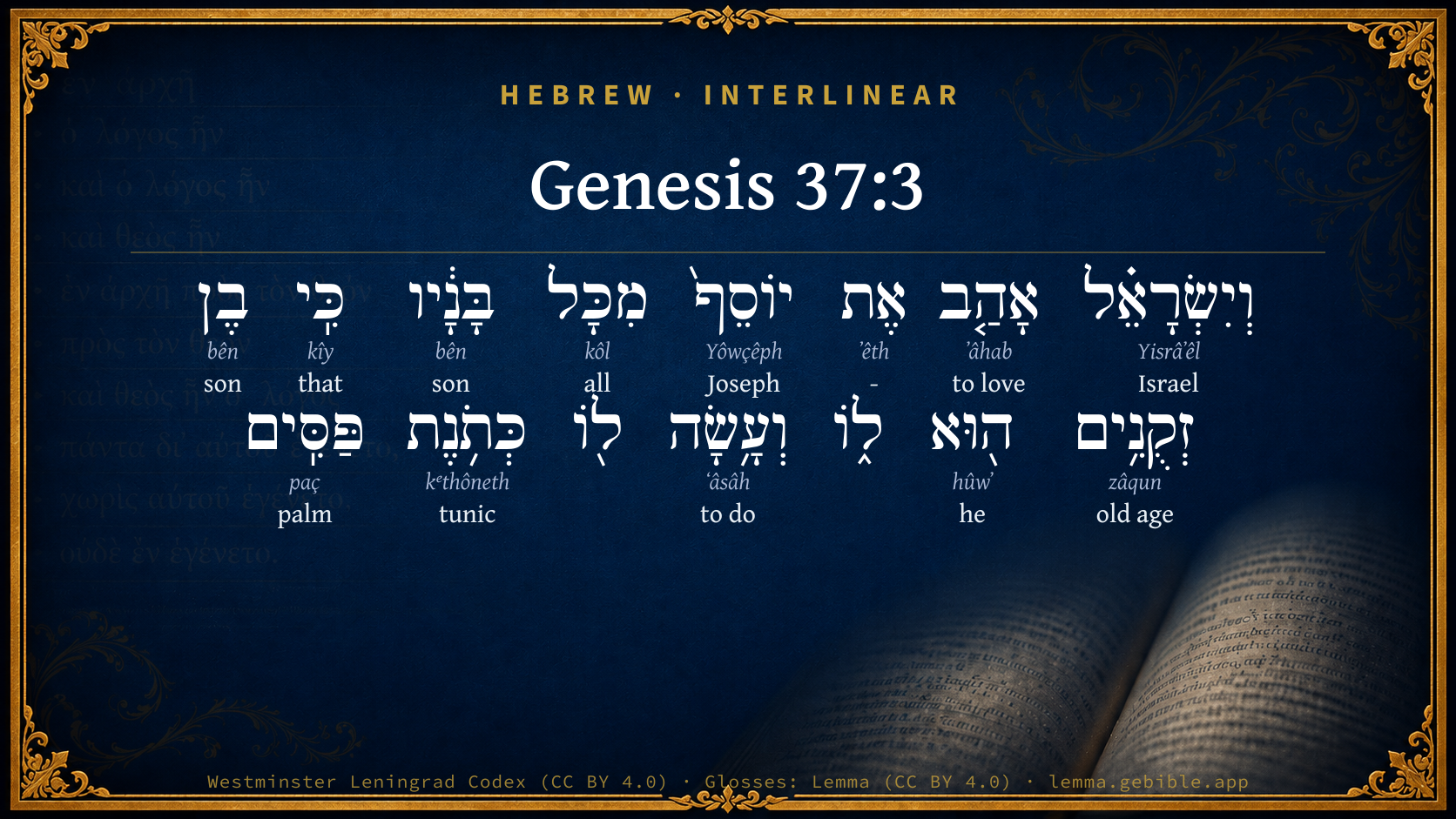
  1. וְיִשְׂרָאֵ֗ל Yisrâʼêl H3478 “and · Israel” Conjunction + Noun, Proper
  2. אָהַ֤ב ʼâhab H157 “to love” Verb, Qal, Perfect, 3rd Person, Masculine, Singular
  3. אֶת ʼêth H853 “-” Particle, Direct Object
  4. יוֹסֵף֙ Yôwçêph H3130 “Joseph” Noun, Proper
  5. מִכָּל kôl H3605 “from · all of” Preposition + Noun, Common, Masculine, Singular, Construct
  6. בָּנָ֔יו bên H1121 “sons · his” Noun, Common, Masculine, Plural, Construct + Suffix, Personal, 3rd Person, Masculine, Singular
  7. כִּֽי kîy H3588 “that” Conjunction
  8. בֶן bên H1121 “son of” Noun, Common, Masculine, Singular, Construct
  9. ה֖וּא hûwʼ H1931 “he” Pronoun, Personal, 3rd Person, Masculine, Singular
  10. וְעָ֥שָׂה ʻâsâh H6213 “and · to do” Conjunction + Verb, Qal, Perfect, 3rd Person, Masculine, Singular
  11. כְּתֹ֥נֶת kᵉthôneth H3801 “tunic of” Noun, Common, Feminine, Singular, Construct
  12. פַּסִּֽים paç H6446 “palms” Noun, Common, Masculine, Plural, Absolute

About this verse

These counts appear in no published source. They are computed here, from the morphology-tagged text and Lemma’s own curated glosses. What Lemma adds →

15
words
12
distinct lemmas
Pentateuch
section

Notable vocabulary

The rarest word here is זְקֻנִ֥ים old age H2208 — appearing just 4 times in the whole Hebrew Bible.

First appearance in Scripture

This word makes its first canonical appearance in the Hebrew Bible here:

  • פַּסִּֽים palm H6446

Shared distinctive vocabulary

זְקֻנִ֥ים old age H2208 occurs in 4 verses of the Hebrew Bible. Also found in:

Grammatical profile

  • 2 verbs
  • 8 nouns
  • 1 pronoun
  • 2 prepositions
  • 1 conjunction
  • 1 particle

Verb forms

  • אָהַ֤ב Qal · Perfect
  • וְעָ֥שָׂה Qal · Perfect

Repetition

A word recurs within this verse — often emphatic in Hebrew:

  • בָּנָ֔יו son H1121 ×2

Hebrew & Septuagint length

In English translation the verse runs 27 words from the Hebrew and 29 from the Septuagint (LXX English) — closely comparable.

A rough comparison of the two English renderings, which tokenize alike — not a word-level alignment.

Word counts can differ between the Hebrew and the Greek without any difference in meaning — e.g. the Hebrew direct-object marker אֵת has no separate Greek word, and Greek often adds the article ὁ.

In the original languages it is 15 Hebrew tokens and 20 Greek tokens — but the two are counted differently (Hebrew bundles its prefixes and suffixes into one token; the Greek is in lemma form), so that isn’t a like-for-like length.

Cross-references

8

Topical passages linked to Genesis 37:3 in the Treasury of Scripture Knowledge — connected by theme and wording, ordered by reader-vote popularity; previews shown in the World English Bible.

  • Genesis 37:32 They took the coat of many colors, and they brought it to their father, and said, "We have found this. Examine it, now, whether it is your son's coat or not."
  • John 3:35 The Father loves the Son, and has given all things into his hand.
  • Genesis 37:23 It happened, when Joseph came to his brothers, that they stripped Joseph of his coat, the coat of many colors that was on him;
  • 2 Samuel 13:18 She had a garment of various colors on her; for with such robes were the king's daughters who were virgins dressed. Then his servant brought her out, and bolted the door after her.
  • John 13:22–23 The disciples looked at one another, perplexed about whom he spoke.
  • Genesis 44:20–30 We said to my lord, 'We have a father, an old man, and a child of his old age, a little one; and his brother is dead, and he alone is left of his mother; and his father loves him.'
  • Psalms 45:13–14 The princess inside is all glorious. Her clothing is interwoven with gold.
  • Ezekiel 16:16 You took of your garments, and made for yourselves high places decked with various colors, and played the prostitute on them: [the like things] shall not come, neither shall it be [so].

Cross-references courtesy of OpenBible.info (CC BY 4.0).

Hebrew and Greek witnesses Masoretic Hebrew ↔ Greek Septuagint

The same verse in the two great witnesses to the Old Testament, shown verse-for-verse.

These are two independent witnesses, not word-aligned to each other, and the Septuagint is shown in lemma (dictionary) form.

Hebrew Genesis 37:3 Masoretic · Westminster Leningrad Codex

וְיִשְׂרָאֵ֗ל אָהַ֤ב אֶת יוֹסֵף֙ מִכָּל בָּנָ֔יו כִּֽי בֶן זְקֻנִ֥ים ה֖וּא ל֑וֹ וְעָ֥שָׂה ל֖וֹ כְּתֹ֥נֶת פַּסִּֽים

Now Israel loved Joseph more than all his children, because he was the son of his old age, and he made him a coat of many colors.

World English Bible · Public Domain

Greek LXX Genesis 37:3 Septuagint · lemma form

ἰακώβ δέ ἀγαπάω ὁ ιωσηφ παρά πᾶς ὁ υἱός αὐτός ὅτι υἱός γῆρας εἰμί αὐτός ποιέω δέ αὐτός χιτών ποικίλος

And Jacob loved Joseph more than all his sons, because he was to him the son of old age; and he made for him a coat of many colors.

LXX2012 (modern English Septuagint) · Public Domain

On this verse, The Cambridge Bible for Schools and Colleges discusses the Septuagint’s reading. Read the note in Commentary ↓

Hebrew: Westminster Leningrad Codex (CC BY 4.0). Greek: Septuagint (public domain); English from LXX2012 (modern English Septuagint) (Public Domain). How the Septuagint differs from the Hebrew →

Targum (Aramaic paraphrase)

2

The Targum is the ancient Jewish Aramaic paraphrase of the Hebrew Scriptures — an interpretive translation, not the Hebrew text itself. Onkelos (literal) and Pseudo-Jonathan (expansive) render the Torah, and Jonathan the Prophets. Coverage is partial: where no permissively-licensed English translation exists for a verse, only the Aramaic is shown. This is verse-level text, not a word-by-word alignment to the Hebrew.

  1. Targum Onkelos Torah (Genesis–Deuteronomy)
    וְיִשְׂרָאֵל רְחֵם יָת יוֹסֵף מִכָּל בְּנוֹהִי אֲרֵי בַר חַכִּים הוּא לֵהּ וַעֲבַד לֵהּ כִּתּוּנָא דְפַסֵי

    (no public-domain English translation for this verse)

    Targum Onkelos — Aramaic: “Onkelos Genesis” (public domain); “Onkelos Exodus” (public domain); “Onkelos Leviticus” (public domain); “Onkelos Numbers” (public domain); “Onkelos Deuteronomy” (public domain). English: “Sefaria Community Translation” (CC0 1.0 (public-domain dedication)); “J.W. Etheridge. The Targums of Onkelos and Jonathan Ben Uzziel on the Pentateuch. London: Longmans, Green, 1862” (public domain). Text via Sefaria.

  2. Targum Pseudo-Jonathan Torah (Genesis–Deuteronomy)
    וְיִשְרָאֵל רְחֵים יַת יוֹסֵף מִכָּל בְּנוֹי אֲרוּם אִיקוּנֵי דְיוֹסֵף דַמְיַין לְאִיקוּנִין דִילֵיהּ וְעָבַד לֵיהּ פַּרְגוֹד מְצוּיָיר

    And Israel loved Joseph more than all his sons, because the likeness of Joseph resembled his own, and he made him a figured robe.

    Targum Pseudo-Jonathan — Aramaic: “Targum Jonathan on Genesis” (public domain); “Targum Jonathan on Exodus” (public domain); “Targum Jonathan on Leviticus” (public domain); “Targum Jonathan on Numbers” (public domain); “Targum Jonathan on Deuteronomy” (public domain). English: “The Targum of Jonathan ben Uzziel, trans. J. W. Etheridge, London, 1862” (public domain). Text via Sefaria.

Commentary

Notes on Genesis 37:3 from classic Christian and Jewish commentators (each source and its license shown beneath its notes). The classic Christian expositions comment on the surrounding passage and are grouped to its opening verse, so a note may address several verses; the Jewish commentaries on the Tanakh (Rashi and others) are per-verse, so they appear only where the commentator wrote on this verse.

Lemma curates 59 commentaries, every one of them public domain or Creative Commons licensed, each selected and text-cleaned for this edition rather than reprinted as found. About our sources →

Trapp's Complete Commentary

John Trapp

Gen 37:3 Now Israel loved Joseph more than all his children, because he [was] the son of his old age: and he made him a coat of [many] colours.

Ver. 3. Because he was the son of his old age.] The Chaldee Paraphrast renders it morally, Because he was a wise son, in quo ante canos sapientia: such a one as Macarius was, of whom Nicephorus saith, that, for his prudence and gravity while he was yet but a youth, he was surnamed παιδαριογερων, the old stripling. Josephus saith, he was very like his mother Rachel; and therefore his father so loved him. But Chrysostom saith, better, that it was for his virtuous life, and godly disposition. Goodness is lovely in any; much more in an own child. John was the best beloved disciple, because best conditioned. But otherwise, Cavete, saith Ambrose, ne quos natura coniunxit, paterna gratia dividat. Parents’ partiality may breed heart-buruings. {Eph 6:4}

John Trapp, A Commentary or Exposition upon All the Books of the Old and New Testament (1647–1656) — public domain. Text from a community e-Sword module.

The Biblical Illustrator

Joseph S. Exell

Gen_37:3

Israel loved Joseph more than all his children

Partiality in the family

I.

IT WAS NATURAL.

1. On account of a kindred spirit.

2. On account of pleasant associations.

II. UNCONCEALED.

1. It was revealed for the comfort of Joseph.

2. It was manifested in such a manner that the other children could take offence.

III. IT PRODUCED HATRED.

1. Their hatred took a wrong direction.

2. Their hatred overcame their humanity. (Homilist.)

Evils of partiality in the family

I. PARTIALITY SHOWS WEAKNESS IN THOSE EXERCISING IT.

II. PARTIALITY OFFENDS THOSE OVERLOOKED.

II. PARTIALITY INJURES THE ONE IT IS INTENDED TO BENEFIT.

IV. PARTIALITY LEADS TO ESTRANGEMENT IN THE FAMILY.

V. PARTIALITY RESULTS IN MANY SINS AND MANY SORROWS. (J. Henry Burn, B. D.)

Jacobs affection for Joseph not misplaced

Enabled to study characters, alike by long experience and natural shrewdness, he was eminently fit to discover the spirit of Josephs accounts; and had he detected a vile motive, his heart would have turned from the slanderer; for he had himself thoroughly completed his moral purification. Further, the general conduct of the brothers were such as to let unfavourable statements appear at least as no deceitful fabrications. And, lastly, depravity and meanness are totally at variance with those noble qualities of Josephs mind, which we shall soon have opportunities to unfold, and which alone could make him the worthy medium of the great plans of Providence. Too young to listen to prudence, and too generous to regard expediency, his pure and susceptible mind repeated in harmless innocence what passed among his brothers; and open and communicative, he knew no artificial reserve. He, therefore, is not even liable to the reproach of carelessness; for he would have seen no wrong in his conduct, even had his attention been directed to it; following the unrestricted impulses of his nature, he had not yet commenced to reflect upon his feelings, or to control and direct his emotions. But was it not blamable on the part of Jacob, so decidedly to prefer one son to all the others? Ought not a father to bestow an equal share of affection upon all his children? This question is but partially to be answered in the affirmative. Certainly, the natural love of a father, which is the result of the close relationship, is very generally equally ardent towards all his children; he will, with the greatest sacrifices, support, educate, and protect all his offspring. But another affection, based upon esteem or internal affinity of characters, may be superadded to the natural love, as will frequently be the case with parents of strongly-marked mental or moral organization; and thus that love is produced which is the emancipation from the blind rule of instinct, and consists in the prevalence of reason and moral liberty. And if it is not reprehensible in a father to feel more strongly for the children in whom he finds his own existence more distinctly renewed, or who are more susceptible of culture and refinement, it can, at the utmost, only be deemed an imprudence if the predeliction is manifested before the less beloved children. But though it is no moral offence, it may become a source of envy, strife and domestic discord. This truth was neglected by Jacob when he made for his favoured son Joseph a long and costly robe. The ample and folding garments of persons of wealth and distinction were not seldom composed of, or covered with, pieces of various costly stuffs, tastefully arranged--ambitious vestments, well calculated to account for the feelings of animosity on the part of Josephs brothers. (M. M. Kalisch, Ph. D.)

Parental fidelity

It is interesting to read the testimony of men at once great and good, to parental fidelity and affection. Said Lamartine, the celebrated French author: The future state of the child depends in a great measure upon the home in which he is born. His soul is nourished and grows, above all, by the impressions which are there left upon his memory. My father gave me the example of a sincerity carried even to scrupulousness; my mother, of a goodness rising to devotion the most heroic . . . I drank deep from my mothers mind; I read through her eyes; I felt through her impressions; I lived through her life. Further on, he says: I know that my mother wished to make me a happy child, with a healthy mind and a loving soul, a creature of God, not a puppet of men. Again, he adds: Our mothers knee was always our familiar altar in infancy and in boyhood. She elevated our thoughts to God as naturally as the plant stretches upward to the air and light. When she prayed along with us and over us, her lovely countenance became even sweeter and gentler than before, and when we left her side to battle with the world, we never forgot her precepts. The child of the wisest and best may go wrong, for there are seeds of evil in every heart. But the rule is that Gods blessing on affectionate fidelity secures a happy and useful life here, with the assurance of heavenly awards in the hereafter. (Henry M. Grout, D. D.)

Family training

Another manifest principle observed by Mrs. Wesley in the education and training of her family, was that of thorough impartiality. There was no pet lamb in her deeply interesting flock; no Joseph among her children to be decked out in a coat of many colours, to the envy of his less loved brethren. It was supposed by some of her sisters that Martha was a greater favourite with Mrs. Wesley than the rest of her children, and Charles expressed his wonder that so wise a woman as his mother could give way to such a partiality or did not better conceal it. This, however, was an evident mistake. Many years afterwards, when the saying of her brother was mentioned to Martha, she replied, What my sisters call partiality was what they might all have enjoyed if they had wished it, which was permission to sit in my mothers chamber when disengaged, to listen to her conversation with others, and to hear her remarks on things and books out of school-hours. There is certainly no evidence of partiality here. All her children stood before her on a common level, with equal claims, and all were treated in the same way. (J. Kirk.)

A coat of many colours

Josephs coat of many colours

It may remind us--

I. OF THE DRESS WHICH EARTHLY PARENTS PREPARE FOR THEIR CHILDREN. Respecting which consider--

1. They toil to procure it, working hard and long.

2. They exercise thought in selecting. Have to consider size, season, material, appearance.

3. They have to inspect it often. How it has been used; how it wears; does it need repair.

4. They have to renew it often. The best will wear out or be out-grown 1Sa_2:19).

II. OF THE ROBE WHICH OUR HEAVENLY FATHER PREPARES FOR THOSE WHO LOVE HIM.

1. We need clothing for the soul, as well as for the body (1Pe_3:3-4; 1Pe_5:5). God knows what things we have need of, even if we are unconscious of our need (Rev_3:17).

2. We cannot make, or purchase, soul-clothing. We must receive it as a free gift. Only God can give it (Rev_3:18).

3. For earnest, persevering, asking--accompanied by watching--we may obtain the robe of righteousness, the garment of salvation. This robe Jesus wrought for us.

4. This robe will fit well, look well, wear for ever. It is a white robe. White includes all the colours (explain). Hence it is a coat of many colours.

5. It is a court dress (explain) in which to enter the great Kings presence. Learn:

(1) Be careful of clothes. Those who cannot earn them may lesson their parents expenses and labour and anxiety by taking care of them.

(2) Keep your soulclothes unspotted from the world. Beware of sin-stains, and of self-righteous cleansing and patching. (J. C. Gray.)

Joseph

I. THE MANY-COLOURED COAT, The margin says many pieces. May have been many colours as well. Such coats are not uncommon for young people in the East at this day (Ranwolfs Travels, pt. I., p. 89), in Syria, Persia, and India. Made probably of strips of variously-coloured cloth. This Jacob gave to Joseph because he was a son of his old age; a phrase understood by most to mean that Jacob was an old man when Joseph was born; but which Dr. Jamieson says means that Joseph had--to use a familiar phrase--an old head on young shoulders. This coat maybe regarded--

1. As a gift of affection. It may be questioned how far it was wise to show special love in so marked a manner. Jacob, knowing his other sons, must have been sure that their envy would be excited.

2. As a reward of merit. Some reward less noticeable would have been better. Joseph was made overseer, or chief shepherd, for such is the meaning of Gen_37:2, and hence it might be also--

3. A badge of office.

II. THE EVIL EFFORT. If Joseph were a mere tale-bearer he would be blamable. But as chief shepherd he was bound to state what was the conduct of his brothers, if they were under-shepherds.

III. THE WONDERFUL DREAMS. Dreams in that age more influential than with us. No sure word of prophecy. Abraham, Isaac, and Jacob had had wonderful dreams, or rather visions. Such had, doubtless, been often related. Hence these sons of Jacob were prepared to consider dreams with much reverence and awe. But believing them to be Divine messages, they should not have been angry. It is clear that their hearts were not right with God, or they would not have opposed His will. Learn:

1. To guard against the appearance of partiality in our families.

2. God is no respector of persons.

3. To abstain from the appearance of evil, that there be no evil report concerning us. (J. C. Gray.)

Josephs coat of many colours

It was customary in those times for princes to give to their subjects, and parents to their children, valuable garments as tokens of esteem. These garments were of different texture and material, and were more or less valuable according to their quality. The art of manufacturing cloths is of very great antiquity. Wool, cotton, and flax were all used in these fabrications both by the Hebrews and the Egyptians. The colours generally used were white, purple, scarlet, and black; but party coloured cloths, or plaids, were also much esteemed. Such garments are represented on some of the monuments of Egypt. At Beni-Hassan, for example, there is a magnificent excavation, forming the tomb of Pihrai, a military officer of Osartasen I., in which a train of foreign captives appears, who are supposed to be Jebusites, an inscription over one person in the group reading, The Chief of the land of the Jebusites. The whole of the captives are clad in party-coloured garments, and the tunic of this individual in particular may be called a coat of many colours. A coat of many colours Jacob gave to his son Joseph. Some, however, are of opinion that it was not a plaid, but a garment of patch-work, the word rendered colours being in the margin pieces. In reference to the narrative, Mr. Roberts, in his Oriental Illustrations of the Sacred Scriptures, observes: For beautiful or favoured children precisely the same thing is done at this day. Crimson, and purple, and other colours are often tastefully sewed together. Sometimes the children of Mahometans have their jackets embroidered with gold and silk of various colours. (Thornley Smith.)

Imprudent testimonies of regard

Parents ought to love most affectionately those children who best deserve their love; but they ought not to hurt, instead of benefiting, the children whom they love, by imprudent testimonies of their regard. Joseph might have lived happily in his fathers house without a garment of divers colours; but he could not wear it without encountering the hatred of all his brethren. (G. Lawson, D. D.)

The Biblical Illustrator, edited by Joseph S. Exell (c. 1880s–1900s) — public domain. Text from a community e-Sword module.

Joseph Benson's Commentary

Gen 37:3. The son of his old age — Born when Jacob was ninety-one years old. Such children are commonly best beloved of their parents. Several of the ancient translations, Chaldee, Persian, Arabic, and Samaritan, render the words a wise or prudent son, old age being an emblem of prudence; one born old, wise above his years. Jacob’s other sons had in many things grieved and disgraced him; but Joseph, it seems, gave, while young, indications of that wisdom and piety which adorned his riper years. A coat of divers colours — Interwoven with threads, or made of pieces of divers colours. This probably was meant to signify that further honours were intended him; but it seems to have been an injudicious distinction, and excited the envy of Jacob’s other sons.

Joseph Benson's Commentary on the Old and New Testaments (1811–1818) — public domain. Text from a community e-Sword module.

Tyndale Open Study Notes

Tyndale Open Resources

37:3 Jacob: Hebrew Israel; also in 37:13. • Jacob loved Joseph more because Joseph had been born to him in his old age and because he was the first son of his favorite wife, Rachel. • Jacob gave Joseph a beautiful robe to demonstrate that he intended to grant him the largest portion of the inheritance.

Tyndale Open Study Notes — © Tyndale Open Resources, licensed CC BY-SA 4.0. Text via the HelloAO Bible API.

Geneva Bible (1599)

Geneva Bible translators

Or, pieces.

Geneva Bible (1599) marginal notes — public domain. Text via Bolls.life.

Jamieson, Fausset & Brown

Robert Jamieson, A. R. Fausset & David Brown

son of his old age--Benjamin being younger, was more the son of his old age and consequently on that ground might have been expected to be the favorite. Literally rendered, it is "son of old age to him"--Hebrew phrase, for "a wise son"--one who possessed observation and wisdom above his years--an old head on young shoulders.

made him a coat of many colors--formed in those early days by sewing together patches of colored cloth, and considered a dress of distinction (Jdg 5:30; Sa2 13:18). The passion for various colors still reigns among the Arabs and other people of the East, who are fond of dressing their children in this gaudy attire. But since the art of interweaving various patterns was introduced, "the coats of colors" are different now from what they seem to have been in patriarchal times, and bear a close resemblance to the varieties of tartan.

Jamieson, Fausset & Brown — Commentary Critical and Explanatory on the Whole Bible (1871) — public domain (CC PDM 1.0). Text via the HelloAO Bible API.

Adam Clarke's Commentary

Verse 3. A coat of many colours.] כתנת פסים kethoneth passim, a coat made up of stripes of differently coloured cloth. Similar to this was the toga praetexta of the Roman youth, which was white, striped or fringed with purple; this they wore till they were seventeen years of age, when they changed it for the toga virilis, or toga pura, which was all white. Such vestures as clothing of distinction are worn all over Persia, India, and China to the present day. It is no wonder that his brethren should envy him, when his father had thus made him such a distinguished object of his partial love. We have already seen some of the evils produced by this unwarrantable conduct of parents in preferring one child to all the rest. The old fable of the ape and her favourite cub, which she hugged to death through kindness, was directed against such foolish parental fondnesses as these.

Adam Clarke's Commentary on the Bible (1810–1826) — public domain. Text from a community e-Sword/MySword module.

Ellicott's Commentary for English Readers

(3) He was the son of his old age.—Jacob was ninety-one when Joseph was born; but at Benjamin’s birth he was eight or nine years older; and according to the common belief that Jacob was only twenty years in Padan-aram, the four sons of the handmaids must have been about Joseph’s age, and Leah’s last two sons even younger. But the epithet is intelligible if Jacob had waited twenty-seven years after his marriage with Rachel, before Joseph was born. There would then be a considerable interval between him and the other sons; and though Rachel had a second son some years afterwards, yet Joseph would continue to be the son long looked for, whose birth had given him so great happiness; whereas his joy at Benjamin’s coming was bought at the terrible price of the mother’s death.

A coat of many colours.—Two explanations are given of this phrase; the first, that it was a long garment with sleeves or fringes; the other, that it was composed of patchwork of various colours. The latter is the more probable interpretation; for from the tomb at Beni-Hassan we learn that such dresses were worn in Palestine, as a train of captive Jebusites is represented upon it clad in rich robes, the patterns of which seem to have been produced by sewing together small pieces of different colours. So also in India beautiful dresses are made by sewing together strips of crimson, purple, and other colours. (Roberts’ Oriental Illustrations, p. 43.) Some have thought that Jacob by this dress marked out Joseph as the future head of the family, in the place of Reuben, supposing it to indicate the priestly office borne by the firstborn; but this is doubtful, and it was Judah to whom Jacob gave the right of primogeniture.

A Bible Commentary for English Readers, edited by Charles John Ellicott (1878–1897) — public domain. Text from a community e-Sword module.

The Cambridge Bible for Schools and Colleges

gen. ed. J. J. S. Perowne

3. Israel] In J this name is generally used. Contrast the use of Jacob by P in Gen_37:2.

the son of his old age] This is hardly the description that we should expect from chap. Gen_30:22-24, which records the birth of Joseph. The phrase is used in Gen_44:20 of Benjamin with greater appropriateness.

a coat of many colours] Rather, as R.V. marg., a long garment with sleeves. The familiar rendering “a coat of many colours,” derived from LXX χιτῶνα ποικίλον, Vulg. tunicam polymitam, is certainly incorrect. It is literally “a tunic of palms,” i.e. reaching to the palms of the hands and the soles of the feet, differing from an ordinary tunic by having sleeves, and by reaching to the feet. The same word is used in 2Sa_13:18 of a dress worn by a princess, where LXX χιτὼν καρπωτός and Lat. tunica talaris are correct. The rendering of the margin, of Pesh., Symm. (χειριδωτόν) and Aquila (χιτὼν ἀστραγάλων), if less picturesque, is more accurate.

The unwise favouritism shewn by his father heightened the unpopularity of the boy.

3, 4 (J). Joseph and his Brethren

The Cambridge Bible for Schools and Colleges (gen. ed. J. J. S. Perowne; Cambridge University Press, 1878–1918) — public domain. Text from a community e-Sword module.

John Gill's Exposition

Now Israel loved Joseph more than all his children,.... He being the firstborn of his beloved Rachel, and a lovely youth, of a beautiful aspect, very promising, prudent and pious: the reason given in the text follows:

because he was the son of his old age; being ninety one years of age when he was born; and the youngest children are generally most beloved, and especially such as are born to their parents when in years. Benjamin indeed was younger than Joseph, and is described in like manner, Gen 44:20; and for this reason one would think had the greatest claim to his father's affections; wherefore some give a different sense of this phrase, and render it, the "son" or disciple of "elders", "senators", i.e. a wise and prudent man: and indeed, if being the son of his old age was the reason of his affection, Benjamin had the best claim to it, being the youngest, and born to him when he was still older; and this sense is countenanced by Onkelos, who renders it,"because he was a wise son to him:''and so the reason why he loved him more than the rest was, because of his senile wisdom; though a child in years, he was old in wisdom and knowledge. Abendana observes, that it was a custom with old men to take one of their little children to be with them continually, and attend upon them, and minister to them, and lean upon their arm; and such an one was called the son of their old age, because he ministered to them in their old age:

and he made him a coat of many colours; that is, had one made for him, which was interwoven with threads of divers colours, or painted, or embroidered with divers figures, or made with different pieces of various colours: according to Jerom (f), it was a garment which reached down to the ankles, and was distinguished with great variety by the hands of the artificer, or which had long sleeves reaching to the hands; and so the Jewish writers (g) say it was called "passim", because it reached to the palms of the hands: this might be an emblem of the various virtues which early appeared in him; or rather of the several graces of the Spirit of God implanted in him, and of the raiment of needlework, the righteousness of Christ, with which he was clothed, Psa 45:14; and of the various providences which Jacob, under a spirit of prophecy, foresaw he would be attended with.

(f) Trad. Heb. in Gen. fol. 72. A. (g) Bereshit Rabba, ut supra. (sect. 84. fol 73.1.)

John Gill's Exposition of the Whole Bible (1746–1763) — public domain (CC PDM 1.0). Text via the HelloAO Bible API.

Haydock's Catholic Bible Commentary

Old age, and therefore expected to have no more children; but he loved him still more, on account of his innocent and sweet behaviour (Menochius): in which sense the Samaritan, Chaldean, &c., have, "because he was a wise and prudent boy." --- Colours. The nations of the East delight in gaudy attire, "hanging down to the heels" as the original passim is sometimes expressed, talaris & polymita, ver. 3. (Calmet)

George Leo Haydock (1774–1849), Haydock's Catholic Family Bible and Commentary, 1859 edition — public domain. Excludes Psalms (Douay-Rheims chapter numbering differs from Protestant) and Deuterocanonical books (Catholic canon only).

Matthew Poole's English Annotations

He was the son of his old age, being born when Jacob was ninety-one years old. Such children are commonly best beloved by their parents, either because such are a singular blessing of God, and a more than common testimony of his favour, and a mercy least expected by them, and therefore most prized; or because they have more pleasing conversation with them, and less experience of their misbehaviour, of which the elder ofttimes are guilty, whereby they alienate their parents’ affections from them. The ancient translations, Chaldee, Persian, Arabic, and Samaritan, render the words thus, a wise or prudent son; old age being oft mentioned as a token of prudence; one born old, one wise above his years, one that had a grey head, as we say, upon green shoulders. This may seem the more probable, both because Joseph was indeed such a child, and gave good evidence of it in a prudent observation of his brethren’s trespasses, and a discreet choice of the fittest remedy for them; and because the reason here alleged seems proper and peculiar to Joseph; whereas in the other sense it belongs more to Benjamin, who was younger than Joseph, and cost his mother dearer, and therefore might upon that account claim a greater interest in his father’s afflictions.

A coat of many colours, probably made of threads of divers colours interwoven together. Compare 2Sa 13:18. This he gave him as a token of his special love, and of the rights of the first-born, which being justly taken from Reuben, he conferred upon Joseph, 1Ch 5:1.

Matthew Poole's English Annotations on the Holy Bible (1683–1685) — public domain. Text from a community e-Sword/MySword module.

Whedon's Commentary on the Bible

Daniel D. Whedon

3. Israel loved Joseph more… because he was the son of his old age. “The ancient Jewish interpreters do not consider this as describing the parental partiality for the latest born, but render, because he was a wise son. (Onk.) Maimonides says, that as late-born he stayed at home, and was his father’s stay, the nourisher of his age, a careful son, whom Jacob thus naturally loved with special affection. So Fagius, Bush, Lewis. And he made him a coat of many colours, (figured or variegated, Samuel, Sept., Vulg., Targ.,) or, more likely, a sleeved tunic reaching to the ankles, such as was worn by persons not much engaged in manual labour, the ordinary Oriental tunic being, like a loose shirt, girded about the waist, without sleeves, and reaching to the knees. So Gesen., Knobel, Del. after Sym., and Aquila. Lewis understands it to mean a tunic with spots, stripes, or fringes; so A. Clarke, who compares it with the striped and fringed toga of the Roman youth. This dress was intended as a badge of distinction, as rank has always thus been indicated in Oriental countries. Probably it was the badge of the birthright (Bush) which Reuben had forfeited, (1Ch_5:1,) and which was transferred to the eldest son of the favourite Rachel. Jacob very unwisely makes his preference thus conspicuous, and thus subjects the virtue of his favourite son to a test most painful and severe.” — Newhall.

Daniel D. Whedon (gen. ed.), Commentary on the Old and New Testaments (1874–1909) — public domain. Text from a community e-Sword module.

The Pulpit Commentary

Now (literally, and) Israel loved Joseph more than all his children (literally, sons), because he was the son of his old age literally, a son of old age (was) he to him; not a son possessing the wisdom of advanced years (Onkelos), but a son born in his old age (Rosenm Keil, Kalisch, et alii), which was literally true of Joseph, since he was born in his father"s ninety-first year. Yet as Joseph was only a year or two younger than the children of Bilhah and Zilpah, and as Benjamin was still later born than he, the application of this epithet to Joseph has been explained on the ground that Benjamin was at this time little more than a child (Keil), and had not much come into notice (Murphy), or perhaps was not born when this portion of the narrative was originally written ("Speaker"s Commentary); or that Joseph had obtained the name before Benjamin"s birth, and that it had clung to him after that event (Inglis). Josephus ("Ant.," 2:2, 1) gives another reason for Jacob"s partiality which is not inconsistent with the statement in the text, viz., the beauty of his person and the virtue of his mind, dia te thmatov eujgeneian kai yuchv ajrethv. And he made him a coat of many colors literally, a coat (kithoneth, from kathan, to cover; vide (Gen_3:21) of ends (Keil, Lange), i.e. a tunic reaching to the ancles, and with sleeves reaching to the wrists, and commonly worn by boys and girls of the upper ranks (Josephus, "Ant.," 7:8, 9; 2Sa_13:18) or a coat of pieces (Kalisch, T. Lewis, Wordsworth); hence a variegated garment, citwlov (LXX), tunica polymita (Vulgate), a coat of many colors (Murphy, "Speaker"s Commentary"). "Such garments are represented on some of.the monuments of Egypt. At Beni-Hassan, for example, there is a magnificent excavation forming the tomb of Pihrai, a military officer of Osirtasen I, in which a train of foreign captives appears, who are supposed to be Jebusites, an inscription over one person in the group reading, "The Chief of the Land of the Jebusites. "The whole of the captives are clad in parti-colored garments, and the tunic of this individual in particular may be called "a coat of many colors" (Thornlcy Smith, "Joseph and his Times," p. 12). It has been supposed that Jacob"s object in conferring this distinction on Joseph was to mark him out as the heir to whom the forfeited birthright of Reuben (1Ch_5:1) was to be transferred (Kurtz, Lange, Gerlach, Bush, Wordsworth, "Speaker"s Commentary," &c.); but the historian only mentions it as a token of affection, such as was customary in those times for princes to bestow upon their subjects, and parents on their children (vide Thornley Smith, "Joseph and his Times," p. 11). Roberts says the same thing is still done among the Hindoos, crimson, purple, and other colors being often tastefully sewed together for beautiful or favored children (vide "Oriental Illustrations," p. 43).

The Pulpit Commentary (1880–1919), ed. H.D.M. Spence-Jones & Joseph S. Exell — public domain. Text from a community e-Sword module.

John Wesley's Explanatory Notes

He made him a coat of divers colours - Which probably was significant of farther honours intended him.

John Wesley, Explanatory Notes Upon the Whole Bible (1754–1765) — public domain. Text via the GEBible commentary corpus.

unfoldingWord translationNotes

Door43 World Missions Community

Now

This word is used here to mark a change from the story to background information about Israel and Joseph. (See: Background Information)

loved

This refers to brotherly love or love for a friend or family member. This is natural human love between friends or relatives.

of his old age

This means that Joseph was born when Israel was an old man. AT: "who was born when Israel was an old man" (See: Idiom)

He made him

"Israel made Joseph"

a beautiful garment

"a beautiful robe"

would not speak kindly to him

"could not speak in a courteous manner to him"

translationWords

Jacob

love

unfoldingWord translationNotes — © Distant Shores Media and the Door43 World Missions Community, licensed CC BY-SA 4.0. Source: git.door43.org/Door43/en_tn.

Rashi

Rabbi Shlomo Yitzchaki (Rashi)

בן זקנים THE SON OF HIS OLD AGE — because he was a wise son to him” — all that he had learnt from Shem and Eber he taught him (Genesis Rabbah 84:8). Another explanation of בן זקנים— his facial features were similar to his (Jacob’s) (Genesis Rabbah 84:8).

פסים is a term for raiment of fine wool (Shabbat 10b). Similar is (Ester 1:6) כרפס “Fine linen and blue”. The same garment כתנת הפסים is mentioned (2 Samuel 13:18) in the story of Amnon and Tamar and we may therefore gather that it was made of very fine material. There is a Midrashic statement that in the word פסים we may find an allusion to all his misfortunes: he was sold to Potiphar (פוטיפר), to the merchants (סוחרים), to the Ishmaelites (ישמעאלים), and to the Midianites (מדינים) (Genesis Rabbah 84:8).

Rashi on the Tanakh — English translations: “The Judaica Press complete Tanach with Rashi, translated by A. J. Rosenberg” (CC BY 4.0); “Pentateuch with Rashi's commentary by M. Rosenbaum and A.M. Silbermann, 1929-1934” (public domain); “The Metsudah Tanach series, Lakewood, N.J” (CC BY 4.0); and “The Book of Joshua, Metsudah Publications, 1997” (CC BY 4.0). Text via Sefaria.

Ramban (Nachmanides)

Rabbi Moshe ben Nachman (Ramban / Nachmanides)

BECAUSE HE WAS THE SON OF HIS OLD AGE. That is, he was born to him during his old age. Onkelos translated: “he was a wise son to him,” for all that he had learned from Shem and Eber he transmitted to him. Another interpretation is that the facial features of Joseph were similar to those of Jacob. This is Rashi’s language. Rabbi Abraham ibn Ezra also explains it in this way: “Because he was the son of old age — for he begot him in his old age when he was ninety-one years old. They likewise called his brother Benjamin a little child of his old age. “ But in my opinion this is not correct for the verse states that Jacob loved Joseph more than all his children because he was the son of his old age, whereas all his children were born to him during his old age! Issachar and Zebulun were not more than a year or two older than Joseph.The correct interpretation appears to me to be that it was the custom of the elders to take one of their younger sons to be with them to attend them. He would constantly lean on his arm, never being separated from him, and he would be called ben z’kunav because he attended him in his old age. Now Jacob took Joseph for this purpose, and he was with him constantly. He therefore did not accompany the flock when they went to pasture in distant places. And Onkelos who translated, “he was a wise son,” intended to say that in his father’s eyes, Joseph was a knowledgeable and wise son, and his understanding was as that of elders. However in the case of Benjamin, who is called yeled z’kunim (a little child of his old age), Onkelos translated: bar savtin, as in the case of Joseph. (a son of old age). [The explanation of Onkelos in the case of Joseph becomes clear] because the verse here does not state, “Joseph hayah (was) a son of old age;” instead, it says, hu lo (he was unto him), meaning that in his eyes he appeared to be [a ben z’kunim, and consequently it must mean bar chakim, a wise son]., which means that Joseph was a wise son in his father’s estimate. This is the intent of the Sages when they said: “Whatever Jacob had learned from Shem and Eber he transmitted to him,” meaning that he passed on to him wisdoms and the secrets of the Torah, and that the father found the son to be intelligent and profound in these areas as if he were an elder and a man of many years.

Ramban (Nachmanides) on the Tanakh — English translation: “Commentary on the Torah by Ramban (Nachmanides). Translated and annotated by Charles B. Chavel. New York, Shilo Pub. House, 1971-1976” (CC BY 4.0). Text via Sefaria.

Radak

Rabbi David Kimhi (Radak)

כי בן זקונים, what was so special about Joseph’s age, seeing all the eleven brothers had been born in the space of 7 years? How much older was Yaakov at the time Joseph was born than, say, at the time Yehudah was born? We conclude therefore, that the meaning of the word זקונים has nothing to do with physical age, but that Joseph appeared to him as especially intelligent, wise, wise well beyond his years. The words of wisdom spoken by Joseph would normally be expected only from the mouth of men who had acquired such wisdom through having lived for many years. This is also the way Onkelos understood the term when he translates it as בר חכים, “a wise son.” Seeing that he considered him so wise he dressed him in especially attractive garments. In this way he gave tangible expression to his special love for him.

ועשה לו כתונת פסים, the word פס is related to the same word in Daniel 5,5 פס ידא, palm of a hand. The cloth was made of differently coloured surfaces similar to garments made of soft wool which are made in a number of differently coloured stripes or sections. The garment looked very impressive, arousing the hatred of the brothers in addition to the fact that they hated him for spreading tales about them to their father. Our sages in Shabbat 10 seize upon this detail to teach us that a father must ever be careful not to arouse inter-fraternal jealousies, seeing that the fortunes of the Jewish people have been so negatively affected on account of five silver coins worth of angora wool which Yaakov spent more on Joseph’s attire than he did on the garments worn by his other sons. The enslavement of the Jewish people in Egypt was brought about as a direct consequence of this jealousy.

Radak on the Tanakh — English translations: “Sefaria Community Translation” (CC0 1.0 (public-domain dedication)); “Eliyahu Munk, HaChut Hameshulash” (CC BY 4.0); “Rabbi Mike Feuer, Jerusalem Anthology” (CC BY 4.0); and “R. David Kimhi on the first book of Psalms, Translated by R.G. Finch, London, 1919” (public domain). Text via Sefaria.

Lesson kit

Teaching starters — assembled from the data on this page, not authored interpretation. Every prompt links to the verse data it draws on. Edit before teaching.

Genesis, in the Pentateuch, opens this verse with 15 words (12 distinct Hebrew lemmas). Its most distinctive word is zâqun (“old age”). A historical commentator’s framing appears above. Read the whole chapter for the surrounding context.

Discussion questions

  1. What does “old age” (zâqun) contribute to the verse as a whole?
  2. This is the first place “palm” appears in Scripture (first appears here). What does its debut here establish?
  3. How does Genesis 21:2, which shares the word «old age», read alongside this verse?
  4. What does the repetition of “son” (2× in this one verse) do in this verse?
  5. The translations on this page render this verse differently — a whole-verse word diff, not a word-by-word alignment. What might account for the different wordings?
  6. «אָהַ֤ב» is a Qal Perfect verb. How does that grammatical form shape the action described?
  7. Compare how Trapp's Complete Commentary and The Biblical Illustrator read this verse. Where do they agree or differ?

Things to notice

Reading settings

Reading text

Shown beneath each verse's original-language words.

Old Testament
Old Testament edition

Read the OT as the Masoretic Hebrew (MT) or the Greek Septuagint (LXX).

English shown for the Greek Septuagint (in the Hebrew ↔ Greek comparison).

Comparing translations? Open the Compare panel on any verse page to stack up to four side by side.