
2 Kings 16:5

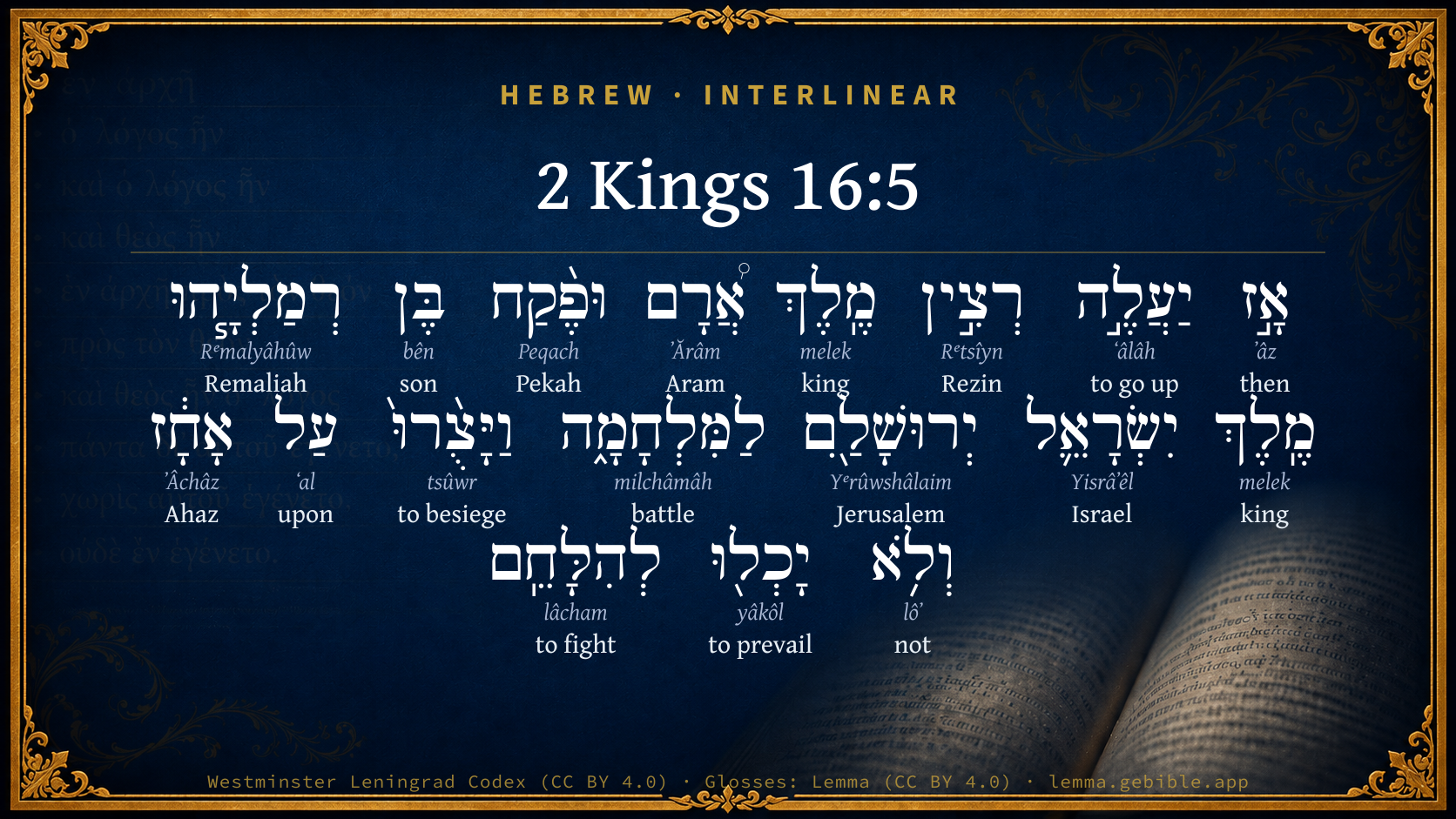
Hebrew (Westminster Leningrad Codex) 2 Kings 16:5 appears in the Hebrew Old Testament. The text above is from the Westminster Leningrad Codex. Each word links to its Strong’s number, a concise gloss, and parsing drawn from the Open Scriptures Hebrew Bible morphology. Click any word for its full Brown-Driver-Briggs (BDB) entry.
Download image
Cite this verse

2 Kings 16:5 (World English Bible). Public Domain. Lemma interlinear Bible study tool, https://lemma.gebible.app/v/2-kings/16/5.

Show BibTeX & RIS
BibTeX
RIS
English Translation
Then Rezin king of Syria and Pekah son of Remaliah king of Israel came up to Jerusalem to war: and they besieged Ahaz, but could not overcome him.
World English Bible · Public Domain
Download a study sheet

One document with this verse’s original text, its word-by-word gloss line, the meaning frame, cross-references with their text, attributed commentary, and full source and license credits — printable, and it pastes into notes with its structure intact.

This verse Autodidact and up

Study sheet (.html) Plain text (.txt)

A passage Seminary Student

Up to 50 verses in one chapter. A passage sheet keeps up to 6 commentary sources and 12 cross-references per verse, in the order this page ranks them, and says so on the sheet whenever that leaves anything out. Ask for a single verse and you get the Autodidact verse sheet above.

Everything on this page stays free to read, with no account — the sheet is a download of what is already on screen, not access to it.

Want to remove ads? Support Godless Engineer
Compare translations 3

The same verse in 3 English versions, stacked beneath the original-language interlinear above. Click any original word for its lexicon entry.

Each is an independent rendering of the whole verse — the interlinear is not word-aligned to these translations.

Highlighted words mark where these versions differ — a whole-verse word diff, not a word-by-word alignment.

  • World English Bible Public Domain
    Then Rezin king of Syria and Pekah son of Remaliah king of Israel came up to Jerusalem to war: and they besieged Ahaz, but could not overcome him.
  • King James Version Public Domain
    Then Rezin king of Syria and Pekah son of Remaliah king of Israel came up to Jerusalem to war: and they besieged Ahaz, but could not overcome him.
  • unfoldingWord Literal Text CC BY-SA 4.0
    Then Rezin, the king of Aram, came up with Pekah, the son of Remaliah, the king of Israel, Jerusalem for battle. And they besieged against Ahaz, but they were not able to fight.

unfoldingWord Literal Text — © unfoldingWord, licensed CC BY-SA 4.0. Word-aligned USFM3 via Door43 (git.door43.org/unfoldingWord/en_ult).

Versions to compare (up to 4)

3 of 4 selected

Show all 18 translations

Every available English version of this verse, each an independent rendering of the whole verse.

  • World English Bible Public Domain
    Then Rezin king of Syria and Pekah son of Remaliah king of Israel came up to Jerusalem to war: and they besieged Ahaz, but could not overcome him.
  • Berean Standard Bible Public Domain
    Then Rezin king of Aram and Pekah son of Remaliah king of Israel came up to wage war against Jerusalem. They besieged Ahaz but could not overcome him.
  • Majority Standard Bible Public Domain
    Then Rezin king of Aram and Pekah son of Remaliah king of Israel came up to wage war against Jerusalem. They besieged Ahaz but could not overcome him.
  • King James Version Public Domain
    Then Rezin king of Syria and Pekah son of Remaliah king of Israel came up to Jerusalem to war: and they besieged Ahaz, but could not overcome him.
  • American Standard Version (1901) Public Domain
    Then Rezin king of Syria and Pekah son of Remaliah king of Israel came up to Jerusalem to war: and they besieged Ahaz, but could not overcome him.
  • Revised Version (1885) Public Domain
    Then Rezin king of Syria and Pekah son of Remaliah king of Israel came up to Jerusalem to war: and they besieged Ahaz, but could not overcome him.
  • Geneva Bible (1599) Public Domain
    Then Rezin king of Aram and Pekah sonne of Remaliah King of Israel came vp to Ierusalem to fight: and they besieged Ahaz, but could not ouercome him.
  • Douay-Rheims (1899) Public Domain
    Then Basin king of Syria, and Phacee son of Romelia king of Israel came up to Jerusalem to fight: and they besieged Achaz, but were not able to overcome him.
  • Young's Literal Translation Public Domain
    Then doth Rezin king of Aram go up, and Pekah son of Remaliah king of Israel, to Jerusalem, to battle, and they lay siege to Ahaz, and they have not been able to fight.
  • Literal Standard Version CC BY-SA 4.0
    Then Rezin king of Aram, and Pekah son of Remaliah, king of Israel, go up to Jerusalem, to battle, and they lay siege to Ahaz, and they have not been able to fight.
  • Unlocked Literal Bible CC BY-SA 4.0
    Then Rezin, king of Aram and Pekah son of Remaliah, king of Israel, came up to Jerusalem to attack. They besieged Ahaz, but they could not conquer him.
  • unfoldingWord Literal Text CC BY-SA 4.0
    Then Rezin, the king of Aram, came up with Pekah, the son of Remaliah, the king of Israel, Jerusalem for battle. And they besieged against Ahaz, but they were not able to fight.
  • Darby Bible Public Domain
    Then Rezin the king of Syria, and Pekah son of Remaliah, the king of Israel, came up to Jerusalem to battle; and they besieged Ahaz, but were unable to conquer him.
  • World Messianic Bible Public Domain
    Then Rezin king of Syria and Pekah son of Remaliah king of Israel came up to Jerusalem to wage war. They besieged Ahaz, but could not overcome him.
  • Webster's Bible Public Domain
    Then Rezin king of Syria and Pekah son of Remaliah king of Israel came up to Jerusalem to war: and they besieged Ahaz, but could not overcome him.
  • Free Bible Version CC BY-SA 4.0
    Rezin, king of Aram, and Pekah, son of Remaliah, king of Israel, came and attacked Jerusalem. They besieged Ahaz but couldn't defeat him.
  • Bible in Basic English Public Domain
    Then Rezin, king of Aram, and Pekah, son of Remaliah, king of Israel, came up to Jerusalem to make war; and they made an attack on Ahaz, shutting him in, but were not able to overcome him.
  • JPS Tanakh (1917) Public Domain
    Then Rezin king of Aram and Pekah son of Remaliah king of Israel came up to Jerusalem to war; and they besieged Ahaz, but could not overcome him.

Literal Standard Version (2020), Covenant Press — licensed CC BY-SA 4.0. Text via the HelloAO Bible API (eBible.org). Unlocked Literal Bible (unfoldingWord) — licensed CC BY-SA 4.0. Text via the HelloAO Bible API (eBible.org). unfoldingWord Literal Text — © unfoldingWord, licensed CC BY-SA 4.0. Word-aligned USFM3 via Door43 (git.door43.org/unfoldingWord/en_ult). Free Bible Version, Dr. Jonathan Gallagher — licensed CC BY-SA 4.0. Text via the HelloAO Bible API (eBible.org).

Word by word

More ways to search: Search by grammar → Find every occurrence → Compare this word →

Practice this passage: Drill this verse → Learn its vocabulary →

רְצִ֣ין
Rᵉtsîyn
H7526
“Rezin”
Noun, Proper
Part of Speech
Noun
Type
Proper
Full BDB Definition

Origin: probably for H7522

TWOT: None

Rezin = "firm" - king of Damascus during the reigns of kings Jotham and Ahaz of Judah - the progenitor of a family of temple slaves who returned from captivity with Zerubbabel
  1. אָ֣ז ʼâz H227 “then” Adverb
  2. יַעֲלֶ֣ה ʻâlâh H5927 “to go up” Verb, Qal, Imperfect, 3rd Person, Masculine, Singular
  3. מֶֽלֶךְ melek H4428 “king of” Noun, Common, Masculine, Singular, Construct
  4. אֲ֠רָם ʼĂrâm H758 “Aram” Noun, Proper
  5. וּפֶ֨קַח Peqach H6492 “and · Pekah” Conjunction + Noun, Proper
  6. בֶּן bên H1121 “son of” Noun, Common, Masculine, Singular, Construct
  7. רְמַלְיָ֧הוּ Rᵉmalyâhûw H7425 “Remaliah” Noun, Proper
  8. מֶֽלֶךְ melek H4428 “king of” Noun, Common, Masculine, Singular, Construct
  9. יִשְׂרָאֵ֛ל Yisrâʼêl H3478 “Israel” Noun, Proper
  10. יְרוּשָׁלִַ֖ם Yᵉrûwshâlaim H3389 “Jerusalem” Noun, Proper
  11. לַמִּלְחָמָ֑ה milchâmâh H4421 “to/for the · battle” Preposition, Determined + Noun, Common, Feminine, Singular, Absolute
  12. וַיָּצֻ֨רוּ֙ tsûwr H6696 “and · to besiege” Conjunction + Verb, Qal, Sequential Imperfect, 3rd Person, Masculine, Plural
  13. עַל ʻal H5921 “upon” Preposition
  14. אָחָ֔ז ʼÂchâz H271 “Ahaz” Noun, Proper
  15. וְלֹ֥א lôʼ H3808 “and · not” Conjunction + Particle, Negative
  16. יָכְל֖וּ yâkôl H3201 “to prevail” Verb, Qal, Perfect, 3rd Person, Common, Plural
  17. לְהִלָּחֵֽם lâcham H3898 “to fight” Preposition + Verb, Niphal, Infinitive Construct

About this verse

These counts appear in no published source. They are computed here, from the morphology-tagged text and Lemma’s own curated glosses. What Lemma adds →

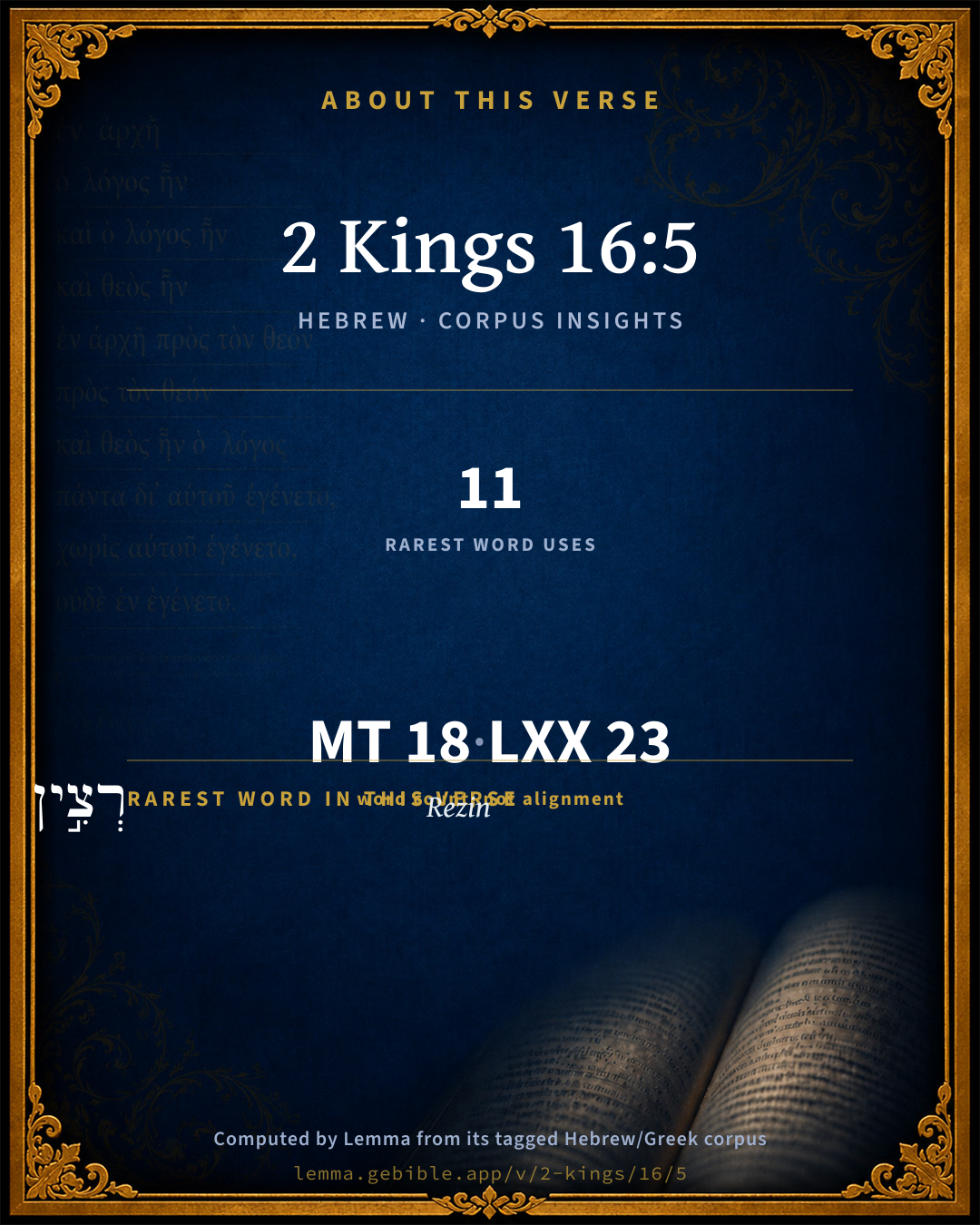
18
words
17
distinct lemmas
Historical
section

Notable vocabulary

The rarest word here is רְצִ֣ין Rezin H7526 — appearing just 11 times in the whole Hebrew Bible.

Shared distinctive vocabulary

רְצִ֣ין Rezin H7526 occurs in 11 verses of the Hebrew Bible. Also found in:

Grammatical profile

  • 4 verbs
  • 11 nouns
  • 1 preposition
  • 1 adverb
  • 1 particle

Verb forms

  • יַעֲלֶ֣ה Qal · Imperfect
  • וַיָּצֻ֨רוּ֙ Qal · Sequential Imperfect
  • יָכְל֖וּ Qal · Perfect
  • לְהִלָּחֵֽם Niphal · Infinitive Construct

Repetition

A word recurs within this verse — often emphatic in Hebrew:

  • מֶֽלֶךְ king H4428 ×2

Hebrew & Septuagint length

In English translation the verse runs 28 words from the Hebrew and 28 from the Septuagint (LXX English) — the same length.

A rough comparison of the two English renderings, which tokenize alike — not a word-level alignment.

Word counts can differ between the Hebrew and the Greek without any difference in meaning — e.g. the Hebrew direct-object marker אֵת has no separate Greek word, and Greek often adds the article ὁ.

In the original languages it is 18 Hebrew tokens and 23 Greek tokens — but the two are counted differently (Hebrew bundles its prefixes and suffixes into one token; the Greek is in lemma form), so that isn’t a like-for-like length.

Cross-references

9

Topical passages linked to 2 Kings 16:5 in the Treasury of Scripture Knowledge — connected by theme and wording, ordered by reader-vote popularity; previews shown in the World English Bible.

  • 2 Kings 15:37 In those days Yahweh began to send against Judah Rezin the king of Syria, and Pekah the son of Remaliah.
  • Isaiah 7:1–9 It happened in the days of Ahaz the son of Jotham, the son of Uzziah, king of Judah, that Rezin the king of Syria, and Pekah the son of Remaliah, king of Israel, went up to Jerusalem to war against it, but could not prevail against it.
  • Isaiah 7:14 Therefore the Lord himself will give you a sign. Behold, the virgin will conceive, and bear a son, and shall call his name Immanuel.
  • Isaiah 8:9–10 Make an uproar, O you peoples, and be broken in pieces! And give ear, all you of far countries: gird yourselves, and be broken in pieces! Gird yourselves, and be broken in pieces!
  • Isaiah 9:6–7 For to us a child is born, to us a son is given; and the government shall be on his shoulder: and his name shall be called Wonderful, Counselor, Mighty God, Everlasting Father, Prince of Peace.
  • 1 Kings 11:36 To his son will I give one tribe, that David my servant may have a lamp always before me in Jerusalem, the city which I have chosen me to put my name there.
  • 1 Kings 15:4 Nevertheless for David's sake did Yahweh his God give him a lamp in Jerusalem, to set up his son after him, and to establish Jerusalem;
  • 2 Chronicles 28:5–15 Therefore Yahweh his God delivered him into the hand of the king of Syria; and they struck him, and carried away of his a great multitude of captives, and brought them to Damascus. He was also delivered into the hand of the king of Israel, who struck him with a great slaughter.
  • Isaiah 8:6 Because this people have refused the waters of Shiloah that go softly, and rejoice in Rezin and Remaliah's son;

Cross-references courtesy of OpenBible.info (CC BY 4.0).

Hebrew and Greek witnesses Masoretic Hebrew ↔ Greek Septuagint

The same verse in the two great witnesses to the Old Testament, shown verse-for-verse.

These are two independent witnesses, not word-aligned to each other, and the Septuagint is shown in lemma (dictionary) form.

Hebrew 2 Kings 16:5 Masoretic · Westminster Leningrad Codex

אָ֣ז יַעֲלֶ֣ה רְצִ֣ין מֶֽלֶךְ אֲ֠רָם וּפֶ֨קַח בֶּן רְמַלְיָ֧הוּ מֶֽלֶךְ יִשְׂרָאֵ֛ל יְרוּשָׁלִַ֖ם לַמִּלְחָמָ֑ה וַיָּצֻ֨רוּ֙ עַל אָחָ֔ז וְלֹ֥א יָכְל֖וּ לְהִלָּחֵֽם

Then Rezin king of Syria and Pekah son of Remaliah king of Israel came up to Jerusalem to war: and they besieged Ahaz, but could not overcome him.

World English Bible · Public Domain

Greek LXX 2 Kings 16:5 Septuagint · lemma form

τότε ἀναβαίνω ραασσων βασιλεύς συρία καί φακεε υἱός ρομελιας βασιλεύς ἰσραήλ εἰς ἰερουσαλήμ εἰς πόλεμος καί πολιορκέω ἐπί αχαζ καί οὐ δύναμαι πολεμέω

Then went up Raasson king of Syria and Phakee son of Romelias king of Israel against Jerusalem to war, and besieged Achaz, but could not prevail against him.

LXX2012 (modern English Septuagint) · Public Domain

On this verse, John Gill's Exposition discusses the Septuagint’s reading. Read the note in Commentary ↓

Hebrew: Westminster Leningrad Codex (CC BY 4.0). Greek: Septuagint (public domain); English from LXX2012 (modern English Septuagint) (Public Domain). How the Septuagint differs from the Hebrew →

Targum (Aramaic paraphrase)

1

The Targum is the ancient Jewish Aramaic paraphrase of the Hebrew Scriptures — an interpretive translation, not the Hebrew text itself. Onkelos (literal) and Pseudo-Jonathan (expansive) render the Torah, and Jonathan the Prophets. Coverage is partial: where no permissively-licensed English translation exists for a verse, only the Aramaic is shown. This is verse-level text, not a word-by-word alignment to the Hebrew.

  1. Targum Jonathan Prophets (Joshua–Malachi)
    בְּכֵן סְלֵיק רְצִין מַלְכָּא דַאֲרָם וּפֶקַח בַּר רְמַלְיָהוּ מַלְכָּא דְיִשְׂרָאֵל לִירוּשְׁלֵם לְאַגָחָא קְרָבָא וְצָרוּ עַל אָחָז וְלָא יָכִילוּ לְאַגָחָא:

    (no public-domain English translation for this verse)

    Targum Jonathan — Aramaic: “Mikraot Gedolot” (public domain). English: “Sefaria Community Translation” (CC0 1.0 (public-domain dedication)); “London "Chaldee Paraphrase," 1871” (public domain). Text via Sefaria.

Commentary

Notes on 2 Kings 16:5 from classic Christian and Jewish commentators (each source and its license shown beneath its notes). The classic Christian expositions comment on the surrounding passage and are grouped to its opening verse, so a note may address several verses; the Jewish commentaries on the Tanakh (Rashi and others) are per-verse, so they appear only where the commentator wrote on this verse.

Lemma curates 59 commentaries, every one of them public domain or Creative Commons licensed, each selected and text-cleaned for this edition rather than reprinted as found. About our sources →

Trapp's Complete Commentary

John Trapp

2Ki 16:5 Then Rezin king of Syria and Pekah son of Remaliah king of Israel came up to Jerusalem to war: and they besieged Ahaz, but could not overcome [him].

Ver. 5. Then Rezin king of Syria and Pekah, &c.] After a former invasion of the land, and great spoil made, {2Ch 28:5} these two confederate kings came up to Jerusalem, the chief city, which they had already devoured in their hopes, resolving to set up the son of Tabeal, some great man of Syria, for king. {Isa 7:5-6}

And besieged Ahaz.] Who, with his people, was grievously frightened till confirmed by a sign, though most unworthy of such a favour. {Isa 7:1; Isa 7:16}

But could not overcome him.] For they proved like two tails of smoking firebrands. {Isa 7:4} They came into the country like thunder and lightning: but went out like a snuff.

John Trapp, A Commentary or Exposition upon All the Books of the Old and New Testament (1647–1656) — public domain. Text from a community e-Sword module.

Joseph Benson's Commentary

2Ki 16:5-6. But could not overcome him — Because God, of his own mere grace, undertook the protection of Judah, as he promised to do, and disappointed the designs and hopes of their enemies, Isa 7:1-9. At that time Rezin recovered Elath — Took it from the Jews, who had not long been in possession of it, having but lately recovered it, with the rest of Edom: see on 2Ki 14:22. So that, though the confederate kings of Syria and Israel failed, through the interference of Divine Providence, in their attempts on Jerusalem, the former made himself master of this considerable and very commodious port on the Red sea.

Joseph Benson's Commentary on the Old and New Testaments (1811–1818) — public domain. Text from a community e-Sword module.

Keil & Delitzsch

C. F. Keil & F. Delitzsch

Of the war which the allied Syrians and Israelites waged upon Ahaz, only the principal fact is mentioned in Kg2 16:5, namely, that the enemy marched to Jerusalem to war, but were not able to make war upon the city, i.e., to conquer it; and in Kg2 16:6 we have a brief notice of the capture of the port of Elath by the Syrians. We find Kg2 16:5 again, with very trifling alterations, in Isa 7:1 at the head of the prophecy, in which the prophet promises the king the help of God and predicts that the plans of his enemies will fail. According to this, the allied kings intended to take Judah, to dethrone Ahaz, and to install a vassal king, viz., the son of Tabeel. We learn still more concerning this war, which had already begun, according to Kg2 15:37, in the closing years of Jotham, from Ch2 28:5-15; namely, that the two kings inflicted great defeats upon Ahaz, and carried off many prisoners and a large amount of booty, but that the Israelites set their prisoners at liberty again, by the direction of the prophet Oded, and after feeding and clothing them, sent them back to their brethren. It is now generally admitted that these statements are not at variance with our account (as Ges., Winer, and others maintain), but can be easily reconciled with it, and simply serve to complete it.

(Note: Compare C. P. Caspari's article on the Syro-Ephraimitish war in the reigns of Jotham and Ahaz (Univers. Progr. von Christiania, 1849), where the different views concerning the relation between the two accounts are fully discussed, and the objections to the credibility of the account given in the Chronicles most conclusively answered.)

The only questions in dispute are, whether the two accounts refer to two different campaigns, or merely to two different events in the same campaign, and whether the battles to which the Chronicles allude are to be placed before or after the siege of Jerusalem mentioned in our text. The first question cannot be absolutely decided, since there are no decisive arguments to be found in favour of either the one supposition or the other; and even "the one strong argument" which Caspari finds in Isa 7:6 against the idea of two campaigns is not conclusive. For if the design which the prophet there attributes to the allied kings, "we will make a breach in Judah," i.e., storm his fortresses and his passes and conquer them, does obviously presuppose, that at the time when the enemy spake or thought in this manner, Judah was still standing uninjured and unconquered, and therefore the battles mentioned in Ch2 28:5-6 cannot yet have been fought; it by no means follows from the connection between Isa 7:6 and Isa 7:1 (of the same chapter) that Isa 7:6 refers to plans which the enemy had only just formed at the time when Isaiah spoke (Kg2 7:4.). On the contrary, Isaiah is simply describing the plans which the enemy devised and pursued, and which they had no doubt formed from the very commencement of the war, and now that they were marching against Jerusalem, hoped to attain by the conquest of the capital. All that we can assume as certain is, that the war lasted longer than a year, since the invasion of Judah by these foes had already commenced before the death of Jotham, and that the greater battles (Ch2 28:5-6) were not fought till the time of Ahaz, and it was not till his reign that the enemy advanced to the siege of Jerusalem. - With regard to the second question, it cannot be at all doubtful that the battles mentioned preceded the advance of the enemy to the front of Jerusalem, and therefore our account merely mentions the last and principal event of the war, and that the enemy was compelled to retreat from Jerusalem by the fact that the king of Assyria, Tiglath-pileser, whom Ahaz had called to his help, marched against Syria and compelled Rezin to hurry back to the defence of his kingdom. - It is more difficult to arrange in the account of the capture of Elath by the Syrians (Kg2 16:6) among the events of this war. The expression ההיא בּעת merely assigns it in a perfectly general manner to the period of the war. The supposition of Thenius, that it did not take place till after the siege of Jerusalem had been relinquished, and that Rezin, after the failure of his attempt to take Jerusalem, that he might not have come altogether in vain, marched away from Jerusalem round the southern point of the Dead Sea and conquered Elath, is impossible, because he would never have left his own kingdom in such a defenceless state to the advancing Assyrians. We must therefore place the taking of Elath by Rezin before his march against Jerusalem, though we still leave it undecided how Rezin conducted the war against Ahaz: whether by advancing along the country to the east of the Jordan, defeating the Judaeans there (Ch2 28:5), and then pressing forward to Elath and conquering that city, while Pekah made a simultaneous incursion into Judah from the north and smote Ahaz, so that it was not till after the conquest of Elath that Rezin entered the land from the south, and there joined Pekah for a common attack upon Jerusalem, as Caspari supposes; or whether by advancing into Judah along with Pekah at the very outset, and after he had defeated the army of Ahaz in a great battle, sending a detachment of his own army to Idumaea, to wrest that land from Judah and conquer Elath, while he marched with the rest of his forces in combination with Pekah against Jerusalem.

"Rezin brought Elath to Aram and drove the Jews out of Elath, and Aramaeans came to Elath and dwelt therein to this day." השׁיב does not mean "to lead back" here, but literally to turn, to bring to a person; for Elath had never belonged to Aram before this, but was an Edomitish city, so that even if we were to read אדום for ארם, השׁיב could not mean to bring back. But there is no ground whatever for altering לארם into לאדום (Cler., Mich., Ew., Then., and others), whereas the form ארם is at variance with such an alteration through the assumption of an exchange of r and d, because אדום is never written defective אדם except in Eze 25:14. There are also no sufficient reasons for altering וארומים into וארומים (Keri); ארומיּם is merely a Syriac form for ארמּים with the dull Syriac u-sound, several examples of which form occur in this very chapter, - e.g., הקּומים for הקּמים Kg2 16:7, דּוּמשׂק for דּמּשׂק Kg2 16:10, and אילות for אילת Kg2 16:6, - whereas אדום, with additions, is only written plene twice in the ancient books, and that in the Chronicles, where the scriptio plena is generally preferred (Ch2 25:14 and Ch2 28:17), but is always written defective (אדמים). Moreover the statement that "אדומים (Edomites, not the Edomites) came thither," etc., would be very inappropriate, since Edomites certainly lived in this Idumaean city in perfect security, even while it was under Judaean government. And there would be no sense in the expression "the Edomites dwelt there to this day," since the Edomites remained in their own land to the time of the captivity. All this is applicable to Aramaeans alone. As soon as Rezin had conquered this important seaport town, it was a very natural thing to establish an Aramaean colony there, which obtained possession of the trade of the town, and remained there till the time when the annals of the kings were composed (for it is to this that the expression הזּה עד־היּום refers), even after the kingdom of Rezin had long been destroyed by the Assyrians, since Elath and the Aramaeans settled there were not affected by that blow.

(Note: If we only observe that ארומים has not the article, and therefore the words merely indicate the march of an Aramaean colony to Elath, it is evident that אדומים would be unsuitable; for when the יהודים had been driven from the city which the Syrians had conquered, it was certainly not some Edomites but the Edomites who took possession again. Hence Winer, Caspari, and others are quite right in deciding that ארומים is the only correct reading.)

As soon as the Edomites had been released by Rezin from the control of Judah, to which they had been brought back by Amaziah and Uzziah (Kg2 14:7, Kg2 14:22), they began plundering Judah again (Ch2 28:17); and even the Philistines took possession of several cities in the lowland, to avenge themselves for the humiliation they had sustained at the hand of Uzziah (Ch2 28:18).

Keil & Delitzsch — Biblical Commentary on the Old Testament (1861–1891) — public domain (CC PDM 1.0). Text via the HelloAO Bible API. (Old Testament only.)

Tyndale Open Study Notes

Tyndale Open Resources

16:5-6 Rezin . . . Pekah: This alliance between the kings of Aram and Israel was intended to free the area of Assyrian dominance under Tiglath-pileser III (15:29-30; Isa 9:1). The attack against Judah may have occurred to force Judah into the alliance or to replace the Judean king with one of their own choosing (Isa 7:3-6). The result was captivity and widespread death for the people of Judah (2 Chr 28:5-15). Isaiah reports that Rezin and Pekah intended to install a new king on Judah’s throne (Isa 7:3-6). Judah also suffered further attacks by the Edomites and Philistines (2 Chr 28:17-18). All of this was God’s will due to Ahaz’s detestable spiritual practices, which led to great sin among the people of Judah (2 Chr 28:5, 19).

Tyndale Open Study Notes — © Tyndale Open Resources, licensed CC BY-SA 4.0. Text via the HelloAO Bible API.

Geneva Bible (1599)

Geneva Bible translators

For the Lord preserved the city and his people for his promise sake made to David.

Geneva Bible (1599) marginal notes — public domain. Text via Bolls.life.

Matthew Henry's Commentary

Here is, 1. The attempt of his confederate neighbours, the kings of Syria and Israel, upon him. They thought to make themselves masters of Jerusalem, and to set a king of their own in it, Isa 7:6. In this they fell short, but the king of Syria recovered Elath, a considerable port upon the Red Sea, which Amaziah had taken from the Syrians, Kg2 14:22. What can those keep that have lost their religion? Let them expect, thenceforward, to be always on the losing hand. 2. His project to get clear of them. Having forsaken God, he had neither courage nor strength to make head against his enemies, nor could he, with any boldness, ask help of God; but he made his court to the king of Assyria, and got him to come in for his relief. Those whose hearts condemn them will go any where in a day of distress rather than to God. Was it because there was not a God in Israel that he sent to the Assyrian for help? Was the rock of ages removed out of its place, that he stayed himself on this broken reed? The sin itself was its own punishment; for, though it is true that he gained his point (the king of Assyria hearkened to him, and, to serve his own turn, made a descent upon Damascus, whereby he gave a powerful diversion to the king of Syria, Kg2 16:9, and obliged him to let fall his design against Ahaz, carrying the Syrians captive to Kir, as Amos had expressly foretold, Amo 1:5), yet, considering all, he made but a bad bargain; for, to compass this, (1.) He enslaved himself (Kg2 16:7): I am thy servant and thy son, that is, "I will be as dutiful and obedient to thee as to a master or father, if thou wilt but do me this good turn." Had he thus humbled himself to God, and implored his favour, he might have been delivered upon easier terms; he might have saved his money, and needed only to have parted with his sins. But, if the prodigal forsake his father's house, he soon becomes a slave to the worst of masters, Luk 15:15. (2.) He impoverished himself; for he took the silver and gold that were laid up in the treasury both of the temple and of the kingdom, and sent it to the king of Assyria, Kg2 16:8. Both church and state must be squeezed and exhausted, to gratify this his new patron and guardian. I know not what authority he had thus to dispose of the public stock; but it is common for those that have brought themselves into straits by one sin to help themselves out by another; and those that have alienated themselves from God will make no difficulty of alienating any of his rights.

Matthew Henry's Commentary on the Whole Bible (1708–1710) — public domain (CC PDM 1.0). Text via the HelloAO Bible API.

Jamieson, Fausset & Brown

Robert Jamieson, A. R. Fausset & David Brown

Then Rezin king of Syria and Pekah son of Remaliah king of Israel came up to Jerusalem--Notwithstanding their great efforts and military preparations, they failed to take it and, being disappointed, raised the siege and returned home (compare Isa 7:1).

Jamieson, Fausset & Brown — Commentary Critical and Explanatory on the Whole Bible (1871) — public domain (CC PDM 1.0). Text via the HelloAO Bible API.

Adam Clarke's Commentary

Verse 5. But could not overcome him.] It is likely that this was the time when Isaiah was sent to console Ahaz; (see Isa 7:1;) and predicted the death both of Rezin and Pekah, his enemies.

Adam Clarke's Commentary on the Bible (1810–1826) — public domain. Text from a community e-Sword/MySword module.

Ellicott's Commentary for English Readers

(5) Then Rezin king of Syria . . . to war.—This verse agrees almost word for word with Isa_7:1. The time is soon after the accession of Ahaz. “Jotham, the last of a series of strong and generally successful princes, had died at a critical moment, when Pekah and Rezin were maturing their plans against his kingdom. The opposing parties in northern Israel suspended their feuds to make common cause against Judah (Isa_9:21), and the proud inhabitants of Samaria hoped by this policy to more than restore the prestige forfeited in previous years of calamity (Isa_9:9-10). At the same time the Syrians began to operate in the eastern dependencies of Judah, their aim being to possess themselves of the harbour of Elath on the Red Sea, while the Philistines attacked the Judeans in the rear, and ravaged the fertile lowlands (Isa_9:12, 2Ki_16:6). A heavy and sudden disaster had already fallen on the Judean arms, a defeat in which ‘head and tail, palm-branch and rush’ had been mown down in indiscriminate slaughter (Isa_9:14). Ahaz was no fit leader in so critical a time; his character was petulant and childish, his policy was dictated in the harem (Isa_3:12). Nor was the internal order of the state calculated to inspire confidence. Wealth, indeed, had greatly accumulated in the preceding time of prosperity, but its distribution had been such that it weakened rather than added strength to the nation. The rich nobles were steeped in sensual luxury, the court was full of gallantry, feminine extravagance and vanity gave the tone to aristocratic society (Isa_5:11; Isa_3:16; comp. Isa_3:12; Isa_4:4), which, like the noblesse of France on the eve of the Revolution, was absorbed in gaiety and pleasure, while the masses were ground down by oppression, and the cry of their distress filled the land (Isa_3:15; Isa_5:7).”—Prof. Robertson Smith.

They besieged Ahaz.—The allies wanted to compel Judah to join them in their attempt to throw off the burdensome yoke of Assyria, imposed in 738 B.C. (2Ki_15:19); and thought the best way to secure this was to dethrone the dynasty of David, and set up a creature of their own—“the son of Tabeal” (Isa_7:6).

Could not overcome him.—Literally, they were not able to war, as in Isa_7:2. The allies could not storm the city, which had been strongly fortified by Uzziah and Jotham (2Ch_26:9; 2Ch_27:3).

A Bible Commentary for English Readers, edited by Charles John Ellicott (1878–1897) — public domain. Text from a community e-Sword module.

The Cambridge Bible for Schools and Colleges

gen. ed. J. J. S. Perowne

5. came up to Jerusalem to war] The plans which had been formed in the reign of Jotham (see 2Ki_15:37) were now put into execution. And from Isa_7:2 we can see into what agitation the people of Judah were brought by the advance of the allied enemies. ‘It was told the house of David, saying, Syria is confederate with Ephraim (i.e. Israel). And his heart was moved and the heart of his people as the trees of the wood are moved with the wind’.

they besieged Ahaz, but could not overcome him] i.e. They never took Jerusalem (cf. Isa_7:1). This is the security which Isaiah was instructed to promise to Ahaz. But it is evident from the narrative of the Chronicler that much damage was done in the land by the invasion. He says (2Ch_28:5) that Ahaz was delivered into the hand of the king of Syria, who smote him and carried away a great multitude of captives and brought them to Damascus, and he was also delivered into the hand of Pekah king of Israel, who slew in Judah a hundred and twenty thousand men in one day, and carried away captive two hundred thousand, women, sons and daughters, along with much spoil. We can understand the stir caused in Jerusalem by the approach of an army which had already inflicted such blows upon the land.

The Cambridge Bible for Schools and Colleges (gen. ed. J. J. S. Perowne; Cambridge University Press, 1878–1918) — public domain. Text from a community e-Sword module.

John Gill's Exposition

At that time Rezin king of Syria recovered Elath to Syria,.... A port on the Red sea, that formerly belonged to Edom, taken from them by David, retaken by them when they revolted in Joram's time, and perhaps taken by Amaziah again, since his son Azariah rebuilt it, and restored it to Judah, Kg2 14:22 and it seems by this that it had been in the hands of the Syrians, who now recovered it; unless instead of Aram, rendered Syrians, we could substitute Edom, which Le Clerc has ventured to do without any authority:

and drave the Jews from Elath; who were in possession of it. This is the first time that the inhabitants of the kingdom of Judah are called Jews, from the name of their original patriarch, and principal tribe; though some think (m) they had this name from the time this tribe went up first against the Canaanites, Jdg 1:1, however, it is a mistake of R. Elias Levita (n), that it is never found in the Bible they were called Jews, but from the time the ten tribes were carried captive, and not before; and a greater mistake still it is of Tacitus (o), that they were called Jews or Judaeans, as if they were Idaeans from Mount Ida in Crete, from whence he supposes they came:

and the Syrians came to Elath, and dwelt there unto this day; the marginal reading is Edomites; and so read the Septuagint and Vulgate Latin versions; and Kimchi observes that it is written "Aramim", Syrians, because the king of Syria took it, and by his means the Edomites returned to it, but is read "Edomim", Edomites, because it belonged to the children of Edom; and it is certain the Edomites had come and smitten Judah, Ch2 28:17.

(m) Polydor. Virgil. de Invent. l. 4. c. 1. (n) Tishbi, p. 143. So David de Pomis Lexic. fol. 83. 4. (o) Hist. l. 5. sect. 2.

John Gill's Exposition of the Whole Bible (1746–1763) — public domain (CC PDM 1.0). Text via the HelloAO Bible API.

Albert Barnes' Notes on the Bible

Rezin and Pekah, who had already begun their attacks upon Judaea in the reign of Jotham 2Ki 15:37, regarded the accession of a boy-king, only 16 years of age, as especially favorable to their projects, and proceeded without loss of time to carry them out. The earlier scenes of the war, omitted by the writer of Kings, are given at some length in 2Ch 28:5-15.

Albert Barnes' Notes on the Bible (1834–1885) — public domain. Text from a community e-Sword/MySword module.

Haydock's Catholic Bible Commentary

Then. In punishment of such enormous crimes, God first delivered Achaz into the hands of Rasin, (2 Paralipomenon xxviii.; St. Jerome, in Isaias vii.) and afterwards Phacee destroyed 120,000 in one battle, and took 200,000 prisoners, whom the prophet Oded persuaded him to release, 2 Paralipomenon xxviii. 8, 11. Salien (the year before Christ 759.) observes that the two kings then joined their forces , and besieged Jerusalem the following year, but to no purpose. (Haydock) --- Isaias was sent before the siege to encourage Achaz, and to promise the miraculous birth of the Messias, as a sign that he should be delivered: and to convince him of it the more, he foretold that the two kings should be destroyed before his own son should be able to say father, Isaias vii. 8., &c. Yet as Achaz did not still amend his life, God sent the same kings the following year (the year of the world 3263.) to lay waste the country. (Calmet)

George Leo Haydock (1774–1849), Haydock's Catholic Family Bible and Commentary, 1859 edition — public domain. Excludes Psalms (Douay-Rheims chapter numbering differs from Protestant) and Deuterocanonical books (Catholic canon only).

Matthew Poole's English Annotations

Because God of his own mere grace undertook their protection, as he promised to do, and disappointed the hopes and design of their enemies; of which see on Isa 7.

Matthew Poole's English Annotations on the Holy Bible (1683–1685) — public domain. Text from a community e-Sword/MySword module.

Whedon's Commentary on the Bible

Daniel D. Whedon

5. Rezin… and Pekah… came up — In the days of Jotham they had formed an alliance and commenced operations against the kingdom of Judah, but for some reason they seem not to have come up to Jerusalem until the beginning of Ahaz’s reign. Perhaps Jotham’s soldier-like power and valour were more than a match for the allied armies.

Besieged Ahaz — His weakness and wickedness emboldened his foes.

Could not overcome — The army of Jerusalem seems to have been inspirited by Isaiah’s words, who came forward at this season of alarm, and uttered the oracle of doom against “the two tails of these smoking firebrands, Rezin and the son of Remaliah.” Compare Isa_7:1-9.

But though unable to capture Jerusalem, they did immense injury to the kingdom of Judah. According to 2Ch_28:5-15, they either slew or carried into exile hundreds of thousands of the people, and also took much spoil. The Israelites, however, at the expostulation of the prophet Obed, released their captives and sent them back to Jericho.

Daniel D. Whedon (gen. ed.), Commentary on the Old and New Testaments (1874–1909) — public domain. Text from a community e-Sword module.

The Pulpit Commentary

Vers. 5, 6. War of Ahazleith Pekah and Rezin.

Then Rezin King of Syria and Pekah son of Remaliah King of Israel came up to Jerusalem to war. The alliance between Rezin and Pekah has been already glanced at. (2Ki_16:3-7) It began, apparently, in the reign of Jotham. The policy which brought it about was one that was entirely new. Since Syria developed an aggressive tendency under the first Ben-hadad, (1Ki_20:1) there had till now been no alliance made with her by either of the two Israelite kingdoms. She had been reckoned as their common enemy; and while they had on two occasions been allied together against her (1Ki_22:4-36; 2Ki_8:28) never as yet had either asked her help against the other. Now, however, Ephraim became confederate with Syria against Judah. The new policy must be ascribed to the new condition of things consequent upon the attitude assumed by Assyria under Tiglath-pileser. Assyria had been under a cloud for forty years. The nations of the western coast of Asia had ceased to fear her, and had felt at liberty to pursue their own quarrels. Her recovery of vigor altered the whole situation. It was at once evident to the statesmen who directed the policy of the small western states that, unless they combined; they were lost. Hence the alliance between Pekah and Rezin. Probably they would have been glad to have drawn Ahaz into the confederacy; but it would seem that he did not share their fears, and would not join them. Hereupon the design was formed to dethrone him, and set up in his place a new ruler, a certain Ben-Tabeal, (Isa_7:6) on whose assistance they could rely. The two confederate princes then began the campaign. Pekah invaded Judaea, and gained a great victory over Ahaz, which is perhaps exaggerated in 2Ch_28:6-15; Rezin carried his arms further south, took Elath, and reestablished the Edomites in power (see the comment on ver. 6). Then the allies joined forces and proceeded to besiege Jerusalem. And they besieged Ahaz, but could not ever-come him. The siege is mentioned by Isa_7:1, who was commissioned by God to comfort Ahaz, and assure him that the city would not fall. (Isa_7:7) The fortifications of Uzziah (2Ch_26:9) and Jotham (2Ch_27:3) had, no doubt, greatly strengthened the city since the time when (as related in 2Ki_14:13) it was captured so easily by Joash.

Vers. 5-7. God"s punishments of a nation"s sins are often long delayed, but, when they come, it is not by degrees, but suddenly, violently, and at once.

This subject may best be treated, as the last, under three heads, viz.

(1) the sins of Judah, which had provoked God;

(2) the long delay in their punishment; and

(3) the suddenness and overwhelming force with which the punishment came at last.

I THE SINS OF JUDAH. Though, on the whole, less guilty than her sister, Ephraim, still Judah had, from the division of the kingdom of Solomon, been more or less unfaithful to Jehovah in several respects.

1. An unauthorized and illegitimate high-place worship, tinged with superstition and perhaps even idolatry, had maintained its place by the side of the authorized Jehovah-cult, throughout the whole period of the divided monarchy, from the accession of Rehoboam to the death of Ahaz (1Ki_14:23 1Ki_15:14 1Ki_22:43; 2Ki_12:3 2Ki_14:4 2Ki_15:4, 35 16:4)

2. The worship of Baal had been introduced from the sister kingdom by the influence of Athaliah, and had prevailed during the reigns of her husband, Jehoram, her son, Ahaziah, and her own. (2Ki_8:18, 27 11:18)

3. Luxury and effeminacy had crept in, especially during the prosperous reigns of Uzziah and Jotham, and had led on to debauchery and licentiousness (Isa_1:4 Isa_2:6-8 Isa_3:16-24 Isa_5:11, Isa_5:12; Joe_1:5; Amo_6:1-6, etc.)

4. Injustice and oppression had become rife. The rich men sought to "join house to house, and field to field"; (Isa_5:8) they stripped the poor of their small properties by legal chicanery, (Isa_3:14) oppressed them, and "ground their faces". (Isa_3:15) The judges in the courtsaccepted bribes (Isa_1:23) and gave wrong judgments. (Isa_5:23) Widows and orphans were the special objects of attack, on account of their weakness and defenselessness. (Isa_1:17, 23 10:2)

5. The forms of religion were kept up, but the spirit had evaporated. Men thronged God"s courts, brought abundant offerings, made many prayers, kept the new moons and the sabbaths and the appointed feasts, but without any real care for the honor of God or any thought of seeking to serve and obey him. Hence their worship was "an offence;" their ceremonies were mockeries, their oblations "vain," their solemn meetings "iniquity" God was "weary to bear them". (Isa_1:11-15)

II THE LONG DELAY IN THEIR PUNISHMENT. More than two centuries had elapsed since Judah began to "do evil in the sight of the Lord, and to provoke him to jealousy with their sins which they had committed, above all that their fathers had done". (1Ki_14:22) Above a century had passed since the apostasy of Jehoram and Ahaziah. During all this time Judah had maintained her independence, had received no severe blow, fallen under no crushing affliction. Latterly, she had even prospered. Under Uzziah she had recovered Elath, (2Ki_14:22) conquered a part of Philistia, (2Ch_26:6) defeated the Arabians and Mehunim, (2Ch_26:7) and made the Ammonites her tributaries; (2Ch_26:8) under Jotham she had maintained these conquests, and when Ammon revolted bad reduced her to subjection (2Ch_27:5) without any difficulty. God, in his long-suffering mercy, bore with his people. He would win them by kindness, draw them to him by cords of love, at any rate give them ample time for repentance. But it was in vain. The longer he left them unpunished, the further they wandered from the right way, and the more they hardened their hearts. The time came when the prophet could only say of them, "Ah sinful nation, a people laden with iniquity, a seed of evil-doers, children that are corrupters: they have forsaken the Lord, they have provoked the Holy One of Israel unto anger, they are gone away backward. The whole head is sick, and the whole heart faint. From the sole of the foot even unto the head there is no soundness in it; but wounds, and bruises, and putrefying sores". (Isa_1:4-6)

III THE SUDDENNESS AND OVERWHELMING FORCE WITH WHICH THE PUNISHMENT DESCENDED WHEN IT CAME. Bishop Butler remarks how, in the punishment which God brings upon vicious individuals in this world, there is often a long respite. "After the chief bad consequences, temporal consequences, of their follies have been delayed for a great while; at length they break in irresistibly, like an armed force; repentance is too late to relieve, and can only serve to aggravate their distress; the case is become desperate, and poverty and sickness, remorse and anguish, infamy and death, the effects of their own doings, overwhelm them, beyond possibility of remedy or escape" ("Analogy of Religion, Natural and Revealed," pt. 1. 2 Kings 2. p. 52). And so it is often with nations; so it was now with the nation of the Jews. As soon as the punishment began, blow was dealt upon blow. First, Rezin "smote them, and carried away a great multitude of them captives, and brought them to Damascus". (2Ch_28:5) Then they were delivered into the hand of Pekah, who "smote them with a great slaughter, slaying a hundred and twenty thousand in one day, which were all valiant men". (2Ch_28:5, 2Ch_28:6) Next, Edom had her fling at the sick lion, and "came and smote Judah, and carried away captives". (2Ch_28:17) Then Philistia attacked the cities of the low country, and of the south of Judah, and took a number of them, "and dwelt there". (2Ch_28:18) Presently, Pekah and Rezin, joining their forces, advanced together to the siege of Jerusalem. All was lost, except only honor; and then honor was thrown into the gulf; Judah went down on her knees to Assyria, and implored aid, gave tribute, accepted a suzerain, made the inglorious confession, "I am thy servant and thy son". (2Ki_16:7) Having incurred defeat, disgrace, the loss of military honor, the loss of the flower of her troops, she crowns all by giving up her national independence, inviting a master, and herself placing a foreign yoke upon her own shoulders. But for the wonderful efforts made by Hezekiah when he ascended the throne, (2Ki_18:3-8) Judaea"s ruin would have been completed under Ahaz; and the punishment so long delayed, when it came, would have been final, "without escape or remedy.

Vers. 5-9. The-Syro-Israelitish war.

Again was the truth to be verified that national sins bring in their train national calamities. God is not mocked. He vindicates the reality of his moral government by visiting the transgressor with manifest strokes of his displeasure. In addition to the invasion of Pekah and Rezin spoken of below, we read of assaults of the Edomites and of the Philistines, by which Judah was brought very low. (2Ch_28:17-19) The kingdom also was brought into a state of servitude to Assyria.

I THE ATTACK OF PEKAH AND REZIN.

1. The Syro-Israelite conspiracy. Israel and Syria had been hereditary enemies. Now they make common cause, on the one side against Assyria, and on the other against Judah. Their object in invading Judah was probably not the simple one of plunder, but the political one of still further strengthening themselves against the King of Assyria. Pekah was a mere military adventurer, and would be restrained from attacking Judah by no scruples of brotherhood. He and Rezin had begun their attacks while Jotham was still alive, but now that Ahaz was on the throne, their plans took bolder shape. They conceived the project of removing Ahaz, and putting a certain "son of Tabeal" in his place. (Isa_7:6) The news of their expedition terrified Ahaz and his people. Instead of putting their trust in God, their hearts were moved "as the trees of the wood are moved by the wind". (Isa_7:2) They had cause to fear, for they showed no desire to forsake their sins, and when a people forsake God, they have no reason to hope that God will protect them.

2. The assault on Jerusalem, and its discomfiture. The earlier part of the joint expedition was crowned with great success. We read in Chronicles of terrible battles that were fought, and severe defeats that were sustained by the army of Judah. Large numbers of captives, with their spoil, were taken to Samaria, and were only restored by the intercession of the Prophet Oded. (2Ch_28:6-13) God permitted Judah to be thus far humbled. But when, elated with victory, the conquerors pressed on, and invested Jerusalem, he interposed to prevent their further progress. Not for the sake of Ahaz, but for his own Name"s sake, he saved Jerusalem, and hindered the invaders from accomplishing their purpose of overthrowing the house of David. Isaiah had predicted this deliverance, (Isa_7:7) and, but for the unbelief of Ahaz, and his sinful recourse to the King of Assyria, it is unlikely that the adversaries would have been permitted to go so far even as they did. Wicked men often receive mercies of which they are wholly undeserving. God spares them, not because they have any claim upon his favor, but for the sake of some oath or promise of his own, or from regard to the righteous who remain, or in order to give the sinners yet another opportunity of repentance. Because God had sworn to David that his seed should sit upon the throne, (2Sa 7) he did not allow even the wicked Ahaz to be removed. In the ease of Pekah and Rezin, we see how entirely human movements are under the Divine control. It appeared as if these bold men would sweep all before them, but God had said, "Hitherto shalt thou come, but no further", (Job_38:11) and there their proud waves were stayed.

3. The loss of Elath. The war was not wholly without gain to the Syrians. They possessed themselves of the port of Elath, at the head of the Red Sea, and thus stripped Judah of another important dependency.

II THE APPEAL TO ASSYRIA. In the distress to which the repeated attacks on his territory reduced him, Ahaz, instead of casting himself on Divine protection, foolishly betook himself to the King of Assyria.

1. Short-sighted policy. Israel had set the example of resort to the Assyrian, but the prophets had always denounced such insensate conduct. (Hos_5:13 Hos_8:9, 10 10:6) Even from the point of view of worldly policy, the action was foolish. As well might the lamb invoke the help of the lion against the wolf, as any lesser power invoke the help of the King of Assyria against an enemy. The conqueror, pleased with any pretext for interfering in another nation"s affairs, would not refuse his help, but only that the weaker power which had solicited the help might in the end be despoiled and devoured. Thus Ahaz found it. The King of Assyria was glad enough of the occasion to march against Israel and Damascus, but when once the conquest was effected, Ahaz found that he had derived no benefit, but only exchanged one oppressor for another.

2. Expensive help. To purchase the aid of Tiglath-pileser, Ahaz had

(1) to become a vassal of the King of Assyria; and

(2) to send him a large present of gold and silver.

This he could only obtain by emptying once more the often-ransacked treasuries of the temple and the palace. The accumulations of years of prosperity under Uzziah and Jotham were again dispersed, and the freedom of the country was sold to boot. God"s people passed formally under the yoke of a Gentile conqueror. To such straits was the kingdom brought by Ahaz"s godless policy.

3. The Assyrian a broken reed. The King of Assyria marched against Pekah and Rezin, and soon reduced them to his power. Damascus was severely dealt with. Its king was slain, and the people carried captive. Pekah was also chastised; his territory was ravaged, and considerable parts of the population were removed. (2Ki_15:29) The instruments employed in punishing Ahaz were thus themselves punished. The fact that men are used as instruments in God"s providence does not exonerate them from guilt. Ahaz, however, as we learn from the parallel narrative, reaped no benefit, for "Tiglath-pileser King of Assyria came unto him, and distressed him, but strengthened him not". (2Ch_28:20) It was his own ends, not those of his foolish vassal that the King of Assyria was serving. Ahaz leaned on a bruised reed, and only got his hand pierced. Thus it usually is with those who put their trust in the help of man. They reap from their assiduous sowing but the gall and wormwood of chagrin and disappointment. J.O.

The Pulpit Commentary (1880–1919), ed. H.D.M. Spence-Jones & Joseph S. Exell — public domain. Text from a community e-Sword module.

John Wesley's Explanatory Notes

Could not overcome - Because God of his own mere grace, undertook his protection, and disappointed the hopes of his enemies.

John Wesley, Explanatory Notes Upon the Whole Bible (1754–1765) — public domain. Text via the GEBible commentary corpus.

unfoldingWord translationNotes

Door43 World Missions Community

Rezin ... Pekah ... Remaliah

These are men's names. See how you translated them in 2 Kings 15:37. (See: How to Translate Names)

besieged Ahaz

Ahaz was in Jerusalem. Here "Ahaz" represents himself and the people who were in Jerusalem with him. AT: "surrounded the city with Ahaz in it" or "surrounded Ahaz and the others in the city with him" (See: Synecdoche)

recovered Elath for Aram

Here "Aram" represents the people who live there. AT: "took back control of the city of Elath for the people of Aram" (See: Metonymy)

Elath

This is the name of a city. See how you translated it in 2 Kings 14:22. (See: How to Translate Names)

drove the men of Judah out of Elath

"forced the men of Judah to leave Elath"

to this day

This means to the time of the writing of this book.

translationWords

Aram

life

unfoldingWord translationNotes — © Distant Shores Media and the Door43 World Missions Community, licensed CC BY-SA 4.0. Source: git.door43.org/Door43/en_tn.

Lesson kit

Teaching starters — assembled from the data on this page, not authored interpretation. Every prompt links to the verse data it draws on. Edit before teaching.

2 Kings, in the Historical, opens this verse with 18 words (17 distinct Hebrew lemmas). Its most distinctive word is Rᵉtsîyn (“Rezin”). A historical commentator’s framing appears above. Read the whole chapter for the surrounding context.

Discussion questions

  1. What does “Rezin” (Rᵉtsîyn) contribute to the verse as a whole?
  2. 2 Kings 15:37 shares the word «Rezin» with this verse. How do the two illuminate each other?
  3. “king” occurs 2× in this one verse. What is the effect of the repetition?
  4. The translations on this page render this verse differently — a whole-verse word diff, not a word-by-word alignment. What might account for the different wordings?
  5. The verb «יַעֲלֶ֣ה» is Qal Imperfect. How does its form color the action?
  6. Reading how Trapp's Complete Commentary and Joseph Benson's Commentary read this verse, where do the two commentators agree and where do they part?

Things to notice

Reading settings

Reading text

Shown beneath each verse's original-language words.

Old Testament
Old Testament edition

Read the OT as the Masoretic Hebrew (MT) or the Greek Septuagint (LXX).

English shown for the Greek Septuagint (in the Hebrew ↔ Greek comparison).

Comparing translations? Open the Compare panel on any verse page to stack up to four side by side.