1 Chronicles 2:21

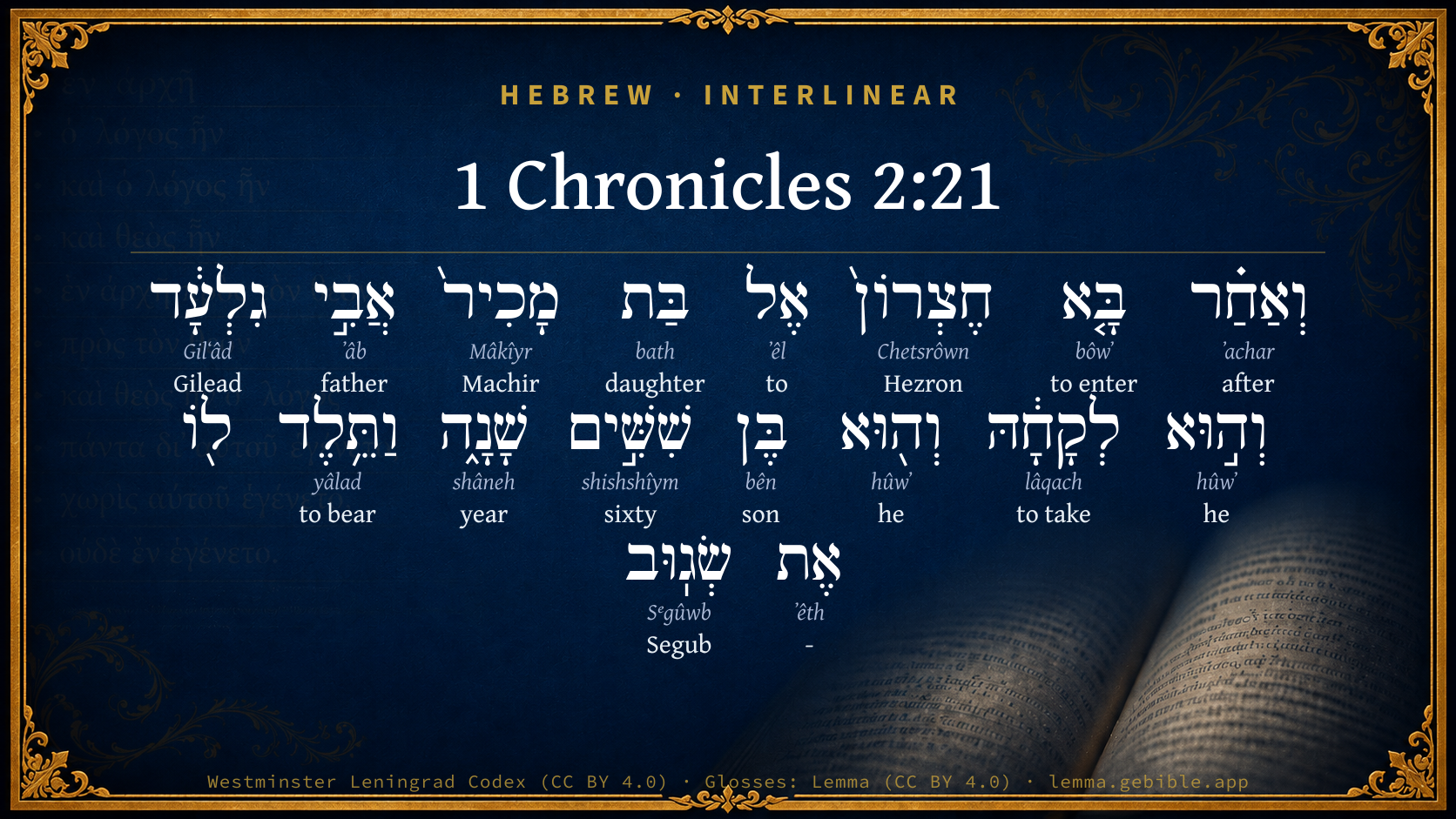
Hebrew (Westminster Leningrad Codex) 1 Chronicles 2:21 appears in the Hebrew Old Testament. The text above is from the Westminster Leningrad Codex. Each word links to its Strong’s number, a concise gloss, and parsing drawn from the Open Scriptures Hebrew Bible morphology. Click any word for its full Brown-Driver-Briggs (BDB) entry.
Download image
Cite this verse

1 Chronicles 2:21 (World English Bible). Public Domain. Lemma interlinear Bible study tool, https://lemma.gebible.app/v/1-chronicles/2/21.

Show BibTeX & RIS
BibTeX
RIS
English Translation
Afterward Hezron went in to the daughter of Machir the father of Gilead, whom he took [as wife] when he was sixty years old; and she bore him Segub.
World English Bible · Public Domain
Download a study sheet

One document with this verse’s original text, its word-by-word gloss line, the meaning frame, cross-references with their text, attributed commentary, and full source and license credits — printable, and it pastes into notes with its structure intact.

This verse Autodidact and up

Study sheet (.html) Plain text (.txt)

A passage Seminary Student

Up to 50 verses in one chapter. A passage sheet keeps up to 6 commentary sources and 12 cross-references per verse, in the order this page ranks them, and says so on the sheet whenever that leaves anything out. Ask for a single verse and you get the Autodidact verse sheet above.

Everything on this page stays free to read, with no account — the sheet is a download of what is already on screen, not access to it.

Want to remove ads? Support Godless Engineer
Compare translations 3

The same verse in 3 English versions, stacked beneath the original-language interlinear above. Click any original word for its lexicon entry.

Each is an independent rendering of the whole verse — the interlinear is not word-aligned to these translations.

Highlighted words mark where these versions differ — a whole-verse word diff, not a word-by-word alignment.

  • World English Bible Public Domain
    Afterward Hezron went in to the daughter of Machir the father of Gilead, whom he took [as wife] when he was sixty years old; and she bore him Segub.
  • King James Version Public Domain
    And afterward Hezron went in to the daughter of Machir the father of Gilead, whom he married when he was threescore years old; and she bare him Segub.
  • unfoldingWord Literal Text CC BY-SA 4.0
    And afterward Hezron went in to the daughter of Machir, the father of Gilead. (Now he, he had taken her when he was a son of 60 years.) And she bore Segub to him.

unfoldingWord Literal Text — © unfoldingWord, licensed CC BY-SA 4.0. Word-aligned USFM3 via Door43 (git.door43.org/unfoldingWord/en_ult).

Versions to compare (up to 4)

3 of 4 selected

Show all 18 translations

Every available English version of this verse, each an independent rendering of the whole verse.

  • World English Bible Public Domain
    Afterward Hezron went in to the daughter of Machir the father of Gilead, whom he took [as wife] when he was sixty years old; and she bore him Segub.
  • Berean Standard Bible Public Domain
    Later, Hezron slept with the daughter of Machir the father of Gilead. He had married her when he was sixty years old, and she bore to him Segub.
  • Majority Standard Bible Public Domain
    Later, Hezron slept with the daughter of Machir the father of Gilead. He had married her when he was sixty years old, and she bore to him Segub.
  • King James Version Public Domain
    And afterward Hezron went in to the daughter of Machir the father of Gilead, whom he married when he was threescore years old; and she bare him Segub.
  • American Standard Version (1901) Public Domain
    And afterward Hezron went in to the daughter of Machir the father of Gilead, whom he took `to wife' when he was threescore years old; and she bare him Segub.
  • Revised Version (1885) Public Domain
    And afterward Hezron went in to the daughter of Machir the father of Gilead; whom he took to wife when he was threescore years old; and she bare him Segub.
  • Geneva Bible (1599) Public Domain
    And afterward came Hezron to the daughter of Machir the father of Gilead, and tooke her when hee was threescore yere olde, and shee bare him Segub.
  • Douay-Rheims (1899) Public Domain
    And afterwards Hesron went in to the daughter of Machir the father of Galaad, and took her to wife when he was threescore years old: and she bore him Segub.
  • Young's Literal Translation Public Domain
    And afterwards hath Hezron gone in unto a daughter of Machir father of Gilead, and he hath taken her, and he `is' a son of sixty years, and she beareth to him Segub.
  • Literal Standard Version CC BY-SA 4.0
    And afterward Hezron has gone in to a daughter of Machir father of Gilead, and he has taken her, and he [is] a son of sixty years, and she bears Segub to him.
  • Unlocked Literal Bible CC BY-SA 4.0
    Later Hezron (when he was sixty years old) married the daughter of Makir, the father of Gilead. She bore him Segub.
  • unfoldingWord Literal Text CC BY-SA 4.0
    And afterward Hezron went in to the daughter of Machir, the father of Gilead. (Now he, he had taken her when he was a son of 60 years.) And she bore Segub to him.
  • Darby Bible Public Domain
    And afterwards Hezron went to the daughter of Machir, the father of Gilead, and he took her when he was sixty years old; and she bore him Segub.
  • World Messianic Bible Public Domain
    Afterward Hezron went in to the daughter of Machir the father of Gilead, whom he took as wife when he was sixty years old; and she bore him Segub.
  • Webster's Bible Public Domain
    And afterward Hezron went in to the daughter of Machir the father of Gilead, whom he married when he was sixty years old; and she bore him Segub.
  • Free Bible Version CC BY-SA 4.0
    Later on Hezron slept with the daughter of Makir the father of Gilead, whom he married when he was sixty years old, and she bore him Segub.
  • Bible in Basic English Public Domain
    And after that, Hezron had connection with the daughter of Machir, the father of Gilead, whom he took as his wife when he was sixty years old; and she had Segub by him.
  • JPS Tanakh (1917) Public Domain
    And afterward Hezron went in to the daughter of Machir the father of Gilead; whom he took to wife when he was threescore years old; and she bore him Segub.

Literal Standard Version (2020), Covenant Press — licensed CC BY-SA 4.0. Text via the HelloAO Bible API (eBible.org). Unlocked Literal Bible (unfoldingWord) — licensed CC BY-SA 4.0. Text via the HelloAO Bible API (eBible.org). unfoldingWord Literal Text — © unfoldingWord, licensed CC BY-SA 4.0. Word-aligned USFM3 via Door43 (git.door43.org/unfoldingWord/en_ult). Free Bible Version, Dr. Jonathan Gallagher — licensed CC BY-SA 4.0. Text via the HelloAO Bible API (eBible.org).

Word by word

More ways to search: Search by grammar → Find every occurrence → Compare this word →

Practice this passage: Drill this verse → Learn its vocabulary →

שְׂגֽוּב
Sᵉgûwb
H7687
“Segub”
Noun, Proper
Part of Speech
Noun
Type
Proper
Full BDB Definition

Origin: from H7682

TWOT: None

Segub = "exalted" - the youngest son of Hiel the Bethelite who rebuilt Jericho - a Judaite, son of Hezron
  1. וְאַחַ֗ר ʼachar H310 “and · after” Conjunction + Adverb
  2. בָּ֤א bôwʼ H935 “to enter” Verb, Qal, Perfect, 3rd Person, Masculine, Singular
  3. חֶצְרוֹן֙ Chetsrôwn H2696 “Hezron” Noun, Proper
  4. אֶל ʼêl H413 “to” Preposition
  5. בַּת bath H1323 “daughter of” Noun, Common, Feminine, Singular, Construct
  6. מָכִיר֙ Mâkîyr H4353 “Machir” Noun, Proper
  7. אֲבִ֣י ʼâb H1 “father of” Noun, Common, Masculine, Singular, Construct
  8. גִלְעָ֔ד Gilʻâd H1568 “Gilead” Noun, Proper
  9. וְה֣וּא hûwʼ H1931 “and · he” Conjunction + Pronoun, Personal, 3rd Person, Masculine, Singular
  10. לְקָחָ֔הּ lâqach H3947 “to take · her” Verb, Qal, Perfect, 3rd Person, Masculine, Singular + Suffix, Personal, 3rd Person, Feminine, Singular
  11. וְה֖וּא hûwʼ H1931 “and · he” Conjunction + Pronoun, Personal, 3rd Person, Masculine, Singular
  12. בֶּן bên H1121 “son of” Noun, Common, Masculine, Singular, Construct
  13. שִׁשִּׁ֣ים shishshîym H8346 “sixty” Adjective, Cardinal number, Both, Plural, Absolute
  14. שָׁנָ֑ה shâneh H8141 “year” Noun, Common, Feminine, Singular, Absolute
  15. וַתֵּ֥לֶד yâlad H3205 “and · to bear” Conjunction + Verb, Qal, Sequential Imperfect, 3rd Person, Feminine, Singular
  16. אֶת ʼêth H853 “-” Particle, Direct Object

About this verse

These counts appear in no published source. They are computed here, from the morphology-tagged text and Lemma’s own curated glosses. What Lemma adds →

18
words
16
distinct lemmas
Historical
section

Notable vocabulary

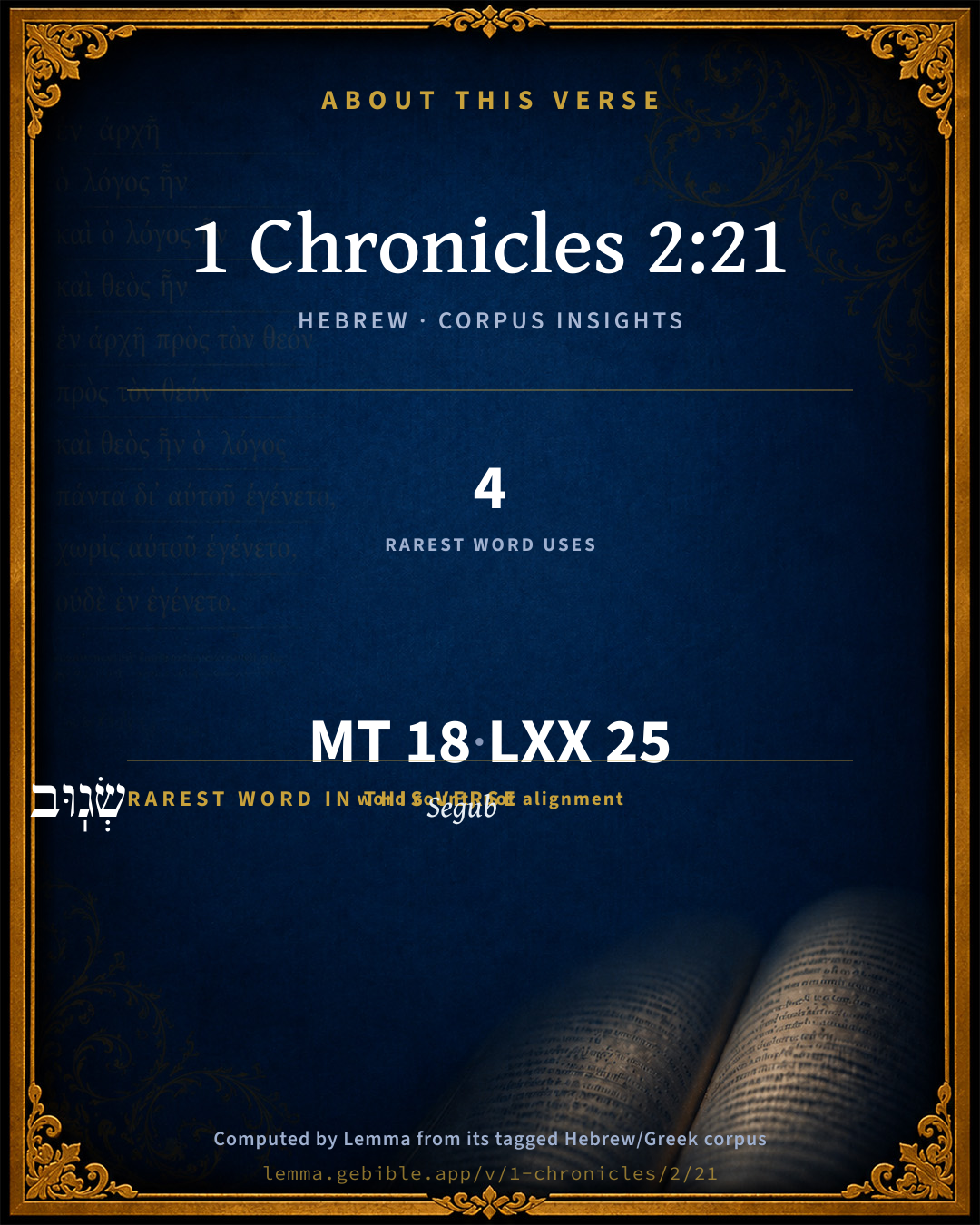
The rarest word here is שְׂגֽוּב Segub H7687 — appearing just 4 times in the whole Hebrew Bible.

Shared distinctive vocabulary

שְׂגֽוּב Segub H7687 occurs in 3 verses of the Hebrew Bible. Also found in:

Grammatical profile

  • 3 verbs
  • 8 nouns
  • 1 adjective
  • 2 pronouns
  • 2 prepositions
  • 1 adverb
  • 1 particle

Verb forms

  • בָּ֤א Qal · Perfect
  • לְקָחָ֔הּ Qal · Perfect
  • וַתֵּ֥לֶד Qal · Sequential Imperfect

Repetition

A word recurs within this verse — often emphatic in Hebrew:

  • וְה֣וּא he H1931 ×2

Hebrew & Septuagint length

In English translation the verse runs 29 words from the Hebrew and 30 from the Septuagint (LXX English) — closely comparable.

A rough comparison of the two English renderings, which tokenize alike — not a word-level alignment.

Word counts can differ between the Hebrew and the Greek without any difference in meaning — e.g. the Hebrew direct-object marker אֵת has no separate Greek word, and Greek often adds the article ὁ.

In the original languages it is 18 Hebrew tokens and 25 Greek tokens — but the two are counted differently (Hebrew bundles its prefixes and suffixes into one token; the Greek is in lemma form), so that isn’t a like-for-like length.

Cross-references

5

Topical passages linked to 1 Chronicles 2:21 in the Treasury of Scripture Knowledge — connected by theme and wording, ordered by reader-vote popularity; previews shown in the World English Bible.

  • Numbers 27:1 Then drew near the daughters of Zelophehad, the son of Hepher, the son of Gilead, the son of Machir, the son of Manasseh, of the families of Manasseh the son of Joseph; and these are the names of his daughters: Mahlah, Noah, and Hoglah, and Milcah, and Tirzah.
  • Genesis 50:23 Joseph saw Ephraim's children to the third generation. The children also of Machir, the son of Manasseh, were born on Joseph's knees.
  • Numbers 26:29 The sons of Manasseh: of Machir, the family of the Machirites; and Machir became the father of Gilead; of Gilead, the family of the Gileadites.
  • Numbers 32:39–40 The children of Machir the son of Manasseh went to Gilead, and took it, and dispossessed the Amorites who were therein.
  • Deuteronomy 3:15 I gave Gilead to Machir.

Cross-references courtesy of OpenBible.info (CC BY 4.0).

Hebrew and Greek witnesses Masoretic Hebrew ↔ Greek Septuagint

The same verse in the two great witnesses to the Old Testament, shown verse-for-verse.

These are two independent witnesses, not word-aligned to each other, and the Septuagint is shown in lemma (dictionary) form.

Hebrew 1 Chronicles 2:21 Masoretic · Westminster Leningrad Codex

וְאַחַ֗ר בָּ֤א חֶצְרוֹן֙ אֶל בַּת מָכִיר֙ אֲבִ֣י גִלְעָ֔ד וְה֣וּא לְקָחָ֔הּ וְה֖וּא בֶּן שִׁשִּׁ֣ים שָׁנָ֑ה וַתֵּ֥לֶד ל֖וֹ אֶת שְׂגֽוּב

Afterward Hezron went in to the daughter of Machir the father of Gilead, whom he took [as wife] when he was sixty years old; and she bore him Segub.

World English Bible · Public Domain

Greek LXX 1 Chronicles 2:21 Septuagint · lemma form

καί μετά οὗτος εἰςἔρχομαι εσερων πρός ὁ θυγάτηρ μαχιρ πατήρ γαλαάδ καί οὗτος λαμβάνω αὐτός καί αὐτός ἑξήκοντα εἰμί ἔτος καί τίκτω αὐτός ὁ σεγουβ

And after this Esron went in to the daughter of Machir the father of Galaad, and he took her when he was sixty-five years old; and she bore him Seruch.

LXX2012 (modern English Septuagint) · Public Domain

On this verse, The Pulpit Commentary discusses the Septuagint’s reading. Read the note in Commentary ↓

Hebrew: Westminster Leningrad Codex (CC BY 4.0). Greek: Septuagint (public domain); English from LXX2012 (modern English Septuagint) (Public Domain). How the Septuagint differs from the Hebrew →

Commentary

Notes on 1 Chronicles 2:21 from classic Christian and Jewish commentators (each source and its license shown beneath its notes). The classic Christian expositions comment on the surrounding passage and are grouped to its opening verse, so a note may address several verses; the Jewish commentaries on the Tanakh (Rashi and others) are per-verse, so they appear only where the commentator wrote on this verse.

Lemma curates 59 commentaries, every one of them public domain or Creative Commons licensed, each selected and text-cleaned for this edition rather than reprinted as found. About our sources →

Joseph Benson's Commentary

1Ch 2:21. The father of Gilead — It is doubtful whether the word Gilead is here the name of a man, or of the country so called: if it be the latter, the expression means, the prince of Gilead, as the word father often signifies: if the former, the Gilead intended must have been a person of noted valour, probably the great champion in those parts.

Joseph Benson's Commentary on the Old and New Testaments (1811–1818) — public domain. Text from a community e-Sword module.

Tyndale Open Study Notes

Tyndale Open Resources

2:21-23 Some of the families of Gilead, listed elsewhere as members of the tribe of Manasseh (cp. Num 32:39-42), also had a connection with the tribe of Judah.

Tyndale Open Study Notes — © Tyndale Open Resources, licensed CC BY-SA 4.0. Text via the HelloAO Bible API.

Geneva Bible (1599)

Geneva Bible translators

Who was prince of mount Gilead, read Num. 32:40.

Geneva Bible (1599) marginal notes — public domain. Text via Bolls.life.

Jamieson, Fausset & Brown

Robert Jamieson, A. R. Fausset & David Brown

Hezron . . . daughter of Machir the father of Gilead--that is, chief of that town, which with the lands adjacent was no doubt the property of Machir, who was so desirous of a male heir. He was grandson of Joseph. The wife of Machir was of the tribe of Manasseh (Num 26:29).

Jamieson, Fausset & Brown — Commentary Critical and Explanatory on the Whole Bible (1871) — public domain (CC PDM 1.0). Text via the HelloAO Bible API.

Ellicott's Commentary for English Readers

(21) And afterward Hezron went in to the daughter of Machir.—This appears to mean, after the birth of the three sons mentioned in 1Ch_2:9.

Machir.—The firstborn of Manasseh (Gen_1:23), to whom Moses gave the land of Gilead (Num_32:40; Deu_3:15). This explains the term “father of Gilead.” The great clan of Machir was the ruling clan in Gilead. Comp. Num_26:28, which mentions the clan of the Machirites, and adds that “Machir begat Gilead,” which perhaps means to say that the Israelite settlers in Gilead were of the clan Machir.

Whom he married when he was threescore.—It is possible to see here a metaphorical statement of the fact that a branch of Hezronites amalgamated with the Machirites of Gilead. The “daughter of Machir” would then mean the clan so named. Comp. the expressions, “daughter of Zion” (Isa_37:22), “daughter of Judah” (Lam_1:15), “daughter of Babylon” (Isa_47:1).

(21-24) This short section, concerning other Hezronites than those of the house of Caleb, is a parenthesis relating to a Hezronite element in Manassite Gilead.

A Bible Commentary for English Readers, edited by Charles John Ellicott (1878–1897) — public domain. Text from a community e-Sword module.

John Gill's Exposition

And the sons of Ram the firstborn of Jerahmeel,.... By his first wife:

were Maaz, and Jamin, and Eker; of whom no other notice is taken; perhaps they left no children.

John Gill's Exposition of the Whole Bible (1746–1763) — public domain (CC PDM 1.0). Text via the HelloAO Bible API.

Haydock's Catholic Bible Commentary

Machir, grandson of Joseph, whose descendants occupied part of Galaad, (Haydock) of which he is styled the father, or prince. (Menochius) --- The daughter of Machir was probably an heiress, and Segub dwelt with his mother’s tribe. (Calmet)

George Leo Haydock (1774–1849), Haydock's Catholic Family Bible and Commentary, 1859 edition — public domain. Excludes Psalms (Douay-Rheims chapter numbering differs from Protestant) and Deuterocanonical books (Catholic canon only).

Matthew Poole's English Annotations

Went in, i.e. lay with her, as that phrase is commonly used, as Gen 4:1; 6:4.

The father of Gilead; of a man so called. Or if Gilead be the name of that known country, father is put for head or governor, as it is used 1Sa 24:11; 2Ki 5:13; 16:7; Isa 22:21; or for protector or curator, as father is used Job 29:16; Jer 2:27; Lam 5:3; this man being a man of noted valour, and the great champion in those parts.

Whom, he married, Heb. and he took her, to wit, to wife. Or, after he had taken her; for so the particle vau is used, as hath been formerly noted.

When he was threescore years old, Heb. and he was, to wit, when he went in unto her, or when he married her.

Matthew Poole's English Annotations on the Holy Bible (1683–1685) — public domain. Text from a community e-Sword/MySword module.

The Pulpit Commentary

Vers. 21-24. The first interruption to the record of Caleb"s posterity is now occasioned by a resumed reference to Hezron, who at the age of threescore took to wife (as it seems from ver. 24) Abiah, sister to Gilead, daughter of the eminent man Machir, who was Manasseh"s oldest son by an Aramitess concubine. (1Ch_7:14) Two sons of Hezron by Abiah are given (the latter of them a posthumous child), but the elder having a son called Jair tracked, no doubt as one who became famous by the number of cities he took. He was thus connected on the father"s side with a great family of Judah, and on the mother"s with a great family of Manasseh. He is probably not the Jair of Jud_1:10:3, with his "thirty sons, thirty ass colts, and thirty cities." And ryaiy (jIaeizov, Mar_5:22) is not dyiy; of 2Sa_21:19; 1Ch_20:5. Evident stress is laid on his maternal descent. Thus (Num_32:41) he is styled son of Manasseh, and hence also the explanation of the last clause of ver. 23, infra, all these belonged to the sons of Machir the father of Gilead. Some of the cities alluded to are the Havoth-Jair (Deu_3:14; Jos_13:30) Englished as the "groups of dwellings of Jair," on which see interesting note in Stanley"s "Sinai and Palestine" (edit. 1866), vocabulary, pp. 526, 527. They lay in the trans-Jordanic district Trachonitis, the modern El-leyah and Jebel-Hauran. It is not possible to harmonize exactly the numbers of the cities given here with those in passages quoted above; nor is the translation of ver. 23, Authorized Version, very certainly the correct one. E. Bertheau, in his "Die Bucher der Chronik erklart; 15. Kurzgef. exegetisches Handbuch. z. A.T.," translates, "And Geshur and Aram took the Havvoth-Jair from them with Kenath and her daughter-towns, sixty cities." "Took" is supposed to mean here "retook," or "recovered." Though this suits the Hebrew syntax better, it does not suit so well our immediate context; nor have we any other information of such re, covering of them. Vers. 21-35. The Authorized Version is not justified in substituting children for the Hebrew "sons;" the object evidently being to make this statement reconcilable with ver. 34, which says that Sheshan had only daughters. The difficulty can be removed, possibly, by supposing that Ahlai died (yet see, 1Ch_11:41) or that, at the time to which ver. 34 refers, only daughters were in question. Wall"s conjecture, that Ahlai of ver. 31 is the same with Attai of ver. 35, would have more probability if aleph were not the initial letter of the one, and ayin of the other. Still, as all the other "sons" of this passage mean sons strictly, it would be unlikely that sons of Sheshan only should mean "grandsons." The genealogy now proceeds through Sheshan"s daughter, name not given (unless possibly Ahlai), married to his Egyptian servant Jarha, down to (ver. 41) Elishama, at the twentieth generation from Jerahmeel. To this, however, the Septuagint (Juxta Exemplar Originals Vaticanum, of 1657), adds one generation more, kai jElismannhse tol. The Egyptian servant Jarha is not heard of elsewhere; that he was enfranchised before his marriage with Sheshan"s daughter is likely enough. (Deu_23:8; 1Sa_30:11) The language of the end of ver. 33, These were the sons of Jerahmeel, would seem to exclude the following thirteen descendants of Jarha and Sheshan"s daughter from the genealogy. Yet this is scarcely likely to be the intention, which perhaps was satisfied with simply marking a distinction by the pause.

The Pulpit Commentary (1880–1919), ed. H.D.M. Spence-Jones & Joseph S. Exell — public domain. Text from a community e-Sword module.

John Wesley's Explanatory Notes

Gilead - Of a man so called: a man of noted valour, and the great champion in those parts.

John Wesley, Explanatory Notes Upon the Whole Bible (1754–1765) — public domain. Text via the GEBible commentary corpus.

Keil & Delitzsch

C. F. Keil & F. Delitzsch

And the sons of Ram the firstborn of Jerahmeel,.... By his first wife:

were Maaz, and Jamin, and Eker; of whom no other notice is taken; perhaps they left no children.

Keil & Delitzsch — Biblical Commentary on the Old Testament (1861–1891) — public domain (CC PDM 1.0). Text via the HelloAO Bible API. (Old Testament only.)

unfoldingWord translationNotes

Door43 World Missions Community

General Information:

All names in this list are the names of men. (See: How to Translate Names)

bore him

"gave birth to"

land of Gilead

People gave the land the name of the man.

translationWords

Gilead

unfoldingWord translationNotes — © Distant Shores Media and the Door43 World Missions Community, licensed CC BY-SA 4.0. Source: git.door43.org/Door43/en_tn.

Rashi

Rabbi Shlomo Yitzchaki (Rashi)

And afterwards Hezron came to the daughter of Machir This was because of David’s honor, because Hezron came to the daughter of Machir, taking her as a concubine, not for matrimony, similar to (Ps. 51:2): “... when he came to Bathsheba,” and he was sixty years old, thus making two uncomplimentary qualities for Machir’s daughter: one, that he did not take her for the purpose of matrimony, and one, that he was old, but because of the esteem of the families of Judah, they gave her to him, and when Jair begot [children], Machir’s sons gave him twenty-three cities to take one of his daughters as a wife.

Rashi on the Tanakh — English translations: “The Judaica Press complete Tanach with Rashi, translated by A. J. Rosenberg” (CC BY 4.0); “Pentateuch with Rashi's commentary by M. Rosenbaum and A.M. Silbermann, 1929-1934” (public domain); “The Metsudah Tanach series, Lakewood, N.J” (CC BY 4.0); and “The Book of Joshua, Metsudah Publications, 1997” (CC BY 4.0). Text via Sefaria.

Lesson kit

Teaching starters — assembled from the data on this page, not authored interpretation. Every prompt links to the verse data it draws on. Edit before teaching.

1 Chronicles, in the Historical, opens this verse with 18 words (16 distinct Hebrew lemmas). Its most distinctive word is Sᵉgûwb (“Segub”). A historical commentator’s framing appears above. Read the whole chapter for the surrounding context.

Discussion questions

  1. What does “Segub” (Sᵉgûwb) contribute to the verse as a whole?
  2. 1 Kings 16:34 shares the word «Segub» with this verse. How do the two illuminate each other?
  3. “he” occurs 2× in this one verse. What is the effect of the repetition?
  4. These translations render this verse differently. What is at stake in choosing one wording over another?
  5. The verb «בָּ֤א» is Qal Perfect. How does its form color the action?
  6. Reading how Joseph Benson's Commentary and Tyndale Open Study Notes read this verse, where do the two commentators agree and where do they part?

Things to notice

Reading settings

Reading text

Shown beneath each verse's original-language words.

Old Testament
Old Testament edition

Read the OT as the Masoretic Hebrew (MT) or the Greek Septuagint (LXX).

English shown for the Greek Septuagint (in the Hebrew ↔ Greek comparison).

Comparing translations? Open the Compare panel on any verse page to stack up to four side by side.