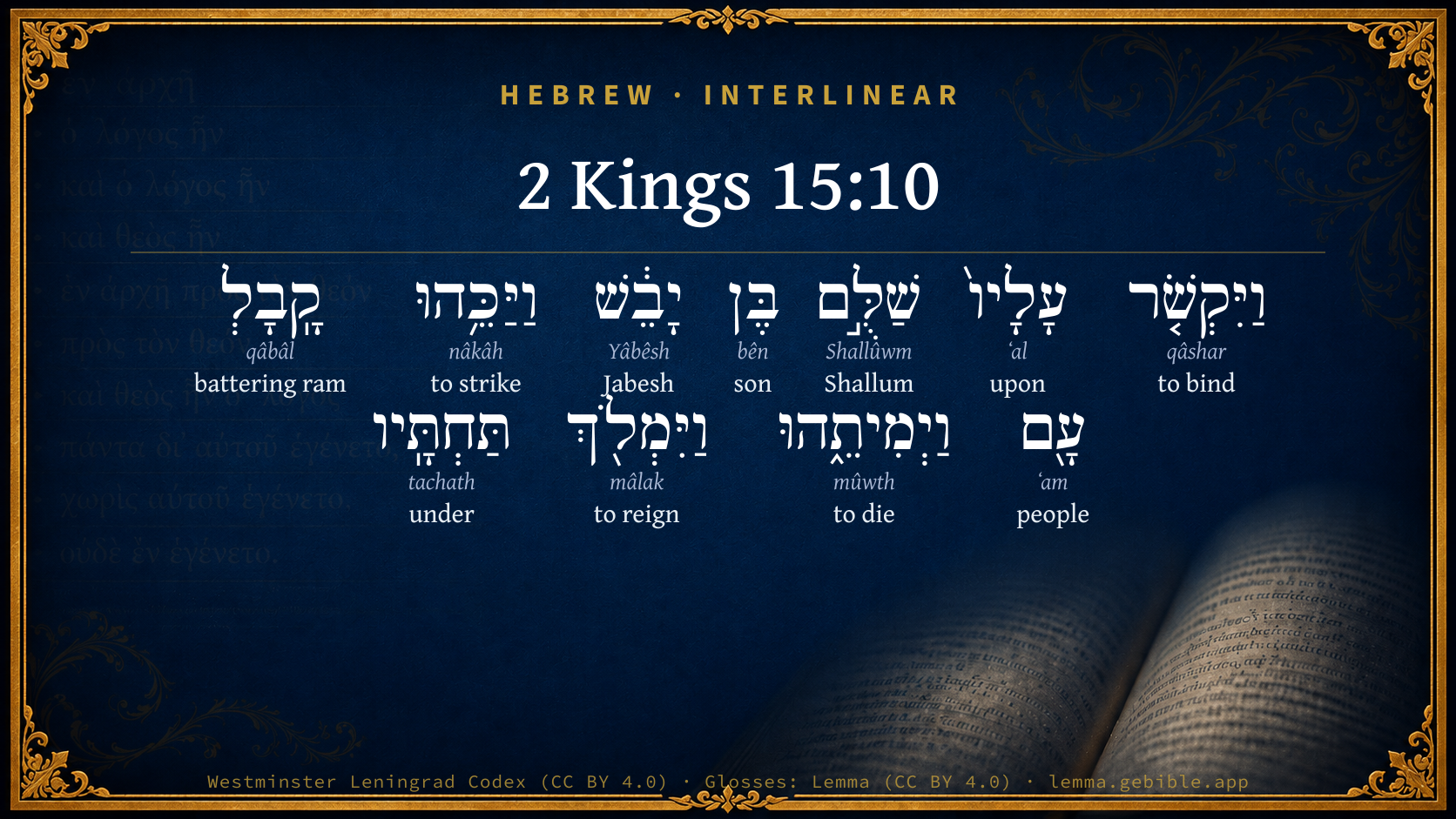
2 Kings 15:10

Hebrew (Westminster Leningrad Codex) 2 Kings 15:10 appears in the Hebrew Old Testament. The text above is from the Westminster Leningrad Codex. Each word links to its Strong’s number, a concise gloss, and parsing drawn from the Open Scriptures Hebrew Bible morphology. Click any word for its full Brown-Driver-Briggs (BDB) entry.
Download image
Cite this verse

2 Kings 15:10 (World English Bible). Public Domain. Lemma interlinear Bible study tool, https://lemma.gebible.app/v/2-kings/15/10.

Show BibTeX & RIS
BibTeX
RIS
English Translation
Shallum the son of Jabesh conspired against him, and struck him before the people, and killed him, and reigned in his place.
World English Bible · Public Domain
Highlights
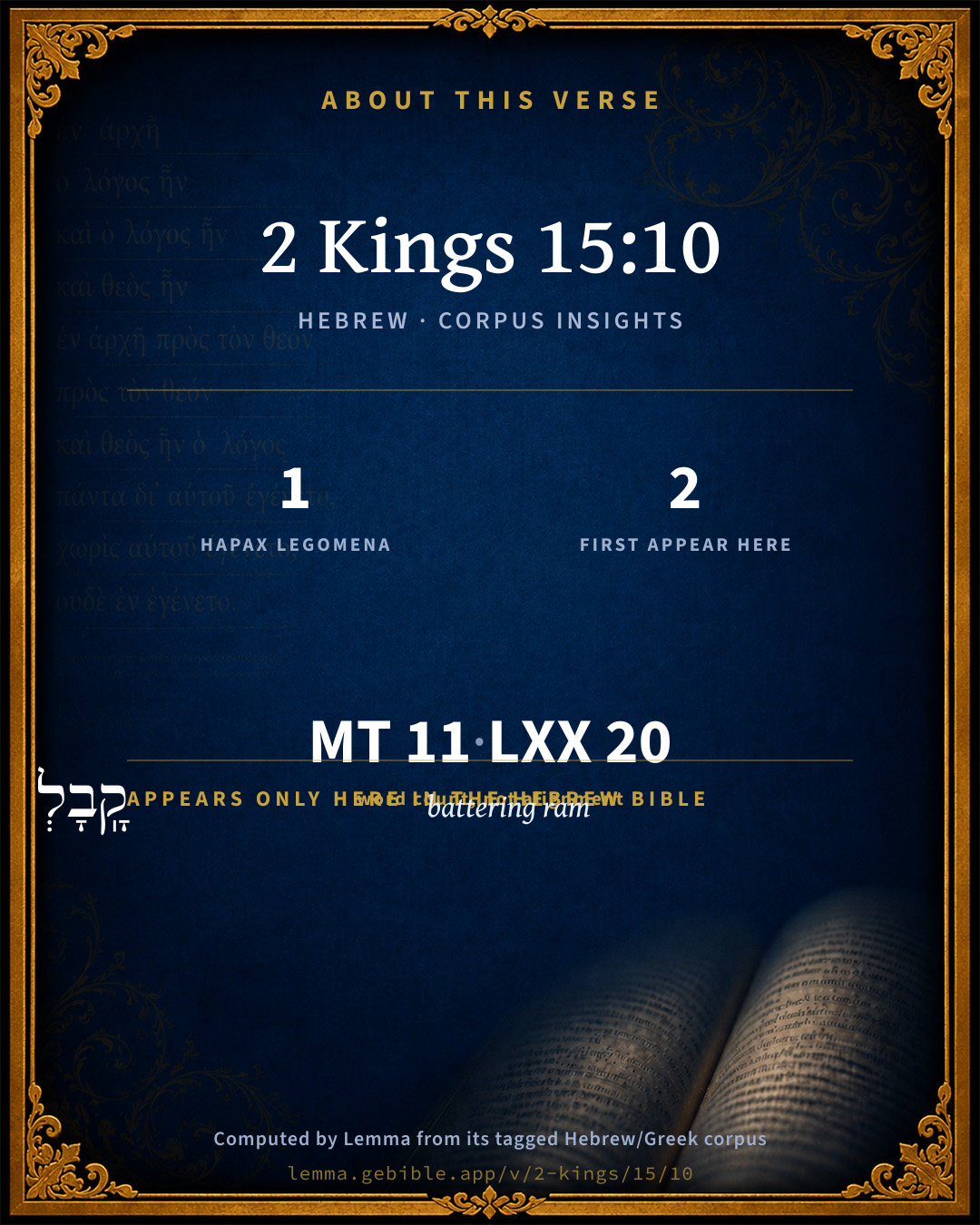
  • 1 hapax legomenon — only here in the Hebrew Bible
  • 2 first appearances in the Hebrew Bible
Full analysis ↓
Download a study sheet

One document with this verse’s original text, its word-by-word gloss line, the meaning frame, cross-references with their text, attributed commentary, and full source and license credits — printable, and it pastes into notes with its structure intact.

This verse Autodidact and up

Study sheet (.html) Plain text (.txt)

A passage Seminary Student

Up to 50 verses in one chapter. A passage sheet keeps up to 6 commentary sources and 12 cross-references per verse, in the order this page ranks them, and says so on the sheet whenever that leaves anything out. Ask for a single verse and you get the Autodidact verse sheet above.

Everything on this page stays free to read, with no account — the sheet is a download of what is already on screen, not access to it.

Want to remove ads? Support Godless Engineer
Compare translations 3

The same verse in 3 English versions, stacked beneath the original-language interlinear above. Click any original word for its lexicon entry.

Each is an independent rendering of the whole verse — the interlinear is not word-aligned to these translations.

Highlighted words mark where these versions differ — a whole-verse word diff, not a word-by-word alignment.

  • World English Bible Public Domain
    Shallum the son of Jabesh conspired against him, and struck him before the people, and killed him, and reigned in his place.
  • King James Version Public Domain
    And Shallum the son of Jabesh conspired against him, and smote him before the people, and slew him, and reigned in his stead.
  • unfoldingWord Literal Text CC BY-SA 4.0
    And Shallum, the son of Jabesh, conspired against him, and he struck him in front of the people, and he killed him. And he reigned in his place.

unfoldingWord Literal Text — © unfoldingWord, licensed CC BY-SA 4.0. Word-aligned USFM3 via Door43 (git.door43.org/unfoldingWord/en_ult).

Versions to compare (up to 4)

3 of 4 selected

Show all 18 translations

Every available English version of this verse, each an independent rendering of the whole verse.

  • World English Bible Public Domain
    Shallum the son of Jabesh conspired against him, and struck him before the people, and killed him, and reigned in his place.
  • Berean Standard Bible Public Domain
    Then Shallum son of Jabesh conspired against Zechariah, struck him down and killed him in front of the people, and reigned in his place.
  • Majority Standard Bible Public Domain
    Then Shallum son of Jabesh conspired against Zechariah, struck him down and killed him in front of the people, and reigned in his place.
  • King James Version Public Domain
    And Shallum the son of Jabesh conspired against him, and smote him before the people, and slew him, and reigned in his stead.
  • American Standard Version (1901) Public Domain
    And Shallum the son of Jabesh conspired against him, and smote him before the people, and slew him, and reigned in his stead.
  • Revised Version (1885) Public Domain
    And Shallum the son of Jabesh conspired against him, and smote him before the people, and slew him, and reigned in his stead.
  • Geneva Bible (1599) Public Domain
    And Shallum the sonne of Iabesh cospired against him, and smote him in the sight of the people, and killed him, and reigned in his stead.
  • Douay-Rheims (1899) Public Domain
    And Sellum the son of Jabes conspired against him: and struck him publicly and killed him, and reigned in his place.
  • Young's Literal Translation Public Domain
    And Shallum son of Jabesh conspireth against him, and smiteth him before the people, and putteth him to death, and reigneth in his stead.
  • Literal Standard Version CC BY-SA 4.0
    And Shallum son of Jabesh conspires against him, and strikes him before the people, and puts him to death, and reigns in his stead.
  • Unlocked Literal Bible CC BY-SA 4.0
    Shallum son of Jabesh conspired against Zechariah, attacked him in Ibleam, and killed him. Then he became king in his place.
  • unfoldingWord Literal Text CC BY-SA 4.0
    And Shallum, the son of Jabesh, conspired against him, and he struck him in front of the people, and he killed him. And he reigned in his place.
  • Darby Bible Public Domain
    And Shallum the son of Jabesh conspired against him, and smote him before the people, and slew him, and reigned in his stead.
  • World Messianic Bible Public Domain
    Shallum the son of Jabesh conspired against him, and struck him before the people and killed him, and reigned in his place.
  • Webster's Bible Public Domain
    And Shallum the son of Jabesh conspired against him, and smote him before the people, and slew him, and reigned in his stead.
  • Free Bible Version CC BY-SA 4.0
    Then Shallum, son of Jabesh, plotted against Zechariah. He attacked him, murdering him in front of the people, and took over as king.
  • Bible in Basic English Public Domain
    And Shallum, the son of Jabesh, made a secret design against him, and, attacking him in Ibleam, put him to death and became king in his place.
  • JPS Tanakh (1917) Public Domain
    And Shallum the son of Jabesh conspired against him, and smote him before the people, and slew him, and reigned in his stead.

Literal Standard Version (2020), Covenant Press — licensed CC BY-SA 4.0. Text via the HelloAO Bible API (eBible.org). Unlocked Literal Bible (unfoldingWord) — licensed CC BY-SA 4.0. Text via the HelloAO Bible API (eBible.org). unfoldingWord Literal Text — © unfoldingWord, licensed CC BY-SA 4.0. Word-aligned USFM3 via Door43 (git.door43.org/unfoldingWord/en_ult). Free Bible Version, Dr. Jonathan Gallagher — licensed CC BY-SA 4.0. Text via the HelloAO Bible API (eBible.org).

Word by word

More ways to search: Search by grammar → Find every occurrence → Compare this word →

Practice this passage: Drill this verse → Learn its vocabulary →

קָֽבָלְ
qâbâl
H6905
“battering ram of”
Noun, Common, Masculine, Singular, Construct
Part of Speech
Noun
Type
Common
Gender
Masculine
Number
Singular
State
Construct
Full BDB Definition

Origin: from H6901 in the sense of opposite [see H6904 ]

TWOT: 1980a

something in front, attacking engine, something before (noun masculine) - before - siege-engine, battering-ram - (CLBL) before (adverb)
  1. וַיִּקְשֹׁ֤ר qâshar H7194 “and · to bind” Conjunction + Verb, Qal, Sequential Imperfect, 3rd Person, Masculine, Singular
  2. עָלָיו֙ ʻal H5921 “upon · him” Preposition + Suffix, Personal, 3rd Person, Masculine, Singular
  3. שַׁלֻּ֣ם Shallûwm H7967 “Shallum” Noun, Proper
  4. בֶּן bên H1121 “son of” Noun, Common, Masculine, Singular, Construct
  5. יָבֵ֔שׁ Yâbêsh H3003 “Jabesh” Noun, Proper
  6. וַיַּכֵּ֥הוּ nâkâh H5221 “and · to strike · him” Conjunction + Verb, Hiphil, Sequential Imperfect, 3rd Person, Masculine, Singular + Suffix, Personal, 3rd Person, Masculine, Singular
  7. עָ֖ם ʻam H5971 “people” Noun, Common, Masculine, Singular, Absolute
  8. וַיְמִיתֵ֑הוּ mûwth H4191 “and · to die · him” Conjunction + Verb, Hiphil, Sequential Imperfect, 3rd Person, Masculine, Singular + Suffix, Personal, 3rd Person, Masculine, Singular
  9. וַיִּמְלֹ֖ךְ mâlak H4427 “and · to reign” Conjunction + Verb, Qal, Sequential Imperfect, 3rd Person, Masculine, Singular
  10. תַּחְתָּֽיו tachath H8478 “under · him” Preposition + Suffix, Personal, 3rd Person, Masculine, Singular

About this verse

These counts appear in no published source. They are computed here, from the morphology-tagged text and Lemma’s own curated glosses. What Lemma adds →

11
words
11
distinct lemmas
Historical
section

Notable vocabulary

1 hapax legomenon — a word that appears only here in the entire Hebrew Bible:

  • קָֽבָלְ battering ram H6905

First appearance in Scripture

These words make their first canonical appearance in the Hebrew Bible here:

  • שַׁלֻּ֣ם Shallum H7967
  • קָֽבָלְ battering ram H6905

Shared distinctive vocabulary

יָבֵ֔שׁ Jabesh H3003 occurs in 21 verses of the Hebrew Bible. Also found in:

Grammatical profile

  • 4 verbs
  • 5 nouns
  • 2 prepositions

Verb forms

  • וַיִּקְשֹׁ֤ר Qal · Sequential Imperfect
  • וַיַּכֵּ֥הוּ Hiphil · Sequential Imperfect
  • וַיְמִיתֵ֑הוּ Hiphil · Sequential Imperfect
  • וַיִּמְלֹ֖ךְ Qal · Sequential Imperfect

Hebrew & Septuagint length

In English translation the verse runs 22 words from the Hebrew and 26 from the Septuagint (LXX English) — closely comparable.

A rough comparison of the two English renderings, which tokenize alike — not a word-level alignment.

Word counts can differ between the Hebrew and the Greek without any difference in meaning — e.g. the Hebrew direct-object marker אֵת has no separate Greek word, and Greek often adds the article ὁ.

In the original languages it is 11 Hebrew tokens and 20 Greek tokens — but the two are counted differently (Hebrew bundles its prefixes and suffixes into one token; the Greek is in lemma form), so that isn’t a like-for-like length.

Cross-references

9

Topical passages linked to 2 Kings 15:10 in the Treasury of Scripture Knowledge — connected by theme and wording, ordered by reader-vote popularity; previews shown in the World English Bible.

  • 1 Kings 15:28 Even in the third year of Asa king of Judah did Baasha kill him, and reigned in his place.
  • 1 Kings 16:9–10 His servant Zimri, captain of half his chariots, conspired against him. Now he was in Tirzah, drinking himself drunk in the house of Arza, who was over the household in Tirzah:
  • 2 Kings 9:24 Jehu drew his bow with his full strength, and struck Joram between his arms; and the arrow went out at his heart, and he sunk down in his chariot.
  • 2 Kings 9:31 As Jehu entered in at the gate, she said, Is it peace, you Zimri, your master's murderer?
  • 2 Kings 15:14 Menahem the son of Gadi went up from Tirzah, and came to Samaria, and struck Shallum the son of Jabesh in Samaria, and killed him, and reigned in his place.
  • 2 Kings 15:25 Pekah the son of Remaliah, his captain, conspired against him, and struck him in Samaria, in the castle of the king's house, with Argob and Arieh; and with him were fifty men of the Gileadites: and he killed him, and reigned in his place.
  • 2 Kings 15:30 Hoshea the son of Elah made a conspiracy against Pekah the son of Remaliah, and struck him, and killed him, and reigned in his place, in the twentieth year of Jotham the son of Uzziah.
  • Hosea 1:4–5 Yahweh said to him, "Call his name Jezreel; for yet a little while, and I will avenge the blood of Jezreel on the house of Jehu, and will cause the kingdom of the house of Israel to cease.
  • Amos 7:9 The high places of Isaac will be desolate, the sanctuaries of Israel will be laid waste; and I will rise against the house of Jeroboam with the sword."

Cross-references courtesy of OpenBible.info (CC BY 4.0).

Hebrew and Greek witnesses Masoretic Hebrew ↔ Greek Septuagint

The same verse in the two great witnesses to the Old Testament, shown verse-for-verse.

These are two independent witnesses, not word-aligned to each other, and the Septuagint is shown in lemma (dictionary) form.

Hebrew 2 Kings 15:10 Masoretic · Westminster Leningrad Codex

וַיִּקְשֹׁ֤ר עָלָיו֙ שַׁלֻּ֣ם בֶּן יָבֵ֔שׁ וַיַּכֵּ֥הוּ קָֽבָלְ עָ֖ם וַיְמִיתֵ֑הוּ וַיִּמְלֹ֖ךְ תַּחְתָּֽיו

Shallum the son of Jabesh conspired against him, and struck him before the people, and killed him, and reigned in his place.

World English Bible · Public Domain

Greek LXX 2 Kings 15:10 Septuagint · lemma form

καί συνστρέφω ἐπί αὐτός σελλουμ υἱός ιαβις καί κεβλααμ καί πατάσσω αὐτός καί θανατόω αὐτός καί σελλουμ βασιλεύω ἀντί αὐτός

And Sellum the son of Jabis and others conspired against him, and they struck him in Keblaam, and killed him, and he reigned in his stead.

LXX2012 (modern English Septuagint) · Public Domain

On this verse, Ellicott's Commentary for English Readers discusses the Septuagint’s reading. Read the note in Commentary ↓

Hebrew: Westminster Leningrad Codex (CC BY 4.0). Greek: Septuagint (public domain); English from LXX2012 (modern English Septuagint) (Public Domain). How the Septuagint differs from the Hebrew →

Targum (Aramaic paraphrase)

1

The Targum is the ancient Jewish Aramaic paraphrase of the Hebrew Scriptures — an interpretive translation, not the Hebrew text itself. Onkelos (literal) and Pseudo-Jonathan (expansive) render the Torah, and Jonathan the Prophets. Coverage is partial: where no permissively-licensed English translation exists for a verse, only the Aramaic is shown. This is verse-level text, not a word-by-word alignment to the Hebrew.

  1. Targum Jonathan Prophets (Joshua–Malachi)
    וּמְרַד עֲלוֹהִי שַׁלֻם בַּר יָבֵשׁ וּמְחָהִי קֳדָם עַמָא וְקַטְלֵיהּ וּמְלַךְ תְּחוֹתוֹהִי:

    (no public-domain English translation for this verse)

    Targum Jonathan — Aramaic: “Mikraot Gedolot” (public domain). English: “Sefaria Community Translation” (CC0 1.0 (public-domain dedication)); “London "Chaldee Paraphrase," 1871” (public domain). Text via Sefaria.

Commentary

Notes on 2 Kings 15:10 from classic Christian and Jewish commentators (each source and its license shown beneath its notes). The classic Christian expositions comment on the surrounding passage and are grouped to its opening verse, so a note may address several verses; the Jewish commentaries on the Tanakh (Rashi and others) are per-verse, so they appear only where the commentator wrote on this verse.

Lemma curates 59 commentaries, every one of them public domain or Creative Commons licensed, each selected and text-cleaned for this edition rather than reprinted as found. About our sources →

Trapp's Complete Commentary

John Trapp

2Ki 15:10 And Shallum the son of Jabesh conspired against him, and smote him before the people, and slew him, and reigned in his stead.

Ver. 10. And slew him, and reigned in his stead.] After whose death followed these direful calamities foretold by the prophet Amos. {2Ki 7:9} Never did the kingdom of Israel so flourish as under this king’s father - viz., Jeroboam II. The greatest prosperity is oft followed by the greatest misery. Periculosa est, secundum Hippocratem, summe bona corporis valetudo.

John Trapp, A Commentary or Exposition upon All the Books of the Old and New Testament (1647–1656) — public domain. Text from a community e-Sword module.

Joseph Benson's Commentary

2Ki 15:10. Shallum the son of Jabesh — Probably one of his chief captains; conspired against him — On what pretence is quite uncertain. And smote him before the people — Openly and impudently, which, it is likely, he presumed to do, either because he remembered that the promise of the kingdom, made to Jehu, was confined to the fourth generation, (2Ki 10:30,) which he observed to be now expired; or because he perceived the people were generally disaffected to their king, and favourable to his attempt.

Joseph Benson's Commentary on the Old and New Testaments (1811–1818) — public domain. Text from a community e-Sword module.

Geneva Bible (1599)

Geneva Bible translators

Zechariah was the last in Israel, that had the kingdom by succession, save only Pekahiah the son of Menahem, who reigned but two years.

Geneva Bible (1599) marginal notes — public domain. Text via Bolls.life.

Adam Clarke's Commentary

Verse 10. Smote him before the people] In some public assembly: he probably became very unpopular.

Adam Clarke's Commentary on the Bible (1810–1826) — public domain. Text from a community e-Sword/MySword module.

Ellicott's Commentary for English Readers

(10) Son of Jabesh.—Not man of Jabesh Gilead, as Hitzig explains. The father’s name is always given in the case of usurpers.

Before the people.—Rather, before people—i.e., in public. So all the versions except the LXX. The open assassination of the king is noted, in contrast with the secrecy with which former conspiracies had been concerted. It is a symptom of the rapidly-increasing corruption of morals, which allowed people to look on with indifference while the king was being murdered. (The LXX. puts the Hebrew words into Greek letters thus: κεβλααμ. The word qobol—“before”—is Aramaic rather than Hebrew, and only occurs here. Ewald acutely conjectured that Qobol’âm—“before people”—was really the proper name of another usurper, comparing Zec_11:8, “the third king during that month;” but in that case the narrative is hardly coherent of complete. Grätz suggests the correction “in Ibleam.”

A Bible Commentary for English Readers, edited by Charles John Ellicott (1878–1897) — public domain. Text from a community e-Sword module.

The Cambridge Bible for Schools and Colleges

gen. ed. J. J. S. Perowne

10. Shallum the son of Jabesh] Nothing more is known of him than is given in this verse. The death of the last scion of the house of Jehu by the sword appears to be foretold in Amo_7:9, ‘I will rise against the house of Jeroboam with the sword’.

before the people] i.e. Publicly. Hence it would seem that the conspiracy of Shallum had large popular support. But the LXX. here has plural verbs ‘they conspired’, ‘they smote’ and ‘they slew’ and writes the two words translated ‘before the people’ as though they were one proper name Κεβλαὰμ. Hence some have thought that Shallum had a fellow-conspirator of whom this was the name. The words occur in such a combination and sense nowhere else, and the preposition, rendered ‘before’, is not found except in the Chaldee portions of the Old Testament. But there is nothing in the Hebrew to warrant the changes of the LXX., though Ewald, and after him the late Dean Stanley, adopted them as representing a more correct text. Stanley says (Jewish Church 2:308) ‘Zechariah was, it would seem, succeeded by a king, whose very name is almost lost to us, Kobolam, and Kobolam was succeeded by Shallum’. There needs a great deal of manipulation of even the text of the LXX. to extract any such statement from it. A much more reasonable conjecture is to make Κεβλαὰμ (though found nowhere else) the name of the place where Zachariah was murdered.

The Cambridge Bible for Schools and Colleges (gen. ed. J. J. S. Perowne; Cambridge University Press, 1878–1918) — public domain. Text from a community e-Sword module.

John Gill's Exposition

Shallum the son of Jabesh began to reign in the nine and thirtieth year of Uzziah king of Judah,.... The same with Azariah: he is sometimes called by one name, and sometimes by the other, see Kg2 14:21,

and he reigned a full month in Samaria: and no longer; so soon were the conspiracy against his sovereign, and the murder of him, punished.

John Gill's Exposition of the Whole Bible (1746–1763) — public domain (CC PDM 1.0). Text via the HelloAO Bible API.

Albert Barnes' Notes on the Bible

Before the people - i. e. openly and publicly. The Septuagint turns the original of the above words into a proper name, Keblaam, and makes him the actual assassin, but without much ground.

Albert Barnes' Notes on the Bible (1834–1885) — public domain. Text from a community e-Sword/MySword module.

Haydock's Catholic Bible Commentary

Place, having before taken his measures with the conspirators; (ver. 15.) so that he had not to fear the resentment of the people. He cut off the last king of the family of Jehu; (Haydock) probably at Jezrahel, Osee i. 5. (Calmet)

George Leo Haydock (1774–1849), Haydock's Catholic Family Bible and Commentary, 1859 edition — public domain. Excludes Psalms (Douay-Rheims chapter numbering differs from Protestant) and Deuterocanonical books (Catholic canon only).

Matthew Poole's English Annotations

Shallum the son of Jabesh; one of his chief captains.

Before the people openly and impudently; which he presumed to do, either because he remembered that the promise of the kingdom made to Jehu was confined to the fourth generation, 2Ki 10:30, which he observed to be now expired; or because he perceived that the people were generally disaffected to their king, and favourable to his attempt.

Matthew Poole's English Annotations on the Holy Bible (1683–1685) — public domain. Text from a community e-Sword/MySword module.

Whedon's Commentary on the Bible

Daniel D. Whedon

10. Smote him before the people — That is, openly; before the eyes of all. It would seem that Zachariah’s administration was so unpopular as to invite or occasion conspiracy. The Septuagint takes the words rendered before the people as a proper name — in Keblaam — and Ewald thinks we should disregard the in, and understand Keblaam as the name of another conspirator, who sought, like Shallum, to usurp the throne.

Daniel D. Whedon (gen. ed.), Commentary on the Old and New Testaments (1874–1909) — public domain. Text from a community e-Sword module.

The Pulpit Commentary

And Shallum the son of Jabesh conspired against him. Josephus calls Shallum Zachariah"s "friend," but otherwise adds nothing to the present narrative. And smote him before the people. The phrase employed is very unusual, and has justly excited suspicion. It was not understood by the LXX, who translate ejpataxan aujtom, which gives no sense. Ewald sought to solve the difficulty by inventing a king, "Zobolam," but other critics have found this expedient too bold. The rendering of our translators is generally accepted, though qobal, "before," only occurs here and in Daniel. If we accept this rendering, we must suppose that the act of violence was done openly, like Jehu"s murder of Jehoram. And slew him, and reigned in his stead (comp. ver. 13).

The Pulpit Commentary (1880–1919), ed. H.D.M. Spence-Jones & Joseph S. Exell — public domain. Text from a community e-Sword module.

Scofield Reference Notes

C. I. Scofield

smote

As prophesied, Amo 7:9.

The Scofield Reference Bible (1917 edition), notes by C. I. Scofield — public domain. Text from a community e-Sword module.

unfoldingWord translationNotes

Door43 World Missions Community

Shallum ... Jabesh

These are the names of two men. (See: How to Translate Names)

against Zechariah

"against King Zechariah"

Ibleam

This was the name of a city. (See: How to Translate Names)

Then he became king in his place

"Then Shallum became king in Zechariah's place"

they are written in the book of the events of the kings of Israel

This can be stated in active form. AT: "you can read about them in the book of the events of the kings of Israel" (See: Active or Passive)

This was the word of Yahweh

It can be stated clearly that the events described in verse 10 fulfilled the word of Yahweh. AT: "What happened to Zechariah was according to the word of Yahweh" or "What happened to Zechariah fulfilled the word of Yahweh" (See: Assumed Knowledge and Implicit Information)

Your descendants will sit on the throne of Israel to the fourth generation

Sitting on the throne represents being the king. AT: "Your descendants will be the kings of Israel for four generations" (See: Metonymy)

translationWords

word of God

Jehu

descend

throne

generation

unfoldingWord translationNotes — © Distant Shores Media and the Door43 World Missions Community, licensed CC BY-SA 4.0. Source: git.door43.org/Door43/en_tn.

Rashi

Rabbi Shlomo Yitzchaki (Rashi)

And struck him before the people. [Targum Yonoson renders,] he struck him before the people [i.e.,] before the eyes of the people.

Rashi on the Tanakh — English translations: “The Judaica Press complete Tanach with Rashi, translated by A. J. Rosenberg” (CC BY 4.0); “Pentateuch with Rashi's commentary by M. Rosenbaum and A.M. Silbermann, 1929-1934” (public domain); “The Metsudah Tanach series, Lakewood, N.J” (CC BY 4.0); and “The Book of Joshua, Metsudah Publications, 1997” (CC BY 4.0). Text via Sefaria.

Lesson kit

Teaching starters — assembled from the data on this page, not authored interpretation. Every prompt links to the verse data it draws on. Edit before teaching.

2 Kings, in the Historical, opens this verse with 11 words (11 distinct Hebrew lemmas). Its most distinctive word is qâbâl (“battering ram”). A historical commentator’s framing appears above. Read the whole chapter for the surrounding context.

Discussion questions

  1. The word qâbâl carries the sense “battering ram.” How does it shape the verse?
  2. 1 word here appears nowhere else in the Hebrew Bible. Why might the author reach for such rare wording?
  3. 2 words make their first appearance in Scripture here. What does this debut establish?
  4. How does Judges 21:8, which shares the word «Jabesh», read alongside this verse?
  5. These translations render this verse differently. What is at stake in choosing one wording over another?
  6. «וַיִּקְשֹׁ֤ר» is a Qal Sequential Imperfect verb. How does that grammatical form shape the action described?
  7. Compare how Trapp's Complete Commentary and Joseph Benson's Commentary read this verse. Where do they agree or differ?

Things to notice

Reading settings

Reading text

Shown beneath each verse's original-language words.

Old Testament
Old Testament edition

Read the OT as the Masoretic Hebrew (MT) or the Greek Septuagint (LXX).

English shown for the Greek Septuagint (in the Hebrew ↔ Greek comparison).

Comparing translations? Open the Compare panel on any verse page to stack up to four side by side.