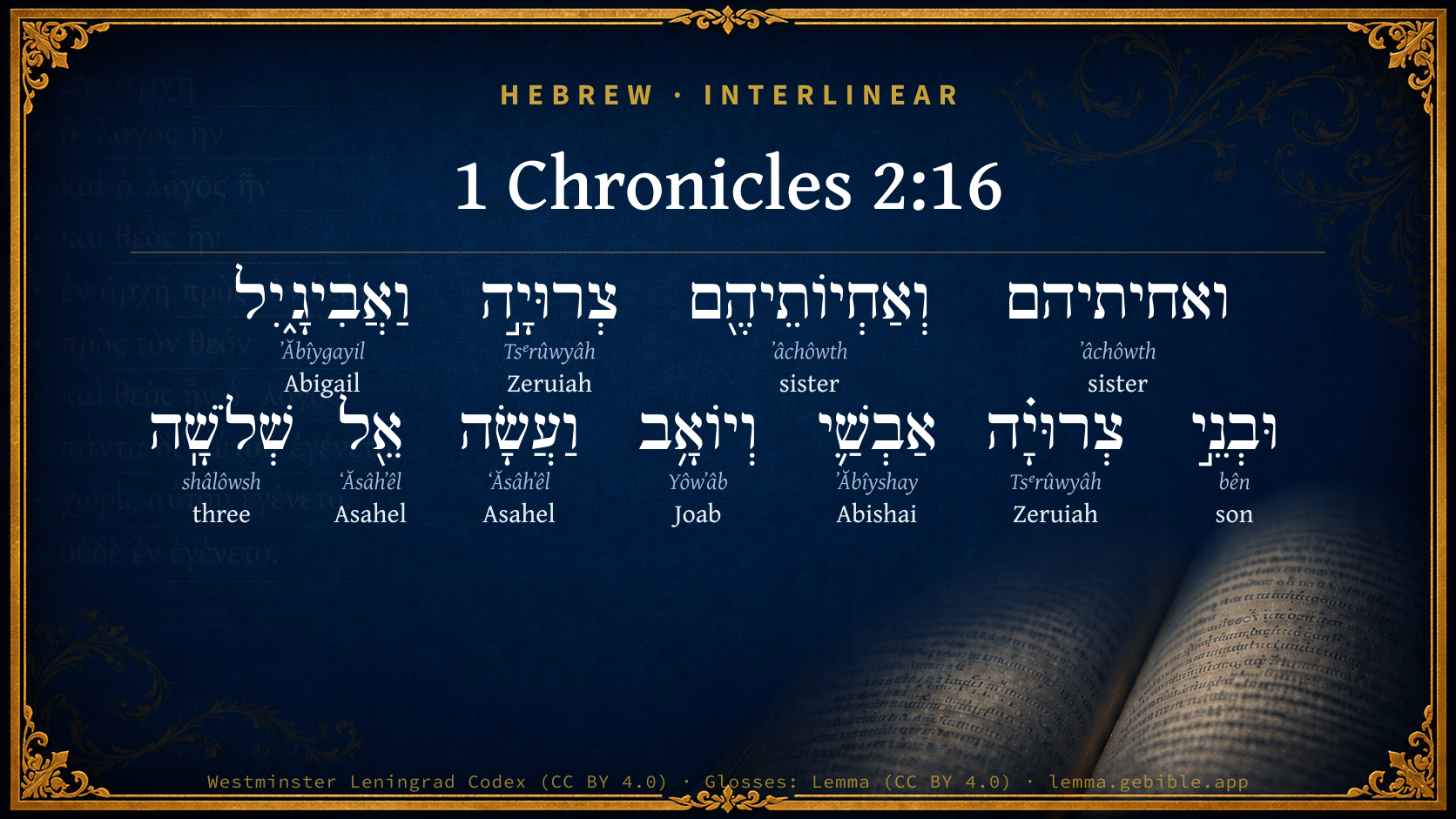
1 Chronicles 2:16

Hebrew (Westminster Leningrad Codex) 1 Chronicles 2:16 appears in the Hebrew Old Testament. The text above is from the Westminster Leningrad Codex. Each word links to its Strong’s number, a concise gloss, and parsing drawn from the Open Scriptures Hebrew Bible morphology. Click any word for its full Brown-Driver-Briggs (BDB) entry.
Download image
Cite this verse

1 Chronicles 2:16 (World English Bible). Public Domain. Lemma interlinear Bible study tool, https://lemma.gebible.app/v/1-chronicles/2/16.

Show BibTeX & RIS
BibTeX
RIS
English Translation
and their sisters were Zeruiah and Abigail. The sons of Zeruiah: Abishai, and Joab, and Asahel, three.
World English Bible · Public Domain
Download a study sheet

One document with this verse’s original text, its word-by-word gloss line, the meaning frame, cross-references with their text, attributed commentary, and full source and license credits — printable, and it pastes into notes with its structure intact.

This verse Autodidact and up

Study sheet (.html) Plain text (.txt)

A passage Seminary Student

Up to 50 verses in one chapter. A passage sheet keeps up to 6 commentary sources and 12 cross-references per verse, in the order this page ranks them, and says so on the sheet whenever that leaves anything out. Ask for a single verse and you get the Autodidact verse sheet above.

Everything on this page stays free to read, with no account — the sheet is a download of what is already on screen, not access to it.

Want to remove ads? Support Godless Engineer
Compare translations 3

The same verse in 3 English versions, stacked beneath the original-language interlinear above. Click any original word for its lexicon entry.

Each is an independent rendering of the whole verse — the interlinear is not word-aligned to these translations.

Highlighted words mark where these versions differ — a whole-verse word diff, not a word-by-word alignment.

  • World English Bible Public Domain
    and their sisters were Zeruiah and Abigail. The sons of Zeruiah: Abishai, and Joab, and Asahel, three.
  • King James Version Public Domain
    Whose sisters were Zeruiah, and Abigail. And the sons of Zeruiah; Abishai, and Joab, and Asahel, three.
  • unfoldingWord Literal Text CC BY-SA 4.0
    And their sisters Zeruiah and Abigail. And the sons of Zeruiah: Abishai and Joab and Asahel—three.

unfoldingWord Literal Text — © unfoldingWord, licensed CC BY-SA 4.0. Word-aligned USFM3 via Door43 (git.door43.org/unfoldingWord/en_ult).

Versions to compare (up to 4)

3 of 4 selected

Show all 18 translations

Every available English version of this verse, each an independent rendering of the whole verse.

  • World English Bible Public Domain
    and their sisters were Zeruiah and Abigail. The sons of Zeruiah: Abishai, and Joab, and Asahel, three.
  • Berean Standard Bible Public Domain
    Their sisters were Zeruiah and Abigail. And the three sons of Zeruiah were Abishai, Joab, and Asahel.
  • Majority Standard Bible Public Domain
    Their sisters were Zeruiah and Abigail. And the three sons of Zeruiah were Abishai, Joab, and Asahel.
  • King James Version Public Domain
    Whose sisters were Zeruiah, and Abigail. And the sons of Zeruiah; Abishai, and Joab, and Asahel, three.
  • American Standard Version (1901) Public Domain
    and their sisters were Zeruiah and Abigail. And the sons of Zeruiah: Abishai, and Joab, and Asahel, three.
  • Revised Version (1885) Public Domain
    and their sisters were Zeruiah and Abigail. And the sons of Zeruiah; Abishai, and Joab, and Asahel, three.
  • Geneva Bible (1599) Public Domain
    Whose sisters were Zeruiah and Abigail. And the sonnes of Zeruiah, Abishai, and Ioab, and Asahel.
  • Douay-Rheims (1899) Public Domain
    And their sisters were Sarvia, and Abigail. The sons of Sarvia: Abisai, Joab, and Asael, three.
  • Young's Literal Translation Public Domain
    and their sisters Zeruiah and Abigail. And sons of Zeruiah: Abishai, and Joab, and Asah-El -- three.
  • Literal Standard Version CC BY-SA 4.0
    and their sisters Zeruiah and Abigail. And sons of Zeruiah: Abishai, and Joab, and Asah-El—three.
  • Unlocked Literal Bible CC BY-SA 4.0
    Their sisters were Zeruiah and Abigail. The sons of Zeruiah were Abishai, Joab, and Asahel, three of them.
  • unfoldingWord Literal Text CC BY-SA 4.0
    And their sisters Zeruiah and Abigail. And the sons of Zeruiah: Abishai and Joab and Asahel—three.
  • Darby Bible Public Domain
    and their sisters were Zeruiah and Abigail. And the sons of Zeruiah: Abishai, and Joab, and Asahel, three.
  • World Messianic Bible Public Domain
    and their sisters were Zeruiah and Abigail. The sons of Zeruiah: Abishai, Joab, and Asahel, three.
  • Webster's Bible Public Domain
    Whose sisters were Zeruiah, and Abigail. And the sons of Zeruiah; Abishai, and Joab, and Asahel, three.
  • Free Bible Version CC BY-SA 4.0
    Their sisters were Zeruiah and Abigail. The sons of Zeruiah's were Abishai, Joab, and Asahel, three in total.
  • Bible in Basic English Public Domain
    And their sisters were Zeruiah and Abigail. And Zeruiah had three sons: Abishai and Joab and Asahel.
  • JPS Tanakh (1917) Public Domain
    And their sisters were Zeruiah and Abigail. And the sons of Zeruiah: Abishai, and Joab, and Asahel, three.

Literal Standard Version (2020), Covenant Press — licensed CC BY-SA 4.0. Text via the HelloAO Bible API (eBible.org). Unlocked Literal Bible (unfoldingWord) — licensed CC BY-SA 4.0. Text via the HelloAO Bible API (eBible.org). unfoldingWord Literal Text — © unfoldingWord, licensed CC BY-SA 4.0. Word-aligned USFM3 via Door43 (git.door43.org/unfoldingWord/en_ult). Free Bible Version, Dr. Jonathan Gallagher — licensed CC BY-SA 4.0. Text via the HelloAO Bible API (eBible.org).

Word by word

More ways to search: Search by grammar → Find every occurrence → Compare this word →

Practice this passage: Drill this verse → Learn its vocabulary →

וַאֲבִיגָ֑יִל
ʼĂbîygayil
H26
“and · Abigail”
Conjunction + Noun, Proper
Part of Speech
Conjunction + Noun
Type
Proper
Full BDB Definition

Origin: from H1 and H1524

TWOT: None

Abigail = "my father is joy" - wife of Nabal, then of David - sister of David
  1. ואחיתיהם ʼâchôwth H269 “and · sisters · their” Conjunction + Noun, Common, Feminine, Plural, Construct + Suffix, Personal, 3rd Person, Masculine, Plural
  2. וְאַחְיוֹתֵיהֶ֖ם ʼâchôwth H269 “and · sisters · their” Conjunction + Noun, Common, Feminine, Plural, Construct + Suffix, Personal, 3rd Person, Masculine, Plural
  3. צְרוּיָ֣ה Tsᵉrûwyâh H6870 “Zeruiah” Noun, Proper
  4. וּבְנֵ֣י bên H1121 “and · sons of” Conjunction + Noun, Common, Masculine, Plural, Construct
  5. צְרוּיָ֗ה Tsᵉrûwyâh H6870 “Zeruiah” Noun, Proper
  6. אַבְשַׁ֛י ʼĂbîyshay H52 “Abishai” Noun, Proper
  7. וְיוֹאָ֥ב Yôwʼâb H3097 “and · Joab” Conjunction + Noun, Proper
  8. וַעֲשָׂה ʻĂsâhʼêl H6214 “and · Asahel” Conjunction + Noun, Proper
  9. אֵ֖ל ʻĂsâhʼêl H6214 “Asahel” Noun, Proper
  10. שְׁלֹשָֽׁה shâlôwsh H7969 “three” Adjective, Cardinal number, Masculine, Singular, Absolute

About this verse

These counts appear in no published source. They are computed here, from the morphology-tagged text and Lemma’s own curated glosses. What Lemma adds →

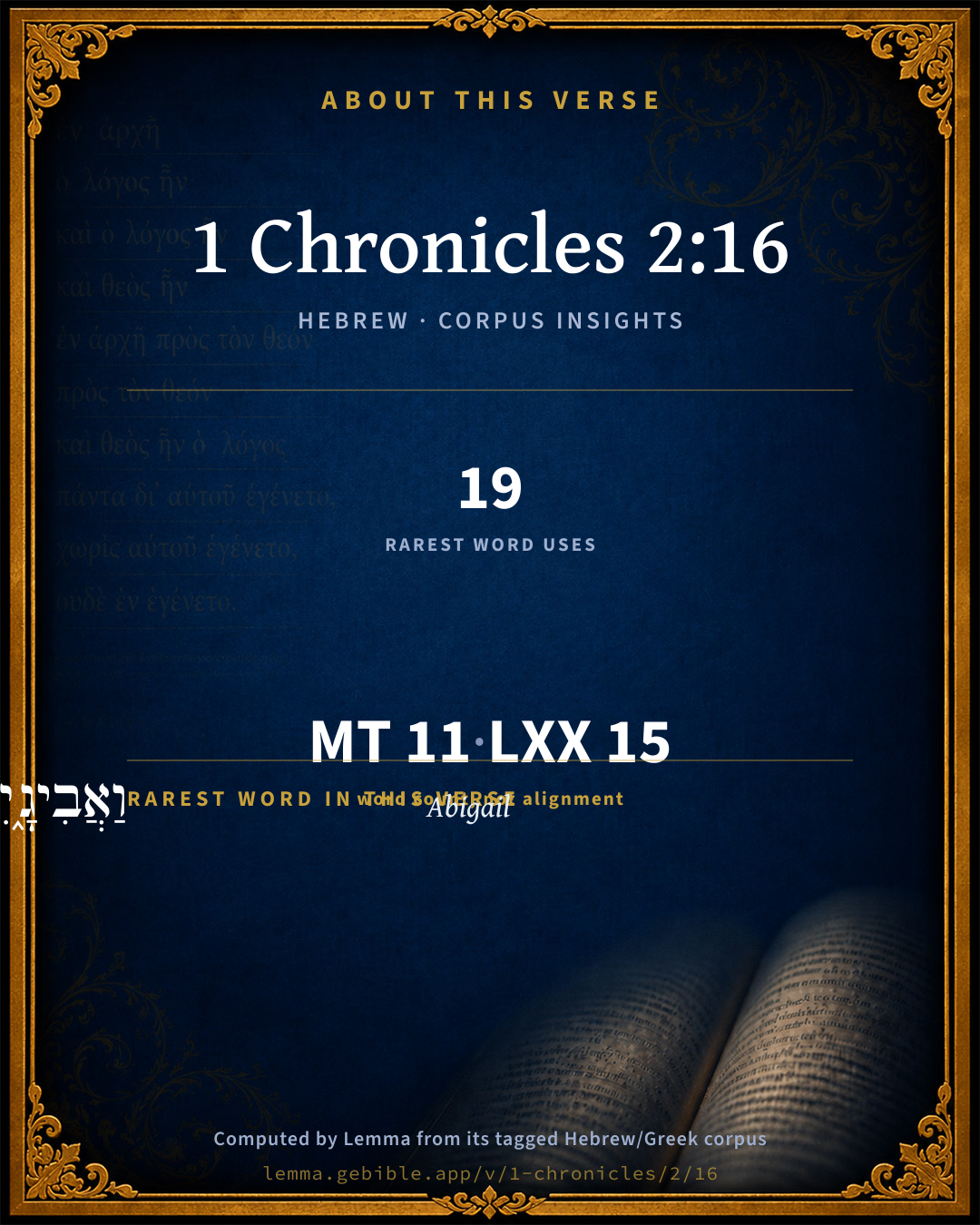
11
words
8
distinct lemmas
Historical
section

Notable vocabulary

The rarest word here is וַאֲבִיגָ֑יִל Abigail H26 — appearing just 19 times in the whole Hebrew Bible.

Shared distinctive vocabulary

וַאֲבִיגָ֑יִל Abigail H26 occurs in 17 verses of the Hebrew Bible. Also found in:

Grammatical profile

  • 10 nouns
  • 1 adjective

Repetition

Words recur within this verse — often emphatic in Hebrew:

  • ואחיתיהם sister H269 ×2
  • צְרוּיָ֣ה Zeruiah H6870 ×2
  • וַעֲשָׂה Asahel H6214 ×2

Hebrew & Septuagint length

In English translation the verse runs 17 words from the Hebrew and 20 from the Septuagint (LXX English) — closely comparable.

A rough comparison of the two English renderings, which tokenize alike — not a word-level alignment.

Word counts can differ between the Hebrew and the Greek without any difference in meaning — e.g. the Hebrew direct-object marker אֵת has no separate Greek word, and Greek often adds the article ὁ.

In the original languages it is 11 Hebrew tokens and 15 Greek tokens — but the two are counted differently (Hebrew bundles its prefixes and suffixes into one token; the Greek is in lemma form), so that isn’t a like-for-like length.

Cross-references

5

Topical passages linked to 1 Chronicles 2:16 in the Treasury of Scripture Knowledge — connected by theme and wording, ordered by reader-vote popularity; previews shown in the World English Bible.

  • 1 Samuel 26:6 Then answered David and said to Ahimelech the Hittite, and to Abishai the son of Zeruiah, brother to Joab, saying, Who will go down with me to Saul to the camp? Abishai said, I will go down with you.
  • 2 Samuel 2:18–23 The three sons of Zeruiah were there, Joab, and Abishai, and Asahel: and Asahel was as light of foot as a wild gazelle.
  • 2 Samuel 3:39 I am this day weak, though anointed king; and these men the sons of Zeruiah are too hard for me. May Yahweh reward the evil-doer according to his wickedness."
  • 2 Samuel 16:9–11 Then said Abishai the son of Zeruiah to the king, "Why should this dead dog curse my lord the king? Please let me go over and take off his head."
  • 2 Samuel 19:22 David said, What have I to do with you, you sons of Zeruiah, that you should this day be adversaries to me? shall there any man be put to death this day in Israel? for don't I know that I am this day king over Israel?

Cross-references courtesy of OpenBible.info (CC BY 4.0).

Hebrew and Greek witnesses Masoretic Hebrew ↔ Greek Septuagint

The same verse in the two great witnesses to the Old Testament, shown verse-for-verse.

These are two independent witnesses, not word-aligned to each other, and the Septuagint is shown in lemma (dictionary) form.

Hebrew 1 Chronicles 2:16 Masoretic · Westminster Leningrad Codex

ואחיתיהם וְאַחְיוֹתֵיהֶ֖ם צְרוּיָ֣ה וַאֲבִיגָ֑יִל וּבְנֵ֣י צְרוּיָ֗ה אַבְשַׁ֛י וְיוֹאָ֥ב וַעֲשָׂה אֵ֖ל שְׁלֹשָֽׁה

and their sisters were Zeruiah and Abigail. The sons of Zeruiah: Abishai, and Joab, and Asahel, three.

World English Bible · Public Domain

Greek LXX 1 Chronicles 2:16 Septuagint · lemma form

καί ἀδελφή αὐτός σαρουια καί αβιγαια καί υἱός σαρουια αβεσσα καί ιωαβ καί ασαηλ τρεῖς

And their sister was Saruia, and another Abigaia: and the sons of Saruia were Abisa, and Joab, and Asael, three.

LXX2012 (modern English Septuagint) · Public Domain

Hebrew: Westminster Leningrad Codex (CC BY 4.0). Greek: Septuagint (public domain); English from LXX2012 (modern English Septuagint) (Public Domain). How the Septuagint differs from the Hebrew →

Commentary

Notes on 1 Chronicles 2:16 from classic Christian and Jewish commentators (each source and its license shown beneath its notes). The classic Christian expositions comment on the surrounding passage and are grouped to its opening verse, so a note may address several verses; the Jewish commentaries on the Tanakh (Rashi and others) are per-verse, so they appear only where the commentator wrote on this verse.

Lemma curates 59 commentaries, every one of them public domain or Creative Commons licensed, each selected and text-cleaned for this edition rather than reprinted as found. About our sources →

Trapp's Complete Commentary

John Trapp

1Ch 2:16 Whose sisters [were] Zeruiah, and Abigail. And the sons of Zeruiah; Abishai, and Joab, and Asahel, three.

Ver. 16. Abishai.] Elder brother to Joab, who yet got the start of him.

John Trapp, A Commentary or Exposition upon All the Books of the Old and New Testament (1647–1656) — public domain. Text from a community e-Sword module.

Albert Barnes' Notes on the Bible

Sisters - i. e. half-sisters. Abigail and Zeruiah were daughters not of Jesse, but of a certain Nahash, whose widow Jesse took to wife 2Sa 17:25.

From the present passage, and from the fact that Abishai joined David as a comrade in arms before Joab 1Sa 26:6, it would seem that, although Joab was pre-eminent among the three 2Sa 2:13, 2Sa 2:16, Abishai was the eldest.

Albert Barnes' Notes on the Bible (1834–1885) — public domain. Text from a community e-Sword/MySword module.

The Cambridge Bible for Schools and Colleges

gen. ed. J. J. S. Perowne

16. sons of Zeruiah] Joab and his brothers are always thus named after their mother; probably their father died while they were young, or we may have a relic here of the ancient method of tracing kinship through the mother.

The Cambridge Bible for Schools and Colleges (gen. ed. J. J. S. Perowne; Cambridge University Press, 1878–1918) — public domain. Text from a community e-Sword module.

John Gill's Exposition

And Hur begat Uri, and Uri begat Bezaleel. Who yet is not thought to be the same Bezaleel we read of in Exo 31:2 though the fathers and grandfathers of both have the same names, and were of the same tribe.

though the fathers and grandfathers of both have the same names, and were of the same tribe.

1 Chronicles 2:21

ch1 2:21

ch1 2:21

ch1 2:21And afterward Hezron went in to the daughter of Machir the father of Gilead,.... Which Machir was the son of Manasseh, and Gilead was his grandson, Num 26:29 the Targum is,"but he enticed a virgin, the daughter of Machir;''which suggests, that he committed fornication with her, though he afterwards married her; her name is not mentioned; to me it seems to be Abiah, Ch1 2:24 and whom the Targum there calls the daughter of Machir:

whom he married when he was sixty years old; the Targum is sixty six; this seems to be his last wife:

and she bare him Segub; the same name with the youngest son of Hiel, who rebuilt Jericho, Kg1 16:34.

John Gill's Exposition of the Whole Bible (1746–1763) — public domain (CC PDM 1.0). Text via the HelloAO Bible API.

Haydock's Catholic Bible Commentary

Sarvia. The honour shewn to the sisters of David is unusual. The father of the three valiant children of Sarvia is no where specified.

George Leo Haydock (1774–1849), Haydock's Catholic Family Bible and Commentary, 1859 edition — public domain. Excludes Psalms (Douay-Rheims chapter numbering differs from Protestant) and Deuterocanonical books (Catholic canon only).

The Pulpit Commentary

Vers. 16, 17. These verses do not say that David "begat" Zeruiah and Abigail, but that these two were sisters of the foregoing seven brethren. Light is thrown upon this by 2Sa_17:25, which says that Abigail was the daughter of one Nahash, and that Zeruiah was her sister. But it is to leave us in greater darkness as to who Nahath was: whether Nahath was another name for Jesse, or the name of Jesse"s wife, or the name of a former husband of Jesse"s wife, to whom she bore these two daughters before she became wife to Jesse, and that former husband possibly none other than the Ammonite king (2Sa_10:2) or whether none of these conjectures be near the truth, some of which on the face of them seem unlikely enough, is as yet unsettled. Meantime it is worth remembering that Zeruiah named one of her celebrated sons, and probably the eldest of them, Abishai, after Jesse, Ishai being the same as our Jesse; yet from the above premises it is taken that she was strictly sister of Abigail, and therefore was not really related to Jesse. The subject is treated interestingly under the various names in Smith"s "Bible Dictionary." The husband of Zeruiah is given nowhere, while the husband of Abigail, hero called Jether the Ishmeelite, is, in the passage already referred to, (2Sa_17:25) called Ithra (which is a slightly altered form of the name), an Israelite, with little doubt an error for Ishmaelite. In the same passage also her own name appears as lgybia instead of lyigybia though many manuscripts have this latter.

The Pulpit Commentary (1880–1919), ed. H.D.M. Spence-Jones & Joseph S. Exell — public domain. Text from a community e-Sword module.

Keil & Delitzsch

C. F. Keil & F. Delitzsch

And Hur begat Uri, and Uri begat Bezaleel. Who yet is not thought to be the same Bezaleel we read of in Exo 31:2 though the fathers and grandfathers of both have the same names, and were of the same tribe.

though the fathers and grandfathers of both have the same names, and were of the same tribe.

1 Chronicles 2:21

ch1 2:21

ch1 2:21

ch1 2:21And afterward Hezron went in to the daughter of Machir the father of Gilead,.... Which Machir was the son of Manasseh, and Gilead was his grandson, Num 26:29 the Targum is,"but he enticed a virgin, the daughter of Machir;''which suggests, that he committed fornication with her, though he afterwards married her; her name is not mentioned; to me it seems to be Abiah, Ch1 2:24 and whom the Targum there calls the daughter of Machir:

whom he married when he was sixty years old; the Targum is sixty six; this seems to be his last wife:

and she bare him Segub; the same name with the youngest son of Hiel, who rebuilt Jericho, Kg1 16:34.

Keil & Delitzsch — Biblical Commentary on the Old Testament (1861–1891) — public domain (CC PDM 1.0). Text via the HelloAO Bible API. (Old Testament only.)

unfoldingWord translationNotes

Door43 World Missions Community

General Information:

All names here except Zeruiah and Abigail are the names of men. Zeruiah and Abigail are the names of women. (See: How to Translate Names)

Jether the Ishmaelite

"Jether, a descendant of Ishmael"

translationWords

sister

Joab

unfoldingWord translationNotes — © Distant Shores Media and the Door43 World Missions Community, licensed CC BY-SA 4.0. Source: git.door43.org/Door43/en_tn.

Rashi

Rabbi Shlomo Yitzchaki (Rashi)

And their sisters: Zeruiah and Abigail [They are mentioned] because of David’s honor, i.e., they [Joab, Abishai, and Asael] were his sister’s sons, mighty men and princes. So it is explained further.

Rashi on the Tanakh — English translations: “The Judaica Press complete Tanach with Rashi, translated by A. J. Rosenberg” (CC BY 4.0); “Pentateuch with Rashi's commentary by M. Rosenbaum and A.M. Silbermann, 1929-1934” (public domain); “The Metsudah Tanach series, Lakewood, N.J” (CC BY 4.0); and “The Book of Joshua, Metsudah Publications, 1997” (CC BY 4.0). Text via Sefaria.

Lesson kit

Teaching starters — assembled from the data on this page, not authored interpretation. Every prompt links to the verse data it draws on. Edit before teaching.

1 Chronicles, in the Historical, opens this verse with 11 words (8 distinct Hebrew lemmas). Its most distinctive word is ʼĂbîygayil (“Abigail”). A historical commentator’s framing appears above. Read the whole chapter for the surrounding context.

Discussion questions

  1. What does “Abigail” (ʼĂbîygayil) contribute to the verse as a whole?
  2. 1 Samuel 25:3 shares the word «Abigail» with this verse. How do the two illuminate each other?
  3. “sister” occurs 2× in this one verse. What is the effect of the repetition?
  4. These translations render this verse differently; the difference is in the English rendering, not the original. What questions does that raise?
  5. Reading how Trapp's Complete Commentary and Albert Barnes' Notes on the Bible read this verse, where do the two commentators agree and where do they part?

Things to notice

Reading settings

Reading text

Shown beneath each verse's original-language words.

Old Testament
Old Testament edition

Read the OT as the Masoretic Hebrew (MT) or the Greek Septuagint (LXX).

English shown for the Greek Septuagint (in the Hebrew ↔ Greek comparison).

Comparing translations? Open the Compare panel on any verse page to stack up to four side by side.