Exodus 13:2

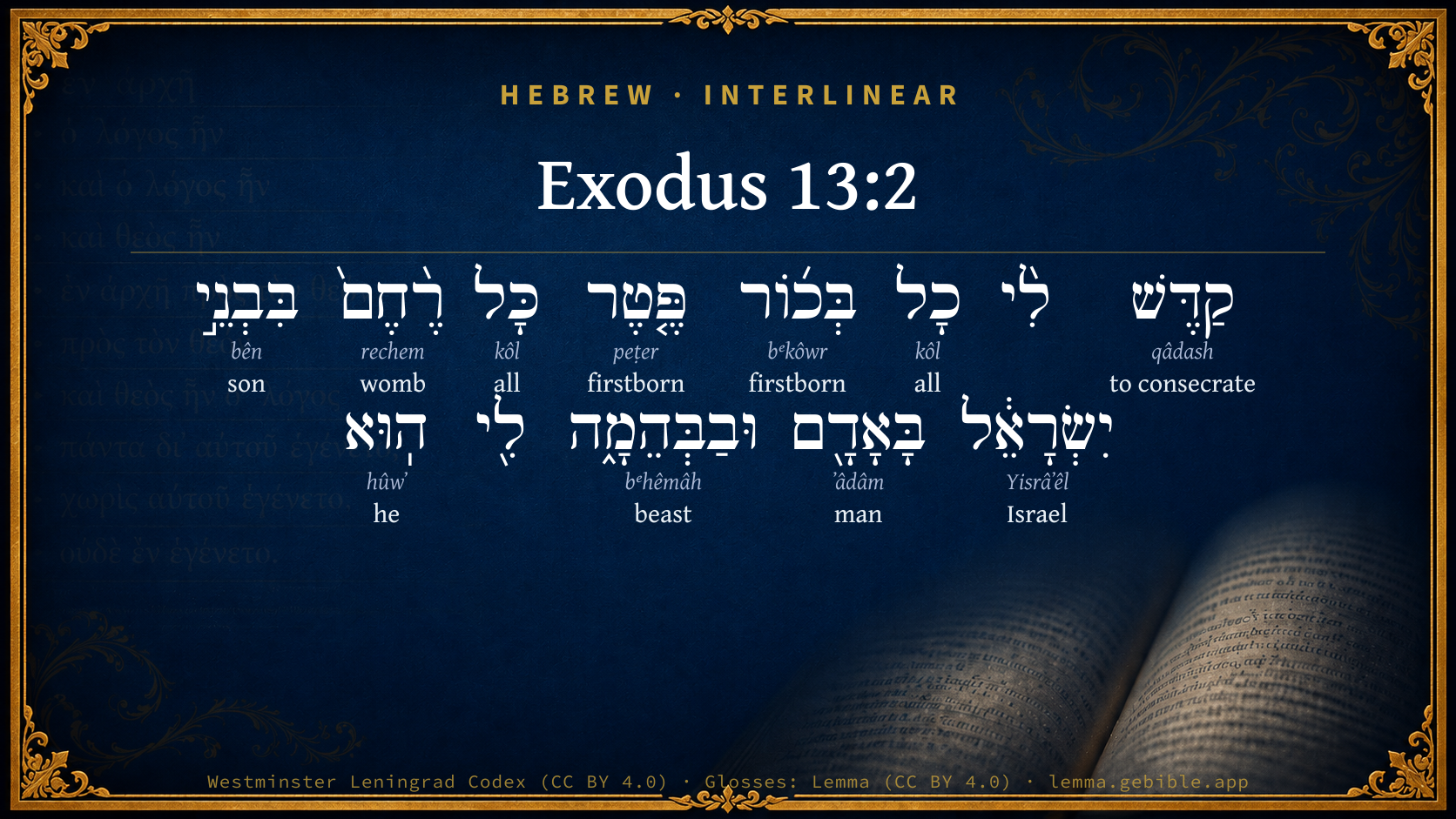
Hebrew (Westminster Leningrad Codex) Exodus 13:2 appears in the Hebrew Old Testament. The text above is from the Westminster Leningrad Codex. Each word links to its Strong’s number, a concise gloss, and parsing drawn from the Open Scriptures Hebrew Bible morphology. Click any word for its full Brown-Driver-Briggs (BDB) entry.
Download image
Cite this verse

Exodus 13:2 (World English Bible). Public Domain. Lemma interlinear Bible study tool, https://lemma.gebible.app/v/exodus/13/2.

Show BibTeX & RIS
BibTeX
RIS
English Translation
"Sanctify to me all of the firstborn, whatever opens the womb among the children of Israel, both of man and of animal. It is mine."
World English Bible · Public Domain
Highlights
  • 1 first appearance in the Hebrew Bible
Full analysis ↓
Download a study sheet

One document with this verse’s original text, its word-by-word gloss line, the meaning frame, cross-references with their text, attributed commentary, and full source and license credits — printable, and it pastes into notes with its structure intact.

This verse Autodidact and up

Study sheet (.html) Plain text (.txt)

A passage Seminary Student

Up to 50 verses in one chapter. A passage sheet keeps up to 6 commentary sources and 12 cross-references per verse, in the order this page ranks them, and says so on the sheet whenever that leaves anything out. Ask for a single verse and you get the Autodidact verse sheet above.

Everything on this page stays free to read, with no account — the sheet is a download of what is already on screen, not access to it.

Want to remove ads? Support Godless Engineer
Compare translations 3

The same verse in 3 English versions, stacked beneath the original-language interlinear above. Click any original word for its lexicon entry.

Each is an independent rendering of the whole verse — the interlinear is not word-aligned to these translations.

Highlighted words mark where these versions differ — a whole-verse word diff, not a word-by-word alignment.

  • World English Bible Public Domain
    "Sanctify to me all of the firstborn, whatever opens the womb among the children of Israel, both of man and of animal. It is mine."
  • King James Version Public Domain
    Sanctify unto me all the firstborn, whatsoever openeth the womb among the children of Israel, both of man and of beast: it is mine.
  • unfoldingWord Literal Text CC BY-SA 4.0
    “Set apart to me all the firstborn, openers of every womb among the sons of Israel, among man and among beast; he is mine.”

unfoldingWord Literal Text — © unfoldingWord, licensed CC BY-SA 4.0. Word-aligned USFM3 via Door43 (git.door43.org/unfoldingWord/en_ult).

Versions to compare (up to 4)

3 of 4 selected

Show all 18 translations

Every available English version of this verse, each an independent rendering of the whole verse.

  • World English Bible Public Domain
    "Sanctify to me all of the firstborn, whatever opens the womb among the children of Israel, both of man and of animal. It is mine."
  • Berean Standard Bible Public Domain
    “Consecrate to Me every firstborn male. The firstborn from every womb among the Israelites belongs to Me, both of man and beast.”
  • Majority Standard Bible Public Domain
    “Consecrate to Me every firstborn male. The firstborn from every womb among the Israelites belongs to Me, both of man and beast.”
  • King James Version Public Domain
    Sanctify unto me all the firstborn, whatsoever openeth the womb among the children of Israel, both of man and of beast: it is mine.
  • American Standard Version (1901) Public Domain
    Sanctify unto me all the first-born, whatsoever openeth the womb among the children of Israel, both of man and of beast: it is mine.
  • Revised Version (1885) Public Domain
    Sanctify unto me all the firstborn, whatsoever openeth the womb among the children of Israel, both of man and of beast: it is mine.
  • Geneva Bible (1599) Public Domain
    Sanctifie vnto me all the first borne: that is, euery one that first openeth the wombe among the children of Israel, as well of man as of beast: for it is mine.
  • Douay-Rheims (1899) Public Domain
    Sanctify unto me every firstborn that openeth the womb among the children of Israel, as well of men as of beasts: for they are all mine.
  • Young's Literal Translation Public Domain
    `Sanctify to Me every first-born, opening any womb among the sons of Israel, among man and among beast; it `is' Mine.'
  • Literal Standard Version CC BY-SA 4.0
    “Sanctify to Me every firstborn, opening any womb among the sons of Israel, among man and among beast; it [is] Mine.”
  • Unlocked Literal Bible CC BY-SA 4.0
    “Set apart to me all the firstborn, every firstborn male among the Israelites, both of people and animals. The firstborn belongs to me.”
  • unfoldingWord Literal Text CC BY-SA 4.0
    “Set apart to me all the firstborn, openers of every womb among the sons of Israel, among man and among beast; he is mine.”
  • Darby Bible Public Domain
    Hallow unto me every firstborn, whatever breaketh open the womb among the children of Israel, of man and of cattle: it is mine.
  • World Messianic Bible Public Domain
    “Sanctify to me all the firstborn, whatever opens the womb among the children of Israel, both of man and of animal. It is mine.”
  • Webster's Bible Public Domain
    Sanctify to me all the first-born, whatever openeth the womb among the children of Israel, both of man and of beast: it is mine.
  • Free Bible Version CC BY-SA 4.0
    “Every firstborn male is to be dedicated to me. The firstborn from every Israelite family belongs to me, and also every firstborn animal.”
  • Bible in Basic English Public Domain
    Let the first male child of every mother among the children of Israel be kept holy for me, even the first male birth among man or beast; for it is mine.
  • JPS Tanakh (1917) Public Domain
    'Sanctify unto Me all the first-born, whatsoever openeth the womb among the children of Israel, both of man and of beast, it is Mine.'

Literal Standard Version (2020), Covenant Press — licensed CC BY-SA 4.0. Text via the HelloAO Bible API (eBible.org). Unlocked Literal Bible (unfoldingWord) — licensed CC BY-SA 4.0. Text via the HelloAO Bible API (eBible.org). unfoldingWord Literal Text — © unfoldingWord, licensed CC BY-SA 4.0. Word-aligned USFM3 via Door43 (git.door43.org/unfoldingWord/en_ult). Free Bible Version, Dr. Jonathan Gallagher — licensed CC BY-SA 4.0. Text via the HelloAO Bible API (eBible.org).

Word by word

More ways to search: Search by grammar → Find every occurrence → Compare this word →

Practice this passage: Drill this verse → Learn its vocabulary →

פֶּ֤טֶר
peṭer
H6363
“firstborn of”
Noun, Common, Masculine, Singular, Construct
Part of Speech
Noun
Type
Common
Gender
Masculine
Number
Singular
State
Construct
Full BDB Definition

Origin: from H6362

TWOT: 1764a , 1764b

firstborn, firstling, that which separates or first opens
  1. קַדֶּשׁ qâdash H6942 “consecrate” Verb, Piel, Imperative, 2nd Person, Masculine, Singular
  2. כָל kôl H3605 “all of” Noun, Common, Masculine, Singular, Construct
  3. בְּכ֜וֹר bᵉkôwr H1060 “firstborn” Noun, Common, Masculine, Singular, Absolute
  4. כָּל kôl H3605 “all of” Noun, Common, Masculine, Singular, Construct
  5. רֶ֨חֶם֙ rechem H7358 “womb” Noun, Common, Masculine, Singular, Absolute
  6. בִּבְנֵ֣י bên H1121 “in/at · sons of” Preposition + Noun, Common, Masculine, Plural, Construct
  7. יִשְׂרָאֵ֔ל Yisrâʼêl H3478 “Israel” Noun, Proper
  8. בָּאָדָ֖ם ʼâdâm H120 “in/at the · man” Preposition, Determined + Noun, Common, Masculine, Singular, Absolute
  9. וּבַבְּהֵמָ֑ה bᵉhêmâh H929 “and · in/at the · beast” Conjunction + Preposition, Determined + Noun, Common, Feminine, Singular, Absolute
  10. הֽוּא hûwʼ H1931 “he” Pronoun, Personal, 3rd Person, Masculine, Singular

About this verse

These counts appear in no published source. They are computed here, from the morphology-tagged text and Lemma’s own curated glosses. What Lemma adds →

13
words
10
distinct lemmas
Pentateuch
section

Notable vocabulary

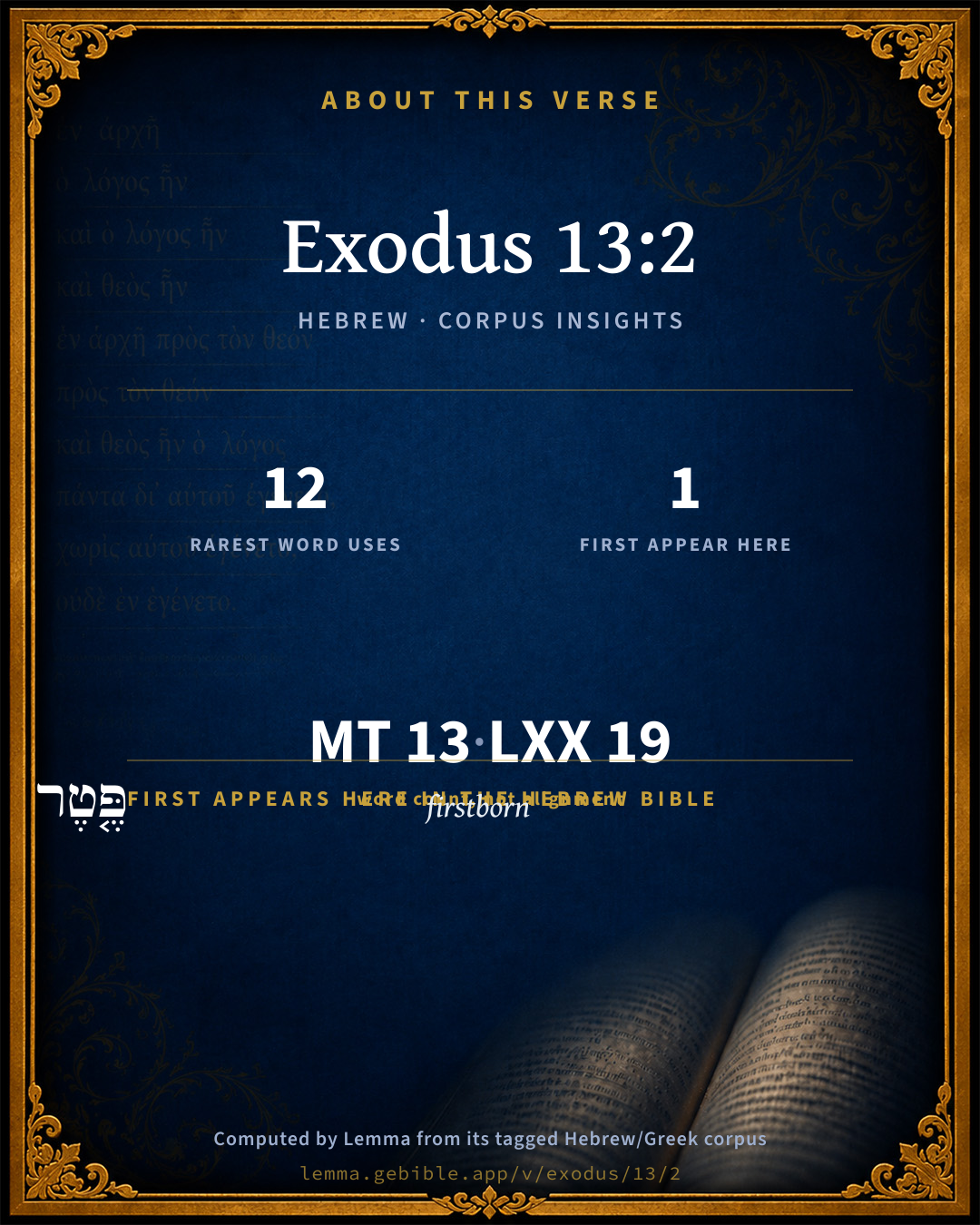
The rarest word here is פֶּ֤טֶר firstborn H6363 — appearing just 12 times in the whole Hebrew Bible.

First appearance in Scripture

This word makes its first canonical appearance in the Hebrew Bible here:

  • פֶּ֤טֶר firstborn H6363

Shared distinctive vocabulary

פֶּ֤טֶר firstborn H6363 occurs in 10 verses of the Hebrew Bible. Also found in:

Grammatical profile

  • 1 verb
  • 9 nouns
  • 1 pronoun
  • 2 prepositions

Verb forms

  • קַדֶּשׁ Piel · Imperative

Repetition

A word recurs within this verse — often emphatic in Hebrew:

Hebrew & Septuagint length

In English translation the verse runs 25 words from the Hebrew and 23 from the Septuagint (LXX English) — closely comparable.

A rough comparison of the two English renderings, which tokenize alike — not a word-level alignment.

Word counts can differ between the Hebrew and the Greek without any difference in meaning — e.g. the Hebrew direct-object marker אֵת has no separate Greek word, and Greek often adds the article ὁ.

In the original languages it is 13 Hebrew tokens and 19 Greek tokens — but the two are counted differently (Hebrew bundles its prefixes and suffixes into one token; the Greek is in lemma form), so that isn’t a like-for-like length.

Cross-references

12

Topical passages linked to Exodus 13:2 in the Treasury of Scripture Knowledge — connected by theme and wording, ordered by reader-vote popularity; previews shown in the World English Bible.

  • Luke 2:23 (as it is written in the law of the Lord, "Every male who opens the womb shall be called holy to the Lord"),
  • Numbers 3:13 for all the firstborn are mine. On the day that I struck down all the firstborn in the land of Egypt I made holy to me all the firstborn in Israel, both man and animal. They shall be mine. I am Yahweh."
  • Deuteronomy 15:19 All the firstborn males that are born of your herd and of your flock you shall sanctify to Yahweh your God: you shall do no work with the firstborn of your herd, nor shear the firstborn of your flock.
  • Exodus 22:29–30 "You shall not delay to offer from your harvest and from the outflow of your presses. "You shall give the firstborn of your sons to me.
  • Numbers 8:16–17 For they are wholly given to me from among the children of Israel; instead of all who open the womb, even the firstborn of all the children of Israel, I have taken them to me.
  • Numbers 18:15 Everything that opens the womb, of all flesh which they offer to Yahweh, both of man and animal shall be yours: nevertheless the firstborn of man shall you surely redeem, and the firstborn of unclean animals shall you redeem.
  • Exodus 13:12–15 that you shall set apart to Yahweh all that opens the womb, and every firstborn which you have that comes from an animal. The males shall be Yahweh's.
  • Exodus 34:19–20 All that opens the womb is mine; and all your cattle that is male, the firstborn of cow and sheep.
  • Leviticus 27:26 "'Only the firstborn among animals, which is made a firstborn to Yahweh, no man may dedicate it; whether an ox or sheep, it is Yahweh's.
  • Exodus 4:22 You shall tell Pharaoh, 'Thus says Yahweh, Israel is my son, my firstborn,
  • Exodus 23:19 The first of the first fruits of your ground you shall bring into the house of Yahweh your God. "You shall not boil a kid in its mother's milk.
  • Hebrews 12:23 to the general assembly and assembly of the firstborn who are enrolled in heaven, to God the Judge of all, to the spirits of just men made perfect,

Cross-references courtesy of OpenBible.info (CC BY 4.0).

Hebrew and Greek witnesses Masoretic Hebrew ↔ Greek Septuagint

The same verse in the two great witnesses to the Old Testament, shown verse-for-verse.

These are two independent witnesses, not word-aligned to each other, and the Septuagint is shown in lemma (dictionary) form.

Hebrew Exodus 13:2 Masoretic · Westminster Leningrad Codex

קַדֶּשׁ לִ֨י כָל בְּכ֜וֹר פֶּ֤טֶר כָּל רֶ֨חֶם֙ בִּבְנֵ֣י יִשְׂרָאֵ֔ל בָּאָדָ֖ם וּבַבְּהֵמָ֑ה לִ֖י הֽוּא

"Sanctify to me all of the firstborn, whatever opens the womb among the children of Israel, both of man and of animal. It is mine."

World English Bible · Public Domain

Greek LXX Exodus 13:2 Septuagint · lemma form

ἁγιάζω ἐγώ πᾶς πρωτότοκος πρωτογενής δια ἀναοἴγω πᾶς μήτρα ἐν ὁ υἱός ἰσραήλ ἀπό ἄνθρωπος ἕως κτῆνος ἐγώ εἰμί

Sanctify to me every firstborn, first produced, opening every womb among the children of Israel both of man and beast: it is mine.

LXX2012 (modern English Septuagint) · Public Domain

Hebrew: Westminster Leningrad Codex (CC BY 4.0). Greek: Septuagint (public domain); English from LXX2012 (modern English Septuagint) (Public Domain). How the Septuagint differs from the Hebrew →

Targum (Aramaic paraphrase)

2

The Targum is the ancient Jewish Aramaic paraphrase of the Hebrew Scriptures — an interpretive translation, not the Hebrew text itself. Onkelos (literal) and Pseudo-Jonathan (expansive) render the Torah, and Jonathan the Prophets. Coverage is partial: where no permissively-licensed English translation exists for a verse, only the Aramaic is shown. This is verse-level text, not a word-by-word alignment to the Hebrew.

  1. Targum Onkelos Torah (Genesis–Deuteronomy)
    אַקְדֵשׁ קֳדָמַי כָּל בּוּכְרָא פָּתַח כָּל וַלְדָא בִּבְנֵי יִשְׂרָאֵל בֶּאֱנָשָׁא וּבִבְעִירָא דִילִי הוּא:

    (no public-domain English translation for this verse)

    Targum Onkelos — Aramaic: “Onkelos Genesis” (public domain); “Onkelos Exodus” (public domain); “Onkelos Leviticus” (public domain); “Onkelos Numbers” (public domain); “Onkelos Deuteronomy” (public domain). English: “Sefaria Community Translation” (CC0 1.0 (public-domain dedication)); “J.W. Etheridge. The Targums of Onkelos and Jonathan Ben Uzziel on the Pentateuch. London: Longmans, Green, 1862” (public domain). Text via Sefaria.

  2. Targum Pseudo-Jonathan Torah (Genesis–Deuteronomy)
    אַקְדֵישׁ קֳדָמַי כָּל בּוּכְרָא דְכוּרַיָא פְּתַח כָּל וַולְדָא בִּבְנֵי יִשְרָאֵל בְּאֵינָשָׁא וּבִבְעִירָא דִילִי הוּא

    Sanctify before Me every firstborn male. Whatsoever openeth the womb of all the sons of Israel among men, and (also) among beasts, is Mine.

    Targum Pseudo-Jonathan — Aramaic: “Targum Jonathan on Genesis” (public domain); “Targum Jonathan on Exodus” (public domain); “Targum Jonathan on Leviticus” (public domain); “Targum Jonathan on Numbers” (public domain); “Targum Jonathan on Deuteronomy” (public domain). English: “The Targum of Jonathan ben Uzziel, trans. J. W. Etheridge, London, 1862” (public domain). Text via Sefaria.

Commentary

Notes on Exodus 13:2 from classic Christian and Jewish commentators (each source and its license shown beneath its notes). The classic Christian expositions comment on the surrounding passage and are grouped to its opening verse, so a note may address several verses; the Jewish commentaries on the Tanakh (Rashi and others) are per-verse, so they appear only where the commentator wrote on this verse.

Lemma curates 59 commentaries, every one of them public domain or Creative Commons licensed, each selected and text-cleaned for this edition rather than reprinted as found. About our sources →

Trapp's Complete Commentary

John Trapp

Exo 13:2 Sanctify unto me all the firstborn, whatsoever openeth the womb among the children of Israel, [both] of man and of beast: it [is] mine.

Ver. 2. It is mine.] By right of redemption also. He that is saved is "not his own"; {1Co 6:19} but his that saved him. Servati sumus ut serviamus. {Luk 1:74} God hath sworn we shall do so, {Luk 1:73} or else never come to his kingdom. {Psa 95:11}

John Trapp, A Commentary or Exposition upon All the Books of the Old and New Testament (1647–1656) — public domain. Text from a community e-Sword module.

Joseph Benson's Commentary

Exo 13:2. Sanctify — That is, command all the people to sanctify; unto me — To my use and service, in a manner I shall hereafter explain; all the firstborn — That are males, as the command is limited, Exo 13:12; whatsoever openeth the womb — That is, every child which is the firstborn of his mother: so that if a man had many wives, either together or successively, his first child by every one of these was a firstborn, and, if a male, was claimed by the Lord. But if a female came first, and afterward a male, that male was not devoted to God, because it was not the firstborn. Hence the parents were not to look upon themselves as having an interest in their firstborn, if males, till they had first solemnly presented them to God, and received them back from him again. It is mine — By special right and title, as being by singular favour preserved from the common destruction. The firstborn of man, if males, were claimed for the sacred ministrations of the priestly office. But after the Jewish commonwealth was formed, the Levites were chosen to officiate in their stead, Num 3:12; and the firstborn were to be redeemed at a certain rate, which was part of the priest’s maintenance, Num 18:15-16. And of beast — Which was to be offered to God, if a male: only an ass was to be redeemed.

Joseph Benson's Commentary on the Old and New Testaments (1811–1818) — public domain. Text from a community e-Sword module.

Adam Clarke's Commentary

Verse 2. Sanctify unto me all the first-born] To sanctify, קדש kadash, signifies to consecrate, separate, and set apart a thing or person from all secular purposes to some religious use; and exactly answers to the import of the Greek αγιαζω, from a, privative, and γη, the earth, because every thing offered or consecrated to God was separated from all earthly uses. Hence a holy person or saint is termed αγιος, i.e., a person separated from the earth; one who lives a holy life, entirely devoted to the service of God. Thus the persons and animals sanctified to God were employed in the service of the tabernacle and temple; and the animals, such as were proper, were offered in sacrifice.

The Hindoos frequently make a vow, and devote to an idol the first-born of a goat and of a man. The goat is permitted to run wild, as a consecrated animal. A child thus devoted has a lock of hair separated, which at the time appointed is cut off and placed near the idol. Hindoo women sometimes pray to Gunga (the Ganges) for children, and promise to devote the first-born to her. Children thus devoted are cast into the Ganges, but are generally saved by the friendly hand of some stranger. - Ward's Customs.

Whatsoever openeth the womb] That is, the first-born, if a male; for females were not offered, nor the first male, if a female had been born previously. Again, if a man had several wives, the first-born of each, if a male, was to be offered to God. And all this was done to commemorate the preservation of the first-born of the Israelites, when those of the Egyptians were destroyed.

Adam Clarke's Commentary on the Bible (1810–1826) — public domain. Text from a community e-Sword/MySword module.

Ellicott's Commentary for English Readers

XIII.

SANCTIFICATION OF THE FIRSTBORN, AND LAW OF REDEMPTION.

(2) Sanctify unto me all the firstborn.—It was a reasonable demand that the existing firstborn of Israel, spared by God when the Egyptian firstborn were destroyed, should be regarded thenceforth as His, and set apart for His service. The extension of the demand to existing beasts was also reasonable, since they too had been spared. God’s further requirement, that henceforth all the future firstborn should also be His, was intended to perpetuate the memory of the recent deliverance, and to help to fix it in the mind of the nation. The substitution of a redemption in the case of unclean beasts was necessitated by the circumstances of the case, since they could not be sacrificed; and the redemption of the firstborn sons naturally followed when the Levitical priesthood was established, and their services were no longer necessary. (See Num_3:40-51; Num_18:16.) The Jews still observe the ordinance, so far as the children are concerned, and redeem the son which has “opened the womb” on the thirtieth day after the birth.

A Bible Commentary for English Readers, edited by Charles John Ellicott (1878–1897) — public domain. Text from a community e-Sword module.

The Cambridge Bible for Schools and Colleges

gen. ed. J. J. S. Perowne

2. whatsoever openeth] i.e. first openeth; Heb. péṭer, a technical term: so vv. 12, 13 (|| Exo_34:19-20), 15; Num_3:12; Num_8:16; Num_18:15; Eze_20:26†. The law is cited (but not verbally) in Luk_2:23.

The Cambridge Bible for Schools and Colleges (gen. ed. J. J. S. Perowne; Cambridge University Press, 1878–1918) — public domain. Text from a community e-Sword module.

John Gill's Exposition

Sanctify unto me all the firstborn,.... That is, of males, as the Targum of Jonathan adds, for those, and not females, were only either sacrificed or redeemed, see Exo 13:12, and this sanctification of them to the Lord signifies the separation or devoting of them to the service of God; if the firstborn of clean creatures they were to be sacrificed, if unclean to be redeemed with a price, and so the firstborn of men, because it was not lawful to sacrifice them; and the money for the redemption of them was given to the priests, the ministers of the Lord, and so to him; who these first, born were is further explained:

whatsoever openeth the womb among the children of Israel, both of man and of beast; that is, if a male; for, if a female, though it openeth the womb, was not reckoned a firstborn, because not to be offered; nor even a male after the birth of a female, because that openeth not the womb; and so if a man married a widow, and she had had children by her former husband, though she should bring him a son, which was his firstborn, yet not being her's, and not opening the womb, was not subject to this law; but if a man married several wives one after another, or together, who had never been married before, or had had no children; if each of them brought him a son at first birth, they were all of them firstborn, and to be sanctified to the Lord; but the Jews say (u), if a woman at her first birth brought forth a male and a female, the father was free from this law of the redemption of the firstborn, because the female might come forth first: this phrase, "among the children of Israel", shows that this law only belonged to them, and not to the Gentiles; wherefore the Jewish doctors say (w), if a man buys cattle of an Heathen, and sells to him, or is in partnership with him, and gives and takes of him, he is free from the law of the firstborn; for it is said "among the Israelites", and not among others:

it is mine: all creatures, man and beast, are the Lord's by creation; but these firstborn were his in a peculiar manner, and which he reserved to himself, to his own use and service; and the people of Israel were under great obligation to devote them to him, since he had spared all their firstborn, when all the firstborn of the Egyptians, both man and beast, were destroyed: this may denote the special and peculiar interest the Lord has in the general assembly and church of the firstborn, whose names are written in heaven, through the special, particular, and eternal choice of them in Christ, and the redemption of them to him by the price of his blood; and who, on account both of their election of God, and redemption by Christ, are laid under obligation to give up themselves to God, a holy, living, and acceptable sacrifice, which is but their reasonable service.

(u) Misn. Becorot, c. 8. sect. 4, 5. & Bartenora in ib. (w) lbid. c. 2. sect. 1.

John Gill's Exposition of the Whole Bible (1746–1763) — public domain (CC PDM 1.0). Text via the HelloAO Bible API.

Albert Barnes' Notes on the Bible

Sanctify unto me - The command is addressed to Moses. It was to declare the will of God that all firstborn were to be consecrated to Him, set apart from all other creatures. The command is expressly based upon the Passover. The firstborn exempt from the destruction became in a new and special sense the exclusive property of the Lord: the firstborn of man as His ministers, the firstborn of cattle as victims. In lieu of the firstborn of men the Levites were devoted to the temple services.

Albert Barnes' Notes on the Bible (1834–1885) — public domain. Text from a community e-Sword/MySword module.

Haydock's Catholic Bible Commentary

Sanctify unto me every first-born. Sanctification in this place means, that the first-born males of the Hebrews should be deputed to the ministry in the divine worship: and the first-born of beasts to be given for a sacrifice. (Challoner) --- Sanctify, set apart. (Menochius) --- Openeth, the first male fruit of the womb. If a female was born the first, none of the children were to be redeemed. (Luke ii. 23.) Jesus Christ submitted to this law; though many of the fathers have asserted that, on account of his miraculous conception and birth, he was not subjected to it; while others maintain the contrary. (Calmet)

George Leo Haydock (1774–1849), Haydock's Catholic Family Bible and Commentary, 1859 edition — public domain. Excludes Psalms (Douay-Rheims chapter numbering differs from Protestant) and Deuterocanonical books (Catholic canon only).

Matthew Poole's English Annotations

Sanctify unto me, to my use and service, in manner as I shall hereafter explain. And sanctify, i.e. command all the people to sanctify, as Moses did, Exo 13:12.

All the first-born, viz. if they be males, as it is limited, Exo 13:12.

Whatsoever openeth the womb; every child which is the first-born of his mother: so that if a man had many wives, either together or successively, his first child by every one of these was a first-born. Whether clean or unclean, though in different manner; whereof see Num 18:13,15,17. It is mine, by special right and title; as being by my singular care and favour preserved from the common destruction, and therefore I challenge a peculiar interest in them, and do hereby require that they be devoted to me.

Matthew Poole's English Annotations on the Holy Bible (1683–1685) — public domain. Text from a community e-Sword/MySword module.

The Pulpit Commentary

Sanctify unto me. Not by any positive ceremony, but by regarding it as "set apart unto the Lord" (verse 12) made over to him, that is, as his own. All the first-born. The Hebrew word used is masculine, and by its proper force limits the command to the first-born males, who alone had been in danger from the tenth plague. Whatever openeth the womb. This clause added definiteness, showing that "firstborn" did not contain any reference to any later Birth, and that it applied to every case where a woman"s first child was a male. It is mine. Or, "it shall be mine." I claim it.

The Pulpit Commentary (1880–1919), ed. H.D.M. Spence-Jones & Joseph S. Exell — public domain. Text from a community e-Sword module.

John Wesley's Explanatory Notes

Sanctify to me all the first-born - The parents were not to look upon themselves as interested in their first-born, till they had first solemnly presented them to God, and received them back from him again. It is mine - By a special right, being by my singular favour preserved from the common destruction.

John Wesley, Explanatory Notes Upon the Whole Bible (1754–1765) — public domain. Text via the GEBible commentary corpus.

Rashi

Rabbi Shlomo Yitzchaki (Rashi)

פטר כל רחם THE FIRST OFFSPRING OF EVERY WOMB — The words mean: that which first openeth the womb, the root פטר meaning to open, as in (Proverbs 17:14) “As one makes an opening (פוטר) for water so is the beginning of strife”; and so, too, is (Psalms 22:8) יפטירו בשפה i. e. “they open the lips”.

לי הוא IT IS MINE — I have acquired him for Myself through My having smitten the first born of the Egyptians.

Rashi on the Tanakh — English translations: “The Judaica Press complete Tanach with Rashi, translated by A. J. Rosenberg” (CC BY 4.0); “Pentateuch with Rashi's commentary by M. Rosenbaum and A.M. Silbermann, 1929-1934” (public domain); “The Metsudah Tanach series, Lakewood, N.J” (CC BY 4.0); and “The Book of Joshua, Metsudah Publications, 1997” (CC BY 4.0). Text via Sefaria.

Ramban (Nachmanides)

Rabbi Moshe ben Nachman (Ramban / Nachmanides)

SANCTIFY UNTO ME. This means that they are to consecrate the firstborn at once so that the commandment be applicable in the wilderness. This chapter adds many commandments: that they remember the day [when they left Egypt] and that the month was Aviv, and that they keep this ordinance in its season. This is an allusion to the intercalation [of an extra month] in the lunar year, since we are to observe the Passover only in the month of Aviv, [which is the spring]. On the subject of leavened bread, this chapter adds: Neither shall there be leaven seen with thee, in all thy borders. At the conclusion, it adds the commandment of the frontlets.

Ramban (Nachmanides) on the Tanakh — English translation: “Commentary on the Torah by Ramban (Nachmanides). Translated and annotated by Charles B. Chavel. New York, Shilo Pub. House, 1971-1976” (CC BY 4.0). Text via Sefaria.

Lesson kit

Teaching starters — assembled from the data on this page, not authored interpretation. Every prompt links to the verse data it draws on. Edit before teaching.

Exodus, in the Pentateuch, opens this verse with 13 words (10 distinct Hebrew lemmas). Its most distinctive word is peṭer (“firstborn”). A historical commentator’s framing appears above. Read the whole chapter for the surrounding context.

Discussion questions

  1. The word peṭer carries the sense “firstborn.” How does it shape the verse?
  2. The word “firstborn” first appears here in Scripture. What is being introduced at this debut?
  3. Exodus 13:12 shares the word «firstborn» with this verse. How do the two illuminate each other?
  4. “all” occurs 2× in this one verse. What is the effect of the repetition?
  5. These translations render this verse differently. What is at stake in choosing one wording over another?
  6. The verb «קַדֶּשׁ» is Piel Imperative. How does its form color the action?
  7. Reading how Trapp's Complete Commentary and Joseph Benson's Commentary read this verse, where do the two commentators agree and where do they part?

Things to notice

Reading settings

Reading text

Shown beneath each verse's original-language words.

Old Testament
Old Testament edition

Read the OT as the Masoretic Hebrew (MT) or the Greek Septuagint (LXX).

English shown for the Greek Septuagint (in the Hebrew ↔ Greek comparison).

Comparing translations? Open the Compare panel on any verse page to stack up to four side by side.