Deuteronomy 8:5

Hebrew (Westminster Leningrad Codex) Deuteronomy 8:5 appears in the Hebrew Old Testament. The text above is from the Westminster Leningrad Codex. Each word links to its Strong’s number, a concise gloss, and parsing drawn from the Open Scriptures Hebrew Bible morphology. Click any word for its full Brown-Driver-Briggs (BDB) entry.
Download image
Cite this verse

Deuteronomy 8:5 (World English Bible). Public Domain. Lemma interlinear Bible study tool, https://lemma.gebible.app/v/deuteronomy/8/5.

Show BibTeX & RIS
BibTeX
RIS
English Translation
You shall consider in your heart that as a man chastens his son, so Yahweh your God chastens you.
World English Bible · Public Domain
Download a study sheet

One document with this verse’s original text, its word-by-word gloss line, the meaning frame, cross-references with their text, attributed commentary, and full source and license credits — printable, and it pastes into notes with its structure intact.

This verse Autodidact and up

Study sheet (.html) Plain text (.txt)

A passage Seminary Student

Up to 50 verses in one chapter. A passage sheet keeps up to 6 commentary sources and 12 cross-references per verse, in the order this page ranks them, and says so on the sheet whenever that leaves anything out. Ask for a single verse and you get the Autodidact verse sheet above.

Everything on this page stays free to read, with no account — the sheet is a download of what is already on screen, not access to it.

Want to remove ads? Support Godless Engineer
Compare translations 3

The same verse in 3 English versions, stacked beneath the original-language interlinear above. Click any original word for its lexicon entry.

Each is an independent rendering of the whole verse — the interlinear is not word-aligned to these translations.

Highlighted words mark where these versions differ — a whole-verse word diff, not a word-by-word alignment.

  • World English Bible Public Domain
    You shall consider in your heart that as a man chastens his son, so Yahweh your God chastens you.
  • King James Version Public Domain
    Thou shalt also consider in thine heart, that, as a man chasteneth his son, so the LORD thy God chasteneth thee.
  • unfoldingWord Literal Text CC BY-SA 4.0
    And you shall know with your heart that, as a man instructs his son, Yahweh your God instructs you.

unfoldingWord Literal Text — © unfoldingWord, licensed CC BY-SA 4.0. Word-aligned USFM3 via Door43 (git.door43.org/unfoldingWord/en_ult).

Versions to compare (up to 4)

3 of 4 selected

Show all 18 translations

Every available English version of this verse, each an independent rendering of the whole verse.

  • World English Bible Public Domain
    You shall consider in your heart that as a man chastens his son, so Yahweh your God chastens you.
  • Berean Standard Bible Public Domain
    So know in your heart that just as a man disciplines his son, so the LORD your God disciplines you.
  • Majority Standard Bible Public Domain
    So know in your heart that just as a man disciplines his son, so the LORD your God disciplines you.
  • King James Version Public Domain
    Thou shalt also consider in thine heart, that, as a man chasteneth his son, so the LORD thy God chasteneth thee.
  • American Standard Version (1901) Public Domain
    And thou shalt consider in thy heart, that, as a man chasteneth his son, so Jehovah thy God chasteneth thee.
  • Revised Version (1885) Public Domain
    And thou shalt consider in thine heart, that, as a man chasteneth his son, so the LORD thy God chasteneth thee.
  • Geneva Bible (1599) Public Domain
    Knowe therefore in thine heart, that as a man nourtereth his sonne, so the Lord thy God nourtereth thee.
  • Douay-Rheims (1899) Public Domain
    That thou mayst consider in thy heart, that as a man traineth up his son, so the Lord thy God hath trained thee up.
  • Young's Literal Translation Public Domain
    and thou hast known, with thy heart, that as a man chastiseth his son Jehovah thy God is chastising thee,
  • Literal Standard Version CC BY-SA 4.0
    and you have known with your heart that as a man disciplines his son, your God YHWH is disciplining you,
  • Unlocked Literal Bible CC BY-SA 4.0
    You will think about in your heart, how, as a man disciplines his son, so Yahweh your God disciplines you.
  • unfoldingWord Literal Text CC BY-SA 4.0
    And you shall know with your heart that, as a man instructs his son, Yahweh your God instructs you.
  • Darby Bible Public Domain
    And know in thy heart that, as a man chasteneth his son, so Jehovah thy God chasteneth thee;
  • World Messianic Bible Public Domain
    You shall consider in your heart that as a man disciplines his son, so the LORD your God disciplines you.
  • Webster's Bible Public Domain
    Thou shalt also consider in thy heart, that as a man chasteneth his son, so the LORD thy God chasteneth thee.
  • Free Bible Version CC BY-SA 4.0
    So you should realize that just as a parent disciplines their child, so the Lord your God disciplines you.
  • Bible in Basic English Public Domain
    Keep in mind this thought, that as a son is trained by his father, so you have been trained by the Lord your God.
  • JPS Tanakh (1917) Public Domain
    And thou shalt consider in thy heart, that, as a man chasteneth his son, so the LORD thy God chasteneth thee.

Literal Standard Version (2020), Covenant Press — licensed CC BY-SA 4.0. Text via the HelloAO Bible API (eBible.org). Unlocked Literal Bible (unfoldingWord) — licensed CC BY-SA 4.0. Text via the HelloAO Bible API (eBible.org). unfoldingWord Literal Text — © unfoldingWord, licensed CC BY-SA 4.0. Word-aligned USFM3 via Door43 (git.door43.org/unfoldingWord/en_ult). Free Bible Version, Dr. Jonathan Gallagher — licensed CC BY-SA 4.0. Text via the HelloAO Bible API (eBible.org).

Word by word

More ways to search: Search by grammar → Find every occurrence → Compare this word →

Practice this passage: Drill this verse → Learn its vocabulary →

יְיַסֵּ֥ר
yâçar
H3256
“to discipline”
Verb, Piel, Imperfect, 3rd Person, Masculine, Singular
Part of Speech
Verb
Stem
Piel
Form
Imperfect
Person
3rd Person
Gender
Masculine
Number
Singular
Full BDB Definition

Origin: a primitive root

TWOT: 877

to chasten, discipline, instruct, admonish - (Qal) - to chasten, admonish - to instruct - to discipline - (Niphal) to let oneself be chastened or corrected or admonished - (Piel) - to discipline, correct - to chasten, chastise - (Hiphil) to chasten - (Nithpael) to teach
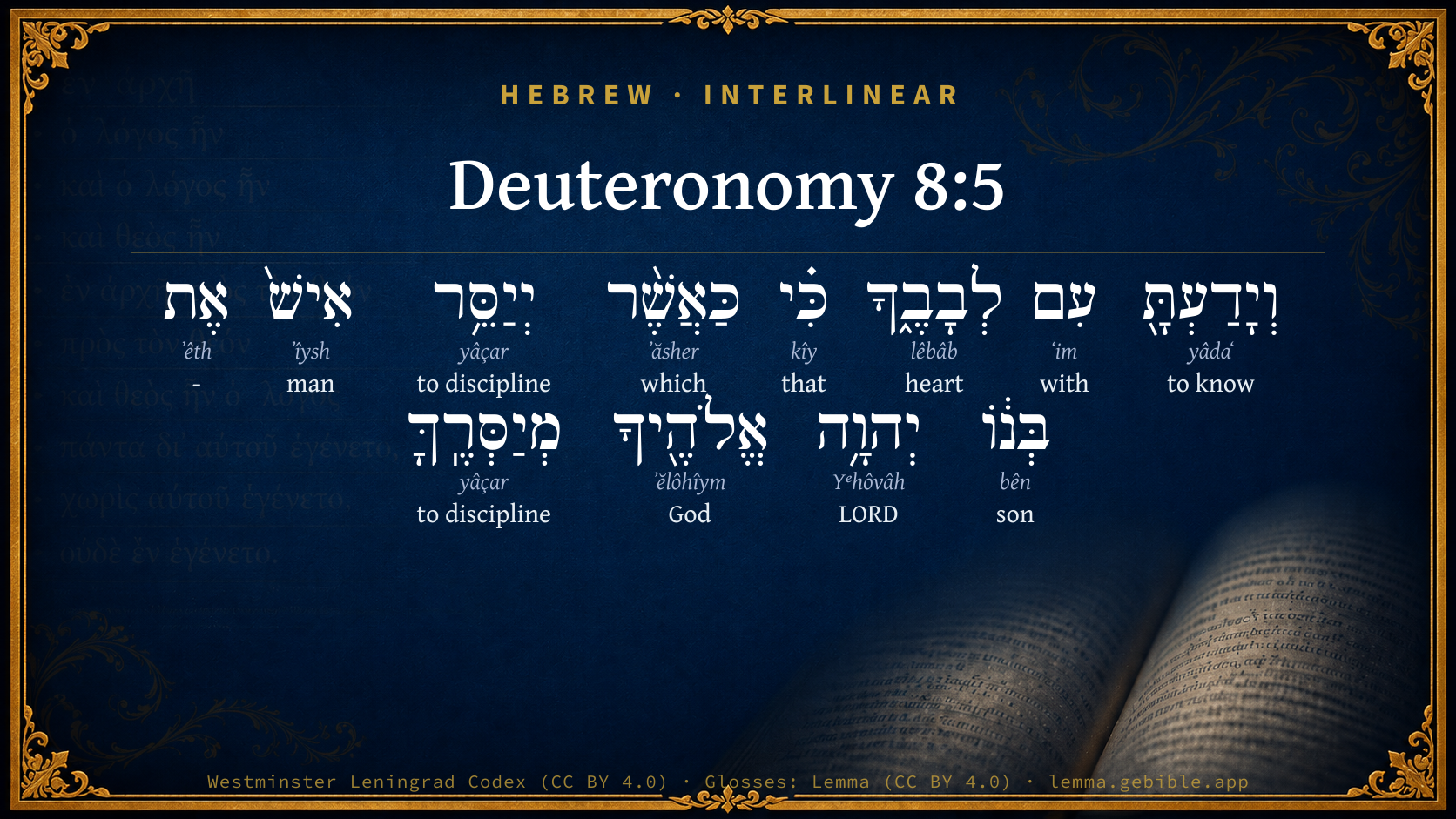
  1. וְיָדַעְתָּ֖ yâdaʻ H3045 “and · to know” Conjunction + Verb, Qal, Sequential Perfect, 2nd Person, Masculine, Singular
  2. עִם ʻim H5973 “with” Preposition
  3. לְבָבֶ֑ךָ lêbâb H3824 “heart · your” Noun, Common, Masculine, Singular, Construct + Suffix, Personal, 2nd Person, Masculine, Singular
  4. כִּ֗י kîy H3588 “that” Conjunction
  5. כַּאֲשֶׁ֨ר ʼăsher H834 “like/as · which” Preposition + Particle, Relative
  6. אִישׁ֙ ʼîysh H376 “man” Noun, Common, Masculine, Singular, Absolute
  7. אֶת ʼêth H853 “-” Particle, Direct Object
  8. בְּנ֔וֹ bên H1121 “son · his” Noun, Common, Masculine, Singular, Construct + Suffix, Personal, 3rd Person, Masculine, Singular
  9. יְהוָ֥ה Yᵉhôvâh H3068 “LORD” Noun, Proper
  10. אֱלֹהֶ֖יךָ ʼĕlôhîym H430 “God(s) · your” Noun, Common, Masculine, Plural, Construct + Suffix, Personal, 2nd Person, Masculine, Singular
  11. מְיַסְּרֶֽךָּ yâçar H3256 “disciplining · you” Verb, Piel, Participle Active, Masculine, Singular, Construct + Suffix, Personal, 2nd Person, Masculine, Singular

About this verse

These counts appear in no published source. They are computed here, from the morphology-tagged text and Lemma’s own curated glosses. What Lemma adds →

12
words
11
distinct lemmas
Pentateuch
section

Shared distinctive vocabulary

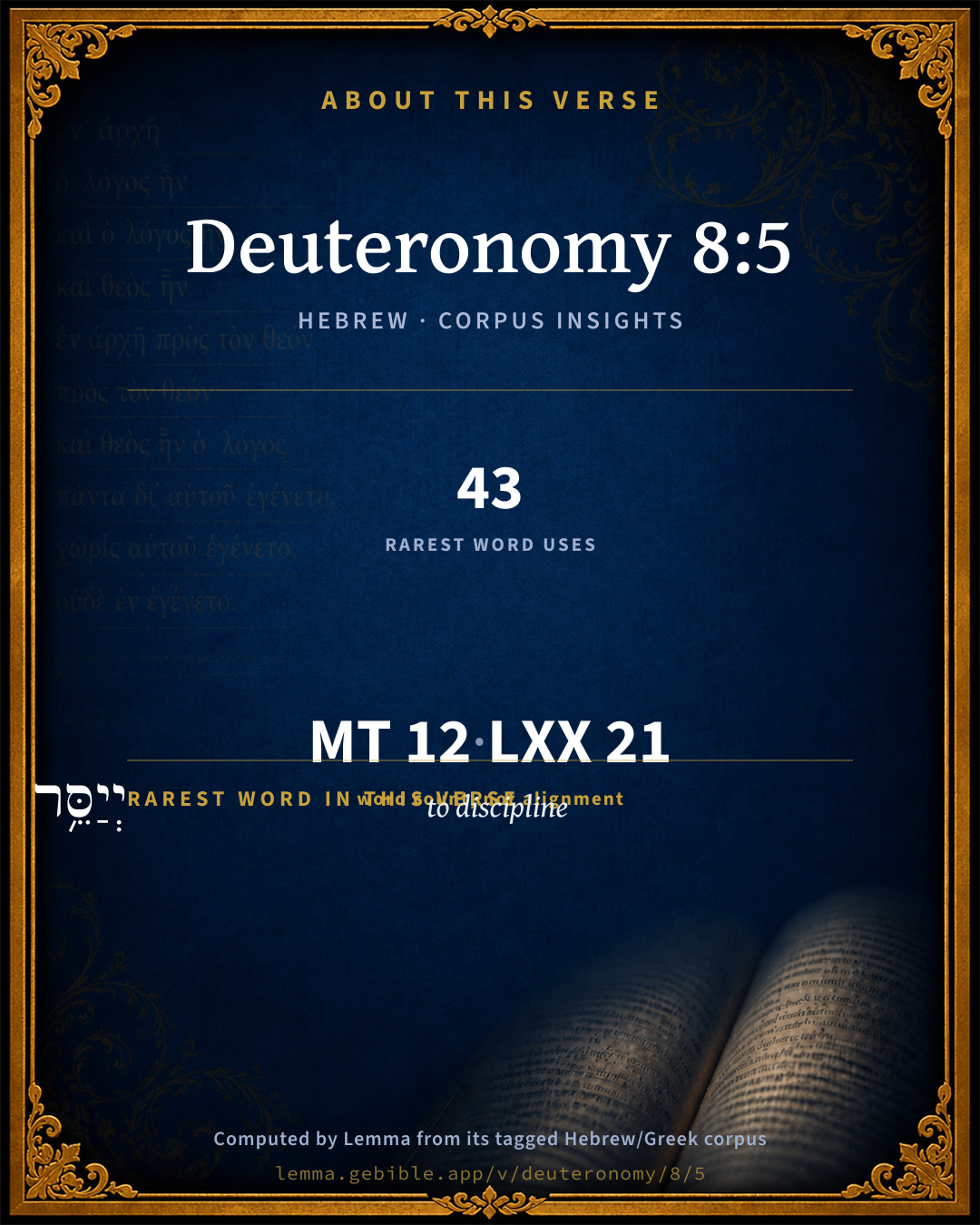
יְיַסֵּ֥ר to discipline H3256 occurs in 38 verses of the Hebrew Bible. Also found in:

Grammatical profile

  • 3 verbs
  • 5 nouns
  • 1 preposition
  • 1 conjunction
  • 2 particles

Verb forms

  • וְיָדַעְתָּ֖ Qal · Sequential Perfect
  • יְיַסֵּ֥ר Piel · Imperfect
  • מְיַסְּרֶֽךָּ Piel · Participle Active

Repetition

A word recurs within this verse — often emphatic in Hebrew:

  • יְיַסֵּ֥ר to discipline H3256 ×2

Hebrew & Septuagint length

In English translation the verse runs 19 words from the Hebrew and 24 from the Septuagint (LXX English) — closely comparable.

A rough comparison of the two English renderings, which tokenize alike — not a word-level alignment.

Word counts can differ between the Hebrew and the Greek without any difference in meaning — e.g. the Hebrew direct-object marker אֵת has no separate Greek word, and Greek often adds the article ὁ.

In the original languages it is 12 Hebrew tokens and 21 Greek tokens — but the two are counted differently (Hebrew bundles its prefixes and suffixes into one token; the Greek is in lemma form), so that isn’t a like-for-like length.

Cross-references

13

Topical passages linked to Deuteronomy 8:5 in the Treasury of Scripture Knowledge — connected by theme and wording, ordered by reader-vote popularity; previews shown in the World English Bible.

  • Revelation 3:19 As many as I love, I reprove and chasten. Be zealous therefore, and repent.
  • 2 Samuel 7:14 I will be his father, and he shall be my son: if he commit iniquity, I will chasten him with the rod of men, and with the stripes of the children of men;
  • Job 5:17–18 "Behold, happy is the man whom God corrects: Therefore do not despise the chastening of the Almighty.
  • Proverbs 3:12 For whom Yahweh loves, he reproves; Even as a father reproves the son in whom he delights.
  • Hebrews 12:5–11 and you have forgotten the exhortation which reasons with you as with children, "My son, don't take lightly the chastening of the Lord, Nor faint when you are reproved by him;
  • 1 Corinthians 11:32 But when we are judged, we are punished by the Lord, that we may not be condemned with the world.
  • Psalms 94:12 Blessed is the man whom you discipline, Yah, And teach out of your law;
  • Ezekiel 18:28 Because he considers, and turns away from all his transgressions that he has committed, he shall surely live, he shall not die.
  • Psalms 89:32 Then I will punish their sin with the rod, And their iniquity with stripes.
  • Deuteronomy 4:9 Only take heed to yourself, and keep your soul diligently, lest you forget the things which your eyes saw, and lest they depart from your heart all the days of your life; but make them known to your children and your children's children;
  • Deuteronomy 4:23 Take heed to yourselves, lest you forget the covenant of Yahweh your God, which he made with you, and make you an engraved image in the form of anything which Yahweh your God has forbidden you.
  • Ezekiel 12:3 Therefore, you son of man, prepare you stuff for removing, and remove by day in their sight; and you shall remove from your place to another place in their sight: it may be they will consider, though they are a rebellious house.
  • Isaiah 1:3 The ox knows his owner, And the donkey his master's crib; But Israel doesn't know, My people don't consider.

Cross-references courtesy of OpenBible.info (CC BY 4.0).

Hebrew and Greek witnesses Masoretic Hebrew ↔ Greek Septuagint

The same verse in the two great witnesses to the Old Testament, shown verse-for-verse.

These are two independent witnesses, not word-aligned to each other, and the Septuagint is shown in lemma (dictionary) form.

Hebrew Deuteronomy 8:5 Masoretic · Westminster Leningrad Codex

וְיָדַעְתָּ֖ עִם לְבָבֶ֑ךָ כִּ֗י כַּאֲשֶׁ֨ר יְיַסֵּ֥ר אִישׁ֙ אֶת בְּנ֔וֹ יְהוָ֥ה אֱלֹהֶ֖יךָ מְיַסְּרֶֽךָּ

You shall consider in your heart that as a man chastens his son, so Yahweh your God chastens you.

World English Bible · Public Domain

Greek LXX Deuteronomy 8:5 Septuagint · lemma form

καί γιγνώσκω ὁ καρδία σύ ὅτι ὡς εἰ τις παιδεύω ἄνθρωπος ὁ υἱός αὐτός οὕτως κύριος ὁ θεός σύ παιδεύω σύ

And you shall know in your heart, that as if any man should chasten his son, so the Lord your God will chasten you.

LXX2012 (modern English Septuagint) · Public Domain

Hebrew: Westminster Leningrad Codex (CC BY 4.0). Greek: Septuagint (public domain); English from LXX2012 (modern English Septuagint) (Public Domain). How the Septuagint differs from the Hebrew →

Targum (Aramaic paraphrase)

2

The Targum is the ancient Jewish Aramaic paraphrase of the Hebrew Scriptures — an interpretive translation, not the Hebrew text itself. Onkelos (literal) and Pseudo-Jonathan (expansive) render the Torah, and Jonathan the Prophets. Coverage is partial: where no permissively-licensed English translation exists for a verse, only the Aramaic is shown. This is verse-level text, not a word-by-word alignment to the Hebrew.

  1. Targum Onkelos Torah (Genesis–Deuteronomy)
    וְתִדַע עִם לִבָּךְ אֲרֵי כְּמָא דִי מְאַלֵף גַבְרָא יָת בְּרֵהּ יְיָ אֱלָהָךְ מְאַלֵף לָךְ

    (no public-domain English translation for this verse)

    Targum Onkelos — Aramaic: “Onkelos Genesis” (public domain); “Onkelos Exodus” (public domain); “Onkelos Leviticus” (public domain); “Onkelos Numbers” (public domain); “Onkelos Deuteronomy” (public domain). English: “Sefaria Community Translation” (CC0 1.0 (public-domain dedication)); “J.W. Etheridge. The Targums of Onkelos and Jonathan Ben Uzziel on the Pentateuch. London: Longmans, Green, 1862” (public domain). Text via Sefaria.

  2. Targum Pseudo-Jonathan Torah (Genesis–Deuteronomy)
    וְתִנְדְּעוּן עִם רַעֲיוֹנֵי לִבְכוֹן אֲרוּם הֵיכְמָא דִּמְסַקֵּר גְּבַר יַת בְּרֵיהּ יְיָ אֱלָהָךְ מַסְקֵר יַתְכוֹן

    But you know with the thoughts of your hearts, that as a man regardeth his child, so the Lord your God hath regarded you.

    Targum Pseudo-Jonathan — Aramaic: “Targum Jonathan on Genesis” (public domain); “Targum Jonathan on Exodus” (public domain); “Targum Jonathan on Leviticus” (public domain); “Targum Jonathan on Numbers” (public domain); “Targum Jonathan on Deuteronomy” (public domain). English: “The Targum of Jonathan ben Uzziel, trans. J. W. Etheridge, London, 1862” (public domain). Text via Sefaria.

Commentary

Notes on Deuteronomy 8:5 from classic Christian and Jewish commentators (each source and its license shown beneath its notes). The classic Christian expositions comment on the surrounding passage and are grouped to its opening verse, so a note may address several verses; the Jewish commentaries on the Tanakh (Rashi and others) are per-verse, so they appear only where the commentator wrote on this verse.

Lemma curates 59 commentaries, every one of them public domain or Creative Commons licensed, each selected and text-cleaned for this edition rather than reprinted as found. About our sources →

Trapp's Complete Commentary

John Trapp

Deu 8:5 Thou shalt also consider in thine heart, that, as a man chasteneth his son, [so] the LORD thy God chasteneth thee.

Ver. 5. That as a man chasteneth his son.] This is reckoned here as a high favour. So Job accounts it, {Job 7:17-18} and Paul describes it, {Heb 12:7-8} and Jeremiah prays for it. {Jer 10:24}

John Trapp, A Commentary or Exposition upon All the Books of the Old and New Testament (1647–1656) — public domain. Text from a community e-Sword module.

Joseph Benson's Commentary

Deu 8:5. As a man chasteneth his son — That is, unwillingly, being constrained by necessity; moderately, in judgment remembering mercy; and for his reformation, not his destruction.

Joseph Benson's Commentary on the Old and New Testaments (1811–1818) — public domain. Text from a community e-Sword module.

Geneva Bible (1599)

Geneva Bible translators

So that his afflictions are signs of his fatherly love toward us.

Geneva Bible (1599) marginal notes — public domain. Text via Bolls.life.

Ellicott's Commentary for English Readers

(5) As a man chasteneth his son.—This is the foundation of many similar sayings in Holy Scripture: Pro_13:24, “He seeketh chastening for him,” i.e., seeks it early. All our ideas of training necessarily imply time; it cannot be done in a moment. But the main point of the illustration is to prove God’s love. “Whom the Lord loveth, He chasteneth;” else, why should He be at the pains to chasten at all?

A Bible Commentary for English Readers, edited by Charles John Ellicott (1878–1897) — public domain. Text from a community e-Sword module.

The Cambridge Bible for Schools and Colleges

gen. ed. J. J. S. Perowne

5. And thou shalt consider in thine heart] Lit. know with thy heart; cp. ‘conscire sibi,’ and see above on Deu_7:9.

as a man chasteneth his son] disciplineth, cp. Deu_4:36, Deu_11:2 q.v.; Hos_11:1-4, also Deu_2:14 on the wilderness as a school of discipline. In Deut. which so frequently emphasises physical suffering and adversity as God’s punishment for sin this explanation of them as signs not of His hostility, but of His fatherly providence, is remarkable. It anticipates the more developed doctrine of later O.T. writings and of the N.T.

The Cambridge Bible for Schools and Colleges (gen. ed. J. J. S. Perowne; Cambridge University Press, 1878–1918) — public domain. Text from a community e-Sword module.

John Gill's Exposition

Therefore thou shalt keep the commandments of the Lord thy God,.... Not only because they are the commands of God, and of a covenant God and Father, which are reasons sufficient for the observance of them; but because the Lord had dealt so bountifully with them, in providing food and raiment for them in the wilderness, which always continued with them; and because, when he afflicted them, it was a fatherly chastisement, with great tenderness and compassion, and for their good; all which laid them under obligations to keep the commands of God, whatsoever he had enjoined them, whether of the moral, ceremonial, or judicial kind:

to walk in his ways, and to fear him; to walk in the ways he directed, to be under an awe of his majesty, a fear of offending him, and a reverential affection for him, such as children have to a father.

John Gill's Exposition of the Whole Bible (1746–1763) — public domain (CC PDM 1.0). Text via the HelloAO Bible API.

Haydock's Catholic Bible Commentary

Up, by mildness and correction alternately. Hebrew, "chastiseth thee," Proverbs iii. 12.

George Leo Haydock (1774–1849), Haydock's Catholic Family Bible and Commentary, 1859 edition — public domain. Excludes Psalms (Douay-Rheims chapter numbering differs from Protestant) and Deuterocanonical books (Catholic canon only).

Matthew Poole's English Annotations

i.e. Unwillingly, being constrained by thy necessity; moderately, in judgment remembering mercy; and for thy reformation, not for thy destruction. Compare Pro 3:11,12; Heb 12:5, &c.

Matthew Poole's English Annotations on the Holy Bible (1683–1685) — public domain. Text from a community e-Sword/MySword module.

Whedon's Commentary on the Bible

Daniel D. Whedon

5. As a man chasteneth his son — The word which in our version is rendered chasteneth is also used in the sense of instruct, educate. In Deu_4:36, it is translated instruct. This discipline of the wilderness was designed to educate the people. It was to teach them obedience and trust in Him who was guiding them and providing for them. It was training them to become a holy and peculiar people whose God is Jehovah.

Daniel D. Whedon (gen. ed.), Commentary on the Old and New Testaments (1874–1909) — public domain. Text from a community e-Sword module.

The Pulpit Commentary

Thus God educated, disciplined, and trained his people as a father does his child. Chasteneth. The idea is not so much that of punishment or chastisement, properly so called, as that of severe discipline and training. God made them feel his hand upon them, but ever for their good; the end of the discipline to which they were subjected was that they might keep his commandments and walk in his ways, so as to enjoy his favor. (cf. Heb_12:5, etc.)

God the Chastener.

I CHASTISEMENT IS A NECESSITY OF OUR MORAL NATURE. He is no wise parent who spares the rod when the good of the child requires that chastisement be administered. Gentler methods failing, the undutiful son ought to be chastised, he deserves it. He needs the discipline. It acts wholesomely upon him, awakening conscience, begetting respect for paternal authority, deterring from evil, leading probably to penitence and submission.

II CHASTISEMENT IS AN ESSENTIAL PART OF GOD"S TREATMENT OF HIS CHILDREN. His chastisements proceed from love. (Heb_12:6) They are wisely meted out, and are always for our profit. (Heb_12:10) God can bear to punish. He will not allow our faults to slip. He will make us feel when we do wrong, hedging up our way, and laying stripes upon us. God"s children have the comfort of knowing that they are thus in a Father"s hand, and that in all they suffer they are being chastened by unerring love and wisdom.

III CHASTISEMENT IS A PART OF GOD"S DISCIPLINE OF US FOR WHICH WE SHOULD BE GRATEFUL. Not murmuring, but submitting to it. Without this chastisement:

1. How forgetful of God would we soon become!

2. How haughty and self-willed!

3. How dilatory in duty! J.O.

The Pulpit Commentary (1880–1919), ed. H.D.M. Spence-Jones & Joseph S. Exell — public domain. Text from a community e-Sword module.

John Wesley's Explanatory Notes

As a man chastiseth his son - That is, unwillingly, being constrained by necessity; moderately, in judgment remembering mercy; and for thy reformation not thy destruction.

John Wesley, Explanatory Notes Upon the Whole Bible (1754–1765) — public domain. Text via the GEBible commentary corpus.

Ramban (Nachmanides)

Rabbi Moshe ben Nachman (Ramban / Nachmanides)

AND THOU SHALT CONSIDER IN THY HEART, THAT, AS A MAN CHASTENETH HIS SON, placing upon him the yoke of instruction for his benefit, as it is said, Chasten thy son, for there is hope; but set not thy heart on his destruction — SO THE ETERNAL THY G-D CHASTENETH THEE, at first with the affliction of the wilderness and the trial with the manna so that the goodness of the Land and its fruits should be pleasing to you. Therefore walk after Him, for the Eternal thy G-d bringeth thee into a good Land.

Ramban (Nachmanides) on the Tanakh — English translation: “Commentary on the Torah by Ramban (Nachmanides). Translated and annotated by Charles B. Chavel. New York, Shilo Pub. House, 1971-1976” (CC BY 4.0). Text via Sefaria.

Lesson kit

Teaching starters — assembled from the data on this page, not authored interpretation. Every prompt links to the verse data it draws on. Edit before teaching.

Deuteronomy, in the Pentateuch, opens this verse with 12 words (11 distinct Hebrew lemmas). Its most distinctive word is yâçar (“to discipline”). A historical commentator’s framing appears above. Read the whole chapter for the surrounding context.

Discussion questions

  1. What does “to discipline” (yâçar) contribute to the verse as a whole?
  2. Leviticus 26:18 shares the word «to discipline» with this verse. How do the two illuminate each other?
  3. “to discipline” occurs 2× in this one verse. What is the effect of the repetition?
  4. The translations on this page render this verse differently — a whole-verse word diff, not a word-by-word alignment. What might account for the different wordings?
  5. The verb «וְיָדַעְתָּ֖» is Qal Sequential Perfect. How does its form color the action?
  6. Reading how Trapp's Complete Commentary and Joseph Benson's Commentary read this verse, where do the two commentators agree and where do they part?

Things to notice

Reading settings

Reading text

Shown beneath each verse's original-language words.

Old Testament
Old Testament edition

Read the OT as the Masoretic Hebrew (MT) or the Greek Septuagint (LXX).

English shown for the Greek Septuagint (in the Hebrew ↔ Greek comparison).

Comparing translations? Open the Compare panel on any verse page to stack up to four side by side.