
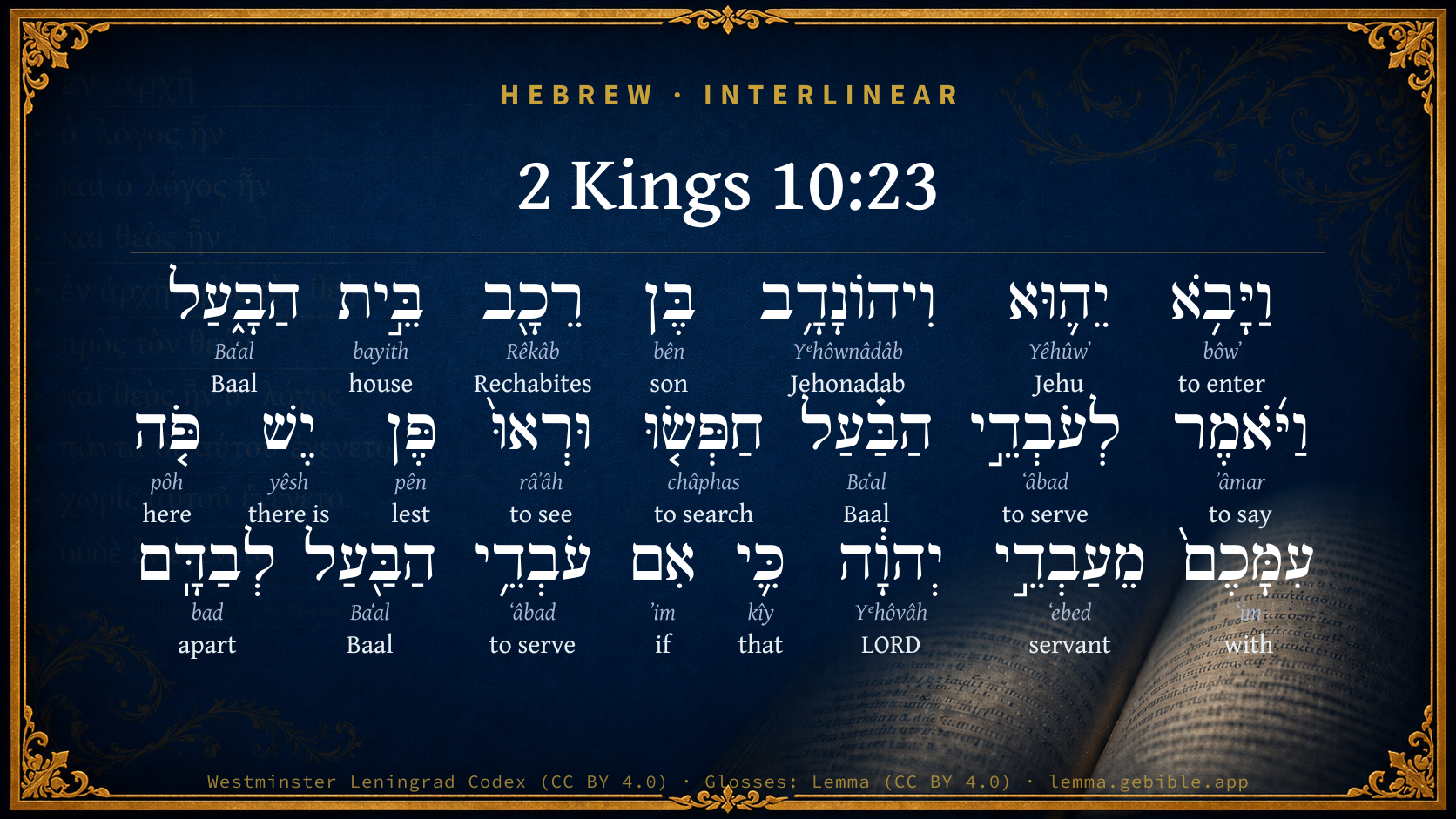
2 Kings 10:23

Hebrew (Westminster Leningrad Codex) 2 Kings 10:23 appears in the Hebrew Old Testament. The text above is from the Westminster Leningrad Codex. Each word links to its Strong’s number, a concise gloss, and parsing drawn from the Open Scriptures Hebrew Bible morphology. Click any word for its full Brown-Driver-Briggs (BDB) entry.
Download image
Cite this verse

2 Kings 10:23 (World English Bible). Public Domain. Lemma interlinear Bible study tool, https://lemma.gebible.app/v/2-kings/10/23.

Show BibTeX & RIS
BibTeX
RIS
English Translation
Jehu went, and Jehonadab the son of Rechab, into the house of Baal; and he said to the worshippers of Baal, Search, and look that there be here with you none of the servants of Yahweh, but the worshippers of Baal only.
World English Bible · Public Domain
Download a study sheet

One document with this verse’s original text, its word-by-word gloss line, the meaning frame, cross-references with their text, attributed commentary, and full source and license credits — printable, and it pastes into notes with its structure intact.

This verse Autodidact and up

Study sheet (.html) Plain text (.txt)

A passage Seminary Student

Up to 50 verses in one chapter. A passage sheet keeps up to 6 commentary sources and 12 cross-references per verse, in the order this page ranks them, and says so on the sheet whenever that leaves anything out. Ask for a single verse and you get the Autodidact verse sheet above.

Everything on this page stays free to read, with no account — the sheet is a download of what is already on screen, not access to it.

Want to remove ads? Support Godless Engineer
Compare translations 3

The same verse in 3 English versions, stacked beneath the original-language interlinear above. Click any original word for its lexicon entry.

Each is an independent rendering of the whole verse — the interlinear is not word-aligned to these translations.

Highlighted words mark where these versions differ — a whole-verse word diff, not a word-by-word alignment.

  • World English Bible Public Domain
    Jehu went, and Jehonadab the son of Rechab, into the house of Baal; and he said to the worshippers of Baal, Search, and look that there be here with you none of the servants of Yahweh, but the worshippers of Baal only.
  • King James Version Public Domain
    And Jehu went, and Jehonadab the son of Rechab, into the house of Baal, and said unto the worshippers of Baal, Search, and look that there be here with you none of the servants of the LORD, but the worshippers of Baal only.
  • unfoldingWord Literal Text CC BY-SA 4.0
    And Jehu entered the house of Baal with Jehonadab, the son of Recab, and he said to the servants of Baal, “Search and see that there are not with you here from the servants of Yahweh, but only servants of Baal.”

unfoldingWord Literal Text — © unfoldingWord, licensed CC BY-SA 4.0. Word-aligned USFM3 via Door43 (git.door43.org/unfoldingWord/en_ult).

Versions to compare (up to 4)

3 of 4 selected

Show all 18 translations

Every available English version of this verse, each an independent rendering of the whole verse.

  • World English Bible Public Domain
    Jehu went, and Jehonadab the son of Rechab, into the house of Baal; and he said to the worshippers of Baal, Search, and look that there be here with you none of the servants of Yahweh, but the worshippers of Baal only.
  • Berean Standard Bible Public Domain
    Next, Jehu and Jehonadab son of Rechab entered the temple of Baal, and Jehu said to the servants of Baal, “Look around to see that there are no servants of the LORD here among you—only servants of Baal.”
  • Majority Standard Bible Public Domain
    Next, Jehu and Jehonadab son of Rechab entered the temple of Baal, and Jehu said to the servants of Baal, “Look around to see that there are no servants of the LORD here among you—only servants of Baal.”
  • King James Version Public Domain
    And Jehu went, and Jehonadab the son of Rechab, into the house of Baal, and said unto the worshippers of Baal, Search, and look that there be here with you none of the servants of the LORD, but the worshippers of Baal only.
  • American Standard Version (1901) Public Domain
    And Jehu went, and Jehonadab the son of Rechab, into the house of Baal; and he said unto the worshippers of Baal, Search, and look that there be here with you none of the servants of Jehovah, but the worshippers of Baal only.
  • Revised Version (1885) Public Domain
    And Jehu went, and Jehonadab the son of Rechab, into the house of Baal; and he said unto the worshippers of Baal, Search, and look that there be here with you none of the servants of the LORD, but the worshippers of Baal only.
  • Geneva Bible (1599) Public Domain
    And when Iehu went, and Iehonadab the sonne of Rechab into the house of Baal, he sayde vnto the seruants of Baal, Searche diligently, and looke, lest there be here with you any of the seruants of the Lord, but the seruants of Baal only.
  • Douay-Rheims (1899) Public Domain
    And Jehu and Jonadab the son of Rechab went to the temple of Baal, and said to the worshippers of Baal: Search, and see that there be not any with you of the servants of the Lord, but that there be the servants of Baal only.
  • Young's Literal Translation Public Domain
    And Jehu goeth in, and Jehonadab son of Rechab, to the house of Baal, and saith to the servants of Baal, `Search and see, lest there be here with you of the servants of Jehovah -- but, the servants of Baal by themselves.'
  • Literal Standard Version CC BY-SA 4.0
    And Jehu goes in—and Jehonadab son of Rechab—to the house of Ba‘al, and says to the servants of Ba‘al, “Search and see, lest there be [any] from the servants of YHWH here with you—but [only] the servants of Ba‘al by themselves.”
  • Unlocked Literal Bible CC BY-SA 4.0
    So Jehu went with Jehonadab son of Recab into the house of Baal, and he said to the worshipers of Baal, “Search and make sure that there is no one here with you from the servants of Yahweh, but the worshipers of Baal alone.”
  • unfoldingWord Literal Text CC BY-SA 4.0
    And Jehu entered the house of Baal with Jehonadab, the son of Recab, and he said to the servants of Baal, “Search and see that there are not with you here from the servants of Yahweh, but only servants of Baal.”
  • Darby Bible Public Domain
    And Jehu and Jehonadab the son of Rechab entered into the house of Baal, and said to the servants of Baal, Search, and see that there be here with you none of the servants of Jehovah, but the servants of Baal only.
  • World Messianic Bible Public Domain
    Jehu went with Jehonadab the son of Rechab into the house of Baal. Then he said to the worshipers of Baal, “Search, and see that none of the servants of the LORD are here with you, but only the worshipers of Baal.”
  • Webster's Bible Public Domain
    And Jehu went, and Jehonadab the son of Rechab, into the house of Baal, and said to the worshipers of Baal, Search, and look that there are here with you none of the servants of the LORD, but the worshipers of Baal only.
  • Free Bible Version CC BY-SA 4.0
    Then Jehu and Jehonadab, son of Rechab, went into the temple of Baal. Jehu told the followers of Baal, “Look around and make sure that no one who follows the Lord is here with you, only the worshipers of Baal.”
  • Bible in Basic English Public Domain
    And Jehu, with Jehonadab, the son of Rechab, went into the house of Baal; and he said to the servants of Baal, Make a search with care, to see that no servant of the Lord is with you, but only servants of Baal.
  • JPS Tanakh (1917) Public Domain
    And Jehu went, and Jehonadab the son of Rechab, into the house of Baal; and he said unto the worshippers of Baal: 'Search, and look that there be here with you none of the servants of the LORD, but the worshippers of Baal only.'

Literal Standard Version (2020), Covenant Press — licensed CC BY-SA 4.0. Text via the HelloAO Bible API (eBible.org). Unlocked Literal Bible (unfoldingWord) — licensed CC BY-SA 4.0. Text via the HelloAO Bible API (eBible.org). unfoldingWord Literal Text — © unfoldingWord, licensed CC BY-SA 4.0. Word-aligned USFM3 via Door43 (git.door43.org/unfoldingWord/en_ult). Free Bible Version, Dr. Jonathan Gallagher — licensed CC BY-SA 4.0. Text via the HelloAO Bible API (eBible.org).

Word by word

More ways to search: Search by grammar → Find every occurrence → Compare this word →

Practice this passage: Drill this verse → Learn its vocabulary →

וִיהוֹנָדָ֥ב
Yᵉhôwnâdâb
H3082
“and · Jehonadab”
Conjunction + Noun, Proper
Part of Speech
Conjunction + Noun
Type
Proper
Full BDB Definition

Origin: from H3068 and H5068

TWOT: None

Jehonadab = "Jehovah is willing" - a son of Rechab, chief of the Rechabites, in the time of Jehu and Ahab - a nephew of David
  1. וַיָּבֹ֥א bôwʼ H935 “and · to enter” Conjunction + Verb, Qal, Sequential Imperfect, 3rd Person, Masculine, Singular
  2. יֵה֛וּא Yêhûwʼ H3058 “Jehu” Noun, Proper
  3. בֶּן bên H1121 “son of” Noun, Common, Masculine, Singular, Construct
  4. רֵכָ֖ב Rêkâb H7394 “Rechabites” Noun, Proper
  5. בֵּ֣ית bayith H1004 “house of” Noun, Common, Masculine, Singular, Construct
  6. הַבָּ֑עַל Baʻal H1168 “the · Baal” Particle, Definite Article + Noun, Proper
  7. וַיֹּ֜אמֶר ʼâmar H559 “and · to say” Conjunction + Verb, Qal, Sequential Imperfect, 3rd Person, Masculine, Singular
  8. לְעֹבְדֵ֣י ʻâbad H5647 “to/for · serving” Preposition + Verb, Qal, Participle Active, Masculine, Plural, Construct
  9. הַבַּ֗עַל Baʻal H1168 “the · Baal” Particle, Definite Article + Noun, Proper
  10. חַפְּשׂ֤וּ châphas H2664 “search” Verb, Piel, Imperative, 2nd Person, Masculine, Plural
  11. וּרְאוּ֙ râʼâh H7200 “and · see” Conjunction + Verb, Qal, Imperative, 2nd Person, Masculine, Plural
  12. פֶּן pên H6435 “lest” Conjunction
  13. יֶשׁ yêsh H3426 “there is” Particle, Demonstrative
  14. פֹּ֤ה pôh H6311 “here” Adverb
  15. עִמָּכֶם֙ ʻim H5973 “with · you” Preposition + Suffix, Personal, 2nd Person, Masculine, Plural
  16. מֵעַבְדֵ֣י ʻebed H5650 “from · servants of” Preposition + Noun, Common, Masculine, Plural, Construct
  17. יְהוָ֔ה Yᵉhôvâh H3068 “LORD” Noun, Proper
  18. כִּ֛י kîy H3588 “that” Conjunction
  19. אִם ʼim H518 “if” Conjunction
  20. עֹבְדֵ֥י ʻâbad H5647 “serving” Verb, Qal, Participle Active, Masculine, Plural, Construct
  21. הַבַּ֖עַל Baʻal H1168 “the · Baal” Particle, Definite Article + Noun, Proper
  22. לְבַדָּֽם bad H905 “to/for · apart · their” Preposition + Noun, Common, Masculine, Singular, Construct + Suffix, Personal, 3rd Person, Masculine, Plural

About this verse

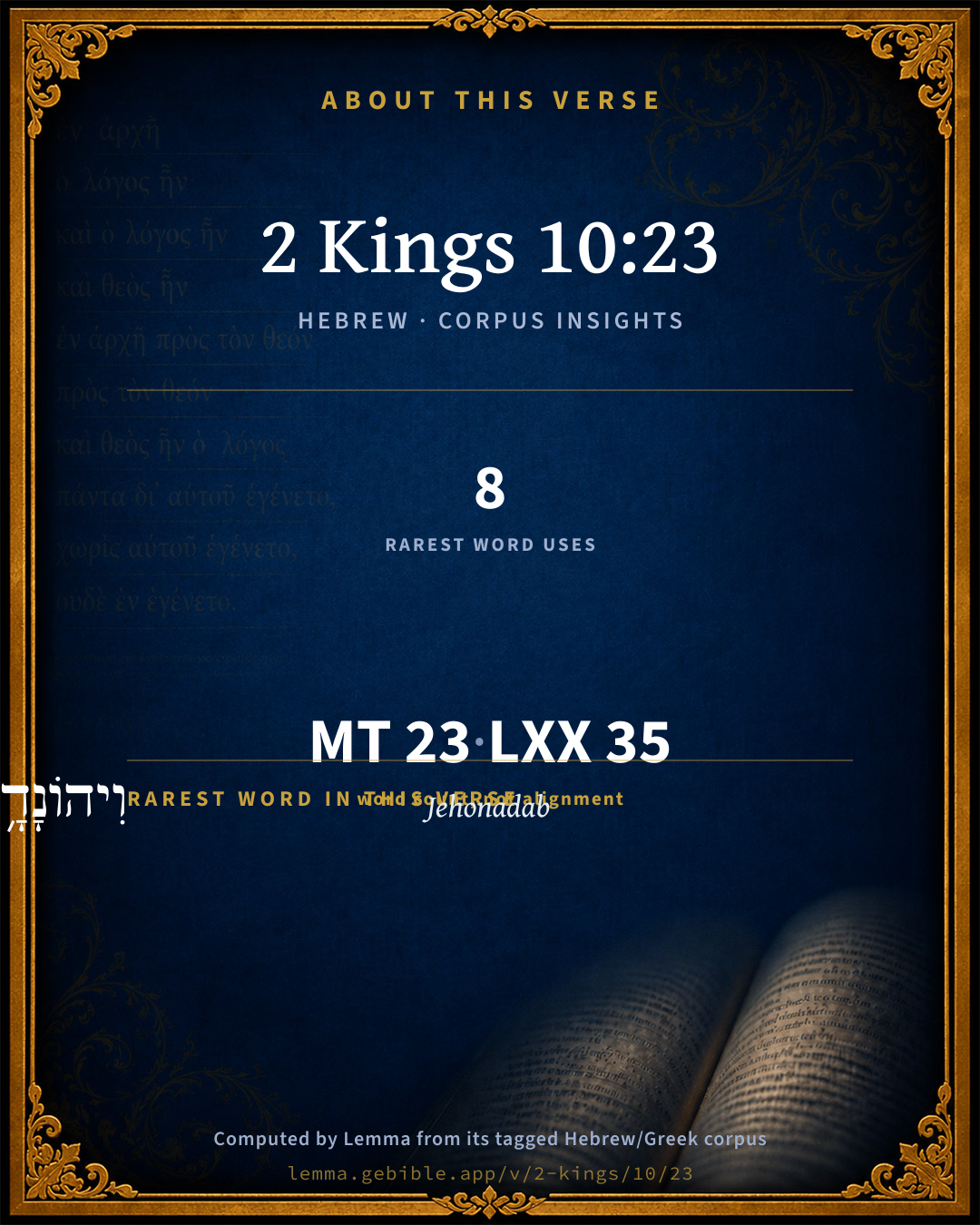
These counts appear in no published source. They are computed here, from the morphology-tagged text and Lemma’s own curated glosses. What Lemma adds →

23
words
20
distinct lemmas
Historical
section

Notable vocabulary

The rarest word here is וִיהוֹנָדָ֥ב Jehonadab H3082 — appearing just 8 times in the whole Hebrew Bible.

Shared distinctive vocabulary

וִיהוֹנָדָ֥ב Jehonadab H3082 occurs in 7 verses of the Hebrew Bible. Also found in:

Grammatical profile

  • 6 verbs
  • 11 nouns
  • 1 preposition
  • 3 conjunctions
  • 1 adverb
  • 1 particle

Verb forms

  • וַיָּבֹ֥א Qal · Sequential Imperfect
  • וַיֹּ֜אמֶר Qal · Sequential Imperfect
  • לְעֹבְדֵ֣י Qal · Participle Active
  • חַפְּשׂ֤וּ Piel · Imperative
  • וּרְאוּ֙ Qal · Imperative
  • עֹבְדֵ֥י Qal · Participle Active

Repetition

Words recur within this verse — often emphatic in Hebrew:

  • הַבָּ֑עַל Baal H1168 ×3
  • לְעֹבְדֵ֣י to serve H5647 ×2

Hebrew & Septuagint length

In English translation the verse runs 42 words from the Hebrew and 44 from the Septuagint (LXX English) — closely comparable.

A rough comparison of the two English renderings, which tokenize alike — not a word-level alignment.

Word counts can differ between the Hebrew and the Greek without any difference in meaning — e.g. the Hebrew direct-object marker אֵת has no separate Greek word, and Greek often adds the article ὁ.

In the original languages it is 23 Hebrew tokens and 35 Greek tokens — but the two are counted differently (Hebrew bundles its prefixes and suffixes into one token; the Greek is in lemma form), so that isn’t a like-for-like length.

Cross-references

3

Topical passages linked to 2 Kings 10:23 in the Treasury of Scripture Knowledge — connected by theme and wording, ordered by reader-vote popularity; previews shown in the World English Bible.

  • Matthew 13:30 Let both grow together until the harvest, and in the harvest time I will tell the reapers, "First, gather up the darnel, and bind them in bundles to burn them; but gather the wheat into my barn."'"
  • Matthew 13:41 The Son of Man will send out his angels, and they will gather out of his Kingdom all things that cause stumbling, and those who do iniquity,
  • Matthew 25:32–33 Before him all the nations will be gathered, and he will separate them one from another, as a shepherd separates the sheep from the goats.

Cross-references courtesy of OpenBible.info (CC BY 4.0).

Hebrew and Greek witnesses Masoretic Hebrew ↔ Greek Septuagint

The same verse in the two great witnesses to the Old Testament, shown verse-for-verse.

These are two independent witnesses, not word-aligned to each other, and the Septuagint is shown in lemma (dictionary) form.

Hebrew 2 Kings 10:23 Masoretic · Westminster Leningrad Codex

וַיָּבֹ֥א יֵה֛וּא וִיהוֹנָדָ֥ב בֶּן רֵכָ֖ב בֵּ֣ית הַבָּ֑עַל וַיֹּ֜אמֶר לְעֹבְדֵ֣י הַבַּ֗עַל חַפְּשׂ֤וּ וּרְאוּ֙ פֶּן יֶשׁ פֹּ֤ה עִמָּכֶם֙ מֵעַבְדֵ֣י יְהוָ֔ה כִּ֛י אִם עֹבְדֵ֥י הַבַּ֖עַל לְבַדָּֽם

Jehu went, and Jehonadab the son of Rechab, into the house of Baal; and he said to the worshippers of Baal, Search, and look that there be here with you none of the servants of Yahweh, but the worshippers of Baal only.

World English Bible · Public Domain

Greek LXX 2 Kings 10:23 Septuagint · lemma form

καί εἰςἔρχομαι ιου καί ιωναδαβ υἱός ρηχαβ εἰς οἶκος ὁ βααλ καί εἶπον ὁ δοῦλος ὁ βααλ ἐρευνάω καί ὁράω εἰ εἰμί μετά σύ ὁ δοῦλος κύριος ὅτι ἀλλά ἤ ὁ δοῦλος ὁ βααλ μόνος

And Ju and Jonadab the son of Rechab entered into the house of Baal, and said to the servants of Baal, Search, and see whether there is among you any of the servants of the Lord, or only the servants of Baal, by themselves.

LXX2012 (modern English Septuagint) · Public Domain

Hebrew: Westminster Leningrad Codex (CC BY 4.0). Greek: Septuagint (public domain); English from LXX2012 (modern English Septuagint) (Public Domain). How the Septuagint differs from the Hebrew →

Targum (Aramaic paraphrase)

1

The Targum is the ancient Jewish Aramaic paraphrase of the Hebrew Scriptures — an interpretive translation, not the Hebrew text itself. Onkelos (literal) and Pseudo-Jonathan (expansive) render the Torah, and Jonathan the Prophets. Coverage is partial: where no permissively-licensed English translation exists for a verse, only the Aramaic is shown. This is verse-level text, not a word-by-word alignment to the Hebrew.

  1. Targum Jonathan Prophets (Joshua–Malachi)
    וַאֲתָא יֵהוּא וִיהוֹנָדָב בַּר רֵכָב לְבֵית בְעָלָא וַאֲמַר לְפַלְחֵי בְעָלָא בְּלוּשׁוּ וַחֲזוֹ דִלְמָא אִית בָּא עִמְכוֹן מֵעַבְדַיָא דַייָ אֱלָהִין פַּלְחֵי בְעָלָא בִלְחוֹדֵיהוֹן:

    (no public-domain English translation for this verse)

    Targum Jonathan — Aramaic: “Mikraot Gedolot” (public domain). English: “Sefaria Community Translation” (CC0 1.0 (public-domain dedication)); “London "Chaldee Paraphrase," 1871” (public domain). Text via Sefaria.

Commentary

Notes on 2 Kings 10:23 from classic Christian and Jewish commentators (each source and its license shown beneath its notes). The classic Christian expositions comment on the surrounding passage and are grouped to its opening verse, so a note may address several verses; the Jewish commentaries on the Tanakh (Rashi and others) are per-verse, so they appear only where the commentator wrote on this verse.

Lemma curates 59 commentaries, every one of them public domain or Creative Commons licensed, each selected and text-cleaned for this edition rather than reprinted as found. About our sources →

Trapp's Complete Commentary

John Trapp

2Ki 10:23 And Jehu went, and Jehonadab the son of Rechab, into the house of Baal, and said unto the worshippers of Baal, Search, and look that there be here with you none of the servants of the LORD, but the worshippers of Baal only.

Ver. 23. And Jehonabad the son of Rechab.] His presence might well have made the Baalites suspect a plot; for they knew him an utter enemy to their idolatry, and saw him now in great favour with Jehu; but they were besotted, as was before noted, and went on without fear or wit, as an ox to the slaughter, and as a fool to the stocks.

Search and look that there be here with you none.] This search also might well have made them suspect somewhat, were it not that in all those idolatrous services, the first care was to avoid the profane. Procul hinc, procul este profani, said the crier.

John Trapp, A Commentary or Exposition upon All the Books of the Old and New Testament (1647–1656) — public domain. Text from a community e-Sword module.

Joseph Benson's Commentary

2Ki 10:23. And Jehonadab — Whom the Baalites, possibly, did not know, and therefore suspected nothing inimical to their worship: or, if any of the more sagacious began to suspect any thing, it was now too late to amend their error. Look that there be here with you none of the servants of the Lord — Intimating that their presence would offend Baal, and pollute his worship. Jehu’s real intention, however, was, that none but the worshippers of Baal should be slain, and therefore he caused this search to be made, lest any other Israelite, out of curiosity, or from any other motive, should have entered the temple.

Joseph Benson's Commentary on the Old and New Testaments (1811–1818) — public domain. Text from a community e-Sword module.

Geneva Bible (1599)

Geneva Bible translators

Thus God would have his servants preserved, and idolaters destroyed, as in his law he giveth express commandment, Deut. 13.

Geneva Bible (1599) marginal notes — public domain. Text via Bolls.life.

Adam Clarke's Commentary

Verse 23. None of the servants of the Lord] Though he was not attached to that service, yet he would tolerate it; and as he was led to suppose that he was fulfilling the will of Jehovah in what he was doing, he would of course treat his worship and worshippers with the more respect.

He might have ordered the search to be made on pretense of expelling any of those whom they would consider the profane, especially as this was "a solemn assembly for Baal," as was the custom with the heathen when any extraordinary exhibition of or for their god was expected; thus Callimachus, (Hymn to Apollo,) after imagining the temple and its suburbs to be shaken by the approach of Apollo, cries out, Εκας, ἑκας, ὁστις, αλιτρος. To prevent any suspicion of his real design, such might have been Jehu's plea, else alarm must have been excited, and perhaps some would have escaped.

Adam Clarke's Commentary on the Bible (1810–1826) — public domain. Text from a community e-Sword/MySword module.

Ellicott's Commentary for English Readers

(23) And Jehu went . . . into the house—i.e., into the outer court before the temple, where all the worshippers were waiting.

That there be here with you none of the servants of the Lord.—This precaution of Jehu’s suggests suspicion to a modern reader, but it would suggest the very contrary to the Baal-worshippers—viz., an extraordinary reverence for Baal; a dread lest some profane person should be present in his sanctuary.

Servants of the Lord.—Worshippers of Jehovah.

A Bible Commentary for English Readers, edited by Charles John Ellicott (1878–1897) — public domain. Text from a community e-Sword module.

The Cambridge Bible for Schools and Colleges

gen. ed. J. J. S. Perowne

23. Search, and look, &c.] Not only did he manifest anxiety that all the Baal-worshippers should be present, but that none of the rest of the people should be included in the destruction. As the worshippers would be full of the thought that they were to become possessed of special privileges in the new reign, they were sure to be the best agents in excluding any who could not shew that he had belonged to Baal’s congregation before. Josephus strangely says ‘When he had come into the house with his friend Jonadab he gave commandment to search lest any alien or stranger should be among them. For he did not wish a foreigner to take part in their sacrifices’.

The Cambridge Bible for Schools and Colleges (gen. ed. J. J. S. Perowne; Cambridge University Press, 1878–1918) — public domain. Text from a community e-Sword module.

John Gill's Exposition

And Jehu went, and Jehonadab the son of Rechab, into the house of Baal,.... Who no doubt was led into the secret, and knew the design of Jehu, or he would not have gone into such an idolatrous place:

and said unto the worshippers of Baal, search and look, that there be here with you none of the servants of the Lord, but the worshippers of Baal only; pretending a great regard to the purity of their worship and sacrifices, that they might not be profaned (t) by the company of such who were not worshippers of Baal, but of Jehovah; whereas his view was to prevent any of the worshippers of God perishing with them, who might out of curiosity go in among them, to behold the manner of their service.

(t) "----procul, o procul este profani". Virgil. Aeneid. 6. ver. 258.

John Gill's Exposition of the Whole Bible (1746–1763) — public domain (CC PDM 1.0). Text via the HelloAO Bible API.

Albert Barnes' Notes on the Bible

The presence of persons belonging to another religion was usually regarded by the ancients as a profanation of the rites. In the case of the Greek mysteries such intrusion is said to have been punished by death. Consequently Jehu could give these injunctions without arousing any suspicion.

Albert Barnes' Notes on the Bible (1834–1885) — public domain. Text from a community e-Sword/MySword module.

Matthew Poole's English Annotations

The Baalites possibly did not know Jehonadab, and therefore suspected nothing; or if any of the more crafty sort suspected any thing, it was now too late to amend their error.

Look that there be here with you none of the servants of the Lord; because their presence will offend Baal, and deride or pollute his worship; whence profane persons have been oft excluded from solemn acts of worship, both by Jews and heathens. So this did not raise their suspicion.

Matthew Poole's English Annotations on the Holy Bible (1683–1685) — public domain. Text from a community e-Sword/MySword module.

The Pulpit Commentary

And Jehu went, and Jehonadab the son of Rechab, into the house of Baal. Keeping up the pretence that he was a devotee of Baal, anxious to "serve him much" (ver. 18), Jehu himself entered the sacred edifice, together with Jehonadab the son of Rechab, whom he wished to have as a witness to his "zeal for the Lord" (ver. 16). Having entered, he addressed the multitude, or the chief authorities among them, requiring that they should exercise extreme vigilance, and make it quite certain that none but true followers of Baal were present. And said unto the worshippers of Baal, Search, and look that there be here with you none of the servants of the Lord, but the worshippers of Baal only. Jehu"s real object was undoubtedly to save the lives of any "servants of Jehovah" who might incautiously have mixed themselves up with the Baal-wor-shippers, out of curiosity, or to have their share in the general holiday. That he should have thought such a thing possible or even probable indicates the general laxity of the time, and the want of any sharp line of demarcation between the adherents of the two religions. He cleverly masked his desire for the safety of his own religionists under a show of keen anxiety that the coming ceremonies should not be profaned by the presence of scoffers or indifferent persons. His requirement was in the spirit of that warning which the heathen commonly gave before entering upon the more sacred rites of their religion profani."

The Pulpit Commentary (1880–1919), ed. H.D.M. Spence-Jones & Joseph S. Exell — public domain. Text from a community e-Sword module.

Keil & Delitzsch

C. F. Keil & F. Delitzsch

Jehu then came with Jehonadab to the temple, and commanded the worshippers of Baal to be carefully examined, that there might not be one of the worshippers of Jehovah with (among) them. When the priests of Baal were preparing to offer sacrifice, Jehu had eighty men of his guards stationed before the temple, and laid this injunction upon them: "Whoever lets one of the men escape whom I bring into your hands (we must read ימלּט instead of ימּלט), his life shall answer for his (the escaped man's) life. נפשׁו תּחת נפשׁו, as in Kg1 20:39.

Keil & Delitzsch — Biblical Commentary on the Old Testament (1861–1891) — public domain (CC PDM 1.0). Text via the HelloAO Bible API. (Old Testament only.)

unfoldingWord translationNotes

Door43 World Missions Community

he said to the worshipers of Baal

"Jehu said to the people who were in the temple to worship Baal"

but the worshipers of Baal alone

"but that only worshipers of Baal are here"

If any of the men whom I bring into your hands escapes

Here the "hands" of the men refer to their "control." By being stationed around the temple they were in control of the situation and it was up to them whether people were able to escape or not. AT: "If any of these men that I brought into your control escapes" or "If any of the men that are inside gets away" (See: Metonymy)

whoever lets that man escape, his life will be taken for the life of the one who escaped

"we will kill the man who let him escape"

his life will be taken

This can be stated in active form. This is a polite way to refer to a person being killed. AT: "we will take his life" or "we will kill him" (See: Active or Passive)

for the life of the one

"in exchange for the life of the man." Here this man is referred to by his "life" to emphasize that he did not die. AT: "for the man" (See: Metonymy)

translationWords

Jehu

house

servant

Yahweh

burnt offering

unfoldingWord translationNotes — © Distant Shores Media and the Door43 World Missions Community, licensed CC BY-SA 4.0. Source: git.door43.org/Door43/en_tn.

Lesson kit

Teaching starters — assembled from the data on this page, not authored interpretation. Every prompt links to the verse data it draws on. Edit before teaching.

2 Kings, in the Historical, opens this verse with 23 words (20 distinct Hebrew lemmas). Its most distinctive word is Yᵉhôwnâdâb (“Jehonadab”). A historical commentator’s framing appears above. Read the whole chapter for the surrounding context.

Discussion questions

  1. What does “Jehonadab” (Yᵉhôwnâdâb) contribute to the verse as a whole?
  2. 2 Samuel 13:5 shares the word «Jehonadab» with this verse. How do the two illuminate each other?
  3. “Baal” occurs 3× in this one verse. What is the effect of the repetition?
  4. The translations on this page render this verse differently — a whole-verse word diff, not a word-by-word alignment. What might account for the different wordings?
  5. The verb «וַיָּבֹ֥א» is Qal Sequential Imperfect. How does its form color the action?
  6. Reading how Trapp's Complete Commentary and Joseph Benson's Commentary read this verse, where do the two commentators agree and where do they part?

Things to notice

Reading settings

Reading text

Shown beneath each verse's original-language words.

Old Testament
Old Testament edition

Read the OT as the Masoretic Hebrew (MT) or the Greek Septuagint (LXX).

English shown for the Greek Septuagint (in the Hebrew ↔ Greek comparison).

Comparing translations? Open the Compare panel on any verse page to stack up to four side by side.