
Ecclesiastes 2:3

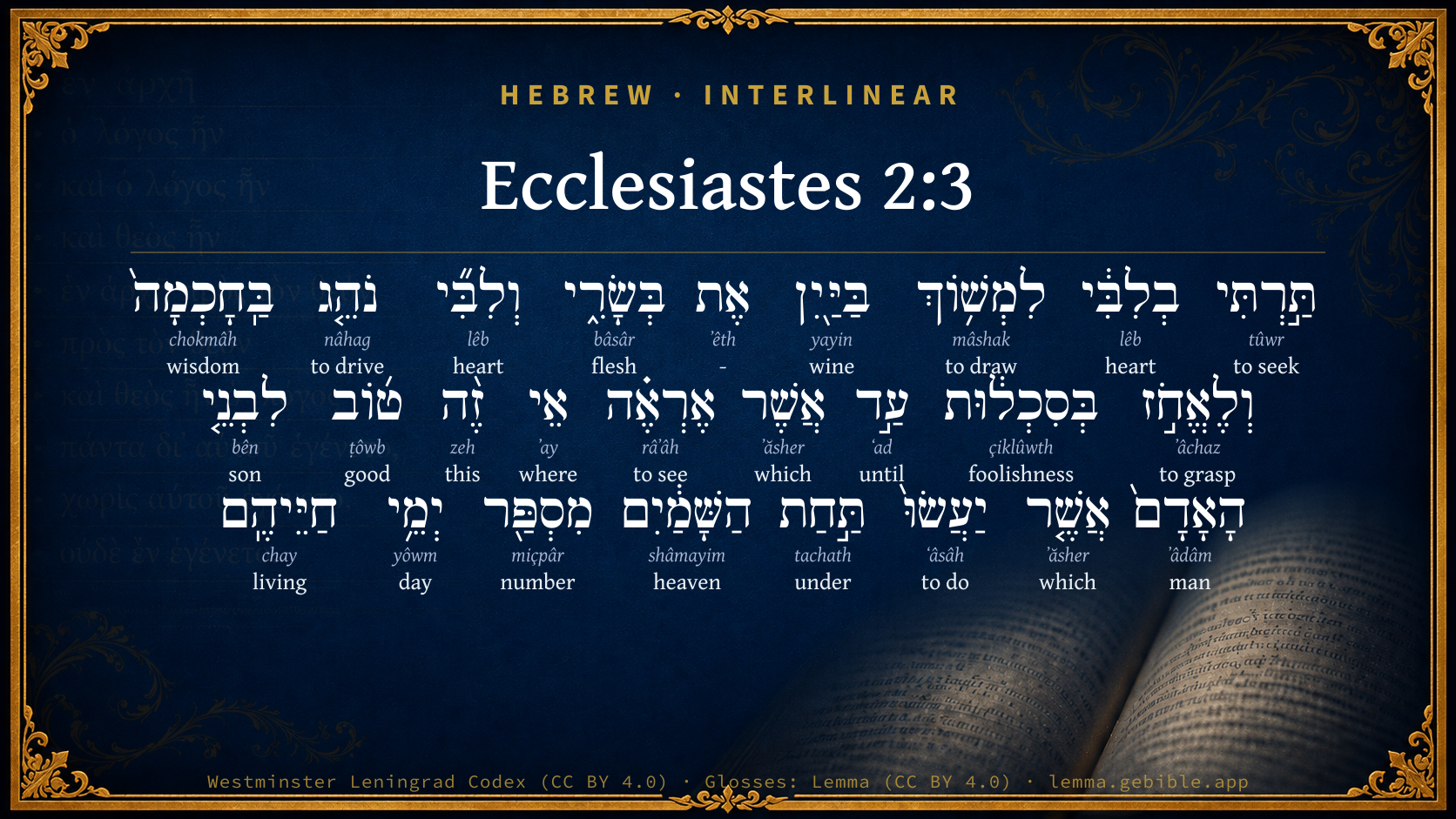
Hebrew (Westminster Leningrad Codex) Ecclesiastes 2:3 appears in the Hebrew Old Testament. The text above is from the Westminster Leningrad Codex. Each word links to its Strong’s number, a concise gloss, and parsing drawn from the Open Scriptures Hebrew Bible morphology. Click any word for its full Brown-Driver-Briggs (BDB) entry.
Download image
Cite this verse

Ecclesiastes 2:3 (World English Bible). Public Domain. Lemma interlinear Bible study tool, https://lemma.gebible.app/v/ecclesiastes/2/3.

Show BibTeX & RIS
BibTeX
RIS
English Translation
I searched in my heart how to cheer my flesh with wine, my heart yet guiding me with wisdom, and how to lay hold of folly, until I might see what it was good for the sons of men that they should do under heaven all the days of their lives.
World English Bible · Public Domain
Download a study sheet

One document with this verse’s original text, its word-by-word gloss line, the meaning frame, cross-references with their text, attributed commentary, and full source and license credits — printable, and it pastes into notes with its structure intact.

This verse Autodidact and up

Study sheet (.html) Plain text (.txt)

A passage Seminary Student

Up to 50 verses in one chapter. A passage sheet keeps up to 6 commentary sources and 12 cross-references per verse, in the order this page ranks them, and says so on the sheet whenever that leaves anything out. Ask for a single verse and you get the Autodidact verse sheet above.

Everything on this page stays free to read, with no account — the sheet is a download of what is already on screen, not access to it.

Want to remove ads? Support Godless Engineer
Compare translations 3

The same verse in 3 English versions, stacked beneath the original-language interlinear above. Click any original word for its lexicon entry.

Each is an independent rendering of the whole verse — the interlinear is not word-aligned to these translations.

Highlighted words mark where these versions differ — a whole-verse word diff, not a word-by-word alignment.

  • World English Bible Public Domain
    I searched in my heart how to cheer my flesh with wine, my heart yet guiding me with wisdom, and how to lay hold of folly, until I might see what it was good for the sons of men that they should do under heaven all the days of their lives.
  • King James Version Public Domain
    I sought in mine heart to give myself unto wine, yet acquainting mine heart with wisdom; and to lay hold on folly, till I might see what was that good for the sons of men, which they should do under the heaven all the days of their life.
  • unfoldingWord Literal Text CC BY-SA 4.0
    I explored in my heart to drag my flesh with wine (and my heart was guiding with wisdom) and to seize folly until I could see where good for the sons of humanity that they might do under the heavens the number of the days of their lives.

unfoldingWord Literal Text — © unfoldingWord, licensed CC BY-SA 4.0. Word-aligned USFM3 via Door43 (git.door43.org/unfoldingWord/en_ult).

Versions to compare (up to 4)

3 of 4 selected

Show all 18 translations

Every available English version of this verse, each an independent rendering of the whole verse.

  • World English Bible Public Domain
    I searched in my heart how to cheer my flesh with wine, my heart yet guiding me with wisdom, and how to lay hold of folly, until I might see what it was good for the sons of men that they should do under heaven all the days of their lives.
  • Berean Standard Bible Public Domain
    I sought to cheer my body with wine and to embrace folly—my mind still guiding me with wisdom—until I could see what was worthwhile for men to do under heaven during the few days of their lives.
  • Majority Standard Bible Public Domain
    I sought to cheer my body with wine and to embrace folly—my mind still guiding me with wisdom—until I could see what was worthwhile for men to do under heaven during the few days of their lives.
  • King James Version Public Domain
    I sought in mine heart to give myself unto wine, yet acquainting mine heart with wisdom; and to lay hold on folly, till I might see what was that good for the sons of men, which they should do under the heaven all the days of their life.
  • American Standard Version (1901) Public Domain
    I searched in my heart how to cheer my flesh with wine, my heart yet guiding `me' with wisdom, and how to lay hold on folly, till I might see what it was good for the sons of men that they should do under heaven all the days of their life.
  • Revised Version (1885) Public Domain
    I searched in mine heart how to cheer my flesh with wine, mine heart yet guiding me with wisdom, and how to lay hold on folly, till I might see what it was good for the sons of men that they should do under the heaven all the days of their life.
  • Geneva Bible (1599) Public Domain
    I sought in mine heart to giue my selfe to wine, and to leade mine heart in wisdome, and to take holde of follie, till I might see where is that goodnesse of the children of men, which they enioy vnder the sunne: the whole nomber of the dayes of their life.
  • Douay-Rheims (1899) Public Domain
    I thought in my heart, to withdraw my flesh from wine, that I might turn my mind to wisdom, and might avoid folly, till I might see what was profitable for the children of men: and what they ought to do under the sun, all the days of their life.
  • Young's Literal Translation Public Domain
    I have sought in my heart to draw out with wine my appetite, (and my heart leading in wisdom), and to take hold on folly till that I see where `is' this -- the good to the sons of man of that which they do under the heavens, the number of the days of their lives.
  • Literal Standard Version CC BY-SA 4.0
    I have sought in my heart to draw out with wine my appetite (and my heart leading in wisdom), and to take hold on folly until I see where this [is]—the good to the sons of man of that which they do under the heavens, the number of the days of their lives.
  • Unlocked Literal Bible CC BY-SA 4.0
    I explored in my heart how to gratify my desires with wine. I let my mind guide me with wisdom although I was still holding on to folly. I wanted to find out what is good for people to do under heaven during the days of their lives.
  • unfoldingWord Literal Text CC BY-SA 4.0
    I explored in my heart to drag my flesh with wine (and my heart was guiding with wisdom) and to seize folly until I could see where good for the sons of humanity that they might do under the heavens the number of the days of their lives.
  • Darby Bible Public Domain
    I searched in my heart how to cherish my flesh with wine, while practising my heart with wisdom; and how to lay hold on folly, till I should see what was that good for the children of men which they should do under the heavens all the days of their life.
  • World Messianic Bible Public Domain
    I searched in my heart how to cheer my flesh with wine, my heart yet guiding me with wisdom, and how to lay hold of folly, until I might see what it was good for the sons of men that they should do under heaven all the days of their lives.
  • Webster's Bible Public Domain
    I sought in my heart, to give myself to wine, yet acquainting my heart with wisdom; and to lay hold on folly, till I might see what was that good for the sons of men, which they should do under the heaven all the days of their life.
  • Free Bible Version CC BY-SA 4.0
    Then I used my mind to examine the attraction of wine to my body. My mind still guiding me with wisdom, I took it until I acted like a fool, so that I might see whether this was good for people to do during their time here.
  • Bible in Basic English Public Domain
    I made a search with my heart to give pleasure to my flesh with wine, still guiding my heart with wisdom, and to go after foolish things, so that I might see what was good for the sons of men to do under the heavens all the days of their life.
  • JPS Tanakh (1917) Public Domain
    I searched in my heart how to pamper my flesh with wine, and, my heart conducting itself with wisdom, how yet to lay hold on folly, till I might see which it was best for the sons of men that they should do under the heaven the few days of their life.

Literal Standard Version (2020), Covenant Press — licensed CC BY-SA 4.0. Text via the HelloAO Bible API (eBible.org). Unlocked Literal Bible (unfoldingWord) — licensed CC BY-SA 4.0. Text via the HelloAO Bible API (eBible.org). unfoldingWord Literal Text — © unfoldingWord, licensed CC BY-SA 4.0. Word-aligned USFM3 via Door43 (git.door43.org/unfoldingWord/en_ult). Free Bible Version, Dr. Jonathan Gallagher — licensed CC BY-SA 4.0. Text via the HelloAO Bible API (eBible.org).

Word by word

More ways to search: Search by grammar → Find every occurrence → Compare this word →

Practice this passage: Drill this verse → Learn its vocabulary →

בְּסִכְל֔וּת
çiklûwth
H5531
“in/at · foolishness”
Preposition + Noun, Common, Feminine, Singular, Absolute
Part of Speech
Preposition + Noun
Type
Common
Gender
Feminine
Number
Singular
State
Absolute
Full BDB Definition

Origin: from H5528

TWOT: 1493c , 1493d

folly, foolishness
  1. תַּ֣רְתִּי tûwr H8446 “to seek” Verb, Qal, Perfect, 1st Person, Common, Singular
  2. בְלִבִּ֔י lêb H3820 “in/at · heart · my” Preposition + Noun, Common, Masculine, Singular, Construct + Suffix, Personal, 1st Person, Common, Singular
  3. לִמְשׁ֥וֹךְ mâshak H4900 “to draw” Preposition + Verb, Qal, Infinitive Construct
  4. בַּיַּ֖יִן yayin H3196 “in/at the · wine” Preposition, Determined + Noun, Common, Masculine, Singular, Absolute
  5. אֶת ʼêth H853 “-” Particle, Direct Object
  6. בְּשָׂרִ֑י bâsâr H1320 “flesh · my” Noun, Common, Masculine, Singular, Construct + Suffix, Personal, 1st Person, Common, Singular
  7. וְלִבִּ֞י lêb H3820 “and · heart · my” Conjunction + Noun, Common, Masculine, Singular, Construct + Suffix, Personal, 1st Person, Common, Singular
  8. נֹהֵ֤ג nâhag H5090 “driving” Verb, Qal, Participle Active, Masculine, Singular, Absolute
  9. בַּֽחָכְמָה֙ chokmâh H2451 “in/at the · wisdom” Preposition, Determined + Noun, Common, Feminine, Singular, Absolute
  10. וְלֶאֱחֹ֣ז ʼâchaz H270 “and · to grasp” Conjunction + Preposition + Verb, Qal, Infinitive Construct
  11. עַ֣ד ʻad H5704 “until” Preposition
  12. אֲשֶׁר ʼăsher H834 “which” Particle, Relative
  13. אֶרְאֶ֗ה râʼâh H7200 “to see” Verb, Qal, Imperfect, 1st Person, Common, Singular
  14. אֵי ʼay H335 “where” Particle, Interrogative
  15. זֶ֨ה zeh H2088 “this” Pronoun, Demonstrative, Masculine, Singular
  16. ט֜וֹב ṭôwb H2896 “good” Adjective, Adjective, Masculine, Singular, Absolute
  17. לִבְנֵ֤י bên H1121 “to/for · sons of” Preposition + Noun, Common, Masculine, Plural, Construct
  18. הָאָדָם֙ ʼâdâm H120 “the · man” Particle, Definite Article + Noun, Common, Masculine, Singular, Absolute
  19. אֲשֶׁ֤ר ʼăsher H834 “which” Particle, Relative
  20. יַעֲשׂוּ֙ ʻâsâh H6213 “to do” Verb, Qal, Imperfect, 3rd Person, Masculine, Plural
  21. תַּ֣חַת tachath H8478 “under” Preposition
  22. הַשָּׁמַ֔יִם shâmayim H8064 “the · heaven(s)” Particle, Definite Article + Noun, Common, Masculine, Plural, Absolute
  23. מִסְפַּ֖ר miçpâr H4557 “number of” Noun, Common, Masculine, Singular, Construct
  24. יְמֵ֥י yôwm H3117 “days of” Noun, Common, Masculine, Plural, Construct
  25. חַיֵּיהֶֽם chay H2416 “living things · their” Noun, Common, Masculine, Plural, Construct + Suffix, Personal, 3rd Person, Masculine, Plural

About this verse

These counts appear in no published source. They are computed here, from the morphology-tagged text and Lemma’s own curated glosses. What Lemma adds →

26
words
24
distinct lemmas
Wisdom
section

Notable vocabulary

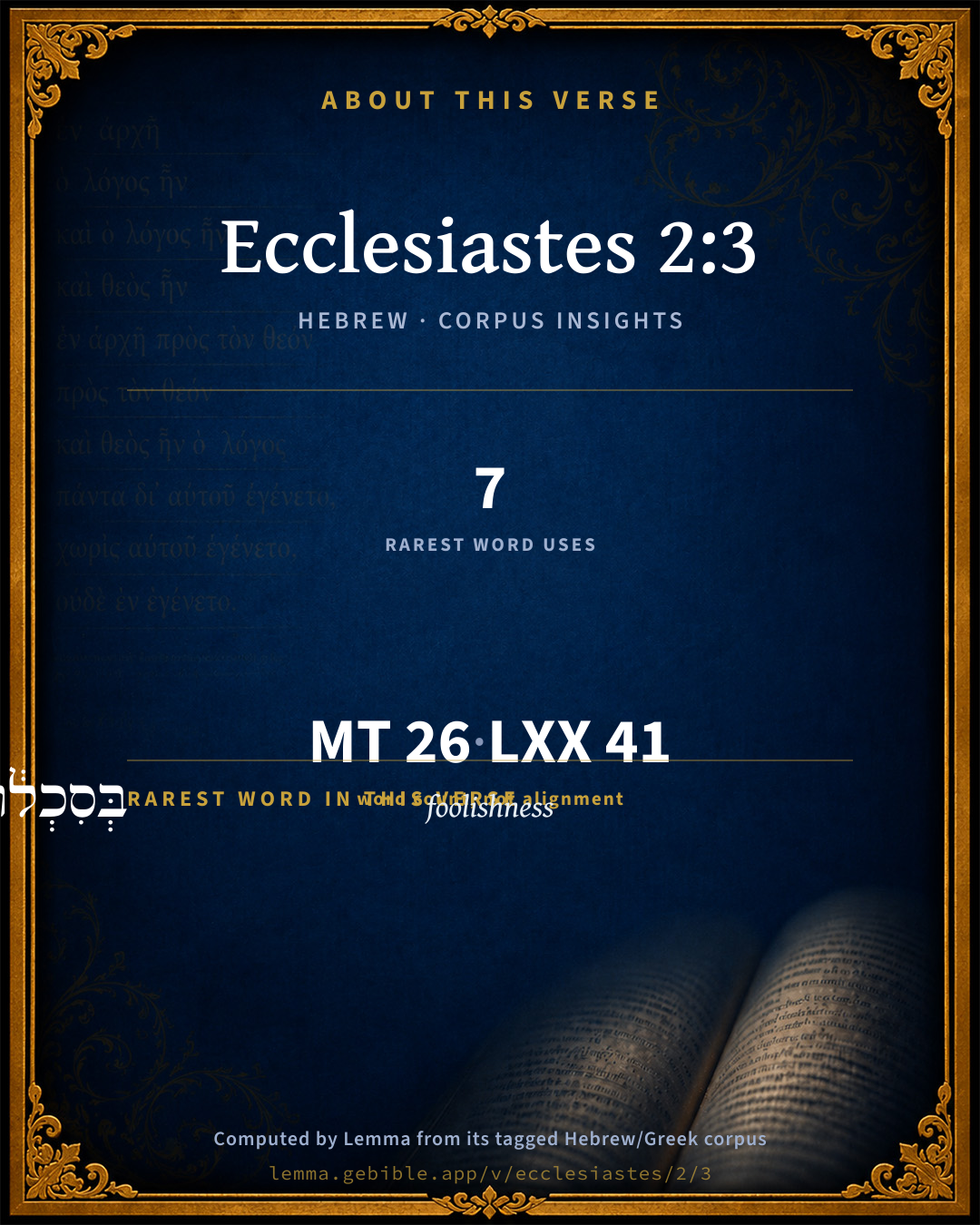
The rarest word here is בְּסִכְל֔וּת foolishness H5531 — appearing just 7 times in the whole Hebrew Bible.

Shared distinctive vocabulary

בְּסִכְל֔וּת foolishness H5531 occurs in 7 verses of the Hebrew Bible. Also found in:

Grammatical profile

  • 6 verbs
  • 12 nouns
  • 1 adjective
  • 1 pronoun
  • 2 prepositions
  • 4 particles

Verb forms

  • תַּ֣רְתִּי Qal · Perfect
  • לִמְשׁ֥וֹךְ Qal · Infinitive Construct
  • נֹהֵ֤ג Qal · Participle Active
  • וְלֶאֱחֹ֣ז Qal · Infinitive Construct
  • אֶרְאֶ֗ה Qal · Imperfect
  • יַעֲשׂוּ֙ Qal · Imperfect

Repetition

Words recur within this verse — often emphatic in Hebrew:

  • בְלִבִּ֔י heart H3820 ×2
  • אֲשֶׁר which H834 ×2

Hebrew & Septuagint length

In English translation the verse runs 51 words from the Hebrew and 56 from the Septuagint (LXX English) — closely comparable.

A rough comparison of the two English renderings, which tokenize alike — not a word-level alignment.

Word counts can differ between the Hebrew and the Greek without any difference in meaning — e.g. the Hebrew direct-object marker אֵת has no separate Greek word, and Greek often adds the article ὁ.

In the original languages it is 26 Hebrew tokens and 41 Greek tokens — but the two are counted differently (Hebrew bundles its prefixes and suffixes into one token; the Greek is in lemma form), so that isn’t a like-for-like length.

Cross-references

17

Topical passages linked to Ecclesiastes 2:3 in the Treasury of Scripture Knowledge — connected by theme and wording, ordered by reader-vote popularity; previews shown in the World English Bible.

  • Proverbs 20:1 Wine is a mocker, and beer is a brawler; Whoever is led astray by them is not wise.
  • Ecclesiastes 1:17 I applied my heart to know wisdom, and to know madness and folly. I perceived that this also was a chasing after wind.
  • Genesis 47:9 Jacob said to Pharaoh, "The days of the years of my pilgrimage are one hundred thirty years. Few and evil have been the days of the years of my life, and they have not attained to the days of the years of the life of my fathers in the days of their pilgrimage."
  • Proverbs 31:4–5 It is not for kings, Lemuel; It is not for kings to drink wine; Nor for princes to say, 'Where is strong drink?'
  • Ecclesiastes 6:12 For who knows what is good for man in life, all the days of his vain life which he spends like a shadow? For who can tell a man what will be after him under the sun?
  • Ecclesiastes 12:13 This is the end of the matter. All has been heard. Fear God, and keep his commandments; for this is the whole duty of man.
  • Ephesians 5:18 Don't be drunken with wine, in which is dissipation, but be filled with the Spirit,
  • 1 Samuel 25:36 Abigail came to Nabal; and, behold, he held a feast in his house, like the feast of a king; and Nabal's heart was merry within him, for he was very drunken: therefore she told him nothing, less or more, until the morning light.
  • Job 14:14 If a man dies, shall he live again? All the days of my warfare would I wait, Until my release should come.
  • Psalms 90:9–12 For all our days have passed away in your wrath. We bring our years to an end as a sigh.
  • Proverbs 23:29–35 Who has woe? Who has sorrow? Who has strife? Who has complaints? Who has needless bruises? Who has bloodshot eyes?
  • Ecclesiastes 2:24 There is nothing better for a man than that he should eat and drink, and make his soul enjoy good in his labor. This also I saw, that it is from the hand of God.
  • Ecclesiastes 3:12–13 I know that there is nothing better for them than to rejoice, and to do good as long as they live.
  • Ecclesiastes 7:18 It is good that you should take hold of this. Yes, also from that don't withdraw your hand; for he who fears God will come forth from them all.
  • Ecclesiastes 7:25 I turned around, and my heart sought to know and to search out, and to seek wisdom and the scheme of things, and to know that wickedness is stupidity, and that foolishness is madness.
  • Matthew 6:24 "No one can serve two masters, for either he will hate the one and love the other; or else he will be devoted to one and despise the other. You can't serve both God and Mammon.
  • 2 Corinthians 6:15–17 What agreement has Christ with Belial? Or what portion has a believer with an unbeliever?

Cross-references courtesy of OpenBible.info (CC BY 4.0).

Hebrew and Greek witnesses Masoretic Hebrew ↔ Greek Septuagint

The same verse in the two great witnesses to the Old Testament, shown verse-for-verse.

These are two independent witnesses, not word-aligned to each other, and the Septuagint is shown in lemma (dictionary) form.

Hebrew Ecclesiastes 2:3 Masoretic · Westminster Leningrad Codex

תַּ֣רְתִּי בְלִבִּ֔י לִמְשׁ֥וֹךְ בַּיַּ֖יִן אֶת בְּשָׂרִ֑י וְלִבִּ֞י נֹהֵ֤ג בַּֽחָכְמָה֙ וְלֶאֱחֹ֣ז בְּסִכְל֔וּת עַ֣ד אֲשֶׁר אֶרְאֶ֗ה אֵי זֶ֨ה ט֜וֹב לִבְנֵ֤י הָאָדָם֙ אֲשֶׁ֤ר יַעֲשׂוּ֙ תַּ֣חַת הַשָּׁמַ֔יִם מִסְפַּ֖ר יְמֵ֥י חַיֵּיהֶֽם

I searched in my heart how to cheer my flesh with wine, my heart yet guiding me with wisdom, and how to lay hold of folly, until I might see what it was good for the sons of men that they should do under heaven all the days of their lives.

World English Bible · Public Domain

Greek LXX Ecclesiastes 2:3 Septuagint · lemma form

κατασκέπτομαι ἐν καρδία ἐγώ ὁ ἕλκω εἰς οἶνος ὁ σάρξ ἐγώ καί καρδία ἐγώ ὁδηγέω ἐν σοφία καί ὁ κρατέω ἐπί ἀφροσύνη ἕως ὅς ὁράω ποῖος ὁ ἀγαθός ὁ υἱός ὁ ἄνθρωπος ὅς ποιέω ὑπό ὁ ἥλιος ἀριθμός ἡμέρα ζωή αὐτός

And I examined whether my heart would excite my flesh as with wine, (though my heart guided me in wisdom,) and I desired to lay hold of mirth, until I should see of what kind is the good to the sons of men, which they should do under the sun all the days of their life.

LXX2012 (modern English Septuagint) · Public Domain

On this verse, The Pulpit Commentary discusses the Septuagint’s reading. Read the note in Commentary ↓

Hebrew: Westminster Leningrad Codex (CC BY 4.0). Greek: Septuagint (public domain); English from LXX2012 (modern English Septuagint) (Public Domain). How the Septuagint differs from the Hebrew →

Commentary

Notes on Ecclesiastes 2:3 from classic Christian and Jewish commentators (each source and its license shown beneath its notes). The classic Christian expositions comment on the surrounding passage and are grouped to its opening verse, so a note may address several verses; the Jewish commentaries on the Tanakh (Rashi and others) are per-verse, so they appear only where the commentator wrote on this verse.

Lemma curates 59 commentaries, every one of them public domain or Creative Commons licensed, each selected and text-cleaned for this edition rather than reprinted as found. About our sources →

Trapp's Complete Commentary

John Trapp

Ecc 2:3 I sought in mine heart to give myself unto wine, yet acquainting mine heart with wisdom; and to lay hold on folly, till I might see what [was] that good for the sons of men, which they should do under the heaven all the days of their life.

Ver. 3. Yet acquainting my heart with wisdom,] i.e., Resolving to retain my wisdom; but that could not be, "For whoredom, and wine, and new wine take away the heart"; {Hos 4:11} they dull and disable nature, and so set us in a greater distance from grace; they "fight against the soul," {1Pe 2:11} and take away all scent and sense of heavenly comforts: much like that parcel of ground in Sicily, that sendeth such a strong smell of fragrant flowers to all the fields thereabouts, that no hound can hunt there. {a} And here I believe began Solomon’s apostasy, his laying the reins on the neck to pursue sinful pleasures, pleasing himself in a conceit that he could serve God and his lusts too. A Christian hath ever God for his chief end, and never sins with deliberation about this end; he will not forego God upon any terms; only he errs in the way, thinking he may fulfil such a lust, and keep God too. But God and sin cannot cohabit; and God’s graces groaning under our abuses in this kind cry unto him for help, who gives them thereupon, as he did to the wronged Church, {Rev 12:14} the wings of an eagle: after which, one lust calls upon another, as they once did upon their fellow soldiers, "Now Moab to the spoil," till the heart be filled with as many corruptions as Solomon had concubines.

{a} Arist., De Mirab. Auscul., lib. viii.

John Trapp, A Commentary or Exposition upon All the Books of the Old and New Testament (1647–1656) — public domain. Text from a community e-Sword module.

Joseph Benson's Commentary

Ecc 2:3. I sought to give myself unto wine — To gratify myself with delicious meats and drinks; yet acquainting, &c. — Yet resolving to use my wisdom, that I might try whether I could not arrive at satisfaction, by mixing wine and wisdom together. To lay hold on folly, &c. — To pursue sensual pleasure, which was my folly; till I might see, &c. — Till I might find out the true way to contentment and satisfaction, during this mortal life.

Joseph Benson's Commentary on the Old and New Testaments (1811–1818) — public domain. Text from a community e-Sword module.

The Preacher's Complete Homiletical Commentary

Joseph S. Exell (gen. ed.)

CRITICAL NOTES.—

Ecc_2:3. I sought in mine heart.] The word has the meaning not of thinking or reflecting, but to prove or assay—to make a moral experiment.

Ecc_2:8. The peculiar treasure of Kings.] The treasure forced from vanquished heathen rulers, and the voluntary gifts of friendly rulers such as the Queen of Sheba. The delights of the Sons of Men. An obvious reference to Solomon’s excessive animal indulgence.

MAIN HOMILETICS OF THE PARAGRAPH.—Ecc_2:3-11

THE WORTH OF THIS WORLD’S PLEASURES FAIRLY TESTED

The experiment to ascertain whether the pleasures of this life have any abiding value for man, was conducted, in this instance, with perfect fairness.

I. It was tried on a sufficient number and variety of cases. Solomon had ample opportunity of tasting every pleasure the age could afford. He did not, like one from some obscure retreat, despise those glories he could not share. He tried them all.

1. He tried coarse pleasures. “I sought in my heart to give myself unto wine.” The excessive indulgence of the lower appetites—such as the intoxication of the senses with wine—promises us a brief happiness. We forget the miseries and painful aspects of life, and enjoy a temporary elevation of soul. The feelings become intense, the mind seems half inspired, life appears as if lighted up with a sudden glare. The graces of intellect and feeling, and even of religious rapture, are imitated in the condition produced by wine. “Be not drunk with wine, but filled with the Spirit,” implies as much. The indulgence of animal instincts was also tried. “The delights of the children of men.” Solomon was a melancholy example of a great soul debased by a wild indulgence of animal passion.

2. He tried those pleasures which feed the desire of display. There is a feeling of pride in human nature which has a natural outlet in parade and show. We court admiration, and the distinction of being an object of envy. Solomon had great riches, tribute from foreign kings, numerous servants, houses, and gardens—all that could support splendour and magnificence. The homage paid to great estate and grandeur increases the outward happiness of this life. Men make wealth and display the standard of honour.

3. He tried those pleasures which minister to a sense of refinement. There are pleasures more exalted than the indulgence of our lower instincts—more worthy of the dignity of our nature. The royal sage employed himself in works of constructive skill—noble architecture, vineyards, gardens, pools of water, groves. He enjoyed the delights of music. Such pleasures engage some of the noblest powers of the mind, they lend a grace and elegance to life, they assuage the troubles of the heart, and they fill up the pauses of sensual pleasures which so soon tire the power of enjoyment. They are more congenial to our better nature. They take us beyond the mere things themselves, and are not unworthy to represent spiritual delights. They furnish a parable of Divine joys. Worldly refinement is a close imitation of religion. They yield but a temporary joy. “For my heart rejoiced in all my labour.” Misery can exist beneath them all, and as they vanish with life they cannot be our chief good. God permits some men to run through the entire scale of human happiness to show others that the best of this world cannot fill the soul.

II. It was tried under the Restraints and Control of Wisdom. “Yet acquainting mine heart with wisdom.” “Wisdom remained with me.” He did not rush headlong into sensual enjoyments, but tested them with calm reflection and composure. He did not allow himself to be blindly led by passion, but was under the guidance of a mind regulated by prudence.

1. Such a course is distinguished from that of the mere voluptuary. Such plunge into pleasure and do not allow the control of the higher faculties. Wisdom is left behind. The man is a slave to passion. Unless the mind retains its supremacy and dignity, our trial of wordly pleasure cannot even merit the poor name of an experiment.

2. Such a course may be expected to yield a hopeful result.

(1.) It saves the soul from utter debasement. When the voice of reason is hushed, and a man is abandoned entirely to sensuality, there is but little prospect that he will escape the snare.

(2.) Conscience is on the side of reason and right; and is effectual when reason is released from the control of passion.

(3.) A man is not condemned to hopeless slavery while his mind is free. He preserves an instrument which can help him to recover his liberty.

III. It was tried with an Honest Endeavour to discover what was the Chief Good of Man. “Till I might see what was good for the sons of men,” &c. It was not the love of pleasure for its own sake that prompted him. The experiment was made in all honesty to find out what, on the whole, was best for the sons of men. We must expect that like experiments will be made in such a world as this.

1. It is not always evident, at first, what is best. A life devoted to wisdom has superior advantages over one of pleasure, yet, for aught we know, the enjoyment of the world’s pleasure may be better for us than a cold and severe wisdom, which only serves to increase our pains and anxieties. The mystery and uncertainty of human things is some justification for making a trial of this kind

2. Practical wisdom can only be gained by experience. This requires repeated trials. We can only be said really to know that of human life which we have ascertained by trial. It is well when life’s solemn lessons are quickly learned, and we become truly wise before worldly pleasure completely injures our moral force, and claims us for her own.

SUGGESTIVE COMMENTS ON THE VERSES

Ecc_2:3. He who indulges in the coarse mirth excited by wine, with the hope that a superior wisdom will preserve him from moral danger, runs the risk of being shorn of his strength in the lap of luxury.

He who gives the reins to pleasure may never recover his command.

Human life is so short and uncertain that we should come to an early decision concerning our Chief Good.

How much use of wit and reason soever men may have in the pursuance of earthly delights, yet while they are seeking in their hearts to give themselves away to these things, they are but taking hold of folly. And though the foolish sinner does not look upon his way while he is pursuing his idols, yet when God awakes him, whether in wrath or mercy, he will see and be forced to say that he hath been doing nothing but taking hold on folly [Nisbet].

The original goes thus, “in the number of the days of their life,” as showing the fewness of man’s days, so that they may be numbered. For as the Poet speaketh, Pauperis est numerare pecus. It is a sign of a poor man to number his cattle; so it is a proof of the scantiness of man’s days that number doth so easily measure them [Jermin].

Ecc_2:4. In producing works of utility and adornment, man enjoys a pleasure beyond the value of the things themselves.

Some kind of activity is necessary for the happiness of those whose lot does not require them to toil for subsistence. No one can be happy in a life of soft enjoyment—passively receiving the gifts of pleasure. There must be some means of employing the active powers of the mind.

The power of constructing great works is part of the likeness of the Divine Nature. The beginning of all these things is laid in the thought of man’s mind. All the devices of human industry and skill have been developed from ideas. And what is creation, but the Divine thought taking form and expression in eternal things? It is God-like to possess the power to devise and produce great works.

For how much the magnificence is greater in the structure of houses, either in respect of their multitude or cost, by so much the shame is greater, that the soul is not adorned. Let that be built up carefully; let humility be the pavement of it, let hope be the roof of it, let faith be the pillars of it; on this side let justice be towards men, on that side devotion towards God. And let love, an excellent artificer, neatly join all these together, and then there will be a house for wisdom to dwell in [Jermin].

We may use our means of living to administer to our necessity, and the culture of our mind and taste; or to feed the desire of display and vain show.

A Greek Father says, that Solomon’s confession of the planting of vineyards contains a catalogue of his vain affections, that “Wine immoderately taken is the nourishment of intemperancy, the bane of youth, the reproach of old age, the shame of women, the prison of madness.”

Ecc_2:5. Man still finds his delight in what is but the degenerate imitation of Paradise. Buildings and palaces would soon cease to please. He must have the pleasures of the open air, the sweet refreshments of gardens.

Let those to whom God hath afforded these delights have in their gardens, as Joseph had, a sepulchre—that is, let them in their pleasures remember their death. And as Joesph’s sepulchre in his garden was made the sepulchre of Christ, so it were good also that such in their gardens—that is, in their delights—would think of the misery which He suffered for them [Jermin].

The church is the true garden of God, enclosed from the wilderness of the world, and tended with special care. All possible varieties are compelled to grow in the garden, so the church includes every variety of mind, temper, and disposition; affording special encouragements and means of spiritual growth for each. Yet God has some garden plants in the wilderness; the fruits of the Spirit may be brought forth outside the domain of Christendom.

Ecc_2:6. Large pools were necessary for watering the gardens and orchards. The Church of God needs her fountains near.

Nature, though free with her bountiful blessings, leaves much for man to do. Water is provided, but human contrivance is necessary to conduct it to every place where it is required. We have our part to do in preparing our souls to be proper receptacles of the plentiful grace of God.

But that from these pools of water, we may draw something that shall be wholesome for us; let us make our eyes pools of water, that so a sorrow for our sins may wash them away with the watering of it, and cleanse us from them by the current of amendment in the course of our life. Or else let us make pools of charity, therewith to water the decayed trees of misery; therewith to moisten the dry ground of want and necessity. Charity is Rehoboth, the well of breadth, a name given by Isaac to a well which his servants digged; for charity doth spread abroad her waters wheresoever is need of them [Jermin].

Let us make us pools by digging into the depths of heavenly knowledge. There is nothing better than this Divine fountain, by which the dryness and barrenness of our souls is made wet and moistened, by which virtues do spring up in us, so that even a grove of good desires and works doth sprout forth in our lives [Gregory Nyssenus].

Ecc_2:7. The vanity of man is fed by that display of grandeur which raises the admiration of others.

Servants born in the house would be endowed with natural fidelity. Men make use of natural laws to serve their own ambition.

It is not the lot of all to be attended by numerous trains of servants, but if we are the sons of the heavenly king, the angels wait upon us. The heirs of salvation have, even under the disadvantages of the present state, some signs of royal dignity.

In the heavenly household, the greatest, waits upon the least. Man is greatest, not when exacting, but when performing service.

Ecc_2:8. The love of gold and silver tends to burden the heart more than the love of large possessions in cattle, &c. A man is more likely to worship the image of wealth than wealth itself.

The homage paid to wealth is a strong temptation to indulge the illusion of superiority.

Gifts persuade even the gods, and gold is more potent with men than a thousand arguments [Plato].

Wealth honours wealth; income pays respect to income; but it is wont to cherish in its secret heart an unmeasured contempt for poverty. It is the possession of wealth, and of the social power which is conferred by wealth, which constitutes the title to honour. To believe that a man with £60 a year is just as much deserving of respect as a man with £6000, you must be seriously a Christian. A philosophical estimate of men and things is not really proof against the inroads of the sentiment which makes the possession of mere income the standard of honour [Liddon].

The most obvious danger which worldly possessions present to our spiritual welfare is, that they become practically a substitute in our hearts for that One Object to which our supreme devotion is due. They are present; God is unseen. They are means at hand of effecting what we want: whether God will hear our petitions for those wants is uncertain; or rather, I may say, certain in the negative. Thus they promise and are able to be gods to us, and such gods too as require no service, but, like dumb idols, exalt the worshipper, impressing him with a notion of his own power and security. Religious men are able to repress, nay extirpate, sinful desires; but as to wealth, they cannot easily rid themselves of a secret feeling that it gives them a footing to stand upon—an importance, a superiority; and in consequence they get attached to the world, lose sight of the duty of bearing the Cross, become dull and dim-sighted, and lose their delicacy and precision of touch, are numbed (so to say) in their fingers’ ends, as regards religious interests and prospects [J. H. Newman].

Music is a kind of language, and has a voice independent of the forms of speech. It has an universal eloquence, a power to withdraw even the dull and the sensual for awhile from their grosser existence. It is a luxury to feel strongly, and to allow the soul to be dissolved in harmony. But whatever exalts the feelings without leading to right practice inflicts moral injury.

We may understand “the delights of the sons of men” of music generally, great being the power which the delight of music hath upon men. Of which King Theodoric writing to Boetius in Cassiodore saith—“When she cometh from the secret of nature, as it were the Queen of the senses, adorned with her musical figures; other thoughts skip away, and she causeth all things to be cast out, that there may be a delight only of hearing her. She sweeteneth grief, mollifieth rage, mitigateth cruelty, quickeneth laziness, giveth rest to the watchful, maketh her chaste who hath been defiled with unclean love, and that which is a most blessed kind of curing, by most sweet pleasures driveth away the passions of the mind, and by the subjection of things that are insensible obtaineth command over the senses.” But though this be “the delight of the sons of men,” let the delight of the sons of God be the music and harmony of their lives unto God’s commandments [Jermin].

Ecc_2:9. Solomon compares his greatness as a worldly-wise man, not with private characters, but with official. He was great, yet it was only “more than they that were before him in Jerusalem,” not more than they that were in virtue and holiness before him. Worldly greatness is not to be compared with spiritual.

Men imagine that the greatness of their works and possessions is transferred to themselves, that their magnificence can be determined by measures of surface. The Rich Fool thought that the enlarging of his barns would make the foundations of his life surer and more lasting.

The most exalted human wisdom cannot save us from becoming a prey to vanity. We may by means of it conquer sensuality, and yet end in the worship of ourselves.

While the outward man revels in pleasure, the inward man may be yearning for a higher life.

There is some hope for a man who has made even a foolish experiment upon principles of reason. He who leaves wisdom behind him, when he plunges into worldly pleasures, destroys the bridge by which alone he can return.

Solomon could not have come to the conclusion that “all was vanity,” unless he discovered that there was something in himself which was not vanity—thus, “wisdom remained with him.” Hugh of S. Victor says, “He was able to speak that against vanity not vainly.”

So prone are men enjoying plenty of outward delights to lose even the exercise of common prudence and reason, and to give themselves up as beasts to the leading of their sensual appetites, that it is a mercy much to be marked and acknowledged for a man to have any measure of the exercise thereof continued in that case. For Solomon speaks of this as a remarkable thing, which hardly would be expected by many, that he having “all the delights of the sons of men,” being so great and increased more than all that had been before him, might yet truly say this, “Also my wisdom remaineth with me” [Nisbet].

Ecc_2:10. The heart is often led by the eye, the seat of moral power becomes subject to the senses.

The eye, the guardian of our safety, may be allured by a false light that “leads to bewilder, and dazzles to blind,”—by false philosophies, pleasures, religions.

Man received the first wounds of sin through the eye. The very sentinel placed aloft by heaven to guard us must be defended by God’s especial grace.

Let us remember how unhappily their eyes were opened unto them that were in Paradise, which were enlightened so long as they had them shut unto sin. Where we read “the eye is the light of the body,” the Greek is, the lamp, the candle of the body: for as a lamp burneth very well, and giveth good light so long as it is shut up and kept close within some room; but if it be set in the open air, is soon blown out by the wind; so the eye, if it be kept shut from vanity by a watchful carefulness, then it giveth the best light to the body. But if it be wantonly and negligently opened, then the good light of it is soon put out [Jermin].

There is some earthly recompense for human labours; but, at best, man is never truly rewarded here for all his pains. A transitory joy is but a poor compensation to set over against the infinite sadness of life, and the terrible forebodings of the heart.

The eye, the most far-reaching of all our powers, cannot give us lasting joy. It may range freely over every delight, but the spirit of man will remain in bondage till it is delivered by the coming of the Holy Ghost.

Labour there was in the seeking of it, labour in the possession of it, and yet this is the All which man seeketh of all his labour. This is the portion which the Preacher saith he had; there being no sickness, no enemy, no other cross either in mind or body, at home or abroad, to deprive him of it. So that we have here under the law, the Prodigal under the Gospel, asking his portion of his father, which is divided to him, and spent by him in the far country of this world upon worldly delights [Jermin].

Ecc_2:11. “All the works.”

1. In collecting riches.

2. In increasing the magnificence of the State.

3. In multiplying the means of social enjoyment.

It is well that we should look upon the works we have wrought in the world, till we discover that, apart from God, they are labour, weariness; and pain upon every remembrance of them. To think upon our ways, to survey our position, is the first step towards obtaining our true good.

The pangs of spiritual famine—the want of God, may be felt by one whose lot it is to live in the midst of a profusion of this world’s plenty and pleasure.

Our works in the world often outlast our joy. The Royal Moralist did not look upon his joy, but upon his labours.

Vanity has two ingredients—hollowness and aimlessness. Without God, all things are unsubstantial; they have no solid and lasting worth. Human labour, when not inspired by the Divine idea, reaches no worthy goal. God had His witnesses for this truth in the old heathen world. Thus, in the poem of Lucretius, we read—“Therefore the race of men labours always fruitlessly, and in vain; and life is consumed in empty cares.”

The wisdom which is concerned with what is under the sun can only give us negative conclusions; can only say of true happiness—It is not here. Religion has a positive truth to set over against this—“Every good gift and every perfect gift is from above.”

That is vain which is empty, when there is a name, but not anything at all. A name of riches, but not the thing; a name of glory, but without the thing; a name of power, but the name only is to be found. Who is therefore so senseless as to seek after names which have not the things, and to follow after empty things which should be shunned [St. Chrysostom].

The Fortunate Islands, which anyone may talk of, are but mere dreams, not lying anywhere under the sun’s light [Jermin].

The Preacher's Complete Homiletical Commentary (gen. ed. Joseph S. Exell; Funk & Wagnalls, c. 1892) — public domain (pre-1929). A full-Bible homiletical/sermon-outline anthology covering 65 of 66 books (2 John is absent from the source module). Text from a community e-Sword module.

Tyndale Open Study Notes

Tyndale Open Resources

2:3 The Teacher understood that trying to cheer himself with wine was foolishness, but he did it while still seeking wisdom—i.e., during his attempt to understand how to experience . . . happiness. This proved to be empty (2:11). • brief life in this world: The totality of human experience is “a breath.”

Tyndale Open Study Notes — © Tyndale Open Resources, licensed CC BY-SA 4.0. Text via the HelloAO Bible API.

Geneva Bible (1599)

Geneva Bible translators

Hebrew, draw my flesh to wine.

Albeit I gave myself to pleasures, yet I thought to keep wisdom and the fear of God in mine heart, and govern mine affairs by the same.

Hebrew, do.

Geneva Bible (1599) marginal notes — public domain. Text via Bolls.life.

Jamieson, Fausset & Brown

Robert Jamieson, A. R. Fausset & David Brown

Illustration more at large of Ecc 2:1-2.

I sought--I resolved, after search into many plans.

give myself unto wine--literally, "to draw my flesh," or "body to wine" (including all banquetings). Image from a captive drawn after a chariot in triumph (Rom 6:16, Rom 6:19; Co1 12:2); or, one "allured" (Pe2 2:18-19).

yet acquainting . . . wisdom--literally, "and my heart (still) was behaving, or guiding itself," with wisdom [GESENIUS]. MAURER translates: "was weary of (worldly) wisdom." But the end of Ecc 2:9 confirms English Version.

folly--namely, pleasures of the flesh, termed "mad," Ecc 2:2.

all the days, &c.--(See Margin and Ecc 6:12; Job 15:20).

Jamieson, Fausset & Brown — Commentary Critical and Explanatory on the Whole Bible (1871) — public domain (CC PDM 1.0). Text via the HelloAO Bible API.

Adam Clarke's Commentary

Verse 3. To give myself unto wine, (yet acquainting [נהג noheg, "guiding"] mine heart with wisdom,)] I did not run into extremes, as when I gave up myself to mirth and pleasure. There, I threw off all restraint; here, I took the middle course, to see whether a moderate enjoyment of the things of the world might not produce that happiness which I supposed man was created to enjoy here below.

Adam Clarke's Commentary on the Bible (1810–1826) — public domain. Text from a community e-Sword/MySword module.

Ellicott's Commentary for English Readers

(3) Sought.—The word translated “search out” (Ecc_1:13).

“Draw,” margin. There is no Biblical parallel for the use of the word in this sense. The general meaning is plain.

Acquainting.—Rather, guiding. The word is used of the driver of an animal or the shepherd of a flock (2Sa_6:3; Psa_80:1; Isa_63:4). Kohéleth contemplated not an unrestrained enjoyment of pleasure, but one controlled by prudence.

All the days.—(See margin). This phrase occurs again in Ecc_5:17; Ecc_6:12. We have “men of number” in the sense of “few”—i.e., so few that they can be numbered (Gen_34:30, and often elsewhere). So we may translate here “for their span of life.”

A Bible Commentary for English Readers, edited by Charles John Ellicott (1878–1897) — public domain. Text from a community e-Sword module.

The Cambridge Bible for Schools and Colleges

gen. ed. J. J. S. Perowne

3. to give myself unto wine] Literally, and more vividly, to cherish my flesh with wine. The Hebrew word for “give” is unusual and obscure. The primary meaning is “to draw out,” that of the word for “acquainting” is “to guide” or “drive,” as in Exo_3:1; 2Sa_6:3. Possibly, as Lewis suggests in Lange’s Commentary, the idea is like that of the parable in the Phædrus of Plato (p. 54) and the seeker gives the rein to pleasure, yet seeks to guide or drive the steed with his wisdom. The words point to the next stage in the progress of the pleasure seeker. Pleasure as such, in its graceful, lighter forms, soon palls, and he seeks the lower, fiercer stimulation of the wine cup. But he did this, he is careful to state, not as most men do, drifting along the current of lower pleasures

“Till the seared taste, from foulest wells

Is fain to quench its fires,”

but deliberately, “yet guiding mine heart with wisdom.” This also was an experiment, and he retained, or tried to retain, his self-analysing introspection even in the midst of his revelry. All paths must be tried, seeming folly as well as seeming wisdom, to see if they gave any adequate standard by which the “sons of men” might guide their conduct, any pathway to the “chief good” which was the object of the seeker’s quest.

The Cambridge Bible for Schools and Colleges (gen. ed. J. J. S. Perowne; Cambridge University Press, 1878–1918) — public domain. Text from a community e-Sword module.

John Gill's Exposition

I sought in mine heart to give myself unto wine,.... Not in an immoderate way, so as to intoxicate himself with it, in which there can be no pleasure, nor any show of happiness; but in a moderate, yet liberal way, so as to be innocently cheerful and pleasant, and hereby try what good and happiness were to be possessed in this way. By "wine" is meant, not that only, but everything eatable and drinkable that is good; it signifies what is called good living, good eating and drinking: Solomon always lived well; was brought up as a prince, and, when he came to the throne, lived like a king; but being increased in riches, and willing to make trial of the good that was in all the creatures of God, to see if any happiness was in them; determines to keep a better table still, and resolved to have everything to eat or drink that could be had, cost what it will; of Solomon's daily provision for his household, see Kg1 4:22; the Midrash interprets it, of the wine of the law. It may be rendered, "I sought in mine heart to draw out my flesh with wine", or "my body" (y); to extend it, and make it fat and plump; which might be reduced to skin and bones, to a mere skeleton, through severe studies after wisdom and knowledge. The Targum is,

"I sought in my heart to draw my flesh into the house of the feast of wine;''

as if there was a reluctance in him to such a conduct; and that he as it were put a force upon himself, in order to make the experiment;

(yet acquainting mine heart with wisdom); or, "yet my heart led me in wisdom" (z): he was guided and governed by wisdom in this research of happiness; he was upon his guard, that he did not go into any sinful extravagancies, or criminal excesses in eating and drinking;

and to lay hold on folly; that he might better know what folly was, and what was the folly of the sons of men to place their happiness in such things; or rather, he studiously sought to lay hold on folly, to restrain it, and himself from it, that it might not have the ascendant over him; so that he would not be able to form a right judgment whether there is any real happiness in this sort of pleasure, or not, he is, speaking of; for the epicure, the voluptuous person, is no judge of it;

till I might see what was that good for the sons of men, which they should do under the heaven all the days of their life; where the "summum bonum", or chief happiness of man lies; and which he should endeavour to seek after and pursue, that he might enjoy it throughout the whole of his life, while in this world: and that he might still more fully know it, if possible, he did the following things.

(y) "ut diducerem vino carnem meam", Piscator; "ut protraherem, et inde distenderem carnem meam", Rambachius. (z) "et cor meam ducens in sapientia", Montanus; "interim cor meum ducens in sapientiam", Drusius.

John Gill's Exposition of the Whole Bible (1746–1763) — public domain (CC PDM 1.0). Text via the HelloAO Bible API.

Albert Barnes' Notes on the Bible

I sought ... - Rather, I resolved (literally “I turned in my heart”) to draw my flesh with wine (see the margin), my heart guiding me with wisdom. In the course of his attempt to answer the question of Ecc 1:3, while his heart was directing him (as a charioteer directs his horses or a shepherd his sheep) with wisdom, and while he was following that guidance, he determined to draw with him his flesh by wine, thus making his flesh, which he speaks of as distinct from himself (compare Rom 7:25), a confederate and subsidiary in his attempt.

Albert Barnes' Notes on the Bible (1834–1885) — public domain. Text from a community e-Sword/MySword module.

Haydock's Catholic Bible Commentary

Wine, and to lead a temperate life. (Calmet) --- Protestants, "to give myself unto wine, (yet acquainting mine heart with wisdom) and to lay hold on folly," &c. (Haydock) --- I wished to indulge myself in pleasure, yet so as not to lose the reputation of wisdom, chap. v. 9. (Haydock)

George Leo Haydock (1774–1849), Haydock's Catholic Family Bible and Commentary, 1859 edition — public domain. Excludes Psalms (Douay-Rheims chapter numbering differs from Protestant) and Deuterocanonical books (Catholic canon only).

Matthew Poole's English Annotations

To give myself unto wine; to relax and gratify my flesh with delicious meats and drinks, synecdochically expressed by wine here, as also Pro 9:2; Son 2:4, &c., as necessary food is by bread, Amo 7:12, compared with Amo 8:2.

Yet acquainting my heart with wisdom; yet resolving to use my wisdom; either,

1. To set bounds to my pleasures. Or rather,

2. That I might try whether I could not arrive at satisfaction, by mixing wine and wisdom together, by using wine to sweeten and allay the toils of wisdom, and wisdom to prevent that destruction which many bring upon themselves by intemperate pleasures whilst they seek for satisfaction, that so I might have the comfort without the danger and mischief of pleasures.

To lay hold on folly; to pursue and addict myself to carnal pleasures, which was my folly.

Till I might see, & c.; till by trying several methods I might find out the true way to contentment and satisfaction, during this mortal life.

Matthew Poole's English Annotations on the Holy Bible (1683–1685) — public domain. Text from a community e-Sword/MySword module.

Whedon's Commentary on the Bible

Daniel D. Whedon

3. Yet acquainting — Hebrew, My mind still guiding with wisdom. The sense seems to be, that not rashly or impulsively, but with reflection and self-counsel, he sought to determine whether real enjoyment could be found in merely sensual pleasures.

To lay hold on — Hebrew, to enlarge or reinforce. Strengthening by wine, after Koheleth’s idea, is thus stated by an Arabian poet, —

“‘Tis we who steal the sense of wine,

Not wine that robbeth us of wit.”

All the days — Better, The limited days of their lives; necessarily few.

Daniel D. Whedon (gen. ed.), Commentary on the Old and New Testaments (1874–1909) — public domain. Text from a community e-Sword module.

The Pulpit Commentary

I sought in mine heart; literally, I spied out (as Ecc_1:13) in my heart. Having proved the fruitlessness of some sort of sensual pleasure, he made another experiment in a philosophical spirit. To give myself unto wine; literally, to draw (mashak) my flesh with wine; i.e. to use the attraction of the pleasures of the table. Yet acquainting my heart with wisdom. This is a parenthetical clause, which Wright translates, "While my heart was acting guiding with wisdom." That is, while, as it were, experimenting with pleasure, he still retained sufficient control over his passions as not to be wholly given over to vice; he was in the position of one who is being carried down an impetuous stream, yet has the power of stopping his headlong course before it becomes fatal to him. Such control was given by wisdom. Deliberately to enter upon a course of self-indulgence, even with a possibly good intention, must be a most perilous trial, and one which would leave indelible marks upon the soul; and not one person in a hundred would be able to stop short of ruin, The historical Solomon, by his experiment, suffered infinite loss, which nothing could compensate. The Septuagint renders not very successfully, "I examined whether my heart would draw (eJlkusei) my flesh as wine; and my heart guided me in wisdom." The Vulgate gives a sense entirely contrary to the writer"s intention; "I thought in my heart to withdraw my flesh from wine, that I might transfer my mind to wisdom." And to lay hold on folly. These words are dependent upon "I sought in my heart," and refer to the sensual pleasures in which he indulged for a certain object. "Dulce est desipere in loco," says Horace ("Canto.," 4:12. 28); jEn menoiv mala mainomai (Theognis, 313). Till I might see. His purpose was to discover if there was in these things any real good which might satisfy men"s cravings, and be a worthy object for them to pursue all the days of their life.

The Pulpit Commentary (1880–1919), ed. H.D.M. Spence-Jones & Joseph S. Exell — public domain. Text from a community e-Sword module.

John Wesley's Explanatory Notes

To wine - To gratify myself with delicious meats and drinks. Yet - Yet resolving to use my wisdom, that I might try whether I could not arrive at satisfaction, by mixing wine and wisdom together. To lay hold - To pursue sensual pleasures, which was my folly. 'Till - 'Till I might find out the true way to contentment and satisfaction, during this mortal life.

John Wesley, Explanatory Notes Upon the Whole Bible (1754–1765) — public domain. Text via the GEBible commentary corpus.

Keil & Delitzsch

C. F. Keil & F. Delitzsch

"I searched in my heart, (henceforth) to nourish my body with wine, while my heart had the direction by means of wisdom; and to lay hold on folly, till I might see what it was good for the children of men that they should do, all the number of the days of their life." After he became conscious that unbridled sensual intoxication does not lead to the wished-for end, he looked around him farther, and examined into the following reception for happiness. Inappropriately, Zckl., with Hengst.: "I essayed in my heart to nourish ...." תּוּר does not mean probare, but explorare, to spy out, Num 10:33, and frequently in the Book of Koheleth (here and at Ecc 1:13; Ecc 7:25) of mental searching and discovery (Targ. אלּל). With למשׁוך there then follows the new thing that is contrived. If we read משׁך and נהג in connection, then the idea of drawing a carriage, Isa 5:18, cf. Deu 21:3, and of driving a carriage, Sa2 6:3, lies near; according to which Hitzig explains: "Wine is compared to a draught beast such as a horse, and he places wisdom as the driver on the box, that his horse may not throw him into a ditch or a morass." But moshēk is not the wine, but the person himself who makes the trial; and nohēg is not the wisdom, but the heart, - the former thus only the means of guidance; no man expresses himself thus: I draw the carriage by means of a horse, and I guide it by means of a driv. Rightly the Syr.: "To delight (למבסמן, from בּסּם, oblectare) my flesh with wine." Thus also the Targ. and the Venet., by "drawing the flesh." The metaphor does not accord with the Germ. ziehen = to nourish by caring for (for which רבּה is used); it is more natural, with Gesen., to compare the passing of trahere into tractare, e.g., in the expression se benignius tractare (Horace, Ep. 1:17); but apart from the fact that trahere is a word of doubtful etymology,

(Note: Vid., Crossen's Nachtr. zur lat. Formenlehre, pp. 107-109.)

tractare perhaps attains the meaning of attending to, using, managing, through the intermediate idea of moving hither and thither, which is foreign to the Heb. משׁך, which means only to draw, - to draw to oneself, and hold fast (attractum sive prehensum tenere). As the Talm. משׁך occurs in the sense of "to refresh," e.g., Chagiga 14a: "The Haggadists (in contradistinction to the Halachists) refresh the heart of a man as with water"; so here, "to draw the flesh" = to bring it into willing obedience by means of pleasant attractions.

(Note: Grtz translates: to embrocate my body with wine, and remarks that in this lies a raffinement. But why does he not rather say, "to bathe in wine"? If משׁח can mean "to embrocate," it may also mean "to bathe," and for ביין may be read ביוני: in Grecian, i.e., Falernian, Chian, wine.)

The phrase which follows: velibbi nohēg bahhochmāh, is conditioning: While my heart had the direction by means of wisdom; or, perhaps in accordance with the more modern usus loq. While my heart guided, demeaned, behaved itself with wisdom. Then the inf. limshok, depending on tarti as its obj., is carried forward with velěěhhoz besichluth. Plainly the subject treated of is an intermediate thing (Bardach: ממצּעת). He wished to have enjoyment, but in measure, without losing himself in enjoyment, and thereby destroying himself. He wished to give himself over to sweet desipere, but yet with wise self-possession (because it is sadly true that ubi mel ibi fel) to lick the honey and avoid the gall. There are drinkers who know how to guide themselves so that they do not end in drunken madness; and there are habitual pleasure-seekers who yet know how so far to control themselves, that they do not at length become rous. Koheleth thus gave himself to a foolish life, yet tempered by wisdom, till there dawned upon him a better light upon the way to true happiness.

The expression of the donec viderem is old Heb. Instead of אי־זה טוב, quidnam sit bonum in indirect interrog. (as Ecc 11:6, cf. Jer 6:16), the old form מה־טוב (Heb 6:12) would lie at least nearer. Asher yǎǎsu may be rendered: quod faciant or ut faciant; after Ecc 2:24; Ecc 3:22; Ecc 5:4; Ecc 7:18, the latter is to be assumed. The accus. designation of time, "through the number of days of their life," is like Ecc 5:17; Ecc 6:12. We have not, indeed, to translate with Knobel: "the few days of their life," but yet there certainly lies in מספּר the idea that the days of man's life are numbered, and that thus even if they are not few but many (Ecc 6:3), they do not endure for ev.

The king now, in the verse following, relates his undertakings for the purpose of gaining the joys of life in fellowship with wisdom, and first, how he made architecture and gardening serviceable to this new style of life.

Keil & Delitzsch — Biblical Commentary on the Old Testament (1861–1891) — public domain (CC PDM 1.0). Text via the HelloAO Bible API. (Old Testament only.)

unfoldingWord translationNotes

Door43 World Missions Community

I explored in my heart

This speaks of thinking hard for a long time as if it were exploring. Also, the author speaks of his feelings and his thoughts as if they were his "heart." AT: "I thought hard about" (See: Metaphor and Metonymy)

to gratify my desires with wine

The word "desires" may be expressed as a verbal phrase. AT: "to use wine to make myself happy" (See: Abstract Nouns)

I let my mind guide me with wisdom

Here the author speaks of using the wisdom that he had been taught to guide himself as if this wisdom were a person who guided him. AT: "I thought about the things that wise people had taught me" (See: Personification)

under heaven

This refers to things that are done on earth. AT: "on the earth" (See: Assumed Knowledge and Implicit Information)

during the days of their lives

"during the time that they are alive"

translationWords

wine

mind

wise

fool

good

heaven

life

unfoldingWord translationNotes — © Distant Shores Media and the Door43 World Missions Community, licensed CC BY-SA 4.0. Source: git.door43.org/Door43/en_tn.

Rashi

Rabbi Shlomo Yitzchaki (Rashi)

I searched in my heart I returned to search in my heart to maintain all of them: feasting, wisdom, and folly, and to indulge and to pamper my body with wine feasting. Every feast of enjoyment is called מִשְּׁתֶּה because of the wine.

conducting itself with wisdom Even if my body is being indulged with wine, my heart is being conducted with wisdom, to hold onto the Torah.

and holding onto folly to things that appear to me as folly, concerning which I said, (Prov. 30:1): “God is with me; yea, God is with me, and I will be able,” for example, the wearing of shaatnez and mingled species in a vineyard, which Satan and the nations of the world dispute, and so he says (below 7:18): “It is good that you should take hold of this,” and also, concerning Saul, to whom it appeared folly to slay both man and woman, both infant and suckling, but it was the commandment of the Omnipresent, and he called it folly.

Rashi on the Tanakh — English translations: “The Judaica Press complete Tanach with Rashi, translated by A. J. Rosenberg” (CC BY 4.0); “Pentateuch with Rashi's commentary by M. Rosenbaum and A.M. Silbermann, 1929-1934” (public domain); “The Metsudah Tanach series, Lakewood, N.J” (CC BY 4.0); and “The Book of Joshua, Metsudah Publications, 1997” (CC BY 4.0). Text via Sefaria.

Lesson kit

Teaching starters — assembled from the data on this page, not authored interpretation. Every prompt links to the verse data it draws on. Edit before teaching.

Ecclesiastes, in the Wisdom, opens this verse with 26 words (24 distinct Hebrew lemmas). Its most distinctive word is çiklûwth (“foolishness”). A historical commentator’s framing appears above. Read the whole chapter for the surrounding context.

Discussion questions

  1. The word çiklûwth carries the sense “foolishness.” How does it shape the verse?
  2. How does Ecclesiastes 1:17, which shares the word «foolishness», read alongside this verse?
  3. What does the repetition of “heart” (2× in this one verse) do in this verse?
  4. The translations on this page render this verse differently — a whole-verse word diff, not a word-by-word alignment. What might account for the different wordings?
  5. «תַּ֣רְתִּי» is a Qal Perfect verb. How does that grammatical form shape the action described?
  6. Compare how Trapp's Complete Commentary and Joseph Benson's Commentary read this verse. Where do they agree or differ?

Things to notice

Reading settings

Reading text

Shown beneath each verse's original-language words.

Old Testament
Old Testament edition

Read the OT as the Masoretic Hebrew (MT) or the Greek Septuagint (LXX).

English shown for the Greek Septuagint (in the Hebrew ↔ Greek comparison).

Comparing translations? Open the Compare panel on any verse page to stack up to four side by side.