
1 Samuel 14:52

Hebrew (Westminster Leningrad Codex) 1 Samuel 14:52 appears in the Hebrew Old Testament. The text above is from the Westminster Leningrad Codex. Each word links to its Strong’s number, a concise gloss, and parsing drawn from the Open Scriptures Hebrew Bible morphology. Click any word for its full Brown-Driver-Briggs (BDB) entry.
Download image
Cite this verse

1 Samuel 14:52 (World English Bible). Public Domain. Lemma interlinear Bible study tool, https://lemma.gebible.app/v/1-samuel/14/52.

Show BibTeX & RIS
BibTeX
RIS
English Translation
There was sore war against the Philistines all the days of Saul: and when Saul saw any mighty man, or any valiant man, he took him to him.
World English Bible · Public Domain
Download a study sheet

One document with this verse’s original text, its word-by-word gloss line, the meaning frame, cross-references with their text, attributed commentary, and full source and license credits — printable, and it pastes into notes with its structure intact.

This verse Autodidact and up

Study sheet (.html) Plain text (.txt)

A passage Seminary Student

Up to 50 verses in one chapter. A passage sheet keeps up to 6 commentary sources and 12 cross-references per verse, in the order this page ranks them, and says so on the sheet whenever that leaves anything out. Ask for a single verse and you get the Autodidact verse sheet above.

Everything on this page stays free to read, with no account — the sheet is a download of what is already on screen, not access to it.

Want to remove ads? Support Godless Engineer
Compare translations 3

The same verse in 3 English versions, stacked beneath the original-language interlinear above. Click any original word for its lexicon entry.

Each is an independent rendering of the whole verse — the interlinear is not word-aligned to these translations.

Highlighted words mark where these versions differ — a whole-verse word diff, not a word-by-word alignment.

  • World English Bible Public Domain
    There was sore war against the Philistines all the days of Saul: and when Saul saw any mighty man, or any valiant man, he took him to him.
  • King James Version Public Domain
    And there was sore war against the Philistines all the days of Saul: and when Saul saw any strong man, or any valiant man, he took him unto him.
  • unfoldingWord Literal Text CC BY-SA 4.0
    And the battle was strong against the Philistines all of the days of Saul. When Saul saw any man, a warrior, or any son of valor, then he gathered him to himself.

unfoldingWord Literal Text — © unfoldingWord, licensed CC BY-SA 4.0. Word-aligned USFM3 via Door43 (git.door43.org/unfoldingWord/en_ult).

Versions to compare (up to 4)

3 of 4 selected

Show all 18 translations

Every available English version of this verse, each an independent rendering of the whole verse.

  • World English Bible Public Domain
    There was sore war against the Philistines all the days of Saul: and when Saul saw any mighty man, or any valiant man, he took him to him.
  • Berean Standard Bible Public Domain
    And the war with the Philistines was fierce for all the days of Saul. So whenever he noticed any strong or brave man, Saul would enlist him.
  • Majority Standard Bible Public Domain
    And the war with the Philistines was fierce for all the days of Saul. So whenever he noticed any strong or brave man, Saul would enlist him.
  • King James Version Public Domain
    And there was sore war against the Philistines all the days of Saul: and when Saul saw any strong man, or any valiant man, he took him unto him.
  • American Standard Version (1901) Public Domain
    And there was sore war against the Philistines all the days of Saul: and when Saul saw any mighty man, or any valiant man, he took him unto him.
  • Revised Version (1885) Public Domain
    And there was sore war against the Philistines all the days of Saul: and when Saul saw any mighty man, or any valiant man, he took him unto him.
  • Geneva Bible (1599) Public Domain
    And there was sore warre against the Philistims all the dayes of Saul: and whomsoeuer Saul sawe to be a strong man, and meete for the warre, he tooke him vnto him.
  • Douay-Rheims (1899) Public Domain
    And there was a great war against the Philistines all the days of Saul. For whomsoever Saul saw to be a valiant man, and fit for war, he took him to himself.
  • Young's Literal Translation Public Domain
    And the war is severe against the Philistines all the days of Saul; when Saul hath seen any mighty man, and any son of valour, then he doth gather him unto himself.
  • Literal Standard Version CC BY-SA 4.0
    And the war is severe against the Philistines all the days of Saul; when Saul has seen any mighty man, and any son of valor, then he gathers him to himself.
  • Unlocked Literal Bible CC BY-SA 4.0
    There was hard fighting against the Philistines all the days of Saul. When Saul saw any mighty man, or any valiant man, he attached him to himself.
  • unfoldingWord Literal Text CC BY-SA 4.0
    And the battle was strong against the Philistines all of the days of Saul. When Saul saw any man, a warrior, or any son of valor, then he gathered him to himself.
  • Darby Bible Public Domain
    And there was sore war against the Philistines all the days of Saul; and when Saul saw any mighty man, or any valiant man, he took him to himself.
  • World Messianic Bible Public Domain
    There was severe war against the Philistines all the days of Saul; and when Saul saw any mighty man or any valiant man, he took him into his service.
  • Webster's Bible Public Domain
    And there was violent war against the Philistines all the days of Saul: and when Saul saw any strong man, or any valiant man, he took him to himself.
  • Free Bible Version CC BY-SA 4.0
    Throughout Saul's lifetime there was constant war with the Philistines. Saul recruited into his army every strong warrior and every brave fighter that he met.
  • Bible in Basic English Public Domain
    All through the life of Saul there was bitter war against the Philistines; and whenever Saul saw any strong man or any good fighting man, he kept him near himself.
  • JPS Tanakh (1917) Public Domain
    And there was sore war against the Philistines all the days of Saul; and when Saul saw any mighty man, or any valiant man, he took him unto him.

Literal Standard Version (2020), Covenant Press — licensed CC BY-SA 4.0. Text via the HelloAO Bible API (eBible.org). Unlocked Literal Bible (unfoldingWord) — licensed CC BY-SA 4.0. Text via the HelloAO Bible API (eBible.org). unfoldingWord Literal Text — © unfoldingWord, licensed CC BY-SA 4.0. Word-aligned USFM3 via Door43 (git.door43.org/unfoldingWord/en_ult). Free Bible Version, Dr. Jonathan Gallagher — licensed CC BY-SA 4.0. Text via the HelloAO Bible API (eBible.org).

Word by word

More ways to search: Search by grammar → Find every occurrence → Compare this word →

Practice this passage: Drill this verse → Learn its vocabulary →

חֲזָקָ֣ה
châzâq
H2389
“strong”
Adjective, Adjective, Feminine, Singular, Absolute
Part of Speech
Adjective
Type
Adjective
Gender
Feminine
Number
Singular
State
Absolute
Full BDB Definition

Origin: from H2388

TWOT: 636a

strong, stout, mighty - strong - severe, sharp, hot - firm, hard - a strong one (substantive)
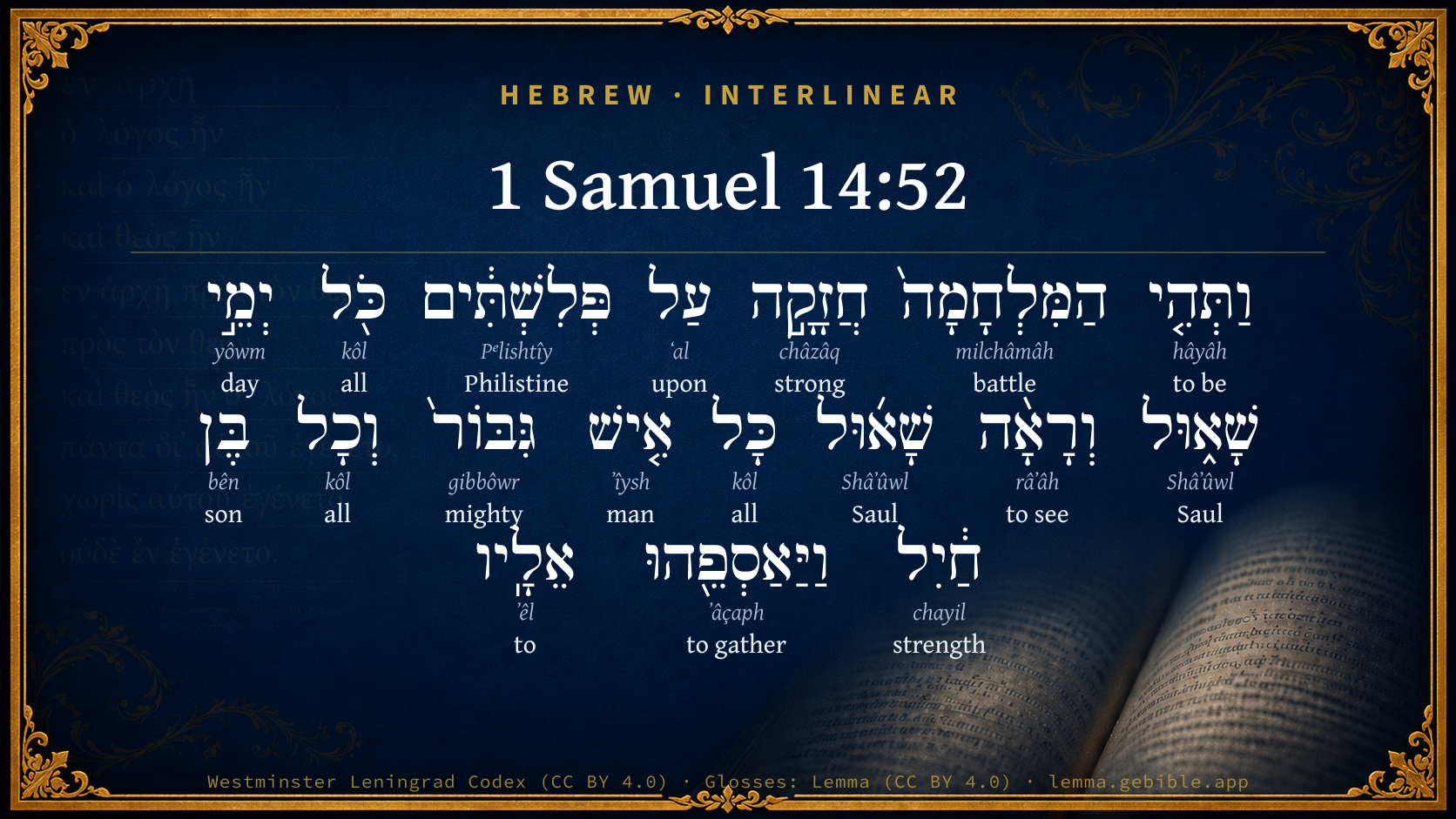
  1. וַתְּהִ֤י hâyâh H1961 “and · to be” Conjunction + Verb, Qal, Sequential Imperfect, 3rd Person, Feminine, Singular
  2. הַמִּלְחָמָה֙ milchâmâh H4421 “the · battle” Particle, Definite Article + Noun, Common, Feminine, Singular, Absolute
  3. עַל ʻal H5921 “upon” Preposition
  4. פְּלִשְׁתִּ֔ים Pᵉlishtîy H6430 “Philistines” Noun, Gentilic, Masculine, Plural, Absolute
  5. כֹּ֖ל kôl H3605 “all of” Noun, Common, Masculine, Singular, Construct
  6. יְמֵ֣י yôwm H3117 “days of” Noun, Common, Masculine, Plural, Construct
  7. שָׁא֑וּל Shâʼûwl H7586 “Saul” Noun, Proper
  8. וְרָאָ֨ה râʼâh H7200 “and · to see” Conjunction + Verb, Qal, Sequential Perfect, 3rd Person, Masculine, Singular
  9. שָׁא֜וּל Shâʼûwl H7586 “Saul” Noun, Proper
  10. כָּל kôl H3605 “all of” Noun, Common, Masculine, Singular, Construct
  11. אִ֤ישׁ ʼîysh H376 “man” Noun, Common, Masculine, Singular, Absolute
  12. גִּבּוֹר֙ gibbôwr H1368 “mighty” Adjective, Adjective, Masculine, Singular, Absolute
  13. וְכָל kôl H3605 “and · all of” Conjunction + Noun, Common, Masculine, Singular, Construct
  14. בֶּן bên H1121 “son of” Noun, Common, Masculine, Singular, Construct
  15. חַ֔יִל chayil H2428 “strength” Noun, Common, Masculine, Singular, Absolute
  16. וַיַּאַסְפֵ֖הוּ ʼâçaph H622 “and · to gather · him” Conjunction + Verb, Qal, Sequential Imperfect, 3rd Person, Masculine, Singular + Suffix, Personal, 3rd Person, Masculine, Singular
  17. אֵלָֽיו ʼêl H413 “to · him” Preposition + Suffix, Personal, 3rd Person, Masculine, Singular

About this verse

These counts appear in no published source. They are computed here, from the morphology-tagged text and Lemma’s own curated glosses. What Lemma adds →

18
words
15
distinct lemmas
Historical
section

Shared distinctive vocabulary

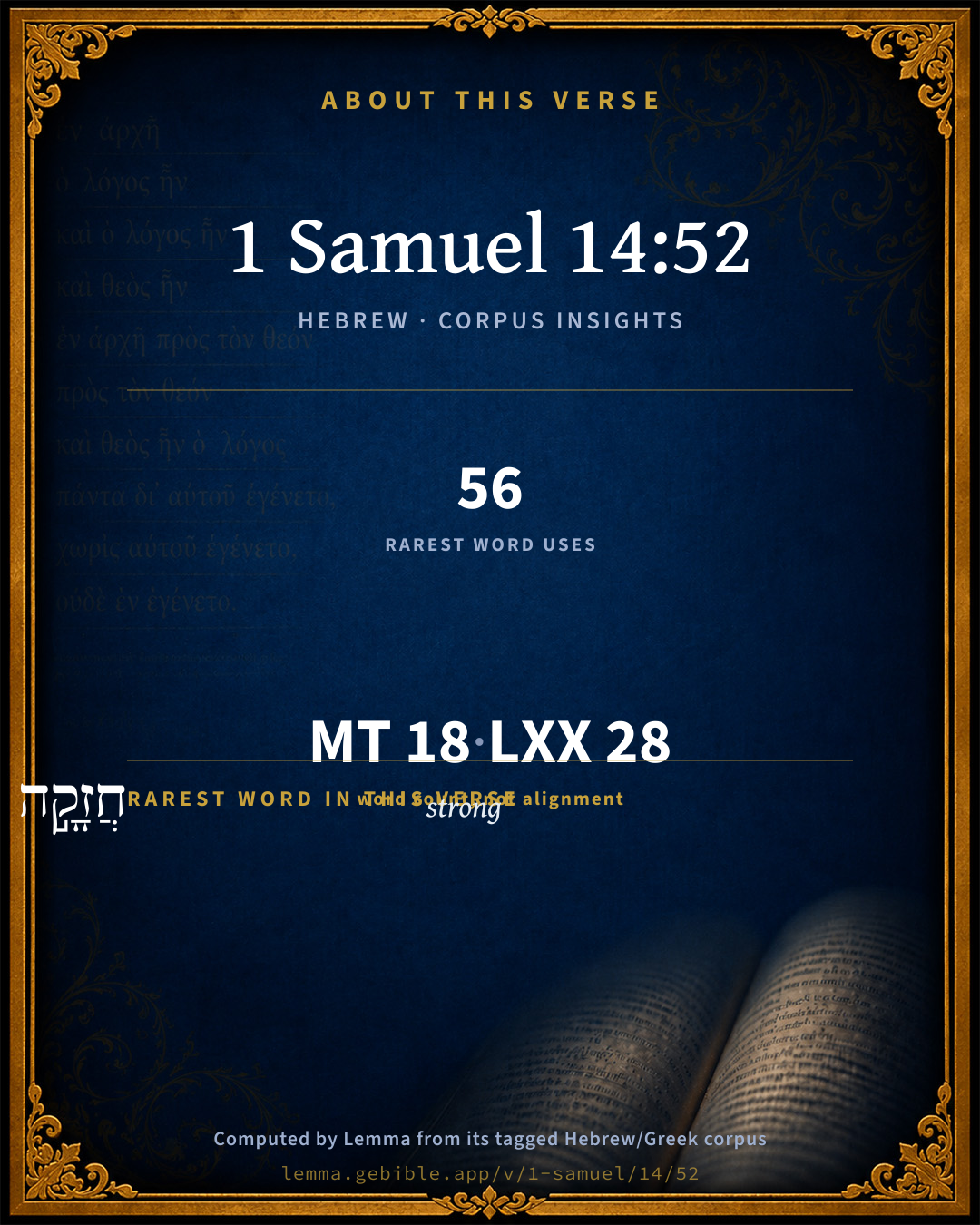
חֲזָקָ֣ה strong H2389 occurs in 54 verses of the Hebrew Bible. Also found in:

Grammatical profile

  • 3 verbs
  • 11 nouns
  • 2 adjectives
  • 2 prepositions

Verb forms

  • וַתְּהִ֤י Qal · Sequential Imperfect
  • וְרָאָ֨ה Qal · Sequential Perfect
  • וַיַּאַסְפֵ֖הוּ Qal · Sequential Imperfect

Repetition

Words recur within this verse — often emphatic in Hebrew:

  • כֹּ֖ל all H3605 ×3
  • שָׁא֑וּל Saul H7586 ×2

Hebrew & Septuagint length

In English translation the verse runs 28 words from the Hebrew and 30 from the Septuagint (LXX English) — closely comparable.

A rough comparison of the two English renderings, which tokenize alike — not a word-level alignment.

Word counts can differ between the Hebrew and the Greek without any difference in meaning — e.g. the Hebrew direct-object marker אֵת has no separate Greek word, and Greek often adds the article ὁ.

In the original languages it is 18 Hebrew tokens and 28 Greek tokens — but the two are counted differently (Hebrew bundles its prefixes and suffixes into one token; the Greek is in lemma form), so that isn’t a like-for-like length.

Cross-references

2

Topical passages linked to 1 Samuel 14:52 in the Treasury of Scripture Knowledge — connected by theme and wording, ordered by reader-vote popularity; previews shown in the World English Bible.

  • 1 Samuel 8:11 He said, This will be the manner of the king who shall reign over you: he will take your sons, and appoint them to him, for his chariots, and to be his horsemen; and they shall run before his chariots;
  • 1 Samuel 8:1 It happened, when Samuel was old, that he made his sons judges over Israel.

Cross-references courtesy of OpenBible.info (CC BY 4.0).

Hebrew and Greek witnesses Masoretic Hebrew ↔ Greek Septuagint

The same verse in the two great witnesses to the Old Testament, shown verse-for-verse.

These are two independent witnesses, not word-aligned to each other, and the Septuagint is shown in lemma (dictionary) form.

Hebrew 1 Samuel 14:52 Masoretic · Westminster Leningrad Codex

וַתְּהִ֤י הַמִּלְחָמָה֙ חֲזָקָ֣ה עַל פְּלִשְׁתִּ֔ים כֹּ֖ל יְמֵ֣י שָׁא֑וּל וְרָאָ֨ה שָׁא֜וּל כָּל אִ֤ישׁ גִּבּוֹר֙ וְכָל בֶּן חַ֔יִל וַיַּאַסְפֵ֖הוּ אֵלָֽיו

There was sore war against the Philistines all the days of Saul: and when Saul saw any mighty man, or any valiant man, he took him to him.

World English Bible · Public Domain

Greek LXX 1 Samuel 14:52 Septuagint · lemma form

καί εἰμί ὁ πόλεμος κραταιός ἐπί ὁ ἀλλόφυλος πᾶς ὁ ἡμέρα σαούλ καί ὁράω σαούλ πᾶς ἀνήρ δυνατός καί πᾶς ἀνήρ υἱός δύναμις καί συνἄγω αὐτός πρός αὐτός

And the war was vehement against the Philistines all the days of Saul; and when Saul saw any mighty man, and any valiant man, then he took them to himself.

LXX2012 (modern English Septuagint) · Public Domain

Hebrew: Westminster Leningrad Codex (CC BY 4.0). Greek: Septuagint (public domain); English from LXX2012 (modern English Septuagint) (Public Domain). How the Septuagint differs from the Hebrew →

Targum (Aramaic paraphrase)

1

The Targum is the ancient Jewish Aramaic paraphrase of the Hebrew Scriptures — an interpretive translation, not the Hebrew text itself. Onkelos (literal) and Pseudo-Jonathan (expansive) render the Torah, and Jonathan the Prophets. Coverage is partial: where no permissively-licensed English translation exists for a verse, only the Aramaic is shown. This is verse-level text, not a word-by-word alignment to the Hebrew.

  1. Targum Jonathan Prophets (Joshua–Malachi)
    וַהֲוַת קְרָבָא תַּקִיפָא עַל פְּלִישְׁתָּאֵי כָּל יוֹמֵי שָׁאוּל וַחֲזָא שָׁאוּל כָּל גְבַר גִבַּר וְכָל גְבַר עָבֵיד קְרָב וּכְנַשׁ יָתֵיהּ לְוָתֵיהּ:

    (no public-domain English translation for this verse)

    Targum Jonathan — Aramaic: “Mikraot Gedolot” (public domain). English: “Sefaria Community Translation” (CC0 1.0 (public-domain dedication)); “London "Chaldee Paraphrase," 1871” (public domain). Text via Sefaria.

Commentary

Notes on 1 Samuel 14:52 from classic Christian and Jewish commentators (each source and its license shown beneath its notes). The classic Christian expositions comment on the surrounding passage and are grouped to its opening verse, so a note may address several verses; the Jewish commentaries on the Tanakh (Rashi and others) are per-verse, so they appear only where the commentator wrote on this verse.

Lemma curates 59 commentaries, every one of them public domain or Creative Commons licensed, each selected and text-cleaned for this edition rather than reprinted as found. About our sources →

Trapp's Complete Commentary

John Trapp

1Sa 14:52 And there was sore war against the Philistines all the days of Saul: and when Saul saw any strong man, or any valiant man, he took him unto him.

Ver. 52. And when Saul saw any strong man.] Robustum et pugnacem. This was not amiss, had he not placed too much confidence in them, as indeed he did.

John Trapp, A Commentary or Exposition upon All the Books of the Old and New Testament (1647–1656) — public domain. Text from a community e-Sword module.

Joseph Benson's Commentary

1Sa 14:52. When Saul saw any strong man, he took him — That is, when he saw any one behave well in battle, or of great strength, he took him into his band to be near to him on all occasions, and to go out to battle with him.

Joseph Benson's Commentary on the Old and New Testaments (1811–1818) — public domain. Text from a community e-Sword module.

Tyndale Open Study Notes

Tyndale Open Resources

14:52 Saul had easily defeated the Ammonites (11:11) but was having much less success with the Philistines, given their well-organized fighting machine and their monopoly on iron and bronze (13:19-22). • he drafted him: Samuel had warned earlier that the king would take people as well as possessions (8:11).

Tyndale Open Study Notes — © Tyndale Open Resources, licensed CC BY-SA 4.0. Text via the HelloAO Bible API.

Geneva Bible (1599)

Geneva Bible translators

As Samuel had forewarned, 1 Sam. 8:11.

Geneva Bible (1599) marginal notes — public domain. Text via Bolls.life.

Adam Clarke's Commentary

Verse 52. When Saul saw any strong man] This was very politic. He thus continued to recruit his army with strong and effective men.

Adam Clarke's Commentary on the Bible (1810–1826) — public domain. Text from a community e-Sword/MySword module.

Ellicott's Commentary for English Readers

(52) All the days of Saul.—Although after the rout of Michmash the Philistines were driven out of their fastnesses in the land of Israel back into their own coast districts, yet all through the reign of Saul they continued to be powerful, and were a constant source of danger and trouble to the people. We know that in the end Saul lost his life in an engagement with this warlike and restless race, who were not finally crushed before the days of his successor, David. To keep them in check necessitated the maintenance of a standing army, which, in the days of David, became one of the great armed forces of the East. The reader of this verse is reminded at once of a similar military fancy of King Frederick William of Prussia, the founder of Prussian military greatness, and the father of the Great Frederick.

A Bible Commentary for English Readers, edited by Charles John Ellicott (1878–1897) — public domain. Text from a community e-Sword module.

The Cambridge Bible for Schools and Colleges

gen. ed. J. J. S. Perowne

52. he took him] to serve in his permanent corps of picked soldiers (1Sa_13:4).

The Cambridge Bible for Schools and Colleges (gen. ed. J. J. S. Perowne; Cambridge University Press, 1878–1918) — public domain. Text from a community e-Sword module.

John Gill's Exposition

And there was sore war against the Philistines all the days of Saul,.... For notwithstanding the late victory over them, and slaughter made among them, they recovered themselves, and came out again to battle, and gave Saul a great deal of trouble, and he at last died in battle with them:

and when Saul saw any strong man, or any valiant man, he took him unto him; to be his bodyguard, as Josephus (q) says; or for soldiers and officers in his army, even such, as the same writer observes, that exceeded others in comeliness of person, and in largeness and height; such as were in some measure like himself, that were strong, able bodied men, and of courage, and valour, and fortitude of mind.

(q) Ut supra. (Antiqu. l. 6. c. 6. sect. 5.)

Next: 1 Samuel Chapter 15

John Gill's Exposition of the Whole Bible (1746–1763) — public domain (CC PDM 1.0). Text via the HelloAO Bible API.

Matthew Poole's English Annotations

Into his service, or army.

Matthew Poole's English Annotations on the Holy Bible (1683–1685) — public domain. Text from a community e-Sword/MySword module.

Whedon's Commentary on the Bible

Daniel D. Whedon

52. Sore war… all the days of Saul — This statement is given as a reason why Saul pressed into his service every strong man of mark. In this he acted the part of a prudent general.

Daniel D. Whedon (gen. ed.), Commentary on the Old and New Testaments (1874–1909) — public domain. Text from a community e-Sword module.

The Pulpit Commentary

The summary ends with two important particulars respecting Saul"s kingdom the first, that the Philistines were powerful and dangerous enemies to Israel all his days; the second, that in order to carry on the war with them he ever kept around him the nucleus of a standing army. In thus forming a "school of heroes" he raised the whole spirit of the people, and took an essential and necessary step for maintaining Israel"s freedom. With much of the despot in him, Saul had grand qualities as a soldier, and for many years admirably fulfilled the primary object for which he was chosen. And while he was thus giving the nation internal security, Samuel was teaching it how to use its growing prosperity, and was raising it in the scale of intellectual worth. If in the time of the judges we have Israel in its boyhood, as in the Sinaitic desert we have it in its infancy, under Saul and Samuel it reached its manhood, and became a powerful, vigorous, and well ordered community, able to maintain its freedom, and with means for its internal development in the schools of the prophets, which ended in making it not merely enlightened itself, but the giver of light to the rest of mankind.

The Pulpit Commentary (1880–1919), ed. H.D.M. Spence-Jones & Joseph S. Exell — public domain. Text from a community e-Sword module.

unfoldingWord translationNotes

Door43 World Missions Community

all the days of Saul

"all of Saul's life"

he attached him to himself

"he forced him to join his army"

translationWords

Saul (OT)

might

unfoldingWord translationNotes — © Distant Shores Media and the Door43 World Missions Community, licensed CC BY-SA 4.0. Source: git.door43.org/Door43/en_tn.

Rashi

Rabbi Shlomo Yitzchaki (Rashi)

And whenever Shaul saw. This is in the present tense, meaning, when Shaul would see a valiant soldier, he would bring him [into his army].

Rashi on the Tanakh — English translations: “The Judaica Press complete Tanach with Rashi, translated by A. J. Rosenberg” (CC BY 4.0); “Pentateuch with Rashi's commentary by M. Rosenbaum and A.M. Silbermann, 1929-1934” (public domain); “The Metsudah Tanach series, Lakewood, N.J” (CC BY 4.0); and “The Book of Joshua, Metsudah Publications, 1997” (CC BY 4.0). Text via Sefaria.

Lesson kit

Teaching starters — assembled from the data on this page, not authored interpretation. Every prompt links to the verse data it draws on. Edit before teaching.

1 Samuel, in the Historical, opens this verse with 18 words (15 distinct Hebrew lemmas). Its most distinctive word is châzâq (“strong”). A historical commentator’s framing appears above. Read the whole chapter for the surrounding context.

Discussion questions

  1. The word châzâq carries the sense “strong.” How does it shape the verse?
  2. Exodus 3:19 shares the word «strong» with this verse. How do the two illuminate each other?
  3. “all” occurs 3× in this one verse. What is the effect of the repetition?
  4. The translations on this page render this verse differently — a whole-verse word diff, not a word-by-word alignment. What might account for the different wordings?
  5. The verb «וַתְּהִ֤י» is Qal Sequential Imperfect. How does its form color the action?
  6. Reading how Trapp's Complete Commentary and Joseph Benson's Commentary read this verse, where do the two commentators agree and where do they part?

Things to notice

Reading settings

Reading text

Shown beneath each verse's original-language words.

Old Testament
Old Testament edition

Read the OT as the Masoretic Hebrew (MT) or the Greek Septuagint (LXX).

English shown for the Greek Septuagint (in the Hebrew ↔ Greek comparison).

Comparing translations? Open the Compare panel on any verse page to stack up to four side by side.