
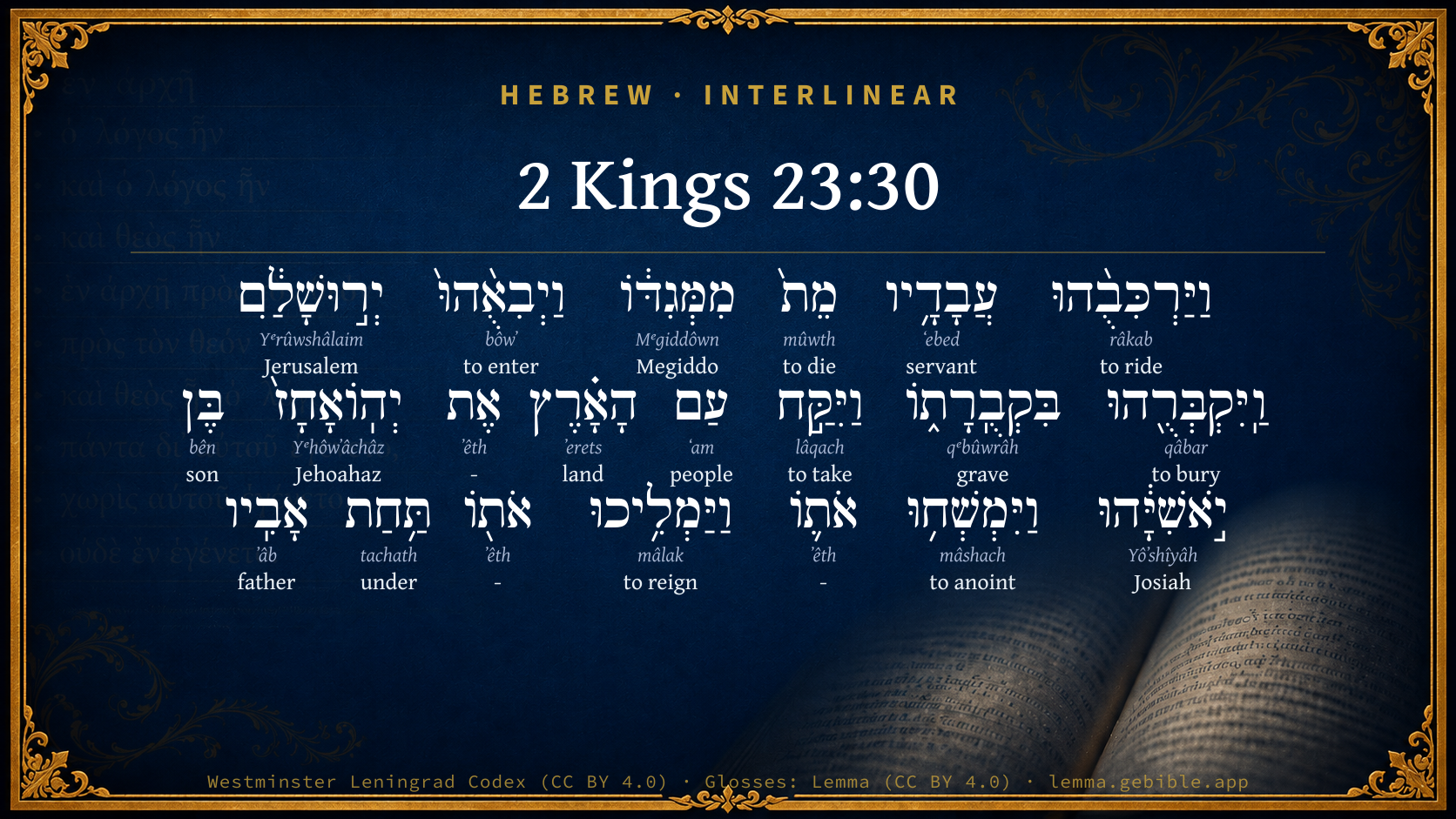
2 Kings 23:30

Hebrew (Westminster Leningrad Codex) 2 Kings 23:30 appears in the Hebrew Old Testament. The text above is from the Westminster Leningrad Codex. Each word links to its Strong’s number, a concise gloss, and parsing drawn from the Open Scriptures Hebrew Bible morphology. Click any word for its full Brown-Driver-Briggs (BDB) entry.
Download image
Cite this verse

2 Kings 23:30 (World English Bible). Public Domain. Lemma interlinear Bible study tool, https://lemma.gebible.app/v/2-kings/23/30.

Show BibTeX & RIS
BibTeX
RIS
English Translation
His servants carried him in a chariot dead from Megiddo, and brought him to Jerusalem, and buried him in his own tomb. The people of the land took Jehoahaz the son of Josiah, and anointed him, and made him king in his father's place.
World English Bible · Public Domain
Download a study sheet

One document with this verse’s original text, its word-by-word gloss line, the meaning frame, cross-references with their text, attributed commentary, and full source and license credits — printable, and it pastes into notes with its structure intact.

This verse Autodidact and up

Study sheet (.html) Plain text (.txt)

A passage Seminary Student

Up to 50 verses in one chapter. A passage sheet keeps up to 6 commentary sources and 12 cross-references per verse, in the order this page ranks them, and says so on the sheet whenever that leaves anything out. Ask for a single verse and you get the Autodidact verse sheet above.

Everything on this page stays free to read, with no account — the sheet is a download of what is already on screen, not access to it.

Want to remove ads? Support Godless Engineer
Compare translations 3

The same verse in 3 English versions, stacked beneath the original-language interlinear above. Click any original word for its lexicon entry.

Each is an independent rendering of the whole verse — the interlinear is not word-aligned to these translations.

Highlighted words mark where these versions differ — a whole-verse word diff, not a word-by-word alignment.

  • World English Bible Public Domain
    His servants carried him in a chariot dead from Megiddo, and brought him to Jerusalem, and buried him in his own tomb. The people of the land took Jehoahaz the son of Josiah, and anointed him, and made him king in his father's place.
  • King James Version Public Domain
    And his servants carried him in a chariot dead from Megiddo, and brought him to Jerusalem, and buried him in his own sepulchre. And the people of the land took Jehoahaz the son of Josiah, and anointed him, and made him king in his father's stead.
  • unfoldingWord Literal Text CC BY-SA 4.0
    And his servants caused him to ride dead from Megiddo and brought him Jerusalem. And they buried him in his grave. And the people of the land took Jehoahaz, the son of Josiah, and they anointed him and made him king in place of his father.

unfoldingWord Literal Text — © unfoldingWord, licensed CC BY-SA 4.0. Word-aligned USFM3 via Door43 (git.door43.org/unfoldingWord/en_ult).

Versions to compare (up to 4)

3 of 4 selected

Show all 18 translations

Every available English version of this verse, each an independent rendering of the whole verse.

  • World English Bible Public Domain
    His servants carried him in a chariot dead from Megiddo, and brought him to Jerusalem, and buried him in his own tomb. The people of the land took Jehoahaz the son of Josiah, and anointed him, and made him king in his father's place.
  • Berean Standard Bible Public Domain
    From Megiddo his servants carried his body in a chariot, brought him to Jerusalem, and buried him in his own tomb. Then the people of the land took Jehoahaz son of Josiah, anointed him, and made him king in place of his father.
  • Majority Standard Bible Public Domain
    From Megiddo his servants carried his body in a chariot, brought him to Jerusalem, and buried him in his own tomb. Then the people of the land took Jehoahaz son of Josiah, anointed him, and made him king in place of his father.
  • King James Version Public Domain
    And his servants carried him in a chariot dead from Megiddo, and brought him to Jerusalem, and buried him in his own sepulchre. And the people of the land took Jehoahaz the son of Josiah, and anointed him, and made him king in his father's stead.
  • American Standard Version (1901) Public Domain
    And his servants carried him in a chariot dead from Megiddo, and brought him to Jerusalem, and buried him in his own sepulchre. And the people of the land took Jehoahaz the son of Josiah, and anointed him, and made him king in his father's stead.
  • Revised Version (1885) Public Domain
    And his servants carried him in a chariot dead from Megiddo, and brought him to Jerusalem, and buried him in his own sepulchre. And the people of the land took Jehoahaz the son of Josiah, and anointed him, and made him king in his father’s stead.
  • Geneva Bible (1599) Public Domain
    Then his seruants caryed him dead from Megiddo, and brought him to Ierusalem, and buried him in his owne sepulchre. And the people of the lande tooke Iehoahaz the sonne of Iosiah, and anointed him, and made him King in his fathers steade.
  • Douay-Rheims (1899) Public Domain
    And his servants carried him dead from Mageddo: and they brought him to Jerusalem, and buried him in Iris own sepulchre. And the people of the land took Joachaz the son of Josias: and they anointed him, and made him king in his father's stead.
  • Young's Literal Translation Public Domain
    And his servants cause him to ride dying from Megiddo, and bring him in to Jerusalem, and bury him in his own grave, and the people of the land take Jehoahaz son of Josiah, and anoint him, and cause him to reign instead of his father.
  • Literal Standard Version CC BY-SA 4.0
    And his servants cause him to ride dying from Megiddo, and bring him to Jerusalem, and bury him in his own grave, and the people of the land take Jehoahaz son of Josiah, and anoint him, and cause him to reign instead of his father.
  • Unlocked Literal Bible CC BY-SA 4.0
    Josiah's servants carried him dead in a chariot from Megiddo, brought him to Jerusalem, and buried him in his own grave. Then the people of the land took Jehoahaz son of Josiah, anointed him, and made him king in his father's place.
  • unfoldingWord Literal Text CC BY-SA 4.0
    And his servants caused him to ride dead from Megiddo and brought him Jerusalem. And they buried him in his grave. And the people of the land took Jehoahaz, the son of Josiah, and they anointed him and made him king in place of his father.
  • Darby Bible Public Domain
    And his servants carried him in a chariot dead from Megiddo, and brought him to Jerusalem, and buried him in his own sepulchre. And the people of the land took Jehoahaz the son of Josiah, and anointed him, and made him king in his father's stead.
  • World Messianic Bible Public Domain
    His servants carried him dead in a chariot from Megiddo, brought him to Jerusalem, and buried him in his own tomb. The people of the land took Jehoahaz the son of Josiah, and anointed him, and made him king in his father’s place.
  • Webster's Bible Public Domain
    And his servants carried him in a chariot dead from Megiddo, and brought him to Jerusalem, and buried him in his own sepulcher. And the people of the land took Jehoahaz the son of Josiah and anointed him, and made him king in his father's stead.
  • Free Bible Version CC BY-SA 4.0
    His servants put his body in a chariot, brought him back from Megiddo to Jerusalem, and buried him in his own tomb. Then the people of the land chose Jehoahaz, son of Josiah, anointed him, and made him king in succession to his father.
  • Bible in Basic English Public Domain
    And his servants took his body in a carriage from Megiddo to Jerusalem, and put him into the earth there. And the people of the land took Jehoahaz, the son of Josiah, and put the holy oil on him and made him king in place of his father.
  • JPS Tanakh (1917) Public Domain
    And his servants carried him in a chariot dead from Megiddo, and brought him to Jerusalem, and buried him in his own sepulchre. And the people of the land took Jehoahaz the son of Josiah, and anointed him, and made him king in his father's stead.

Literal Standard Version (2020), Covenant Press — licensed CC BY-SA 4.0. Text via the HelloAO Bible API (eBible.org). Unlocked Literal Bible (unfoldingWord) — licensed CC BY-SA 4.0. Text via the HelloAO Bible API (eBible.org). unfoldingWord Literal Text — © unfoldingWord, licensed CC BY-SA 4.0. Word-aligned USFM3 via Door43 (git.door43.org/unfoldingWord/en_ult). Free Bible Version, Dr. Jonathan Gallagher — licensed CC BY-SA 4.0. Text via the HelloAO Bible API (eBible.org).

Word by word

More ways to search: Search by grammar → Find every occurrence → Compare this word →

Practice this passage: Drill this verse → Learn its vocabulary →

מִמְּגִדּ֔וֹ
Mᵉgiddôwn
H4023
“from · Megiddo”
Preposition + Noun, Proper
Part of Speech
Preposition + Noun
Type
Proper
Full BDB Definition

Origin: from H1413

TWOT: None

Megiddo or Megiddon = "place of crowds" - ancient city of Canaan assigned to Manasseh and located on the southern rim of the plain of Esdraelon 6 miles (10 kilometers) from Mount Carmel and 11 miles (18 kilometers) from Nazareth
  1. וַיַּרְכִּבֻ֨הוּ râkab H7392 “and · to ride · him” Conjunction + Verb, Hiphil, Sequential Imperfect, 3rd Person, Masculine, Plural + Suffix, Personal, 3rd Person, Masculine, Singular
  2. עֲבָדָ֥יו ʻebed H5650 “servants · his” Noun, Common, Masculine, Plural, Construct + Suffix, Personal, 3rd Person, Masculine, Singular
  3. מֵת֙ mûwth H4191 “dying” Verb, Qal, Participle Active, Masculine, Singular, Absolute
  4. וַיְבִאֻ֨הוּ֙ bôwʼ H935 “and · to enter · him” Conjunction + Verb, Hiphil, Sequential Imperfect, 3rd Person, Masculine, Plural + Suffix, Personal, 3rd Person, Masculine, Singular
  5. יְר֣וּשָׁלִַ֔ם Yᵉrûwshâlaim H3389 “Jerusalem” Noun, Proper
  6. וַֽיִּקְבְּרֻ֖הוּ qâbar H6912 “and · to bury · him” Conjunction + Verb, Qal, Sequential Imperfect, 3rd Person, Masculine, Plural + Suffix, Personal, 3rd Person, Masculine, Singular
  7. בִּקְבֻֽרָת֑וֹ qᵉbûwrâh H6900 “in/at · grave · his” Preposition + Noun, Common, Feminine, Singular, Construct + Suffix, Personal, 3rd Person, Masculine, Singular
  8. וַיִּקַּ֣ח lâqach H3947 “and · to take” Conjunction + Verb, Qal, Sequential Imperfect, 3rd Person, Masculine, Singular
  9. עַם ʻam H5971 “people of” Noun, Common, Masculine, Singular, Construct
  10. הָאָ֗רֶץ ʼerets H776 “the · land” Particle, Definite Article + Noun, Common, Both, Singular, Absolute
  11. אֶת ʼêth H853 “-” Particle, Direct Object
  12. יְהֽוֹאָחָז֙ Yᵉhôwʼâchâz H3059 “Jehoahaz” Noun, Proper
  13. בֶּן bên H1121 “son of” Noun, Common, Masculine, Singular, Construct
  14. יֹ֣אשִׁיָּ֔הוּ Yôʼshîyâh H2977 “Josiah” Noun, Proper
  15. וַיִּמְשְׁח֥וּ mâshach H4886 “and · to anoint” Conjunction + Verb, Qal, Sequential Imperfect, 3rd Person, Masculine, Plural
  16. אֹת֛וֹ ʼêth H853 “- · him” Particle, Direct Object + Suffix, Personal, 3rd Person, Masculine, Singular
  17. וַיַּמְלִ֥יכוּ mâlak H4427 “and · to reign” Conjunction + Verb, Hiphil, Sequential Imperfect, 3rd Person, Masculine, Plural
  18. אֹת֖וֹ ʼêth H853 “- · him” Particle, Direct Object + Suffix, Personal, 3rd Person, Masculine, Singular
  19. תַּ֥חַת tachath H8478 “under” Preposition
  20. אָבִֽיו ʼâb H1 “father · his” Noun, Common, Masculine, Singular, Construct + Suffix, Personal, 3rd Person, Masculine, Singular

About this verse

These counts appear in no published source. They are computed here, from the morphology-tagged text and Lemma’s own curated glosses. What Lemma adds →

21
words
19
distinct lemmas
Historical
section

Notable vocabulary

The rarest word here is מִמְּגִדּ֔וֹ Megiddo H4023 — appearing just 12 times in the whole Hebrew Bible.

Shared distinctive vocabulary

מִמְּגִדּ֔וֹ Megiddo H4023 occurs in 12 verses of the Hebrew Bible. Also found in:

Grammatical profile

  • 7 verbs
  • 10 nouns
  • 1 preposition
  • 3 particles

Verb forms

  • וַיַּרְכִּבֻ֨הוּ Hiphil · Sequential Imperfect
  • מֵת֙ Qal · Participle Active
  • וַיְבִאֻ֨הוּ֙ Hiphil · Sequential Imperfect
  • וַֽיִּקְבְּרֻ֖הוּ Qal · Sequential Imperfect
  • וַיִּקַּ֣ח Qal · Sequential Imperfect
  • וַיִּמְשְׁח֥וּ Qal · Sequential Imperfect
  • וַיַּמְלִ֥יכוּ Hiphil · Sequential Imperfect

Hebrew & Septuagint length

In English translation the verse runs 44 words from the Hebrew and 44 from the Septuagint (LXX English) — the same length.

A rough comparison of the two English renderings, which tokenize alike — not a word-level alignment.

Word counts can differ between the Hebrew and the Greek without any difference in meaning — e.g. the Hebrew direct-object marker אֵת has no separate Greek word, and Greek often adds the article ὁ.

Cross-references

6

Topical passages linked to 2 Kings 23:30 in the Treasury of Scripture Knowledge — connected by theme and wording, ordered by reader-vote popularity; previews shown in the World English Bible.

  • 2 Kings 9:28 His servants carried him in a chariot to Jerusalem, and buried him in his tomb with his fathers in the city of David.
  • 2 Chronicles 36:1–4 Then the people of the land took Jehoahaz the son of Josiah, and made him king in his father's place in Jerusalem.
  • 1 Kings 22:33–38 It happened, when the captains of the chariots saw that it was not the king of Israel, that they turned back from pursuing him.
  • 2 Kings 14:21 All the people of Judah took Azariah, who was sixteen years old, and made him king in the room of his father Amaziah.
  • 2 Kings 21:24 But the people of the land killed all those who had conspired against king Amon; and the people of the land made Josiah his son king in his place.
  • 2 Chronicles 35:24 So his servants took him out of the chariot, and put him in the second chariot that he had, and brought him to Jerusalem; and he died, and was buried in the tombs of his fathers. All Judah and Jerusalem mourned for Josiah.

Cross-references courtesy of OpenBible.info (CC BY 4.0).

Hebrew and Greek witnesses Masoretic Hebrew ↔ Greek Septuagint

The same verse in the two great witnesses to the Old Testament, shown verse-for-verse.

These are two independent witnesses, not word-aligned to each other, and the Septuagint is shown in lemma (dictionary) form.

Hebrew 2 Kings 23:30 Masoretic · Westminster Leningrad Codex

וַיַּרְכִּבֻ֨הוּ עֲבָדָ֥יו מֵת֙ מִמְּגִדּ֔וֹ וַיְבִאֻ֨הוּ֙ יְר֣וּשָׁלִַ֔ם וַֽיִּקְבְּרֻ֖הוּ בִּקְבֻֽרָת֑וֹ וַיִּקַּ֣ח עַם הָאָ֗רֶץ אֶת יְהֽוֹאָחָז֙ בֶּן יֹ֣אשִׁיָּ֔הוּ וַיִּמְשְׁח֥וּ אֹת֛וֹ וַיַּמְלִ֥יכוּ אֹת֖וֹ תַּ֥חַת אָבִֽיו

His servants carried him in a chariot dead from Megiddo, and brought him to Jerusalem, and buried him in his own tomb. The people of the land took Jehoahaz the son of Josiah, and anointed him, and made him king in his father's place.

World English Bible · Public Domain

Greek LXX 2 Kings 23:30 Septuagint · lemma form

καί ἐπιβιβάζω αὐτός ὁ παῖς αὐτός νεκρός ἐκ μαγεδδω καί ἄγω αὐτός εἰς ἰερουσαλήμ καί θάπτω αὐτός ἐν ὁ τάφος αὐτός ἐν πόλις δαυίδ καί λαμβάνω ὁ λαός ὁ γῆ ὁ ιωαχας υἱός ιωσιας καί χρίω αὐτός καί βασιλεύω αὐτός ἀντί ὁ πατήρ αὐτός

And his servants carried him dead from Mageddo, and brought him to Jerusalem, and buried him in his sepulchre: and the people of the land took Joachaz the son of Josias, and anointed him, and made him king in the room of his father.

LXX2012 (modern English Septuagint) · Public Domain

Hebrew: Westminster Leningrad Codex (CC BY 4.0). Greek: Septuagint (public domain); English from LXX2012 (modern English Septuagint) (Public Domain). How the Septuagint differs from the Hebrew →

Targum (Aramaic paraphrase)

1

The Targum is the ancient Jewish Aramaic paraphrase of the Hebrew Scriptures — an interpretive translation, not the Hebrew text itself. Onkelos (literal) and Pseudo-Jonathan (expansive) render the Torah, and Jonathan the Prophets. Coverage is partial: where no permissively-licensed English translation exists for a verse, only the Aramaic is shown. This is verse-level text, not a word-by-word alignment to the Hebrew.

  1. Targum Jonathan Prophets (Joshua–Malachi)
    וְאַחְתוּהִי עַבְדוֹהִי כַּד מִית מִמְגִדוֹ וִאַיְתִיאוּהִי לִירוּשְׁלֵם וְקַבְרוּהִי בִּקְבוּרְתֵּיהּ וּדְבַר עַמָא דְאַרְעָא יַת יְהוֹאָחָז בַּר יֹאשִׁיָהוּ וּמְשָׁחוּ יָתֵיהּ וְאַמְלִיכוּ יָתֵיהּ תְּחוֹת אֲבוּהִי:

    (no public-domain English translation for this verse)

    Targum Jonathan — Aramaic: “Mikraot Gedolot” (public domain). English: “Sefaria Community Translation” (CC0 1.0 (public-domain dedication)); “London "Chaldee Paraphrase," 1871” (public domain). Text via Sefaria.

Commentary

Notes on 2 Kings 23:30 from classic Christian and Jewish commentators (each source and its license shown beneath its notes). The classic Christian expositions comment on the surrounding passage and are grouped to its opening verse, so a note may address several verses; the Jewish commentaries on the Tanakh (Rashi and others) are per-verse, so they appear only where the commentator wrote on this verse.

Lemma curates 59 commentaries, every one of them public domain or Creative Commons licensed, each selected and text-cleaned for this edition rather than reprinted as found. About our sources →

Trapp's Complete Commentary

John Trapp

2Ki 23:30 And his servants carried him in a chariot dead from Megiddo, and brought him to Jerusalem, and buried him in his own sepulchre. And the people of the land took Jehoahaz the son of Josiah, and anointed him, and made him king in his father’s stead.

Ver. 30. And his servants carried him in a chariot dead.] Mortuum, i.e., Moribundum, a dying man. See on 2Ki 23:29.

And the people of the land took Jehoahaz.] Lest Pharaoh at his return finding no king, should seize upon the kingdom; but this greatly provoked the conqueror, to whom they should rather have sought for peace and liberty to make them a new king.

John Trapp, A Commentary or Exposition upon All the Books of the Old and New Testament (1647–1656) — public domain. Text from a community e-Sword module.

Joseph Benson's Commentary

2Ki 23:30. His servants carried him in a chariot dead from Megiddo — That is, mortally wounded, as in the former verse; and, as we commonly say of a sick man, past hopes of recovery, that he is a dead man. Instead of dead, Houbigant reads dying. The people took Jehoahaz, and made him king — Who was younger than Jehoiakim, yet preferred by the people before the elder brother; either because Jehoiakim refused the kingdom for fear of Pharaoh, whom he knew he should hereby provoke; or, because Jehoahaz was the more stout and warlike prince: whence he is called a lion, Eze 19:3. And anointed him — Which ceremony was used because this was a troublesome time, and he was not the right heir to the crown, and therefore needed this solemn rite of confirmation, which Solomon had in the same circumstances.

Joseph Benson's Commentary on the Old and New Testaments (1811–1818) — public domain. Text from a community e-Sword module.

Tyndale Open Study Notes

Tyndale Open Resources

23:30 The Chronicler reports on the great honor that Josiah received in death (2 Chr 35:24-25).

Tyndale Open Study Notes — © Tyndale Open Resources, licensed CC BY-SA 4.0. Text via the HelloAO Bible API.

Adam Clarke's Commentary

Verse 30. Dead from Megiddo] The word מת meth should here be considered as a participle, dying, for it is certain he was not dead: he was mortally wounded at Megiddo, was carried in a dying state to Jerusalem, and there he died and was buried. See 2Ch 35:24.

Herodotus, lib. i., c. 17, 18, 25, and lib. ii. 159, appears to refer to the same war which is here mentioned. He says that Nechoh, in the sixth year of his reign, went to attack the king of Assyria at Magdolum, gained a complete victory, and took Cadytis. Usher and others believe that Magdolum and Megiddo were the same place. The exact place of the battle seems to have been Hadadrimmon, in the valley of Megiddo, for there Zechariah tells us 2Kg 12:11, was the great mourning for Josiah. Compare this with 2Ch 35:24-25.

Adam Clarke's Commentary on the Bible (1810–1826) — public domain. Text from a community e-Sword/MySword module.

Ellicott's Commentary for English Readers

(30) And his servants carried him . . .—See Notes 2Ch_35:24.

The people of the land.—Thenius says they were the soldiery who had fled to Jerusalem; but this is doubtful.

Took Jehoahaz.—He was not the eldest son (see 2Ki_23:36), but he may have been thought a more capable prince amid the emergencies of the time, although Jer_22:10 seq. shows that this estimate was fallacious.

A Bible Commentary for English Readers, edited by Charles John Ellicott (1878–1897) — public domain. Text from a community e-Sword module.

The Cambridge Bible for Schools and Colleges

gen. ed. J. J. S. Perowne

30. carried him in a chariot] The italics are wrong as also in 2Ki_9:28. The verb signifies ‘to carry in a chariot’. The R.V. prints in common type. According to the Chronicler, they moved him from his war chariot into a second chariot which he had at hand. From Zec_12:11 ‘As the mourning of Hadad-Rimmon in the valley of Megiddo’ it has been supposed that Josiah did not die till he reached Hadad-Rimmon, and that the mourning there mentioned by the prophet was for this good king’s death. The Chronicler dwells at length on the sorrow which this event caused. ‘Jeremiah lamented for him, and all the singing men and singing women spake of Josiah in their lamentations unto this day’. Some have thought that the lamentation here spoken of is preserved to us in the poem contained in Lamentations 4. But there is hardly anything in it which can be taken as clear allusion to this time. Jeremiah’s dirge for Josiah has probably perished with much other literature of the period.

Jehoahaz … and anointed him] To anoint a king who succeeded in the ordinary way was not usual. Hence some have thought that the people of the land were not acting according to what Josiah himself would have wished, nor choosing the recognised successor in passing over the elder brother. They wished therefore, by this solemn rite, to ensure his acceptance as their religiously consecrated monarch.

It appears from the history in Kings that Eliakim (Jehoiakim) was older than Jehoahaz, because on Eliakim’s succession he is stated to have been 25 years old, while Jehoahaz, whose reign was only of three months’ duration, is said to have been 23 when he came to the throne (2Ki_23:31; 2Ki_23:36). But in the genealogy (1Ch_3:15) the sons of Josiah are put down as ‘the firstborn Johanan (and this the margin of A.V. identifies with Jehoahaz), the second Jehoiakim, the third Zedekiah, the fourth Shallum’. If the margin of A.V. is correct then Jehoahaz would have succeeded in his proper place. But he is called Shallum in Jer_22:11, and so he would be, according to the Chronicler, the fourth son.

The Cambridge Bible for Schools and Colleges (gen. ed. J. J. S. Perowne; Cambridge University Press, 1878–1918) — public domain. Text from a community e-Sword module.

John Gill's Exposition

And he did that which was evil in the sight of the Lord,.... Committed idolatry:

according to all that his fathers had done; his grand father and great grandfather, Amon and Manasseh; so soon after Josiah's death was the revolt to idolatry.

John Gill's Exposition of the Whole Bible (1746–1763) — public domain (CC PDM 1.0). Text via the HelloAO Bible API.

Albert Barnes' Notes on the Bible

Dead - It appears from a comparison of this passage with 2 Chronicles (marginal reference) that Josiah was not actually killed in the battle.

Jehoahaz - Or Shallum (the marginal note). He may have taken the name of Jehoahaz (“the Lord possesses”) on his accession. He was not the eldest son of Josiah (see 2Ki 23:36 note). The mention of “anointing” here favors the view that there was some irregularity in the succession (see 1Ki 1:34 note).

Albert Barnes' Notes on the Bible (1834–1885) — public domain. Text from a community e-Sword/MySword module.

Haydock's Catholic Bible Commentary

Sepulchre. Paralipomenon xxxv., in the monument (or mausoleum) of his fathers. Such was the end of Josias: he fell gloriously in defence of his country, as he had spent his life in promoting religion. God therefore withdrew him from the sight of the miseries which were shortly to fall on his devoted people, chap. xxii. 20. (Haydock) --- He was a prince of most excellent disposition, and receives the highest encomium, ver. 25., and Ecclesiasticus xlix. 1. Jeremias composed his funeral canticle, which was sung on his anniversary for many years, 2 Paralipomenon xxxv. 24. The mourning for this pious king became proverbial, and resembled that which should be made for the Messias, Zacharias xii. 11. The life and death of Josias prefigured those of Jesus Christ; who should be long expected as the restorer of the true religion, the teacher of a more excellent law, and the most innocent victim for the sins of the people. The glorious Phase under Josias, was but a faint representation of the eucharistic sacrifice. (Calmet)

George Leo Haydock (1774–1849), Haydock's Catholic Family Bible and Commentary, 1859 edition — public domain. Excludes Psalms (Douay-Rheims chapter numbering differs from Protestant) and Deuterocanonical books (Catholic canon only).

Matthew Poole's English Annotations

Dead, i.e. mortally wounded, as in the former verse; and as we commonly say of a sick man past hopes of recovery, that he is a dead man: compare Gen 20:3.

Jehoahaz the son of Josiah, who was younger than Jehoiakim, by comparing 2Ki 23:31 with 2Ki 23:36, yet preferred by the people before the elder brother; either because Jehoiakim refused the kingdom for fear of Pharaoh, whom he knew he should hereby provoke; or because Jehoahaz was the more stout and warlike prince; whence he is called a lion, Eze 19:3, though indeed he showed his courage more against his people than his enemies; but they judged that he was most able and willing to defend them against the conquering army.

Anointed him; as they used to do in such extraordinary cases, because this was a troublesome time, and he was not the right heir to the crown, and therefore needed this solemn rite of confirmation, which Solomon had in the same circumstances.

Matthew Poole's English Annotations on the Holy Bible (1683–1685) — public domain. Text from a community e-Sword/MySword module.

Whedon's Commentary on the Bible

Daniel D. Whedon

30. Dead from Megiddo — So he did not die at Jerusalem, as the form of statement in Chronicles would lead one to suppose. He probably gave orders, as soon as wounded, for his whole army to retreat, and he had perhaps been carried as far as Hadadrimmon, some five miles south of Megiddo, before he expired. Hence the origin of the expression, “the mourning of Hadadrimmon in the valley of Megiddon.” Zec_12:11.

Buried him in his own sepulchre — Which was probably “in the garden of Uzza,” where his father (2Ki_21:26) and grandfather (2Ki_21:18) had been buried. 2 Chronicles adds, that “all Judah and Jerusalem mourned for Josiah. And Jeremiah lamented,” together with “all the singing men and the singing women,” so that their lamentations became “an ordinance in Israel.”

People of the land — The great body of the nation by their representatives, the elders. Compare 2 Kings 11:24.

Daniel D. Whedon (gen. ed.), Commentary on the Old and New Testaments (1874–1909) — public domain. Text from a community e-Sword module.

The Pulpit Commentary

And his servants carried him in a chariot his "second chariot," according to the writer of Chronicles, (2Ch_35:24) which was probably one kept in reserve in case flight should be necessary, of lighter construction, and drawn by fleeter horses, than his war-chariotdead from Megiddo. Wounded to death, that is. From Chronicles we gather that his wound, which was from an arrow, was not immediately fatal; (2Ch_35:23, 2Ch_35:24) but that he died of it on his way to Jerusalem, or directly after his arrival. And brought him to Jerusalem, and buried him in his own sepulcher. (comp. 2Ki_21:18, 2Ki_21:26) The writer of Chronicles says, "in the sepulcher of his fathers," apparently meaning the burial-place in which were interred the bodies of Manasseh and Amen. We learn from Chronicles that a great lamentation was made for Josiah, the only King of Judah slain in battle, the last good king of David"s line, the pious prince whose piety had not sufficed to avert the anger of Jehovah. Jeremiah "lamented for him", (2Ch_35:25) perhaps in a set composition (Josephus, " Ant. Jud:," 10:5. though that composition is certainly not either the Book of Lamentations or the fourth chapter of that book. He was further mourned by "all the singing men and the singing women" (2 Chronicles, l.s.c.), who "spake of him in their lamentations, and "made them an ordinance in Israel," and entered these "lamentations," apparently in a book, which was called "The Book of Lamentations," or "of Dirges." And the people of the laud took Jehoahaz the son of Josiah. Jehoahaz was otherwise named "Shallum" (1Ch_3:15; Jer_22:11) On what grounds the people preferred him to his elder brother, Eliakim, we do not know. Perhaps Eliakim had accompanied his father to Megiddo, and been made prisoner by Nechoh in the battle. And anointed him (see the comment on 1Ki_1:34, and supra, 2Ki_11:12) and made him king in his father"s stead.

The Pulpit Commentary (1880–1919), ed. H.D.M. Spence-Jones & Joseph S. Exell — public domain. Text from a community e-Sword module.

John Wesley's Explanatory Notes

Dead - Mortally wounded. Jehoahaz - Who was younger than Jehoiakim, yet preferred by the people before the elder brother; either because Jehoiakim refused the kingdom for fear of Pharaoh, whom he knew he should hereby provoke. Or because Jehoahaz was the more stout and warlike prince; whence he is called a lion, Ezek xix, 3.

John Wesley, Explanatory Notes Upon the Whole Bible (1754–1765) — public domain. Text via the GEBible commentary corpus.

Rashi

Rabbi Shlomo Yitzchaki (Rashi)

Anointed. He did not require anointment, nonetheless [he was anointed] because Yehoyakim his brother was two years older than he, as is explained in this section.

Rashi on the Tanakh — English translations: “The Judaica Press complete Tanach with Rashi, translated by A. J. Rosenberg” (CC BY 4.0); “Pentateuch with Rashi's commentary by M. Rosenbaum and A.M. Silbermann, 1929-1934” (public domain); “The Metsudah Tanach series, Lakewood, N.J” (CC BY 4.0); and “The Book of Joshua, Metsudah Publications, 1997” (CC BY 4.0). Text via Sefaria.

Lesson kit

Teaching starters — assembled from the data on this page, not authored interpretation. Every prompt links to the verse data it draws on. Edit before teaching.

2 Kings, in the Historical, opens this verse with 21 words (19 distinct Hebrew lemmas). Its most distinctive word is Mᵉgiddôwn (“Megiddo”). A historical commentator’s framing appears above. Read the whole chapter for the surrounding context.

Discussion questions

  1. What does “Megiddo” (Mᵉgiddôwn) contribute to the verse as a whole?
  2. Joshua 12:21 shares the word «Megiddo» with this verse. How do the two illuminate each other?
  3. The translations on this page render this verse differently — a whole-verse word diff, not a word-by-word alignment. What might account for the different wordings?
  4. The verb «וַיַּרְכִּבֻ֨הוּ» is Hiphil Sequential Imperfect. How does its form color the action?
  5. Reading how Trapp's Complete Commentary and Joseph Benson's Commentary read this verse, where do the two commentators agree and where do they part?

Things to notice

Reading settings

Reading text

Shown beneath each verse's original-language words.

Old Testament
Old Testament edition

Read the OT as the Masoretic Hebrew (MT) or the Greek Septuagint (LXX).

English shown for the Greek Septuagint (in the Hebrew ↔ Greek comparison).

Comparing translations? Open the Compare panel on any verse page to stack up to four side by side.