
Deuteronomy 2:4

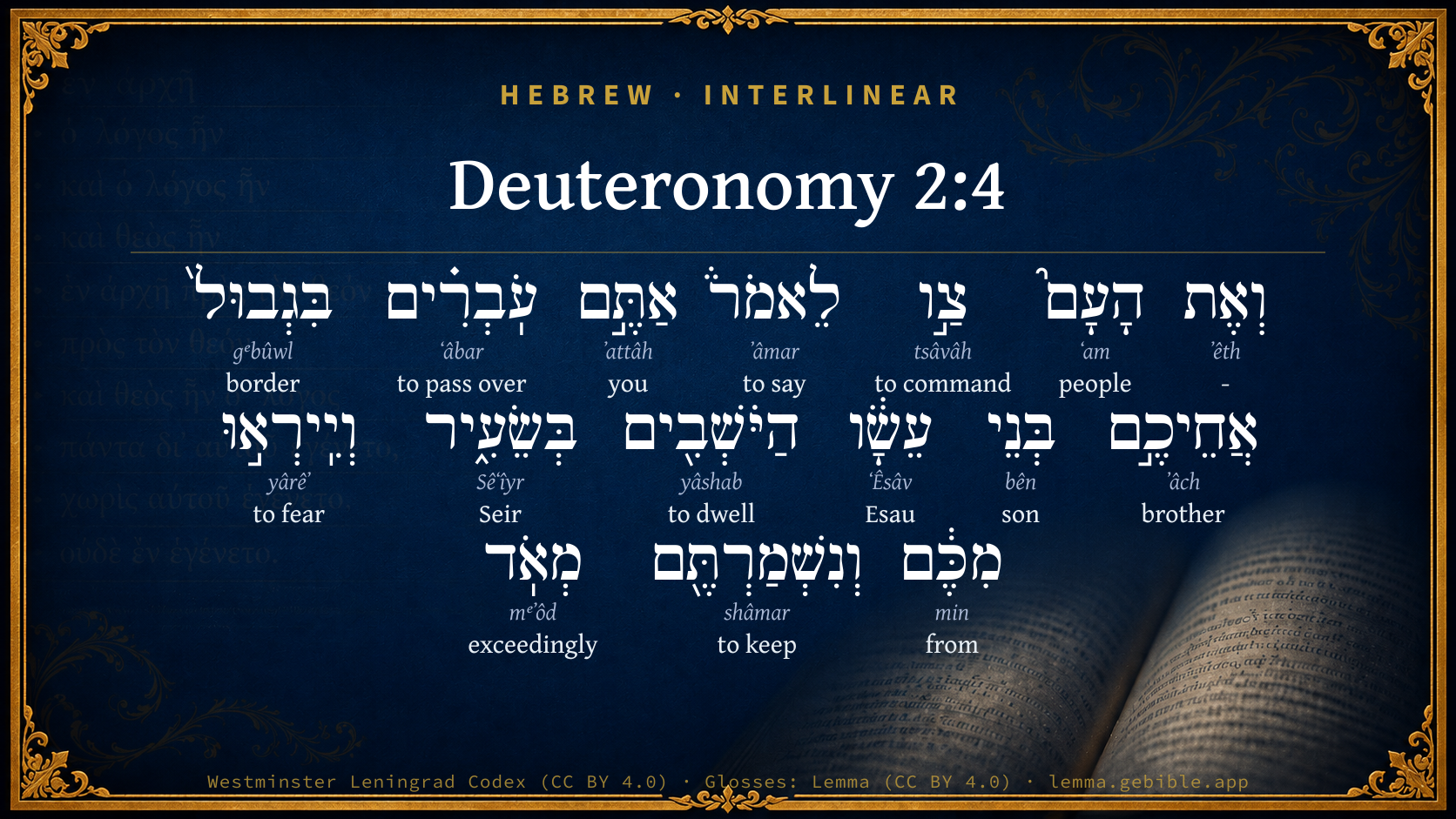
Hebrew (Westminster Leningrad Codex) Deuteronomy 2:4 appears in the Hebrew Old Testament. The text above is from the Westminster Leningrad Codex. Each word links to its Strong’s number, a concise gloss, and parsing drawn from the Open Scriptures Hebrew Bible morphology. Click any word for its full Brown-Driver-Briggs (BDB) entry.
Download image
Cite this verse

Deuteronomy 2:4 (World English Bible). Public Domain. Lemma interlinear Bible study tool, https://lemma.gebible.app/v/deuteronomy/2/4.

Show BibTeX & RIS
BibTeX
RIS
English Translation
Command you the people, saying, You are to pass through the border of your brothers the children of Esau, who dwell in Seir; and they will be afraid of you: take good heed to yourselves therefore;
World English Bible · Public Domain
Download a study sheet

One document with this verse’s original text, its word-by-word gloss line, the meaning frame, cross-references with their text, attributed commentary, and full source and license credits — printable, and it pastes into notes with its structure intact.

This verse Autodidact and up

Study sheet (.html) Plain text (.txt)

A passage Seminary Student

Up to 50 verses in one chapter. A passage sheet keeps up to 6 commentary sources and 12 cross-references per verse, in the order this page ranks them, and says so on the sheet whenever that leaves anything out. Ask for a single verse and you get the Autodidact verse sheet above.

Everything on this page stays free to read, with no account — the sheet is a download of what is already on screen, not access to it.

Want to remove ads? Support Godless Engineer
Compare translations 3

The same verse in 3 English versions, stacked beneath the original-language interlinear above. Click any original word for its lexicon entry.

Each is an independent rendering of the whole verse — the interlinear is not word-aligned to these translations.

Highlighted words mark where these versions differ — a whole-verse word diff, not a word-by-word alignment.

  • World English Bible Public Domain
    Command you the people, saying, You are to pass through the border of your brothers the children of Esau, who dwell in Seir; and they will be afraid of you: take good heed to yourselves therefore;
  • King James Version Public Domain
    And command thou the people, saying, Ye are to pass through the coast of your brethren the children of Esau, which dwell in Seir; and they shall be afraid of you: take ye good heed unto yourselves therefore:
  • unfoldingWord Literal Text CC BY-SA 4.0
    And command the people, saying, “You will be crossing the border of your brothers, the sons of Esau, who live in Seir. And they will be afraid of you. And you shall be exceedingly on guard.

unfoldingWord Literal Text — © unfoldingWord, licensed CC BY-SA 4.0. Word-aligned USFM3 via Door43 (git.door43.org/unfoldingWord/en_ult).

Versions to compare (up to 4)

3 of 4 selected

Show all 18 translations

Every available English version of this verse, each an independent rendering of the whole verse.

  • World English Bible Public Domain
    Command you the people, saying, You are to pass through the border of your brothers the children of Esau, who dwell in Seir; and they will be afraid of you: take good heed to yourselves therefore;
  • Berean Standard Bible Public Domain
    and command the people: ‘You will pass through the territory of your brothers, the descendants of Esau, who live in Seir. They will be afraid of you, so you must be very careful.
  • Majority Standard Bible Public Domain
    and command the people: ‘You will pass through the territory of your brothers, the descendants of Esau, who live in Seir. They will be afraid of you, so you must be very careful.
  • King James Version Public Domain
    And command thou the people, saying, Ye are to pass through the coast of your brethren the children of Esau, which dwell in Seir; and they shall be afraid of you: take ye good heed unto yourselves therefore:
  • American Standard Version (1901) Public Domain
    And command thou the people, saying, Ye are to pass through the border of your brethren the children of Esau, that dwell in Seir; and they will be afraid of you: take ye good heed unto yourselves therefore;
  • Revised Version (1885) Public Domain
    And command thou the people, saying, Ye are to pass through the border of your brethren the children of Esau, which dwell in Seir; and they shall be afraid of you: take ye good heed unto yourselves therefore:
  • Geneva Bible (1599) Public Domain
    And warne thou the people, saying, Ye shall go through the coast of your brethren the children of Esau, which dwell in Seir, and they shall be afraide of you: take ye good heede therefore.
  • Douay-Rheims (1899) Public Domain
    And command thou the people, saying: You shall pass by the borders of your brethren the children of Esau, who dwell in Seir, and they will be afraid of you.
  • Young's Literal Translation Public Domain
    `And the people command thou, saying, Ye are passing over into the border of your brethren, sons of Esau, who are dwelling in Seir, and they are afraid of you; and ye have been very watchful,
  • Literal Standard Version CC BY-SA 4.0
    And the people command you, saying, You are passing over into the border of your brothers, sons of Esau, who are dwelling in Seir, and they are afraid of you; and you have been very watchful;
  • Unlocked Literal Bible CC BY-SA 4.0
    Command the people, saying, “You are to pass through the border of your brothers, the descendants of Esau, who live in Seir; they will be afraid of you. Therefore be careful
  • unfoldingWord Literal Text CC BY-SA 4.0
    And command the people, saying, “You will be crossing the border of your brothers, the sons of Esau, who live in Seir. And they will be afraid of you. And you shall be exceedingly on guard.
  • Darby Bible Public Domain
    And command the people, saying, Ye are to pass through the border of your brethren the children of Esau, who dwell in Seir; and they will be afraid of you; and ye shall be very guarded:
  • World Messianic Bible Public Domain
    Command the people, saying, ‘You are to pass through the border of your brothers, the children of Esau, who dwell in Seir; and they will be afraid of you. Therefore be careful.
  • Webster's Bible Public Domain
    And command thou the people, saying, Ye are to pass through the border of your brethren the children of Esau, who dwell in Seir; and they will be afraid of you: therefore take ye good heed to yourselves:
  • Free Bible Version CC BY-SA 4.0
    and give these orders to the people: You are going to pass through the territory of your relatives, the descendants of Esau, who live in Seir. They will be frightened of you, so you need to be very careful.
  • Bible in Basic English Public Domain
    And give the people orders, saying, You are about to go through the land of your brothers, the children of Esau, who are living in Seir; and they will have fear of you; so take care what you do:
  • JPS Tanakh (1917) Public Domain
    And command thou the people, saying: Ye are to pass through the border of your brethren the children of Esau, that dwell in Seir; and they will be afraid of you; take ye good heed unto yourselves therefore;

Literal Standard Version (2020), Covenant Press — licensed CC BY-SA 4.0. Text via the HelloAO Bible API (eBible.org). Unlocked Literal Bible (unfoldingWord) — licensed CC BY-SA 4.0. Text via the HelloAO Bible API (eBible.org). unfoldingWord Literal Text — © unfoldingWord, licensed CC BY-SA 4.0. Word-aligned USFM3 via Door43 (git.door43.org/unfoldingWord/en_ult). Free Bible Version, Dr. Jonathan Gallagher — licensed CC BY-SA 4.0. Text via the HelloAO Bible API (eBible.org).

Word by word

More ways to search: Search by grammar → Find every occurrence → Compare this word →

Practice this passage: Drill this verse → Learn its vocabulary →

בְּשֵׂעִ֑יר
Sêʻîyr
H8165
“in/at · Seir”
Preposition + Noun, Proper
Part of Speech
Preposition + Noun
Type
Proper
Full BDB Definition

Origin: formed like H8163

TWOT: 2274h , 2274g

Seir = "hairy" or " shaggy" - patriarch of the Horites, the inhabitants of Edom before the descendants of Esau, the Edomites (noun proper masculine) - the land of Edom, south of the Dead Sea (noun proper territorial) - a mountain range in Edom extending from the Dead Sea to the Elanitic Gulf (noun proper mountain) - apparently also called 'Mount Seir' and extending most of the distance of the mountain range itself - a mountain in northern Judah lying westward from Kirjath-jearim (noun proper mountain)
  1. וְאֶת ʼêth H853 “and · -” Conjunction + Particle, Direct Object
  2. הָעָם֮ ʻam H5971 “the · people” Particle, Definite Article + Noun, Common, Masculine, Singular, Absolute
  3. צַ֣ו tsâvâh H6680 “command” Verb, Piel, Imperative, 2nd Person, Masculine, Singular
  4. לֵאמֹר֒ ʼâmar H559 “to say” Preposition + Verb, Qal, Infinitive Construct
  5. אַתֶּ֣ם ʼattâh H859 “you” Pronoun, Personal, 2nd Person, Masculine, Plural
  6. עֹֽבְרִ֗ים ʻâbar H5674 “passing over” Verb, Qal, Participle Active, Masculine, Plural, Absolute
  7. בִּגְבוּל֙ gᵉbûwl H1366 “in/at · border of” Preposition + Noun, Common, Masculine, Singular, Construct
  8. אֲחֵיכֶ֣ם ʼâch H251 “brothers · your” Noun, Common, Masculine, Plural, Construct + Suffix, Personal, 2nd Person, Masculine, Plural
  9. בְּנֵי bên H1121 “sons of” Noun, Common, Masculine, Plural, Construct
  10. עֵשָׂ֔ו ʻÊsâv H6215 “Esau” Noun, Proper
  11. הַיֹּשְׁבִ֖ים yâshab H3427 “the · dwelling” Particle, Definite Article + Verb, Qal, Participle Active, Masculine, Plural, Absolute
  12. וְיִֽירְא֣וּ yârêʼ H3372 “and · to fear” Conjunction + Verb, Qal, Imperfect, 3rd Person, Masculine, Plural
  13. מִכֶּ֔ם min H4480 “from · you” Preposition + Suffix, Personal, 2nd Person, Masculine, Plural
  14. וְנִשְׁמַרְתֶּ֖ם shâmar H8104 “and · to keep” Conjunction + Verb, Niphal, Sequential Perfect, 2nd Person, Masculine, Plural
  15. מְאֹֽד mᵉʼôd H3966 “exceedingly” Adverb

About this verse

These counts appear in no published source. They are computed here, from the morphology-tagged text and Lemma’s own curated glosses. What Lemma adds →

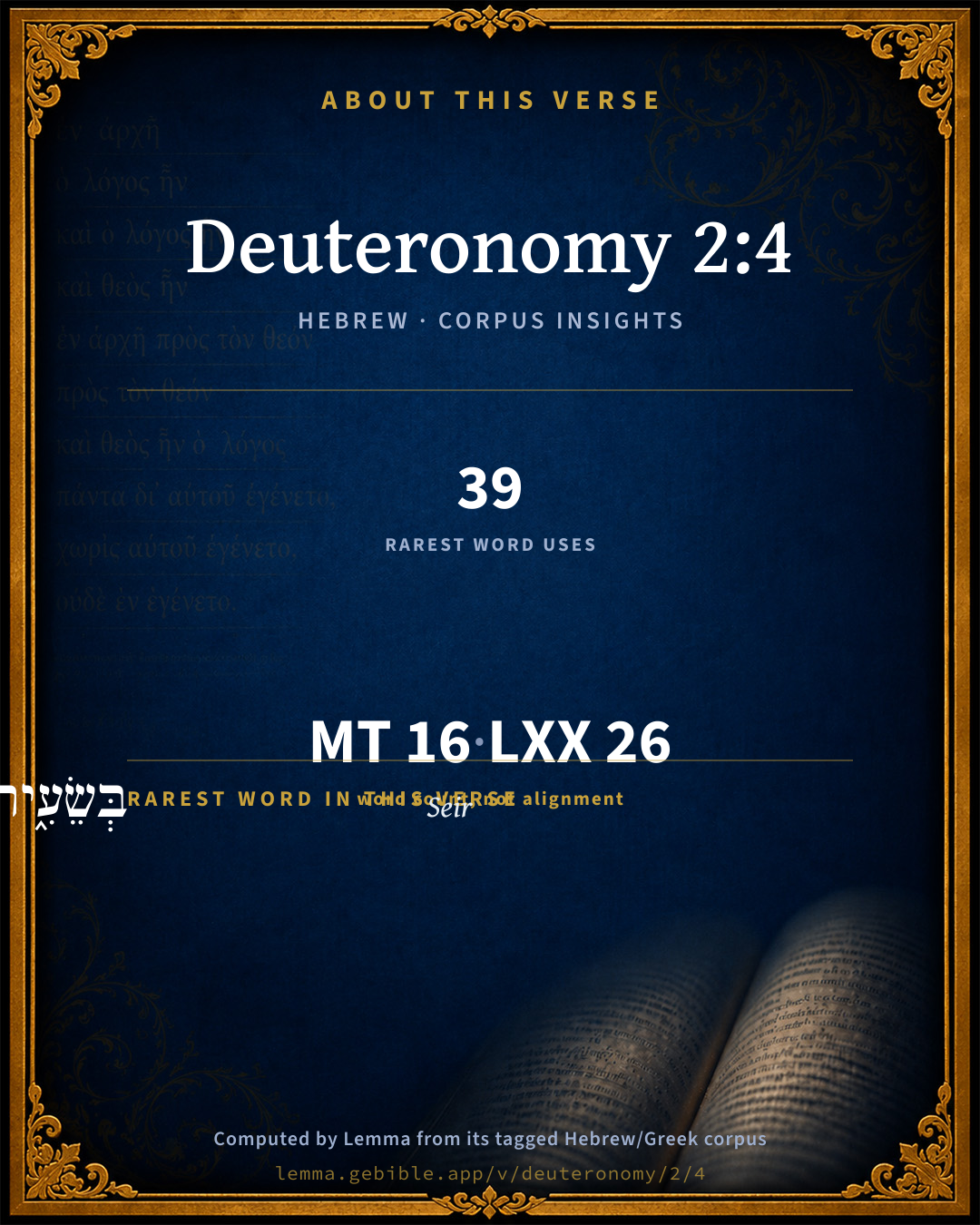
16
words
16
distinct lemmas
Pentateuch
section

Shared distinctive vocabulary

בְּשֵׂעִ֑יר Seir H8165 occurs in 38 verses of the Hebrew Bible. Also found in:

Grammatical profile

  • 6 verbs
  • 6 nouns
  • 1 pronoun
  • 1 preposition
  • 1 adverb
  • 1 particle

Verb forms

  • צַ֣ו Piel · Imperative
  • לֵאמֹר֒ Qal · Infinitive Construct
  • עֹֽבְרִ֗ים Qal · Participle Active
  • הַיֹּשְׁבִ֖ים Qal · Participle Active
  • וְיִֽירְא֣וּ Qal · Imperfect
  • וְנִשְׁמַרְתֶּ֖ם Niphal · Sequential Perfect

Hebrew & Septuagint length

In English translation the verse runs 36 words from the Hebrew and 31 from the Septuagint (LXX English) — closely comparable.

A rough comparison of the two English renderings, which tokenize alike — not a word-level alignment.

Word counts can differ between the Hebrew and the Greek without any difference in meaning — e.g. the Hebrew direct-object marker אֵת has no separate Greek word, and Greek often adds the article ὁ.

In the original languages it is 16 Hebrew tokens and 26 Greek tokens — but the two are counted differently (Hebrew bundles its prefixes and suffixes into one token; the Greek is in lemma form), so that isn’t a like-for-like length.

Cross-references

11

Topical passages linked to Deuteronomy 2:4 in the Treasury of Scripture Knowledge — connected by theme and wording, ordered by reader-vote popularity; previews shown in the World English Bible.

  • Numbers 20:14–21 Moses sent messengers from Kadesh to the king of Edom, Thus says your brother Israel, You know all the travail that has happened to us:
  • Exodus 15:15 Then the chiefs of Edom were dismayed. Trembling takes hold of the mighty men of Moab. All the inhabitants of Canaan are melted away.
  • Deuteronomy 23:7 You shall not abhor an Edomite; for he is your brother: you shall not abhor an Egyptian, because you lived as a foreigner in his land.
  • Numbers 22:3–4 Moab was sore afraid of the people, because they were many: and Moab was distressed because of the children of Israel.
  • Obadiah 1:10–13 For the violence done to your brother Jacob, shame will cover you, and you will be cut off forever.
  • Matthew 5:16 Even so, let your light shine before men; that they may see your good works, and glorify your Father who is in heaven.
  • Luke 12:15 He said to them, "Beware! Keep yourselves from covetousness, for a man's life doesn't consist of the abundance of the things which he possesses."
  • Ephesians 5:15 Therefore watch carefully how you walk, not as unwise, but as wise;
  • Philippians 2:15 that you may become blameless and harmless, children of God without blemish in the midst of a crooked and perverse generation, among whom you are seen as lights in the world,
  • Colossians 4:5 Walk in wisdom toward those who are outside, redeeming the time.
  • Numbers 24:14–18 Now, behold, I go to my people: come, [and] I will advertise you what this people shall do to your people in the latter days.

Cross-references courtesy of OpenBible.info (CC BY 4.0).

Hebrew and Greek witnesses Masoretic Hebrew ↔ Greek Septuagint

The same verse in the two great witnesses to the Old Testament, shown verse-for-verse.

These are two independent witnesses, not word-aligned to each other, and the Septuagint is shown in lemma (dictionary) form.

Hebrew Deuteronomy 2:4 Masoretic · Westminster Leningrad Codex

וְאֶת הָעָם֮ צַ֣ו לֵאמֹר֒ אַתֶּ֣ם עֹֽבְרִ֗ים בִּגְבוּל֙ אֲחֵיכֶ֣ם בְּנֵי עֵשָׂ֔ו הַיֹּשְׁבִ֖ים בְּשֵׂעִ֑יר וְיִֽירְא֣וּ מִכֶּ֔ם וְנִשְׁמַרְתֶּ֖ם מְאֹֽד

Command you the people, saying, You are to pass through the border of your brothers the children of Esau, who dwell in Seir; and they will be afraid of you: take good heed to yourselves therefore;

World English Bible · Public Domain

Greek LXX Deuteronomy 2:4 Septuagint · lemma form

καί ὁ λαός ἐντέλλομαι λέγω σύ παραπορεύομαι διά ὁ ὅριον ὁ ἀδελφός σύ υἱός ησαυ ὅς καταοἰκέω ἐν σηιρ καί φοβέω σύ καί εὐλαβέομαι σύ σφόδρα

And charge the people, saying, You⌃ are going through the borders of your brethren the children of Esau, who dwell in Seir; and they shall fear you, and dread you greatly.

LXX2012 (modern English Septuagint) · Public Domain

On this verse, The Pulpit Commentary discusses the Septuagint’s reading. Read the note in Commentary ↓

Hebrew: Westminster Leningrad Codex (CC BY 4.0). Greek: Septuagint (public domain); English from LXX2012 (modern English Septuagint) (Public Domain). How the Septuagint differs from the Hebrew →

Targum (Aramaic paraphrase)

2

The Targum is the ancient Jewish Aramaic paraphrase of the Hebrew Scriptures — an interpretive translation, not the Hebrew text itself. Onkelos (literal) and Pseudo-Jonathan (expansive) render the Torah, and Jonathan the Prophets. Coverage is partial: where no permissively-licensed English translation exists for a verse, only the Aramaic is shown. This is verse-level text, not a word-by-word alignment to the Hebrew.

  1. Targum Onkelos Torah (Genesis–Deuteronomy)
    וְיָת עַמָא פַּקֵד לְמֵימַר אַתּוּן עָבְרִין בִּתְחוּם אֲחוּכוֹן בְּנֵי עֵשָׂו דְיָתְבִין בְּשֵׂעִיר וְיִדְחֲלוּן מִנְכוֹן וְתִסְתַּמְרוּן לַחֲדָא

    (no public-domain English translation for this verse)

    Targum Onkelos — Aramaic: “Onkelos Genesis” (public domain); “Onkelos Exodus” (public domain); “Onkelos Leviticus” (public domain); “Onkelos Numbers” (public domain); “Onkelos Deuteronomy” (public domain). English: “Sefaria Community Translation” (CC0 1.0 (public-domain dedication)); “J.W. Etheridge. The Targums of Onkelos and Jonathan Ben Uzziel on the Pentateuch. London: Longmans, Green, 1862” (public domain). Text via Sefaria.

  2. Targum Pseudo-Jonathan Torah (Genesis–Deuteronomy)
    וְיַת עַמָּא פַּקֵּיד לְמֵימָר אַתּוּן עָבְרִין בִּתְחוּם אֲחוּכוֹן בְּנוֹי דְעֵשָו דְּיָתְבִין בְּגַבְלָא וִידַחֲלוּן מִנְכוֹן וְתִסְתַּמְרוּן לַחֲדָא

    and command the people, saying, You are to pass by the border of your brethren, the children of Esau, who dwell in Gebala, and they will be afraid of you; be very heedful therefore;

    Targum Pseudo-Jonathan — Aramaic: “Targum Jonathan on Genesis” (public domain); “Targum Jonathan on Exodus” (public domain); “Targum Jonathan on Leviticus” (public domain); “Targum Jonathan on Numbers” (public domain); “Targum Jonathan on Deuteronomy” (public domain). English: “The Targum of Jonathan ben Uzziel, trans. J. W. Etheridge, London, 1862” (public domain). Text via Sefaria.

Commentary

Notes on Deuteronomy 2:4 from classic Christian and Jewish commentators (each source and its license shown beneath its notes). The classic Christian expositions comment on the surrounding passage and are grouped to its opening verse, so a note may address several verses; the Jewish commentaries on the Tanakh (Rashi and others) are per-verse, so they appear only where the commentator wrote on this verse.

Lemma curates 59 commentaries, every one of them public domain or Creative Commons licensed, each selected and text-cleaned for this edition rather than reprinted as found. About our sources →

Trapp's Complete Commentary

John Trapp

Deu 2:4 And command thou the people, saying, Ye [are] to pass through the coast of your brethren the children of Esau, which dwell in Seir; and they shall be afraid of you: take ye good heed unto yourselves therefore:

Ver. 4. Which dwell in Seir.] To distinguish them from the Amalekites, Esau’s seed too, but devoted to destruction.

And they shall be afraid of you.] Though worse afraid than hurt.

“ Hic rogo, non furor est, ne moriare, mori? ”

We read of some Jews, that at the sack of Jerusalem killed themselves lest they should be taken by the enemy.

John Trapp, A Commentary or Exposition upon All the Books of the Old and New Testament (1647–1656) — public domain. Text from a community e-Sword module.

Geneva Bible (1599)

Geneva Bible translators

This was the second time: for before they had caused the Israelites to return, Num. 20:21.

Geneva Bible (1599) marginal notes — public domain. Text via Bolls.life.

Jamieson, Fausset & Brown

Robert Jamieson, A. R. Fausset & David Brown

the children of Esau, which dwell in Seir . . . shall be afraid of you--The same people who had haughtily repelled the approach of the Israelites from the western frontier were alarmed now that they had come round upon the weak side of their country.

Jamieson, Fausset & Brown — Commentary Critical and Explanatory on the Whole Bible (1871) — public domain (CC PDM 1.0). Text via the HelloAO Bible API.

Ellicott's Commentary for English Readers

(4) Ye are to pass through the coast.—Literally, Ye are passing through the border. This was apparently said before the permission was asked, and in view of the request made for it (Num_20:17). But Edom refused to let Israel pass through his coast or border (Num_20:21).

They shall be afraid of you.—According to the prophecy in the song of Moses (Exo_15:15), “Then the dukes of Edom shall be amazed.”

A Bible Commentary for English Readers, edited by Charles John Ellicott (1878–1897) — public domain. Text from a community e-Sword module.

The Cambridge Bible for Schools and Colleges

gen. ed. J. J. S. Perowne

4. Ye are to pass] The Heb. participle expressing, as often, the immediate future.

through the border] Rather through the territory. The preposition is the same as that used in Israel’s request in JE, Num_21:17, let us pass through thy land and in Edom’s reply, thou shall not pass through me. Had the meaning been on or along the border, another preposition would have been used. The territory of Edom appears to have reached the sea (1Ki_9:26), and Israel must needs cross it on the way to Moab.

your brethren, the sons of Esau] Deu_23:7; Amo_1:11; Oba_1:10; Oba_1:12; Mal_1:2.

which dwell in Seir] Se‘îr is here equivalent to Mt Se‘îr as the next verse shows; yet the range, running S., droops and gives way before the W. el ’Ithm is reached, up which we have supposed that Israel marched.

and they shall be afraid of you] Heb. so that they shall be afraid of you. This is the temper imputed to Edom by JE when Israel asked leave to cross their land from Ḳadesh, Num_10:18-20.

take ye good hed unto yourselves] Another favourite expression of the deuteronomic writers.

The Cambridge Bible for Schools and Colleges (gen. ed. J. J. S. Perowne; Cambridge University Press, 1878–1918) — public domain. Text from a community e-Sword module.

John Gill's Exposition

And command thou the people,.... Give them a strict charge:

saying, ye are to pass through the coast of your brethren the children or Esau: not through the midst of their country, for that the king of Edom would not admit of, but by or on the border of it:

and they shall be afraid of you; lest such a numerous body of people as Israel were should seize upon their country, and dispossess them of it, they having been so long, wanderers in a wilderness near them:

take ye good heed unto yourselves therefore; that they did not take any advantage of their fears, and fall upon them, and do them mischief, or that they did not provoke them to battle and overcome them.

John Gill's Exposition of the Whole Bible (1746–1763) — public domain (CC PDM 1.0). Text via the HelloAO Bible API.

Albert Barnes' Notes on the Bible

Compare the marginal reference. Though the Edomites resisted the passage through the midst of their land, they did not, and probably could not, oppose the “passing through the coast” or along their eastern frontier.

Albert Barnes' Notes on the Bible (1834–1885) — public domain. Text from a community e-Sword/MySword module.

Matthew Poole's English Annotations

Through the coast, or, by or near the coast or border; for they did not pass through their borders, as it is said, Num 20:21. And the particle beth doth oft signify by or near, as Gen 37:13; Jos 5:13; Jdg 8:5; Jer 32:7. Thus that difference may be reconciled, which others reconcile thus, that they at first denied it, but afterwards granted it.

Which dwell in Seir: these words restrain the prohibition to these particular children of Esau, for there were another sort or branch of Esau’s children, which were to be meddled with and destroyed, even the Amalekites, Exo 17:14; Deu 25:17, who were Esau’s posterity, Gen 36:12.

They shall be afraid of you; but I charge you take no advantage of their fears, which you will be very apt to do.

Matthew Poole's English Annotations on the Holy Bible (1683–1685) — public domain. Text from a community e-Sword/MySword module.

Whedon's Commentary on the Bible

Daniel D. Whedon

4. The coast of… the children of Esau — In Num_20:14, we read that Moses sent messengers to the king of Edom asking permission to pass through his country. The request was refused, and the Edomites made hostile preparations to resist the march of the Israelites. At this time the march is along the eastern frontier of Edom, where the land is comparatively open and defenceless.

They shall be afraid of you — The same people who had repelled the Israelites when on their western frontier are alarmed at their march along their eastern border.

Daniel D. Whedon (gen. ed.), Commentary on the Old and New Testaments (1874–1909) — public domain. Text from a community e-Sword module.

The Pulpit Commentary

It would appear that the Edomites made preparations to resist the passage of the Israelites through their territory. (Num_20:18-20) As the Israelites, however, kept on the outskirts of their country, and did not attempt to penetrate into the interior, the Edomites did not attack them or seek to hinder their progress. The Israelites, on the other hand, were strictly forbidden to invade that country in a hostile manner; they were to watch over themselves, so as not to be tempted to make war on the Edomites, who were their brethren; as God would not give them any part, not so much as a foot-breadth, of that laud, for he had given Esau (i.e. the race descended from Esau, the Edomites LXX, toiv uiJoiv Hsau) Mount Seir for a possession. They shall be afraid of you. (see Exo_15:15)

HOMILIES BY J. ORR

Vers. 4-10, 17-20. Edom, Moab, Ammon.

The Israelites are strictly enjoined not to molest these three peoples, or to attempt to rob them of any portion of their territory. The ground of this injunction is that God had given them the territory they possessed, and had not given it to the Israelites. Additional reasons why Israel was not to molest them lay in the facts that they were kinsmen (ver. 4) and that Israel was amply provided for already (ver. 7). God"s people have little need to covet the possessions of the worldly. Apart from questions of their rights, kinsmen are entitled to be treated with special kindness and forbearance. We learn from this passage

I THAT THE PROVIDENCE OF GOD IS MINUTELY CONCERNED IN THE SETTLEMENT OF NATIONS. (Vers. 5, 9, 19.) It is not by accident that they are where they are. God marks out for them the bounds of their habitation. This is a fundamental idea in Scripture. (Ge 10; Deu_32:8; Act_17:26) In the verses before us the territories of Edom, of Moab, and of Ammon are spoken of as being a gift to them from God, as directly as Canaan was a gift to the Israelites. It does not alter this fact, though it renders the comprehension of it more difficult, that men"s own violent and aggressive dispositions are often the means by which these secret purposes of God are fulfilled (vers. 12, 22, 23). The barbarian incursions which overthrew the Roman empire were prompted by mere love of conquest, with the hope of enrichment by slaughter and pillage; but we may trace the providence of God working through them for the formation of modern Europe. Our own acquisition of India was not without blame; but we may see in our present possession of it a gift of God which, with our other territories in different parts of the globe, we are bound to use for his glory. This is the highest view we can take of the possession of territory, and one which, so far from justifying unlawful aggression, leads us to refrain from it. It is to be remarked, however, that the possessions which God gives to nations are not irrevocable not forever. Instances of dispossession occur in these verses, and Edom, Moab, and Ammon themselves have long since been dispossessed. "Be not high-minded, but fear". (Rom_11:20)

II THAT THE RIGHTS OF NATIONS ARE TO BE SACREDLY RESPECTED. These verses teach lessons which might be pondered with advantage by the most advanced modern nations. They teach:

1. Scrupulous respect for international rights. It can never be our duty wantonly to invade the territories of those at peace with us, or, from motives of ambition, to seek pretexts of war with them. They are as entitled to the peaceable possession of what they have, as we are to the peaceable possession of the lands belonging to us. The fight of the stronger is not to rule our policy.

2. Scrupulous justice in international transactions. The Israelites might have used force, but they were to deal justly, and honestly to pay for everything they received (vers. 6, 29).

3. Scrupulous self-restraint under circumstances of provocation. The Edomites had refused the Israelites a passage through their mountains, and had entailed on them a long, painful, and circuitous journey; Moab had employed Balsam to curse them, and had, with Midian, done them yet worse evil; (Num_25:1) but not even these provocations were to tempt them to retaliation. How many modern nations would have made a casus belli of far less? Forgiveness of injuries should have a place in our international as in our private dealings, and it is strange if we have to be sent back to the Jews of Canaan-conquering notoriety to learn it. It is to be added

III THESE INSTRUCTIONS WERE A VALUABLE DISCIPLINE TO THE JEWS THEMSELVES.

1. It taught them to recognize the Divine gift as the ground of their own tenure of Canaan. If the Divine providence so guarded these neighboring peoples, and would not allow one foot of their land to be taken from them against his will, how much more might the Jews, if obedient to the covenant, depend on being preserved in theirs! If God gave, who could take away?

2. It taught them to distinguish their commission to destroy the Canaanites from one of rude conquest. It teaches us also to take a just estimate of those acts of the Israelites in destroying the Canaanitish nations on which so much indignation has been expended. Their conduct here shows how far they were from being actuated by the motives often ascribed to them. This high sense of honor, this scrupulous justice, this exemplary self-restraint prove that it was in no bloodthirsty, slaughter-loving spirit they were proceeding to their work; and show how at every step they were guided by God"s will, fell in with the lines of his providence, and wrought out his wishes and purposes. They help us to conceive of the destruction of the Canaanites, not as a barbarous massacre, but as the execution of a long-delayed, deliberately pronounced, and most justly deserved sentence of Heaven. J.O.

The Pulpit Commentary (1880–1919), ed. H.D.M. Spence-Jones & Joseph S. Exell — public domain. Text from a community e-Sword module.

unfoldingWord translationNotes

Door43 World Missions Community

General Information:

Yahweh continues speaking to Moses.

of your brothers, the descendants of Esau

"of your relatives, the descendants of Esau"

I have given Mount Seir to Esau as a possession

Yahweh is reminding the Israelites that he has given this territory to the descendants of Esau.

translationWords

command

people group

brother

Esau

life

fear

possess

unfoldingWord translationNotes — © Distant Shores Media and the Door43 World Missions Community, licensed CC BY-SA 4.0. Source: git.door43.org/Door43/en_tn.

Rashi

Rabbi Shlomo Yitzchaki (Rashi)

ונשמרתם מאד TAKE YE GOOD HEED TO YOURSELVES — And what is this "taking heed”? What follows: אל תתגרו בם CONTEND NOT WITH THEM.

Rashi on the Tanakh — English translations: “The Judaica Press complete Tanach with Rashi, translated by A. J. Rosenberg” (CC BY 4.0); “Pentateuch with Rashi's commentary by M. Rosenbaum and A.M. Silbermann, 1929-1934” (public domain); “The Metsudah Tanach series, Lakewood, N.J” (CC BY 4.0); and “The Book of Joshua, Metsudah Publications, 1997” (CC BY 4.0). Text via Sefaria.

Ramban (Nachmanides)

Rabbi Moshe ben Nachman (Ramban / Nachmanides)

YOUR BRETHREN THE CHILDREN OF ESAU. The reason for this expression is that descent of Israel is from Abraham and all his seed are thus “brothers” because they were all circumcised. This is the purport of the verse, Thou shalt not abhor an Edomite, for he is ‘thy brother.’ Only the sons of the concubines [of Abraham], Ishmael, Midian, Verse 2. and all children of Keturah, Verses 1-4. are not in this “brotherhood,” as we see from the verse, for in Isaac shall seed be called to thee., 21:12. Thus Esau [Edom] is in this “brotherhood” for he is a son of Isaac, but Ishmael, born of Hagar and Midian, born of Keturah, although they are Abraham’s biological sons, are not in this “brotherhood,” for as G-d said to Abraham: in Isaac shall seed be called to thee. This makes it clear that the spiritual brotherhood of the Abrahamitic seed is restricted to descendants of Isaac. See my Hebrew commentary p. 351.

Ramban (Nachmanides) on the Tanakh — English translation: “Commentary on the Torah by Ramban (Nachmanides). Translated and annotated by Charles B. Chavel. New York, Shilo Pub. House, 1971-1976” (CC BY 4.0). Text via Sefaria.

Lesson kit

Teaching starters — assembled from the data on this page, not authored interpretation. Every prompt links to the verse data it draws on. Edit before teaching.

Deuteronomy, in the Pentateuch, opens this verse with 16 words (16 distinct Hebrew lemmas). Its most distinctive word is Sêʻîyr (“Seir”). A historical commentator’s framing appears above. Read the whole chapter for the surrounding context.

Discussion questions

  1. The word Sêʻîyr carries the sense “Seir.” How does it shape the verse?
  2. How does Genesis 14:6, which shares the word «Seir», read alongside this verse?
  3. The translations on this page render this verse differently — a whole-verse word diff, not a word-by-word alignment. What might account for the different wordings?
  4. «צַ֣ו» is a Piel Imperative verb. How does that grammatical form shape the action described?
  5. Compare how Trapp's Complete Commentary and Geneva Bible (1599) read this verse. Where do they agree or differ?

Things to notice

Reading settings

Reading text

Shown beneath each verse's original-language words.

Old Testament
Old Testament edition

Read the OT as the Masoretic Hebrew (MT) or the Greek Septuagint (LXX).

English shown for the Greek Septuagint (in the Hebrew ↔ Greek comparison).

Comparing translations? Open the Compare panel on any verse page to stack up to four side by side.