Exodus 12:5

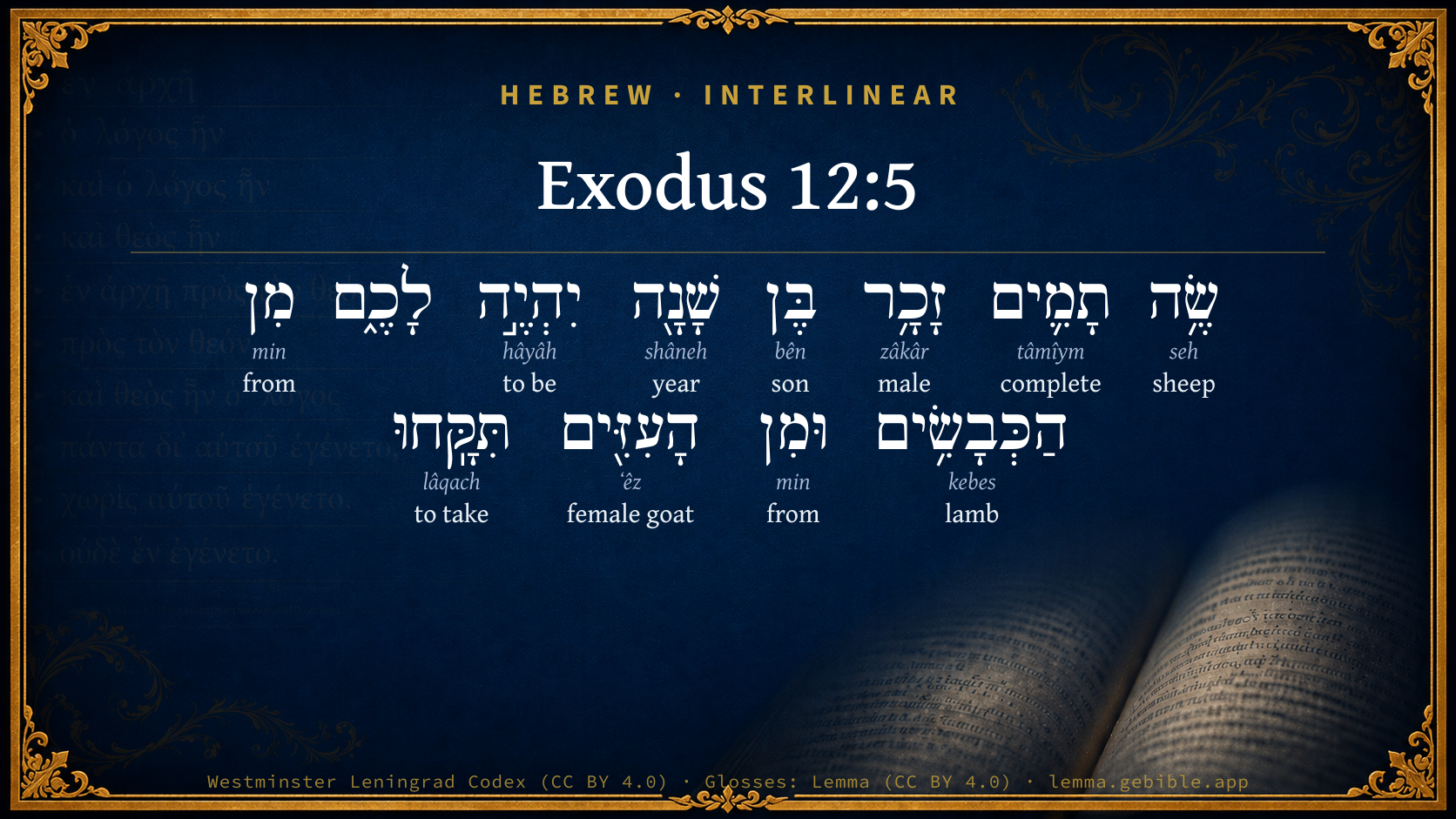
Hebrew (Westminster Leningrad Codex) Exodus 12:5 appears in the Hebrew Old Testament. The text above is from the Westminster Leningrad Codex. Each word links to its Strong’s number, a concise gloss, and parsing drawn from the Open Scriptures Hebrew Bible morphology. Click any word for its full Brown-Driver-Briggs (BDB) entry.
Download image
Cite this verse

Exodus 12:5 (World English Bible). Public Domain. Lemma interlinear Bible study tool, https://lemma.gebible.app/v/exodus/12/5.

Show BibTeX & RIS
BibTeX
RIS
English Translation
Your lamb shall be without blemish, a male a year old. You shall take it from the sheep, or from the goats:
World English Bible · Public Domain
Highlights
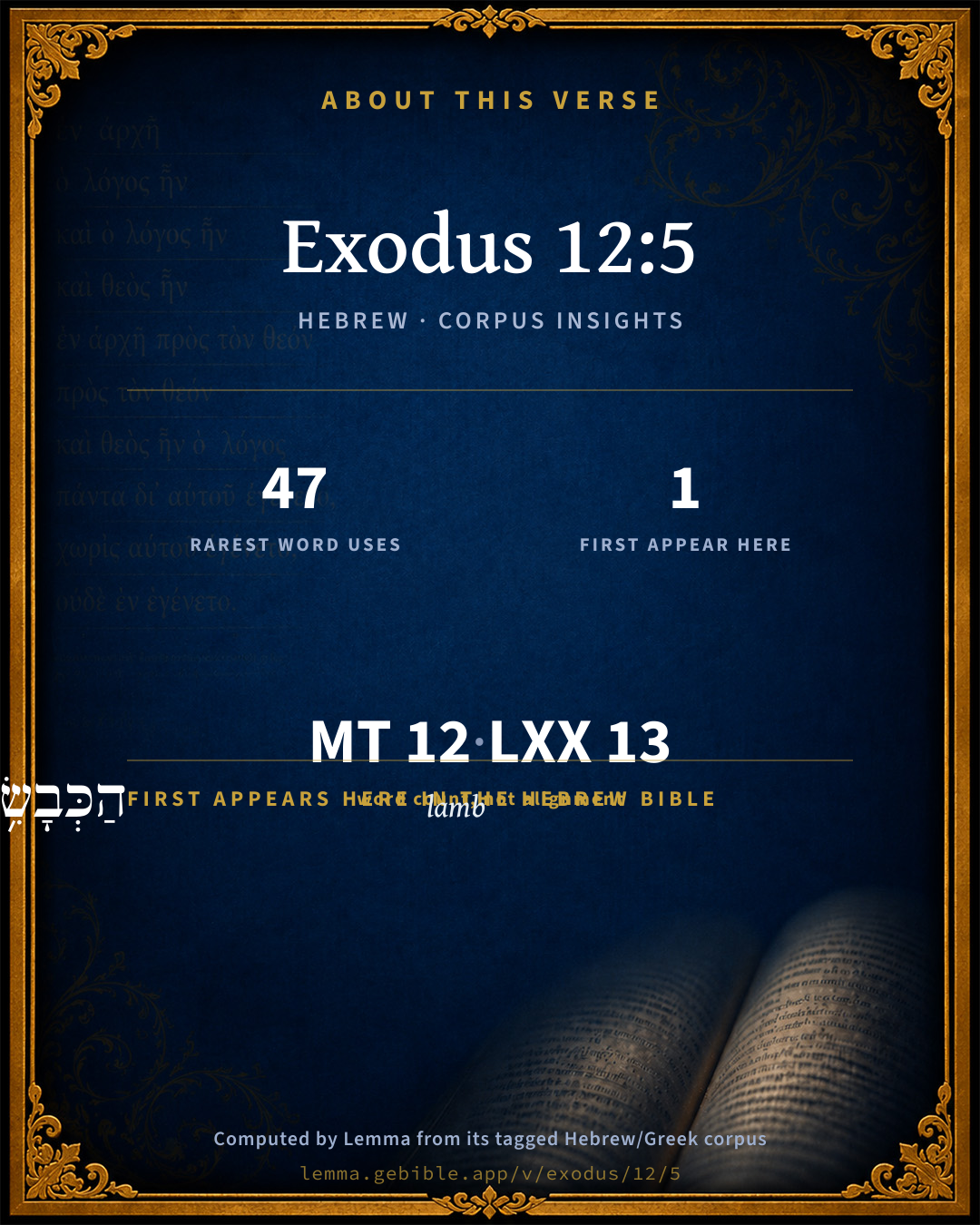
  • 1 first appearance in the Hebrew Bible
Full analysis ↓
Download a study sheet

One document with this verse’s original text, its word-by-word gloss line, the meaning frame, cross-references with their text, attributed commentary, and full source and license credits — printable, and it pastes into notes with its structure intact.

This verse Autodidact and up

Study sheet (.html) Plain text (.txt)

A passage Seminary Student

Up to 50 verses in one chapter. A passage sheet keeps up to 6 commentary sources and 12 cross-references per verse, in the order this page ranks them, and says so on the sheet whenever that leaves anything out. Ask for a single verse and you get the Autodidact verse sheet above.

Everything on this page stays free to read, with no account — the sheet is a download of what is already on screen, not access to it.

Want to remove ads? Support Godless Engineer
Compare translations 3

The same verse in 3 English versions, stacked beneath the original-language interlinear above. Click any original word for its lexicon entry.

Each is an independent rendering of the whole verse — the interlinear is not word-aligned to these translations.

Highlighted words mark where these versions differ — a whole-verse word diff, not a word-by-word alignment.

  • World English Bible Public Domain
    Your lamb shall be without blemish, a male a year old. You shall take it from the sheep, or from the goats:
  • King James Version Public Domain
    Your lamb shall be without blemish, a male of the first year: ye shall take it out from the sheep, or from the goats:
  • unfoldingWord Literal Text CC BY-SA 4.0
    Your lamb shall be complete, male, the son of a year. You may take from the sheep or from the goats.

unfoldingWord Literal Text — © unfoldingWord, licensed CC BY-SA 4.0. Word-aligned USFM3 via Door43 (git.door43.org/unfoldingWord/en_ult).

Versions to compare (up to 4)

3 of 4 selected

Show all 18 translations

Every available English version of this verse, each an independent rendering of the whole verse.

  • World English Bible Public Domain
    Your lamb shall be without blemish, a male a year old. You shall take it from the sheep, or from the goats:
  • Berean Standard Bible Public Domain
    Your lamb must be an unblemished year-old male, and you may take it from the sheep or the goats.
  • Majority Standard Bible Public Domain
    Your lamb must be an unblemished year-old male, and you may take it from the sheep or the goats.
  • King James Version Public Domain
    Your lamb shall be without blemish, a male of the first year: ye shall take it out from the sheep, or from the goats:
  • American Standard Version (1901) Public Domain
    Your lamb shall be without blemish, a male a year old: ye shall take it from the sheep, or from the goats:
  • Revised Version (1885) Public Domain
    Your lamb shall be without blemish, a male of the first year: ye shall take it from the sheep, or from the goats:
  • Geneva Bible (1599) Public Domain
    Your lambe shalbe without blemish, a male of a yeere olde: ye shall take it of the lambes, or of the kiddes.
  • Douay-Rheims (1899) Public Domain
    And it shall be a lamb without blemish, a male, of one year: according to which rite also you shall take a kid.
  • Young's Literal Translation Public Domain
    a lamb, a perfect one, a male, a son of a year, let be to you; from the sheep or from the goats ye do take `it'.
  • Literal Standard Version CC BY-SA 4.0
    A lamb, a perfect one, a male, a son of a year, let [it] be to you; you take [it] from the sheep or from the goats.
  • Unlocked Literal Bible CC BY-SA 4.0
    Your lamb or young goat must be without blemish, a one-year-old male. You may take one of the sheep or goats.
  • unfoldingWord Literal Text CC BY-SA 4.0
    Your lamb shall be complete, male, the son of a year. You may take from the sheep or from the goats.
  • Darby Bible Public Domain
    Your lamb shall be without blemish, a yearling male; ye shall take [it] from the sheep, or from the goats.
  • World Messianic Bible Public Domain
    Your lamb shall be without defect, a male a year old. You shall take it from the sheep or from the goats.
  • Webster's Bible Public Domain
    Your lamb shall be without blemish, a male of the first year: ye shall take it from the sheep or from the goats:
  • Free Bible Version CC BY-SA 4.0
    Your lamb must be a year-old male without any defects, and you can take it either from the sheep or the goats.
  • Bible in Basic English Public Domain
    Let your lamb be without a mark, a male in its first year: you may take it from among the sheep or the goats:
  • JPS Tanakh (1917) Public Domain
    Your lamb shall be without blemish, a male of the first year; ye shall take it from the sheep, or from the goats;

Literal Standard Version (2020), Covenant Press — licensed CC BY-SA 4.0. Text via the HelloAO Bible API (eBible.org). Unlocked Literal Bible (unfoldingWord) — licensed CC BY-SA 4.0. Text via the HelloAO Bible API (eBible.org). unfoldingWord Literal Text — © unfoldingWord, licensed CC BY-SA 4.0. Word-aligned USFM3 via Door43 (git.door43.org/unfoldingWord/en_ult). Free Bible Version, Dr. Jonathan Gallagher — licensed CC BY-SA 4.0. Text via the HelloAO Bible API (eBible.org).

Word by word

More ways to search: Search by grammar → Find every occurrence → Compare this word →

Practice this passage: Drill this verse → Learn its vocabulary →

שֶׂ֥ה
seh
H7716
“sheep”
Noun, Common, Both, Singular, Absolute
Part of Speech
Noun
Type
Common
Gender
Both
Number
Singular
State
Absolute
Full BDB Definition

Origin: probably from H7582 through the idea of pushing out to graze

TWOT: 2237

one of a flock, lamb, sheep, goat, young sheep, young goat - sheep, goat - flock (collective)
  1. תָמִ֛ים tâmîym H8549 “complete” Adjective, Adjective, Masculine, Singular, Absolute
  2. זָכָ֥ר zâkâr H2145 “male” Adjective, Adjective, Masculine, Singular, Absolute
  3. בֶּן bên H1121 “son of” Noun, Common, Masculine, Singular, Construct
  4. שָׁנָ֖ה shâneh H8141 “year” Noun, Common, Feminine, Singular, Absolute
  5. יִהְיֶ֣ה hâyâh H1961 “to be” Verb, Qal, Imperfect, 3rd Person, Masculine, Singular
  6. מִן min H4480 “from” Preposition
  7. הַכְּבָשִׂ֥ים kebes H3532 “the · lambs” Particle, Definite Article + Noun, Common, Masculine, Plural, Absolute
  8. וּמִן min H4480 “and · from” Conjunction + Preposition
  9. הָעִזִּ֖ים ʻêz H5795 “the · female goats” Particle, Definite Article + Noun, Common, Feminine, Plural, Absolute
  10. תִּקָּֽחוּ lâqach H3947 “to take” Verb, Qal, Imperfect, 2nd Person, Masculine, Plural

About this verse

These counts appear in no published source. They are computed here, from the morphology-tagged text and Lemma’s own curated glosses. What Lemma adds →

12
words
10
distinct lemmas
Pentateuch
section

First appearance in Scripture

This word makes its first canonical appearance in the Hebrew Bible here:

  • הַכְּבָשִׂ֥ים lamb H3532

Shared distinctive vocabulary

שֶׂ֥ה sheep H7716 occurs in 39 verses of the Hebrew Bible. Also found in:

Grammatical profile

  • 2 verbs
  • 5 nouns
  • 2 adjectives
  • 3 prepositions

Verb forms

  • יִהְיֶ֣ה Qal · Imperfect
  • תִּקָּֽחוּ Qal · Imperfect

Repetition

A word recurs within this verse — often emphatic in Hebrew:

Hebrew & Septuagint length

In English translation the verse runs 22 words from the Hebrew and 24 from the Septuagint (LXX English) — closely comparable.

A rough comparison of the two English renderings, which tokenize alike — not a word-level alignment.

Word counts can differ between the Hebrew and the Greek without any difference in meaning — e.g. the Hebrew direct-object marker אֵת has no separate Greek word, and Greek often adds the article ὁ.

In the original languages it is 12 Hebrew tokens and 13 Greek tokens — but the two are counted differently (Hebrew bundles its prefixes and suffixes into one token; the Greek is in lemma form), so that isn’t a like-for-like length.

Cross-references

10

Topical passages linked to Exodus 12:5 in the Treasury of Scripture Knowledge — connected by theme and wording, ordered by reader-vote popularity; previews shown in the World English Bible.

  • Hebrews 9:13–14 For if the blood of goats and bulls, and the ashes of a heifer sprinkling those who have been defiled, sanctify to the cleanness of the flesh:
  • Malachi 1:14 "But the deceiver is cursed, who has in his flock a male, and vows, and sacrifices to the Lord a blemished thing; for I am a great King," says Yahweh of hosts, "and my name is awesome among the nations."
  • 1 Peter 1:18–19 knowing that you were redeemed, not with corruptible things, with silver or gold, from the useless way of life handed down from your fathers,
  • Malachi 1:7–8 You offer polluted bread on my altar. You say, 'How have we polluted you?' In that you say, 'Yahweh's table contemptible.'
  • Deuteronomy 17:1 You shall not sacrifice to Yahweh your God an ox, or a sheep, in which is a blemish, [or] anything evil; for that is an abomination to Yahweh your God.
  • Leviticus 22:18–24 "Speak to Aaron, and to his sons, and to all the children of Israel, and say to them, 'Whoever is of the house of Israel, or of the foreigners in Israel, who offers his offering, whether it be any of their vows, or any of their freewill offerings, which they offer to Yahweh for a burnt offering;
  • Leviticus 23:12 On the day when you wave the sheaf, you shall offer a male lamb without blemish a year old for a burnt offering to Yahweh.
  • Hebrews 7:26 For such a high priest was fitting for us: holy, guiltless, undefiled, separated from sinners, and made higher than the heavens;
  • Leviticus 1:3 "'If his offering is a burnt offering from the herd, he shall offer a male without blemish. He shall offer it at the door of the Tent of Meeting, that he may be accepted before Yahweh.
  • Leviticus 1:10 "'If his offering is from the flock, from the sheep, or from the goats, for a burnt offering, he shall offer a male without blemish.

Cross-references courtesy of OpenBible.info (CC BY 4.0).

Hebrew and Greek witnesses Masoretic Hebrew ↔ Greek Septuagint

The same verse in the two great witnesses to the Old Testament, shown verse-for-verse.

These are two independent witnesses, not word-aligned to each other, and the Septuagint is shown in lemma (dictionary) form.

Hebrew Exodus 12:5 Masoretic · Westminster Leningrad Codex

שֶׂ֥ה תָמִ֛ים זָכָ֥ר בֶּן שָׁנָ֖ה יִהְיֶ֣ה לָכֶ֑ם מִן הַכְּבָשִׂ֥ים וּמִן הָעִזִּ֖ים תִּקָּֽחוּ

Your lamb shall be without blemish, a male a year old. You shall take it from the sheep, or from the goats:

World English Bible · Public Domain

Greek LXX Exodus 12:5 Septuagint · lemma form

πρόβατον τέλειος ἄρσην ἐνιαύσιος εἰμί σύ ἀπό ὁ ἀρνός καί ὁ ἔριφος λαμβάνω

It shall be to you a lamb unblemished, a male of a year old: you⌃ shall take it of the lambs and the kids.

LXX2012 (modern English Septuagint) · Public Domain

On this verse, The Cambridge Bible for Schools and Colleges discusses the Septuagint’s reading. Read the note in Commentary ↓

Hebrew: Westminster Leningrad Codex (CC BY 4.0). Greek: Septuagint (public domain); English from LXX2012 (modern English Septuagint) (Public Domain). How the Septuagint differs from the Hebrew →

Targum (Aramaic paraphrase)

2

The Targum is the ancient Jewish Aramaic paraphrase of the Hebrew Scriptures — an interpretive translation, not the Hebrew text itself. Onkelos (literal) and Pseudo-Jonathan (expansive) render the Torah, and Jonathan the Prophets. Coverage is partial: where no permissively-licensed English translation exists for a verse, only the Aramaic is shown. This is verse-level text, not a word-by-word alignment to the Hebrew.

  1. Targum Onkelos Torah (Genesis–Deuteronomy)
    אִמַר שְׁלִים דְכַר בַּר שַׁתֵּהּ יְהֵי לְכוֹן מִן אִמְרַיָא וּמִן עִזַיָא תִּסְבוּן:

    (no public-domain English translation for this verse)

    Targum Onkelos — Aramaic: “Onkelos Genesis” (public domain); “Onkelos Exodus” (public domain); “Onkelos Leviticus” (public domain); “Onkelos Numbers” (public domain); “Onkelos Deuteronomy” (public domain). English: “Sefaria Community Translation” (CC0 1.0 (public-domain dedication)); “J.W. Etheridge. The Targums of Onkelos and Jonathan Ben Uzziel on the Pentateuch. London: Longmans, Green, 1862” (public domain). Text via Sefaria.

  2. Targum Pseudo-Jonathan Torah (Genesis–Deuteronomy)
    אִימַר שְׁלִים דְּכַר בַּר שַׁתָּא יְהֵי לְכוֹן מִן אִימְרַיָא וּמִן בְּנֵי עִזַּיָא תִּסְבוּן

    The lamb shall be perfect, a male, the son of a year he shall be to you; from the sheep or from the young goats ye may take.

    Targum Pseudo-Jonathan — Aramaic: “Targum Jonathan on Genesis” (public domain); “Targum Jonathan on Exodus” (public domain); “Targum Jonathan on Leviticus” (public domain); “Targum Jonathan on Numbers” (public domain); “Targum Jonathan on Deuteronomy” (public domain). English: “The Targum of Jonathan ben Uzziel, trans. J. W. Etheridge, London, 1862” (public domain). Text via Sefaria.

Commentary

Notes on Exodus 12:5 from classic Christian and Jewish commentators (each source and its license shown beneath its notes). The classic Christian expositions comment on the surrounding passage and are grouped to its opening verse, so a note may address several verses; the Jewish commentaries on the Tanakh (Rashi and others) are per-verse, so they appear only where the commentator wrote on this verse.

Lemma curates 59 commentaries, every one of them public domain or Creative Commons licensed, each selected and text-cleaned for this edition rather than reprinted as found. About our sources →

Trapp's Complete Commentary

John Trapp

Exo 12:5 Your lamb shall be without blemish, a male of the first year: ye shall take [it] out from the sheep, or from the goats:

Ver. 5. Without blemish.] Christ, that immaculate Lamb of God, was hereby typified, {1Pe 1:19} {See Trapp on "1Pe 1:19"}

From the sheep, or from the goats.] A lamb; to show Christ’s innocency, meekness, patience, profitableness. Or a kid; to show that he was a sinner; (1.) By imputation, for "the Lord made our sins to meet upon him"; {Isa 53:6} (2.) By reputation, for "he made his grave with the wicked." {Isa 53:9}

John Trapp, A Commentary or Exposition upon All the Books of the Old and New Testament (1647–1656) — public domain. Text from a community e-Sword module.

Joseph Benson's Commentary

Exo 12:5. Your lamb shall be without blemish — Shall be perfect, as the Hebrew is, that is, in all its parts. This was a qualification indispensably requisite in all sacrifices: Lev 22:20-24. Even the heathen, in the worship of their false gods, were particular in this circumstance. A male — Because the males were accounted more excellent, and their flesh better than that of females. Of the first year — Under a year old, not above: for the lamb, as also a kid and calf, was fit for sacrifice at eight days old, but not before, Exo 22:30. And the same law was observed in the daily sacrifice, Exo 29:38. They were not to be offered before the eighth day, “because,” says Bochart, “till then they have hardly attained to the perfection of animal life, and are not sufficiently purified.” He adds, “they were not to be offered after the first year, because then they begin to feel the heat of libidinous appetite, and consequently are not fit emblems of purity and innocence.”

Joseph Benson's Commentary on the Old and New Testaments (1811–1818) — public domain. Text from a community e-Sword module.

Tyndale Open Study Notes

Tyndale Open Resources

12:5 with no defects: We must give God our best, just as he gave us his best: “the sinless, spotless Lamb of God” (1 Pet 1:19).

Tyndale Open Study Notes — © Tyndale Open Resources, licensed CC BY-SA 4.0. Text via the HelloAO Bible API.

Jamieson, Fausset & Brown

Robert Jamieson, A. R. Fausset & David Brown

lamb . . . without blemish--The smallest deformity or defect made a lamb unfit for sacrifice--a type of Christ (Heb 7:26; Pe1 1:19).

a male of the first year--Christ in the prime of life.

Jamieson, Fausset & Brown — Commentary Critical and Explanatory on the Whole Bible (1871) — public domain (CC PDM 1.0). Text via the HelloAO Bible API.

Adam Clarke's Commentary

Verse 5. Without blemish] Having no natural imperfection, no disease, no deficiency or redundancy of parts. On this point the rabbins have trifled most egregiously, reckoning fifty blemishes that render a lamb or kid, or any animal, improper to be sacrificed: five in the ear, three in the eyelid, eight in the eye, three in the nose, six in the mouth, c., &c.

A male of the first year] That is, any age in the first year between eight days and twelve months.

From the sheep, or from the goats] The שה seh means either and either was equally proper if without blemish. The Hebrews however in general preferred the lamb to the kid.

Adam Clarke's Commentary on the Bible (1810–1826) — public domain. Text from a community e-Sword/MySword module.

Ellicott's Commentary for English Readers

(5) Without blemish.—Natural piety teaches that we must not “offer the blind, the lame, or the sick for sacrifice” (Mal_1:8). We must give to (God of our best. The Law emphasized this teaching, and here, on the first occasion when a sacrifice was formally appointed, required it to be absolutely without blemish of any kind. Afterwards the requirement was made general (Lev_22:19-25). It was peculiarly fitting that the Paschal offering should be without defect of any kind, as especially typifying “the Lamb of God,” who is “holy, harmless, undefiled”—a “lamb without spot.”

A male.—Males were reckoned superior to females, and were especially appropriate here, since the victim represented the firstborn male in each house.

Of the first year—i.e., not above a year old. As children are most innocent when young, so even animals were thought to be.

A Bible Commentary for English Readers, edited by Charles John Ellicott (1878–1897) — public domain. Text from a community e-Sword module.

The Cambridge Bible for Schools and Colleges

gen. ed. J. J. S. Perowne

5. Characteristics of the animal chosen: it is to be (1) without blemish (like sacrificial animals in general, Deu_17:1, Lev_22:19; Lev_22:21 [H]); (2) a male, as superior to a female, and therefore more appropriate as an offering to Jehovah (so for burnt-offerings, in H and P, Lev_1:3; Lev_1:10; Lev_22:19 : for peace- and sin-offerings females were allowed); (3) one year old (cf. the same regulation Exo_29:38, Lev_9:3, and elsewhere); (4) either a lamb or a kid (cf. on v. 3); later usage declared in favour of a lamb.

of the first year] Heb. ‘the son of a year.’ The meaning is disputed. The Rabbis interpret of the first year, i.e. from 8 days old (Lev_22:27 H) to a full year; modern commentators generally, a year old (LXX. ἐνιαύσιος). The Hebrew idiom (of human beings as well as of animals) occurs constantly (Gen_21:4-5; Gen_25:26, &c.): the same age as here is appointed for sacrifices, esp. for burnt-offerings, Lev_9:3; Lev_12:6 (‘a son of its year’), Exo_23:12; Exo_23:18-19, and elsewhere.

The Cambridge Bible for Schools and Colleges (gen. ed. J. J. S. Perowne; Cambridge University Press, 1878–1918) — public domain. Text from a community e-Sword module.

John Gill's Exposition

Your lamb shall be without blemish,.... Without any spot or defect in it. Maimonides (h) reckons no less than fifty blemishes in a creature, anyone of which makes it unfit for sacrifice, see Lev 21:21. This lamb was a type of Christ, who is therefore said to be our passover sacrificed for us, Co1 5:7 comparable to a lamb for his innocence and harmlessness, for his meekness, humility, and patience, for usefulness both for food and raiment, as well as for being fit for sacrifice; and who is a lamb without spot and blemish, either of original sin, or actual transgression, holy in his nature, harmless in his life:

a male of the first year; anyone within that time, but not beyond it; denoting the strength and vigour of Christ, in the flower of his age, his short continuance among men, and his being tender and savoury food for the faith of his people:

ye shall take it out from the sheep, or from the goats; it might be either a lamb, or a kid of the goats; for the most part, or generally, it was a lamb that was taken; so the Jewish canon runs (i),"he that says to his servant, go and slay for me the passover, if he slays a kid he may eat it; if he slays a lamb he may eat of it; if he slays a kid and a lamb, he may eat of the first.''The goat being of an ill smell may denote Christ being made sin, and a sin offering for his people; and the taking of a lamb from these may signify the choice of Christ from among the people in the council and covenant of God; the preordination of him to be the lamb slain from the foundation of the world; the preservation of him from the infection of sin in his incarnation, and the separation of him from sinners in his conversation.

(h) Hilchot Biath Hamikdash, c. 7. sect. 1. (i) Misn. Pesach. c. 8. sect. 2.

John Gill's Exposition of the Whole Bible (1746–1763) — public domain (CC PDM 1.0). Text via the HelloAO Bible API.

Albert Barnes' Notes on the Bible

Without blemish - This is in accordance with the general rule (margin reference): although in this case there is a special reason, since the lamb was in place of the firstborn male in each household. The restriction to the first year is unique, and refers apparently to the condition of perfect innocence in the antitype, the Lamb of God.

Albert Barnes' Notes on the Bible (1834–1885) — public domain. Text from a community e-Sword/MySword module.

Haydock's Catholic Bible Commentary

Lamb. Hebrew se, which denotes the young of either sheep or goats. (Kimchi.) He who had not a lamb, was to sacrifice a kid. (Theodoret) --- A kid. The Phase might be performed, either with a lamb or with a kid; and all the same rites and ceremonies were to be used with the one as with the other. (Challoner) --- Many have asserted, that both were to be sacrificed. But custom decides against them. All was to be perfect, Momim, as even the pagans required; (Grotius) and God (Leviticus xxii. 22,) orders the victims in general must have no fault. The Egyptians rejected them, if they were even spotted, or twins. --- A male, as all holocausts were to be. Pagans gave the preference to females. (Calmet) --- One year, not older, though it would do if above eight days old. (Menochius) --- The paschal lamb prefigured Jesus Christ, who has redeemed us by his death, being holy, set apart, and condescending to feed us with his sacred person, in the blessed Eucharist. Here we eat the lamb without breaking a bone, though we take the whole victim. (John xix. 36; 1 Corinthians v. 7.) (Calmet) --- To fulfil this figure, Christ substituted his own body, and, making his apostles priests, ordered them to continue this sacrifice for ever. He came to Jerusalem on the 10th day of Nisan, on Sunday. He gave himself to his disciples on the evening of the 14th, and died at noon on the 15th. The unleavened bread, and the cup, (Luke xxii. 17,) clearly denoted the blessed Sacrament, which was ordered to be eaten in the house or church of God. (St. Cyprian, Unit.) See St. Gregory, hom. 22, in Evang.; Tertullian, contra Marc. iv, "The bread he made his own body." If, therefore, the truth must surpass the figure, surely the blessed Sacrament must be more than bread and wine; otherwise it would yield in excellence and signification to the paschal lamb. (Worthington)

George Leo Haydock (1774–1849), Haydock's Catholic Family Bible and Commentary, 1859 edition — public domain. Excludes Psalms (Douay-Rheims chapter numbering differs from Protestant) and Deuterocanonical books (Catholic canon only).

Matthew Poole's English Annotations

Without blemish; without any deformity or distemper of body. Heb. perfect. Of which see Lev 22:21, &c.; Deu 15:21; 17:1. And this the very light of nature taught the heathens to observe in their sacrifices. This property was required both to typify Christ, a Lamb without spot or blemish, Heb 9:14; 1Pe 1:19, and to instruct us that all our services to God must be as perfect as possibly may be.

A male, partly because that was better and more perfect than the female, whence a male is opposed to a corrupt thing, Mal 1:14; and partly to typify the man Christ Jesus.

Of the first year, i.e. a year old, when it is in its rigour and perfection, and the fittest type of Christ. Most explain it thus, That it was not to be more than a year old, but it might be much less, seeing it might be offered to God any time after it was eight days old, Exo 22:30; Lev 22:27. But though it was then fit to be offered to God, it was not very fit to be eaten by men. And the Hebrew phrase, the son of a year, seems to require a year’s age, as Saul is called the son of one year, 1Sa 13:1, when he had reigned one whole year. And it is remarkable, that he doth not say the son of this or that year, which might agree to one brought forth that year, though it was much younger than a year, but the son of a year, without any restrictive article.

Or from the goats; Heb. and from the goats: if you want a lamb, you shall take a kid of or from the goats. But the particle and is here well rendered or, as it is used Gen 13:8; Exo 21:17, compared with Mat 15:4; Psa 8:4, compared with Heb 2:6.

Matthew Poole's English Annotations on the Holy Bible (1683–1685) — public domain. Text from a community e-Sword/MySword module.

Whedon's Commentary on the Bible

Daniel D. Whedon

5. Without blemish, a male of the first year — A faultless male, at least a year old. Only perfect gifts could be offered to God, as the heathens also felt. So Homer teaches us, (Iliad, 1:66,) αγνων… αιγων τε τελειων, “perfect lambs and goats.” The letter of the law allowed a kid, but a lamb was almost always chosen.

Daniel D. Whedon (gen. ed.), Commentary on the Old and New Testaments (1874–1909) — public domain. Text from a community e-Sword module.

The Pulpit Commentary

Your lamb shall be without blemish. Natural piety would teach that "the blind, the lame, and the sick" should not be selected for sacrifice. (Mal_1:8) The Law afterwards expressly forbade any blemished animals or broken, or maimed, or having a wen, or scurvy, or scabbed to be offered for any of the stated sacrifices, though they might be given as free-will offerings. (Lev_22:20-25) The absence of blemish was especially important in a victim which was to typify One "holy, harmless, undefiled, separate from sinners." A male. As standing in place of and redeeming the first-born of the males in each family. Of the first year. Perhaps as then more approaching to the ideal of perfect innocence. The requirement was not a usual one. Or from the goats. Theodoret says the proviso was made for the relief of the poorer class of persons; but practically it seems not to have taken effect. When people were poor, their richer neighbours supplied them with lambs (Kalisch).

The Pulpit Commentary (1880–1919), ed. H.D.M. Spence-Jones & Joseph S. Exell — public domain. Text from a community e-Sword module.

unfoldingWord translationNotes

Door43 World Missions Community

twilight

This refers to the time of evening after the sun has set but while there is still some light.

on the two side doorposts and on the tops of the doorframes of the houses

"on the sides and top of the way into the house"

Eat it with bread made without yeast

This can be stated in active form. AT: "Eat it with bread which you have made without yeast" (See: Active or Passive)

bitter herbs

These are small plants that have a strong and usually bad taste.

translationWords

blemish

blood

doorpost

fire

yeast

unfoldingWord translationNotes — © Distant Shores Media and the Door43 World Missions Community, licensed CC BY-SA 4.0. Source: git.door43.org/Door43/en_tn.

Rashi

Rabbi Shlomo Yitzchaki (Rashi)

תמים PERFECT i. e. without blemish (Mekhilta).

בן שנה OF THE FIRST YEAR — the whole of its first year it is termed שנה בן, as much as to say, that it was born during this year (it does not mean that it is one year old — in its second year) (cf.Mekhilta).

מן הכבשים ומן העזים — i. e. either from these (a lamb) or from these (a goat) (i. e. the ו of ומן does not signify “and”, but “or”); for a goat, also, is called שה, as it is said, (Deuteronomy 14:4) “the שה of the goats” (שה means the young animal, either of the sheep or of the goats) (cf. Mekhilta).

Rashi on the Tanakh — English translations: “The Judaica Press complete Tanach with Rashi, translated by A. J. Rosenberg” (CC BY 4.0); “Pentateuch with Rashi's commentary by M. Rosenbaum and A.M. Silbermann, 1929-1934” (public domain); “The Metsudah Tanach series, Lakewood, N.J” (CC BY 4.0); and “The Book of Joshua, Metsudah Publications, 1997” (CC BY 4.0). Text via Sefaria.

Lesson kit

Teaching starters — assembled from the data on this page, not authored interpretation. Every prompt links to the verse data it draws on. Edit before teaching.

Exodus, in the Pentateuch, opens this verse with 12 words (10 distinct Hebrew lemmas). Its most distinctive word is seh (“sheep”). A historical commentator’s framing appears above. Read the whole chapter for the surrounding context.

Discussion questions

  1. The word seh carries the sense “sheep.” How does it shape the verse?
  2. The word “lamb” first appears here in Scripture. What is being introduced at this debut?
  3. Genesis 22:7 shares the word «sheep» with this verse. How do the two illuminate each other?
  4. “from” occurs 2× in this one verse. What is the effect of the repetition?
  5. These translations render this verse differently; the difference is in the English rendering, not the original. What questions does that raise?
  6. The verb «יִהְיֶ֣ה» is Qal Imperfect. How does its form color the action?
  7. Reading how Trapp's Complete Commentary and Joseph Benson's Commentary read this verse, where do the two commentators agree and where do they part?

Things to notice

Reading settings

Reading text

Shown beneath each verse's original-language words.

Old Testament
Old Testament edition

Read the OT as the Masoretic Hebrew (MT) or the Greek Septuagint (LXX).

English shown for the Greek Septuagint (in the Hebrew ↔ Greek comparison).

Comparing translations? Open the Compare panel on any verse page to stack up to four side by side.