
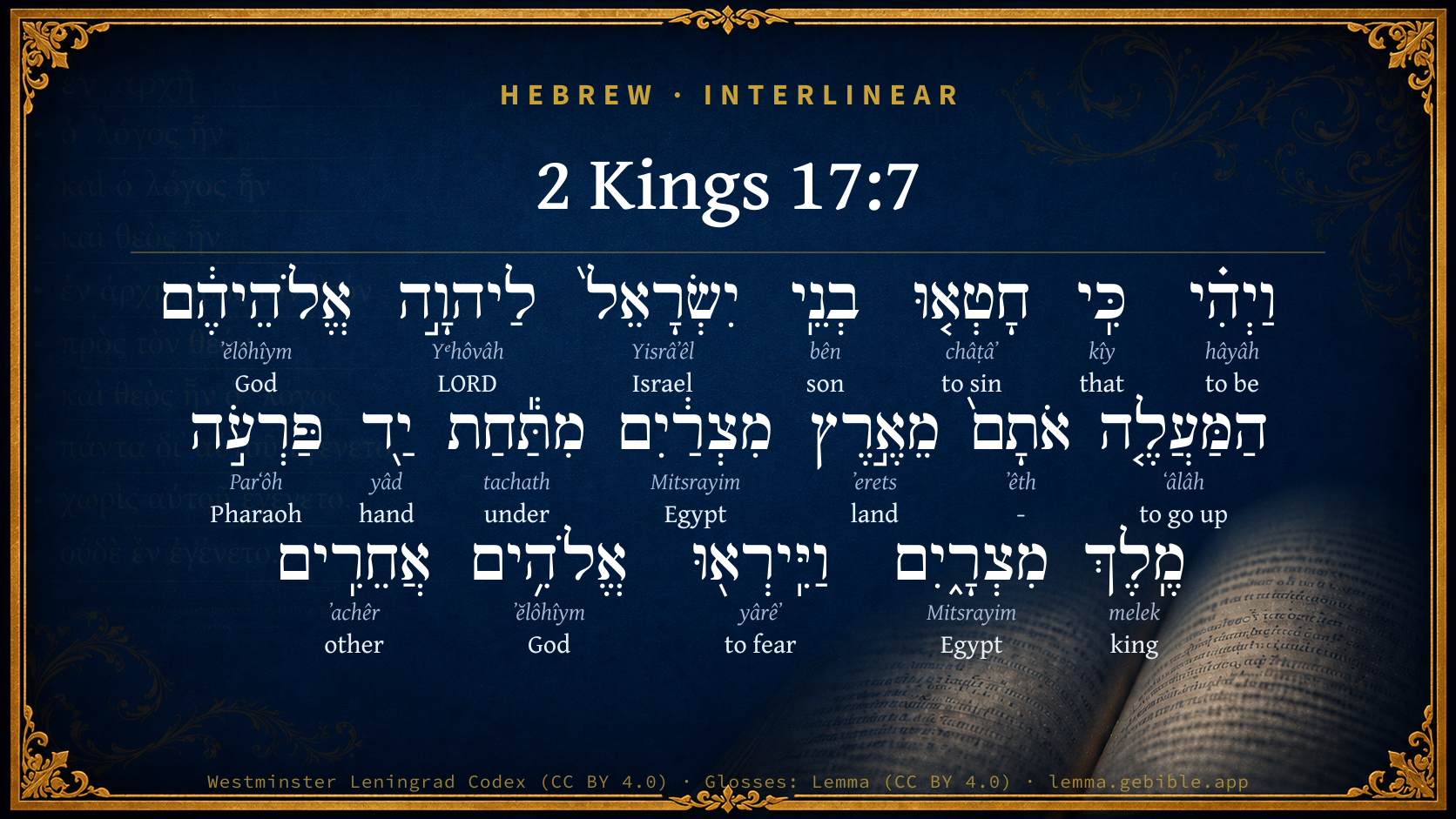
2 Kings 17:7

Hebrew (Westminster Leningrad Codex) 2 Kings 17:7 appears in the Hebrew Old Testament. The text above is from the Westminster Leningrad Codex. Each word links to its Strong’s number, a concise gloss, and parsing drawn from the Open Scriptures Hebrew Bible morphology. Click any word for its full Brown-Driver-Briggs (BDB) entry.
Download image
Cite this verse

2 Kings 17:7 (World English Bible). Public Domain. Lemma interlinear Bible study tool, https://lemma.gebible.app/v/2-kings/17/7.

Show BibTeX & RIS
BibTeX
RIS
English Translation
It was so, because the children of Israel had sinned against Yahweh their God, who brought them up out of the land of Egypt from under the hand of Pharaoh king of Egypt, and had feared other gods,
World English Bible · Public Domain
Download a study sheet

One document with this verse’s original text, its word-by-word gloss line, the meaning frame, cross-references with their text, attributed commentary, and full source and license credits — printable, and it pastes into notes with its structure intact.

This verse Autodidact and up

Study sheet (.html) Plain text (.txt)

A passage Seminary Student

Up to 50 verses in one chapter. A passage sheet keeps up to 6 commentary sources and 12 cross-references per verse, in the order this page ranks them, and says so on the sheet whenever that leaves anything out. Ask for a single verse and you get the Autodidact verse sheet above.

Everything on this page stays free to read, with no account — the sheet is a download of what is already on screen, not access to it.

Want to remove ads? Support Godless Engineer
Compare translations 3

The same verse in 3 English versions, stacked beneath the original-language interlinear above. Click any original word for its lexicon entry.

Each is an independent rendering of the whole verse — the interlinear is not word-aligned to these translations.

Highlighted words mark where these versions differ — a whole-verse word diff, not a word-by-word alignment.

  • World English Bible Public Domain
    It was so, because the children of Israel had sinned against Yahweh their God, who brought them up out of the land of Egypt from under the hand of Pharaoh king of Egypt, and had feared other gods,
  • King James Version Public Domain
    For so it was, that the children of Israel had sinned against the LORD their God, which had brought them up out of the land of Egypt, from under the hand of Pharaoh king of Egypt, and had feared other gods,
  • unfoldingWord Literal Text CC BY-SA 4.0
    And it happened because the sons of Israel sinned against Yahweh their God, the one having brought them up from the land of Egypt, from under the hand of Pharaoh, the king of Egypt. And they feared other gods,

unfoldingWord Literal Text — © unfoldingWord, licensed CC BY-SA 4.0. Word-aligned USFM3 via Door43 (git.door43.org/unfoldingWord/en_ult).

Versions to compare (up to 4)

3 of 4 selected

Show all 18 translations

Every available English version of this verse, each an independent rendering of the whole verse.

  • World English Bible Public Domain
    It was so, because the children of Israel had sinned against Yahweh their God, who brought them up out of the land of Egypt from under the hand of Pharaoh king of Egypt, and had feared other gods,
  • Berean Standard Bible Public Domain
    All this happened because the people of Israel had sinned against the LORD their God, who had brought them out of the land of Egypt from under the hand of Pharaoh king of Egypt. They had worshiped other gods
  • Majority Standard Bible Public Domain
    All this happened because the people of Israel had sinned against the LORD their God, who had brought them out of the land of Egypt from under the hand of Pharaoh king of Egypt. They had worshiped other gods
  • King James Version Public Domain
    For so it was, that the children of Israel had sinned against the LORD their God, which had brought them up out of the land of Egypt, from under the hand of Pharaoh king of Egypt, and had feared other gods,
  • American Standard Version (1901) Public Domain
    And it was so, because the children of Israel had sinned against Jehovah their God, who brought them up out of the land of Egypt from under the hand of Pharaoh king of Egypt, and had feared other gods,
  • Revised Version (1885) Public Domain
    And it was so, because the children of Israel had sinned against the LORD their God, which brought them up out of the land of Egypt from under the hand of Pharaoh king of Egypt, and had feared other gods,
  • Geneva Bible (1599) Public Domain
    For when the children of Israel sinned against the Lord their God, which had brought them out of the land of Egypt, from vnder ye hand of Pharaoh king of Egypt, and feared other gods,
  • Douay-Rheims (1899) Public Domain
    For so it was that the children of Israel had sinned against the Lord their God, who brought them out of the land of Egypt, from under the hand of Pharao king of Egypt, and they worshipped strange gods.
  • Young's Literal Translation Public Domain
    And it cometh to pass, because the sons of Israel have sinned against Jehovah their God -- who bringeth them up out of the land of Egypt, from under the hand of Pharaoh king of Egypt -- and fear other gods,
  • Literal Standard Version CC BY-SA 4.0
    And it comes to pass, because the sons of Israel have sinned against their God YHWH—who brings them up out of the land of Egypt, from under the hand of Pharaoh king of Egypt—and fear other gods,
  • Unlocked Literal Bible CC BY-SA 4.0
    This captivity happened because the people of Israel had sinned against Yahweh their God, who had brought them up from the land of Egypt, from under the hand of Pharaoh king of Egypt. The people had been worshiping other gods
  • unfoldingWord Literal Text CC BY-SA 4.0
    And it happened because the sons of Israel sinned against Yahweh their God, the one having brought them up from the land of Egypt, from under the hand of Pharaoh, the king of Egypt. And they feared other gods,
  • Darby Bible Public Domain
    And so it was, because the children of Israel had sinned against Jehovah their God, who had brought them up out of the land of Egypt from under the hand of Pharaoh king of Egypt, and had feared other gods;
  • World Messianic Bible Public Domain
    It was so because the children of Israel had sinned against the LORD their God, who brought them up out of the land of Egypt from under the hand of Pharaoh king of Egypt, and had feared other gods,
  • Webster's Bible Public Domain
    For so it was, that the children of Israel had sinned against the LORD their God, who had brought them out of the land of Egypt, from under the hand of Pharaoh king of Egypt, and had feared other gods,
  • Free Bible Version CC BY-SA 4.0
    All this happened because the people of Israel had sinned against the Lord their God, the one who had led them out of Egypt, saving them from the power of Pharaoh, king of Egypt. They had worshiped other gods,
  • Bible in Basic English Public Domain
    And the wrath of the Lord came on Israel because they had done evil against the Lord their God, who took them out of the land of Egypt from under the yoke of Pharaoh, king of Egypt, and had become worshippers of other gods,
  • JPS Tanakh (1917) Public Domain
    And it was so, because the children of Israel had sinned against the LORD their God, who brought them up out of the land of Egypt from under the hand of Pharaoh king of Egypt, and had feared other gods,

Literal Standard Version (2020), Covenant Press — licensed CC BY-SA 4.0. Text via the HelloAO Bible API (eBible.org). Unlocked Literal Bible (unfoldingWord) — licensed CC BY-SA 4.0. Text via the HelloAO Bible API (eBible.org). unfoldingWord Literal Text — © unfoldingWord, licensed CC BY-SA 4.0. Word-aligned USFM3 via Door43 (git.door43.org/unfoldingWord/en_ult). Free Bible Version, Dr. Jonathan Gallagher — licensed CC BY-SA 4.0. Text via the HelloAO Bible API (eBible.org).

Word by word

More ways to search: Search by grammar → Find every occurrence → Compare this word →

Practice this passage: Drill this verse → Learn its vocabulary →

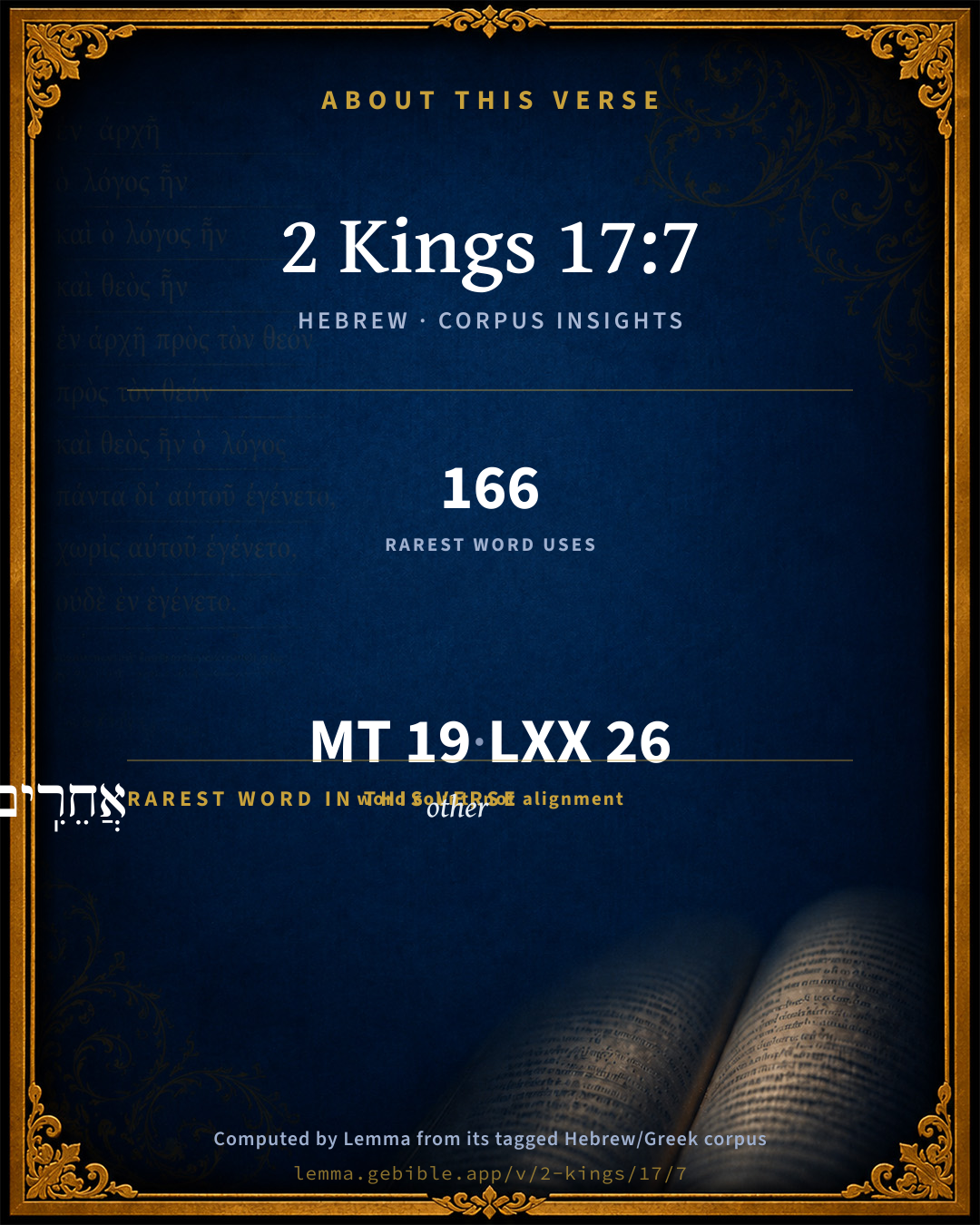
אֲחֵרִֽים
ʼachêr
H312
“other”
Adjective, Adjective, Masculine, Plural, Absolute
Part of Speech
Adjective
Type
Adjective
Gender
Masculine
Number
Plural
State
Absolute
Full BDB Definition

Origin: from H309

TWOT: 68a

another, other, following - following, further - other, different
  1. וַיְהִ֗י hâyâh H1961 “and · to be” Conjunction + Verb, Qal, Sequential Imperfect, 3rd Person, Masculine, Singular
  2. כִּֽי kîy H3588 “that” Conjunction
  3. חָטְא֤וּ châṭâʼ H2398 “to sin” Verb, Qal, Perfect, 3rd Person, Common, Plural
  4. בְנֵֽי bên H1121 “sons of” Noun, Common, Masculine, Plural, Construct
  5. יִשְׂרָאֵל֙ Yisrâʼêl H3478 “Israel” Noun, Proper
  6. לַיהוָ֣ה Yᵉhôvâh H3068 “to/for · LORD” Preposition + Noun, Proper
  7. אֱלֹהֵיהֶ֔ם ʼĕlôhîym H430 “God(s) · their” Noun, Common, Masculine, Plural, Construct + Suffix, Personal, 3rd Person, Masculine, Plural
  8. הַמַּעֲלֶ֤ה ʻâlâh H5927 “the · going up” Particle, Definite Article + Verb, Hiphil, Participle Active, Masculine, Singular, Absolute
  9. אֹתָם֙ ʼêth H853 “- · them” Particle, Direct Object + Suffix, Personal, 3rd Person, Masculine, Plural
  10. מֵאֶ֣רֶץ ʼerets H776 “from · land of” Preposition + Noun, Common, Both, Singular, Construct
  11. מִצְרַ֔יִם Mitsrayim H4714 “Egypt” Noun, Proper
  12. מִתַּ֕חַת tachath H8478 “from · under” Preposition + Preposition
  13. יַ֖ד yâd H3027 “hand of” Noun, Common, Both, Singular, Construct
  14. פַּרְעֹ֣ה Parʻôh H6547 “Pharaoh” Noun, Proper
  15. מֶֽלֶךְ melek H4428 “king of” Noun, Common, Masculine, Singular, Construct
  16. מִצְרָ֑יִם Mitsrayim H4714 “Egypt” Noun, Proper
  17. וַיִּֽירְא֖וּ yârêʼ H3372 “and · to fear” Conjunction + Verb, Qal, Sequential Imperfect, 3rd Person, Masculine, Plural
  18. אֱלֹהִ֥ים ʼĕlôhîym H430 “God(s)” Noun, Common, Masculine, Plural, Absolute

About this verse

These counts appear in no published source. They are computed here, from the morphology-tagged text and Lemma’s own curated glosses. What Lemma adds →

19
words
17
distinct lemmas
Historical
section

Grammatical profile

  • 4 verbs
  • 11 nouns
  • 1 adjective
  • 1 preposition
  • 1 conjunction
  • 1 particle

Verb forms

  • וַיְהִ֗י Qal · Sequential Imperfect
  • חָטְא֤וּ Qal · Perfect
  • הַמַּעֲלֶ֤ה Hiphil · Participle Active
  • וַיִּֽירְא֖וּ Qal · Sequential Imperfect

Repetition

Words recur within this verse — often emphatic in Hebrew:

  • אֱלֹהֵיהֶ֔ם God H430 ×2
  • מִצְרַ֔יִם Egypt H4714 ×2

Hebrew & Septuagint length

In English translation the verse runs 38 words from the Hebrew and 42 from the Septuagint (LXX English) — closely comparable.

A rough comparison of the two English renderings, which tokenize alike — not a word-level alignment.

Word counts can differ between the Hebrew and the Greek without any difference in meaning — e.g. the Hebrew direct-object marker אֵת has no separate Greek word, and Greek often adds the article ὁ.

In the original languages it is 19 Hebrew tokens and 26 Greek tokens — but the two are counted differently (Hebrew bundles its prefixes and suffixes into one token; the Greek is in lemma form), so that isn’t a like-for-like length.

Cross-references

20

Topical passages linked to 2 Kings 17:7 in the Treasury of Scripture Knowledge — connected by theme and wording, ordered by reader-vote popularity; previews shown in the World English Bible.

  • Joshua 23:16 When you disobey the covenant of Yahweh your God, which he commanded you, and go and serve other gods, and bow down yourselves to them; then will the anger of Yahweh be kindled against you, and you shall perish quickly from off the good land which he has given to you.
  • Exodus 20:2 "I am Yahweh your God, who brought you out of the land of Egypt, out of the house of bondage.
  • Judges 2:14–17 The anger of Yahweh was kindled against Israel, and he delivered them into the hands of spoilers who despoiled them; and he sold them into the hands of their enemies round about, so that they could not any longer stand before their enemies.
  • Nehemiah 9:26 Nevertheless they were disobedient, and rebelled against you, and cast your law behind their back, and killed your prophets that testified against them to turn them again to you, and they committed awful blasphemies.
  • Psalms 106:35–41 But mixed themselves with the nations, And learned their works.
  • Jeremiah 10:5 They are like a palm tree, of turned work, and don't speak: they must be carried, because they can't go. Don't be afraid of them; for they can't do evil, neither is it in them to do good."
  • Exodus 14:15–30 Yahweh said to Moses, "Why do you cry to me? Speak to the children of Israel, that they go forward.
  • Deuteronomy 31:16–17 Yahweh said to Moses, Behold, you shall sleep with your fathers; and this people will rise up, and play the prostitute after the strange gods of the land, where they go to be among them, and will forsake me, and break my covenant which I have made with them.
  • Deuteronomy 31:29 For I know that after my death you will utterly corrupt yourselves, and turn aside from the way which I have commanded you; and evil will happen to you in the latter days; because you will do that which is evil in the sight of Yahweh, to provoke him to anger through the work of your hands.
  • Deuteronomy 32:15–52 But Jeshurun grew fat, and kicked: You have grown fat, you are grown thick, you are become sleek; Then he forsook God who made him, Lightly esteemed the Rock of his salvation.
  • Judges 6:10 and I said to you, I am Yahweh your God; you shall not fear the gods of the Amorites, in whose land you dwell. But you have not listened to my voice.
  • 1 Kings 11:4 For it happened, when Solomon was old, that his wives turned away his heart after other gods; and his heart was not perfect with Yahweh his God, as was the heart of David his father.
  • 2 Kings 16:2 Twenty years old was Ahaz when he began to reign; and he reigned sixteen years in Jerusalem: and he didn't do that which was right in the eyes of Yahweh his God, like David his father.
  • 2 Kings 17:35 with whom Yahweh had made a covenant, and charged them, saying, You shall not fear other gods, nor bow yourselves to them, nor serve them, nor sacrifice to them:
  • 2 Chronicles 36:5 Jehoiakim was Twenty-five years old when he began to reign; and he reigned eleven years in Jerusalem: and he did that which was evil in the sight of Yahweh his God.
  • 2 Chronicles 36:14–16 Moreover all the chiefs of the priests, and the people, trespassed very greatly after all the abominations of the nations; and they polluted the house of Yahweh which he had made holy in Jerusalem.
  • Hosea 4:1–3 Hear the word of Yahweh, you children of Israel; For Yahweh has a charge against the inhabitants of the land: "Indeed there is no truth, Nor goodness, Nor knowledge of God in the land.
  • Hosea 8:5–14 Let Samaria throw out his calf-idol! My anger burns against them! How long will it be before the are capable of purity?
  • 1 Kings 15:3 He walked in all the sins of his father, which he had done before him; and his heart was not perfect with Yahweh his God, as the heart of David his father.
  • Ezekiel 23:2–16 Son of man, there were two women, the daughters of one mother:

Cross-references courtesy of OpenBible.info (CC BY 4.0).

Hebrew and Greek witnesses Masoretic Hebrew ↔ Greek Septuagint

The same verse in the two great witnesses to the Old Testament, shown verse-for-verse.

These are two independent witnesses, not word-aligned to each other, and the Septuagint is shown in lemma (dictionary) form.

Hebrew 2 Kings 17:7 Masoretic · Westminster Leningrad Codex

וַיְהִ֗י כִּֽי חָטְא֤וּ בְנֵֽי יִשְׂרָאֵל֙ לַיהוָ֣ה אֱלֹהֵיהֶ֔ם הַמַּעֲלֶ֤ה אֹתָם֙ מֵאֶ֣רֶץ מִצְרַ֔יִם מִתַּ֕חַת יַ֖ד פַּרְעֹ֣ה מֶֽלֶךְ מִצְרָ֑יִם וַיִּֽירְא֖וּ אֱלֹהִ֥ים אֲחֵרִֽים

It was so, because the children of Israel had sinned against Yahweh their God, who brought them up out of the land of Egypt from under the hand of Pharaoh king of Egypt, and had feared other gods,

World English Bible · Public Domain

Greek LXX 2 Kings 17:7 Septuagint · lemma form

καί γίγνομαι ὅτι ἁμαρτάνω ὁ υἱός ἰσραήλ ὁ κύριος θεός αὐτός ὁ ἀναἄγω αὐτός ἐκ γῆ αἴγυπτος ὑποκάτωθεν χείρ φαραώ βασιλεύς αἴγυπτος καί φοβέω θεός ἕτερος

For it came to pass that the children of Israel had transgressed against the Lord their God, who had brought them up out of the land of Egypt, from under the hand of Pharao king of Egypt, and they feared other gods,

LXX2012 (modern English Septuagint) · Public Domain

On this verse, Keil & Delitzsch discusses the Septuagint’s reading. Read the note in Commentary ↓

Hebrew: Westminster Leningrad Codex (CC BY 4.0). Greek: Septuagint (public domain); English from LXX2012 (modern English Septuagint) (Public Domain). How the Septuagint differs from the Hebrew →

Targum (Aramaic paraphrase)

1

The Targum is the ancient Jewish Aramaic paraphrase of the Hebrew Scriptures — an interpretive translation, not the Hebrew text itself. Onkelos (literal) and Pseudo-Jonathan (expansive) render the Torah, and Jonathan the Prophets. Coverage is partial: where no permissively-licensed English translation exists for a verse, only the Aramaic is shown. This is verse-level text, not a word-by-word alignment to the Hebrew.

  1. Targum Jonathan Prophets (Joshua–Malachi)
    וַהֲוָה כַד חָבוּ בְנֵי יִשְׂרָאֵל קֳדָם יְיָ אֱלָהָהוֹן דְאַסֵיק יַתְהוֹן מֵאַרְעָא דְמִצְרַיִם מִתְּחוֹת יַד פַּרְעֹה מַלְכָּא דְמִצְרַיִם וּדְחִילוּ טַעֲוַת עַמְמַיָא:

    (no public-domain English translation for this verse)

    Targum Jonathan — Aramaic: “Mikraot Gedolot” (public domain). English: “Sefaria Community Translation” (CC0 1.0 (public-domain dedication)); “London "Chaldee Paraphrase," 1871” (public domain). Text via Sefaria.

Commentary

Notes on 2 Kings 17:7 from classic Christian and Jewish commentators (each source and its license shown beneath its notes). The classic Christian expositions comment on the surrounding passage and are grouped to its opening verse, so a note may address several verses; the Jewish commentaries on the Tanakh (Rashi and others) are per-verse, so they appear only where the commentator wrote on this verse.

Lemma curates 59 commentaries, every one of them public domain or Creative Commons licensed, each selected and text-cleaned for this edition rather than reprinted as found. About our sources →

Matthew Henry's Commentary

Though the destruction of the kingdom of the ten tribes was but briefly related, it is in these verses largely commented upon by our historian, and the reasons of it assigned, not taken from the second causes - the weakness of Israel, their impolitic management, and the strength and growing greatness of the Assyrian monarch (these things are overlooked) - but only from the First Cause. Observe, 1. It was the Lord that removed Israel out of his sight; whoever were the instruments, he was the author of this calamity. It was destruction from the Almighty; the Assyrian was but the rod of his anger, Isa 10:5. It was the Lord that rejected the seed of Israel, else their enemies could not have seized upon them, Kg2 17:20. Who gave Jacob for a spoil, and Israel to the robbers? Did not the Lord? Isa 43:24. We lose the benefit of national judgments if we do not eye the hand of God in them, and the fulfilling of the scripture, for that also is taken notice of here (Kg2 17:23): The Lord removed Israel out of his favour, and out of their own land, as he had said by all his servants the prophets. Rather shall heaven and earth pass than one tittle of God's word fall to the ground. When God's word and his works are compared, it will be found not only that they agree, but that they illustrate each other. But why would God ruin a people that were raised and incorporated, as Israel was, by miracles and oracles? Why would he undo that which he himself had done at so vast an expense? Was it purely an act of sovereignty? No, it was an act of necessary justice. For, 2. They provoked him to do this by their wickedness. Was it God's doing? Nay, it was their own; by their way and their doings they procured all this to themselves, and it was their own wickedness that did correct them. This the sacred historian shows here at large, that it might appear that God did them no wrong and that others might hear and fear. Come and see what it was that did all this mischief, that broke their power and laid their honour in the dust; it was sin; that, and nothing else, separated between them and God. This is here very movingly laid open as the cause of all the desolations of Israel. He here shows,

I. What God had done for Israel, to engage them to serve him. 1. He gave them their liberty (Kg2 17:7): He brought them from under the hand of Pharaoh who oppressed them, asserted their freedom (Israel is my son), and effected their freedom with a high hand. Thus they were bound in duty and gratitude to be his servants, for he had loosed their bonds; nor would he that rescued them out of the hand of the king of Egypt have contradicted himself so far as to deliver them into the hand of the king of Assyria, as he did, if they had not, by their iniquity, betrayed their liberty and sold themselves. 2. He gave them their law, and was himself their king. They were immediately under a divine regimen. They could not plead ignorance of good and evil, sin and duty, for God had particularly charged them against those very things which here he charges them with (Kg2 17:15), That they should not do like the heathen. Nor could they be in any doubt concerning their obligation to observe the laws which they are here charged with rejecting, for they were the commandments and statutes of the Lord their God (Kg2 17:13), so that no room was left to dispute whether they should keep them or no. He had not dealt so with other nations, Psa 147:19, Psa 147:20. 3. He gave them their land, for he cast out the heathen from before them (Kg2 17:8), to make room for them; and the casting out of them for their idolatries was as fair a warning as could be given to Israel not to do like them.

II. What they had done against God, notwithstanding these engagements which he had laid upon them. 1. In general. They sinned against the Lord their God (Kg2 17:7), they did those things that were not right (Kg2 17:9), but secretly. So wedded were they to their evil practices that when they could not do them publicly, could not for shame or could not for fear, they would do them secretly - an evidence of their atheism, that they thought what was done in secret was from under the eye of God himself and would not be required. Again, they wrought wicked things in such a direct contradiction to the divine law that they seemed as if they were done on purpose to provoke the Lord to anger (Kg2 17:11), in contempt of his authority and defiance of his justice. They rejected God's statutes and his covenant (Kg2 17:15), would not be bound up either by his command or the consent they themselves had given to the covenant, but threw off the obligations of both, and therefore God justly rejected them, Kg2 17:20. See Hos 4:6. They left all the commandments of the Lord their God (Kg2 17:16), left the way, left the work, which those commandments prescribed them and directed them in. Nay, lastly, they sold themselves to do evil in the sight of the Lord, that is, they wholly addicted themselves to sin, as slaves to the service of those to whom they are sold, and, by their obstinately persisting in sin, so hardened their own hearts that at length it had become morally impossible for them to recover themselves, as one that has sold himself has put his liberty past recall. 2. In particular. Though they were guilty (no doubt) of many immoralities, and violated all the commands of the second table, yet nothing is here specified, but their idolatry. This was the sin that did most easily beset them; this was, of all sins, most provoking to God: it was the spiritual adultery that broke the marriage-covenant, and was the inlet of all other wickedness. Hence it is again and again mentioned here as the sin that ruined them. (1.) They feared other gods (Kg2 17:7), that is, worshipped them and paid their homage to them, as if they feared their displeasure. (2.) They walked in the statutes of the heathen, which were contrary to God's statutes (Kg2 17:8), did as did the heathen (Kg2 17:11), went after the heathen that were round about them (Kg2 17:15), so prostituting the honour of their peculiarity, and defeating God's design concerning them, which was that they should be distinguished from the heathen. Must those that were taught of God go to school to the heathen - those that were appropriated to God take their measures from the nations that were abandoned by him? (3.) They walked in the statutes of the idolatrous kings of Israel (Kg2 17:8), in all the sins of Jeroboam, Kg2 17:22. When their kings assumed a power to alter and add to the divine institutions they submitted to them, and thought the command of their kings would bear them out in disobedience to the command of their God. (4.) They built themselves high places in all their cities, Kg2 17:9. If in any place there was but the tower of the watchmen (a country tower that had no walls, but only a tower to shelter the watch in time of danger), or but a lodge for shepherds, it must be honoured with a high place, and that with an altar. If there was a fenced city, it must be further fortified with a high place. Having forsaken God's only place, they knew no end of high places, in which every man followed his own fancy and directed his devotion to what god he pleased. Sacred things were hereby profaned and laid common, when their altars were as heaps in the furrows of the field, Hos 12:11. (5.) They set them up images and groves - Asherim (even wooden images, so some think the term, which we translate groves, should be rendered) or Ashtaroth (so others) - directed contrary to the second commandment, Kg2 17:10. They served idols (Kg2 17:12), the works of their own hands and creatures of their own fancy, though God had warned them particularly not to do this thing. (6.) They burnt incense in all the high places, to the honour of strange gods, for it was to the dishonour of the true God, Kg2 17:11. (7.) They followed vanity. Idols are called so, because they could do neither good nor evil, but were the most insignificant things that could be; those that worshipped them were like unto them, and so they became vain and good for nothing (Kg2 17:16), vain in their devotions, which were brutish and ridiculous, and so became vain in their whole conversation. (8.) Besides the molten images, even the two calves, they worshipped all the host of heaven - the sun, moon, and stars: for it is not meant of the heavenly host of angels; they could not rise so far above sensible things as to think of them. And, withal, they served Baal, the deified heroes of the Gentiles, Kg2 17:16. (9.) They caused their children to pass through the fire, in token of their dedicating them to their idols. (10.) They used divinations and enchantments, that they might receive directions from the gods to whom they paid their devotions.

III. What means God used with them, to bring them off from their idolatries, and to how little purpose. He testified against them, showed them their sins and warned them of the fatal consequences of them by all the prophets and all the seers (for so the prophets had been formerly called), and pressed them to turn from their evil ways, Kg2 17:13. We have read of prophets, more or less, in every reign. Though they had forsaken God's family of priests, he did not leave them without a succession of prophets, who made it their business to teach them the good knowledge of the Lord, but all in vain (Kg2 17:14); they would not hear, but hardened their necks, persisted in their idolatries, and were like their fathers, that would not bow their necks to God's yoke, because they did not believe in him, did not receive his truths, nor would venture upon his promises: it seems to refer to their fathers in the wilderness; the same sin that kept them out of Canaan turned these out, and that was unbelief.

IV. How God punished them for their sins. He was very angry with them (Kg2 17:18); for, in the matter of his worship, he is a jealous God, and resents nothing more deeply than giving that honour to any creature which is due to himself only. He afflicted them (Kg2 17:20) and delivered them into the hand of spoilers, in the days of the judges and of Saul, and afterwards in the days of most of their kings, to see if they would be awakened by the judgments of God to consider and amend their ways; but, when all these corrections did not prevail to drive out the folly, God first rent Israel from the house of David, under which they might have been happy. As Judah was hereby weakened, so Israel was hereby corrupted; for they made a man king who drove them from following the Lord and caused them to sin a great sin, Kg2 17:21. This was a national judgment, and the punishment of their former idolatries; and, at length, he removed them quite out of his sight (Kg2 17:18, Kg2 17:23), without giving them any hopes of a return out of their captivity.

Lastly, Here is a complaint against Judah in the midst of all (Kg2 17:19): Also Judah kept not the commandments of God; though they were not as yet quite so bad as Israel, yet they walked in the statutes of Israel; and this aggravated the sin of Israel, that they communicated the infection of it to Judah; see Eze 23:11. Those that bring sin into a country or family bring a plague into it and will have to answer for all the mischief that follows.

Matthew Henry's Commentary on the Whole Bible (1708–1710) — public domain (CC PDM 1.0). Text via the HelloAO Bible API.

Jamieson, Fausset & Brown

Robert Jamieson, A. R. Fausset & David Brown

SAMARIA TAKEN, AND ISRAEL FOR THEIR SINS CARRIED CAPTIVE. (2Ki. 17:7-41)

For so it was, that the children of Israel had sinned--There is here given a very full and impressive vindication of the divine procedure in punishing His highly privileged, but rebellious and apostate, people. No wonder that amid so gross a perversion of the worship of the true God, and the national propensity to do reverence to idols, the divine patience was exhausted; and that the God whom they had forsaken permitted them to go into captivity, that they might learn the difference between His service and that of their despotic conquerors.

Jamieson, Fausset & Brown — Commentary Critical and Explanatory on the Whole Bible (1871) — public domain (CC PDM 1.0). Text via the HelloAO Bible API.

Trapp's Complete Commentary

John Trapp

2Ki 17:7 For [so] it was, that the children of Israel had sinned against the LORD their God, which had brought them up out of the land of Egypt, from under the hand of Pharaoh king of Egypt, and had feared other gods,

Ver. 7. For so it was that the children of Israel had sinned.] Their iniquity was their ruin. Out of Hosea and Amos their sins may be gathered; and especially their abominable idolatry, contempt of God’s prophets, and abuse of his benefits. Of the ruin of the Greek empire, the historian assigneth these for the chief causes: - first the innovation and change of their ancient religion, by Michael Paleologus, whereof ensued a world of woes: then covetousness, coloured with the name of good husbandry, the utter destruction of the chief strength of the empire. Next unto that, envy, the ruin of the great; false suspect, the looser of friends; ambition, honour’s overthrow; distrust, the great mind’s torment; and foreign aid, the empire’s unfaithful porter, opening the gate even to the enemy himself; whereunto foul discord joined, what wanted that the barbarous enemy could desire, for the helping of them in the supplanting of so great an empire! {a}

{a} Turk. Hist., 178.

John Trapp, A Commentary or Exposition upon All the Books of the Old and New Testament (1647–1656) — public domain. Text from a community e-Sword module.

The Biblical Illustrator

Joseph S. Exell

2Ki_17:7-25

For so it was, that the children of Israel had sinned.

A great privilege, wickedness, and ruin

I. A great national privilege. We learn herefrom that the Infinite Governor of the world had given them at least three great advantages, political freedom, right to the ]and, and the highest spiritual teaching. He had given them,

1. Political freedom. For ages they had been in political bondage, the mere slaves of despots; but here we are told that God had brought them out of the land of Egypt. Political freedom is the inalienable right of all men, is one of the greatest blessings of a people, but one which in every age has been outraged by despots. The millions are groaning in every land still under political disabilities. He had given them--

2. A right to the land. Canaan was the common right of all; true, it was divided amongst the ten tribes, but this not for the private interests of shy, but for the good of all.

3. The highest spiritual teaching.

II. A great national wickedness. Possessing all these privileges, how acted these people--not merely the people of Israel, but the people of Judah as well? Was the sentiment of worship and justice regnant within them? Were they loyal to all that is beautiful, true, and good? Nay.

1. They rejected God.

2. They adopted idols, Mark

(1) the earnestness of their idolatry. With what unremitting zeal they promoted the cause of idolatry. Mark

(2) the cruelty of their idolatry. And they caused their sons and daughters to pass through the fire.

III. Great national ruin.

1. Their ruin involved the entire loss of their country (verse 23).

2. Their ruin involved the loss of their national existence (verse 18). The ten tribes are gone, and no one knows whether they are now worth looking after, for they were a miserable type of humanity.

3. Their ruin involved the retributive agency of Heaven. (David Thomas, D. D.)

The need of obedience to Gods laws

Charles M. Sheldon says he was once called upon unexpectedly to preach at an insane asylum. Be asked the superintendent what subject he would advise him to take. Preach on the great need of obedience, was the prompt reply. After the service, in response to Mr. Sheldons inquiry as to how much of the sermon was probably understood, the superintendent said: They understood nearly all of it. Besides, you must remember that there were more than fifty of us, counting doctors and attendants, who are sane, and I dont know but what we need the doctrine of obedience preached into us just as much as the other people. I know that disobedience to Gods laws has brought most of these people into this asylum, and the rest of us are in danger of the same end if we do not learn to obey the commands of God.

Following others in sin

Mr. Romanes, who has specially studied the minds of animals, says that we may infer intelligence in an animal whenever we see it able to profit by its own experience. But is it not the sign of a higher intelligence, that we are able to profit by the experience of others. This is the reason why history is written with so much elaboration, and studied with so much solicitude. But men, on a wide scale, disregard this history and refuse the solemn lessons. Men follow one another in sin as they do in nothing else. Baxter tells how he once saw a man driving a flock of lambs, and something meeting and hindering them, one of the lambs leaped on the wall of a bridge and fell over into the river; whereupon the rest of the flock, one by one leaped after it, and were nearly all drowned. Thus we men often act, blindly, madly, smitten by a profound infatuation we wildly follow one another, leaping into the gulf. (W. L. Watkinson.)

Confirmed sinners learn not from the past

The burnt child dreads the fire; it boldly trifles with sticks and papers until it is burnt or scalded, and henceforth keeps a respectful distance from the bars. This is equally true of men in their business life. Let a man speculate in some concern or other that turns out badly, people say, Ah! he has burnt his fingers. Now, when a man has done that, beware how you approach him with your rosy prospectuses. He has lost his money with a farm, or a bank, or a mine, or a mill; do not go to him with a farm, even were it in the land of Goshen, or a mill, even were it the mint, or a bank even were it the Bank of England. He will show you his blisters, and send you away with scant courtesy. As the Oriental says, He who has suffered from a fire-brand is afraid of a firefly; He who has been bitten by a serpent is afraid of a rope, a victim is afraid of anything that bears the most distant likeness to that from which he has suffered. This is rational--if a man acts otherwise it is because he is a fool But men are not thus cautious in regard to the moral life. (W. L. Watkinson.)

The Biblical Illustrator, edited by Joseph S. Exell (c. 1880s–1900s) — public domain. Text from a community e-Sword module.

Joseph Benson's Commentary

2Ki 17:7. For so it was, &c. — Though the destruction of the kingdom of the ten tribes is but briefly related in the preceding verses, it is largely commented upon by the historian in those that follow; and the reasons of it assigned, which are not taken from the second causes, the weakness of Israel and their impolitic management; the strength and growing greatness of the Assyrian monarchy: these things are overlooked, and only the first cause is mentioned. It was the Lord that removed Israel out of his sight: whoever were the instruments, he was the author of this calamity. The destruction was from the Almighty, and the Assyrian was but the rod of his anger, Isa 10:5. It was the Lord that rejected the seed of Israel, otherwise their enemies could not have seized upon them. Who gave Jacob to the spoil, and Israel to the robbers? Did not the Lord? Isa 42:24. We lose the benefit of national judgments if we do not mark the hand of God in them, and the fulfilling of the Scriptures. It must be well observed, however, that their way and their doing procured all this to themselves, and it was their own wickedness that did correct them. This the sacred historian shows here at large, that it might appear God did them no wrong, and that others might hear and fear. The children of Israel had sinned against the Lord, and had feared other gods — This they had done a long time: for, from the beginning of Jeroboam’s setting up the golden calves, to the carrying of Israel away captive, were two hundred and sixty-three years, to say nothing of their former various and multiplied idolatries.

Joseph Benson's Commentary on the Old and New Testaments (1811–1818) — public domain. Text from a community e-Sword module.

The Preacher's Complete Homiletical Commentary

Joseph S. Exell (gen. ed.)

CRITICAL AND EXPLANATORY NOTES.—

2Ki_17:9. Children of Israel did secretly things not right against the Lord—The word חפא has been rendered variously, as secret blasphemy, acts of treachery, dissimulating words; but its meaning, to cover, cloke, when taken with דְּבָרִים, may be accepted as they hid or concealed Jehovah from attention and homage by idolatrous intrusions, so that He was ignored.

2Ki_17:17. Worshipped all the hosts of heaven—The idol Astarte represented the moon, and Moloch (or Baal) the sun; and between these they arrayed for worship “all the hosts of heaven.” This was an addition to their objects of idolatrous reverence, and appears as a new feature of Israelitish worship. This astral homage came in upon Israel through the Assyrian alliances by Pekah and Ahaz, for star worship was distinctively an Assyrian importation.

2Ki_17:18. Removed Israel out of His sight—After 256 years of separate existence from Judah, the kingdom of the ten tribes thus ignominiously ended, its nationality perished. On this kingdom of Israel lay the twofold sin: first, of revolting from loyal tribes of Judah and Benjamin, thus violating the unity of God’s chosen nation; and, next, of revolting against Jehovah and His worship, thus debasing the sacred distinction for which God called then to be His people; therefore Israel became not useless only, but an affront to Jehovah, and was consigned to just retribution.

2Ki_17:24. King of Assyria brought men from Babylon, &c.—Had the land been depopulated there would have seemed promise of the exiles’ return; but under the royal direction Assyrian subjects came in and possessed the sacred soil, making it the home of foreigners. This king, called here מֶלֶך אַשּׁוּר is regarded by many expositors as Esarhaddon; but a doubt naturally springs from the fact that Esarhaddon did not come to the throne for some twenty-six years after Shalmanezer, who carried Israel into captivity. From Ezr_4:2 we gain information that Esarhaddon brought these colonists into Samaria.

2Ki_17:27. Carry thither one of the priests The country was too thinly populated to subdue the growth of those beasts of prey by which the land had been infested prior to its occupancy by Israel (Jdg_14:5; 1Sa_17:34, &c.); now they again multiplied and ravaged the country. Interpreting this as a judgment from God for the neglect of His worship, an exiled priest was sent back to the people to teach them Jehovah’s will. And from this event arose that mingled religion which became distinctive of the Samaritans; also the Samaritan version of the Pentateuch, which acquired such historic importance.

2Ki_17:30. The men of Babylon made Succoth-benoth—“Booths of the daughters,” i.e., tents of voluptuousness, where lust was sanctioned as a religious observance. Nergal—Identified in the British Museum inscriptions as Mars, the god of war. Ashima—a goat idol. Nibhaz—a dog. Tartak—an ass, or planet of ill omen. Adrammelech—Either Moloch the Assyrian sun-god; or, as others think, a mule or a peacock. Anammelech—An idol in form of a hare. Thus the Samaritans became a people of varied religious forms and vagaries, the true worship and knowledge of God being perverted by the rival heathenish fallacies and rites which the immigrants of Babylon had brought into the land. So even though Jehovah was in some way “feared” (2Ki_17:32), idolatry was fostered, and they “served their graven images” through generations following (2Ki_17:41).—W. H. J.

HOMILETICS OF 2Ki_17:7-32

IDOLATRY THE DESTRUCTIVE FORCE IN NATIONAL LIFE

FROM the lengthy review embraced by this paragraph we again obtain a glimpse into the moral purpose of the historian of kings. In the writer’s estimation everything is to be subordinated to the setting forth of the Divine purpose in raising up the Hebrew people, and the miseries that came upon them for the violation of their part of the covenant. The rise and fall of dynasties, the conduct of great battles, the advance of the nation in commercial prosperity and civilization, the notice of contemporary nations, are all dismissed with the briefest reference; but whatever affects the theocratic aspect of the history is described with significant fullness of detail. The downfall of Israel was a catastrophe so momentous that the historian pauses in the midst of his narrative to enlarge upon its moral aspects. One of the most impressive lessons we learn in this review is that Idolatry is the great destructive force in national life. Observe—

I. That idolatry demoralises the national spirit.

1. It weakens the sense of moral obligation to obey the Divine law (2Ki_17:12). When Israel was rescued out of Egyptian bondage, they became God’s covenant people, and pledged themselves to obey Him. The fact of this great and signal deliverance stands at the head of the covenant law (Exo_20:2), and is always cited as the chief and fundamental act of the Divine favour (Lev_11:45; Jos_24:17; 1Ki_8:51; Psa_81:10; Jer_2:6). The discipline of the wildnerness and the awful displays of the Divine power and majesty, were intended to divest them of the remnants of heatheuism that still clung to them, and to instruct them in the knowledge and worship of the only True God. Every relapse into idolatry was a loss of moral stamina, weakened the bonds of obligation, and made obedience more difficult. We have need to be on our guard every moment against the seductive lures of idolatry—all the more dangerous because there is so much in us ever ready to respond to its bewitching overtures. We have need, in moments of temptation, to cultivate towards our Heavenly Father the artless simplicity of the child who, in a state of alarm, ran to his parent, and cried, “Mother, my goodness grows weak—help me!”

2. It leads its votaries into the lowest depths of wickedness (2Ki_17:7-11; 2Ki_17:15-17). In these verses we have the genesis and career of the idolater graphically portrayed. Distaste and neglect of the Divine statutes and commandments—a preference and love for other gods—secret indulgence, unblushing publicity—enforcing by statute on others what he had at tirst but timidly practised himself; a more complete wrenching away from his allegiance to Jehovah; a defiant, menacing attitude assumed; utter rejection of God; reckless and unreserved abandonment to his self-chosen deities; “selling himself to do evil”; infatuated devotion to the most revolting practices; the end, desolation and ruin.

II. That idolatry hardens its victims against the most faithful warnings and appeals (2Ki_17:13-14). Israel was not allowed to drift to her fate unchecked and unwarned; the most gifted prophets of the Hebrew school were sent to instruct and admonish the people. Doubtless some gave heed to their teachers, and mourned over the infatuation of their countrymen. But the bulk of the nation, following the lead of those high in authority, shut their ears to instruction, disdained reproof, and persevered in their sins. It is illustrative of the subtle, dangerous power of idolatry, that it renders its votaries so oblivious to the truth and so impervious to its strokes. The action of water, which, in an early stage, will soften a given substance when continued incessantly, only petrifies it the more; so is it with the moral influence of truth: the nature that was once easily melted is now defiant and obdurate.

III. That idolatry involves the nation in decay and ruin (2Ki_17:18-23). In these verses the writer takes pains to show that their idolatry was the parent of every other sin that weakened and degraded the national character. The heroism and compact union which rendered them invincible in days when Jehovah was honoured and worshipped no longer existed, and they became an easy prey to the spoiler. The Knights of St. John of Malta, in the early period of the order, were remarkable for their devout Christian spirit as well as for bravery and prowess. In 1565 they defended the island against 30,000 Turks. When, after incredible acts of heroism and endurance on both sides, the fortress of St. Elmo fell, the Turkish commander, looking from its ruined bastions across the harbour at the lofty ramparts of St. Angelo, exclaimed, “What will not the parent cost us when the child has been gained at so fearful a price!” He was obliged to raise the seige, and of the 30,000 Turks scarcely 10,000 found their way back to Constantinople. What was invincible to warfare in the 16th century yielded too easily to bribery and corruption in the 18th. The gold of Napoleon accomplished what the combined forces of Turkey had failed to do; and as Napoleon entered the gates of Malta, General Caffarelli remarked to him, glancing at the massive defences, “It is fortunate we have some one to admit us, for we should never have got in of ourselves.” So greatly had the knights of 1798 degenerated from the brave defenders of St. Elmo in 1565. The nation, as the individual, is strong only as it is genuinely religious: decay in piety means decay in all that gives greatness and permanence to a nation.

LESSONS:—

1. Whatever lowers the national moral tone is a calamity.

2. Idolatry is an audacious attempt to live without God in everything.

3. The nation that persistently ignores God will come to naught—it produces in itself the elements that shall destroy it.

GERM NOTES ON THE VERSES

2Ki_17:7-23. A review of the moral causes of national decay.—

1. Civil dissension and revolt (2Ki_17:21-23).

2. Flagrant abandonment of God (2Ki_17:15-16).

3. Voluntary choice and practice of grossest idolatry (2Ki_17:8-12).

4. Habitual neglect of prophetic warning and instruction (2Ki_17:13-14).

—Their iniquity was their ruin. Out of Hosea and Amos their sins may be gathered; and especially their abominable idolatry, contempt of God’s prophets, and abuse of His benefits. Of the ruin of the Greek empire the historian assigns these for the chief causes: First, the innovation and change of their ancient religion, whereof ensued a world of woes; then covetousness, coloured with the name of good husbandry, the utter destruction of the chief strength of the empire; next envy, the ruin of the great; false suspect, the looser of friends; ambition, honour’s overthrow; distrust, the great mind’s torment; and foreign aid, the empire’s unfaithful porter, opening the gate even to the enemy himself.—Trapp.

—Here where the kingdom of the ten tribes comes to an end and disappears for ever from history, was the place for casting a glance back upon its development and history. This the writer does from the old Testament standpoint, according to which God chose the people of Israel to be His own peculiar people, made a covenant with it, and took it under His special guidance and direction for the welfare and salvation of all nations. The breach of the covenant by the Northern Kingdom is in his view the first, the peculiar, and the only cause of its final fall, and this fall is the judgment of the holy and just God. If he had not known that this covenant law, in the form in which he was familiar with it, had existed long before the division of the kingdom, he could not have declared so distinctly and decidedly that the fall of the kingdom of the ten tribes was a Divine judgment upon it for its apostacy from that law.—Lange.

—Would that men, when they read such passages, would stop and think, and would enter upon a comparison between the peoples of God at that time and of this, and would thus make application of the lesson of history. The people of Israel were hardly as wicked as the Christians of to-day. The responsibility of to-day is far greater, for they were called to righteousness under the old law, we under the Gospel of free grace. The people of the Ten Tribes did not reject belief in God at first; but, contrary to the law of this God, they made to themselves an image of Him. This was the beginning of their downfall, the germ of their ruin. This led from error to error. They commenced with an image of Jehovah; they finished with the frightful sacrifices of Moloch. He who has once abandoned the centre of revealed truth, sinks inevitably deeper and deeper, either into unbelief or into superstition, so that he finally comes to consider darkness light, and folly wisdom. So it was in Israel, so it is now in Christendom. He who abandons the central truth of Christianity—Christ, the Son of God—is in the way of losing God. A nation which no longer respects the Word of God, but makes a religion for itself, according to its own good pleasure, will sooner or later come to ruin.—Ibid.

2Ki_17:9-12. The progressive development of evil.—

1. Begins in secret.

2. Gradually gains the mastery over conscientious scruples.

3. Soon acquires a shameless effrontery in public.

4. Becomes universally established by popular usage and example.

5. Reckless of consequences, to either God or man, cares not how deeply God is grieved or man is injured.

2Ki_17:9. They hid, or covered, or cloaked over what they did; but in vain; for God is all eye, and to Him dark things appear, dumb things answer, silence itself maketh confession.—Trapp.

2Ki_17:12. But they did it the rather; taking occasion by the law, that their sin might appear to be exceeding sinful (Rom_7:13). Such is the canker of our vile natures, that the more God forbids a thing, the more we bid for it.—Ibid.

2Ki_17:13. The obduracy of impenitence.—

1. Is coldly indifferent alike to warning or entreaty (2Ki_17:13).

2. Is intensified by persistent unbelief (2Ki_17:14).

3. Is confirmed in its defiant attitude by the character of its daily worship (2Ki_17:15).

4. Utterly rejects every vestige of Divine authority and guidance (2Ki_17:16).

5. Voluntarily abandons itself to the most debasing practices (2Ki_17:17).

6. Inevitably incurs the Divine displeasure (2Ki_17:18).

2Ki_17:13. Neither were these slips of frailty, or ignorant mistakings, but wilful crimes, obstinate impieties, in spite of the doctrines, reproofs, menaces, and miraculous convictions of the holy prophets. Thy destruction is of thyself, O Israel! What could the just hand of the Almighty do less than consume a nation so incorrigibly flagitious—a nation so unthankful for mercies, so impatient of remedies, so incapable of repentance. What nation under heaven can now challenge an indefeasible interest in God, when Israel itself is cast off? He that spared not the natural olive, shall He spare the wild?—Bp. Hall.

2Ki_17:16. “And worshipped all the host of heaven.” It is not easy to determine the exact form which the worship of the heavenly bodies took in the various nations of Western Asia. The purest form of star worship was that of the Assyrio-Persian Magism; it admitted of no images of the Deity, and in its adoration of the heavenly bodies it drew its deepest inspiration from the thought of their perfect beauty. This was the cultus to which Job felt himself tempted when he “beheld the sun when it shined, or the moon walking in brightness” (Job_31:26, compared with Deu_4:19). A second mode of regarding the stars was that of the Phœnicians, by whom they were looked upon as the originators of the growth and decay of nature—the embodiment of the creative and regenerative principle; and from this view there was readily developed a further symbolism, which led ere long to the grossest idolatries. The third great system of astral worship was that whose leading tendency was to dwell rather on the contemplation of the eternal unchangeableness of the heavenly bodies, as contrasted with the chances and changes of this transitory life. This was the form most common among the Chaldeans, and naturally produced the astrology for which they were famous. It is not always possible to determine which form of the worship of the host of heaven was that which presented itself as a temptation to the children of Israel. On the whole, we may assume it to have been the second, not only from the connection in which it is mentioned, but also from the circumstances of the case.—Wilkins’ Phoenicia and Israel.

2Ki_17:17. “And they sold themselves to to do evil in the sight of the Lord.” The responsibility of the sinner.

1. Is grounded in his freedom of volition.

2. Is abused by every act of iniquity he voluntarily commits.

3. Cannot be destroyed by the most frantic efforts of self-forgetfulness and sin.

4. Will one day make him terribly conscious how deeply he has offended God.

2Ki_17:18. The kingdom of Israel had nineteen kings, and not one of them was truly pious. Wonder not at the wrath, but at the patience of God in that He endured their evil ways for many hundred years, and at their ingratitude that they did not allow themselves, by His long-suffering, to be brought to repentance. Is it any better now-a-days?—Lange.

—Speaking humanly, the state was past redemption; the utter corruption and impenitence of the people are attested by the denunciations of Hosea, and confirmed by their scornful rejection of Hezekiah’s call to repentance and union. Even the king was only some shades better than his predecessors; and it was no partial reform that could save and renew the state. Viewing the case from the higher ground taken throughout the Scripture history—the inseparable connection between national prosperity or adversity, and religious obedience or rebellion—we cannot say that it was too late for Israel to be saved; as Sodom would have been, if five righteous men had been found in her; as Nineveh was, when her people repented at the preaching of Jonah. They had only forty days of grace; Heshea and his people had three years. Had the king of Israel made common cause with Hezekiah, and thrown himself upon the protection of Jehovah, we have a right to believe that the times of David might have returned. But Hoshea took the very course denounced by the law of Moses—reliance upon Egypt. His sudden destruction is compared by the prophet Hosea to the disappearance of foam upon the water.—Dr. Smith’s Student Scripture History.

2Ki_17:20-23. A God-forsaken people.

1. The fruit of obstinate and continued disobedience (2Ki_17:22).

2. Become a prey to suffering and spoliation (2Ki_17:20).

3. Cannot but observe the contrast between the goodness and patience of God, and the cruelty of their despotic conquerors (2Ki_17:21; 2Ki_17:23).

4. May be restored, if the Divine favour be sought in penitence and humble submission.

2Ki_17:23. The ultimate fate of the Ten Tribes of Israel. The main body of the inhabitants were transplanted to the remotest provinces of the Assyrian empire. After this it is difficult to discover any distinct trace of the Northern tribes. Some returned with their countrymen of the Southern kingdom. In the New Testament there is special mention of the tribe of Asher, and the ten tribes generally are on three emphatic occasions ranked with others (Jas_1:1; Act_26:7; Rev_7:5-8). The immense Jewish population which made Babylonia a second Palestine was in part derived from them; and the Jewish customs that have been discovered in the Nestorian Christians, with the traditions of the sect itself, may indicate at any rate a mixture of Jewish descent. That they are concealed in some unknown region of the earth is a fable with no foundation either in history or prophecy.—Stanley.

—There has been a wide-spread belief among modern Christians that the Ten Tribes, having never returned to their native country, must still exist somewhere in a collected body. Travellers have thought to discover them in Malabar, in Kashmir, in China, in Turkistan, in Afghanistan, in the Kurdish mountains, in Arabia, in Germany, in North America. Books have been written advocating this or that identification, and the notion has thus obtained extensive currency that somewhere or other in the world the descendants of the Ten Tribes must exist, and that when found they might be recognized as such by careful and diligent enquiry. It seems to have been forgotten that, in the first place, they were scattered over a wide extent of country (Hurran, Chaleitis, Gozan, or Mygdonia and Media) by the original conquerors; that, secondly, in the numerous conquests and changes of populations which are known to have taken place in these regions they would naturally become more scattered; that, thirdly, a considerable number of them probably returned with the Jews under Zerubbabel and Ezra (Ezr_6:17; Ezr_8:35; 1Ch_9:3); that, fourthly, those who remained behind would naturally either mingle with the heathen among whom they lived, or become united with the Jews of the dispersion; and that, fifthly, if there had been anywhere in this part of Asia at the time of Alexander’s conquests, or of the Roman expeditions against Parthia and Persia, a community of the peculiar character supposed, it is most improbable that no Greek or Roman historian or geographer should have mentioned it. Against these arguments there is nothing to be set but a statement of Josephus, in the first century of our era, that the Ten Tribes still existed beyond the Euphrates in his day (he does not say in a collective form); and a similar declaration of Jerome in the fifth. Neither writer has any personal acquaintance with the countries, or speaks from his own knowledge. Both may be regarded as relating rather what they supposed must be, than what they knew actually was the case. Again, neither may mean more than that among the Hebrews of the dispersion (Act_2:9) in Parthia, Media, Elam, and Mesopotamia were many Israelites. On the whole, therefore, it would seem probable

(1) That the Ten Tribes never formed a community in their exile, but were scattered from the first; and

(2) That their descendants either blended with the heathen and were absorbed, or returned to Palestine with Zerubbabel and Ezra, or became inseparably united with the dispersed Jews in Mesopotamia and the adjacent countries. No discovery, therefore, of the Ten Tribes is to be expected, nor can any works written to prove their identity with any existing race or body of persons be regarded as anything more than ingenious exercitations.—Speaker’s Comm.

—Esdras has a vision of the Ten Tribes separating themselves from the heathen and migrating to a distant land, never before inhabited by men (2Es_13:40-47). Perhaps this vision of Esdras was the starting point of all the speculations about the “Lost Tribes,” for they have been lost and found in nearly every part of Asia, Europe, and North America. But vague traditional tales and ingenious speculations are of little weight to counter-balance the abundant testimony of Scripture on the subject, which may be stated as follows:—

1. A considerable portion of the Israelitish population never went into the Assyrian exile. The first deportations were by Pul and Tiglath-Pileser, and in all probability were composed of fewer captives than Sargon carried away after the capture of Samaria and the fall of the Northern Kingdom. Sargon’s inscription, which would not be likely to make too low an estimate, mentions 27, 280 captives; but the Northern Kingdom must surely have had a population far exceeding these numbers. Multitudes were of course slain in the siege of Samaria and in previous wars; but supposing the captives to be ten times the number given, what became of all the rest of Israel, which in David’s time numbered 800,000 warriors, which implied a population of many millions (2Sa_24:9). Only the cities of Samaria seem to have been depopulated, so that in other and remoter districts of the kingdom a larger majority of the populaton seem to have been left to care for the land. Thus the Kingdom of the Ten Tribes ceased to exist; but numerically the mass of the people ware left in their ancient homes. Certain it is that they were not all carried into exile.

2. The captives were not allowed to settle in one district. Perhaps a majority were placed in Halah and along the Habor; but others, and how large a proportion does not appear, were scattered abroad in various cities of Media. This fact of their being scattered throughout various parts of the vast Assyrian empire argues against the notion of their continuing their tribal distinctions, and especially of their perpetuating the Ten Tribes as an organized community.

3. There is reason to believe that ofter the fall of Samaria the old enmity between Judah and Israel began to cease. In the reign of Hezekiah numbers of the tribes of Israel accepted the public invitation to celebrate the Passover at Jerusalem (2 Chronicles 30); and at the close of the Passover “all Israel that were present went out” and destroyed all the signs of idolatry “out of all Judah and Benjamin, in Ephraim also and Manasseh” (2Ch_31:1). The like thing was done by Josiah (2Ki_23:19; 2Ch_29:7; 2Ch_35:8). Such a coming together in their now oppressed land would rapidly efface from Judah and Israel their ancient bitterness and jealousy. The better portion of all the people would see and obey the manifest will of Jehovah, and the rest, having no bond of union, would gradually die and fade away.

4. The prophets, with one voice, represent both Judah and Israel returning together from their exile. More than a century after the fall of Samaria, Judah also was led into exile, and Jeremiah, who flourished at that time, began at once to comfort them with prophecies of a restoration. (Compare Jer_3:18; Jer_30:3; Jer_33:7; Jer_1:4; Eze_37:21-22; Isa_11:11-13; Isa_14:1; Hos_1:11; Mic_2:12). So we may believe that the chastisement of the exile not only cleansed all Israel from idolatry, but also utterly crushed out the tribal feuds and jealousies. Some of these prophecies are doubtless Messianic, but all have more or less to show that in their exile Judah and Israel became united in all their higher sympathies and hopes, and were thus prepared, whenever opportunity offered, to return together to the land of their fathers.

5. Finally: All we know of the subsequent history of Israel tends to show that in the lands of their exile, and elsewhere, Judah and Israel became largely intermingled. It is likely many of the exiles from Judah were settled in cities and districts already occupied by descendants of those Israelites from the cities of Samaria, who had been carried off by the Assyrian kings more than a century before. Since the captivity the common name for all Israelites, wherever scattered abroad, is Jews. With the fall of Samaria, “the kingdom of the house of Israel” had no longer an existence, but was largely absorbed by Judah; and therefore it is not to be wondered at that no express mention is made of descendants of the Ten Tribes returning along with Judah from exile. But there were vast multitudes of Judah and Israel that never accepted the offer to return to the father-land. They are spoken of as “scattered abroad” in the Persian empire (Est_3:8). They are referred to on the day of Pentecost as “out of every nation under heaven” (Act_2:5-10). Josephus speaks of the great numbers of Jews who, in his time, dwelt in Babylon, Mesopotamia, and beyond the Euphrates (Antiq. xv. 22; iii. 1; xviii. 9, 1). Paul speaks of “our Twelve Tribes” Act_26:7); and James addressed his Epistle “to the Twelve Tribes scattered abroad.” From all this we infer, that after the Babylonish exile, the old dominion of “Judah and Israel” became lost—all the scattered tribes became intermixed, no one region held any one tribe, or any definite number of tribes—the name of Jews was applied to them all; the Ten Tribes, as a distinct nation, had long ceased to exist, and the whole body of Israelites throughout the world became amalgamated into one people, recognizing themselves as the descendants and representatives of the twelve ancient tribes.—Whedon.

—Respecting the fate of the captives we have had the statement of their transplantation to certain districts of Assyria and Media, where we almost lose sight of them. Nor is this surprising. The gradual contraction of the limits of the Samaritan kingdom suggests, what the inscription of Sargon confirms, that the numbers carried captive at last were far less considerable than is commonly supposed. Their absorption in the surrounding population would be aided by their long addiction to the practices of idolatry; and the loss of reverence for their religion involved absence of care for the records of their national existence. As they furnished no confessors and martyrs, like Daniel and “the three children,” so neither did they preserve the genealogies on which Judah based the order of the restored commonwealth. But yet their traces are not utterly lost. The fact that a priest was found among them, to teach the Samaritans to fear Jehovah, proves that they maintained some form of worship in His name. The Book of Tobit preserves the record of domestic piety among captives of the tribe of Naphthali. After the great captivity of Judah, it is most interesting to see how continually Ezekiel addresses the captives by the name of Israel. The prophetic symbol of the rod of Judah and “the rod of the children of Israel his companions” being joined into one, in order to their restoration as one nation, as Isaiah also had predicted, seems to imply that all that was worth preserving in Israel became amalgamated with Judah, and either shared in the restoration, or became a part of the “dispersion” who were content to remain behind, and who spread the knowledge of the true God throughout the East. The edict of Cyrus, addressed to the servants of Jehovah, God of Israel, would find a response beyond the tribe of Judah, and though none of the Ten Tribes appear, as such, among the returned exiles, there is room for many of their families in the number of those who could not prove their pedigrees. As for the rest, according to the very images of the prophet,

Like the dew on the mountain,

Like the foam on the river,

Like the bubble on the fountain,

They are gone, and FOR EVER.

The very wildness of the speculations of those who have sought them at the foot of the Himalayas and on the coast of Malabar, among the Nestorians of Abyssinia and the Indians of North America, proves sufficiently the hopelessness of the attempt. Have, then, the promises of God concerning their restoration failed? No! They were represented, as we have seen, in the return of Judah; and for the rest, though they are lost to us, “the Lord knoweth them that are His.” When God shall reveal out of every nation those who have “feared God and wrought righteousness,” all the tribes of believers in Israel will be owned, in some special manner, as His people. That this restoration will not be temporal, but spiritual, seems to be the plain teaching of St. Paul in the passage which forms the great New Testament authority on the whole subject (Romans 9-11).—Dr. Smith’s Student Scripture History.

The Preacher's Complete Homiletical Commentary (gen. ed. Joseph S. Exell; Funk & Wagnalls, c. 1892) — public domain (pre-1929). A full-Bible homiletical/sermon-outline anthology covering 65 of 66 books (2 John is absent from the source module). Text from a community e-Sword module.

Keil & Delitzsch

C. F. Keil & F. Delitzsch

The causes which occasioned this catastrophe. - To the account of the destruction of the kingdom of the ten tribes, and of the transportation of its inhabitants into exile in Assyria, the prophetic historian appends a review of the causes which led to this termination of the greater portion of the covenant-nation, and finds them in the obstinate apostasy of Israel from the Lord its God, and in its incorrigible adherence to idolatry. Kg2 17:7. כּי ויהי, "and it came to pass when" (not because, or that): compare Gen 6:1; Gen 26:8; Gen 27:1; Gen 44:24; Exo 1:21; Jdg 1:28; Jdg 6:7, etc. The apodosis does not follow till Kg2 17:18, as Kg2 17:7-17 simply contain a further explanation of Israel's sin. To show the magnitude of the sin, the writer recalls to mind the great benefit conferred in the redemption from Egypt, whereby the Lord had laid His people under strong obligation to adhere faithfully to Him. The words refer to the first commandment (Exo 20:2-3; Deu 5:6-7). It is from this that the "fearing of other gods" is taken, whereas פּרעה יד מתּחת recall Exo 18:10.

Kg2 17:8

The apostasy of Israel manifested itself in two directions: 1. in their walking in the statutes of the nations who were cut off from before them, instead of in the statutes of Jehovah, as God had commanded (cf. Lev 18:4-5, and Lev 18:26, Lev 20:22-23, etc.; and for the formula וגו הורישׁ אשׁר הגּוים, which occurs repeatedly in our books - e.g., Kg2 16:3; Kg2 21:2, and Kg1 14:24 and Kg1 21:26 - compare Deu 11:23 and Deu 18:12); and 2. in their walking in the statutes which the kings of Israel had made, i.e., the worship of the calves. עשׂוּ אשׁר: it is evident from the parallel passage, Kg2 17:19, that the subject here stands before the relative.

Kg2 17:9

דברים ויחפּאוּ: "they covered words which were not right concerning Jehovah their God," i.e., they sought to conceal the true nature of Jehovah their God," i.e., they sought to conceal the true nature of Jehovah by arbitrary perversions of the word of God. This is the explanation correctly given by Hengstenberg (Dissert. vol. i. p. 210, transl.); whereas the interpretation proposed by Thenius, "they trifled with things which were not right against Jehovah," is as much at variance with the usage of the language as that of Gesenius (thes. p. 5050, perfide egerunt res ... in Jehovam, since חפּא with על simply means to cover over a thing (cf. Isa 4:5). This covering of words over Jehovah showed itself in the fact that they built בּמות (altars on high places), and by worshipping God in ways of their own invention concealed the nature of the revealed God, and made Jehovah like the idols. "In all their cities, from the tower of the watchmen to the fortified city." נוצרים מגדּל is a tower built for the protection of the flocks in the steppes (Ch2 26:10), and is mentioned here as the smallest and most solitary place of human abode in antithesis to the large and fortified city. Such bamoth were the houses of high places and altars built for the golden calves at Bethel and Dan, beside which no others are mentioned by name in the history of the kingdom of the ten tribes, which restricts itself to the principal facts, although there certainly must have been others.

Kg2 17:10

They set up for themselves monuments and asherim on every high hill, etc., - a practice condemned in Kg1 14:16, Kg1 14:23, as early as the time of Jeroboam. In this description of their idolatry, the historian, however, had in his mind not only the ten tribes, but also Judah, as is evident from Kg2 17:13, "Jehovah testified against Israel and Judah through His prophets," and also from Kg2 17:19.

Kg2 17:11

"And burned incense there upon all the high places, like the nations which Jehovah drove out before them." הגלה, lit., to lead into exile, is applied here to the expulsion and destruction of the Canaanites, with special reference to the banishment of the Israelites.

Kg2 17:12

They served the clods, i.e., worshipped clods or masses of stone as gods (גּלּלים, see at Kg1 15:12), notwithstanding the command of God in Exo 20:3., Kg2 23:13; Lev 26:1, etc.

Kg2 17:13-14

And the Lord was not satisfied with the prohibitions of the law, but bore witness against the idolatry and image-worship of Israel and Judah through all His prophets, who exhorted them to turn from their evil way and obey His commandments. But it was all in vain; they were stiff-necked like their fathers. Judah is mentioned as well as Israel, although the historian is simply describing the causes of Israel's rejection to indicate beforehand that Judah was already preparing the same fate for itself, as is still more plainly expressed in Kg2 17:19, Kg2 17:20; not, as Thenius supposes, because he is speaking here of that which took place before the division of the kingdom. The Chethb כל־חזה כּל־נביאו is not to be read וכל־חזה כּל־נביא (Houbig., Then., Ew. 156, e.), but after the lxx כּל־חזה כּל־נביאו, "through all His prophets, every seer," so that כּל־חזה is in apposition to כּל־נביאו, and serves to bring out the meaning with greater force, so as to express the idea, "prophets of every kind, that the Lord had sent." This reading is more rhetorical than the other, and is recommended by the fact that in what follows the copula ו is omitted before חקּותי also on rhetorical grounds. וגו שׁלחתּי ואשׁר: "and according to what I demanded of you through my servants the prophets." To the law of Moses there was added the divine warning through the prophets. את־ערפּם יקשׁוּ has sprung from Deu 10:16. The stiff-necked fathers are the Israelites in the time of Moses.

Kg2 17:15

"They followed vanity and became vain:" verbatim as in Jer 2:5.

A description of the worthlessness of their whole life and aim with regard to the most important thing, namely, their relation to God. Whatever man sets before him as the object of his life apart from God is הבל (cf. Deu 32:21) and idolatry, and leads to worthlessness, to spiritual and moral corruption (Rom 1:21). "And (walked) after the nations who surrounded them," i.e., the heathen living near them. The concluding words of the verse have the ring of Lev 18:3.

Kg2 17:16-17

The climax of their apostasy: "They made themselves molten images, two (golden) calves" (Kg1 12:28), which are called מסּכה after Exo 32:4, Exo 32:8, and Deu 9:12, Deu 9:16, "and Asherah," i.e., idols of Astarte (for the fact, see Kg1 16:33), "and worshipped all the host of heaven (sun, moon, and stars), and served Baal" - in the time of Ahab and his family (Kg1 16:32). The worshipping of all the host of heaven is not specially mentioned in the history of the kingdom of the ten tribes, but occurs first of all in Judah in the time of Manasseh (Kg2 21:3). The fact that the host of heaven is mentioned between Asherah and Baal shows that the historian refers to the Baal and Astarte worship, and has borrowed the expression from Deu 4:19 and Deu 17:3, to show the character of this worship, since both Baal and Astarte were deities of a sidereal nature. The first half of Kg2 17:17 rests upon Deu 18:10, where the worship of Moloch is forbidden along with soothsaying and augury. There is no allusion to this worship in the history of the kingdom of the ten tribes, although it certainly existed in the time of Ahab. The second half of Kg2 17:17 also refers to the conduct of Ahab (see at Kg1 21:20).

Kg2 17:18-19

This conduct excited the anger of God, so that He removed them from His face, and only left the tribe (i.e., the kingdom) of Judah, although Judah also did not keep the commandments of the Lord and walked in the statutes of Israel, and therefore had deserved rejection. Kg2 17:19 contains a parenthesis occasioned by וגו שׁבט רק (Kg2 17:18). The statutes of Israel in which Judah walked are not merely the worship of Baal under the Ahab dynasty, so as to refer only to Joram, Ahaziah, and Ahaz (according to Kg2 8:18, Kg2 8:27, and Kg2 16:3), but also the worship on the high places and worship of idols, which were practised under many of the kings of Judah.

Kg2 17:20

ויּמאס is a continuation of יהוה ויּתאנּף in Kg2 17:18, but so that what follows also refers to the parenthesis in Kg2 17:19. "Then the Lord rejected all the seed of Israel," not merely the ten tribes, but all the nation, and humbled them till He thrust them from His face. מאס differs from מפּניו השׁליך. The latter denotes driving into exile; the former, simply that kind of rejection which consisted in chastisement and deliverance into the hand of plunderers, that is to say, penal judgments by which the Lord sought to lead Israel and Judah to turn to Him and to His commandments, and to preserve them from being driven among the heathen. שׁסים בּיד נתן as in Jdg 2:14.

Kg2 17:21

וגו קרע כּי: "for He (Jehovah) rent Israel from the house of David." This view is apparently more correct than that Israel rent the kingdom from the house of David, not only because it presupposes too harsh an ellipsis to supply את־המּמלכה, but also because we never meet with the thought that Israel rent the kingdom from the house of David, and in Kg1 11:31 it is simply stated that Jehovah rent the kingdom from Solomon; and to this our verse refers, whilst the following words וגו ויּמליכוּ recall Kg1 12:20. The כּי is explanatory: the Lord delivered up His people to the plunderers, for He rent Israel from the house of David as a punishment for the idolatry of Solomon, and the Israelites made Jeroboam king, who turned Israel away from Jehovah, etc. The Chethb וידא is to be read ויּדּא, the Hiphil of נדא = נדה, "he caused to depart away from the Lord." The Keri ויּדּה, Hiphil of נדח, he drove away, turned from the Lord (cf. Deu 13:11), is not unusual, but it is an unnecessary gloss.

Kg2 17:22-23

The sons of Israel (the ten tribes) walked in all the sins of Jeroboam, till the Lord removed them from His face, thrust them out of the land of the Lord, as He had threatened them through all His prophets, namely, from the time of Jeroboam onwards (compare Kg1 14:15-16, and also Hos 1:6; Hos 9:16; Amo 3:11-12; Amo 5:27; Isa 28:1 etc.). The banishment to Assyria (see Kg2 17:6) lasted "unto this day," i.e., till the time when our books were written.

(Note: As the Hebrew דע, like the German bis, is not always used in an exclusive sense, but is frequently abstracted from what lies behind the terminus ad quem mentioned, it by no means follows from the words, "the Lord rejected Israel ... to this day," that the ten tribes returned to their own country after the time when our books were written, viz., about the middle of the sixth century b.c. And it is just as impossible to prove the opposite view, which is very widely spread, namely, that they are living as a body in banishment even at the present day. It is well known how often the long-lost ten tribes have been discovered, in the numerous Jewish communities of southern Arabia, in India, more especially in Malabar, in China, Turkistan, and Cashmir, or in Afghanistan (see Ritter's Erdkunde, x. p. 246), and even in America itself; and now Dr. Asahel Grant (Die Nestorianer oder die zehn Stmme) thinks that he has found them in the independent Nestorians and the Jews living among them; whereas others, such as Witsius (Δεκαφυλ. c. iv.ff.), J. D. Michaelis (de exsilio decem tribuum, comm. iii.), and last of all Robinson in the word quoted by Ritter, l. c. p. 245 (The Nestorians, etc., New York, 1841), have endeavoured to prove that the ten tribes became partly mixed up with the Judaeans during the Babylonian captivity, and partly attached themselves to the exile who were led back to Palestine by Zerubbabel and Ezra; that a portion again became broken up at a still later period by mixing with the rest of the Jews, who were scattered throughout all the world after the destruction of Jerusalem by Titus, and a further portion a long time ago by conversion to Christianity, so that every attempt to discover the remnants of the ten tribes anywhere must be altogether futile. This view is in general the correct one, though its supporters have mixed up the sound arguments with many that are untenable. For example, the predications quoted by Ritter (p. 25), probably after Robinson (viz., Jer 50:4-5, Jer 50:17, Jer 50:19, and Eze 37:11.), and also the prophetic declarations cited by Witsius (v. 11-14: viz., Isa 14:1; Mic 2:12; Jer 3:12; Jer 30:3-4; Jer 33:7-8), prove very little, because for the most part they refer to Messianic times and are to be understood spiritually. So much, however, may certainly be gathered from the books of Daniel, Ezra, Nehemiah, and Esther, that the Judaeans whom Nebuchadnezzar carried away captive were not all placed in the province of Babylonia, but were also dispersed in the different districts that constituted first the Assyrian, then the Chaldaean, and afterwards the Persian empire on the other side of the Euphrates, so that with the cessation of that division which had been so strictly maintained to suit the policy of the Israelitish kings, the ancient separation would also disappear, and their common mournful lot of dispersion among the heathen would of necessity bring about a closer union among all the descendants of Jacob; just as we find that the kings of Persia knew of no difference between Jews and Israelites, and in the time of Xerxes the grand vizier Haman wanted to exterminate all the Jews (not the Judaeans merely, but all the Hebrews). Moreover, the edict of Cyrus (Ezr 1:1-4), "who among you of all his people," and that of Artaxerxes (Ezr 7:13), "whoever in my kingdom is willing of the people of Israel," gave permission to all the Israelites of the twelve tribes to return to Palestine. And who could maintain with any show of reason, that no one belonging to the ten tribes availed himself of this permission? And though Grant argues, on the other side, that with regard to the 50,000 whom Cyrus sent away to their home it is expressly stated that they were of those "whom Nebuchadnezzar had carried away into Babylon" (Ezr 2:1), with which Kg2 1:5 may also be compared, "then rose up the heads of the tribes of Judah and Benjamin, and the priests and Levites, etc.;" these words apply to the majority of those who returned, and undoubtedly prove that the ten tribes as such did not return to Palestine, but they by no means prove that a considerable number of members of the remaining tribes may not have attached themselves to the large number of citizens of the kingdom of Judah who returned. And not only Lightfoot (Hor. hebr. in Eph 1 ad Cor. Addenda ad c. 14, Opp. ii. p. 929) and Witsius (p. 346), but the Rabbins long before them in Seder Olam rab. c. 29, p. 86, have inferred from the fact that the number of persons and families given separately in Ezra 2 only amounts to 30,360, whereas in Ezr 2:64 the total number of persons who returned is said to have been 42,360 heads, besides 7337 men-servants and maid-servants, that this excess above the families of Judah, Benjamin, and Levi, who are mentioned by name, may have come from the ten tribes. Moreover, those who returned did regard themselves as the representatives of the twelve tribes; for at the dedication of the new temple (Ezr 6:17) they offered "sin-offerings for all Israel, according to the number of the twelve tribes." And those who returned with Ezra did the same. As a thanksgiving for their safe return to their fatherland, they offered in sacrifice "twelve oxen for all Israel, ninety-six rams, seventy-seven sheep, and twelve he-goats for a sin-offering, all as a burnt-offering for Jehovah" (Ezr 8:35). There is no doubt that the overwhelming majority of those who returned with Zerubbabel and Ezra belonged to the tribes of Judah, Benjamin, and Levi; which may be explained very simply from the fact, that as they had been a much shorter time in exile, they had retained a much stronger longing for the home given by the Lord to their fathers than the tribes that were carried away 180 years before. But that they also followed in great numbers at a future time, after those who had returned before had risen to a state of greater ecclesiastical and civil prosperity in their own home, is an inference that must be drawn from the fact that in the time of Christ and His apostles, Galilee, and in part also Peraea, was very densely populated by Israelites; and this population cannot be traced back either to the Jews who returned to Jerusalem and Judaea under Zerubbabel and Ezra, or to the small number of Israelites who were left behind in the land when the Assyrian deportation took place.

On the other hand, even the arguments adduced by Grant in support of his view, viz., (1) that we have not the slightest historical evidence that the ten tribes every left Assyria again, (2) that on the return from the Babylonian captivity they did not come back with the rest, prove as argumenta a silentio but very little, and lose their force still more if the assumptions upon which they are based - namely, that the ten tribes who were transported to Assyria and Media had no intercourse whatever with the Jews who were led away to Babylon, but kept themselves unmixed and quite apart from the Judaeans, and that as they did not return with Zerubbabel and Ezra, they did not return to their native land at any later period-are, as we have shown above, untenable. Consequently the further arguments of Grant, (3) that according to Josephus (Ant. xi. 5, 2) the ten tribes were still in the land of their captivity in the first century, and according to Jerome (Comm. on the Prophets) in the fifth; and (4) that in the present day they are still in the country of the ancient Assyrians, since the Nestorians, both according to their own statement and according to the testimony of the Jews there, as Beni Yisrael, and that of the ten tribes, and are also proved to be Israelites by many of the customs and usages which they have preserved (Die Nestor. pp. 113ff.); prove nothing more than that there may still be descendants of the Israelites who were banished thither among the Jews and Nestorians living in northern Assyria by the Uramiah-lake, and by no means that the Jews living there are the unmixed descendants of the ten tribes. The statements made by the Jews lose all their importance from the fact, that Jews of other lands maintain just the same concerning themselves. And the Mosaic manners and customs of the Nestorians prove nothing more than that they are of Jewish origin. In general, the Israelites and Jews who have come into heathen lands from the time of Salmanasar and Nebuchadnezzar onwards, and have settled there, have become so mixed up with the Jews who were scattered in all quarters of the globe from the time of Alexander the Great, and more especially since the destruction of the Jewish state by the Romans, that the last traces of the old division into tribes have entirely disappeared.)

Keil & Delitzsch — Biblical Commentary on the Old Testament (1861–1891) — public domain (CC PDM 1.0). Text via the HelloAO Bible API. (Old Testament only.)

Tyndale Open Study Notes

Tyndale Open Resources

17:7 sinned against the Lord . . . who had brought them . . . out of Egypt: Israel’s demise was due to the people’s persistent sin of infidelity. Rather than remaining true to their Redeemer, the Israelites worshiped other gods. • Israel’s redemption out of Egypt is a theme repeated throughout the Old Testament, appearing in the poetic literature (Exod 15:1-18; Pss 77:13-20; 105:26-45; 106:7-12; 114:1-8; Hab 3:3-15), the prophets (Isa 63:11-14; Jer 2:1-8; 32:21-23; Ezek 20:10-12; Mic 6:4), and the historical literature (Josh 3:5; 4:14, 18-24; 1 Sam 12:6).

Tyndale Open Study Notes — © Tyndale Open Resources, licensed CC BY-SA 4.0. Text via the HelloAO Bible API.

Geneva Bible (1599)

Geneva Bible translators

He setteth forth at length the cause of this great plague and perpetual captivity, to admonish all people, and nations to cleave to the Lord God, and only worship him for fear of like judgment.

Geneva Bible (1599) marginal notes — public domain. Text via Bolls.life.

Ellicott's Commentary for English Readers

(7-23) REFLECTIONS OF THE LAST EDITOR ON THE MORAL CAUSES OF THE CATASTROPHE.

(7) For so it was.—Literally, and it came to pass.

Sinned against the Lord . . . Egypt.—The claim of Jehovah to Israel’s exclusive fealty was from the outset based upon the fact that He had emancipated them from the Egyptian bondage—a fact which is significantly asserted as the preamble to Jehovah’s laws. (See Exo_20:2; and comp. Hos_11:1; Hos_12:9.)

Had feared other gods.—Such as the Baals and Asheras of Canaan, which symbolised the productive powers of Nature, and, further, the heavenly bodies. Comp. Amo_5:25-26; Eze_8:14; Eze_8:16.)

A Bible Commentary for English Readers, edited by Charles John Ellicott (1878–1897) — public domain. Text from a community e-Sword module.

The Cambridge Bible for Schools and Colleges

gen. ed. J. J. S. Perowne

The sins for which Israel was carried into captivity (Not in Chronicles)

7. For so it was that] R.V. And it was so because. A better form of introduction to this account of the causes of the captivity. These are recited under three heads. First, on entering Canaan Israel adopted the idol worship of the people of the land, and would not listen to the warnings of God’s prophets. Secondly, the ten tribes made the molten calves, and thirdly, they adopted the worship of Baal and Moloch and other idolatries from the more distant people, and indulged in all the practices of divination and enchantment which were attendant on these heathen forms of worship.

which had [R.V. omits had] brought them up] This omission makes the clause refer, as it does in the Hebrew, exactly to the same time as ‘whom the Lord cast out’ in the following verse.

The Cambridge Bible for Schools and Colleges (gen. ed. J. J. S. Perowne; Cambridge University Press, 1878–1918) — public domain. Text from a community e-Sword module.

John Gill's Exposition

For so it was, that the children of Israel had sinned against the Lord their God,.... By committing idolatry, which is the sin enlarged upon in the following discourse, as the cause of their being carried captive:

which had brought them up out of the land of Egypt, from under the hand of Pharaoh king of Egypt; which is observed to show their ingratitude, and to aggravate their sin of idolatry:

and had feared other gods; which could do them neither good nor hurt, wherefore it must be great stupidity to fear them.

John Gill's Exposition of the Whole Bible (1746–1763) — public domain (CC PDM 1.0). Text via the HelloAO Bible API.

Albert Barnes' Notes on the Bible

The reasons for which God suffered the Israelites to be deprived of their land and carried into captivity were:

1. their idolatries;

2. their rejection of the Law;

3. their disregard of the warning voices of prophets and seers.

Albert Barnes' Notes on the Bible (1834–1885) — public domain. Text from a community e-Sword/MySword module.

Whedon's Commentary on the Bible

Daniel D. Whedon

7. For so it was, that — Rather, and it came to pass when. Compare the use of ויהי כי, in Gen_6:1; Gen_26:8; Gen_27:1; Gen_44:24. From this verse on through 2Ki_17:17 the historian gives the theocratic view of Israel’s downfall. The apodosis, giving the consequences of Israel’s sins, follows in 2Ki_17:18-23. So momentous a catastrophe was the fall of the kingdom of Israel, that the historian pauses in the midst of his narrative to dwell at length upon its moral aspects.

Which had brought them up out of… Egypt — “The deliverance from Egypt was really the selection of Israel to be God’s peculiar and covenant people. Exo_19:4-6. It was not only the beginning, but also the symbol, of all Divine grace towards Israel, the pledge of its Divine guidance. It therefore stands at the head of the covenant, or organic law, (Exo_20:2; Deu_5:6,) and it is always cited as the chief and fundamental act of the Divine favour. Lev_11:45; Jos_24:17; 1Ki_8:51; Psa_81:10; Jer_2:6. Therefore this author also makes it the stand-point for his review and criticism of the history. He means to say thereby: “Although no people on earth had experienced such favour from Almighty God as Israel had, nevertheless it abandoned this God and served other gods.” — Bahr.

Feared other gods — See the fuller statement of 2Ki_17:16.

Daniel D. Whedon (gen. ed.), Commentary on the Old and New Testaments (1874–1909) — public domain. Text from a community e-Sword module.

The Pulpit Commentary

Vers. 7-23. The lessons to be learnt from the destruction of the kingdom of Samaria.

The first and main lesson is, of course, the great fact

I THAT NATIONS ARE TREATED BY GOD AS RESPONSIBLE UNITS, AND ARE PUNISHED, EVEN DESTROYED, FOR THEIR SINS. It was their "evil ways," their transgression against the commandments of God, that lay at the root of Israel"s rejection. The prophets Hosea and Amos paint an awful picture of the condition of Samaria under its later kings. Luxury, oppression, lewdness, drunkenness, idolatry, prevailed. The service of God was a lip-service, which "his soul hated." There was no truth, no mercy, no real "knowledge of God," in the (Hos_4:1) "By swearing, and lying, and killing, and stealing... they broke out, and blood touched blood". (Hos_4:2) "Whoredom and wine and new wine had taken away their heart". (Hos_4:11) "A man and his father would go in unto the same maid". (Amo_2:7) False balances were employed. (Amo_8:5) "Companies of priests murdered in the way by consent". (Hos_6:9) Therefore was the doom pronounced against the nation they should "go into captivity beyond Damascus". (Amo_5:27) "The Lord swore by his holiness... that he would take them away with hooks, and their posterity with fish-hooks". (Amo_4:2) "The end came upon them; they could not be passed by any more". (Amo_8:2) Minor lessons are

II THAT SINS ARE GREATLY AGGRAVATED IN GOD"S SIGHT WHEN THEY ARE INFRACTIONS OF A COVENANT MADE WITH HIM. Israel was under covenant with God had been made God"s "peculiar people" on the express condition of keeping his statutes, testimonies, commandments, and judgments. (Exo_19:5-8) This they had bound themselves to do; but they had done the exact opposite. Hence the reproaches in vers. 15 and 35-40. It is the breach of the covenant by the northern kingdom that, in the view of the writer of Kings, is the main and special cause of its fall. All else might have been forgiven, but not that. A covenant is a holy thing, even when it is only between man and man; (Gal_3:15) but a covenant between man and God how can anything be more holy? Must not the infraction of such a covenant entail fearful consequences?

III THAT IT IS A FURTHER GREAT AGGRAVATION OF THE GUILT OF SIN TO COMMIT IT AGAINST FREQUENT WARNINGS. "Yet the Lord testified against Israel, and against Judah, by all the prophets, and by all the seers, saying, Turn ye from your evil ways" (ver. 13). Comp. 2Ch_36:15, 2Ch_36:16, "And the Lord God of their fathers sent to them by his messengers, rising up betimes, and sending; because he had compassion on his people, and on his dwelling-place: but they mocked the messengers of God, and despised his words, and misused his prophets, until the wrath of the Lord arose against his people, till there was no remedy." The sin of Israel would have been far less, would not perhaps have been quite "without remedy," had they not for so long a time turned a deaf ear to the warnings and exhortations of the prophets, refusing to "hear the voice of the charmers, charmed they never so wisely," and persisting in their disobedience, their wickedness, their greed, their cruelty, their besotted idolatry, despite the scathing denunciations, the tender pleadings, the wise counsels, almost uninterruptedly addressed to them. "Stiffnecked and uncircumcised in heart and ears", (Act_7:51) they resisted the Holy Ghost; "and their doom had to be pronounced. Congregations in this country and at the present day may be reminded

(1) that England is not without her national sins;

(2) that the sins of Christians are, all of them, infractions of the covenant made in baptism between themselves and God; and

(3) that the sins of Christians are committed against the constant warnings of God"s appointed ministers, who stand to them as the prophets stood to the Israelites.

Vers. 7-23. Review of the history of Israel.

The Bible does not simply relate, but draws aside the veil and shows us the innermost springs of God"s providence, and how they work. It teaches us to understand the deepest causes of the rise and fall of nations. The causes it insists on are not economical, or political, or intellectual, but religious, and its lessons are for all time. We may say of this survey of Israel"s history these things "are written for our admonition, upon whom the ends of the world are come". (1Co_10:11) We have here

I MANIFOLD PROVOCATIONS.

1. Ingratitude to God. This is put in the foreground. It was the Lord "their God "Israel had sinned against the God who had brought them up from Egypt, who had delivered them from bondage, who had made a nation of them, who had given them a land to dwell in, who had bound them to himself by solemn covenant. What people were ever under stronger obligations to obedience! Yet they apostatized, and "feared other gods." Sin appears more heinous against a background of mercies received. It is worse for a nation that has known God, that has possessed pure ordinances, and has been graciously dealt with by him, to backslide, than for another that has been less favored. Our own nation has been blessed in these respects as few have been or are. Correspondingly great are our responsibilities. The individual may reflect that the fact of spiritual redemption salvation through Christ places him under greater obligations than could spring from any temporal deliverance.

2. Heathenish ways. The positive wickedness of the people is next detailed. The heart of man cannot exist without an object to fill and occupy it; and if God is neglected, something else must be found to take his place. The Israelites rejected Jehovah, but they took to following idols. They would have none of his statutes, but they walked in the statutes of the heathen, and of the kings of Israel. It is to be remembered that the heathen worships here referred to were saturated through and through with lust and vileness. It was because of the nameless abominations connected with them that the Lord, after long forbearance, cast out the former inhabitants from Canaan. (Lev_18:24 Lev_20:1-6) Yet these were the ways into which Israel turned back in the land which God had given them. May we not fear as we think of the vices, the impurities, the filthy abominations, which abound in our own nation?

3. Zeal in the service of idols. Israel had no heart for the service of God, but they showed unbounded zeal in the service of their idols. Publicly, and in secret also, in every city, on every hill, and under every green tree, wherever even there was a watchman"s solitary tower, there they set up their high places, burnt incense, and "wrought wicked things to provoke the Lord to anger." The children of light may well learn a lesson from the children of this world in respect of zeal. If only one tithe of the earnestness with which men serve the devil were put into the service of God, how rapid would be the spread of true religion! The wicked throw the whole energy of their souls into their follies, their pursuit of pleasure, their service of the world, the devil, and the flesh. But how slack-handed and half-hearted oftentimes are Christians! What wonder God"s cause suffers!

II REJECTION OF PROPHETS.

1. God"s prophets sent. God did not leave Israel to sin without trying every means to turn the people from their evil ways. Prophets were sent, and these not one or two, but "all the prophets" and "all the seers." They were sent both to Israel and to Judah. They spoke in God"s Name to the people, testified against their sins, and exhorted them to return to the ways of right. They warned them also of the consequences of disobedience (ver. 23). Thus it was shown that God has no pleasure in the death of him that dieth. (Eze_18:32) The fact of warning being given is a great aggravation of guilt if sin is persisted in. It leaves the transgressor without excuse. In our own land, warnings abound. The Bible is widely circulated, the gospel is faithfully preached; there is no lack of voices proclaiming the need and duty of repentance. If men perish, it is not in ignorance. They sin against light, and their blood is on their own heads.

2. Their testimony rejected. The efforts of the prophets to bring the people back to God proved unavailing. No heed was paid to their warnings; rather the people grew bolder and more daring in sin. If faithful counsel does not soften, it hardens. Judged by outward results, no class of preachers ever had less success than the Hebrew prophets. Their exhortations seemed as water spilt upon the ground. Yet through them was preserved and kept alive in the nation a remnant according to grace, (Rom_11:5) and to it belonged the great future of God"s promises. The stubbornness of the Jewish character was proverbial they were, and had ever been, a stiff-necked people. The root of their evil was they did not believe in the Lord their God." When they did believe, the same basis of character discovers itself in their unyielding tenacity and perseverance in serving God and obeying the dictates of their conscience. (cf. Da 3)

3. Aggravated wickedness. The people latterly threw off all restraint in the practice of their evil. It was no longer "secretly," but openly, that they rejected the statutes of the Lord their God and his covenant, and the testimonies which he testified, against them. It but aggravated the evil that in name they still claimed him as their God, and professed to do him honor, while in reality they had "left all his commandments," and had changed the whole substance of his religion. The form is nothing if the heart is wanting; (Mat_15:7-9) but the Israelites changed even the form. They went after vanity, and became vain, imitating the heathen who were round about them, and unblushingly introducing the worst heathen abominations into their own worship.

(1) They changed the fundamental law of Israel in making molten images intended to represent Jehovah, no doubt, but still idols Baalim.

(2) They imported the Phoenician Baal-worship, with its pillars and asheras, and its licentious rites another direct violation of fundamental laws.

(3) They went further afield, and imported from Babylonia or Assyria the worship of "the host of heaven another thing directly forbidden on pain of death. (Deu_17:2-7)

(4) Still unsatisfied, they abandoned themselves to the horrid rites of Moloch, and to the practice of every kind of divination and enchantment the last and lowest stage in a people"s religious degradation. This also was most emphatically forbidden to the Israelites under the most severe penalties. (Lev_20:1-6) Thus they literally "sold" themselves to do evil, throwing off all shame or pretence of regard for God"s authority, and became confirmed and wedded to their evil ways. In heart and outward conduct they had absolutely and utterly apostatized from God, and seemed bent only on provoking him to anger. Instead of marveling at their final rejection, one wonders how a holy God should have borne with them so long. But is not God"s patience with sinners and peoples still just as wonderful? Their iniquities literally go up to heaven before he cuts them off.

III JUSTICE NO LONGER TARRYING. If the Lord"s justice tarries, it does not sleep. And when the blow does fall, it is all the more severe that it has been so long delayed.

1. Israel rejected. This people had rejected God, and God now rejected them, as he had from the first threatened he would do. (Lev_26:14-29) He did not cast them off without the warning afforded by many premonitory judgments. But when neither judgment nor mercy was regarded, and the cup of their transgression was brimming over, he gave them up, and "cast them out of his sight." They were carried away out of their own land to Assyria, and never, as a nation, returned.

2. Judah not taking warning. The sad thing was that Judah also, which had begun to walk in the same paths, did not take warning by the fall of the sister kingdom. "The princes of Judah were like them that remove the bound", (Hos_5:10) and many warnings directed to Judah mingle with the prophetic denunciations of Israel. Yet, notwithstanding partial reformations, the people did not repent. The sight is not unparalleled. If wicked men could be deterred from sin, or led to repentance, by warnings, these are never wanting. History and experience bear uniform testimony that it is well with the righteous, ill with the wicked; men have daily examples of the ruinous effects of vice before their eyes; yet they go on heedless and blinded. It is not a question of reason, but of evil inclination, and wrong bent of will. Sin is truly named folly it is the absolute unwisdom.

3. The origin of the mischief. Again, the source of all these evils which came on Israel is traced to Jeroboam"s fatal step in setting up the two calves. It was he who "drave Israel from following the Lord, and made them sin a great sin." One step in the wrong direction carries many others in its train. That act of Jeroboam had in the heart of it a principle which logically meant the overthrow of the theocracy. It was not only a violation of the fundamental law of the second commandment; but it was an act of self-will in religion; the assertion of the right to set human will above God"s ordinances, and change and alter them at pleasure. Once a principle of that kind is introduced and acted on, it cannot be prevented from logically working itself out. The consequences of a wrong step stretch far beyond the results immediately seen or intended. J.O.

The Pulpit Commentary (1880–1919), ed. H.D.M. Spence-Jones & Joseph S. Exell — public domain. Text from a community e-Sword module.

Scofield Reference Notes

C. I. Scofield

sinned

Cf. Deu 28:15-68. From this captivity the ten tribes have never been restored to Palestine. A remnant of Judah returned under Zerubbabel, Ezra, and Nehemiah, and individuals out of the ten tribes (called, after the division of Solomon’s kingdom, "Israel" in the historical books and Prophets, also "Ephraim" by the latter) went back, but the national restoration is yet to be fulfilled. See Palestinian Covenant, (See Scofield "Deu 30:3"), Kingdom, 2Sa 7:8-17.

The Scofield Reference Bible (1917 edition), notes by C. I. Scofield — public domain. Text from a community e-Sword module.

unfoldingWord translationNotes

Door43 World Missions Community

General Information:

The narrative pauses to summarize Yahweh's judgment on Israel.

This captivity

This refers to the capture of the Israelites by the Assyrians.

the hand of

"Hand" is metonymy for control, authority or power. AT: "the control of" (See: Metonymy)

walking in the practices

"Walking" is metaphor for the ways or patterns of behavior people use in their lives. AT: "doing the activities" (See: Metaphor)

translationWords

captive

sin

Yahweh

God

power

Pharaoh

worship

false god

walk

nation

unfoldingWord translationNotes — © Distant Shores Media and the Door43 World Missions Community, licensed CC BY-SA 4.0. Source: git.door43.org/Door43/en_tn.

Lesson kit

Teaching starters — assembled from the data on this page, not authored interpretation. Every prompt links to the verse data it draws on. Edit before teaching.

2 Kings, in the Historical, opens this verse with 19 words (17 distinct Hebrew lemmas). Its most distinctive word is ʼachêr (“other”). A historical commentator’s framing appears above. Read the whole chapter for the surrounding context.

Discussion questions

  1. The word ʼachêr carries the sense “other.” How does it shape the verse?
  2. How does Joshua 23:16, which shares this passage’s theme, read alongside this verse?
  3. What does the repetition of “God” (2× in this one verse) do in this verse?
  4. These translations render this verse differently. What is at stake in choosing one wording over another?
  5. «וַיְהִ֗י» is a Qal Sequential Imperfect verb. How does that grammatical form shape the action described?
  6. Compare how Matthew Henry's Commentary and Jamieson, Fausset & Brown read this verse. Where do they agree or differ?

Things to notice

Reading settings

Reading text

Shown beneath each verse's original-language words.

Old Testament
Old Testament edition

Read the OT as the Masoretic Hebrew (MT) or the Greek Septuagint (LXX).

English shown for the Greek Septuagint (in the Hebrew ↔ Greek comparison).

Comparing translations? Open the Compare panel on any verse page to stack up to four side by side.