
1 Chronicles 2:7

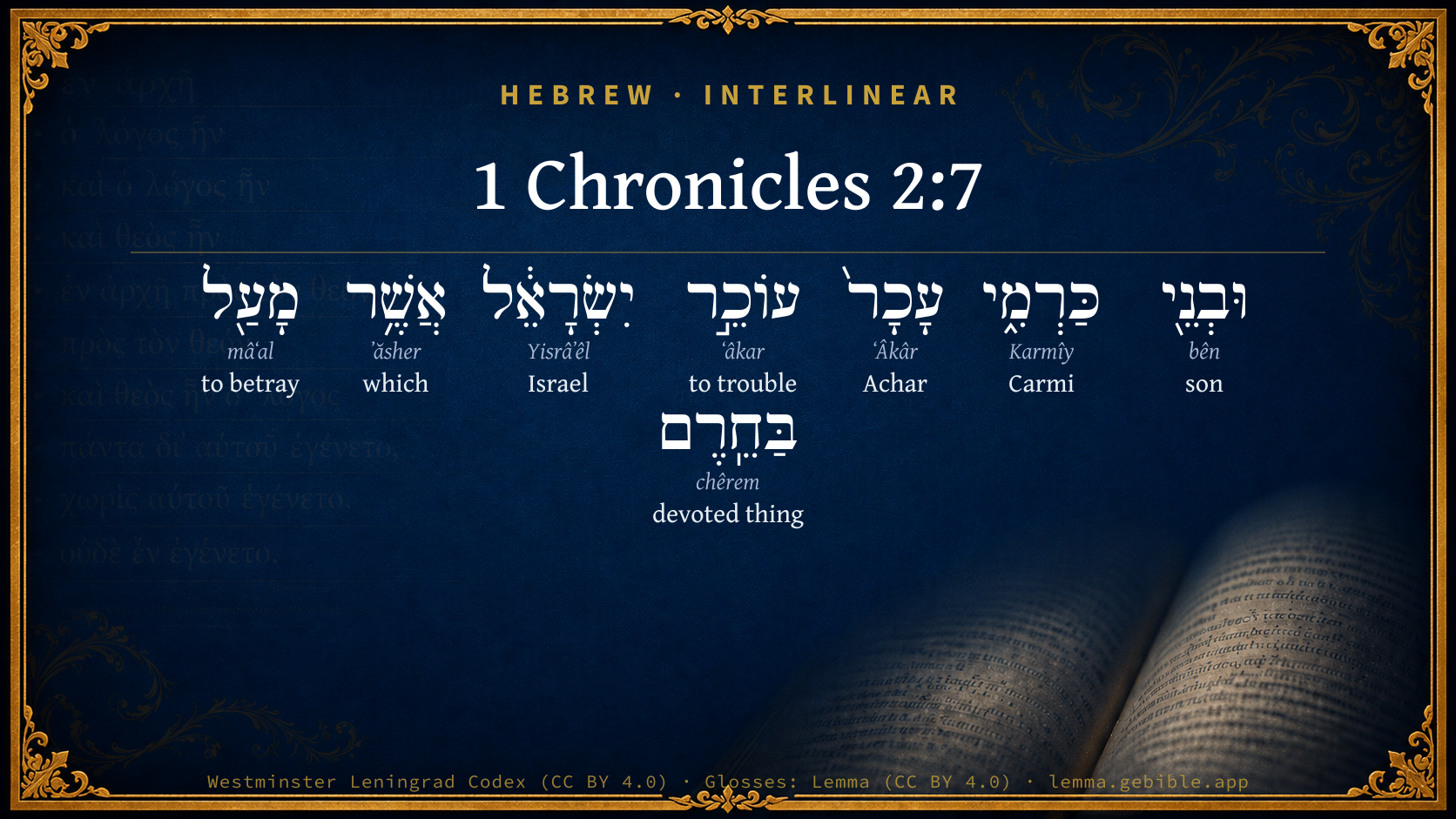
Hebrew (Westminster Leningrad Codex) 1 Chronicles 2:7 appears in the Hebrew Old Testament. The text above is from the Westminster Leningrad Codex. Each word links to its Strong’s number, a concise gloss, and parsing drawn from the Open Scriptures Hebrew Bible morphology. Click any word for its full Brown-Driver-Briggs (BDB) entry.
Download image
Cite this verse

1 Chronicles 2:7 (World English Bible). Public Domain. Lemma interlinear Bible study tool, https://lemma.gebible.app/v/1-chronicles/2/7.

Show BibTeX & RIS
BibTeX
RIS
English Translation
The sons of Carmi: Achar, the troubler of Israel, who committed a trespass in the devoted thing.
World English Bible · Public Domain
Highlights
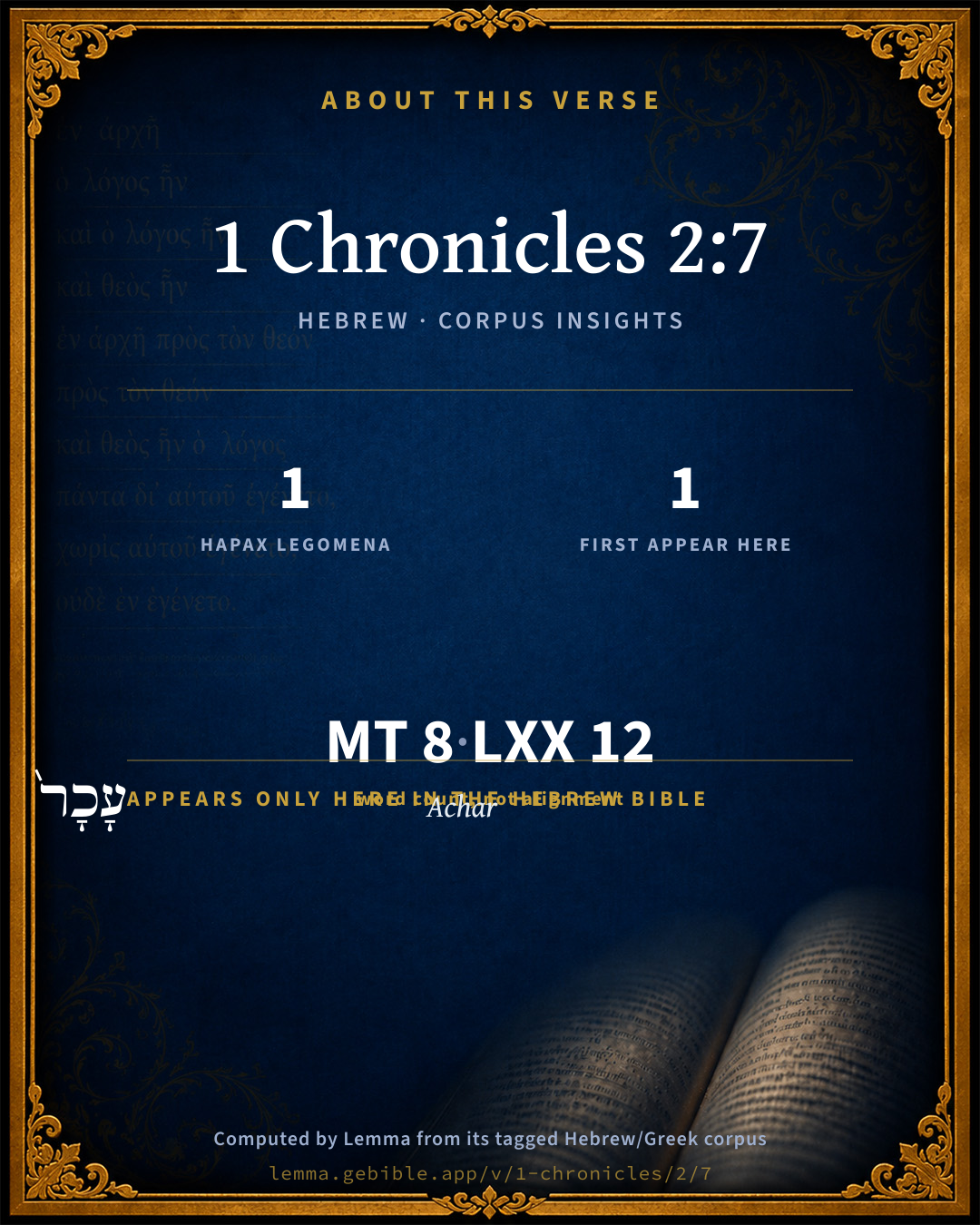
  • 1 hapax legomenon — only here in the Hebrew Bible
  • 1 first appearance in the Hebrew Bible
Full analysis ↓
Download a study sheet

One document with this verse’s original text, its word-by-word gloss line, the meaning frame, cross-references with their text, attributed commentary, and full source and license credits — printable, and it pastes into notes with its structure intact.

This verse Autodidact and up

Study sheet (.html) Plain text (.txt)

A passage Seminary Student

Up to 50 verses in one chapter. A passage sheet keeps up to 6 commentary sources and 12 cross-references per verse, in the order this page ranks them, and says so on the sheet whenever that leaves anything out. Ask for a single verse and you get the Autodidact verse sheet above.

Everything on this page stays free to read, with no account — the sheet is a download of what is already on screen, not access to it.

Want to remove ads? Support Godless Engineer
Compare translations 3

The same verse in 3 English versions, stacked beneath the original-language interlinear above. Click any original word for its lexicon entry.

Each is an independent rendering of the whole verse — the interlinear is not word-aligned to these translations.

Highlighted words mark where these versions differ — a whole-verse word diff, not a word-by-word alignment.

  • World English Bible Public Domain
    The sons of Carmi: Achar, the troubler of Israel, who committed a trespass in the devoted thing.
  • King James Version Public Domain
    And the sons of Carmi; Achar, the troubler of Israel, who transgressed in the thing accursed.
  • unfoldingWord Literal Text CC BY-SA 4.0
    And the sons of Carmi: Achan, the troubler of Israel who transgressed against the devoted thing.

unfoldingWord Literal Text — © unfoldingWord, licensed CC BY-SA 4.0. Word-aligned USFM3 via Door43 (git.door43.org/unfoldingWord/en_ult).

Versions to compare (up to 4)

3 of 4 selected

Show all 18 translations

Every available English version of this verse, each an independent rendering of the whole verse.

  • World English Bible Public Domain
    The sons of Carmi: Achar, the troubler of Israel, who committed a trespass in the devoted thing.
  • Berean Standard Bible Public Domain
    The son of Carmi: Achar, who brought trouble upon Israel by violating the ban on devoted things.
  • Majority Standard Bible Public Domain
    The son of Carmi: Achar, who brought trouble upon Israel by violating the ban on devoted things.
  • King James Version Public Domain
    And the sons of Carmi; Achar, the troubler of Israel, who transgressed in the thing accursed.
  • American Standard Version (1901) Public Domain
    And the sons of Carmi: Achar, the troubler of Israel, who committed a trespass in the devoted thing.
  • Revised Version (1885) Public Domain
    And the sons of Carmi; Achar, the troubler of Israel, who committed a trespass in the devoted thing.
  • Geneva Bible (1599) Public Domain
    And the sonne of Carmi, Achar that troubled Israel, transgressing in the thing excommunicate.
  • Douay-Rheims (1899) Public Domain
    And the sons of a Charmi: Achar, who troubled Israel, and sinned by the theft of the anathema.
  • Young's Literal Translation Public Domain
    And sons of Carmi: Achar, troubler of Israel, who trespassed in the devoted thing.
  • Literal Standard Version CC BY-SA 4.0
    And sons of Carmi: Achar, troubler of Israel, who trespassed in the devoted thing.
  • Unlocked Literal Bible CC BY-SA 4.0
    Karmi's son was Achar, who brought trouble on Israel when he stole what was reserved for God.
  • unfoldingWord Literal Text CC BY-SA 4.0
    And the sons of Carmi: Achan, the troubler of Israel who transgressed against the devoted thing.
  • Darby Bible Public Domain
    And the sons of Carmi: Achar, the troubler of Israel, who transgressed in the accursed thing.
  • World Messianic Bible Public Domain
    The son of Carmi: Achar, the troubler of Israel, who committed a trespass in the devoted thing.
  • Webster's Bible Public Domain
    And the sons of Carmi; Achar, the troubler of Israel, who transgressed in the thing accursed.
  • Free Bible Version CC BY-SA 4.0
    The son of Carmi: Achar, who caused trouble for Israel by being unfaithful in taking what was consecrated to the Lord.
  • Bible in Basic English Public Domain
    And the sons of Carmi: Achan, the troubler of Israel, who did wrong about the cursed thing.
  • JPS Tanakh (1917) Public Domain
    And the sons of Carmi: Achar, the troubler of Israel, who committed a trespass concerning the devoted thing.

Literal Standard Version (2020), Covenant Press — licensed CC BY-SA 4.0. Text via the HelloAO Bible API (eBible.org). Unlocked Literal Bible (unfoldingWord) — licensed CC BY-SA 4.0. Text via the HelloAO Bible API (eBible.org). unfoldingWord Literal Text — © unfoldingWord, licensed CC BY-SA 4.0. Word-aligned USFM3 via Door43 (git.door43.org/unfoldingWord/en_ult). Free Bible Version, Dr. Jonathan Gallagher — licensed CC BY-SA 4.0. Text via the HelloAO Bible API (eBible.org).

Word by word

More ways to search: Search by grammar → Find every occurrence → Compare this word →

Practice this passage: Drill this verse → Learn its vocabulary →

About this verse

These counts appear in no published source. They are computed here, from the morphology-tagged text and Lemma’s own curated glosses. What Lemma adds →

8
words
8
distinct lemmas
Historical
section

Notable vocabulary

1 hapax legomenon — a word that appears only here in the entire Hebrew Bible:

  • עָכָר֙ Achar H5917

First appearance in Scripture

This word makes its first canonical appearance in the Hebrew Bible here:

  • עָכָר֙ Achar H5917

Shared distinctive vocabulary

כַּרְמִ֑י Carmi H3756 occurs in 8 verses of the Hebrew Bible. Also found in:

Grammatical profile

  • 2 verbs
  • 5 nouns
  • 1 particle

Verb forms

  • עוֹכֵ֣ר Qal · Participle Active
  • מָעַ֖ל Qal · Perfect

Hebrew & Septuagint length

In English translation the verse runs 17 words from the Hebrew and 17 from the Septuagint (LXX English) — the same length.

A rough comparison of the two English renderings, which tokenize alike — not a word-level alignment.

Word counts can differ between the Hebrew and the Greek without any difference in meaning — e.g. the Hebrew direct-object marker אֵת has no separate Greek word, and Greek often adds the article ὁ.

In the original languages it is 8 Hebrew tokens and 12 Greek tokens — but the two are counted differently (Hebrew bundles its prefixes and suffixes into one token; the Greek is in lemma form), so that isn’t a like-for-like length.

Cross-references

8

Topical passages linked to 1 Chronicles 2:7 in the Treasury of Scripture Knowledge — connected by theme and wording, ordered by reader-vote popularity; previews shown in the World English Bible.

  • Joshua 6:18 But as for you, only keep yourselves from the devoted thing, lest when you have devoted it, you take of the devoted thing; so would you make the camp of Israel accursed, and trouble it.
  • Deuteronomy 7:26 You shall not bring an abomination into your house, and become a devoted thing like it: you shall utterly detest it, and you shall utterly abhor it; for it is a devoted thing.
  • Deuteronomy 13:17 There shall cleave nothing of the devoted thing to your hand; that Yahweh may turn from the fierceness of his anger, and show you mercy, and have compassion on you, and multiply you, as he has sworn to your fathers;
  • Joshua 7:1–5 But the children of Israel committed a trespass in the devoted thing; for Achan, the son of Carmi, the son of Zabdi, the son of Zerah, of the tribe of Judah, took of the devoted thing: and the anger of Yahweh was kindled against the children of Israel.
  • Joshua 7:11–15 Israel has sinned; yes, they have even transgressed my covenant which I commanded them: yes, they have even taken of the devoted thing, and have also stolen, and dissembled also; and they have even put it among their own stuff.
  • Joshua 7:25 Joshua said, Why have you troubled us? Yahweh shall trouble you this day. All Israel stoned him with stones; and they burned them with fire, and stoned them with stones.
  • Joshua 22:20 Didn't Achan the son of Zerah commit a trespass in the devoted thing, and wrath fell on all the congregation of Israel? and that man didn't perish alone in his iniquity.
  • 1 Chronicles 4:1 The sons of Judah: Perez, Hezron, and Carmi, and Hur, and Shobal.

Cross-references courtesy of OpenBible.info (CC BY 4.0).

Hebrew and Greek witnesses Masoretic Hebrew ↔ Greek Septuagint

The same verse in the two great witnesses to the Old Testament, shown verse-for-verse.

These are two independent witnesses, not word-aligned to each other, and the Septuagint is shown in lemma (dictionary) form.

Hebrew 1 Chronicles 2:7 Masoretic · Westminster Leningrad Codex

וּבְנֵ֖י כַּרְמִ֑י עָכָר֙ עוֹכֵ֣ר יִשְׂרָאֵ֔ל אֲשֶׁ֥ר מָעַ֖ל בַּחֵֽרֶם

The sons of Carmi: Achar, the troubler of Israel, who committed a trespass in the devoted thing.

World English Bible · Public Domain

Greek LXX 1 Chronicles 2:7 Septuagint · lemma form

καί υἱός χαρμι αχαρ ὁ ἐμποδοστάτης ἰσραήλ ὅς ἀθετέω εἰς ὁ ἀνάθεμα

And the sons of Charmi; Achar the troubler of Israel, who was disobedient in the accursed thing.

LXX2012 (modern English Septuagint) · Public Domain

On this verse, Haydock's Catholic Bible Commentary discusses the Septuagint’s reading. Read the note in Commentary ↓

Hebrew: Westminster Leningrad Codex (CC BY 4.0). Greek: Septuagint (public domain); English from LXX2012 (modern English Septuagint) (Public Domain). How the Septuagint differs from the Hebrew →

Commentary

Notes on 1 Chronicles 2:7 from classic Christian and Jewish commentators (each source and its license shown beneath its notes). The classic Christian expositions comment on the surrounding passage and are grouped to its opening verse, so a note may address several verses; the Jewish commentaries on the Tanakh (Rashi and others) are per-verse, so they appear only where the commentator wrote on this verse.

Lemma curates 59 commentaries, every one of them public domain or Creative Commons licensed, each selected and text-cleaned for this edition rather than reprinted as found. About our sources →

Trapp's Complete Commentary

John Trapp

1Ch 2:7 And the sons of Carmi; Achar, the troubler of Israel, who transgressed in the thing accursed.

Ver. 7. Achar.] Alias Achan, {Jos 6:1-27; Jos 7:1-26} per paranomasiam.

John Trapp, A Commentary or Exposition upon All the Books of the Old and New Testament (1647–1656) — public domain. Text from a community e-Sword module.

The Biblical Illustrator

Joseph S. Exell

1Ch_2:7

Achar, the troubler of Israel.

The troubler of Israel

I have read many biographies, but never met with any which hit off a mans character in a line as this word of inspiration does. The noble and the great used frequently to suspend the achievement over the tomb of their departed ancestor in memorial of his renown, bearing a motto, which described the leading characteristic of the ancient founder of the family. Here is the tomb of Achar, or Achan, and here is the motto for his achievement. The tomb consists of a large heap of stones, which am injured people by Gods command piled upon his ashes after they had stoned him to death, and burned his dead body with fire. What is the motto? The troubler of Israel. What a finale to a mans life! What a record to paint on his escutcheon!

I. What made Achan a troubler of Israel? Sin. All trouble may be traced to this. It led Achan to commit the threefold crime of disobedience, defiance of Gods scrutiny, and sacrilege. His one sin brought trouble into all the camp. This is all the mere remarkable when you remember how insignificant his position was among the tribes. We die all alone, but we cannot all sin alone. Even our secret sins are public calamities, and no transgression is without its malign influence upon the common weal.

II. The troubles Achan brought upon his people.

1. Defeat before a less powerful foe.

2. Depression of spirit, which unremedied, would he fatal to the very existence of the nation.

3. Anger from God, which would not be appeased even by the intercession of Joshua.

4. The threat of abandonment by God if they did not root out the evil from among them. (George Venables.)

Achan, the troubler of Israel

Why was the punishment of Achan so severe?

1. His was a terrible sin; it was a wilful disobedience; it was high treason against God; it was sacrilege; it was stealing, lying, coveting, and practically murder.

2. This sin struck at the very life of the nation. If the people could disobey God with impunity, the nation would soon be ruined, and the hope of the world be put out.

3. The course Achan took would have degraded God in the eyes of Israel and of the Gentiles. The people and cities of Canaan were rich; the Israelites were poor. Canaan had the resources of a somewhat high civilisation--gold, silver, vessels of brass and of iron; goodly Babyionish garments. Now, suppose the Lord had given them free license to plunder, to steal and hide, and appropriate all they could lay hands on? This movement for the conquest of Canaan would have become a savage, plundering, marauding expedition.

4. These fascinating spoils--these glittering prizes of gold and silver, and these ornaments of the cultured Canaanites--were linked in on every hand with idolatry. Art and wealth in Canaan, as in every other heathen nation, lent their power to augment the attractions towards idol-worship.

5. But another consideration must have great weight. The Israelites had before them the task of conquering Palestine, a task which required the utmost discipline in the army. God was the Captain, directing, through Joshua, all the campaign. It was absolutely necessary, in the interests of military discipline, to check the first buddings of that cupidity which so often characterised ancient warfare. (Christian Age.)

The Biblical Illustrator, edited by Joseph S. Exell (c. 1880s–1900s) — public domain. Text from a community e-Sword module.

Joseph Benson's Commentary

1Ch 2:7. The sons of Carmi — This man is here mentioned, because he was the son of Zimri, who was also called Zabdi, Jos 7:18. Achar, the troubler of Israel — He who in Joshua 7. is called Achan, is here, by a small variation, elegantly and significantly called Achar, which means troubler: because he had brought Israel into great danger and distress, by the sin he committed.

Joseph Benson's Commentary on the Old and New Testaments (1811–1818) — public domain. Text from a community e-Sword module.

Tyndale Open Study Notes

Tyndale Open Resources

2:7 set apart for the Lord: See “Complete Destruction” Theme Note.

Tyndale Open Study Notes — © Tyndale Open Resources, licensed CC BY-SA 4.0. Text via the HelloAO Bible API.

Geneva Bible (1599)

Geneva Bible translators

Or, Achan.

Geneva Bible (1599) marginal notes — public domain. Text via Bolls.life.

Jamieson, Fausset & Brown

Robert Jamieson, A. R. Fausset & David Brown

the sons of Carmi--He was the son of Zimri, or Zabdi, as he is called (Jos 7:1).

Achar--or Achan (Jos 7:1). This variety in the form of the name is with great propriety used here, since Achar means "troubler."

Jamieson, Fausset & Brown — Commentary Critical and Explanatory on the Whole Bible (1871) — public domain (CC PDM 1.0). Text via the HelloAO Bible API.

Ellicott's Commentary for English Readers

(7) The sons of Carmi.—See Note on 1Ch_1:41.

Achar, the troubler of Israel.—See Jos_7:1, where the man is called “Achan, son of Carmi, son of Zabdi, son of Zerah, of the tribe of Judah.” The family of Carmi, therefore, were Zarhites. Jos_7:24 calls him “Achan, the son of Zerah,” an expression which shows, if other proof were wanting, that we must be cautious of interpreting such phrases literally in all instances.

Achar . . . troubler of Israel.—There is a play on the man’s name in the Hebrew, which is, “Achar ’ocher Yisrael.” So in Jos_7:25 Joshua asks, “Why hast thou troubled us?” (‘achartânu), and in 1Ch_2:26 the place of Achar’s doom is called “the valley of Achor” (trouble). Probably Achan is an old error for Achar.

A Bible Commentary for English Readers, edited by Charles John Ellicott (1878–1897) — public domain. Text from a community e-Sword module.

The Cambridge Bible for Schools and Colleges

gen. ed. J. J. S. Perowne

7. the sons of Carmi] Carmi is probably to be taken as the son of Zimri (= Zabdi, Jos_7:1). Targ. however has “Carmi who is Zimri.” See note on Zimri 1Ch_2:6.

Achar] This form of the name (instead of “Achan” Jos_7:1) is used by the Chronicler to bring out better the play on the Heb. word for “troubler.” The Heb. runs, “Achar ocher Israel.”

The Cambridge Bible for Schools and Colleges (gen. ed. J. J. S. Perowne; Cambridge University Press, 1878–1918) — public domain. Text from a community e-Sword module.

John Gill's Exposition

And Ram begat Amminadab,.... Ram is the same with Aram, Mat 1:3 the genealogy is carried down from him to Jesse in the same order as there, and in Rut 4:19 only here Nahshon the son of Amminadab is called

the prince of the children of Judah; which Kimchi and Jarchi say is written for the honour of David, who descended from him; and Salmon his son is here called Salma.

John Gill's Exposition of the Whole Bible (1746–1763) — public domain (CC PDM 1.0). Text via the HelloAO Bible API.

Albert Barnes' Notes on the Bible

“Achan” Jos 7:1 seems to have become “Achar,” in order to assimilate the word more closely to the Hebrew term for “troubler,” which was from the time of Achan’s sin regarded as the true meaning of his name Jos 7:25-26.

Albert Barnes' Notes on the Bible (1834–1885) — public domain. Text from a community e-Sword/MySword module.

Haydock's Catholic Bible Commentary

Achar, alias Achan, (Josue vii.; Challoner) which was his real name, as the former was given him (Calmet) in consequence of his having "troubled" Israel. (Du Hamel) --- One letter may have been mistaken. (Worthington) --- It may seem more probable that Achar, which appears invaribly in the Vatican Septuagint and Syriac, is the proper name. (Kennicott) --- Anathema, the thing devoted or accursed, viz., the spoils of Jericho. (Challoner)

George Leo Haydock (1774–1849), Haydock's Catholic Family Bible and Commentary, 1859 edition — public domain. Excludes Psalms (Douay-Rheims chapter numbering differs from Protestant) and Deuterocanonical books (Catholic canon only).

Matthew Poole's English Annotations

Carmi is here mentioned, because he was the son of Zimri, who is also called Zabdi, Jos 7:1.

Achar; called Achan, Jos 7:1, and here Achar, with a little variation for greater significancy; for Achar signifies a troubler.

Matthew Poole's English Annotations on the Holy Bible (1683–1685) — public domain. Text from a community e-Sword/MySword module.

The Pulpit Commentary

We have then so far seven grandsons to Judah, when a new name, unmentioned before, is introduced Carmi. He is neither described as one of the seven grandsons nor as descended from any one of them, but unenviably enough is marked as the father of Achar later form of Achauthe troubler of Israel., Jos_7:1-18 supplies the missing link, and states that Carmi is son of Zimri (Zabdi) one of the aforesaid seven grandsons. By the punishment of death, visited upon this Achar, with his sons and daughters, (Jos_7:24, Jos_7:25) it may be presumed that the line of Judah through him became extinct. HOMILIES BY J.R. THOMSON Ver. 7.

A transgressor and troubler.

In most instances in the genealogies of this book, the names of the successive members of the families of Israel are mentioned without remark. But now and then a memorable personage is named, and some trait of his character, some incident in his life, is recorded, or rather referred to, by the chronicler. This is the case even when the record is one of shame and infamy. So is it With Achan.

I Achan was A TRANSGRESSOR. In transgression much is involved:

e.g. Law. A line must be drawn in order that it may be passed over. A commandment must be given before it can be violated. In the case of Achan, the law was published with authority. Covetousness. Before there can be sin there must be lust. Desires are divinely implanted, and evil does not lie in their existence, but in their unlawful gratification. Temptation. There must be some circumstance without eliciting and fostering the desire within. Men often blame the temptation, but unreasonably, for the evil is in themselves, not in the innocent and often unconscious occasion of their transgression. Yielding of the will when tempted. Without this, all that goes before is harmless; it is here that the harm begins. If temptation is resisted, virtue is strengthened and character is improved; if the will succumb, moral deterioration ensues. The latter was the ease with Achan. Hiding of sin. This will often follow upon transgression. There is a hope that it may be concealed from men, perhaps even from God. Conscience of sin. This is divinely appointed, to lead the sinner to repentance and reformation. Yet it may prove, if it fail in this mission, a scourge to chastise, awakening remorse and fear.

II Achan was A TROUBLER. The trouble which follows upon sin is not confined to the sinner. In the case before us all Israel was punished because of one man"s sin. Such is the constitution of society, that this is often seen, the chastisement of many for the transgression of one. Trouble may lead to inquiry, and inquiry to discovery. This happened in Achan"s case by supernatural agency; but the same happens every day by means which appear natural. Discovery may lead to confession, and confession may be followed by punishment. So it was with Achan. And there are cases where there seem to be no means of avoiding the consequences of transgression. Yet the sinner must remember that we have been assured that "if we confess our sins, God is faithful and just to forgive us our sins, and to cleanse us from all unrighteousness." Trouble may be followed by Divine acceptance and favour. There seems something harsh in Joshua"s language to Achan, "Why hast thou troubled us? The Lord shall trouble thee this day." Yet, when the transgressor was removed and the transgression was put away from Israel, the Lord received his people again into his favour.

PRACTICAL LESSONS.

1. Before transgression, "Be sure your sin will find you out.

2. After transgression, the trouble that comes upon the sinner is sent inmercy.

3. Confession and repentance, and faith in Christ, are necessary in order toreconciliation and acceptance. T. Ver. 7.

Sinners are troublers.

Achar is but a modernized form of the familiar Achan. (Jos_7:25) The story of this man is given so fully in the early records, and is here so definitely recalled, that we may be sure some important and permanent lessons were taught by it, and it may be still for "our instruction, on whom the ends of the world are come." The narrative should be fully detailed. Bring out that Achan"s sin was at once self-will, disobedience , covetousness, and sacrilege. Explain that the one condition of Divine blessing for Israel was entire and unquestioning loyalty to the Divine will. And there is no other condition of blessing now. That will might oppose seemingly right feelings; and this brings us the more subtle and anxious testings of our loyalty, e.g. Abraham"s offering Isaac. That will would necessarily oppose all covetous feeling. The man who wants to get for self will ever find it hard to accept God"s will and way for him. But the covetous man who is a member of a community not only brings trouble on himself, but on others who may be related to him.

I THIS SINNER"S SIN. Set out its public character, in view of Joshua"s public proclamation. Show its aggravations, as committed directly against the known will of God.

II THIS SINNER"S SIN BROUGHT TROUBLE ON HIMSELF. As sin always must do. Here the sorrow of feeling himself to be the cause of national disaster; the penalty of his own forfeited life; and the misery of knowing that his family must suffer for his sin, and his very name be blotted out of the national records. As is ever the case with the covetous, Achan might glory over what he had gained, until it could be revealed to him what he had lost; then the gain could only appear to be utterly worthless and hopelessly ruinous, a millstone hung round his neck to drown him in the sea. Compare what Judas Iscariot gained thirty pieces of silver; and what he lost life and hope and Christ, his all. But the point which is specially called up to our remembrance is that

III THIS SINNER"S SIN BROUGHT TROUBLE ON OTHERS. SO he is known as the "troubler of Israel." Set out the trouble that came upon Israel. They were grievously smitten before their foes. Also the trouble that came upon Joshua. He was humbled in the dust, filled with fears, and driven to God in agonizing intercessions. But even more terribly Achan"s sin brought trouble upon his own family, just as the drunkard and the licentious and the dishonest now drag down into their ruin those they profess to love. "Not Achan alone is called forth to death, but all his family, all his substance. The actor alone does not smart with sacrilege; all that concerns him is enwrapped in the judgment. God"s first revenges are so much the more fearful because they must be exemplary." On the penalty of a man"s wrong-doing covering and including those related to him, Archbishop Whitgift has this figure: "The eagle that stole a coal from the altar thereby set her nest on fire, which consumed both her young eagles and herself that stole it." We recognize that, if men are linked together in family and social life, it is well that, in God"s providence, they should bear one another"s burdens, share one another"s disabilities, and suffer one another"s woes. In such a case as Achan"s we have but God doing, by direct command, what he is always doing in the orderings of Divine providence. No man"s sin can ever stand alone it must involve others in its consequences; and in this its hatefulness is revealed and a due fear of it is wrought in our minds. We should not so much hesitate to sin if we could ensure the limitation of the consequences to ourselves. But our sin must make us troublers. Even if the sin be forgiven, the issues must still go on. Then what a sublime idea we may gain of the redemption which God proposes I It deals with us for forgiveness and cleansing, but it also goes on after all the issues of human sin, and will not rest until the whole world is fully delivered, recovered, and saved. R.T.

The Pulpit Commentary (1880–1919), ed. H.D.M. Spence-Jones & Joseph S. Exell — public domain. Text from a community e-Sword module.

John Wesley's Explanatory Notes

Carmi - Who is here mentioned, because he was the son of Zimri, who is also called Zabdi, Josh. vii, 1. Achar - Called Achan, Josh. vii, 1, and here Achar, with a little variation for greater significancy: for Achar signifies a troubler.

John Wesley, Explanatory Notes Upon the Whole Bible (1754–1765) — public domain. Text via the GEBible commentary corpus.

Keil & Delitzsch

C. F. Keil & F. Delitzsch

And Ram begat Amminadab,.... Ram is the same with Aram, Mat 1:3 the genealogy is carried down from him to Jesse in the same order as there, and in Rut 4:19 only here Nahshon the son of Amminadab is called

the prince of the children of Judah; which Kimchi and Jarchi say is written for the honour of David, who descended from him; and Salmon his son is here called Salma.

Keil & Delitzsch — Biblical Commentary on the Old Testament (1861–1891) — public domain (CC PDM 1.0). Text via the HelloAO Bible API. (Old Testament only.)

Rashi

Rabbi Shlomo Yitzchaki (Rashi)

And the sons of Carmi: Achar Now why do I call him Achar? Was his name not Achan? (It is explained) that [he was called thus] since he troubled Israel by transgressing the devoted thing, and because of him thirty-six thousand (sic) men fell. This is what I explained that whatever derogatory information he can tell, he tells, (but nevertheless) the kingship emanated from them.

Rashi on the Tanakh — English translations: “The Judaica Press complete Tanach with Rashi, translated by A. J. Rosenberg” (CC BY 4.0); “Pentateuch with Rashi's commentary by M. Rosenbaum and A.M. Silbermann, 1929-1934” (public domain); “The Metsudah Tanach series, Lakewood, N.J” (CC BY 4.0); and “The Book of Joshua, Metsudah Publications, 1997” (CC BY 4.0). Text via Sefaria.

Lesson kit

Teaching starters — assembled from the data on this page, not authored interpretation. Every prompt links to the verse data it draws on. Edit before teaching.

1 Chronicles, in the Historical, opens this verse with 8 words (8 distinct Hebrew lemmas). Its most distinctive word is ʻÂkâr (“Achar”). A historical commentator’s framing appears above. Read the whole chapter for the surrounding context.

Discussion questions

  1. The word ʻÂkâr carries the sense “Achar.” How does it shape the verse?
  2. This verse holds 1 word here found nowhere else in the Hebrew Bible. What might the rare word draw attention to?
  3. The word “Achar” first appears here in Scripture. What is being introduced at this debut?
  4. Genesis 46:9 shares the word «Carmi» with this verse. How do the two illuminate each other?
  5. The translations on this page render this verse differently — a whole-verse word diff, not a word-by-word alignment. What might account for the different wordings?
  6. The verb «עוֹכֵ֣ר» is Qal Participle Active. How does its form color the action?
  7. Reading how Trapp's Complete Commentary and The Biblical Illustrator read this verse, where do the two commentators agree and where do they part?

Things to notice

Reading settings

Reading text

Shown beneath each verse's original-language words.

Old Testament
Old Testament edition

Read the OT as the Masoretic Hebrew (MT) or the Greek Septuagint (LXX).

English shown for the Greek Septuagint (in the Hebrew ↔ Greek comparison).

Comparing translations? Open the Compare panel on any verse page to stack up to four side by side.