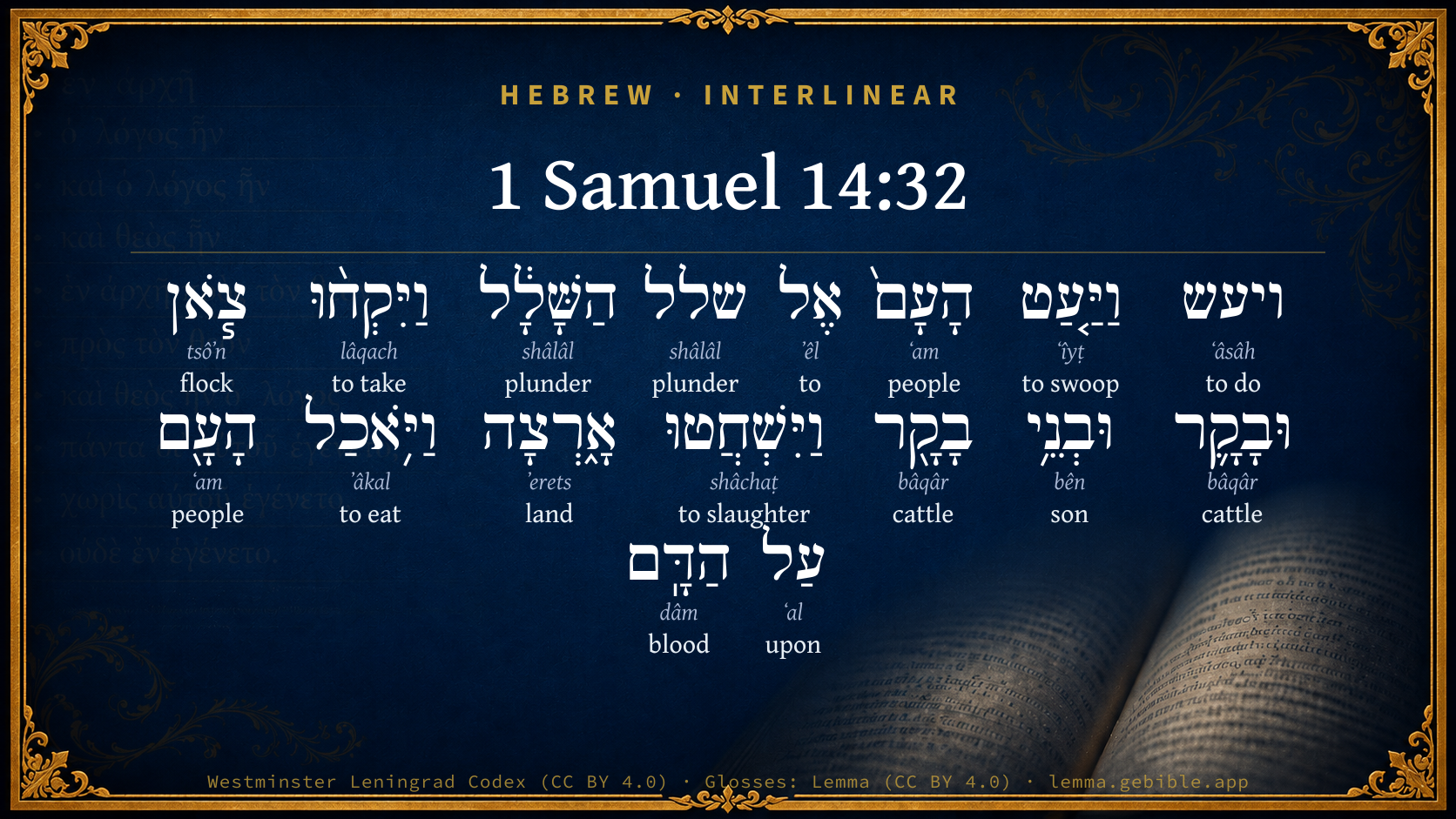
1 Samuel 14:32

Hebrew (Westminster Leningrad Codex) 1 Samuel 14:32 appears in the Hebrew Old Testament. The text above is from the Westminster Leningrad Codex. Each word links to its Strong’s number, a concise gloss, and parsing drawn from the Open Scriptures Hebrew Bible morphology. Click any word for its full Brown-Driver-Briggs (BDB) entry.
Download image
Cite this verse

1 Samuel 14:32 (World English Bible). Public Domain. Lemma interlinear Bible study tool, https://lemma.gebible.app/v/1-samuel/14/32.

Show BibTeX & RIS
BibTeX
RIS
English Translation
and the people flew on the spoil, and took sheep, and oxen, and calves, and killed them on the ground; and the people ate them with the blood.
World English Bible · Public Domain
Highlights
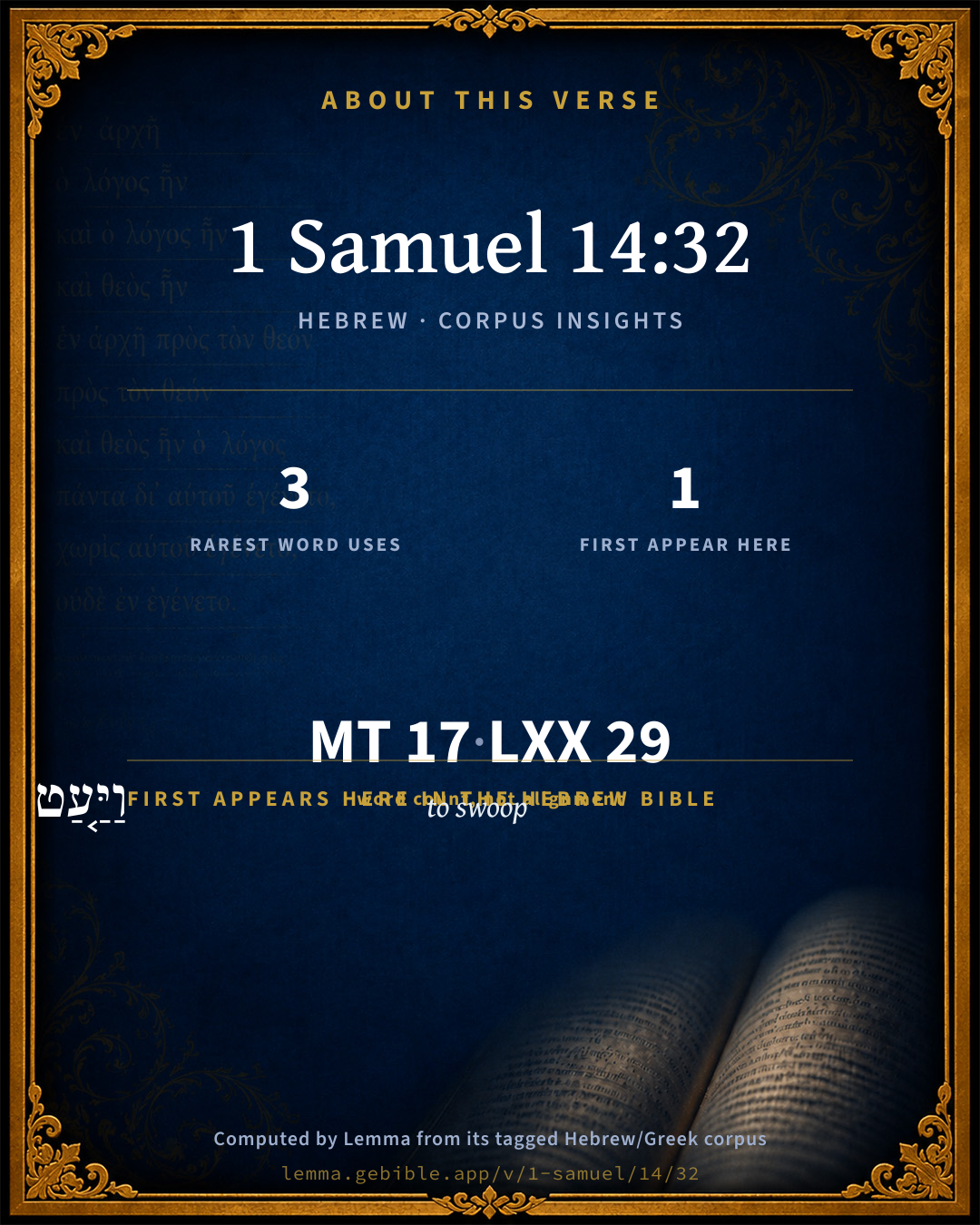
  • 1 first appearance in the Hebrew Bible
Full analysis ↓
Download a study sheet

One document with this verse’s original text, its word-by-word gloss line, the meaning frame, cross-references with their text, attributed commentary, and full source and license credits — printable, and it pastes into notes with its structure intact.

This verse Autodidact and up

Study sheet (.html) Plain text (.txt)

A passage Seminary Student

Up to 50 verses in one chapter. A passage sheet keeps up to 6 commentary sources and 12 cross-references per verse, in the order this page ranks them, and says so on the sheet whenever that leaves anything out. Ask for a single verse and you get the Autodidact verse sheet above.

Everything on this page stays free to read, with no account — the sheet is a download of what is already on screen, not access to it.

Want to remove ads? Support Godless Engineer
Compare translations 3

The same verse in 3 English versions, stacked beneath the original-language interlinear above. Click any original word for its lexicon entry.

Each is an independent rendering of the whole verse — the interlinear is not word-aligned to these translations.

Highlighted words mark where these versions differ — a whole-verse word diff, not a word-by-word alignment.

  • World English Bible Public Domain
    and the people flew on the spoil, and took sheep, and oxen, and calves, and killed them on the ground; and the people ate them with the blood.
  • King James Version Public Domain
    And the people flew upon the spoil, and took sheep, and oxen, and calves, and slew them on the ground: and the people did eat them with the blood.
  • unfoldingWord Literal Text CC BY-SA 4.0
    And the people swooped down upon the plunder, and they took flock and herd and sons of the herd, and they slaughtered on the ground. And the people ate with the blood.

unfoldingWord Literal Text — © unfoldingWord, licensed CC BY-SA 4.0. Word-aligned USFM3 via Door43 (git.door43.org/unfoldingWord/en_ult).

Versions to compare (up to 4)

3 of 4 selected

Show all 18 translations

Every available English version of this verse, each an independent rendering of the whole verse.

  • World English Bible Public Domain
    and the people flew on the spoil, and took sheep, and oxen, and calves, and killed them on the ground; and the people ate them with the blood.
  • Berean Standard Bible Public Domain
    So they rushed greedily to the plunder, taking sheep, cattle, and calves. They slaughtered them on the ground and ate meat with the blood still in it.
  • Majority Standard Bible Public Domain
    So they rushed greedily to the plunder, taking sheep, cattle, and calves. They slaughtered them on the ground and ate meat with the blood still in it.
  • King James Version Public Domain
    And the people flew upon the spoil, and took sheep, and oxen, and calves, and slew them on the ground: and the people did eat them with the blood.
  • American Standard Version (1901) Public Domain
    and the people flew upon the spoil, and took sheep, and oxen, and calves, and slew them on the ground; and the people did eat them with the blood.
  • Revised Version (1885) Public Domain
    and the people flew upon the spoil, and took sheep, and oxen, and calves, and slew them on the ground: and the people did eat them with the blood.
  • Geneva Bible (1599) Public Domain
    So the people turned to the spoile, and tooke sheepe, and oxen, and calues, and slewe them on the ground, and the people did eate them with the blood.
  • Douay-Rheims (1899) Public Domain
    And falling upon the spoils, they took sheep, and oxen, and calves, and slew them on the ground: and the people ate them with the blood.
  • Young's Literal Translation Public Domain
    and the people make unto the spoil, and take sheep, and oxen, and sons of the herd, and slaughter on the earth, and the people eat with the blood.
  • Literal Standard Version CC BY-SA 4.0
    and the people make toward the spoil, and take sheep, and oxen, and sons of the herd, and slaughter on the earth, and the people eat with the blood.
  • Unlocked Literal Bible CC BY-SA 4.0
    The people rushed greedily on the plunder and took sheep, oxen and calves, and killed them on the ground. The people ate them with the blood.
  • unfoldingWord Literal Text CC BY-SA 4.0
    And the people swooped down upon the plunder, and they took flock and herd and sons of the herd, and they slaughtered on the ground. And the people ate with the blood.
  • Darby Bible Public Domain
    And the people fell on the spoil, and took sheep, and oxen, and calves, and slaughtered them on the ground; and the people ate [them] with the blood.
  • World Messianic Bible Public Domain
    and the people pounced on the plunder, and took sheep, cattle, and calves, and killed them on the ground; and the people ate them with the blood.
  • Webster's Bible Public Domain
    And the people flew upon the spoil, and took sheep and oxen, and calves, and slew them on the ground: and the people ate them with the blood.
  • Free Bible Version CC BY-SA 4.0
    They grabbed the plunder, taking sheep, cattle, and calves, and slaughtered them right there on the ground. But they ate them with the blood.
  • Bible in Basic English Public Domain
    And rushing at the goods taken in the fight, the people took oxen and sheep and young oxen, and put them to death there on the earth, and had a meal, taking the flesh with the blood in it.
  • JPS Tanakh (1917) Public Domain
    And the people flew upon the spoil, and took sheep, and oxen, and calves, and slew them on the ground; and the people did eat them with the blood.

Literal Standard Version (2020), Covenant Press — licensed CC BY-SA 4.0. Text via the HelloAO Bible API (eBible.org). Unlocked Literal Bible (unfoldingWord) — licensed CC BY-SA 4.0. Text via the HelloAO Bible API (eBible.org). unfoldingWord Literal Text — © unfoldingWord, licensed CC BY-SA 4.0. Word-aligned USFM3 via Door43 (git.door43.org/unfoldingWord/en_ult). Free Bible Version, Dr. Jonathan Gallagher — licensed CC BY-SA 4.0. Text via the HelloAO Bible API (eBible.org).

Word by word

More ways to search: Search by grammar → Find every occurrence → Compare this word →

Practice this passage: Drill this verse → Learn its vocabulary →

וַיַּ֤עַט
ʻîyṭ
H5860
“and · to swoop”
Conjunction + Verb, Qal, Sequential Imperfect, 3rd Person, Masculine, Singular
Part of Speech
Conjunction + Verb
Stem
Qal
Form
Sequential Imperfect
Person
3rd Person
Gender
Masculine
Number
Singular
Full BDB Definition

Origin: a primitive root

TWOT: 1610 , 1610b

to scream, shriek - (Qal) to scream - to dart greedily, swoop upon, rush upon - (Qal) to dart greedily
  1. ויעש ʻâsâh H6213 “and · to do” Conjunction + Verb, Qal, Sequential Imperfect, 3rd Person, Masculine, Singular
  2. הָעָם֙ ʻam H5971 “the · people” Particle, Definite Article + Noun, Common, Masculine, Singular, Absolute
  3. אֶל ʼêl H413 “to” Preposition
  4. שלל shâlâl H7998 “plunder” Noun, Common, Masculine, Singular, Absolute
  5. הַשָּׁלָ֔ל shâlâl H7998 “the · plunder” Particle, Definite Article + Noun, Common, Masculine, Singular, Absolute
  6. וַיִּקְח֨וּ lâqach H3947 “and · to take” Conjunction + Verb, Qal, Sequential Imperfect, 3rd Person, Masculine, Plural
  7. צֹ֧אן tsôʼn H6629 “flock” Noun, Common, Both, Singular, Absolute
  8. וּבָקָ֛ר bâqâr H1241 “and · cattle” Conjunction + Noun, Common, Both, Singular, Absolute
  9. וּבְנֵ֥י bên H1121 “and · sons of” Conjunction + Noun, Common, Masculine, Plural, Construct
  10. בָקָ֖ר bâqâr H1241 “cattle” Noun, Common, Both, Singular, Absolute
  11. וַיִּשְׁחֲטוּ shâchaṭ H7819 “and · to slaughter” Conjunction + Verb, Qal, Sequential Imperfect, 3rd Person, Masculine, Plural
  12. אָ֑רְצָה ʼerets H776 “land · toward” Noun, Common, Both, Singular, Absolute + Suffix, Demonstrative
  13. וַיֹּ֥אכַל ʼâkal H398 “and · to eat” Conjunction + Verb, Qal, Sequential Imperfect, 3rd Person, Masculine, Singular
  14. הָעָ֖ם ʻam H5971 “the · people” Particle, Definite Article + Noun, Common, Masculine, Singular, Absolute
  15. עַל ʻal H5921 “upon” Preposition
  16. הַדָּֽם dâm H1818 “the · blood” Particle, Definite Article + Noun, Common, Masculine, Singular, Absolute

About this verse

These counts appear in no published source. They are computed here, from the morphology-tagged text and Lemma’s own curated glosses. What Lemma adds →

17
words
14
distinct lemmas
Historical
section

Notable vocabulary

The rarest word here is וַיַּ֤עַט to swoop H5860 — appearing just 3 times in the whole Hebrew Bible.

First appearance in Scripture

This word makes its first canonical appearance in the Hebrew Bible here:

  • וַיַּ֤עַט to swoop H5860

Shared distinctive vocabulary

וַיַּ֤עַט to swoop H5860 occurs in 3 verses of the Hebrew Bible. Also found in:

Grammatical profile

  • 5 verbs
  • 10 nouns
  • 2 prepositions

Verb forms

  • ויעש Qal · Sequential Imperfect
  • וַיַּ֤עַט Qal · Sequential Imperfect
  • וַיִּקְח֨וּ Qal · Sequential Imperfect
  • וַיִּשְׁחֲטוּ Qal · Sequential Imperfect
  • וַיֹּ֥אכַל Qal · Sequential Imperfect

Repetition

Words recur within this verse — often emphatic in Hebrew:

  • הָעָם֙ people H5971 ×2
  • שלל plunder H7998 ×2
  • וּבָקָ֛ר cattle H1241 ×2

Hebrew & Septuagint length

In English translation the verse runs 28 words from the Hebrew and 29 from the Septuagint (LXX English) — closely comparable.

A rough comparison of the two English renderings, which tokenize alike — not a word-level alignment.

Word counts can differ between the Hebrew and the Greek without any difference in meaning — e.g. the Hebrew direct-object marker אֵת has no separate Greek word, and Greek often adds the article ὁ.

In the original languages it is 17 Hebrew tokens and 29 Greek tokens — but the two are counted differently (Hebrew bundles its prefixes and suffixes into one token; the Greek is in lemma form), so that isn’t a like-for-like length.

Cross-references

11

Topical passages linked to 1 Samuel 14:32 in the Treasury of Scripture Knowledge — connected by theme and wording, ordered by reader-vote popularity; previews shown in the World English Bible.

  • Leviticus 3:17 "'It shall be a perpetual statute throughout your generations in all your dwellings, that you shall eat neither fat nor blood.'"
  • 1 Samuel 15:19 Why then didn't you obey the voice of Yahweh, but flew on the spoil, and did that which was evil in the sight of Yahweh?"
  • Genesis 9:4 But flesh with the life of it, the blood of it, you shall not eat.
  • Leviticus 17:10–14 "'Any man of the house of Israel, or of the strangers who live as foreigners among them, who eats any kind of blood, I will set my face against that soul who eats blood, and will cut him off from among his people.
  • Leviticus 19:26 "'You shall not eat any meat with the blood still in it; neither shall you use enchantments, nor practice sorcery.
  • Deuteronomy 12:16 Only you shall not eat the blood; you shall pour it out on the earth as water.
  • Deuteronomy 12:23–24 Only be sure that you don't eat the blood: for the blood is the life; and you shall not eat the life with the flesh.
  • Acts 15:20 but that we write to them that they abstain from the pollution of idols, from sexual immorality, from what is strangled, and from blood.
  • Leviticus 7:26–27 You shall not eat any blood, whether it is of bird or of animal, in any of your dwellings.
  • Ezekiel 33:25 Therefore tell them, Thus says the Lord Yahweh: You eat with the blood, and lift up your eyes to your idols, and shed blood: and shall you possess the land?
  • Acts 15:29 that you abstain from things sacrificed to idols, from blood, from things strangled, and from sexual immorality, from which if you keep yourselves, it will be well with you. Farewell."

Cross-references courtesy of OpenBible.info (CC BY 4.0).

Hebrew and Greek witnesses Masoretic Hebrew ↔ Greek Septuagint

The same verse in the two great witnesses to the Old Testament, shown verse-for-verse.

These are two independent witnesses, not word-aligned to each other, and the Septuagint is shown in lemma (dictionary) form.

Hebrew 1 Samuel 14:32 Masoretic · Westminster Leningrad Codex

ויעש וַיַּ֤עַט הָעָם֙ אֶל שלל הַשָּׁלָ֔ל וַיִּקְח֨וּ צֹ֧אן וּבָקָ֛ר וּבְנֵ֥י בָקָ֖ר וַיִּשְׁחֲטוּ אָ֑רְצָה וַיֹּ֥אכַל הָעָ֖ם עַל הַדָּֽם

and the people flew on the spoil, and took sheep, and oxen, and calves, and killed them on the ground; and the people ate them with the blood.

World English Bible · Public Domain

Greek LXX 1 Samuel 14:32 Septuagint · lemma form

καί κλίνω ὁ λαός εἰς ὁ σκῦλον καί λαμβάνω ὁ λαός ποίμνιον καί βουκόλιον καί τέκνον βοῦς καί σφάζω ἐπί ὁ γῆ καί ἐσθίω ὁ λαός σύν ὁ αἷμα

And the people turned to the spoil; and the people took flocks, and herds, and calves, and killed them on the ground, and the people ate with the blood.

LXX2012 (modern English Septuagint) · Public Domain

Hebrew: Westminster Leningrad Codex (CC BY 4.0). Greek: Septuagint (public domain); English from LXX2012 (modern English Septuagint) (Public Domain). How the Septuagint differs from the Hebrew →

Targum (Aramaic paraphrase)

1

The Targum is the ancient Jewish Aramaic paraphrase of the Hebrew Scriptures — an interpretive translation, not the Hebrew text itself. Onkelos (literal) and Pseudo-Jonathan (expansive) render the Torah, and Jonathan the Prophets. Coverage is partial: where no permissively-licensed English translation exists for a verse, only the Aramaic is shown. This is verse-level text, not a word-by-word alignment to the Hebrew.

  1. Targum Jonathan Prophets (Joshua–Malachi)
    וְאִתְפְּנֵי עַמָא עַל בִּיזְתָא וּנְסִיבוּ עָאן וְתוֹרִין וּבְנֵי תוֹרִין וּנְכִיסוּ עַל אַרְעָא וַאֲכַל עַמָא עַל דְמָא:

    (no public-domain English translation for this verse)

    Targum Jonathan — Aramaic: “Mikraot Gedolot” (public domain). English: “Sefaria Community Translation” (CC0 1.0 (public-domain dedication)); “London "Chaldee Paraphrase," 1871” (public domain). Text via Sefaria.

Commentary

Notes on 1 Samuel 14:32 from classic Christian and Jewish commentators (each source and its license shown beneath its notes). The classic Christian expositions comment on the surrounding passage and are grouped to its opening verse, so a note may address several verses; the Jewish commentaries on the Tanakh (Rashi and others) are per-verse, so they appear only where the commentator wrote on this verse.

Lemma curates 59 commentaries, every one of them public domain or Creative Commons licensed, each selected and text-cleaned for this edition rather than reprinted as found. About our sources →

Trapp's Complete Commentary

John Trapp

1Sa 14:32 And the people flew upon the spoil, and took sheep, and oxen, and calves, and slew [them] on the ground: and the people did eat [them] with the blood.

Ver. 32. And the people flew upon the spoil.] Hard hunger, which driveth the wolf out of the wood and breaketh through stone walls, as we say, made them impatient, {a} when once the evening was come, that they might do it with safety of their lives.

And the people did eat them with the blood.] And so with the hazard of their souls, because they did it against an express law of God. {Lev 17:14 Deu 12:16; Deu 15:23} Pain of death prevailed more with them than fear of hell.

{a} Praefestinatione et fame expectare nequibant. - Cajetan.

John Trapp, A Commentary or Exposition upon All the Books of the Old and New Testament (1647–1656) — public domain. Text from a community e-Sword module.

Joseph Benson's Commentary

1Sa 14:32. The people flew on the spoil — Like ravenous birds. They were so faint and hungry that in the evening, when the pursuit was given over, they seized upon and devoured what was eatable of the spoil, and had not patience to wait the killing and draining of the blood from the beasts, in the manner it ought to have been done according to the law. But did eat them with (or rather in) the blood — Thus they who made conscience of obeying the king’s commandment, for fear of the curse, made no scruple of transgressing God’s command.

Joseph Benson's Commentary on the Old and New Testaments (1811–1818) — public domain. Text from a community e-Sword module.

Tyndale Open Study Notes

Tyndale Open Resources

14:32-34 The men were famished, so they ate meat without draining the blood. This act violated God’s law (see Lev 17:10-14) and thus constituted sinning against the Lord. To prevent more sin, Saul used a large rock as a field altar so that the animals’ blood could be properly drained. The incident would never have occurred had it not been for Saul’s foolish oath.

Tyndale Open Study Notes — © Tyndale Open Resources, licensed CC BY-SA 4.0. Text via the HelloAO Bible API.

Adam Clarke's Commentary

Verse 32. The people did eat them with the blood.] They were faint through hunger, and did not take time to bleed the cattle on which they fed. This was another bad effect of Saul's rash adjuration.

Adam Clarke's Commentary on the Bible (1810–1826) — public domain. Text from a community e-Sword/MySword module.

Ellicott's Commentary for English Readers

(32) And the people flew upon the spoil . . . —No doubt, had the men of Israel not been so faint for want of food, and utterly weary, many more of the Philistine host would have fallen: as it was, vast spoil was left behind in the hurried flight; but it was the beasts that the conquerors greedily seized, their hunger was so great. “The moment that the day, with its enforced fast, was over, they flew, like Mussulmans at sunset during the fast of Ramazan, upon the captured cattle, and devoured them, even to the brutal neglect of the Law forbidding the eating of flesh which contained blood.”—Stanley. (See Lev_17:10-14; Lev_19:26.)

A Bible Commentary for English Readers, edited by Charles John Ellicott (1878–1897) — public domain. Text from a community e-Sword module.

The Cambridge Bible for Schools and Colleges

gen. ed. J. J. S. Perowne

32. the people did eat them with the blood] As soon as it was evening, the fasting people flew upon the spoil to satisfy their hunger, and in doing so transgressed the primeval prohibition (Gen_9:4), which was re-enacted in the Mosaic law (Lev_17:10-14), and observed in the early days of the Christian Church (Act_15:20).

The Cambridge Bible for Schools and Colleges (gen. ed. J. J. S. Perowne; Cambridge University Press, 1878–1918) — public domain. Text from a community e-Sword module.

John Gill's Exposition

And the people flew upon the spoil,.... Like a swift and ravenous bird, as the eagle, and which seems to have its name in Greek from this word, see Isa 46:11. When the evening was come, and they were free from the oath of Saul, and being extremely hungry, faint, and weary, they were even ravenous for food and with the greatest haste and eagerness laid hold on what came first to hand:

and took sheep, and oxen, and calves, and slew them on the ground; and there they lay in their blood, which in such a position would not run out freely as when slain and hang up:

and the people did eat them with the blood; they were so hungry they could not stay the dressing of them, but ate them raw with the blood in them, not being squeezed or drained out, at least not half boiled or roasted. Some of the Jewish Rabbins (a) are of opinion(a) See Jarchi in loc.

John Gill's Exposition of the Whole Bible (1746–1763) — public domain (CC PDM 1.0). Text via the HelloAO Bible API.

Haydock's Catholic Bible Commentary

Blood, contrary to a two-fold law, Genesis ix. 4., and Leviticus xvii. 14. The blood ought to have been carefully extracted and buried. (Calmet) --- This was another bad effect of Saul’s rash oath. (Worthington)

George Leo Haydock (1774–1849), Haydock's Catholic Family Bible and Commentary, 1859 edition — public domain. Excludes Psalms (Douay-Rheims chapter numbering differs from Protestant) and Deuterocanonical books (Catholic canon only).

Matthew Poole's English Annotations

The people flew upon the spoil, to wit, at evening, when the time prefixed by Saul was expired.

With the blood; not having patience to tarry till the blood was perfectly gone out of them, as they should have done. See Gen 9:4; Lev 17:14; Deu 12:16. So they who seemed to make conscience of the king’s commandment for fear of the curse, make no scruple of transgressing God’s command.

Matthew Poole's English Annotations on the Holy Bible (1683–1685) — public domain. Text from a community e-Sword/MySword module.

Whedon's Commentary on the Bible

Daniel D. Whedon

32. The people flew upon the spoil, and… did eat… with the blood — This was another unfortunate result of Saul’s hasty oath. So voracious did the people become by the evening time that, in their haste to satisfy their hunger, they waited not for proper dressing and cooking, but ate the sheep and oxen with the blood, thus violating an oft-repeated commandment of the law. See marginal references. The reading of the Keri ויעשׂ, from עושׂ, or עישׂ, to fly upon, after the analogy of 1Sa_15:19, is to be preferred before ויעשׂ of the Kethib, for עשׂה gives in this connexion, no good sense.

Daniel D. Whedon (gen. ed.), Commentary on the Old and New Testaments (1874–1909) — public domain. Text from a community e-Sword module.

The Pulpit Commentary

The people flew upon the spoil. The written text has, "And the people set to work upon the spoil, and took sheep," etc., but as the sentence is not very grammatical the kri has corrected it from 1Sa_15:19. The versions have either "greedily desired," or "turned themselvesunto." The people who had waited until evening, when the oath forced upon them by Saul was over, then in their hunger broke the law doubly: first in killing calves with their dams on the same day, (Lev_22:28) and secondly, more seriously, in so killing them "on the ground" that the blood remained in the carcase. The law enjoined the utmost care in this respect (ibid. 17:10-14), but the people were too weary and hungry to trouble about it.

The Pulpit Commentary (1880–1919), ed. H.D.M. Spence-Jones & Joseph S. Exell — public domain. Text from a community e-Sword module.

John Wesley's Explanatory Notes

Slew - At evening, when the time prefixed by Saul was expired. With blood - Not having patience to tarry 'till the blood was perfectly gone out of them, as they should have done. So they who made conscience of the king's commandment for fear of the curse, make no scruple of transgressing God's command.

John Wesley, Explanatory Notes Upon the Whole Bible (1754–1765) — public domain. Text via the GEBible commentary corpus.

Rashi

Rabbi Shlomo Yitzchaki (Rashi)

The people rushed. Meaning 'the people rushed,' an expression of, עַיִט [birds of prey [הָעַיִט] who swoop down].

Sheep, cattle and their young. I say that this was in violation of, "It and its young you must not slaughter [on the same day]," and he, therefore, called them sinners. But our Rabbis said in [Perek] שְׁחִיטַת קָדָשִׁים [in Maseches Zevochim] that they sanctified them for peace-offerings, from which they were eating before the sprinkling of the blood. This is what Scripture [means when it] states, "And the people ate with the blood," i.e., they ate of the sacrifice when the blood was yet in the basin.

Rashi on the Tanakh — English translations: “The Judaica Press complete Tanach with Rashi, translated by A. J. Rosenberg” (CC BY 4.0); “Pentateuch with Rashi's commentary by M. Rosenbaum and A.M. Silbermann, 1929-1934” (public domain); “The Metsudah Tanach series, Lakewood, N.J” (CC BY 4.0); and “The Book of Joshua, Metsudah Publications, 1997” (CC BY 4.0). Text via Sefaria.

Lesson kit

Teaching starters — assembled from the data on this page, not authored interpretation. Every prompt links to the verse data it draws on. Edit before teaching.

1 Samuel, in the Historical, opens this verse with 17 words (14 distinct Hebrew lemmas). Its most distinctive word is ʻîyṭ (“to swoop”). A historical commentator’s framing appears above. Read the whole chapter for the surrounding context.

Discussion questions

  1. What does “to swoop” (ʻîyṭ) contribute to the verse as a whole?
  2. The word “to swoop” first appears here in Scripture. What is being introduced at this debut?
  3. 1 Samuel 15:19 shares the word «to swoop» with this verse. How do the two illuminate each other?
  4. “people” occurs 2× in this one verse. What is the effect of the repetition?
  5. These translations render this verse differently; the difference is in the English rendering, not the original. What questions does that raise?
  6. The verb «ויעש» is Qal Sequential Imperfect. How does its form color the action?
  7. Reading how Trapp's Complete Commentary and Joseph Benson's Commentary read this verse, where do the two commentators agree and where do they part?

Things to notice

Reading settings

Reading text

Shown beneath each verse's original-language words.

Old Testament
Old Testament edition

Read the OT as the Masoretic Hebrew (MT) or the Greek Septuagint (LXX).

English shown for the Greek Septuagint (in the Hebrew ↔ Greek comparison).

Comparing translations? Open the Compare panel on any verse page to stack up to four side by side.