2 Kings 14:8

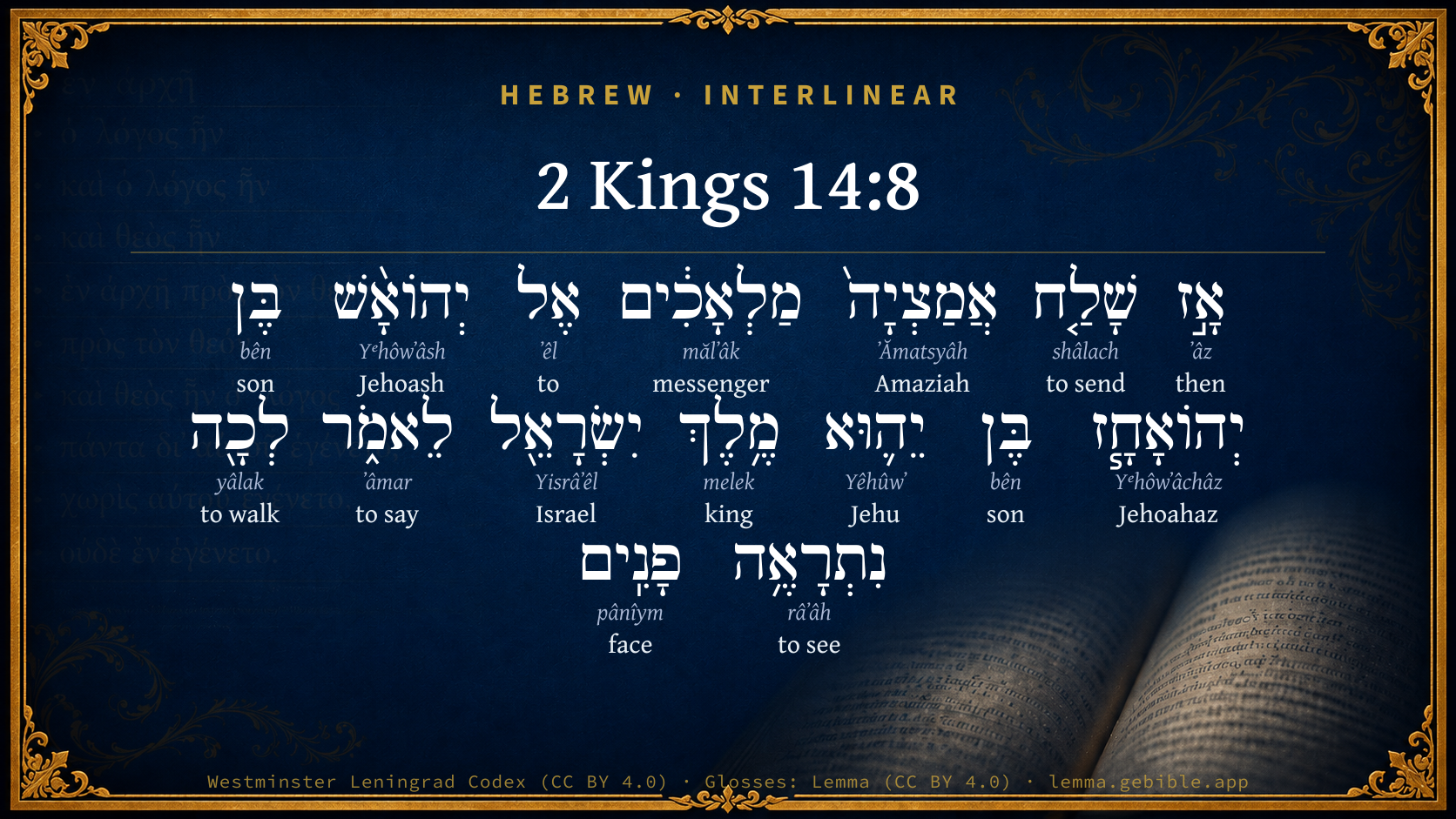
Hebrew (Westminster Leningrad Codex) 2 Kings 14:8 appears in the Hebrew Old Testament. The text above is from the Westminster Leningrad Codex. Each word links to its Strong’s number, a concise gloss, and parsing drawn from the Open Scriptures Hebrew Bible morphology. Click any word for its full Brown-Driver-Briggs (BDB) entry.
Download image
Cite this verse

2 Kings 14:8 (World English Bible). Public Domain. Lemma interlinear Bible study tool, https://lemma.gebible.app/v/2-kings/14/8.

Show BibTeX & RIS
BibTeX
RIS
English Translation
Then Amaziah sent messengers to Jehoash, the son of Jehoahaz son of Jehu, king of Israel, saying, Come, let us look one another in the face.
World English Bible · Public Domain
Download a study sheet

One document with this verse’s original text, its word-by-word gloss line, the meaning frame, cross-references with their text, attributed commentary, and full source and license credits — printable, and it pastes into notes with its structure intact.

This verse Autodidact and up

Study sheet (.html) Plain text (.txt)

A passage Seminary Student

Up to 50 verses in one chapter. A passage sheet keeps up to 6 commentary sources and 12 cross-references per verse, in the order this page ranks them, and says so on the sheet whenever that leaves anything out. Ask for a single verse and you get the Autodidact verse sheet above.

Everything on this page stays free to read, with no account — the sheet is a download of what is already on screen, not access to it.

Want to remove ads? Support Godless Engineer
Compare translations 3

The same verse in 3 English versions, stacked beneath the original-language interlinear above. Click any original word for its lexicon entry.

Each is an independent rendering of the whole verse — the interlinear is not word-aligned to these translations.

Highlighted words mark where these versions differ — a whole-verse word diff, not a word-by-word alignment.

  • World English Bible Public Domain
    Then Amaziah sent messengers to Jehoash, the son of Jehoahaz son of Jehu, king of Israel, saying, Come, let us look one another in the face.
  • King James Version Public Domain
    Then Amaziah sent messengers to Jehoash, the son of Jehoahaz son of Jehu, king of Israel, saying, Come, let us look one another in the face.
  • unfoldingWord Literal Text CC BY-SA 4.0
    Then Amaziah sent messengers to Jehoash, the son of Jehoahaz, the son of Jehu, the king of Israel, saying, “Come, let us see one another’s faces.”

unfoldingWord Literal Text — © unfoldingWord, licensed CC BY-SA 4.0. Word-aligned USFM3 via Door43 (git.door43.org/unfoldingWord/en_ult).

Versions to compare (up to 4)

3 of 4 selected

Show all 18 translations

Every available English version of this verse, each an independent rendering of the whole verse.

  • World English Bible Public Domain
    Then Amaziah sent messengers to Jehoash, the son of Jehoahaz son of Jehu, king of Israel, saying, Come, let us look one another in the face.
  • Berean Standard Bible Public Domain
    Then Amaziah sent messengers to the king of Israel Jehoash son of Jehoahaz, the son of Jehu. “Come, let us meet face to face,” he said.
  • Majority Standard Bible Public Domain
    Then Amaziah sent messengers to the king of Israel Jehoash son of Jehoahaz, the son of Jehu. “Come, let us meet face to face,” he said.
  • King James Version Public Domain
    Then Amaziah sent messengers to Jehoash, the son of Jehoahaz son of Jehu, king of Israel, saying, Come, let us look one another in the face.
  • American Standard Version (1901) Public Domain
    Then Amaziah sent messengers to Jehoash, the son of Jehoahaz son of Jehu, king of Israel, saying, Come, let us look one another in the face.
  • Revised Version (1885) Public Domain
    Then Amaziah sent messengers to Jehoash, the son of Jehoahaz son of Jehu, king of Israel, saying, Come, let us look one another in the face.
  • Geneva Bible (1599) Public Domain
    Then Amaziah sent messengers to Iehoash the sonne of Iehoahaz, sonne of Iehu King of Israel, saying, Come, let vs see one another in the face.
  • Douay-Rheims (1899) Public Domain
    Then Amasias sent messengers to Joas son of Joachaz, son of Jehu king of Israel, saying: Come let us see one another.
  • Young's Literal Translation Public Domain
    then hath Amaziah sent messengers unto Jehoash son of Jehoahaz, son of Jehu, king of Israel, saying, `Come, we look one another in the face.'
  • Literal Standard Version CC BY-SA 4.0
    then Amaziah has sent messengers to Jehoash son of Jehoahaz, son of Jehu, king of Israel, saying, “Come, we look one another in the face.”
  • Unlocked Literal Bible CC BY-SA 4.0
    Then Amaziah sent messengers to Jehoash son of Jehoahaz son of Jehu king of Israel, saying, “Come, let us meet each other face to face in battle.”
  • unfoldingWord Literal Text CC BY-SA 4.0
    Then Amaziah sent messengers to Jehoash, the son of Jehoahaz, the son of Jehu, the king of Israel, saying, “Come, let us see one another’s faces.”
  • Darby Bible Public Domain
    Then Amaziah sent messengers to Jehoash the son of Jehoahaz, son of Jehu, king of Israel, saying, Come, let us look one another in the face.
  • World Messianic Bible Public Domain
    Then Amaziah sent messengers to Jehoash, the son of Jehoahaz son of Jehu, king of Israel, saying, “Come, let’s look one another in the face.”
  • Webster's Bible Public Domain
    Then Amaziah sent messengers to Jehoash the son of Jehoahaz son of Jehu king of Israel, saying, Come, let us look one another in the face.
  • Free Bible Version CC BY-SA 4.0
    Amaziah sent messengers to the king of Israel, Jehoash, son of Jehoahaz, son of Jehu, telling him, “Let's fight, face to face!”
  • Bible in Basic English Public Domain
    Then Amaziah sent representatives to Jehoash, the son of Jehoahaz, son of Jehu, king of Israel, saying, Come, let us have a meeting face to face.
  • JPS Tanakh (1917) Public Domain
    Then Amaziah sent messengers to Jehoash, the son of Jehoahaz son of Jehu, king of Israel, saying: 'Come, let us look one another in the face.'

Literal Standard Version (2020), Covenant Press — licensed CC BY-SA 4.0. Text via the HelloAO Bible API (eBible.org). Unlocked Literal Bible (unfoldingWord) — licensed CC BY-SA 4.0. Text via the HelloAO Bible API (eBible.org). unfoldingWord Literal Text — © unfoldingWord, licensed CC BY-SA 4.0. Word-aligned USFM3 via Door43 (git.door43.org/unfoldingWord/en_ult). Free Bible Version, Dr. Jonathan Gallagher — licensed CC BY-SA 4.0. Text via the HelloAO Bible API (eBible.org).

Word by word

More ways to search: Search by grammar → Find every occurrence → Compare this word →

Practice this passage: Drill this verse → Learn its vocabulary →

יְהוֹאָ֨שׁ
Yᵉhôwʼâsh
H3060
“Jehoash”
Noun, Proper
Part of Speech
Noun
Type
Proper
Full BDB Definition

Origin: from H3068 and (perhaps) H784

TWOT: None

Jehoash = "given by the Lord" - son of king Ahaziah and the 8th king of Judah - son of king Jehoahaz and the 12th king of the northern kingdom of Israel
  1. אָ֣ז ʼâz H227 “then” Adverb
  2. שָׁלַ֤ח shâlach H7971 “to send” Verb, Qal, Perfect, 3rd Person, Masculine, Singular
  3. אֲמַצְיָה֙ ʼĂmatsyâh H558 “Amaziah” Noun, Proper
  4. מַלְאָכִ֔ים mălʼâk H4397 “messengers” Noun, Common, Masculine, Plural, Absolute
  5. אֶל ʼêl H413 “to” Preposition
  6. בֶּן bên H1121 “son of” Noun, Common, Masculine, Singular, Construct
  7. יְהוֹאָחָ֧ז Yᵉhôwʼâchâz H3059 “Jehoahaz” Noun, Proper
  8. בֶּן bên H1121 “son of” Noun, Common, Masculine, Singular, Construct
  9. יֵה֛וּא Yêhûwʼ H3058 “Jehu” Noun, Proper
  10. מֶ֥לֶךְ melek H4428 “king of” Noun, Common, Masculine, Singular, Construct
  11. יִשְׂרָאֵ֖ל Yisrâʼêl H3478 “Israel” Noun, Proper
  12. לֵאמֹ֑ר ʼâmar H559 “to say” Preposition + Verb, Qal, Infinitive Construct
  13. לְכָ֖ה yâlak H3212 “walk” Verb, Qal, Imperative, 2nd Person, Masculine, Singular + Suffix, h
  14. נִתְרָאֶ֥ה râʼâh H7200 “to see” Verb, Hithpael, Imperfect, 1st Person, Common, Plural
  15. פָנִֽים pânîym H6440 “face(s)” Noun, Common, Both, Plural, Absolute

About this verse

These counts appear in no published source. They are computed here, from the morphology-tagged text and Lemma’s own curated glosses. What Lemma adds →

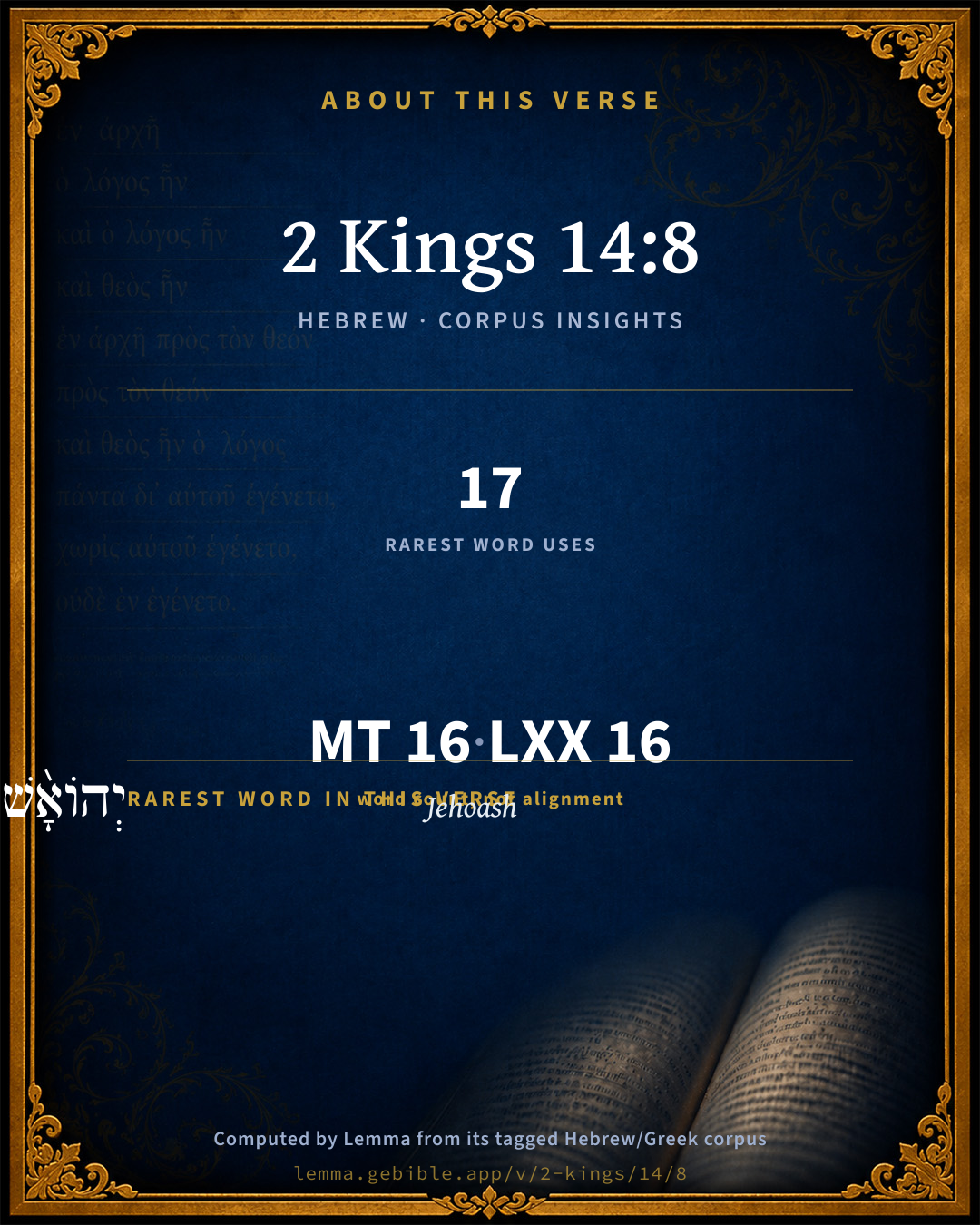
16
words
15
distinct lemmas
Historical
section

Notable vocabulary

The rarest word here is יְהוֹאָ֨שׁ Jehoash H3060 — appearing just 17 times in the whole Hebrew Bible.

Shared distinctive vocabulary

יְהוֹאָ֨שׁ Jehoash H3060 occurs in 16 verses of the Hebrew Bible. Also found in:

Grammatical profile

  • 4 verbs
  • 10 nouns
  • 1 preposition
  • 1 adverb

Verb forms

  • שָׁלַ֤ח Qal · Perfect
  • לֵאמֹ֑ר Qal · Infinitive Construct
  • לְכָ֖ה Qal · Imperative
  • נִתְרָאֶ֥ה Hithpael · Imperfect

Repetition

A word recurs within this verse — often emphatic in Hebrew:

Hebrew & Septuagint length

In English translation the verse runs 26 words from the Hebrew and 25 from the Septuagint (LXX English) — closely comparable.

A rough comparison of the two English renderings, which tokenize alike — not a word-level alignment.

Word counts can differ between the Hebrew and the Greek without any difference in meaning — e.g. the Hebrew direct-object marker אֵת has no separate Greek word, and Greek often adds the article ὁ.

In the original languages it is 16 Hebrew tokens and 16 Greek tokens — but the two are counted differently (Hebrew bundles its prefixes and suffixes into one token; the Greek is in lemma form), so that isn’t a like-for-like length.

Cross-references

8

Topical passages linked to 2 Kings 14:8 in the Treasury of Scripture Knowledge — connected by theme and wording, ordered by reader-vote popularity; previews shown in the World English Bible.

  • 2 Chronicles 25:17–24 Then Amaziah king of Judah took advice, and sent to Joash, the son of Jehoahaz the son of Jehu, king of Israel, saying, Come, let us look one another in the face.
  • 2 Samuel 2:14–17 Abner said to Joab, Please let the young men arise and play before us. Joab said, Let them arise.
  • 2 Kings 14:11 But Amaziah would not hear. So Jehoash king of Israel went up; and he and Amaziah king of Judah looked one another in the face at Beth-shemesh, which belongs to Judah.
  • Proverbs 13:10 Pride only breeds quarrels, But with ones who take advice is wisdom.
  • Proverbs 17:14 The beginning of strife is like breaching a dam, Therefore stop contention before quarreling breaks out.
  • Proverbs 18:6 A fool's lips come into strife, And his mouth invites beatings.
  • Proverbs 20:18 Plans are established by advice; By wise guidance you wage war!
  • Proverbs 25:8 Don't be hasty in bringing charges to court. What will you do in the end when your neighbor shames you?

Cross-references courtesy of OpenBible.info (CC BY 4.0).

Hebrew and Greek witnesses Masoretic Hebrew ↔ Greek Septuagint

The same verse in the two great witnesses to the Old Testament, shown verse-for-verse.

These are two independent witnesses, not word-aligned to each other, and the Septuagint is shown in lemma (dictionary) form.

Hebrew 2 Kings 14:8 Masoretic · Westminster Leningrad Codex

אָ֣ז שָׁלַ֤ח אֲמַצְיָה֙ מַלְאָכִ֔ים אֶל יְהוֹאָ֨שׁ בֶּן יְהוֹאָחָ֧ז בֶּן יֵה֛וּא מֶ֥לֶךְ יִשְׂרָאֵ֖ל לֵאמֹ֑ר לְכָ֖ה נִתְרָאֶ֥ה פָנִֽים

Then Amaziah sent messengers to Jehoash, the son of Jehoahaz son of Jehu, king of Israel, saying, Come, let us look one another in the face.

World English Bible · Public Domain

Greek LXX 2 Kings 14:8 Septuagint · lemma form

τότε ἀποστέλλω αμεσσιας ἄγγελος πρός ιωας υἱός ιωαχας υἱός ιου βασιλεύς ἰσραήλ λέγω δεῦρο ὁράω πρόσωπον

Then Amessias sent messengers to Joas son of Joachaz son of Ju king of Israel, saying, Come, let us look one another in the face.

LXX2012 (modern English Septuagint) · Public Domain

Hebrew: Westminster Leningrad Codex (CC BY 4.0). Greek: Septuagint (public domain); English from LXX2012 (modern English Septuagint) (Public Domain). How the Septuagint differs from the Hebrew →

Targum (Aramaic paraphrase)

1

The Targum is the ancient Jewish Aramaic paraphrase of the Hebrew Scriptures — an interpretive translation, not the Hebrew text itself. Onkelos (literal) and Pseudo-Jonathan (expansive) render the Torah, and Jonathan the Prophets. Coverage is partial: where no permissively-licensed English translation exists for a verse, only the Aramaic is shown. This is verse-level text, not a word-by-word alignment to the Hebrew.

  1. Targum Jonathan Prophets (Joshua–Malachi)
    בְּכֵן שְׁלַח אֲמַצְיָה אִזְגַדִין לְוַת יְהוֹאָשׁ בַר יְהוֹאָחָז בַּר יֵהוּא מַלְכָּא דְיִשְׂרָאֵל לְמֵימָר אִיתָא נְקַבֵּיל אַפִּין בִּקְרָבָא:

    (no public-domain English translation for this verse)

    Targum Jonathan — Aramaic: “Mikraot Gedolot” (public domain). English: “Sefaria Community Translation” (CC0 1.0 (public-domain dedication)); “London "Chaldee Paraphrase," 1871” (public domain). Text via Sefaria.

Commentary

Notes on 2 Kings 14:8 from classic Christian and Jewish commentators (each source and its license shown beneath its notes). The classic Christian expositions comment on the surrounding passage and are grouped to its opening verse, so a note may address several verses; the Jewish commentaries on the Tanakh (Rashi and others) are per-verse, so they appear only where the commentator wrote on this verse.

Lemma curates 59 commentaries, every one of them public domain or Creative Commons licensed, each selected and text-cleaned for this edition rather than reprinted as found. About our sources →

Matthew Henry's Commentary

For several successions after the division of the kingdoms that of Judah suffered much by the enmity of Israel. After Asa's time, for several successions, it suffered more by the friendship of Israel, and by the alliance and affinity made with them. But now we meet with hostility between them again, which had not been for some ages before.

I. Amaziah, upon no provocation, and without showing any cause of quarrel, challenged Joash into the field (Kg2 14:8): "Come, let us look one another in the face; let us try our strength in battle." Had he challenged him to a personal duel only, the error would have remained with himself, but each must bring all their forces into the field, and thousands of lives on both sides must be sacrificed to his capricious humour. Hereby he showed himself proud, presumptuous, and prodigal of blood. Some think that he intended to avenge the injury which the dismissed disgusted Israelites had lately done to his country, in their return (Ch2 25:13), and that he had also the vanity to think of subduing the kingdom of Israel, and reuniting it to Judah. A fool's lips thus enter into contention, and his mouth calleth for strokes. Those that challenge are chargeable with that beginning of strife, which is as the letting forth of water. He that is eager either to fight or to go to law may perhaps have enough of it quickly, and be the first that repents it.

II. Joash sent him a grave rebuke for his challenge, with advice to withdraw it, Kg2 14:9, Kg2 14:10. 1. He mortifies his pride, by comparing himself to a cedar, a stately tree, and Amaziah to a thistle, a sorry weed, telling him he was so far from fearing him that he despised him, and scorned as much to have any thing to do with him, or make any alliance with him, as the cedar would to match his daughter to a thistle. The ancient house of David he thinks not worthy to be named the same day with the house of Jehu, though an upstart. How may a humble man smile to hear two proud and scornful men set their wits on work to vilify and undervalue one another! 2. He foretels his fall: A wild beast trode down the thistle, and so put an end to his treaty with the cedar; so easily does Joash think his forces can crush Amaziah, and so unable does he think him to make any resistance. 3. He shows him the folly of his challenge: "Thou hast indeed smitten Edom, a weak, unarmed, undisciplined body of men, and therefore thinkest thou canst carry all before thee and subdue the regular forces of Israel with as much ease. Thy heart has lifted thee up." See where the root of all sin lies; it is in the heart, thence it flows, and that must bear the blame. It is not Providence, the event, the occasion (whatever it is), that makes men proud, or secure, or discontented, or the like, but it is their own heart that does it. "Thou art proud of the blow thou hast given to Edom, as if that had made thee formidable to all mankind." Those wretchedly deceive themselves that magnify their own performances, and, because they have been blessed with some little success and reputation, conclude themselves fit for any thing and no less sure of it. 4. He counsels him to be content with the honour he has won, and not to hazard that, by grasping at more that was out of his reach: Why shouldst thou meddle to thy hurt, as fools often do, that will be meddling? Pro 20:3. Many would have had wealth and honour enough if they had but known when they had enough. He warns him of the consequence, that it would be fatal not to himself only, but to his kingdom, which he ought to protect.

III. Amaziah persisted in his resolution, and the issue was bad; he had better have tarried at home, for Joash gave him such a look in the face as put him to confusion. Challengers commonly prove to be on the losing side. 1. His army was routed and dispersed, Kg2 14:12. Josephus says, When they were to engage they were struck with such terror that they did not strike a stroke, but every one made the best of his way. 2. He himself was taken prisoner by the king of Israel, and then had enough of looking him in the face. Amaziah's pedigree comes in here somewhat abruptly (the son of Joash, the son of Ahaziah), because perhaps he had gloried in the dignity of his ancestors, or because he now smarted for their iniquity. 3. The conqueror entered Jerusalem, which tamely opened to him, and yet he broke down their wall (and, as Josephus says, drove his chariot in triumph through the breach), in reproach to them, and that he might, when he pleased, take possession of the royal city. 4. He plundered Jerusalem, took away all that was valuable, and returned to Samaria, laden with spoils, Kg2 14:14. It was said of Joash that he did that which was evil in the sight of the Lord, and of Amaziah that he did that which was right; and yet Joash triumphs thus over Amaziah, and why so? Because God would show, in Amaziah's fate, that he resists the proud, or because, whatever they were otherwise, Joash had lately been respectful to one of God's prophets (Kg2 13:14), but Amaziah had been abusive to another (Ch2 25:16), and God will honour those who honour him in his prophets, but those who despise them, and him in them, shall be lightly esteemed.

Matthew Henry's Commentary on the Whole Bible (1708–1710) — public domain (CC PDM 1.0). Text via the HelloAO Bible API.

Jamieson, Fausset & Brown

Robert Jamieson, A. R. Fausset & David Brown

JOASH DEFEATS HIM. (Kg2 14:8-16)

Amaziah sent messengers to Jehoash, the son of Jehoahaz, son of Jehu, king of Israel--This bold and haughty challenge, which was most probably stimulated by a desire of satisfaction for the outrages perpetrated by the discharged auxiliaries of Israel (Ch2 25:13) on the towns that lay in their way home, as well as by revenge for the massacre of his ancestors by Jehu (2Ki. 9:1-37) sprang, there is little doubt, from pride and self-confidence, inspired by his victory over the Edomites.

Jamieson, Fausset & Brown — Commentary Critical and Explanatory on the Whole Bible (1871) — public domain (CC PDM 1.0). Text via the HelloAO Bible API.

Trapp's Complete Commentary

John Trapp

2Ki 14:8 Then Amaziah sent messengers to Jehoash, the son of Jehoahaz son of Jehu, king of Israel, saying, Come, let us look one another in the face.

Ver. 8. Then Amaziah sent.] Being puffed up with his recent victory over the Edomites, he had a proud conceit that he should prosper in whatsoever he undertook; albeit he had now forsaken the Lord, and served the gods of those Edomites, whom he had erst subdued. By a like folly, the old Romans, after that they had subdued any nation, were wont to set up their gods to themselves, to win their favour.

Come, let us look one another in the face,] i.e., Let us fight it out in the open field. He had been wronged in his absence by those one hundred thousand mercenaries of Israel, whom he had dismissed at the command of the prophet, {2Ch 25:10; 2Ch 25:13} who had told him that God was not with the Israelites. He was apt enough also to believe that his own forces were invincible, and that victory was now pinned to his sleeve; but he was soon confuted.

John Trapp, A Commentary or Exposition upon All the Books of the Old and New Testament (1647–1656) — public domain. Text from a community e-Sword module.

The Biblical Illustrator

Joseph S. Exell

2Ki_14:8

Come, let us look one another in the face.

Looking in the face

Let us look one another in the face. Such was the message of a king to a king. The whole transaction was hypocritical, and we cannot read of it without loathing. Separate the words from the original surroundings, however, and they contain most excellent advice. We may give them a practical and seasonable turn.

I. Look God in the face. Behold Him as He is. It is, alas, so easy to get wrong conceptions of the Most High, and much enmity to Him has its beginning thus. They hated me without a cause. If men knew God better, they would dread Him less and trust Him more. Come now, let us reason together, saith the Lord. Concerning what? why, the very point of which we have been speaking: false notions of the Lord. Though your sins be as scarlet, they shall be white as snow; though they be red like crimson, they shall be as wool. You fancy Me to be harsh and hard: get rid of that thought; I delight in mercy. To look God in the face is no difficult matter now that Christ has come. He is the image of the invisible God. See the one, and you see the other. The tenderness which said to a desolate widow in Nain, Dont cry; I will raise your son; the power which subdued the crested waves and-hushed the roaring winds by a single word; the holiness which took no taint from contact with publicans and sinners--reveal the attributes of Jehovah. Agnosticism erect again the ancient Athenian altar, and writes on it, to the Unknown God.; but Paul still cries, Whom ye ignorantly worship, Him declare I unto you.

II. Look yourself in the face. If any be a hearer of the word, he is like unto a man beholding his natural face in a glass. by the light of Scripture we may see our own characters; and this self-scrutiny is eminently important. Socrates said: We should not live a life which is not subject to examination. for lack of this, some are astoundingly ignorant of their true condition. What they say to others might well be spoken of and by themselves, I have not the pleasure of knowing you. Nathan proved this in respect of David, and the very church which thought that it had need of nothing was pronounced by Christ poor and miserable, and blind, and naked. As it is in the literary, so it is in the moral world: authors are often bad judges of their own productions. John Foster wished that he could write like Johnson or Young, hut the fact is that he wrote better than either. Sir Walter Scott published the Waverley Novels anonymously, lest they should injure his fame as a poet; but posterity thinks more of his stories than his verses. Something like this holds good of us: we may be ludicrously mistaken regarding ourselves. To avoid such blunders, let us use the balances of the sanctuary. We should employ the scales and weights which God has provided. Paul told the Corinthians that they were not wise, because they measured themselves by themselves, and compared themselves with themselves.

III. Look man in the face. A needless counsel, some may complain. Dont we do it? Nothing is so common as the wish to see peoples faces. We all believe in the vis-a-vis position. The pen is not enough; we want the countenance also. If you hear of a great writer or preacher, you at once want to see him. When we visit friends we call it going to see them Nevertheless there is need of the advice: see men. We are much too isolated. English folk are what Matthew Arnold calls insular. If the various classes of society had more intercourse with each other, it would be better for us all round. Were the cultured and intellectual to mingle with Philistines rather oftener, the latter would get a little of their refinement. Communion between the rich and the poor would hardly fail in producing sympathy on the part of the one and confidence on the part of the other. Christians might learn a lesson here. They keep too much apart. Only lately it was asked at a metropolitan meeting of our denomination--Where now is the continuing in the apostles doctrine and fellowship of which we read in the early Church? One other thought. How many misunderstandings in social life might be prevented or removed, if we looked each other in the face! You think that a friend is cooler in his manner than of yore, or he has done something which you interpret as hostile to you. Dont brood over it. If you do, your suspicions and imagination will blow the spark into a flame which will consume your comfort. Visit him. Be candid. Have it out, as we say, and the probability is that a few minutes plain dealing on both sides will put the whole business right. (T. R. Stevenson.)

Challenge to combat couched in terms of peace

These are sweet words. What can they mean? Surely but one thing only. Giving them transliteration and broadest meaning, they will sound thus: We have been a long time estranged; let us burn down the barriers of separation: we have hidden ourselves from one another when we ought to have stood face to face, each beaming-with complacency upon the other; come, let us make an end of this alienation, and fraternally and trustfully look one another in the face. Was that the real meaning of the message? Not a whir! These beautiful words were the velvet which hid the sword. These terms of supposed approach and trustfulness are really a challenge. The right reading would be: Come, let us fight; let us see which is the stronger man. Here again we keep upon the same line as in the former instance--the line which points to the right use of language. There is a morality of words. Men arc not at liberty to put words into any shape they please; they must consider whether in putting words together they are building a pillar, plumbed by the Eternal Righteousness, and going, so far as they do go, straight up to heaven. But if this were the rule, society would be dissolved. Who can speak truth with his neighbour--except in some broad and general sense? Who can let his Yea be yea, and his Nay, nay? When the Saviour delivered that injunction we thought it was elementary; in reality it is ultimate; there is nothing beyond it. When Yea means yea, and Nay nay, the millennium has come: men will not tell lies, nor will they act them; they will not allow wrong impressions to be made upon the mind; there will be no grammatical torture, no mental reservation, no putting out of words in the sense of putting out a feeler; every heart transparent, every motive pure and generous, human speech a human religion, and the human religion sanctified and cleansed by the blood of Christ. But we live in lies; we tell them, we act them, we look them, we suggest them. When David is reported in English to say. All men are liars, he is misreported; the right reading is, all men are a lie,--a grander speech; not a stone thrown at individuals, but an impeachment made upon human nature. (J. Parker, D. D.)

The Biblical Illustrator, edited by Joseph S. Exell (c. 1880s–1900s) — public domain. Text from a community e-Sword module.

Joseph Benson's Commentary

2Ki 14:8. Let us look one another in the face — Let us try our valour and strength in battle. Being flushed with his late great victory over the Edomites, and incensed by the injury which the dismissed, disgusted Israelites had lately done to his country in their return, (2Ch 25:13,) he sent this challenge to the king of Israel. Perhaps he had the vanity to think he could subdue his kingdom, and reunite it to Judah. Had he challenged him merely to a personal duel, the error had remained with himself: but each of them must bring all his forces into the field, and thousands of lives must be sacrificed on both sides to his capricious humour! Hereby he showed himself proud, presumptuous, and prodigal of blood. They that challenge are chargeable with that beginning of strife which is as the letting out of water. And they that are fond either of fighting or going to law, may perhaps have enough of it quickly, and will probably be the first that repent it.

Joseph Benson's Commentary on the Old and New Testaments (1811–1818) — public domain. Text from a community e-Sword module.

Tyndale Open Study Notes

Tyndale Open Resources

14:8 Amaziah’s challenge to Israel’s King Jehoash may have been provoked by thoughts of revenge (see 2 Chr 25:13). Perhaps Amaziah had also become overly confident and proud because of his recent victory over Edom.

Tyndale Open Study Notes — © Tyndale Open Resources, licensed CC BY-SA 4.0. Text via the HelloAO Bible API.

Geneva Bible (1599)

Geneva Bible translators

Let us fight hand to hand, and try it by battle, and not destroy one another’s cities.

Geneva Bible (1599) marginal notes — public domain. Text via Bolls.life.

Adam Clarke's Commentary

Verse 8. Come, let us look one another in the face.] This was a real declaration of war; and the ground of it is most evident from this circumstance: that the one hundred thousand men of Israel that had been dismissed, though they had the stipulated money, taking the advantage of Amaziah's absence, fell upon the cities of Judah, from Samaria to Beth-horon, and smote three thousand men, and took much spoil, 2Ch 25:10-13. Amaziah no doubt remonstrated with Jehoash, but to no purpose; and therefore he declared war against him.

Adam Clarke's Commentary on the Bible (1810–1826) — public domain. Text from a community e-Sword/MySword module.

Ellicott's Commentary for English Readers

(8) Then.—After the reduction of Edom. The more extended narrative which follows is plainly taken from a different source than that of the brief extract preceding it.

Come, let us look one another in the face.—A challenge to battle, the ground of which might be found in the outrages committed by the Israelite mercenaries on their homeward march. It appears likely, however, that Amaziah, intoxicated by his recent success, aimed at nothing less than the recovery of the Ten Tribes for the house of David. So Josephus (Antt. ix. 9, § 2), who gives what purport to be the letters which passed between the two kings on this occasion.

A Bible Commentary for English Readers, edited by Charles John Ellicott (1878–1897) — public domain. Text from a community e-Sword module.

The Cambridge Bible for Schools and Colleges

gen. ed. J. J. S. Perowne

8–16. Amaziah’s challenge to Joash king of Israel. Answer of Joash. Defeat of Amaziah. Death of Joash (2Ch_25:17-24)

8. Then Amaziah sent messengers to Jehoash] The Chronicler gives a history anterior to the challenge of Amaziah, which explains why the king who had been divinely guided before the Edomite expedition was left without the like guidance afterwards. We are told that Amaziah brought back from Edom the gods of the children of Seir and set them up to be his gods, and when a prophet was sent to rebuke him, he threatened the messenger of God with punishment. Upon this the prophet forbare, but left the king with the words, ‘I know that God hath determined to destroy thee, because thou hast done this and hast not hearkened unto my counsel’. The Chronicler also says that before his challenge ‘Amaziah king of judah took advice’, which forces one to think of the counsellors whom Rehoboam listened to at the time of his accession, and by following whom he brought about the revolt of the ten tribes. It may be that the conduct of the Israelitish soldiers whom Amaziah had sent home (see note on verse 7) incited the king of Judah to take some revenge on Israel. In 2 Chronicles (2Ki_25:13) we read that these men ‘fell upon the cities of Judah, from Samaria even unto Beth-horon, and smote three thousand of them and took much spoil’. The ‘three thousand’ of course means ‘of the inhabitants’. If this attack occurred while Amaziah was on his expedition against Edom, we can better understand his action.

Come, let us look one another in the face] A figurative expression equivalent to ‘Let us measure swords’, let us test each other’s power. It was under all circumstances rash for the smaller power, the king of two tribes, to challenge the king of ten. Moreover if Amaziah had been victorious over Edom, Jehoash had repulsed the Syrians and recovered those portions of the land which had been lost in the time of Jehoahaz.

The Cambridge Bible for Schools and Colleges (gen. ed. J. J. S. Perowne; Cambridge University Press, 1878–1918) — public domain. Text from a community e-Sword module.

John Gill's Exposition

Thou hast indeed smitten Edom, and thine heart hath lifted thee up,.... Swelled him with pride and vanity on account of the victory he had obtained over the Edomites; which pride was at the bottom of his message to him, and that goes before a fall: Pro 16:18.

glory of this, and tarry at home; be content with the glory of it, and boast of it at home, but do not swagger abroad, and insult thy neighbours:

for why shouldest thou meddle to thy hurt, that thou shouldest fall, even thou, and Judah with thee? suggesting to him, that he had better be quiet, since it would be to the harm, if not the ruin, of him and his kingdom.

John Gill's Exposition of the Whole Bible (1746–1763) — public domain (CC PDM 1.0). Text via the HelloAO Bible API.

Albert Barnes' Notes on the Bible

Amaziah’s success against Edom had so elated him that he thought himself more than a match for his northern neighbor. The grounds of the quarrel between them were furnished by the conduct of the hired, but dismissed, Israelite soldiers (see the marginal reference).

Let us look one another in the face - i. e. “let us meet face to face in arms, and try each other’s strength” 2Ki 14:11-12.

Albert Barnes' Notes on the Bible (1834–1885) — public domain. Text from a community e-Sword/MySword module.

Haydock's Catholic Bible Commentary

Let us see one another. This was a challenge to fight. (Challoner) (Worthington) --- The interviews of ambitious kings are often baneful. (Haydock) --- Abner said in the same sense, "Let the young men rise and play," 2 Kings ii. 14; and Virgil, (Æneid xii.) Inter se coiisse viros & cernere ferro. Amasias had many reasons to be displeased with the king of Israel. He might justly redemand part of the money, (Calmet) as he had not employed the soldiers. (Haydock) --- They had also committed depredations in Juda. (Paralipomenon) Jehu had slain Ochozias, and many of his relations. (Calmet) --- Josephus also observes that he now required Israel to return to his obedience, and acknowledge the power of the lawful descendants of David. (Sanctius)

George Leo Haydock (1774–1849), Haydock's Catholic Family Bible and Commentary, 1859 edition — public domain. Excludes Psalms (Douay-Rheims chapter numbering differs from Protestant) and Deuterocanonical books (Catholic canon only).

Matthew Poole's English Annotations

Let us fight personally, and with our armies. This challenge he sent, partly upon the late and great injuries done by the Israelites to his people, 2Ch 25:10,13, and partly from self-confidence, and a desire of advancing his glory and empire by his arms.

Matthew Poole's English Annotations on the Holy Bible (1683–1685) — public domain. Text from a community e-Sword/MySword module.

Whedon's Commentary on the Bible

Daniel D. Whedon

8. Let us look one another in the face — An idiomatic expression used in a hostile sense. Equivalent to, Let us see each other’s face by coming into close conflict on a field of battle. The Germans have a similar idiom, To view heads, and to view the whites in the eye.

In Chronicles we learn the occasion of this war of Amaziah against the kingdom of Israel. The Israelitish soldiers whom Amaziah hired and soon after dismissed were greatly offended at such treatment, and “fell upon the cities of Judah, from Samaria even unto Beth-heron, and smote three thousand of them, and took much spoil.” This was too great an injury for the king of Judah to pass by without notice, and his elation over his Edomite victory, and the native pride of his heart, urged him on.

Daniel D. Whedon (gen. ed.), Commentary on the Old and New Testaments (1874–1909) — public domain. Text from a community e-Sword module.

The Pulpit Commentary

Then Amaziah sent messengers to Jehoash, the son of Jehoahaz son of Jehu, King of Israel, saying. Amaziah had a cause of complaint against Jehoash, or at any rate against his subjects, which does not appear in the narrative of Kings. The author of Chronicles tells us that, when Amaziah dismissed his Israelite mercenaries, they were offended, and vented their anger by an inroad into his territories, (2Ch_25:13) where they killed three thousand men and "took much spoil." This was a clear casus belli, if Amaziah chose to consider it such. Come, let us look one another in the face. A rude message, if it was actually couched in these terms. But perhaps the writer substitutes the gist of the message for the language in which it was wrapped up. Josephus says that Amaziah wrote a letter to Joash, and required him to submit himself and people to the authority of the Jewish state, and thus restore the state of things which had existed under David and Solomon. Otherwise the sword must decide between them ("Ant. Jud:," 9:9. Whatever its terms, pride and self-confidence, the result of his success against Edom, were at the root of the challenge.

Vers. 8-14. Pride goes before a fall.

Amaziah"s challenge and its result furnish a remarkable illustration of this maxim. The following points should be dwelt upon.

I THE WEAK GROUND OF THE PRIDE. This was military success, which is just as often the result of good fortune, or one"s enemies" mistakes, as of any merits of one"s own. Amaziah"s after-life showed that he did not possess any great military capacity, and so had nothing on which he ought to have prided himself. Men constantly over estimate their own merits.

II THE WRONGFUL WAY IN WHICH THE PRIDE VENTED ITSELF. In quarrel, causeless quarrel with a neighbor. Amaziah had no grievance which he felt it necessary to redress, no need to quarrel with Joash. Having gained one success, he was simply greedy for more. And to gratify his self-esteem he was careless how many lives he sacrificed or what injuries he inflicted

(1) on his adversaries;

(2) on his own subjects.

He forgot that the Israelites were of kindred blood, (1Ki_12:24) of the same religion, a portion of God"s people. He plunged into an unnecessary war in itself always a sin with a nation towards which he ought to have felt friendly, without obtaining or seeking any Divine sanction, in sole reliance on himself. What wonder that God punished such combined folly and wickedness!

III THE OBSTINACY WITH WHICH THE WRONGFUL COURSE WAS PERSISTED IN. Proud men dislike above all things admitting that they are in the wrong. Amaziah had ample time to retract his challenge and. give up his enterprise. Joash was not at all eager for the encounter; on the contrary, he was quite willing to have remained at peace if Amaziah would have let him. But to retract, still more to apologize, would have been unpleasant. The pride which had given birth to the challenge absolutely forbade its withdrawal.

IV THE COMPLETENESS AND EXTREME IGNOMINY OF THE FALL. Amaziah had, no doubt, counted on an easy victory; he went to war "with a light heart." He would do with Israel as he had done with Edom smite and slay, and make prisoners, and perhaps punish his prisoners with death (ver. 7). The result is, not a victory, not even a drawn battle, not a long war with alternations of success and defeat, but one crushing blow, from which there is no recovery even for an instant. His army is defeated, dispersed; he himself is a prisoner in the hands of his enemy, his capital is taken, its walls broken down, its treasures carded off. He is disgraced in the eyes of all his subjects, as well as of the neighboring nations, and thenceforth remains absolutely quiescent, attempts nothing, but, humbled and confounded, "sits in the dust.

Vers. 8-14. The boastful challenge, and its results.

It is in the light of the facts narrated in the Book of Chronicles, but not alluded to here, that we are to read the story of Amaziah"s folly in his boastful challenge to Joash of Israel (cf. 2Ch_25:20)

I THE BOASTFUL CHALLENGE.

1. Its motives. It is not difficult to conceive the kind of influences which led Amaziah to give this challenge to Joash.

(1) Naturally vain-glorious, he was greatly elated by his successes over Edom, and was ambitious to pose as a great military conqueror. How many wars have had their origin in no higher source! To gratify the vanity and ambition of individuals, or the lust of glory in nations, torrents of blood have been shed.

(2) Israel was at this time in a very humbled state, but showed signs of reviving. Amaziah probably thought it was a good time to bring back the revolted tribes to the scepter of Judah.

(3) The Israelites had given some provocation in attacks upon the cities of. (2Ch_25:13) This at least would furnish a pretext.

1. Its nature. The challenge took the form of a message to Joash, "Come, let us look one another in the face." In giving such a challenge, Amaziah did not count the cost (cf. Luk_14:31) He was puffed up with conceit, and did not reflect on the superior military abilities of Joash, already beginning to be displayed in his wars with the Syrians, or on his larger forces. Rather, Joash"s rising reputation roused in him the ambition to measure himself against Joash. When men are left to themselves there are no limits to the extent to which their folly will lead them.

2. Its lack of sanction from God. This time God was not with Amaziah in his undertaking. No prophet"s voice commanded, sanctioned, or promised blessings on the war. Amaziah was acting on his own motion, and in reliance solely on his own strength. God had left him, as he left Saul. In such condition a man but plunges on to his ruin.

II THE HAUGHTY REPLY. Joash perfectly took the measure of his challenger, and answered him according to his folly.

1. His insulting parable. First, he replied by a parable. He told how the briar (or thistle) of Lebanon sent to the cedar of Lebanon, demanding that the daughter of the cedar should be given in wife to his son. But a wild beast of the forest passed by, and trode down the briar. The idea of the parable is, of course, to ridicule the presumption of Amaziah in venturing to put himself on an equality with Joash. It was meant to sting and insult the Jewish king by intimating to him that in Joash"s eyes he was no more than a contemptible briar in comparison with the majestic cedars. On it we remark

(1) that Joash also cannot be acquitted of overweening arrogance. It is a scornful, haughty spirit which breathes in his parable. From the Israelitish point of view the ten tribes were the kingdom of Israel; Judah was the isolated tribe. But the state of Israel at this time, and in the recent past, did not warrant these boastful metaphors. The cedar, as well as the briar, had been pretty well trodden down by the wild beast of the forest. This arrogant spirit, moreover, is apt to lead its possessor into the error of despising things simply because they are outwardly weak. In this case the King of Israel very justly took the boastful Amaziah"s measure. But it does not always follow that the cedar has the right to lord it over the briar. It is no uncommon thing for the weak things of the world to overcome the mighty. (1Co_1:27, 1Co_1:28) David was a feeble stripling in Goliath"s sight, but Goliath fell before him. (1Sa 16:43-51) The numbers may be few, but if they have a good cause, are inspired by faith, and go forward at God"s call, one will chase a thousand. (Deu_32:30 Jos_23:10)

(2) Nevertheless, the parable was just in so far as Amaziah was matching himself against one who, as the event showed, was greatly his superior. Joash was by far the abler soldier, and had larger forces. Amaziah wished to show himself his equal, but lacked the Power of taking a just estimate of his own capabilities. This is one of the first conditions of a man"s strength to know himself. "How many men may you meet in middle life whosecareer has been marked by bitter disappointments, and whose hearts have been soured by these! They began with vaulting hopes which have never been realized; and so they blame what they call their adverse fate. But you see the effect of one great blunder which has pursued them all their lives you see that they have never sought to know themselves. They began in a fool"s paradise, and they have never made their escape from it. A more exact and modest estimate of Their own powers, a clear and honest apprehension of their own capacity, a readiness to do the work within their limits, the work they were meant to do, and they had been spared many bitter hours.

2. His contemptuous advice. Following up his parable, Joash gave the King of Judah a piece of advice, scornfully and contemptuously expressed, but such advice as, on the whole, Amaziah would have done well to take.

(1) He touched truly enough the motive of his foolish challenge. "Thou hast indeed smitten Edom, and thine heart is lifted up." A measure of success turns the heads of some people, inflates their ideas of themselves, and incapacitates them for sober calculation of the future.

(2) He bids him content himself with what he has achieved, and tarry at home. The tone is most insulting, implying the most perfect contempt for Amaziah"s threatened attack; but the advice was wise. Amaziah was a fool to pro-yoke a needless war, and run himself and his kingdom into danger from a mere motive of vain-glory.

(3) He predicts to him what will happen if he persists in his foolish course. "Why shouldest thou meddle to thy hurt, that thou shouldest fall, even thou, and Judah with thee?" It perhaps was not to be expected that Amaziah should take advice so unpalatable, so tauntingly conveyed, so wounding to his pride and royal honor. But the result showed that Joash had not overstated his case. Amaziah meddled truly to his hurt., and he fell, even he, and Judah with him. It is the fatality of a foolish mind that it is impregnable to considerations which would show it its folly.

III THE CRUSHING DEFEAT. Amaziah, as was to be expected, would not hear. No obstinate man does. He went on his foolish, headstrong way, and brought down upon himself an avalanche of trouble.

1. The army was defeated. He and Joash met in battle, and his army was utterly routed. It is characteristic teat the fight took place at Beth-shemesh, in the territory of Judah. This shows that Joash was the first to move when he saw that war was inevitable. While Amaziah was dallying and mustering his men, Joash was already on the march, and took the offensive. For victory of any kind, much depends on promptitude, alertness, and activity on the part of the assailant.

2. The king was taken prisoner. Joash "took Amaziah." How long the king remained a captive is not said. He was probably delivered up after "hostages" had been given. But the humiliation was great and bitter. The people of Judah never forgot or forgave it.

3. Jerusalem was captured and plundered. The royal city shared the fate of its king. It had no alternative but to open its gates to the conqueror. Joash did not spare it. To mark the completeness of his conquest he,

(1) brake down four hundred cubits of the city wall on the side towards Ephraim;

(2) plundered the house of the Lord and the palace of the king of their treasures. The treasuries had been emptied in the preceding reign for Hazael; (2Ki_12:18) now a second time their contents are taken away. Miserable people, and miserable king! No wonder burning indignation existed against Amaziah, who had led the kingdom into this trouble. We may see some parallel to it in the feelings of the French towards their emperor after the Franco-Prussian War. The lesson had been taught in the preceding reign, but Amaziah had not profited by his father"s misfortunes; and, having followed his footsteps in sin, was now reaping the consequences in even severer chastisement. J.O.

The Pulpit Commentary (1880–1919), ed. H.D.M. Spence-Jones & Joseph S. Exell — public domain. Text from a community e-Sword module.

John Wesley's Explanatory Notes

Sent - This challenge he sent, from self-confidence, and a desire of advancing his glory. But he that is fond either of fighting or going to law, will probably be the first that repents it.

John Wesley, Explanatory Notes Upon the Whole Bible (1754–1765) — public domain. Text via the GEBible commentary corpus.

unfoldingWord translationNotes

Door43 World Missions Community

Then Amaziah sent messengers to Jehoash son of Jehoahaz son of Jehu king of Israel, saying, "Come, let us meet each other face to face in battle."

Here "each other" also included their armies. AT: "Then Amaziah sent messengers to King Jehoash of Israel, saying, 'Come here and let us and our armies fight each other in battle.'" (See: Synecdoche)

A thistle that was in Lebanon ... trampled down the thistle

This is a word picture and a riddle. A cedar tree is great and a thistle is small and worthless. Jehoash compares himself to the cedar and Amaziah to the thistle and warns Amaziah not to attack. If you have a similar comparison in your own language, you can use it. (See: Metaphor)

thistle

type of bush with thorns

saying, 'Give your daughter to my son for a wife,'

This direct quotation can be stated as an indirect quotation. AT: "asking the cedar to give his daughter to the thistle's son for a wife" (See: Direct and Indirect Quotations)

You have indeed attacked Edom

This is the warning part of Jehoash's message to Amaziah. "Amaziah, you have definitely defeated Edom"

your heart has lifted you up

This is an idiom that refers to being proud. AT: "you are very proud of what you have done" (See: Idiom)

Take pride in your victory

"Be content with your victory"

for why should you cause yourself trouble and fall

Jehoash uses this question to warn Amaziah not to attack him. AT: "for you should not cause trouble for yourself and suffer defeat" (See: Rhetorical Question)

translationWords

Amaziah

messenger

Jehu

face

send

Lebanon

cedar

heart

proud

trouble

unfoldingWord translationNotes — © Distant Shores Media and the Door43 World Missions Community, licensed CC BY-SA 4.0. Source: git.door43.org/Door43/en_tn.

Rashi

Rabbi Shlomo Yitzchaki (Rashi)

Amatzyoh then sent messengers, etc., “let us battle each other.” [By going] to war.

Rashi on the Tanakh — English translations: “The Judaica Press complete Tanach with Rashi, translated by A. J. Rosenberg” (CC BY 4.0); “Pentateuch with Rashi's commentary by M. Rosenbaum and A.M. Silbermann, 1929-1934” (public domain); “The Metsudah Tanach series, Lakewood, N.J” (CC BY 4.0); and “The Book of Joshua, Metsudah Publications, 1997” (CC BY 4.0). Text via Sefaria.

Lesson kit

Teaching starters — assembled from the data on this page, not authored interpretation. Every prompt links to the verse data it draws on. Edit before teaching.

2 Kings, in the Historical, opens this verse with 16 words (15 distinct Hebrew lemmas). Its most distinctive word is Yᵉhôwʼâsh (“Jehoash”). A historical commentator’s framing appears above. Read the whole chapter for the surrounding context.

Discussion questions

  1. What does “Jehoash” (Yᵉhôwʼâsh) contribute to the verse as a whole?
  2. How does 2 Kings 11:21, which shares the word «Jehoash», read alongside this verse?
  3. What does the repetition of “son” (2× in this one verse) do in this verse?
  4. The translations on this page render this verse differently — a whole-verse word diff, not a word-by-word alignment. What might account for the different wordings?
  5. «שָׁלַ֤ח» is a Qal Perfect verb. How does that grammatical form shape the action described?
  6. Compare how Matthew Henry's Commentary and Jamieson, Fausset & Brown read this verse. Where do they agree or differ?

Things to notice

Reading settings

Reading text

Shown beneath each verse's original-language words.

Old Testament
Old Testament edition

Read the OT as the Masoretic Hebrew (MT) or the Greek Septuagint (LXX).

English shown for the Greek Septuagint (in the Hebrew ↔ Greek comparison).

Comparing translations? Open the Compare panel on any verse page to stack up to four side by side.